Presented by :
Arvind Singh Heer
(M.Sc -Analytical Chemistry)
HUMAN NUTRITION
CONTENT
 Introduction
 Biological values of human nutrition
 Estimation of enzymes
 Carbohydrates
 Lipids
 Proteins
INTRODUCTION
What is Human Nutrition?
 Human nutrition refers to the provision of
essential nutrients necessary to
support humanlife and health. Generally, people
can survive up to 40 days without food, a period
largely depending on the amount of water
consumed, stored body fat, muscle mass and
genetic factors.
BIOLOGICAL VALUES
 Biological value (BV) is a measure of the
proportion of absorbed protein from a food which
becomes incorporated into the proteins of the
organism's body. It captures how readily the
digested protein can be used in protein
synthesis in the cells of the organism. Proteins
are the major source of nitrogen in food. BV
assumes protein is the only source of nitrogen
and measures the proportion of this nitrogen
absorbed by the body which is then excreted. The
remainder must have been incorporated into the
proteins of the organisms body. A ratio of nitrogen
incorporated into the body over nitrogen
absorbed gives a measure of protein 'usability' -
the BV.
ESTIMATION OF ENZYMES
 Enzyme assays are laboratory methods for
measuring enzymatic activity. They are vital for
the study of enzyme kinetics and enzyme
inhibition.
CARBOHYDRATES
 Carbohydrates are one of the main types of nutrients.
They are the most important source of energy for your
body. Your digestive system changes carbohydrates into
glucose (blood sugar). Your body uses this sugar for
energy for your cells, tissues and organs.
 Energy Metabolism
 Glucose is the fuel used by cells to make ATP
 Neurons and RBCs rely almost entirely upon glucose
 Excess glucose is converted to glycogen or fat and stored
 Dietary sources
 Starch (complex carbohydrates) in grains and vegetables
 Sugars in fruits, sugarcane, sugar beets, honey and milk
 Insoluble fiber: cellulose in vegetables; provides roughage
 Soluble fiber: pectin in apples and citrus fruits; reduces
blood cholesterol levels
 Dietary requirements
 Minimum 100 g/day to maintain adequate blood
glucose levels
 Recommended minimum 130 g/day
 Recommended intake: 45–65% of total calorie
intake; mostly complex carbohydrates
 Dietary Fiber
 water-insoluble fiber adds bulk to fecal matter
facilitating its passage through and elimination from
the digestive system
 water-soluble fiber may absorb dietary cholesterol,
reducing its absorption by the digestion tract
LIPIDS
Lipids are a group of naturally occurring molecules that
include fats, waxes, sterols, fat-soluble vitamins (such as
vitamins A, D, E, and K), monoglycerides, diglycerides,
triglycerides, phospholipids, and others.
Dietary sources
 Triglycerides
 Saturated fats in meat, dairy foods, and tropical oils
 Unsaturated fats in seeds, nuts, olive oil, and most
vegetable oils
 Cholesterol in egg yolk, meats, organ meats, shellfish,
and milk products
Essential uses of lipids in the body
 Help absorb fat-soluble vitamins
 Major fuel of hepatocytes and skeletal muscle
 Phospholipids are essential in myelin sheaths and
all cell membranes
Functions of fatty deposits (adipose tissue)
 Protective cushions around body organs
 Insulating layer beneath the skin
 Concentrated source of energy
 Essential fatty acids
 Linoleic and linolenic acid, found in most vegetable oils
 Must be ingested
 Regulatory functions of prostaglandins
 Smooth muscle contraction
 Control of blood pressure
 Inflammation
 Functions of cholesterol
 Stabilizes membranes
 Precursor of bile salts and steroid hormones
Dietary requirements suggested by the American Heart
Association
 Fats should represent 30% or less of total caloric intake
 Saturated fats should be limited to 10% or less of total fat
intake
 Daily cholesterol intake should be no more than 300 mg
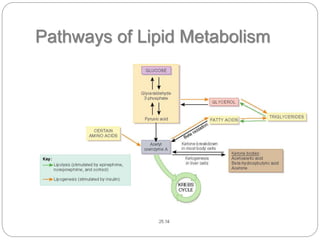
Pathways of Lipid Metabolism
Proteins
• Any of a class of nitrogenous organic compounds
which have large molecules composed of one or
more long chains of amino acids and are an
essential part of all living organisms, especially as
structural components of body tissues such as
muscle, hair, etc., and as enzymes and antibodies.
• Enzymes
• Structural proteins (shape and form of cells and
tissues)
• Hormones
• Immunoglobulins (antibodies)
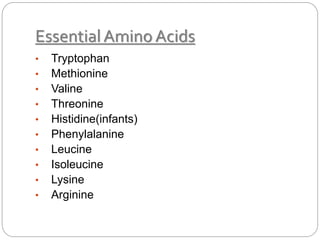
EssentialAmino Acids
• Tryptophan
• Methionine
• Valine
• Threonine
• Histidine(infants)
• Phenylalanine
• Leucine
• Isoleucine
• Lysine
• Arginine
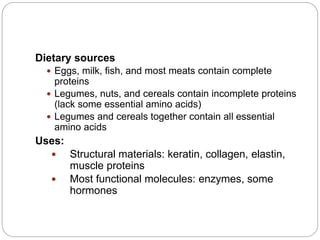
Dietary sources
 Eggs, milk, fish, and most meats contain complete
proteins
 Legumes, nuts, and cereals contain incomplete proteins
(lack some essential amino acids)
 Legumes and cereals together contain all essential
amino acids
Uses:
 Structural materials: keratin, collagen, elastin,
muscle proteins
 Most functional molecules: enzymes, some
hormones
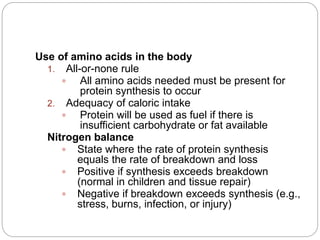
Use of amino acids in the body
1. All-or-none rule
 All amino acids needed must be present for
protein synthesis to occur
2. Adequacy of caloric intake
 Protein will be used as fuel if there is
insufficient carbohydrate or fat available
Nitrogen balance
 State where the rate of protein synthesis
equals the rate of breakdown and loss
 Positive if synthesis exceeds breakdown
(normal in children and tissue repair)
 Negative if breakdown exceeds synthesis (e.g.,
stress, burns, infection, or injury)
Hormonal controls
 Anabolic hormones (GH, sex hormones)
accelerate protein synthesis
REFERENCE
General, Organic and Biological
Chemistry
H. Stephen Stoker
-
THANK YOU

Human nutrition

  • 1.
    Presented by : ArvindSingh Heer (M.Sc -Analytical Chemistry) HUMAN NUTRITION
  • 2.
    CONTENT  Introduction  Biologicalvalues of human nutrition  Estimation of enzymes  Carbohydrates  Lipids  Proteins
  • 3.
    INTRODUCTION What is HumanNutrition?  Human nutrition refers to the provision of essential nutrients necessary to support humanlife and health. Generally, people can survive up to 40 days without food, a period largely depending on the amount of water consumed, stored body fat, muscle mass and genetic factors.
  • 4.
    BIOLOGICAL VALUES  Biologicalvalue (BV) is a measure of the proportion of absorbed protein from a food which becomes incorporated into the proteins of the organism's body. It captures how readily the digested protein can be used in protein synthesis in the cells of the organism. Proteins are the major source of nitrogen in food. BV assumes protein is the only source of nitrogen and measures the proportion of this nitrogen absorbed by the body which is then excreted. The remainder must have been incorporated into the proteins of the organisms body. A ratio of nitrogen incorporated into the body over nitrogen absorbed gives a measure of protein 'usability' - the BV.
  • 5.
    ESTIMATION OF ENZYMES Enzyme assays are laboratory methods for measuring enzymatic activity. They are vital for the study of enzyme kinetics and enzyme inhibition.
  • 6.
    CARBOHYDRATES  Carbohydrates areone of the main types of nutrients. They are the most important source of energy for your body. Your digestive system changes carbohydrates into glucose (blood sugar). Your body uses this sugar for energy for your cells, tissues and organs.  Energy Metabolism  Glucose is the fuel used by cells to make ATP  Neurons and RBCs rely almost entirely upon glucose  Excess glucose is converted to glycogen or fat and stored  Dietary sources  Starch (complex carbohydrates) in grains and vegetables  Sugars in fruits, sugarcane, sugar beets, honey and milk  Insoluble fiber: cellulose in vegetables; provides roughage  Soluble fiber: pectin in apples and citrus fruits; reduces blood cholesterol levels
  • 7.
     Dietary requirements Minimum 100 g/day to maintain adequate blood glucose levels  Recommended minimum 130 g/day  Recommended intake: 45–65% of total calorie intake; mostly complex carbohydrates  Dietary Fiber  water-insoluble fiber adds bulk to fecal matter facilitating its passage through and elimination from the digestive system  water-soluble fiber may absorb dietary cholesterol, reducing its absorption by the digestion tract
  • 8.
    LIPIDS Lipids are agroup of naturally occurring molecules that include fats, waxes, sterols, fat-soluble vitamins (such as vitamins A, D, E, and K), monoglycerides, diglycerides, triglycerides, phospholipids, and others. Dietary sources  Triglycerides  Saturated fats in meat, dairy foods, and tropical oils  Unsaturated fats in seeds, nuts, olive oil, and most vegetable oils  Cholesterol in egg yolk, meats, organ meats, shellfish, and milk products
  • 9.
    Essential uses oflipids in the body  Help absorb fat-soluble vitamins  Major fuel of hepatocytes and skeletal muscle  Phospholipids are essential in myelin sheaths and all cell membranes Functions of fatty deposits (adipose tissue)  Protective cushions around body organs  Insulating layer beneath the skin  Concentrated source of energy
  • 10.
     Essential fattyacids  Linoleic and linolenic acid, found in most vegetable oils  Must be ingested  Regulatory functions of prostaglandins  Smooth muscle contraction  Control of blood pressure  Inflammation  Functions of cholesterol  Stabilizes membranes  Precursor of bile salts and steroid hormones Dietary requirements suggested by the American Heart Association  Fats should represent 30% or less of total caloric intake  Saturated fats should be limited to 10% or less of total fat intake  Daily cholesterol intake should be no more than 300 mg
  • 11.
  • 12.
    Proteins • Any ofa class of nitrogenous organic compounds which have large molecules composed of one or more long chains of amino acids and are an essential part of all living organisms, especially as structural components of body tissues such as muscle, hair, etc., and as enzymes and antibodies. • Enzymes • Structural proteins (shape and form of cells and tissues) • Hormones • Immunoglobulins (antibodies)
  • 13.
    EssentialAmino Acids • Tryptophan •Methionine • Valine • Threonine • Histidine(infants) • Phenylalanine • Leucine • Isoleucine • Lysine • Arginine
  • 14.
    Dietary sources  Eggs,milk, fish, and most meats contain complete proteins  Legumes, nuts, and cereals contain incomplete proteins (lack some essential amino acids)  Legumes and cereals together contain all essential amino acids Uses:  Structural materials: keratin, collagen, elastin, muscle proteins  Most functional molecules: enzymes, some hormones
  • 15.
    Use of aminoacids in the body 1. All-or-none rule  All amino acids needed must be present for protein synthesis to occur 2. Adequacy of caloric intake  Protein will be used as fuel if there is insufficient carbohydrate or fat available Nitrogen balance  State where the rate of protein synthesis equals the rate of breakdown and loss  Positive if synthesis exceeds breakdown (normal in children and tissue repair)  Negative if breakdown exceeds synthesis (e.g., stress, burns, infection, or injury)
  • 16.
    Hormonal controls  Anabolichormones (GH, sex hormones) accelerate protein synthesis
  • 17.
    REFERENCE General, Organic andBiological Chemistry H. Stephen Stoker - THANK YOU