by
Arvind Singh Heer
Nanomaterials
Definition
 Nanomaterials are tiny particles of material that have size
in the range of 1nm to 100nm.
Methods of synthesis
 Physical
 Chemical
 Biological
 Hybrid Methods
 Chemical Methods:-
1. Wet Methods
2. Gas Phase Methods
 Wet Methods:-
1. Colloidal Method
2. Sol-Gel Method
 In both the methods nanomaterials are obtained in the form of powder,
thin film or non-porous material.
Advantages of Chemical
Methods
1. Low temperature technique- below 623K.
2. Less instrumentation hence cheap and simple.
3. Nanomaterials obtained in the form of powder and thin film.
4. Obtained in different sizes and shapes.
5. Foreign ions or dopants depending on need can be introduced.
6. Supports thermodynamical aspects by using weaker forces and
chemical bonds.
7. Used in making zeolite in industry.
8. Follows liquid nucleation method.
9. Sol is converted to gel to combine materials with oxygen.
Colloidal Route Method
 Colloids are a class of materials in which two or more phases of
same or different materials co-exist.
 Atleast one dimension is less than a micrometer.
 In nanoparticles, one of the dimensions exist in range of 1-100
nm.
 Large number of atoms and molecules on the surface of colloidal
particles are in a highly reactive state.
 Because of this they easily interact and tend to coagulate.
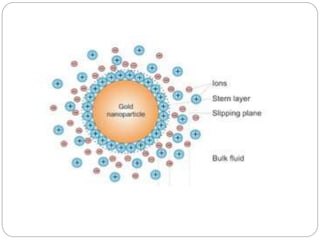
 In the colloidal solution, colloids are generally charged.
 As there are charges on the particles, ions of opposite charge
collect around them and form counter ions.
 Accumulation of counter ions leads to formation of electrical
double layer.
Colloidal Route Method
 The particles are larger than atomic dimensions but small enough to
exhibit Brownian motion.
 As the counter ions are not fixed and due to Brownian motion, colloidal
particles are also not at rest.
 The stability of colloids can be increased by creating repulsion between
the charged particles.
 This can be done by creating layers of different materials like polymers
over the colloidal particles so that the attractive forces between the
particles are reduced.
 Such coated particles are called capped nanoparticles.
Colloidal Route Method
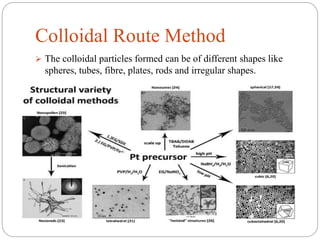
 The colloidal particles formed can be of different shapes like
spheres, tubes, fibre, plates, rods and irregular shapes.
Synthesis of colloids and growth of
nanoparticles
 Synthesis of metal nanoparticles is carried out mostly by
reduction of metals salts or acids.
 Size of these particles is increased by the process of nucleation
and Ostwald’s ripening.
 Nanomaterials of different shapes and sizes can be prepared.
Synthesis of metal nanoparticles
 By colloidal route method, metal nanoparticles are usually
synthesized by reduction of metal salt or acid.
 The starting materials are called Precursors.
 Two nanoparticles:-
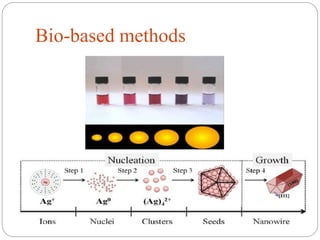
1. Silver nanoparticles
2. Gold nanoparticles
Silver nanoparticles
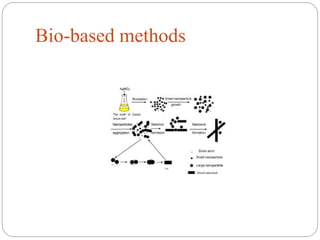
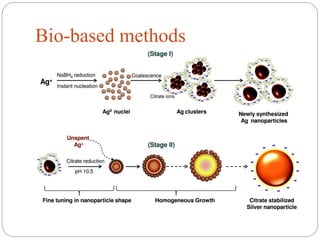
 Can be obtained by reducing silver nitrate with ethylene glycol in
presence of poly vinyl pyrolidone.
 To control growth rate of various faces of silver crystals, PVP acts as
capping agent.
 A variety of techniques have been introduced for the synthesis of silver
nanoparticles; examples include Gamma irradiation, Electron
irradiation, chemical reduction, microwave processing and biological
synthetic methods.
 Silver NP’s are of interest because of the unique which can be
incorporated into:
1. Antimicrobial applications
2. Biosenser materials
3. Composite fibres
4. Cryogenic super-conducting materials
5. Cosmetic products
6. Electronic componets
Bio-based methods
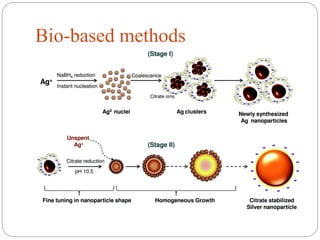
 Preparation of silver NP’s by various methods:
1. Physical methods- Evaporation-condensation
2. Chemical methods- Chemical reduction
3. Microemulsion technique
4. UV-initiated photoreduction
5. Photoinduced reduction
6. Electrochemical synthetic method
7. Irradiation methods
8. Microwave-assisted synthesis
9. Polymers and polysaccharides
Bio-based methods
Bio-based methods
Gold nanoparticles
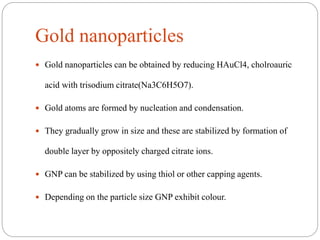
 Gold nanoparticles can be obtained by reducing HAuCl4, cholroauric
acid with trisodium citrate(Na3C6H5O7).
 Gold atoms are formed by nucleation and condensation.
 They gradually grow in size and these are stabilized by formation of
double layer by oppositely charged citrate ions.
 GNP can be stabilized by using thiol or other capping agents.
 Depending on the particle size GNP exhibit colour.
Bio-based methods
Bio-based methods
Bio-based methods
 Similarly nanoparticles of other metals like copper, palladium can be
synthesized using proper precursors, temperature, pH, duration of
synthesis.
 The size and shape mainly depend upon the reaction parameters and can be
controlled to achieve proper results.
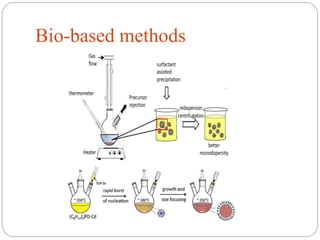
 Synthesis is usually carried out in a reactor.
Bio-based methods
Bio-based methods
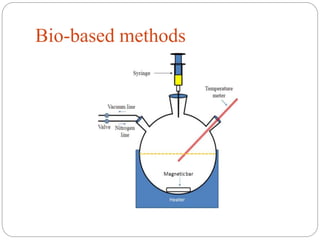
 A glass reactor of suitable size is taken.
 It has two openings at sides, one to introduce reactants like precursors,
gases, and second to measure temperature, pH.
 Reactions are carried out in inert atmosphere to avoid oxidation of
colloidal particles.
 Reaction mixture can be stirred with the help of Teflon coated magnetic
stirrer.
Bio-based methods
Sol-Gel method
 Nanomaterials have superior properties:
 Mechanical strength
 Thermal properties
 Catalytic activities
 Magnetic and optical properties
Definition
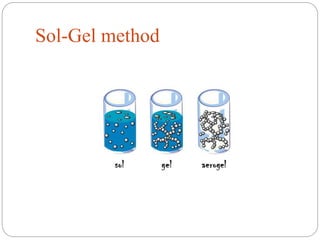
 Sols:
 Colloidal suspensions of very small solid particles in a continuous
liquid medium.
 Very stable.
 Examples are blood, paint, cell fluids.
 Gels:
 Jelly like colloidal system.
 Sol particles are interlinked.
 Form continuous network.
Sol-Gel method
Sol-Gel method
 Wet chemical technique.
 Also called chemical solution deposition.
Sol-Gel method
Sol-Gel method
Sol-Gel method
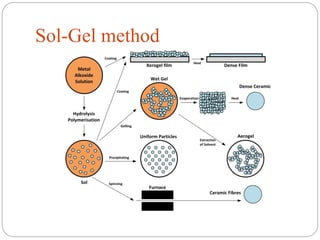
 Sol gradually evolves towards formation of gel like diphasic system.
 Consists of both liquid and solid phase.
 Liquid or solvent phase is removed by drying.
 This accompanies significant amount of shrinkage.
 Common precursors are metal oxides, alkoxides and metal chlorides.
 Precursors can be deposited on the substrate to form:
1. A film
2. A cast in a suitable container
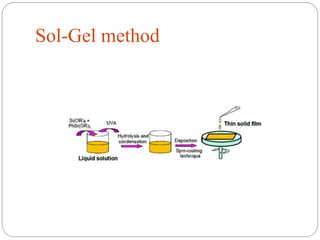
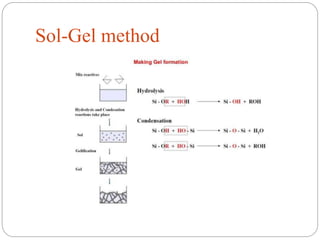
 Precursors undergo hydrolysis and polycondensation reactions to form
colloids.
 Metal oxo or Metal hydroxo formation in solution- Metal centres from metal
oxides form connections with oxo(M-O-M) or hydroxo(M-OH-M) bridges.
 By drying liquid phase is removed.
 Calcination can be performed for polycondensation to enhance mechanical
properties.
Sol-Gel method
Sol-Gel method
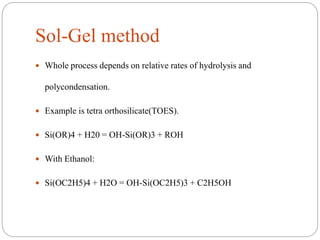
 Whole process depends on relative rates of hydrolysis and
polycondensation.
 Example is tetra orthosilicate(TOES).
 Si(OR)4 + H20 = OH-Si(OR)3 + ROH
 With Ethanol:
 Si(OC2H5)4 + H2O = OH-Si(OC2H5)3 + C2H5OH
Advantages
 Able to get uniform and small sized powder.
 Easy to do coating for films.
 High uniformity.
 Can get fibres and objects or films with high porosity.
Characterization of Nanomaterials
Novel effects can occur in materials when structures are formed with sizes
comparable to any one of many possible length scales, such as the de Broglie
wavelength of electrons, or the optical wavelengths of high energy photons. In
these cases quantum mechanical effects can dominate material properties. One
example is quantum confinement where the electronic properties of solids are
altered with great reductions in particle size. The optical properties of
nanoparticles, e.g. fluorescence, also become a function of the particle
diameter. This effect does not come into play by going from macrosocopic to
micrometer dimensions, but becomes pronounced when the nanometer scale is
reached.
In addition to optical and electronic properties, the novel mechanical properties of
many nanomaterials is the subject of nanomechanics research. When added to a
bulk material, nanoparticles can strongly influence the mechanical properties of
the material, such as the stiffness or elasticity. For example, traditional polymers
can be reinforced by nanoparticles (such as carbon nanotubes) resulting in novel
materials which can be used as lightweight replacements for metals. Such
composite materials may enable a weight reduction accompanied by an increase
in stability and improved functionality.
Finally, nanostructured materials with small particle size such as zeolites, and
asbestos, are used as catalysts in a wide range of critical industrial chemical
reactions. The further development of such catalysts can form the basis of more
efficient, environmentally friendly chemical processes.
The first observations and size measurements of nano-particles were made during
the first decade of the 20th century. Zsigmondy made detailed studies of gold sols
and other nanomaterials with sizes down to 10 nm and less. He published a book in
1914. He used an ultramicroscope that employs a dark field method for seeing
particles with sizes much less than light wavelength.
There are traditional techniques developed during 20th century in Interface and
Colloid Science for characterizing nanomaterials. These are widely used for first
generation passive nanomaterials specified in the next section.
These methods include several different techniques for characterizing particle size
distribution. This characterization is imperative because many materials that are
expected to be nano-sized are actually aggregated in solutions. Some of methods
are based on light scattering. Others apply ultrasound, such as ultrasound
attenuation spectroscopy for testing concentrated nano-dispersions and
microemulsion
There is also a group of traditional techniques for characterizing surface charge or zeta
potential of nano-particles in solutions. This information is required for proper system
stabilzation, preventing its aggregation or flocculation. These methods include
microelectrophoresis, electrophoretic light scattering and electroacoustics. The last one,
for instance colloid vibration current method is suitable for characterizing concentrated
systems.
X- Ray Diffraction (XRD)
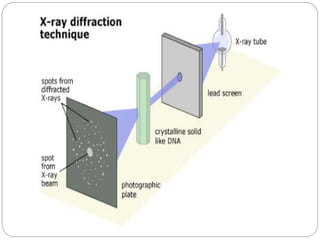
X-ray diffraction (XRD) is a powerful method for the study of nanomaterials
(materials with structural features of at least one dimension in the range of 1-100
nm). The wavelength of X-rays is on the atomic scale, so X-ray diffraction
(XRD) is a primary tool for probing structure of nano-materials. XRD offers
unparalleled accuracy in the measurement of atomic spacing and is the technique
of choice for determining strain states in thin films. The intensities measured
with XRD can provide quantitative, accurate information on the atomic
arrangements at interfaces. With lab-based equipment, surface sensitivities down
to a thickness of ~50A0 are achievable, but synchrotron radiation allows the
characterization of much thinner films and for many materials, monoatomic
layers can be analyzed.
XRD is non contact and non-destructive, which makes it ideal for in situ studies.
Nanomaterials have a characteristic microstructure length comparable with the
critical length scales of physical phenomena, giving them unique mechanical,
optical and electronic properties.
X-ray diffractograms of nanomaterials provide a wealth of information - from phase
composition to crystallite size, from lattice strain to crystallographic orientation. The main use
of powder diffraction is to identify components in a sample by a search/match procedure.
Furthermore, the areas under the peak are related to the amount of each phase present in the
sample. In 1919 A.W.Hull gave
a paper titled, “A New Method of Chemical Analysis”. Here he pointed out that “… .every
crystalline substance gives a pattern; the same substance always gives the same pattern; and in a
mixture of substances each produces its pattern independently of the others. “The X-ray
diffraction pattern of a pure substance is, therefore, like a fingerprint of the substance. The
powder diffraction method is thus ideally suited for characterization and identification of
polycrystalline phases
Conclusion of X-ray Diffraction
X-Ray diffraction associated to calculations is a powerfull tool to
study the:
• Structure
• Crystallinity
• Particle size and size distribution
• Particle shape
• Homogeneity of the whole sample
It is the perfect tool to be associated with transmission electron
microscopy study
Bragg’s Law of X-ray Diffraction
In physics, Bragg's law, or Wulff–Bragg's condition in post-Soviet countries, a special
case of Laue diffraction, gives the angles for coherent and incoherent scattering from a
crystal lattice. When X-rays are incident on an atom, they make the electronic cloud
move as does any electromagnetic wave. The movement of these charges re-radiates
waves with the same frequency, blurred slightly due to a variety of effects; this
phenomenon is known as Rayleigh scattering (or elastic scattering). The scattered
waves can themselves be scattered but this secondary scattering is assumed to be
negligible.
A similar process occurs upon scattering neutron waves from the nuclei or by a coherent
spin interaction with an unpaired electron. These re-emitted wave fields interfere with
each other either constructively or destructively (overlapping waves either add up
together to produce stronger peaks or are subtracted from each other to some degree),
producing a diffraction pattern on a detector or film. The resulting wave interference
pattern is the basis of diffraction analysis. This analysis is called Bragg diffraction.
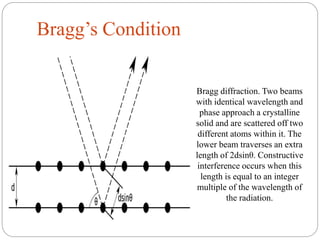
Bragg’s Condition
Bragg diffraction. Two beams
with identical wavelength and
phase approach a crystalline
solid and are scattered off two
different atoms within it. The
lower beam traverses an extra
length of 2dsinθ. Constructive
interference occurs when this
length is equal to an integer
multiple of the wavelength of
the radiation.
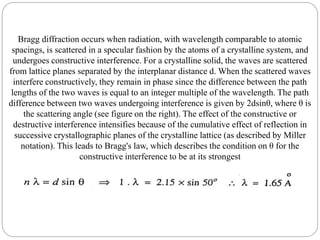
Bragg diffraction occurs when radiation, with wavelength comparable to atomic
spacings, is scattered in a specular fashion by the atoms of a crystalline system, and
undergoes constructive interference. For a crystalline solid, the waves are scattered
from lattice planes separated by the interplanar distance d. When the scattered waves
interfere constructively, they remain in phase since the difference between the path
lengths of the two waves is equal to an integer multiple of the wavelength. The path
difference between two waves undergoing interference is given by 2dsinθ, where θ is
the scattering angle (see figure on the right). The effect of the constructive or
destructive interference intensifies because of the cumulative effect of reflection in
successive crystallographic planes of the crystalline lattice (as described by Miller
notation). This leads to Bragg's law, which describes the condition on θ for the
constructive interference to be at its strongest
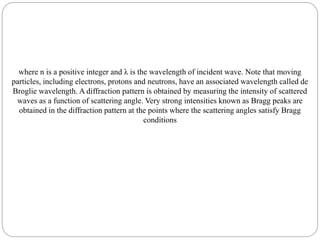
where n is a positive integer and λ is the wavelength of incident wave. Note that moving
particles, including electrons, protons and neutrons, have an associated wavelength called de
Broglie wavelength. A diffraction pattern is obtained by measuring the intensity of scattered
waves as a function of scattering angle. Very strong intensities known as Bragg peaks are
obtained in the diffraction pattern at the points where the scattering angles satisfy Bragg
conditions
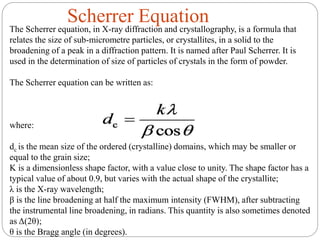
Scherrer Equation
The Scherrer equation, in X-ray diffraction and crystallography, is a formula that
relates the size of sub-micrometre particles, or crystallites, in a solid to the
broadening of a peak in a diffraction pattern. It is named after Paul Scherrer. It is
used in the determination of size of particles of crystals in the form of powder.
The Scherrer equation can be written as:
where:
dc is the mean size of the ordered (crystalline) domains, which may be smaller or
equal to the grain size;
K is a dimensionless shape factor, with a value close to unity. The shape factor has a
typical value of about 0.9, but varies with the actual shape of the crystallite;
λ is the X-ray wavelength;
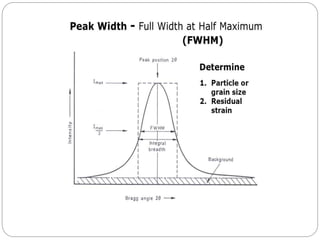
β is the line broadening at half the maximum intensity (FWHM), after subtracting
the instrumental line broadening, in radians. This quantity is also sometimes denoted
as Δ(2θ);
θ is the Bragg angle (in degrees).
UV -Visible Spectroscopy
Ultraviolet–visible spectroscopy or ultraviolet-visible spectrophotometry (UV-Vis
or UV/Vis) refers to absorption spectroscopy or reflectance spectroscopy in the
ultraviolet-visible spectral region. This means it uses light in the visible and
adjacent (near-UV and near-infrared [NIR]) ranges. The absorption or reflectance
in the visible range directly affects the perceived color of the chemicals involved.
In this region of the electromagnetic spectrum, atoms and molecules undergo
electronic transitions. Absorption spectroscopy is complementary to fluorescence
spectroscopy, in that fluorescence deals with transitions from the excited state to
the ground state, while absorption measures transitions from the ground state to
the excited state.
Applications of UV-Visible
Spectroscopy
UV/Vis spectroscopy is routinely used in analytical chemistry for the
quantitative determination of different analytes, such as transition metal ions,
highly conjugated organic compounds, and biological macromolecules.
Spectroscopic analysis is commonly carried out in solutions but solids and
gases may also be studied.
Solutions of transition metal ions can be colored (i.e., absorb visible light)
because d electrons within the metal atoms can be excited from one electronic
state to another. The colour of metal ion solutions is strongly affected by the
presence of other species, such as certain anions or ligands. For instance, the
colour of a dilute solution of copper sulfate is a very light blue; adding
ammonia intensifies the colour and changes the wavelength of maximum
absorption (λmax).
Organic compounds, especially those with a high degree of conjugation, also
absorb light in the UV or visible regions of the electromagnetic spectrum. The
solvents for these determinations are often water for water-soluble compounds, or
ethanol for organic-soluble compounds. (Organic solvents may have significant
UV absorption; not all solvents are suitable for use in UV spectroscopy. Ethanol
absorbs very weakly at most wavelengths.) Solvent polarity and pH can affect the
absorption spectrum of an organic compound. Tyrosine, for example, increases in
absorption maxima and molar extinction coefficient when pH increases from 6 to
13 or when solvent polarity decreases.
While charge transfer complexes also give rise to colours, the colours are often too
intense to be used for quantitative measurement.
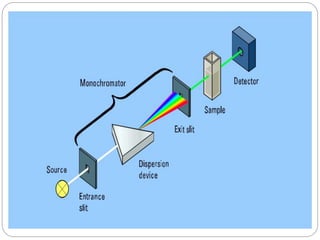
The Beer-Lambert law states that the absorbance of a solution is directly
proportional to the concentration of the absorbing species in the solution and the
path length. Thus, for a fixed path length, UV/Vis spectroscopy can be used to
determine the concentration of the absorber in a solution. It is necessary to know
how quickly the absorbance changes with concentration. This can be taken from
references (tables of molar extinction coefficients), or more accurately, determined
from a calibration curve.
A UV/Vis spectrophotometer may be used as a detector for HPLC. The presence of
an analyte gives a response assumed to be proportional to the concentration. For
accurate results, the instrument's response to the analyte in the unknown should be
compared with the response to a standard; this is very similar to the use of
calibration curves. The response (e.g., peak height) for a particular concentration is
known as the response factor.
Conclusion for UV-Visible
Spectroscopy
1) UV-visible spectroscopy is a valid, simple and cost effective method for
determining the concentration of absorbing species if applied to pure
compounds, and used with the appropriate standard curve.
2) A standard curve relating absorbance to concentration can be developed
for any compound, and used to determine the concentration of samples
containing the same compound.
3) The analysis should be done at a wavelength with maximum absorption,
and located in relatively flat region of the spectra so that absorbance will
be high and constant in a narrow range around the chosen wavelength.
4) The optimal wavelength should ensure good absorbance of the analyte
and low absorbance by other species in the solution.
5) This wavelength will allow valid absorption measurements to be made on
analyte samples that contain mixtures of materials.

Nanomaterials

  • 1.
  • 2.
    Definition  Nanomaterials aretiny particles of material that have size in the range of 1nm to 100nm.
  • 3.
    Methods of synthesis Physical  Chemical  Biological  Hybrid Methods  Chemical Methods:- 1. Wet Methods 2. Gas Phase Methods  Wet Methods:- 1. Colloidal Method 2. Sol-Gel Method  In both the methods nanomaterials are obtained in the form of powder, thin film or non-porous material.
  • 4.
    Advantages of Chemical Methods 1.Low temperature technique- below 623K. 2. Less instrumentation hence cheap and simple. 3. Nanomaterials obtained in the form of powder and thin film. 4. Obtained in different sizes and shapes. 5. Foreign ions or dopants depending on need can be introduced. 6. Supports thermodynamical aspects by using weaker forces and chemical bonds. 7. Used in making zeolite in industry. 8. Follows liquid nucleation method. 9. Sol is converted to gel to combine materials with oxygen.
  • 5.
    Colloidal Route Method Colloids are a class of materials in which two or more phases of same or different materials co-exist.  Atleast one dimension is less than a micrometer.  In nanoparticles, one of the dimensions exist in range of 1-100 nm.
  • 6.
     Large numberof atoms and molecules on the surface of colloidal particles are in a highly reactive state.  Because of this they easily interact and tend to coagulate.  In the colloidal solution, colloids are generally charged.  As there are charges on the particles, ions of opposite charge collect around them and form counter ions.  Accumulation of counter ions leads to formation of electrical double layer. Colloidal Route Method
  • 8.
    Colloidal Route Method The particles are larger than atomic dimensions but small enough to exhibit Brownian motion.  As the counter ions are not fixed and due to Brownian motion, colloidal particles are also not at rest.  The stability of colloids can be increased by creating repulsion between the charged particles.  This can be done by creating layers of different materials like polymers over the colloidal particles so that the attractive forces between the particles are reduced.  Such coated particles are called capped nanoparticles.
  • 9.
  • 10.
    Colloidal Route Method The colloidal particles formed can be of different shapes like spheres, tubes, fibre, plates, rods and irregular shapes.
  • 11.
    Synthesis of colloidsand growth of nanoparticles  Synthesis of metal nanoparticles is carried out mostly by reduction of metals salts or acids.  Size of these particles is increased by the process of nucleation and Ostwald’s ripening.  Nanomaterials of different shapes and sizes can be prepared.
  • 12.
    Synthesis of metalnanoparticles  By colloidal route method, metal nanoparticles are usually synthesized by reduction of metal salt or acid.  The starting materials are called Precursors.  Two nanoparticles:- 1. Silver nanoparticles 2. Gold nanoparticles
  • 13.
    Silver nanoparticles  Canbe obtained by reducing silver nitrate with ethylene glycol in presence of poly vinyl pyrolidone.  To control growth rate of various faces of silver crystals, PVP acts as capping agent.  A variety of techniques have been introduced for the synthesis of silver nanoparticles; examples include Gamma irradiation, Electron irradiation, chemical reduction, microwave processing and biological synthetic methods.  Silver NP’s are of interest because of the unique which can be incorporated into: 1. Antimicrobial applications 2. Biosenser materials 3. Composite fibres 4. Cryogenic super-conducting materials 5. Cosmetic products 6. Electronic componets
  • 14.
    Bio-based methods  Preparationof silver NP’s by various methods: 1. Physical methods- Evaporation-condensation 2. Chemical methods- Chemical reduction 3. Microemulsion technique 4. UV-initiated photoreduction 5. Photoinduced reduction 6. Electrochemical synthetic method 7. Irradiation methods 8. Microwave-assisted synthesis 9. Polymers and polysaccharides
  • 15.
  • 16.
  • 17.
    Gold nanoparticles  Goldnanoparticles can be obtained by reducing HAuCl4, cholroauric acid with trisodium citrate(Na3C6H5O7).  Gold atoms are formed by nucleation and condensation.  They gradually grow in size and these are stabilized by formation of double layer by oppositely charged citrate ions.  GNP can be stabilized by using thiol or other capping agents.  Depending on the particle size GNP exhibit colour.
  • 18.
  • 19.
  • 20.
    Bio-based methods  Similarlynanoparticles of other metals like copper, palladium can be synthesized using proper precursors, temperature, pH, duration of synthesis.  The size and shape mainly depend upon the reaction parameters and can be controlled to achieve proper results.  Synthesis is usually carried out in a reactor.
  • 21.
  • 22.
    Bio-based methods  Aglass reactor of suitable size is taken.  It has two openings at sides, one to introduce reactants like precursors, gases, and second to measure temperature, pH.  Reactions are carried out in inert atmosphere to avoid oxidation of colloidal particles.  Reaction mixture can be stirred with the help of Teflon coated magnetic stirrer.
  • 23.
  • 24.
    Sol-Gel method  Nanomaterialshave superior properties:  Mechanical strength  Thermal properties  Catalytic activities  Magnetic and optical properties
  • 25.
    Definition  Sols:  Colloidalsuspensions of very small solid particles in a continuous liquid medium.  Very stable.  Examples are blood, paint, cell fluids.  Gels:  Jelly like colloidal system.  Sol particles are interlinked.  Form continuous network.
  • 26.
  • 27.
    Sol-Gel method  Wetchemical technique.  Also called chemical solution deposition.
  • 28.
  • 29.
  • 30.
    Sol-Gel method  Solgradually evolves towards formation of gel like diphasic system.  Consists of both liquid and solid phase.  Liquid or solvent phase is removed by drying.  This accompanies significant amount of shrinkage.  Common precursors are metal oxides, alkoxides and metal chlorides.  Precursors can be deposited on the substrate to form: 1. A film 2. A cast in a suitable container  Precursors undergo hydrolysis and polycondensation reactions to form colloids.  Metal oxo or Metal hydroxo formation in solution- Metal centres from metal oxides form connections with oxo(M-O-M) or hydroxo(M-OH-M) bridges.  By drying liquid phase is removed.  Calcination can be performed for polycondensation to enhance mechanical properties.
  • 31.
  • 32.
    Sol-Gel method  Wholeprocess depends on relative rates of hydrolysis and polycondensation.  Example is tetra orthosilicate(TOES).  Si(OR)4 + H20 = OH-Si(OR)3 + ROH  With Ethanol:  Si(OC2H5)4 + H2O = OH-Si(OC2H5)3 + C2H5OH
  • 33.
    Advantages  Able toget uniform and small sized powder.  Easy to do coating for films.  High uniformity.  Can get fibres and objects or films with high porosity.
  • 34.
    Characterization of Nanomaterials Noveleffects can occur in materials when structures are formed with sizes comparable to any one of many possible length scales, such as the de Broglie wavelength of electrons, or the optical wavelengths of high energy photons. In these cases quantum mechanical effects can dominate material properties. One example is quantum confinement where the electronic properties of solids are altered with great reductions in particle size. The optical properties of nanoparticles, e.g. fluorescence, also become a function of the particle diameter. This effect does not come into play by going from macrosocopic to micrometer dimensions, but becomes pronounced when the nanometer scale is reached.
  • 35.
    In addition tooptical and electronic properties, the novel mechanical properties of many nanomaterials is the subject of nanomechanics research. When added to a bulk material, nanoparticles can strongly influence the mechanical properties of the material, such as the stiffness or elasticity. For example, traditional polymers can be reinforced by nanoparticles (such as carbon nanotubes) resulting in novel materials which can be used as lightweight replacements for metals. Such composite materials may enable a weight reduction accompanied by an increase in stability and improved functionality. Finally, nanostructured materials with small particle size such as zeolites, and asbestos, are used as catalysts in a wide range of critical industrial chemical reactions. The further development of such catalysts can form the basis of more efficient, environmentally friendly chemical processes.
  • 36.
    The first observationsand size measurements of nano-particles were made during the first decade of the 20th century. Zsigmondy made detailed studies of gold sols and other nanomaterials with sizes down to 10 nm and less. He published a book in 1914. He used an ultramicroscope that employs a dark field method for seeing particles with sizes much less than light wavelength. There are traditional techniques developed during 20th century in Interface and Colloid Science for characterizing nanomaterials. These are widely used for first generation passive nanomaterials specified in the next section. These methods include several different techniques for characterizing particle size distribution. This characterization is imperative because many materials that are expected to be nano-sized are actually aggregated in solutions. Some of methods are based on light scattering. Others apply ultrasound, such as ultrasound attenuation spectroscopy for testing concentrated nano-dispersions and microemulsion
  • 37.
    There is alsoa group of traditional techniques for characterizing surface charge or zeta potential of nano-particles in solutions. This information is required for proper system stabilzation, preventing its aggregation or flocculation. These methods include microelectrophoresis, electrophoretic light scattering and electroacoustics. The last one, for instance colloid vibration current method is suitable for characterizing concentrated systems.
  • 38.
    X- Ray Diffraction(XRD) X-ray diffraction (XRD) is a powerful method for the study of nanomaterials (materials with structural features of at least one dimension in the range of 1-100 nm). The wavelength of X-rays is on the atomic scale, so X-ray diffraction (XRD) is a primary tool for probing structure of nano-materials. XRD offers unparalleled accuracy in the measurement of atomic spacing and is the technique of choice for determining strain states in thin films. The intensities measured with XRD can provide quantitative, accurate information on the atomic arrangements at interfaces. With lab-based equipment, surface sensitivities down to a thickness of ~50A0 are achievable, but synchrotron radiation allows the characterization of much thinner films and for many materials, monoatomic layers can be analyzed. XRD is non contact and non-destructive, which makes it ideal for in situ studies. Nanomaterials have a characteristic microstructure length comparable with the critical length scales of physical phenomena, giving them unique mechanical, optical and electronic properties.
  • 39.
    X-ray diffractograms ofnanomaterials provide a wealth of information - from phase composition to crystallite size, from lattice strain to crystallographic orientation. The main use of powder diffraction is to identify components in a sample by a search/match procedure. Furthermore, the areas under the peak are related to the amount of each phase present in the sample. In 1919 A.W.Hull gave a paper titled, “A New Method of Chemical Analysis”. Here he pointed out that “… .every crystalline substance gives a pattern; the same substance always gives the same pattern; and in a mixture of substances each produces its pattern independently of the others. “The X-ray diffraction pattern of a pure substance is, therefore, like a fingerprint of the substance. The powder diffraction method is thus ideally suited for characterization and identification of polycrystalline phases
  • 41.
    Conclusion of X-rayDiffraction X-Ray diffraction associated to calculations is a powerfull tool to study the: • Structure • Crystallinity • Particle size and size distribution • Particle shape • Homogeneity of the whole sample It is the perfect tool to be associated with transmission electron microscopy study
  • 42.
    Bragg’s Law ofX-ray Diffraction In physics, Bragg's law, or Wulff–Bragg's condition in post-Soviet countries, a special case of Laue diffraction, gives the angles for coherent and incoherent scattering from a crystal lattice. When X-rays are incident on an atom, they make the electronic cloud move as does any electromagnetic wave. The movement of these charges re-radiates waves with the same frequency, blurred slightly due to a variety of effects; this phenomenon is known as Rayleigh scattering (or elastic scattering). The scattered waves can themselves be scattered but this secondary scattering is assumed to be negligible. A similar process occurs upon scattering neutron waves from the nuclei or by a coherent spin interaction with an unpaired electron. These re-emitted wave fields interfere with each other either constructively or destructively (overlapping waves either add up together to produce stronger peaks or are subtracted from each other to some degree), producing a diffraction pattern on a detector or film. The resulting wave interference pattern is the basis of diffraction analysis. This analysis is called Bragg diffraction.
  • 43.
    Bragg’s Condition Bragg diffraction.Two beams with identical wavelength and phase approach a crystalline solid and are scattered off two different atoms within it. The lower beam traverses an extra length of 2dsinθ. Constructive interference occurs when this length is equal to an integer multiple of the wavelength of the radiation.
  • 44.
    Bragg diffraction occurswhen radiation, with wavelength comparable to atomic spacings, is scattered in a specular fashion by the atoms of a crystalline system, and undergoes constructive interference. For a crystalline solid, the waves are scattered from lattice planes separated by the interplanar distance d. When the scattered waves interfere constructively, they remain in phase since the difference between the path lengths of the two waves is equal to an integer multiple of the wavelength. The path difference between two waves undergoing interference is given by 2dsinθ, where θ is the scattering angle (see figure on the right). The effect of the constructive or destructive interference intensifies because of the cumulative effect of reflection in successive crystallographic planes of the crystalline lattice (as described by Miller notation). This leads to Bragg's law, which describes the condition on θ for the constructive interference to be at its strongest
  • 45.
    where n isa positive integer and λ is the wavelength of incident wave. Note that moving particles, including electrons, protons and neutrons, have an associated wavelength called de Broglie wavelength. A diffraction pattern is obtained by measuring the intensity of scattered waves as a function of scattering angle. Very strong intensities known as Bragg peaks are obtained in the diffraction pattern at the points where the scattering angles satisfy Bragg conditions
  • 46.
    Scherrer Equation The Scherrerequation, in X-ray diffraction and crystallography, is a formula that relates the size of sub-micrometre particles, or crystallites, in a solid to the broadening of a peak in a diffraction pattern. It is named after Paul Scherrer. It is used in the determination of size of particles of crystals in the form of powder. The Scherrer equation can be written as: where: dc is the mean size of the ordered (crystalline) domains, which may be smaller or equal to the grain size; K is a dimensionless shape factor, with a value close to unity. The shape factor has a typical value of about 0.9, but varies with the actual shape of the crystallite; λ is the X-ray wavelength; β is the line broadening at half the maximum intensity (FWHM), after subtracting the instrumental line broadening, in radians. This quantity is also sometimes denoted as Δ(2θ); θ is the Bragg angle (in degrees).
  • 48.
    UV -Visible Spectroscopy Ultraviolet–visiblespectroscopy or ultraviolet-visible spectrophotometry (UV-Vis or UV/Vis) refers to absorption spectroscopy or reflectance spectroscopy in the ultraviolet-visible spectral region. This means it uses light in the visible and adjacent (near-UV and near-infrared [NIR]) ranges. The absorption or reflectance in the visible range directly affects the perceived color of the chemicals involved. In this region of the electromagnetic spectrum, atoms and molecules undergo electronic transitions. Absorption spectroscopy is complementary to fluorescence spectroscopy, in that fluorescence deals with transitions from the excited state to the ground state, while absorption measures transitions from the ground state to the excited state.
  • 49.
    Applications of UV-Visible Spectroscopy UV/Visspectroscopy is routinely used in analytical chemistry for the quantitative determination of different analytes, such as transition metal ions, highly conjugated organic compounds, and biological macromolecules. Spectroscopic analysis is commonly carried out in solutions but solids and gases may also be studied. Solutions of transition metal ions can be colored (i.e., absorb visible light) because d electrons within the metal atoms can be excited from one electronic state to another. The colour of metal ion solutions is strongly affected by the presence of other species, such as certain anions or ligands. For instance, the colour of a dilute solution of copper sulfate is a very light blue; adding ammonia intensifies the colour and changes the wavelength of maximum absorption (λmax).
  • 50.
    Organic compounds, especiallythose with a high degree of conjugation, also absorb light in the UV or visible regions of the electromagnetic spectrum. The solvents for these determinations are often water for water-soluble compounds, or ethanol for organic-soluble compounds. (Organic solvents may have significant UV absorption; not all solvents are suitable for use in UV spectroscopy. Ethanol absorbs very weakly at most wavelengths.) Solvent polarity and pH can affect the absorption spectrum of an organic compound. Tyrosine, for example, increases in absorption maxima and molar extinction coefficient when pH increases from 6 to 13 or when solvent polarity decreases. While charge transfer complexes also give rise to colours, the colours are often too intense to be used for quantitative measurement.
  • 51.
    The Beer-Lambert lawstates that the absorbance of a solution is directly proportional to the concentration of the absorbing species in the solution and the path length. Thus, for a fixed path length, UV/Vis spectroscopy can be used to determine the concentration of the absorber in a solution. It is necessary to know how quickly the absorbance changes with concentration. This can be taken from references (tables of molar extinction coefficients), or more accurately, determined from a calibration curve. A UV/Vis spectrophotometer may be used as a detector for HPLC. The presence of an analyte gives a response assumed to be proportional to the concentration. For accurate results, the instrument's response to the analyte in the unknown should be compared with the response to a standard; this is very similar to the use of calibration curves. The response (e.g., peak height) for a particular concentration is known as the response factor.
  • 53.
    Conclusion for UV-Visible Spectroscopy 1)UV-visible spectroscopy is a valid, simple and cost effective method for determining the concentration of absorbing species if applied to pure compounds, and used with the appropriate standard curve. 2) A standard curve relating absorbance to concentration can be developed for any compound, and used to determine the concentration of samples containing the same compound. 3) The analysis should be done at a wavelength with maximum absorption, and located in relatively flat region of the spectra so that absorbance will be high and constant in a narrow range around the chosen wavelength. 4) The optimal wavelength should ensure good absorbance of the analyte and low absorbance by other species in the solution. 5) This wavelength will allow valid absorption measurements to be made on analyte samples that contain mixtures of materials.