Presented by :
Arvind Singh Heer
MSc-1
(Sem-2)
Inorganic Chemistry
MITHIBAI COLLEGE
CONTENT
 Introduction.
 Cope Rearrangement.
 Claisen Rearrangement.
 Curtius Rearrangement.
INTRODUCTION
What is Rearrangement reaction?
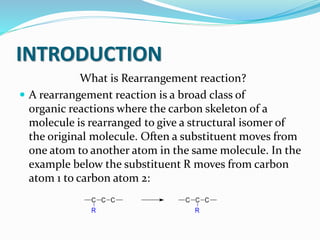
 A rearrangement reaction is a broad class of
organic reactions where the carbon skeleton of a
molecule is rearranged to give a structural isomer of
the original molecule. Often a substituent moves from
one atom to another atom in the same molecule. In the
example below the substituent R moves from carbon
atom 1 to carbon atom 2:
Cope rearrangement
 The Cope rearrangement is an extensively
studied organic reaction involving the [3,3]-sigmatropic
rearrangement of 1,5-dienes. It was developed by Arthur
C. Cope
 For example 3-methyl-1,5-hexadiene heated to 300°C yields
1,5-heptadiene.
 The Cope rearrangement causes the fluxional states of the
molecules in the bullvalene family
Mechanism of the Cope
Rearrangement
Claisen rearrangement
 The Claisen rearrangement (not to be confused with
the Claisen condensation) is a powerful carbon-
carbon bond-forming chemical reaction discovered
by Rainer Ludwig Claisen.
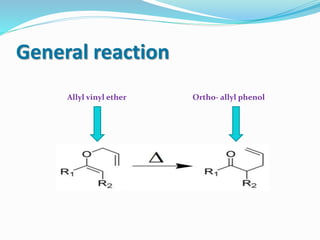
 The heating of an allyl vinyl ether will initiate a [3,3]-
sigmatropic rearrangement to give a γ,δ-unsaturated
carbonyl.
 Discovered in 1912, the Claisen rearrangement is the first
recorded example of a [3,3]-sigmatropic rearrangement.
General reaction
Allyl vinyl ether Ortho- allyl phenol
Mechanism of the Claisen
Rearrangement
Curtius Rearrangement
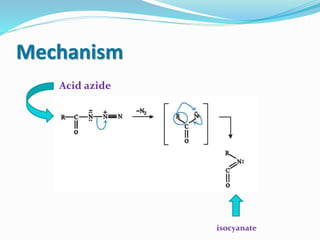
 The curtius rearrangement is intramolecular.
 The optical activity of the migrating R group is never lost
confirming that R is never free during the course of the
rearrangement.
This reaction is very general reaction applicable to all
carboxylic acids-aliphatic, alicyclic, hetero cyclic as well as
aromatic.
 It gives good yield of isocyanate if water is absent. However,
the reaction can be carried out in water or alcohol. Lewis
acids or protic catalyze the reaction but these are
unnecessary for good results.
Mechanism
Acid azide
isocyanate
REFERENCE
 March’s Advanced Organic Chemistry: Reactions, Mechanisms and
Structure
Michael B. Smith
Jerry March
(SIXTH EDITION)
-THANK YOU

Rearrangement

  • 1.
    Presented by : ArvindSingh Heer MSc-1 (Sem-2) Inorganic Chemistry MITHIBAI COLLEGE
  • 2.
    CONTENT  Introduction.  CopeRearrangement.  Claisen Rearrangement.  Curtius Rearrangement.
  • 3.
    INTRODUCTION What is Rearrangementreaction?  A rearrangement reaction is a broad class of organic reactions where the carbon skeleton of a molecule is rearranged to give a structural isomer of the original molecule. Often a substituent moves from one atom to another atom in the same molecule. In the example below the substituent R moves from carbon atom 1 to carbon atom 2:
  • 4.
    Cope rearrangement  TheCope rearrangement is an extensively studied organic reaction involving the [3,3]-sigmatropic rearrangement of 1,5-dienes. It was developed by Arthur C. Cope  For example 3-methyl-1,5-hexadiene heated to 300°C yields 1,5-heptadiene.  The Cope rearrangement causes the fluxional states of the molecules in the bullvalene family
  • 5.
    Mechanism of theCope Rearrangement
  • 6.
    Claisen rearrangement  TheClaisen rearrangement (not to be confused with the Claisen condensation) is a powerful carbon- carbon bond-forming chemical reaction discovered by Rainer Ludwig Claisen.  The heating of an allyl vinyl ether will initiate a [3,3]- sigmatropic rearrangement to give a γ,δ-unsaturated carbonyl.  Discovered in 1912, the Claisen rearrangement is the first recorded example of a [3,3]-sigmatropic rearrangement.
  • 7.
    General reaction Allyl vinylether Ortho- allyl phenol
  • 8.
    Mechanism of theClaisen Rearrangement
  • 9.
    Curtius Rearrangement  Thecurtius rearrangement is intramolecular.  The optical activity of the migrating R group is never lost confirming that R is never free during the course of the rearrangement. This reaction is very general reaction applicable to all carboxylic acids-aliphatic, alicyclic, hetero cyclic as well as aromatic.  It gives good yield of isocyanate if water is absent. However, the reaction can be carried out in water or alcohol. Lewis acids or protic catalyze the reaction but these are unnecessary for good results.
  • 10.
  • 11.
    REFERENCE  March’s AdvancedOrganic Chemistry: Reactions, Mechanisms and Structure Michael B. Smith Jerry March (SIXTH EDITION) -THANK YOU