X-RAY POWDER DIFFRACTION &
X-RAY POWDER DIFFRACTOMETER.
PRESENTED BY
ARANTHA. J. JOSEPH
FIRST YEAR MPHARM
DEPARTMENT OF PHARMACEUTICS.
1
X-RAY POWDER DIFFRACTION
 Rapid analytical technique
 Primarily used for phase identification of a crystalline material.
 Provide information on unit cell dimensions.
 The analyzed material is finely ground, homogenized and average
bulk composition is determined.
2
PRINCIPLE
 X-ray diffraction is based on constructive interference of
monochromatic X-rays and a crystalline sample.
 X-rays are generated by a cathode ray tube.
 Filtered to produce monochromatic radiation.
 collimated to concentrate.
 directed toward the sample.
 For every set of crystal planes , one or more crystals will be in the
correct orientation to give the correct Bragg angle to satisfy Bragg's
equation.
3
4
 Each diffraction line is made up of a large number of small
spots, each from a separate crystal.
 Each spot is so small as to give the appearance of a continuous
line.
 Every crystal plane is thus capable of diffraction.
X-RAY DIFFRACTION PATTERN
5
6
 The powdered sample generates the concentric
cones of diffracted X-rays because of the random
orientation of crystallites in the sample.
 Hence, instead of the sample generating only
single diffraction spots, it generates cones of
diffracted X-rays, with the point of all of the cones
at the sample.
 These cones intersect a strip of photographic
film located in the cylindrical camera to produce
a characteristic set of arcs on the film.
7
 When the film is removed from the camera, flattened and
processed, it shows the diffraction lines and the holes for the
incident and transmitted beams.
 The x-ray pattern of a pure crystalline substance can be
considered as a “fingerprint”
 with each crystalline material having, within limits, a unique
diffraction pattern
Figure 2. Example of an x-ray powder diffractogram produced during an x-ray scan. The peaks represent
positions where the x-ray beam has been diffracted by the crystal lattice. The set of d-spacings (the
between adjacent planes of atoms), which represent the unique "fingerprint" of the mineral, can easily be
calculated from the 2-theta (2) values shown.
8
X-RAY POWDER DIFFRACTOMETER
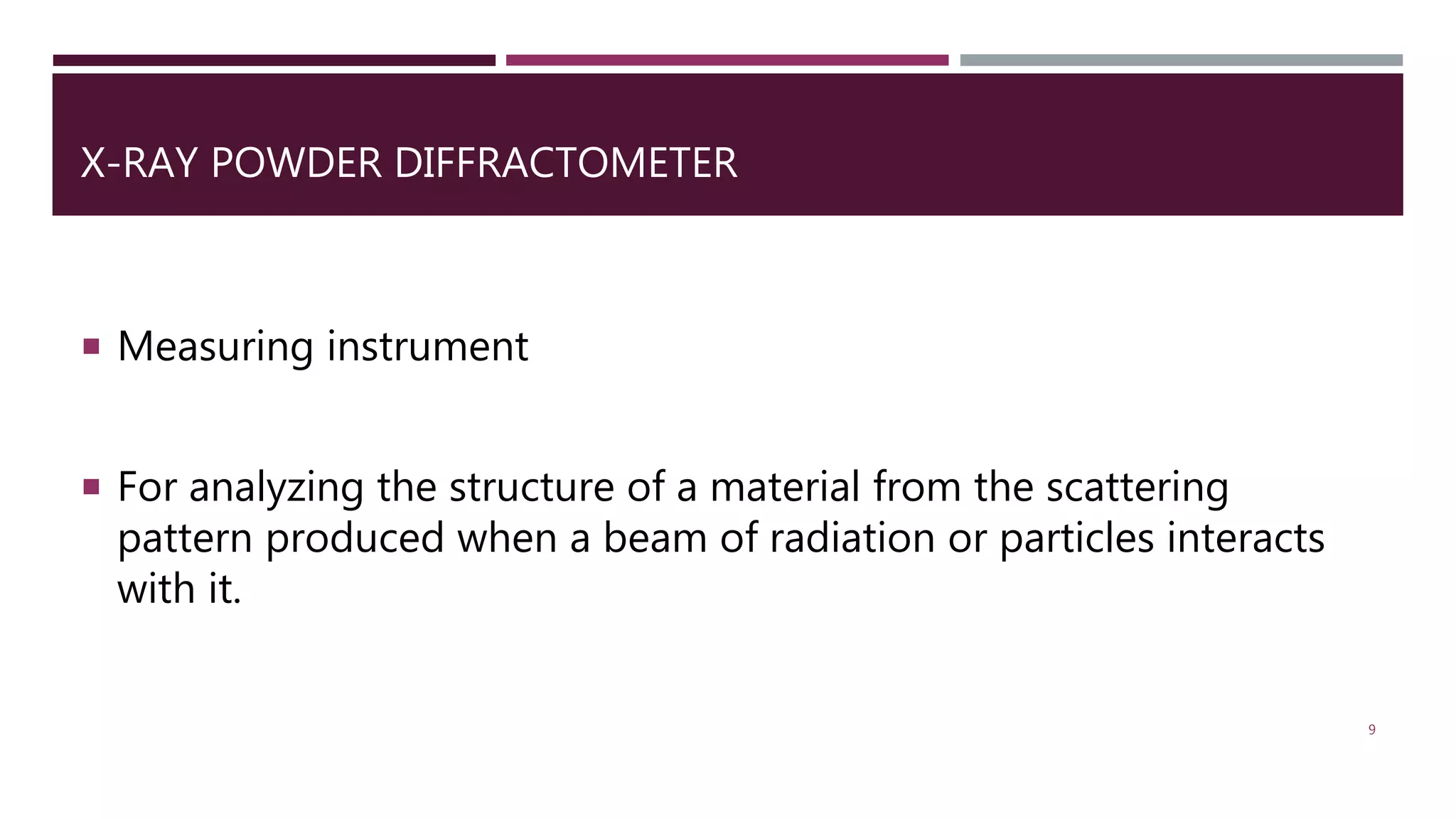
 Measuring instrument
 For analyzing the structure of a material from the scattering
pattern produced when a beam of radiation or particles interacts
with it.
9
TYPES OF X-RAY DIFFRACTOMETER
 Single crystal diffractometer.
 Powder camera diffractometer.
10
CLASSICAL POWDER DIFFRACTOMETER
11
BRAGG-BRENTANO DIFFRACTOMETER
12
 COMES IN 2 VARIETY
BRAGG-BRENTANO DIFFRACTOMETER….
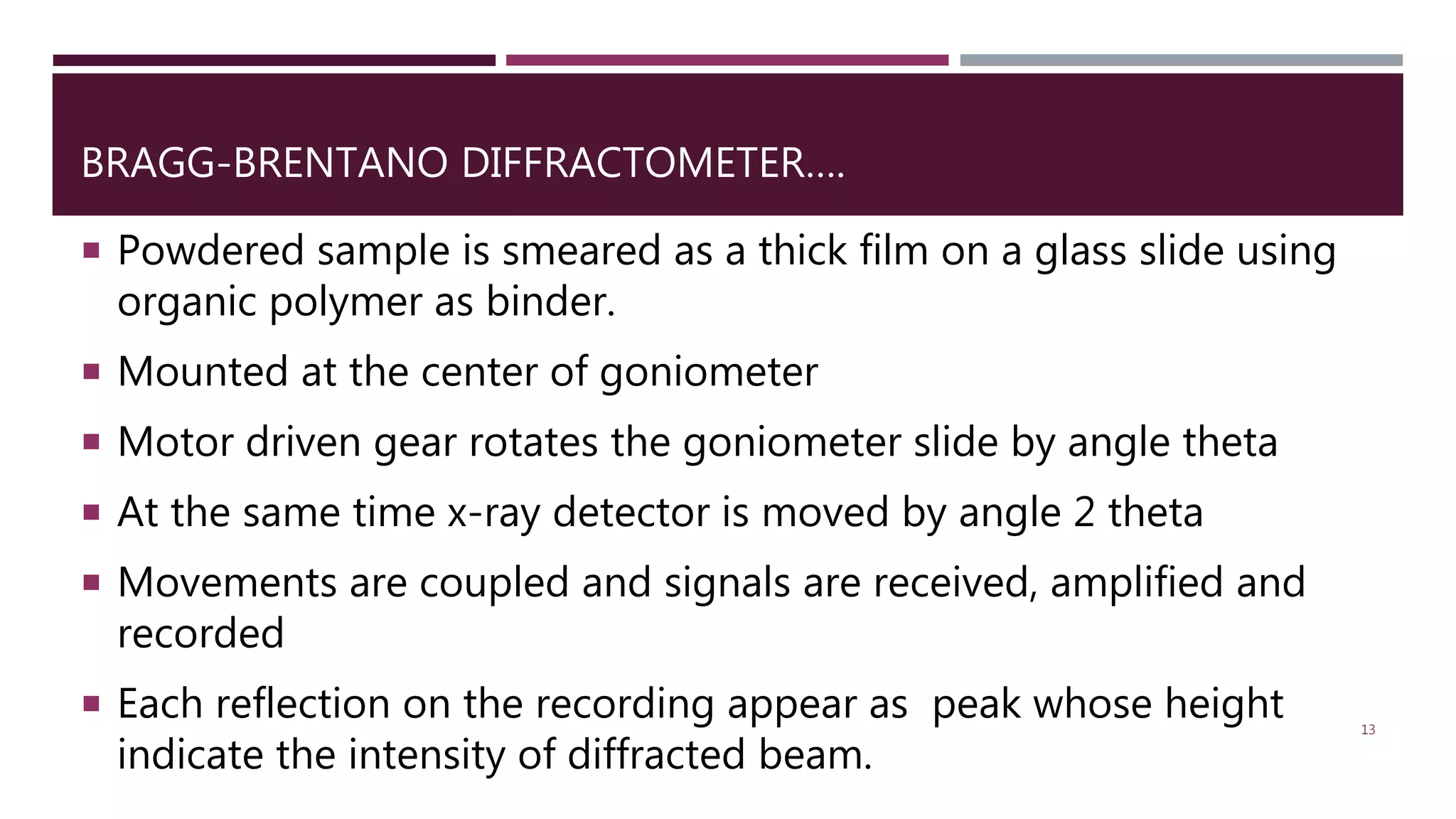
 Powdered sample is smeared as a thick film on a glass slide using
organic polymer as binder.
 Mounted at the center of goniometer
 Motor driven gear rotates the goniometer slide by angle theta
 At the same time x-ray detector is moved by angle 2 theta
 Movements are coupled and signals are received, amplified and
recorded
 Each reflection on the recording appear as peak whose height
indicate the intensity of diffracted beam.
13
POWDER CAMERA DIFFRACTOMETERS
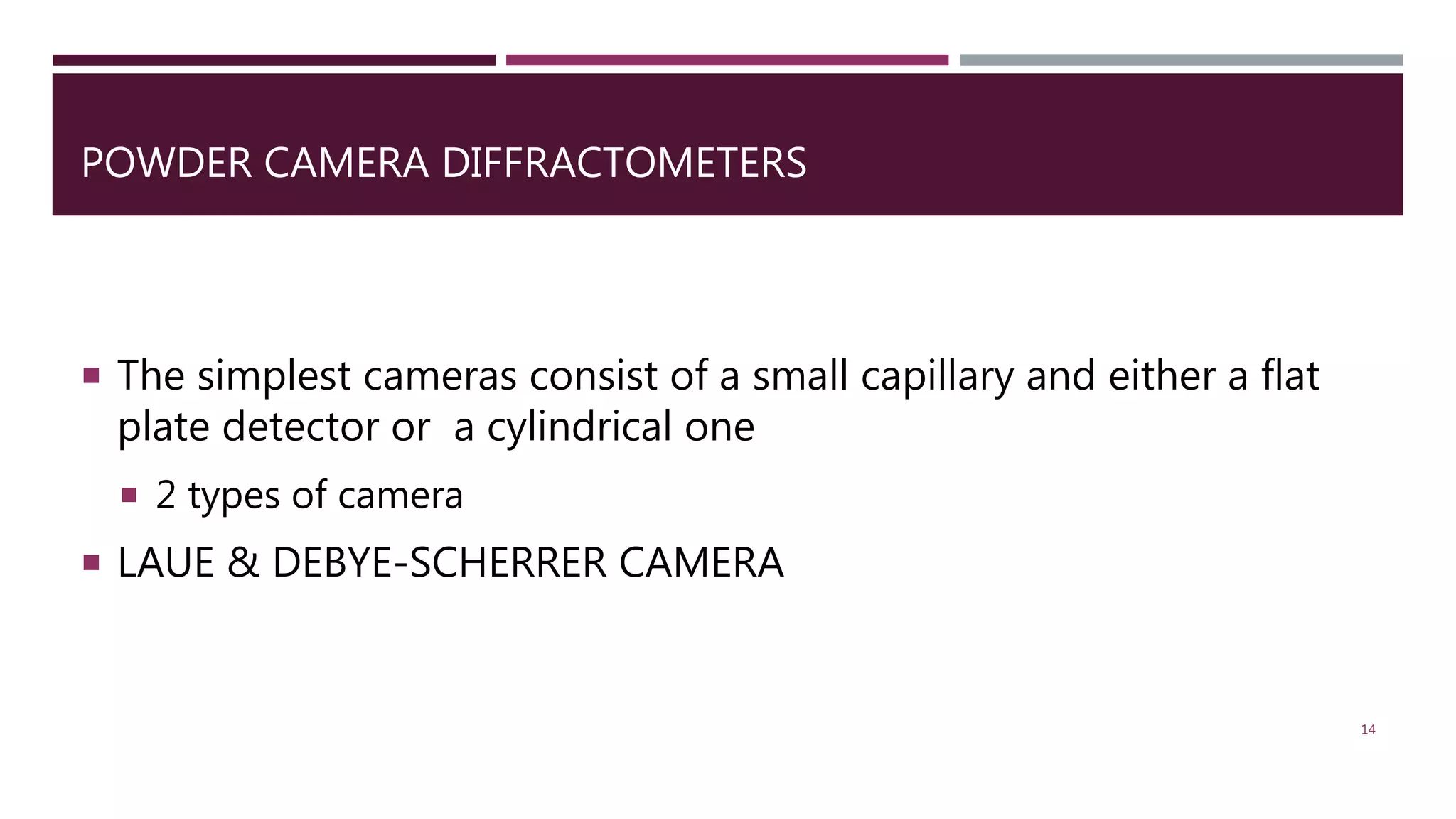
 The simplest cameras consist of a small capillary and either a flat
plate detector or a cylindrical one
 2 types of camera
 LAUE & DEBYE-SCHERRER CAMERA
14
POWDER CAMERA DIFFRACTOMETER…
LAUE CAMERA METHOD
 A is a source of X-rays which can be made
monochromatic by a filter
 Allow the X-ray beam to fall on the powdered
specimen P through the slits S1 and S2. The
function of these slits is to get a narrow pencil of
X-rays.
 Fine powder, P, struck on a specimen by means
of gum is suspended vertically in the axis of a
cylindrical camera. This enables sharp lines to be
obtained on the photographic film which is
surrounding the powder crystal in the form of a
circular arc.
15
LAUE CAMERA METHOD…..
 The X-rays after falling on the powder passes out of the camera through a cut
in the film so as to minimize the fogging produced by the scattering of the
direct beam.
 As the sample and detector are rotated, the intensity of the reflected X-rays is
recorded.
 When the geometry of the incident X-rays impinging the sample satisfies the
Bragg Equation, constructive interference occurs and a peak in intensity
occurs.
 A detector records and processes this X-ray signal and converts the signal to a
count rate which is then output to a device such as a printer or computer
monitor.
16
DEBYE-SCHERRER METHOD
 Method of studying the structure of finely
crystalline substance using x-ray diffraction.
 Narrow parallel beam monochromatic x-rays upon
falling onto a polycrystalline samples
 And reflected by the crystallites that make up the
sample
 Produces a number of coaxial that is having one
common axis,
 Diffracting cones.
17
ADVANTAGES
 Powerful and rapid (< 20 min) technique for identification of an
unknown mineral
 In most cases, it provides an unambiguous mineral determination
 Minimal sample preparation is required
 XRD units are widely available
 Data interpretation is relatively straight forward
18
LIMITATIONS
 Homogeneous and single phase material is best for identification
of an unknown.
 Requires tenths of a gram of material which must be ground into a
powder.
 For mixed materials, detection limit is ~ 2% of sample.
 Peak overlay may occur and worsens for high angle 'reflections’ .
 For unit cell determinations, indexing of patterns for non-isometric
crystal systems is complicated .
19
APPLICATIONS
X-ray powder diffraction is most widely used for the identification of unknown
crystalline materials (e.G. Minerals, inorganic compounds). Determination of
unknown solids is critical to studies in geology, environmental science, material
science, engineering and biology.
Other applications include:
 Characterization of crystalline materials
 Identification of fine-grained minerals such as clays and mixed layer clays that
are difficult to determine optically
 Determination of unit cell dimensions
 Measurement of sample purity 20
APPLICATIONS
 Determine crystal structures .
 Determine of modal amounts of minerals (quantitative analysis)
 Characterize thin films samples by:
 Determining lattice mismatch between film and substrate and to inferring stress
and strain
 Determining dislocation density and quality of the film by rocking curve
measurements
 Measuring superlattices in multilayered epitaxial structures
 Determining the thickness, roughness and density of the film using glancing
incidence x-ray reflectivity measurements
 Make textural measurements, such as the orientation of grains, in a polycrystalline
sample
21
REFERENCE
 http://serc.carleton.edu/research_education/geochemsheets/techniques/XRD.
html
 http://pubs.usgs.gov/info/diffraction/html/
 Instrumental methods of chemical analysis by G.R.Chatwal & Sham.K.Anand …
Page No. 2.324-2.326
 Instrumental methods of chemical analysis by B. K Sharma… Page No.S-494-
536
 Practical Pharmaceutical Chemistry Beckett and Stenlake… Page No. 78-81
22
THANK YOUUUU………
23

X ray powder diffraction &amp;

  • 1.
    X-RAY POWDER DIFFRACTION& X-RAY POWDER DIFFRACTOMETER. PRESENTED BY ARANTHA. J. JOSEPH FIRST YEAR MPHARM DEPARTMENT OF PHARMACEUTICS. 1
  • 2.
    X-RAY POWDER DIFFRACTION Rapid analytical technique  Primarily used for phase identification of a crystalline material.  Provide information on unit cell dimensions.  The analyzed material is finely ground, homogenized and average bulk composition is determined. 2
  • 3.
    PRINCIPLE  X-ray diffractionis based on constructive interference of monochromatic X-rays and a crystalline sample.  X-rays are generated by a cathode ray tube.  Filtered to produce monochromatic radiation.  collimated to concentrate.  directed toward the sample.  For every set of crystal planes , one or more crystals will be in the correct orientation to give the correct Bragg angle to satisfy Bragg's equation. 3
  • 4.
    4  Each diffractionline is made up of a large number of small spots, each from a separate crystal.  Each spot is so small as to give the appearance of a continuous line.  Every crystal plane is thus capable of diffraction.
  • 5.
  • 6.
    6  The powderedsample generates the concentric cones of diffracted X-rays because of the random orientation of crystallites in the sample.  Hence, instead of the sample generating only single diffraction spots, it generates cones of diffracted X-rays, with the point of all of the cones at the sample.  These cones intersect a strip of photographic film located in the cylindrical camera to produce a characteristic set of arcs on the film.
  • 7.
    7  When thefilm is removed from the camera, flattened and processed, it shows the diffraction lines and the holes for the incident and transmitted beams.  The x-ray pattern of a pure crystalline substance can be considered as a “fingerprint”  with each crystalline material having, within limits, a unique diffraction pattern
  • 8.
    Figure 2. Exampleof an x-ray powder diffractogram produced during an x-ray scan. The peaks represent positions where the x-ray beam has been diffracted by the crystal lattice. The set of d-spacings (the between adjacent planes of atoms), which represent the unique "fingerprint" of the mineral, can easily be calculated from the 2-theta (2) values shown. 8
  • 9.
    X-RAY POWDER DIFFRACTOMETER Measuring instrument  For analyzing the structure of a material from the scattering pattern produced when a beam of radiation or particles interacts with it. 9
  • 10.
    TYPES OF X-RAYDIFFRACTOMETER  Single crystal diffractometer.  Powder camera diffractometer. 10
  • 11.
  • 12.
  • 13.
    BRAGG-BRENTANO DIFFRACTOMETER….  Powderedsample is smeared as a thick film on a glass slide using organic polymer as binder.  Mounted at the center of goniometer  Motor driven gear rotates the goniometer slide by angle theta  At the same time x-ray detector is moved by angle 2 theta  Movements are coupled and signals are received, amplified and recorded  Each reflection on the recording appear as peak whose height indicate the intensity of diffracted beam. 13
  • 14.
    POWDER CAMERA DIFFRACTOMETERS The simplest cameras consist of a small capillary and either a flat plate detector or a cylindrical one  2 types of camera  LAUE & DEBYE-SCHERRER CAMERA 14
  • 15.
    POWDER CAMERA DIFFRACTOMETER… LAUECAMERA METHOD  A is a source of X-rays which can be made monochromatic by a filter  Allow the X-ray beam to fall on the powdered specimen P through the slits S1 and S2. The function of these slits is to get a narrow pencil of X-rays.  Fine powder, P, struck on a specimen by means of gum is suspended vertically in the axis of a cylindrical camera. This enables sharp lines to be obtained on the photographic film which is surrounding the powder crystal in the form of a circular arc. 15
  • 16.
    LAUE CAMERA METHOD….. The X-rays after falling on the powder passes out of the camera through a cut in the film so as to minimize the fogging produced by the scattering of the direct beam.  As the sample and detector are rotated, the intensity of the reflected X-rays is recorded.  When the geometry of the incident X-rays impinging the sample satisfies the Bragg Equation, constructive interference occurs and a peak in intensity occurs.  A detector records and processes this X-ray signal and converts the signal to a count rate which is then output to a device such as a printer or computer monitor. 16
  • 17.
    DEBYE-SCHERRER METHOD  Methodof studying the structure of finely crystalline substance using x-ray diffraction.  Narrow parallel beam monochromatic x-rays upon falling onto a polycrystalline samples  And reflected by the crystallites that make up the sample  Produces a number of coaxial that is having one common axis,  Diffracting cones. 17
  • 18.
    ADVANTAGES  Powerful andrapid (< 20 min) technique for identification of an unknown mineral  In most cases, it provides an unambiguous mineral determination  Minimal sample preparation is required  XRD units are widely available  Data interpretation is relatively straight forward 18
  • 19.
    LIMITATIONS  Homogeneous andsingle phase material is best for identification of an unknown.  Requires tenths of a gram of material which must be ground into a powder.  For mixed materials, detection limit is ~ 2% of sample.  Peak overlay may occur and worsens for high angle 'reflections’ .  For unit cell determinations, indexing of patterns for non-isometric crystal systems is complicated . 19
  • 20.
    APPLICATIONS X-ray powder diffractionis most widely used for the identification of unknown crystalline materials (e.G. Minerals, inorganic compounds). Determination of unknown solids is critical to studies in geology, environmental science, material science, engineering and biology. Other applications include:  Characterization of crystalline materials  Identification of fine-grained minerals such as clays and mixed layer clays that are difficult to determine optically  Determination of unit cell dimensions  Measurement of sample purity 20
  • 21.
    APPLICATIONS  Determine crystalstructures .  Determine of modal amounts of minerals (quantitative analysis)  Characterize thin films samples by:  Determining lattice mismatch between film and substrate and to inferring stress and strain  Determining dislocation density and quality of the film by rocking curve measurements  Measuring superlattices in multilayered epitaxial structures  Determining the thickness, roughness and density of the film using glancing incidence x-ray reflectivity measurements  Make textural measurements, such as the orientation of grains, in a polycrystalline sample 21
  • 22.
    REFERENCE  http://serc.carleton.edu/research_education/geochemsheets/techniques/XRD. html  http://pubs.usgs.gov/info/diffraction/html/ Instrumental methods of chemical analysis by G.R.Chatwal & Sham.K.Anand … Page No. 2.324-2.326  Instrumental methods of chemical analysis by B. K Sharma… Page No.S-494- 536  Practical Pharmaceutical Chemistry Beckett and Stenlake… Page No. 78-81 22
  • 23.