Presented by:
Pratik Siddhapura
M.Pharm 1st Year
Sem- 1
CONTENT
 X- ray diffraction
 Bragg’s law
 Different X-ray diffraction techniques
1. Laue photographic method
2. Bragg’s X-ray spectrometer method
3. Rotating crystal technique
4. X-ray powder technique
 Type of crystal
 Application of x-ray diffraction
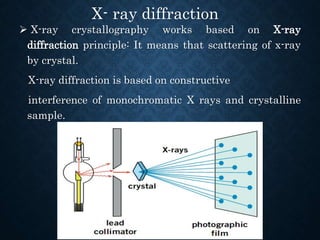
 X-ray crystallography works based on X-ray
diffraction principle: It means that scattering of x-ray
by crystal.
X-ray diffraction is based on constructive
interference of monochromatic X rays and crystalline
sample.
X- ray diffraction
BRAGG’S LAW
• Diffraction occurs only when Bragg’s Law is satisfied.
• Bragg law identifies the angles of the incident radiation relative to the
lattice planes for which diffraction peaks occurs.
• Bragg derived the condition for constructive interference of the X-rays
scattered from a set of parallel lattice planes.
• When the X-rays strike a layer of a crystal, some of them will be reflected.
These two x-ray beams travel slightly different distances.
• Connecting the two beams with perpendicular lines shows the
difference between the top and the bottom beams.
• For a crystalline solid, the waves are scattered from lattice planes
separated by the inter planar distance d.
• When the scattered waves interfere constructively, they remain in phase
since the difference between the path lengths of the two waves is equal to
an integer multiple of the wavelength.
• The path difference between two waves undergoing interference is given
by 2dsinθ, where θ is the scattering angle.
crystal
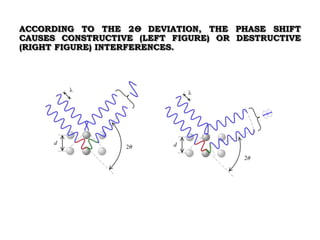
ACCORDING TO THE 2Θ DEVIATION, THE PHASE SHIFT
CAUSES CONSTRUCTIVE (LEFT FIGURE) OR DESTRUCTIVE
(RIGHT FIGURE) INTERFERENCES.
THE LENGTH AB IS THE SAME AS BC SO THE TOTAL DISTANCE
TRAVELED BY THE BOTTOM WAVE IS EXPRESSED BY:
AB= D SINΘ
BC = D SINΘ
AB+ BC= 2D SINΘ
NΛ = 2D SINΘ
CONSTRUCTIVE INTERFERENCE OF THE RADIATION FROM SUCCESSIVE
PLANES OCCURS WHEN THE PATH DIFFERENCE IS AN INTEGRAL
NUMBER OF WAVE LENGTHS. THIS IS THE BRAGG LAW.
1.Laue photographic method
Transmission method
 In this method the crystal is held
stationary in a beam of x-rays ,
after passing through the crystal
is diffracted and is recorded on a
Photographic plate. Laue pattern
can be used to orient crystals for
solid State experiments.
1.Laue photographic method
Back reflection method
 The film is placed between the x-
ray source and the crystal. The
beams which are diffracted in
backward direction are recorded.
2.BRAGG X-RAY SPECTROMETER
METHOD
Construction:-
• Bragg's Spectrometer consists of a collimator containing two slits S1 and
S2 made up of lead, through which X-ray is passed.
• A turn table is situated in-front of the collimator on which crystal is
placed.
• Ionization chamber collects the reflected X-ray
Procedure:-
• A fine beam of a monochromatic X-ray is made to fall on the crystal.
• The crystal reflects the X-rays which are collected by the ionization
chamber.
• Turn table is rotated till a sharp increase in the intensity is detected.
• The sudden increase in intensity suggests that Bragg's Law is satisfied at
the given angle θ.
• Then the inter-planar spacing can be determined by using Bragg's Law
nλ = 2d.sinθ
3. ROTATING CRYSTAL
METHOD
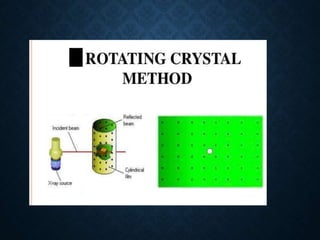
The X- rays are generated in the X-ray tube and then the beam is
made by monochromator.
The beam is allowed to pass through collimating system which
permits a parallel
X-rays.
 Then the X –ray beam is made to fall on crystal which is
mounted on a rotating shaft.
 When x-ray strike on crystal plane, it will produce a spot on
photographic film.
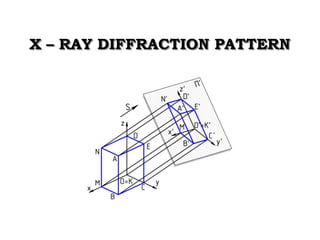
X – RAY DIFFRACTION PATTERN
4. POWDER CRYSTAL METHOD
• When an X-ray is shined on a crystal, it diffracts in
a pattern characteristic of the structure. In powder
X-ray diffraction, the diffraction pattern is obtained
from a powder of the material.
• Powder diffraction is often easier and more
convenient than single crystal diffraction since it
does not require individual crystals be made.
Powder X-ray diffraction (XRD) also obtains a
diffraction pattern for the bulk material of a
crystalline solid, rather than of a single crystal.
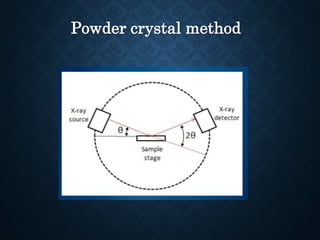
Powder crystal method
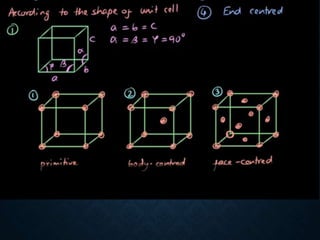
TYPE OF CRYSTAL
Application
• X-ray powder diffraction is most widely used for the
identification of unknown crystalline materials (e.g.
minerals, inorganic compounds).
• characterization of crystalline materials
• identification of fine-grained minerals such as clays and
mixed layer clays that are difficult to determine optically
• determination of unit cell dimensions
• To identify crystalline phases and orientation
To determine structural properties:
• To measure thickness of thin films and multi-layers
• To determine atomic arrangement
• measurement of sample purity
• Particle size determination
• Determination of Cis - Trans isomerism
• It is used to assess the weathering and degradation of
natural and synthetic , minerals.
• Tooth enamel and dentine have been examined by
xrd.
x-ray crystallography,bragg's law,different x-ray diffraction technique,laue photographic method,bragg's x-ray spectrometer method,rotating crystal method,x-ray powder technique,type of crystal ,application of x-ray diffraction

x-ray crystallography,bragg's law,different x-ray diffraction technique,laue photographic method,bragg's x-ray spectrometer method,rotating crystal method,x-ray powder technique,type of crystal ,application of x-ray diffraction

  • 1.
  • 2.
    CONTENT  X- raydiffraction  Bragg’s law  Different X-ray diffraction techniques 1. Laue photographic method 2. Bragg’s X-ray spectrometer method 3. Rotating crystal technique 4. X-ray powder technique  Type of crystal  Application of x-ray diffraction
  • 3.
     X-ray crystallographyworks based on X-ray diffraction principle: It means that scattering of x-ray by crystal. X-ray diffraction is based on constructive interference of monochromatic X rays and crystalline sample. X- ray diffraction
  • 4.
    BRAGG’S LAW • Diffractionoccurs only when Bragg’s Law is satisfied. • Bragg law identifies the angles of the incident radiation relative to the lattice planes for which diffraction peaks occurs. • Bragg derived the condition for constructive interference of the X-rays scattered from a set of parallel lattice planes. • When the X-rays strike a layer of a crystal, some of them will be reflected. These two x-ray beams travel slightly different distances. • Connecting the two beams with perpendicular lines shows the difference between the top and the bottom beams. • For a crystalline solid, the waves are scattered from lattice planes separated by the inter planar distance d. • When the scattered waves interfere constructively, they remain in phase since the difference between the path lengths of the two waves is equal to an integer multiple of the wavelength. • The path difference between two waves undergoing interference is given by 2dsinθ, where θ is the scattering angle.
  • 5.
  • 6.
    ACCORDING TO THE2Θ DEVIATION, THE PHASE SHIFT CAUSES CONSTRUCTIVE (LEFT FIGURE) OR DESTRUCTIVE (RIGHT FIGURE) INTERFERENCES.
  • 7.
    THE LENGTH ABIS THE SAME AS BC SO THE TOTAL DISTANCE TRAVELED BY THE BOTTOM WAVE IS EXPRESSED BY: AB= D SINΘ BC = D SINΘ AB+ BC= 2D SINΘ NΛ = 2D SINΘ CONSTRUCTIVE INTERFERENCE OF THE RADIATION FROM SUCCESSIVE PLANES OCCURS WHEN THE PATH DIFFERENCE IS AN INTEGRAL NUMBER OF WAVE LENGTHS. THIS IS THE BRAGG LAW.
  • 8.
    1.Laue photographic method Transmissionmethod  In this method the crystal is held stationary in a beam of x-rays , after passing through the crystal is diffracted and is recorded on a Photographic plate. Laue pattern can be used to orient crystals for solid State experiments.
  • 9.
    1.Laue photographic method Backreflection method  The film is placed between the x- ray source and the crystal. The beams which are diffracted in backward direction are recorded.
  • 10.
  • 11.
    Construction:- • Bragg's Spectrometerconsists of a collimator containing two slits S1 and S2 made up of lead, through which X-ray is passed. • A turn table is situated in-front of the collimator on which crystal is placed. • Ionization chamber collects the reflected X-ray Procedure:- • A fine beam of a monochromatic X-ray is made to fall on the crystal. • The crystal reflects the X-rays which are collected by the ionization chamber. • Turn table is rotated till a sharp increase in the intensity is detected. • The sudden increase in intensity suggests that Bragg's Law is satisfied at the given angle θ. • Then the inter-planar spacing can be determined by using Bragg's Law nλ = 2d.sinθ
  • 12.
    3. ROTATING CRYSTAL METHOD TheX- rays are generated in the X-ray tube and then the beam is made by monochromator. The beam is allowed to pass through collimating system which permits a parallel X-rays.  Then the X –ray beam is made to fall on crystal which is mounted on a rotating shaft.  When x-ray strike on crystal plane, it will produce a spot on photographic film.
  • 14.
    X – RAYDIFFRACTION PATTERN
  • 15.
    4. POWDER CRYSTALMETHOD • When an X-ray is shined on a crystal, it diffracts in a pattern characteristic of the structure. In powder X-ray diffraction, the diffraction pattern is obtained from a powder of the material. • Powder diffraction is often easier and more convenient than single crystal diffraction since it does not require individual crystals be made. Powder X-ray diffraction (XRD) also obtains a diffraction pattern for the bulk material of a crystalline solid, rather than of a single crystal.
  • 16.
  • 17.
  • 25.
    Application • X-ray powderdiffraction is most widely used for the identification of unknown crystalline materials (e.g. minerals, inorganic compounds). • characterization of crystalline materials • identification of fine-grained minerals such as clays and mixed layer clays that are difficult to determine optically • determination of unit cell dimensions
  • 26.
    • To identifycrystalline phases and orientation To determine structural properties: • To measure thickness of thin films and multi-layers • To determine atomic arrangement • measurement of sample purity
  • 27.
    • Particle sizedetermination • Determination of Cis - Trans isomerism • It is used to assess the weathering and degradation of natural and synthetic , minerals. • Tooth enamel and dentine have been examined by xrd.