X-RAY POWDER DIFFRACTION


Prepared By –                        Guided By –
           Amit $hah                               Mr. Pinak R. Patel
         M.Pharm 1st sem                            Assistant
QA                                   Professor
           Roll NO :- 03                            Dept. P’ceutical
                                     Chem.
     D      Dharmaj Degree Pharmacy College, Dharmaj
Fundamental principles


   Instrumentation


     Applications


Strength & Limitations


                         2
WHAT IS X-RAY POWDER DIFFRACTION
              (XRD)
    X-ray powder diffraction (XRD) is a rapid analytical
     technique primarily used for phase identification of a
     crystalline material and can provide information on
     unit cell dimensions.
    In other methods a single crystal is required whose
     size is much larger than microscopic dimensions.
     However, in the powder method as little as 1 mg of the
     material is sufficient for the study.
    The         analyzed         material   is      finely
     ground, homogenized, and average bulk composition
     is determined.
                                                              3
   Max von Laue, in 1912, discovered that crystalline
    substances act as three-dimensional diffraction
    gratings for X-ray wavelengths similar to the
    spacing of planes in a crystal lattice.
   The powder method was devised independently
    by Debye and Scherrer in Germany and by Hull in
    America at about the same time.


                                                         4
FUNDAMENTAL PRINCIPLES OF X-RAY
       POWDER DIFFRACTION (XRD)
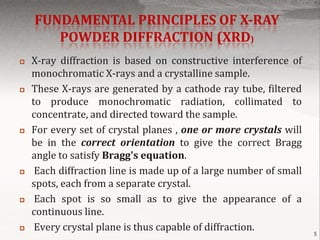
   X-ray diffraction is based on constructive interference of
    monochromatic X-rays and a crystalline sample.
   These X-rays are generated by a cathode ray tube, filtered
    to produce monochromatic radiation, collimated to
    concentrate, and directed toward the sample.
   For every set of crystal planes , one or more crystals will
    be in the correct orientation to give the correct Bragg
    angle to satisfy Bragg's equation.
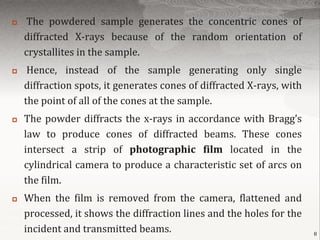
    Each diffraction line is made up of a large number of small
    spots, each from a separate crystal.
    Each spot is so small as to give the appearance of a
    continuous line.
    Every crystal plane is thus capable of diffraction.           5
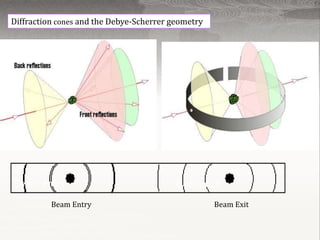
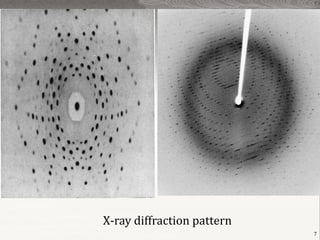
Diffraction cones and the Debye-Scherrer geometry


          Beam Entry                                Beam Exit
X-ray diffraction pattern
                            7
   The powdered sample generates the concentric cones of
    diffracted X-rays because of the random orientation of
    crystallites in the sample.
    Hence, instead of the sample generating only single
    diffraction spots, it generates cones of diffracted X-rays, with
    the point of all of the cones at the sample.
   The powder diffracts the x-rays in accordance with Bragg’s
    law to produce cones of diffracted beams. These cones
    intersect a strip of photographic film located in the
    cylindrical camera to produce a characteristic set of arcs on
    the film.
   When the film is removed from the camera, flattened and
    processed, it shows the diffraction lines and the holes for the
    incident and transmitted beams.                                    8
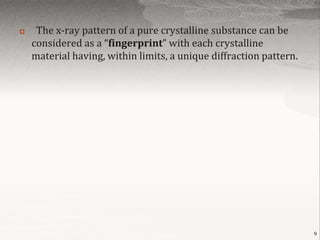
    The x-ray pattern of a pure crystalline substance can be
    considered as a “fingerprint” with each crystalline
    material having, within limits, a unique diffraction pattern.


                                                                    9
X-RAY POWDER DIFFRACTION (XRD)
 INSTRUMENTATION - HOW DOES IT
           WORK?


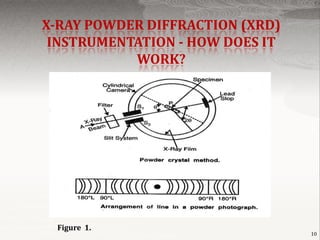
 Figure 1.
                                 10
11
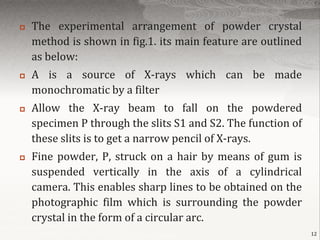
   The experimental arrangement of powder crystal
    method is shown in fig.1. its main feature are outlined
    as below:
   A is a source of X-rays which can be made
    monochromatic by a filter
   Allow the X-ray beam to fall on the powdered
    specimen P through the slits S1 and S2. The function of
    these slits is to get a narrow pencil of X-rays.
   Fine powder, P, struck on a hair by means of gum is
    suspended vertically in the axis of a cylindrical
    camera. This enables sharp lines to be obtained on the
    photographic film which is surrounding the powder
    crystal in the form of a circular arc.
                                                              12
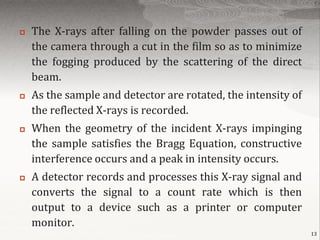
   The X-rays after falling on the powder passes out of
    the camera through a cut in the film so as to minimize
    the fogging produced by the scattering of the direct
    beam.
   As the sample and detector are rotated, the intensity of
    the reflected X-rays is recorded.
   When the geometry of the incident X-rays impinging
    the sample satisfies the Bragg Equation, constructive
    interference occurs and a peak in intensity occurs.
   A detector records and processes this X-ray signal and
    converts the signal to a count rate which is then
    output to a device such as a printer or computer
    monitor.
                                                               13
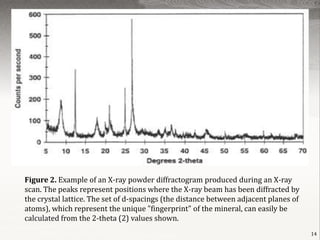
Figure 2. Example of an X-ray powder diffractogram produced during an X-ray
scan. The peaks represent positions where the X-ray beam has been diffracted by
the crystal lattice. The set of d-spacings (the distance between adjacent planes of
atoms), which represent the unique "fingerprint" of the mineral, can easily be
calculated from the 2-theta (2) values shown.
                                                                                      14
APPLICATIONS
    Identification : The most common use of
    powder        (polycrystalline)      diffraction is
    chemical analysis.
            This can include phase identification
             (search/match)
   X-ray powder diffraction is most widely used for
    the identification of unknown crystalline materials
    (e.g. minerals, inorganic compounds).
   Other applications include :
          identification    of fine-grained minerals
          such as clays and mixed layer clays that are
          difficult to determine optically.
                                                          15
   determination of unit cell dimensions.
   measurement of sample purity .
   Most useful for cubic crystal.
   Used for determining the complex structure
    of metals and alloys.
   Useful to make distinction between the
    allotropic modifications of the same
    substance.


                                                 16
STRENGTHS AND LIMITATIONS OF X-
RAY POWDER DIFFRACTION (XRD)?

   Strengths :-

         Powerful and rapid (< 20 min) technique for
         identification of an unknown mineral.
         In most cases, it provides a clear structural
         determination.
         XRD units are widely available.
         Data interpretation is relatively straight
         forward .

                                                          17
   Limitations:-

          Homogeneous and single phase material is best
          for identification of an unknown.
          Requires tenths of a gram of material which
          must be ground into a powder.
          For mixed materials, detection limit is
          ~ 2% of sample.
          Peak overlay may occur and worsens for high
          angle 'reflections’ .
          For unit cell determinations, indexing of
          patterns for non-isometric crystal systems is
          complicated .
                                                           18
REFERENCE
   http://serc.carleton.edu/research_education/geochem
    sheets/techniques/XRD.html

   http://pubs.usgs.gov/info/diffraction/html/

   Instrumental methods ofPage No.
                            chemical analysis by G.R.Chatwal
    & Sham.K.Anand … Page No. 2.324-2.326

   Instrumental methods of chemical analysis by B. K
    Sharma… Page No.S-494-536

   Practical Pharmaceutical Chemistry Beckett and Stenlake…
    Page No. 78-81
                                                               19
20

X ray powder diffraction

  • 1.
    X-RAY POWDER DIFFRACTION PreparedBy – Guided By – Amit $hah Mr. Pinak R. Patel M.Pharm 1st sem Assistant QA Professor Roll NO :- 03 Dept. P’ceutical Chem. D Dharmaj Degree Pharmacy College, Dharmaj
  • 2.
    Fundamental principles Instrumentation Applications Strength & Limitations 2
  • 3.
    WHAT IS X-RAYPOWDER DIFFRACTION (XRD)  X-ray powder diffraction (XRD) is a rapid analytical technique primarily used for phase identification of a crystalline material and can provide information on unit cell dimensions.  In other methods a single crystal is required whose size is much larger than microscopic dimensions. However, in the powder method as little as 1 mg of the material is sufficient for the study.  The analyzed material is finely ground, homogenized, and average bulk composition is determined. 3
  • 4.
    Max von Laue, in 1912, discovered that crystalline substances act as three-dimensional diffraction gratings for X-ray wavelengths similar to the spacing of planes in a crystal lattice.  The powder method was devised independently by Debye and Scherrer in Germany and by Hull in America at about the same time. 4
  • 5.
    FUNDAMENTAL PRINCIPLES OFX-RAY POWDER DIFFRACTION (XRD)  X-ray diffraction is based on constructive interference of monochromatic X-rays and a crystalline sample.  These X-rays are generated by a cathode ray tube, filtered to produce monochromatic radiation, collimated to concentrate, and directed toward the sample.  For every set of crystal planes , one or more crystals will be in the correct orientation to give the correct Bragg angle to satisfy Bragg's equation.  Each diffraction line is made up of a large number of small spots, each from a separate crystal.  Each spot is so small as to give the appearance of a continuous line.  Every crystal plane is thus capable of diffraction. 5
  • 6.
    Diffraction cones andthe Debye-Scherrer geometry Beam Entry Beam Exit
  • 7.
  • 8.
    The powdered sample generates the concentric cones of diffracted X-rays because of the random orientation of crystallites in the sample.  Hence, instead of the sample generating only single diffraction spots, it generates cones of diffracted X-rays, with the point of all of the cones at the sample.  The powder diffracts the x-rays in accordance with Bragg’s law to produce cones of diffracted beams. These cones intersect a strip of photographic film located in the cylindrical camera to produce a characteristic set of arcs on the film.  When the film is removed from the camera, flattened and processed, it shows the diffraction lines and the holes for the incident and transmitted beams. 8
  • 9.
    The x-ray pattern of a pure crystalline substance can be considered as a “fingerprint” with each crystalline material having, within limits, a unique diffraction pattern. 9
  • 10.
    X-RAY POWDER DIFFRACTION(XRD) INSTRUMENTATION - HOW DOES IT WORK? Figure 1. 10
  • 11.
  • 12.
    The experimental arrangement of powder crystal method is shown in fig.1. its main feature are outlined as below:  A is a source of X-rays which can be made monochromatic by a filter  Allow the X-ray beam to fall on the powdered specimen P through the slits S1 and S2. The function of these slits is to get a narrow pencil of X-rays.  Fine powder, P, struck on a hair by means of gum is suspended vertically in the axis of a cylindrical camera. This enables sharp lines to be obtained on the photographic film which is surrounding the powder crystal in the form of a circular arc. 12
  • 13.
    The X-rays after falling on the powder passes out of the camera through a cut in the film so as to minimize the fogging produced by the scattering of the direct beam.  As the sample and detector are rotated, the intensity of the reflected X-rays is recorded.  When the geometry of the incident X-rays impinging the sample satisfies the Bragg Equation, constructive interference occurs and a peak in intensity occurs.  A detector records and processes this X-ray signal and converts the signal to a count rate which is then output to a device such as a printer or computer monitor. 13
  • 14.
    Figure 2. Exampleof an X-ray powder diffractogram produced during an X-ray scan. The peaks represent positions where the X-ray beam has been diffracted by the crystal lattice. The set of d-spacings (the distance between adjacent planes of atoms), which represent the unique "fingerprint" of the mineral, can easily be calculated from the 2-theta (2) values shown. 14
  • 15.
    APPLICATIONS  Identification : The most common use of powder (polycrystalline) diffraction is chemical analysis.  This can include phase identification (search/match)  X-ray powder diffraction is most widely used for the identification of unknown crystalline materials (e.g. minerals, inorganic compounds).  Other applications include : identification of fine-grained minerals such as clays and mixed layer clays that are difficult to determine optically. 15
  • 16.
    determination of unit cell dimensions.  measurement of sample purity .  Most useful for cubic crystal.  Used for determining the complex structure of metals and alloys.  Useful to make distinction between the allotropic modifications of the same substance. 16
  • 17.
    STRENGTHS AND LIMITATIONSOF X- RAY POWDER DIFFRACTION (XRD)?  Strengths :-  Powerful and rapid (< 20 min) technique for identification of an unknown mineral.  In most cases, it provides a clear structural determination.  XRD units are widely available.  Data interpretation is relatively straight forward . 17
  • 18.
    Limitations:-  Homogeneous and single phase material is best for identification of an unknown.  Requires tenths of a gram of material which must be ground into a powder.  For mixed materials, detection limit is ~ 2% of sample.  Peak overlay may occur and worsens for high angle 'reflections’ .  For unit cell determinations, indexing of patterns for non-isometric crystal systems is complicated . 18
  • 19.
    REFERENCE  http://serc.carleton.edu/research_education/geochem sheets/techniques/XRD.html  http://pubs.usgs.gov/info/diffraction/html/  Instrumental methods ofPage No. chemical analysis by G.R.Chatwal & Sham.K.Anand … Page No. 2.324-2.326  Instrumental methods of chemical analysis by B. K Sharma… Page No.S-494-536  Practical Pharmaceutical Chemistry Beckett and Stenlake… Page No. 78-81 19
  • 20.