Numerical Methods

                  N. B. Vyas


     Department of Mathematics,
 Atmiya Institute of Tech. and Science,
             Rajkot (Guj.)


N.B.V yas − Department of M athematics, AIT S − Rajkot
Introduction


  There are two types of functions: (i) Algebraic function and
  (ii) Transcendental function


           N.B.V yas − Department of M athematics, AIT S − Rajkot
Introduction


  There are two types of functions: (i) Algebraic function and
  (ii) Transcendental function
  An algebraic function is informally a function that
  satisfies a polynomial equation


           N.B.V yas − Department of M athematics, AIT S − Rajkot
Introduction


  There are two types of functions: (i) Algebraic function and
  (ii) Transcendental function
  An algebraic function is informally a function that
  satisfies a polynomial equation
  A function which is not algebraic is called a transcendental
  function.


          N.B.V yas − Department of M athematics, AIT S − Rajkot
Introduction


  There are two types of functions: (i) Algebraic function and
  (ii) Transcendental function
  An algebraic function is informally a function that
  satisfies a polynomial equation
  A function which is not algebraic is called a transcendental
  function.
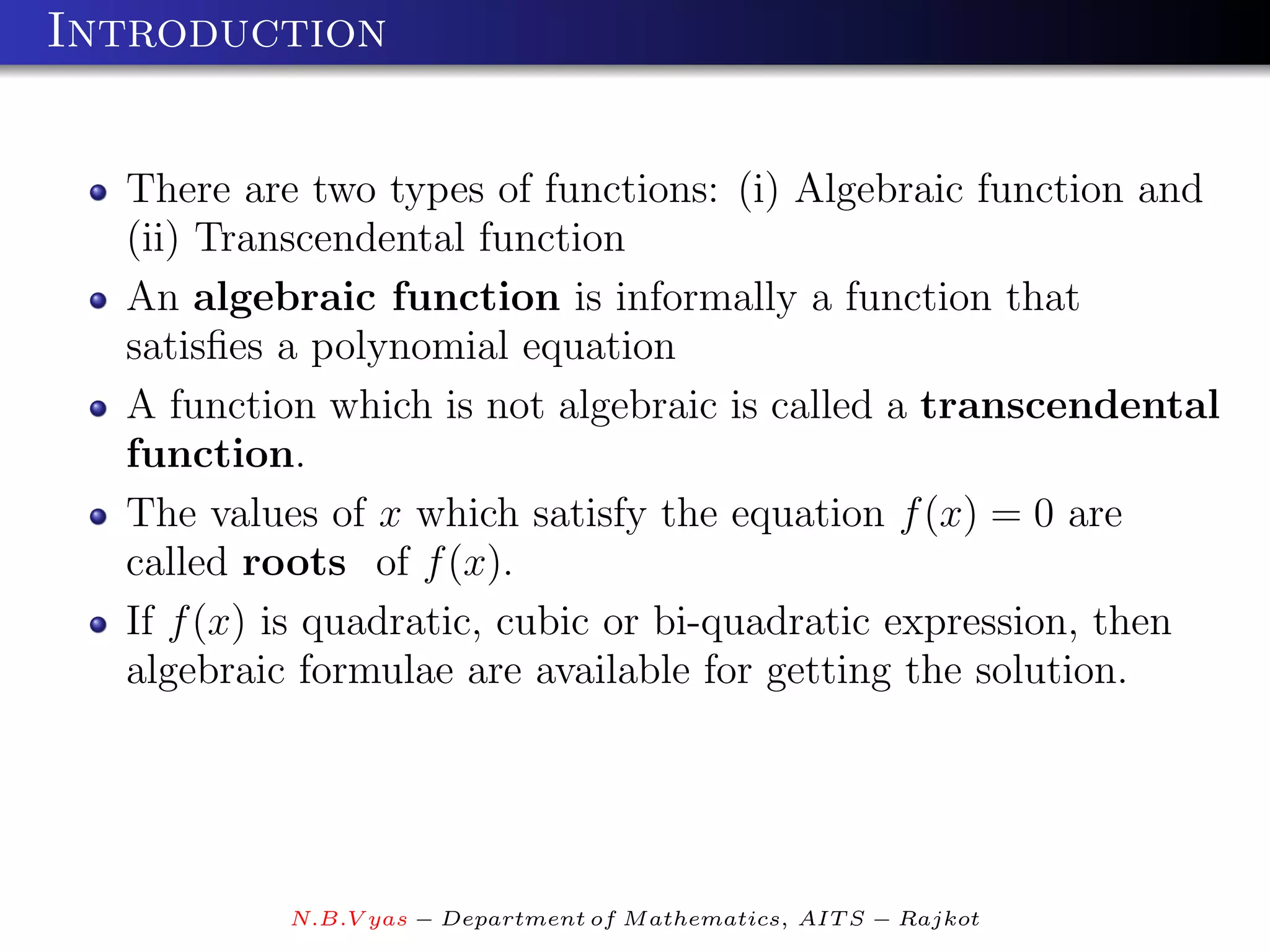
  The values of x which satisfy the equation f (x) = 0 are
  called roots of f (x).


          N.B.V yas − Department of M athematics, AIT S − Rajkot
Introduction


  There are two types of functions: (i) Algebraic function and
  (ii) Transcendental function
  An algebraic function is informally a function that
  satisfies a polynomial equation
  A function which is not algebraic is called a transcendental
  function.
  The values of x which satisfy the equation f (x) = 0 are
  called roots of f (x).
  If f (x) is quadratic, cubic or bi-quadratic expression, then
  algebraic formulae are available for getting the solution.


           N.B.V yas − Department of M athematics, AIT S − Rajkot
Introduction


  There are two types of functions: (i) Algebraic function and
  (ii) Transcendental function
  An algebraic function is informally a function that
  satisfies a polynomial equation
  A function which is not algebraic is called a transcendental
  function.
  The values of x which satisfy the equation f (x) = 0 are
  called roots of f (x).
  If f (x) is quadratic, cubic or bi-quadratic expression, then
  algebraic formulae are available for getting the solution.
  If f (x) is a higher degree polynomial or transcendental
  function then algebraic methods are not available.


           N.B.V yas − Department of M athematics, AIT S − Rajkot
Errors


  It is never possible to measure anything exactly.


           N.B.V yas − Department of M athematics, AIT S − Rajkot
Errors


  It is never possible to measure anything exactly.
  So in order to make valid conclusions, it is good to make the
  error as small as possible.


           N.B.V yas − Department of M athematics, AIT S − Rajkot
Errors


  It is never possible to measure anything exactly.
  So in order to make valid conclusions, it is good to make the
  error as small as possible.
  The result of any physical measurement has two essential
  components :


           N.B.V yas − Department of M athematics, AIT S − Rajkot
Errors


  It is never possible to measure anything exactly.
  So in order to make valid conclusions, it is good to make the
  error as small as possible.
  The result of any physical measurement has two essential
  components :
  i) A numerical value


           N.B.V yas − Department of M athematics, AIT S − Rajkot
Errors


  It is never possible to measure anything exactly.
  So in order to make valid conclusions, it is good to make the
  error as small as possible.
  The result of any physical measurement has two essential
  components :
  i) A numerical value
  ii) A degree of uncertainty Or Errors.


           N.B.V yas − Department of M athematics, AIT S − Rajkot
Errors


  Exact Numbers: There are the numbers in which there is
  no uncertainty and no approximation.


          N.B.V yas − Department of M athematics, AIT S − Rajkot
Errors


  Exact Numbers: There are the numbers in which there is
  no uncertainty and no approximation.
  Approximate Numbers: These are the numbers which
  represent a certain degree of accuracy but not the exact
  value.


          N.B.V yas − Department of M athematics, AIT S − Rajkot
Errors


  Exact Numbers: There are the numbers in which there is
  no uncertainty and no approximation.
  Approximate Numbers: These are the numbers which
  represent a certain degree of accuracy but not the exact
  value.
  These numbers cannot be represented in terms of finite
  number of digits.


          N.B.V yas − Department of M athematics, AIT S − Rajkot
Errors


  Exact Numbers: There are the numbers in which there is
  no uncertainty and no approximation.
  Approximate Numbers: These are the numbers which
  represent a certain degree of accuracy but not the exact
  value.
  These numbers cannot be represented in terms of finite
  number of digits.
  Significant Digits: It refers to the number of digits in a
  number excluding leading zeros.


          N.B.V yas − Department of M athematics, AIT S − Rajkot
Bisection Method

  Consider a continuous function f (x).


           N.B.V yas − Department of M athematics, AIT S − Rajkot
Bisection Method

  Consider a continuous function f (x).
  Numbers a < b such that f (a) and f (b) have opposite signs.


           N.B.V yas − Department of M athematics, AIT S − Rajkot
Bisection Method

  Consider a continuous function f (x).
  Numbers a < b such that f (a) and f (b) have opposite signs.
  Let f (a) be negative and f (b) be positive for [a, b].


           N.B.V yas − Department of M athematics, AIT S − Rajkot
Bisection Method

  Consider a continuous function f (x).
  Numbers a < b such that f (a) and f (b) have opposite signs.
  Let f (a) be negative and f (b) be positive for [a, b].
  Then there exists at least one point(root), say x, a < x < b
  such that f (x) = 0.


           N.B.V yas − Department of M athematics, AIT S − Rajkot
Bisection Method

  Consider a continuous function f (x).
  Numbers a < b such that f (a) and f (b) have opposite signs.
  Let f (a) be negative and f (b) be positive for [a, b].
  Then there exists at least one point(root), say x, a < x < b
  such that f (x) = 0.
  Now according to Bisection method, bisect the interval [a, b],
        a+b
  x1 =       (a < x1 < b).
          2


           N.B.V yas − Department of M athematics, AIT S − Rajkot
Bisection Method

  Consider a continuous function f (x).
  Numbers a < b such that f (a) and f (b) have opposite signs.
  Let f (a) be negative and f (b) be positive for [a, b].
  Then there exists at least one point(root), say x, a < x < b
  such that f (x) = 0.
  Now according to Bisection method, bisect the interval [a, b],
         a+b
  x1 =         (a < x1 < b).
            2
  If f (x1 ) = 0 then x1 be the root of the given equation.


           N.B.V yas − Department of M athematics, AIT S − Rajkot
Bisection Method

  Consider a continuous function f (x).
  Numbers a < b such that f (a) and f (b) have opposite signs.
  Let f (a) be negative and f (b) be positive for [a, b].
  Then there exists at least one point(root), say x, a < x < b
  such that f (x) = 0.
  Now according to Bisection method, bisect the interval [a, b],
         a+b
  x1 =         (a < x1 < b).
            2
  If f (x1 ) = 0 then x1 be the root of the given equation.
  Otherwise the root lies between x1 and b if f (x1 ) < 0.


           N.B.V yas − Department of M athematics, AIT S − Rajkot
Bisection Method

  Consider a continuous function f (x).
  Numbers a < b such that f (a) and f (b) have opposite signs.
  Let f (a) be negative and f (b) be positive for [a, b].
  Then there exists at least one point(root), say x, a < x < b
  such that f (x) = 0.
  Now according to Bisection method, bisect the interval [a, b],
         a+b
  x1 =         (a < x1 < b).
            2
  If f (x1 ) = 0 then x1 be the root of the given equation.
  Otherwise the root lies between x1 and b if f (x1 ) < 0.
  OR the root lies between a and x1 if f (x1 ) > 0.
  Then again bisect this interval to get next point x2 .


           N.B.V yas − Department of M athematics, AIT S − Rajkot
Bisection Method

  Consider a continuous function f (x).
  Numbers a < b such that f (a) and f (b) have opposite signs.
  Let f (a) be negative and f (b) be positive for [a, b].
  Then there exists at least one point(root), say x, a < x < b
  such that f (x) = 0.
  Now according to Bisection method, bisect the interval [a, b],
         a+b
  x1 =         (a < x1 < b).
            2
  If f (x1 ) = 0 then x1 be the root of the given equation.
  Otherwise the root lies between x1 and b if f (x1 ) < 0.
  OR the root lies between a and x1 if f (x1 ) > 0.
  Then again bisect this interval to get next point x2 .
  Repeat the above procedure to generate x1 , x2 , . . . till the
  root upto desired accuracy is obtained.
           N.B.V yas − Department of M athematics, AIT S − Rajkot
Bisection Method


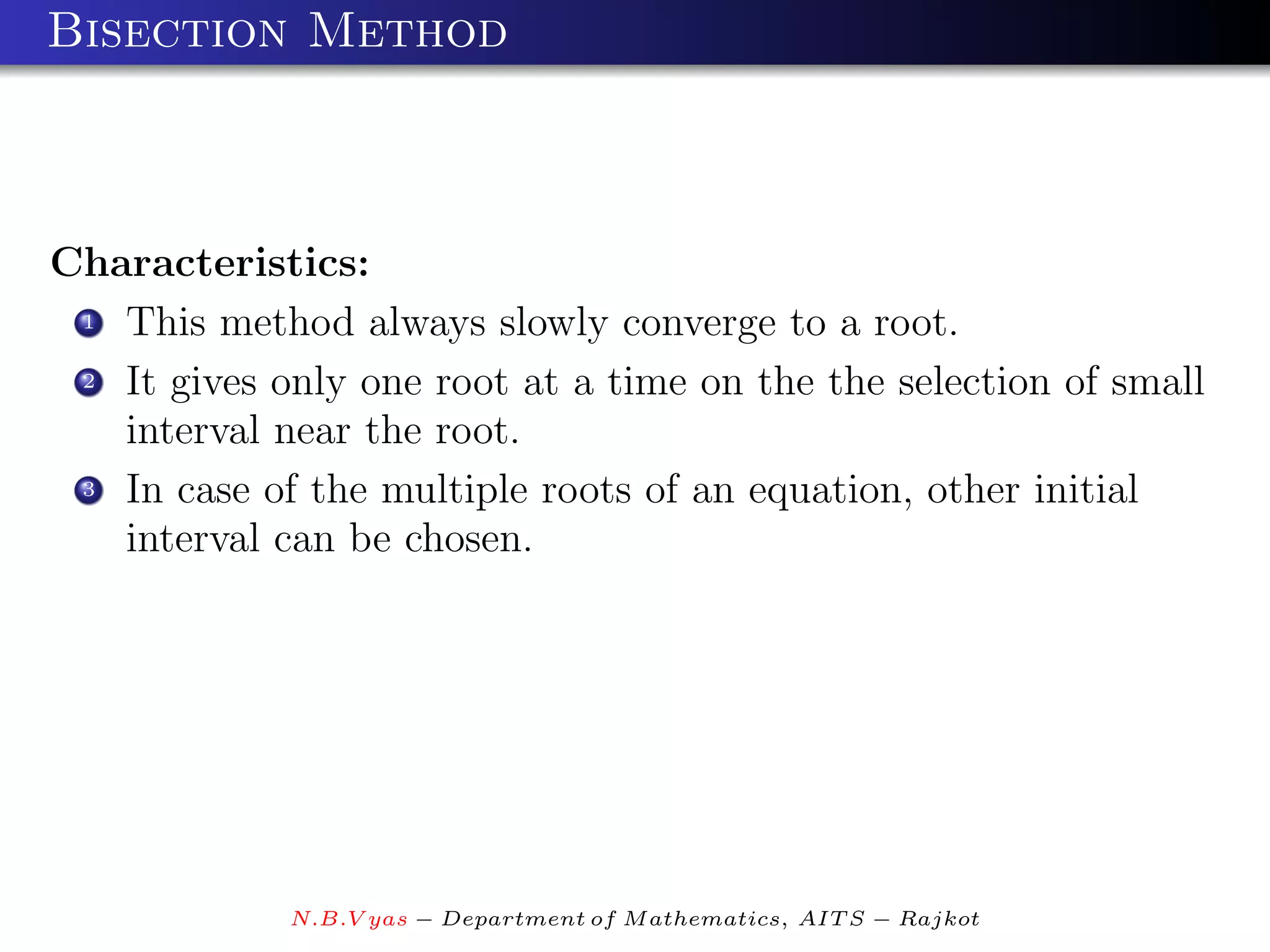
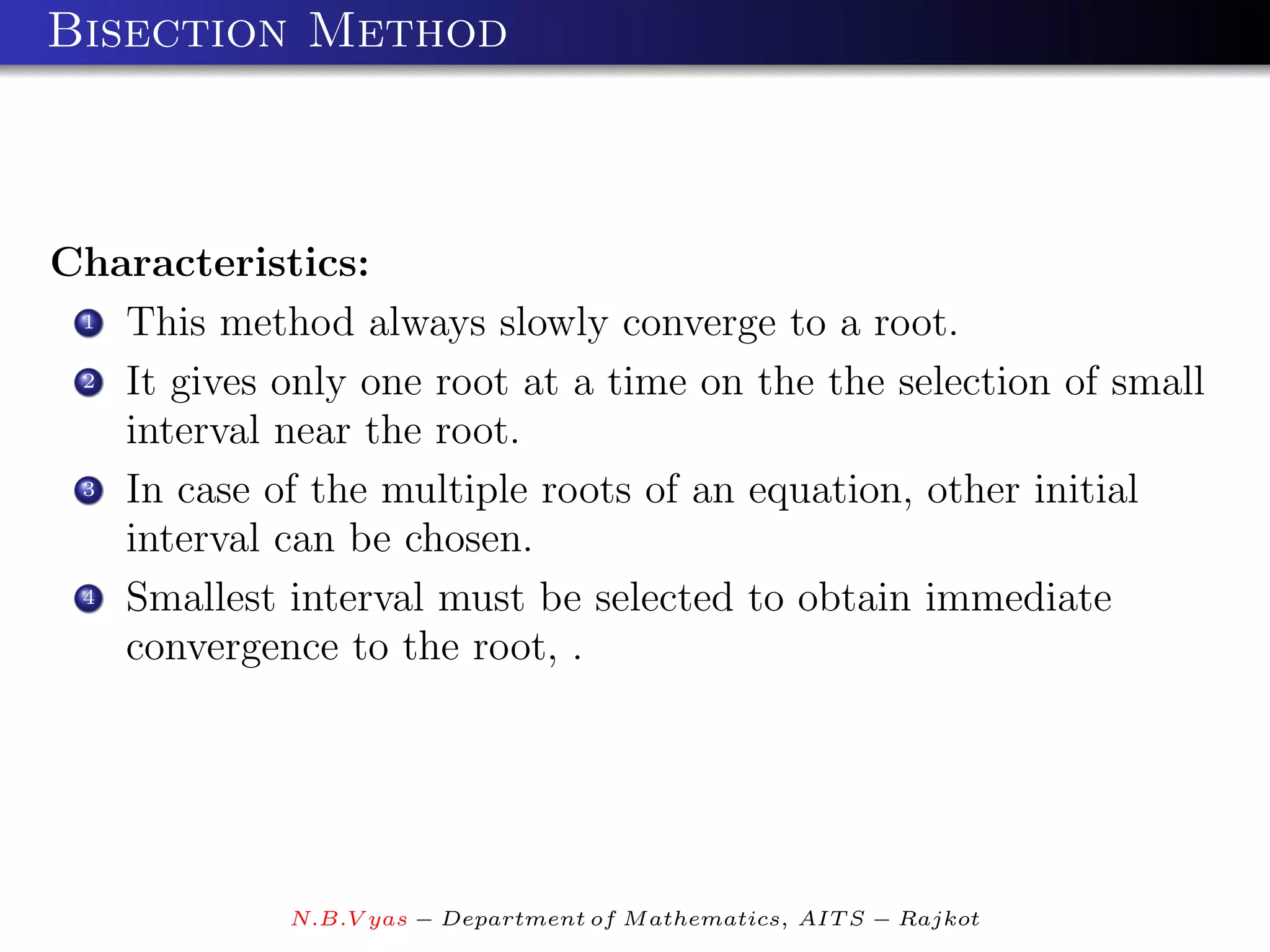
Characteristics:
 1 This method always slowly converge to a root.


            N.B.V yas − Department of M athematics, AIT S − Rajkot
Bisection Method


Characteristics:
 1 This method always slowly converge to a root.

 2 It gives only one root at a time on the the selection of small

   interval near the root.


             N.B.V yas − Department of M athematics, AIT S − Rajkot
Bisection Method


Characteristics:
 1 This method always slowly converge to a root.

 2 It gives only one root at a time on the the selection of small

   interval near the root.
 3 In case of the multiple roots of an equation, other initial

   interval can be chosen.


             N.B.V yas − Department of M athematics, AIT S − Rajkot
Bisection Method


Characteristics:
 1 This method always slowly converge to a root.

 2 It gives only one root at a time on the the selection of small

   interval near the root.
 3 In case of the multiple roots of an equation, other initial

   interval can be chosen.
 4 Smallest interval must be selected to obtain immediate

   convergence to the root, .


             N.B.V yas − Department of M athematics, AIT S − Rajkot
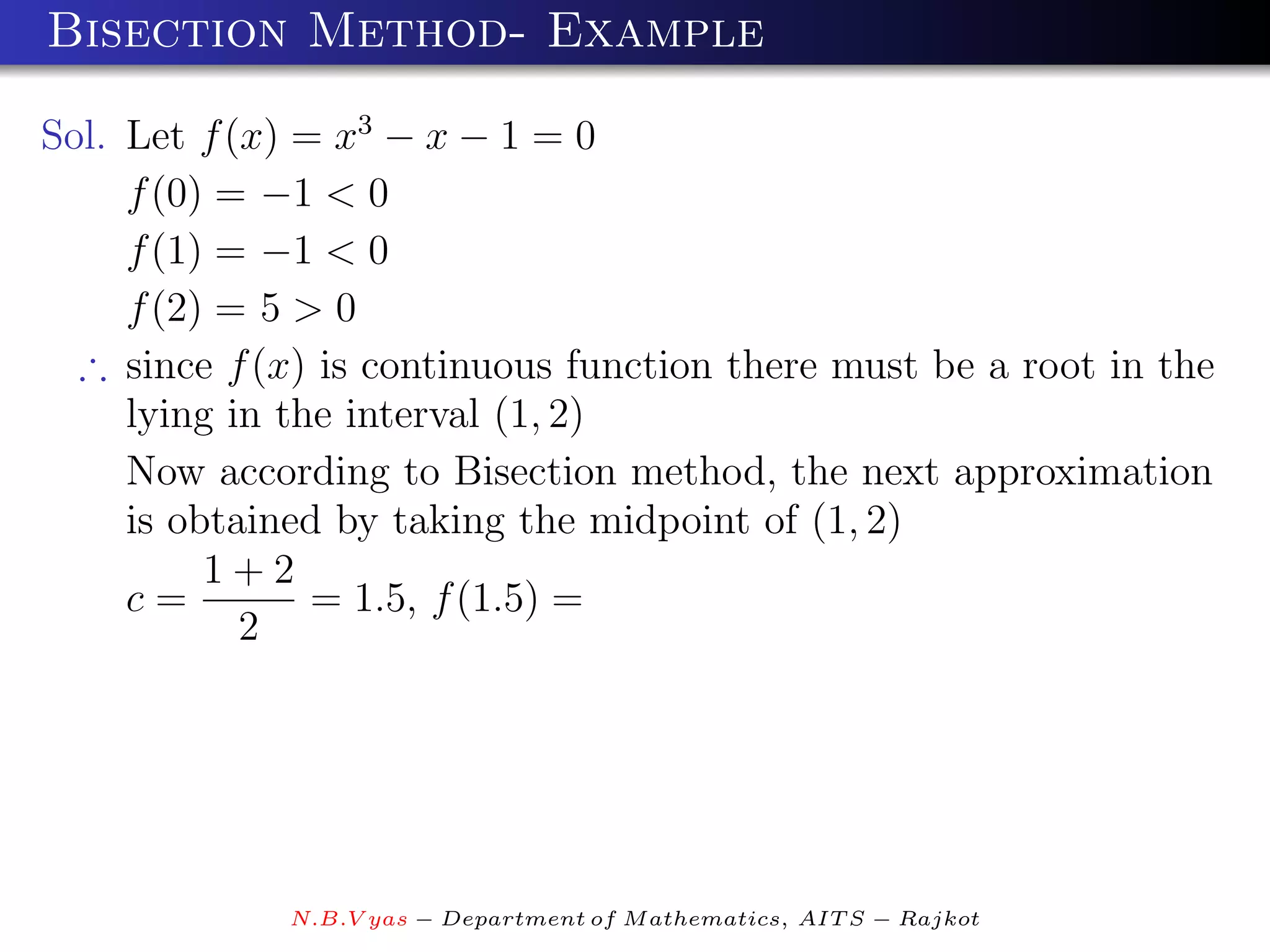
Bisection Method- Example


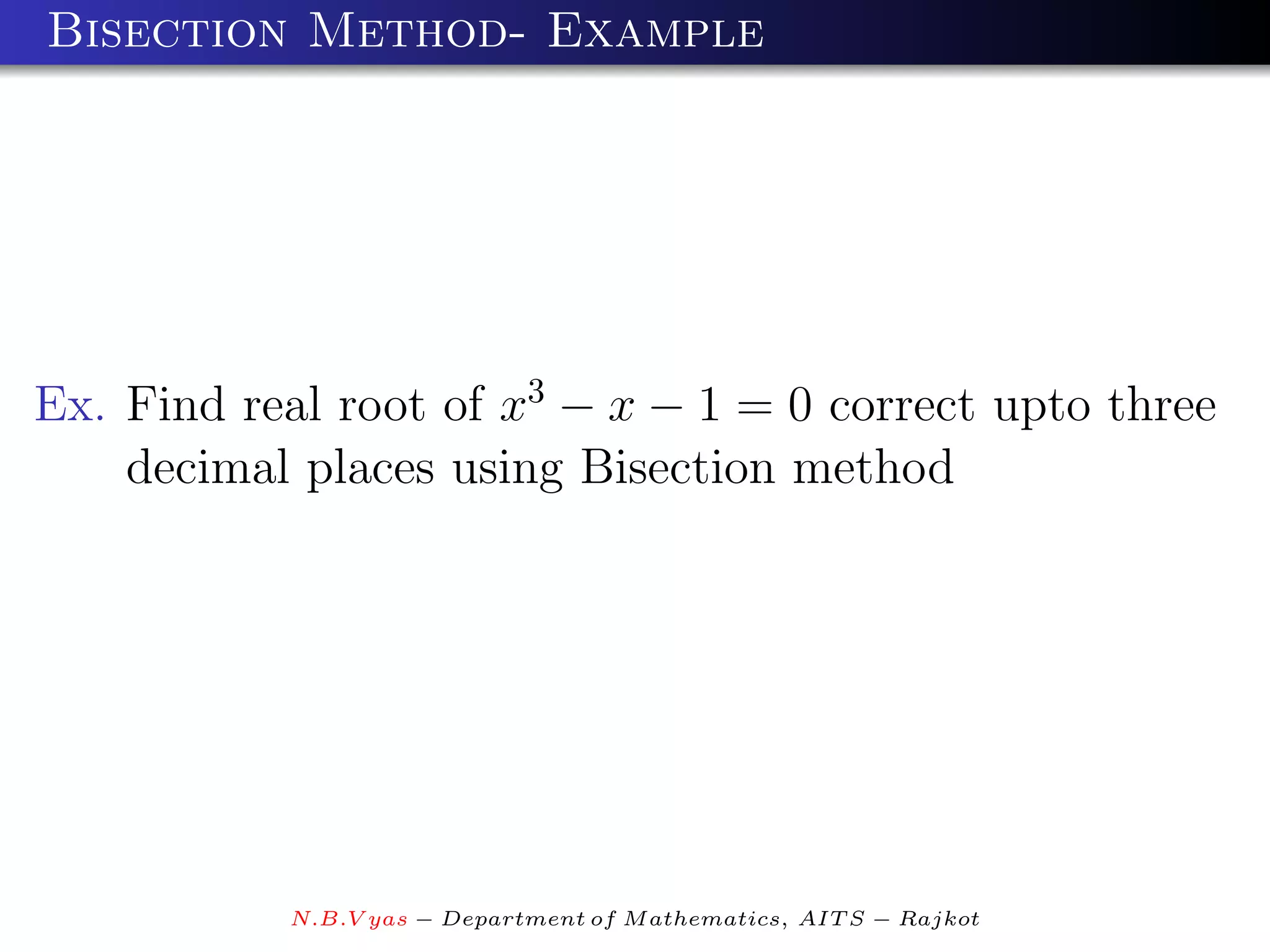
Ex. Find real root of x3 − x − 1 = 0 correct upto three
    decimal places using Bisection method


           N.B.V yas − Department of M athematics, AIT S − Rajkot
Bisection Method- Example

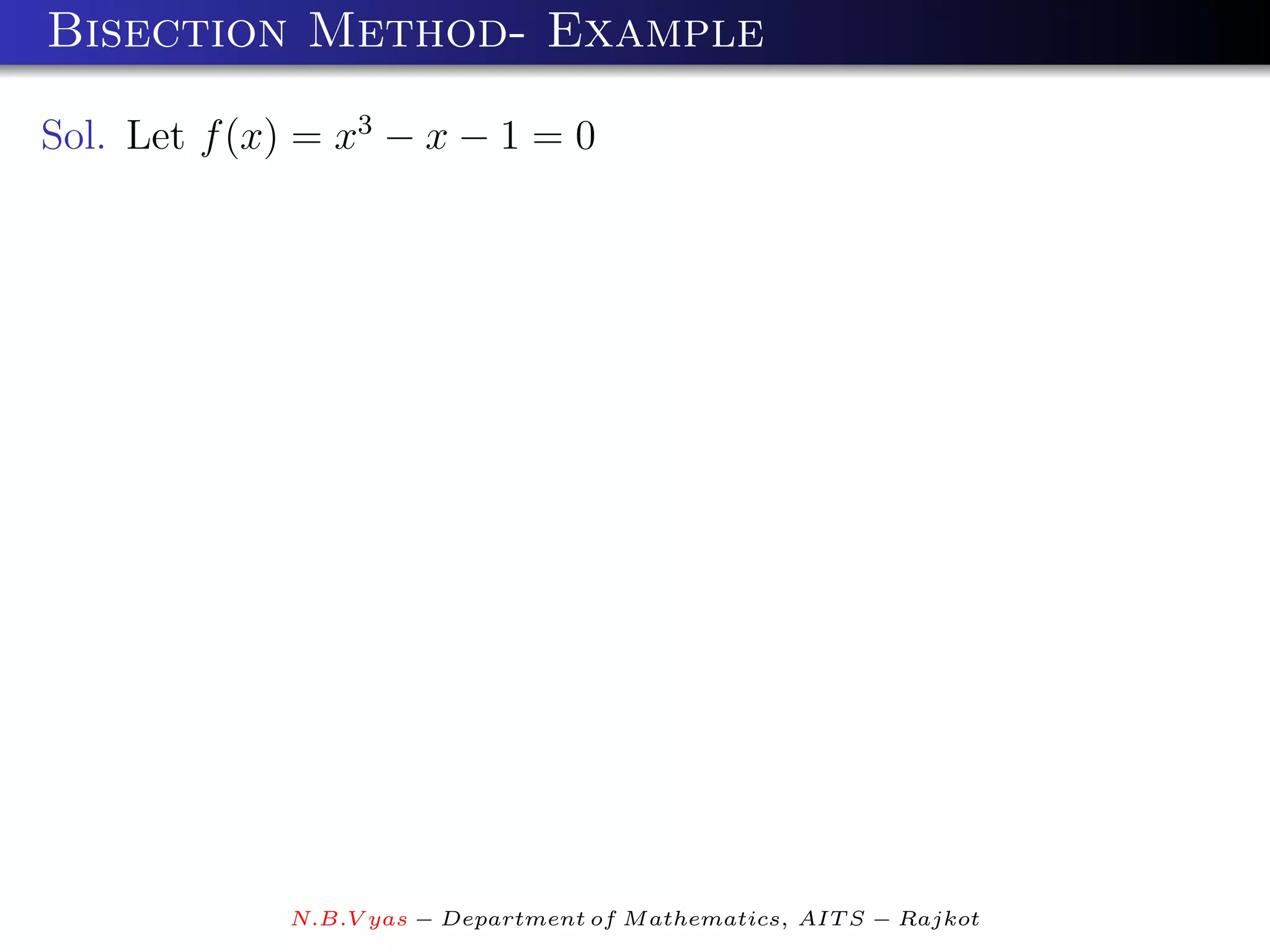
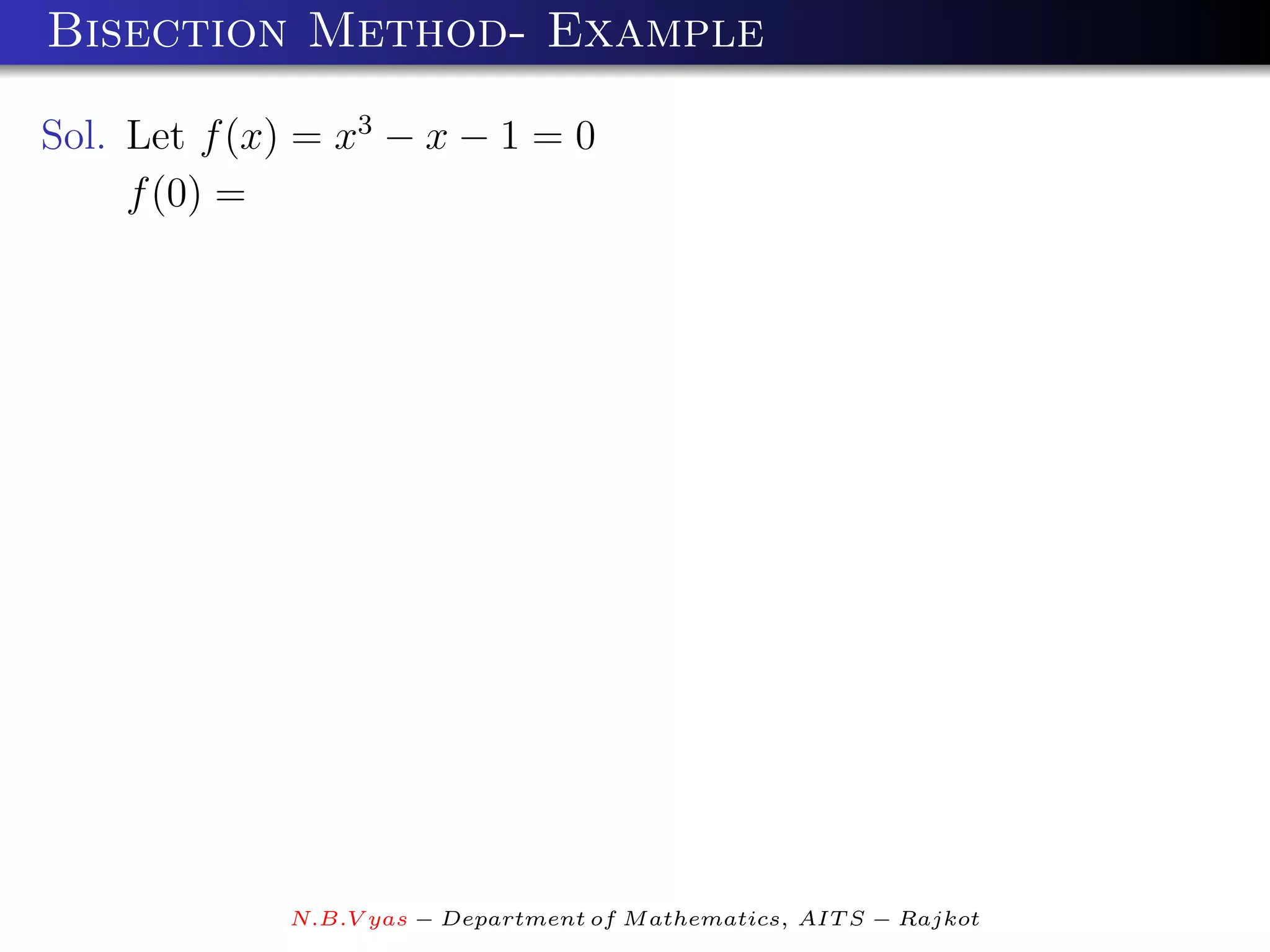
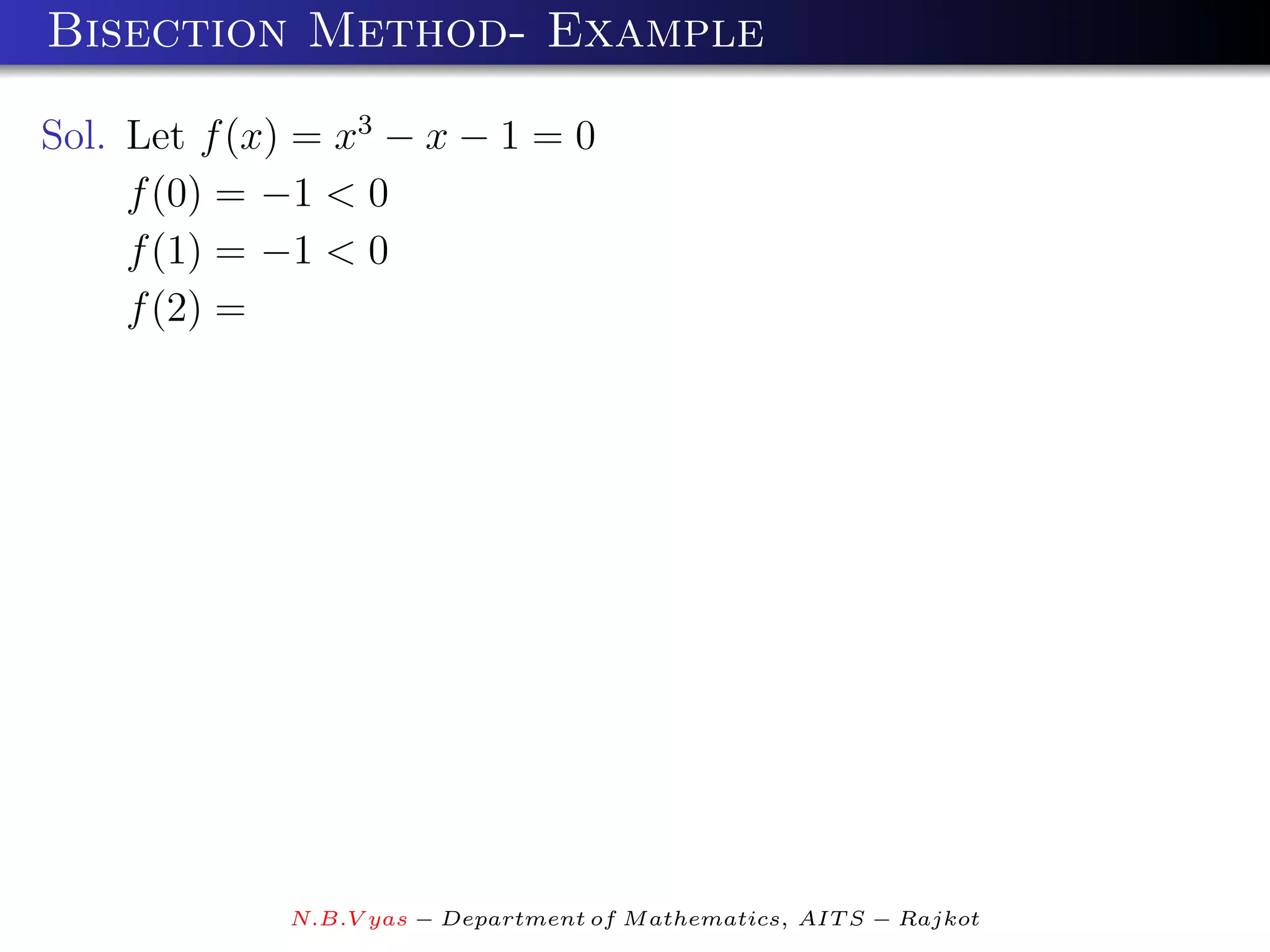
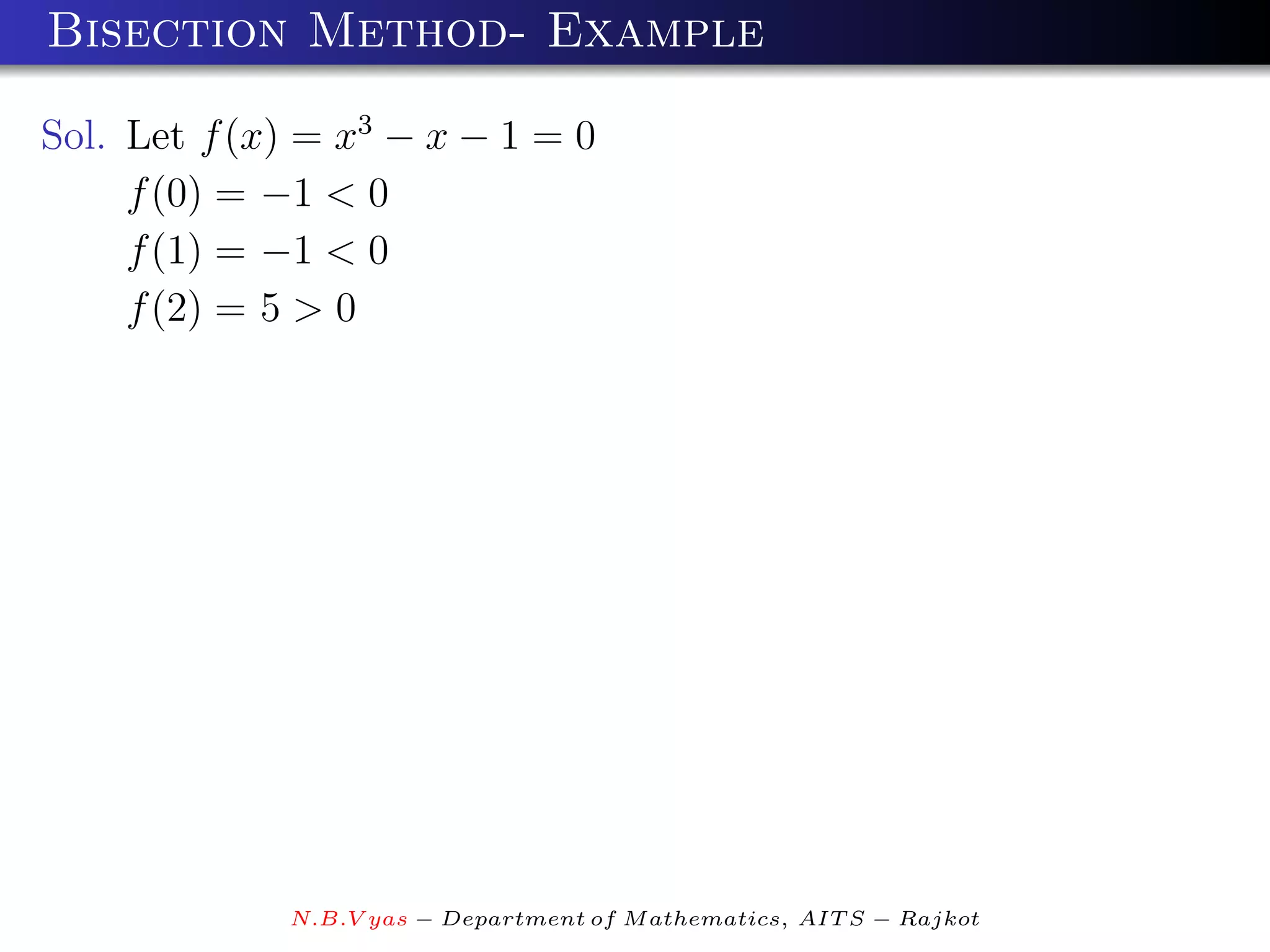
Sol. Let f (x) = x3 − x − 1 = 0


             N.B.V yas − Department of M athematics, AIT S − Rajkot
Bisection Method- Example

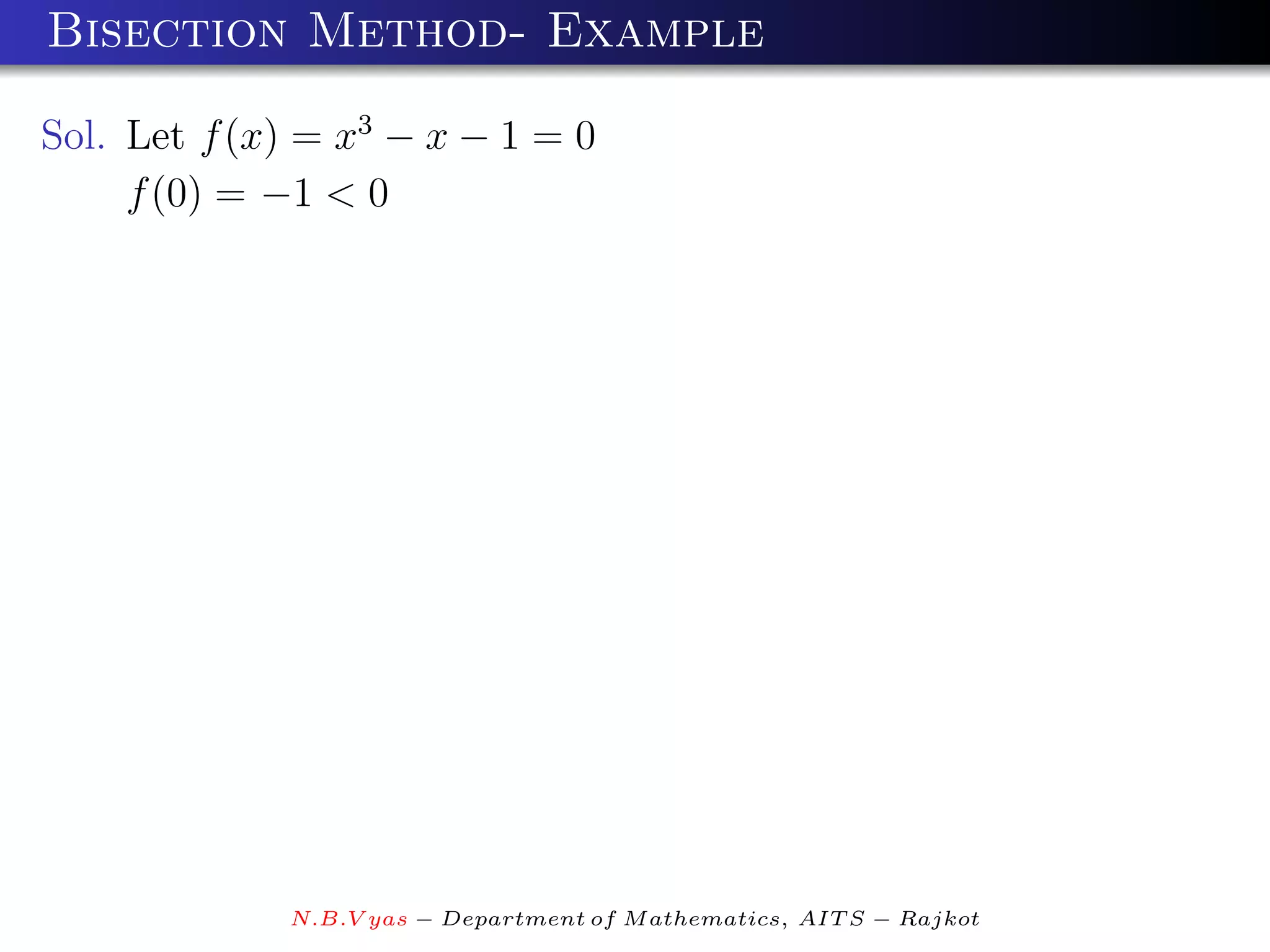
Sol. Let f (x) = x3 − x − 1 = 0
     f (0) =


             N.B.V yas − Department of M athematics, AIT S − Rajkot
Bisection Method- Example

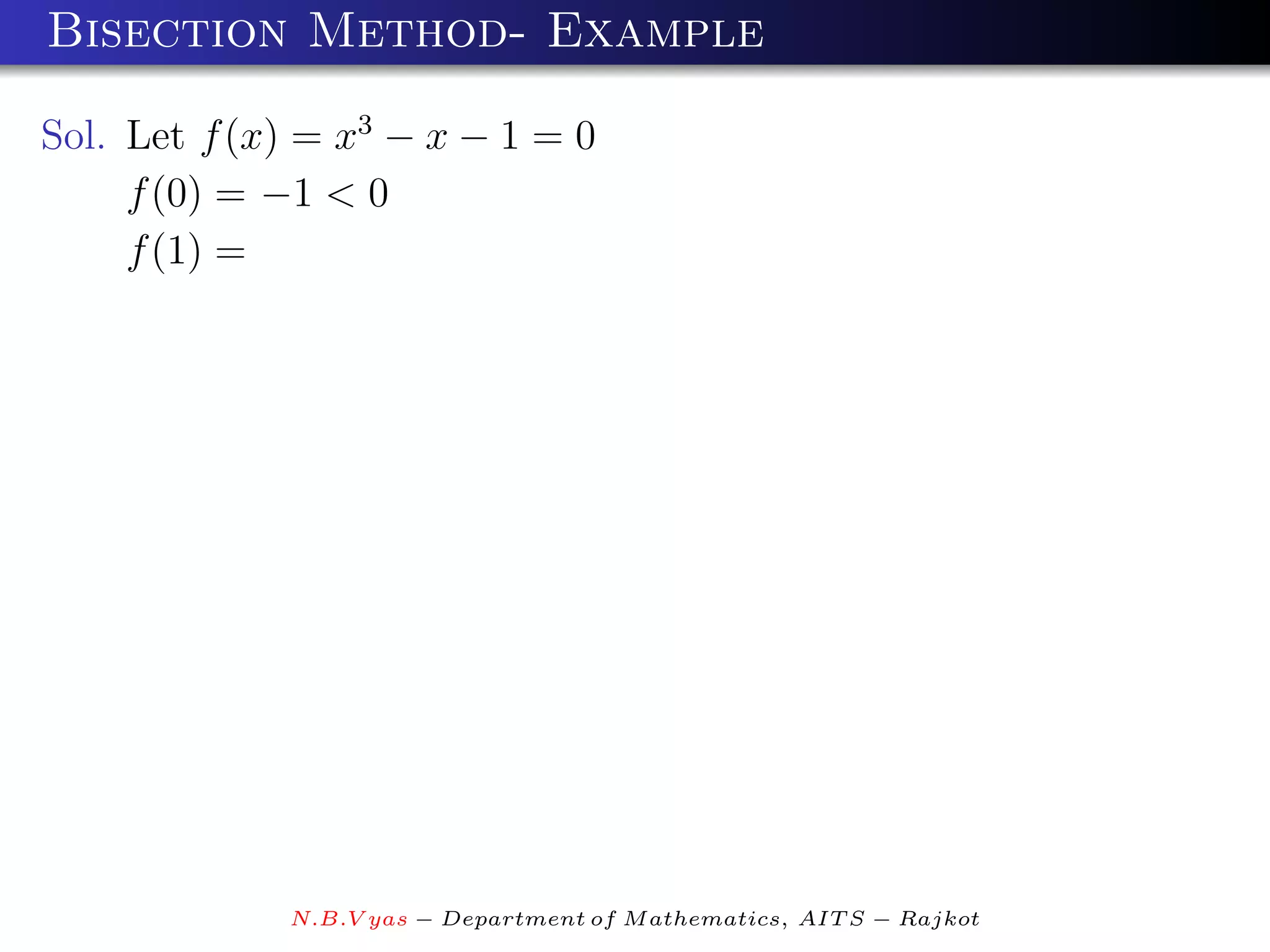
Sol. Let f (x) = x3 − x − 1 = 0
     f (0) = −1 < 0


             N.B.V yas − Department of M athematics, AIT S − Rajkot
Bisection Method- Example

Sol. Let f (x) = x3 − x − 1 = 0
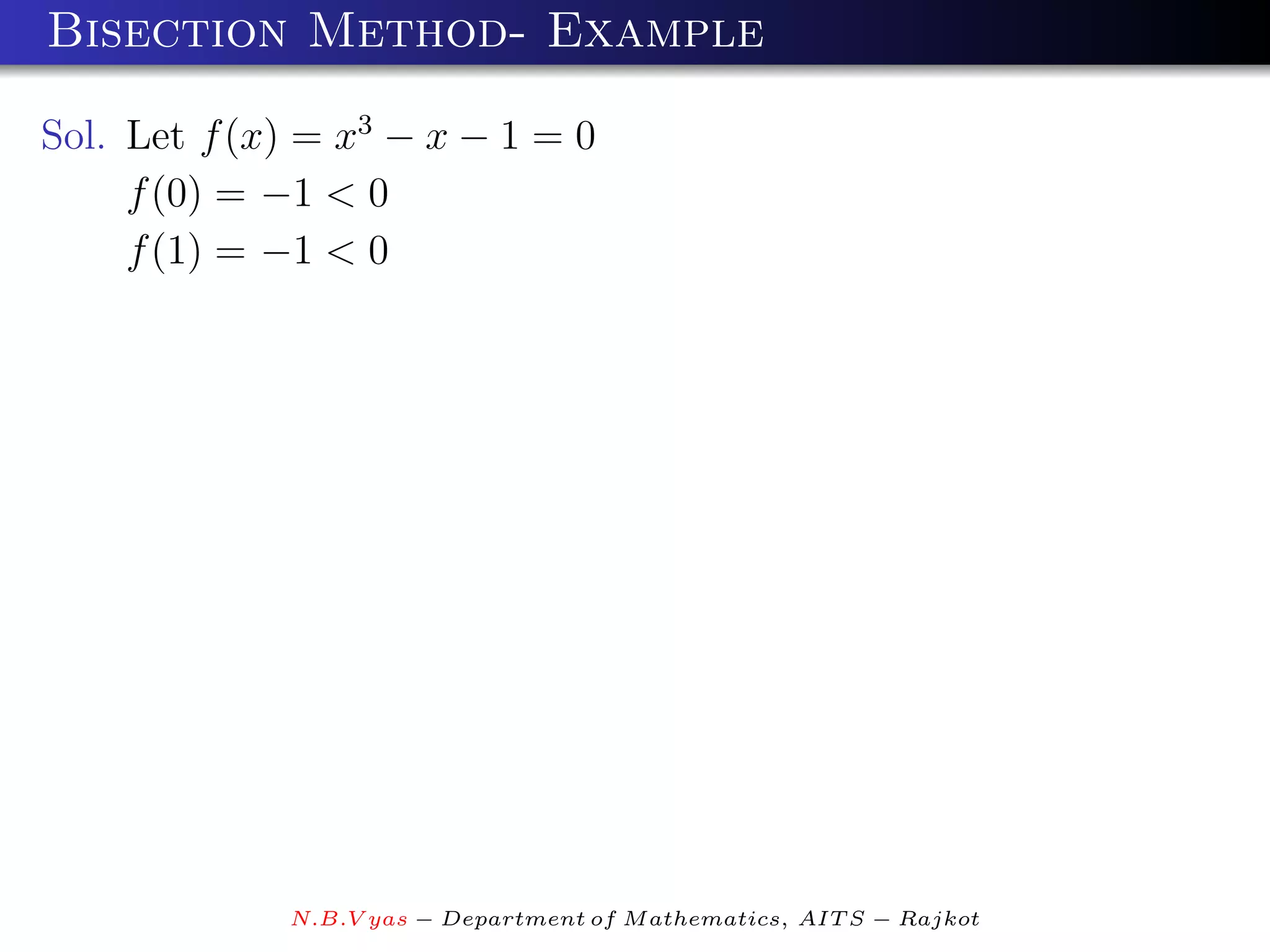
     f (0) = −1 < 0
     f (1) =


             N.B.V yas − Department of M athematics, AIT S − Rajkot
Bisection Method- Example

Sol. Let f (x) = x3 − x − 1 = 0
     f (0) = −1 < 0
     f (1) = −1 < 0


             N.B.V yas − Department of M athematics, AIT S − Rajkot
Bisection Method- Example

Sol. Let f (x) = x3 − x − 1 = 0
     f (0) = −1 < 0
     f (1) = −1 < 0
     f (2) =


             N.B.V yas − Department of M athematics, AIT S − Rajkot
Bisection Method- Example

Sol. Let f (x) = x3 − x − 1 = 0
     f (0) = −1 < 0
     f (1) = −1 < 0
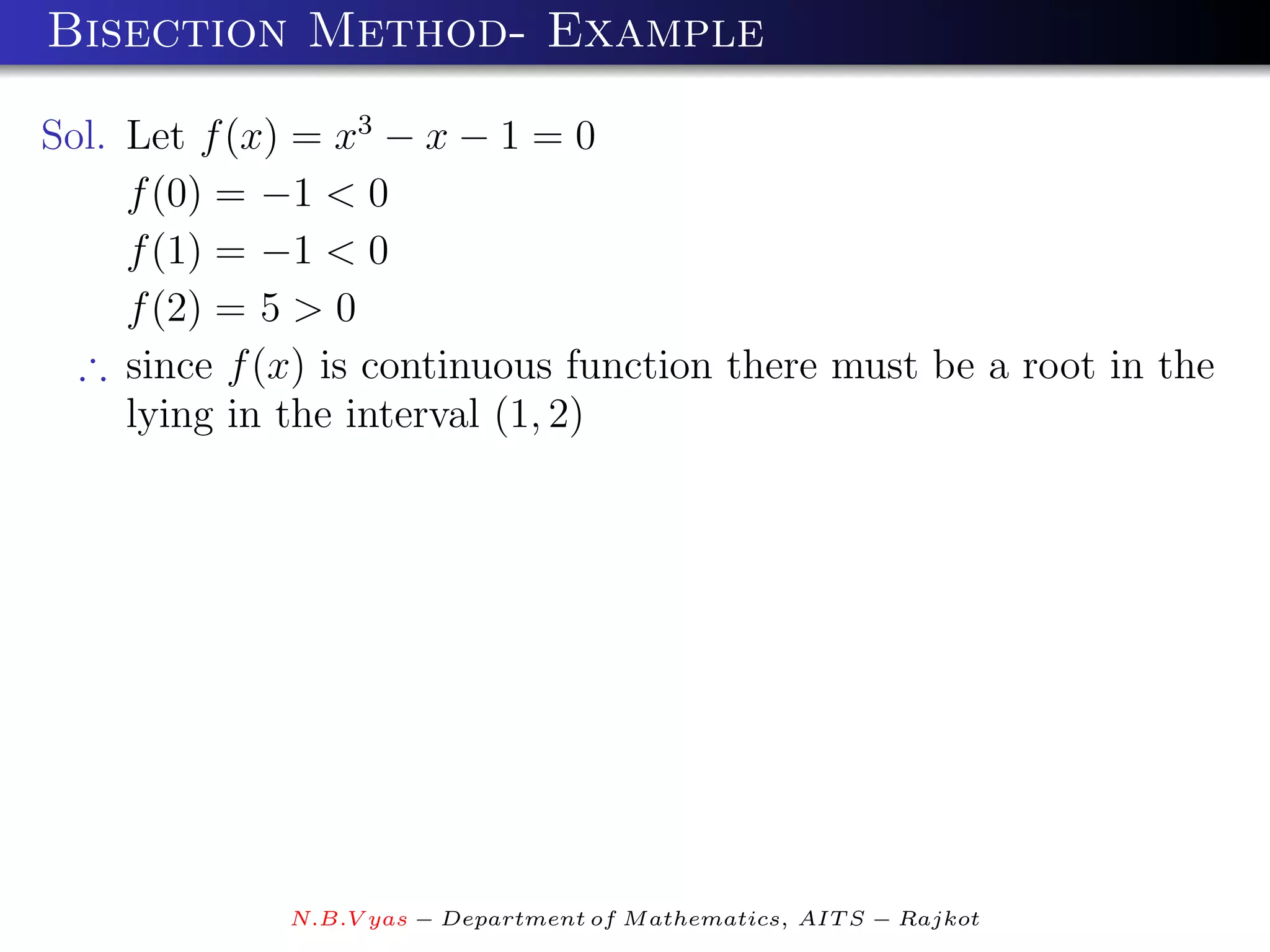
     f (2) = 5 > 0


             N.B.V yas − Department of M athematics, AIT S − Rajkot
Bisection Method- Example

Sol. Let f (x) = x3 − x − 1 = 0
     f (0) = −1 < 0
     f (1) = −1 < 0
     f (2) = 5 > 0
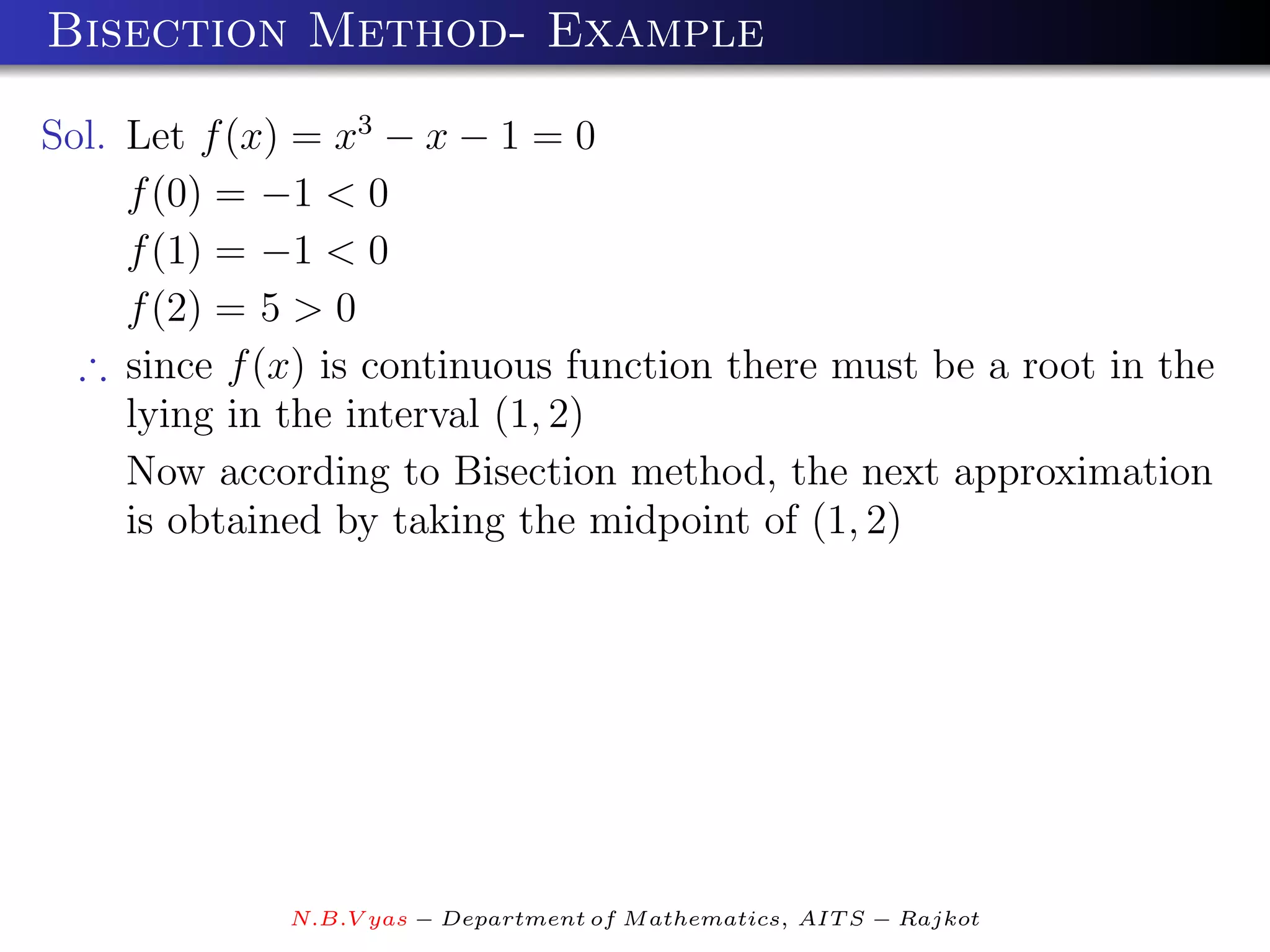
  ∴ since f (x) is continuous function there must be a root in the
     lying in the interval (1, 2)


             N.B.V yas − Department of M athematics, AIT S − Rajkot
Bisection Method- Example

Sol. Let f (x) = x3 − x − 1 = 0
     f (0) = −1 < 0
     f (1) = −1 < 0
     f (2) = 5 > 0
  ∴ since f (x) is continuous function there must be a root in the
     lying in the interval (1, 2)
     Now according to Bisection method, the next approximation
     is obtained by taking the midpoint of (1, 2)


             N.B.V yas − Department of M athematics, AIT S − Rajkot
Bisection Method- Example

Sol. Let f (x) = x3 − x − 1 = 0
     f (0) = −1 < 0
     f (1) = −1 < 0
     f (2) = 5 > 0
  ∴ since f (x) is continuous function there must be a root in the
     lying in the interval (1, 2)
     Now according to Bisection method, the next approximation
     is obtained by taking the midpoint of (1, 2)
          1+2
     c=         = 1.5, f (1.5) =
            2


             N.B.V yas − Department of M athematics, AIT S − Rajkot
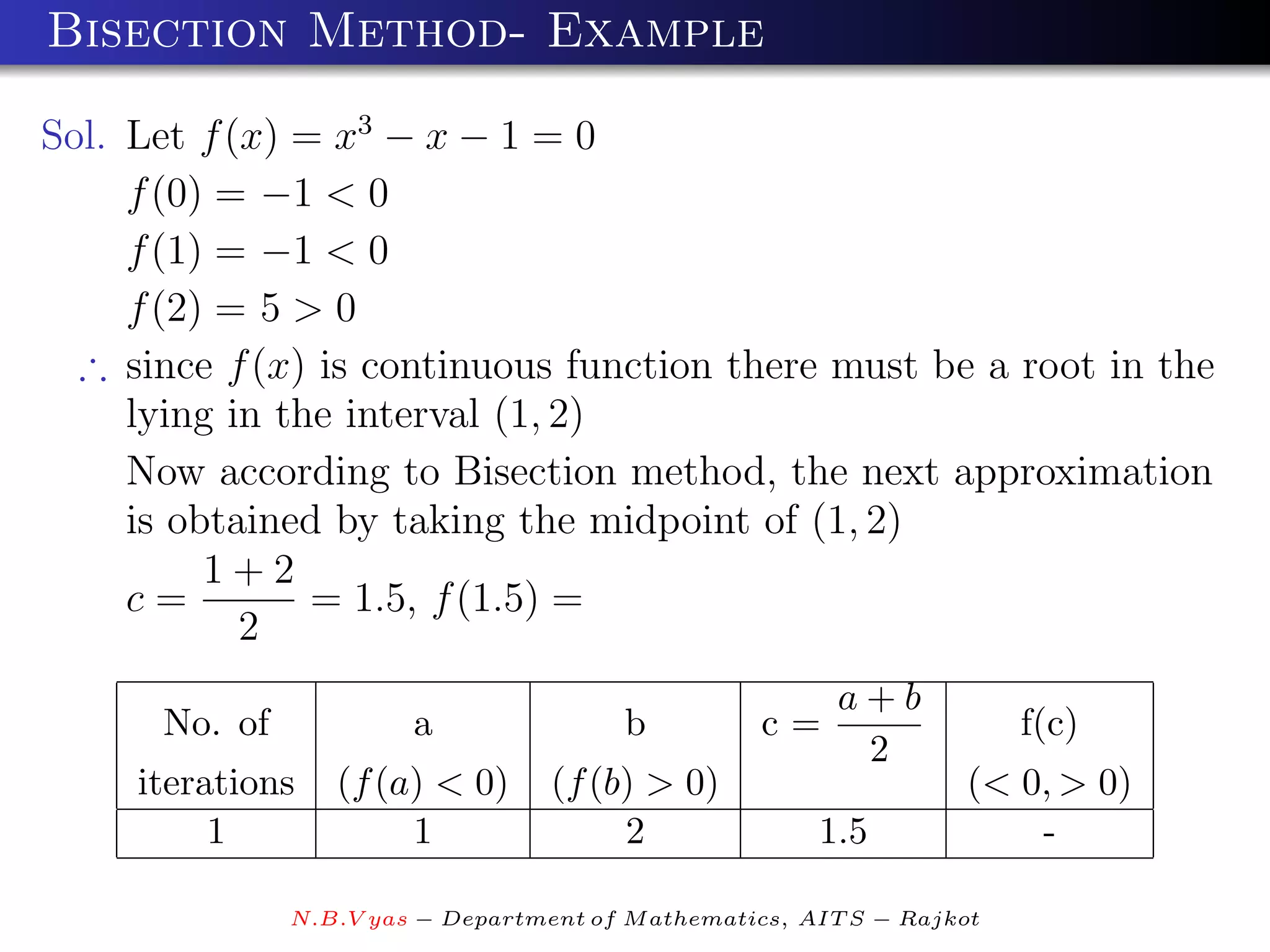
Bisection Method- Example

Sol. Let f (x) = x3 − x − 1 = 0
     f (0) = −1 < 0
     f (1) = −1 < 0
     f (2) = 5 > 0
  ∴ since f (x) is continuous function there must be a root in the
     lying in the interval (1, 2)
     Now according to Bisection method, the next approximation
     is obtained by taking the midpoint of (1, 2)
          1+2
     c=         = 1.5, f (1.5) =
            2
                                                         a+b
      No. of            a                b         c=                   f(c)
                                                          2
     iterations   (f (a) < 0)      (f (b) > 0)                     (< 0, > 0)
          1            1                2               1.5            -

               N.B.V yas − Department of M athematics, AIT S − Rajkot
Bisection Method- Example


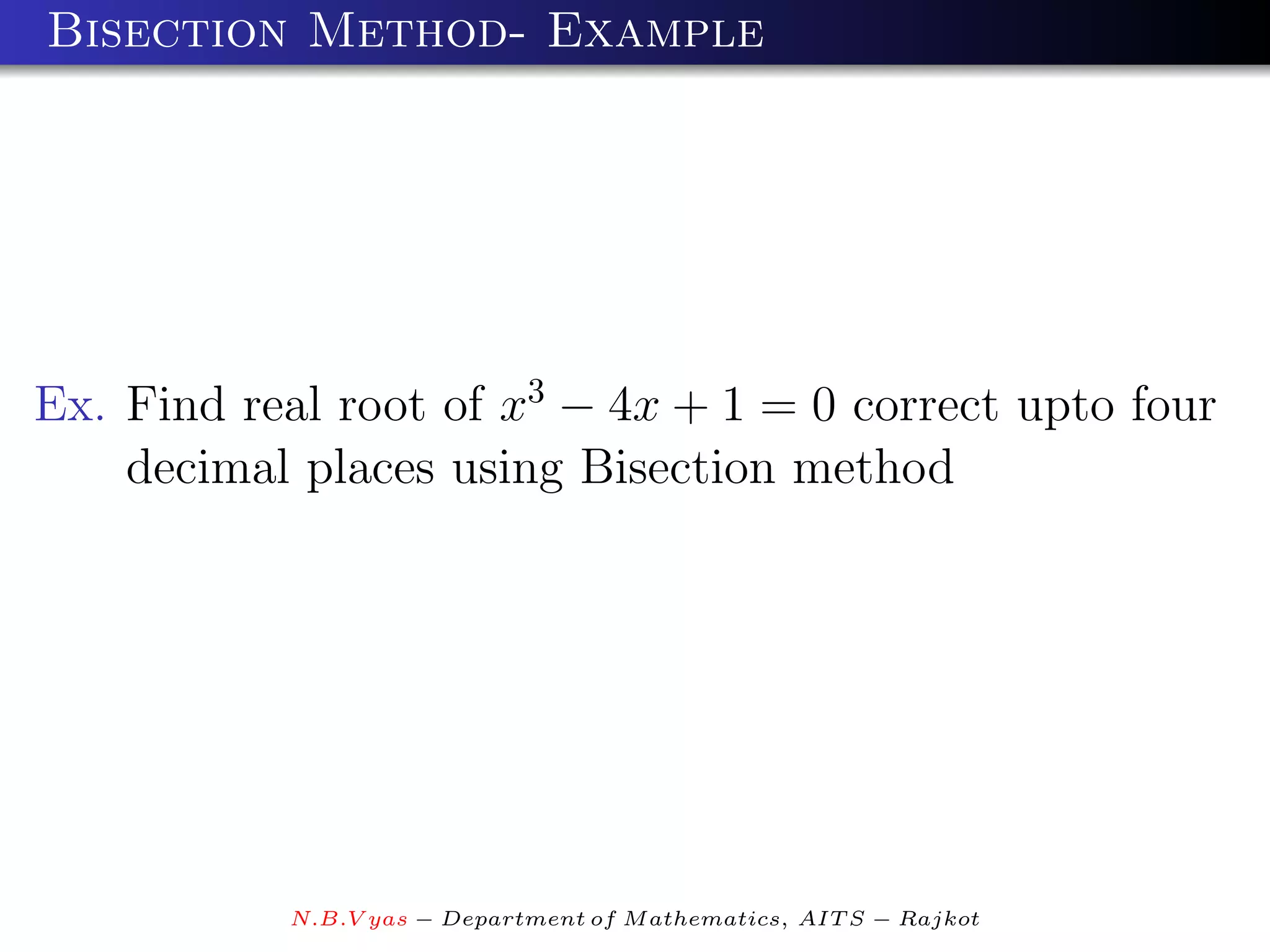
Ex. Find real root of x3 − 4x + 1 = 0 correct upto four
    decimal places using Bisection method


           N.B.V yas − Department of M athematics, AIT S − Rajkot
Bisection Method- Example


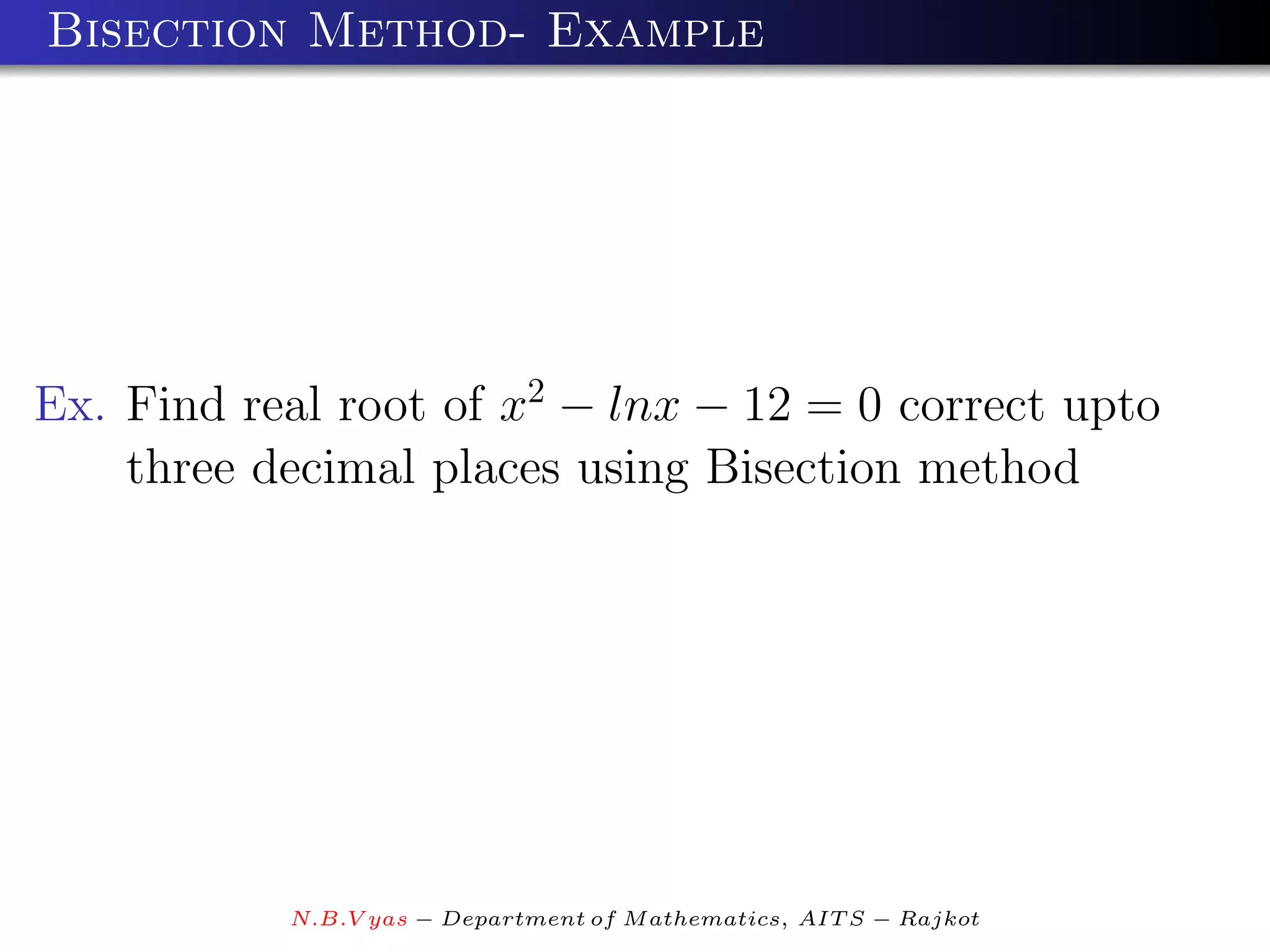
Ex. Find real root of x2 − lnx − 12 = 0 correct upto
    three decimal places using Bisection method


           N.B.V yas − Department of M athematics, AIT S − Rajkot
Newton-Raphson Method(N-R Method)
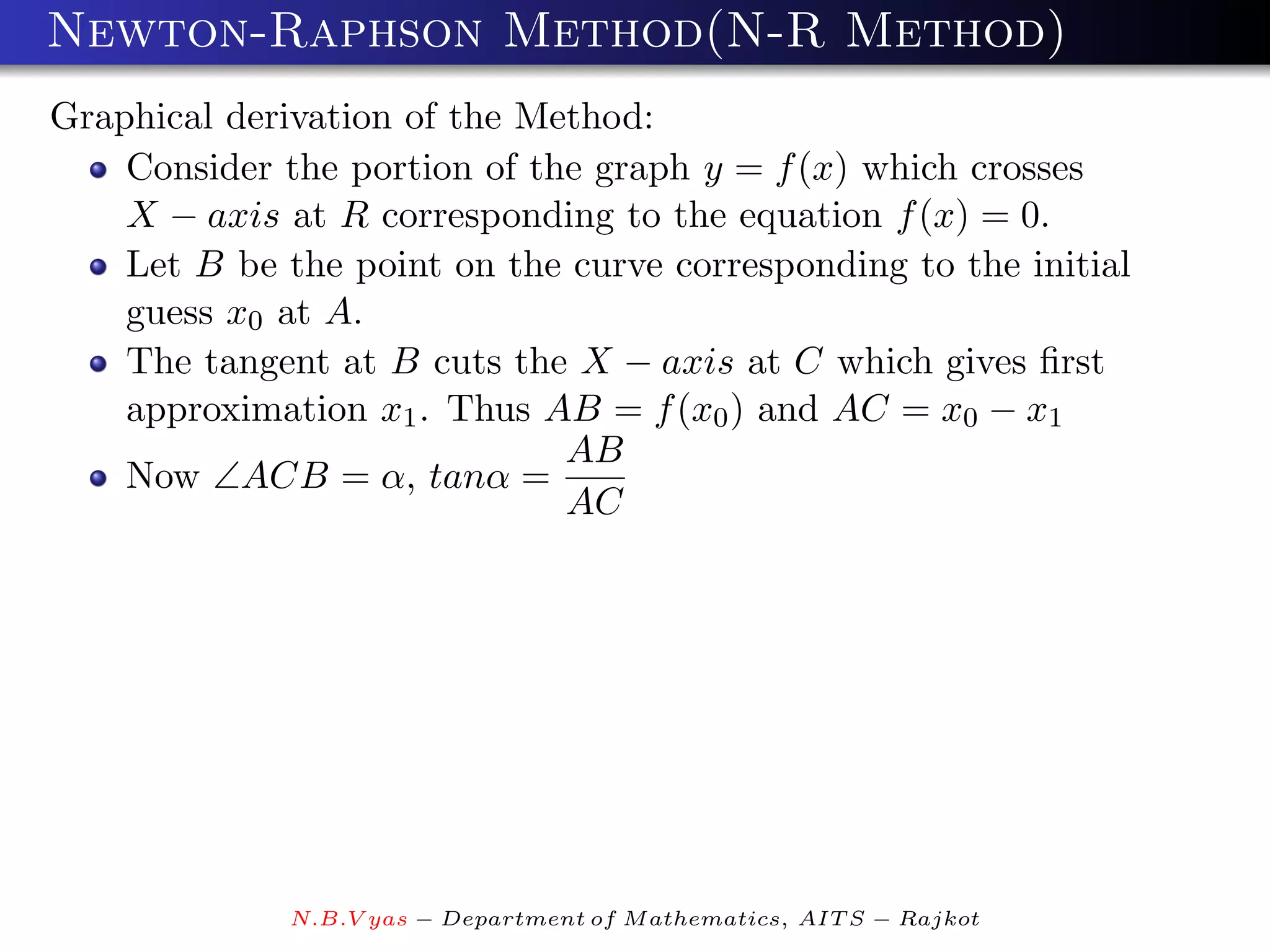
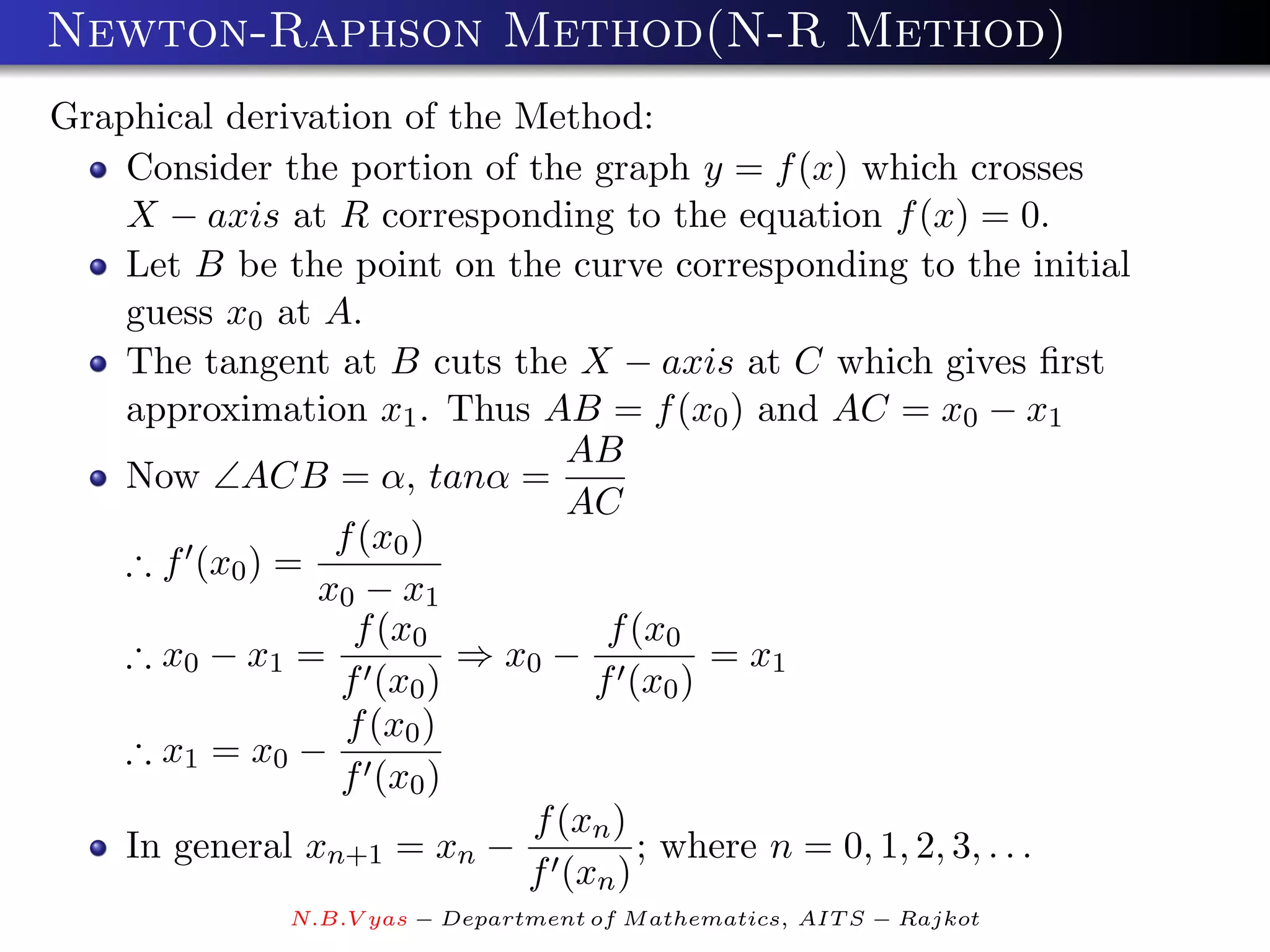
Graphical derivation of the Method:
    Consider the portion of the graph y = f (x) which crosses
    X − axis at R corresponding to the equation f (x) = 0.


              N.B.V yas − Department of M athematics, AIT S − Rajkot
Newton-Raphson Method(N-R Method)
Graphical derivation of the Method:
    Consider the portion of the graph y = f (x) which crosses
    X − axis at R corresponding to the equation f (x) = 0.
    Let B be the point on the curve corresponding to the initial
    guess x0 at A.


              N.B.V yas − Department of M athematics, AIT S − Rajkot
Newton-Raphson Method(N-R Method)
Graphical derivation of the Method:
    Consider the portion of the graph y = f (x) which crosses
    X − axis at R corresponding to the equation f (x) = 0.
    Let B be the point on the curve corresponding to the initial
    guess x0 at A.
    The tangent at B cuts the X − axis at C which gives first
    approximation x1 .


              N.B.V yas − Department of M athematics, AIT S − Rajkot
Newton-Raphson Method(N-R Method)
Graphical derivation of the Method:
    Consider the portion of the graph y = f (x) which crosses
    X − axis at R corresponding to the equation f (x) = 0.
    Let B be the point on the curve corresponding to the initial
    guess x0 at A.
    The tangent at B cuts the X − axis at C which gives first
    approximation x1 . Thus AB = f (x0 ) and AC = x0 − x1


              N.B.V yas − Department of M athematics, AIT S − Rajkot
Newton-Raphson Method(N-R Method)
Graphical derivation of the Method:
    Consider the portion of the graph y = f (x) which crosses
    X − axis at R corresponding to the equation f (x) = 0.
    Let B be the point on the curve corresponding to the initial
    guess x0 at A.
    The tangent at B cuts the X − axis at C which gives first
    approximation x1 . Thus AB = f (x0 ) and AC = x0 − x1
                              AB
    Now ∠ACB = α, tanα =
                              AC


              N.B.V yas − Department of M athematics, AIT S − Rajkot
Newton-Raphson Method(N-R Method)
Graphical derivation of the Method:
    Consider the portion of the graph y = f (x) which crosses
    X − axis at R corresponding to the equation f (x) = 0.
    Let B be the point on the curve corresponding to the initial
    guess x0 at A.
    The tangent at B cuts the X − axis at C which gives first
    approximation x1 . Thus AB = f (x0 ) and AC = x0 − x1
                              AB
    Now ∠ACB = α, tanα =
                              AC
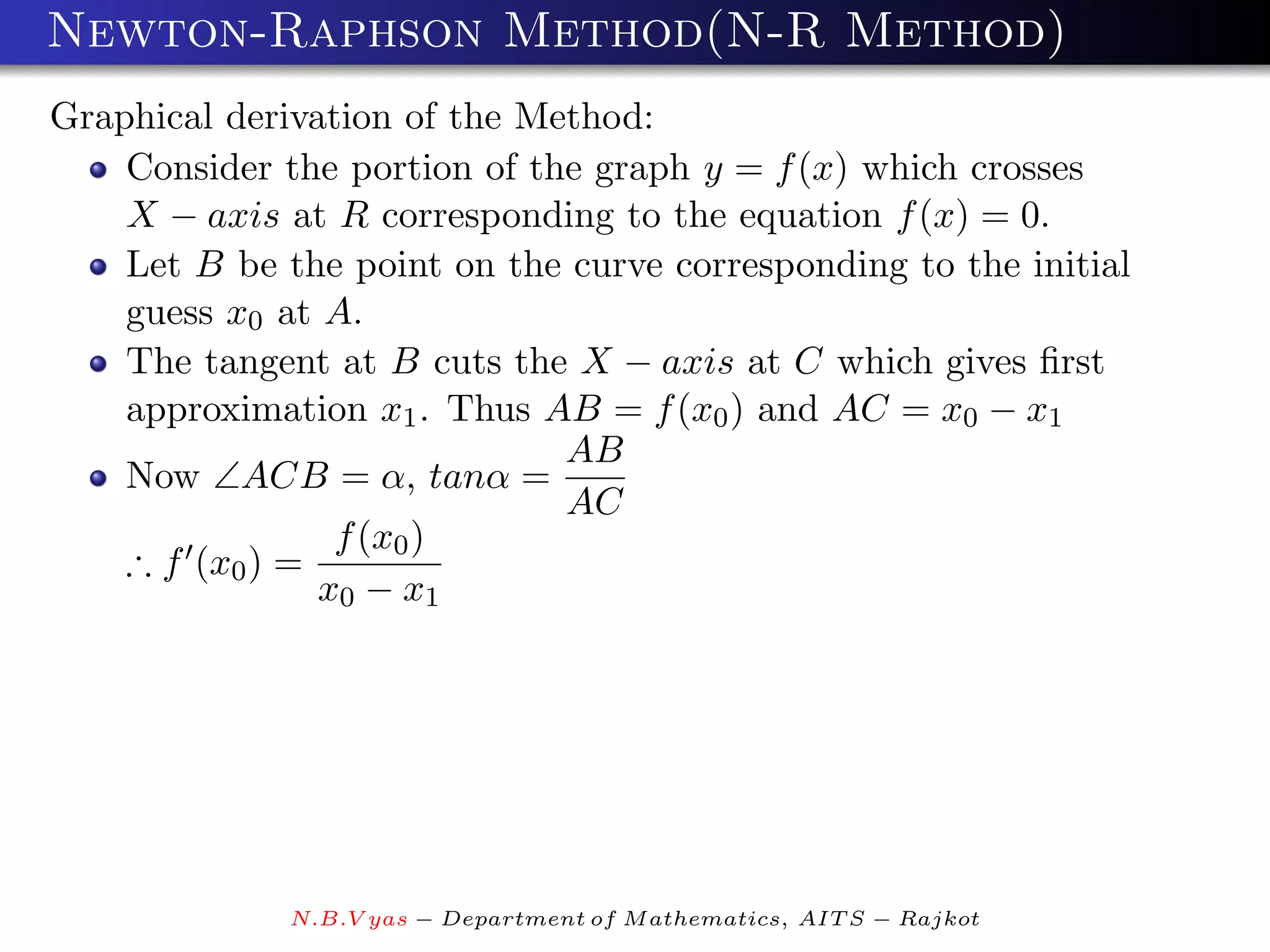
                 f (x0 )
    ∴ f (x0 ) =
                x0 − x1


              N.B.V yas − Department of M athematics, AIT S − Rajkot
Newton-Raphson Method(N-R Method)
Graphical derivation of the Method:
    Consider the portion of the graph y = f (x) which crosses
    X − axis at R corresponding to the equation f (x) = 0.
    Let B be the point on the curve corresponding to the initial
    guess x0 at A.
    The tangent at B cuts the X − axis at C which gives first
    approximation x1 . Thus AB = f (x0 ) and AC = x0 − x1
                              AB
    Now ∠ACB = α, tanα =
                              AC
                 f (x0 )
    ∴ f (x0 ) =
                x0 − x1
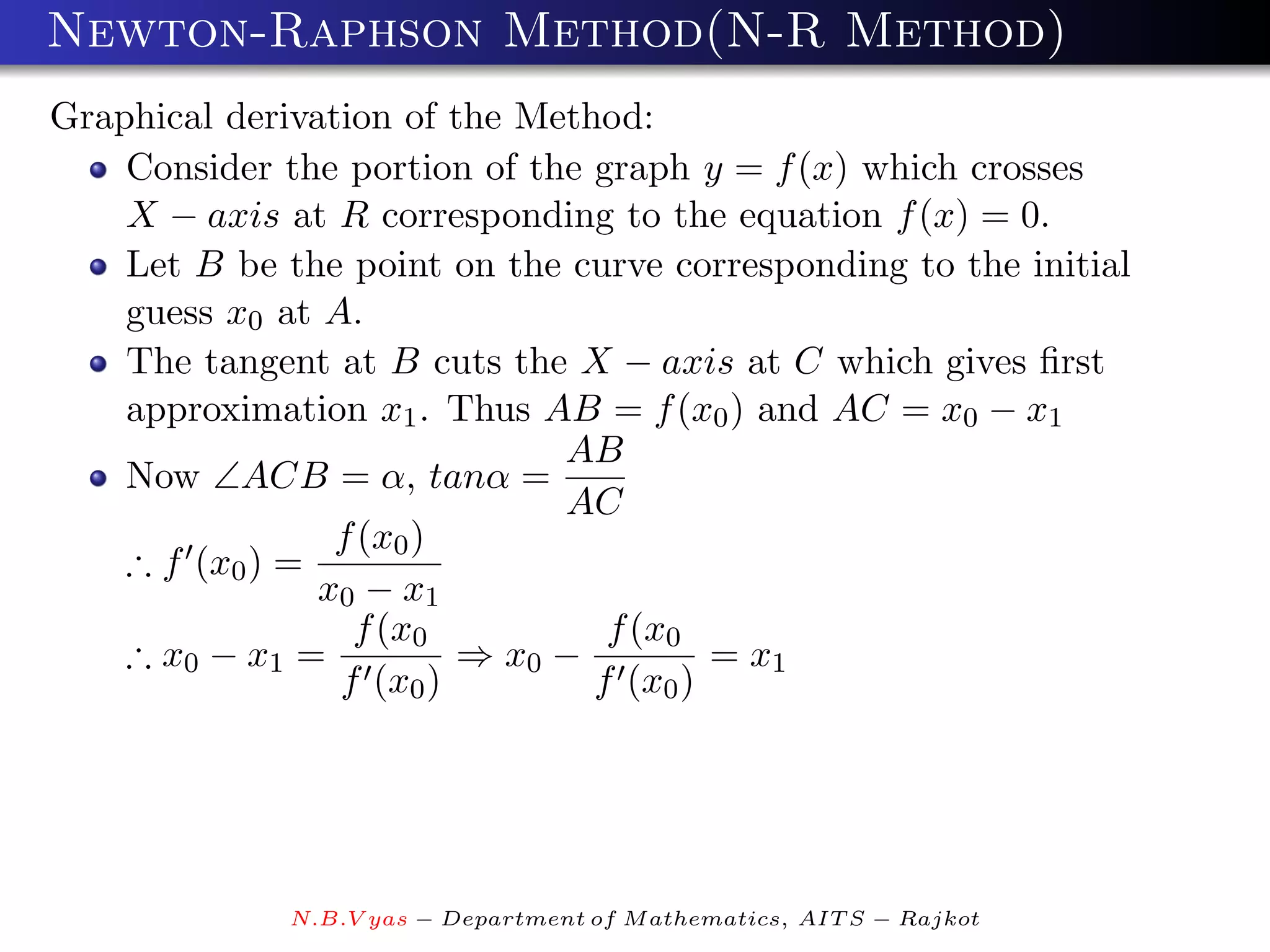
                  f (x0          f (x0
    ∴ x0 − x1 =          ⇒ x0 −         = x1
                 f (x0 )        f (x0 )


              N.B.V yas − Department of M athematics, AIT S − Rajkot
Newton-Raphson Method(N-R Method)
Graphical derivation of the Method:
    Consider the portion of the graph y = f (x) which crosses
    X − axis at R corresponding to the equation f (x) = 0.
    Let B be the point on the curve corresponding to the initial
    guess x0 at A.
    The tangent at B cuts the X − axis at C which gives first
    approximation x1 . Thus AB = f (x0 ) and AC = x0 − x1
                               AB
    Now ∠ACB = α, tanα =
                               AC
                 f (x0 )
    ∴ f (x0 ) =
                x0 − x1
                  f (x0           f (x0
    ∴ x0 − x1 =           ⇒ x0 −         = x1
                 f (x0 )         f (x0 )
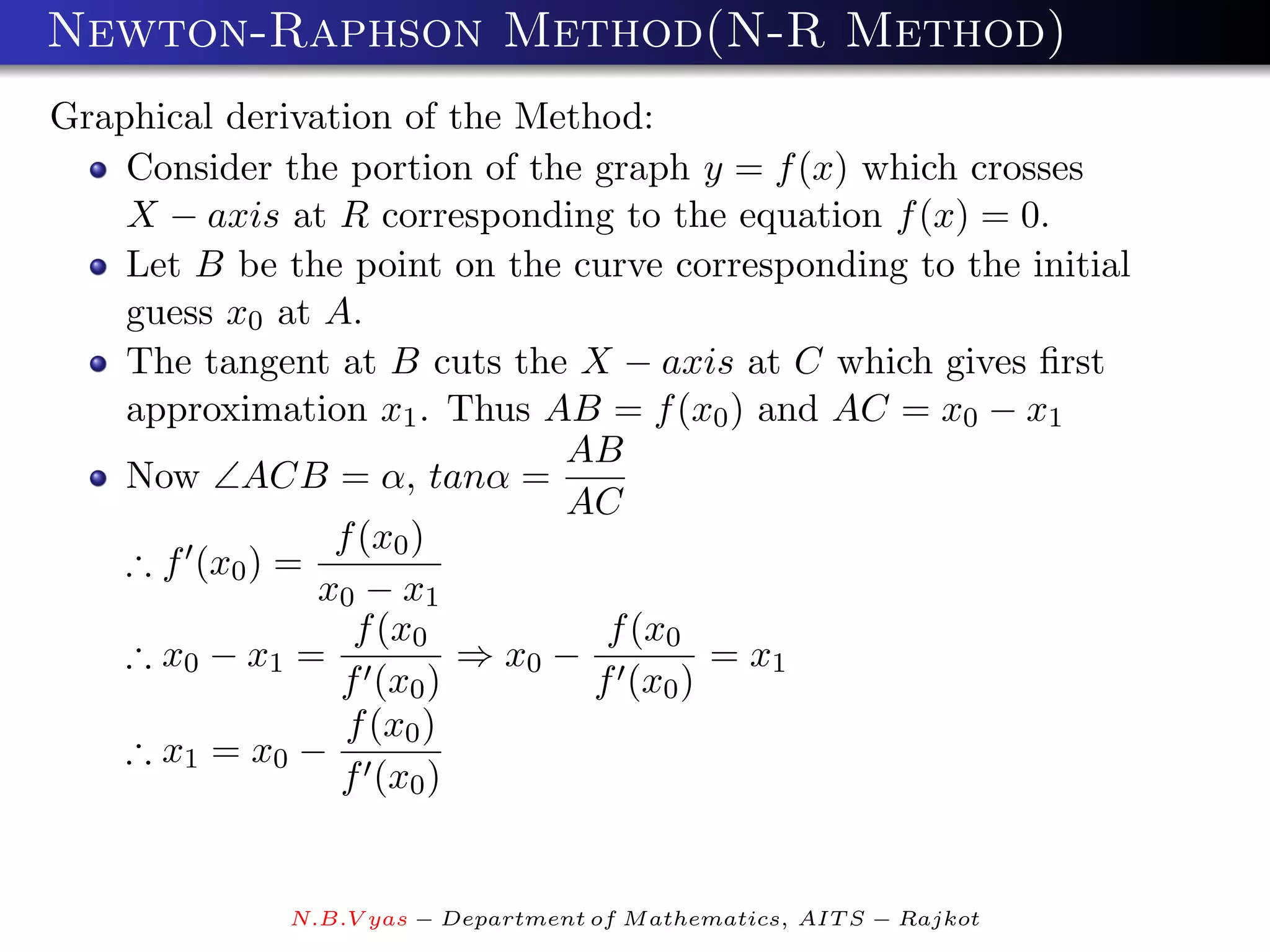
                  f (x0 )
    ∴ x1 = x0 −
                 f (x0 )


              N.B.V yas − Department of M athematics, AIT S − Rajkot
Newton-Raphson Method(N-R Method)
Graphical derivation of the Method:
    Consider the portion of the graph y = f (x) which crosses
    X − axis at R corresponding to the equation f (x) = 0.
    Let B be the point on the curve corresponding to the initial
    guess x0 at A.
    The tangent at B cuts the X − axis at C which gives first
    approximation x1 . Thus AB = f (x0 ) and AC = x0 − x1
                                AB
    Now ∠ACB = α, tanα =
                                AC
                 f (x0 )
    ∴ f (x0 ) =
                x0 − x1
                  f (x0           f (x0
    ∴ x0 − x1 =           ⇒ x0 −         = x1
                 f (x0 )         f (x0 )
                  f (x0 )
    ∴ x1 = x0 −
                 f (x0 )
                             f (xn )
    In general xn+1 = xn −           ; where n = 0, 1, 2, 3, . . .
                             f (xn )
              N.B.V yas − Department of M athematics, AIT S − Rajkot
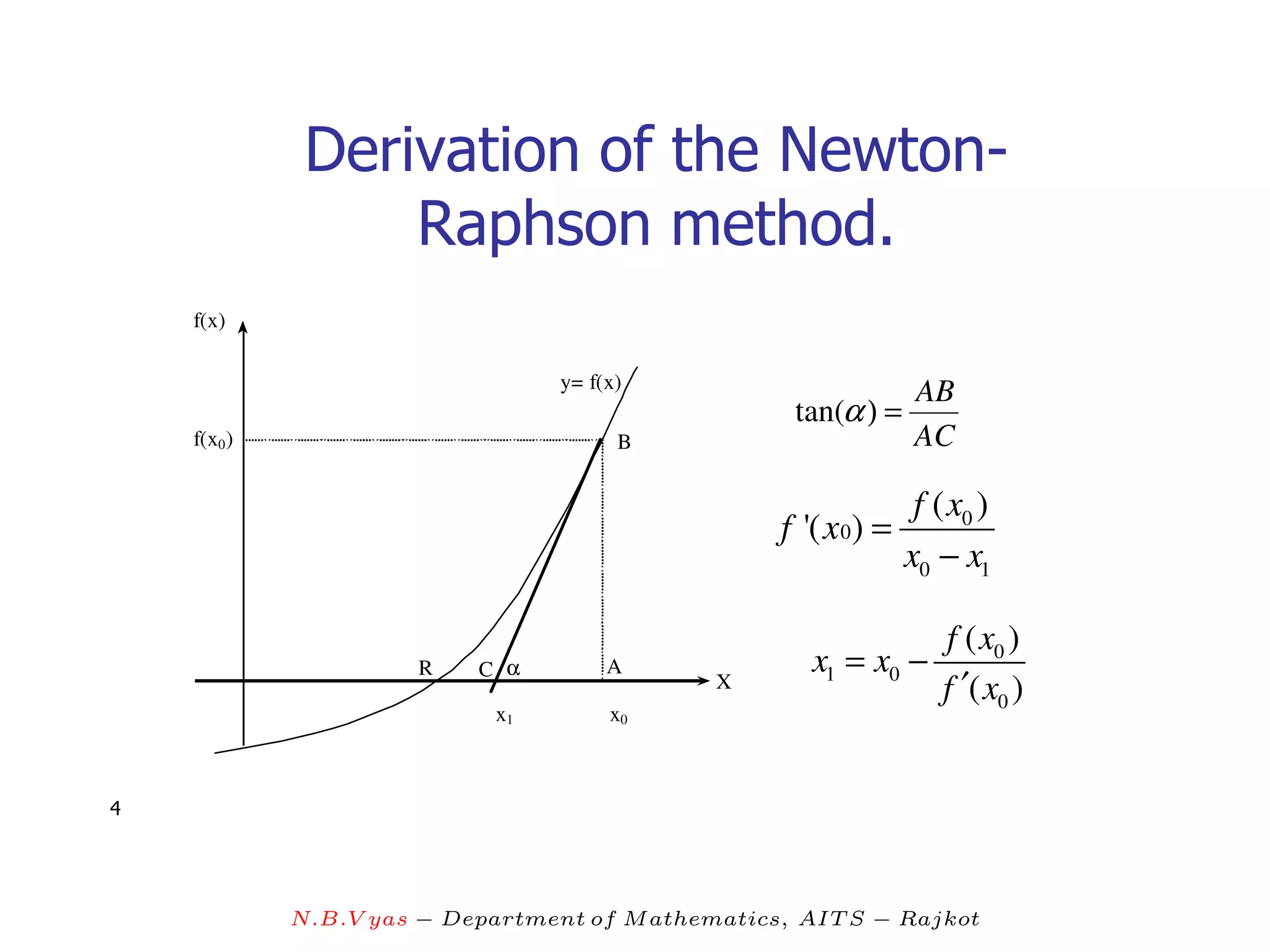
Derivation of the Newton-
                  Raphson method.
    f(x)

                                  y= f(x)
                                                                  AB
                                                    tan(α ) =
    f(x0 )                              B                         AC

                                                                  f ( x0 )
                                                   f '( x 0) =
                                                                 x0 − x1

                                                                     f ( x0 )
                       R   C α         A              x1 = x0 −
                                              X                      f ′( x0 )
                             x1        x0


4


             N.B.V yas − Department of M athematics, AIT S − Rajkot
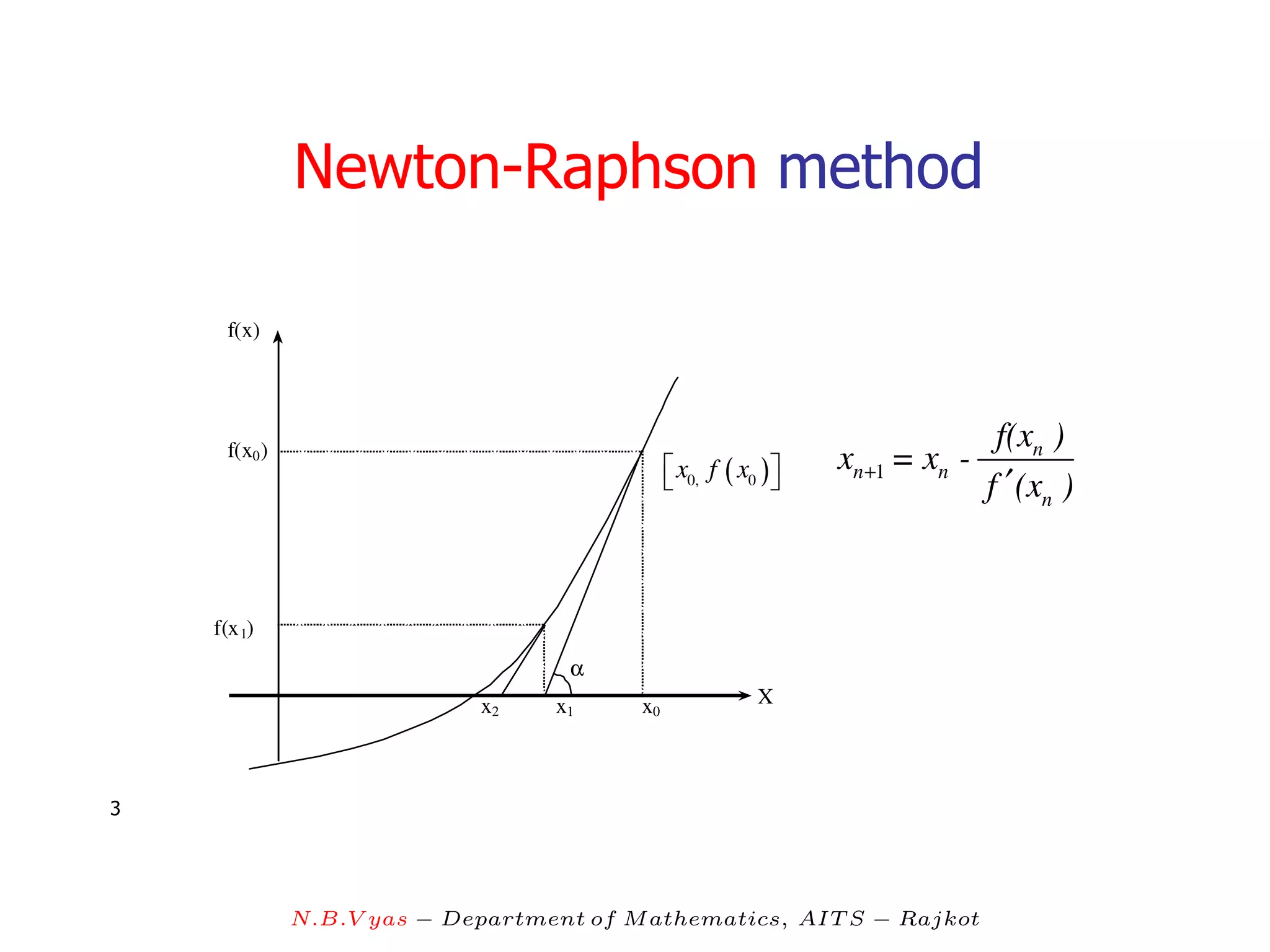
Newton-Raphson method

      f(x)


      f(x0 )                                                                     f(xn )
                                                x0, f ( x0 )   xn +1 = xn -
                                                                              f ′ (xn )


    f(x 1)
                                    α
                             x2    x1     x0               X


3


               N.B.V yas − Department of M athematics, AIT S − Rajkot
N-R Method:


Advantages:
   Converges Fast (if it converges).
   Requires only one guess.


              N.B.V yas − Department of M athematics, AIT S − Rajkot
Drawbacks:
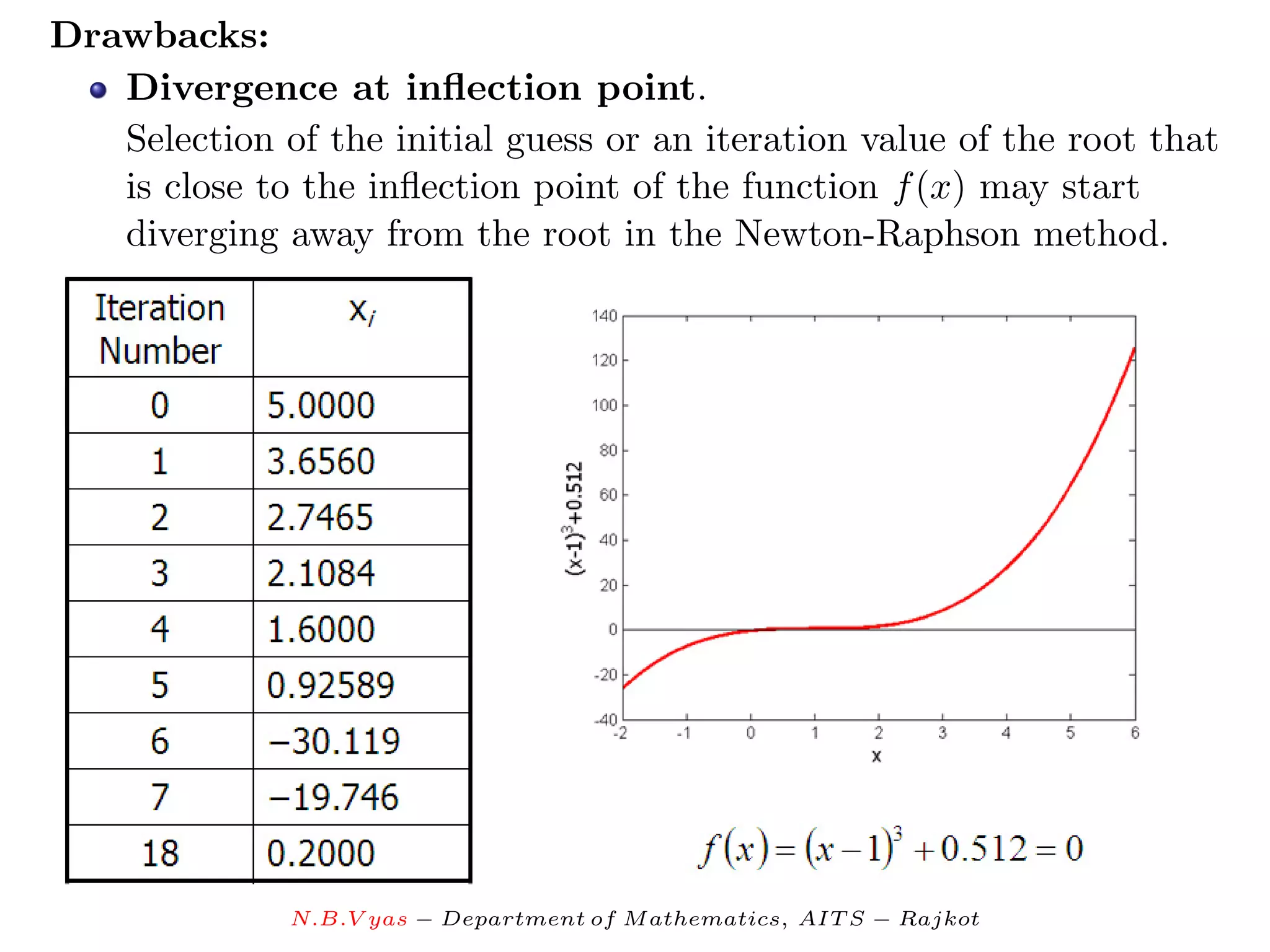
   Divergence at inflection point.
   Selection of the initial guess or an iteration value of the root that
   is close to the inflection point of the function f (x) may start
   diverging away from the root in the Newton-Raphson method.


              N.B.V yas − Department of M athematics, AIT S − Rajkot
N-R Method:(Drawbacks)


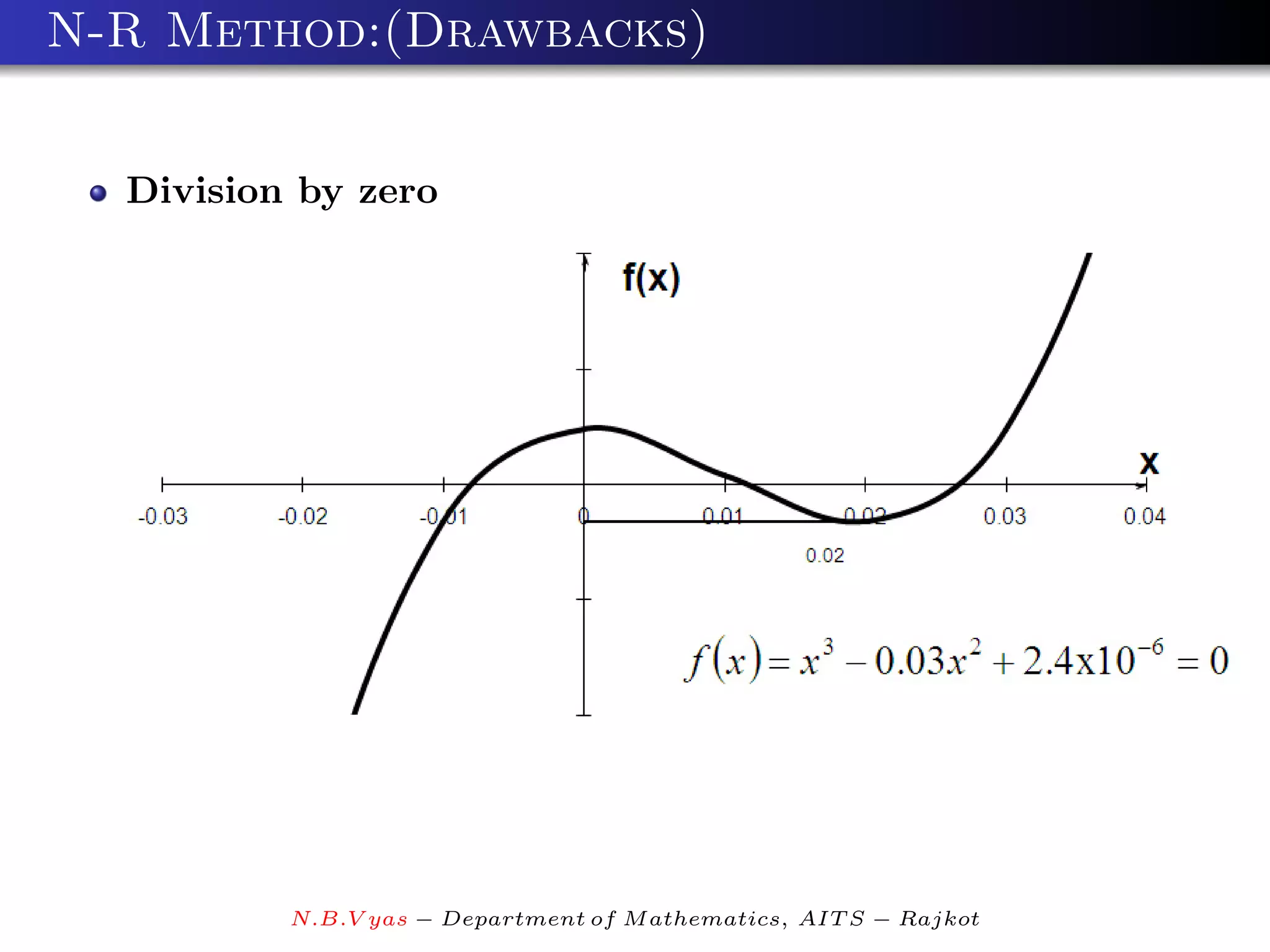
  Division by zero


          N.B.V yas − Department of M athematics, AIT S − Rajkot
N-R Method:(Drawbacks)
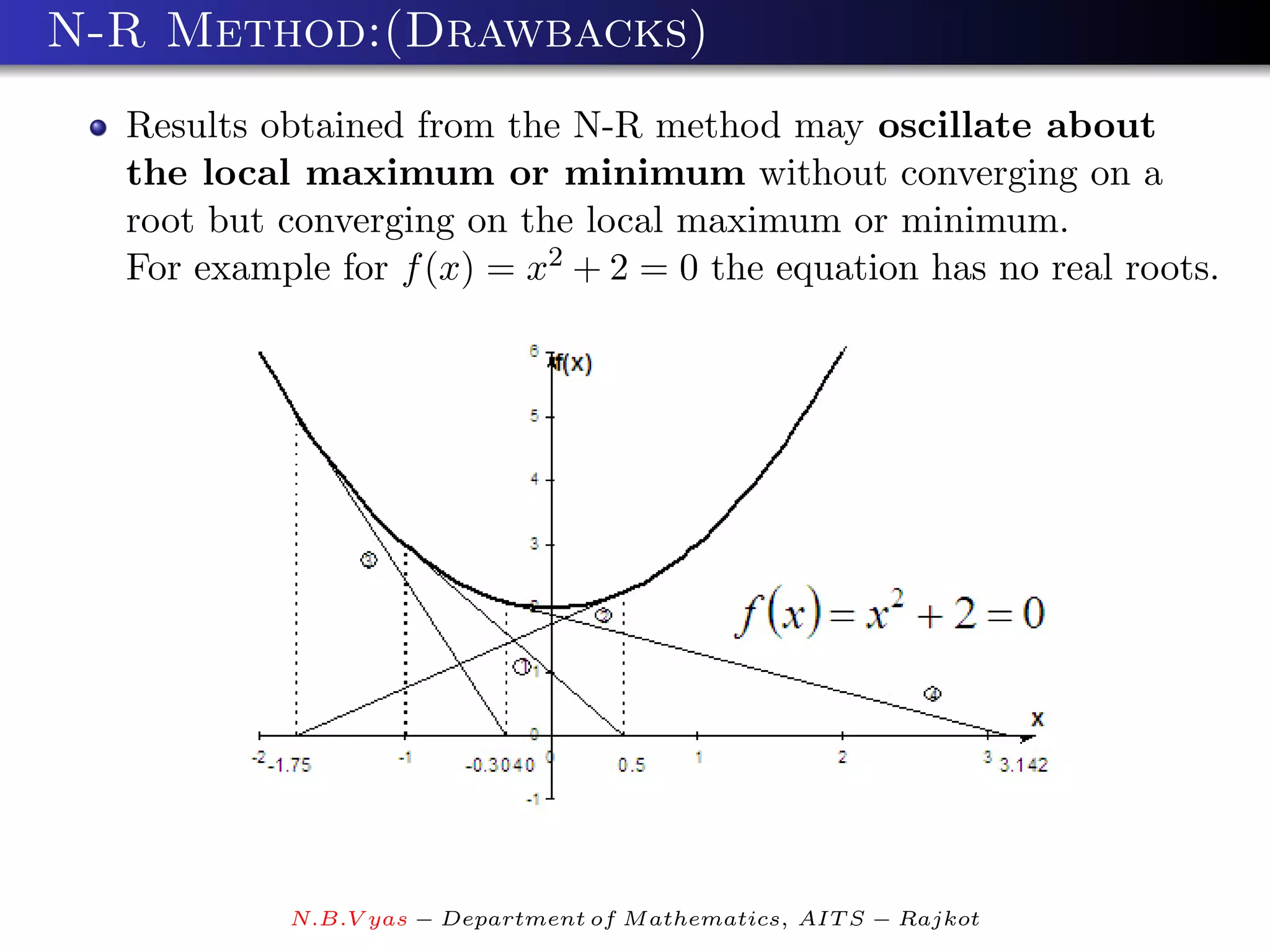
  Results obtained from the N-R method may oscillate about
  the local maximum or minimum without converging on a
  root but converging on the local maximum or minimum.
  For example for f (x) = x2 + 2 = 0 the equation has no real roots.


           N.B.V yas − Department of M athematics, AIT S − Rajkot
N-R Method:(Drawbacks)

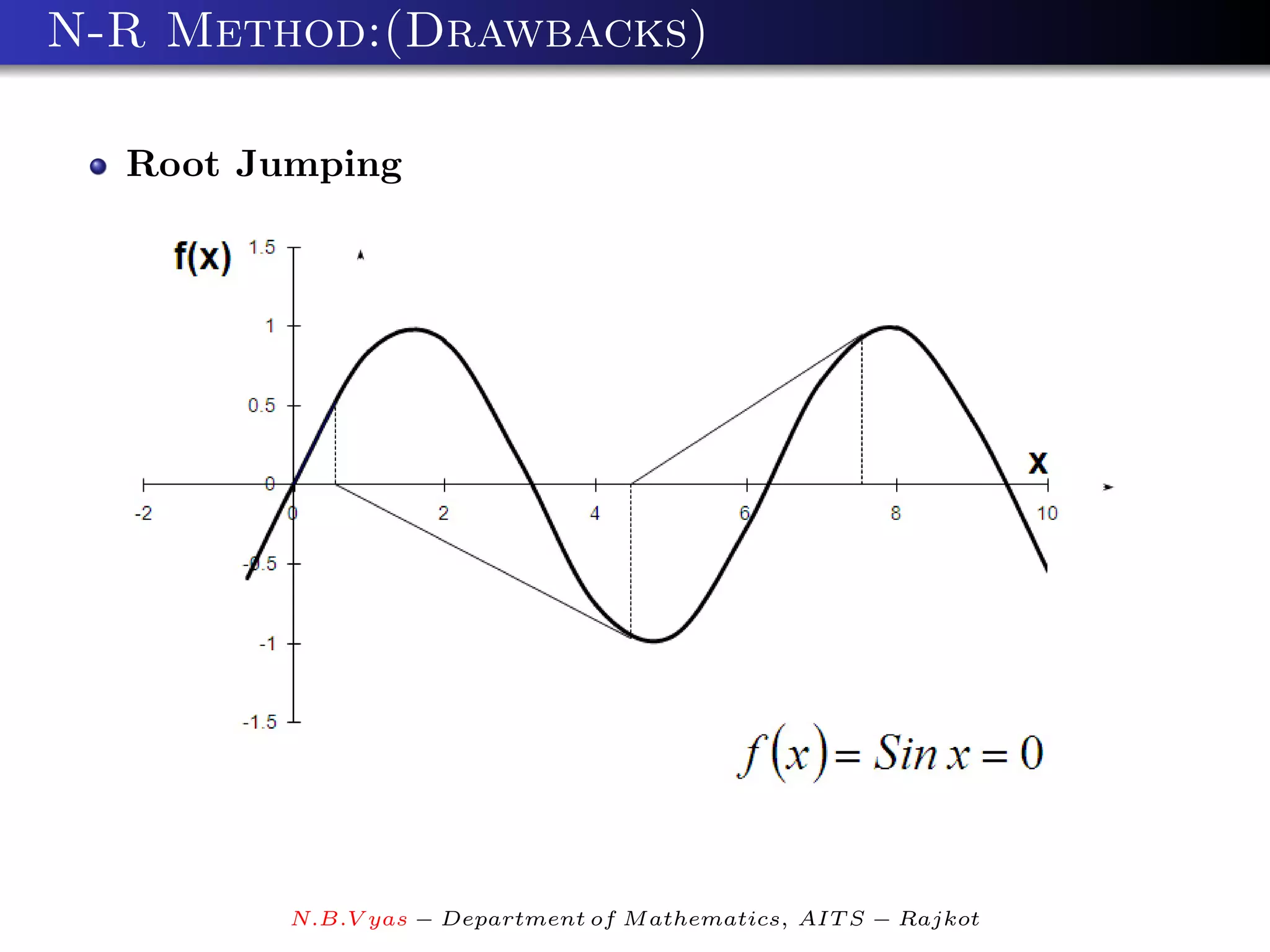
  Root Jumping


         N.B.V yas − Department of M athematics, AIT S − Rajkot
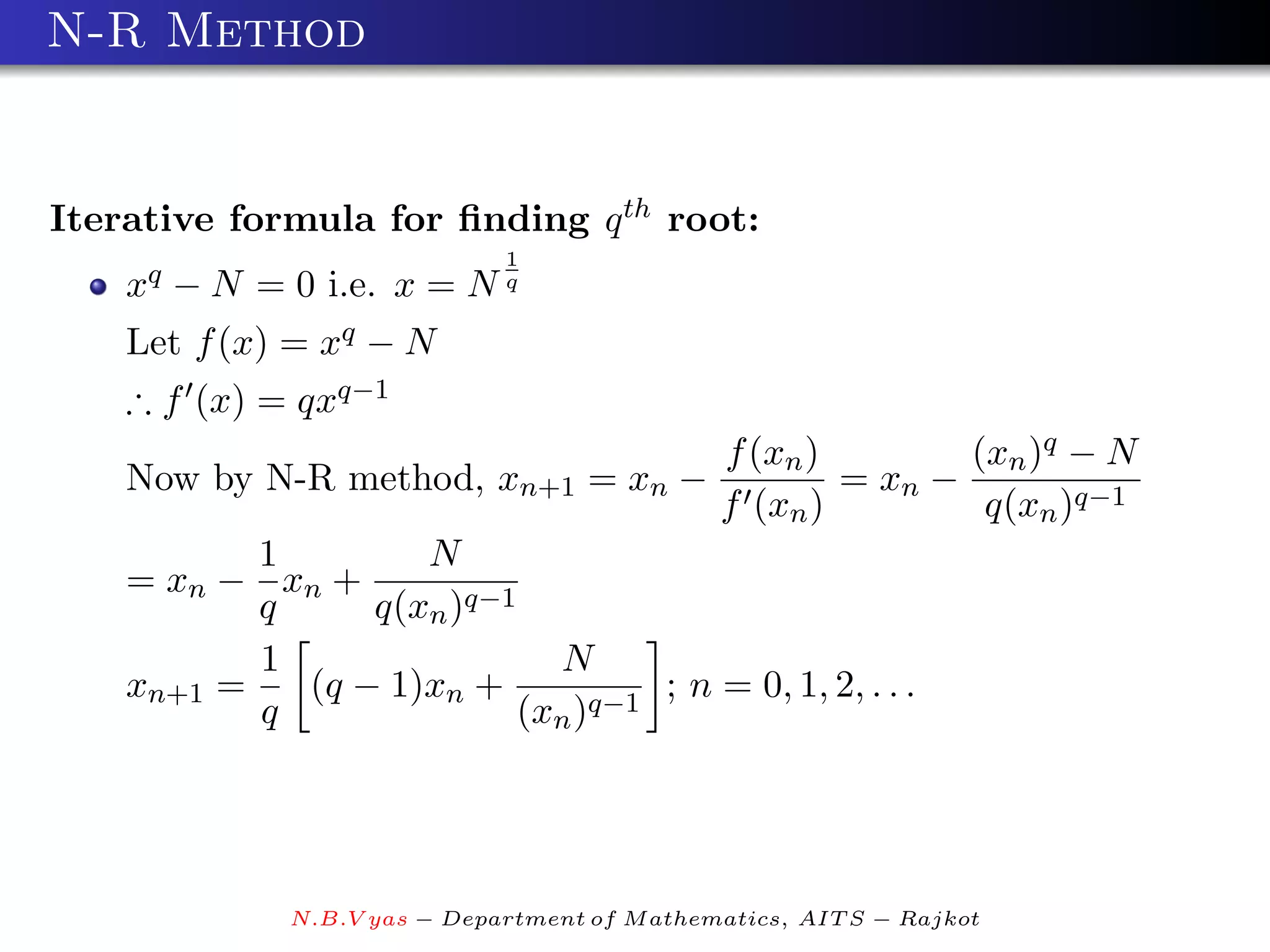
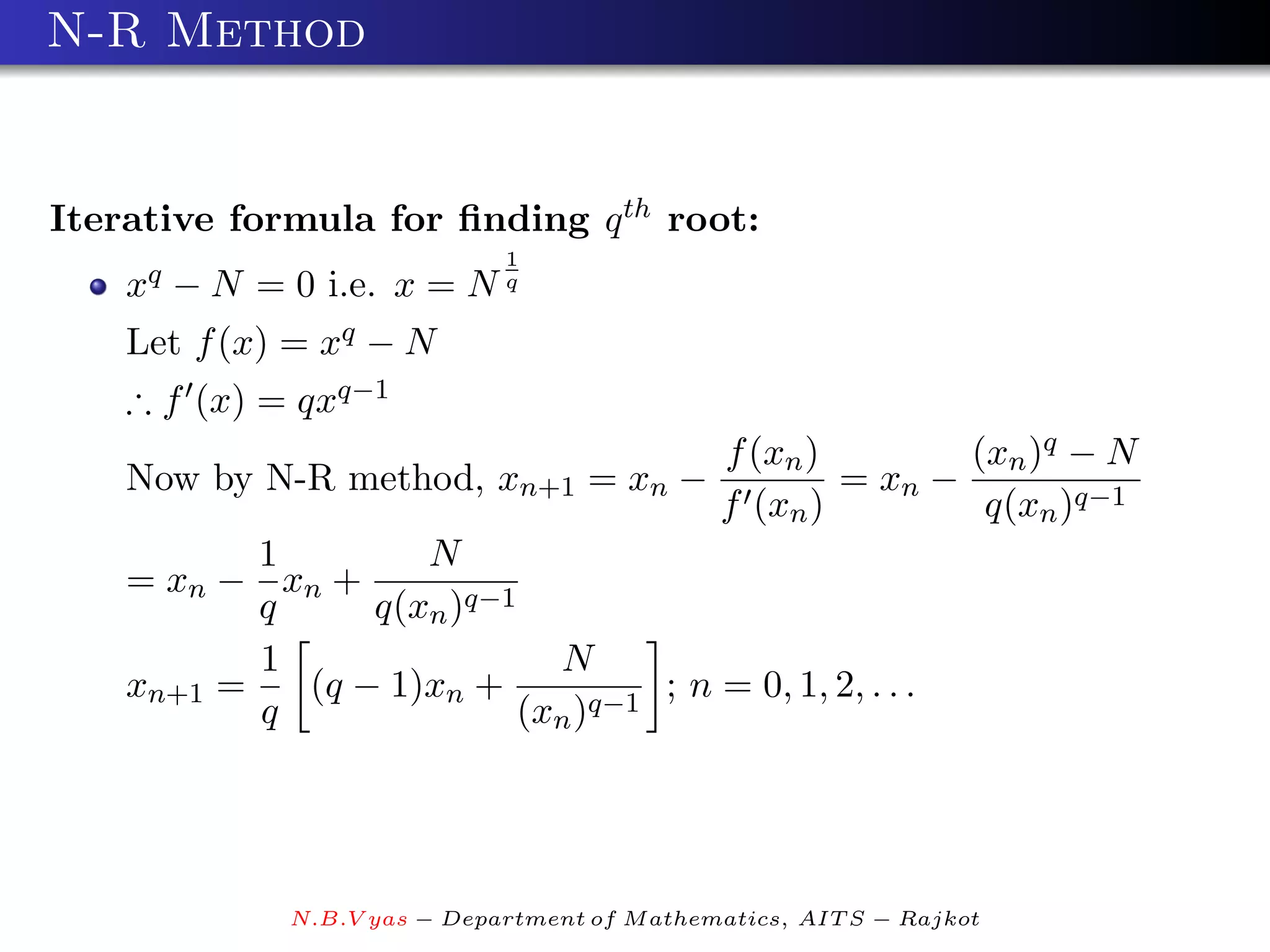
N-R Method


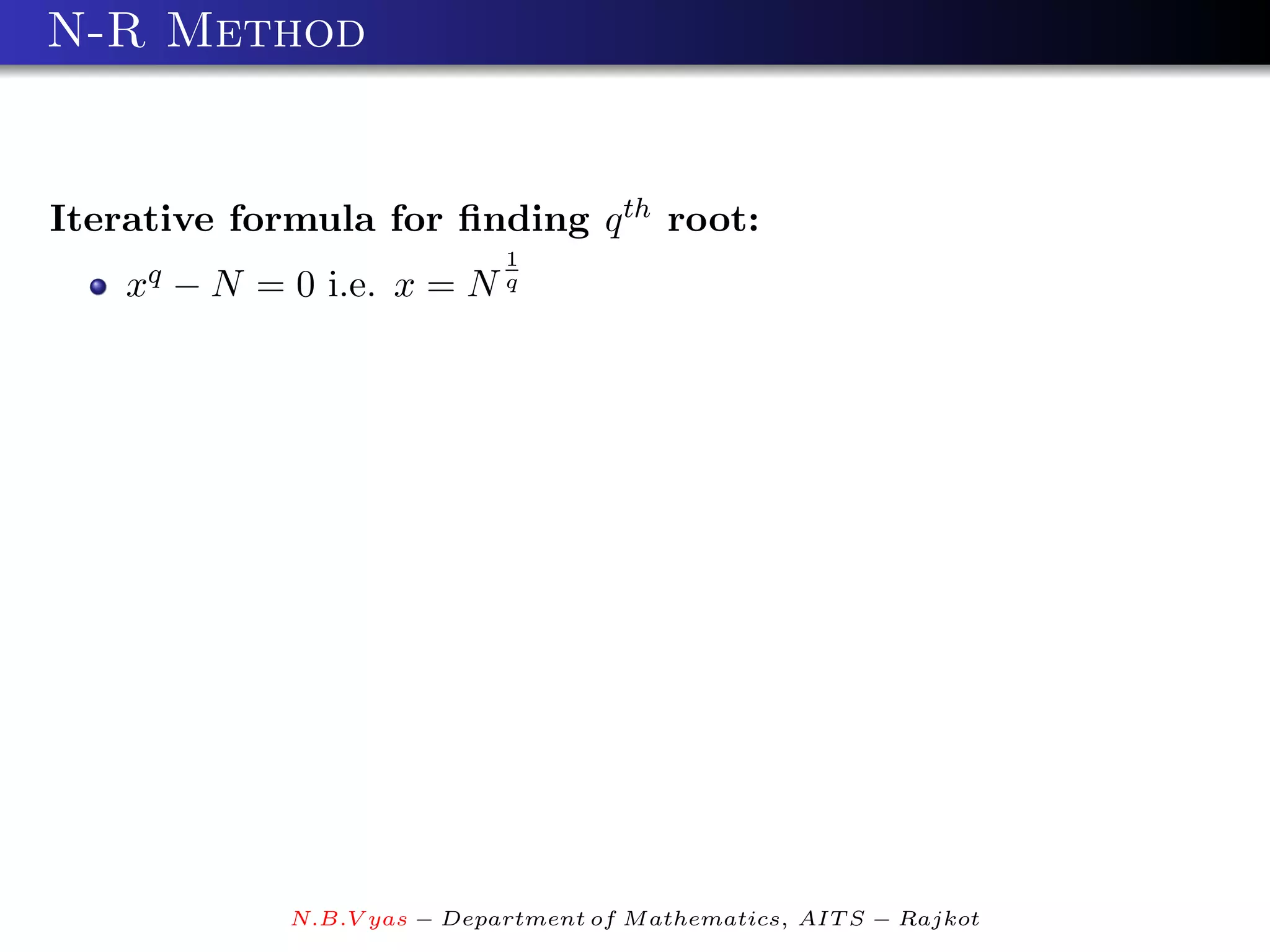
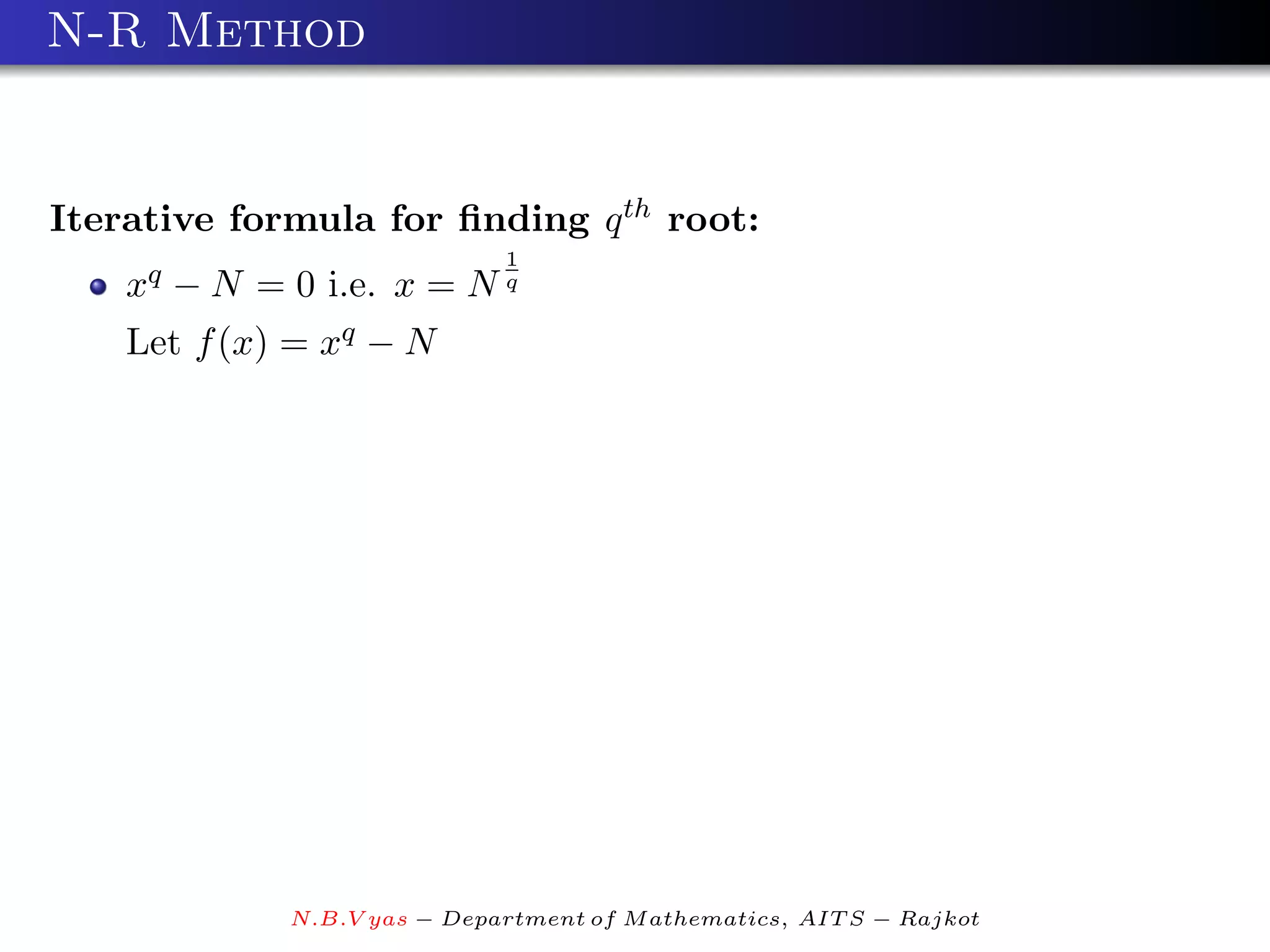
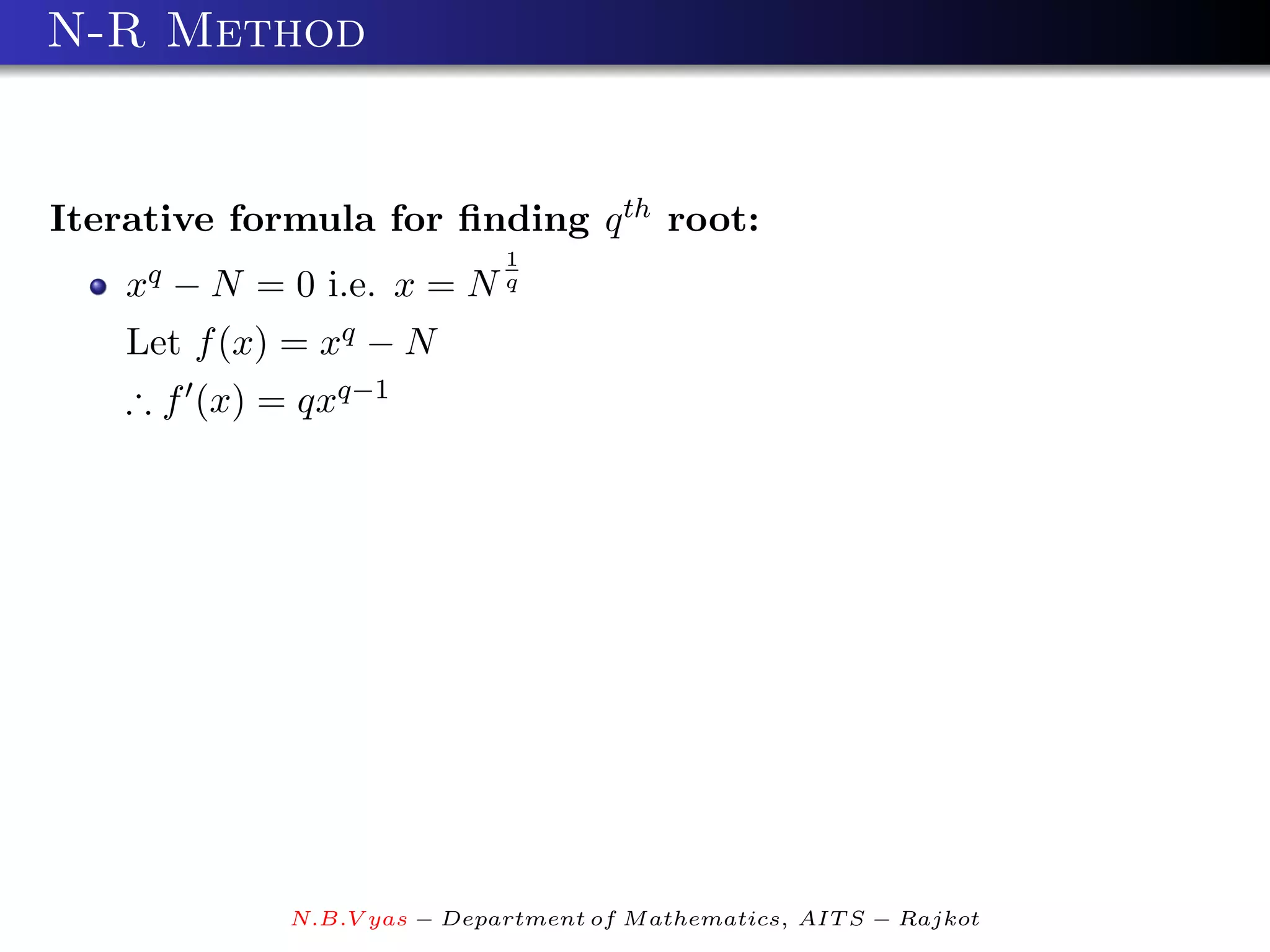
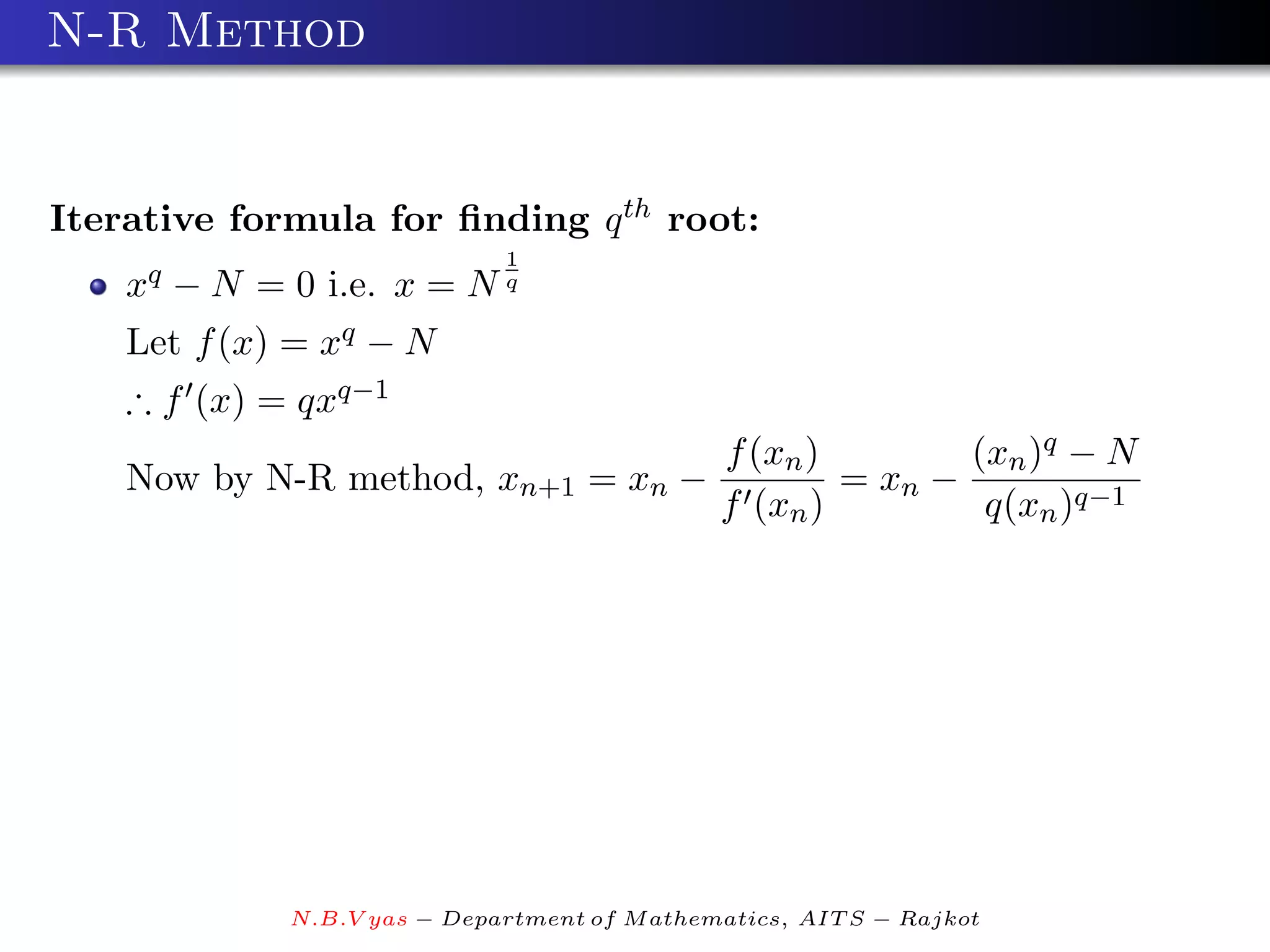
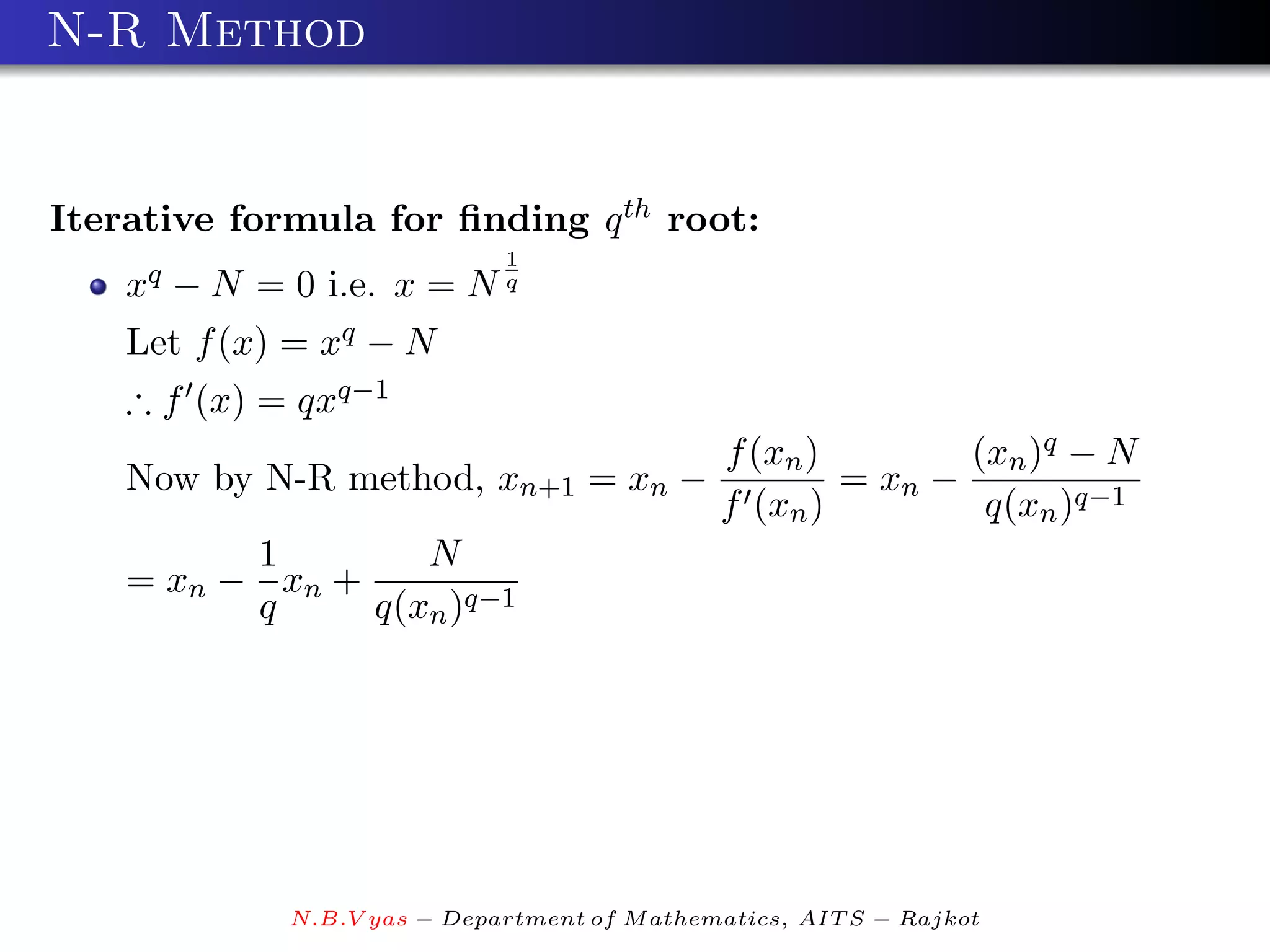
Iterative formula for finding q th root:
                             1
    xq − N = 0 i.e. x = N q


             N.B.V yas − Department of M athematics, AIT S − Rajkot
N-R Method


Iterative formula for finding q th root:
                             1
    xq − N = 0 i.e. x = N q
    Let f (x) = xq − N


             N.B.V yas − Department of M athematics, AIT S − Rajkot
N-R Method


Iterative formula for finding q th root:
                             1
    xq − N = 0 i.e. x = N q
    Let f (x) = xq − N
    ∴ f (x) = qxq−1


             N.B.V yas − Department of M athematics, AIT S − Rajkot
N-R Method


Iterative formula for finding q th root:
                             1
    xq − N = 0 i.e. x = N q
    Let f (x) = xq − N
    ∴ f (x) = qxq−1
                                              f (xn )        (xn )q − N
    Now by N-R method, xn+1 = xn −                    = xn −
                                              f (xn )         q(xn )q−1


             N.B.V yas − Department of M athematics, AIT S − Rajkot
N-R Method


Iterative formula for finding q th root:
                             1
    xq − N = 0 i.e. x = N q
    Let f (x) = xq − N
    ∴ f (x) = qxq−1
                                              f (xn )        (xn )q − N
    Now by N-R method, xn+1 = xn −                    = xn −
                                              f (xn )         q(xn )q−1
          1        N
    = xn − xn +
          q     q(xn )q−1


             N.B.V yas − Department of M athematics, AIT S − Rajkot
N-R Method


Iterative formula for finding q th root:
                              1
    xq − N = 0 i.e. x = N q
    Let f (x) = xq − N
    ∴ f (x) = qxq−1
                                               f (xn )        (xn )q − N
    Now by N-R method, xn+1 = xn −                     = xn −
                                               f (xn )         q(xn )q−1
           1        N
    = xn − xn +
           q     q(xn )q−1
           1                 N
    xn+1 =   (q − 1)xn +            ; n = 0, 1, 2, . . .
           q               (xn )q−1


              N.B.V yas − Department of M athematics, AIT S − Rajkot
N-R Method


Iterative formula for finding q th root:
                              1
    xq − N = 0 i.e. x = N q
    Let f (x) = xq − N
    ∴ f (x) = qxq−1
                                               f (xn )        (xn )q − N
    Now by N-R method, xn+1 = xn −                     = xn −
                                               f (xn )         q(xn )q−1
           1        N
    = xn − xn +
           q     q(xn )q−1
           1                 N
    xn+1 =   (q − 1)xn +            ; n = 0, 1, 2, . . .
           q               (xn )q−1


              N.B.V yas − Department of M athematics, AIT S − Rajkot
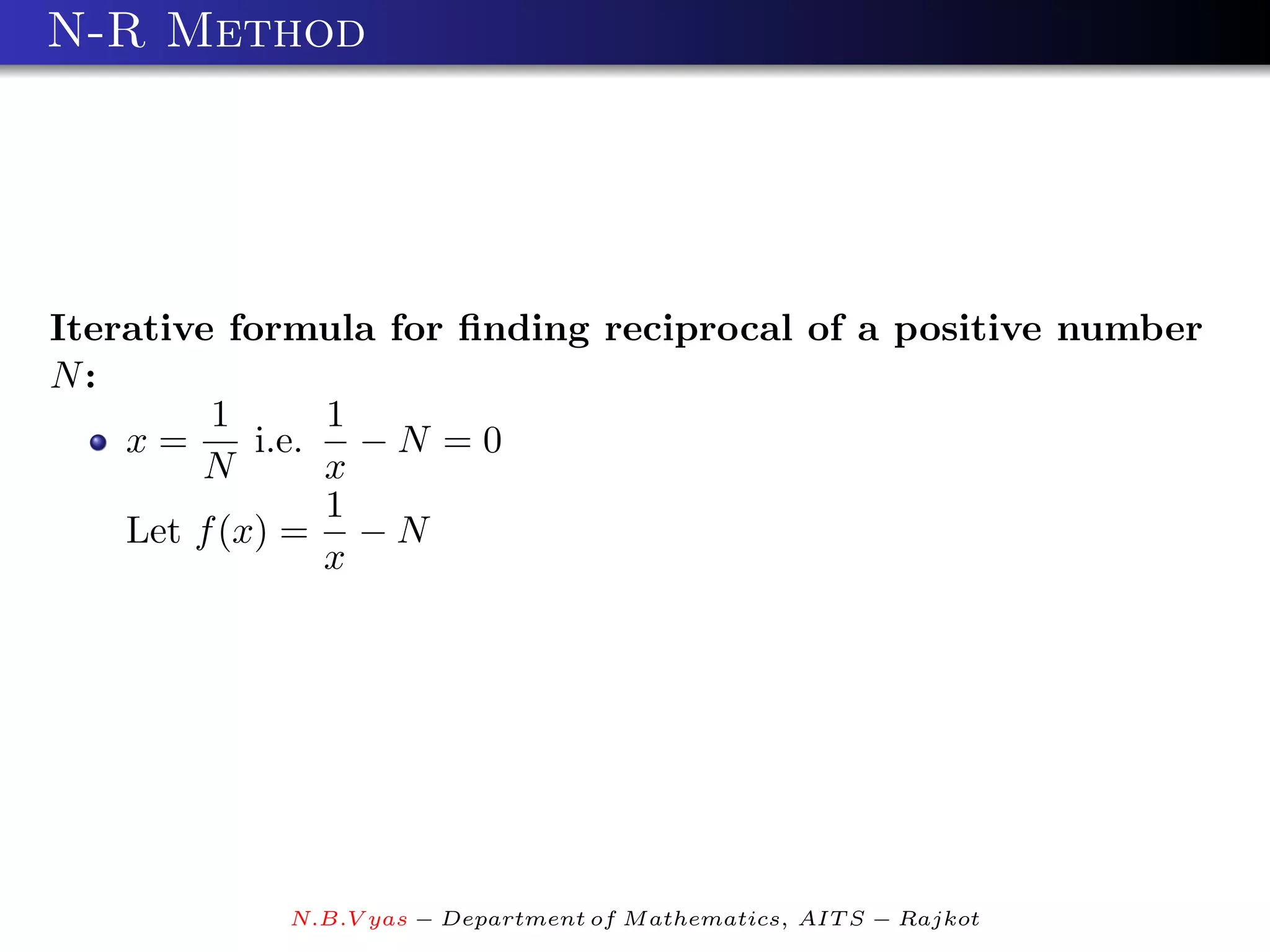
N-R Method


Iterative formula for finding reciprocal of a positive number
N:
         1      1
    x=      i.e. − N = 0
        N       x
                1
    Let f (x) = − N
                x


            N.B.V yas − Department of M athematics, AIT S − Rajkot
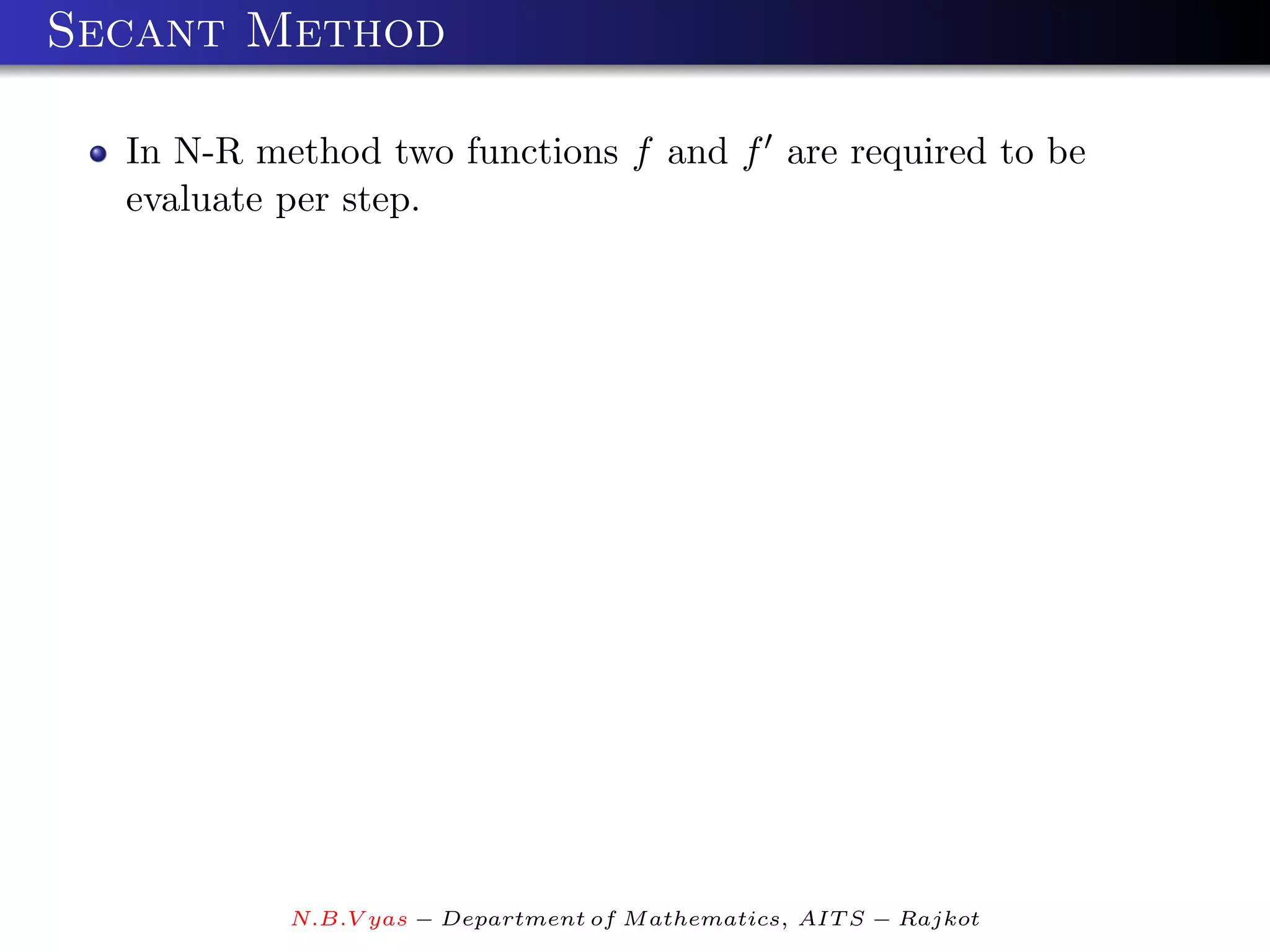
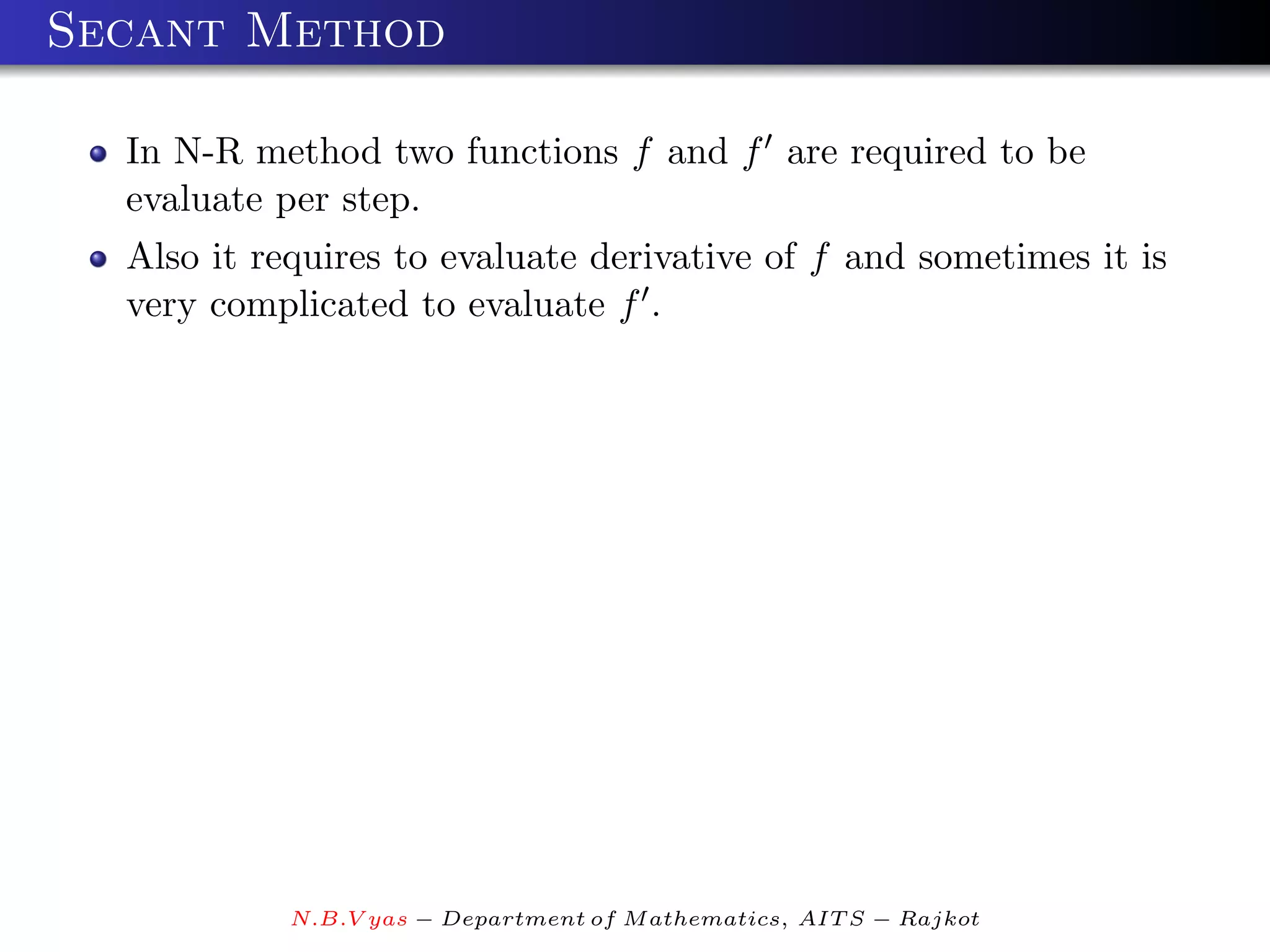
Secant Method

  In N-R method two functions f and f are required to be
  evaluate per step.


           N.B.V yas − Department of M athematics, AIT S − Rajkot
Secant Method

  In N-R method two functions f and f are required to be
  evaluate per step.
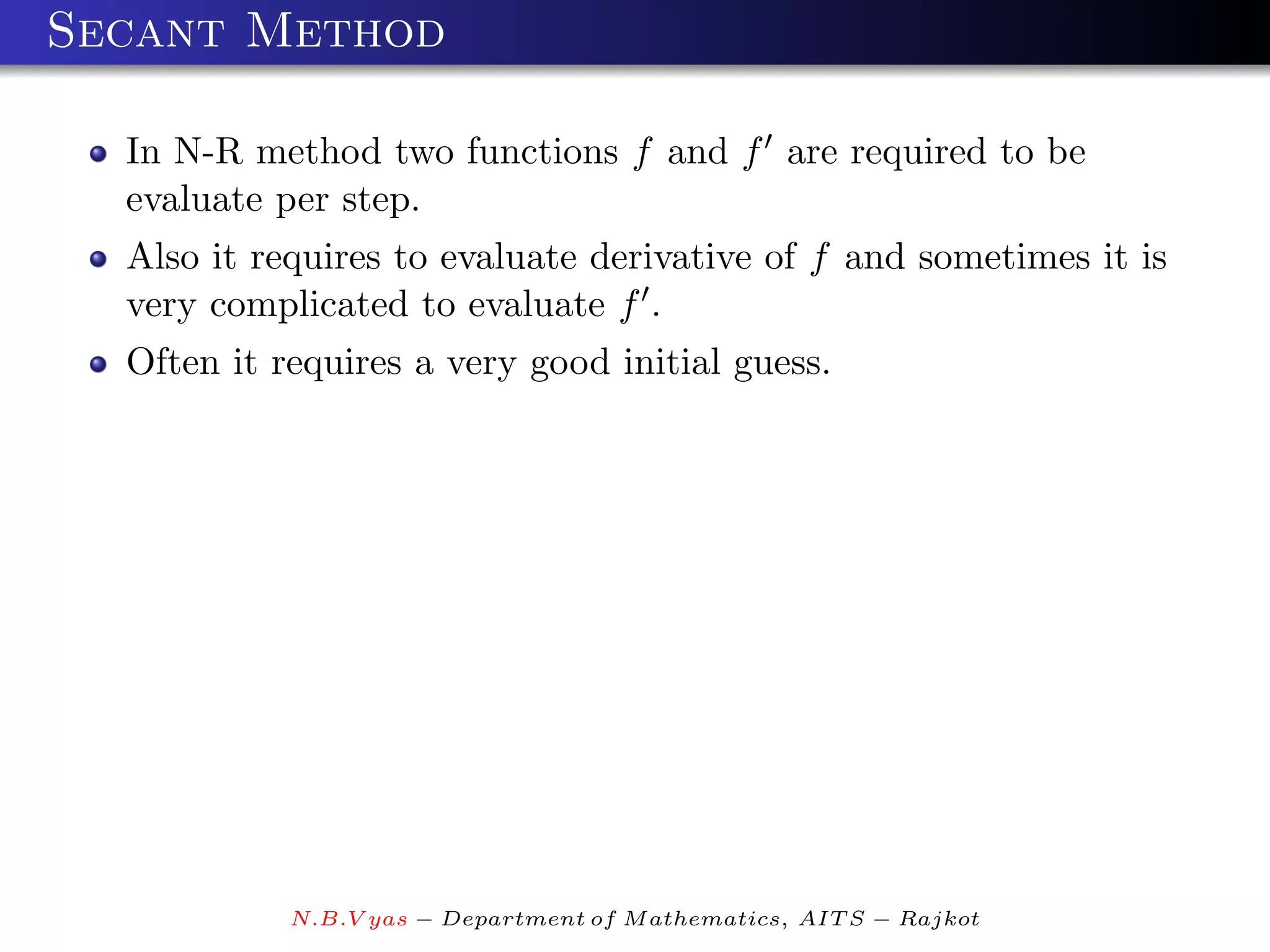
  Also it requires to evaluate derivative of f and sometimes it is
  very complicated to evaluate f .


            N.B.V yas − Department of M athematics, AIT S − Rajkot
Secant Method

  In N-R method two functions f and f are required to be
  evaluate per step.
  Also it requires to evaluate derivative of f and sometimes it is
  very complicated to evaluate f .
  Often it requires a very good initial guess.


            N.B.V yas − Department of M athematics, AIT S − Rajkot
Secant Method

  In N-R method two functions f and f are required to be
  evaluate per step.
  Also it requires to evaluate derivative of f and sometimes it is
  very complicated to evaluate f .
  Often it requires a very good initial guess.
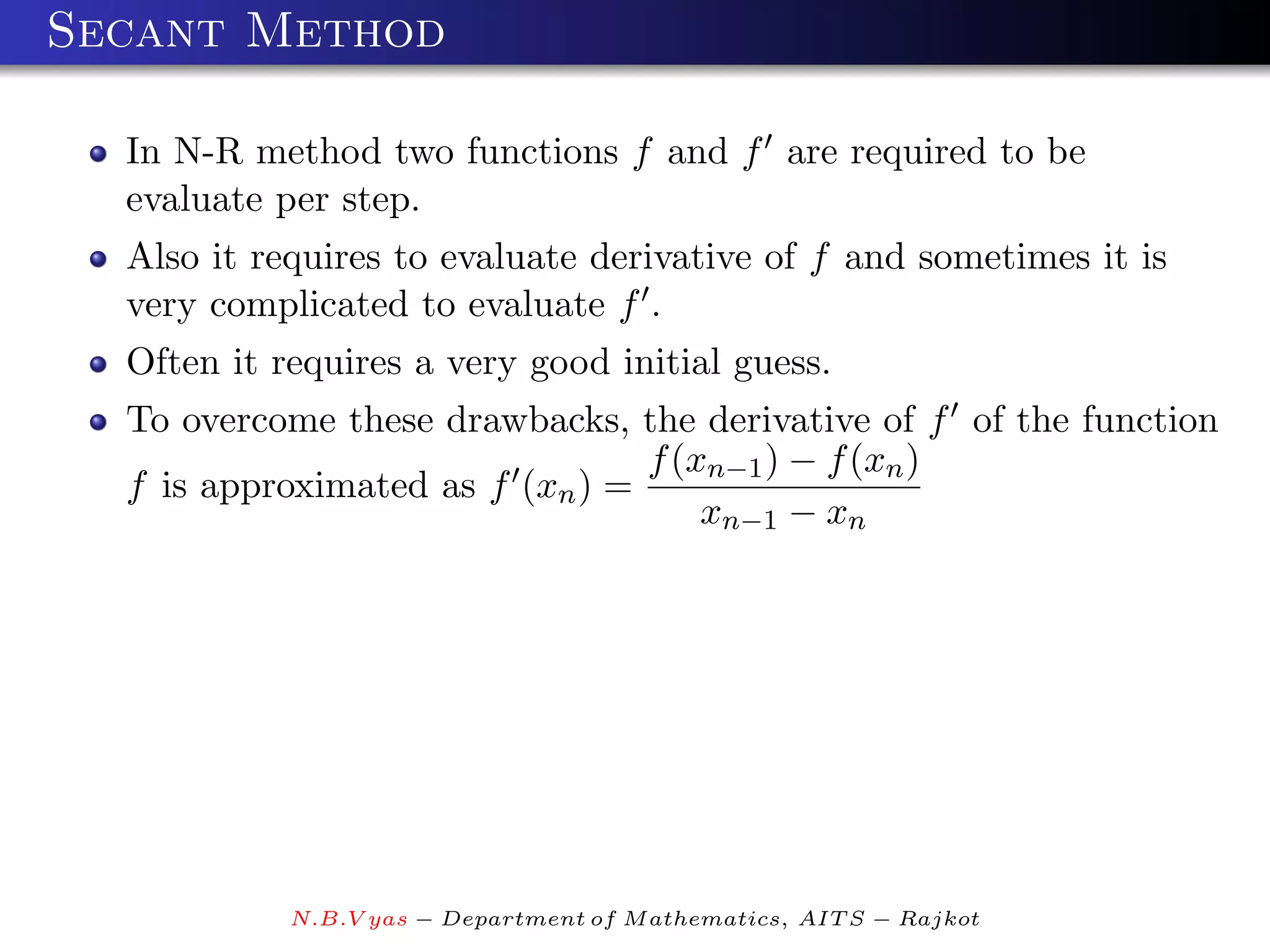
  To overcome these drawbacks, the derivative of f of the function
                                 f (xn−1 ) − f (xn )
  f is approximated as f (xn ) =
                                     xn−1 − xn


            N.B.V yas − Department of M athematics, AIT S − Rajkot
Secant Method

  In N-R method two functions f and f are required to be
  evaluate per step.
  Also it requires to evaluate derivative of f and sometimes it is
  very complicated to evaluate f .
  Often it requires a very good initial guess.
  To overcome these drawbacks, the derivative of f of the function
                                 f (xn−1 ) − f (xn )
  f is approximated as f (xn ) =
                                     xn−1 − xn
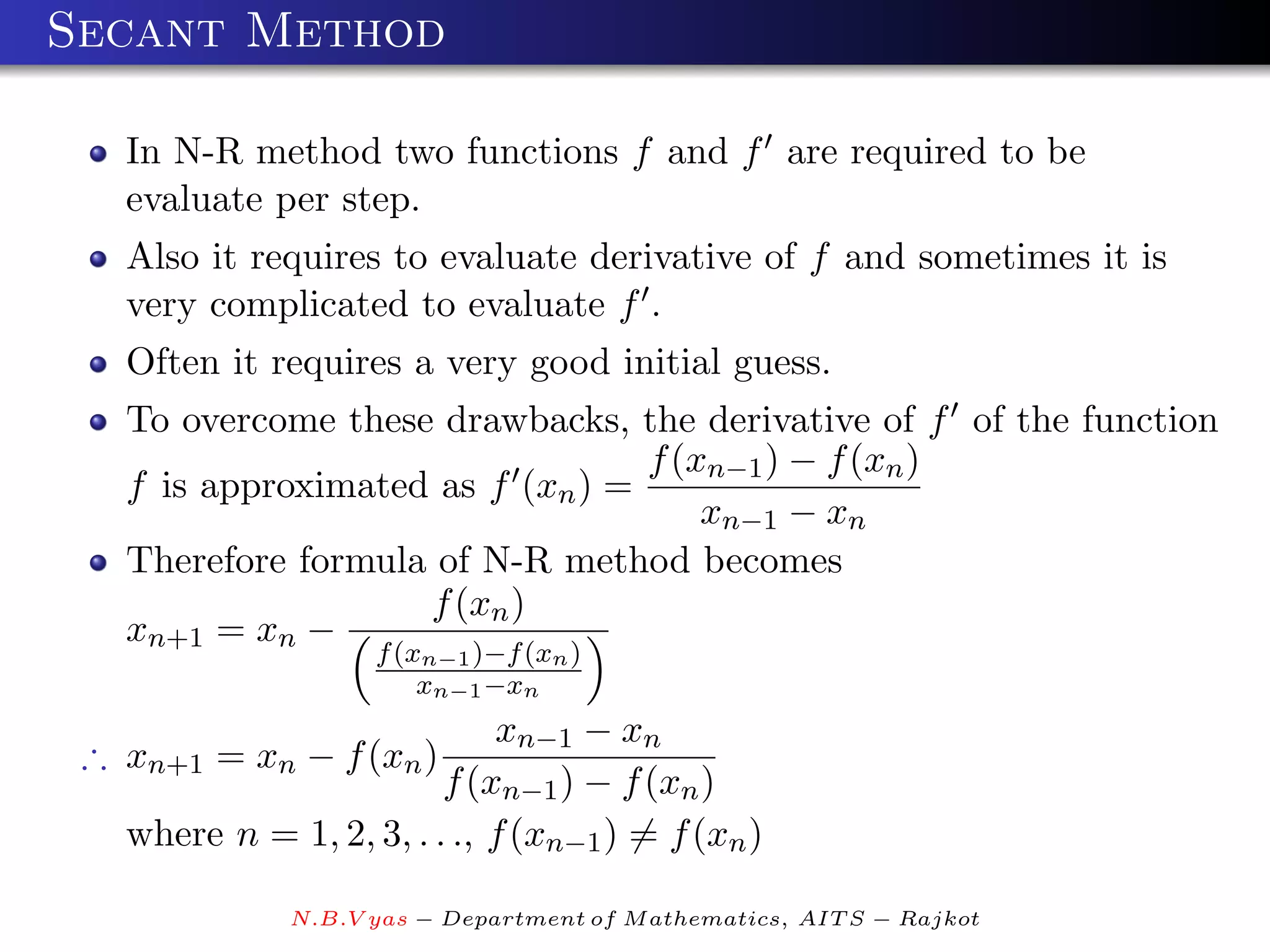
  Therefore formula of N-R method becomes


            N.B.V yas − Department of M athematics, AIT S − Rajkot
Secant Method

  In N-R method two functions f and f are required to be
  evaluate per step.
  Also it requires to evaluate derivative of f and sometimes it is
  very complicated to evaluate f .
  Often it requires a very good initial guess.
  To overcome these drawbacks, the derivative of f of the function
                                 f (xn−1 ) − f (xn )
  f is approximated as f (xn ) =
                                     xn−1 − xn
  Therefore formula of N-R method becomes
                   f (xn )
  xn+1 = xn −
                  f (xn−1 )−f (xn )
                      xn−1 −xn


            N.B.V yas − Department of M athematics, AIT S − Rajkot
Secant Method

   In N-R method two functions f and f are required to be
   evaluate per step.
   Also it requires to evaluate derivative of f and sometimes it is
   very complicated to evaluate f .
   Often it requires a very good initial guess.
   To overcome these drawbacks, the derivative of f of the function
                                  f (xn−1 ) − f (xn )
   f is approximated as f (xn ) =
                                      xn−1 − xn
   Therefore formula of N-R method becomes
                    f (xn )
   xn+1 = xn −
                    f (xn−1 )−f (xn )
                        xn−1 −xn
                             xn−1 − xn
 ∴ xn+1 = xn − f (xn )
                         f (xn−1 ) − f (xn )
   where n = 1, 2, 3, . . ., f (xn−1 ) = f (xn )

              N.B.V yas − Department of M athematics, AIT S − Rajkot
Secant Method


  This method requires two initial guesses


           N.B.V yas − Department of M athematics, AIT S − Rajkot
Secant Method


  This method requires two initial guesses
  The two initial guesses do not need to bracket the root of the
  equation, so it is not classified as a bracketing method.


           N.B.V yas − Department of M athematics, AIT S − Rajkot
Secant Method


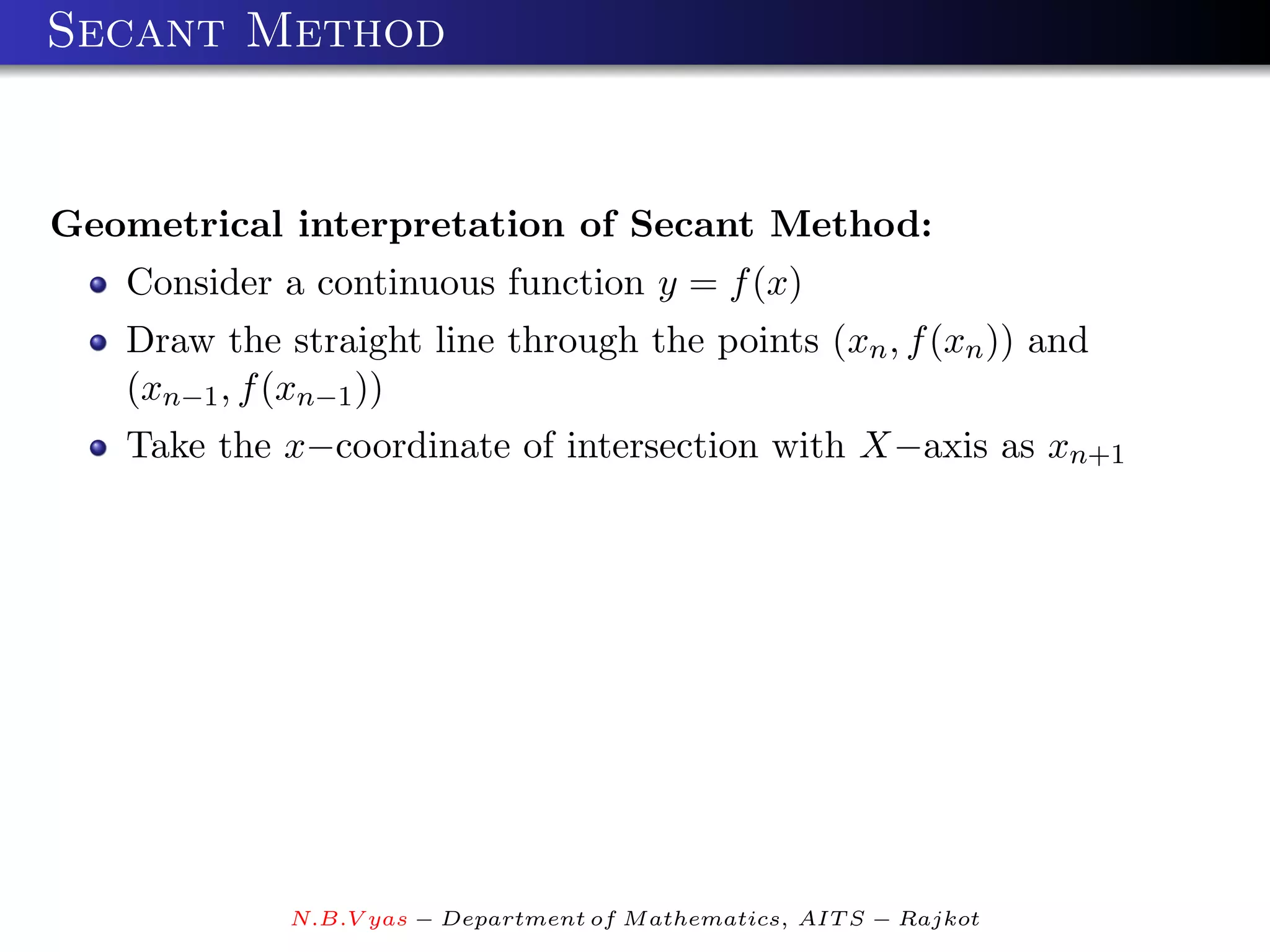
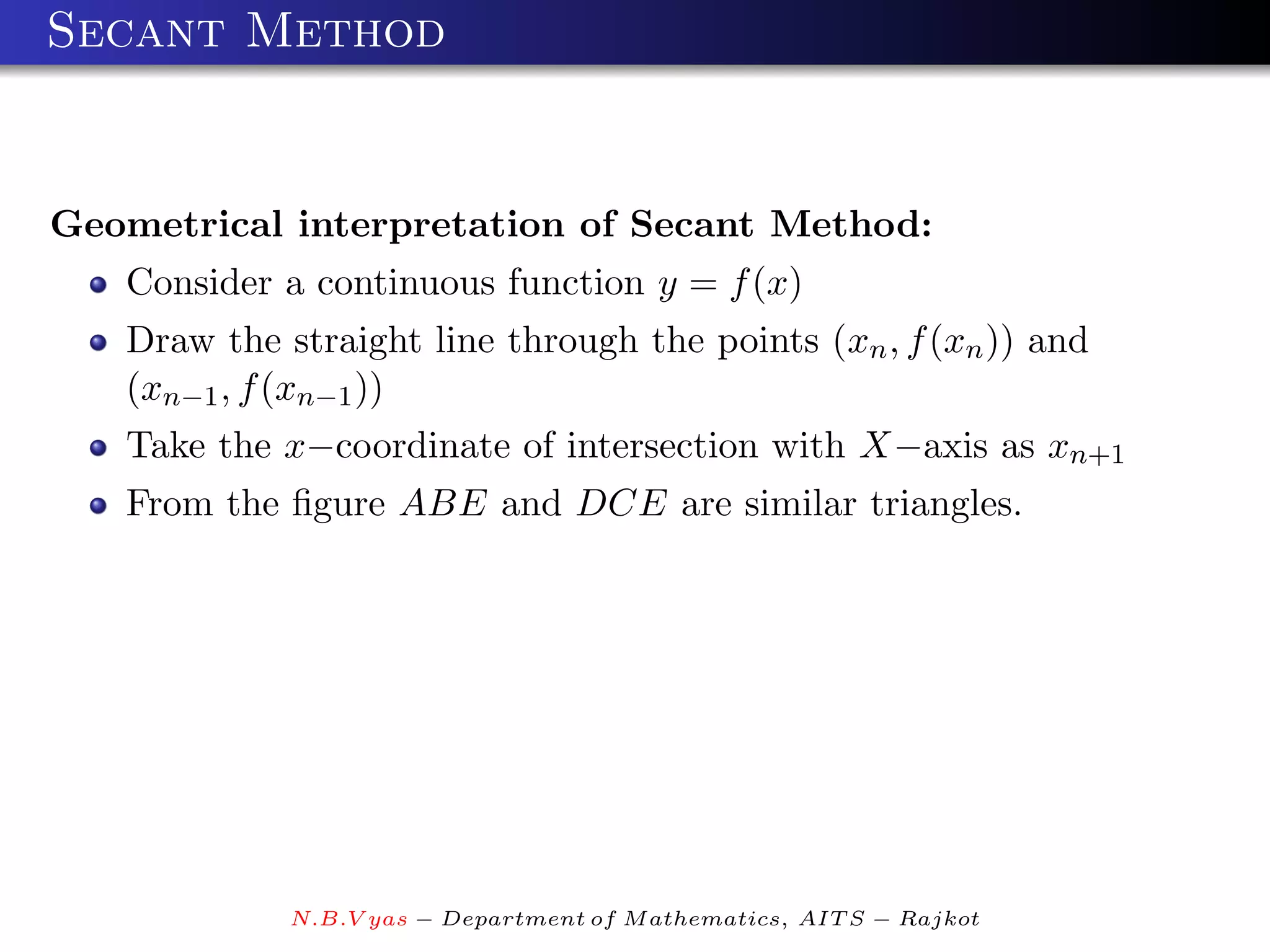
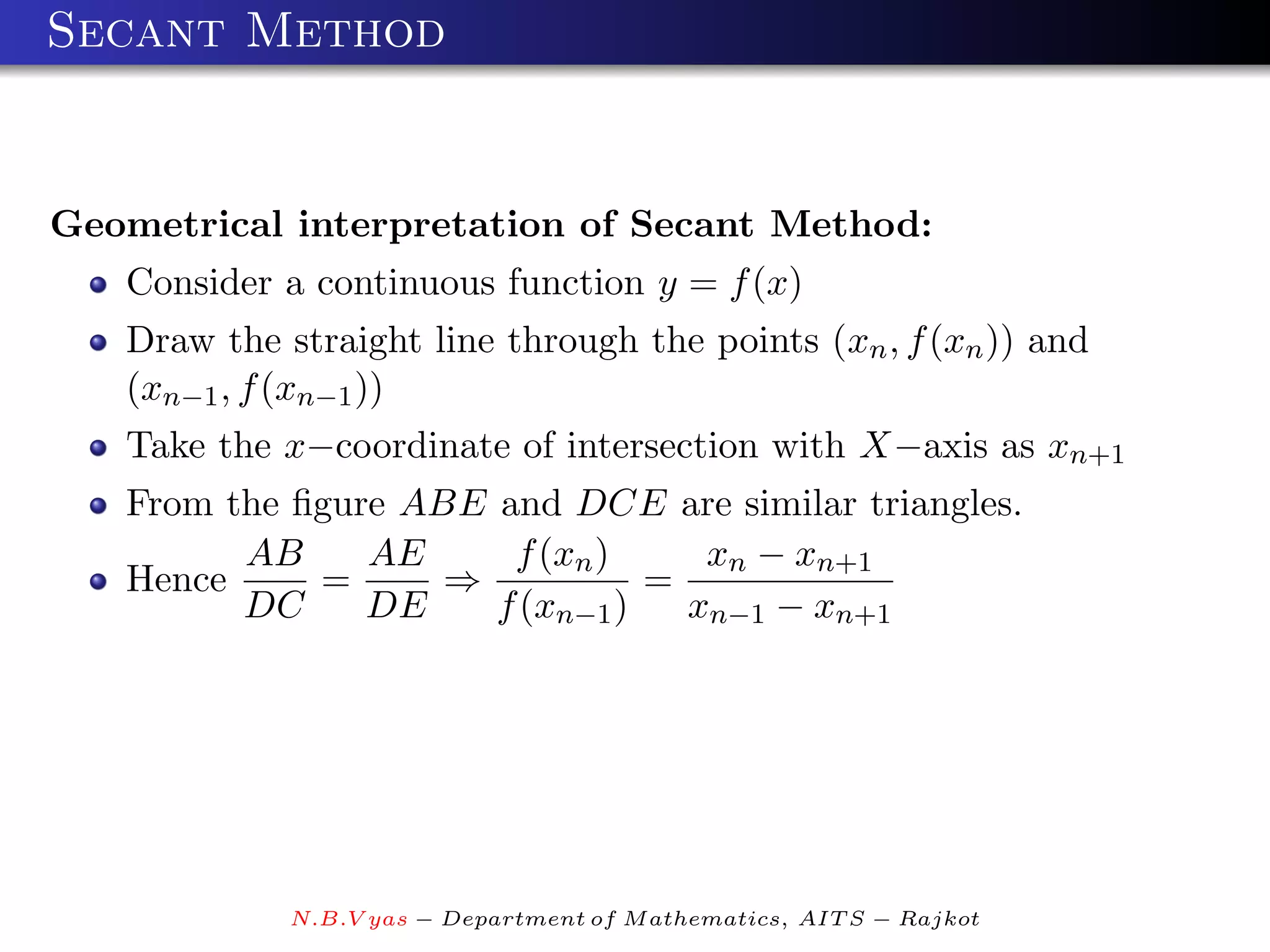
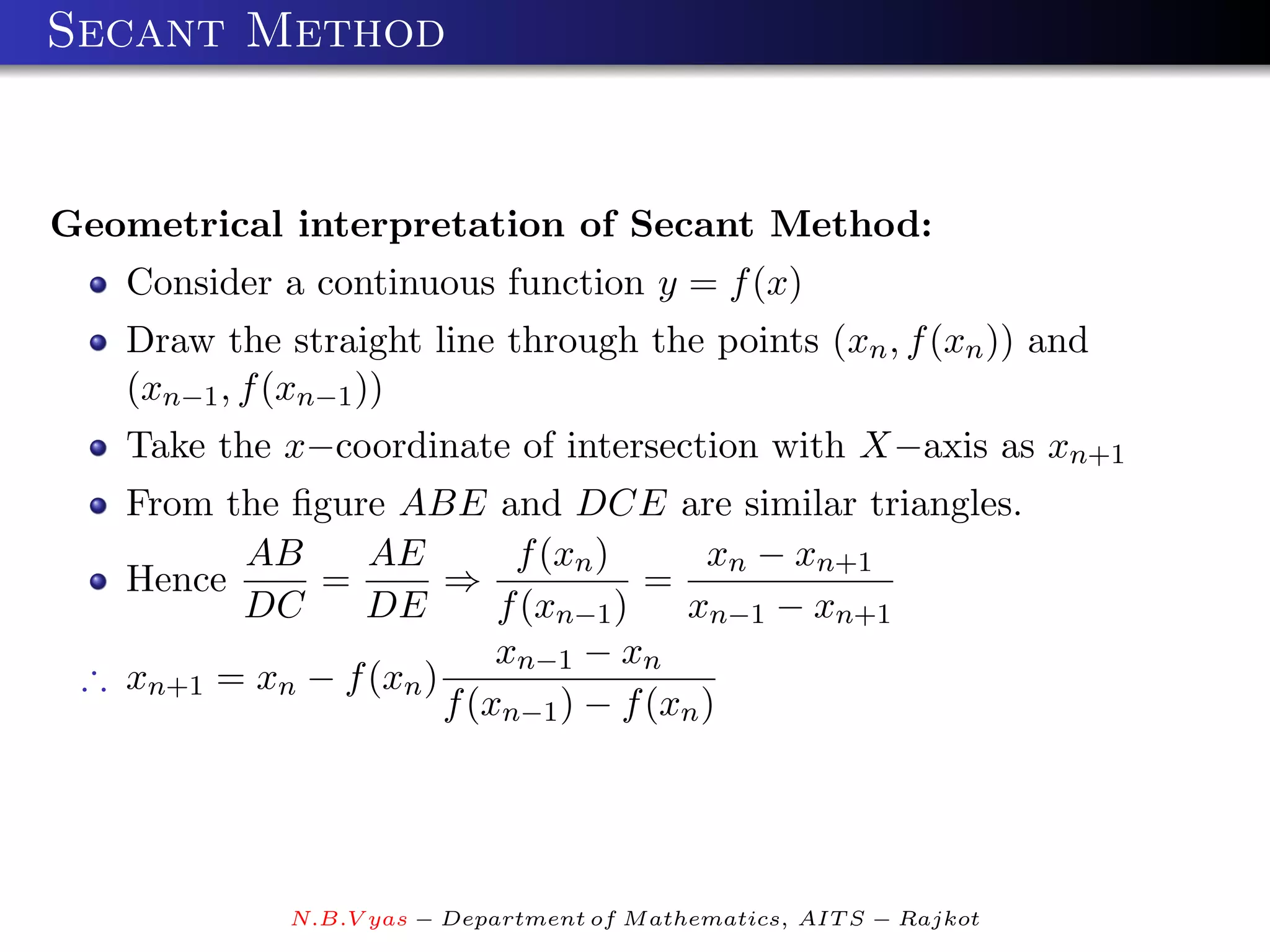
Geometrical interpretation of Secant Method:
   Consider a continuous function y = f (x)


            N.B.V yas − Department of M athematics, AIT S − Rajkot
Secant Method


Geometrical interpretation of Secant Method:
   Consider a continuous function y = f (x)
   Draw the straight line through the points (xn , f (xn )) and
   (xn−1 , f (xn−1 ))


             N.B.V yas − Department of M athematics, AIT S − Rajkot
Secant Method


Geometrical interpretation of Secant Method:
   Consider a continuous function y = f (x)
   Draw the straight line through the points (xn , f (xn )) and
   (xn−1 , f (xn−1 ))
   Take the x−coordinate of intersection with X−axis as xn+1


             N.B.V yas − Department of M athematics, AIT S − Rajkot
Secant Method


Geometrical interpretation of Secant Method:
   Consider a continuous function y = f (x)
   Draw the straight line through the points (xn , f (xn )) and
   (xn−1 , f (xn−1 ))
   Take the x−coordinate of intersection with X−axis as xn+1
   From the figure ABE and DCE are similar triangles.


             N.B.V yas − Department of M athematics, AIT S − Rajkot
Secant Method


Geometrical interpretation of Secant Method:
   Consider a continuous function y = f (x)
   Draw the straight line through the points (xn , f (xn )) and
   (xn−1 , f (xn−1 ))
   Take the x−coordinate of intersection with X−axis as xn+1
   From the figure ABE and DCE are similar triangles.
         AB     AE     f (xn )     xn − xn+1
   Hence     =      ⇒           =
         DC     DE    f (xn−1 )   xn−1 − xn+1


             N.B.V yas − Department of M athematics, AIT S − Rajkot
Secant Method


Geometrical interpretation of Secant Method:
   Consider a continuous function y = f (x)
   Draw the straight line through the points (xn , f (xn )) and
   (xn−1 , f (xn−1 ))
   Take the x−coordinate of intersection with X−axis as xn+1
   From the figure ABE and DCE are similar triangles.
         AB      AE         f (xn )      xn − xn+1
   Hence     =         ⇒             =
         DC      DE        f (xn−1 )   xn−1 − xn+1
                           xn−1 − xn
 ∴ xn+1 = xn − f (xn )
                       f (xn−1 ) − f (xn )


             N.B.V yas − Department of M athematics, AIT S − Rajkot
Secant Method


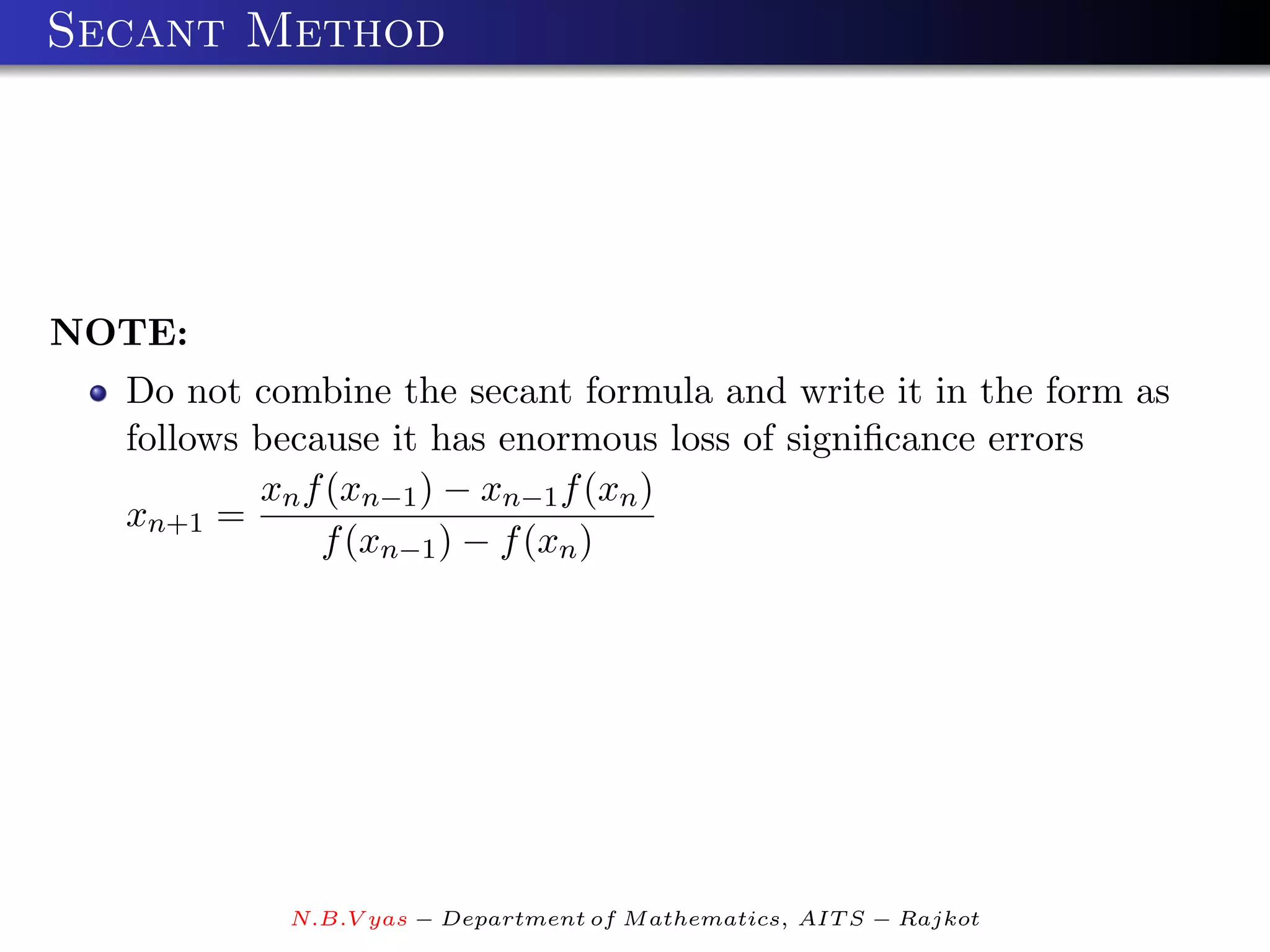
NOTE:
  Do not combine the secant formula and write it in the form as
  follows because it has enormous loss of significance errors
          xn f (xn−1 ) − xn−1 f (xn )
  xn+1 =
              f (xn−1 ) − f (xn )


           N.B.V yas − Department of M athematics, AIT S − Rajkot
Secant Method


General Features:
   The secant method is an open method and may not converge.


            N.B.V yas − Department of M athematics, AIT S − Rajkot
Secant Method


General Features:
   The secant method is an open method and may not converge.
   It requires fewer function evaluations.


             N.B.V yas − Department of M athematics, AIT S − Rajkot
Secant Method


General Features:
   The secant method is an open method and may not converge.
   It requires fewer function evaluations.
   In some problems the secant method will work when Newton’s
   method does not and vice-versa.


             N.B.V yas − Department of M athematics, AIT S − Rajkot
Secant Method


General Features:
   The secant method is an open method and may not converge.
   It requires fewer function evaluations.
   In some problems the secant method will work when Newton’s
   method does not and vice-versa.
   The method is usually a bit slower than Newton’s method. It is
   more rapidly convergent than the bisection method.


             N.B.V yas − Department of M athematics, AIT S − Rajkot
Secant Method


General Features:
   The secant method is an open method and may not converge.
   It requires fewer function evaluations.
   In some problems the secant method will work when Newton’s
   method does not and vice-versa.
   The method is usually a bit slower than Newton’s method. It is
   more rapidly convergent than the bisection method.
   This method does not require use of the derivative of the
   function.


             N.B.V yas − Department of M athematics, AIT S − Rajkot
Secant Method


General Features:
   The secant method is an open method and may not converge.
   It requires fewer function evaluations.
   In some problems the secant method will work when Newton’s
   method does not and vice-versa.
   The method is usually a bit slower than Newton’s method. It is
   more rapidly convergent than the bisection method.
   This method does not require use of the derivative of the
   function.
   This method requires only one function evaluation per iteration.


             N.B.V yas − Department of M athematics, AIT S − Rajkot
Secant Method


Disadvantages:
   There is no guaranteed error bound for the computed value.


            N.B.V yas − Department of M athematics, AIT S − Rajkot
Secant Method


Disadvantages:
   There is no guaranteed error bound for the computed value.
   It is likely to difficulty of f (x) = 0. This means X−axis is
   tangent to the graph of y = f (x)


            N.B.V yas − Department of M athematics, AIT S − Rajkot
Secant Method


Disadvantages:
   There is no guaranteed error bound for the computed value.
   It is likely to difficulty of f (x) = 0. This means X−axis is
   tangent to the graph of y = f (x)
   Method may converge very slowly or not at all.


            N.B.V yas − Department of M athematics, AIT S − Rajkot

Numerical Methods 1

  • 1.
    Numerical Methods N. B. Vyas Department of Mathematics, Atmiya Institute of Tech. and Science, Rajkot (Guj.) N.B.V yas − Department of M athematics, AIT S − Rajkot
  • 2.
    Introduction Thereare two types of functions: (i) Algebraic function and (ii) Transcendental function N.B.V yas − Department of M athematics, AIT S − Rajkot
  • 3.
    Introduction Thereare two types of functions: (i) Algebraic function and (ii) Transcendental function An algebraic function is informally a function that satisfies a polynomial equation N.B.V yas − Department of M athematics, AIT S − Rajkot
  • 4.
    Introduction Thereare two types of functions: (i) Algebraic function and (ii) Transcendental function An algebraic function is informally a function that satisfies a polynomial equation A function which is not algebraic is called a transcendental function. N.B.V yas − Department of M athematics, AIT S − Rajkot
  • 5.
    Introduction Thereare two types of functions: (i) Algebraic function and (ii) Transcendental function An algebraic function is informally a function that satisfies a polynomial equation A function which is not algebraic is called a transcendental function. The values of x which satisfy the equation f (x) = 0 are called roots of f (x). N.B.V yas − Department of M athematics, AIT S − Rajkot
  • 6.
    Introduction Thereare two types of functions: (i) Algebraic function and (ii) Transcendental function An algebraic function is informally a function that satisfies a polynomial equation A function which is not algebraic is called a transcendental function. The values of x which satisfy the equation f (x) = 0 are called roots of f (x). If f (x) is quadratic, cubic or bi-quadratic expression, then algebraic formulae are available for getting the solution. N.B.V yas − Department of M athematics, AIT S − Rajkot
  • 7.
    Introduction Thereare two types of functions: (i) Algebraic function and (ii) Transcendental function An algebraic function is informally a function that satisfies a polynomial equation A function which is not algebraic is called a transcendental function. The values of x which satisfy the equation f (x) = 0 are called roots of f (x). If f (x) is quadratic, cubic or bi-quadratic expression, then algebraic formulae are available for getting the solution. If f (x) is a higher degree polynomial or transcendental function then algebraic methods are not available. N.B.V yas − Department of M athematics, AIT S − Rajkot
  • 8.
    Errors Itis never possible to measure anything exactly. N.B.V yas − Department of M athematics, AIT S − Rajkot
  • 9.
    Errors Itis never possible to measure anything exactly. So in order to make valid conclusions, it is good to make the error as small as possible. N.B.V yas − Department of M athematics, AIT S − Rajkot
  • 10.
    Errors Itis never possible to measure anything exactly. So in order to make valid conclusions, it is good to make the error as small as possible. The result of any physical measurement has two essential components : N.B.V yas − Department of M athematics, AIT S − Rajkot
  • 11.
    Errors Itis never possible to measure anything exactly. So in order to make valid conclusions, it is good to make the error as small as possible. The result of any physical measurement has two essential components : i) A numerical value N.B.V yas − Department of M athematics, AIT S − Rajkot
  • 12.
    Errors Itis never possible to measure anything exactly. So in order to make valid conclusions, it is good to make the error as small as possible. The result of any physical measurement has two essential components : i) A numerical value ii) A degree of uncertainty Or Errors. N.B.V yas − Department of M athematics, AIT S − Rajkot
  • 13.
    Errors ExactNumbers: There are the numbers in which there is no uncertainty and no approximation. N.B.V yas − Department of M athematics, AIT S − Rajkot
  • 14.
    Errors ExactNumbers: There are the numbers in which there is no uncertainty and no approximation. Approximate Numbers: These are the numbers which represent a certain degree of accuracy but not the exact value. N.B.V yas − Department of M athematics, AIT S − Rajkot
  • 15.
    Errors ExactNumbers: There are the numbers in which there is no uncertainty and no approximation. Approximate Numbers: These are the numbers which represent a certain degree of accuracy but not the exact value. These numbers cannot be represented in terms of finite number of digits. N.B.V yas − Department of M athematics, AIT S − Rajkot
  • 16.
    Errors ExactNumbers: There are the numbers in which there is no uncertainty and no approximation. Approximate Numbers: These are the numbers which represent a certain degree of accuracy but not the exact value. These numbers cannot be represented in terms of finite number of digits. Significant Digits: It refers to the number of digits in a number excluding leading zeros. N.B.V yas − Department of M athematics, AIT S − Rajkot
  • 17.
    Bisection Method Consider a continuous function f (x). N.B.V yas − Department of M athematics, AIT S − Rajkot
  • 18.
    Bisection Method Consider a continuous function f (x). Numbers a < b such that f (a) and f (b) have opposite signs. N.B.V yas − Department of M athematics, AIT S − Rajkot
  • 19.
    Bisection Method Consider a continuous function f (x). Numbers a < b such that f (a) and f (b) have opposite signs. Let f (a) be negative and f (b) be positive for [a, b]. N.B.V yas − Department of M athematics, AIT S − Rajkot
  • 20.
    Bisection Method Consider a continuous function f (x). Numbers a < b such that f (a) and f (b) have opposite signs. Let f (a) be negative and f (b) be positive for [a, b]. Then there exists at least one point(root), say x, a < x < b such that f (x) = 0. N.B.V yas − Department of M athematics, AIT S − Rajkot
  • 21.
    Bisection Method Consider a continuous function f (x). Numbers a < b such that f (a) and f (b) have opposite signs. Let f (a) be negative and f (b) be positive for [a, b]. Then there exists at least one point(root), say x, a < x < b such that f (x) = 0. Now according to Bisection method, bisect the interval [a, b], a+b x1 = (a < x1 < b). 2 N.B.V yas − Department of M athematics, AIT S − Rajkot
  • 22.
    Bisection Method Consider a continuous function f (x). Numbers a < b such that f (a) and f (b) have opposite signs. Let f (a) be negative and f (b) be positive for [a, b]. Then there exists at least one point(root), say x, a < x < b such that f (x) = 0. Now according to Bisection method, bisect the interval [a, b], a+b x1 = (a < x1 < b). 2 If f (x1 ) = 0 then x1 be the root of the given equation. N.B.V yas − Department of M athematics, AIT S − Rajkot
  • 23.
    Bisection Method Consider a continuous function f (x). Numbers a < b such that f (a) and f (b) have opposite signs. Let f (a) be negative and f (b) be positive for [a, b]. Then there exists at least one point(root), say x, a < x < b such that f (x) = 0. Now according to Bisection method, bisect the interval [a, b], a+b x1 = (a < x1 < b). 2 If f (x1 ) = 0 then x1 be the root of the given equation. Otherwise the root lies between x1 and b if f (x1 ) < 0. N.B.V yas − Department of M athematics, AIT S − Rajkot
  • 24.
    Bisection Method Consider a continuous function f (x). Numbers a < b such that f (a) and f (b) have opposite signs. Let f (a) be negative and f (b) be positive for [a, b]. Then there exists at least one point(root), say x, a < x < b such that f (x) = 0. Now according to Bisection method, bisect the interval [a, b], a+b x1 = (a < x1 < b). 2 If f (x1 ) = 0 then x1 be the root of the given equation. Otherwise the root lies between x1 and b if f (x1 ) < 0. OR the root lies between a and x1 if f (x1 ) > 0. Then again bisect this interval to get next point x2 . N.B.V yas − Department of M athematics, AIT S − Rajkot
  • 25.
    Bisection Method Consider a continuous function f (x). Numbers a < b such that f (a) and f (b) have opposite signs. Let f (a) be negative and f (b) be positive for [a, b]. Then there exists at least one point(root), say x, a < x < b such that f (x) = 0. Now according to Bisection method, bisect the interval [a, b], a+b x1 = (a < x1 < b). 2 If f (x1 ) = 0 then x1 be the root of the given equation. Otherwise the root lies between x1 and b if f (x1 ) < 0. OR the root lies between a and x1 if f (x1 ) > 0. Then again bisect this interval to get next point x2 . Repeat the above procedure to generate x1 , x2 , . . . till the root upto desired accuracy is obtained. N.B.V yas − Department of M athematics, AIT S − Rajkot
  • 26.
    Bisection Method Characteristics: 1This method always slowly converge to a root. N.B.V yas − Department of M athematics, AIT S − Rajkot
  • 27.
    Bisection Method Characteristics: 1This method always slowly converge to a root. 2 It gives only one root at a time on the the selection of small interval near the root. N.B.V yas − Department of M athematics, AIT S − Rajkot
  • 28.
    Bisection Method Characteristics: 1This method always slowly converge to a root. 2 It gives only one root at a time on the the selection of small interval near the root. 3 In case of the multiple roots of an equation, other initial interval can be chosen. N.B.V yas − Department of M athematics, AIT S − Rajkot
  • 29.
    Bisection Method Characteristics: 1This method always slowly converge to a root. 2 It gives only one root at a time on the the selection of small interval near the root. 3 In case of the multiple roots of an equation, other initial interval can be chosen. 4 Smallest interval must be selected to obtain immediate convergence to the root, . N.B.V yas − Department of M athematics, AIT S − Rajkot
  • 30.
    Bisection Method- Example Ex.Find real root of x3 − x − 1 = 0 correct upto three decimal places using Bisection method N.B.V yas − Department of M athematics, AIT S − Rajkot
  • 31.
    Bisection Method- Example Sol.Let f (x) = x3 − x − 1 = 0 N.B.V yas − Department of M athematics, AIT S − Rajkot
  • 32.
    Bisection Method- Example Sol.Let f (x) = x3 − x − 1 = 0 f (0) = N.B.V yas − Department of M athematics, AIT S − Rajkot
  • 33.
    Bisection Method- Example Sol.Let f (x) = x3 − x − 1 = 0 f (0) = −1 < 0 N.B.V yas − Department of M athematics, AIT S − Rajkot
  • 34.
    Bisection Method- Example Sol.Let f (x) = x3 − x − 1 = 0 f (0) = −1 < 0 f (1) = N.B.V yas − Department of M athematics, AIT S − Rajkot
  • 35.
    Bisection Method- Example Sol.Let f (x) = x3 − x − 1 = 0 f (0) = −1 < 0 f (1) = −1 < 0 N.B.V yas − Department of M athematics, AIT S − Rajkot
  • 36.
    Bisection Method- Example Sol.Let f (x) = x3 − x − 1 = 0 f (0) = −1 < 0 f (1) = −1 < 0 f (2) = N.B.V yas − Department of M athematics, AIT S − Rajkot
  • 37.
    Bisection Method- Example Sol.Let f (x) = x3 − x − 1 = 0 f (0) = −1 < 0 f (1) = −1 < 0 f (2) = 5 > 0 N.B.V yas − Department of M athematics, AIT S − Rajkot
  • 38.
    Bisection Method- Example Sol.Let f (x) = x3 − x − 1 = 0 f (0) = −1 < 0 f (1) = −1 < 0 f (2) = 5 > 0 ∴ since f (x) is continuous function there must be a root in the lying in the interval (1, 2) N.B.V yas − Department of M athematics, AIT S − Rajkot
  • 39.
    Bisection Method- Example Sol.Let f (x) = x3 − x − 1 = 0 f (0) = −1 < 0 f (1) = −1 < 0 f (2) = 5 > 0 ∴ since f (x) is continuous function there must be a root in the lying in the interval (1, 2) Now according to Bisection method, the next approximation is obtained by taking the midpoint of (1, 2) N.B.V yas − Department of M athematics, AIT S − Rajkot
  • 40.
    Bisection Method- Example Sol.Let f (x) = x3 − x − 1 = 0 f (0) = −1 < 0 f (1) = −1 < 0 f (2) = 5 > 0 ∴ since f (x) is continuous function there must be a root in the lying in the interval (1, 2) Now according to Bisection method, the next approximation is obtained by taking the midpoint of (1, 2) 1+2 c= = 1.5, f (1.5) = 2 N.B.V yas − Department of M athematics, AIT S − Rajkot
  • 41.
    Bisection Method- Example Sol.Let f (x) = x3 − x − 1 = 0 f (0) = −1 < 0 f (1) = −1 < 0 f (2) = 5 > 0 ∴ since f (x) is continuous function there must be a root in the lying in the interval (1, 2) Now according to Bisection method, the next approximation is obtained by taking the midpoint of (1, 2) 1+2 c= = 1.5, f (1.5) = 2 a+b No. of a b c= f(c) 2 iterations (f (a) < 0) (f (b) > 0) (< 0, > 0) 1 1 2 1.5 - N.B.V yas − Department of M athematics, AIT S − Rajkot
  • 42.
    Bisection Method- Example Ex.Find real root of x3 − 4x + 1 = 0 correct upto four decimal places using Bisection method N.B.V yas − Department of M athematics, AIT S − Rajkot
  • 43.
    Bisection Method- Example Ex.Find real root of x2 − lnx − 12 = 0 correct upto three decimal places using Bisection method N.B.V yas − Department of M athematics, AIT S − Rajkot
  • 44.
    Newton-Raphson Method(N-R Method) Graphicalderivation of the Method: Consider the portion of the graph y = f (x) which crosses X − axis at R corresponding to the equation f (x) = 0. N.B.V yas − Department of M athematics, AIT S − Rajkot
  • 45.
    Newton-Raphson Method(N-R Method) Graphicalderivation of the Method: Consider the portion of the graph y = f (x) which crosses X − axis at R corresponding to the equation f (x) = 0. Let B be the point on the curve corresponding to the initial guess x0 at A. N.B.V yas − Department of M athematics, AIT S − Rajkot
  • 46.
    Newton-Raphson Method(N-R Method) Graphicalderivation of the Method: Consider the portion of the graph y = f (x) which crosses X − axis at R corresponding to the equation f (x) = 0. Let B be the point on the curve corresponding to the initial guess x0 at A. The tangent at B cuts the X − axis at C which gives first approximation x1 . N.B.V yas − Department of M athematics, AIT S − Rajkot
  • 47.
    Newton-Raphson Method(N-R Method) Graphicalderivation of the Method: Consider the portion of the graph y = f (x) which crosses X − axis at R corresponding to the equation f (x) = 0. Let B be the point on the curve corresponding to the initial guess x0 at A. The tangent at B cuts the X − axis at C which gives first approximation x1 . Thus AB = f (x0 ) and AC = x0 − x1 N.B.V yas − Department of M athematics, AIT S − Rajkot
  • 48.
    Newton-Raphson Method(N-R Method) Graphicalderivation of the Method: Consider the portion of the graph y = f (x) which crosses X − axis at R corresponding to the equation f (x) = 0. Let B be the point on the curve corresponding to the initial guess x0 at A. The tangent at B cuts the X − axis at C which gives first approximation x1 . Thus AB = f (x0 ) and AC = x0 − x1 AB Now ∠ACB = α, tanα = AC N.B.V yas − Department of M athematics, AIT S − Rajkot
  • 49.
    Newton-Raphson Method(N-R Method) Graphicalderivation of the Method: Consider the portion of the graph y = f (x) which crosses X − axis at R corresponding to the equation f (x) = 0. Let B be the point on the curve corresponding to the initial guess x0 at A. The tangent at B cuts the X − axis at C which gives first approximation x1 . Thus AB = f (x0 ) and AC = x0 − x1 AB Now ∠ACB = α, tanα = AC f (x0 ) ∴ f (x0 ) = x0 − x1 N.B.V yas − Department of M athematics, AIT S − Rajkot
  • 50.
    Newton-Raphson Method(N-R Method) Graphicalderivation of the Method: Consider the portion of the graph y = f (x) which crosses X − axis at R corresponding to the equation f (x) = 0. Let B be the point on the curve corresponding to the initial guess x0 at A. The tangent at B cuts the X − axis at C which gives first approximation x1 . Thus AB = f (x0 ) and AC = x0 − x1 AB Now ∠ACB = α, tanα = AC f (x0 ) ∴ f (x0 ) = x0 − x1 f (x0 f (x0 ∴ x0 − x1 = ⇒ x0 − = x1 f (x0 ) f (x0 ) N.B.V yas − Department of M athematics, AIT S − Rajkot
  • 51.
    Newton-Raphson Method(N-R Method) Graphicalderivation of the Method: Consider the portion of the graph y = f (x) which crosses X − axis at R corresponding to the equation f (x) = 0. Let B be the point on the curve corresponding to the initial guess x0 at A. The tangent at B cuts the X − axis at C which gives first approximation x1 . Thus AB = f (x0 ) and AC = x0 − x1 AB Now ∠ACB = α, tanα = AC f (x0 ) ∴ f (x0 ) = x0 − x1 f (x0 f (x0 ∴ x0 − x1 = ⇒ x0 − = x1 f (x0 ) f (x0 ) f (x0 ) ∴ x1 = x0 − f (x0 ) N.B.V yas − Department of M athematics, AIT S − Rajkot
  • 52.
    Newton-Raphson Method(N-R Method) Graphicalderivation of the Method: Consider the portion of the graph y = f (x) which crosses X − axis at R corresponding to the equation f (x) = 0. Let B be the point on the curve corresponding to the initial guess x0 at A. The tangent at B cuts the X − axis at C which gives first approximation x1 . Thus AB = f (x0 ) and AC = x0 − x1 AB Now ∠ACB = α, tanα = AC f (x0 ) ∴ f (x0 ) = x0 − x1 f (x0 f (x0 ∴ x0 − x1 = ⇒ x0 − = x1 f (x0 ) f (x0 ) f (x0 ) ∴ x1 = x0 − f (x0 ) f (xn ) In general xn+1 = xn − ; where n = 0, 1, 2, 3, . . . f (xn ) N.B.V yas − Department of M athematics, AIT S − Rajkot
  • 53.
    Derivation of theNewton- Raphson method. f(x) y= f(x) AB tan(α ) = f(x0 ) B AC f ( x0 ) f '( x 0) = x0 − x1 f ( x0 ) R C α A x1 = x0 − X f ′( x0 ) x1 x0 4 N.B.V yas − Department of M athematics, AIT S − Rajkot
  • 54.
    Newton-Raphson method f(x) f(x0 ) f(xn )  x0, f ( x0 ) xn +1 = xn -   f ′ (xn ) f(x 1) α x2 x1 x0 X 3 N.B.V yas − Department of M athematics, AIT S − Rajkot
  • 55.
    N-R Method: Advantages: Converges Fast (if it converges). Requires only one guess. N.B.V yas − Department of M athematics, AIT S − Rajkot
  • 56.
    Drawbacks: Divergence at inflection point. Selection of the initial guess or an iteration value of the root that is close to the inflection point of the function f (x) may start diverging away from the root in the Newton-Raphson method. N.B.V yas − Department of M athematics, AIT S − Rajkot
  • 57.
    N-R Method:(Drawbacks) Division by zero N.B.V yas − Department of M athematics, AIT S − Rajkot
  • 58.
    N-R Method:(Drawbacks) Results obtained from the N-R method may oscillate about the local maximum or minimum without converging on a root but converging on the local maximum or minimum. For example for f (x) = x2 + 2 = 0 the equation has no real roots. N.B.V yas − Department of M athematics, AIT S − Rajkot
  • 59.
    N-R Method:(Drawbacks) Root Jumping N.B.V yas − Department of M athematics, AIT S − Rajkot
  • 60.
    N-R Method Iterative formulafor finding q th root: 1 xq − N = 0 i.e. x = N q N.B.V yas − Department of M athematics, AIT S − Rajkot
  • 61.
    N-R Method Iterative formulafor finding q th root: 1 xq − N = 0 i.e. x = N q Let f (x) = xq − N N.B.V yas − Department of M athematics, AIT S − Rajkot
  • 62.
    N-R Method Iterative formulafor finding q th root: 1 xq − N = 0 i.e. x = N q Let f (x) = xq − N ∴ f (x) = qxq−1 N.B.V yas − Department of M athematics, AIT S − Rajkot
  • 63.
    N-R Method Iterative formulafor finding q th root: 1 xq − N = 0 i.e. x = N q Let f (x) = xq − N ∴ f (x) = qxq−1 f (xn ) (xn )q − N Now by N-R method, xn+1 = xn − = xn − f (xn ) q(xn )q−1 N.B.V yas − Department of M athematics, AIT S − Rajkot
  • 64.
    N-R Method Iterative formulafor finding q th root: 1 xq − N = 0 i.e. x = N q Let f (x) = xq − N ∴ f (x) = qxq−1 f (xn ) (xn )q − N Now by N-R method, xn+1 = xn − = xn − f (xn ) q(xn )q−1 1 N = xn − xn + q q(xn )q−1 N.B.V yas − Department of M athematics, AIT S − Rajkot
  • 65.
    N-R Method Iterative formulafor finding q th root: 1 xq − N = 0 i.e. x = N q Let f (x) = xq − N ∴ f (x) = qxq−1 f (xn ) (xn )q − N Now by N-R method, xn+1 = xn − = xn − f (xn ) q(xn )q−1 1 N = xn − xn + q q(xn )q−1 1 N xn+1 = (q − 1)xn + ; n = 0, 1, 2, . . . q (xn )q−1 N.B.V yas − Department of M athematics, AIT S − Rajkot
  • 66.
    N-R Method Iterative formulafor finding q th root: 1 xq − N = 0 i.e. x = N q Let f (x) = xq − N ∴ f (x) = qxq−1 f (xn ) (xn )q − N Now by N-R method, xn+1 = xn − = xn − f (xn ) q(xn )q−1 1 N = xn − xn + q q(xn )q−1 1 N xn+1 = (q − 1)xn + ; n = 0, 1, 2, . . . q (xn )q−1 N.B.V yas − Department of M athematics, AIT S − Rajkot
  • 67.
    N-R Method Iterative formulafor finding reciprocal of a positive number N: 1 1 x= i.e. − N = 0 N x 1 Let f (x) = − N x N.B.V yas − Department of M athematics, AIT S − Rajkot
  • 68.
    Secant Method In N-R method two functions f and f are required to be evaluate per step. N.B.V yas − Department of M athematics, AIT S − Rajkot
  • 69.
    Secant Method In N-R method two functions f and f are required to be evaluate per step. Also it requires to evaluate derivative of f and sometimes it is very complicated to evaluate f . N.B.V yas − Department of M athematics, AIT S − Rajkot
  • 70.
    Secant Method In N-R method two functions f and f are required to be evaluate per step. Also it requires to evaluate derivative of f and sometimes it is very complicated to evaluate f . Often it requires a very good initial guess. N.B.V yas − Department of M athematics, AIT S − Rajkot
  • 71.
    Secant Method In N-R method two functions f and f are required to be evaluate per step. Also it requires to evaluate derivative of f and sometimes it is very complicated to evaluate f . Often it requires a very good initial guess. To overcome these drawbacks, the derivative of f of the function f (xn−1 ) − f (xn ) f is approximated as f (xn ) = xn−1 − xn N.B.V yas − Department of M athematics, AIT S − Rajkot
  • 72.
    Secant Method In N-R method two functions f and f are required to be evaluate per step. Also it requires to evaluate derivative of f and sometimes it is very complicated to evaluate f . Often it requires a very good initial guess. To overcome these drawbacks, the derivative of f of the function f (xn−1 ) − f (xn ) f is approximated as f (xn ) = xn−1 − xn Therefore formula of N-R method becomes N.B.V yas − Department of M athematics, AIT S − Rajkot
  • 73.
    Secant Method In N-R method two functions f and f are required to be evaluate per step. Also it requires to evaluate derivative of f and sometimes it is very complicated to evaluate f . Often it requires a very good initial guess. To overcome these drawbacks, the derivative of f of the function f (xn−1 ) − f (xn ) f is approximated as f (xn ) = xn−1 − xn Therefore formula of N-R method becomes f (xn ) xn+1 = xn − f (xn−1 )−f (xn ) xn−1 −xn N.B.V yas − Department of M athematics, AIT S − Rajkot
  • 74.
    Secant Method In N-R method two functions f and f are required to be evaluate per step. Also it requires to evaluate derivative of f and sometimes it is very complicated to evaluate f . Often it requires a very good initial guess. To overcome these drawbacks, the derivative of f of the function f (xn−1 ) − f (xn ) f is approximated as f (xn ) = xn−1 − xn Therefore formula of N-R method becomes f (xn ) xn+1 = xn − f (xn−1 )−f (xn ) xn−1 −xn xn−1 − xn ∴ xn+1 = xn − f (xn ) f (xn−1 ) − f (xn ) where n = 1, 2, 3, . . ., f (xn−1 ) = f (xn ) N.B.V yas − Department of M athematics, AIT S − Rajkot
  • 75.
    Secant Method This method requires two initial guesses N.B.V yas − Department of M athematics, AIT S − Rajkot
  • 76.
    Secant Method This method requires two initial guesses The two initial guesses do not need to bracket the root of the equation, so it is not classified as a bracketing method. N.B.V yas − Department of M athematics, AIT S − Rajkot
  • 77.
    Secant Method Geometrical interpretationof Secant Method: Consider a continuous function y = f (x) N.B.V yas − Department of M athematics, AIT S − Rajkot
  • 78.
    Secant Method Geometrical interpretationof Secant Method: Consider a continuous function y = f (x) Draw the straight line through the points (xn , f (xn )) and (xn−1 , f (xn−1 )) N.B.V yas − Department of M athematics, AIT S − Rajkot
  • 79.
    Secant Method Geometrical interpretationof Secant Method: Consider a continuous function y = f (x) Draw the straight line through the points (xn , f (xn )) and (xn−1 , f (xn−1 )) Take the x−coordinate of intersection with X−axis as xn+1 N.B.V yas − Department of M athematics, AIT S − Rajkot
  • 80.
    Secant Method Geometrical interpretationof Secant Method: Consider a continuous function y = f (x) Draw the straight line through the points (xn , f (xn )) and (xn−1 , f (xn−1 )) Take the x−coordinate of intersection with X−axis as xn+1 From the figure ABE and DCE are similar triangles. N.B.V yas − Department of M athematics, AIT S − Rajkot
  • 81.
    Secant Method Geometrical interpretationof Secant Method: Consider a continuous function y = f (x) Draw the straight line through the points (xn , f (xn )) and (xn−1 , f (xn−1 )) Take the x−coordinate of intersection with X−axis as xn+1 From the figure ABE and DCE are similar triangles. AB AE f (xn ) xn − xn+1 Hence = ⇒ = DC DE f (xn−1 ) xn−1 − xn+1 N.B.V yas − Department of M athematics, AIT S − Rajkot
  • 82.
    Secant Method Geometrical interpretationof Secant Method: Consider a continuous function y = f (x) Draw the straight line through the points (xn , f (xn )) and (xn−1 , f (xn−1 )) Take the x−coordinate of intersection with X−axis as xn+1 From the figure ABE and DCE are similar triangles. AB AE f (xn ) xn − xn+1 Hence = ⇒ = DC DE f (xn−1 ) xn−1 − xn+1 xn−1 − xn ∴ xn+1 = xn − f (xn ) f (xn−1 ) − f (xn ) N.B.V yas − Department of M athematics, AIT S − Rajkot
  • 83.
    Secant Method NOTE: Do not combine the secant formula and write it in the form as follows because it has enormous loss of significance errors xn f (xn−1 ) − xn−1 f (xn ) xn+1 = f (xn−1 ) − f (xn ) N.B.V yas − Department of M athematics, AIT S − Rajkot
  • 84.
    Secant Method General Features: The secant method is an open method and may not converge. N.B.V yas − Department of M athematics, AIT S − Rajkot
  • 85.
    Secant Method General Features: The secant method is an open method and may not converge. It requires fewer function evaluations. N.B.V yas − Department of M athematics, AIT S − Rajkot
  • 86.
    Secant Method General Features: The secant method is an open method and may not converge. It requires fewer function evaluations. In some problems the secant method will work when Newton’s method does not and vice-versa. N.B.V yas − Department of M athematics, AIT S − Rajkot
  • 87.
    Secant Method General Features: The secant method is an open method and may not converge. It requires fewer function evaluations. In some problems the secant method will work when Newton’s method does not and vice-versa. The method is usually a bit slower than Newton’s method. It is more rapidly convergent than the bisection method. N.B.V yas − Department of M athematics, AIT S − Rajkot
  • 88.
    Secant Method General Features: The secant method is an open method and may not converge. It requires fewer function evaluations. In some problems the secant method will work when Newton’s method does not and vice-versa. The method is usually a bit slower than Newton’s method. It is more rapidly convergent than the bisection method. This method does not require use of the derivative of the function. N.B.V yas − Department of M athematics, AIT S − Rajkot
  • 89.
    Secant Method General Features: The secant method is an open method and may not converge. It requires fewer function evaluations. In some problems the secant method will work when Newton’s method does not and vice-versa. The method is usually a bit slower than Newton’s method. It is more rapidly convergent than the bisection method. This method does not require use of the derivative of the function. This method requires only one function evaluation per iteration. N.B.V yas − Department of M athematics, AIT S − Rajkot
  • 90.
    Secant Method Disadvantages: There is no guaranteed error bound for the computed value. N.B.V yas − Department of M athematics, AIT S − Rajkot
  • 91.
    Secant Method Disadvantages: There is no guaranteed error bound for the computed value. It is likely to difficulty of f (x) = 0. This means X−axis is tangent to the graph of y = f (x) N.B.V yas − Department of M athematics, AIT S − Rajkot
  • 92.
    Secant Method Disadvantages: There is no guaranteed error bound for the computed value. It is likely to difficulty of f (x) = 0. This means X−axis is tangent to the graph of y = f (x) Method may converge very slowly or not at all. N.B.V yas − Department of M athematics, AIT S − Rajkot