PREPARED BY
Prof. ASHISH N. UMALE
M. PHARM IN PHARMACOLOGY
ASSISTANT PROFESSOR
SHRADDHA INSTITUTE OF PHARMACY, WASHIM-444505
HUMAN ANATOMY
AND PHYSIOLOGY - I
Introduction to
Anatomy and Physiology
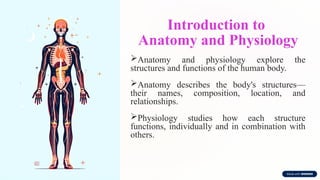
Anatomy and physiology explore the
structures and functions of the human body.
Anatomy describes the body's structures—
their names, composition, location, and
relationships.
Physiology studies how each structure
functions, individually and in combination with
others.
Two Major Fields of
Anatomy
Gross Anatomy
Study of large, visible structures that can be seen
with the naked eye.
Microscopic Anatomy
Study of structures too small to see, such as
cells and molecules.
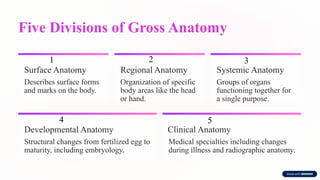
Five Divisions of Gross Anatomy
1
Surface Anatomy
Describes surface forms
and marks on the body.
2
Regional Anatomy
Organization of specific
body areas like the head
or hand.
3
Systemic Anatomy
Groups of organs
functioning together for
a single purpose.
4
Developmental Anatomy
Structural changes from fertilized egg to
maturity, including embryology.
5
Clinical Anatomy
Medical specialties including changes
during illness and radiographic anatomy.
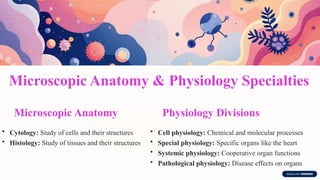
Microscopic Anatomy & Physiology Specialties
Microscopic Anatomy
• Cytology: Study of cells and their structures
• Histology: Study of tissues and their structures
Physiology Divisions
• Cell physiology: Chemical and molecular processes
• Special physiology: Specific organs like the heart
• Systemic physiology: Cooperative organ functions
• Pathological physiology: Disease effects on organs
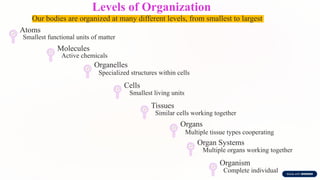
Levels of Organization
Our bodies are organized at many different levels, from smallest to largest
Atoms
Smallest functional units of matter
Molecules
Active chemicals
Organelles
Specialized structures within cells
Cells
Smallest living units
Tissues
Similar cells working together
Organs
Multiple tissue types cooperating
Organ Systems
Multiple organs working together
Organism
Complete individual
11 Organ Systems
The human body is divided into 11
interconnected organ systems.
 All systems work together, and many organs
function in multiple systems.
Protection & Support Systems
Integumentary System
Skin and derived structures
protect internal organs and
maintain body temperature.
Skeletal System
Bones and joints provide support
and protection to internal organs.
Muscular System
Skeletal muscles provide
movement throughout the body.
Control & Regulation Systems
Nervous System
Brain, spinal cord, and nerves regulate body
functions and provide sensory perception.
Endocrine System
Hormone-producing cells and glands regulate
homeostasis, growth, and development.
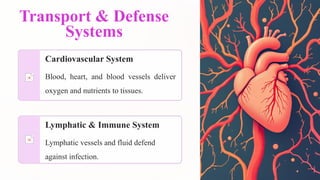
Transport & Defense
Systems
Cardiovascular System
Blood, heart, and blood vessels deliver
oxygen and nutrients to tissues.
Lymphatic & Immune System
Lymphatic vessels and fluid defend
against infection.
Processing & Elimination Systems
Respiratory System
Lungs and airways absorb oxygen and release carbon dioxide.
Digestive System
Gastrointestinal tract organs absorb nutrients from food.
Urinary System
Kidneys, ureters, and bladder maintain electrolyte balance and remove waste.
Reproductive System
Reproductive organs in males and females.
It controls the biological process by which new individuals are produced.
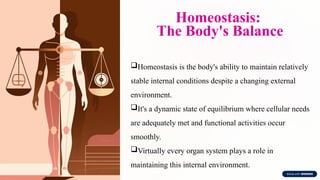
Homeostasis:
The Body's Balance
Homeostasis is the body's ability to maintain relatively
stable internal conditions despite a changing external
environment.
It's a dynamic state of equilibrium where cellular needs
are adequately met and functional activities occur
smoothly.
Virtually every organ system plays a role in
maintaining this internal environment.
The Three Components of
Homeostatic Regulation
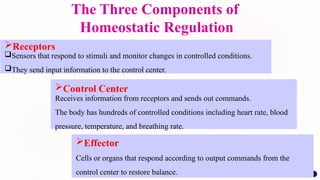
Receptors
Sensors that respond to stimuli and monitor changes in controlled conditions.
They send input information to the control center.
Control Center
Receives information from receptors and sends out commands.
The body has hundreds of controlled conditions including heart rate, blood
pressure, temperature, and breathing rate.
Effector
Cells or organs that respond according to output commands from the
control center to restore balance.
Negative Feedback:
Opposing the Stimulus
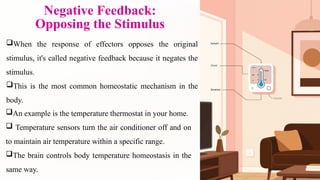
When the response of effectors opposes the original
stimulus, it's called negative feedback because it negates the
stimulus.
This is the most common homeostatic mechanism in the
body.
An example is the temperature thermostat in your home.
 Temperature sensors turn the air conditioner off and on
to maintain air temperature within a specific range.
The brain controls body temperature homeostasis in the
same way.
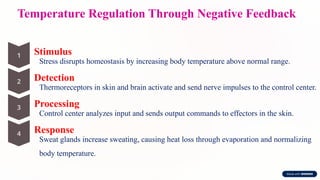
Temperature Regulation Through Negative Feedback
Stimulus
Stress disrupts homeostasis by increasing body temperature above normal range.
Detection
Thermoreceptors in skin and brain activate and send nerve impulses to the control center.
Processing
Control center analyzes input and sends output commands to effectors in the skin.
Response
Sweat glands increase sweating, causing heat loss through evaporation and normalizing
body temperature.
Positive Feedback:
Amplifying the Response
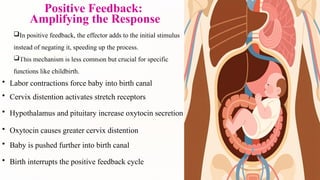
In positive feedback, the effector adds to the initial stimulus
instead of negating it, speeding up the process.
This mechanism is less common but crucial for specific
functions like childbirth.
Labor Contraction Example
• Labor contractions force baby into birth canal
• Cervix distention activates stretch receptors
• Hypothalamus and pituitary increase oxytocin secretion
• Oxytocin causes greater cervix distention
• Baby is pushed further into birth canal
• Birth interrupts the positive feedback cycle
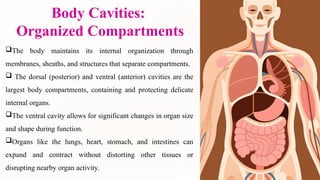
Body Cavities:
Organized Compartments
The body maintains its internal organization through
membranes, sheaths, and structures that separate compartments.
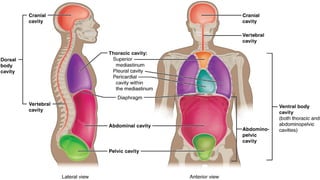
 The dorsal (posterior) and ventral (anterior) cavities are the
largest body compartments, containing and protecting delicate
internal organs.
The ventral cavity allows for significant changes in organ size
and shape during function.
Organs like the lungs, heart, stomach, and intestines can
expand and contract without distorting other tissues or
disrupting nearby organ activity.
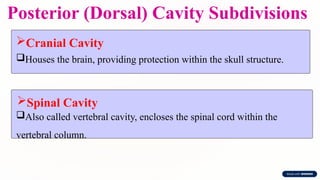
Posterior (Dorsal) Cavity Subdivisions
Cranial Cavity
Houses the brain, providing protection within the skull structure.
Spinal Cavity
Also called vertebral cavity, encloses the spinal cord within the
vertebral column.
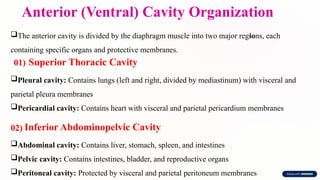
Anterior (Ventral) Cavity Organization
The anterior cavity is divided by the diaphragm muscle into two major regions, each
containing specific organs and protective membranes.
01) Superior Thoracic Cavity
Pleural cavity: Contains lungs (left and right, divided by mediastinum) with visceral and
parietal pleura membranes
Pericardial cavity: Contains heart with visceral and parietal pericardium membranes
02) Inferior Abdominopelvic Cavity
Abdominal cavity: Contains liver, stomach, spleen, and intestines
Pelvic cavity: Contains intestines, bladder, and reproductive organs
Peritoneal cavity: Protected by visceral and parietal peritoneum membranes
Serous Membranes: Protective Layers
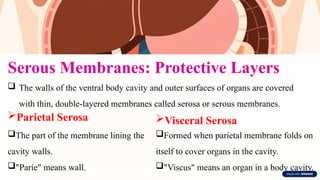
 The walls of the ventral body cavity and outer surfaces of organs are covered
with thin, double-layered membranes called serosa or serous membranes.
Parietal Serosa
The part of the membrane lining the
cavity walls.
"Parie" means wall.
Visceral Serosa
Formed when parietal membrane folds on
itself to cover organs in the cavity.
"Viscus" means an organ in a body cavity.
Body Fluid Compartments
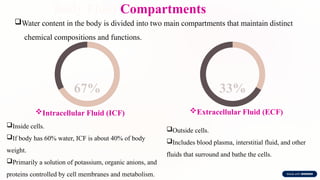
Water content in the body is divided into two main compartments that maintain distinct
chemical compositions and functions.
67%
Intracellular Fluid (ICF)
Inside cells.
If body has 60% water, ICF is about 40% of body
weight.
Primarily a solution of potassium, organic anions, and
proteins controlled by cell membranes and metabolism.
33%
Extracellular Fluid (ECF)
Outside cells.
Includes blood plasma, interstitial fluid, and other
fluids that surround and bathe the cells.
Body Fluid Compartments
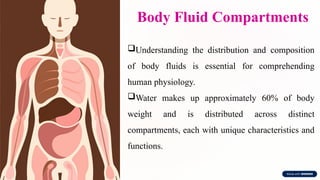
Understanding the distribution and composition
of body fluids is essential for comprehending
human physiology.
Water makes up approximately 60% of body
weight and is distributed across distinct
compartments, each with unique characteristics and
functions.
The Two Major Fluid
Compartments
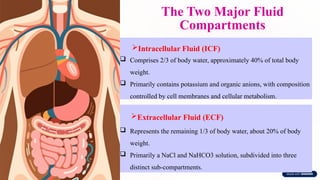
Intracellular Fluid (ICF)
 Comprises 2/3 of body water, approximately 40% of total body
weight.
 Primarily contains potassium and organic anions, with composition
controlled by cell membranes and cellular metabolism.
Extracellular Fluid (ECF)
 Represents the remaining 1/3 of body water, about 20% of body
weight.
 Primarily a NaCl and NaHCO3 solution, subdivided into three
distinct sub-compartments.
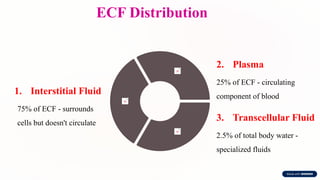
ECF Distribution
1. Interstitial Fluid
75% of ECF - surrounds
cells but doesn't circulate
2. Plasma
25% of ECF - circulating
component of blood
3. Transcellular Fluid
2.5% of total body water -
specialized fluids
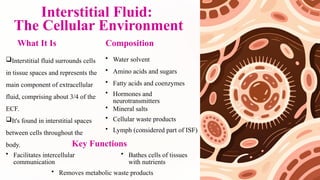
Interstitial Fluid:
The Cellular Environment
What It Is
Interstitial fluid surrounds cells
in tissue spaces and represents the
main component of extracellular
fluid, comprising about 3/4 of the
ECF.
It's found in interstitial spaces
between cells throughout the
body. Key Functions
• Facilitates intercellular
communication
• Bathes cells of tissues
with nutrients
• Removes metabolic waste products
Composition
• Water solvent
• Amino acids and sugars
• Fatty acids and coenzymes
• Hormones and
neurotransmitters
• Mineral salts
• Cellular waste products
• Lymph (considered part of ISF)
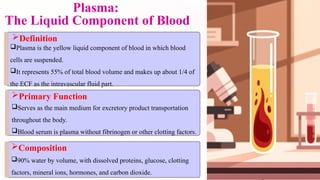
Plasma:
The Liquid Component of Blood
Definition
Plasma is the yellow liquid component of blood in which blood
cells are suspended.
It represents 55% of total blood volume and makes up about 1/4 of
the ECF as the intravascular fluid part.
Composition
90% water by volume, with dissolved proteins, glucose, clotting
factors, mineral ions, hormones, and carbon dioxide.
Primary Function
Serves as the main medium for excretory product transportation
throughout the body.
Blood serum is plasma without fibrinogen or other clotting factors.
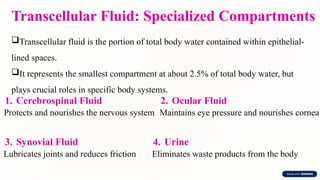
Transcellular Fluid: Specialized Compartments
Transcellular fluid is the portion of total body water contained within epithelial-
lined spaces.
It represents the smallest compartment at about 2.5% of total body water, but
plays crucial roles in specific body systems.
1. Cerebrospinal Fluid
Protects and nourishes the nervous system
2. Ocular Fluid
Maintains eye pressure and nourishes cornea
3. Synovial Fluid
Lubricates joints and reduces friction
4. Urine
Eliminates waste products from the body
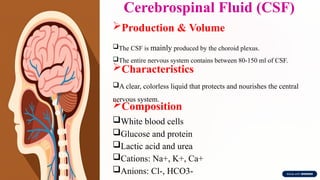
Cerebrospinal Fluid (CSF)
Production & Volume
The CSF is mainly produced by the choroid plexus.
The entire nervous system contains between 80-150 ml of CSF.
Characteristics
A clear, colorless liquid that protects and nourishes the central
nervous system.
Composition
White blood cells
Glucose and protein
Lactic acid and urea
Cations: Na+, K+, Ca+
Anions: Cl-, HCO3-
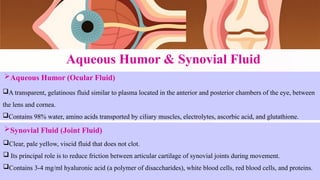
Aqueous Humor & Synovial Fluid
Aqueous Humor (Ocular Fluid)
A transparent, gelatinous fluid similar to plasma located in the anterior and posterior chambers of the eye, between
the lens and cornea.
Contains 98% water, amino acids transported by ciliary muscles, electrolytes, ascorbic acid, and glutathione.
Synovial Fluid (Joint Fluid)
Clear, pale yellow, viscid fluid that does not clot.
 Its principal role is to reduce friction between articular cartilage of synovial joints during movement.
Contains 3-4 mg/ml hyaluronic acid (a polymer of disaccharides), white blood cells, red blood cells, and proteins.
Urine: The Body's Waste Elimination System
Urine is a typically sterile liquid byproduct secreted by the kidneys through urination and
excreted through the urethra.
It serves as the primary mechanism for eliminating metabolic waste and maintaining chemical
balance. 95%
Water Content
The primary component of urine
5%
Solutes
Organic and inorganic compounds
Composition Details
Organic Solutes
• Urea, creatinine, uric acid
• Trace enzymes and carbohydrates
• Hormones and fatty acids
• Pigments and mucins
Inorganic Ions
• Sodium (Na+) and Potassium (K+)
• Chloride (Cl-) and Magnesium (Mg2+)
• Calcium (Ca2+) and Ammonium (NH4+)
• Sulfates (SO42-) and Phosphates (PO43-)
Key Takeaways: Body Fluid Distribution
1.Total Body Water
Approx 60% of body weight, divided into intracellular (40%) and extracellular (20%) compartments
2.ICF Dominance
Intracellular fluid comprises 2/3 of body water, primarily containing potassium and organic anions
3.ECF Subdivisions
Extracellular fluid includes interstitial fluid (75%), plasma (25%), and transcellular fluid (2.5% of total
body water)
4.Specialized Functions
Each compartment has unique composition and functions essential for maintaining homeostasis and
supporting life processes