Partial Differential Equations
Introduction
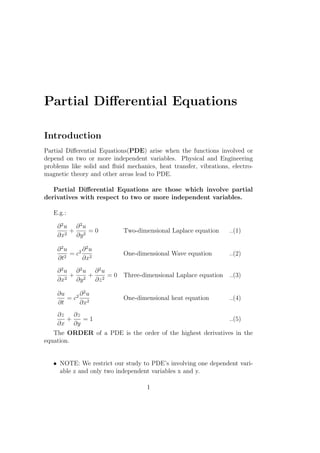
Partial Differential Equations(PDE) arise when the functions involved or
depend on two or more independent variables. Physical and Engineering
problems like solid and fluid mechanics, heat transfer, vibrations, electro-
magnetic theory and other areas lead to PDE.
Partial Differential Equations are those which involve partial
derivatives with respect to two or more independent variables.
E.g.:
∂2
u
∂x2
+
∂2
u
∂y2
= 0 Two-dimensional Laplace equation ..(1)
∂2
u
∂t2
= c2 ∂2
u
∂x2
One-dimensional Wave equation ..(2)
∂2
u
∂x2
+
∂2
u
∂y2
+
∂2
u
∂z2
= 0 Three-dimensional Laplace equation ..(3)
∂u
∂t
= c2 ∂2
u
∂x2
One-dimensional heat equation ..(4)
∂z
∂x
+
∂z
∂y
= 1 ..(5)
The ORDER of a PDE is the order of the highest derivatives in the
equation.
• NOTE: We restrict our study to PDE’s involving one dependent vari-
able z and only two independent variables x and y.
1
Partial Differential Equations
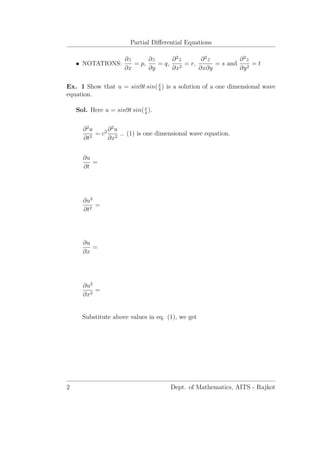
• NOTATIONS:
∂z
∂x
= p,
∂z
∂y
= q,
∂2
z
∂x2
= r,
∂2
z
∂x∂y
= s and
∂2
z
∂y2
= t
Ex. 1 Show that u = sin9t sin(x
4
) is a solution of a one dimensional wave
equation.
Sol. Here u = sin9t sin(x
4
).
∂2
u
∂t2
= c2 ∂2
u
∂x2
.. (1) is one dimensional wave equation.
∂u
∂t
=
∂2
u
∂t2
=
∂u
∂x
=
∂2
u
∂x2
=
Substitute above values in eq. (1), we get
2 Dept. of Mathematics, AITS - Rajkot
Partial Differential Equations
c =
∴ For c = , u = sin9t sin(x
4
) is a solution of a wave equation.
Ex. 2 Verify that the function u = ex
cosy is the solution of the Laplace
equation
∂2
u
∂x2
+
∂2
u
∂y2
= 0.
Sol.
Dept. of Mathematics, AITS - Rajkot 3
Partial Differential Equations
Ex. 3 Verify that the function u = x3
+ 3xt2
is the solution of the wave
equation
∂2
u
∂t2
= c2 ∂2
u
∂x2
for a suitable value of c.
Sol.
4 Dept. of Mathematics, AITS - Rajkot
Partial Differential Equations
Exercise 1.1
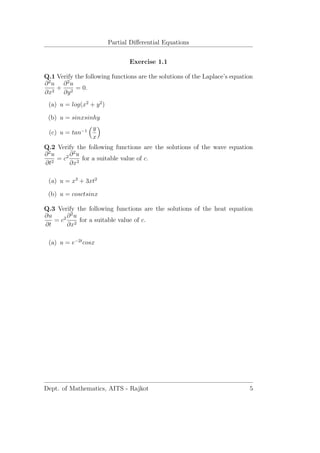
Q.1 Verify the following functions are the solutions of the Laplace’s equation
∂2
u
∂x2
+
∂2
u
∂y2
= 0.
(a) u = log(x2
+ y2
)
(b) u = sinxsinhy
(c) u = tan−1 y
x
Q.2 Verify the following functions are the solutions of the wave equation
∂2
u
∂t2
= c2 ∂2
u
∂x2
for a suitable value of c.
(a) u = x3
+ 3xt2
(b) u = cosctsinx
Q.3 Verify the following functions are the solutions of the heat equation
∂u
∂t
= c2 ∂2
u
∂x2
for a suitable value of c.
(a) u = e−2t
cosx
Dept. of Mathematics, AITS - Rajkot 5
Partial Differential Equations
Formation of PDE
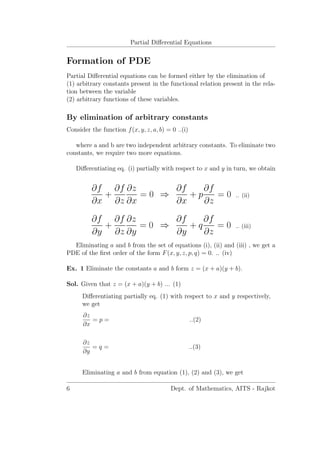
Partial Differential equations can be formed either by the elimination of
(1) arbitrary constants present in the functional relation present in the rela-
tion between the variable
(2) arbitrary functions of these variables.
By elimination of arbitrary constants
Consider the function f(x, y, z, a, b) = 0 ..(i)
where a and b are two independent arbitrary constants. To eliminate two
constants, we require two more equations.
Differentiating eq. (i) partially with respect to x and y in turn, we obtain
∂f
∂x
+
∂f
∂z
∂z
∂x
= 0 ⇒
∂f
∂x
+ p
∂f
∂z
= 0 .. (ii)
∂f
∂y
+
∂f
∂z
∂z
∂y
= 0 ⇒
∂f
∂y
+ q
∂f
∂z
= 0 .. (iii)
Eliminating a and b from the set of equations (i), (ii) and (iii) , we get a
PDE of the first order of the form F(x, y, z, p, q) = 0. .. (iv)
Ex. 1 Eliminate the constants a and b form z = (x + a)(y + b).
Sol. Given that z = (x + a)(y + b) ... (1)
Differentiating partially eq. (1) with respect to x and y respectively,
we get
∂z
∂x
= p = ..(2)
∂z
∂y
= q = ..(3)
Eliminating a and b from equation (1), (2) and (3), we get
6 Dept. of Mathematics, AITS - Rajkot
Partial Differential Equations
is the required partial differential equation.
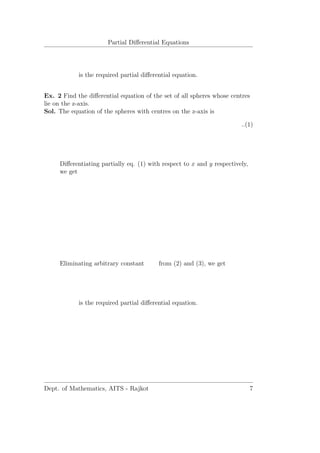
Ex. 2 Find the differential equation of the set of all spheres whose centres
lie on the z-axis.
Sol. The equation of the spheres with centres on the z-axis is
..(1)
Differentiating partially eq. (1) with respect to x and y respectively,
we get
Eliminating arbitrary constant from (2) and (3), we get
is the required partial differential equation.
Dept. of Mathematics, AITS - Rajkot 7
Partial Differential Equations
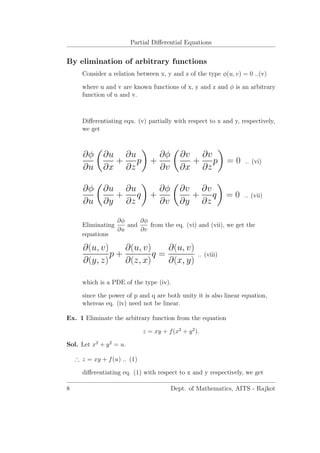
By elimination of arbitrary functions
Consider a relation between x, y and z of the type φ(u, v) = 0 ..(v)
where u and v are known functions of x, y and z and φ is an arbitrary
function of u and v.
Differentiating equ. (v) partially with respect to x and y, respectively,
we get
∂φ
∂u
∂u
∂x
+
∂u
∂z
p +
∂φ
∂v
∂v
∂x
+
∂v
∂z
p = 0 .. (vi)
∂φ
∂u
∂u
∂y
+
∂u
∂z
q +
∂φ
∂v
∂v
∂y
+
∂v
∂z
q = 0 .. (vii)
Eliminating
∂φ
∂u
and
∂φ
∂v
from the eq. (vi) and (vii), we get the
equations
∂(u, v)
∂(y, z)
p +
∂(u, v)
∂(z, x)
q =
∂(u, v)
∂(x, y)
.. (viii)
which is a PDE of the type (iv).
since the power of p and q are both unity it is also linear equation,
whereas eq. (iv) need not be linear.
Ex. 1 Eliminate the arbitrary function from the equation
z = xy + f(x2
+ y2
).
Sol. Let x2
+ y2
= u.
∴ z = xy + f(u) .. (1)
differentiating eq. (1) with respect to x and y respectively, we get
8 Dept. of Mathematics, AITS - Rajkot
Partial Differential Equations
p = ..(2)
q = ..(3)
eliminating from (2) and (3), we get
Ex. 2 Eliminate arbitrary function from the equation
f(x + y + z, x2
+ y2
+ z2
) = 0.
Sol. Let x + y + z = u, x2
+ y2
+ z2
= v then
f(u, v) = 0 .. (1)
Differentiating (1) with respect to x and y, we get
∂f
∂u
∂u
∂x
+
∂u
∂z
p +
∂f
∂v
∂v
∂x
+
∂v
∂z
p = 0 .. (2)
∂f
∂u
∂u
∂y
+
∂u
∂z
q +
∂f
∂v
∂v
∂y
+
∂v
∂z
q = 0 .. (3)
Now
∂u
∂x
=
∂v
∂x
=
∂u
∂y
=
∂v
∂y
=
∂u
∂z
=
∂v
∂z
=
Dept. of Mathematics, AITS - Rajkot 9
Partial Differential Equations
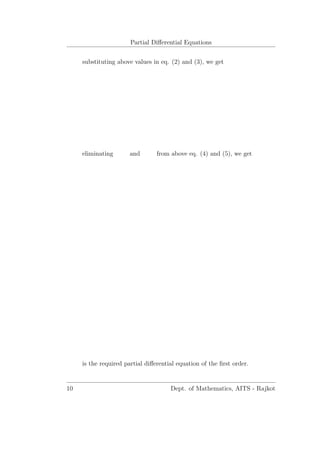
substituting above values in eq. (2) and (3), we get
eliminating and from above eq. (4) and (5), we get
is the required partial differential equation of the first order.
10 Dept. of Mathematics, AITS - Rajkot
Partial Differential Equations
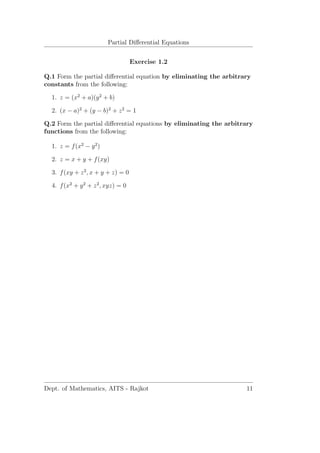
Exercise 1.2
Q.1 Form the partial differential equation by eliminating the arbitrary
constants from the following:
1. z = (x2
+ a)(y2
+ b)
2. (x − a)2
+ (y − b)2
+ z2
= 1
Q.2 Form the partial differential equations by eliminating the arbitrary
functions from the following:
1. z = f(x2
− y2
)
2. z = x + y + f(xy)
3. f(xy + z2
, x + y + z) = 0
4. f(x2
+ y2
+ z2
, xyz) = 0
Dept. of Mathematics, AITS - Rajkot 11
Partial Differential Equations
Integrals of Partial Differential Equation
• A solution or integral of a partial differential equation is a relation
between the dependent and the independent variables that satisfies
the differential equation.
• A solution which contains a number of arbitrary constants equal to
the independent variables, is called a complete integral.
• A solution obtained by giving particular values to the arbitrary
constants in a complete integral is called a particular integral.
• Singular integral
Let F(x, y, z, p, q) = 0 .. (1)
be the partial differential equation whose complete integral is
f(x, y, z, a, b) = 0 .. (2)
eliminating a, b between eq. (2) and
∂f
∂a
= 0,
∂f
∂b
= 0
if it exists, is called a singular integral.
• General Integral
In eq. (2), if we assume b = φ(a), then (2) becomes
f[x, y, z, a, φ(a)] = 0 .. (3)
differentiating (2) partially with respect to a,
∂f
∂a
+
∂f
∂b
φ (a) = 0 .. (4)
eliminating a between theses two equations (3) and (4), if it exists, is
called the general integral of eq. (1).
12 Dept. of Mathematics, AITS - Rajkot
Partial Differential Equations
Solutions of PDE by the method of Direct
Integration
This method is applicable to those problems, where direct integration is
possible.
Ex. 1 Solve
∂2
z
∂x∂y
= x3
+ y3
Sol. Given that
∂
∂x
∂z
∂y
= x3
+ y3
Integrating w.r.t to keeping constant, we get
∴
∂z
∂y
=
Now integrating w.r.t. to keeping as constant
∴ z =
Dept. of Mathematics, AITS - Rajkot 13
Partial Differential Equations
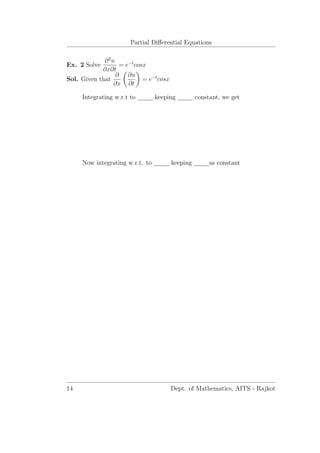
Ex. 2 Solve
∂2
u
∂x∂t
= e−t
cosx
Sol. Given that
∂
∂x
∂u
∂t
= e−t
cosx
Integrating w.r.t to keeping constant, we get
Now integrating w.r.t. to keeping as constant
14 Dept. of Mathematics, AITS - Rajkot
Partial Differential Equations
Ex. 3 Solve
∂3
z
∂x2∂y
= cos(2x + 3y)
Sol. Given that
∂2
∂x2
∂z
∂y
= cos(2x + 3y)
Integrating w.r.t to keeping constant, we get
∴
∂
∂x
∂z
∂y
=
Integrating w.r.t. to keeping as constant
Finally integrating w.r.t. to keeping as constant
Dept. of Mathematics, AITS - Rajkot 15
Partial Differential Equations
Lagrange’s Equation
We have
∂(u, v)
∂(y, z)
p +
∂(u, v)
∂(z, x)
q =
∂(u, v)
∂(x, y)
This can be expressed in the form Pp + Qq = R, where P, Q and R are
functions of x, y and z. This partial differential equation is known as
Lagrange’s equation.
Method to solve Pp + Qq = R
In order to solve the equation Pp + Qq = R
1 Form the subsidiary (auxiliary ) equation
dx
P
=
dy
Q
=
dz
R
2 Solve these subsidiary equations by the method of grouping or by the
method of multiples or both to get two independent solutions u = c1
and v = c2.
3 Then φ(u, v) = 0 or u = f(v) or v = f(u) is the general solution of
the equation Pp + Qq = R.
Ex. 1 Solve
y2
z
x
∂z
∂x
+ xz
∂z
∂y
= y2
.
Sol. The given equation can be written as ( in for of p and q)
y2
zp + x2
zq = xy2
comparing with Pp + Qq = R, we get
P = , Q = and R =
The subsidiary equations are
dx
P
=
dy
Q
=
dz
R
Taking first two, we have
16 Dept. of Mathematics, AITS - Rajkot
Partial Differential Equations
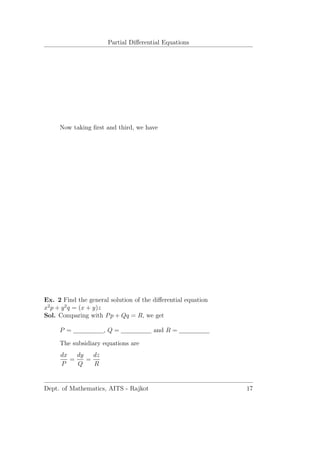
Now taking first and third, we have
Ex. 2 Find the general solution of the differential equation
x2
p + y2
q = (x + y)z
Sol. Comparing with Pp + Qq = R, we get
P = , Q = and R =
The subsidiary equations are
dx
P
=
dy
Q
=
dz
R
Dept. of Mathematics, AITS - Rajkot 17
Partial Differential Equations
Taking first two, we have
Ex. 3 Solve (y + z)p + (z + x)q = x + y
Ex. 4 Solve pz − qz = z2
+ (x + y)2
Ex. 5 Solve x2
(y − z)p + y2
(z − x) = z2
(x − y)
Ex. 6 Solve (z2
− 2yz − y2
)p + (xy + zx)q = xy − zx
Exercise
1. xp + yq = z
2. xp − yq = xy
3. (1 − x)p + (2 − y)q = 3 − z
4. zxp − zyq = y2
− x2
5. (y − z)p + (z − x)q = x − y
6. p − 2q = 2x − ey
+ 1
7. x(y2
− z2
)p + y(z2
− x2
)q = z(x2
− y2
)
18 Dept. of Mathematics, AITS - Rajkot
Partial Differential Equations
Special type of Nonlinear PDE of the first
order
A PDE which involves first order derivatives p and q with degree more than
one and the products of p and q is called a non-linear PDE of the first
order.
There are four standard forms of these equations.
1. Equations involving only p and q
2. Equations not involving the independent variables
3. Separable equations
4. Clairaut’s form
Standard Form 1. Equations involving only p and q
Such equations are of the form f(p,q)=0
z = ax + by + c ... (1)
is a solution of the equation f(p, q) = 0
provided f(a, b) = 0 (means put p = a and q = b) ... (2)
solving (2) for b, b = F(a)
Hence the complete integral is z = ax + F(a)y + c
where a and c are arbitrary constants.
Ex. 1 Solve pq = p + q
Sol. Here the give DE involves on p and q (so standard form 1)
The solution is
put p = and q =
therefore,
b =
Dept. of Mathematics, AITS - Rajkot 19
Partial Differential Equations
Hence the complete solution is
Exercise
Solve the following equations
1. pq = 1
2. p = q2
3. p2
+ q2
= 4
4. pq + p + q = 0
20 Dept. of Mathematics, AITS - Rajkot
Partial Differential Equations
Standard Form 2. Equations not involving the
independent variables
Such equations are of the form f(z,p,q)=0
Consider f(z, p, q) = 0 .. (1)
since z is a function of x and y
dz =
∂z
∂x
dx +
∂z
∂y
dy = pdx + qdy
let q = ap
then eq (1) becomes f(z, p, ap) = 0 .. (2)
solving (2) for p i.e. p = φ(z, a)
∴ dz = φ(z, a) dx + a φ(z, a) dy
∴
dz
φ(z, a)
= dx + ady
integrating, we get
dz
φ(z, a)
= x + ay + b which is a complete integral.
Ex. 1 Solve: p2
z2
+ q2
= 1
Sol. Given equation involves only p, q and z (standard form 2)
Therefore putting q = ap in given equation, we get
Now dz = pdx + qdy, substituting above values in this equation and
integrate
Dept. of Mathematics, AITS - Rajkot 21
Partial Differential Equations
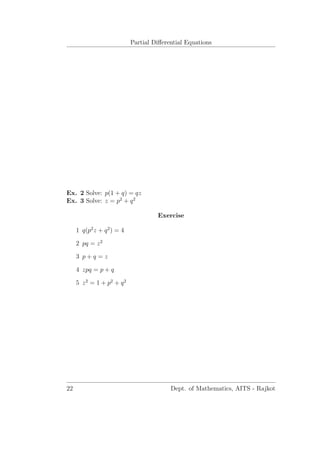
Ex. 2 Solve: p(1 + q) = qz
Ex. 3 Solve: z = p2
+ q2
Exercise
1 q(p2
z + q2
) = 4
2 pq = z2
3 p + q = z
4 zpq = p + q
5 z2
= 1 + p2
+ q2
22 Dept. of Mathematics, AITS - Rajkot
Partial Differential Equations
Standard Form 3. Separable equations
Such equations are of the form f1(x,p) = f2(y,q)
A first order PDE is seperable if it can be written in the form
f1(x, p) = f2(y, q)
We assume each side equal to an arbitrary constant a.
solving f1(x, p) = a ⇒ p = φ1(x, a)
solving f2(y, q) = a ⇒ q = φ2(y, a)
∴ z = φ1(x, a)dx + φ2(y, a)dy which is complete integral
Ex. 1 Solve: p − x2
= q + y2
Sol. Writing equation in the form
p − x2
= q + y2
= a
∴ p = a + x2
and q = a − y2
Now dz = pdx + qdy
dz = dx + dy
Integrating both sides, we get
z =
Ex. 2 Solve: p2
+ q2
= x2
+ y2
Sol. Writing equation in the form
p2
− x2
= y2
− q2
Let p2
− x2
= a and y2
− q2
= a
Hence, p2
= x2
+ a, q2
= y2
− a
Dept. of Mathematics, AITS - Rajkot 23
Partial Differential Equations
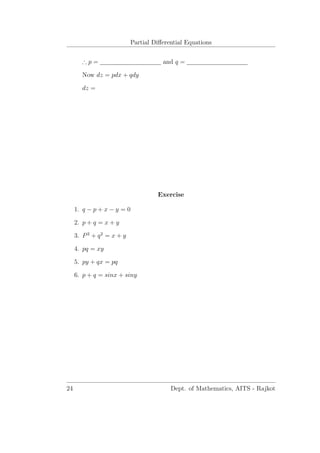
∴ p = and q =
Now dz = pdx + qdy
dz =
Exercise
1. q − p + x − y = 0
2. p + q = x + y
3. P2
+ q2
= x + y
4. pq = xy
5. py + qx = pq
6. p + q = sinx + siny
24 Dept. of Mathematics, AITS - Rajkot
Partial Differential Equations
Standard Form 4. Clairaut’s form
A first-order PDE is said to be of Clairaut type if it can be written in the
form,
z = px + qy + f(p, q)
substitute p = a and q = b in f(p, q)
The solution of the the equation is z = ax + by + f(a, b)
Ex. 1 Solve: z = px + qy + 1 + p2 + q2
Sol. The complete integral is obtained
z = px + qy +
√
1 + a2 + b2
Ex. 2 Solve: (p + q)(z − xp − yq) = 1.
Sol.
Exercise
Solve the following equations.
1. z = px + qy + p2
q2
2. z = px + qy + 2
√
pq
3. z = px + qy +
q
p
− p
4. (1 − x)p + (2 − y)q = 3 − z
5.
z
pq
=
x
q
+
y
p
+
√
pq
Dept. of Mathematics, AITS - Rajkot 25
Partial Differential Equations
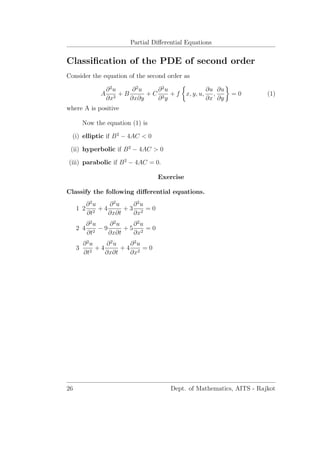
Classification of the PDE of second order
Consider the equation of the second order as
A
∂2
u
∂x2
+ B
∂2
u
∂x∂y
+ C
∂2
u
∂2y
+ f x, y, u,
∂u
∂x
,
∂u
∂y
= 0 (1)
where A is positive
Now the equation (1) is
(i) elliptic if B2
− 4AC < 0
(ii) hyperbolic if B2
− 4AC > 0
(iii) parabolic if B2
− 4AC = 0.
Exercise
Classify the following differential equations.
1 2
∂2
u
∂t2
+ 4
∂2
u
∂x∂t
+ 3
∂2
u
∂x2
= 0
2 4
∂2
u
∂t2
− 9
∂2
u
∂x∂t
+ 5
∂2
u
∂x2
= 0
3
∂2
u
∂t2
+ 4
∂2
u
∂x∂t
+ 4
∂2
u
∂x2
= 0
26 Dept. of Mathematics, AITS - Rajkot

Partial Differential Equation - Notes

  • 1.
    Partial Differential Equations Introduction PartialDifferential Equations(PDE) arise when the functions involved or depend on two or more independent variables. Physical and Engineering problems like solid and fluid mechanics, heat transfer, vibrations, electro- magnetic theory and other areas lead to PDE. Partial Differential Equations are those which involve partial derivatives with respect to two or more independent variables. E.g.: ∂2 u ∂x2 + ∂2 u ∂y2 = 0 Two-dimensional Laplace equation ..(1) ∂2 u ∂t2 = c2 ∂2 u ∂x2 One-dimensional Wave equation ..(2) ∂2 u ∂x2 + ∂2 u ∂y2 + ∂2 u ∂z2 = 0 Three-dimensional Laplace equation ..(3) ∂u ∂t = c2 ∂2 u ∂x2 One-dimensional heat equation ..(4) ∂z ∂x + ∂z ∂y = 1 ..(5) The ORDER of a PDE is the order of the highest derivatives in the equation. • NOTE: We restrict our study to PDE’s involving one dependent vari- able z and only two independent variables x and y. 1
  • 2.
    Partial Differential Equations •NOTATIONS: ∂z ∂x = p, ∂z ∂y = q, ∂2 z ∂x2 = r, ∂2 z ∂x∂y = s and ∂2 z ∂y2 = t Ex. 1 Show that u = sin9t sin(x 4 ) is a solution of a one dimensional wave equation. Sol. Here u = sin9t sin(x 4 ). ∂2 u ∂t2 = c2 ∂2 u ∂x2 .. (1) is one dimensional wave equation. ∂u ∂t = ∂2 u ∂t2 = ∂u ∂x = ∂2 u ∂x2 = Substitute above values in eq. (1), we get 2 Dept. of Mathematics, AITS - Rajkot
  • 3.
    Partial Differential Equations c= ∴ For c = , u = sin9t sin(x 4 ) is a solution of a wave equation. Ex. 2 Verify that the function u = ex cosy is the solution of the Laplace equation ∂2 u ∂x2 + ∂2 u ∂y2 = 0. Sol. Dept. of Mathematics, AITS - Rajkot 3
  • 4.
    Partial Differential Equations Ex.3 Verify that the function u = x3 + 3xt2 is the solution of the wave equation ∂2 u ∂t2 = c2 ∂2 u ∂x2 for a suitable value of c. Sol. 4 Dept. of Mathematics, AITS - Rajkot
  • 5.
    Partial Differential Equations Exercise1.1 Q.1 Verify the following functions are the solutions of the Laplace’s equation ∂2 u ∂x2 + ∂2 u ∂y2 = 0. (a) u = log(x2 + y2 ) (b) u = sinxsinhy (c) u = tan−1 y x Q.2 Verify the following functions are the solutions of the wave equation ∂2 u ∂t2 = c2 ∂2 u ∂x2 for a suitable value of c. (a) u = x3 + 3xt2 (b) u = cosctsinx Q.3 Verify the following functions are the solutions of the heat equation ∂u ∂t = c2 ∂2 u ∂x2 for a suitable value of c. (a) u = e−2t cosx Dept. of Mathematics, AITS - Rajkot 5
  • 6.
    Partial Differential Equations Formationof PDE Partial Differential equations can be formed either by the elimination of (1) arbitrary constants present in the functional relation present in the rela- tion between the variable (2) arbitrary functions of these variables. By elimination of arbitrary constants Consider the function f(x, y, z, a, b) = 0 ..(i) where a and b are two independent arbitrary constants. To eliminate two constants, we require two more equations. Differentiating eq. (i) partially with respect to x and y in turn, we obtain ∂f ∂x + ∂f ∂z ∂z ∂x = 0 ⇒ ∂f ∂x + p ∂f ∂z = 0 .. (ii) ∂f ∂y + ∂f ∂z ∂z ∂y = 0 ⇒ ∂f ∂y + q ∂f ∂z = 0 .. (iii) Eliminating a and b from the set of equations (i), (ii) and (iii) , we get a PDE of the first order of the form F(x, y, z, p, q) = 0. .. (iv) Ex. 1 Eliminate the constants a and b form z = (x + a)(y + b). Sol. Given that z = (x + a)(y + b) ... (1) Differentiating partially eq. (1) with respect to x and y respectively, we get ∂z ∂x = p = ..(2) ∂z ∂y = q = ..(3) Eliminating a and b from equation (1), (2) and (3), we get 6 Dept. of Mathematics, AITS - Rajkot
  • 7.
    Partial Differential Equations isthe required partial differential equation. Ex. 2 Find the differential equation of the set of all spheres whose centres lie on the z-axis. Sol. The equation of the spheres with centres on the z-axis is ..(1) Differentiating partially eq. (1) with respect to x and y respectively, we get Eliminating arbitrary constant from (2) and (3), we get is the required partial differential equation. Dept. of Mathematics, AITS - Rajkot 7
  • 8.
    Partial Differential Equations Byelimination of arbitrary functions Consider a relation between x, y and z of the type φ(u, v) = 0 ..(v) where u and v are known functions of x, y and z and φ is an arbitrary function of u and v. Differentiating equ. (v) partially with respect to x and y, respectively, we get ∂φ ∂u ∂u ∂x + ∂u ∂z p + ∂φ ∂v ∂v ∂x + ∂v ∂z p = 0 .. (vi) ∂φ ∂u ∂u ∂y + ∂u ∂z q + ∂φ ∂v ∂v ∂y + ∂v ∂z q = 0 .. (vii) Eliminating ∂φ ∂u and ∂φ ∂v from the eq. (vi) and (vii), we get the equations ∂(u, v) ∂(y, z) p + ∂(u, v) ∂(z, x) q = ∂(u, v) ∂(x, y) .. (viii) which is a PDE of the type (iv). since the power of p and q are both unity it is also linear equation, whereas eq. (iv) need not be linear. Ex. 1 Eliminate the arbitrary function from the equation z = xy + f(x2 + y2 ). Sol. Let x2 + y2 = u. ∴ z = xy + f(u) .. (1) differentiating eq. (1) with respect to x and y respectively, we get 8 Dept. of Mathematics, AITS - Rajkot
  • 9.
    Partial Differential Equations p= ..(2) q = ..(3) eliminating from (2) and (3), we get Ex. 2 Eliminate arbitrary function from the equation f(x + y + z, x2 + y2 + z2 ) = 0. Sol. Let x + y + z = u, x2 + y2 + z2 = v then f(u, v) = 0 .. (1) Differentiating (1) with respect to x and y, we get ∂f ∂u ∂u ∂x + ∂u ∂z p + ∂f ∂v ∂v ∂x + ∂v ∂z p = 0 .. (2) ∂f ∂u ∂u ∂y + ∂u ∂z q + ∂f ∂v ∂v ∂y + ∂v ∂z q = 0 .. (3) Now ∂u ∂x = ∂v ∂x = ∂u ∂y = ∂v ∂y = ∂u ∂z = ∂v ∂z = Dept. of Mathematics, AITS - Rajkot 9
  • 10.
    Partial Differential Equations substitutingabove values in eq. (2) and (3), we get eliminating and from above eq. (4) and (5), we get is the required partial differential equation of the first order. 10 Dept. of Mathematics, AITS - Rajkot
  • 11.
    Partial Differential Equations Exercise1.2 Q.1 Form the partial differential equation by eliminating the arbitrary constants from the following: 1. z = (x2 + a)(y2 + b) 2. (x − a)2 + (y − b)2 + z2 = 1 Q.2 Form the partial differential equations by eliminating the arbitrary functions from the following: 1. z = f(x2 − y2 ) 2. z = x + y + f(xy) 3. f(xy + z2 , x + y + z) = 0 4. f(x2 + y2 + z2 , xyz) = 0 Dept. of Mathematics, AITS - Rajkot 11
  • 12.
    Partial Differential Equations Integralsof Partial Differential Equation • A solution or integral of a partial differential equation is a relation between the dependent and the independent variables that satisfies the differential equation. • A solution which contains a number of arbitrary constants equal to the independent variables, is called a complete integral. • A solution obtained by giving particular values to the arbitrary constants in a complete integral is called a particular integral. • Singular integral Let F(x, y, z, p, q) = 0 .. (1) be the partial differential equation whose complete integral is f(x, y, z, a, b) = 0 .. (2) eliminating a, b between eq. (2) and ∂f ∂a = 0, ∂f ∂b = 0 if it exists, is called a singular integral. • General Integral In eq. (2), if we assume b = φ(a), then (2) becomes f[x, y, z, a, φ(a)] = 0 .. (3) differentiating (2) partially with respect to a, ∂f ∂a + ∂f ∂b φ (a) = 0 .. (4) eliminating a between theses two equations (3) and (4), if it exists, is called the general integral of eq. (1). 12 Dept. of Mathematics, AITS - Rajkot
  • 13.
    Partial Differential Equations Solutionsof PDE by the method of Direct Integration This method is applicable to those problems, where direct integration is possible. Ex. 1 Solve ∂2 z ∂x∂y = x3 + y3 Sol. Given that ∂ ∂x ∂z ∂y = x3 + y3 Integrating w.r.t to keeping constant, we get ∴ ∂z ∂y = Now integrating w.r.t. to keeping as constant ∴ z = Dept. of Mathematics, AITS - Rajkot 13
  • 14.
    Partial Differential Equations Ex.2 Solve ∂2 u ∂x∂t = e−t cosx Sol. Given that ∂ ∂x ∂u ∂t = e−t cosx Integrating w.r.t to keeping constant, we get Now integrating w.r.t. to keeping as constant 14 Dept. of Mathematics, AITS - Rajkot
  • 15.
    Partial Differential Equations Ex.3 Solve ∂3 z ∂x2∂y = cos(2x + 3y) Sol. Given that ∂2 ∂x2 ∂z ∂y = cos(2x + 3y) Integrating w.r.t to keeping constant, we get ∴ ∂ ∂x ∂z ∂y = Integrating w.r.t. to keeping as constant Finally integrating w.r.t. to keeping as constant Dept. of Mathematics, AITS - Rajkot 15
  • 16.
    Partial Differential Equations Lagrange’sEquation We have ∂(u, v) ∂(y, z) p + ∂(u, v) ∂(z, x) q = ∂(u, v) ∂(x, y) This can be expressed in the form Pp + Qq = R, where P, Q and R are functions of x, y and z. This partial differential equation is known as Lagrange’s equation. Method to solve Pp + Qq = R In order to solve the equation Pp + Qq = R 1 Form the subsidiary (auxiliary ) equation dx P = dy Q = dz R 2 Solve these subsidiary equations by the method of grouping or by the method of multiples or both to get two independent solutions u = c1 and v = c2. 3 Then φ(u, v) = 0 or u = f(v) or v = f(u) is the general solution of the equation Pp + Qq = R. Ex. 1 Solve y2 z x ∂z ∂x + xz ∂z ∂y = y2 . Sol. The given equation can be written as ( in for of p and q) y2 zp + x2 zq = xy2 comparing with Pp + Qq = R, we get P = , Q = and R = The subsidiary equations are dx P = dy Q = dz R Taking first two, we have 16 Dept. of Mathematics, AITS - Rajkot
  • 17.
    Partial Differential Equations Nowtaking first and third, we have Ex. 2 Find the general solution of the differential equation x2 p + y2 q = (x + y)z Sol. Comparing with Pp + Qq = R, we get P = , Q = and R = The subsidiary equations are dx P = dy Q = dz R Dept. of Mathematics, AITS - Rajkot 17
  • 18.
    Partial Differential Equations Takingfirst two, we have Ex. 3 Solve (y + z)p + (z + x)q = x + y Ex. 4 Solve pz − qz = z2 + (x + y)2 Ex. 5 Solve x2 (y − z)p + y2 (z − x) = z2 (x − y) Ex. 6 Solve (z2 − 2yz − y2 )p + (xy + zx)q = xy − zx Exercise 1. xp + yq = z 2. xp − yq = xy 3. (1 − x)p + (2 − y)q = 3 − z 4. zxp − zyq = y2 − x2 5. (y − z)p + (z − x)q = x − y 6. p − 2q = 2x − ey + 1 7. x(y2 − z2 )p + y(z2 − x2 )q = z(x2 − y2 ) 18 Dept. of Mathematics, AITS - Rajkot
  • 19.
    Partial Differential Equations Specialtype of Nonlinear PDE of the first order A PDE which involves first order derivatives p and q with degree more than one and the products of p and q is called a non-linear PDE of the first order. There are four standard forms of these equations. 1. Equations involving only p and q 2. Equations not involving the independent variables 3. Separable equations 4. Clairaut’s form Standard Form 1. Equations involving only p and q Such equations are of the form f(p,q)=0 z = ax + by + c ... (1) is a solution of the equation f(p, q) = 0 provided f(a, b) = 0 (means put p = a and q = b) ... (2) solving (2) for b, b = F(a) Hence the complete integral is z = ax + F(a)y + c where a and c are arbitrary constants. Ex. 1 Solve pq = p + q Sol. Here the give DE involves on p and q (so standard form 1) The solution is put p = and q = therefore, b = Dept. of Mathematics, AITS - Rajkot 19
  • 20.
    Partial Differential Equations Hencethe complete solution is Exercise Solve the following equations 1. pq = 1 2. p = q2 3. p2 + q2 = 4 4. pq + p + q = 0 20 Dept. of Mathematics, AITS - Rajkot
  • 21.
    Partial Differential Equations StandardForm 2. Equations not involving the independent variables Such equations are of the form f(z,p,q)=0 Consider f(z, p, q) = 0 .. (1) since z is a function of x and y dz = ∂z ∂x dx + ∂z ∂y dy = pdx + qdy let q = ap then eq (1) becomes f(z, p, ap) = 0 .. (2) solving (2) for p i.e. p = φ(z, a) ∴ dz = φ(z, a) dx + a φ(z, a) dy ∴ dz φ(z, a) = dx + ady integrating, we get dz φ(z, a) = x + ay + b which is a complete integral. Ex. 1 Solve: p2 z2 + q2 = 1 Sol. Given equation involves only p, q and z (standard form 2) Therefore putting q = ap in given equation, we get Now dz = pdx + qdy, substituting above values in this equation and integrate Dept. of Mathematics, AITS - Rajkot 21
  • 22.
    Partial Differential Equations Ex.2 Solve: p(1 + q) = qz Ex. 3 Solve: z = p2 + q2 Exercise 1 q(p2 z + q2 ) = 4 2 pq = z2 3 p + q = z 4 zpq = p + q 5 z2 = 1 + p2 + q2 22 Dept. of Mathematics, AITS - Rajkot
  • 23.
    Partial Differential Equations StandardForm 3. Separable equations Such equations are of the form f1(x,p) = f2(y,q) A first order PDE is seperable if it can be written in the form f1(x, p) = f2(y, q) We assume each side equal to an arbitrary constant a. solving f1(x, p) = a ⇒ p = φ1(x, a) solving f2(y, q) = a ⇒ q = φ2(y, a) ∴ z = φ1(x, a)dx + φ2(y, a)dy which is complete integral Ex. 1 Solve: p − x2 = q + y2 Sol. Writing equation in the form p − x2 = q + y2 = a ∴ p = a + x2 and q = a − y2 Now dz = pdx + qdy dz = dx + dy Integrating both sides, we get z = Ex. 2 Solve: p2 + q2 = x2 + y2 Sol. Writing equation in the form p2 − x2 = y2 − q2 Let p2 − x2 = a and y2 − q2 = a Hence, p2 = x2 + a, q2 = y2 − a Dept. of Mathematics, AITS - Rajkot 23
  • 24.
    Partial Differential Equations ∴p = and q = Now dz = pdx + qdy dz = Exercise 1. q − p + x − y = 0 2. p + q = x + y 3. P2 + q2 = x + y 4. pq = xy 5. py + qx = pq 6. p + q = sinx + siny 24 Dept. of Mathematics, AITS - Rajkot
  • 25.
    Partial Differential Equations StandardForm 4. Clairaut’s form A first-order PDE is said to be of Clairaut type if it can be written in the form, z = px + qy + f(p, q) substitute p = a and q = b in f(p, q) The solution of the the equation is z = ax + by + f(a, b) Ex. 1 Solve: z = px + qy + 1 + p2 + q2 Sol. The complete integral is obtained z = px + qy + √ 1 + a2 + b2 Ex. 2 Solve: (p + q)(z − xp − yq) = 1. Sol. Exercise Solve the following equations. 1. z = px + qy + p2 q2 2. z = px + qy + 2 √ pq 3. z = px + qy + q p − p 4. (1 − x)p + (2 − y)q = 3 − z 5. z pq = x q + y p + √ pq Dept. of Mathematics, AITS - Rajkot 25
  • 26.
    Partial Differential Equations Classificationof the PDE of second order Consider the equation of the second order as A ∂2 u ∂x2 + B ∂2 u ∂x∂y + C ∂2 u ∂2y + f x, y, u, ∂u ∂x , ∂u ∂y = 0 (1) where A is positive Now the equation (1) is (i) elliptic if B2 − 4AC < 0 (ii) hyperbolic if B2 − 4AC > 0 (iii) parabolic if B2 − 4AC = 0. Exercise Classify the following differential equations. 1 2 ∂2 u ∂t2 + 4 ∂2 u ∂x∂t + 3 ∂2 u ∂x2 = 0 2 4 ∂2 u ∂t2 − 9 ∂2 u ∂x∂t + 5 ∂2 u ∂x2 = 0 3 ∂2 u ∂t2 + 4 ∂2 u ∂x∂t + 4 ∂2 u ∂x2 = 0 26 Dept. of Mathematics, AITS - Rajkot