 It is defined as an equation involving two or 
more independent variables like x,y……., a 
dependent variable like u and its partial 
derivatives. 
 Partial Differential Equation can be formed 
either by elimination of arbitrary constants 
or by the elimination of arbitrary functions 
from a relation involving three or more 
variables .
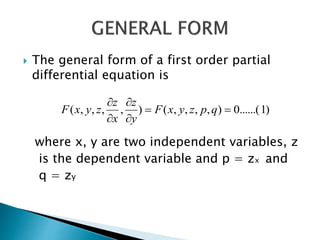
 The general form of a first order partial 
differential equation is 
z 
 
z 
 
F x y z p q 
F x y z 
( , , , , )  ( , , , , )  0......(1) 
y 
 
x 
 
where x, y are two independent variables, z 
is the dependent variable and p = zx and 
q = zy
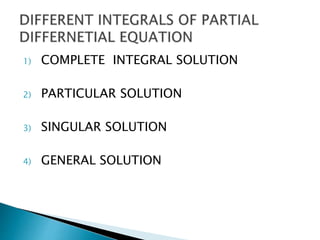
1) COMPLETE INTEGRAL SOLUTION 
2) PARTICULAR SOLUTION 
3) SINGULAR SOLUTION 
4) GENERAL SOLUTION
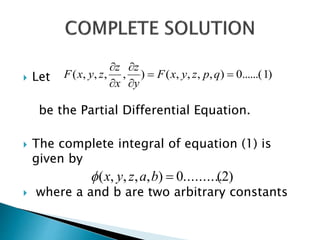
 Let 
z 
 
z 
 
F x y z p q 
F x y z 
( , , , , )  ( , , , , )  0......(1) 
y 
 
x 
 
be the Partial Differential Equation. 
 The complete integral of equation (1) is 
given by 
 (x, y, z,a,b)  0.........(.2) 
 where a and b are two arbitrary constants
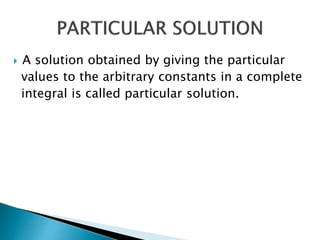
 A solution obtained by giving the particular 
values to the arbitrary constants in a complete 
integral is called particular solution.
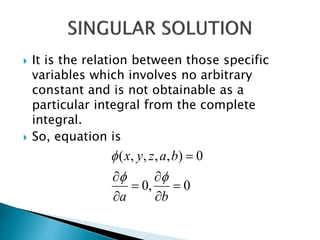
 It is the relation between those specific 
variables which involves no arbitrary 
constant and is not obtainable as a 
particular integral from the complete 
integral. 
 So, equation is 
x y z a b 
  
 
( , , , , ) 0 
 
0,  
0 
 
 
 
 
 
a b
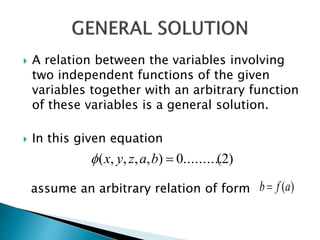
 A relation between the variables involving 
two independent functions of the given 
variables together with an arbitrary function 
of these variables is a general solution. 
 In this given equation 
 (x, y, z,a,b)  0.........(.2) 
assume an arbitrary relation of form 
b  f (a)
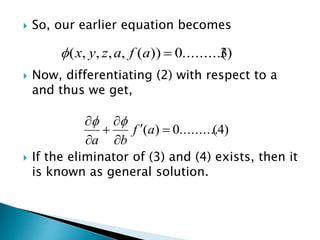
 So, our earlier equation becomes 
 (x, y, z,a, f (a))  0.........3() 
 Now, differentiating (2) with respect to a 
and thus we get, 
( )  0.........(.4) 
  
 
 
a  
b 
 
 
f a 
 If the eliminator of (3) and (4) exists, then it 
is known as general solution.
 TYPE-1 
The Partial Differential equation of the form 
has solution 
f ( p,q)  0 
z  ax by  c and 
f (a,b)  0
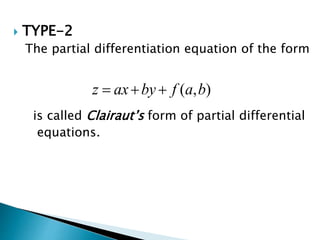
 TYPE-2 
The partial differentiation equation of the form 
z  ax by  f (a,b) 
is called Clairaut’s form of partial differential 
equations.
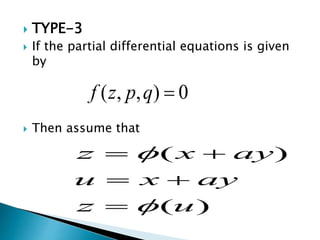
 TYPE-3 
 If the partial differential equations is given 
by 
f (z, p,q)  0 
 Then assume that 
z   
x  
ay 
( ) 
u  x  
ay 
z  
u 
( ) 

dz 
dz 
du 
z 
 
 
z 
 
 
1 . 
a a 
u 
u 
 
u 
y 
z 
 
 
z 
 
 
u 
z 
 
 
z 
 
 
y 
q 
du 
u 
x 
u 
x 
p 
 
 
 
 
 
 
 
 
 
 
 
.
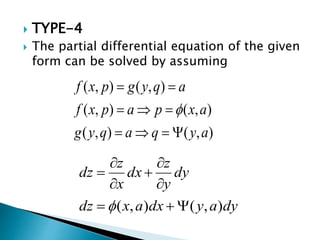
 TYPE-4 
 The partial differential equation of the given 
form can be solved by assuming 
f ( x , p )  g ( y , q ) 
 
a 
f x p a p x a 
( , )    
 
( , ) 
g y q a q y a 
( , )     
( , ) 
z 
 
 
dy 
y 
z 
 
 
dx 
x 
dz 
 
 
dz   
( x , a ) dx ( y , a ) 
dy
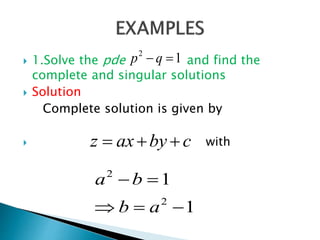
p2  q 1 
 1.Solve the pde and find the 
complete and singular solutions 
 Solution 
Complete solution is given by 
z  ax by  c 
 with 
1 
1 
2 
2 
a b 
  
b a 
  
z  ax  (a 1) y  c 2 
d.w.r.to. a and c then 
2 
  
1 0 
z 
 
z 
 
 
  
 
c 
x ay 
a 
Which is not possible 
Hence there is no singular solution
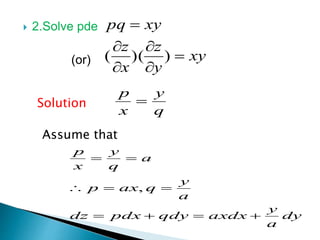
 2.Solve pde 
pq xy 
z 
z 
 
 
(or) xy 
y 
x 
 
 
 
 
( )( ) 
Solution 
y 
q 
p 
x 
 
Assume that 
dy 
y 
a 
y 
a 
a 
y 
  
q 
p ax q 
p 
x 
  , 
 
dz pdx qdy axdx 
   
 Integrating on both sides 
b 
2 2 
x y 
z  a   
a 
2 2
130080112013 
130080112014 
130080112015 
130080112016 
130080112017

Partial differential equations

  • 2.
     It isdefined as an equation involving two or more independent variables like x,y……., a dependent variable like u and its partial derivatives.  Partial Differential Equation can be formed either by elimination of arbitrary constants or by the elimination of arbitrary functions from a relation involving three or more variables .
  • 3.
     The generalform of a first order partial differential equation is z  z  F x y z p q F x y z ( , , , , )  ( , , , , )  0......(1) y  x  where x, y are two independent variables, z is the dependent variable and p = zx and q = zy
  • 4.
    1) COMPLETE INTEGRALSOLUTION 2) PARTICULAR SOLUTION 3) SINGULAR SOLUTION 4) GENERAL SOLUTION
  • 5.
     Let z  z  F x y z p q F x y z ( , , , , )  ( , , , , )  0......(1) y  x  be the Partial Differential Equation.  The complete integral of equation (1) is given by  (x, y, z,a,b)  0.........(.2)  where a and b are two arbitrary constants
  • 6.
     A solutionobtained by giving the particular values to the arbitrary constants in a complete integral is called particular solution.
  • 7.
     It isthe relation between those specific variables which involves no arbitrary constant and is not obtainable as a particular integral from the complete integral.  So, equation is x y z a b    ( , , , , ) 0  0,  0      a b
  • 8.
     A relationbetween the variables involving two independent functions of the given variables together with an arbitrary function of these variables is a general solution.  In this given equation  (x, y, z,a,b)  0.........(.2) assume an arbitrary relation of form b  f (a)
  • 9.
     So, ourearlier equation becomes  (x, y, z,a, f (a))  0.........3()  Now, differentiating (2) with respect to a and thus we get, ( )  0.........(.4)     a  b   f a  If the eliminator of (3) and (4) exists, then it is known as general solution.
  • 10.
     TYPE-1 ThePartial Differential equation of the form has solution f ( p,q)  0 z  ax by  c and f (a,b)  0
  • 11.
     TYPE-2 Thepartial differentiation equation of the form z  ax by  f (a,b) is called Clairaut’s form of partial differential equations.
  • 12.
     TYPE-3 If the partial differential equations is given by f (z, p,q)  0  Then assume that z   x  ay ( ) u  x  ay z  u ( ) 
  • 13.
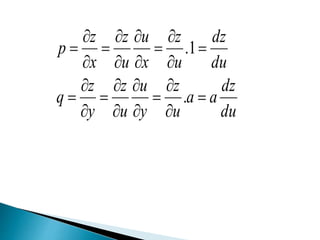
    dz dz du z   z   1 . a a u u  u y z   z   u z   z   y q du u x u x p            .
  • 14.
     TYPE-4 The partial differential equation of the given form can be solved by assuming f ( x , p )  g ( y , q )  a f x p a p x a ( , )     ( , ) g y q a q y a ( , )     ( , ) z   dy y z   dx x dz   dz   ( x , a ) dx ( y , a ) dy
  • 15.
    p2  q1  1.Solve the pde and find the complete and singular solutions  Solution Complete solution is given by z  ax by  c  with 1 1 2 2 a b   b a   
  • 16.
    z  ax (a 1) y  c 2 d.w.r.to. a and c then 2   1 0 z  z      c x ay a Which is not possible Hence there is no singular solution
  • 17.
     2.Solve pde pq xy z z   (or) xy y x     ( )( ) Solution y q p x  Assume that dy y a y a a y   q p ax q p x   ,  dz pdx qdy axdx    
  • 18.
     Integrating onboth sides b 2 2 x y z  a   a 2 2
  • 19.
    130080112013 130080112014 130080112015 130080112016 130080112017