Combinatorics

Rosen 6th ed., §5.1-5.3, § 5.5


                                 1
Combinatorics
• Count the number of ways to put things
  together into various combinations.
    e.g. If a password is 6-8 letters and/or digits,
    how many passwords can there be?
• Two main rules:
  – Sum rule
  – Product rule


                                               2
Sum Rule
• Let us consider two tasks:
  –   m is the number of ways to do task 1
  –   n is the number of ways to do task 2
  –   Tasks are independent of each other, i.e.,
       • Performing task 1 does not accomplish task 2 and
         vice versa.
• Sum rule: the number of ways that “either
  task 1 or task 2 can be done, but not both”,
  is m+n.
• Generalizes to multiple tasks ...
                                                  3
Example
• A student can choose a computer project from one of three
  lists. The three lists contain 23, 15, and 19 possible
  projects respectively. How many possible projects are
  there to choose from?


                                                  4
Set Theoretic Version
• If A is the set of ways to do task 1, and B
  the set of ways to do task 2, and if A and B
  are disjoint, then:

   “the ways to do either task 1 or 2 are
        A∪B, and |A∪B|=|A|+|B|”


                                        5
Product Rule
• Let us consider two tasks:
  –   m is the number of ways to do task 1
  –   n is the number of ways to do task 2
  –   Tasks are independent of each other, i.e.,
       • Performing task 1does not accomplish task 2 and
         vice versa.
• Product rule: the number of ways that
  “both tasks 1 and 2 can be done” in mn.
• Generalizes to multiple tasks ...

                                                  6
Example
• The chairs of an auditorium are to be labeled with a letter
  and a positive integer not to exceed 100. What is the
  largest number of chairs that can be labeled differently?


                                                     7
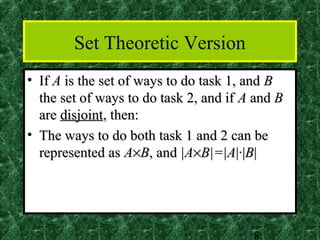
Set Theoretic Version
• If A is the set of ways to do task 1, and B
  the set of ways to do task 2, and if A and B
  are disjoint, then:
• The ways to do both task 1 and 2 can be
  represented as A×B, and |A×B|=|A|·|B|


                                        8
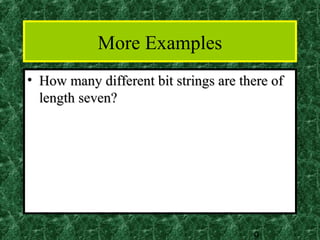
More Examples
• How many different bit strings are there of
  length seven?


                                       9
More Examples
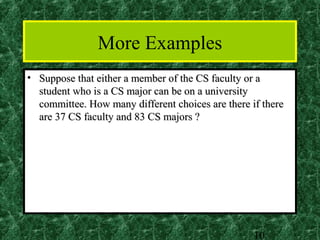
• Suppose that either a member of the CS faculty or a
  student who is a CS major can be on a university
  committee. How many different choices are there if there
  are 37 CS faculty and 83 CS majors ?


                                                   10
More Examples
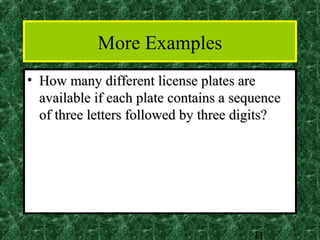
• How many different license plates are
  available if each plate contains a sequence
  of three letters followed by three digits?


                                        11
More Examples
• What is the number of different subsets of a
  finite set S ?


                                       12
Example Using Both Rules
• Each user on a computer system has a password, which is
  six to eight characters long where each character is an
  uppercase letter or a digit. Each password must contain at
  least one digit. How many possible passwords are there?


                                                    13
IP Address Example
             (Internet Protocol vers. 4)
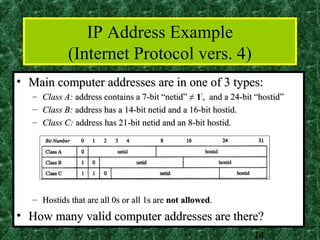
• Main computer addresses are in one of 3 types:
   – Class A: address contains a 7-bit “netid” ≠ 17, and a 24-bit “hostid”
   – Class B: address has a 14-bit netid and a 16-bit hostid.
   – Class C: address has 21-bit netid and an 8-bit hostid.


   – Hostids that are all 0s or all 1s are not allowed.
• How many valid computer addresses are there?
                                                                 14
Example Using Both Rules:
           IP address solution
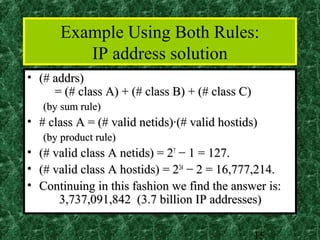
• (# addrs)
     = (# class A) + (# class B) + (# class C)
    (by sum rule)
• # class A = (# valid netids)·(# valid hostids)
    (by product rule)
•   (# valid class A netids) = 27 − 1 = 127.
•   (# valid class A hostids) = 224 − 2 = 16,777,214.
•   Continuing in this fashion we find the answer is:
        3,737,091,842 (3.7 billion IP addresses)

                                                 15
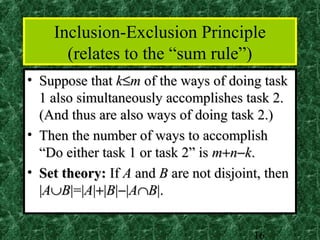
Inclusion-Exclusion Principle
      (relates to the “sum rule”)
• Suppose that k≤m of the ways of doing task
  1 also simultaneously accomplishes task 2.
  (And thus are also ways of doing task 2.)
• Then the number of ways to accomplish
  “Do either task 1 or task 2” is m+n−k.
• Set theory: If A and B are not disjoint, then
  |A∪B|=|A|+|B|−|A∩B|.


                                        16
Example
• How many strings of length eight either
  start with a 1 bit or end with the two bit
  string 00?


                                         17
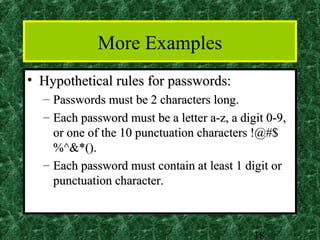
More Examples
• Hypothetical rules for passwords:
  – Passwords must be 2 characters long.
  – Each password must be a letter a-z, a digit 0-9,
    or one of the 10 punctuation characters !@#$
    %^&*().
  – Each password must contain at least 1 digit or
    punctuation character.


                                             18
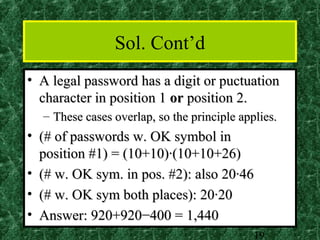
Sol. Cont’d
• A legal password has a digit or puctuation
  character in position 1 or position 2.
  – These cases overlap, so the principle applies.
• (# of passwords w. OK symbol in
  position #1) = (10+10)·(10+10+26)
• (# w. OK sym. in pos. #2): also 20·46
• (# w. OK sym both places): 20·20
• Answer: 920+920−400 = 1,440
                                             19
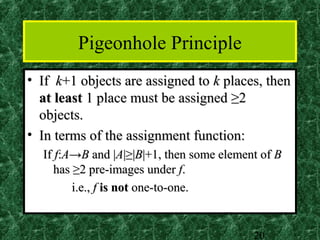
Pigeonhole Principle
• If k+1 objects are assigned to k places, then
  at least 1 place must be assigned ≥2
  objects.
• In terms of the assignment function:
  If f:A→B and |A|≥|B|+1, then some element of B
     has ≥2 pre-images under f.
         i.e., f is not one-to-one.


                                          20
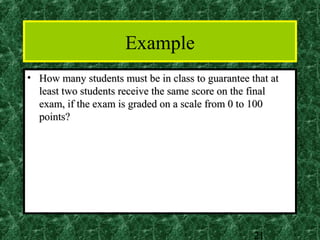
Example
• How many students must be in class to guarantee that at
  least two students receive the same score on the final
  exam, if the exam is graded on a scale from 0 to 100
  points?


                                                   21
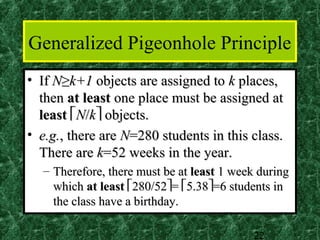
Generalized Pigeonhole Principle
• If N≥k+1 objects are assigned to k places,
  then at least one place must be assigned at
  least N/k objects.
• e.g., there are N=280 students in this class.
  There are k=52 weeks in the year.
  – Therefore, there must be at least 1 week during
    which at least 280/52= 5.38=6 students in
    the class have a birthday.

                                           22
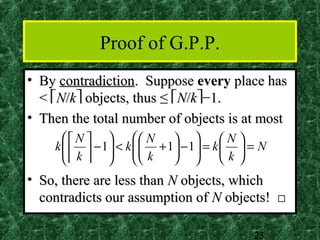
Proof of G.P.P.
• By contradiction. Suppose every place has
  < N/k objects, thus ≤ N/k−1.
• Then the total number of objects is at most
      N           N            N
    k    − 1 < k   + 1 − 1 = k   = N
       k            k         
                               k
• So, there are less than N objects, which
  contradicts our assumption of N objects! □

                                           23
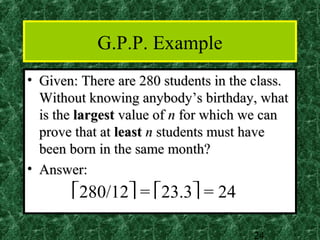
G.P.P. Example
• Given: There are 280 students in the class.
  Without knowing anybody’s birthday, what
  is the largest value of n for which we can
  prove that at least n students must have
  been born in the same month?
• Answer:
       280/12 = 23.3 = 24

                                      24
More Examples
• What is the minimum number of students required in a
  discrete math class to be sure that at least six will receive
  the same grade, if there are five possible grades, A, B, C,
  D, and F?


                                                       25
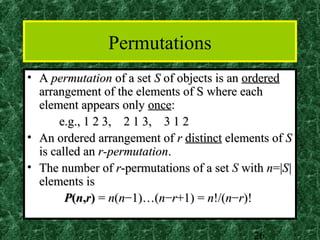
Permutations
• A permutation of a set S of objects is an ordered
  arrangement of the elements of S where each
  element appears only once:
       e.g., 1 2 3, 2 1 3, 3 1 2
• An ordered arrangement of r distinct elements of S
  is called an r-permutation.
• The number of r-permutations of a set S with n=|S|
  elements is
        P(n,r) = n(n−1)…(n−r+1) = n!/(n−r)!

                                            26
Example
• How many ways are there to select a third-
  prize winner from 100 different people who
  have entered a contest?


                                      27
More Examples
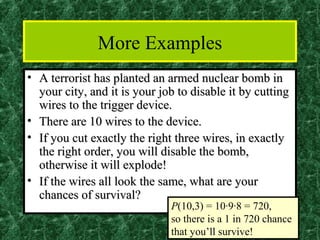
• A terrorist has planted an armed nuclear bomb in
  your city, and it is your job to disable it by cutting
  wires to the trigger device.
• There are 10 wires to the device.
• If you cut exactly the right three wires, in exactly
  the right order, you will disable the bomb,
  otherwise it will explode!
• If the wires all look the same, what are your
  chances of survival?
                              P(10,3) = 10·9·8 = 720,
                              so there is a 1 in 720 chance
                              that you’ll survive! 28
More Examples
• How many permutations of the letters
  ABCDEFG contain the string ABC?


                                     29
Combinations
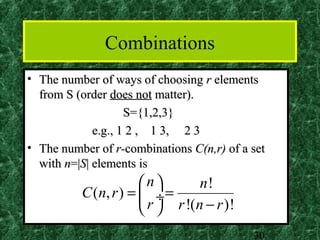
• The number of ways of choosing r elements
  from S (order does not matter).
                    S={1,2,3}
             e.g., 1 2 , 1 3, 2 3
• The number of r-combinations C(n,r) of a set
  with n=|S| elements is
                      n        n!
          C (n, r ) =  ÷ =
                       r  r !(n − r )!
                                           30
Combinations vs Permutations
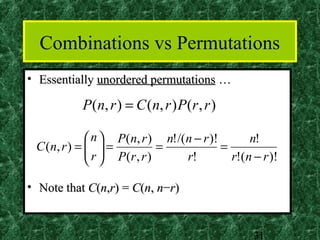
• Essentially unordered permutations …

           P ( n , r ) = C ( n, r ) P ( r , r )

               n  P(n, r ) n! /(n − r )!       n!
 C ( n, r ) =   =
               r  P(r , r ) =            =
                                r!         r!(n − r )!

• Note that C(n,r) = C(n, n−r)


                                                  31
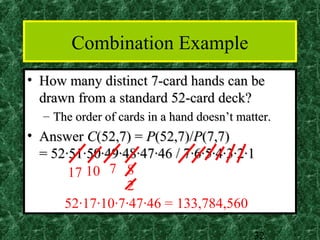
Combination Example
• How many distinct 7-card hands can be
  drawn from a standard 52-card deck?
  – The order of cards in a hand doesn’t matter.
• Answer C(52,7) = P(52,7)/P(7,7)
  = 52·51·50·49·48·47·46 / 7·6·5·4·3·2·1
       17 10 7 8
                 2
      52·17·10·7·47·46 = 133,784,560

                                            32
More Examples
• How many ways are there to select a committee to develop
  a discrete mathematics course if the committee is to consist
  of 3 faculty members from the Math department and 4
  from the CS department, if there are 9 faculty members
  from Math and 11 from CS?


                                                    33
Generalized
   Permutations and Combinations
• How to solve counting problems where
  elements may be used more than once?
• How to solve counting problems in which
  some elements are not distinguishable?
• How to solve problems involving counting
  the ways we to place distinguishable
  elements in distinguishable boxes?


                                     34
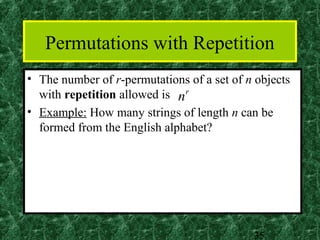
Permutations with Repetition
• The number of r-permutations of a set of n objects
  with repetition allowed is n r
• Example: How many strings of length n can be
  formed from the English alphabet?


                                            35
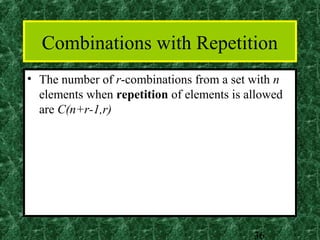
Combinations with Repetition
• The number of r-combinations from a set with n
  elements when repetition of elements is allowed
  are C(n+r-1,r)


                                           36
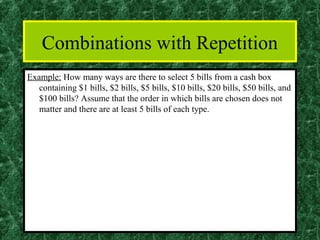
Combinations with Repetition
Example: How many ways are there to select 5 bills from a cash box
   containing $1 bills, $2 bills, $5 bills, $10 bills, $20 bills, $50 bills, and
   $100 bills? Assume that the order in which bills are chosen does not
   matter and there are at least 5 bills of each type.


                                                                    37
Combinations with Repetition
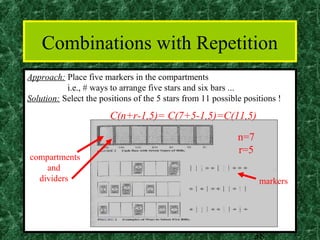
Approach: Place five markers in the compartments
           i.e., # ways to arrange five stars and six bars ...
Solution: Select the positions of the 5 stars from 11 possible positions !

                        C(n+r-1,5)= C(7+5-1,5)=C(11,5)

                                                             n=7
                                                             r=5
compartments
    and
  dividers                                                         markers


                                                                  38
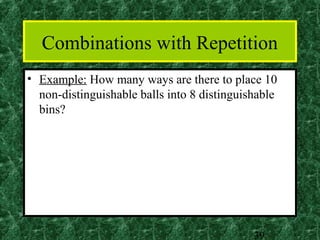
Combinations with Repetition
• Example: How many ways are there to place 10
  non-distinguishable balls into 8 distinguishable
  bins?


                                             39
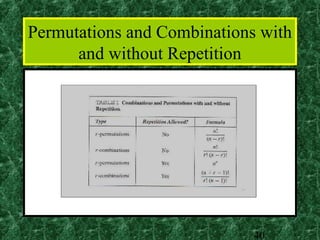
Permutations and Combinations with
      and without Repetition


                             40
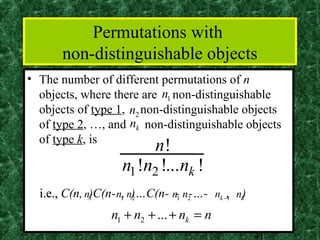
Permutations with
       non-distinguishable objects
• The number of different permutations of n
  objects, where there are n1 non-distinguishable
  objects of type 1, n2 non-distinguishable objects
  of type 2, …, and nk non-distinguishable objects
  of type k, is
                          n!
                     n1 !n2 !...nk !
  i.e., C(n, n)C(n- n1, n)…C(n- n1 n2-…- nk −, nk)
              1          2       -           1


                  n1 + n2 + ... + nk = n
                                                     41
Permutations with
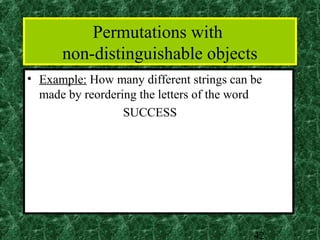
      non-distinguishable objects
• Example: How many different strings can be
  made by reordering the letters of the word
                  SUCCESS


                                          42
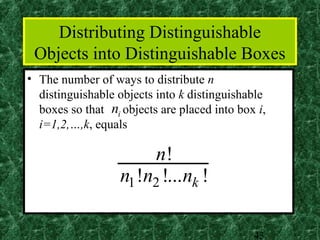
Distributing Distinguishable
 Objects into Distinguishable Boxes
• The number of ways to distribute n
  distinguishable objects into k distinguishable
  boxes so that ni objects are placed into box i,
  i=1,2,…,k, equals

                        n!
                   n1 !n2 !...nk !

                                              43
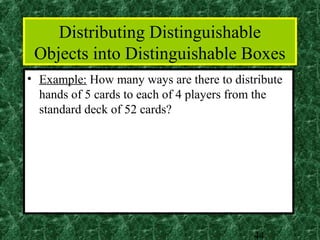
Distributing Distinguishable
 Objects into Distinguishable Boxes
• Example: How many ways are there to distribute
  hands of 5 cards to each of 4 players from the
  standard deck of 52 cards?


                                          44

Combinatorics

  • 1.
    Combinatorics Rosen 6th ed.,§5.1-5.3, § 5.5 1
  • 2.
    Combinatorics • Count thenumber of ways to put things together into various combinations. e.g. If a password is 6-8 letters and/or digits, how many passwords can there be? • Two main rules: – Sum rule – Product rule 2
  • 3.
    Sum Rule • Letus consider two tasks: – m is the number of ways to do task 1 – n is the number of ways to do task 2 – Tasks are independent of each other, i.e., • Performing task 1 does not accomplish task 2 and vice versa. • Sum rule: the number of ways that “either task 1 or task 2 can be done, but not both”, is m+n. • Generalizes to multiple tasks ... 3
  • 4.
    Example • A studentcan choose a computer project from one of three lists. The three lists contain 23, 15, and 19 possible projects respectively. How many possible projects are there to choose from? 4
  • 5.
    Set Theoretic Version •If A is the set of ways to do task 1, and B the set of ways to do task 2, and if A and B are disjoint, then: “the ways to do either task 1 or 2 are A∪B, and |A∪B|=|A|+|B|” 5
  • 6.
    Product Rule • Letus consider two tasks: – m is the number of ways to do task 1 – n is the number of ways to do task 2 – Tasks are independent of each other, i.e., • Performing task 1does not accomplish task 2 and vice versa. • Product rule: the number of ways that “both tasks 1 and 2 can be done” in mn. • Generalizes to multiple tasks ... 6
  • 7.
    Example • The chairsof an auditorium are to be labeled with a letter and a positive integer not to exceed 100. What is the largest number of chairs that can be labeled differently? 7
  • 8.
    Set Theoretic Version •If A is the set of ways to do task 1, and B the set of ways to do task 2, and if A and B are disjoint, then: • The ways to do both task 1 and 2 can be represented as A×B, and |A×B|=|A|·|B| 8
  • 9.
    More Examples • Howmany different bit strings are there of length seven? 9
  • 10.
    More Examples • Supposethat either a member of the CS faculty or a student who is a CS major can be on a university committee. How many different choices are there if there are 37 CS faculty and 83 CS majors ? 10
  • 11.
    More Examples • Howmany different license plates are available if each plate contains a sequence of three letters followed by three digits? 11
  • 12.
    More Examples • Whatis the number of different subsets of a finite set S ? 12
  • 13.
    Example Using BothRules • Each user on a computer system has a password, which is six to eight characters long where each character is an uppercase letter or a digit. Each password must contain at least one digit. How many possible passwords are there? 13
  • 14.
    IP Address Example (Internet Protocol vers. 4) • Main computer addresses are in one of 3 types: – Class A: address contains a 7-bit “netid” ≠ 17, and a 24-bit “hostid” – Class B: address has a 14-bit netid and a 16-bit hostid. – Class C: address has 21-bit netid and an 8-bit hostid. – Hostids that are all 0s or all 1s are not allowed. • How many valid computer addresses are there? 14
  • 15.
    Example Using BothRules: IP address solution • (# addrs) = (# class A) + (# class B) + (# class C) (by sum rule) • # class A = (# valid netids)·(# valid hostids) (by product rule) • (# valid class A netids) = 27 − 1 = 127. • (# valid class A hostids) = 224 − 2 = 16,777,214. • Continuing in this fashion we find the answer is: 3,737,091,842 (3.7 billion IP addresses) 15
  • 16.
    Inclusion-Exclusion Principle (relates to the “sum rule”) • Suppose that k≤m of the ways of doing task 1 also simultaneously accomplishes task 2. (And thus are also ways of doing task 2.) • Then the number of ways to accomplish “Do either task 1 or task 2” is m+n−k. • Set theory: If A and B are not disjoint, then |A∪B|=|A|+|B|−|A∩B|. 16
  • 17.
    Example • How manystrings of length eight either start with a 1 bit or end with the two bit string 00? 17
  • 18.
    More Examples • Hypotheticalrules for passwords: – Passwords must be 2 characters long. – Each password must be a letter a-z, a digit 0-9, or one of the 10 punctuation characters !@#$ %^&*(). – Each password must contain at least 1 digit or punctuation character. 18
  • 19.
    Sol. Cont’d • Alegal password has a digit or puctuation character in position 1 or position 2. – These cases overlap, so the principle applies. • (# of passwords w. OK symbol in position #1) = (10+10)·(10+10+26) • (# w. OK sym. in pos. #2): also 20·46 • (# w. OK sym both places): 20·20 • Answer: 920+920−400 = 1,440 19
  • 20.
    Pigeonhole Principle • Ifk+1 objects are assigned to k places, then at least 1 place must be assigned ≥2 objects. • In terms of the assignment function: If f:A→B and |A|≥|B|+1, then some element of B has ≥2 pre-images under f. i.e., f is not one-to-one. 20
  • 21.
    Example • How manystudents must be in class to guarantee that at least two students receive the same score on the final exam, if the exam is graded on a scale from 0 to 100 points? 21
  • 22.
    Generalized Pigeonhole Principle •If N≥k+1 objects are assigned to k places, then at least one place must be assigned at least N/k objects. • e.g., there are N=280 students in this class. There are k=52 weeks in the year. – Therefore, there must be at least 1 week during which at least 280/52= 5.38=6 students in the class have a birthday. 22
  • 23.
    Proof of G.P.P. •By contradiction. Suppose every place has < N/k objects, thus ≤ N/k−1. • Then the total number of objects is at most N    N   N k    − 1 < k   + 1 − 1 = k   = N  k   k        k • So, there are less than N objects, which contradicts our assumption of N objects! □ 23
  • 24.
    G.P.P. Example • Given:There are 280 students in the class. Without knowing anybody’s birthday, what is the largest value of n for which we can prove that at least n students must have been born in the same month? • Answer: 280/12 = 23.3 = 24 24
  • 25.
    More Examples • Whatis the minimum number of students required in a discrete math class to be sure that at least six will receive the same grade, if there are five possible grades, A, B, C, D, and F? 25
  • 26.
    Permutations • A permutationof a set S of objects is an ordered arrangement of the elements of S where each element appears only once: e.g., 1 2 3, 2 1 3, 3 1 2 • An ordered arrangement of r distinct elements of S is called an r-permutation. • The number of r-permutations of a set S with n=|S| elements is P(n,r) = n(n−1)…(n−r+1) = n!/(n−r)! 26
  • 27.
    Example • How manyways are there to select a third- prize winner from 100 different people who have entered a contest? 27
  • 28.
    More Examples • Aterrorist has planted an armed nuclear bomb in your city, and it is your job to disable it by cutting wires to the trigger device. • There are 10 wires to the device. • If you cut exactly the right three wires, in exactly the right order, you will disable the bomb, otherwise it will explode! • If the wires all look the same, what are your chances of survival? P(10,3) = 10·9·8 = 720, so there is a 1 in 720 chance that you’ll survive! 28
  • 29.
    More Examples • Howmany permutations of the letters ABCDEFG contain the string ABC? 29
  • 30.
    Combinations • The numberof ways of choosing r elements from S (order does not matter). S={1,2,3} e.g., 1 2 , 1 3, 2 3 • The number of r-combinations C(n,r) of a set with n=|S| elements is n n! C (n, r ) =  ÷ =  r  r !(n − r )! 30
  • 31.
    Combinations vs Permutations •Essentially unordered permutations … P ( n , r ) = C ( n, r ) P ( r , r )  n  P(n, r ) n! /(n − r )! n! C ( n, r ) =   =  r  P(r , r ) = =   r! r!(n − r )! • Note that C(n,r) = C(n, n−r) 31
  • 32.
    Combination Example • Howmany distinct 7-card hands can be drawn from a standard 52-card deck? – The order of cards in a hand doesn’t matter. • Answer C(52,7) = P(52,7)/P(7,7) = 52·51·50·49·48·47·46 / 7·6·5·4·3·2·1 17 10 7 8 2 52·17·10·7·47·46 = 133,784,560 32
  • 33.
    More Examples • Howmany ways are there to select a committee to develop a discrete mathematics course if the committee is to consist of 3 faculty members from the Math department and 4 from the CS department, if there are 9 faculty members from Math and 11 from CS? 33
  • 34.
    Generalized Permutations and Combinations • How to solve counting problems where elements may be used more than once? • How to solve counting problems in which some elements are not distinguishable? • How to solve problems involving counting the ways we to place distinguishable elements in distinguishable boxes? 34
  • 35.
    Permutations with Repetition •The number of r-permutations of a set of n objects with repetition allowed is n r • Example: How many strings of length n can be formed from the English alphabet? 35
  • 36.
    Combinations with Repetition •The number of r-combinations from a set with n elements when repetition of elements is allowed are C(n+r-1,r) 36
  • 37.
    Combinations with Repetition Example:How many ways are there to select 5 bills from a cash box containing $1 bills, $2 bills, $5 bills, $10 bills, $20 bills, $50 bills, and $100 bills? Assume that the order in which bills are chosen does not matter and there are at least 5 bills of each type. 37
  • 38.
    Combinations with Repetition Approach:Place five markers in the compartments i.e., # ways to arrange five stars and six bars ... Solution: Select the positions of the 5 stars from 11 possible positions ! C(n+r-1,5)= C(7+5-1,5)=C(11,5) n=7 r=5 compartments and dividers markers 38
  • 39.
    Combinations with Repetition •Example: How many ways are there to place 10 non-distinguishable balls into 8 distinguishable bins? 39
  • 40.
    Permutations and Combinationswith and without Repetition 40
  • 41.
    Permutations with non-distinguishable objects • The number of different permutations of n objects, where there are n1 non-distinguishable objects of type 1, n2 non-distinguishable objects of type 2, …, and nk non-distinguishable objects of type k, is n! n1 !n2 !...nk ! i.e., C(n, n)C(n- n1, n)…C(n- n1 n2-…- nk −, nk) 1 2 - 1 n1 + n2 + ... + nk = n 41
  • 42.
    Permutations with non-distinguishable objects • Example: How many different strings can be made by reordering the letters of the word SUCCESS 42
  • 43.
    Distributing Distinguishable Objectsinto Distinguishable Boxes • The number of ways to distribute n distinguishable objects into k distinguishable boxes so that ni objects are placed into box i, i=1,2,…,k, equals n! n1 !n2 !...nk ! 43
  • 44.
    Distributing Distinguishable Objectsinto Distinguishable Boxes • Example: How many ways are there to distribute hands of 5 cards to each of 4 players from the standard deck of 52 cards? 44