G.H.PATEL COLLEGE OF ENGINEERING AND TECHNOLOGY
Chemical Department
Topic Name: First Order ODE with Application
Subject: Advanced Engineering Mathematics(2130002)
Name:
Shivam Patel (150110105031)
Vatsal Patel (150110105032)
Vyom Patodiya (150110105033)
Krishna Peshivadiya (150110105034)
Hardik Pipaliya (150110105035)
Bhavin Poshiya (150110105036).
Faculty Name: Prof. Mukesh T. Joshi
Content:
Introduction
Some useful Terms
Type of First Order ODEs
Bernoulli Equation
Orthogonal Trajectory
First Order Ordinary Linear Differential
Equations
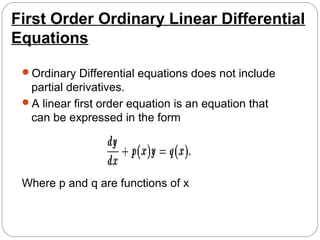
Ordinary Differential equations does not include
partial derivatives.
A linear first order equation is an equation that
can be expressed in the form
Where p and q are functions of x
Some useful Terms:
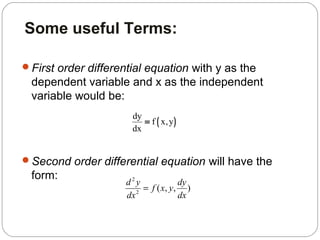
First order differential equation with y as the
dependent variable and x as the independent
variable would be:
Second order differential equation will have the
form:
( )
dy
f x,y
dx
=
),,(2
2
dx
dy
yxf
dx
yd
=
The order of a differential equation is the order of the
highest derivative occurring in the equation.
The degree of a differential equation is the power of
the highest ordered derivative occurring in the
equation, provided all derivatives are made free from
radicals and fractions.
• Uniqueness: Does a differential equation have more than
one solution? If yes, how can we find a solution which
satisfies particular conditions?
If no initial conditions are given, we call the
description of all solutions to the differential equation
the general solution. This type of solution will contain
arbitrary constants whose number is equal to the
order of differential equation.
A solution obtained from the general solution by
giving particular values to arbitrary constants is
known as a particular solution.
A solution which cannot be obtained from general
solution is called a singular solution.
Types Of First 0rder ODE:
1. Variable Separable
2. Homogeneous Differential Equation
3. Exact Differential Equation
4. Linear Differential Equation
The first-order differential equation
( ),
dy
f x y
dx
=
is called separable provided that f(x,y) can be written
as the product of a function of x and a function of y.
(1)
1. Variable Separation:-
Suppose we can write the above equation as
)()( yhxg
dx
dy
=
We then say we have “ separated ” the variables. By
taking h(y) to the LHS, the equation becomes
1
( )
( )
dy g x dx
h y
=
Integrating, we get the solution as
1
( )
( )
dy g x dx c
h y
= +∫ ∫
where c is an arbitrary constant.
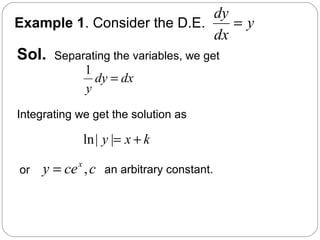
Example 1. Consider the D.E. y
dx
dy
=
Sol. Separating the variables, we get
dxdy
y
=
1
Integrating we get the solution as
kxy +=||ln
or ccey x
,= an arbitrary constant.
2. Homogeneous Diff. equations
Definition : A function f(x, y) is said to be
homogeneous of degree n in x, y if
),(),( yxfttytxf n
= for all t, x, y
Examples
22
2),( yxyxyxf −−=
is homogeneous of degree
)sin(),(
x
xy
x
y
yxf
−
+=
is homogeneous of degree
2.
0.
A first order D.E. 0),(),( =+ dyyxNdxyxM
is called homogeneous if ),(,),( yxNyxM
are homogeneous functions of x and y of the same
degree.
This D.E. can be written in the form
),( yxf
dx
dy
=
The substitution y = vx converts the given equation into
“variables separable” form and hence can be solved.
(Note that v is also a new variable)
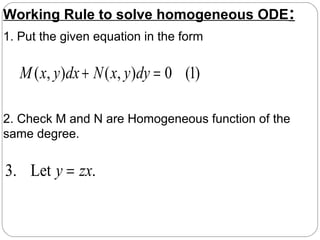
Working Rule to solve homogeneous ODE:
1. Put the given equation in the form
.Let.3 zxy =
)1(0),(),( =+ dyyxNdxyxM
2. Check M and N are Homogeneous function of the
same degree.
5. Put this value of dy/dx into (1) and solve the equation
for z by separating the variables.
6. Replace z by y/x and simplify.
dx
dz
xz
dx
dy
+=
4. Differentiate y = z x to get
Example:- Solve the Homogeneous ODE
)sin(
x
xy
x
y
y
−
+=′
Let y = z x. Hence we get
zz
dx
dz
xz sin+=+ or z
dx
dz
x sin=
Separating the variables, we get
x
dx
dz
z
=
sin
1
Integrating we get
where
cosec z – cot z = c x
and c an arbitrary constant.
y
z
x
=
3. EXACT DIFFERENTIAL EQUATIONS
A first order D.E. 0),(),( =+ dyyxNdxyxM
is called an exact D.E. if
M N
y x
∂ ∂
=
∂ ∂
The solution given by:
∫ ∫ =+ cNdyMdx
(Terms free from ‘x’)
Solution is:
cyxy
cdy
y
ydx
=+
=+∫ ∫
ln2
2
∫ ∫ =+ cNdyMdx
Example 1 The D.E. 0xdx y dy+ =
Sol.:- It is exact as it is d (x2
+ y2
) = 0
Hence the solution is: x2
+ y2
= c
Example 2 The D.E. 2
1
sin( ) sin( ) 0
x x x
dx dy
y y y y
− + =
Sol:- It is exact (cos( )) 0
x
d
y
=
Hence the solution is: cos( )
x
c
y
=
Integrating Factors
Definition: If on multiplying by I.F.(x, y) or µ, the D.E.
0M dx N dy+ =
becomes an exact D.E. , we say that I.F.(x, y) or µ is an
Integrating Factor of the above D.E.
2 2
1 1 1
, ,
xy x y
are all integrating factors of
the non-exact D.E. 0y dx xdy− =
( )
M N
y x
g x
N
∂ ∂
−
∂ ∂
=
( )g x dx
eµ ∫=
is an integrating factor of the given DE
0M dx N dy+ =
Rule 1: I.F is a function of ‘x’ alone.
Rule 2: I.F is a function of ‘y’ alone.
If , a function of y alone,
then
( )h y dy
eµ ∫=
is an integrating factor of the given DE.
x
N
y
M
∂
∂
−
∂
∂
M
( )yh=
is an integrating factor of the given DE
0M dx N dy+ =
Rule 3: Given DE is homogeneous.
µ=
+ NyMx
1
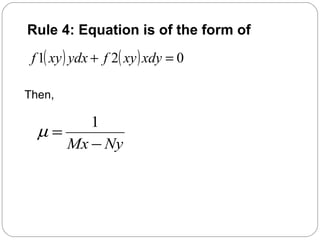
Rule 4: Equation is of the form of
( ) ( ) 021 =+ xdyxyfydxxyf
Then,
NyMx −
=
1
µ
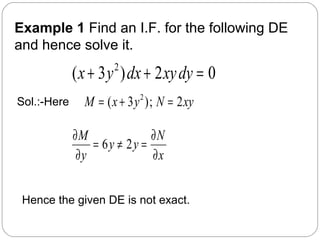
Example 1 Find an I.F. for the following DE
and hence solve it.
2
( 3 ) 2 0x y dx xydy+ + =
Sol.:-Here
6 2
M N
y y
y x
∂ ∂
= ≠ =
∂ ∂
2
( 3 ); 2M x y N xy= + =
Hence the given DE is not exact.
M N
y x
N
∂ ∂
−
∂ ∂
=Now 6 2
2
y y
xy
−
=
2
( ),g x
x
=
a function of x alone. Hence
( )g x dx
eµ ∫= =
2
2
dx
x
e x
∫
=
is an integrating factor of the given DE
Multiplying by x2
, the given DE becomes
3 2 2 3
( 3 ) 2 0x x y dx x ydy+ + =
which is of the form 0M dx N dy+ =
Note that now 3 2 2 3
( 3 ); 2M x x y N x y= + =
Integrating, we easily see that the solution is
4
3 2
,
4
x
x y c+ = c an arbitrary constant.
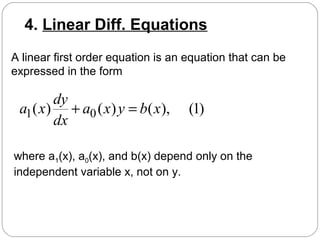
4. Linear Diff. Equations
A linear first order equation is an equation that can be
expressed in the form
1 0( ) ( ) ( ), (1)
dy
a x a x y b x
dx
+ =
where a1(x), a0(x), and b(x) depend only on the
independent variable x, not on y.
We assume that the function a1(x), a0(x), and b(x) are
continuous on an interval and that a1(x) ≠ 0on that
interval. Then, on dividing by a1(x), we can rewrite
equation (1) in the standard form
( ) ( ) (2)
dy
P x y Q x
dx
+ =
where P(x), Q(x) are continuous functions on the interval.
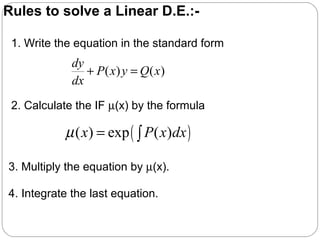
Rules to solve a Linear D.E.:-
1. Write the equation in the standard form
( ) ( )
dy
P x y Q x
dx
+ =
2. Calculate the IF µ(x) by the formula
( )( ) exp ( )x P x dxµ = ∫
3. Multiply the equation by µ(x).
4. Integrate the last equation.
Example 1. Solve
( ) 1cossincos =++





xxxy
dx
dy
xx
Solution :- Dividing by x cos x, throughout, we get
x
x
y
x
x
dx
dy sec1
tan =





++
1
tan( )
( )
x dxP x dx x
x e eµ
 
 ÷
 
+∫∫= =
log sec log loglog sec
( ) sece e ex x xx
x e e e x xµ +
= = =
( )
sec
sec sec
d x
dx x
y x x x x=
2
sec sec tany x xdx C x C= + = +∫
Multiply by secx x so
Integrate both side we get
Bernoulli Equation
In mathematics, an ordinary differential equation of the
form:
y'+P(x)y=Q(x)y^{n}
is called a Bernoulli differential equation where { n} is
any real number and n≠ 0 or n ≠1. It is named
after Jacob Bernoulli who discussed it in 1695.
Bernoulli equations are special because they are
nonlinear differential equations with known exact
solutions.
before.toldweassolutionitsandequationlinearisthis
)()1()()1(
)()(
)1(
1
)1(thenPutb)
)()(
1
yoverEquationBernoulliDividea)
EquationBernoullisolveTo
)1(
)1(
n
xQnzxpn
dx
dz
xQxp
dx
dz
n
dx
dy
yn
dx
dz
yz
xQyxP
dx
dy
y
n
n
n
−=−+
=+
−
∴
−==
=+
−
−
note :-
if n = 0 the Bernoulli
Equation will be
linear equation.
if n = 1 Bernoulli
Equation will be
separable equation
the general solution will be
2
22
1
2
lnexpln2expexpexp
linearisequationthissin62
22
.sin3
solution
sin3)
x
xxdxpdx
x
x
z
dx
dz
dx
dy
y
dx
dz
enand thyput z
yx
x
y
–
dx
dy
x
x
y
–
dx
dy
yEx
x
=∴
====
=+
==
=
=
∫∫
−
µ
µ
cxxxxyx
cxdxxyx
+++−=
+∫=
)cossincos(6
sin6
22
22
Orthogonal Trajectories
Orthogonal trajectories are a
family of curves in the plane
that intersect a given family of
curves at right angles.
Suppose we are given the
family of circles centered
about the origin:
x2
+ y2
= c
The orthogonal trajectories of
this family are the family of
curves/lines such that
intersect the circle at right
angles.
Example
Find the orthogonal trajectories of the curve x2
+
y2
= c2
Solution:-Differentiating w.r.t. variable x, we get
Writing it in explicit form, we get
The derived equation is a linear equation.
If we use the method of solving linear equations, then we derive
the following results for I.F. :
Thus, we get the general solution as
y = mx
General Applications of ODE
ODEs are used in various fields such as:
Radioactivity and carbon dating
Equations of series RL circuits
Economics
Bernoulli Equation
Population Dynamics
Newton’s Law of Cooling
•Cooling/Warming law
We have seen in Newton’sempirical law of cooling of
an object in given by the linear first-order differential
equation
)mTα(T
dt
dT
−=
This is a separable differential equation. We have
αdt
)T(T
dT
m
=
−
or ln|T-Tm
|
=αt+c1
or T(t) = Tm
+c2
eαt
In Series Circuits
i(t), is the solution of the differential equation.
)(tERi
dt
di
=+Ι
dt
dq
i =
)t(Eq
C
1
dt
dq
R =+
Si
nce
It can be
written as
 first order ode with its application

first order ode with its application

  • 1.
    G.H.PATEL COLLEGE OFENGINEERING AND TECHNOLOGY Chemical Department Topic Name: First Order ODE with Application Subject: Advanced Engineering Mathematics(2130002) Name: Shivam Patel (150110105031) Vatsal Patel (150110105032) Vyom Patodiya (150110105033) Krishna Peshivadiya (150110105034) Hardik Pipaliya (150110105035) Bhavin Poshiya (150110105036). Faculty Name: Prof. Mukesh T. Joshi
  • 2.
    Content: Introduction Some useful Terms Typeof First Order ODEs Bernoulli Equation Orthogonal Trajectory
  • 3.
    First Order OrdinaryLinear Differential Equations Ordinary Differential equations does not include partial derivatives. A linear first order equation is an equation that can be expressed in the form Where p and q are functions of x
  • 4.
    Some useful Terms: Firstorder differential equation with y as the dependent variable and x as the independent variable would be: Second order differential equation will have the form: ( ) dy f x,y dx = ),,(2 2 dx dy yxf dx yd =
  • 5.
    The order ofa differential equation is the order of the highest derivative occurring in the equation. The degree of a differential equation is the power of the highest ordered derivative occurring in the equation, provided all derivatives are made free from radicals and fractions. • Uniqueness: Does a differential equation have more than one solution? If yes, how can we find a solution which satisfies particular conditions?
  • 6.
    If no initialconditions are given, we call the description of all solutions to the differential equation the general solution. This type of solution will contain arbitrary constants whose number is equal to the order of differential equation. A solution obtained from the general solution by giving particular values to arbitrary constants is known as a particular solution. A solution which cannot be obtained from general solution is called a singular solution.
  • 7.
    Types Of First0rder ODE: 1. Variable Separable 2. Homogeneous Differential Equation 3. Exact Differential Equation 4. Linear Differential Equation
  • 8.
    The first-order differentialequation ( ), dy f x y dx = is called separable provided that f(x,y) can be written as the product of a function of x and a function of y. (1) 1. Variable Separation:-
  • 9.
    Suppose we canwrite the above equation as )()( yhxg dx dy = We then say we have “ separated ” the variables. By taking h(y) to the LHS, the equation becomes
  • 10.
    1 ( ) ( ) dyg x dx h y = Integrating, we get the solution as 1 ( ) ( ) dy g x dx c h y = +∫ ∫ where c is an arbitrary constant.
  • 11.
    Example 1. Considerthe D.E. y dx dy = Sol. Separating the variables, we get dxdy y = 1 Integrating we get the solution as kxy +=||ln or ccey x ,= an arbitrary constant.
  • 12.
    2. Homogeneous Diff.equations Definition : A function f(x, y) is said to be homogeneous of degree n in x, y if ),(),( yxfttytxf n = for all t, x, y Examples 22 2),( yxyxyxf −−= is homogeneous of degree )sin(),( x xy x y yxf − += is homogeneous of degree 2. 0.
  • 13.
    A first orderD.E. 0),(),( =+ dyyxNdxyxM is called homogeneous if ),(,),( yxNyxM are homogeneous functions of x and y of the same degree. This D.E. can be written in the form ),( yxf dx dy = The substitution y = vx converts the given equation into “variables separable” form and hence can be solved. (Note that v is also a new variable)
  • 14.
    Working Rule tosolve homogeneous ODE: 1. Put the given equation in the form .Let.3 zxy = )1(0),(),( =+ dyyxNdxyxM 2. Check M and N are Homogeneous function of the same degree.
  • 15.
    5. Put thisvalue of dy/dx into (1) and solve the equation for z by separating the variables. 6. Replace z by y/x and simplify. dx dz xz dx dy += 4. Differentiate y = z x to get
  • 16.
    Example:- Solve theHomogeneous ODE )sin( x xy x y y − +=′ Let y = z x. Hence we get zz dx dz xz sin+=+ or z dx dz x sin= Separating the variables, we get x dx dz z = sin 1 Integrating we get where cosec z – cot z = c x and c an arbitrary constant. y z x =
  • 17.
    3. EXACT DIFFERENTIALEQUATIONS A first order D.E. 0),(),( =+ dyyxNdxyxM is called an exact D.E. if M N y x ∂ ∂ = ∂ ∂ The solution given by: ∫ ∫ =+ cNdyMdx (Terms free from ‘x’)
  • 18.
  • 19.
    Example 1 TheD.E. 0xdx y dy+ = Sol.:- It is exact as it is d (x2 + y2 ) = 0 Hence the solution is: x2 + y2 = c Example 2 The D.E. 2 1 sin( ) sin( ) 0 x x x dx dy y y y y − + = Sol:- It is exact (cos( )) 0 x d y = Hence the solution is: cos( ) x c y =
  • 20.
    Integrating Factors Definition: Ifon multiplying by I.F.(x, y) or µ, the D.E. 0M dx N dy+ = becomes an exact D.E. , we say that I.F.(x, y) or µ is an Integrating Factor of the above D.E. 2 2 1 1 1 , , xy x y are all integrating factors of the non-exact D.E. 0y dx xdy− =
  • 21.
    ( ) M N yx g x N ∂ ∂ − ∂ ∂ = ( )g x dx eµ ∫= is an integrating factor of the given DE 0M dx N dy+ = Rule 1: I.F is a function of ‘x’ alone.
  • 22.
    Rule 2: I.Fis a function of ‘y’ alone. If , a function of y alone, then ( )h y dy eµ ∫= is an integrating factor of the given DE. x N y M ∂ ∂ − ∂ ∂ M ( )yh=
  • 23.
    is an integratingfactor of the given DE 0M dx N dy+ = Rule 3: Given DE is homogeneous. µ= + NyMx 1
  • 24.
    Rule 4: Equationis of the form of ( ) ( ) 021 =+ xdyxyfydxxyf Then, NyMx − = 1 µ
  • 25.
    Example 1 Findan I.F. for the following DE and hence solve it. 2 ( 3 ) 2 0x y dx xydy+ + = Sol.:-Here 6 2 M N y y y x ∂ ∂ = ≠ = ∂ ∂ 2 ( 3 ); 2M x y N xy= + = Hence the given DE is not exact.
  • 26.
    M N y x N ∂∂ − ∂ ∂ =Now 6 2 2 y y xy − = 2 ( ),g x x = a function of x alone. Hence ( )g x dx eµ ∫= = 2 2 dx x e x ∫ = is an integrating factor of the given DE Multiplying by x2 , the given DE becomes
  • 27.
    3 2 23 ( 3 ) 2 0x x y dx x ydy+ + = which is of the form 0M dx N dy+ = Note that now 3 2 2 3 ( 3 ); 2M x x y N x y= + = Integrating, we easily see that the solution is 4 3 2 , 4 x x y c+ = c an arbitrary constant.
  • 28.
    4. Linear Diff.Equations A linear first order equation is an equation that can be expressed in the form 1 0( ) ( ) ( ), (1) dy a x a x y b x dx + = where a1(x), a0(x), and b(x) depend only on the independent variable x, not on y.
  • 29.
    We assume thatthe function a1(x), a0(x), and b(x) are continuous on an interval and that a1(x) ≠ 0on that interval. Then, on dividing by a1(x), we can rewrite equation (1) in the standard form ( ) ( ) (2) dy P x y Q x dx + = where P(x), Q(x) are continuous functions on the interval.
  • 30.
    Rules to solvea Linear D.E.:- 1. Write the equation in the standard form ( ) ( ) dy P x y Q x dx + = 2. Calculate the IF µ(x) by the formula ( )( ) exp ( )x P x dxµ = ∫ 3. Multiply the equation by µ(x). 4. Integrate the last equation.
  • 31.
    Example 1. Solve () 1cossincos =++      xxxy dx dy xx Solution :- Dividing by x cos x, throughout, we get x x y x x dx dy sec1 tan =      ++
  • 32.
    1 tan( ) ( ) xdxP x dx x x e eµ    ÷   +∫∫= = log sec log loglog sec ( ) sece e ex x xx x e e e x xµ + = = = ( ) sec sec sec d x dx x y x x x x= 2 sec sec tany x xdx C x C= + = +∫ Multiply by secx x so Integrate both side we get
  • 33.
    Bernoulli Equation In mathematics,an ordinary differential equation of the form: y'+P(x)y=Q(x)y^{n} is called a Bernoulli differential equation where { n} is any real number and n≠ 0 or n ≠1. It is named after Jacob Bernoulli who discussed it in 1695. Bernoulli equations are special because they are nonlinear differential equations with known exact solutions.
  • 34.
  • 35.
    the general solutionwill be 2 22 1 2 lnexpln2expexpexp linearisequationthissin62 22 .sin3 solution sin3) x xxdxpdx x x z dx dz dx dy y dx dz enand thyput z yx x y – dx dy x x y – dx dy yEx x =∴ ==== =+ == = = ∫∫ − µ µ cxxxxyx cxdxxyx +++−= +∫= )cossincos(6 sin6 22 22
  • 36.
    Orthogonal Trajectories Orthogonal trajectoriesare a family of curves in the plane that intersect a given family of curves at right angles. Suppose we are given the family of circles centered about the origin: x2 + y2 = c The orthogonal trajectories of this family are the family of curves/lines such that intersect the circle at right angles.
  • 37.
    Example Find the orthogonaltrajectories of the curve x2 + y2 = c2 Solution:-Differentiating w.r.t. variable x, we get Writing it in explicit form, we get
  • 38.
    The derived equationis a linear equation. If we use the method of solving linear equations, then we derive the following results for I.F. : Thus, we get the general solution as y = mx
  • 39.
    General Applications ofODE ODEs are used in various fields such as: Radioactivity and carbon dating Equations of series RL circuits Economics Bernoulli Equation Population Dynamics Newton’s Law of Cooling
  • 40.
    •Cooling/Warming law We haveseen in Newton’sempirical law of cooling of an object in given by the linear first-order differential equation )mTα(T dt dT −= This is a separable differential equation. We have αdt )T(T dT m = − or ln|T-Tm | =αt+c1 or T(t) = Tm +c2 eαt
  • 41.
    In Series Circuits i(t),is the solution of the differential equation. )(tERi dt di =+Ι dt dq i = )t(Eq C 1 dt dq R =+ Si nce It can be written as