Laplace Transforms 
Nirav B. Vyas 
Department of Mathematics 
Atmiya Institute of Technology and Science 
Yogidham, Kalavad road 
Rajkot - 360005 . Gujarat 
N. B. Vyas Laplace Transforms
Laplace Transforms 
De
nition: 
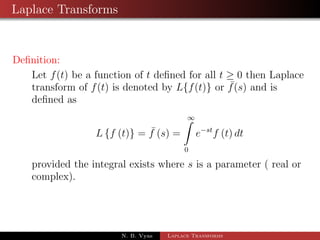
Let f(t) be a function of t de
ned for all t  0 then Laplace 
transform of f(t) is denoted by Lff(t)g or  f(s) and is 
de
ned as 
L ff (t)g =  f (s) = 
Z1 
0 
estf (t) dt 
provided the integral exists where s is a parameter ( real or 
complex). 
N. B. Vyas Laplace Transforms
Laplace Transforms 
NOTATIONS: 
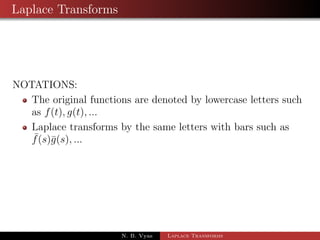
The original functions are denoted by lowercase letters such 
as f(t); g(t); ::: 
Laplace transforms by the same letters with bars such as 
 f(s)g(s); ::: 
N. B. Vyas Laplace Transforms
Linearity of the Laplace Transforms 
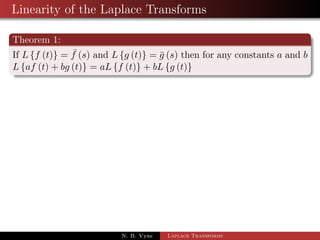
Theorem 1: 
If Lff (t)g =  f (s) and Lfg (t)g = g (s) then for any constants a and b 
Lfaf (t) + bg (t)g = aL ff (t)g + bL fg (t)g 
N. B. Vyas Laplace Transforms
Linearity of the Laplace Transforms 
Theorem 1: 
If Lff (t)g =  f (s) and Lfg (t)g = g (s) then for any constants a and b 
Lfaf (t) + bg (t)g = aL ff (t)g + bL fg (t)g 
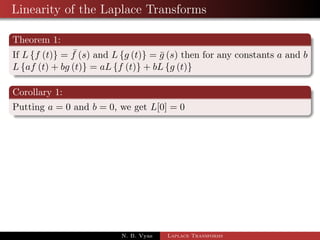
Corollary 1: 
Putting a = 0 and b = 0, we get L[0] = 0 
N. B. Vyas Laplace Transforms
Linearity of the Laplace Transforms 
Theorem 1: 
If Lff (t)g =  f (s) and Lfg (t)g = g (s) then for any constants a and b 
Lfaf (t) + bg (t)g = aL ff (t)g + bL fg (t)g 
Corollary 1: 
Putting a = 0 and b = 0, we get L[0] = 0 
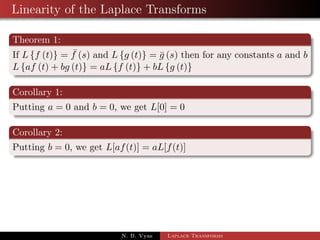
Corollary 2: 
Putting b = 0, we get L[af(t)] = aL[f(t)] 
N. B. Vyas Laplace Transforms
Linearity of the Laplace Transforms 
Theorem 1: 
If Lff (t)g =  f (s) and Lfg (t)g = g (s) then for any constants a and b 
Lfaf (t) + bg (t)g = aL ff (t)g + bL fg (t)g 
Corollary 1: 
Putting a = 0 and b = 0, we get L[0] = 0 
Corollary 2: 
Putting b = 0, we get L[af(t)] = aL[f(t)] 
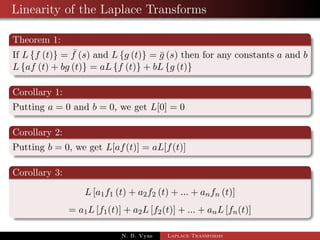
Corollary 3: 
L[a1f1 (t) + a2f2 (t) + ::: + anfn (t)] 
= a1L[f1(t)] + a2L[f2(t)] + ::: + anL[fn(t)] 
N. B. Vyas Laplace Transforms
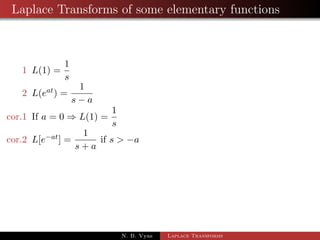
Laplace Transforms of some elementary functions 
1 L(1) = 
1 
s 
N. B. Vyas Laplace Transforms
Laplace Transforms of some elementary functions 
1 L(1) = 
1 
s 
2 L(eat) = 
1 
s  a 
N. B. Vyas Laplace Transforms
Laplace Transforms of some elementary functions 
1 L(1) = 
1 
s 
2 L(eat) = 
1 
s  a 
cor.1 If a = 0 ) L(1) = 
1 
s 
N. B. Vyas Laplace Transforms
Laplace Transforms of some elementary functions 
1 L(1) = 
1 
s 
2 L(eat) = 
1 
s  a 
cor.1 If a = 0 ) L(1) = 
1 
s 
cor.2 L[eat] = 
1 
s + a 
if s  a 
N. B. Vyas Laplace Transforms
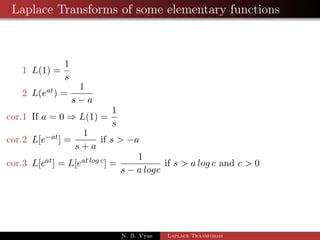
Laplace Transforms of some elementary functions 
1 L(1) = 
1 
s 
2 L(eat) = 
1 
s  a 
cor.1 If a = 0 ) L(1) = 
1 
s 
cor.2 L[eat] = 
1 
s + a 
if s  a 
cor.3 L[cat] = L[eat log c] = 
1 
s  a logc 
if s  a log c and c  0 
N. B. Vyas Laplace Transforms
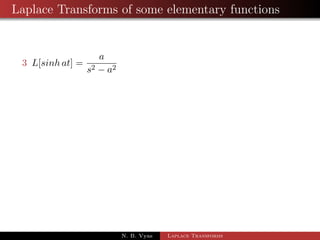
Laplace Transforms of some elementary functions 
3 L[sinh at] = 
a 
s2  a2 
N. B. Vyas Laplace Transforms
Laplace Transforms of some elementary functions 
3 L[sinh at] = 
a 
s2  a2 
4 L[cosh at] = 
s 
s2  a2 
N. B. Vyas Laplace Transforms
Laplace Transforms of some elementary functions 
3 L[sinh at] = 
a 
s2  a2 
4 L[cosh at] = 
s 
s2  a2 
5 L[sin at] = 
a 
s2 + a2 
N. B. Vyas Laplace Transforms
Laplace Transforms of some elementary functions 
3 L[sinh at] = 
a 
s2  a2 
4 L[cosh at] = 
s 
s2  a2 
5 L[sin at] = 
a 
s2 + a2 
6 L[cos at] = 
s 
s2 + a2 ; s  0 
N. B. Vyas Laplace Transforms
Laplace Transforms of some elementary functions 
3 L[sinh at] = 
a 
s2  a2 
4 L[cosh at] = 
s 
s2  a2 
5 L[sin at] = 
a 
s2 + a2 
6 L[cos at] = 
s 
s2 + a2 ; s  0 
cor.1 L[sin t] = 
1 
s2 + 1 
; s  0 
N. B. Vyas Laplace Transforms
Laplace Transforms of some elementary functions 
3 L[sinh at] = 
a 
s2  a2 
4 L[cosh at] = 
s 
s2  a2 
5 L[sin at] = 
a 
s2 + a2 
6 L[cos at] = 
s 
s2 + a2 ; s  0 
cor.1 L[sin t] = 
1 
s2 + 1 
; s  0 
cor.2 L[cos t] = 
s 
s2 + 1 
; s  0 
N. B. Vyas Laplace Transforms
Laplace Transforms of some elementary functions 
7 L[tn] = 
(n + 1) 
sn+1 
N. B. Vyas Laplace Transforms
Laplace Transforms of some elementary functions 
7 L[tn] = 
(n + 1) 
sn+1 
= 
n! 
sn+1 ; n = 0; 1; 2; ::: 
N. B. Vyas Laplace Transforms
Laplace Transforms of some elementary functions 
7 L[tn] = 
(n + 1) 
sn+1 
= 
n! 
sn+1 ; n = 0; 1; 2; ::: 
cor.1 If n = 0, L[1] = 
1 
s 
N. B. Vyas Laplace Transforms
Laplace Transforms of some elementary functions 
7 L[tn] = 
(n + 1) 
sn+1 
= 
n! 
sn+1 ; n = 0; 1; 2; ::: 
cor.1 If n = 0, L[1] = 
1 
s 
cor.2 If n =  
1 
2 
N. B. Vyas Laplace Transforms
Laplace Transforms of some elementary functions 
7 L[tn] = 
(n + 1) 
sn+1 
= 
n! 
sn+1 ; n = 0; 1; 2; ::: 
cor.1 If n = 0, L[1] = 
1 
s 
cor.2 If n =  
1 
2 
L 
 
t1 
2 
 
= 
(1 
) 
2 1 
s 
2 
= 
r 
 
s 
N. B. Vyas Laplace Transforms
Laplace Transforms of some elementary functions 
7 L[tn] = 
(n + 1) 
sn+1 
= 
n! 
sn+1 ; n = 0; 1; 2; ::: 
cor.1 If n = 0, L[1] = 
1 
s 
cor.2 If n =  
1 
2 
L 
 
t1 
2 
 
= 
(1 
) 
2 1 
s 
2 
= 
r 
 
s 
N. B. Vyas Laplace Transforms
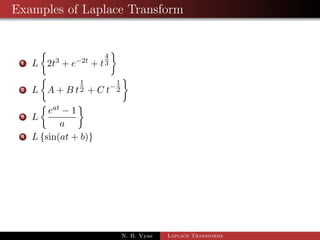
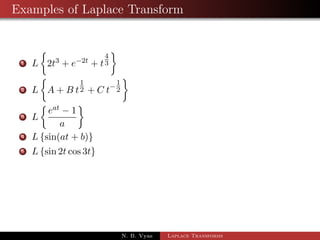
Examples of Laplace Transform 
1 L 
 
2t3 + e2t + t 
4 
3 
 
N. B. Vyas Laplace Transforms
Examples of Laplace Transform 
1 L 
 
2t3 + e2t + t 
4 
3 
 
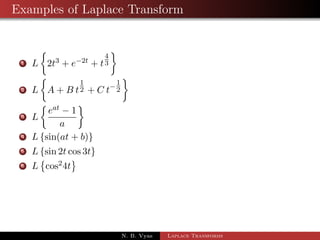
2 L 
 
A + B t 
1 
2 + C t 
1 
2 
 
N. B. Vyas Laplace Transforms
Examples of Laplace Transform 
1 L 
 
2t3 + e2t + t 
4 
3 
 
2 L 
 
A + B t 
1 
2 + C t 
1 
2 
 
3 L 
 
eat  1 
a 
 
N. B. Vyas Laplace Transforms
Examples of Laplace Transform 
1 L 
 
2t3 + e2t + t 
4 
3 
 
2 L 
 
A + B t 
1 
2 + C t 
1 
2 
 
3 L 
 
eat  1 
a 
 
4 Lfsin(at + b)g 
N. B. Vyas Laplace Transforms
Examples of Laplace Transform 
1 L 
 
2t3 + e2t + t 
4 
3 
 
2 L 
 
A + B t 
1 
2 + C t 
1 
2 
 
3 L 
 
eat  1 
a 
 
4 Lfsin(at + b)g 
5 Lfsin 2t cos 3tg 
N. B. Vyas Laplace Transforms
Examples of Laplace Transform 
1 L 
 
2t3 + e2t + t 
4 
3 
 
2 L 
 
A + B t 
1 
2 + C t 
1 
2 
 
3 L 
 
eat  1 
a 
 
4 Lfsin(at + b)g 
5 Lfsin 2t cos 3tg 
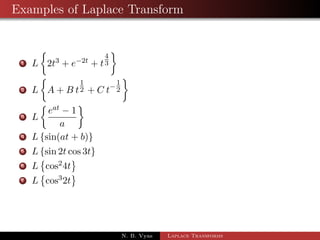
6 L 
 
cos24t 
	 
N. B. Vyas Laplace Transforms
Examples of Laplace Transform 
1 L 
 
2t3 + e2t + t 
4 
3 
 
2 L 
 
A + B t 
1 
2 + C t 
1 
2 
 
3 L 
 
eat  1 
a 
 
4 Lfsin(at + b)g 
5 Lfsin 2t cos 3tg 
6 L 
 
cos24t 
	 
7 L 
 
cos32t 
	 
N. B. Vyas Laplace Transforms
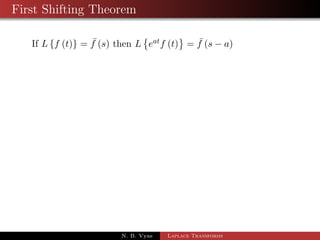
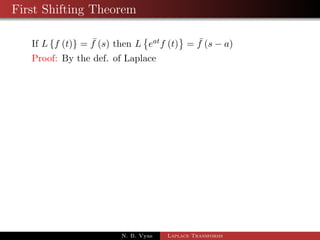
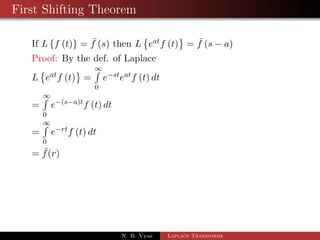
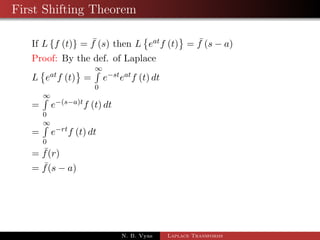
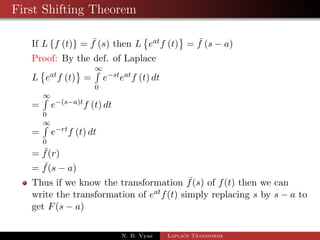
First Shifting Theorem 
If Lff (t)g =  f (s) then L 
 
eatf (t) 
	 
=  f (s  a) 
N. B. Vyas Laplace Transforms
First Shifting Theorem 
If Lff (t)g =  f (s) then L 
 
eatf (t) 
	 
=  f (s  a) 
Proof: By the def. of Laplace 
N. B. Vyas Laplace Transforms
First Shifting Theorem 
If Lff (t)g =  f (s) then L 
 
eatf (t) 
	 
=  f (s  a) 
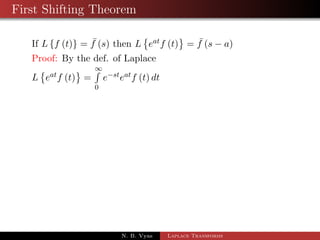
Proof: By the def. of Laplace 
 
	 
1R 
L 
eatf (t) 
= 
0 
esteatf (t) dt 
N. B. Vyas Laplace Transforms
First Shifting Theorem 
If Lff (t)g =  f (s) then L 
 
eatf (t) 
	 
=  f (s  a) 
Proof: By the def. of Laplace 
 
	 
1R 
L 
eatf (t) 
= 
0 
esteatf (t) dt 
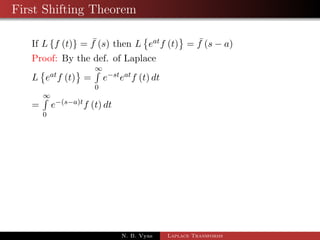
= 
1R 
0 
e(sa)tf (t) dt 
N. B. Vyas Laplace Transforms
First Shifting Theorem 
If Lff (t)g =  f (s) then L 
 
eatf (t) 
	 
=  f (s  a) 
Proof: By the def. of Laplace 
 
	 
1R 
L 
eatf (t) 
= 
0 
esteatf (t) dt 
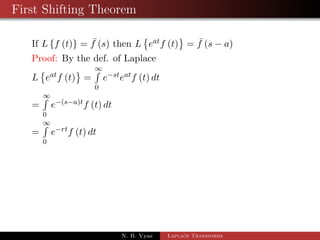
= 
1R 
0 
e(sa)tf (t) dt 
= 
1R 
0 
ertf (t) dt 
N. B. Vyas Laplace Transforms
First Shifting Theorem 
If Lff (t)g =  f (s) then L 
 
eatf (t) 
	 
=  f (s  a) 
Proof: By the def. of Laplace 
 
	 
1R 
L 
eatf (t) 
= 
0 
esteatf (t) dt 
= 
1R 
0 
e(sa)tf (t) dt 
= 
1R 
0 
ertf (t) dt 
=  f(r) 
N. B. Vyas Laplace Transforms
First Shifting Theorem 
If Lff (t)g =  f (s) then L 
 
eatf (t) 
	 
=  f (s  a) 
Proof: By the def. of Laplace 
 
	 
1R 
L 
eatf (t) 
= 
0 
esteatf (t) dt 
= 
1R 
0 
e(sa)tf (t) dt 
= 
1R 
0 
ertf (t) dt 
=  f(r) 
=  f(s  a) 
N. B. Vyas Laplace Transforms
First Shifting Theorem 
If Lff (t)g =  f (s) then L 
 
eatf (t) 
	 
=  f (s  a) 
Proof: By the def. of Laplace 
 
	 
1R 
L 
eatf (t) 
= 
0 
esteatf (t) dt 
= 
1R 
0 
e(sa)tf (t) dt 
= 
1R 
0 
ertf (t) dt 
=  f(r) 
=  f(s  a) 
Thus if we know the transformation  f(s) of f(t) then we can 
write the transformation of eatf(t) simply replacing s by s  a to 
get F(s  a) 
N. B. Vyas Laplace Transforms
First Shifting Theorem 
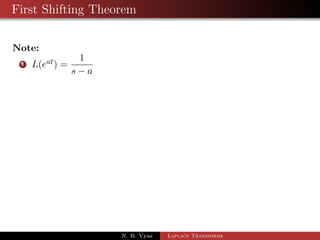
Note: 
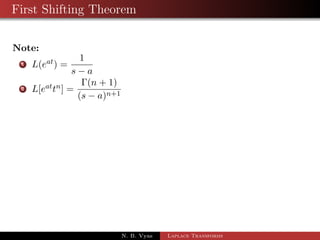
1 L(eat) = 
1 
s  a 
N. B. Vyas Laplace Transforms
First Shifting Theorem 
Note: 
1 L(eat) = 
1 
s  a 
2 L[eattn] = 
(n + 1) 
(s  a)n+1 
N. B. Vyas Laplace Transforms
First Shifting Theorem 
Note: 
1 L(eat) = 
1 
s  a 
2 L[eattn] = 
(n + 1) 
(s  a)n+1 
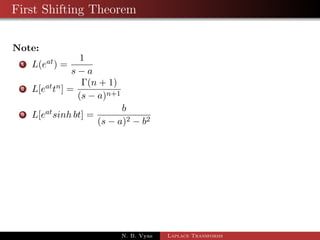
3 L[eatsinh bt] = 
b 
(s  a)2  b2 
N. B. Vyas Laplace Transforms
First Shifting Theorem 
Note: 
1 L(eat) = 
1 
s  a 
2 L[eattn] = 
(n + 1) 
(s  a)n+1 
3 L[eatsinh bt] = 
b 
(s  a)2  b2 
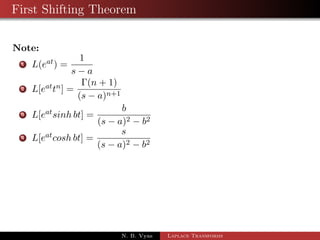
4 L[eatcosh bt] = 
s 
(s  a)2  b2 
N. B. Vyas Laplace Transforms
First Shifting Theorem 
Note: 
1 L(eat) = 
1 
s  a 
2 L[eattn] = 
(n + 1) 
(s  a)n+1 
3 L[eatsinh bt] = 
b 
(s  a)2  b2 
4 L[eatcosh bt] = 
s 
(s  a)2  b2 
5 L[eatsin bt] = 
b 
(s  a)2 + b2 
N. B. Vyas Laplace Transforms
First Shifting Theorem 
Note: 
1 L(eat) = 
1 
s  a 
2 L[eattn] = 
(n + 1) 
(s  a)n+1 
3 L[eatsinh bt] = 
b 
(s  a)2  b2 
4 L[eatcosh bt] = 
s 
(s  a)2  b2 
5 L[eatsin bt] = 
b 
(s  a)2 + b2 
6 L[eatcos bt] = 
s  a 
(s  a)2 + b2 ; s  0 
N. B. Vyas Laplace Transforms
Examples 
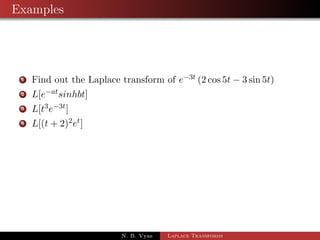
1 Find out the Laplace transform of e3t (2 cos 5t  3 sin 5t) 
N. B. Vyas Laplace Transforms
Examples 
1 Find out the Laplace transform of e3t (2 cos 5t  3 sin 5t) 
2 L[eatsinhbt] 
N. B. Vyas Laplace Transforms
Examples 
1 Find out the Laplace transform of e3t (2 cos 5t  3 sin 5t) 
2 L[eatsinhbt] 
3 L[t3e3t] 
N. B. Vyas Laplace Transforms
Examples 
1 Find out the Laplace transform of e3t (2 cos 5t  3 sin 5t) 
2 L[eatsinhbt] 
3 L[t3e3t] 
4 L[(t + 2)2et] 
N. B. Vyas Laplace Transforms
Examples 
1 Find out the Laplace transform of e3t (2 cos 5t  3 sin 5t) 
2 L[eatsinhbt] 
3 L[t3e3t] 
4 L[(t + 2)2et] 
5 L[etsin2t] 
N. B. Vyas Laplace Transforms
Examples 
1 Find out the Laplace transform of e3t (2 cos 5t  3 sin 5t) 
2 L[eatsinhbt] 
3 L[t3e3t] 
4 L[(t + 2)2et] 
5 L[etsin2t] 
6 L[cosh at sin at] 
N. B. Vyas Laplace Transforms
Examples 
Ex. Find the Laplace transform of the function which is de
ned as 
f(t) = 
 
t/T 0  t  T 
1 when t  T 
N. B. Vyas Laplace Transforms
Examples 
Ex. Find Laplace transform of f(t) = 
 
sin t 0  t   
0 when t   
N. B. Vyas Laplace Transforms
Examples 
Ex. Find Laplace transform of f(t) where f(t) = 
 
t 0  t  4 
5 when t  4 
N. B. Vyas Laplace Transforms
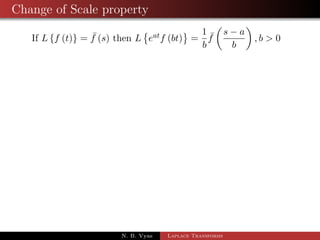
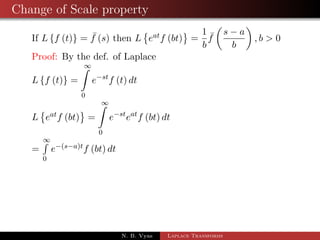
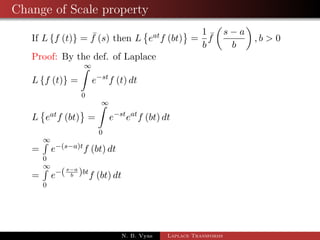
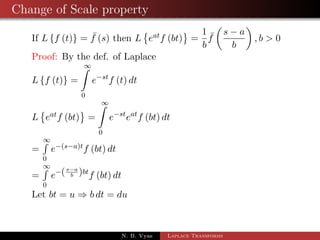
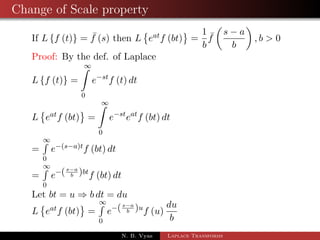
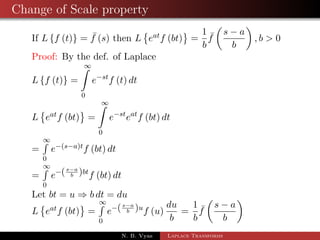
Change of Scale property 
If Lff (t)g =  f (s) then L 
 
eatf (bt) 
	 
= 
1 
b 
 f 
 
s  a 
b 
 
; b  0 
N. B. Vyas Laplace Transforms
Change of Scale property 
If Lff (t)g =  f (s) then L 
 
eatf (bt) 
	 
= 
1 
b 
 f 
 
s  a 
b 
 
; b  0 
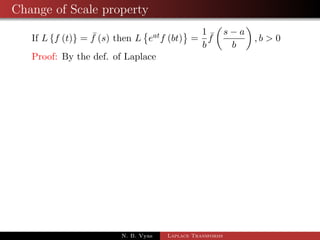
Proof: By the def. of Laplace 
N. B. Vyas Laplace Transforms
Change of Scale property 
If Lff (t)g =  f (s) then L 
 
eatf (bt) 
	 
= 
1 
b 
 f 
 
s  a 
b 
 
; b  0 
Proof: By the def. of Laplace 
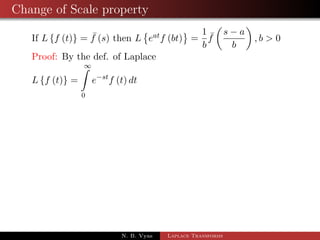
Lff (t)g = 
1 Z 
0 
estf (t) dt 
N. B. Vyas Laplace Transforms
Change of Scale property 
If Lff (t)g =  f (s) then L 
 
eatf (bt) 
	 
= 
1 
b 
 f 
 
s  a 
b 
 
; b  0 
Proof: By the def. of Laplace 
Lff (t)g = 
1 Z 
0 
estf (t) dt 
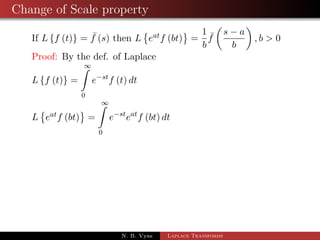
L 
 
eatf (bt) 
	 
= 
1 Z 
0 
esteatf (bt) dt 
N. B. Vyas Laplace Transforms
Change of Scale property 
If Lff (t)g =  f (s) then L 
 
eatf (bt) 
	 
= 
1 
b 
 f 
 
s  a 
b 
 
; b  0 
Proof: By the def. of Laplace 
Lff (t)g = 
1 Z 
0 
estf (t) dt 
L 
 
eatf (bt) 
	 
= 
1 Z 
0 
esteatf (bt) dt 
= 
1R 
0 
e(sa)tf (bt) dt 
N. B. Vyas Laplace Transforms
Change of Scale property 
If Lff (t)g =  f (s) then L 
 
eatf (bt) 
	 
= 
1 
b 
 f 
 
s  a 
b 
 
; b  0 
Proof: By the def. of Laplace 
Lff (t)g = 
1 Z 
0 
estf (t) dt 
L 
 
eatf (bt) 
	 
= 
1 Z 
0 
esteatf (bt) dt 
= 
1R 
0 
e(sa)tf (bt) dt 
= 
1R 
0 
e( sa 
b )btf (bt) dt 
N. B. Vyas Laplace Transforms
Change of Scale property 
If Lff (t)g =  f (s) then L 
 
eatf (bt) 
	 
= 
1 
b 
 f 
 
s  a 
b 
 
; b  0 
Proof: By the def. of Laplace 
Lff (t)g = 
1 Z 
0 
estf (t) dt 
L 
 
eatf (bt) 
	 
= 
1 Z 
0 
esteatf (bt) dt 
= 
1R 
0 
e(sa)tf (bt) dt 
= 
1R 
0 
e( sa 
b )btf (bt) dt 
Let bt = u ) b dt = du 
N. B. Vyas Laplace Transforms
Change of Scale property 
If Lff (t)g =  f (s) then L 
 
eatf (bt) 
	 
= 
1 
b 
 f 
 
s  a 
b 
 
; b  0 
Proof: By the def. of Laplace 
Lff (t)g = 
1 Z 
0 
estf (t) dt 
L 
 
eatf (bt) 
	 
= 
1 Z 
0 
esteatf (bt) dt 
= 
1R 
0 
e(sa)tf (bt) dt 
= 
1R 
0 
e( sa 
b )btf (bt) dt 
Let bt = u ) b dt = du 
 
	 
1R 
L 
eatf (bt) 
= 
0 
e( sa 
b )uf (u) 
du 
b 
N. B. Vyas Laplace Transforms
Change of Scale property 
If Lff (t)g =  f (s) then L 
 
eatf (bt) 
	 
= 
1 
b 
 f 
 
s  a 
b 
 
; b  0 
Proof: By the def. of Laplace 
Lff (t)g = 
1 Z 
0 
estf (t) dt 
L 
 
eatf (bt) 
	 
= 
1 Z 
0 
esteatf (bt) dt 
= 
1R 
0 
e(sa)tf (bt) dt 
= 
1R 
0 
e( sa 
b )btf (bt) dt 
Let bt = u ) b dt = du 
 
	 
1R 
L 
eatf (bt) 
= 
0 
e( sa 
b )uf (u) 
du 
b 
= 
1 
b 
 f 
 
s  a 
b 
 
N. B. Vyas Laplace Transforms
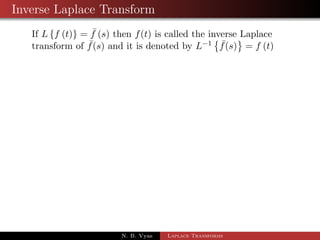
Inverse Laplace Transform 
If Lff (t)g = f  (s) then f(t) is called the inverse  
Laplace 
transform of f(s)  and it is denoted by L1 
f(s) 
 	 
= f (t) 
N. B. Vyas Laplace Transforms
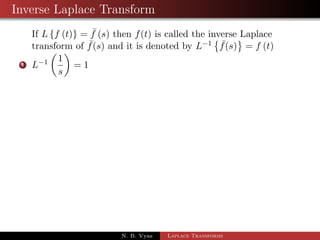
Inverse Laplace Transform 
If Lff (t)g = f  (s) then f(t) is called the inverse  
Laplace 
transform of f(s)  and it is denoted by L1 
f(s) 
 	 
= f (t) 
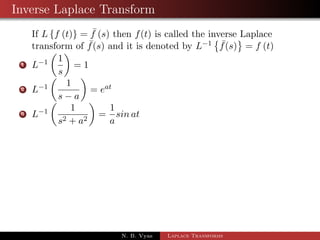
1 L1 
 
1 
s 
 
= 1 
N. B. Vyas Laplace Transforms
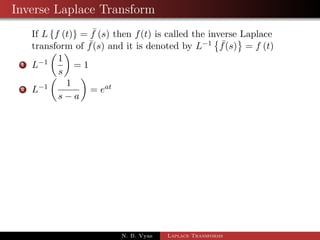
Inverse Laplace Transform 
If Lff (t)g = f  (s) then f(t) is called the inverse  
Laplace 
transform of f(s)  and it is denoted by L1 
f(s) 
 	 
= f (t) 
1 L1 
 
1 
s 
 
= 1 
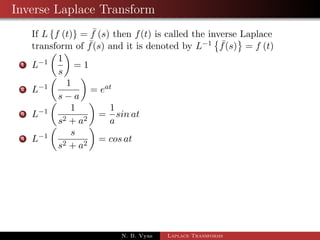
2 L1 
 
1 
s  a 
 
= eat 
N. B. Vyas Laplace Transforms
Inverse Laplace Transform 
If Lff (t)g = f  (s) then f(t) is called the inverse  
Laplace 
transform of f(s)  and it is denoted by L1 
f(s) 
 	 
= f (t) 
1 L1 
 
1 
s 
 
= 1 
2 L1 
 
1 
s  a 
 
= eat 
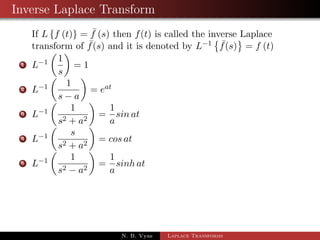
3 L1 
 
1 
s2 + a2 
 
= 
1 
a 
sin at 
N. B. Vyas Laplace Transforms
Inverse Laplace Transform 
If Lff (t)g = f  (s) then f(t) is called the inverse  
Laplace 
transform of f(s)  and it is denoted by L1 
f(s) 
 	 
= f (t) 
1 L1 
 
1 
s 
 
= 1 
2 L1 
 
1 
s  a 
 
= eat 
3 L1 
 
1 
s2 + a2 
 
= 
1 
a 
sin at 
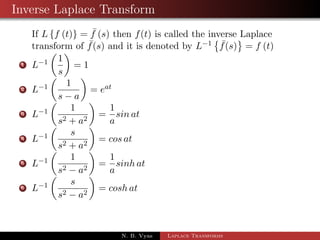
4 L1 
 
s 
s2 + a2 
 
= cos at 
N. B. Vyas Laplace Transforms
Inverse Laplace Transform 
If Lff (t)g = f  (s) then f(t) is called the inverse  
Laplace 
transform of f(s)  and it is denoted by L1 
f(s) 
 	 
= f (t) 
1 L1 
 
1 
s 
 
= 1 
2 L1 
 
1 
s  a 
 
= eat 
3 L1 
 
1 
s2 + a2 
 
= 
1 
a 
sin at 
4 L1 
 
s 
s2 + a2 
 
= cos at 
5 L1 
 
1 
s2  a2 
 
= 
1 
a 
sinh at 
N. B. Vyas Laplace Transforms
Inverse Laplace Transform 
If Lff (t)g = f  (s) then f(t) is called the inverse  
Laplace 
transform of f(s)  and it is denoted by L1 
f(s) 
 	 
= f (t) 
1 L1 
 
1 
s 
 
= 1 
2 L1 
 
1 
s  a 
 
= eat 
3 L1 
 
1 
s2 + a2 
 
= 
1 
a 
sin at 
4 L1 
 
s 
s2 + a2 
 
= cos at 
5 L1 
 
1 
s2  a2 
 
= 
1 
a 
sinh at 
6 L1 
 
s 
s2  a2 
 
= cosh at 
N. B. Vyas Laplace Transforms
Inverse Laplace Transform 
If Lff (t)g = f  (s) then f(t) is called the inverse  
Laplace 
transform of f(s)  and it is denoted by L1 
f(s) 
 	 
= f (t) 
1 L1 
 
1 
s 
 
= 1 
2 L1 
 
1 
s  a 
 
= eat 
3 L1 
 
1 
s2 + a2 
 
= 
1 
a 
sin at 
4 L1 
 
s 
s2 + a2 
 
= cos at 
5 L1 
 
1 
s2  a2 
 
= 
1 
a 
sinh at 
6 L1 
 
s 
s2  a2 
 
= cosh at 
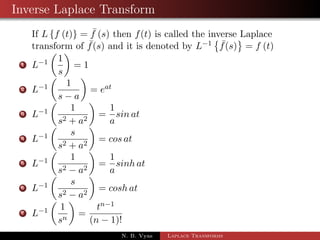
7 L1 
 
1 
sn 
 
= 
tn1 
(n  1)! 
N. B. Vyas Laplace Transforms
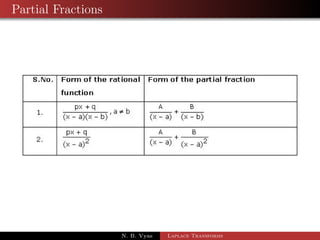
Partial Fractions 
N. B. Vyas Laplace Transforms
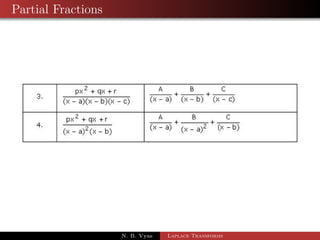
Partial Fractions 
N. B. Vyas Laplace Transforms
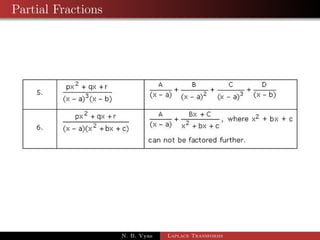
Partial Fractions 
N. B. Vyas Laplace Transforms
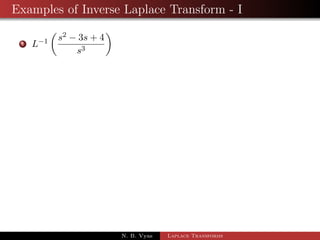
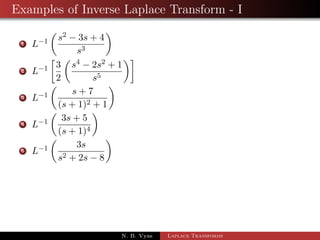
Examples of Inverse Laplace Transform - I 
1 L1 
 
s2  3s + 4 
s3 
 
N. B. Vyas Laplace Transforms
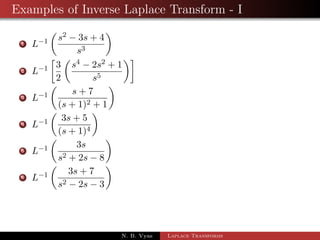
Examples of Inverse Laplace Transform - I 
1 L1 
 
s2  3s + 4 
s3 
 
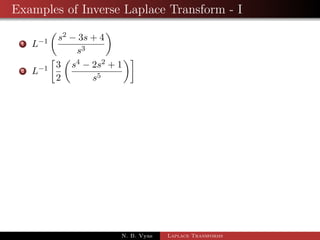
2 L1 
 
3 
2 
 
s4  2s2 + 1 
s5 
 
N. B. Vyas Laplace Transforms
Examples of Inverse Laplace Transform - I 
1 L1 
 
s2  3s + 4 
s3 
 
2 L1 
 
3 
2 
 
s4  2s2 + 1 
s5 
 
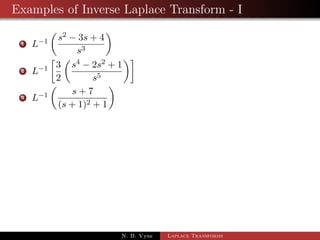
3 L1 
 
s + 7 
(s + 1)2 + 1 
 
N. B. Vyas Laplace Transforms
Examples of Inverse Laplace Transform - I 
1 L1 
 
s2  3s + 4 
s3 
 
2 L1 
 
3 
2 
 
s4  2s2 + 1 
s5 
 
3 L1 
 
s + 7 
(s + 1)2 + 1 
 
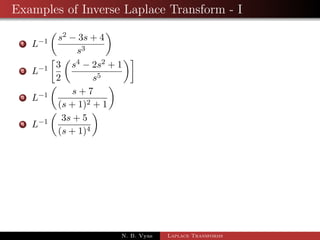
4 L1 
 
3s + 5 
(s + 1)4 
 
N. B. Vyas Laplace Transforms
Examples of Inverse Laplace Transform - I 
1 L1 
 
s2  3s + 4 
s3 
 
2 L1 
 
3 
2 
 
s4  2s2 + 1 
s5 
 
3 L1 
 
s + 7 
(s + 1)2 + 1 
 
4 L1 
 
3s + 5 
(s + 1)4 
 
5 L1 
 
3s 
s2 + 2s  8 
 
N. B. Vyas Laplace Transforms
Examples of Inverse Laplace Transform - I 
1 L1 
 
s2  3s + 4 
s3 
 
2 L1 
 
3 
2 
 
s4  2s2 + 1 
s5 
 
3 L1 
 
s + 7 
(s + 1)2 + 1 
 
4 L1 
 
3s + 5 
(s + 1)4 
 
5 L1 
 
3s 
s2 + 2s  8 
 
6 L1 
 
3s + 7 
s2  2s  3 
 
N. B. Vyas Laplace Transforms
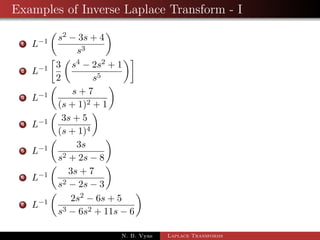
Examples of Inverse Laplace Transform - I 
1 L1 
 
s2  3s + 4 
s3 
 
2 L1 
 
3 
2 
 
s4  2s2 + 1 
s5 
 
3 L1 
 
s + 7 
(s + 1)2 + 1 
 
4 L1 
 
3s + 5 
(s + 1)4 
 
5 L1 
 
3s 
s2 + 2s  8 
 
6 L1 
 
3s + 7 
s2  2s  3 
 
7 L1 
 
2s2  6s + 5 
s3  6s2 + 11s  6 
 
N. B. Vyas Laplace Transforms
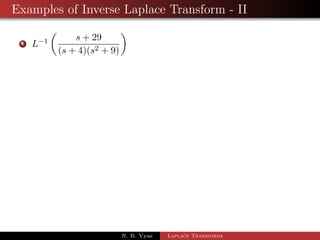
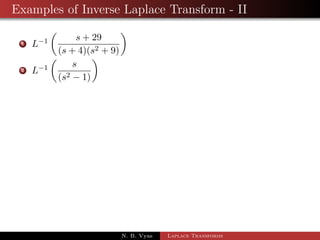
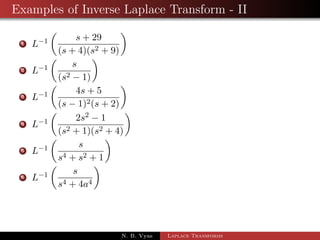
Examples of Inverse Laplace Transform - II 
1 L1 
 
s + 29 
(s + 4)(s2 + 9) 
 
N. B. Vyas Laplace Transforms
Examples of Inverse Laplace Transform - II 
1 L1 
 
s + 29 
(s + 4)(s2 + 9) 
 
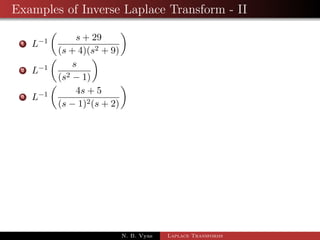
2 L1 
 
s 
(s2  1) 
 
N. B. Vyas Laplace Transforms
Examples of Inverse Laplace Transform - II 
1 L1 
 
s + 29 
(s + 4)(s2 + 9) 
 
2 L1 
 
s 
(s2  1) 
 
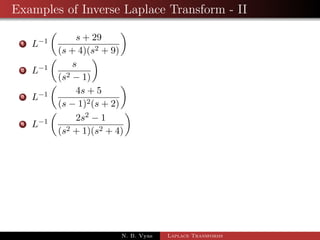
3 L1 
 
4s + 5 
(s  1)2(s + 2) 
 
N. B. Vyas Laplace Transforms
Examples of Inverse Laplace Transform - II 
1 L1 
 
s + 29 
(s + 4)(s2 + 9) 
 
2 L1 
 
s 
(s2  1) 
 
3 L1 
 
4s + 5 
(s  1)2(s + 2) 
 
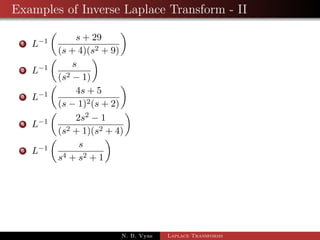
4 L1 
 
2s2  1 
(s2 + 1)(s2 + 4) 
 
N. B. Vyas Laplace Transforms
Examples of Inverse Laplace Transform - II 
1 L1 
 
s + 29 
(s + 4)(s2 + 9) 
 
2 L1 
 
s 
(s2  1) 
 
3 L1 
 
4s + 5 
(s  1)2(s + 2) 
 
4 L1 
 
2s2  1 
(s2 + 1)(s2 + 4) 
 
5 L1 
 
s 
s4 + s2 + 1 
 
N. B. Vyas Laplace Transforms
Examples of Inverse Laplace Transform - II 
1 L1 
 
s + 29 
(s + 4)(s2 + 9) 
 
2 L1 
 
s 
(s2  1) 
 
3 L1 
 
4s + 5 
(s  1)2(s + 2) 
 
4 L1 
 
2s2  1 
(s2 + 1)(s2 + 4) 
 
5 L1 
 
s 
s4 + s2 + 1 
 
6 L1 
 
s 
s4 + 4a4 
 
N. B. Vyas Laplace Transforms
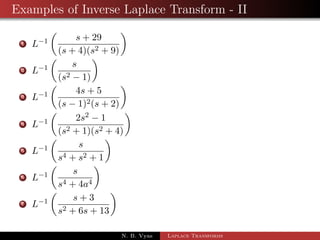
Examples of Inverse Laplace Transform - II 
1 L1 
 
s + 29 
(s + 4)(s2 + 9) 
 
2 L1 
 
s 
(s2  1) 
 
3 L1 
 
4s + 5 
(s  1)2(s + 2) 
 
4 L1 
 
2s2  1 
(s2 + 1)(s2 + 4) 
 
5 L1 
 
s 
s4 + s2 + 1 
 
6 L1 
 
s 
s4 + 4a4 
 
7 L1 
 
s + 3 
s2 + 6s + 13 
 
N. B. Vyas Laplace Transforms
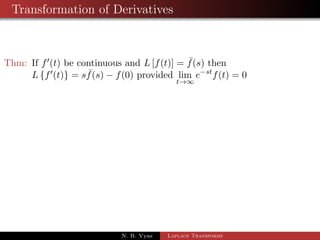
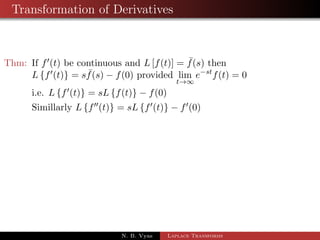
Transformation of Derivatives 
Thm: If f0(t) be continuous and L[f(t)] =  f(s) then 
Lff0(t)g = s  f(s)  f(0) provided lim 
t!1 
estf(t) = 0 
N. B. Vyas Laplace Transforms
Transformation of Derivatives 
Thm: If f0(t) be continuous and L[f(t)] =  f(s) then 
Lff0(t)g = s  f(s)  f(0) provided lim 
t!1 
estf(t) = 0 
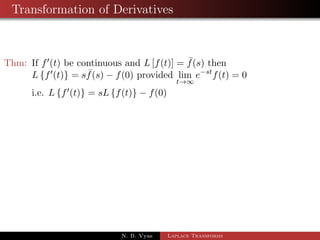
i.e. Lff0(t)g = sL ff(t)g  f(0) 
N. B. Vyas Laplace Transforms
Transformation of Derivatives 
Thm: If f0(t) be continuous and L[f(t)] =  f(s) then 
Lff0(t)g = s  f(s)  f(0) provided lim 
t!1 
estf(t) = 0 
i.e. Lff0(t)g = sL ff(t)g  f(0) 
Simillarly Lff00(t)g = sL ff0(t)g  f0(0) 
N. B. Vyas Laplace Transforms
Transformation of Derivatives 
Thm: If f0(t) be continuous and L[f(t)] =  f(s) then 
Lff0(t)g = s  f(s)  f(0) provided lim 
t!1 
estf(t) = 0 
i.e. Lff0(t)g = sL ff(t)g  f(0) 
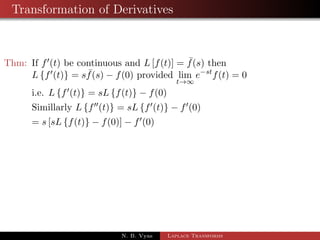
Simillarly Lff00(t)g = sL ff0(t)g  f0(0) 
= s [sL ff(t)g  f(0)]  f0(0) 
N. B. Vyas Laplace Transforms
Transformation of Derivatives 
Thm: If f0(t) be continuous and L[f(t)] =  f(s) then 
Lff0(t)g = s  f(s)  f(0) provided lim 
t!1 
estf(t) = 0 
i.e. Lff0(t)g = sL ff(t)g  f(0) 
Simillarly Lff00(t)g = sL ff0(t)g  f0(0) 
= s [sL ff(t)g  f(0)]  f0(0) 
= s2Lff(t)g  sf(0)  f0(0) 
N. B. Vyas Laplace Transforms
Transformation of Derivatives 
Thm: If f0(t) be continuous and L[f(t)] =  f(s) then 
Lff0(t)g = s  f(s)  f(0) provided lim 
t!1 
estf(t) = 0 
i.e. Lff0(t)g = sL ff(t)g  f(0) 
Simillarly Lff00(t)g = sL ff0(t)g  f0(0) 
= s [sL ff(t)g  f(0)]  f0(0) 
= s2Lff(t)g  sf(0)  f0(0) 
= s2  f(s)  sf(0)  f0(0) 
N. B. Vyas Laplace Transforms
Transformation of Derivatives 
Thm: If f0(t) be continuous and L[f(t)] =  f(s) then 
Lff0(t)g = s  f(s)  f(0) provided lim 
t!1 
estf(t) = 0 
i.e. Lff0(t)g = sL ff(t)g  f(0) 
Simillarly Lff00(t)g = sL ff0(t)g  f0(0) 
= s [sL ff(t)g  f(0)]  f0(0) 
= s2Lff(t)g  sf(0)  f0(0) 
= s2  f(s)  sf(0)  f0(0) 
In general 
Lffn(t)g = sn  f(s)  sn1f(0)  sn2f0(0)  : : :  fn1(0) 
N. B. Vyas Laplace Transforms
Transformation of Derivatives 
Thm: If f0(t) be continuous and L[f(t)] =  f(s) then 
Lff0(t)g = s  f(s)  f(0) provided lim 
t!1 
estf(t) = 0 
i.e. Lff0(t)g = sL ff(t)g  f(0) 
Simillarly Lff00(t)g = sL ff0(t)g  f0(0) 
= s [sL ff(t)g  f(0)]  f0(0) 
= s2Lff(t)g  sf(0)  f0(0) 
= s2  f(s)  sf(0)  f0(0) 
In general 
Lffn(t)g = sn  f(s)  sn1f(0)  sn2f0(0)  : : :  fn1(0) 
N. B. Vyas Laplace Transforms
Examples of Transformation of Derivatives 
Ex. Derive the Laplace transform of sin at and cos at 
N. B. Vyas Laplace Transforms
Examples of Transformation of Derivatives 
Ex. Derive the Laplace transform of sin at and cos at 
Ex. Obtain Lftng from L(1) = 
1 
s 
N. B. Vyas Laplace Transforms
Examples of Transformation of Derivatives 
Ex. Derive the Laplace transform of sin at and cos at 
Ex. Obtain Lftng from L(1) = 
1 
s 
Ex. Find L(t sin at) 
N. B. Vyas Laplace Transforms
Examples of Transformation of Derivatives 
Ex. Derive the Laplace transform of sin at and cos at 
Ex. Obtain Lftng from L(1) = 
1 
s 
Ex. Find L(t sin at) 
Ex. Find L(t cos at) 
N. B. Vyas Laplace Transforms
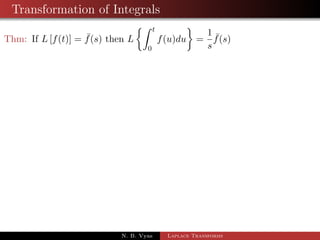
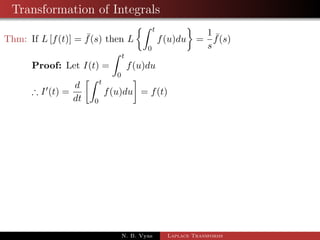
Transformation of Integrals 
Thm: If L[f(t)] =  f(s) then L 
Z t 
0 
 
f(u)du 
= 
1 
s 
 f(s) 
N. B. Vyas Laplace Transforms
Transformation of Integrals 
Thm: If L[f(t)] =  f(s) then L 
Z t 
0 
 
f(u)du 
= 
1 
s 
 f(s) 
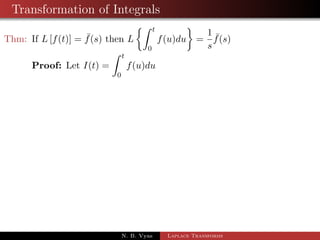
Proof: Let I(t) = 
Z t 
0 
f(u)du 
N. B. Vyas Laplace Transforms
Transformation of Integrals 
Thm: If L[f(t)] =  f(s) then L 
Z t 
0 
 
f(u)du 
= 
1 
s 
 f(s) 
Proof: Let I(t) = 
Z t 
0 
f(u)du 
) I0(t) = 
d 
dt 
Z t 
0 
 
= f(t) 
f(u)du 
N. B. Vyas Laplace Transforms
Transformation of Integrals 
Thm: If L[f(t)] =  f(s) then L 
Z t 
0 
 
f(u)du 
= 
1 
s 
 f(s) 
Proof: Let I(t) = 
Z t 
0 
f(u)du 
) I0(t) = 
d 
dt 
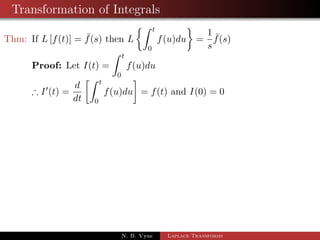
Z t 
0 
 
= f(t) and I(0) = 0 
f(u)du 
N. B. Vyas Laplace Transforms
Transformation of Integrals 
Thm: If L[f(t)] =  f(s) then L 
Z t 
0 
 
f(u)du 
= 
1 
s 
 f(s) 
Proof: Let I(t) = 
Z t 
0 
f(u)du 
) I0(t) = 
d 
dt 
Z t 
0 
 
= f(t) and I(0) = 0 
f(u)du 
) Lff(t)g = LfI0(t)g = sI(s)  I(0) = sI(s) 
N. B. Vyas Laplace Transforms
Transformation of Integrals 
Thm: If L[f(t)] =  f(s) then L 
Z t 
0 
 
f(u)du 
= 
1 
s 
 f(s) 
Proof: Let I(t) = 
Z t 
0 
f(u)du 
) I0(t) = 
d 
dt 
Z t 
0 
 
= f(t) and I(0) = 0 
f(u)du 
) Lff(t)g = LfI0(t)g = sI(s)  I(0) = sI(s) 
) Lff(t)g = sI(s) 
N. B. Vyas Laplace Transforms
Transformation of Integrals 
Thm: If L[f(t)] =  f(s) then L 
Z t 
0 
 
f(u)du 
= 
1 
s 
 f(s) 
Proof: Let I(t) = 
Z t 
0 
f(u)du 
) I0(t) = 
d 
dt 
Z t 
0 
 
= f(t) and I(0) = 0 
f(u)du 
) Lff(t)g = LfI0(t)g = sI(s)  I(0) = sI(s) 
) Lff(t)g = sI(s) 
) Lff(t)g = sL fI(t)g 
N. B. Vyas Laplace Transforms
Transformation of Integrals 
Thm: If L[f(t)] =  f(s) then L 
Z t 
0 
 
f(u)du 
= 
1 
s 
 f(s) 
Proof: Let I(t) = 
Z t 
0 
f(u)du 
) I0(t) = 
d 
dt 
Z t 
0 
 
= f(t) and I(0) = 0 
f(u)du 
) Lff(t)g = LfI0(t)g = sI(s)  I(0) = sI(s) 
) Lff(t)g = sI(s) 
) Lff(t)g = Z sL fI(t)g 
t 
) f(s)  = sL 
0 
 
f(u)du 
N. B. Vyas Laplace Transforms
Transformation of Integrals 
Thm: If L[f(t)] =  f(s) then L 
Z t 
0 
 
f(u)du 
= 
1 
s 
 f(s) 
Proof: Let I(t) = 
Z t 
0 
f(u)du 
) I0(t) = 
d 
dt 
Z t 
0 
 
= f(t) and I(0) = 0 
f(u)du 
) Lff(t)g = LfI0(t)g = sI(s)  I(0) = sI(s) 
) Lff(t)g = sI(s) 
) Lff(t)g = Z sL fI(t)g 
t 
) f(s)  = sL 
0 
 
f(u)du 
) 1 
s 
 f(s) = L 
Z t 
0 
 
f(u)du 
N. B. Vyas Laplace Transforms
Transformation of Integrals 
Thm: If L[f(t)] =  f(s) then L 
Z t 
0 
 
f(u)du 
= 
1 
s 
 f(s) 
Proof: Let I(t) = 
Z t 
0 
f(u)du 
) I0(t) = 
d 
dt 
Z t 
0 
 
= f(t) and I(0) = 0 
f(u)du 
) Lff(t)g = LfI0(t)g = sI(s)  I(0) = sI(s) 
) Lff(t)g = sI(s) 
) Lff(t)g = Z sL fI(t)g 
t 
) f(s)  = sL 
0 
 
f(u)du 
) 1 
s 
 f(s) = L 
Z t 
0 
 
f(u)du 
) L1 
 
1 
s 
 f(s) 
 
= 
Z t 
0 
f(u)du 
N. B. Vyas Laplace Transforms
Examples of Transformation of Integrals 
Ex. Prove that: L1 
 
1 
s2 + 1 
 
= sin t 
Ex. Prove that: L1 
 
1 
s(s2 + 1) 
 
= 1  cos t 
Ex. Find inverse Laplace transform of 
1 
s3(s2 + a2) 
N. B. Vyas Laplace Transforms
Multiplication by tn 
Thm: If L[f(t)] =  f(s) then Lftnf(t)g = (1)n dn 
dsn 
 
 f(s) 
 
N. B. Vyas Laplace Transforms
Multiplication by tn 
Thm: If L[f(t)] =  f(s) then Lftnf(t)g = (1)n dn 
dsn 
 
 f(s) 
 
if Lftf (t)g = (1)1 d 
ds 
 
 f(s) 
 
then L1 
 
 f0(s) 
	 
= tf (t) 
N. B. Vyas Laplace Transforms
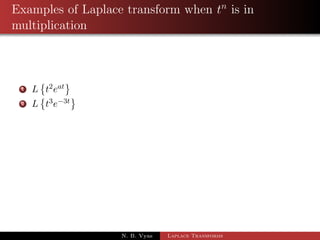
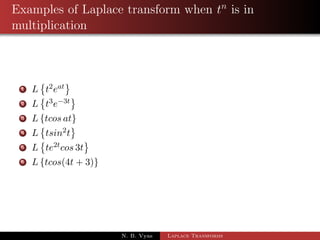
Examples of Laplace transform when tn is in 
multiplication 
1 L 
 
t2eat 
	 
N. B. Vyas Laplace Transforms
Examples of Laplace transform when tn is in 
multiplication 
1 L 
 
t2eat 
	 
2 L 
 
t3e3t 
	 
N. B. Vyas Laplace Transforms
Examples of Laplace transform when tn is in 
multiplication 
1 L 
 
t2eat 
	 
2 L 
 
t3e3t 
	 
3 Lftcos atg 
N. B. Vyas Laplace Transforms
Examples of Laplace transform when tn is in 
multiplication 
1 L 
 
t2eat 
	 
2 L 
 
t3e3t 
	 
3 Lftcos atg 
4 L 
 
tsin2t 
	 
N. B. Vyas Laplace Transforms
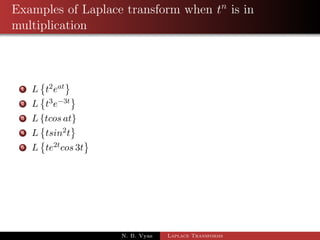
Examples of Laplace transform when tn is in 
multiplication 
1 L 
 
t2eat 
	 
2 L 
 
t3e3t 
	 
3 Lftcos atg 
4 L 
 
tsin2t 
	 
5 L 
 
te2tcos 3t 
	 
N. B. Vyas Laplace Transforms
Examples of Laplace transform when tn is in 
multiplication 
1 L 
 
t2eat 
	 
2 L 
 
t3e3t 
	 
3 Lftcos atg 
4 L 
 
tsin2t 
	 
5 L 
 
te2tcos 3t 
	 
6 Lftcos(4t + 3)g 
N. B. Vyas Laplace Transforms
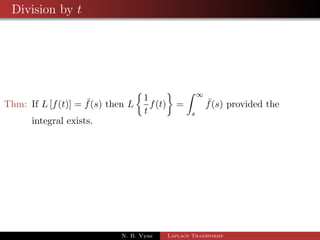
Division by t 
Thm: If L[f(t)] =  f(s) then L 
 
1 
t 
 
f(t) 
= 
Z 1 
s 
 f(s) provided the 
integral exists. 
N. B. Vyas Laplace Transforms
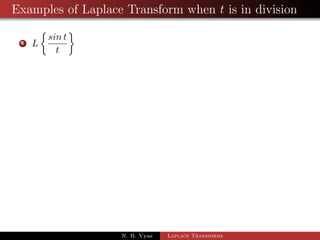
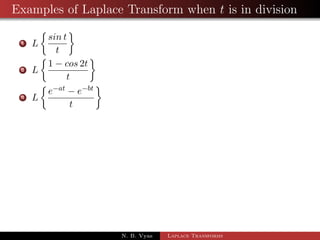
Examples of Laplace Transform when t is in division 
1 L 
 
sin t 
t 
 
N. B. Vyas Laplace Transforms
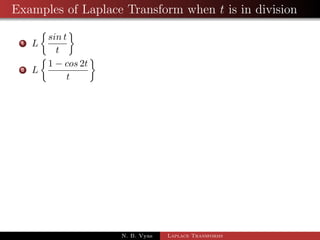
Examples of Laplace Transform when t is in division 
1 L 
 
sin t 
t 
 
2 L 
 
1  cos 2t 
t 
 
N. B. Vyas Laplace Transforms
Examples of Laplace Transform when t is in division 
1 L 
 
sin t 
t 
 
2 L 
 
1  cos 2t 
t 
 
3 L 
 
eat  ebt 
t 
 
N. B. Vyas Laplace Transforms
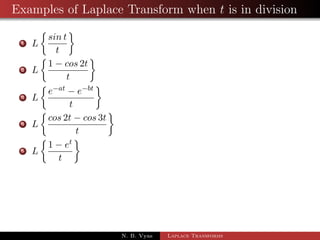
Examples of Laplace Transform when t is in division 
1 L 
 
sin t 
t 
 
2 L 
 
1  cos 2t 
t 
 
3 L 
 
eat  ebt 
t 
 
4 L 
 
cos 2t  cos 3t 
t 
 
N. B. Vyas Laplace Transforms
Examples of Laplace Transform when t is in division 
1 L 
 
sin t 
t 
 
2 L 
 
1  cos 2t 
t 
 
3 L 
 
eat  ebt 
t 
 
4 L 
 
cos 2t  cos 3t 
t 
 
5 L 
 
1  et 
t 
 
N. B. Vyas Laplace Transforms
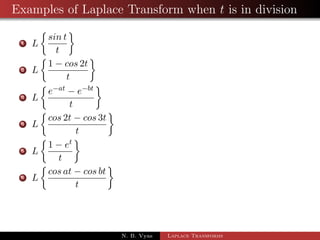
Examples of Laplace Transform when t is in division 
1 L 
 
sin t 
t 
 
2 L 
 
1  cos 2t 
t 
 
3 L 
 
eat  ebt 
t 
 
4 L 
 
cos 2t  cos 3t 
t 
 
5 L 
 
1  et 
t 
 
6 L 
 
cos at  cos bt 
t 
 
N. B. Vyas Laplace Transforms
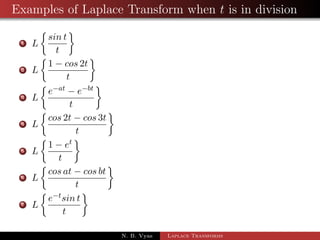
Examples of Laplace Transform when t is in division 
1 L 
 
sin t 
t 
 
2 L 
 
1  cos 2t 
t 
 
3 L 
 
eat  ebt 
t 
 
4 L 
 
cos 2t  cos 3t 
t 
 
5 L 
 
1  et 
t 
 
6 L 
 
cos at  cos bt 
t 
 
7 L 
 
etsin t 
t 
 
N. B. Vyas Laplace Transforms
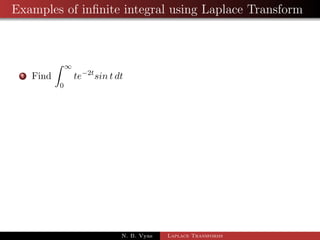
Examples of in
nite integral using Laplace Transform 
1 Find 
Z 1 
0 
te2tsin t dt 
N. B. Vyas Laplace Transforms
Examples of in
nite integral using Laplace Transform 
1 Find 
Z 1 
0 
te2tsin t dt 
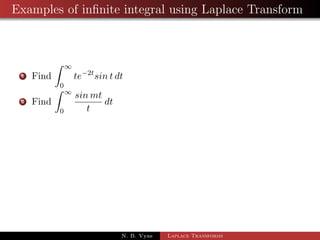
2 Find 
Z 1 
0 
sin mt 
t 
dt 
N. B. Vyas Laplace Transforms
Examples of in
nite integral using Laplace Transform 
1 Find 
Z 1 
0 
te2tsin t dt 
2 Find 
Z 1 
0 
sin mt 
t 
dt 
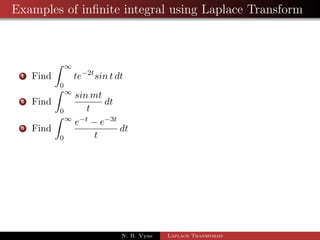
3 Find 
Z 1 
0 
et  e3t 
t 
dt 
N. B. Vyas Laplace Transforms
Examples of in
nite integral using Laplace Transform 
1 Find 
Z 1 
0 
te2tsin t dt 
2 Find 
Z 1 
0 
sin mt 
t 
dt 
3 Find 
Z 1 
0 
et  e3t 
t 
dt 
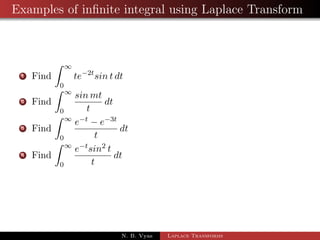
4 Find 
Z 1 
0 
etsin2 t 
t 
dt 
N. B. Vyas Laplace Transforms
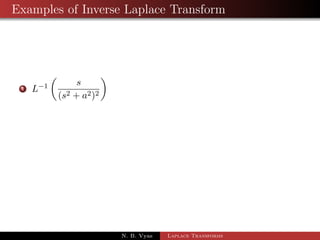
Examples of Inverse Laplace Transform 
1 L1 
 
s 
(s2 + a2)2 
 
N. B. Vyas Laplace Transforms
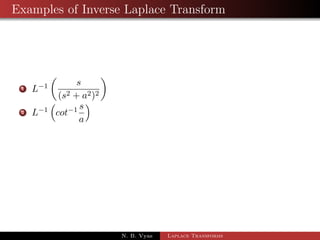
Examples of Inverse Laplace Transform 
1 L1 
 
s 
(s2 + a2)2 
 
2 L1 
 
cot1 s 
a 
 
N. B. Vyas Laplace Transforms
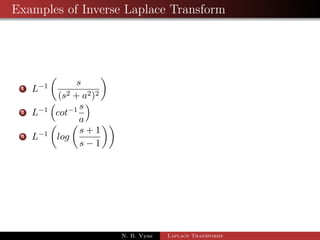
Examples of Inverse Laplace Transform 
1 L1 
 
s 
(s2 + a2)2 
 
2 L1 
 
cot1 s 
a 
 
3 L1 
 
log 
 
s + 1 
s  1 
 
N. B. Vyas Laplace Transforms
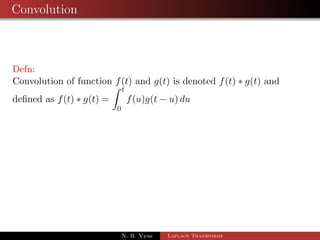
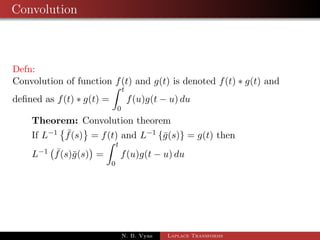
Convolution 
Defn: 
Convolution of function Z f(t) and g(t) is denoted f(t)  g(t) and 
t 
de
ned as f(t)  g(t) = 
0 
f(u)g(t  u) du 
N. B. Vyas Laplace Transforms
Convolution 
Defn: 
Convolution of function Z f(t) and g(t) is denoted f(t)  g(t) and 
t 
de
ned as f(t)  g(t) = 
0 
f(u)g(t  u) du 
Theorem:  
Convolution theorem 
If L1 
f(s) 
 	 
= f(t) and L1 fg(s)g = g(t) then 
L1 
 
 f(s)g(s) 
 
= 
Z t 
0 
f(u)g(t  u) du 
N. B. Vyas Laplace Transforms
Convolution 
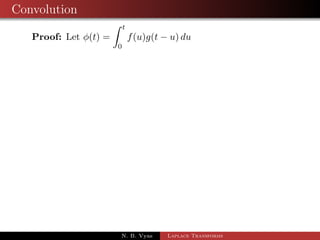
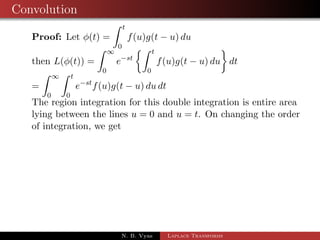
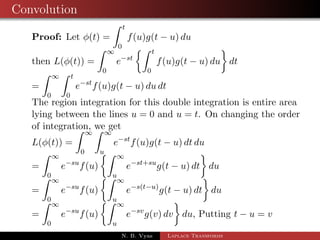
Proof: Let (t) = 
Z t 
0 
f(u)g(t  u) du 
N. B. Vyas Laplace Transforms
Convolution 
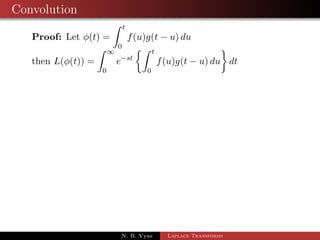
Proof: Let (t) = 
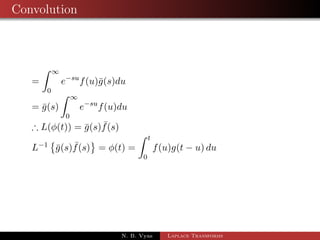
Z t 
0 
f(u)g(t  u) du 
then L((t)) = 
Z 1 
0 
est 
Z t 
0 
 
dt 
f(u)g(t  u) du 
N. B. Vyas Laplace Transforms
Convolution 
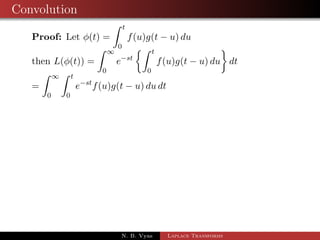
Proof: Let (t) = 
Z t 
0 
f(u)g(t  u) du 
then L((t)) = 
Z 1 
0 
est 
Z t 
0 
 
dt 
f(u)g(t  u) du 
= 
Z 1 
0 
Z t 
0 
estf(u)g(t  u) du dt 
N. B. Vyas Laplace Transforms
Convolution 
Proof: Let (t) = 
Z t 
0 
f(u)g(t  u) du 
then L((t)) = 
Z 1 
0 
est 
Z t 
0 
 
dt 
f(u)g(t  u) du 
= 
Z 1 
0 
Z t 
0 
estf(u)g(t  u) du dt 
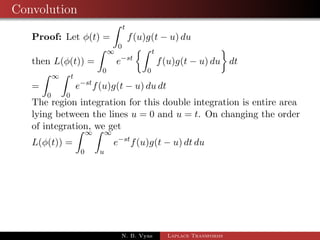
The region integration for this double integration is entire area 
lying between the lines u = 0 and u = t. On changing the order 
of integration, we get 
N. B. Vyas Laplace Transforms
Convolution 
Proof: Let (t) = 
Z t 
0 
f(u)g(t  u) du 
then L((t)) = 
Z 1 
0 
est 
Z t 
0 
 
dt 
f(u)g(t  u) du 
= 
Z 1 
0 
Z t 
0 
estf(u)g(t  u) du dt 
The region integration for this double integration is entire area 
lying between the lines u = 0 and u = t. On changing the order 
of integration, Z we get 
1 
L((t)) = 
0 
Z 1 
u 
estf(u)g(t  u) dt du 
N. B. Vyas Laplace Transforms
Convolution 
Proof: Let (t) = 
Z t 
0 
f(u)g(t  u) du 
then L((t)) = 
Z 1 
0 
est 
Z t 
0 
 
dt 
f(u)g(t  u) du 
= 
Z 1 
0 
Z t 
0 
estf(u)g(t  u) du dt 
The region integration for this double integration is entire area 
lying between the lines u = 0 and u = t. On changing the order 
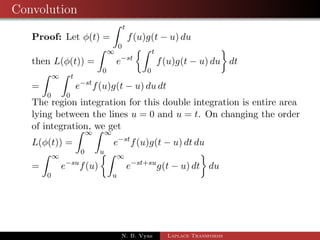
of integration, Z we get 
1 
L((t)) = 
0 
Z 1 
u 
estf(u)g(t  u) dt du 
= 
Z 1 
0 
esuf(u) 
Z 1 
u 
 
du 
est+sug(t  u) dt 
N. B. Vyas Laplace Transforms
Convolution 
Proof: Let (t) = 
Z t 
0 
f(u)g(t  u) du 
then L((t)) = 
Z 1 
0 
est 
Z t 
0 
 
dt 
f(u)g(t  u) du 
= 
Z 1 
0 
Z t 
0 
estf(u)g(t  u) du dt 
The region integration for this double integration is entire area 
lying between the lines u = 0 and u = t. On changing the order 
of integration, Z we get 
1 
L((t)) = 
0 
Z 1 
u 
estf(u)g(t  u) dt du 
= 
Z 1 
0 
esuf(u) 
Z 1 
u 
 
du 
est+sug(t  u) dt 
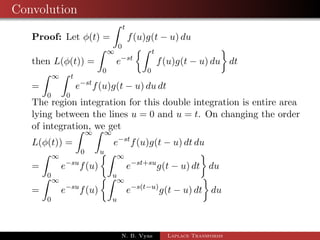
= 
Z 1 
0 
esuf(u) 
Z 1 
u 
 
du 
es(tu)g(t  u) dt 
N. B. Vyas Laplace Transforms
Convolution 
Proof: Let (t) = 
Z t 
0 
f(u)g(t  u) du 
then L((t)) = 
Z 1 
0 
est 
Z t 
0 
 
dt 
f(u)g(t  u) du 
= 
Z 1 
0 
Z t 
0 
estf(u)g(t  u) du dt 
The region integration for this double integration is entire area 
lying between the lines u = 0 and u = t. On changing the order 
of integration, Z we get 
1 
L((t)) = 
0 
Z 1 
u 
estf(u)g(t  u) dt du 
= 
Z 1 
0 
esuf(u) 
Z 1 
u 
 
du 
est+sug(t  u) dt 
= 
Z 1 
0 
esuf(u) 
Z 1 
u 
 
du 
es(tu)g(t  u) dt 
= 
Z 1 
0 
esuf(u) 
Z 1 
u 
esvg(v) dv 
 
du, Putting t  u = v 
N. B. Vyas Laplace Transforms
Convolution 
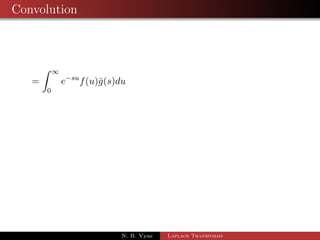
= 
Z 1 
0 
esuf(u)g(s)du 
N. B. Vyas Laplace Transforms
Convolution 
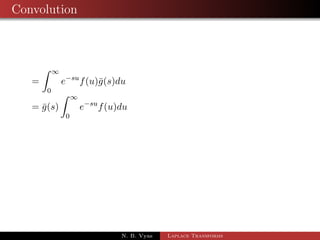
= 
Z 1 
0 
esuf(u)g(s)du 
= g(s) 
Z 1 
0 
esuf(u)du 
N. B. Vyas Laplace Transforms
Convolution 
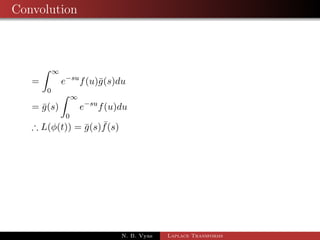
= 
Z 1 
0 
esuf(u)g(s)du 
= g(s) 
Z 1 
0 
esuf(u)du 
) L((t)) = g(s)  f(s) 
N. B. Vyas Laplace Transforms
Convolution 
= 
Z 1 
0 
esuf(u)g(s)du 
= g(s) 
Z 1 
0 
esuf(u)du 
) L((t)) = g(s) f(s) 
  
L1 
g(s) f(s) 
 	 
= (t) = 
Z t 
0 
f(u)g(t  u) du 
N. B. Vyas Laplace Transforms
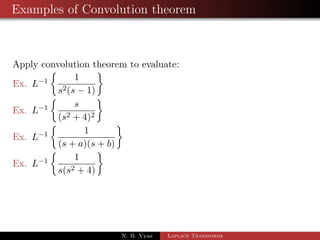
Examples of Convolution theorem 
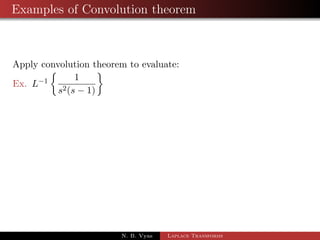
Apply convolution theorem to evaluate: 
Ex. L1 
 
1 
s2(s  1) 
 
N. B. Vyas Laplace Transforms
Examples of Convolution theorem 
Apply convolution theorem to evaluate: 
Ex. L1 
 
1 
s2(s  1) 
 
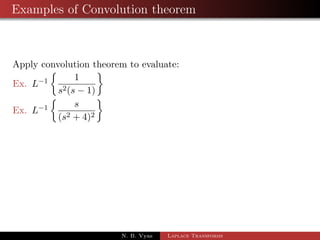
Ex. L1 
 
s 
(s2 + 4)2 
 
N. B. Vyas Laplace Transforms
Examples of Convolution theorem 
Apply convolution theorem to evaluate: 
Ex. L1 
 
1 
s2(s  1) 
 
Ex. L1 
 
s 
(s2 + 4)2 
 
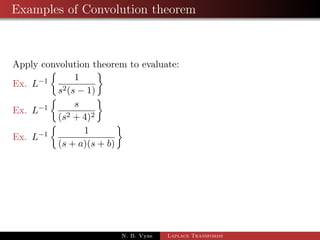
Ex. L1 
 
1 
(s + a)(s + b) 
 
N. B. Vyas Laplace Transforms
Examples of Convolution theorem 
Apply convolution theorem to evaluate: 
Ex. L1 
 
1 
s2(s  1) 
 
Ex. L1 
 
s 
(s2 + 4)2 
 
Ex. L1 
 
1 
(s + a)(s + b) 
 
Ex. L1 
 
1 
s(s2 + 4) 
 
N. B. Vyas Laplace Transforms
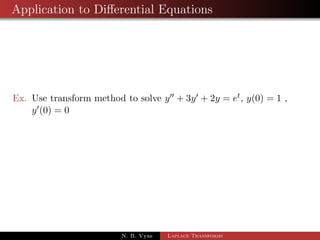
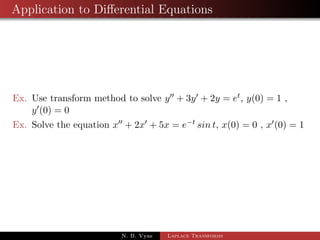
Application to Dierential Equations 
Ex. Use transform method to solve y00 + 3y0 + 2y = et, y(0) = 1 , 
y0(0) = 0 
N. B. Vyas Laplace Transforms
Application to Dierential Equations 
Ex. Use transform method to solve y00 + 3y0 + 2y = et, y(0) = 1 , 
y0(0) = 0 
Ex. Solve the equation x00 + 2x0 + 5x = et sin t, x(0) = 0 , x0(0) = 1 
N. B. Vyas Laplace Transforms
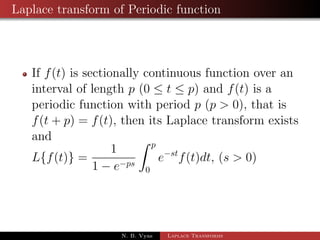
Laplace transform of Periodic function 
If f(t) is sectionally continuous function over an 
interval of length p (0  t  p) and f(t) is a 
periodic function with period p (p  0), that is 
f(t + p) = f(t), then its Laplace transform exists 
and 
1 
Lff(t)g = 
1  eps 
Z p 
0 
estf(t)dt, (s  0) 
N. B. Vyas Laplace Transforms
Laplace transform of Periodic function 
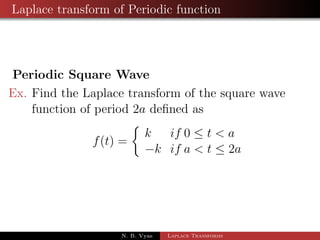
Periodic Square Wave 
Ex. Find the Laplace transform of the square wave 
function of period 2a de
ned as 
f(t) = 
 
k if 0  t  a 
k if a  t  2a 
N. B. Vyas Laplace Transforms
Laplace transform of Periodic function 
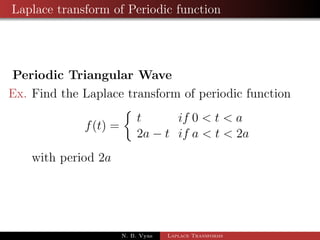
Periodic Triangular Wave 
Ex. Find the Laplace transform of periodic function 
f(t) = 
 
t if 0  t  a 
2a  t if a  t  2a 
with period 2a 
N. B. Vyas Laplace Transforms
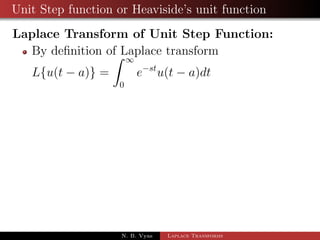
Unit Step function or Heaviside's unit function 
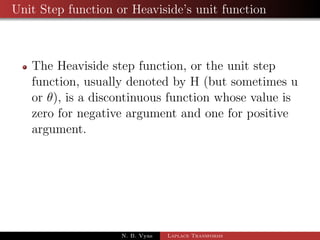
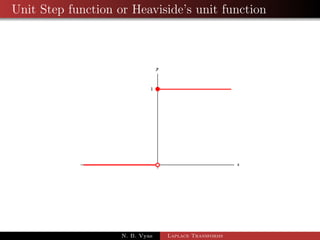
The Heaviside step function, or the unit step 
function, usually denoted by H (but sometimes u 
or ), is a discontinuous function whose value is 
zero for negative argument and one for positive 
argument. 
N. B. Vyas Laplace Transforms
Unit Step function or Heaviside's unit function 
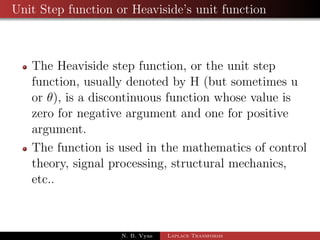
The Heaviside step function, or the unit step 
function, usually denoted by H (but sometimes u 
or ), is a discontinuous function whose value is 
zero for negative argument and one for positive 
argument. 
The function is used in the mathematics of control 
theory, signal processing, structural mechanics, 
etc.. 
N. B. Vyas Laplace Transforms
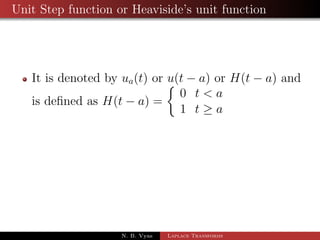
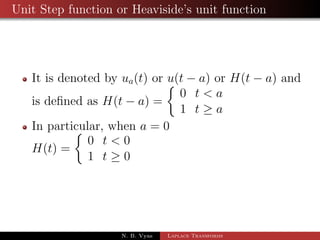
Unit Step function or Heaviside's unit function 
It is denoted by ua(t) or  
u(t  a) or H(t  a) and 
is de
ned as H(t  a) = 
0 t  a 
1 t  a 
N. B. Vyas Laplace Transforms

Laplace Transforms

  • 1.
    Laplace Transforms NiravB. Vyas Department of Mathematics Atmiya Institute of Technology and Science Yogidham, Kalavad road Rajkot - 360005 . Gujarat N. B. Vyas Laplace Transforms
  • 2.
  • 3.
    nition: Let f(t)be a function of t de
  • 4.
    ned for allt 0 then Laplace transform of f(t) is denoted by Lff(t)g or f(s) and is de
  • 5.
    ned as Lff (t)g = f (s) = Z1 0 estf (t) dt provided the integral exists where s is a parameter ( real or complex). N. B. Vyas Laplace Transforms
  • 6.
    Laplace Transforms NOTATIONS: The original functions are denoted by lowercase letters such as f(t); g(t); ::: Laplace transforms by the same letters with bars such as f(s)g(s); ::: N. B. Vyas Laplace Transforms
  • 7.
    Linearity of theLaplace Transforms Theorem 1: If Lff (t)g = f (s) and Lfg (t)g = g (s) then for any constants a and b Lfaf (t) + bg (t)g = aL ff (t)g + bL fg (t)g N. B. Vyas Laplace Transforms
  • 8.
    Linearity of theLaplace Transforms Theorem 1: If Lff (t)g = f (s) and Lfg (t)g = g (s) then for any constants a and b Lfaf (t) + bg (t)g = aL ff (t)g + bL fg (t)g Corollary 1: Putting a = 0 and b = 0, we get L[0] = 0 N. B. Vyas Laplace Transforms
  • 9.
    Linearity of theLaplace Transforms Theorem 1: If Lff (t)g = f (s) and Lfg (t)g = g (s) then for any constants a and b Lfaf (t) + bg (t)g = aL ff (t)g + bL fg (t)g Corollary 1: Putting a = 0 and b = 0, we get L[0] = 0 Corollary 2: Putting b = 0, we get L[af(t)] = aL[f(t)] N. B. Vyas Laplace Transforms
  • 10.
    Linearity of theLaplace Transforms Theorem 1: If Lff (t)g = f (s) and Lfg (t)g = g (s) then for any constants a and b Lfaf (t) + bg (t)g = aL ff (t)g + bL fg (t)g Corollary 1: Putting a = 0 and b = 0, we get L[0] = 0 Corollary 2: Putting b = 0, we get L[af(t)] = aL[f(t)] Corollary 3: L[a1f1 (t) + a2f2 (t) + ::: + anfn (t)] = a1L[f1(t)] + a2L[f2(t)] + ::: + anL[fn(t)] N. B. Vyas Laplace Transforms
  • 11.
    Laplace Transforms ofsome elementary functions 1 L(1) = 1 s N. B. Vyas Laplace Transforms
  • 12.
    Laplace Transforms ofsome elementary functions 1 L(1) = 1 s 2 L(eat) = 1 s a N. B. Vyas Laplace Transforms
  • 13.
    Laplace Transforms ofsome elementary functions 1 L(1) = 1 s 2 L(eat) = 1 s a cor.1 If a = 0 ) L(1) = 1 s N. B. Vyas Laplace Transforms
  • 14.
    Laplace Transforms ofsome elementary functions 1 L(1) = 1 s 2 L(eat) = 1 s a cor.1 If a = 0 ) L(1) = 1 s cor.2 L[eat] = 1 s + a if s a N. B. Vyas Laplace Transforms
  • 15.
    Laplace Transforms ofsome elementary functions 1 L(1) = 1 s 2 L(eat) = 1 s a cor.1 If a = 0 ) L(1) = 1 s cor.2 L[eat] = 1 s + a if s a cor.3 L[cat] = L[eat log c] = 1 s a logc if s a log c and c 0 N. B. Vyas Laplace Transforms
  • 16.
    Laplace Transforms ofsome elementary functions 3 L[sinh at] = a s2 a2 N. B. Vyas Laplace Transforms
  • 17.
    Laplace Transforms ofsome elementary functions 3 L[sinh at] = a s2 a2 4 L[cosh at] = s s2 a2 N. B. Vyas Laplace Transforms
  • 18.
    Laplace Transforms ofsome elementary functions 3 L[sinh at] = a s2 a2 4 L[cosh at] = s s2 a2 5 L[sin at] = a s2 + a2 N. B. Vyas Laplace Transforms
  • 19.
    Laplace Transforms ofsome elementary functions 3 L[sinh at] = a s2 a2 4 L[cosh at] = s s2 a2 5 L[sin at] = a s2 + a2 6 L[cos at] = s s2 + a2 ; s 0 N. B. Vyas Laplace Transforms
  • 20.
    Laplace Transforms ofsome elementary functions 3 L[sinh at] = a s2 a2 4 L[cosh at] = s s2 a2 5 L[sin at] = a s2 + a2 6 L[cos at] = s s2 + a2 ; s 0 cor.1 L[sin t] = 1 s2 + 1 ; s 0 N. B. Vyas Laplace Transforms
  • 21.
    Laplace Transforms ofsome elementary functions 3 L[sinh at] = a s2 a2 4 L[cosh at] = s s2 a2 5 L[sin at] = a s2 + a2 6 L[cos at] = s s2 + a2 ; s 0 cor.1 L[sin t] = 1 s2 + 1 ; s 0 cor.2 L[cos t] = s s2 + 1 ; s 0 N. B. Vyas Laplace Transforms
  • 22.
    Laplace Transforms ofsome elementary functions 7 L[tn] = (n + 1) sn+1 N. B. Vyas Laplace Transforms
  • 23.
    Laplace Transforms ofsome elementary functions 7 L[tn] = (n + 1) sn+1 = n! sn+1 ; n = 0; 1; 2; ::: N. B. Vyas Laplace Transforms
  • 24.
    Laplace Transforms ofsome elementary functions 7 L[tn] = (n + 1) sn+1 = n! sn+1 ; n = 0; 1; 2; ::: cor.1 If n = 0, L[1] = 1 s N. B. Vyas Laplace Transforms
  • 25.
    Laplace Transforms ofsome elementary functions 7 L[tn] = (n + 1) sn+1 = n! sn+1 ; n = 0; 1; 2; ::: cor.1 If n = 0, L[1] = 1 s cor.2 If n = 1 2 N. B. Vyas Laplace Transforms
  • 26.
    Laplace Transforms ofsome elementary functions 7 L[tn] = (n + 1) sn+1 = n! sn+1 ; n = 0; 1; 2; ::: cor.1 If n = 0, L[1] = 1 s cor.2 If n = 1 2 L t1 2 = (1 ) 2 1 s 2 = r s N. B. Vyas Laplace Transforms
  • 27.
    Laplace Transforms ofsome elementary functions 7 L[tn] = (n + 1) sn+1 = n! sn+1 ; n = 0; 1; 2; ::: cor.1 If n = 0, L[1] = 1 s cor.2 If n = 1 2 L t1 2 = (1 ) 2 1 s 2 = r s N. B. Vyas Laplace Transforms
  • 28.
    Examples of LaplaceTransform 1 L 2t3 + e2t + t 4 3 N. B. Vyas Laplace Transforms
  • 29.
    Examples of LaplaceTransform 1 L 2t3 + e2t + t 4 3 2 L A + B t 1 2 + C t 1 2 N. B. Vyas Laplace Transforms
  • 30.
    Examples of LaplaceTransform 1 L 2t3 + e2t + t 4 3 2 L A + B t 1 2 + C t 1 2 3 L eat 1 a N. B. Vyas Laplace Transforms
  • 31.
    Examples of LaplaceTransform 1 L 2t3 + e2t + t 4 3 2 L A + B t 1 2 + C t 1 2 3 L eat 1 a 4 Lfsin(at + b)g N. B. Vyas Laplace Transforms
  • 32.
    Examples of LaplaceTransform 1 L 2t3 + e2t + t 4 3 2 L A + B t 1 2 + C t 1 2 3 L eat 1 a 4 Lfsin(at + b)g 5 Lfsin 2t cos 3tg N. B. Vyas Laplace Transforms
  • 33.
    Examples of LaplaceTransform 1 L 2t3 + e2t + t 4 3 2 L A + B t 1 2 + C t 1 2 3 L eat 1 a 4 Lfsin(at + b)g 5 Lfsin 2t cos 3tg 6 L cos24t N. B. Vyas Laplace Transforms
  • 34.
    Examples of LaplaceTransform 1 L 2t3 + e2t + t 4 3 2 L A + B t 1 2 + C t 1 2 3 L eat 1 a 4 Lfsin(at + b)g 5 Lfsin 2t cos 3tg 6 L cos24t 7 L cos32t N. B. Vyas Laplace Transforms
  • 35.
    First Shifting Theorem If Lff (t)g = f (s) then L eatf (t) = f (s a) N. B. Vyas Laplace Transforms
  • 36.
    First Shifting Theorem If Lff (t)g = f (s) then L eatf (t) = f (s a) Proof: By the def. of Laplace N. B. Vyas Laplace Transforms
  • 37.
    First Shifting Theorem If Lff (t)g = f (s) then L eatf (t) = f (s a) Proof: By the def. of Laplace 1R L eatf (t) = 0 esteatf (t) dt N. B. Vyas Laplace Transforms
  • 38.
    First Shifting Theorem If Lff (t)g = f (s) then L eatf (t) = f (s a) Proof: By the def. of Laplace 1R L eatf (t) = 0 esteatf (t) dt = 1R 0 e(sa)tf (t) dt N. B. Vyas Laplace Transforms
  • 39.
    First Shifting Theorem If Lff (t)g = f (s) then L eatf (t) = f (s a) Proof: By the def. of Laplace 1R L eatf (t) = 0 esteatf (t) dt = 1R 0 e(sa)tf (t) dt = 1R 0 ertf (t) dt N. B. Vyas Laplace Transforms
  • 40.
    First Shifting Theorem If Lff (t)g = f (s) then L eatf (t) = f (s a) Proof: By the def. of Laplace 1R L eatf (t) = 0 esteatf (t) dt = 1R 0 e(sa)tf (t) dt = 1R 0 ertf (t) dt = f(r) N. B. Vyas Laplace Transforms
  • 41.
    First Shifting Theorem If Lff (t)g = f (s) then L eatf (t) = f (s a) Proof: By the def. of Laplace 1R L eatf (t) = 0 esteatf (t) dt = 1R 0 e(sa)tf (t) dt = 1R 0 ertf (t) dt = f(r) = f(s a) N. B. Vyas Laplace Transforms
  • 42.
    First Shifting Theorem If Lff (t)g = f (s) then L eatf (t) = f (s a) Proof: By the def. of Laplace 1R L eatf (t) = 0 esteatf (t) dt = 1R 0 e(sa)tf (t) dt = 1R 0 ertf (t) dt = f(r) = f(s a) Thus if we know the transformation f(s) of f(t) then we can write the transformation of eatf(t) simply replacing s by s a to get F(s a) N. B. Vyas Laplace Transforms
  • 43.
    First Shifting Theorem Note: 1 L(eat) = 1 s a N. B. Vyas Laplace Transforms
  • 44.
    First Shifting Theorem Note: 1 L(eat) = 1 s a 2 L[eattn] = (n + 1) (s a)n+1 N. B. Vyas Laplace Transforms
  • 45.
    First Shifting Theorem Note: 1 L(eat) = 1 s a 2 L[eattn] = (n + 1) (s a)n+1 3 L[eatsinh bt] = b (s a)2 b2 N. B. Vyas Laplace Transforms
  • 46.
    First Shifting Theorem Note: 1 L(eat) = 1 s a 2 L[eattn] = (n + 1) (s a)n+1 3 L[eatsinh bt] = b (s a)2 b2 4 L[eatcosh bt] = s (s a)2 b2 N. B. Vyas Laplace Transforms
  • 47.
    First Shifting Theorem Note: 1 L(eat) = 1 s a 2 L[eattn] = (n + 1) (s a)n+1 3 L[eatsinh bt] = b (s a)2 b2 4 L[eatcosh bt] = s (s a)2 b2 5 L[eatsin bt] = b (s a)2 + b2 N. B. Vyas Laplace Transforms
  • 48.
    First Shifting Theorem Note: 1 L(eat) = 1 s a 2 L[eattn] = (n + 1) (s a)n+1 3 L[eatsinh bt] = b (s a)2 b2 4 L[eatcosh bt] = s (s a)2 b2 5 L[eatsin bt] = b (s a)2 + b2 6 L[eatcos bt] = s a (s a)2 + b2 ; s 0 N. B. Vyas Laplace Transforms
  • 49.
    Examples 1 Findout the Laplace transform of e3t (2 cos 5t 3 sin 5t) N. B. Vyas Laplace Transforms
  • 50.
    Examples 1 Findout the Laplace transform of e3t (2 cos 5t 3 sin 5t) 2 L[eatsinhbt] N. B. Vyas Laplace Transforms
  • 51.
    Examples 1 Findout the Laplace transform of e3t (2 cos 5t 3 sin 5t) 2 L[eatsinhbt] 3 L[t3e3t] N. B. Vyas Laplace Transforms
  • 52.
    Examples 1 Findout the Laplace transform of e3t (2 cos 5t 3 sin 5t) 2 L[eatsinhbt] 3 L[t3e3t] 4 L[(t + 2)2et] N. B. Vyas Laplace Transforms
  • 53.
    Examples 1 Findout the Laplace transform of e3t (2 cos 5t 3 sin 5t) 2 L[eatsinhbt] 3 L[t3e3t] 4 L[(t + 2)2et] 5 L[etsin2t] N. B. Vyas Laplace Transforms
  • 54.
    Examples 1 Findout the Laplace transform of e3t (2 cos 5t 3 sin 5t) 2 L[eatsinhbt] 3 L[t3e3t] 4 L[(t + 2)2et] 5 L[etsin2t] 6 L[cosh at sin at] N. B. Vyas Laplace Transforms
  • 55.
    Examples Ex. Findthe Laplace transform of the function which is de
  • 56.
    ned as f(t)= t/T 0 t T 1 when t T N. B. Vyas Laplace Transforms
  • 57.
    Examples Ex. FindLaplace transform of f(t) = sin t 0 t 0 when t N. B. Vyas Laplace Transforms
  • 58.
    Examples Ex. FindLaplace transform of f(t) where f(t) = t 0 t 4 5 when t 4 N. B. Vyas Laplace Transforms
  • 59.
    Change of Scaleproperty If Lff (t)g = f (s) then L eatf (bt) = 1 b f s a b ; b 0 N. B. Vyas Laplace Transforms
  • 60.
    Change of Scaleproperty If Lff (t)g = f (s) then L eatf (bt) = 1 b f s a b ; b 0 Proof: By the def. of Laplace N. B. Vyas Laplace Transforms
  • 61.
    Change of Scaleproperty If Lff (t)g = f (s) then L eatf (bt) = 1 b f s a b ; b 0 Proof: By the def. of Laplace Lff (t)g = 1 Z 0 estf (t) dt N. B. Vyas Laplace Transforms
  • 62.
    Change of Scaleproperty If Lff (t)g = f (s) then L eatf (bt) = 1 b f s a b ; b 0 Proof: By the def. of Laplace Lff (t)g = 1 Z 0 estf (t) dt L eatf (bt) = 1 Z 0 esteatf (bt) dt N. B. Vyas Laplace Transforms
  • 63.
    Change of Scaleproperty If Lff (t)g = f (s) then L eatf (bt) = 1 b f s a b ; b 0 Proof: By the def. of Laplace Lff (t)g = 1 Z 0 estf (t) dt L eatf (bt) = 1 Z 0 esteatf (bt) dt = 1R 0 e(sa)tf (bt) dt N. B. Vyas Laplace Transforms
  • 64.
    Change of Scaleproperty If Lff (t)g = f (s) then L eatf (bt) = 1 b f s a b ; b 0 Proof: By the def. of Laplace Lff (t)g = 1 Z 0 estf (t) dt L eatf (bt) = 1 Z 0 esteatf (bt) dt = 1R 0 e(sa)tf (bt) dt = 1R 0 e( sa b )btf (bt) dt N. B. Vyas Laplace Transforms
  • 65.
    Change of Scaleproperty If Lff (t)g = f (s) then L eatf (bt) = 1 b f s a b ; b 0 Proof: By the def. of Laplace Lff (t)g = 1 Z 0 estf (t) dt L eatf (bt) = 1 Z 0 esteatf (bt) dt = 1R 0 e(sa)tf (bt) dt = 1R 0 e( sa b )btf (bt) dt Let bt = u ) b dt = du N. B. Vyas Laplace Transforms
  • 66.
    Change of Scaleproperty If Lff (t)g = f (s) then L eatf (bt) = 1 b f s a b ; b 0 Proof: By the def. of Laplace Lff (t)g = 1 Z 0 estf (t) dt L eatf (bt) = 1 Z 0 esteatf (bt) dt = 1R 0 e(sa)tf (bt) dt = 1R 0 e( sa b )btf (bt) dt Let bt = u ) b dt = du 1R L eatf (bt) = 0 e( sa b )uf (u) du b N. B. Vyas Laplace Transforms
  • 67.
    Change of Scaleproperty If Lff (t)g = f (s) then L eatf (bt) = 1 b f s a b ; b 0 Proof: By the def. of Laplace Lff (t)g = 1 Z 0 estf (t) dt L eatf (bt) = 1 Z 0 esteatf (bt) dt = 1R 0 e(sa)tf (bt) dt = 1R 0 e( sa b )btf (bt) dt Let bt = u ) b dt = du 1R L eatf (bt) = 0 e( sa b )uf (u) du b = 1 b f s a b N. B. Vyas Laplace Transforms
  • 68.
    Inverse Laplace Transform If Lff (t)g = f (s) then f(t) is called the inverse Laplace transform of f(s) and it is denoted by L1 f(s) = f (t) N. B. Vyas Laplace Transforms
  • 69.
    Inverse Laplace Transform If Lff (t)g = f (s) then f(t) is called the inverse Laplace transform of f(s) and it is denoted by L1 f(s) = f (t) 1 L1 1 s = 1 N. B. Vyas Laplace Transforms
  • 70.
    Inverse Laplace Transform If Lff (t)g = f (s) then f(t) is called the inverse Laplace transform of f(s) and it is denoted by L1 f(s) = f (t) 1 L1 1 s = 1 2 L1 1 s a = eat N. B. Vyas Laplace Transforms
  • 71.
    Inverse Laplace Transform If Lff (t)g = f (s) then f(t) is called the inverse Laplace transform of f(s) and it is denoted by L1 f(s) = f (t) 1 L1 1 s = 1 2 L1 1 s a = eat 3 L1 1 s2 + a2 = 1 a sin at N. B. Vyas Laplace Transforms
  • 72.
    Inverse Laplace Transform If Lff (t)g = f (s) then f(t) is called the inverse Laplace transform of f(s) and it is denoted by L1 f(s) = f (t) 1 L1 1 s = 1 2 L1 1 s a = eat 3 L1 1 s2 + a2 = 1 a sin at 4 L1 s s2 + a2 = cos at N. B. Vyas Laplace Transforms
  • 73.
    Inverse Laplace Transform If Lff (t)g = f (s) then f(t) is called the inverse Laplace transform of f(s) and it is denoted by L1 f(s) = f (t) 1 L1 1 s = 1 2 L1 1 s a = eat 3 L1 1 s2 + a2 = 1 a sin at 4 L1 s s2 + a2 = cos at 5 L1 1 s2 a2 = 1 a sinh at N. B. Vyas Laplace Transforms
  • 74.
    Inverse Laplace Transform If Lff (t)g = f (s) then f(t) is called the inverse Laplace transform of f(s) and it is denoted by L1 f(s) = f (t) 1 L1 1 s = 1 2 L1 1 s a = eat 3 L1 1 s2 + a2 = 1 a sin at 4 L1 s s2 + a2 = cos at 5 L1 1 s2 a2 = 1 a sinh at 6 L1 s s2 a2 = cosh at N. B. Vyas Laplace Transforms
  • 75.
    Inverse Laplace Transform If Lff (t)g = f (s) then f(t) is called the inverse Laplace transform of f(s) and it is denoted by L1 f(s) = f (t) 1 L1 1 s = 1 2 L1 1 s a = eat 3 L1 1 s2 + a2 = 1 a sin at 4 L1 s s2 + a2 = cos at 5 L1 1 s2 a2 = 1 a sinh at 6 L1 s s2 a2 = cosh at 7 L1 1 sn = tn1 (n 1)! N. B. Vyas Laplace Transforms
  • 76.
    Partial Fractions N.B. Vyas Laplace Transforms
  • 77.
    Partial Fractions N.B. Vyas Laplace Transforms
  • 78.
    Partial Fractions N.B. Vyas Laplace Transforms
  • 79.
    Examples of InverseLaplace Transform - I 1 L1 s2 3s + 4 s3 N. B. Vyas Laplace Transforms
  • 80.
    Examples of InverseLaplace Transform - I 1 L1 s2 3s + 4 s3 2 L1 3 2 s4 2s2 + 1 s5 N. B. Vyas Laplace Transforms
  • 81.
    Examples of InverseLaplace Transform - I 1 L1 s2 3s + 4 s3 2 L1 3 2 s4 2s2 + 1 s5 3 L1 s + 7 (s + 1)2 + 1 N. B. Vyas Laplace Transforms
  • 82.
    Examples of InverseLaplace Transform - I 1 L1 s2 3s + 4 s3 2 L1 3 2 s4 2s2 + 1 s5 3 L1 s + 7 (s + 1)2 + 1 4 L1 3s + 5 (s + 1)4 N. B. Vyas Laplace Transforms
  • 83.
    Examples of InverseLaplace Transform - I 1 L1 s2 3s + 4 s3 2 L1 3 2 s4 2s2 + 1 s5 3 L1 s + 7 (s + 1)2 + 1 4 L1 3s + 5 (s + 1)4 5 L1 3s s2 + 2s 8 N. B. Vyas Laplace Transforms
  • 84.
    Examples of InverseLaplace Transform - I 1 L1 s2 3s + 4 s3 2 L1 3 2 s4 2s2 + 1 s5 3 L1 s + 7 (s + 1)2 + 1 4 L1 3s + 5 (s + 1)4 5 L1 3s s2 + 2s 8 6 L1 3s + 7 s2 2s 3 N. B. Vyas Laplace Transforms
  • 85.
    Examples of InverseLaplace Transform - I 1 L1 s2 3s + 4 s3 2 L1 3 2 s4 2s2 + 1 s5 3 L1 s + 7 (s + 1)2 + 1 4 L1 3s + 5 (s + 1)4 5 L1 3s s2 + 2s 8 6 L1 3s + 7 s2 2s 3 7 L1 2s2 6s + 5 s3 6s2 + 11s 6 N. B. Vyas Laplace Transforms
  • 86.
    Examples of InverseLaplace Transform - II 1 L1 s + 29 (s + 4)(s2 + 9) N. B. Vyas Laplace Transforms
  • 87.
    Examples of InverseLaplace Transform - II 1 L1 s + 29 (s + 4)(s2 + 9) 2 L1 s (s2 1) N. B. Vyas Laplace Transforms
  • 88.
    Examples of InverseLaplace Transform - II 1 L1 s + 29 (s + 4)(s2 + 9) 2 L1 s (s2 1) 3 L1 4s + 5 (s 1)2(s + 2) N. B. Vyas Laplace Transforms
  • 89.
    Examples of InverseLaplace Transform - II 1 L1 s + 29 (s + 4)(s2 + 9) 2 L1 s (s2 1) 3 L1 4s + 5 (s 1)2(s + 2) 4 L1 2s2 1 (s2 + 1)(s2 + 4) N. B. Vyas Laplace Transforms
  • 90.
    Examples of InverseLaplace Transform - II 1 L1 s + 29 (s + 4)(s2 + 9) 2 L1 s (s2 1) 3 L1 4s + 5 (s 1)2(s + 2) 4 L1 2s2 1 (s2 + 1)(s2 + 4) 5 L1 s s4 + s2 + 1 N. B. Vyas Laplace Transforms
  • 91.
    Examples of InverseLaplace Transform - II 1 L1 s + 29 (s + 4)(s2 + 9) 2 L1 s (s2 1) 3 L1 4s + 5 (s 1)2(s + 2) 4 L1 2s2 1 (s2 + 1)(s2 + 4) 5 L1 s s4 + s2 + 1 6 L1 s s4 + 4a4 N. B. Vyas Laplace Transforms
  • 92.
    Examples of InverseLaplace Transform - II 1 L1 s + 29 (s + 4)(s2 + 9) 2 L1 s (s2 1) 3 L1 4s + 5 (s 1)2(s + 2) 4 L1 2s2 1 (s2 + 1)(s2 + 4) 5 L1 s s4 + s2 + 1 6 L1 s s4 + 4a4 7 L1 s + 3 s2 + 6s + 13 N. B. Vyas Laplace Transforms
  • 93.
    Transformation of Derivatives Thm: If f0(t) be continuous and L[f(t)] = f(s) then Lff0(t)g = s f(s) f(0) provided lim t!1 estf(t) = 0 N. B. Vyas Laplace Transforms
  • 94.
    Transformation of Derivatives Thm: If f0(t) be continuous and L[f(t)] = f(s) then Lff0(t)g = s f(s) f(0) provided lim t!1 estf(t) = 0 i.e. Lff0(t)g = sL ff(t)g f(0) N. B. Vyas Laplace Transforms
  • 95.
    Transformation of Derivatives Thm: If f0(t) be continuous and L[f(t)] = f(s) then Lff0(t)g = s f(s) f(0) provided lim t!1 estf(t) = 0 i.e. Lff0(t)g = sL ff(t)g f(0) Simillarly Lff00(t)g = sL ff0(t)g f0(0) N. B. Vyas Laplace Transforms
  • 96.
    Transformation of Derivatives Thm: If f0(t) be continuous and L[f(t)] = f(s) then Lff0(t)g = s f(s) f(0) provided lim t!1 estf(t) = 0 i.e. Lff0(t)g = sL ff(t)g f(0) Simillarly Lff00(t)g = sL ff0(t)g f0(0) = s [sL ff(t)g f(0)] f0(0) N. B. Vyas Laplace Transforms
  • 97.
    Transformation of Derivatives Thm: If f0(t) be continuous and L[f(t)] = f(s) then Lff0(t)g = s f(s) f(0) provided lim t!1 estf(t) = 0 i.e. Lff0(t)g = sL ff(t)g f(0) Simillarly Lff00(t)g = sL ff0(t)g f0(0) = s [sL ff(t)g f(0)] f0(0) = s2Lff(t)g sf(0) f0(0) N. B. Vyas Laplace Transforms
  • 98.
    Transformation of Derivatives Thm: If f0(t) be continuous and L[f(t)] = f(s) then Lff0(t)g = s f(s) f(0) provided lim t!1 estf(t) = 0 i.e. Lff0(t)g = sL ff(t)g f(0) Simillarly Lff00(t)g = sL ff0(t)g f0(0) = s [sL ff(t)g f(0)] f0(0) = s2Lff(t)g sf(0) f0(0) = s2 f(s) sf(0) f0(0) N. B. Vyas Laplace Transforms
  • 99.
    Transformation of Derivatives Thm: If f0(t) be continuous and L[f(t)] = f(s) then Lff0(t)g = s f(s) f(0) provided lim t!1 estf(t) = 0 i.e. Lff0(t)g = sL ff(t)g f(0) Simillarly Lff00(t)g = sL ff0(t)g f0(0) = s [sL ff(t)g f(0)] f0(0) = s2Lff(t)g sf(0) f0(0) = s2 f(s) sf(0) f0(0) In general Lffn(t)g = sn f(s) sn1f(0) sn2f0(0) : : : fn1(0) N. B. Vyas Laplace Transforms
  • 100.
    Transformation of Derivatives Thm: If f0(t) be continuous and L[f(t)] = f(s) then Lff0(t)g = s f(s) f(0) provided lim t!1 estf(t) = 0 i.e. Lff0(t)g = sL ff(t)g f(0) Simillarly Lff00(t)g = sL ff0(t)g f0(0) = s [sL ff(t)g f(0)] f0(0) = s2Lff(t)g sf(0) f0(0) = s2 f(s) sf(0) f0(0) In general Lffn(t)g = sn f(s) sn1f(0) sn2f0(0) : : : fn1(0) N. B. Vyas Laplace Transforms
  • 101.
    Examples of Transformationof Derivatives Ex. Derive the Laplace transform of sin at and cos at N. B. Vyas Laplace Transforms
  • 102.
    Examples of Transformationof Derivatives Ex. Derive the Laplace transform of sin at and cos at Ex. Obtain Lftng from L(1) = 1 s N. B. Vyas Laplace Transforms
  • 103.
    Examples of Transformationof Derivatives Ex. Derive the Laplace transform of sin at and cos at Ex. Obtain Lftng from L(1) = 1 s Ex. Find L(t sin at) N. B. Vyas Laplace Transforms
  • 104.
    Examples of Transformationof Derivatives Ex. Derive the Laplace transform of sin at and cos at Ex. Obtain Lftng from L(1) = 1 s Ex. Find L(t sin at) Ex. Find L(t cos at) N. B. Vyas Laplace Transforms
  • 105.
    Transformation of Integrals Thm: If L[f(t)] = f(s) then L Z t 0 f(u)du = 1 s f(s) N. B. Vyas Laplace Transforms
  • 106.
    Transformation of Integrals Thm: If L[f(t)] = f(s) then L Z t 0 f(u)du = 1 s f(s) Proof: Let I(t) = Z t 0 f(u)du N. B. Vyas Laplace Transforms
  • 107.
    Transformation of Integrals Thm: If L[f(t)] = f(s) then L Z t 0 f(u)du = 1 s f(s) Proof: Let I(t) = Z t 0 f(u)du ) I0(t) = d dt Z t 0 = f(t) f(u)du N. B. Vyas Laplace Transforms
  • 108.
    Transformation of Integrals Thm: If L[f(t)] = f(s) then L Z t 0 f(u)du = 1 s f(s) Proof: Let I(t) = Z t 0 f(u)du ) I0(t) = d dt Z t 0 = f(t) and I(0) = 0 f(u)du N. B. Vyas Laplace Transforms
  • 109.
    Transformation of Integrals Thm: If L[f(t)] = f(s) then L Z t 0 f(u)du = 1 s f(s) Proof: Let I(t) = Z t 0 f(u)du ) I0(t) = d dt Z t 0 = f(t) and I(0) = 0 f(u)du ) Lff(t)g = LfI0(t)g = sI(s) I(0) = sI(s) N. B. Vyas Laplace Transforms
  • 110.
    Transformation of Integrals Thm: If L[f(t)] = f(s) then L Z t 0 f(u)du = 1 s f(s) Proof: Let I(t) = Z t 0 f(u)du ) I0(t) = d dt Z t 0 = f(t) and I(0) = 0 f(u)du ) Lff(t)g = LfI0(t)g = sI(s) I(0) = sI(s) ) Lff(t)g = sI(s) N. B. Vyas Laplace Transforms
  • 111.
    Transformation of Integrals Thm: If L[f(t)] = f(s) then L Z t 0 f(u)du = 1 s f(s) Proof: Let I(t) = Z t 0 f(u)du ) I0(t) = d dt Z t 0 = f(t) and I(0) = 0 f(u)du ) Lff(t)g = LfI0(t)g = sI(s) I(0) = sI(s) ) Lff(t)g = sI(s) ) Lff(t)g = sL fI(t)g N. B. Vyas Laplace Transforms
  • 112.
    Transformation of Integrals Thm: If L[f(t)] = f(s) then L Z t 0 f(u)du = 1 s f(s) Proof: Let I(t) = Z t 0 f(u)du ) I0(t) = d dt Z t 0 = f(t) and I(0) = 0 f(u)du ) Lff(t)g = LfI0(t)g = sI(s) I(0) = sI(s) ) Lff(t)g = sI(s) ) Lff(t)g = Z sL fI(t)g t ) f(s) = sL 0 f(u)du N. B. Vyas Laplace Transforms
  • 113.
    Transformation of Integrals Thm: If L[f(t)] = f(s) then L Z t 0 f(u)du = 1 s f(s) Proof: Let I(t) = Z t 0 f(u)du ) I0(t) = d dt Z t 0 = f(t) and I(0) = 0 f(u)du ) Lff(t)g = LfI0(t)g = sI(s) I(0) = sI(s) ) Lff(t)g = sI(s) ) Lff(t)g = Z sL fI(t)g t ) f(s) = sL 0 f(u)du ) 1 s f(s) = L Z t 0 f(u)du N. B. Vyas Laplace Transforms
  • 114.
    Transformation of Integrals Thm: If L[f(t)] = f(s) then L Z t 0 f(u)du = 1 s f(s) Proof: Let I(t) = Z t 0 f(u)du ) I0(t) = d dt Z t 0 = f(t) and I(0) = 0 f(u)du ) Lff(t)g = LfI0(t)g = sI(s) I(0) = sI(s) ) Lff(t)g = sI(s) ) Lff(t)g = Z sL fI(t)g t ) f(s) = sL 0 f(u)du ) 1 s f(s) = L Z t 0 f(u)du ) L1 1 s f(s) = Z t 0 f(u)du N. B. Vyas Laplace Transforms
  • 115.
    Examples of Transformationof Integrals Ex. Prove that: L1 1 s2 + 1 = sin t Ex. Prove that: L1 1 s(s2 + 1) = 1 cos t Ex. Find inverse Laplace transform of 1 s3(s2 + a2) N. B. Vyas Laplace Transforms
  • 116.
    Multiplication by tn Thm: If L[f(t)] = f(s) then Lftnf(t)g = (1)n dn dsn f(s) N. B. Vyas Laplace Transforms
  • 117.
    Multiplication by tn Thm: If L[f(t)] = f(s) then Lftnf(t)g = (1)n dn dsn f(s) if Lftf (t)g = (1)1 d ds f(s) then L1 f0(s) = tf (t) N. B. Vyas Laplace Transforms
  • 118.
    Examples of Laplacetransform when tn is in multiplication 1 L t2eat N. B. Vyas Laplace Transforms
  • 119.
    Examples of Laplacetransform when tn is in multiplication 1 L t2eat 2 L t3e3t N. B. Vyas Laplace Transforms
  • 120.
    Examples of Laplacetransform when tn is in multiplication 1 L t2eat 2 L t3e3t 3 Lftcos atg N. B. Vyas Laplace Transforms
  • 121.
    Examples of Laplacetransform when tn is in multiplication 1 L t2eat 2 L t3e3t 3 Lftcos atg 4 L tsin2t N. B. Vyas Laplace Transforms
  • 122.
    Examples of Laplacetransform when tn is in multiplication 1 L t2eat 2 L t3e3t 3 Lftcos atg 4 L tsin2t 5 L te2tcos 3t N. B. Vyas Laplace Transforms
  • 123.
    Examples of Laplacetransform when tn is in multiplication 1 L t2eat 2 L t3e3t 3 Lftcos atg 4 L tsin2t 5 L te2tcos 3t 6 Lftcos(4t + 3)g N. B. Vyas Laplace Transforms
  • 124.
    Division by t Thm: If L[f(t)] = f(s) then L 1 t f(t) = Z 1 s f(s) provided the integral exists. N. B. Vyas Laplace Transforms
  • 125.
    Examples of LaplaceTransform when t is in division 1 L sin t t N. B. Vyas Laplace Transforms
  • 126.
    Examples of LaplaceTransform when t is in division 1 L sin t t 2 L 1 cos 2t t N. B. Vyas Laplace Transforms
  • 127.
    Examples of LaplaceTransform when t is in division 1 L sin t t 2 L 1 cos 2t t 3 L eat ebt t N. B. Vyas Laplace Transforms
  • 128.
    Examples of LaplaceTransform when t is in division 1 L sin t t 2 L 1 cos 2t t 3 L eat ebt t 4 L cos 2t cos 3t t N. B. Vyas Laplace Transforms
  • 129.
    Examples of LaplaceTransform when t is in division 1 L sin t t 2 L 1 cos 2t t 3 L eat ebt t 4 L cos 2t cos 3t t 5 L 1 et t N. B. Vyas Laplace Transforms
  • 130.
    Examples of LaplaceTransform when t is in division 1 L sin t t 2 L 1 cos 2t t 3 L eat ebt t 4 L cos 2t cos 3t t 5 L 1 et t 6 L cos at cos bt t N. B. Vyas Laplace Transforms
  • 131.
    Examples of LaplaceTransform when t is in division 1 L sin t t 2 L 1 cos 2t t 3 L eat ebt t 4 L cos 2t cos 3t t 5 L 1 et t 6 L cos at cos bt t 7 L etsin t t N. B. Vyas Laplace Transforms
  • 132.
  • 133.
    nite integral usingLaplace Transform 1 Find Z 1 0 te2tsin t dt N. B. Vyas Laplace Transforms
  • 134.
  • 135.
    nite integral usingLaplace Transform 1 Find Z 1 0 te2tsin t dt 2 Find Z 1 0 sin mt t dt N. B. Vyas Laplace Transforms
  • 136.
  • 137.
    nite integral usingLaplace Transform 1 Find Z 1 0 te2tsin t dt 2 Find Z 1 0 sin mt t dt 3 Find Z 1 0 et e3t t dt N. B. Vyas Laplace Transforms
  • 138.
  • 139.
    nite integral usingLaplace Transform 1 Find Z 1 0 te2tsin t dt 2 Find Z 1 0 sin mt t dt 3 Find Z 1 0 et e3t t dt 4 Find Z 1 0 etsin2 t t dt N. B. Vyas Laplace Transforms
  • 140.
    Examples of InverseLaplace Transform 1 L1 s (s2 + a2)2 N. B. Vyas Laplace Transforms
  • 141.
    Examples of InverseLaplace Transform 1 L1 s (s2 + a2)2 2 L1 cot1 s a N. B. Vyas Laplace Transforms
  • 142.
    Examples of InverseLaplace Transform 1 L1 s (s2 + a2)2 2 L1 cot1 s a 3 L1 log s + 1 s 1 N. B. Vyas Laplace Transforms
  • 143.
    Convolution Defn: Convolutionof function Z f(t) and g(t) is denoted f(t) g(t) and t de
  • 144.
    ned as f(t) g(t) = 0 f(u)g(t u) du N. B. Vyas Laplace Transforms
  • 145.
    Convolution Defn: Convolutionof function Z f(t) and g(t) is denoted f(t) g(t) and t de
  • 146.
    ned as f(t) g(t) = 0 f(u)g(t u) du Theorem: Convolution theorem If L1 f(s) = f(t) and L1 fg(s)g = g(t) then L1 f(s)g(s) = Z t 0 f(u)g(t u) du N. B. Vyas Laplace Transforms
  • 147.
    Convolution Proof: Let(t) = Z t 0 f(u)g(t u) du N. B. Vyas Laplace Transforms
  • 148.
    Convolution Proof: Let(t) = Z t 0 f(u)g(t u) du then L((t)) = Z 1 0 est Z t 0 dt f(u)g(t u) du N. B. Vyas Laplace Transforms
  • 149.
    Convolution Proof: Let(t) = Z t 0 f(u)g(t u) du then L((t)) = Z 1 0 est Z t 0 dt f(u)g(t u) du = Z 1 0 Z t 0 estf(u)g(t u) du dt N. B. Vyas Laplace Transforms
  • 150.
    Convolution Proof: Let(t) = Z t 0 f(u)g(t u) du then L((t)) = Z 1 0 est Z t 0 dt f(u)g(t u) du = Z 1 0 Z t 0 estf(u)g(t u) du dt The region integration for this double integration is entire area lying between the lines u = 0 and u = t. On changing the order of integration, we get N. B. Vyas Laplace Transforms
  • 151.
    Convolution Proof: Let(t) = Z t 0 f(u)g(t u) du then L((t)) = Z 1 0 est Z t 0 dt f(u)g(t u) du = Z 1 0 Z t 0 estf(u)g(t u) du dt The region integration for this double integration is entire area lying between the lines u = 0 and u = t. On changing the order of integration, Z we get 1 L((t)) = 0 Z 1 u estf(u)g(t u) dt du N. B. Vyas Laplace Transforms
  • 152.
    Convolution Proof: Let(t) = Z t 0 f(u)g(t u) du then L((t)) = Z 1 0 est Z t 0 dt f(u)g(t u) du = Z 1 0 Z t 0 estf(u)g(t u) du dt The region integration for this double integration is entire area lying between the lines u = 0 and u = t. On changing the order of integration, Z we get 1 L((t)) = 0 Z 1 u estf(u)g(t u) dt du = Z 1 0 esuf(u) Z 1 u du est+sug(t u) dt N. B. Vyas Laplace Transforms
  • 153.
    Convolution Proof: Let(t) = Z t 0 f(u)g(t u) du then L((t)) = Z 1 0 est Z t 0 dt f(u)g(t u) du = Z 1 0 Z t 0 estf(u)g(t u) du dt The region integration for this double integration is entire area lying between the lines u = 0 and u = t. On changing the order of integration, Z we get 1 L((t)) = 0 Z 1 u estf(u)g(t u) dt du = Z 1 0 esuf(u) Z 1 u du est+sug(t u) dt = Z 1 0 esuf(u) Z 1 u du es(tu)g(t u) dt N. B. Vyas Laplace Transforms
  • 154.
    Convolution Proof: Let(t) = Z t 0 f(u)g(t u) du then L((t)) = Z 1 0 est Z t 0 dt f(u)g(t u) du = Z 1 0 Z t 0 estf(u)g(t u) du dt The region integration for this double integration is entire area lying between the lines u = 0 and u = t. On changing the order of integration, Z we get 1 L((t)) = 0 Z 1 u estf(u)g(t u) dt du = Z 1 0 esuf(u) Z 1 u du est+sug(t u) dt = Z 1 0 esuf(u) Z 1 u du es(tu)g(t u) dt = Z 1 0 esuf(u) Z 1 u esvg(v) dv du, Putting t u = v N. B. Vyas Laplace Transforms
  • 155.
    Convolution = Z1 0 esuf(u)g(s)du N. B. Vyas Laplace Transforms
  • 156.
    Convolution = Z1 0 esuf(u)g(s)du = g(s) Z 1 0 esuf(u)du N. B. Vyas Laplace Transforms
  • 157.
    Convolution = Z1 0 esuf(u)g(s)du = g(s) Z 1 0 esuf(u)du ) L((t)) = g(s) f(s) N. B. Vyas Laplace Transforms
  • 158.
    Convolution = Z1 0 esuf(u)g(s)du = g(s) Z 1 0 esuf(u)du ) L((t)) = g(s) f(s) L1 g(s) f(s) = (t) = Z t 0 f(u)g(t u) du N. B. Vyas Laplace Transforms
  • 159.
    Examples of Convolutiontheorem Apply convolution theorem to evaluate: Ex. L1 1 s2(s 1) N. B. Vyas Laplace Transforms
  • 160.
    Examples of Convolutiontheorem Apply convolution theorem to evaluate: Ex. L1 1 s2(s 1) Ex. L1 s (s2 + 4)2 N. B. Vyas Laplace Transforms
  • 161.
    Examples of Convolutiontheorem Apply convolution theorem to evaluate: Ex. L1 1 s2(s 1) Ex. L1 s (s2 + 4)2 Ex. L1 1 (s + a)(s + b) N. B. Vyas Laplace Transforms
  • 162.
    Examples of Convolutiontheorem Apply convolution theorem to evaluate: Ex. L1 1 s2(s 1) Ex. L1 s (s2 + 4)2 Ex. L1 1 (s + a)(s + b) Ex. L1 1 s(s2 + 4) N. B. Vyas Laplace Transforms
  • 163.
    Application to DierentialEquations Ex. Use transform method to solve y00 + 3y0 + 2y = et, y(0) = 1 , y0(0) = 0 N. B. Vyas Laplace Transforms
  • 164.
    Application to DierentialEquations Ex. Use transform method to solve y00 + 3y0 + 2y = et, y(0) = 1 , y0(0) = 0 Ex. Solve the equation x00 + 2x0 + 5x = et sin t, x(0) = 0 , x0(0) = 1 N. B. Vyas Laplace Transforms
  • 165.
    Laplace transform ofPeriodic function If f(t) is sectionally continuous function over an interval of length p (0 t p) and f(t) is a periodic function with period p (p 0), that is f(t + p) = f(t), then its Laplace transform exists and 1 Lff(t)g = 1 eps Z p 0 estf(t)dt, (s 0) N. B. Vyas Laplace Transforms
  • 166.
    Laplace transform ofPeriodic function Periodic Square Wave Ex. Find the Laplace transform of the square wave function of period 2a de
  • 167.
    ned as f(t)= k if 0 t a k if a t 2a N. B. Vyas Laplace Transforms
  • 168.
    Laplace transform ofPeriodic function Periodic Triangular Wave Ex. Find the Laplace transform of periodic function f(t) = t if 0 t a 2a t if a t 2a with period 2a N. B. Vyas Laplace Transforms
  • 169.
    Unit Step functionor Heaviside's unit function The Heaviside step function, or the unit step function, usually denoted by H (but sometimes u or ), is a discontinuous function whose value is zero for negative argument and one for positive argument. N. B. Vyas Laplace Transforms
  • 170.
    Unit Step functionor Heaviside's unit function The Heaviside step function, or the unit step function, usually denoted by H (but sometimes u or ), is a discontinuous function whose value is zero for negative argument and one for positive argument. The function is used in the mathematics of control theory, signal processing, structural mechanics, etc.. N. B. Vyas Laplace Transforms
  • 171.
    Unit Step functionor Heaviside's unit function It is denoted by ua(t) or u(t a) or H(t a) and is de
  • 172.
    ned as H(t a) = 0 t a 1 t a N. B. Vyas Laplace Transforms