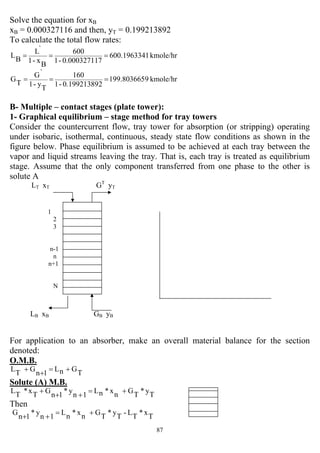
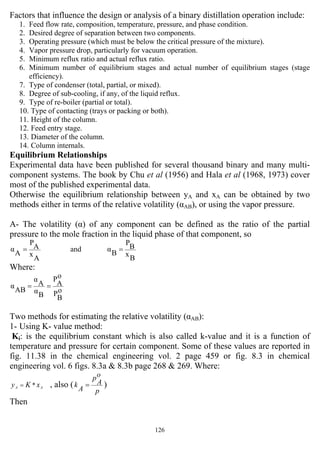
University of Technology
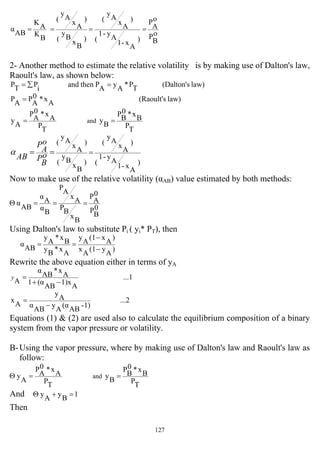
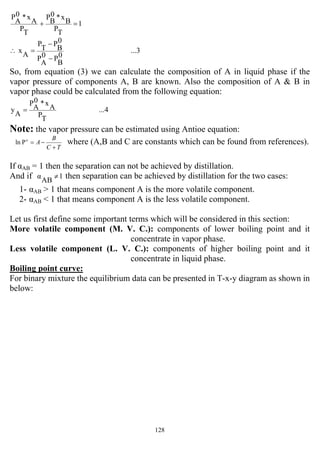
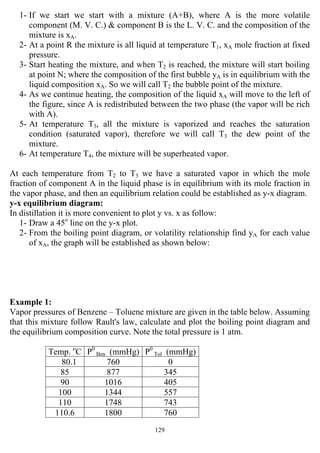
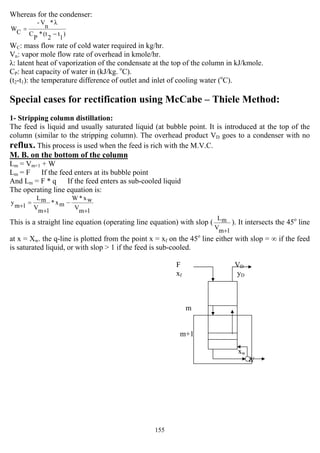
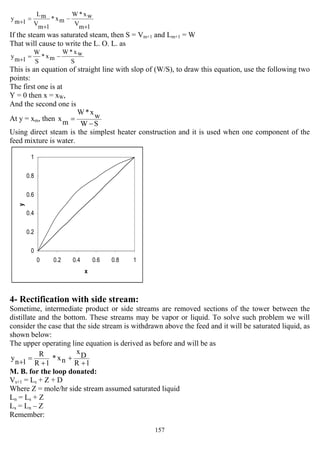
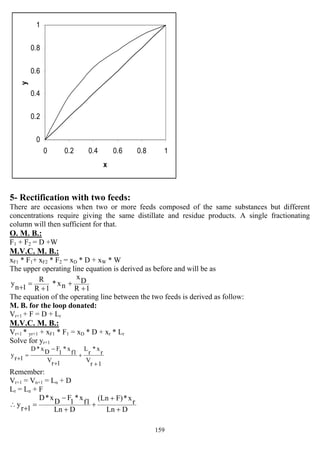
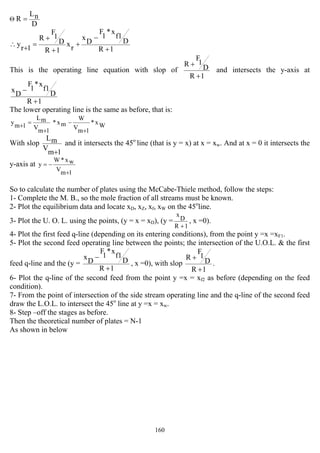
Chemical engineering department
Third year
Mass Transfer
By
Dr. Auroba .N.Abdullah
1
Mass Transfer Operations
Introduction:
What is chemical engineering?
Chemical engineering is the field of engineering that deals with industrial processes in which
raw materials are converted or separated into final useful products.
Who is the chemical Engineer?
The function of a qualified chemical engineer is to apply chemistry of a particular industrial
process through the use of coordinated scientific and engineering principles. Also develop the
laboratory results of chemists into economical chemical plants, he must develop, design and
engineer both the complete industrial process and the equipment used in it. Then his duties can
be stated as:
1- He must choose the raw material.
2- He must design and operate the plant efficiently, safely, and economically.
3- He must know that his products meet the requirements set by the customers.
4- When science does not give him a complete answer, he must use experience & judgment
to combine all sources of information to reach particular solution to processing problems.
Definition of Unit Operation:-
The physical operations necessary for manufacturing chemicals deals mainly with the
transfer and change of material and energy principles by physical means but also by
chemical – physical means such as mass transfer, heat transfer and momentum transfer (fluid
dynamics). There are two types of unit operation classifications:
The first one depends on the process type as:
1- Processes without chemical reaction, as distillation, crystallization, absorption,
extraction, and filtration.
2- Processes with chemical reactions as nitration, oxidation, and sulfonation.
While the second classification depends on the type of transfer occur within the process such as:
1- Mass transfer operations
Transfer of component from one phase to another such processes is:
Gas absorption, Distillation, Extraction, Crystallization, Drying, Evaporation, Leaching,
Stripping, Mechanical separation for example (Filtration, settling, size reduction, and
sedimentation).
2- Heat transfer operations
Accumulation and transfer of heat and energy such as:
Heat exchanger, Evaporation, Drying, Distillation.
3- Momentum transfer operations
Flow and transportation of fluid and solid such as:
Fluid flow, Mixing, Handling of solid, Fluid transportation.
2
Chapter Two
Mass Transfer & Diffusion
Mass transfer is the net movement of a component in a mixture from one location to
another location where the component exists at a different concentration. Often, the
transfer takes place between two phases across an interface. Thus, the absorption by a
liquid of a solute from a gas involves mass transfer of the solute through the gas to the
gas-liquid interface, across the interface, and into the liquid. Mass transfer models are
used to describe processes such as the passage of a species through a gas to the outer
surface of a porous adsorbent particle and into the pores of the adsorbent, where the
species is adsorbed on the porous surface. Mass transfer is also the selective
permeation through a nonporous polymeric material of a component of a gas mixture.
Mass transfer is not the flow of a fluid through a pipe. However, mass transfer might
be superimposed on that flow. Mass transfer is not the flow of solids on a conveyor
belt.
Mass transfer occurs by two basic mechanisms:
(1) Molecular diffusion by random and spontaneous microscopic movement of
individual molecules in a gas, liquid, or solid as a result of thermal motion; and
(2) Eddy (turbulent) diffusion by random macroscopic fluid motion.
Molecular and/or eddy diffusion frequently involves the movement of different
species in opposing directions. When a net flow occurs in one of these directions, the
total rate of mass transfer of individual species is increased or decreased by this bulk
flow or convection effect, which is a third mechanism of mass transfer. As will be
shown later, molecular diffusion is extremely slow, whereas eddy diffusion, when it
occurs, is orders of magnitude more rapid. Therefore, if large-scale separation
processes are to be conducted in equipment of a reasonable size, fluids must be
agitated, interfacial areas maximized, and distances in the direction of diffusion
minimized. In a binary mixture, molecular diffusion occurs because of one or more
different potentials or driving forces, including differences (gradients) of concentration
(ordinary diffusion), pressure (pressure diffusion), temperature (thermal diffusion),
and external force fields (forced diffusion) that act unequally on the different chemical
species present. Pressure diffusion requires a large pressure gradient, which is
achieved for gas mixtures with a centrifuge. Thermal diffusion columns or cascades
can be employed to separate liquid and gas mixtures by establishing a temperature
gradient across the mixture. More widely applied is forced diffusion in an electrical
field, to cause ions of different charges to move in different directions at different
speeds. In this chapter, only molecular diffusion caused by concentration gradients is
considered, because this is the most common type of molecular diffusion in
3
commercial separation processes. Furthermore, emphasis is on binary systems, for
which molecular diffusion theory is simple and applications are relatively
straightforward. Multi-component molecular diffusion, which is important in many
applications, is much more complex than diffusion in binary systems, and is a more
appropriate topic for advanced study using a specialized text.
Molecular diffusion occurs in solids and in fluids that are stagnant or in laminar or
turbulent motion. Eddy diffusion occurs in fluids in turbulent motion. When both
molecular diffusion and eddy diffusion occur, they take place in parallel and are
additive. Furthermore, they take place because of the same concentration difference
(gradient). When mass transfer occurs under turbulent flow conditions, but across an
interface or to a solid surface, conditions may be laminar or nearly stagnant near the
interface or solid surface. Thus, even though eddy diffusion may be the dominant
mechanism in the bulk of the fluid, the overall rate of mass transfer is controlled by
molecular diffusion because the eddy diffusion mechanism is damped or even
eliminated as the interface or solid surface is approached. Mass transfer of one or more
species results in a total net rate of bulk flow or flux in one direction relative to a fixed
plane or stationary coordinate system. When a net flux occurs, it carries all species
present. Thus, the molar flux of an individual species is the sum of all three
mechanisms. If Ni is the molar flux of species i with mole fraction Xi, and N is the
total molar flux, with both fluxes in moles per unit time per unit area in a direction
perpendicular to a stationary plane across which mass transfer occurs, then
...1ioffluxdiffusioneddyioffluxdiffusionmolecularXi.NNi ++=
Where:
Xi.N is the bulk-flow flux.
Each term in (1) is positive or negative depending on the direction of the flux relative
to the direction selected as positive. When the molecular and eddy diffusion fluxes are
in one direction and N is in the opposite direction, even though a concentration
difference or gradient of i exists, the net mass transfer flux, Ni, of i can be zero.
STEADY-STATE ORDINARY MOLECULAR DIFFUSION
Suppose a cylindrical glass vessel is partly filled with water containing a soluble red
dye. Clear water is carefully added on top so that the dyed solution on the bottom is
undisturbed. At first, a sharp boundary exists between the two layers, but after a time
the upper layer becomes colored, while the layer below becomes less colored. The
upper layer is more colored near the original interface between the two layers and less
colored in the region near the top of the upper layer. During this color change, the
motion of each dye molecule is random, undergoing collisions mainly with water
4
molecules and sometimes with other dye molecules, moving first in one direction and
then in another, with no one direction preferred. This type of motion is sometimes
referred to as a random-walk process, which yields a mean-square distance of travel
for a given interval of time, but not a direction of travel. Thus, at a given horizontal
plane through the solution in the cylinder, it is not possible to determine whether, in a
given time interval, a given molecule will cross the plane or not. However, on the
average, a fraction of the molecules in the solution below the plane will cross over into
the region above and the same fraction will cross over in the opposite direction.
Therefore, if the concentration of dye molecules in the lower region is greater than in
the upper region, a net rate of mass transfer of dye molecules will take place from the
lower to the upper region. After a long period of time, the concentration of dye will be
uniform throughout the solution. Based on these observations, it is clear that:
1. Mass transfer by ordinary molecular diffusion occurs because of a concentration
difference or gradient; that is, a species diffuses in the direction of decreasing
concentration.
2. The mass transfer rate is proportional to the area normal to the direction of mass
transfer and not to the volume of the mixture. Thus, the rate can be expressed as a flux.
3. Mass transfer stops when the concentration is uniform.
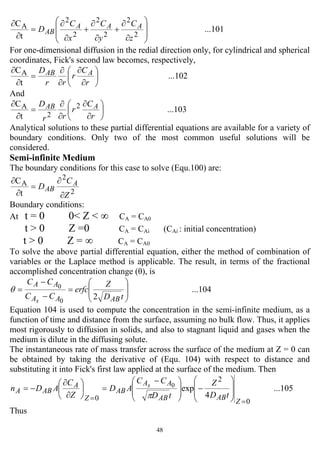
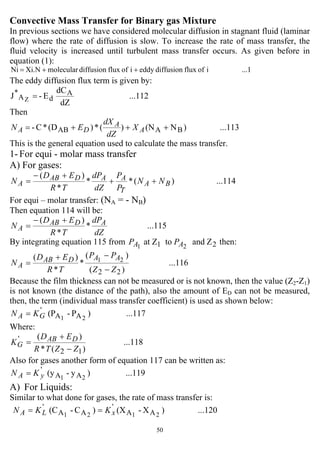
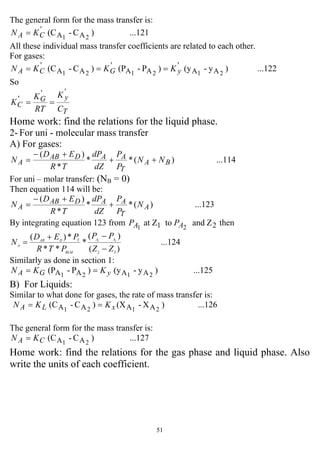
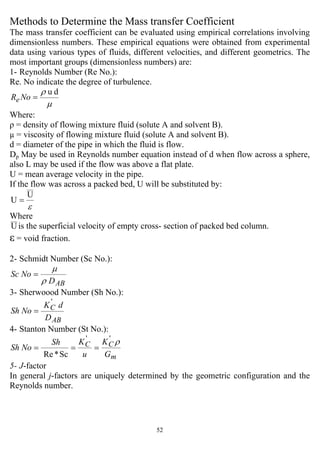
Fick's Law of Diffusion
The above observations were quantified by Fick in 1855, who proposed an extension
of Fourier's 1822 heat conduction theory. Fourier's first law of heat conduction is
...2
dZ
dT
k-qZ =
Where qZ is the heat flux by conduction in the positive Z direction, k is the thermal
conductivity of the medium, and (dT/dZ) is the temperature gradient, which is
negative in the direction of heat conduction. Fick's first law of molecular diffusion is
also proportionality between a flux and a gradient. For a binary mixture of A and B,
...3
dZ
dC
D-J A
ABAZ
=
And
...4
dZ
dC
D-J B
BABZ
=
Where, in (Eq. 3), JA is the molar flux of A by ordinary molecular diffusion relative to
the molar average velocity of the mixture in the positive z direction, DAB is the mutual
diffusion coefficient of A in B, and (dCA/dz) is the concentration gradient of A, which
5
is negative in the direction of ordinary molecular diffusion. Similar definitions apply
to (Eq. 4). The molar fluxes of A and B are in opposite directions. If the gas, liquid, or
solid mixture through which diffusion occurs is isotropic, then values of k and DAB are
independent of direction.
Non-isotropic (anisotropic) materials include fibrous and laminated solids as well as
single, Non-cubic crystals. The diffusion coefficient is also referred to as the
diffusivity and the mass diffusivity (to distinguish it from thermal and momentum
diffusivities). Many alternative forms of (Eq. 3) and (Eq. 4) are used, depending on the
choice of driving force or potential in the gradient. For example, we can express (Eq.
3) as:
...5
dZ
dX
C.D-J A
ABA =
Where, for convenience, the z-subscript on 1 has been dropped, C= total molar
concentration, and Xi = mole fraction of species i.
Velocities in Mass Transfer
It is also useful to formulate expressions for velocities of the various chemical species
in the mixture. These velocities are based on the molar flux, N, and the diffusion flux,
J. The molar average velocity of the mixture, VM, relative to stationary coordinates is
given for a binary mixture as:
...6
NN
C
N
V BA
M
C
+
==
Similarly, the velocity of species i, defined in terms of Ni, is relative to stationary
coordinates:
...7
C
N
V
i
i
i =
Combining (Eq. 6) and (Eq. 7) with Xi = Ci / C give:
VM =XA.VA + XB.VB …8
Alternatively, species diffusion velocities, ViD defined in terms of Ji, are relative to the
molar average velocity and are defined as the difference between the species velocity
and the molar average velocity for the mixture:
...9V-V
C
J
V Mi
i
i
iD
==
When solving mass transfer problems involving net movement of the mixture, it is not
convenient to use fluxes and flow rates based on VM as the frame of reference. Rather,
6
it is preferred to use mass transfer fluxes referred to stationary coordinates with the
observer fixed in space. Thus, from (Eq. 9), the total species velocity is:
Vi = VM + DiV …10
Combining (Eq. 7) and (Eq. 10),
...11V.CV.C DiiMi +=iN
Combining (Eq. 11) with (Eq. 5), (Eq. 6), and (Eq. 7), then
..12)(D.C-N.X
A
n
ABA
A
dZ
dX
N A
A ==
Or can be written as:
..12A)N(N)(D.C- BAAB ++= A
A
A X
dZ
dX
N
And
..13)(D.C-N.X
A
n
BaB
B
dZ
dX
N B
B ==
where in (Eq. 12) and (Eq. 13), ni is the molar flow rate in moles per unit time, A is the
mass transfer area, the first terms on the right-hand sides are the fluxes resulting from
bulk flow, and the second terms on the right-hand sides are the ordinary molecular
diffusion fluxes. Two limiting cases are important:
1. Equimolar counter diffusion (EMD)
2. Uni-molecular diffusion (UMD)
Equimolar Counter diffusion
In equimolar counter diffusion (EMD), the molar fluxes of A and B are equal, but
opposite in direction; thus,
N = NA + NB = 0 …14
Thus, from (Eq. 12, or 12A) and (Eq. 13), the diffusion fluxes are also equal, but
opposite in direction:
JA = -JB …15
7
This idealization is closely approached in distillation. From (Eq. 12) and (Eq.13), we
see that in the absence of fluxes other than molecular diffusion, and
..16)(D.C-J ABA
dZ
dX
N A
A == or ..16A)(D- AB
dZ
dC
N A
A =
And
..17)(D.C-J BaB
dZ
dX
N B
B ==
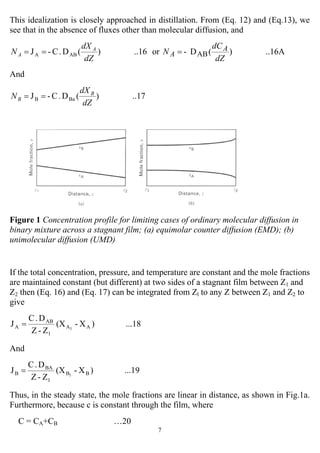
Figure 1 Concentration profile for limiting cases of ordinary molecular diffusion in
binary mixture across a stagnant film; (a) equimolar counter diffusion (EMD); (b)
unimolecular diffusion (UMD)
If the total concentration, pressure, and temperature are constant and the mole fractions
are maintained constant (but different) at two sides of a stagnant film between Z1 and
Z2 then (Eq. 16) and (Eq. 17) can be integrated from Zl to any Z between Z1 and Z2 to
give
...18)X-(X
Z-Z
D.C
J AA
1
AB
A 1
=
And
...19)X-(X
Z-Z
D.C
J BB
1
BA
B 1
=
Thus, in the steady state, the mole fractions are linear in distance, as shown in Fig.1a.
Furthermore, because c is constant through the film, where
C = CA+CB …20
8
By differentiation,
dC = 0 = dCA + dCB …21
Thus,
dCA = - dCB …22
From (Eqs. 3, 4, 15, and 22),
...23
dZ
D
dZ
D BAAB
=
Therefore, DAB = DBA.
This equality of diffusion coefficients is always true in a binary system of constant
molar density.
NOTE:
From the ideal gas law
nRTPV =
RT
P
V
n
=
RT
C
P
= Where C is the total mole concentration
Using Dalton's law, then
AC
RT
== AA P
V
n
Then
dZ
dP
)
RT
D
(-J AAB
A = Another formula of Fick's law for equi-molar gas diffusion
And
))((N
12
A
22
ZZ
PP
RT
D AAAB
−
−
−=
Example 1
Two bulbs are connected by a straight tube, 0.001 m in diameter and 0.15 m in length.
Initially the bulb at end 1 contains N2 and the bulb at end 2 contains H2. The pressure
and temperature are maintained constant at 25°C and 1 atm. At a certain time after
allowing diffusion to occur between the two bulbs, the nitrogen content of the gas at
end 1 of the tube is 80 mol% and at end 2 is 25 mol%. If the binary diffusion
coefficient is 0.784 cm2
/s, determine:
(a) The rates and directions of mass transfer of hydrogen and nitrogen in mol/s
(b) The species velocities relative to stationary coordinates, in cm/s
9
Solution:
(a) Because the gas system is closed and at constant pressure and temperature, mass
transfer in the connecting tube is equimolar counter diffusion by molecular diffusion.
The area for mass transfer through the tube, in cm2
, is
A = Π (0.1)2
/4 = 7.85 * 10-3
cm2
.
The total gas concentration is
3
5-
cm
mol
10*4.09
8)(82.06)(29
1
T.R
P
C ===
Take the reference plane at end 1 of the connecting tube. Applying (Eq. 18) to N2 over
the length of the tube,
A)](X-)(X[
Z-Z
D.C
n 212
22
2 NN
12
HN
N =
)10*(7.85
15
)25.08.0)(784.0)(10*(4.09
n 3-
-5
N2
−
=
2Nn = 9.23 X 10⁻⁹
mol/s in the positive Z direction
2Hn = 9.23 X 10⁻⁹
mol/s in the negative Z direction
(b)For equimolar counter diffusion, the molar average velocity of the mixture, VM, is
Zero
Therefore, from (Eq. 9), species velocities are equal to species diffusion velocities.
Thus,
)])(10*09.4)(10*[(7.85
10*9.23
XCA
n
C
J
)(VV
22
2
2
2
22 55-
-9
N
N
N
N
NN
N
D
X−
====
)(
0.0287
V
2
2N
NX
= in the positive Z direction
Similarly
)(
0.0287
V
2
2H
HX
= in the negative Z direction
Thus, species velocities depend on species mole fractions, as follows:
10
Note that species velocities vary across the length of the connecting tube, but at any
location, Z, VM = 0. For example, at Z = 10 cm, from (Eq. 8)
VM = (0.433)(0.0663) + (0.567)(-0.0506) = 0
Unimolecular Diffusion
In unimolecular diffusion (UMD), mass transfer of component A occurs through
stagnant component B. Thus,
NB = 0 …24
And
N = NA …25
Therefore, from (Eq. 12),
..26)(D.C-N.X ABA
dZ
dX
N A
A =
This can be rearranged to a Fick's law form,
..27)(
)X-(1
CD
-
A
AB
dZ
dX
N A
A =
The factor (1 - XA) accounts for the bulk flow effect. For a mixture dilute in A, the bulk flow effect
is negligible or small. In mixtures more concentrated in A, the bulk flow effect can be appreciable.
For example, in an equimolar mixture of A and B, (1 - XA) = 0.5 and the molar mass transfer flux
of A is twice the ordinary molecular diffusion flux.
For the stagnant component, B, (Eq.13) becomes
...280
dZ
dX
CDNX B
ABAB −=
Or ...29
dZ
dX
CDNX B
ABAB =
Thus, the bulk flow flux of B is equal but opposite to its diffusion flux.
At quasi-steady-state conditions that is, with no accumulation, and with constant molar density,
(Eq. 27) becomes in integral form:
...30
)1(
.
11
∫∫
−
−=
A
A
A
A
X
X A
A
A
AB
Z
Z X
dX
N
DC
dZ
Which upon integration yields
...31)
1
1
ln(
.
11 A
AAB
A
X
X
ZZ
DC
N
−
−
−
=
z (cm) 2NX 2HX 2NV (cm/s) 2HV (cm/s)
o (end 1) 0.800 0.200 0.0351 -0.1435
5 0.617 0.383 0.0465 -0.0749
10 0.433 0.567 0.0663 -0.0506
15 (end 2) 0.250 0.750 0.1148 -0.0383
11
Rearrangement to give the mole-fraction variation as a function of Z yield
...32
.
)(
exp)1(1 1
1 ⎥
⎦
⎤
⎢
⎣
⎡ −
−−=
AB
A
AA
DC
ZZN
XX
Thus, as shown in Fig. 1b, the mole fractions are nonlinear in distance.
An alternative and more useful form of (Eq. 31) can be derived from the definition of
the log mean. When Z= Z2, (Eq. 31) becomes
...33)
1
1
ln(
.
1
2
12 A
AAB
A
X
X
ZZ
DC
N
−
−
−
=
The log mean (LM) of (1 - XA) at the two ends of the stagnant layer is
...34
)
1
1/()
2
1(ln
21
)
1
1/()
2
1(ln
)
1
1()
2
1(
)1(
⎥⎦
⎤
⎢⎣
⎡ −−
−
=
⎥⎦
⎤
⎢⎣
⎡ −−
−−−
=−=
AXAX
AXAX
AXAX
AXAX
LMAXX BLM
Combining (Eq. 33) with (Eq. 34) gives
...35
)()1(
)(C.D
)1(
)(
.
. AB
12
21
ZX
X
X
XX
ZZ
DC
N
LMA
A
LMA
AAAB
A
∆−
∆−
=
−
−
−
=
Or
A...35
)(
)(C.D)(
.
. AB
12
21
ZX
X
X
XX
ZZ
DC
N
BLM
A
BLM
AAAB
A
∆
∆−
=
−
−
=
Diffusion in a tube with change in path length
Assuming steady state diffusion of component A with constant cross-sectional area
and component B is non-diffusing.
Since the case is non-diffusing of B then NB = 0 and NA is given as in equation 35.
...35
)()1(
)(C.D
)1(
)(
.
. AB
12
21
ZX
X
X
XX
ZZ
DC
N
LMA
A
LMA
AAAB
A
∆−
∆−
=
−
−
−
=
mol/sNA*N AA =
dt
dZ
A.C
dt
dV
CN AAA ==
But
12
A
A
Mwt
C A
ρ
=
Then:
⎟
⎠
⎞
⎜
⎝
⎛
=
dt
dZA
A
A
Mwt
N
ρ
dtN
Mwt
dZ A
A
ρ
=
dt
Z)X-(1
XX(C.DMwt
dZ
A
AAAB 21
A
⎟
⎟
⎠
⎞
⎜
⎜
⎝
⎛ −
=
LMρ
…36
Rearrange the above equation
dZ
)XX(C.D
Z)X-(1
Mwt
dt
21
A
AAAB
A
⎟
⎟
⎠
⎞
⎜
⎜
⎝
⎛
−
= LM
ρ
…37
But, as shown before in the equimolar condition
then
RT
P
Cand
RT
P
C A
A ==
dZ
)PP(.DP
Z)(PTR
Mwt
dt
21
A
AAABT
⎟
⎟
⎠
⎞
⎜
⎜
⎝
⎛
−
= BLM
ρ
…38
Knowing that:
)
1
1/()
2
1(ln
21
)
1
1/()
2
1(ln
)
1
1()
2
1(
)1(
⎥⎦
⎤
⎢⎣
⎡ −−
−
=
⎥⎦
⎤
⎢⎣
⎡ −−
−−−
=−=
APAP
APAP
APAP
APAP
LMAPPBLM
Finally by integrating the above equation for the following boundary condition:
t1 = 0 at Z1=Z0 and t2 = tf at Z2 = Zf we can determine the time required to drop the
level of liquid to a certain height:
dZZ
)PP(.DP
)(PTR
Mwt
t
f
021
A
Z
ZAAABT
∫⎟
⎟
⎠
⎞
⎜
⎜
⎝
⎛
−
= BLM
ρ
…39
Example 2:
As shown in Figure 2, an open beaker, 6 cm in height, is filled with liquid benzene at
25°C to within 0.5 cm of the top. A gentle breeze of dry air at 25°C and 1 atm is blown
by a fan across the mouth of the beaker so that evaporated benzene is carried away by
convection after it transfers through a stagnant air layer in the beaker. The vapor
pressure of benzene at 25°C is 0.131 atm. The mutual diffusion coefficient for benzene
in air at 25°C and 1 atm is 0.0905 cm2
/s. Compute:
(a) The initial rate of evaporation of benzene as a molar flux in mol/cm2
.s
(b) The initial mole fraction profiles in the stagnant layer
13
(c) The initial fractions of the mass transfer fluxes due to molecular diffusion.
(d) The initial diffusion velocities, and the species velocities (relative to stationary coordinates) in
the stagnant layer.
(e) The time in hours for the benzene level in the beaker to drop 2 cm from the initial level, if the
specific gravity of liquid benzene is 0.874. Neglect the accumulation of benzene and air in the
stagnant layer as it increases in height.
Figure 2 Evaporation of Benzene from a beaker
SOLUTION:
Let A = benzene, B = air.
3
5-
cm
mol
10*4.09
8)(82.06)(29
1
T.R
P
C ===
(a) Take Zl = 0.
Then Z2 - Zl = ∆Z = 0.5 cm.
From Dalton's law, assuming equilibrium at the liquid benzene-air interface,
0.131
1
0.131
P
P 1
1
A
===AX
02
=AX
Then
[ ]
0.933
0.131)-(1/0)-(1ln
0.131
)X-(1 A ===BLMX
From equation 35, or Equation 35A
14
s.mol/cm10*1.04
933.0
131.0
5.0
)0905.0)(10*(4.09
N 26-
5-
A =⎟
⎠
⎞
⎜
⎝
⎛
=
(b)
Z0.281
)0905.0)(10*09.4(
)0)(10*(1.04
C.D
(N
5
6-
AB
)1A
=
−
=
−
−
ZZZ
From equation 32,
XA = 1 – 0.869[exp (0.281Z)] (1)
Using the above equation (1), the following results are obtained:
These profiles are only slightly curved.
(c) From (Eq. 27) and (Eq. 29), we can compute the bulk flow terms, XANA and
XBNA, from which the molecular diffusion (Ji) terms are obtained.
Note that the molecular diffusion fluxes are equal but opposite, and the bulk flow flux
of B is equal but opposite to its molecular diffusion flux, so that its molar flux, NB, is
zero.
(d) From (Eq. 6)
(2)cm/s0254.0
10*4.09
10*1.04
C
N
C
N
V
5-
6-
A
M ====
15
From (Eq. 9), the diffusion velocities are given by
(3)
CX
J
C
J
V
i
i
i
i
id
==
From (Eq. 10), the species velocities relative to stationary coordinates are:
(4)VVV Mii d
+=
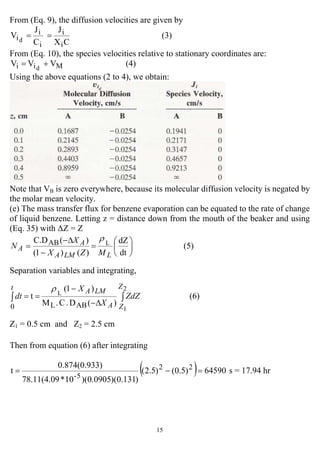
Using the above equations (2 to 4), we obtain:
Note that VB is zero everywhere, because its molecular diffusion velocity is negated by
the molar mean velocity.
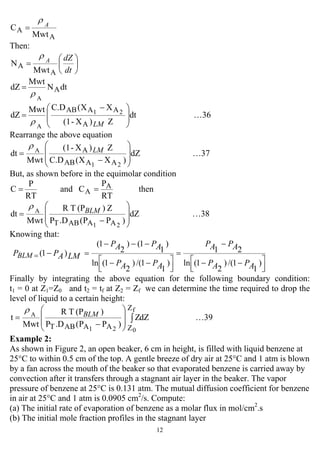
(e) The mass transfer flux for benzene evaporation can be equated to the rate of change
of liquid benzene. Letting z = distance down from the mouth of the beaker and using
(Eq. 35) with ∆Z = Z
(5)
dt
dZ
)()1(
)(C.D LAB
⎟
⎠
⎞
⎜
⎝
⎛
=
−
∆−
=
LLMA
A
A
MZX
X
N
ρ
Separation variables and integrating,
(6)
)(D.C.M
)1(
t
2
1
L
ABL0
∫∫
∆−
−
==
Z
ZA
LMAt
ZdZ
X
X
dt
ρ
Z1 = 0.5 cm and Z2 = 2.5 cm
Then from equation (6) after integrating
( ) 64590)5.0()5.2(
)131.0)(0905.0)(10*78.11(4.09
3)0.874(0.93
t 22
5-
=−= s = 17.94 hr
16
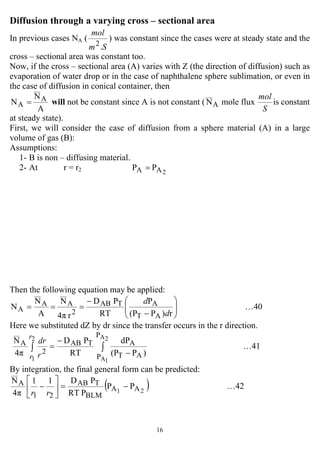
Diffusion through a varying cross – sectional area
In previous cases NA (
Sm
mol
.2
) was constant since the cases were at steady state and the
cross – sectional area was constant too.
Now, if the cross – sectional area (A) varies with Z (the direction of diffusion) such as
evaporation of water drop or in the case of naphthalene sphere sublimation, or even in
the case of diffusion in conical container, then
A
N
N A
A = will not be constant since A is not constant ( AN mole flux
S
mol
is constant
at steady state).
First, we will consider the case of diffusion from a sphere material (A) in a large
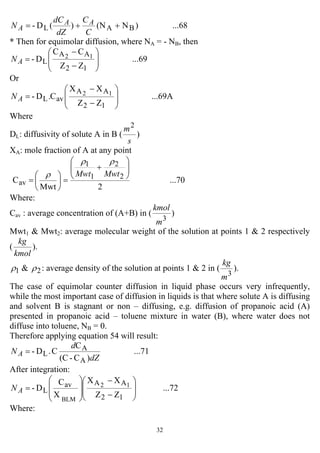
volume of gas (B):
Assumptions:
1- B is non – diffusing material.
2- At r = r2 2AA PP =
Then the following equation may be applied:
⎟⎟
⎠
⎞
⎜⎜
⎝
⎛
−
−
===
r)P(P
P
RT
PD
r4π
N
A
N
N
AT
ATAB
2
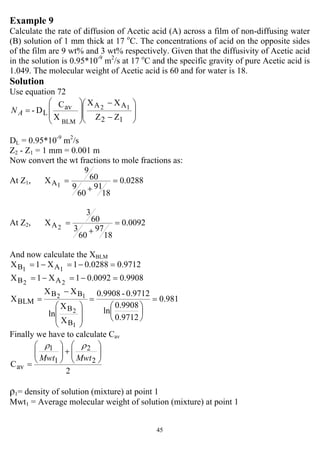
AA
A
d
d
…40
Here we substituted dZ by dr since the transfer occurs in the r direction.
∫∫
−
−
=
2A
1A
2
1
P
P AT
ATAB
2
A
)P(P
dP
RT
PD
4π
N r
r r
dr
…41
By integration, the final general form can be predicted:
( )PP
PRT
PD11
4π
N
21 AA
BLM
TAB
21
A −=⎥
⎦
⎤
⎢
⎣
⎡
−
rr
…42
17
If r2 >> r1 then
2
1
r
=0 and 2AP = 0 (dilute solution) also BLMP = TP , then
( )P
RT
D1
4π
N
1A
AB
1
A =⎥
⎦
⎤
⎢
⎣
⎡
r
…43
Dividing both sides of equation 43 by r1, then
( )11 A
1
AB
2
1
A P
RTr
D1
4π
N
==
⎥
⎥
⎦
⎤
⎢
⎢
⎣
⎡
AN
r
…44 Only for dilute gas
( )11 A
1
AB
2
1
A C
r
D1
4π
N
==
⎥
⎥
⎦
⎤
⎢
⎢
⎣
⎡
AN
r
…45 Only for dilute liquids
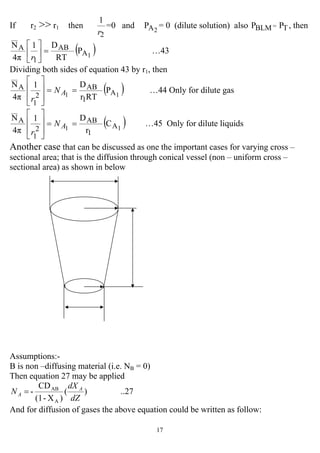
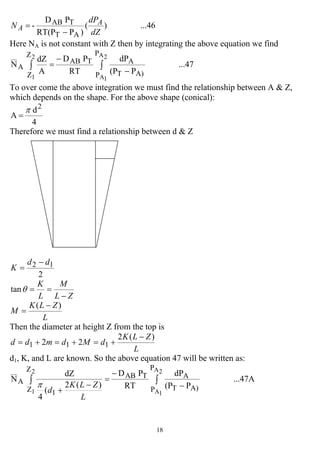
Another case that can be discussed as one the important cases for varying cross –
sectional area; that is the diffusion through conical vessel (non – uniform cross –
sectional area) as shown in below
Assumptions:-
B is non –diffusing material (i.e. NB = 0)
Then equation 27 may be applied
..27)(
)X-(1
CD
-
A
AB
dZ
dX
N A
A =
And for diffusion of gases the above equation could be written as follow:
18
...46)(
)PRT(P
PD
-
AT
TAB
dZ
dP
N A
A
−
=
Here NA is not constant with Z then by integrating the above equation we find
...47
P(P
dP
RT
PD
A
dZ
N
2A
1A
2
1
P
P A)T
ATAB
Z
Z
A ∫∫
−
−
=
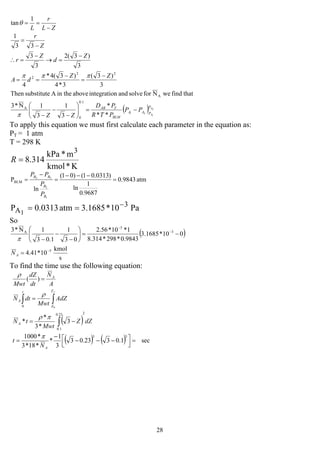
To over come the above integration we must find the relationship between A & Z,
which depends on the shape. For the above shape (conical):
4
d
A
2
π
=
Therefore we must find a relationship between d & Z
2
12 dd
K
−
=
ZL
M
L
K
−
==θtan
L
ZLK
M
)( −
=
Then the diameter at height Z from the top is
L
ZLK
dMdmdd
)(2
22 111
−
+=+=+=
d1, K, and L are known. So the above equation 47 will be written as:
...47A
P(P
dP
RT
PD
)(2
(
4
dZ
N
2A
1A
2
1
P
P A)T
ATAB
Z
Z 1
A ∫∫
−
−
=
−
+
L
ZLK
d
π
19
Diffusivity of Gases or Vapors
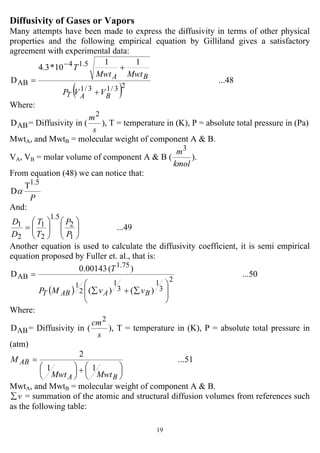
Many attempts have been made to express the diffusivity in terms of other physical
properties and the following empirical equation by Gilliland gives a satisfactory
agreement with experimental data:
( )
...48
11
10*3.4
D
23/13/1
5.14
AB
BAT
BA
VVP
MwtMwt
T
+
+
=
−
Where:
ABD = Diffusivity in (
s
m2
), T = temperature in (K), P = absolute total pressure in (Pa)
MwtA, and MwtB = molecular weight of component A & B.
VA, VB = molar volume of component A & B (
kmol
m3
).
From equation (48) we can notice that:
P
1.5
T
Dα
And:
...49
1
2
5.1
2
1
2
1
⎟⎟
⎠
⎞
⎜⎜
⎝
⎛
⎟⎟
⎠
⎞
⎜⎜
⎝
⎛
=
P
P
T
T
D
D
Another equation is used to calculate the diffusivity coefficient, it is semi empirical
equation proposed by Fuller et. al., that is:
( )
...50
)()(
)(00143.0
D
2
3
1
3
1
2
1
75.1
AB
⎟
⎟
⎠
⎞
⎜
⎜
⎝
⎛
∑+∑
=
BAABT vvMP
T
Where:
ABD = Diffusivity in (
s
cm2
), T = temperature in (K), P = absolute total pressure in
(atm)
...51
11
2
⎟
⎠
⎞
⎜
⎝
⎛+⎟
⎠
⎞
⎜
⎝
⎛
=
BA
AB
MwtMwt
M
MwtA, and MwtB = molecular weight of component A & B.
v∑ = summation of the atomic and structural diffusion volumes from references such
as the following table:
20
Table (1) Diffusion Volumes from Fuller, Ensley, and Giddings [J. Phys. Chem.,
73, 3679-3685 (1969)] for Estimating Binary Gas Diffusivity by the Method of
Fuller et al.
From equation (50) we can notice that:
P
1.75
T
Dα
And:
...52
1
2
75.1
2
1
2
1
⎟⎟
⎠
⎞
⎜⎜
⎝
⎛
⎟⎟
⎠
⎞
⎜⎜
⎝
⎛
=
P
P
T
T
D
D
21
Maxwell's Law of diffusion For Binary System
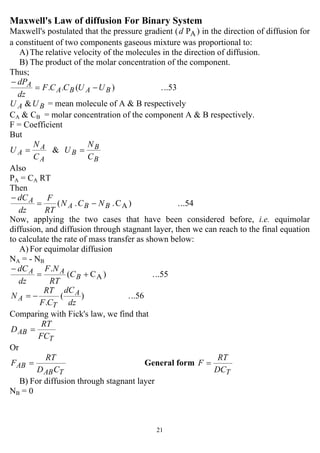
Maxwell's postulated that the pressure gradient ( APd ) in the direction of diffusion for
a constituent of two components gaseous mixture was proportional to:
A) The relative velocity of the molecules in the direction of diffusion.
B) The product of the molar concentration of the component.
Thus;
..53.)(.. BABA
A UUCCF
dz
dP
−=
−
BA UU & = mean molecule of A & B respectively
CA & CB = molar concentration of the component A & B respectively.
F = Coefficient
But
&
B
B
B
A
A
A
C
N
U
C
N
U ==
Also
PA = CA RT
Then
..54.)C..( ABBA
A NCN
RT
F
dz
dC
−=
−
Now, applying the two cases that have been considered before, i.e. equimolar
diffusion, and diffusion through stagnant layer, then we can reach to the final equation
to calculate the rate of mass transfer as shown below:
A) For equimolar diffusion
NA = - NB
..55.)C(
.
A+=
−
B
AA C
RT
NF
dz
dC
..56.)(
. dz
dC
CF
RT
N A
T
A −=
Comparing with Fick's law, we find that
T
AB
FC
RT
D =
Or
TAB
AB
CD
RT
F = General form
TDC
RT
F =
B) For diffusion through stagnant layer
NB = 0
22
Then
..57.).( BA
A CN
RT
F
dz
dC
=
−
And
..58.)(
. dz
dC
CF
RT
N A
B
A −=
Multiplying the right side of the equation by )(
T
T
C
C
and by comparison we find that
..59.)(
.
dz
dC
C
CD
N A
B
T
A −=
This finally will result:
...60)
1
1
ln(
.
1
2
12 A
AABT
A
X
X
ZZ
DC
N
−
−
−
=
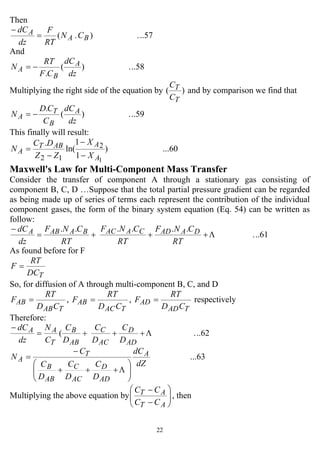
Maxwell's Law for Multi-Component Mass Transfer
Consider the transfer of component A through a stationary gas consisting of
component B, C, D …Suppose that the total partial pressure gradient can be regarded
as being made up of series of terms each represent the contribution of the individual
component gases, the form of the binary system equation (Eq. 54) can be written as
follow:
..61.
......
Λ+++=
−
RT
CNF
RT
CNF
RT
CNF
dz
dC DAADCAACBAABA
As found before for F
TDC
RT
F =
So, for diffusion of A through multi-component B, C, and D
TAB
AB
CD
RT
F = ,
TAC
AB
CD
RT
F = ,
TAD
AD
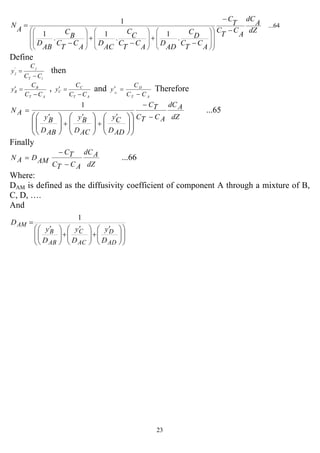
CD
RT
F = respectively
Therefore:
..62.( Λ+++=
−
AD
D
AC
C
AB
B
T
AA
D
C
D
C
D
C
C
N
dz
dC
...63
dZ
dC
D
C
D
C
D
C
C
N A
AD
D
AC
C
AB
B
T
A
⎟⎟
⎠
⎞
⎜⎜
⎝
⎛
+++
−
=
Λ
Multiplying the above equation by ⎟⎟
⎠
⎞
⎜⎜
⎝
⎛
−
−
AT
AT
CC
CC
, then
23
...64
.
1
.
1
.
1
1
dZ
A
dC
A
C
T
C
T
C
A
C
T
C
D
C
AD
D
A
C
T
C
C
C
AC
D
A
C
T
C
B
C
AB
D
A
N
−
−
−
+
−
+
−
=
⎟⎟
⎟
⎠
⎞
⎜⎜
⎜
⎝
⎛
⎟
⎟
⎠
⎞
⎜
⎜
⎝
⎛
⎟
⎟
⎠
⎞
⎜
⎜
⎝
⎛
⎟
⎟
⎠
⎞
⎜
⎜
⎝
⎛
Define
iT
j
j
CC
C
y
−
='
then
AT
B
B
CC
C
y
−
=′ ,
AT
C
C
CC
C
y
−
=′ and
AT
D
CC
C
y D
−
=′ Therefore
...65
1
dZ
AdC
ACTC
TC
ADD
Cy
ACD
By
ABD
By
AN
−
−
′
+
′
+
′
=
⎟
⎟
⎠
⎞
⎜
⎜
⎝
⎛
⎟⎟
⎠
⎞
⎜⎜
⎝
⎛
⎟⎟
⎠
⎞
⎜⎜
⎝
⎛
⎟⎟
⎠
⎞
⎜⎜
⎝
⎛
Finally
...66
dZ
AdC
ACTC
TC
AMDAN
−
−
=
Where:
DAM is defined as the diffusivity coefficient of component A through a mixture of B,
C, D, ….
And
⎟
⎟
⎠
⎞
⎜
⎜
⎝
⎛
⎟⎟
⎠
⎞
⎜⎜
⎝
⎛ ′
+⎟⎟
⎠
⎞
⎜⎜
⎝
⎛ ′
+⎟⎟
⎠
⎞
⎜⎜
⎝
⎛ ′
=
AD
D
AC
C
AB
B
AM
D
y
D
y
D
y
D
1
24
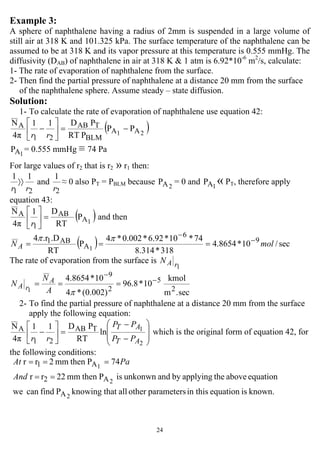
Example 3:
A sphere of naphthalene having a radius of 2mm is suspended in a large volume of
still air at 318 K and 101.325 kPa. The surface temperature of the naphthalene can be
assumed to be at 318 K and its vapor pressure at this temperature is 0.555 mmHg. The
diffusivity (DAB) of naphthalene in air at 318 K & 1 atm is 6.92*10-6
m2
/s, calculate:
1- The rate of evaporation of naphthalene from the surface.
2- Then find the partial pressure of naphthalene at a distance 20 mm from the surface
of the naphthalene sphere. Assume steady – state diffusion.
Solution:
1- To calculate the rate of evaporation of naphthalene use equation 42:
( )PP
PRT
PD11
4π
N
21 AA
BLM
TAB
21
A −=⎥
⎦
⎤
⎢
⎣
⎡
−
rr
1AP = 0.555 mmHg ≡ 74 Pa
For large values of r2 that is r2 » r1 then:
21
11
rr
〉〉 and
2
1
r
≈ 0 also PT = PBLM because 2AP = 0 and 1AP « PT, therefore apply
equation 43:
( )P
RT
D1
4π
N
1A
AB
1
A =⎥
⎦
⎤
⎢
⎣
⎡
r
and then
( ) sec/10*8654.4
318*314.8
74*10*92.6*002.0*4
P
RT
.D.r4 9
6
A
AB1
1
molN A
−
−
===
ππ
The rate of evaporation from the surface is
1rAN
sec.m
kmol
10*8.96
)002.0(*4
10*8654.4
2
5
2
9
1
−
−
===
πA
N
N A
rA
2- To find the partial pressure of naphthalene at a distance 20 mm from the surface
apply the following equation:
⎟
⎟
⎠
⎞
⎜
⎜
⎝
⎛
−
−
=⎥
⎦
⎤
⎢
⎣
⎡
−
2
1
ln
RT
PD11
4π
N TAB
21
A
AT
AT
PP
PP
rr
which is the original form of equation 42, for
the following conditions:
known.isequationin thisparametersotherallthatknowingPfindcanwe
equationabovetheapplyingbyandunkonwnisPthenmm22rr
74Pthenmm2rr
2
2
1
A
A2
A1
==
===
And
PaAt
25
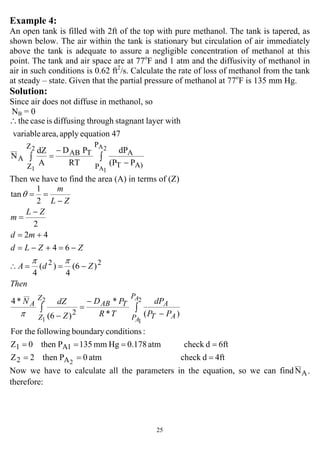
Example 4:
An open tank is filled with 2ft of the top with pure methanol. The tank is tapered, as
shown below. The air within the tank is stationary but circulation of air immediately
above the tank is adequate to assure a negligible concentration of methanol at this
point. The tank and air space are at 77o
F and 1 atm and the diffusivity of methanol in
air in such conditions is 0.62 ft2
/s. Calculate the rate of loss of methanol from the tank
at steady – state. Given that the partial pressure of methanol at 77o
F is 135 mm Hg.
Solution:
Since air does not diffuse in methanol, so
NB = 0
47equationapplyarea,variable
layer withstagnantthroughdiffusingiscasethe∴
P(P
dP
RT
PD
A
dZ
N
2A
1A
2
1
P
P A)T
ATAB
Z
Z
A ∫∫
−
−
=
Then we have to find the area (A) in terms of (Z)
4ftdcheckatm0Pthen2Z
6ftdcheckatm0.178Hgmm135Pthen0Z
:conditionsboundaryfollowingFor the
)(*
*
)6(
*4
)6(
4
)(
4
64
42
2
2
1
tan
2
2
1
2
1
A2
1A1
2
22
===
====
−
−
=
−
−==∴
−=+−=
+=
−
=
−
==
∫∫
A
A
P
P AT
ATAB
Z
Z
A
PP
dP
TR
PD
Z
dZN
Then
ZdA
ZZLd
md
ZL
m
ZL
m
π
ππ
θ
Now we have to calculate all the parameters in the equation, so we can find AN ,
therefore:
26
sec
10*722.162.0
R*lbmol
ftatm
0.7302RUse
atm908.0
822.0
1
ln
822.01
ln
P
atm1Hgmm7600-760P
atm0.822mmHg625135760P
2
4
2
3
BLM
B
B
1
2
22
2
1
ft
hr
ft
D
P
P
PP
AB
B
B
BB
−
==
=
=
−
=
−
=
===
==−=
Now by integrating the above equation, we find:
[ ]
sec
lbmol
10*111.8
)
6
1
4
1
(
0178.0
*
908.0*537*7302.0
1*10*722.1
4
N
*
*
6
1
6
1N*4
7
4
A
1
12
A
2
−
−
=
⎟
⎟
⎟
⎟
⎠
⎞
⎜
⎜
⎜
⎜
⎝
⎛
−
−
⎥
⎥
⎦
⎤
⎢
⎢
⎣
⎡
=
−=⎥
⎦
⎤
⎢
⎣
⎡
−
−
−
π
π
AA
BLM
TAB PP
PRT
PD
ZZ
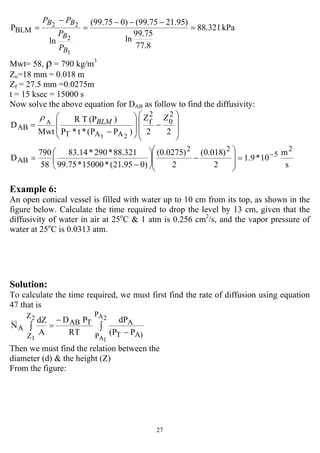
Example 5:
A small diameter tube closed at one end was filled with acetone to within 18 mm of
the top and maintained at 290 K and 99.75 kPa with a gentle stream of air blowing
across the top. After 15 ksec, the liquid level had fallen to 27.5 mm. The vapor
pressure of acetone at that temperature is 21.95 kN/m2
. Calculate the diffusivity of
acetone in air, given the following data:
Mwt of acetone = 58
The density of acetone (ρ) = 790 kg/m3
Solution:
Since evaporation is occurred through constant area, then apply equation 39 and by
integrating this equation we find:
⎟
⎟
⎠
⎞
⎜
⎜
⎝
⎛
−
⎟
⎟
⎠
⎞
⎜
⎜
⎝
⎛
−
=
22
Z
)PP(.DP
)(PTR
Mwt
t
2
0
2
f
AAABT 21
A
ZBLM
ρ
To apply this equation we must first calculate each parameter in the equation as:
PT = 99.75 kPa
T = 290 K
K*kmol
m*kPa
314.8
3
=R
27
kPa88.321
8.77
75.99
ln
)95.2175.99()075.99(
ln
P
1
2
22
BLM =
−−−
=
−
=
B
B
BB
P
P
PP
Mwt= 58, ρ = 790 kg/m3
Zo=18 mm = 0.018 m
Zf = 27.5 mm =0.0275m
t = 15 ksec = 15000 s
Now solve the above equation for DAB as follow to find the diffusivity:
s
m
10*9.1
2
)018.0(
2
)0275.0(
)095.21(*15000*75.99
321.88*290*14.83
58
790
D
22
Z
)PP(*t*P
)(PTR
Mwt
D
2
5
22
AB
2
0
2
f
AAT
AB
21
A
−
=
⎟
⎟
⎠
⎞
⎜
⎜
⎝
⎛
−⎟⎟
⎠
⎞
⎜⎜
⎝
⎛
−
=
⎟
⎟
⎠
⎞
⎜
⎜
⎝
⎛
−
⎟
⎟
⎠
⎞
⎜
⎜
⎝
⎛
−
=
ZBLM
ρ
Example 6:
An open conical vessel is filled with water up to 10 cm from its top, as shown in the
figure below. Calculate the time required to drop the level by 13 cm, given that the
diffusivity of water in air at 25o
C & 1 atm is 0.256 cm2
/s, and the vapor pressure of
water at 25o
C is 0.0313 atm.
Solution:
To calculate the time required, we must first find the rate of diffusion using equation
47 that is
P(P
dP
RT
PD
A
dZ
N
2A
1A
2
1
P
P A)T
ATAB
Z
Z
A ∫∫
−
−
=
Then we must find the relation between the
diameter (d) & the height (Z)
From the figure:
28
( ) 2
1
21
**
*
3
1
3
1N*3
thatfindweNforsolveandnintegratioabovein theAsubstituteThen
3
)3(
3*4
)3(4*
4
3
)3(2
3
3
33
1
1
tan
1.0
0
A
A
22
2
A
A
P
PAA
BLM
TAB
PP
PTR
PD
ZZ
ZZ
dA
Z
d
Z
r
Z
r
ZL
r
L
−=⎟⎟
⎠
⎞
⎜⎜
⎝
⎛
−
−
−
−
=
−
==
−
=→
−
=∴
−
=
−
==
π
πππ
θ
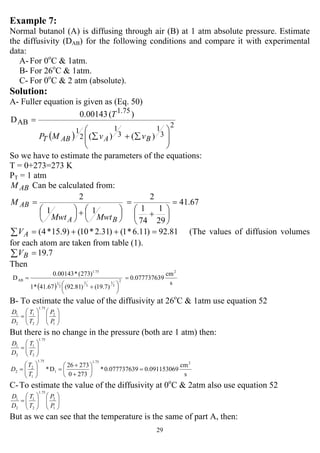
To apply this equation we must first calculate each parameter in the equation as:
PT = 1 atm
T = 298 K
K*kmol
m*kPa
314.8
3
=R
atm0.9843
9687.0
1
ln
)0313.01()01(
ln
P
1
2
22
BLM =
−−−
=
−
=
B
B
BB
P
P
PP
Pa10*1685.3atm0.0313P 3
A1
−
==
So
( )
s
kmol
10*41.4
010*1685.3
9843.0*298*314.8
1*10*56.2
03
1
1.03
1N*3
5
3
5
A
−
−
−
=
−=⎟⎟
⎠
⎞
⎜⎜
⎝
⎛
−
−
−
AN
π
To find the time use the following equation:
( )
( ) ( ) sec1.0323.03
3
1
*
*18*3
*1000
3
*3
*
*
)(
33
223.0
1.0
0 0
=
⎥⎦
⎤
⎢⎣
⎡ −−−
−
=
−=
=
=
∫
∫∫
A
A
Z
Z
t
A
A
N
t
dZZ
Mwt
tN
AdZ
Mwt
dtN
A
N
dt
dZ
Mwt
f
π
πρ
ρ
ρ
29
Example 7:
Normal butanol (A) is diffusing through air (B) at 1 atm absolute pressure. Estimate
the diffusivity (DAB) for the following conditions and compare it with experimental
data:
A- For 0o
C & 1atm.
B- For 26o
C & 1atm.
C- For 0o
C & 2 atm (absolute).
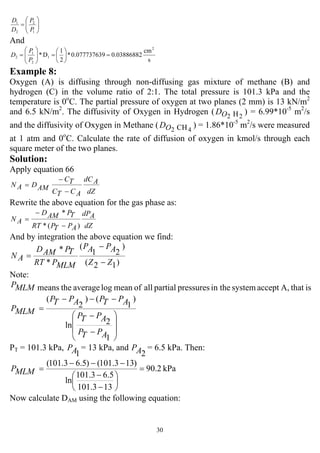
Solution:
A- Fuller equation is given as (Eq. 50)
( ) )()(
)(00143.0
D
2
3
1
3
1
2
1
75.1
AB
⎟
⎟
⎠
⎞
⎜
⎜
⎝
⎛
∑+∑
=
BAABT vvMP
T
So we have to estimate the parameters of the equations:
T = 0+273=273 K
PT = 1 atm
ABM Can be calculated from:
67.41
29
1
74
1
2
11
2
=
⎟
⎠
⎞
⎜
⎝
⎛
+
=
⎟
⎠
⎞
⎜
⎝
⎛+⎟
⎠
⎞
⎜
⎝
⎛
=
BA
AB
MwtMwt
M
∑ =++= 81.92)11.6*1()31.2*10()9.15*4(AV (The values of diffusion volumes
for each atom are taken from table (1).
∑ = 7.19BV
Then
( ) s
cm
90.07773763
)7.19()81.92(67.41*1
)273(*00143.0
D
2
2
3
1
3
1
2
1
75.1
AB =
⎟
⎠
⎞⎜
⎝
⎛ +
=
B- To estimate the value of the diffusivity at 26o
C & 1atm use equation 52
1
2
75.1
2
1
2
1
⎟⎟
⎠
⎞
⎜⎜
⎝
⎛
⎟⎟
⎠
⎞
⎜⎜
⎝
⎛
=
P
P
T
T
D
D
But there is no change in the pressure (both are 1 atm) then:
75.1
2
1
2
1
⎟⎟
⎠
⎞
⎜⎜
⎝
⎛
=
T
T
D
D
s
cm
90.0911530690.07773763*
2730
27326
D*
21.75
1
75.1
1
2
2 =⎟
⎠
⎞
⎜
⎝
⎛
+
+
=⎟⎟
⎠
⎞
⎜⎜
⎝
⎛
=
T
T
D
C-To estimate the value of the diffusivity at 0o
C & 2atm also use equation 52
1
2
75.1
2
1
2
1
⎟⎟
⎠
⎞
⎜⎜
⎝
⎛
⎟⎟
⎠
⎞
⎜⎜
⎝
⎛
=
P
P
T
T
D
D
But as we can see that the temperature is the same of part A, then:
30
1
2
2
1
⎟⎟
⎠
⎞
⎜⎜
⎝
⎛
=
P
P
D
D
And
s
cm
0.0388688290.07773763*
2
1
D*
2
1
2
1
2 =⎟
⎠
⎞
⎜
⎝
⎛
=⎟⎟
⎠
⎞
⎜⎜
⎝
⎛
=
P
P
D
Example 8:
Oxygen (A) is diffusing through non-diffusing gas mixture of methane (B) and
hydrogen (C) in the volume ratio of 2:1. The total pressure is 101.3 kPa and the
temperature is 0o
C. The partial pressure of oxygen at two planes (2 mm) is 13 kN/m2
and 6.5 kN/m2
. The diffusivity of Oxygen in Hydrogen ( 22 HOD ) = 6.99*10-5
m2
/s
and the diffusivity of Oxygen in Methane ( 42 CHOD ) = 1.86*10-5
m2
/s were measured
at 1 atm and 0o
C. Calculate the rate of diffusion of oxygen in kmol/s through each
square meter of the two planes.
Solution:
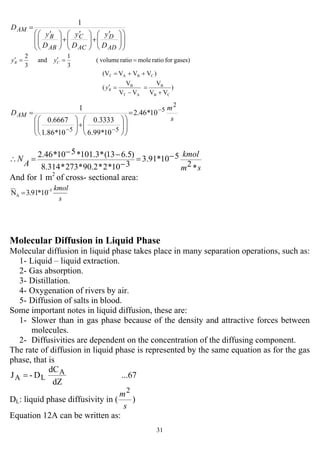
Apply equation 66
dZ
AdC
ACTC
TC
AMDAN
−
−
=
Rewrite the above equation for the gas phase as:
dZ
AdP
APTPRT
TPAMD
AN
)(*
*
−
−
=
And by integration the above equation we find:
)12(
)
21
(
*
*
ZZ
APAP
MLMPRT
TPAMD
AN
−
−
=
Note:
isthatA,acceptsystemin thepressurespartialallofmeanlogaveragethemeansMLMP
⎟
⎟
⎠
⎞
⎜
⎜
⎝
⎛
−
−
−−−
=
1
2ln
)
1
()
2
(
APTP
APTP
APTPAPTP
MLMP
PT = 101.3 kPa,
1AP = 13 kPa, and
2AP = 6.5 kPa. Then:
kPa2.90
133.101
5.63.101
ln
)133.101()5.63.101(
=
⎟
⎠
⎞
⎜
⎝
⎛
−
−
−−−
=MLMP
Now calculate DAM using the following equation:
31
⎟
⎟
⎠
⎞
⎜
⎜
⎝
⎛
⎟⎟
⎠
⎞
⎜⎜
⎝
⎛ ′
+⎟⎟
⎠
⎞
⎜⎜
⎝
⎛ ′
+⎟⎟
⎠
⎞
⎜⎜
⎝
⎛ ′
=
AD
D
AC
C
AB
B
AM
D
y
D
y
D
y
D
1
)
VV
V
VV
V
(
)VVV(V
gases)forratiomoleratiovolume(
3
1
and
3
2
CB
B
AT
B
CBAT
+
=
−
=′
++=
==′=′
B
CB
y
yy
2
5
55
10*46.2
10*99.6
3333.0
10*86.1
6667.0
1
s
m
DAM
−
−−
=
⎟
⎟
⎠
⎞
⎜
⎜
⎝
⎛
⎟⎟
⎠
⎞
⎜⎜
⎝
⎛
+⎟⎟
⎠
⎞
⎜⎜
⎝
⎛
=
sm
kmol
A
N
*2
510*91.3
310*2*2.90*273*314.8
)5.613(*3.101*510*46.2 −=
−
−−
=∴
And for 1 m2
of cross- sectional area:
s
kmol5
A 10*91.3N −
=
Molecular Diffusion in Liquid Phase
Molecular diffusion in liquid phase takes place in many separation operations, such as:
1- Liquid – liquid extraction.
2- Gas absorption.
3- Distillation.
4- Oxygenation of rivers by air.
5- Diffusion of salts in blood.
Some important notes in liquid diffusion, these are:
1- Slower than in gas phase because of the density and attractive forces between
molecules.
2- Diffusivities are dependent on the concentration of the diffusing component.
The rate of diffusion in liquid phase is represented by the same equation as for the gas
phase, that is
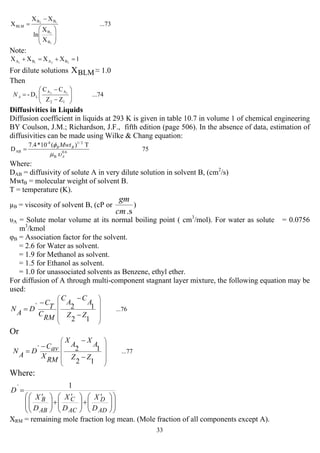
...67
dZ
dC
D-J A
LA =
DL: liquid phase diffusivity in (
s
m2
)
Equation 12A can be written as:
32
...68)N(N)(D- BAL ++=
C
C
dZ
dC
N AA
A
* Then for equimolar diffusion, where NA = - NB, then
...69
ZZ
CC
D-
12
AA
L
12
⎟
⎟
⎠
⎞
⎜
⎜
⎝
⎛
−
−
=AN
Or
...69A
ZZ
XX
C.D-
12
AA
avL
12
⎟
⎟
⎠
⎞
⎜
⎜
⎝
⎛
−
−
=AN
Where
DL: diffusivity of solute A in B (
s
m2
)
XA: mole fraction of A at any point
...70
2Mwt
C 2
2
1
1
av
⎟⎟
⎠
⎞
⎜⎜
⎝
⎛
+
=⎟
⎠
⎞
⎜
⎝
⎛
=
MwtMwt
ρρ
ρ
Where:
Cav : average concentration of (A+B) in (
3
m
kmol
)
Mwt1 & Mwt2: average molecular weight of the solution at points 1 & 2 respectively
(
kmol
kg
).
1ρ & 2ρ : average density of the solution at points 1 & 2 in (
3
m
kg
).
The case of equimolar counter diffusion in liquid phase occurs very infrequently,
while the most important case of diffusion in liquids is that where solute A is diffusing
and solvent B is stagnant or non – diffusing, e.g. diffusion of propanoic acid (A)
presented in propanoic acid – toluene mixture in water (B), where water does not
diffuse into toluene, NB = 0.
Therefore applying equation 54 will result:
...71
)C-(C
C
C.D-
A
A
L
dZ
d
N A =
After integration:
...72
ZZ
XX
X
C
D-
12
AAav
L
12
BLM
⎟
⎟
⎠
⎞
⎜
⎜
⎝
⎛
−
−
⎟
⎟
⎠
⎞
⎜
⎜
⎝
⎛
=AN
Where:
33
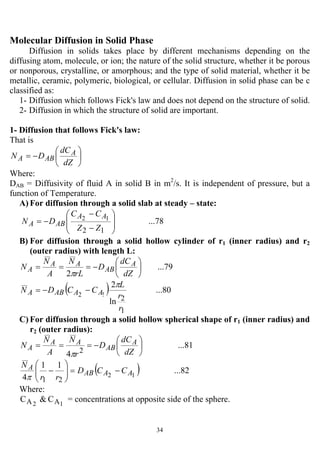
...73
X
X
ln
XX
X
1
2
12
B
B
BB
BLM
⎟
⎟
⎠
⎞
⎜
⎜
⎝
⎛
−
=
Note:
1XXXX 2211 BABA =+=+
For dilute solutions BLMX ≈ 1.0
Then
...74
ZZ
CC
D-
12
AA
L
12
⎟⎟
⎠
⎞
⎜⎜
⎝
⎛
−
−
=AN
Diffusivities in Liquids
Diffusion coefficient in liquids at 293 K is given in table 10.7 in volume 1 of chemical engineering
BY Coulson, J.M.; Richardson, J.F., fifth edition (page 506). In the absence of data, estimation of
diffusivities can be made using Wilke & Chang equation:
75
T)(10*7.4
D 6.0
B
2/1-8
AB
A
BB Mwt
υµ
φ
=
Where:
DAB = diffusivity of solute A in very dilute solution in solvent B, (cm2
/s)
MwtB = molecular weight of solvent B.
T = temperature (K).
µB = viscosity of solvent B, (cP or
.scm
gm
)
υA = Solute molar volume at its normal boiling point ( cm3
/mol). For water as solute = 0.0756
m3
/kmol
φB = Association factor for the solvent.
= 2.6 for Water as solvent.
= 1.9 for Methanol as solvent.
= 1.5 for Ethanol as solvent.
= 1.0 for unassociated solvents as Benzene, ethyl ether.
For diffusion of A through multi-component stagnant layer mixture, the following equation may be
used:
...76
12
12`
⎟⎟
⎟
⎟
⎠
⎞
⎜⎜
⎜
⎜
⎝
⎛
−
−
−
=
ZZ
A
C
A
C
RM
C
T
C
D
A
N
Or
...77
12
12`
⎟⎟
⎟
⎟
⎠
⎞
⎜⎜
⎜
⎜
⎝
⎛
−
−
−
=
ZZ
A
X
A
X
RM
X
avC
D
A
N
Where:
⎟
⎟
⎠
⎞
⎜
⎜
⎝
⎛
⎟⎟
⎠
⎞
⎜⎜
⎝
⎛ ′
+⎟⎟
⎠
⎞
⎜⎜
⎝
⎛ ′
+⎟⎟
⎠
⎞
⎜⎜
⎝
⎛ ′
=
AD
D
AC
C
AB
B
D
X
D
X
D
X
D
1`
XRM = remaining mole fraction log mean. (Mole fraction of all components except A).
34
Molecular Diffusion in Solid Phase
Diffusion in solids takes place by different mechanisms depending on the
diffusing atom, molecule, or ion; the nature of the solid structure, whether it be porous
or nonporous, crystalline, or amorphous; and the type of solid material, whether it be
metallic, ceramic, polymeric, biological, or cellular. Diffusion in solid phase can be c
classified as:
1- Diffusion which follows Fick's law and does not depend on the structure of solid.
2- Diffusion in which the structure of solid are important.
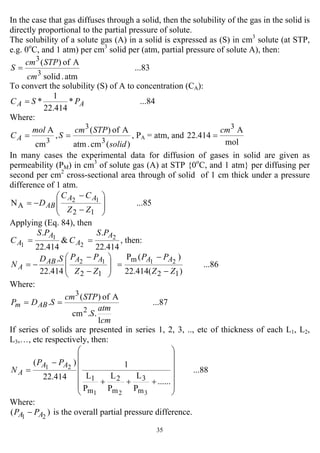
1- Diffusion that follows Fick's law:
That is
⎟
⎠
⎞
⎜
⎝
⎛
−=
dZ
dC
DN A
ABA
Where:
DAB = Diffusivity of fluid A in solid B in m2
/s. It is independent of pressure, but a
function of Temperature.
A) For diffusion through a solid slab at steady – state:
...78
12
12
⎟
⎟
⎠
⎞
⎜
⎜
⎝
⎛
−
−
−=
ZZ
CC
DN
AA
ABA
B) For diffusion through a solid hollow cylinder of r1 (inner radius) and r2
(outer radius) with length L:
...79
2
⎟
⎠
⎞
⎜
⎝
⎛
−===
dZ
dC
D
rL
N
A
N
N A
AB
AA
A
π
( ) ...80
ln
2
1
2
!2
r
r
L
CCDN AAABA
π
−−=
C) For diffusion through a solid hollow spherical shape of r1 (inner radius) and
r2 (outer radius):
...81
4 2
⎟
⎠
⎞
⎜
⎝
⎛
−===
dZ
dC
D
r
N
A
N
N A
AB
AA
A
π
( ) ...82
11
4 12
21
AAAB
A CCD
rr
N
−=⎟⎟
⎠
⎞
⎜⎜
⎝
⎛
−
π
Where:
C&C 12 AA = concentrations at opposite side of the sphere.
35
In the case that gas diffuses through a solid, then the solubility of the gas in the solid is
directly proportional to the partial pressure of solute.
The solubility of a solute gas (A) in a solid is expressed as (S) in cm3
solute (at STP,
e.g. 0o
C, and 1 atm) per cm3
solid per (atm, partial pressure of solute A), then:
...83
atm.solid
Aof)(
3
3
cm
STPcm
S =
To convert the solubility (S) of A to concentration (CA):
...84*
414.22
1
* AA PSC =
Where:
3
cm
Amol
CA = ,
)(cm.atm
Aof)(
3
3
solid
STPcm
S = , PA = atm, and
mol
A
414.22
3
cm
=
In many cases the experimental data for diffusion of gases in solid are given as
permeability (PM) in cm3
of solute gas (A) at STP {0o
C, and 1 atm} per diffusing per
second per cm2
cross-sectional area through of solid of 1 cm thick under a pressure
difference of 1 atm.
...85N
12
A
12
⎟
⎟
⎠
⎞
⎜
⎜
⎝
⎛
−
−
−=
ZZ
CC
D
AA
AB
Applying (Eq. 84), then
414.22
.
&
414.22
. 2
2
1
1
A
A
A
A
PS
C
PS
C == , then:
...86
)(414.22
)(P
414.22
.
12
m
12
2112
ZZ
PP
ZZ
PPSD
N
AAAAAB
A
−
−
=⎟
⎟
⎠
⎞
⎜
⎜
⎝
⎛
−
−
−=
Where:
...87
1
..cm
Aof)(
.
2
3
cm
atm
S
STPcm
SDP ABm ==
If series of solids are presented in series 1, 2, 3, .., etc of thickness of each L1, L2,
L3,…, etc respectively, then:
...88
......
P
L
P
L
P
L
1
414.22
)(
321
21
m
3
m
2
m
1
⎟
⎟
⎟
⎟
⎟
⎠
⎞
⎜
⎜
⎜
⎜
⎜
⎝
⎛
+++
−
=
AA
A
PP
N
Where:
)( 21 AA PP − is the overall partial pressure difference.
36
Diffusion in which the structure of solid are important:
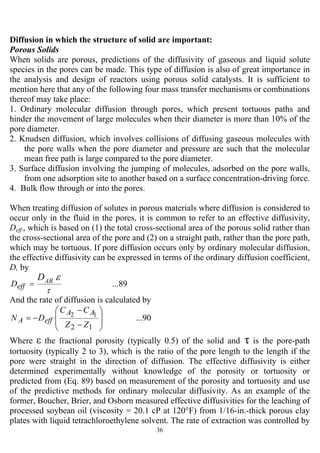
Porous Solids
When solids are porous, predictions of the diffusivity of gaseous and liquid solute
species in the pores can be made. This type of diffusion is also of great importance in
the analysis and design of reactors using porous solid catalysts. It is sufficient to
mention here that any of the following four mass transfer mechanisms or combinations
thereof may take place:
1. Ordinary molecular diffusion through pores, which present tortuous paths and
hinder the movement of large molecules when their diameter is more than 10% of the
pore diameter.
2. Knudsen diffusion, which involves collisions of diffusing gaseous molecules with
the pore walls when the pore diameter and pressure are such that the molecular
mean free path is large compared to the pore diameter.
3. Surface diffusion involving the jumping of molecules, adsorbed on the pore walls,
from one adsorption site to another based on a surface concentration-driving force.
4. Bulk flow through or into the pores.
When treating diffusion of solutes in porous materials where diffusion is considered to
occur only in the fluid in the pores, it is common to refer to an effective diffusivity,
Deff., which is based on (1) the total cross-sectional area of the porous solid rather than
the cross-sectional area of the pore and (2) on a straight path, rather than the pore path,
which may be tortuous. If pore diffusion occurs only by ordinary molecular diffusion,
the effective diffusivity can be expressed in terms of the ordinary diffusion coefficient,
D, by
...89
τ
εABD
effD =
And the rate of diffusion is calculated by
...90
12
12
⎟
⎟
⎠
⎞
⎜
⎜
⎝
⎛
−
−
−=
ZZ
CC
DN
AA
effA
Where ε the fractional porosity (typically 0.5) of the solid and τ is the pore-path
tortuosity (typically 2 to 3), which is the ratio of the pore length to the length if the
pore were straight in the direction of diffusion. The effective diffusivity is either
determined experimentally without knowledge of the porosity or tortuosity or
predicted from (Eq. 89) based on measurement of the porosity and tortuosity and use
of the predictive methods for ordinary molecular diffusivity. As an example of the
former, Boucher, Brier, and Osborn measured effective diffusivities for the leaching of
processed soybean oil (viscosity = 20.1 cP at 120°F) from 1/16-in.-thick porous clay
plates with liquid tetrachloroethylene solvent. The rate of extraction was controlled by
37
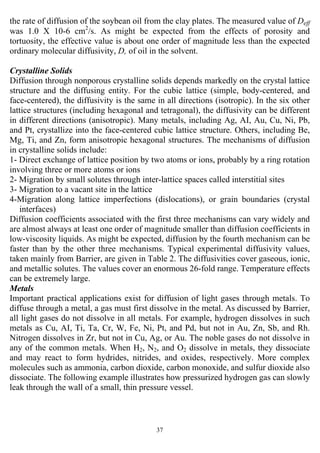
the rate of diffusion of the soybean oil from the clay plates. The measured value of Deff
was 1.0 X 10⁻⁶ cm2
/s. As might be expected from the effects of porosity and
tortuosity, the effective value is about one order of magnitude less than the expected
ordinary molecular diffusivity, D, of oil in the solvent.
Crystalline Solids
Diffusion through nonporous crystalline solids depends markedly on the crystal lattice
structure and the diffusing entity. For the cubic lattice (simple, body-centered, and
face-centered), the diffusivity is the same in all directions (isotropic). In the six other
lattice structures (including hexagonal and tetragonal), the diffusivity can be different
in different directions (anisotropic). Many metals, including Ag, AI, Au, Cu, Ni, Pb,
and Pt, crystallize into the face-centered cubic lattice structure. Others, including Be,
Mg, Ti, and Zn, form anisotropic hexagonal structures. The mechanisms of diffusion
in crystalline solids include:
1- Direct exchange of lattice position by two atoms or ions, probably by a ring rotation
involving three or more atoms or ions
2- Migration by small solutes through inter-lattice spaces called interstitial sites
3- Migration to a vacant site in the lattice
4-Migration along lattice imperfections (dislocations), or grain boundaries (crystal
interfaces)
Diffusion coefficients associated with the first three mechanisms can vary widely and
are almost always at least one order of magnitude smaller than diffusion coefficients in
low-viscosity liquids. As might be expected, diffusion by the fourth mechanism can be
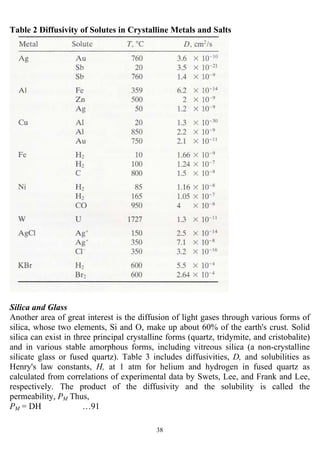
faster than by the other three mechanisms. Typical experimental diffusivity values,
taken mainly from Barrier, are given in Table 2. The diffusivities cover gaseous, ionic,
and metallic solutes. The values cover an enormous 26-fold range. Temperature effects
can be extremely large.
Metals
Important practical applications exist for diffusion of light gases through metals. To
diffuse through a metal, a gas must first dissolve in the metal. As discussed by Barrier,
all light gases do not dissolve in all metals. For example, hydrogen dissolves in such
metals as Cu, AI, Ti, Ta, Cr, W, Fe, Ni, Pt, and Pd, but not in Au, Zn, Sb, and Rh.
Nitrogen dissolves in Zr, but not in Cu, Ag, or Au. The noble gases do not dissolve in
any of the common metals. When H2, N2, and O2 dissolve in metals, they dissociate
and may react to form hydrides, nitrides, and oxides, respectively. More complex
molecules such as ammonia, carbon dioxide, carbon monoxide, and sulfur dioxide also
dissociate. The following example illustrates how pressurized hydrogen gas can slowly
leak through the wall of a small, thin pressure vessel.
38
Table 2 Diffusivity of Solutes in Crystalline Metals and Salts
Silica and Glass
Another area of great interest is the diffusion of light gases through various forms of
silica, whose two elements, Si and O, make up about 60% of the earth's crust. Solid
silica can exist in three principal crystalline forms (quartz, tridymite, and cristobalite)
and in various stable amorphous forms, including vitreous silica (a non-crystalline
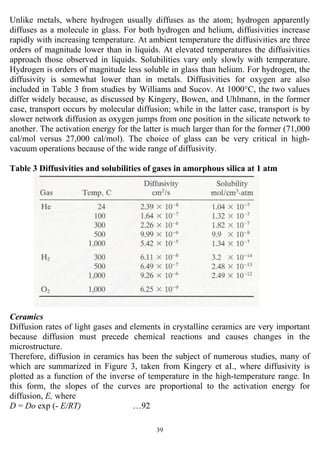
silicate glass or fused quartz). Table 3 includes diffusivities, D, and solubilities as
Henry's law constants, H, at 1 atm for helium and hydrogen in fused quartz as
calculated from correlations of experimental data by Swets, Lee, and Frank and Lee,
respectively. The product of the diffusivity and the solubility is called the
permeability, PM Thus,
PM = DH …91
39
Unlike metals, where hydrogen usually diffuses as the atom; hydrogen apparently
diffuses as a molecule in glass. For both hydrogen and helium, diffusivities increase
rapidly with increasing temperature. At ambient temperature the diffusivities are three
orders of magnitude lower than in liquids. At elevated temperatures the diffusivities
approach those observed in liquids. Solubilities vary only slowly with temperature.
Hydrogen is orders of magnitude less soluble in glass than helium. For hydrogen, the
diffusivity is somewhat lower than in metals. Diffusivities for oxygen are also
included in Table 3 from studies by Williams and Sucov. At 1000°C, the two values
differ widely because, as discussed by Kingery, Bowen, and Uhlmann, in the former
case, transport occurs by molecular diffusion; while in the latter case, transport is by
slower network diffusion as oxygen jumps from one position in the silicate network to
another. The activation energy for the latter is much larger than for the former (71,000
cal/mol versus 27,000 cal/mol). The choice of glass can be very critical in high-
vacuum operations because of the wide range of diffusivity.
Table 3 Diffusivities and solubilities of gases in amorphous silica at 1 atm
Ceramics
Diffusion rates of light gases and elements in crystalline ceramics are very important
because diffusion must precede chemical reactions and causes changes in the
microstructure.
Therefore, diffusion in ceramics has been the subject of numerous studies, many of
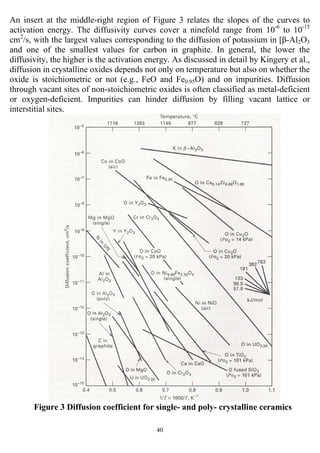
which are summarized in Figure 3, taken from Kingery et aI., where diffusivity is
plotted as a function of the inverse of temperature in the high-temperature range. In
this form, the slopes of the curves are proportional to the activation energy for
diffusion, E, where
D = Do exp (- E/RT) …92
40
An insert at the middle-right region of Figure 3 relates the slopes of the curves to
activation energy. The diffusivity curves cover a ninefold range from 10-6
to 10-15
cm2
/s, with the largest values corresponding to the diffusion of potassium in [β-Al2O3
and one of the smallest values for carbon in graphite. In general, the lower the
diffusivity, the higher is the activation energy. As discussed in detail by Kingery et al.,
diffusion in crystalline oxides depends not only on temperature but also on whether the
oxide is stoichiometric or not (e.g., FeO and Fe0.95O) and on impurities. Diffusion
through vacant sites of non-stoichiometric oxides is often classified as metal-deficient
or oxygen-deficient. Impurities can hinder diffusion by filling vacant lattice or
interstitial sites.
Figure 3 Diffusion coefficient for single- and poly- crystalline ceramics
41
Polymers
Thin, dense, nonporous polymer membranes are widely used to separate gas and liquid
mixtures. Diffusion of gas and liquid species through polymers is highly dependent on
the type of polymer, whether it be crystalline or amorphous and, if the latter, glassy or
rubbery. Commercial crystalline polymers are about 20% amorphous. It is mainly
through the amorphous regions that diffusion occurs. As with the transport of gases
through metals, transport of gaseous species through polymer membranes is usually
characterized by the solution-diffusion mechanism of (Eq. 90). Fick's first law, in the
following integrated forms, is then applied to compute the mass transfer flux
Gas species:
...93)()(
.
2121
1212
ii
m
ii
ii
i PP
ZZ
P
PP
ZZ
DH
N i
−
−
=−
−
=
Where: Pi is the partial pressure of the gas species at a polymer surface.
Liquid species:
...94)(
.
21
12
ii
ii
i CC
ZZ
DK
N −
−
=
Where: Ki, the equilibrium partition coefficient, is equal to the ratio of the
concentration in the polymer to the concentration, Ci, in the liquid adjacent to the
polymer surface. The product Ki Di is the liquid permeability.
Values of diffusivity for light gases in four polymers; given in Table 4, range from
1.3*10-9
to 1.6*10-6
cm2
/s, which are orders of magnitude less than for diffusion of the
same species in a gas. Diffusivities of liquids in rubbery polymers have been studied
extensively as a means of determining visco-elastic parameters. In Table 5,
diffusivities are given for different solutes in seven different rubber polymers at near-
ambient conditions. The values cover a sixfold range, with the largest diffusivity being
that for n-hexadecane in polydimethylsiloxane. The smallest diffusivities correspond
to the case where the temperature is approaching the glass transition temperature,
where the polymer becomes glassy in structure. This more rigid structure hinders
diffusion. In general, as would be expected, smaller molecules have higher
diffusivities. A more detailed study of the diffusivity of n-hexadecane in random
styrene/butadiene copolymers at 25°C by Rhee and Ferry shows a large effect on
diffusivity of fractional free volume in the polymer. Diffusion and permeability in
crystalline polymers depend on the degree of crystallinity. Polymers that are 100%
crystalline permit little or no diffusion of gases and liquids. For example, the
diffusivity of methane at 25°C in polyoxyethylene oxyisophthaloyl decreases from
0.30*10-9
to 0.13*10-9
cm2
/s when the degree of crystallinity increases from 0 (totally
amorphous) to 40%. A measure of crystallinity is the polymer density. The diffusivity
42
of methane at 25°C in polyethylene decreases from 0.193*10-6
to 0.057*10-6
cm2
/s
when the specific gravity increases from 0.914 (low density) to 0.964 (high density). A
plasticizer can cause the diffusivity to increase. For example, when polyvinylchloride
is plasticized with 40% tricresyl triphosphate, the diffusivity of CO at 27°C increases
from 0.23*10-8
to 2.9*10-8
cm2
/s.
Table 4 Coefficient for gas Permeation in polymers
Table 5 Diffusivities of solutes rubbery polymers
43
Cellular Solids and Wood
Cellular solids consist of solid struts or plates that form edges and faces of cells, which
are compartments or enclosed spaces. Cellular solids such as wood, cork, sponge, and
coral exist in nature. Synthetic cellular structures include honeycombs, and foams
(some with open cells) made from polymers, metals, ceramics, and glass. The word
cellulose means "full of little cells."
A widely used cellular solid is wood, whose annual world production of the order of
1012kg is comparable to the production of iron and steel. Chemically, wood consists
of lignin, cellulose, hemi cellulose, and minor amounts of organic chemicals and
elements. The latter are extractable, and the former three, which are all polymers, give
wood its structure. Green wood also contains up to 25 wt% moisture in the cell walls
and cell cavities. Adsorption or desorption of moisture in wood causes anisotropic
swelling and shrinkage. The structure of wood, which often consists of (1) highly
elongated hexagonal or rectangular cells, called tracheids in softwood (coniferous
species, e.g., spruce, pine, and fir) and fibers in hardwood (deciduous or broad-leaf
species, e.g., oak, birch, and walnut); (2) radial arrays of rectangular-like cells, called
rays, which are narrow and short in softwoods but wide and long in hardwoods; and
(3) enlarged cells with large pore spaces and thin walls, called sap channels because
they conduct fluids up the tree. The sap channels are less than 3 vol. % of softwood,
but as much as 55 vol. % of hardwood.
Because the structure of wood is directional, many of its properties are anisotropic. For
example, stiffness and strength are 2 to 20 times greater in the axial direction of the
tracheids or fibers than in the radial and tangential directions of the trunk from which
44
the wood is cut. This anisotropy extends to permeability and diffusivity of wood
penetrates, such as moisture and preservatives. According to Stamm, the permeability
of wood to liquids in the axial direction can be up to 10times greater than in the
transverse direction.
Movement of liquids and gases through wood and wood products takes time during
drying and treatment with preservatives, fire retardants, and other chemicals. This
movement takes place by capillarity, pressure permeability, and diffusion.
Nevertheless, wood is not highly 3.3 One-Dimensional Steady-State and Unsteady-
State Molecular Diffusion 117 permeable because the cell voids are largely discrete
and lack direct interconnections. Instead, communication among cells is through
circular openings spanned by thin membranes with sub micrometer-sized pores, called
pits, and to a smaller extent, across the cell walls. Rays give wood some permeability
in the radial direction. Sap channels do not contribute to permeability. All three
mechanisms of movement of gases and liquids in wood are considered by Stamm.
The simplest form of diffusion is that of a water-soluble solute through wood saturated
with water, such that no dimensional changes occur. For the diffusion of urea,
glycerin, and lactic acid into hardwood, Stamm lists diffusivities in the axial direction
that are about 50% of ordinary liquid diffusivities. In the radial direction, diffusivities
are about 10% of the values in the axial direction. For example, at 26.7°C the
diffusivity of zinc sulfate in water is 5*10-6
cm2
/s. If loblolly pines sapwood is
impregnated with zinc sulfate in the radial direction, the diffusivity is found to be
0.18*10-6
cm2
/s.
The diffusion of water in wood is much more complex. Moisture content determines
the degree of swelling or shrinkage. Water is held in the wood in different ways: It
may be physically adsorbed on cell walls in monomolecular layers, condensed in
preexisting or transient cell capillaries, or absorbed in cell walls to form a solid
solution.
Because of the practical importance of the lumber drying rates, most diffusion
coefficients are measured under drying conditions in the radial direction across the
fibers. The results depend on temperature and swollen-volume specific gravity.
45
Example 9
Calculate the rate of diffusion of Acetic acid (A) across a film of non-diffusing water
(B) solution of 1 mm thick at 17 o
C. The concentrations of acid on the opposite sides
of the film are 9 wt% and 3 wt% respectively. Given that the diffusivity of Acetic acid
in the solution is 0.95*10-9
m2
/s at 17 o
C and the specific gravity of pure Acetic acid is
1.049. The molecular weight of Acetic acid is 60 and for water is 18.
Solution
Use equation 72
⎟
⎟
⎠
⎞
⎜
⎜
⎝
⎛
−
−
⎟
⎟
⎠
⎞
⎜
⎜
⎝
⎛
=
12
AAav
L
ZZ
XX
X
C
D- 12
BLM
AN
DL = 0.95*10-9
m2
/s
Z2 - Z1 = 1 mm = 0.001 m
Now convert the wt fractions to mole fractions as:
At Z1, 0288.0
18
91
60
9
60
9
X 1A =
+
=
At Z2, 0092.0
18
97
60
3
60
3
X 2A =
+
=
And now calculate the XBLM
9712.00288.01X1X 11 AB =−=−=
9908.00092.01X1X 22 AB =−=−=
981.0
0.9712
0.9908
ln
0.9712-0.9908
X
X
ln
XX
X
1
2
12
B
B
BB
BLM =
⎟
⎠
⎞
⎜
⎝
⎛
=
⎟
⎟
⎠
⎞
⎜
⎜
⎝
⎛
−
=
Finally we have to calculate Cav
2
C 2
2
1
1
av
⎟⎟
⎠
⎞
⎜⎜
⎝
⎛
+⎟⎟
⎠
⎞
⎜⎜
⎝
⎛
=
MwtMwt
ρρ
ρ1= density of solution (mixture) at point 1
Mwt1 = Average molecular weight of solution (mixture) at point 1
46
18.31pointMwtAv.
18)*(0.990860)*(0.00922pointMwtAv.
47.1001
cm
gm
00147.1)049.1*03.0()1*97.0(
**
19.21pointMwtAv.
18)*(0.971260)*(0.02881pointMwtAv.
2Mwt*2fractionmol.Mwt1*1fractionmol.Mwt.
41.1004
cm
gm
00441.1)049.1*09.0()1*91.0(
**
332
212
331
211
2
2
=
+=
==+=
+=
=
+=
+=
==+=
+=
m
kgm
XX
Av
m
kgm
XX
AceticacidOH
AceticacidOH
ρ
ρρρ
ρ
ρρρ
3av 3.53
2
3.18
47.1001
2.19
41.1004
C
m
kmol
=
⎟
⎠
⎞
⎜
⎝
⎛
+⎟
⎠
⎞
⎜
⎝
⎛
=
sm
kmol
N A
*
10*318.9
0.001
0.02880.0092
0.981
53.3
10*0.95-
2
79- −
=⎟
⎠
⎞
⎜
⎝
⎛ −
⎟
⎠
⎞
⎜
⎝
⎛
=∴
Example 10
A sintered solid of silica (2mm) thick is porous with void fraction of 0.3 and tortuosity
of 4. the pores are filled with water at 298 K. at one face the concentration of KCl is
held at 0.1 mol / liter and fresh water flow rapidly by other face. Neglecting any other
resistance but that in porous solid, calculate the diffusion of KCl at steady state. Given
the diffusivity DAB is equal to 1.87*10-9
m2
/s.
Solution
Since neglecting any other resistance but that in porous solid, then ordinary diffusion
is occurred and then the diffusion is calculated by equation no. 90
⎟
⎟
⎠
⎞
⎜
⎜
⎝
⎛
−
−
−=
12
12
ZZ
CC
DN
AA
effA
And Deff is calculated by equation 89
s
m
D ABD
eff
2
10
9-
10*4025.1
4
3.0*10*1.98 −
===
τ
ε
sm
KClkmol
N A
*
10*01.7
002.0
1.00
10*4025.1
2
910 −−
=⎟
⎠
⎞
⎜
⎝
⎛ −
−=
47
Unsteady – State Mass transfer
All mass transfer processes will have an initial period of time with unsteady – state
conditions where the concentration at certain point varies with time until steady – state
is reached.
Consider an element of dimensions dx, dy, dz;
X
XAN AN XX ∆+
Y
Z
The molar flow rate of species A by diffusion at the plane Z=Z is given by Fick's law:
...95*D-N ABAZ
Z
A
Z
C
A ⎟
⎠
⎞
⎜
⎝
⎛
∂
∂
=
The molar flow rate of species A by diffusion at the plane Z=Z+∆Z is:
...96*D-N ABAZ
ZZ
A
Z
C
A
∆+
⎟
⎠
⎞
⎜
⎝
⎛
∂
∂
=
The accumulation of species A in the control volume is:
...97
t
C
A A Z∆
∂
∂
Since
Rate in – Rate out = accumulation
...98
t
C
A*D*D- A
ABAB Z
Z
C
A
Z
C
A
ZZ
A
Z
A ∆
∂
∂
=⎟
⎠
⎞
⎜
⎝
⎛
∂
∂
+⎟
⎠
⎞
⎜
⎝
⎛
∂
∂
∆+
Rearranging and simplifying
...99
t
C)/()/(
D A
AB
∂
∂
=⎟
⎠
⎞
⎜
⎝
⎛
∆
∂∂−∂∂ ∆+
Z
ZCZC ZAZZA
In the lime, as ∆Z→0
...100
t
C
2
2
A
Z
C
D A
AB
∂
∂
=
∂
∂
The above equation is Fick's second law for one–dimensional diffusion. The more
general form, for three dimensions rectangular coordinates, is
48
...101
t
C
2
2
2
2
2
2
A
⎟
⎟
⎠
⎞
⎜
⎜
⎝
⎛
∂
∂
+
∂
∂
+
∂
∂
=
∂
∂
z
C
y
C
x
C
D AAA
AB
For one-dimensional diffusion in the redial direction only, for cylindrical and spherical
coordinates, Fick's second law becomes, respectively,
...102
t
CA
⎟
⎠
⎞
⎜
⎝
⎛
∂
∂
∂
∂
=
∂
∂
r
C
r
rr
D AAB
And
...103
t
C 2
2
A
⎟
⎠
⎞
⎜
⎝
⎛
∂
∂
∂
∂
=
∂
∂
r
C
r
rr
D AAB
Analytical solutions to these partial differential equations are available for a variety of
boundary conditions. Only two of the most common useful solutions will be
considered.
Semi-infinite Medium
The boundary conditions for this case to solve (Equ.100) are:
2
2
A
t
C
Z
C
D A
AB
∂
∂
=
∂
∂
Boundary conditions:
At t = 0 0< Z < ∞ CA = CA0
t > 0 Z =0 CA = CAi (CAi : initial concentration)
t > 0 Z = ∞ CA = CA0
To solve the above partial differential equation, either the method of combination of
variables or the Laplace method is applicable. The result, in terms of the fractional
accomplished concentration change (θ), is
...104
20
0
⎟
⎟
⎠
⎞
⎜
⎜
⎝
⎛
=
−
−
=
tD
Z
erfc
CC
CC
ABAA
AA
s
θ
Equation 104 is used to compute the concentration in the semi-infinite medium, as a
function of time and distance from the surface, assuming no bulk flow. Thus, it applies
most rigorously to diffusion in solids, and also to stagnant liquid and gases when the
medium is dilute in the diffusing solute.
The instantaneous rate of mass transfer across the surface of the medium at Z = 0 can
be obtained by taking the derivative of (Equ. 104) with respect to distance and
substituting it into Fick's first law applied at the surface of the medium. Then
...105
4
exp
0
2
0
0
==
⎟
⎟
⎠
⎞
⎜
⎜
⎝
⎛
−⎟
⎟
⎠
⎞
⎜
⎜
⎝
⎛ −
=⎟
⎠
⎞
⎜
⎝
⎛
∂
∂
−=
Z
ABAB
AA
AB
Z
A
ABA
tD
Z
tD
CC
AD
Z
C
ADn s
π
Thus
49
( ) ...106n 00ZA AA
AB CCA
t
D
s
−==
π
We can determine the total number of moles of solute, NA, transferred into the semi-
infinite medium by integrating equation 106 with respect to time:
( ) ...107)(2 00
00
0
ππ
tD
CCA
t
dt
CCA
D
dtn AB
AA
t
AA
AB
t
zA ss
−=−== ∫∫ =AN
Medium of finite Thickness with Sealed Edges
Consider a rectangular parallelepiped medium of finite thickness 2a in the Z direction,
and either infinitely long dimensions in the y and x directions or finite lengths of 2b
and 2c respectively, in those directions. The boundary conditions for this case to solve
(Equ.100)
2
2
A
t
C
Z
C
D A
AB
∂
∂
=
∂
∂
are:
At t = 0 -a < Z < a CA = CA0
t = 0 Z = ± a CA = CAs (CAs > CA0)
t > 0 Z = 0
t
CA
∂
∂
= 0
again by the method of separation of variables or the Laplace transform method the
result in terms of the fractional unaccomplished concentration change, E, is
[ ] ...108
2
)12(
cos
0
2
4/
22
)12(exp
)12(
)1(4
1
a
Zn
n
atnABD
n
n
oAC
sAC
AC
sAC
E
π
π
π
θ
+
∑
∞
=
+−
+
−
=
−
−
=−=
or, in terms of complementary error function,
...109
0n 2
)12(
2
)12(
)1(1 ∑
∞
=
++
+
−+
−=
−
−
=−=
⎥
⎥
⎦
⎤
⎢
⎢
⎣
⎡
tABD
Zan
erfc
tABD
Zan
erfcn
oAC
sAC
AC
sAC
E θ
The instantaneous rate of mass transfer across the surface of either unsealed face of the
medium (i.e. at Z = ± a), is obtained by differentiating (Eq. 108, or 109) with respect
to Z, evaluating the result at Z = a, followed by substitution into Fick's first law to give
( )
...110
4
)12(
exp
2
0
2
22
∑
∞
=
=
⎥
⎥
⎦
⎤
⎢
⎢
⎣
⎡ +
−
−
=
n
ABAAAB
aZA
a
tnD
a
ACCD
n os π
We can also determine the total number of moles transferred across either unsealed
face by integrating (Eq. 110) with respect to time. Thus
...111
2
4
22
)12(
exp1
0 2
)12(
1
2
)(8
0 ⎪⎭
⎪
⎬
⎫
⎪⎩
⎪
⎨
⎧
⎥
⎥
⎦
⎤
⎢
⎢
⎣
⎡ +
−−∑
∞
= +
−
=∫ ==
a
tnABD
n n
Aa
oAC
sACt
dtaZAnAN
π
π
50
Convective Mass Transfer for Binary gas Mixture
In previous sections we have considered molecular diffusion in stagnant fluid (laminar
flow) where the rate of diffusion is slow. To increase the rate of mass transfer, the
fluid velocity is increased until turbulent mass transfer occurs. As given before in
equation (1):
...1ioffluxdiffusioneddyioffluxdiffusionmolecularXi.NNi ++=
The eddy diffusion flux term is given by:
...112
dZ
dC
E-J A
dA
*
Z =
Then
...113)N(N)(*)(D*C- BAAB +++= A
A
DA X
dZ
dX
EN
This is the general equation used to calculate the mass transfer.
1- For equi - molar mass transfer
A) For gases:
...114)(**
*
)(
BA
T
AADAB
A NN
P
P
dZ
dP
TR
ED
N ++
+−
=
For equi – molar transfer: (NA = - NB)
Then equation 114 will be:
...115*
*
)(
dZ
dP
TR
ED
N ADAB
A
+−
=
By integrating equation 115 from 21 Zandtoat Z 21 AA PP then:
...116
)(
)(
*
*
)(
22
21
ZZ
PP
TR
ED
N
AADAB
A
−
−+
=
Because the film thickness can not be measured or is not known, then the value (Z2-Z1)
is not known (the distance of the path), also the amount of ED can not be measured,
then, the term (individual mass transfer coefficient) is used as shown below:
...117)P-(P 21 AA
'
GA KN =
Where:
...118
)(*
)(
12
'
ZZTR
ED
K DAB
G
−
+
=
Also for gases another form of equation 117 can be written as:
...119)y-(y 21 AA
'
yA KN =
A) For Liquids:
Similar to what done for gases, the rate of mass transfer is:
...120)X-(X)C-(C 2121 AA
'
AA
'
xLA KKN ==
51
The general form for the mass transfer is:
...121)C-(C 21 AA
'
CA KN =
All these individual mass transfer coefficients are related to each other.
For gases:
...122)y-(y)P-(P)C-(C 212121 AA
'
AA
'
AA
'
yGCA KKKN ===
So
T
yG
C
C
K
RT
K
K
''
'
==
Home work: find the relations for the liquid phase.
2- For uni - molecular mass transfer
A) For gases:
...114)(**
*
)(
BA
T
AADAB
A NN
P
P
dZ
dP
TR
ED
N ++
+−
=
For uni – molar transfer: (NB = 0)
Then equation 114 will be:
...123)(**
*
)(
A
T
AADAB
A N
P
P
dZ
dP
TR
ED
N +
+−
=
By integrating equation 123 from 21 Zandtoat Z 21 AA PP then
...124
)(
)(
*
**
*)(
22
21
ZZ
PP
PTR
PED
N AA
BLM
TDAB
A
−
−+
=
Similarly as done in section 1:
...125)y-(y)P-(P 2121 AAAA yGA KKN ==
B) For Liquids:
Similar to what done for gases, the rate of mass transfer is:
...126)X-(X)C-(C 2121 AAAA xLA KKN ==
The general form for the mass transfer is:
...127)C-(C 21 AACA KN =
Home work: find the relations for the gas phase and liquid phase. Also
write the units of each coefficient.
52
Methods to Determine the Mass transfer Coefficient
The mass transfer coefficient can be evaluated using empirical correlations involving
dimensionless numbers. These empirical equations were obtained from experimental
data using various types of fluids, different velocities, and different geometrics. The
most important groups (dimensionless numbers) are:
1- Reynolds Number (Re No.):
Re. No indicate the degree of turbulence.
µ
ρ du
=NoRe
Where:
ρ = density of flowing mixture fluid (solute A and solvent B).
µ = viscosity of flowing mixture fluid (solute A and solvent B).
d = diameter of the pipe in which the fluid is flow.
Dp May be used in Reynolds number equation instead of d when flow across a sphere,
also L may be used if the flow was above a flat plate.
U = mean average velocity in the pipe.
If the flow was across a packed bed, U will be substituted by:
ε
U
U =
Where
Uis the superficial velocity of empty cross- section of packed bed column.
ε = void fraction.
2- Schmidt Number (Sc No.):
ABD
NoSc
ρ
µ
=
3- Sherwoood Number (Sh No.):
AB
C
D
dK
NoSh
'
=
4- Stanton Number (St No.):
m
CC
G
K
u
KSh
NoSh
ρ''
Sc*Re
===
5- J-factor
In general j-factors are uniquely determined by the geometric configuration and the
Reynolds number.
53
Now after introducing the dimensionless groups, now we will present the correlations
used to calculate the mass transfer coefficient.
1- Using the analogy or similarity of momentum, heat, and mass
transfer using Chilton – Colburn Analogy:
...128)(
*
2
3/2
'
Sc
G
Kf
jjj
m
C
DHM
ρ
====
2- For flow inside pipe
For both gases and liquids, where Re > 2100
...129)((Re)023.0 333.0833.0
'
Sc
D
dK
NoSh
AB
C ==
Note:
Sc = 0.5 – 3 for gases
Sc > 100 for liquids
Or
100000010000For
...130(Re)023.0
Re
2.0
<<
−
=== DHM jjj
3- For flow parallel to flat plate of length L
A- for gases
µ
ρUL
Rewhere15000For
...131(Re)664.0
Re
5.0
=
===
<
−
DHM jjj
And
µ
ρUL
Rewhere30000015000For
...132(Re)036.0
Re
2.0
=
===
<<
−
DHM jjj
B- for liquids
µ
ρUL
Rewhere50000600For
...133(Re)99.0
Re
5.0
=
===
<<
−
DHM jjj
For both gases and liquids
µ
ρUL
Rewhere810*5500000For
...134(Re)037.0
Re
2.0
=
===
<<
−
DHM jjj
54
4- For flow normal to a long circular cylinder of diameter D, where the
drag coefficient includes both form drag and skin friction, but only the skin
friction contribution applies to the analogy:
µ
ρ
µ
ρ
UcylindD
Rewhere25000040000For
...136(Re)0266.0)(
UcylindD
Rewhere400004000For
...135(Re)193.0)(
Re
Re
195.0
friction
382.0
friction
=
===
=
===
<<
<<
−
−
DHskinM
DHskinM
jjj
jjj
5- For flow past a single sphere of diameter Dp
µ
ρupD
jjj DHskinM
=
===
<<
−
Rewhere10000020For
...137(Re)*37.0)(
Re
4.0
friction
The above equation is used for both gases and liquids. Another method is used to
calculate the mass transfer coefficient.
For very low Re No. (Re < 1) the Sh No. approach a value of 2, then:
...138
*2
*
2
'
'
p
AB
P
AB
C
AB
C
D
D
D
D
ShK
D
dK
NoSh
==∴
==
For gases where Re = 1 – 48000 and Sc = 0.6 – 2.7, a modified equation can be
used:
( ) ...139*Re552.02 333.053.0
'
Sc
D
dK
NoSh
AB
C +==
For liquids:
( )
( )
17000-2000ReFor
...141*Re347.02
liquidsforalsoAnd
2000-2ReFor
...140*Re95.02
333.062.0
'
333.05.0
'
=
+==
=
+==
Sc
D
dK
NoSh
Sc
D
dK
NoSh
AB
C
AB
C
55
6- For flow through beds packed with spherical particles of uniform
size Dp
µ
ρUpD
Rewhere250010For
...142(Re)17.1
Re
415.0
=
==
<<
−
DH jj
For other shapes of packing a correction factor can be used such as:
jD (cylinder) = 0.79 * jD (sphere)
jD (cube) = 0.71 * jD (sphere)
7- For fluidized beds of packed with sphere, for both gases and liquids:
...143
483.0Re
86.0
01.0
58.0
−
+=Dj
Methods for Mass transfer at Fluid – Fluid Interface (Phase Boundary)
In the previous sections, diffusion and mass transfer within solids and fluids were
considered, where the interface was a smooth solid surface. Of greater interest in
separation processes is mass transfer across an interface between a gas and a liquid or
between two liquid phases. Such interfaces exist in absorption, distillation, extraction,
and stripping. At fluid-fluid interfaces, turbulence may persist to the interface. The
following theoretical models have been developed to describe mass transfer from a
fluid to such an interface.
Film Theory
A simple theoretical model for turbulent mass transfer to or from a fluid-phase
boundary was suggested in 1904 by Nernst, who postulated that the entire resistance to
mass transfer in a given turbulent phase is in a thin, stagnant region of that phase at the
interface, called a film. This film is similar to the laminar sub – layer that forms when
a fluid flows in the turbulent regime parallel to a flat plate. This is shown
schematically in Figure 4. For the case of a gas-liquid interface, where the gas is pure
component A, which diffuses into nonvolatile liquid B. Thus, a process of absorption
of A into liquid B takes place, without desorption of B into gaseous A. Because the
gas is pure A at total pressure P = PA, there is no resistance to mass transfer in the gas
phase. At the gas-liquid interface, equilibrium is assumed so the concentration of A,
CAi is related to the partial pressure of A, PA, by some form of Henry's law, for
56
example, CAi= HAPA. In the thin, stagnant liquid film of thickness δ, molecular
diffusion only occurs with a driving force of )( Bi AA CC − . Since the film is assumed
to be very thin, the entire diffusing A passes through the film and into the bulk liquid.
If, in addition, bulk flow of A is neglected, the concentration gradient is linear as in
Figure 4. Accordingly, Fick's first law, (Eq. 3), for the diffusion flux integrates to:
( ) ( ) ...144
*
bibi AA
AB
AA
AB
A XX
DC
CC
D
J −=−=
δδ
Figure 4 Film theory for mass transfer from a fluid – fluid interface into a liquid.
If the liquid phase is dilute in A, the bulk-flow effect can be neglected and (Eq. 144)
applies to the total flux:
( ) ( ) ...145
*
bibi AA
AB
AA
AB
A XX
DC
CC
D
N −=−=
δδ
If the bulk-flow effect is not negligible, then, from (Eq. 31),
...146)X-(X
)X-(1
C.D
)
1
1
ln(
.
bi AA
A
AB
12 LMA
bAAB
A
i
X
X
ZZ
DC
N
δ
=
−
−
−
=
Where:
In practice, the ratios DAB/δ in (Eq. 145) and DAB/δ*(1- XA)LM in (Eq. 146) are
replaced by mass transfer coefficients and cc KK and'
, respectively, because the film
thickness, δ, which depends on the flow conditions, is not known.
57
The film theory, which is easy to understand and apply, is often criticized because it
appears to predict that the rate of mass transfer is directly proportional to the
molecular diffusivity. This dependency is at odds with experimental data, which
indicate a dependency of Dn
, where n ranges from about 0.5 to 0.75. However, if
DAB/δ is replaced with '
cK , which is then estimated from the Chilton-Colburn analogy,
(Eq. 128), we obtain '
cK proportional to 3/2
ABD , which is in better agreement with
experimental data. In effect, δ depends on DAB (Sc No.). Regardless of whether the
criticism of the film theory is valid, the theory has been and continues to be widely
used in the design of mass transfer separation equipment.
Penetration Theory
A more realistic physical model of mass transfer from a fluid-fluid interface into a
bulk liquid stream is provided by the penetration theory of Higbie, shown
schematically in Fig. 5. The stagnant-film concept is replaced by Boussinesq eddies
that, during a cycle, (1) move from the bulk to the interface; (2) stay at the interface
for a short, fixed period of time during which they remain static so that molecular
diffusion takes place in a direction normal to the interface; and (3) leave the interface
to mix with the bulk stream. When an eddy moves to the interface, it replaces another
static eddy. Thus, the eddies are intermittently static and moving. Turbulence extends
to the interface. In the penetration theory, unsteady-state diffusion takes place at the
interface during the time the eddy is static. This process is governed by Fick's second
law, (Eq. 100), with boundary conditions
At t = 0 0 ≤ Z ≤ ∞ CA = CAb
t > 0 Z =0 CA = CAi (CAi : initial concentration)
t > 0 Z = ∞ CA = CAb
Figure 5 Penetration theory for mass transfer from a fluid – fluid interface into a
liquid.
58
Thus, the solution can be written by a rearrangement of (Eq. 104):
...147
2 ⎟
⎟
⎠
⎞
⎜
⎜
⎝
⎛
=
−
−
=
cABAA
AAi
tD
Z
erf
CC
CC
bi
θ
Where tc = "contact time" of the static eddy at the interface during one cycle. The
corresponding average mass transfer flux of A in the absence of bulk flow is given by
the following form of (Eq. 107):
( ) ...148C
*
2 iA bA
c
AB C
t
D
−=
π
AN
Or ( ) ...149C iA bAc CK −=AN
Thus, the penetration theory gives
...150
*
*2
c
AB
c
t
D
K
π
=
This predicts that Kc is proportional to the square root of the molecular diffusivity,
which is at the lower limit of experimental data. The penetration theory is most useful
when mass transfer involves bubbles or droplets, or flow over random packing. For
bubbles, the contact time, to of the liquid surrounding the bubble is taken as the ratio
of bubble diameter to bubble rise velocity. For example, an air bubble of 0.4 cm
diameter rises through water at a velocity of about 20 cm/S. Thus, the estimated
contact time, tc, is 0.4/20 = 0.02 S. For a liquid spray, where no circulation of liquid
occurs inside the droplets, the contact time is the total time for the droplets to fall
through the gas. For a packed tower, where the liquid flows as a film over particles of
random packing, mixing can be assumed to occur each time the liquid film passes
from one piece of packing to another. Resulting contact times are of the order of about
1 S. In the absence of any method of estimating the contact time, the liquid-phase mass
transfer coefficient is sometimes correlated by an empirical expression consistent with
the 0.5 exponent on DAB, given by (Eq. 150)with the contact time replaced by a
function of geometry and the liquid velocity, density, and viscosity.
Surface Renewal Theory
The penetration theory is not satisfying because the assumption of a constant contact
time for all eddies that temporarily reside at the surface is not reasonable, especially
for stirred tanks, contactors with random packing, and bubble and spray columns
where the bubbles and droplets cover a wide range of sizes. In 1951, Danckwerts
suggested an improvement to the penetration theory that involves the replacement of
the constant eddy contact time with the assumption of a residence-time distribution,
wherein the probability of an eddy at the surface being replaced by a fresh eddy is
independent of the age of the surface eddy.
59
Film – Penetration theory
Toor and Marchello, in 1958, combined features of the film, penetration, and surface
renewal theories to develop a film-penetration model, which predicts a dependency of
the mass transfer coefficient Kc on the diffusivity, that varies from ABD to DAB.
Their theory assumes that the entire resistance to mass transfer resides in a film of
fixed thickness δ. Eddies move to and from the bulk fluid and this film. Age
distributions for time spent in the film are of the Higbie or Danckwerts type.
Fick's second law, (Eq. 100), still applies, but the boundary conditions are now
At t = 0 0 ≤ Z ≤ ∞ CA = CAb
t > 0 Z =0 CA = CAi (CAi : initial concentration)
t > 0 Z = δ CA = CAb
Infinite-series solutions are obtained by the method of Laplace transforms. The rate of
mass transfer is then obtained in the usual manner by applying Fick's first law at the
fluid-fluid interface.
( )0
0
AAc
Z
A
ABA CCK
Z
C
DN i
−=
∂
∂
−=
=
Two – Film Theory
Separation processes that involve contacting two fluid phases generally require
consideration of mass transfer resistances in both phases. In 1923, Whitman suggested
an extension of the film theory to two fluid films in series. Each film presents a
resistance to mass transfer, but concentrations in the two fluids at the interface are in
equilibrium. That is, there is no additional interfacial resistance to mass transfer. This
concept has found extensive application in modeling of steady-state gas-liquid and
liquid-liquid separation processes, when the fluid phases are in laminar or turbulent
flow. The assumption of equilibrium at the interface is satisfactory unless mass
transfer rates are very high or surfactants accumulate at the interface.
Gas- Liquid Case
Consider the steady-state mass transfer of A from a gas phase, across an interface, into
liquid phase. It could be postulated, as shown in Figure 6a, that a thin gas film exists
on one side of the interface and a thin liquid film exists on the other side with the
controlling factors being molecular diffusion through each of the films. However, this
postulation is not necessary, because instead of writing the mass transfer rate as:
( )
( ) ( )
( ) ...151
LAA
L
LAB
GAA
G
GAB
A biib
CC
D
CC
D
N −=−=
δδ
We can express the rate of mass transfer in terms of mass transfer coefficients that can
be determined from any suitable theory, with the concentration gradients visualized
more realistically as in Figure 6b. In addition, we can use any number of different
60
mass transfer coefficients, depending on the selection of the driving force for mass
transfer.
Figure 6 Concentration gradients for two – resistance theory: (a) film theory; (b) more
realistic gradients.
For gas phase, under dilute or equimolar counter diffusion (EMD) conditions, we write
the mass transfer rate in terms of partial pressure:
( ) ...152'
ib AAgA PPKN −=
Or for stagnant layer mass transfer (non – volatile liquid), the rate of mass transfer can
be written as:
( ) ...153ib AAgA PPKN −=
Where ( ' ) refers to the equimolar counter diffusion case.
The above equations can be written in terms of mole fractions as:
( ) ( ) ...154'
'
ibib AAyAA
T
g
A yyKyy
P
K
N −=−=
And
( ) ( ) ...155ibib AAyAA
T
g
A yyKyy
P
K
N −=−=
For the liquid phase, we might use molar concentrations:
( ) ...156'
bi AAlA CCKN −= for equi – molar mass transfer
( ) ...157bi AAlA CCKN −= for uni - molar mass transfer
Also can be written in terms of mole fractions:
61
( ) ( ) ...158'
'
bibi AAxAA
T
l
A xxKxx
C
K
N −=−= for equi – molar mass transfer
And
( ) ( ) ...159bibi AAxAA
T
l
A xxKxx
C
K
N −=−= for uni - molar mass transfer
At the phases interface, iAC and iAP are in equilibrium. Applying a version of
Henry's law:
...160* ii AAA PHC =
Equations (152), (156) and (160) are a commonly used combination for vapor-liquid
mass transfer. Computations of mass transfer rates are generally made from
knowledge of bulk concentrations, which in this case are bAC and bAP .
The equilibrium relationship for dilute solution (Henry's law) is:
...161**
AA xHP =
And for gases (Dalton's Law):
...162* ATA yPP =
Then
...163***
AA
T
A xmx
P
H
y ==
Or
...164* *
AA xmy =
And for the interface
...165* ii xmy =
Equilibrium data can be presented as a curve (for concentrated solution) and straight
line (for dilute solution).
The task now is how to calculate the interfacial concentration (interfacial mole
fraction) because we need them in the calculation of mass transfer rate.
Depending on the two film theory, and as shown in above sections we have two cases,
the EMD (for example distillation), and the UMD (absorption through non – volatile
liquid).
Case 1:
For equi-molecular counter diffusion
Let yA = yAb
and xA = xAb
( ) ( ) ...166''
AAxAAgA xxKyyKN ii
−=−=
Then
62
( )
( ) ...167
'
'
i
i
AA
AA
y
x
xx
yy
K
K
−
−
=−
Assume a column where a gas and a liquid are contacted. At any point (P) in the
column, the gas phase has a mole fraction of A (certain composition of A) that is yA.
And the liquid has a mole fraction of A (certain composition of A) that is xA. Then at
that point an equilibrium between the gas phase and the liquid phase exist at iAy and
iAx at point (m)
0
0.2
0.4
0.6
0.8
1
0 0.2 0.4 0.6 0.8 1
(x) mole fraction of liquid phase
(y)molefractionofgasphase
In the above figure plot the equilibrium data and also and point (p). Draw a straight
line from point (P) to intersect the equilibrium curve at point (1), let it be q.
The slop of this straight line (pq) is:
'
'
y
x
AA
AA
K
K
xx
yy
Slop
i
i
−=
−
−
=
Then, to estimate the interface composition, we must know the mass transfer
coefficient for both gas phase and liquid phase also the equilibrium data must be
known.
The equilibrium data are presented by a curve for concentrated solution, and by a
straight line for dilute solution.
63
Case 2:
For uni-molecular diffusion (mass transfer of A through stagnant layer of B)
Let yA = yAb
and xA = xAb
( ) ( ) ...168AAxAAyA xxKyyKN ii
−=−=
Or
( ) ( ) ...168A
''
AA
A
x
AA
A
y
A xx
x
K
yy
y
K
N i
LMi
i
LMi
−=−=
Then
( )
( ) ...169
i
i
AA
AA
y
x
xx
yy
K
K
−
−
=−
But the slop of the drawn between points (P) & (m) is
'
'
y
x
AA
AA
K
K
xx
yy
Slop
i
i
−=
−
−
=
Therefore substitute Ky and Kx by there equivalents as
LMi
LMi
A
x
x
A
y
y
x
K
K
And
y
K
K
'
'
=
=
These relations must be found from the previous section
Therefore the slop for this case is:
i
i
LMi
LMi
AA
AA
A
y
A
x
xx
yy
y
K
x
K
Slop
−
−
=−=
'
'
Where
64
( ) ( )
( )
( )
( ) ( )
( )
( )A
A
AA
A
A
A
AA
A
y
y
yy
y
And
x
x
xx
x
i
i
LMi
i
i
LMi
−
−
−−−
=
−
−
−−−
=
1
1
ln
11
1
1
ln
11
From the slop equation we can conclude that there is a difficulty in calculating the
interface composition ( iAy and iAx ), because they are already exist in the left hand
side of the slop equation. This problem will be solved by trail and error by following
these steps:
1- Assume a value for (
LMiAy and
LMiAx ) and let it be equal to (1).
2- Calculate the slop.
3- Plot the line (pq).
4- From the intersection point read xAi and yAi .
5- Calculate (
LMiAy and
LMiAx ), then recalculate the slop of the line (pq) and let it be
(slop)2 if the value of the two slops are equal then the assumed values of
(
LMiAy and
LMiAx ) is correct. If not, then use the value of (slop)2 to estimate a new
values of xAi and yAi by repeating steps (3-5) until you will reach not more the 10%
change in the value of the slop.
Note:
For dilute solutions (
LMiAy and
LMiAx ) are equal to (1)
Overall driving force and overall mass transfer coefficient
Because of difficulties in measuring the interface composition and the individual mass
transfer coefficients in some cases, another driving force and coefficients are used, that
is the overall driving force and the overall mass transfer coefficient.
Again, assume a column where a gas and a liquid are contacted. At any point (P) in the
column, the gas phase has a mole fraction of A (certain composition of A) that is yA,
and the liquid has a mole fraction of A (certain composition of A) that is xA. Then at
that point which we will call point (1), equilibrium between the gas phase and the
liquid phase exist at iAy and iAx . From point P plot a vertical line to intersect the
equilibrium curve at point (2), where y = *
Ay and x = xA. And plot a horizontal line
65
from point (p) to intercept the equilibrium curve at point (3) at this point y = yA and x
= *
Ax .
phase.liquidfor theforcedivingoverallthecalledis)(x
andphase,gasfor theforcedrivingoverallthecalledis)(
*
A
*
A
AA
x
yy
−
−
The slope of the equilibrium curve at point (1) is 1m :
i
i
AA
AA
xx
yy
m
−
−
=1
The slope of the equilibrium curve at point (2) is 2m :
i
i
AA
AA
xx
yy
m
−
−
=
*
2
The slope of the equilibrium curve at point (3) is 3m :
i
i
AA
AA
xx
yy
m
−
−
=
*3
The slops of the equilibrium curve at points 1, 2, and 3 are equivalent if the solution is
a dilute solution, that is
m1 = m2 = m3
0
0.2
0.4
0.6
0.8
1
0 0.2 0.4 0.6 0.8 1
(x) mole fraction of liquid phase
(y)molefractionofgasphase
66
Now, the rate of mass transfer which will be calculated based on overall driving force
can be written as follow:
A) For EMD
...170)( *'
AAoyA yyKN −=
B) For UMD
...171)( *
AAoyA yyKN −=
Where
'
oyK and Koy are the overall mass transfer coefficients with units (kmol/m2
. s.mol
fract), which are based on the overall driving force in the gas phase.
*
Ay : is the value of the mole fraction of A in the gas phase that would be in
equilibrium with xA.
Or, and for the two cases
...173)(
...172)(
*
*'
AAoxA
AAoxA
xxKN
xxKN
−=
−=
Where
'
oxK and Kox are the overall mass transfer coefficients with units (kmol/m2
. s.mol
fract), which are based on the overall driving force in the liquid phase.
*
Ax : is the value of the mole fraction in the liquid phase that would be in equilibrium
with yA.
The relationship between the overall mass transfer coefficient and the
individual mass transfer coefficient
A)Case 1 EMD
We can write the overall driving force as follow by adding and subtracting iAy , that is:
)()( **
AAAAAA yyyyyy ii
−+−=−
But
i
i
AA
AA
xx
yy
m
−
−
=
*
2
Then
)()( 2
*
ii AAAAAA xxmyyyy −+−=−
Substitute each driving force by its equivalent in the EMD case, that is:
67
'
2
''
*
x
A
y
A
oy
A
K
Nm
K
N
K
N
+=
Finally
...174
11
'
2
''
xyoy K
m
KK
+=
Equation 174 can be explained as follow:
The total resistance for mass transfer is equal to the summation of individual resistance
for each phase 9the gas phase & the liquid phase).
The same procedure could be made to find the relationship between the over all mass
transfer coefficient for the liquid phase and the individual mass transfer coefficients,
the relation is:
...175
111
''
3
'
xyox KKmK
+=
For the dilute solutions:
m1 = m2 = m3 = m
Then:
...176
11
'''
xyoy K
m
KK
+=
...177
111
'''
xyox KmKK
+=
B)Case 1 UMD
In this case only solute A is transferred through the interface and no B is transferred.
As shown in above:
LMi
LMi
A
x
x
A
y
y
x
K
K
And
y
K
K
'
'
=
=
Then
( ) ( ) ...168A
''
AA
A
x
AA
A
y
A xx
x
K
yy
y
K
N i
LMi
i
LMi
−=−=
For the over all driving force, and by using the over all mass transfer coefficient, the
mass transfer rate is calculated by:
68
( ) ( ) ...178*
*
'
*
*
'
AA
A
ox
AA
A
oy
A xx
x
K
yy
y
K
N
LMLM
−=−=
Where:
( ) ( )
( )
( )
( ) ( )
( )
( )A
A
AA
A
A
A
AA
A
y
y
yy
y
And
x
x
xx
x
LM
LM
−
−
−−−
=
−
−
−−−
=
1
1
ln
11
1
1
ln
11
*
*
*
*
*
*
Using the same procedure done in the EMD, we can find the relationship between the
overall mass transfer coefficient and the individual mass transfer coefficients, as
shown:
For the gas phase:
...179
'
2
''
*
x
A
y
A
oy
A
K
xm
K
y
K
y LMiLMiLM
+=
For the liquid phase:
...180
''
3
'
*
x
A
y
y
ox
A
K
x
KmK
x LMiLMiALm
+=
Again for dilute solution when:
m1 = m2 = m3 = m
Then
*
LMAx = *
LMAy =
LMiAx =
LMiAy = 1
Question:
Is there an overall mass transfer coefficient base on partial pressure for
the gas phase, and other one based on concentration for the liquid phase?
Answer:
Yes, these are presented as Kog, and Kol.
Question:
Find the relationships between these overall mass transfer coefficients
and the individual mass transfer coefficient?
69
Example 11
A large volume of pure gas (B) at 2 atm absolute pressure is flowing over a surface
from which pure (A) is evaporating. The liquid (A) completely wets the surface which
is a blotting paper. Hence the partial pressure of (A) at the surface is the vapor
pressure of (A) at 298 K which is (0.2 atm). The K`y has been estimated to be
(6.78*10-5
kmol / s.m2
. mol fraction). Calculate the vaporizing rate (NA), and the
individual mass transfer coefficient Kg.
Solution:
Since the case is mass transfer through a stagnant layer (non-diffusing layer of B).
Then the mass transfer rate is calculated by
)y-(y 21 AAyA KN =
B)ofvolume(large0y&1.0
2
2.0
2
1
1 A ====
T
A
A
P
P
y
LMB
y
y
y
K
K
'
=Θ
95.0
9.0
1
ln
)1.01()01(
ln
1
2
12
=
⎟
⎠
⎞
⎜
⎝
⎛
−−−
=
⎟
⎟
⎠
⎞
⎜
⎜
⎝
⎛
−
=
B
B
BB
B
y
y
yy
y LM
fractiommolS..m
10*138.7
95.0
10*78.6
2
5
5'
kmol
y
K
K
LMB
y
y
−
−
===
m
kmol
10*7.1380)-(0.1*10*7.138)y-(y
2
6-5-
AA 21
S
KN yA ===
atmS
kmol
Py
K
K
PyKPKK
TB
y
g
TBgBgy
LM
LMLm
**m
10*76.3
2*95.0
10*78.6
*
***
2
5
5'
'
−
−
===
==
70
Example 12
A large volume of pure water at 26 o
C is flowing parallel to a flat plate of solid
benzoic acid. The length of the plate in the direction of flow is L = 0.244 m. The water
velocity is 0.061 m/s. the solubility of Benzoic acid in water at that temperature =
0.0295 kmol/m3
. The diffusivity of Benzoic acid in water (DAB = 1.24*10-9
m2
/s).
Calculate the mass transfer coefficient (Kc) and the rate of mass transfer flux NA.
Assume dilute solution, given the following data:
µ = 8.71*10-4
kg/m.s
ρ = 996 kg/m3
Solution
17000
10*71.8
244.0*061.0*996Lu
No.Re
No.Re
4
===
−µ
ρ
Calculate
For liquid flow parallel a flat plate use the following equation
µ
ρUL
Rewhere50000600For
(Re)99.0
Re
5.0
=
===
<<
−
DHM jjj
0.00758(17000)*0.99(Re)99.0 0.5-5.0
=== −
Dj
Since
s
m
10*5.83
(705)
0.061*0.00758
)(
*
705
10*1.24*996
10*8.71
D
Sc
)()(
*
6-
2/33/2
'
9-
4-
AB
3/2
'
3/2
'
===
===
==
Sc
uj
K
Sc
u
K
Sc
G
K
j
D
C
C
m
C
D
ρ
µ
ρ
Since the benzoic acid (A) diffuses through stagnant layer of large volume of Water
(B), NB = 0
Because we are dealing with dilute solution, therefore XBLM = 1
6
6'
10*83.5
1
10*83.5 −
−
===
LMB
C
C
X
K
K
m
kmol
10*1.7190)-(0.0295*10*5.83)C-(C
2
7-6-
AA 21
S
KN CA ===
71
Example 13
A wetted wall column of inside diameter (2 in) contains air and CO2 flowing at 3 ft/s.
at a certain point in the column, the CO2 concentration in the air is 0.1 mol fraction, at
the same point in the column, the concentration of CO2 in the water at the water – air
interface is 0.005 mole fraction. The column operates at 10 atm and 25 o
C. Calculate
the mass transfer coefficient and the mass flux at the point of consideration, given the
following data:
The diffusivity of CO2 in air at 25 o
C and 1 atm = 0.164 cm2
/s
The density of air at STP = 0.0808 lb/ft3
The viscosity of air at 25 o
C and 10 atm = 0.018 cP
Hennery constant = 1640 atm / mol fraction
Solution
Since we are dealing with a case of fluid flow inside a pipe, then to calculate the mass
transfer coefficient use the following equation:
333.0833.0
'
)((Re)023.0 Sc
D
dK
NoSh
AB
C ==
But we are dealing with mass transfer through stagnant layer (transfer of CO2 from air
to water only), then
LMB
T
CC
P
P
KK '
=
Or
333.0833.0
333.0833.0
T
B
)((Re)023.0*
*
*
)((Re)023.0
*P
*P* LM
Sc
dP
DP
K
And
Sc
D
dK
NoSh
LMB
ABT
C
AB
C
=
==
To calculate the dimensionless groups we must first correct the physical properties
from their conditions to the operation condition (10 atm and 25 o
C), also we must
convert all the units of all the quantities to the SI system.
s
m
ft
m
s
ft
u 915.0
28.3
1
*3 ==
m
cm
m
in
cm
inind 0508.0
100
1
*
54.2
*22 ===
sm
kg
cP
*
10*018.0018.0 3−
==µ
72
( )
( )
332
3
3
331
1
1
2
2
1
10,2982
973.11
298
273*10
*296.1
296.1
1
28.3
*
2.2
1
*0808.00808.0
273
1
298
10
*
*
m
kg
m
kg
m
kg
m
ft
lb
kg
ft
lb
ft
lb
T
P
T
P
Then
TR
mwtp
STP
atmK
==∴
=⎟
⎠
⎞
⎜
⎝
⎛
==
=
⎟⎟
⎠
⎞
⎜⎜
⎝
⎛
⎟⎟
⎠
⎞
⎜⎜
⎝
⎛
=
=
ρ
ρ
ρ
ρ
ρ
( )
( )
( )
s
m
D
s
m
cm
m
s
cm
s
cm
D
T
T
P
P
D
D
AB
AB
AB
AB
2
6
5.1
5
2
5
222
1
5.1
1
2
2
1
1
2
10*64.1
298
298
*
10
1
*10*64.1
10*64.1
100
1
*164.0164.0)(
*
−−
−
=⎟
⎠
⎞
⎜
⎝
⎛
⎟
⎠
⎞
⎜
⎝
⎛
=
=⎟
⎠
⎞
⎜
⎝
⎛
==
⎟⎟
⎠
⎞
⎜⎜
⎝
⎛
⎟⎟
⎠
⎞
⎜⎜
⎝
⎛
=
4.473612
)
9
8.1
ln(
98.1
8.12.810
2.81640*005.0
*P
lawHeneryfromestimatedbecan
9110
110*1.0*
ln
2
2
1
1
2
12
A
2
1
1
=
−
=∴
=−=
==
=
=−=
===
⎟
⎟
⎠
⎞
⎜
⎜
⎝
⎛
−
=
LM
Lm
B
B
A
A
A
B
TA
B
B
BB
B
P
atmP
atmP
Hx
P
atmP
atmPyP
P
P
PP
P
Now we can calculate the mass transfer coefficient
73
s
m
CK
D
du
dP
DP
K
Sc
dP
DP
K
CK
LM
LM
ABB
ABT
C
B
ABT
C
008868.0
*
**
*023.0*
*
*
)((Re)023.0*
*
*
333.0
6
10*64.1*973.11
3
10*018.0
*
833.0
3
10*018.0
0508.0*915.0*973.11
*
0508.0*4.473612
023.0*
6
10*64.1*10
333.0833.0
333.0833.0
=
⎟
⎟
⎠
⎞
⎜
⎜
⎝
⎛
⎟⎟
⎠
⎞
⎜⎜
⎝
⎛
⎟⎟
⎠
⎞
⎜⎜
⎝
⎛
⎟
⎠
⎞
⎜
⎝
⎛
=
=
−
−
−
−
=
ρ
µ
µ
ρ
sm
kmol
N
atmsm
kmol
K
K
kmol
mol
l
m
Kmol
latms
m
TR
CK
gK
PPKN
A
g
AAgA
*
10*611.2)12.8(*10*62642.3
**
10*62642.3
298*
1000
*
1000
3
*
*
*
082.0
1
*008868.0
*
)(
2
34
2
4
21
−−
−
=−=
=
==
−=
74
Example 14
A solute (A) is being diffused from a gas mixture of A & B in a wetted wall column
with a liquid flowing as a film downwards along the wall. At a certain point in the
column the gas bulk contains A of yA=0.38 (mole fraction) and at the liquid bulk the
concentration of A is xA= 0.1 mole fraction.
The column is operated at 1 atm and 25 o
C and the equilibrium data in such conditions
are as follow:
xA 0 0.05 0.1 0.15 0.2 0.25 0.3 0.35
yA 0 0.022 0.052 0.087 0.131 0.187 0.265 0.38
The solute A is diffusing through stagnant layer of B and then through non – diffusing
liquid. Given the individual mass transfer coefficient for equi – molar mass transfer for
both gas and liquid phases as:
fractionmolems
Akmol
K
fractionmolems
Akmol
K
x
y
**
10*967.1
**
10*465.1
2
3'
2
3'
−
−
=
=
Calculate the interfacial composition and the flux NA.
Solution
Since we are dealing with a mass transfer operation through stagnant layer, therefore
we can not use the slop as:
( )
( )'
'
i
i
AA
AA
y
x
xx
yy
K
K
slop
−
−
=−=
But we must use the form:
LMi
LMi
A
y
A
x
y
K
x
K
Slop
'
'
−=
Then:
1- Draw the equilibrium curve.
2- Plot point P (yA = 0.38, xA = 0.1).
3- Assume
LMiAy and
LMiAx =1.
4- Draw a line from point P with a slop of:
16-1.3426621
10*465.1
10*967.1
3
3
'
'
=
−
=−=
−
−
y
x
K
K
slop
75
5- Extent the line until it will intercept the equilibrium curve at point (m).
6- Read (xAi)1 and (yAi)1
(xAi)1 =0.246 and (yAi)1 = 0.18
7- Calculate
LMiAy And
LMiAx .
( ) ( )
( )
( )
( ) ( )
( )
( )
715346711.0
)18.01(
)38.01(
ln
)18.01()38.01(
1
1
ln
11
824847594.0
)246.01(
)1.01(
ln
)246.01()1.01(
1
1
ln
11
=
−
−
−−−
=
−
−
−−−
=
=
−
−
−−−
=
−
−
−−−
=
A
A
AA
A
A
A
AA
A
y
y
yy
y
And
x
x
xx
x
i
i
LMi
i
i
LMi
8- Recalculate the slop using the equation:
164419871.1
715346711.0
10*465.1
824847594.010*967.1
3
3
'
'
−=
−
=−=
−
−
LMi
LMi
A
y
A
x
y
K
x
K
Slop
Since (slop)1≠ (slop)2
1- Draw a second line of slop = - 1.164419871
10- Read (xAi)1 and (yAi)1
(xAi)1 =0.258 and (yAi)1 = 0.199
11- Calculate
LMiAy And
LMiAx .
( ) ( )
( )
( )
( ) ( )
( )
( )
70664075.0
)199.01(
)38.01(
ln
)199.01()38.01(
1
1
ln
11
818459811.0
)258.01(
)1.01(
ln
)258.01()1.01(
1
1
ln
11
=
−
−
−−−
=
−
−
−−−
=
=
−
−
−−−
=
−
−
−−−
=
A
A
AA
A
A
A
AA
A
y
y
yy
y
And
x
x
xx
x
i
i
LMi
i
i
LMi
12- Recalculate the slop using the equation:
76
159225845.1
70664075.0
10*465.1
81845811.0
10*967.1
3
3
'
'
−=
−
=−=
−
−
LMi
LMi
A
y
A
x
y
K
x
K
Slop
Since (slop)2 ≠ (slop)3
13-Draw a second line of slop = - 1.159225845
14- Read (xAi)1 and (yAi)1
(xAi)1 =0.257 and (yAi)1 = 0.199
15- Calculate
LMiAy And
LMiAx .
( ) ( )
( )
( )
( ) ( )
( )
( )
70664.0
)199.01(
)38.01(
ln
)199.01()38.01(
1
1
ln
11
819.0
)257.01(
)1.01(
ln
)257.01()1.01(
1
1
ln
11
=
−
−
−−−
=
−
−
−−−
=
=
−
−
−−−
=
−
−
−−−
=
A
A
AA
A
A
A
AA
A
y
y
yy
y
And
x
x
xx
x
i
i
LMi
i
i
LMi
16- Recalculate the slop using the equation:
15846.1
70664.0
10*465.1
819.0
10*967.1
3
3
'
'
−=
−
=−=
−
−
LMi
LMi
A
y
A
x
y
K
x
K
Slop
Since (slop)3 ≈ (slop)4
Then we have reached the correct interface composition which is equal to:
(xAi)1 =0.257 and (yAi)1 = 0.199
And
70664.0
819.0
=
=
LMi
LMi
A
A
y
x
( )
sm
kmol
N
yy
y
K
yyKN
A
AA
A
y
AAyA i
LMi
i
*
10*7317.3
)2.038.0(*
70664.0
10*465.1
)(**
2
4
3'
−
−
=
−=−=−=
77
0
0.1
0.2
0.3
0.4
0.5
0.6
0 0.1 0.2 0.3 0.4
78
Example 15
Using the same data as in example 14, calculate the overall mass transfer coefficient
Koy, the flux (NA) and the percent resistance in the gas and liquid films of the total
resistance. Base your calculation on the case that A is the only solute transferred.
Solution
11
'
2
''
xyoy K
m
KK
+=
Knowing that
*
'
LMA
oy
oy
y
K
K = ,
LMiA
y
y
y
K
K
'
= and
LMiA
x
x
x
K
K
'
=
So we have to calculate m2,
LMiAy ,
LMiAx and *
LMAy .
Then we have to repeat the solution done in previous example to find
LMiAy ,
LMiAx
We can make use of the results in example 14, then:
70664.0
819.0
=
=
LMi
LMi
A
A
y
x
From the plot we find *
Ax and
*
Ay
052.0
35.0
*
*
=
=
A
A
y
x
Using the following relation to calculate m2
AA
AA
xx
yy
m
i
i
−
−
=
*
2
9427.0
1.0257.0
052.02.0
2 =
−
−
=m
( ) ( )
( )
( )
( ) ( )
( )
( )
773.0
38.01
052.01
ln
38.01052.01
1
1
ln
11
*
*
*
=
−
−
−−−
=
−
−
−−−
=
A
A
AA
A
y
y
yy
y LM
Now
3
3'
10*0732.2
70664.0
10*465.1 −
−
===
LMiA
y
y
y
K
K
79
3
3'
10*4017.2
819.0
10*967.1 −
−
===
LMiA
x
x
x
K
K
4'
33'
'
2
''
10*607.8
852.1161
10*967.1
9427.0
10*465.1
11
11
−
−−
=
=+=
+=
oy
oy
xyoy
K
K
K
m
KK
fractionmolesm
kmol
y
K
K
LMA
oy
oy
**
10*1134.1
773.0
10*607.8
2
3
4
*
'
−
−
===
sm
kmol
N
yyKN
A
AAoyA
*
10*6521.3
)052.038.0(10*1134.1)(*
2
4
3*
−
−
=
−=−=
In this example the resistance of the gas film is represented by:
yK
1
, the resistance of
the liquid film is represented by:
xK
m2 and the overall resistance is
oyK
1
.
1062.898
10*607.8
773.01
512.392
10*967.1
819.0*9427.0*
348.482
10*465.1
70664.01
4'
*
3'
22
3'
==
===
===
−
−
−
oy
A
oy
x
A
x
y
A
y
K
y
K
K
xm
K
m
K
y
K
Lm
LMi
LMi
%707.53100*
106.898
348.482
100*
resistanceoverall
resistancegas
resistancegaspercentThe ===
%704.43100*
1062.898
512.392
100*
resistanceoverall
resistanceliquid
resistanceliquidpercentThe ===
As you can see that the summation of percentages does not equal too 100% and that
due to errors in calculating the interface compositions.
80
Summary
1. Mass transfer is the net movement of a component in a mixture from one region to
another region of different concentration, often between two phases across an
interface. Mass transfer occurs by molecular diffusion, eddy diffusion, and bulk flow.
Molecular diffusion occurs because of a number of driving forces, including
concentration (the most important), pressure, temperature, and external force fields.
2. Fick's first law for steady-state conditions states that the mass transfer flux by
ordinary molecular diffusion is equal to the product of the diffusion coefficient
(diffusivity) and the negative of the concentration gradient.
3. Two limiting cases of mass transfer are equimolar counter diffusion (EMD) and
unimolecular diffusion (UMD). The former is also a good approximation for dilute
conditions. The latter must include the bulk-flow effect.
4. When experimental data are not available, diffusivities in gas and liquid mixtures
can be estimated. Diffusivities in solids, including porous solids, crystalline solids,
metals, glass, ceramics, polymers, and cellular solids are best measured. For some
solids-for example, wood-diffusivity is an anisotropic property.
5. Diffusivity values vary by orders of magnitude. Typical values are 0.10, 1 * 10-5
,
and 1* 10-9
cm2
/s for ordinary molecular diffusion of a solute in a gas, liquid, and
solid, respectively.
6. Fick's second law for unsteady-state diffusion is readily applied to semi-infinite and
finite stagnant media, including certain anisotropic materials.
7. Molecular diffusion under laminar-flow conditions can be determined from Fick's
first and second laws, provided that velocity profiles are available. Common cases
include falling liquid-film flow, boundary-layer flow on a flat plate, and fully
developed flow in a straight, circular tube. Results are often expressed in terms of a
mass transfer coefficient embedded in a dimensionless group called the Sherwood
number. The mass transfer flux is given by the product of the mass transfer coefficient
and a concentration-driving force.
8. Mass transfer in turbulent flow is often predicted by analogy to heat transfer. Of
particular importance, is the Chilton-Colburn analogy, which utilizes empirical j-factor
correlations and the dimensionless Stanton number for mass transfer. Semi-theoretical
analogies, such as extensions of the Reynolds analogy, are also sometimes useful.
81
9. A number of models have been developed for mass transfer across a two-fluid
interface and into a liquid. These include the film theory, penetration theory, surface
renewal theory, and the film-penetration theory. These theories predict mass transfer
coefficients that are proportional to the diffusivity raised to an exponent that varies
from 0.5 to 1.0.Most experimental data provide exponents ranging from 0.5 to 0.75
10. The two-film theory of Whitman (more properly referred to as a two-resistance
theory) is widely used to predict the mass transfer flux from one fluid phase, across an
interface, and into another fluid phase, assuming equilibrium at the interface. One
resistance is often controlling. The theory defines an overall mass transfer coefficient
that is determined from the separate coefficients for each of the two phases and the
equilibrium relationship at the interface.
82
Chapter Three
Absorption and Stripping
Introduction:
In absorption (also called gas absorption, gas scrubbing, and gas washing), a gas
mixture is contacted with a liquid (the absorbent or solvent) to selectively dissolve one
or more components by mass transfer from the gas to the liquid. The components
transferred to the liquid are referred to as solute or absorbate.
Absorption is used to separate gas mixture; remove impurities, contaminants,
pollutants, or catalyst poisons from gas; or recovery valuable chemicals. Thus, the
species of interest in the gas mixture may be all components, only the component(s)
not transferred, or only the component(s) transferred.
The opposite of absorption is stripping (also called de-sorption), wherein a liquid
mixture is contacted with gas to selectively remove components by mass transfer from
the liquid to the gas phase.
The absorption process involves molecular and turbulent diffusion or mass transfer of
solute [A] through a stagnant layer gas [B] then through non – diffusing liquid [C].
There are two types of absorption processes:
1- Physical process (e.g. absorption of acetone from acetone – air mixture by water.
2- Chemical process, sometimes called chemi-sorption (e.g. absorption of nitrogen
oxides by water to produce nitric acid.
Equipment:
Absorption and stripping are conducted in tray towers (plate column), packed column,
spray tower, bubble column, and centrifugal contactors. The first two types of these
equipment will be considered in our course for this year.
1- Tray tower:
A tray tower is a vertical, cylindrical pressure vessel in which vapor and liquid, which
flow counter currently, are contacted on a series of metal trays or plates. Liquid flows
across any tray over an outlet weir, and into a down comer, which takes the liquid by
gravity to the tray below. The gas flows upward through opening in each tray,
bubbling through the liquid on the other tray. A schematic diagram for the flow
patterns inside the tray column is shown below.
In Chemical Engineering vol. 2 by J. M. Coulson & J. F. Richardson a review for the
types of trays used in plate towers are given in page 573.
83
Liquid in
Pressure drop Liquid flow
Manometer
Tray Gas flow
2- Packed tower:
The packed column is a vertical, cylindrical pressure vessel containing one or more
section of packing material over who's the liquid flows down wards by gravity as a
film or as droplets between packing elements. Vapor flows upwards through the
wetted packing contacting the liquid. The sections of packing are contained between a
lower gas – injection support plate, which holds the packing, and an upper grid or mish
hold – down plate, which prevent packing movement. A liquid distributor, placed
above the hold – down plate, ensures uniform distribution of liquid as it enters the
packing section.
General Design Consideration
Design or analysis of an absorber (or stripper) requires consideration of a number of
factors, including:
1- Entering gas (liquid) flow rate, composition, temperature, and pressure.
2- Design degree of recovery (R) of one or more solutes.
3- Choice absorbent (stripping) agent.
4- Operating pressure and temperature and allowable pressure drop.
5- Minimum absorbent (stripping) agent flow rate and actual absorbent (stripping)
agent flow rate as a multiple of the minimum rate needed to make the separation.
6- Number of equilibrium stages.
7- Heat effects and need for cooling (heating).
8- Type of absorber (stripper) equipment.
9- Height of absorber (stripper) column.
10- Diameter of absorber (stripper) column.
The ideal absorbent should have
a- High solubility for the solute(s) to minimize the need for absorbent.
b- A low volatility to reduce the loss of absorbent and facilitate separation of
absorbent from solute(s).
84
c- Be stable to maximize absorbent life and reduce absorbent makeup requirement.
d- Be non – corrosive to permit use of common material of construction.
e- Have a low viscosity to provide low pressure drop and high mass and heat
transfer rates.
f- Be non – foaming when contacted with gas so as to make it unnecessary.
g- Be non – toxic and non – flammable to facilitate its safe use.
h- Be available, if possible.
The most widely absorbent used are water, hydrocarbon oils, and aqueous solutions of
acids and bases. While the most common stripping agents used are water vapor, air,
inert gases, and hydrocarbon gases.
Equilibrium Relations Between Phases
The equilibrium relationship in gas – liquid system is given in terms of Henry's law
constants such as:
A-for dilute solutions:
A
x*H
A
P =
Or A
x*`H
A
y =
Where:
H: is the Henry's law constant in
fractionmole
atm
`H : is the modified Henry's law constant in (
liquidinsoluteoffractionmole
gasinsoluteoffractionmole
), that means
(
T
P
H`H = )
B- for concentrated solutions:
The (yA–xA) data, may give the equilibrium relationship, which is obtained from K-
value.
In the following section, the physical process type of absorption will be considered.
1- Tray column
The absorption process can be carried out in countercurrent flow process, which may
be carried out in a single stage unit or multistage unit.
A- Single stage:
Consider the countercurrent flow process that operates under isobaric, isothermal,
continuous steady-state flow condition. The liquid phase enters from the top while the
gas enters from the bottom, with known amounts and composition for both.
Phase equilibrium is assumed to be achieved, that is the two-exit streams (liquid &
gas) leave in equilibrium with each other. Consider the following figure:
85
LT GT
xT yT
LB GB
xB yB
Where:
L: moles of liquid phase/ unit time
G: moles of gas phase/ unit time
We will denote the streams in the top of the equipment by (T), and those in the bottom
of the equipment by (B).
Then, the overall material balance equation for the above consideration can be written
as:
T
G
B
L
B
G
T
L +=+
(Mole balance can be used because there is no chemical reaction)
[A] M.B.
T
y*
T
G
B
x*
B
L
B
y*
B
G
T
x*
T
L +=+
Where:
x: is the mole fraction of solute A in the liquid phase.
y: is the mole fraction of solute A in the gas phase.
Since only component A is redistributed between the two phases then, a balance
component for A can be written as follow:
)
T
y-1
T
y
(`G)
B
x-1
B
x
(`L)
B
y-1
B
y
(`G)
T
x-1
T
x
(`L +=+
The above equation is called the operating equation where:
`L : Moles of inert liquid (solute–free absorbent) / unit time
`G : Mole of inert gas {solute–free gas (or career gas)} / unit time
The operating equation can also be written as:
T
Y*`G
B
X*`L
B
Y*`G
T
X*`L +=+
Where:
phaseliquidin the(inerts)componentsA-nonmoles
phaseliquidin theAsoluteofmoles
x-1
x
X ==
Single stage
86
phasegasin the(inerts)componentsA-nonmoles
phasegasin theAsoluteofmoles
y-1
y
Y ==
That is, X is the mole ratio of (A) in the liquid phase to the moles of inert liquid phase,
and Y is the mole ratio of (A) in the gas phase to the moles of inert gas phase.
Both `L and `G are constants and usually known and xB, yT are in equilibrium. So the
use of Henry's law for dilute solution will solve the operating equation.
Note:
If yB> 0.1 or xT > 0.1 then the solution is considered as concentrated solution.
If yB< 0.1 & xT < 0.1 then the solution is considered as dilute solution.
Example 1:
In a single stage absorption process, a gas mixture at 1 atm pressure containing air and
H2S is contacted with pure water at 30o
C. The exit gas and liquid streams reach
equilibrium. The inlet gas flow rate is (200 kmole / hr), with 0.2 mole fraction of H2S,
while the liquid flow rate entering is 600 kmole/hr. Calculate the amount and
composition of the two outlet phases. Assume water does not vaporize to the gas
phase. Given:
H = 0.0609*104
atm/mole fraction (at 1 atm and 30o
C).
Solution:
Since the inlet liquid is pure water, thus
xT = 0
And, L` = LT = 600 kmole/hr
G` = GB (1-yB)
= 200 * (1-0.2) = 160 kmole/hr
Applying the operating equation of the single stage absorption
)
T
y-1
T
y
(`G)
B
x-1
B
x
(`L)
B
y-1
B
y
(`G)
T
x-1
T
x
(`L +=+
)
T
y-1
T
y
(*160)
B
x-1
B
x
(*600)
0.2-1
0.2
(*160)
0-1
0
(*600 +=+
)
T
y-1
T
y
(*160)
B
x-1
B
x
(*60040 +=
Since xB is in equilibrium with yT and Henry's constant is given, then
B
x*609
B
x*
total
P
H
T
y ==
Substitute in the above equation then
)
B
x*609-1
B
x*609
(*160)
B
x-1
B
x
(*60040 +=
87
Solve the equation for xB
xB = 0.000327116 and then, yT = 0.199213892
To calculate the total flow rates:
kmole/hr1600.196334
70.00032711-1
600
B
x-1
`L
B
L ===
kmole/hr9199.803665
20.19921389-1
160
T
y-1
`G
T
G ===
B- Multiple – contact stages (plate tower):
1- Graphical equilibrium – stage method for tray towers
Consider the countercurrent flow, tray tower for absorption (or stripping) operating
under isobaric, isothermal, continuous, steady state flow conditions as shown in the
figure below. Phase equilibrium is assumed to be achieved at each tray between the
vapor and liquid streams leaving the tray. That is, each tray is treated as equilibrium
stage. Assume that the only component transferred from one phase to the other is
solute A
LT xT GT
yT
1
2
3
n-1
n
n+1
N
LB xB GB yB
For application to an absorber, make an overall material balance for the section
denoted:
O.M.B.
T
GnL
1n
G
T
L +=
+
+
Solute (A) M.B.
T
y*
T
Gnx*nL
1n
y*
1n
G
T
x*
T
L +=
++
+
Then
T
x*
T
L-
T
y*
T
Gnx*nL
1n
y*
1n
G +=
++
88
Where:
1)(nplatetheleavesthatphasegasin theAsoluteofncompositioThe:1ny ++
nx : The composition of solute A in the liquid phase that enters the plate (n+1)
Since the solute A is the only component that transferred between the two phases, then
the above equation can be written as:
)
T
x-1
T
x
(`L-)
T
y-1
T
y
(`G)
n
x-1
n
x
(`L)
1n
y-1
1n
y
(`G +=
+
+
ِِِِِAnd
...1)
T
x-1
T
x
(
`
`G
L
-)
T
y-1
T
y
()
n
x-1
n
x
(
`
`G
L
)
1n
y-1
1n
y
( +=
+
+
Or
...2)
T
X
`
`G
L
-
T
(YnX
`
`G
L
1n
Y +=
+
This is the equation of straight line, with a slop of
`
`G
L
and )
T
X
`
`G
L
-
T
(Y is its
intercept with Y- axis. It is called the operating line equation.
When using the normal axis (y, x) the operating line equation will appear as a curve
and not as a straight line unless we are dealing with dilute solutions, otherwise we
have to convert the equilibrium data to (Y, X) and use the axis as (Y, X) axis to draw
the operating line and the equilibrium data.
When dealing with dilute solutions, we can use the ordinary axis and the operating line
equation will appear as a straight line also the equilibrium data as
1n
y-1
1n
y
+
+ and
n
x-1
n
x
will nearly equal to yn+1 and xn respectively.
How to calculate the number of plates in a plate tower using the
graphical method:
1- Complete the material balance to calculate all the unknowns (all compositions and
flow rates of the inlet and the outlet streams must be known).
2- Draw the equilibrium line (or curve) either from given data or from the equilibrium
equation: y = m * x.
3- Draw the operating line equation using either equation (1) or equation (2) according
to the condition of the process.
4- Draw a vertical line from point 1 which represents the point (yB, xB) {as shown in
the figure} to point 2 which will intersect the equilibrium line (Curve). Then draw a
horizontal line from point 2 to point 3, intersecting the operating line. The triangular
formed will represent the plate number one.
89
5- Continue drawing the vertical lines and horizontal lines as in step 4 (shown in the
fig.).
6- Count the triangles constructed, this number represents the number of theoretical
plates.
7- To calculate the actual number of plates, use the following equation:
η
platesofnumberaltheoreticThe
platesofnumberactualThe =
Where:
η= the efficiency of the plate
Note:
YT = (1-R) * YB
90
Minimum absorbent flow rate:
In the design of absorbers GT, GB, yB, yT, and xT are set by process requirements, but
the quantity of entering liquid LT is subjected to choice in which finally xB depend on.
In the following figure, there are four operating lines for different flow rates, where
each operating line passes through the terminal point, P (yT, xT), at the top of the
column and corresponding to a different slop
`
`G
L
.
Consider the following:
1- P is fixed, since yT, xT are fixed in the process and the line PS is the operating line
with slop 1
)
`
`G
L
( .
2- Also, since G` is fixed, then by reducing the absorbent (liquid) flow rate will lead to
reduce the slop of the operating line causing an increase in xB (line 2, PN). This
reduction will cause also a more contact time which mean requirement of increasing
the height of the tower. In other point of view, the decrease in slop will cause a
decrease in the driving force, which means the absorption process is more difficult.
3- Keeping the reduction in liquid flow rate once more as in point O (line PO)
reaching to pint M the operating line will intersect the equilibrium curve, which will
give a value of Zero of the driving force, i.e. no absorption is carried on and
equilibrium is reached. The slop of line 4 (line PM) called the minimum slop of the
operating line, which means the minimum liquid flow rate. And below this value no
absorption is done.
min
)
`
`G
L
( means (L`)min since G` is fixed.
From literatures
operating
)
`
`G
L
( = 1.5 * min
)
`
`G
L
(
Then to find xB (which is normally will not be known), we must follow these steps:
1- Draw the equilibrium data.
2- Set the point P (yT, xT) on the figure.
3- Find min
)
`
`G
L
( from the figure.
91
4- Find the slop of line 4 (PM) xB either from the figure or using the following
equation:
T
x-*
B
x
T
y-
B
y
min
)
G
L
( =
Where
m
B
y*
B
x = or yB = m*xB
Or this value can be withdrawn from the figure.
5- Calculate operating
)
`
`G
L
( by using suitable factor (1.1 – 1.5) or as defined in the
problem. Then calculate the actual value (operating) of LT.
6- Substitute the operating line slop in the equation of the operating line to find xB.
)
T
x-1
T
x
(
`
`G
L
-)
T
y-1
T
y
()
B
x-1
B
x
(
`
`G
L
)
B
y-1
B
y
( +=
7- Continue to find the number of theoretical plates.
‫ﻖ‬‫ﻃﺮﻳ‬ ‫ﻦ‬‫ﻋ‬ ‫ﺴﺎﺑﻪ‬‫ﺣ‬ ‫ﻦ‬‫ﻳﻤﻜ‬ ‫ﻞ‬‫ﻣﻴ‬ ‫اﻗﻞ‬ ‫ﻓﺄن‬ ،‫اﻟﺸﻜﻞ‬ ‫ﻓﻲ‬ ‫ﻣﻮﺿﺢ‬ ‫آﻤﺎ‬ ‫ﻣﻨﺤﻨﻲ‬ ‫ﺷﻜﻞ‬ ‫ﺗﻌﻄﻲ‬ ‫اﻟﺘﻮازن‬ ‫ﻣﻌﻠﻮﻣﺎت‬ ‫آﻮن‬ ‫ﺣﺎﻟﺔ‬ ‫ﻓﻲ‬
‫اﻟﻨﻘﻄﺔ‬ ‫ﻣﻦ‬ ‫ﻣﻤﺎس‬ ‫رﺳﻢ‬)P(‫ﻟﻤﻨﺤﻨ‬‫ادﻧﺎﻩ‬ ‫اﻟﺸﻜﻞ‬ ‫ﻓﻲ‬ ‫ﻣﻮﺿﺢ‬ ‫آﻤﺎ‬ ‫و‬ ‫اﻟﺘﻮازن‬ ‫ﻲ‬.
92
For stripping:
The process can be shown in the figure:
LT xT GT yT
N
n+1
n
n-1
3
2
1
LB xB GB yB
O.M.B. on the denoted block for solute (A):
ny*nG
B
x*
B
L
B
y*
B
G
1n
x*
1n
L +=+
++
And
)
ny-1
ny
(
`
G)
Bx-1
Bx
(
`
L)
1nx-1
1nx
(
`
L)
By-1
By
(
`
G +=
+
++
Solve for yn, then
)}
B
x-1
B
x
(
`
`G
L
-)
B
y-1
B
y
{()
1n
x-1
1n
x
(
`
`G
L
)
n
y-1
n
y
( +
+
+=
‫ﺷ‬ ‫ﻓﻲ‬ ‫اﺳﺘﺨﺪم‬ ‫اﻟﺬي‬ ‫اﻟﺘﺮﺗﻴﺐ‬ ‫ﺑﻨﻔﺲ‬ ‫و‬ ‫اﻟﺴﺎﺑﻖ‬ ‫اﻟﺘﻄﺒﻴﻖ‬ ‫ﻧﻔﺲ‬‫اﻳﻀﺎ‬ ‫هﻨﺎ‬ ‫ﻳﻄﺒﻖ‬ ‫اﻻﻣﺘﺼﺎص‬ ‫ﺣﺴﺎﺑﺎت‬ ‫ﺮح‬"‫ﺑﻨﻈﺮ‬ ‫اﻻﺧﺬ‬ ‫ﻣﻊ‬
‫ﺼﺎص‬‫اﻻﻣﺘ‬ ‫ﺔ‬‫ﺣﺎﻟ‬ ‫ﺲ‬‫ﻋﻜ‬ ‫اي‬ ‫ﺸﻐﻴﻞ‬‫اﻟﺘ‬ ‫ﻂ‬‫ﺧ‬ ‫ﻰ‬‫اﻋﻠ‬ ‫ﻴﻜﻮن‬‫ﺳ‬ ‫رﺳﻤﻪ‬ ‫ﻋﻨﺪ‬ ‫هﻨﺎ‬ ‫اﻟﺘﻮازن‬ ‫ﻣﻨﺤﻨﻲ‬ ‫ان‬ ‫اﻻﻋﺘﺒﺎر‬.‫ﻀﺎ‬‫اﻳ‬ ‫ﺎ‬‫هﻨ‬ ‫و‬"
‫اي‬ ‫اﻟﺪاﺧﻞ‬ ‫اﻟﻐﺎزي‬ ‫اﻟﻄﻮر‬ ‫ﻣﻦ‬ ‫آﻤﻴﺔ‬ ‫اﻗﻞ‬ ‫ﻣﻊ‬ ‫ﻧﺘﻌﺎﻣﻞ‬ ‫اﻧﻨﺎ‬ ‫ﻋﻠﻰ‬ ‫هﻨﺎ‬ ‫اﻻﻧﺘﺒﺎﻩ‬ ‫ﻳﺠﺐ‬)Gmin(‫ﻞ‬‫ﺑﺘﻘﻠﻴ‬ ‫و‬)G`(‫ﻞ‬‫اﻟﻤﻴ‬ ‫ﻴﺰﻳﺪ‬‫ﺳ‬
‫ﻳ‬ ‫ان‬ ‫اﻟﻰ‬‫ادﻧﺎﻩ‬ ‫اﻻﺷﻜﺎل‬ ‫ﻓﻲ‬ ‫ﻣﻮﺿﺢ‬ ‫آﻤﺎ‬ ‫و‬ ‫اﻟﺘﻮازن‬ ‫ﻣﻨﺤﻨﻲ‬ ‫ﻘﻄﻊ‬.
93
Algebraic method for determining the number of equilibrium stages:
Graphical methods for determining equilibrium stages have great educational value
because of fairly complex multistage problem can be readily followed and understood.
Furthermore, one can quickly gain visual insight into the phenomena involved.
However, the application of graphical method can become very tedious when (1) the
problem speciation fixes the number of stages rather than the percent recovery of
solute, (2) when more than one solute is being absorbed or stripped, (3) when the best
operating conditions of temperature and pressure are to be determined so that the
location of the equilibrium curve is unknown, and/or (4) if very low or very high
concentrations force the graphical construction to the corners of the diagram so that
multiple y – x diagrams of varying sizes and dimensions are needed. Then the
application of an algebraic method may be preferred.
When the flow rate of L and G are constant and the process is countercurrent and the
equilibrium line is a straight line and can be presented by the relation y = m* x, also if
the operating line is a straight line (i.e. dilute solution), a simplified analytical equation
found by Kremser et al. can be used to find the number of theoretical plates as follow:
1- For absorption:
1-1NA
A-1NA
*
T
y-
B
y
T
y
B
y
+
+
=
−
Then
Alog
]
A
1
)
A
1
-1(
T
x*m-
T
y
T
x*m-
B
y
log[
N
+
=
Where
N: Theoretical number of plates.
T
x*m*
T
y = (Equilibrium relation for dilute solution)
A: absorption factor which is the ratio of slop of operating line ( G
L ) to the slop of
equilibrium line (m), then:
G*m
L
A =
For high degree of absorption (high % recovery):
1- Use large number of plates.
2- Use high absorption factor (A), since m is constant by the system, then to get
high value of A means ( G
L ) must be larger than m.
The most economic value of A is about (1.3) {suggested by Calburn}.
94
2- For stripping:
1-1N)
A
1
(
)
A
1
(-1N)
A
1
(
)
m
B
y
(-
T
x
B
x
T
x
+
+
=
−
And
)
A
1
(log
A])A-1(
)m
B
y
(-
B
x
)m
B
y
(-
T
x
log[
N
+
=
Where:
*
B
x
m
B
y
=
‫ﺔ‬‫اﻟﻬﻨﺪﺳ‬ ‫ﺎب‬‫آﺘ‬ ‫ﺑﻤﺮاﺟﻌﺔ‬ ‫ﻋﻠﻴﻪ‬ ‫اﻻﻃﻼع‬ ‫ﻳﻤﻜﻦ‬ ‫و‬ ‫اﻟﺼﻮاﻧﻲ‬ ‫ﻋﺪد‬ ‫ﺣﺴﺎب‬ ‫ﻓﻲ‬ ‫اﻟﻤﺴﺘﺨﺪﻣﺔ‬ ‫ﻟﻠﻤﻌﺎدﻻت‬ ‫ﻣﻄﻠﻮﺑﺔ‬ ‫اﻻﺷﺘﻘﺎﻗﺎت‬
‫اﻟﻜﻴﻤﻴﺎوﻳﺔ‬)‫اﻟﺜﺎﻧﻲ‬ ‫اﻟﺠﺰء‬(‫اﻟﺼﻔﺤﺔ‬573.Chemical engineering (vol. 2) by J. M.Coulson &J. F.
Richardson
Example 2:
When molasses is fermented to produce a liquor containing ethyl alcohol, a CO2- rich
vapor containing a small amount of ethyl alcohol is evolved. The alcohol can be
recovered by absorption with water in a sieve-tray tower. For the following conditions,
determine the number of equilibrium stages required for countercurrent flow of liquid
and gas, assuming isothermal, isobaric conditions in the tower and neglecting mass
transfer of all components except ethyl alcohol.
Entering gas:
180 kmole/hr; 98 mol% CO2, 2 mol% ethyl alcohol; 30 o
C, 110 kPa
Entering liquid absorbent:
100 % water; 30 o
C, 110 kPa
Required recovery (absorption) of ethyl alcohol (R): 97%
Equilibrium relationship: y = 0.57*x
Solution:
YT = (1- R) * YB
0.02041
0.02-1
0.02
B
y-1
B
y
B
Y ===
yT = 0.03 * 0.02041 = 0.00061 (mole fraction of ethyl alcohol in the top)
*
B
x = yB/m = 0.02/0.57 = 0.03509
95
T
x-*
B
x
T
y-
B
y
min
)
G
L
( =
0.5529
003509.0
0.00061-0.02
min
)
G
L
( =
−
=
Take the operating factor 1.5
Then:
0.82930.5529*1.5
operating
)
`
`G
L
( ==
T
x-
B
x
T
y-
B
y
operating
)
`
`G
L
( =
B
x
0.0194
0-
B
x
0.00061-0.02
operating
)
`
`G
L
( ==
So xB = 0.0194/ 0.8293
xB = 0.0234 (the mole fraction of the liquid exits from the bottom)
Now
Draw the equilibrium data using the given equation (the result curve is a straight line)
Draw the operating line using the two points (yB, xB) and (yT, xT) { because we are
dealing with dilute solution yB < 0.1}
From the figure calculate the number of plates = 7
96
0
0.005
0.01
0.015
0.02
0.025
0.03
0 0.01 0.01 0.02 0.02 0.03 0.03
x
y
equilibrium line
operating line
97
2- Packed column:
Absorption and stripping are frequently conducted in packed columns, particularly
when:
(1) the required column diameter is less than 2 ft.
(2) the pressure drop must be low, as for a vacuum service.
(3) corrosion consideration favor the use of ceramic or polymeric material.
(4) low liquid holdup is desirable.
Structured packing is often favored over random packing for revamps to overcome
capacity limitation of trayed towers.
The countercurrent packed towers operates in a different manner from plated towers.
In packed towers the fluids are in contact continuously in their path through the tower,
while in plated towers the fluids are contacted occasionally. So, packed columns are
continuous differential contacting devices that do not have the physically
distinguishable stages found in tray towers. Thus, packed columns are best analyzed
by mass transfer considerations rather than by the equilibrium – stage concept.
Nevertheless, in practice packed – towers performance is often analyzed on the basis
of equivalent equilibrium stages using a packed height equivalent to a theoretical
(equilibrium) plates (stage), called the HETP or HETS and defined by the equation:
tN
T
l
um stagesequilibriequivalentnumber of
ghtpacked hei
HETP ==
The most important reason to use packed towers in absorption is to provide a large
contact area as possible as can. There are many types of packing such as, Rasching
rings, Lessing rings, Bert Saddles, Pall ring, and many others, most of these types of
packing are made of cheep inert materials such as glass, ceramic, graphite or, plastic,
but some times it may be made of stainless –steal.
A schematic diagram of the packed tower is shown in below.
98
Calculations of the height of packing: x T yT
A- for dilute mixtures LT GT
Consider the following figure, then
O. M. B. on the denoted section
G)dLL()dGG(L ++=++
dLdG =∴
[A] M. B.:
A
A
N
A
N =
d (G* y) = d (L*x)
LB GB
xB yB
A
Ny)*(Gd =Θ
And
or
dAyykN iyA )( −=Θ
dAyykN oyA )( *
−=
Then
dAyykGyd
or
dAyykGyd
oy
iy
)()(
)()(
*
−=
−=
Where:
dA: is the interfacial area associated with differential tower length, it is very difficult
to measure in packed towers so, for packed towers
dA = a*s*dZ
Where:
a: Specific interfacial area per unit volume of packing (m2
/m3
)
s: empty tower cross-sectional area (m2
)
dZ: differential height in (m)
Then:
sdzyyaksdzyyakGyd oyiy )()()( *
−=−=
So
∫∫∫ −
=
−
=
B
T
B
T
y
y oy
y
y iy
Z
syyak
Gyd
syyak
Gyd
dZ
)(
)(
)(
)(
*
0
In absorption of dilute solution the flow rate does not effected by the small change in
concentration, so
2
B
G
T
G
mGG
+
== (i.e. constant through out the column)
99
∫
−
=∫ −
=∴
By
Ty
By
Ty yy
dy
asoyk
mG
iyy
dy
asyk
mG
z
*
The equation is based on gas phase and is used in calculating the height of the packing
(Z) are applied only for dilute or weak solution which leads to the assumption that Lm
& Gm are constant through out the solution. Don't forget that the solutions can be
considered dilute if the mole fraction of the solute in the inlet streams (gas & liquid)
are less than 0.1 (i.e. ≤ 10%). So the operating line can be considered as a straight line
and also the equilibrium curve.
Therefore the integration terms:
m
TB
y
y yy
yy
yy
dyB
T
)( **
−
−
=
−∫
Where:
)(
)(
ln
)()(
)(
*
*
**
*
TT
BB
TTBB
m
yy
yy
yyyy
yy
−
−
−−−
=−
Also
mi
TB
y
y i yy
yy
yy
dyB
T
)( −
−
=
−∫ ‫اﻟﻤﻌﺎدﻟﺘﻴﻦ‬ ‫ﻟﻜﻼ‬ ‫اﻟﻨﺎﺗﺞ‬ ‫اﻟﻰ‬ ‫اﻟﻮﺻﻮل‬ ‫آﻴﻔﻴﺔ‬ ‫ﻓﻲ‬ ‫ﻣﻄﻠﻮب‬ ‫اﻻﺷﺘﻘﺎق‬
Where:
)(
)(
ln
)()(
)(
TiT
BiB
TiTBiB
mi
yy
yy
yyyy
yy
−
−
−−−
=−
Now let us name the following terms
1-
as
G
y
m
k
is called the height of transfer unit based on gas film (HTU)y with the units of
(m)
2-
as
G
oy
m
k
is called the height of transfer unit based on overall gas phase (HTU)oy with the
units of (m)
3- ∫ −
B
T
y
y iyy
dy
is called the number of transfer units based on gas film (NTU)y (without
units).
4- ∫ −
B
T
y
y
yy
dy
*
is called the number of transfer units based on overall gas phase (NTU)oy
(without units).
Then the height of packing is calculated as follow:
Z = (NTU)y * (HTU)y = ∫ −
B
T
y
y iy
m
yy
dy
ask
G
Or
100
Z = (NTU)oy * (HTU)oy = ∫ −
B
T
y
yoy
m
yy
dy
ask
G
*
All the above derivations can be done on the basis of liquid phase which will lead to:
∫∫ −
=
−
=
B
T
B
T
x
xox
m
x
x ix
m
xx
dx
ask
L
xx
dx
ask
L
z *
Where:
1-
as
L
x
m
k
is called the height of transfer unit based on liquid film (HTU)x with the units
of (m)
2-
as
L
ox
m
k
is called the height of transfer unit based on overall liquid phase (HTU)ox with
the units of (m)
3- ∫ −
B
T
x
x i xx
dx
is called the number of transfer units based on liquid film (NTU)x (without
units).
4- ∫ −
B
T
x
x xx
dx
*
is called the number of transfer units based on overall liquid phase (NTU)ox
That is:
Z = (NTU)ox * (HTU)ox= (NTU)x * (HTU)x
The terms kya, kxa are called the volumetric film coefficient and their units are:
packingmonmolefractiSec
kmole
3
**
Where kOya, kOxa are called the volumetric overall mass transfer coefficient and their
units:
packingmonmolefractiSec
kmole
3
**
Therefore, depending on the liquid film (overall mass transfer coefficient) the
derivation will be as:
sdzxxaksdzxxaklxd oxix )()()( *
−=−=
So
∫∫∫ −
=
−
=
B
T
B
T
x
x ox
x
x ix
Z
sxxak
lxd
sxxak
lxd
dZ
)(
)(
)(
)(
*
0
In absorption of dilute solution the flow rate does not effected by the small change in
concentration, so
2
T
L
B
L
mLL
+
== (i.e. constant through out the column)
∫∫ −
=
−
=∴
B
T
B
T
x
xox
m
x
x ix
m
xx
dx
ask
L
xx
dx
ask
L
z *
This is finally can be written as:
Z = (NTU)x * (HTU)x = (NTU)ox * (HTU)ox
101
All the above (number of transfer units and height of transfer units) were based on
mole fraction, and also they can be written as:
Z = (NTU)OL * (HTU)OL= (NTU)L * (HTU)L
Or
Z = (NTU)OG * (HTU)OG= (NTU)G * (HTU)G
Where:
1-
as
G
G
m
k
is called the height of transfer unit based on gas film (HTU)G with the units of
(m)
2-
as
G
OG
m
k
is called the height of transfer unit based on overall gas phase (HTU)OG with
the units of (m)
3- ∫ −
BA
TA
p
p iAA
A
pp
dp
is called the number of transfer units based on gas film.
4- ∫ −
BA
TA
p
P AA
A
pp
dp
*
is called the number of transfer units based on overall gas phase (NTU)OG
(without units).
Also
1-
as
L
L
m
k
is called the height of transfer unit based on liquid film (HTU)L with the units
of (m)
2-
as
L
OL
m
k
is called the height of transfer unit based on overall liquid phase (HTU)OL with
the units of (m)
3- ∫ −
BA
TA
c
c AiA
A
cc
dc
is called the number of transfer units based on liquid film (NTU)L (without
units).
4- ∫ −
BA
TA
c
c AA
A
cc
dc
*
is called the number of transfer units based on overall liquid phase
(NTU)OL
Home work:
1-what are the units of kG, kOG, kL, and kOL?
2- Solve the integration to find the number of transfer unit?
The following terms, (HTU)G, (HTU)y, (HTU)L, and (HTU)x, , are called the
individual height of transfer units. While the terms (HTU)OG, (HTU)oy, (HTU)OL, and
(HTU)ox are the overall height of transfer units.
102
The relation between the individual and overall height of transfer units:
1- For gas film
From previous lectures
xyOy k
m
kk
111
+=
By multiplying both sides by
as
Gm
, then we will get
ask
Gm
ask
G
ask
G
x
m
y
m
Oy
m
*
*
**
1
+=
Also from previous lectures, m1=m2=m, then the above equation can be written as
follow:
m
m
x
m1
yoy
L
L
*
as*k
G*m
(HTU)(HTU) +=
Rearrange
m
m1
x
m
yoy
L
G*m
*
as*k
L
(HTU)(HTU) +=
But we have
m
m
G*m
L
A =
Then finally
2- For liquid phase
From previous lectures
xyOx kkmk
1
*
11
2
+=
By multiplying both sides by
as
Lm
, then we will get
*ask
L
*as*km
L
*ask
L
x
m
y
m
Ox
m
+=
2
Also from previous lectures, m1=m2=m, then the above equation can be written as
follow:
(HTU)
G
G
*
as*k*m
L
(HTU) x
m
m
y
m
ox +=
Rearrange
(HTU)
G*m
L
*
as*k
G
(HTU) x
m
m
y
m
ox +=
But we have
m
m
G*m
L
A =
xyoy (HTU)*
1
(HTU)(HTU)
A
+=
103
Then finally
Home work: find the relation between the individual height of transfer units based on
(kG, kL) and the overall height of transfer units which are based on the (kOG, kOL).
Influence of solubility of gas on equilibrium curve & mass transfer coefficient:
In absorption, the equation which relates the individual mass transfer coefficient to the
overall mass transfer coefficient, as given in the above, is:
xyOy k
m
kk
111
+= (For gas phase)
xyOx kkmk
1
*
11
2
+= (For liquid phase)
Or
LGOG k
m
kk
111
+= (For gas phase)
LGOL kkmk
1
*
11
2
+= (For liquid phase)
And as mentioned before, that for dilute solutions: m=m1=m2
We have to two cases:
A) Very soluble gas
If m is very small, the equilibrium line is almost horizontal, that is a small change in
the value of yA in the gas phase will result a large change in the value of xA in the
liquid phase. So the solute is then called very soluble in liquid, then the term 0
xk
m
→
(because m is very small, or we can say that the resistance in the liquid phase is
negligible). Then:
yk
1
oyk
1
≈
Also in such case, it is called (gas controlling process)
Then, the point m will move down very close to point E, that means:
i
yy*yy −≈−
B) Very insoluble gas
If m is very large, the equilibrium line is almost vertical, that is a large change in the
value of yA in the gas phase will result a small change in the value of xA in the liquid
phase. So the solute is then called very insoluble in liquid, then the term 0
yk*m
1
→
x(HTU)y(HTU)*Aox(HTU) +=
104
(because m is very large, or we can say that the resistance in the gas phase is
negligible). Then:
xk
1
oxk
1
≈
Also in such case, it is called (liquid controlling process)
Then, the point m will move up very close to point D, that means:
x
i
xx*x −≈−
How to calculate the height of packing
Follow the following steps to calculate the height of packing:
1- Plot the equilibrium data.
2- From the given data (yT, xT, GB, and yB) make use of min
)
G
L
( to find xB.
3- Plot the operating line (since we are dealing with dilute solution) with slop )
mG
mL
( .
4- From point P1 (xB, yB) draw a line of slop =
ayk
axk
− {and if the data is given as
( a`
xkanda,`
yk ) then the slop =
)
B
ya/(1`
yk
)
B
xa/(1`
xk
−
−
− } to intersect the equilibrium line at m1.
Read (yiB, xiB) as shown in the figure.
5- From point P2 (xT, yT) draw a line of slop =
ayk
axk
− {and if the data is given as
( a`
xkanda,`
yk ) then the slop =
)
T
ya/(1`
yk
)
T
xa/(1`
xk
−
−
− } to intersect the equilibrium line at m2.
Read (yiT, xiT) as shown in the figure.
Note:
If the overall mass transfer coefficient is being used then *
T
xand,*
B
x,*
T
y,*
B
y must be
determined as shown in the figure instead of steps 4 &5.
6- Calculate (y-yi)m and (xi-x)m or (y-y*)m and (x*
-x)m depending on the given data
using the equations given in previous sections.
7- Calculate (HTU), (NTU) depending on the given data, finally calculate Z.
105
yB P1
yiB
y
yT P2
yiT
xT xiT
*
Tx xB xiB x*
x
106
Example 3:
When molasses is fermented to produce a liquor containing ethyl alcohol, a CO2- rich
vapor containing a small amount of ethyl alcohol is evolved. The alcohol can be
recovered by absorption with water in a tower packed with 1.5-in metal Pall rings. For
the following conditions, determine the height of packing required for countercurrent
flow of liquid and gas, assuming isothermal, isobaric conditions in the tower and
neglecting mass transfer of all components except ethyl alcohol. Given that
(HTU)oy=2.0 ft.
Entering gas:
180 kmole/hr; 98 mol% CO2, 2 mol% ethyl alcohol; 30 o
C, 110 kPa
Entering liquid absorbent:
100 % water; 30 o
C, 110 kPa
Required recovery (absorption) of ethyl alcohol (R): 97%
Equilibrium relationship: y = 0.57*x
Solution:
YT = (1- R) * YB
0.02041
0.02-1
0.02
B
y-1
B
y
B
Y ===
yT = 0.03 * 0.02041 = 0.00061 (mole fraction of ethyl alcohol in the top)
*
B
x = yB/m = 0.02/0.57 = 0.03509
T
x-*
B
x
T
y-
B
y
min
)
G
L
( =
0.5529
003509.0
0.00061-0.02
min
)
G
L
( =
−
=
Take the operating factor 1.5
Then:
0.82930.5529*1.5
operating
)
`
`G
L
( ==
T
x-
B
x
T
y-
B
y
operating
)
`
`G
L
( =
B
x
0.0194
0-
B
x
0.00061-0.02
operating
)
`
`G
L
( ==
So xB = 0.0194/ 0.8293
xB = 0.0234 (the mole fraction of the liquid exits from the bottom)
Now:
(NTU)oy=
mi
TB
y
y i yy
yy
yy
dyB
T
)( −
−
=
−∫
107
90.00253145
0*0.57-0.00061
0.0234*0.57-0.02
ln(
0)*0.57-(0.00061-0.0234)*0.57-(0.02
)y(y
)y(y
ln
)y(y)y(y
)y(y
*
TT
*
BB
*
TT
*
BB
m
*
==
−
−
−−−
=−
7.66
90.00253145
0.00061-0.02
oy(NTU) ==∴
Z = (HTU)oy * (NTU)oy = 2 * 7.66 = 15.32 ft
Example 4:
Experimental data have been obtained for air containing 1.6 vol% SO2 being scrubbed
with pure water in a packed column of 1.5 m2
in cross-sectional area and 3.5 m in
packed height. Entering gas and liquid flow rates are 0.062 and 2.2 kmole/sec,
respectively. If the outlet mole fraction of SO2 in the gas is 0.004 and column
temperature is near ambient, calculate from the data:
(a) The (NTU)oy for absorption of SO2
(b) The (HTU)oy in meters
(c) The volumetric overall mass transfer coefficient, koya for SO2 in (kmole/m3
s
mole fraction)
Solution
(a) First we must find xB
[SO2] O.M. B.
T
y*
T
G
B
x*
B
L
B
y*
B
G
T
x*
T
L +=+
And finally
T
Y*`G
B
X*`L
B
Y*`G
T
X*`L +=+
L`= LT (because xT = 0)
L` = 2.2 kmole/s
G` = GB *(1- yB) = 0.062 * (1- 0.016) = 0.061008 kmole/s
Then
2.2
20.00024501-0.0009920
2.2
)]
0.004-1
0.004
(*[0.061008-)]
0.016-1
0.016
(*0.061008[)0*
T
(L
B
X
+
=
+
= XB
= 0.00034
Then
xB = 0.00034 (dilute solution XB = xB)
(NTU)oy=
m
TB
y
y yy
yy
yy
dyB
T
)( **
−
−
=
−∫
40.00313218
)
0*40-0.004
0.00034*40-0.016
ln(
0)*40-(0.004-)0.00034*40-(0.016
)y(y
)y(y
ln
)y(y)y(y
)y(y
*
TT
*
BB
*
TT
*
BB
m
*
==
−
−
−−−
=−
3.8312
40.00313218
0.004-0.016
oy(NTU) ==∴
(b) Z = (HTU)oy * (NTU)oy
108
(HTU)oy = Z / (NTU)oy= 3.5/3.8312 = 0.9136 m
(c)
ask
G
(HTU)
oy
m
oy =
fractionmoleSec3m
kmole
0.045245
1.5*0.9136
0.062
soy(HTU)
mG
aoyk ===∴
Example 5:
Acetone is being absorbed by water in a packed tower having a cross-sectional area of
0.186 m2
at 293 k and 101.3 kPa. The inlet air contains 2.6 mol% acetone and the out
let 0.5 mol%. The gas flow rate is 13.65 kmole air inlet/ hr. The pure water inlet flow
rate is 45.36 kmole/ hr. The film coefficients for the given conditions in the tower are:
fractionmole.packing3m.Sec
komle2-3.78x10a`
yk =
fractionmole.packing3m.Sec
komle2-6.16x10a`
xk =
The equilibrium data is given by the equation: (y = 1.186 x)
Calculate the height of packing using:
(a) a`
yk
(b) a`
xk
Also calculate ( a`
oyk ) and the height of packing based on this coefficient.
Solution:
(a) Z = (HTU)y * (NTU)y
Where:
(NTU)y =
mi
TB
y
y i yy
yy
yy
dyB
T
)( −
−
=
−∫
And
)(
)(
ln
)()(
)(
TiT
BiB
TiTBiB
mi
yy
yy
yyyy
yy
−
−
−−−
=−
Also (HTU)y =
as`
yk
mG
Then we have to find xB so then we can find each of xiB, yiB, xiT, and yiT
[A] M. B.
T
y*`G
B
x*`L
B
y*`G
T
x*`L +=+ (Dilute solution)
L`= LT = 45.31 kmole/hr (xT = 0)
G` = 13.65 kmole/hr (given in data)
Then:
0.00632
45.36
13.65)*(0.00513.65)*(0.02645.36)*(0
B
x =
−+
=
109
Now to find the interface composition:
1- Plot the equilibrium data and the operating line as shown in the figure.
2- Find the slop of line P1M1
1.5974-
0.026)(1
2-3.78x10
0.00632)-(1
2-6.16x10-
)By(1
a`
yk
)Bx(1
a`
xk-
slop =
−
=
−
−
=
3- Draw the line P1M1 of slop -1.5974, then read xiB, yiB
xiB = 0.013 , yiB = 0.0154
0
0.01
0.02
0.03
0.04
0.05
0.06
0.07
0 0.005 0.01 0.015 0.02
x (mole fraction)
y(molefraction)
equilibrium line
operating line
4- Find the slop of line P2M2
1.6215-
0.005)(1
2-3.78x10
0)-(1
2-6.16x10-
)Ty(1
a`
yk
)Tx(1
a`
xk-
slop =
−
=
−
−
=
5- Draw the line P1M1 of slop -1.6215, then read xiB, yiB
xiT = 0.00186 , yiT = 0.002
6- Calculate (NTU)y
(NTU)y=
mi
TB
y
y i yy
yy
yy
dyB
T
)( −
−
=
−∫
110
00682.
002.0005.0
0.0154)-0.026
ln(
0.002)-(0.005-0.0154)-(.026
)(
)(
ln
)()(
)( =
−
=
−
−
−−−
=−
TiT
BiB
TiTBiB
mi
yy
yy
yyyy
yy
(NTU)y= 08.3
00682.0
0.005-0.026
)(
==
−
−
mi
TB
yy
yy
7- Calculate (HTU)y
(HTU)y =
as`
yk
mG
2
B
G
T
G
mG
+
=
kmole/hr14.0144
0.026-1
13.65
B
y-1
`G
B
G ===
kmole/hr13.866
2
13.7214.0144
mG =
+
= = 0.00385 kmole/Sec
m0.5476
0.186*2-3.78x10
0.00385
y(HTU) ==∴
Then
Z = 3.08 * 0.5476 = 1.686 m
(b) Z = (HTU)x * (NTU)x
Repeat the same steps in (a) from step 1 to step 5, then
6- (NTU)x = ∫
−
−
=
−
B
x
Tx mx)
i
(x
TxBx
x
i
x
dx
00377.0
)000186.0(
)00632.0013.0(
ln(
)000186.0()00632.0013.0(
)
T
x
iT
(x
)
B
x
iB
(x
ln(
)
T
x
iT
(x)
B
x
iB
(x
mx)
i
(x
TxBx
=
−
−
−−−
=
−
−
−−−
=
−
−
(NTU)x = 6764.1
00377.
)000632.0(
=
−
(HTU)x =
as`
xk
mL
Lm =
2
LL TB +
LT = L`(1- xT) L` = LT = 45.36 kmole/hr (xT = 0, pure water)
kmole/hr45.38864
0.00632-1
45.36
B
x1
`L
B
L ==
−
=
kmole/hr45.37432
2
45.3886445.36
mL =
+
=∴ = 0.012604 kmole/Sec
kmole/hr13.72
0.005-1
13.65
T
y-1
`G
T
G ===
111
(HTU)x = m1.1
0.186*26.16x10
0.012604
=
−
Z = 1.1 * 1.6764 = 1.844 m
B- for concentrated mixtures
For absorption of concentrated solutions (that is the mole % of the gas feed and/or
liquid exceed 10%), which means that the operating line will be curved, therefore will
be called operating curve, also the equilibrium data will be presented as curve, because
the film coefficient of mass transfer will vary with flow and concentration.
Therefore, the height of column will be calculated as follow:
As done before for the dilute solution, M.B. for the interval height of (dZ):
d(Gy) = (d(Lx) = NA * A = A
N
Then
d(Gy) = ky a (y - yi) s dZ
Or = koy a (y – y*
) s dZ
Since (G) varies with concentration throughout the column, so we substitute G by
y1
G`
−
where (G`) is constant, therefore
)sdZ
i
ya(yyk
2y)(1
dy
*`G)
y1
dy
d(*`Gd(Gy) −=
−
=
−
=
)(2)1(*
*`
iyyyayks
dyG
dZ
−−
=
im
`
y
y
y
ak
ak =Θ ( systemedconcentrat1
im
y ≠ )
Then
∫
−−
=
B
y
)(2)1(
`
y
k
dy
s
`G
Z
T
y
i
yyy
im
y
a
‫اﻟ‬ ‫هﻨﺎ‬‫ﻤ‬‫ﻘﺪار‬aky‫اﻟﻤﻘﺪار‬ ‫او‬ak`
y‫ﺑﺎﻧﻪ‬ ‫ﺳﺎﺑﻘﺎ‬ ‫ذآﺮﻧﺎ‬ ‫آﻤﺎ‬ ‫ﻻﻧﻪ‬ ‫اﻟﺘﻜﺎﻣﻞ‬ ‫ﺧﺎرج‬ ‫ﻳﺨﺮج‬ ‫ﻻ‬‫ﻳ‬‫اﻟﺘﺮآﻴﺰ‬ ‫ﺗﻐﻴﻴﺮ‬ ‫ﻣﻊ‬ ‫ﺘﻐﻴﺮ‬
As done above the following can be driven:
112
∫
−−
=
B
y
)*(2)1(
*
`
oy
k
dy
s
`G
Z
T
y
yyy
m
y
a
Or
∫
−−
=
B
x
)(2)1(
`
x
k
dx
s
`L
Z
T
x
x
i
xx
im
x
a
Or
∫
−−
=
B
x
)*(2)1(
*
`
ox
k
dx
s
`L
Z
T
x
xxx
m
x
a
All the above design equations cannot be solved analytically and must be solved by
graphical integration as the following steps:
1- Draw the operating curve by using the following equation:
)
T
x-1
T
x
(
`
`G
L
-)
T
y-1
T
y
()
n
x-1
n
x
(
`
`G
L
)
1n
y-1
1n
y
( +=
+
+
By assuming xn and then find yn+1, plot (yn+1 vs. xn).
2- Draw the equilibrium data (given.
3- The values of ( a`
xk ) & ( a`
yk ) are obtained from empirical equations (will be given
to you), where the film coefficient are functions of ( n
yG ) (
Sec*2m
gastotalKgm
) & ( n
xL )
(
Sec*2m
liquidtotalKgm
) where (n & m) in the range of (0.2 – 0.8).
Gy, Lx will be calculated for different values of y & x using that were found by the
operating equation. So, for different values of y, x in the tower convert the value of G
& L to Gy, Lx as follow:
gasabsorbedMwt*)
y1
y
(`G(carrier)gasinertofMwt*`GyG
−
+=
(mass flow rate of carrier gas) + mass flow rate of absorbed gas at any section in the
column
113
gasabsorbedMwt*)
x1
x
(`LliquidinertofMwt*`LxL
−
+=
mass flow rate of carrier liquid + mass flow rate of absorbed gas at any section in the
column
Then the value of ( a`
xk ) & ( a`
yk ) are calculated as mentioned before using the
empirical equation for each value of Gy & Lx which means calculate ( a`
xk ) & ( a`
yk )
for each y &x.
4- Starting with tower bottom composition P1 (yB, xB), the interface composition (yiB,
xiB) is determined by plotting line P1M1 with a slop calculated by:
im
y
a`
yk
im
x
a`
xk
-Slop =
Where:
)
iB
x1
B
x1
ln(
)
iB
x(1)
B
x-(1
im
x
−
−
−−
=
)
iB
y1
B
y1
ln(
)
iB
y(1)
B
y-(1
im
y
−
−
−−
=
Starting with xim = 1 - xB & yim = 1 - yB then, the slop of the line P1M1 is calculated by
trail and error.
5- The second point taken is P2 (yT, xT) and determine the slop of line P2M2 using the
same procedure done in step 4 by using xim = 1- xT & yim = 1- yT as the starting point.
Repeating this technique for several intermediate points in the tower to find the
interface composition for each point.
6- Set up the following table from the collected data:
F(y)(y-yi)(1-y)2
yimximyixia`
yka`
xkLxGyyx
yBxB
y1x1
y2x2
y3x3
yTxT
114
Where:
f(y) =
)
i
y(y2y)(1
im
y
a`
yk
1
−−
7-
8- Plot f(y) vs. (y) and then calculate the area under the curve starting from yB to yT.
To calculate the area under the curve. There are two methods:
(a) By counting the squares formed and multiply the number of squares by the area of
each square as shown below.
(b) Using Simpson's rule:
]))2nf(y..)6f(y)4f(y)22(f(y))12nf(y..)5f(y)3f(y)14(f(y))nf(y)0[(f(y
3
h
Area ++++++++++++=
As shown below.
115
Absorption with chemical reaction (chemisorption)
Some processes involve chemical reaction of gas (A) with one component in the liquid
phase (B). Absorption with chemical reaction enlarges the liquid capacity and increase
the absorption rate. In the following some absorption processes involve chemical
reaction:
Solute gas (A) Liquid (B) reagent
CO2 Carbonates, hydroxides, Ethanol amines
NO2 H2O
CO Cuprous, ammonium chloride
SO2 Ca(OH)2, KOH
Cl2 H2O, FeCl2
H2S Ethanol amines, Fe(OH)2
SO3 H2SO4
NO FeSO4, Ca(OH)=, H2SO4
C2H4 KOH
Mechanism of chemical absorption:
The condition in the gas phase is the same as for physical absorption, but in the liquid
phase there is liquid film followed by reaction zone. To understand the mechanism of
chemisorption, there are some assumptions to be considered:
1- Irreversible, fast reaction (preferred first order reaction).
2- Ideal film model.
3- Gas (A) only absorbed by component (B) in liquid phase (stagnant).
Assume the reaction is :
nA + mB AB
Where: AB is non- volatile liquid. See the below figure
116
Θ‫ان‬ ‫ﻳﻌﻨﻲ‬ ‫ﻣﻤﺎ‬ ‫ﻣﺒﺎﺷﺮة‬ ‫ﻳﺤﺼﻞ‬ ‫اﻟﺘﻔﺎﻋﻞ‬)B(‫اﻟﻐﺎز‬ ‫ﻳﺴﺘﺪﻋﻲ‬ ‫ﻣﻤﺎ‬ ‫اﻟﺴﺎﺋﻞ‬ ‫ﻃﺒﻘﺔ‬ ‫ﻓﻲ‬ ‫ﻳﻨﺘﻬﻲ‬)A(‫ﺔ‬‫ﻃﺒﻘ‬ ‫ﻲ‬‫ﻓ‬ ‫ﺸﺎر‬‫ﻟﻼﻧﺘ‬
‫اﺧﺮى‬ ‫ﻃﺒﻘﺔ‬ ‫ﻟﺬﻟﻚ‬ ‫ﺗﺘﻜﻮن‬ ‫و‬ ‫اﻟﺴﺎﺋﻞ‬)‫اﻟﺘﻔﺎﻋﻞ‬ ‫ﻣﻨﻄﻘﺔ‬(‫ﺰ‬‫ﺗﺮآﻴ‬ ‫ﻮن‬‫ﻳﻜ‬ ‫ﺎ‬‫هﻨ‬ ‫و‬ ‫ﻞ‬‫اﻟﺘﻔﺎﻋ‬ ‫ﺎ‬‫ﻓﻴﻬ‬ ‫ﺪث‬‫ﻳﺤ‬ ‫اﻟﺘﻲ‬ ‫ة‬ ‫اﻟﺴﺎﺋﻞ‬ ‫ﻃﺒﻘﺔ‬ ‫ﻓﻲ‬
A‫و‬B‫ﺻﻔﺮ‬.‫ﻟﻠﻤﺎدة‬ ‫ﺗﺮآﻴﺰ‬ ‫اﻋﻠﻰ‬ ‫ان‬)AB(‫اﻟ‬ ‫اﻟﻄﺒﻘﺔ‬ ‫ﻓﻲ‬ ‫ﺳﻴﻜﻮن‬‫ﻪ‬‫ﻟﺬوﺑﺎﻧ‬ ‫ﺼﺎن‬‫ﺑﺎﻟﻨﻘ‬ ‫ﺪأ‬‫ﻳﺒ‬ ‫ﻢ‬‫ﺛ‬ ‫ﻞ‬‫اﻟﺘﻔﺎﻋ‬ ‫ﻓﻴﻬﺎ‬ ‫ﻳﺤﺪث‬ ‫ﺘﻲ‬
‫اﻟﺴﺎﺋﻞ‬ ‫ﻃﺒﻘﺔ‬ ‫ﻓﻲ‬.‫ﺸﺎر‬‫اﻧﺘ‬ ‫ﺪل‬‫ﻣﻌ‬ ‫ﺴﺎوى‬‫ﻳﺘ‬ ‫ﺪﻣﺎ‬‫ﻋﻨ‬ ‫ﺪد‬‫ﻳﺘﺤ‬ ‫اﻟﺘﻔﺎﻋﻞ‬ ‫ﻓﻴﻬﺎ‬ ‫ﻳﺤﺪث‬ ‫اﻟﺘﻲ‬ ‫اﻟﻄﺒﻘﺔ‬ ‫ﻣﻮﻗﻊ‬ ‫أن‬A‫ﺴﺎﺋﻞ‬‫اﻟ‬ ‫ﺔ‬‫ﻃﺒﻘ‬ ‫ﻲ‬‫ﻓ‬
‫اﻧﺘﺸﺎر‬ ‫ﻣﻌﺪل‬ ‫ﻣﻊ‬B‫ﻓﻴﻪ‬ ‫ﻳﺘﻜﻮن‬ ‫اﻟﺬي‬ ‫اﻟﺴﺎﺋﻞ‬ ‫ﻃﺒﻘﺔ‬ ‫ﻓﻲ‬AB.
Based on this model, Van Krevelen & Hoftijzer derived the chemical acceleration
factor or (Enhancement factor E):
.....1
]0.51)Z}(E{1atanh[H
0.51)Z](E[1aH
E
−−
−−
=
Where:
Ha: Hatta number = .....2
L
k
A
D1n
Ai
Cm
B
C
AB
K
1n
2
( −
+
Z = ...3
B
C
B
D
Ai
C
A
D
n
m
(Z is a parameter)
Where:
n
m
: Stochiometric constant ratio, (m) moles of B react with (n) moles of A.
KAB: Chemical reaction rate constant (m3
/s * kmole)
CB: Concentration of B in the liquid bulk (kmole/m3
)
CAi: Concentration of A at the interface (kmole/m3
)
DA: Diffusivity of A in liquid (m2
/s)
DA: Diffusivity of B in liquid (m2
/s)
kL: Liquid phase mass transfer coefficient by physical absorption (m/s)
This relationship is shown in Log-Log plotting presented in vol. 2 of Chemical
engineering by J. M.Coulson &J. F. Richardson (fig. 12.12) page 549.
117
Let us consider the reaction model equation of the form:
m
B
n
AAB CCK
dt
A
dC
=
For first order reaction n = m = 1, then:
cK
ADBCABK
AH
5.0)(
=∴
Same procedure as for physical absorption in the gas phase, but in the liquid phase E
has the effect of reaction, then
)
`
(
)
`
x
k
(E
-
i
x-x
i
y-y
tanPMofSlop
im
y
y
k
im
x
=== α
And
xEk
m
yk
1
oyk
1
+=
Or
xkE
1
ykm
1
oxk
1
+
′′
=
Or
aaa xkE
1
ykm
1
oxk
1
+
′′
=
In the packed tower, shown below, the gas stream containing component A with mole
flow rate of G kmole/hr & liquid stream flow rate L kmole/hr of concentration xB0:
Component M. B.
...1)
1
y-1
1
y
(*`GBx*L
0
Bx*L)
y-1
y
(*` +=+G
...2)
0
B
x*
`G
L
-
1
y-1
1
y
(
B
x*
`G
L
)
y-1
y
( +=
(Equation of operating line assuming L is constant because when comparing the moles
of the reactant component to the total moles we will found that it is small ( the moles
of B is large), beside that the liquid phase will gain the moles of the product which
will replace the losses in A.
The height of packing is calculated by the equation:
...3
)(2)1(
dy
im
y
y
k
`G
Z
n
1
y
∫
−−
=
y i
yyyas
118
Note:
The equilibrium curve is y = f (xA)
While the operating curve is y = g (xB)
Example 6:
A tower packed with 25.4 mm (1") ceramic Rasching rings is to be designed to absorb
SO2 from air using pure water at 293 K and 101.3 kPa absolute pressure. The entering
gas contains 20 mol% SO2 and that leaving 2 mol%. The inert air flow at 6.53x10⁻⁴
kmole/ air/s and the inert water flow is 0.042 kmole water/s. The tower cross-sectional
area is 0.0929 m2
. For dilute SO2, the film mass transfer coefficients at 293 K are
given by the following equations:
fractionmole3mkmole/sxL*yG*0.0594a`
yk 0.250.7
=
fractionmole3mkmole/sxL*0.152a`
xk 0.82
=
Where:
Gy is: kg total gas flow rate /m2
s
Lx is: kg total liquid flow rate /m2
s
Calculate the tower height, given the equilibrium data for SO2/air-water system at 293
K and 101.3 kPa as follow:
xA mole fraction
SO2 in liquid
Y*
A mole fraction
SO2 in gas
0.0000562 0.000658
0.0001403 0.000158
0.0002800 0.004210
0.0004220 0.007630
0.0005640 0.011200
0.0008420 0.018550
0.0019650 0.051300
0.004200 0.12100
0.006980 0.21200
Solution;
∫
−−
=
B
y
)(2)1(
`
y
k
dy
s
`G
Z
T
y
i
yyy
im
y
a
Step one:
From the given data, plot the equilibrium data.
G`=6.53x10⁻⁴
kmole/s
L` = 0.0042 kmole/s
yB = 0.2
119
yT = 0.02
xT = 0
Make material balance to calculate xB
Ty-1
T
y
)
11
(*
`
`L
By1
+
−
−
−
=
−
T
x
T
x
B
x
B
x
G
B
y
0.02-1
0.02
)
01
0
1
(*
000653.0
0.042
0.21
2.0
+
−
−
−
=
−
B
x
B
x
Then: xB = 0.00355
Step two:
Now the operating equation can be written as:
0.02-1
0.02
)
01
0
nx1
nx
(*
0.000653
0.042
1n
y1
1n
y
+
−
−
−
=
+
−
+
Now plot the operating line by assuming yn+1 to find xn starting from yT to yB, the
following data are obtained:
Step three:
By using the equations of mass flow calculate Gy, Lx for each y, x as shown
64*
y1
y
*`G29*`GGy
−
+=
For example, use y = 0.2, whereas x = 0.00356
Therefore:
0.316464]/0.0929*
0.2-1
0.2
*0.00065329)*(0.000653[yG =+= kg / m2
sec
64*
x1
x
*`L18*`LxL
−
+=
seckg/m8.24164]/0.0929*
0.00356-1
0.00356
*0.04218)*(0.042xL 2
=+=
Step four:
Now we have to calculate a`
yk and a`
xk for each value of Gy, Lx estimated in above
using the following equations:
fractionmole3mkmole/sxL*yG*0.0594a`
yk 0.250.7
=
fractionmole3mkmole/s0.044960.25(8.241)*0.7(0.3164)*0.0594a`
yk ==
Xn Yn+1
0 0.02
0.000332 0.04
0.000855 0.07
0.00207 0.13
0.002631 0.16
0.00356 0.2
120
fractionmole3mkmole/sxL*0.152a`
xk 0.82
=
fractionmole3mkmole/s0.857(8.241)*0.152a`
xk 0.82
==
Next we have to calculate the interfacial composition yi, xi for each y, x estimated
above using the technique explained in the first chapter using trial and error.
The first point to be considered is yT = 0.02, xT = 0:
The first trial
Assume xim = 1- xT = 1- 0.00355 = 0.99645
And yim = 1- yB = 1- 0.2 = 0.8
15.3-0.99645-
im
y
a`
yk
im
x
a`
xk
-Slop
8.0
04496.0
857.0
===
Plotting this on y – x diagram we get yi = 0.1688, and xi = 0.00566
Now, calculate the new yim, xim which will equal to 0.816, 0.996 respectively, calculate
the value of the new slop:
15.6-0.995-
im
y
a`
yk
im
x
a`
xk
-Slop
816.0
04496.0
857.0
===
As you can see the new value of the slop is different from the first one, so, repeat the
trials until you find a better results of yi, xi.
Repeat steps (3 to 5) for each value of (y, x) found from the operating curve equation.
Step six:
Calculate the height of the tower:
∫
−−
=
B
y
)(2)1(
`
y
k
dy
s
`G
Z
T
y
i
yyy
im
y
a
All the results of calculations are represented in the following table, and by using
graphical integration between y= 0.2, &y= 0.02 to get height of the tower required,
and that was equal to 1.588.
121
y
X
Gy Lx kxa kya yi xi (1-y)2
yim y-yi )()1(
*
`
2
i
im
y yyy
y
ask
G
−−
0.02 0 0.213 8.138 0.848 0.03398 0.009 0.00046 0.96 0.985 0.011 19.295
0.04 0.000335 0.2226 8.147 0.849 0.03504 0.0235 0.00103 0.9216 0.968 0.0165 12.77
0.07 0.000855 0.2378 8.162 0.85 0.03674 0.0476 0.00185 0.8649 0.941 0.0224 9.292
0.13 0.00201 0.2712 8.196 0.853 0.04032 0.1015 0.00355 0.7569 0.885 0.0285 7.131
0.16 0.002631 0.2895 8.214 0.855 0.04224 0.13 0.0045 0.7056 0.855 0.03 6.718
0.2 0.00355 0.3164 8.241 0.857 0.04496 0.1685 0.00565 0.64 0.816 0.0315 6.327
122
Example 7:
A tower packed with 25.4 mm (1") ceramic Rasching rings is to be designed to absorb
SO2 from air using pure water at 293 K and 101.3 kPa absolute pressure. The entering
gas contains 20 mol% SO2 and that leaving 2 mol%. The inert air flow at 6.53x10⁻⁴
kmole/ air/s and the inert water flow is 0.042 kmole water/s. The tower cross-sectional
area is 0.0929 m2
for dilute SO2 the overall mass transfer coefficient:
k`OG a =16 kmole/hr m3
packing 105
pa
Calculate the tower height on the basis of the overall driving force that is [(NTU)oy,
(HTU)oy], given the equilibrium data for SO2/air-water system at 293 K and 101.3 kPa
as follow:
xA mole fraction
SO2 in liquid
Y*
A mole fraction
SO2 in gas
0.0000562 0.000658
0.0001403 0.000158
0.0002800 0.004210
0.0004220 0.007630
0.0005640 0.011200
0.0008420 0.018550
0.0019650 0.051300
0.0042000 0.121000
0.0069800 0.212000
Solution
∫
−−
=
B
y
)*(2)1(
dy*
my
s`
oyk
`G
Z
T
y yyy
Step one: From the given data, plot the equilibrium data.
G`=6.53x10⁻⁴
kmole/s = 2.3508 kmole/hr
L` = 0.0042 kmole/s
yB = 0.2
yT = 0.02
xT = 0
Make material balance to calculate xB
Ty-1
Ty
)
11
(*
`
`
L
By1
+
−
−
−
=
− Tx
Tx
Bx
Bx
G
By
0.02-1
0.02
)
01
0
1
(*
000653.0
0.042
0.21
2.0
+
−
−
−
=
− Bx
Bx
Then: xB = 0.00355
Step two:
123
Assume xn, and find yn* for each one assumed using the equilibrium curve (you use
the equilibrium data given instead of assuming).
Step three: for each xn assumed calculate y using the operating equation curve:
0.02-1
0.02
)
01
0
nx1
nx
(*
0.000653
0.042
y1
y
+
−
−
−
=
−
Step four:
Now, calculate: *
my),*(,2)1( yyy −− and then establish the following table:
x Y*
y (1-y)2
Y*m y-y*
)*(2)1(`
*
m
y`G
)(
yyys
oy
k
yf
−−
=
0.0000562 0.000658 0.023459 0.953631 0.987897 0.952973 1.71921642
0.0001403 0.000158 0.028592 0.943634 0.985557 0.943476 1.75076248
0.0002800 0.004210 0.037001 0.927368 0.979303 0.923158 1.80912837
0.0004220 0.007630 0.045403 0.911256 0.973362 0.903626 1.86949741
0.0005640 0.011200 0.053661 0.895557 0.967414 0.884357 1.93184301
0.0008420 0.018550 0.06943 0.865961 0.955784 0.847411 2.05990726
0.0019650 0.051300 0.128193 0.760047 0.909712 0.708747 2.67086378
0.0042000 0.121000 0.225818 0.599358 0.825482 0.478358 4.55352709
0.0069800 0.212000 0.320886 0.461196 0.732208 0.249196 10.0760174
Step four:
Plot f(y) vs. y and then calculate the area under the curve.
Z = Area under the curve = m
124
SUMMARY
1. A liquid can be used to selectively absorb one or more components from a gas
mixture. A gas can be used to selectively desorb or strip one or more components from
a liquid mixture.
2. The fraction of a component that can be absorbed or stripped in a countercurrent
depends on the number of equilibrium stages and the absorption factor.
3. Absorption and stripping are most commonly conducted in trayed towers equipped
with sieve or valve trays, or in towers packed with random or structured packing.
4. Absorbers are most effectively operated at high pressure and low temperature. The
reverse is true for stripping. However, high costs of gas compression, refrigeration.
and vacuum often preclude operation at the most thermodynamically favorable
conditions.
5. For a given gas flow rate and composition, a desired degree of absorption of one or
more components, a choice of absorbent, and an operating temperature and pressure,
there is a minimum absorbent flow rate, that corresponds to the use of an infinite
number of equilibrium stages. For the use of a finite and reasonable number of stages,
an absorbent rate of 1.5 times the minimum is typical. A similar criterion, holds for a
stripper.
6. The number of equilibrium stages required for a selected absorbent or stripping
agent flow rate for the absorption or stripping of a dilute solution can be determined
from the equilibrium line, and an operating line, using graphical. algebraic, or
numerical methods. Graphical methods, offer considerable visual insight into stage-by-
stage changes in compositions of the gas and liquid streams.
7. Packed column height can be estimated using the HTU/NTU concepts, with the
latter having a more fundamental theoretical basis in the two-film theory of mass
transfer.
8. One significant advantage of a packed column is its relatively low pressure drop per
unit of packed height, as compared to a trayed tow
125
Chapter Four
Distillation
In distillation (fractionation), a feed mixture of two or more component is separated
into two or more products, including, and often limited to an overhead distillate and a
bottoms, whose compositions differ from that of the feed. Most often, the feed is a
liquid or vapor – liquid mixture. The bottoms products is almost always a liquid, but
the distillate may be a liquid or a vapor or both. The separation requires that (1) a
second phase be formed so that both liquid and vapor phases are present and can
contact each other on each stage within a separation column, (2) the components have
different volatilities so that they will partition between the two phases to different
extents, and (3) the two phases can be separated by gravity or other mechanical means.
Distillation differs from absorption and stripping in that the second phase is created by
thermal means (vaporization and condensation) rather than by the introduction of a
second phase that usually contains an additional component or component not present
in the feed mixture. The word distillation is derived from Latin word destillare, which
means dripping or trickling down. By at least the sixteenth century, it was known that
the extent of separation could be improved by providing multiple vapor-liquid contacts
(stages) in a so-called Rectificatorium. The term rectification is derived from the Latin
words recte facere, meaning to improve. Modern distillation derives its ability to
produce almost pure products from the use of multistage contacting.
A- Distillation of binary mixtures
Binary Mixture: mixture contains only two components differ in boiling point.
Equipment and Design Consideration
Industrial distillation operations are most commonly conducted in trayed towers, but
packed columns are finding increasing use. Occasionally, distillation columns contain
both trays and packing. Types of trays and packing are identical to those used for
absorption and stripping.
A schematic diagram for the distillation column for binary mixture is presented below.
126
Factors that influence the design or analysis of a binary distillation operation include:
1. Feed flow rate, composition, temperature, pressure, and phase condition.
2. Desired degree of separation between two components.
3. Operating pressure (which must be below the critical pressure of the mixture).
4. Vapor pressure drop, particularly for vacuum operation.
5. Minimum reflux ratio and actual reflux ratio.
6. Minimum number of equilibrium stages and actual number of equilibrium stages (stage
efficiency).
7. Type of condenser (total, partial, or mixed).
8. Degree of sub-cooling, if any, of the liquid reflux.
9. Type of re-boiler (partial or total).
10. Type of contacting (trays or packing or both).
11. Height of the column.
12. Feed entry stage.
13. Diameter of the column.
14. Column internals.
Equilibrium Relationships
Experimental data have been published for several thousand binary and many multi-
component systems. The book by Chu et al (1956) and Hala et al (1968, 1973) cover
most of the published experimental data.
Otherwise the equilibrium relationship between yA and xA can be obtained by two
methods either in terms of the relative volatility (αAB), or using the vapor pressure.
A- The volatility (α) of any component can be defined as the ratio of the partial
pressure to the mole fraction in the liquid phase of that component, so
B
x
BP
Bαand
A
x
A
P
A
α ==
Where:
o
B
P
o
A
P
B
α
A
α
AB
α ==
Two methods for estimating the relative volatility (αAB):
1- Using K- value method:
Ki: is the equilibrium constant which is also called k-value and it is a function of
temperature and pressure for certain component. Some of these values are reported in
fig. 11.38 in the chemical engineering vol. 2 page 459 or fig. 8.3 in chemical
engineering vol. 6 figs. 8.3a & 8.3b page 268 & 269. Where:
AA xKy *= , also (
p
o
A
p
A
k = )
Then
127
o
B
P
o
A
P
)
A
x-1
A
y-1
(
)
A
x
A
y
(
)
B
x
B
y
(
)
A
x
A
y
(
B
K
A
K
AB
α ====
2- Another method to estimate the relative volatility is by making use of Dalton's law,
Raoult's law, as shown below:
law)s(Dalton'TP*
A
y
A
Pthenand
i
PTP =∑=
law)s(Raoult'
A
x*0
A
P
A
P =
TP
B
x*0
B
P
B
y
T
P
A
x*0
A
P
A
y and ==
)
A
x-1
A
y-1
(
)
A
x
A
y
(
)
B
x
B
y
(
)
A
x
A
y
(
=== o
B
P
o
A
P
AB
α
Now to make use of the relative volatility (αAB) value estimated by both methods:
0
B
P
0
A
P
B
x
B
P
A
x
A
P
B
α
A
α
AB
α ===Θ
Using Dalton's law to substitute Pi ( yi* PT), then
)
A
y(1
A
x
)
A
x(1
A
y
A
x*
B
y
B
x*
A
y
AB
α
−
−
==
Rewrite the above equation either in terms of yA
...1
A
1)x
AB
(α1
A
x*
AB
α
A −+
=y
...2
1)-
AB
(α
A
y
AB
α
A
y
A
x
−
=
Equations (1) & (2) are used also to calculate the equilibrium composition of a binary
system from the vapor pressure or volatility.
B-Using the vapor pressure, where by making use of Dalton's law and Raoult's law as
follow:
TP
Bx*0
BP
B
y
TP
A
x*0
A
P
A
y and ==Θ
And 1
B
y
A
y =+Θ
Then
128
1
TP
B
x*0
B
P
TP
A
x*0
A
P
=+
...3
0
B
P0
A
P
0
B
P
T
P
A
x
−
−
=∴
So, from equation (3) we can calculate the composition of A in liquid phase if the
vapor pressure of components A, B are known. Also the composition of A & B in
vapor phase could be calculated from the following equation:
...4
TP
A
x*0
A
P
A
y =
Note: the vapor pressure can be estimated using Antioe equation:
TC
B
A
+
−=o
Pln where (A,B and C are constants which can be found from references).
If αAB = 1 then the separation can not be achieved by distillation.
And if 1
AB
α ≠ then separation can be achieved by distillation for the two cases:
1- αAB > 1 that means component A is the more volatile component.
2- αAB < 1 that means component A is the less volatile component.
Let us first define some important terms which will be considered in this section:
More volatile component (M. V. C.): components of lower boiling point and it
concentrate in vapor phase.
Less volatile component (L. V. C.): components of higher boiling point and it
concentrate in liquid phase.
Boiling point curve:
For binary mixture the equilibrium data can be presented in T-x-y diagram as shown in
below:
129
1- If we start we start with a mixture (A+B), where A is the more volatile
component (M. V. C.) & component B is the L. V. C. and the composition of the
mixture is xA.
2- At a point R the mixture is all liquid at temperature T1, xA mole fraction at fixed
pressure.
3- Start heating the mixture, and when T2 is reached, the mixture will start boiling
at point N; where the composition of the first bubble yA is in equilibrium with the
liquid composition xA. So we will call T2 the bubble point of the mixture.
4- As we continue heating, the composition of the liquid xA will move to the left of
the figure, since A is redistributed between the two phase (the vapor will be rich
with A).
5- At temperature T3, all the mixture is vaporized and reaches the saturation
condition (saturated vapor), therefore we will call T3 the dew point of the
mixture.
6- At temperature T4, the mixture will be superheated vapor.
At each temperature from T2 to T3 we have a saturated vapor in which the mole
fraction of component A in the liquid phase is in equilibrium with its mole fraction in
the vapor phase, and then an equilibrium relation could be established as y-x diagram.
y-x equilibrium diagram:
In distillation it is more convenient to plot y vs. x as follow:
1- Draw a 45o
line on the y-x plot.
2- From the boiling point diagram, or volatility relationship find yA for each value
of xA, the graph will be established as shown below:
Example 1:
Vapor pressures of Benzene – Toluene mixture are given in the table below. Assuming
that this mixture follow Rault's law, calculate and plot the boiling point diagram and
the equilibrium composition curve. Note the total pressure is 1 atm.
Temp. o
C P0
Ben (mmHg) P0
Tol (mmHg)
80.1 760 0
85 877 345
90 1016 405
100 1344 557
110 1748 743
110.6 1800 760
130
Solution:
To plot the T-y-x diagram find y, x at each temperature for component (Benzene),
because it is the more volatile component since its boiling point at 1 atm (80.1 o
C) is
lower that of Toluene at the same pressure (110.6 o
C), therefore apply equations 1, 2 to
calculate yA, xA
0
B
P0
A
P
0
B
P
T
P
A
x
−
−
=∴
TP
A
x*0
A
P
A
y =
At T = 85 o
C
0.78
345-877
345-760
A
x ==∴
0.9
760
0.78*877
A
y ==
Repeat for all the given temperatures establish the following table:
T 0
C 80.1 85 90 100 110 110.6
xA 1 0.78 0.581 0.258 0.017 0
yA 1 0.9 0.777 0.456 0.039 0
The following diagram is plotted according to the above data:
75
80
85
90
95
100
105
110
115
0 0.2 0.4 0.6 0.8 1
x,y
Temp
How to calculate the bubble point temperature, or dew point temperature of
mixture:
For bubble point temperature calculation at fixed pressure, assume a temperature and
then from literatures find ki for each component at that temperature and pressure.
Calculate yi using the following equation:
131
i
x
i
y
i
k =
If 1=∑ iy , then the assumption is correct.
If 1〉∑ iy that means that the assumed temperature is larger than the bubble point, and
then assumes smaller temperature for second trail.
If 1〈∑ iy that means that the assumed temperature is lower than the bubble point then
assumes larger temperature for second trail.
For dew point temperature calculation at fixed pressure, assume a temperature and
then from literatures find ki for each component at that temperature and pressure.
Calculate xi using the following equation:
i
x
i
y
i
k =
If 1=∑ ix , then the assumption is correct.
If 1〉∑ ix that means that the assumed temperature is larger than the dew point, and
then assumes smaller temperature for second trail.
If 1〈∑ ix that means that the assumed temperature is lower than the bubble point, and
then assumes larger temperature for second trail.
132
For the binary system we consider the following types of distillation:
1- Batch distillation.
2- Flash distillation.
3- Multi-stage distillation.
1-Batch Distillation
In batch separation operations, a feed mixture is charged to the equipment and one or
more products are withdrawn. A familiar example is laboratory distillation, shown in
Figure 1, where a liquid mixture is charged to a still pot, retort, or flask and heated to
boiling. The vapor formed is continuously removed and condensed to produce a
distillate.
The composition of both the initial charge and distillate change with time; there is no
steady state. The still temperature increases and the relative amount of lower-boiling
components in the charge decreases as distillation proceeds.
Batch operations can be used to advantage under the following circumstances:
1. The capacity of a facility is too small to permit continuous operation at a practical
rate.
2. It is necessary, because of seasonal demands, to distill with one unit different feed
stocks to produce different products.
3. It is desired to produce several new products with one distillation unit for evaluation
by potential buyers.
4. Upstream process operations are batch wise and the composition of feed stocks for
distillation vary with time or from batch to batch.
5. The feed contains solids or materials that form solids, tars, or resin that plug or foul
a continuous distillation column.
A- DIFFERENTIAL DISTILLATION
The simplest case of batch distillation, as discussed by Lord Rayleigh, is differential
distillation, which involves use of the apparatus shown in Figure 1. There is no reflux;
at any instant, vapor leaving the still pot with composition yD is assumed to be in
equilibrium with perfectly mixed liquid in the still. For total condensation, yD=xD.
Thus, there is only a single equilibrium stage, the still pot. This apparatus is useful for
separating wide boiling mixtures. The following nomenclature is used for variables
that vary with time, t, assuming that all compositions refer to a particular species in the
muIti-component mixture.
D = instantaneous distillate rate, mol/h
y = YD = XD = instantaneous distillate composition, mole fraction
W = moles of liquid left in still
x = Xw = composition of liquid left in still, mole fraction
o = subscript referring to t = 0
133
Figure 1 Differential distillation.
For any component in the mixture:
Instantaneous rate of output = DyD
Instantaneous rate of depletion in the still=
dt
dw
x
dt
dx
wxw
dt
d
w
w
w −−=− )*(
The distillate rate and, therefore, the rate of depletion of the liquid in the still depend
on the rate of heat input to the still. By material balance at any instant:
...5-Dy)*( D=+=
dt
dw
x
dt
dx
wxw
dt
d
w
w
w
Multiplying by dt:
wdxw + xwdw = yD(-Ddt) = yDdw …6
Since by total balance (- Ddt = dW) Separating variables and integrating from the
initial charge condition:
...7ln
y
dx
0D
W
00
⎟⎟
⎠
⎞
⎜⎜
⎝
⎛
==
−
∫∫
W
W
w
dw
x
W
W
x
x W
W
W
This is the well-known Rayleigh equation, which was first applied to the separation of
wide-boiling mixtures such as HCl-H20, H2SO4-H20, and NH3-H20. Without reflux, yD
and xw are in equilibrium and (equation 7) simplifies to:
...8ln
y
dx
00
⎟⎟
⎠
⎞
⎜⎜
⎝
⎛
=
−
∫
W
W
x
x
x
Equation (8) is easily integrated only when pressure is constant, temperature change in
the still pot is relatively small (close-boiling mixture), and K-values are composition
independent. Then y = K*x, where K is approximately constant, and (equation 8)
becomes
...9ln
1
1
ln
00
⎟⎟
⎠
⎞
⎜⎜
⎝
⎛
−
=⎟⎟
⎠
⎞
⎜⎜
⎝
⎛
x
x
KW
W
For a binary mixture, if the relative volatility a is assumed constant, substitution of
(equation 1) into (equation 8), followed by integration and simplification, gives
134
...10
1
1
lnln
1
1
ln
0
0
⎥
⎦
⎤
⎢
⎣
⎡
⎟⎟
⎠
⎞
⎜⎜
⎝
⎛
−
−
+⎟
⎠
⎞
⎜
⎝
⎛
−
=⎟
⎠
⎞
⎜
⎝
⎛
x
x
x
x
W
W
AB
o
AB
α
α
If the equilibrium relationship y = f{x} is in graphical or tabular form, integration of
(equation 8) can be performed graphically or numerically. The final liquid remaining
in the still pot is often referred to as the residue.
The average composition of the distillate can be calculated from the following
equation:
( ) ( ) ...11
**
0
00
WW
xWxW
yx avgDavgD
−
−
==
The Rayleigh equation (equation 7) can be applied to any two components, A and B of
a multi – component mixture. Thus for a binary mixture if we let
...12* AWA xWM =
Where: MA is the moles of A in the still at any time.
Then
...13
B
A
D
D
B
A
y
y
dM
dM
=
For constant αAB
...14
*
*
ABα
A
W
x
B
D
y
B
w
x
A
D
y
=
Then equation 13 becomes
...15
x
x
B
A
W
W
⎟
⎟
⎠
⎞
⎜
⎜
⎝
⎛
= AB
B
A
dM
dM
α
Substituting equation 12 for both A and B into equation 15 gives
...16⎟⎟
⎠
⎞
⎜⎜
⎝
⎛
=
A
B
AB
B
A
dM
dM
dM
dM
α
Integration from the initial – charge condition gives
...17ln*ln
⎟
⎟
⎠
⎞
⎜
⎜
⎝
⎛
=
⎟
⎟
⎠
⎞
⎜
⎜
⎝
⎛
oo B
B
AB
A
A
M
M
M
M
α
This equation is useful for determining the effect of relative volatility on the degree of
separation that can be achieved by Rayleigh distillation.
135
Example 2
A batch still is loaded with 100 kmol of a liquid containing a binary mixture of 50
mol% benzene in toluene. As a function of time, make plots of
(a) Still temperature,
(b) Instantaneous vapor composition,
(c) Still-pot composition,
(d) Average total distillate composition.
Assume a constant boil-up rate of 10 kmol/h and a constant relative volatility of 2.41
at a pressure of 101.3 kPa (1 atm).
Equilibrium data is given as follow at 101.3 kPa:
Temp., o
C 105.3 101.5 98.0 95.1 92.3 89.7 87.3 85.0 82.7 81.4
xBen 0.1 0.2 0.3 0.4 0.5 0.6 0.7 0.8 0.9 0.95
yBen 0.208 0.372 0.507 0.612 0.713 0.791 0.857 0.912 0.959 0.98
Solution:
Initially, Wo = 100 kmol, xo= 0.5.
Solving (equation 10) for W at values of x from 0.5 in increments of 0.05, and
determining corresponding values of time from t = (Wo - W)/10, the following table is
generated:
T, hr 2.12 3.75 5.04 6.08 6.94 7.66 8.28 8.83 9.35
W, kmole 78.85 62.51 49.59 39.16 30.59 23.38 17.19 11.69 6.52
x= xW 0.45 0.4 0.35 0.3 0.25 0.2 0.15 0.1 0.05
The instantaneous vapor composition, y, is obtained from (equation 1), which is
...1
A
1)x
AB
(α1
A
x*
AB
α
A −+
=y
For constant αAB, Then:
Ax*1.411
Ax*2.41
A +
=y
The average value of yD or xD over the time interval 0 to t is related to x and W at time
t by combining overall component and total material balances as given in equation 11
( ) ( ) ...11
**
0
00
WW
xWxW
yx avgDavgD
−
−
==
To obtain the temperature in the still, it is necessary to use experimental T-X-Y data
for benzene - toluene at 101.3 kPa as given. The temperature and compositions as a
function of time are shown in the figure below.
136
Example 3:
Repeat Example 2, except instead of using a constant value of 2.41 for the relative
volatility use the vapor-liquid equilibrium data for benzene-toluene at 101.3 kPa, given
in the data, to solve the problem graphically or numerically with (equation 8) rather
than (equation 11).
Equation (8) can be solved by plotting
xy −
1
versus x with a lower limit of x0= 0.5.
Using the equilibrium data given for y as a function of x, points for the plot in terms of
benzene are as follows:
x 0.5 0.4 0.3 0.2 0.1
xy −
1
4.695 4.717 4.831 5.814 9.259
The area under the plotted curve from xo= 0.5 to a given value of x is equated to
ln
0
⎟⎟
⎠
⎞
⎜⎜
⎝
⎛
W
W
and W is computed for Wo = 100 kmol. In the region from x = 0.5 to 0.3, the
value of l/(y – x) changes only slightly. Therefore, a numerical integration by the
trapezoidal rule is readily made:
For x = 0.4:
0.4706-
2
4.7174.695
)5.04.0(
1
y
dx
ln
avg
4.0
5.00
=⎥⎦
⎤
⎢⎣
⎡ +
−=⎥
⎦
⎤
⎢
⎣
⎡
−
∆≈
−
=⎟⎟
⎠
⎞
⎜⎜
⎝
⎛
∫
xy
x
xW
W
W/Wo = 0.625,W = 0.625(100) = 62.5kmol
137
For x=0.3
0.948-
4
4.8314.7174.7174.695
)5.03.0(
1
y
dx
ln
avg
3.0
5.00
=⎥⎦
⎤
⎢⎣
⎡ +++
−=⎥
⎦
⎤
⎢
⎣
⎡
−
∆≈
−
=⎟⎟
⎠
⎞
⎜⎜
⎝
⎛
∫
xy
x
xW
W
W/Wo = 0.388, W = 0.388(100)= 38.8kmol
These two values are in good agreement with those in Example 2. A graphical
integration from xo= 0.4 to x = 0.1 gives W = 10.7, which is approximately 10% less
than the result in example 2, which uses a consta'nt value of the relative volatility.
Example 4:
The charge to a simple batch still consists of an equimolar binary mixture of A and B.
For values of αAB of 2, 5, 10, 100, and 1,000, and 50% vaporization of A, determine
the percent vaporization of B and the mole fraction of B in the total distillate.
Solution:
For αAB = 2 and
⎟
⎟
⎠
⎞
⎜
⎜
⎝
⎛
oA
A
M
M
= ⎟
⎠
⎞
⎜
⎝
⎛ −
1
5.01
= 0.5, (equation 17) gives
0.7071(0.5)0.5
1
==
⎟
⎟
⎠
⎞
⎜
⎜
⎝
⎛
=
⎟
⎟
⎠
⎞
⎜
⎜
⎝
⎛ AB
oo A
A
B
B
M
M
M
M
α
Percent vaporization of B = (1 - 0.7071)*(100) = 29.29%.
For 200 moles of charge, the amounts of components in the distillate are:
DA = (0.5)*(0.5)*(200) = 50 mol
And
DB = (0.2929)*(0.5)*(200) = 29.29 mol
Mole fraction of B in the total distillate = 3694.0
5029.29
29.29
=
+
Similar calculations for other values of αAB give the following results:
αAB % vaporization of B Mole fraction B in the distillate
2 29.29 0.3694
5 12.94 0.2057
10 6.70 0.1182
100 0.69 0.0136
1000 0.07 0.0014
These results show that a sharp separation between A and B for 50% vaporization of A
is only achieved if αAB= 100.
Furthermore, the purity achieved depends on the percent vaporization of A.
For αAB = 100, if 90% of A is vaporized, the mole fraction of B in the total distillate
increases from 0.0136 to 0.0247. For this reason, it is common to conduct a binary
138
batch distillation separation of M.V.C. (only for binary light key, LK) and L.V.C.
(only for binary heavy key, HK) in the following manner:
1. Produce a distillate LK cut until the limit of impurity of HK in the total distillate is
reached.
2. Continue the batch distillation to produce an intermediate cut of impure LK until the
limit of impurity of LK in the liquid in the still is reached.
3. Empty the HK-rich cut from the still.
4. Recycle the intermediate cut to the next still charge.
For desired purities of the LK cut and the HK cut, the fraction of intermediate cut
increases as the LK-HK relative volatility decreases.
B- BINARY BATCH RECTIFICATION WITH CONSTANT REFLUX AND
VARIABLE DISTILLATE COMPOSITION
To achieve a sharp separation and/or reduce the intermediate-cut fraction, a trayed or
packed column, located above the still, and a means of sending reflux to the column, is
provided as shown for the batch rectifier of Figure 2. For a column of a given
diameter, the molar vapor boil-up rate is usually fixed at a value safely below the
column flooding point. If the reflux ratio R is fixed, distillate and still bottoms
compositions vary with time.
The reflux ratio
D
L
R ==
productaswithdrawnliquidofmoleThe
recycledlquidofrateflowmoleThe
For a total condenser, negligible holdup of vapor and liquid in the column, phase
equilibrium at each stage, and constant molar overflow, equation 7 still apply with
yD= xD.
Figure 2 Batch rectification
When the column is operated at a constant reflux ratio R, the concentration of the
M.V.C. in the top product will continuously fall. Over a small interval of time (dt), the
top product composition will fall from xD to (xD – dxD). If in this time the amount of
product is dD, then the material balance for the M.V.C. will be as follow:
139
⎥
⎦
⎤
⎢
⎣
⎡
=
2
Ddx
-DxdD
A
D
DA = xD * dD
XD * dD = - d(WxW)
But
dD = - dW
Then
- xd * dW = - (W * dxW) – (xW * dW)
WdxW = (xd – xW) *dW
∫
−
=∫
1
Wx
2
Wx
1W
2W
W
x
d
x
w
dx
W
dW
W
x
d
x
w
dx
2W
1W
ln
1
Wx
2
Wx
∫
−
=
Or
W
x
d
y
wdx
2
W
1
W
ln
1
Wx
2
Wx
∫ −
= (yD=xD)
The right – hand side of this equation can be integrated by plotting
wd xy −
1
vs. xw. This
will enable the ratio of the initial to final quantity in the still to be found for any
desired change in xw, and hence the amount of distillate D.
The heat to be supplied to provide the reflux will now be:
QR = λ * R * D
C- BINARY BATCH RECTIFICATION WITH CONSTANT DISTILLATE
COMPOSITION AND VARIABLE REFLUX
Suppose a column with N ideal plates be used to separate a binary mixture of A & B.
Initially there are in the still S1 moles of liquid with xS1 mole fraction of the more
volatile component A. The top product is to contain a mole fraction xd and this
necessitate a reflux ration R1. Suppose the distillation to be continued till there are S2
moles in the still, of mole fraction xS2. Then, for the same number of plates the reflux
ration will have been increased to R2 in order to keep the composition of the product
constant. If the amount of product obtained is Db moles, by a material balance:
S1 * xS1 – S2 * xS2 = Db * xd
S1 – S2 = Db
∴S1 * xS1 – (S1 - Db) * xS2 = Db * xd
S1 * xS1 – S1 * xS2 = Db * xd - Db * xS2
140
1
S*
b
a
s2
x
d
x
s2
x
s1
x
*
1
S
b
D =
−
−
=
⎥
⎥
⎦
⎤
⎢
⎢
⎣
⎡
Vn+1 D
yn+1 xD
L
xD
1R
Dx
nx*
1R
R
1ny
+
+
+
=+
If φ is the intercept on the y-axis of any operating line in U.O.L. equation:
Then:
1R
Dx
+
= φ
Or
R = 1
φ
Dx
−
The above equations enable the final reflux ratio to be found for any desired end
concentration in the still, and also give the total quantity of distillate obtained.
When comparing the operation at constant reflux ratio with that at constant product
composition, we find that there is a difference in the total amount of steam used in the
distillation, for a given quantity Db of product that is the most important point to be
considered.
If the reflux ratio R is assumed to be adjusted continuously to keep the top product at
constant quality, then at any moment the reflux ratio is given by
p
b
dD
dL
R =
Then
...1pRdDpdL
2
1
p R
R
L
0
∫=∫
To provide reflux dLb requires the removal of heat λdLb in the condenser; (λ is latent
heat per mole). Thus, the heat to be supplied in the re-boiler QR to provide this reflux
during the total distillation is given by:
...2pRdD*λpdL*λ
R
Q
2
1
p R
R
L
0
∫=∫=
Equations 1 and 2 can be integrated graphically if the relation between R and Db is
found.
141
0
0.2
0.4
0.6
0.8
1
0 0.2 0.4 0.6 0.8 1
x
y
Example 5:
A mixture of ethyl alcohol and water with 0.55 mole fraction of alcohol is distilled in batch column
to give a top product of 0.75 mole fraction of alcohol. The column has four ideal plates. The
distillation is stopped when the reflux ratio has to be increased beyond 4.
Find the amount of distillate obtained and the heat required per kmole of product, given the
following data:
x 0 0.1 0.2 0.3 0.4 0.5 0.6 0.7 0.8 0.9 1.0
y 0 0.42 0.52 0.58 0.61 0.65 0.7 0.75 0.82 0.9 1.0
λaver. = 4000 J/kmol
Solution:
1- Find
1R
Dx
+
for R = 4
φ =
5
0.75
= 0.15
2- Plot operating line for the points
Point 1: y = x = xD = 0.75
Point 2: y = φ = 0.15, x = 0
3- Draw 4 plates starting from:
y = x = 0.75, then read xS2
xS2 = 0.05
4- Find Dp from
⎥
⎥
⎦
⎤
⎢
⎢
⎣
⎡
−
−
=
s2
x
d
x
s2
x
s1
x
*
1
S
b
D
For S1 = 100 kmole
4.71
0.050.75
0.050.55
*100
b
D =
−
−
= ⎥
⎦
⎤
⎢
⎣
⎡
To find the heat required we must solve the equation:
Q = ∫
2
1
R
R
pRdD*λ
Then we have to construct a table shows the effect of R on Dp as follow from:
R1 = 0.5 (chosen) to R2 = 4 (given)
Ignored
Note: you can start from R = 4 and then start to reduce its
value until reaching x = xS2
R φ xS2 Dp
0.5 0.5 0.56 -5.26316
0.85 0.405405 0.55 0
1 0.375 0.5 20
1.5 0.3 0.37 47.36842
2 0.25 0.2 63.63636
3 0.1875 0.075 70.37037
4 0.15 0.05 71.42857
142
Now plot Dp vs. R and calculate the area under the curve obtained, where:
Area = ∫
2
1
R
R
pRdD = 96 Kmole
QR = ∫
2
1
R
R
pRdD*λ
QR = 96 * 4000 = 384000 kJ
For producing 71.4 Kmole
QR = 384000 / 71.4 = 5.32 MJ
143
2- FLASH OR EQUILIBRIUM DISTILLATION
The simplest separation process is one in which two phases in contact are brought to physical
equilibrium, followed by phase separation. If the separation factor between two species in the two
phases is very large, a single contacting stage may be sufficient to achieve a desired separation
between them; if not, multiple stages are required. For example, if a vapor phase is in equilibrium
with a liquid phase, the separation factor is the relative volatility, α, of a volatile component called
the light key, LK, with respect to a less-volatile component called the heavy key, HK, where, αLK,
HK =KLK/KHK. If the separation factor is 10000, an almost perfect separation is achieved in a single
stage. If the separation factor is only 1.1, an almost perfect separation requires hundreds of stages.
For single stage, a liquid mixture is partially vaporized, then pressure is reduced. The vapor and
liquid in contact reach equilibrium, then separation into vapor phase from top and liquid phase
from the bottom as shown in below:
M.B. on the system
F = V + S
F*xf = V*y + S*x
F*xf = V*y + (F-V)*x
)
F
V
-(1*x-xy*
F
V
f=
Let fv =
F
V
(the molar fraction of the feed that is vaporized and withdrawn continuously)
So, (1 - fv) is the molar fraction of the feed that leaves continuously as liquid.
Then:
...1x*)
vf
vf-1
(-
vf
f
x
y =
This is a straight line equation of slop )
vf
vf-1
(- , and intersects the y-axis at
vf
f
x
.
To solve the above equation for y, we have two unknowns, namely x, fv, so we need another
relationship to solve it. This relation is the equilibrium data, such as (y-x) diagram, (T, y-x)
diagrams, or others like ki, or α.
We have two cases:
144
0
0.2
0.4
0.6
0.8
1
0 0.2 0.4 0.6 0.8 1
x
y
Case 1:
Known product composition and known feed composition
Draw the operating line between the following tow points:
Point 1 is at x = xf which lies on the 45o
line, while the second point is the product composition (y,
x) which lies on the equilibrium curve.
Calculate the slop of the operating line, which equals to )
vf
vf-1
(- and then calculate fv.
Case 2:
Known product amount and known feed composition
Draw the operating line from point (y = x = xf) with a slop of )
vf
vf-1
(- , then from the intersect point
of the operating line with the equilibrium curve; calculate the composition of the product.
145
Example 6:
100 kmole/hr of a liquid mixture containing 60 mol% n-butane and 40 mol% n-hexane is subjected
to an equilibrium flash distillation giving products at 250o
F. 80 % of the hexane is to recovered in
the liquid. Calculate the vapor flow rate and the composition of the liquid and vapor, and the
required pressure.
Solution:
V , y
F=100 kmole/hr
xfb = 0.6
xfh= 0.4 S , x
Basis: 1 hr
Hexane in feed = 0.4 * 100 = 40 kmole
Hexane in liquid = 0.8 * Hexane in feed
Hexane in liquid = 0.8 * 40 = 32 kmole
So, Hexane in vapor = 40 – 32 = 8 kmole
O.M. B.
F = V + S
Hexane M. B.
F * xfh = V * yh + S * xh
i
x
i
y
i
k =Θ
Then
Fh = Vh + S * )
V
V
(*
h
k
h
y
)
*
*
(*
Vk
Vy
SVF
h
h
hh +=∴
)
*
(*
Vk
S
VVF
h
hhh +=∴
Vk
S
F
V
h
h
h
*
1+
=
Or 1
*
−=
h
h
h V
F
Vk
S
…1
Benzene M. B.
Repeat the same steps as above to derive the following equation:
1
*
−=
b
b
b V
F
Vk
S
…2
Dived equation 2 by equation one, then
...3
1)
h
V
h
F
(
1)
b
V
b
F
(
b
k
h
k
−
−
=
Where:
146
Fi = molar flow rate of component (i) in feed
Vi = Fi = molar flow rate of component (i) in vapor
In equation 3, Fh = 40, Vh = 8, and Fb = 60
But because the pressure of the process is unknown, then we have three variables, namely (kh, kb,
and Vb) in that equation, which can not be solved directly.
Then, this equation is solved by trial and error, by assuming a pressure, to find the k-values, which
must be done as in the bubble point temperature calculation (Σ yi = Σ (ki * xi) = 1), then evaluating
the correct values of ki, Vb can be calculated.
Assume PT = 10 atm, then from k-value charts for PT = 10 atm, and T = 250o
F:
kh = 0.48 and kb = 1.87
Solving equation (3) for Vb, then:
Vb = 29.603 kmole/hr
V = Vh + Vb = 8 + 29.603 = 37.603 kmole/hr
Remember
Σ yi = Σ (ki * xi) = 1
Then we must test find xh, and xb
STotal
SinHexane
h
x = and
STotal
SinBenzene
b
x =
S = F – V = 100 – 37.603 = 62.397 kmole/hr
5128.0
62.397
32
h
x ==
0.48720.5128-1
b
x ==
Σ yi = (0.48 * 0.5128) + (1.87 * 0.4872) = 1.1572
Which means that the assumption was not correct; we have to assume another pressure higher than
the first one and let it be 11.6 atm.
At PT = 11.6 atm and T = 250 o
F
kh = 0.415 and kb = 1.615
Repeat the same calculation as in the first step, you will find that:
Vb = 29.6 kmole/hr, V = 37.6 kmole/hr, S = 62.4 kmole /hr, xh = 0.5128205, and xb = 0.4871795
Then:
Σ yi = (0.415 * 0.5128205) + (1.615 * 0.487195) = 1
So, the assumption was correct.
The final results are:
S = 62.4 kmole/hr
V = 37.6 kmole/hr
xb = 0.4872 yb = 1.615 * 0.487195 = 0.787
xh = 0.5128 yb = 0.415 * 0.512805 = 0.213
147
C- RECTIFICATION WITH REFLUX
It is also called fractionation (distillation) or multiple stages with reflux.
On each stage there are liquid and vapor flow counter-currently, mixed and equilibrated on each
stage. Therefore, the liquid and vapor leave the stage are in equilibrium.
The final vapor comes from overhead contains high concentration of the M. V. C., is condensed
and portion of it removed as top product, while the remaining liquid is returned to the top tray of
the column as reflux liquid.
The liquid leaving the bottom, which is less in the M. V. C. or in other words rich of the L. V. C.,
is withdrawn as bottom product, portion of this product is evaporated in the re-boiler and sent back
to the bottom stage (or tray).
The methods of calculation of the number of stages are:
1- McCabe – Thiele Method
In 1925, McCabe and Thiele published an approximate graphical method for combining the
equilibrium with the operating – line curves to estimate, for a given binary feed mixture and
column operating pressure, the number of equilibrium stages and the amount of reflux required for
a desired degree of separation of the feed.
The McCabe – Thiele method determine not only N, the number of equilibrium stages, but also
Nmin, Rmin, and the optimal stage for feed entry. Following the application of the McCabe – Thiele
method, energy balances are applied to estimate condenser and re-boiler heat duties.
Besides the equilibrium curve, the McCabe – Thiele method involve a 45o
reference line, separate
operating lines for the upper rectifying (enriching) section of the column and the lower stripping
(exhausting) section of the column, and a fifth line (the q-line or feed line) for the phase or thermal
condition of the feed. The most important assumptions made to apply this method are:
1- The two components have equal and constant molar enthalpies of vaporization (latent heat).
2- Component sensible enthalpy changes (Cp ∆T) and heat of mixing are negligible compared to
latent heat changes.
3- The column is well insulated so that heat loss is negligible.
4- The pressure is uniform throughout the column (no pressure drop).
These assumptions are referred to as the McCabe – Thiele assumptions leading to the condition of
constant molar flow rate in both sections of the column (rectifying & stripping) or we can say
constant molar flow rate in the tower.
Establishing the operating line equation
Consider the following section in the distillation column
O. M. B. on a certain stage (n):
Vn+1 + Ln-1 = Vn + Ln
[A] M. B. on stage (n):
Vn+1 * yn+1 + Ln-1 * xn-1 = Vn * yn + Ln * xn
Where:
Vn+1: molar vapor flow rate from stage n+1, mol/hr
Ln : molar liquid flow rate from stage n, mol/hr
yn+1: mole fraction of (A) in stream Vn+1
xn: mole fraction of (A) in stream Ln
yn & xn are in equilibrium on tray n with a temperature of Tn.
148
0
0.2
0.4
0.6
0.8
1
0 0.2 0.4 0.6 0.8 1
x
y
A- Equations for rectification (enriching) section:
O. M. B. for the entire column:
F = D + W
[A] M. B. for the entire column:
F * xf = D * xD + W * xw
O. M. B. around the selected section:
Vn+1 = Ln + D
[A] M. B. for the selected section:
Vn+1 * yn+1= Ln * xn + D * xD
Solving for yn+1
Dx*
1nV
D
nx*
1nV
nL
1ny
+
+
+
=+
Since R= reflux ratio =
D
nL
= constant
Vn+1 = Ln + D
= D * ( R + 1)
Then
....1
1R
Dx
nx*
1R
R
1ny
+
+
+
=+
The above equation (equation 1) is a straight line equation of slop
1R
R
+
& y-intercept
1R
D
x
+
at x=0.
It is called the upper operating line equation (U. O. L.). It intersects the 45o
line at y = x =xD.
The theoretical number of stages is determined by starting from xD and stepping off the first plate
at x1 and so on
Slop of the operating
Line =
1R
R
+
149
0
0.2
0.4
0.6
0.8
1
0 0.2 0.4 0.6 0.8 1
x
y
B- Equations for stripping section:
O. M. B. around the selected section (stripping section:
Vm+1 = Lm - W
[A] M. B. for the selected section:
Vm+1 * ym+1= Lm * xm - W * xw
Solving for ym+1
...2Wx*
1mV
W
mx*
1mV
mL
1my
+
−
+
=+
The above equation (equation 2) represents the lower operating line equation (L. O. L.) of slop
1m
V
mL
+
and it intersects the 45o
line (that is y = x) at x = xw. And at x = 0 it intersects the y-axis at
1mV
wx*W
y
+
−=
C- Effect of feed condition:
The condition of feed F entering the tower determines the relation between Vm and Vn also Lm and
Ln, such as partially vaporized feed. So we represent the condition of feed by (q) where:
feedofionvaporizatofheatlatentMolal
conditionenteringatfeedofmoleonevaporizetoneededHeat
q =
So we can define (q) as the fraction of feed that is entered as liquid.
l
HvH
f
HvH
q
−
−
=
Where:
Hv: enthalpy of feed at the dew point (saturated vapor enthalpy).
Hl: enthalpy of feed at the bubble point (saturated liquid enthalpy).
Hf: enthalpy of feed at its entering temperature (entrance conditions).
Therefore;
If the feed enters as saturated vapor, then q = 0
150
If the feed enters as saturated liquid, then q = 1
If the feed enters as partially vaporized (mixture of vapor and liquid, then 0< q < 1
If the feed enters as supper heated vapor, then q < 0
If the feed enters as sub-cooled liquid, then q > 1
The effect of feed entering condition is presented by a line called the (q-line), so to find the
equation of the q-line:
M. B. around feed plate
Lm = Ln + q*F
Vn = Vm + (1-q)*F
The point of intersection of the upper operating line can be derived as follow:
Rewrite the equations of (U. O. L.) & (L. O. L.) without tray subscripts, as:
Vn * y = (Ln * x) + (D * xD) …(U. O. L.)
Vm * y = (Lm * x) - (W * xw) … (L. O. L.)
Where x & y is the point of intersection of the two operating lines, Subtract the above two
equations from each other:
(Vm - Vn) * y = (Lm - Ln) * x - (D * xD + W * xw)
O. M. B. on feed plate
F + Vm + Ln = Vn + Lm
Rewrite
Vm - Vn = Lm - Ln – F
And since:
Lm - Ln = q * F and
Vm - Vn = (q – 1) * F
Then:
(q – 1) * F * y = q * F * x - (D * xD + W * xw)
And since
F * xf = D * xD + W * xw (from material balance equation)
Then:
(q – 1) * F * y = q * F * x - F * xf
So the above equation can be written for y as:
....3
1q
f
x
x*
1q
q
y
−
−
−
=
The above equation (equation 3) is the equation of the q-line of slop
1-q
q
& y-intercept
1q
f
x-
−
At x = xf y =x = xf so this point is plotted on 45o
line.
For different states of feed given above, that is if:
If the feed enters as saturated vapor, then q = 0, the slop is 0, the q-line is plotted parallel to x-axis
from point y = x = xf.
If the feed enters as saturated liquid, then q = 1, the slop is ∞, the q-line is plotted parallel to y-axis
from point y = x = xf.
If the feed enters as partially vaporized (mixture of vapor and liquid, then 0< q < 1, the slop is -
the q-line is plotted in the second quarter of the axis.
If the feed enters as supper heated vapor, then q < 0, the slop is + the q-line is plotted in the third
quarter of the axis.
If the feed enters as sub-cooled liquid, then q > 1, the slop is + the q-line is plotted in the first
quarter of the axis.
151
0
0.2
0.4
0.6
0.8
1
0 0.2 0.4 0.6 0.8 1
x
y
0
0.2
0.4
0.6
0.8
1
0 0.2 0.4 0.6 0.8 1
x
y
Location of feed tray and the number of theoretical trays (or stages):
Using the equilibrium data, and the equations (1, 2, and 3), the number of theoretical plates and the
feed tray can be determined as follow:
1- Complete the material balance so the values of all streams and their composition are known.
2- Plot the equilibrium data.
3- Locate xD, xF, xw on the 45o
line.
4- Plot the U. O. L. between xD on the 45o
line & the point (y =
1R
D
x
+
, x =0).
5- Plot the q-line from the point of xf on the 45o
line with slop of
1-q
q
.
6- From the point of intersection of q-line with the U. O. L. draw a line between this point and
the point y=x=xw on the 45o
line (L. O. L.).
7- Either from xD, or from xw step off the number of theoretical stages.
8- Locate the feed plate from the figure.
NOTE:
Theoretical number of stages = the number of stages from the curve – 1
152
0
0.1
0.2
0.3
0.4
0.5
0.6
0.7
0.8
0.9
1
0 0.2 0.4 0.6 0.8 1
x
y
Total and minimum reflux for McCabe – Thiele Method
A reflux ratio must be established before any quantitative fractionation design calculation can be
made. It was pointed out that a distillation column can only produce the desired products between
the limits of minimum reflux and total reflux.
A- Total reflux (minimum number of plates)
In this case, that means no top product (i.e. D =0), so
R =
D
nL
= ∞
From the U. O. L. equation
Dx*
1nV
D
nx*
1nV
nL
1ny
+
+
+
=+
Where
Vn+1 = Ln + D
Then
Dx*
D
n
L
D
nx*
D
n
L
nL
1ny
+
+
+
=+
For D = 0, then the U. O. L. equation will be
nx1ny =+
This is a straight line equation of slop =1 and coincide with the 45o
line.
This gives the minimum number of plates that can possibly used to obtain the desired separation.
This requires infinite size of condenser, re-boiler, and tower diameter for a given feed rate.
B- Minimum reflux:
From figures before, if the efflux ratio reduced, the slop of the U. O. L. is decreased and the
intersection of the u. O. L. with the q-line and with L. O. L. move far from the 45o
line and closer
to the equilibrium curve so the number of stages (required to achieve the desired products mole
fraction xD, xw) increases.
153
0
0.1
0.2
0.3
0.4
0.5
0.6
0.7
0.8
0.9
1
0 0.2 0.4 0.6 0.8 1
x
y
When the two operating lines touch the equilibrium curve, a (Pinch point) at y`, and x` occurs.
Where the number of stages required becomes infinite, so the slop of the U. O. L. is as follow:
`x
D
x
`y
D
x
1
min
R
min
R
−
−
=
+
For vertical q-line (y`, and x`) are substituted by (yf, and xf) as shown in the figure and then the
above equation can be written as
f
x
f
y
f
y
D
x
min −
−
=R
And for horizontal q-line y`, and x`) are substituted by (yf, and xc) as shown in the figure and then
the above equation can be written as
c
x
f
x
f
x
D
x
min −
−
=R
Or can be determined graphically as
shown:
NOTE:
At minimum reflux, it requires minimum
size of condenser & re-boiler.
The number of plates and minimum reflux ratio can be found analytically using Underwood &
Fenske equations:
averagelogα
]W)
Ax
Bx
(*D)
Bx
Ax
log[(
1N =+
For small variation in α
α aaver. = (αD * αw)½
αD: Relative volatility of the overhead product
αw: Relative volatility of the bottom product
While the minimum reflux ratio equation is:
}
f
x1
)
D
xα(1
f
x
D
x
{
1α
1
min
R
−
−
−
−
=
154
So if the number of plates is plotted vs. reflux ratio, the resulting curve is shown as below:
Selection of economic and operating reflux ratio:
It has been shown for many cases that:
Rop. = (1.2 – 1.5) Rmin.
Heating and cooling requirements:
Radiation from a column is small and the column itself is essentially adiabatic. So the heat effects
of the entire plant are confined to the condenser & re-boiler.
Assume λ is constant, so is saturated steam is used at the heating media in the re-boiler, the steam
required is
Sλ
λ*V
SW =
WS: mass of steam required in kg/hr.
V: vapor mole flow rate from re-boiler in kmole/hr.
λ: latent heat of vaporization of the mixture at the bottom of the column in kJ/kmole.
λS: latent heat of vaporization of the steam at P & T in kJ/kmole.
155
Whereas for the condenser:
)
1
t
2
(t*
P
C
λ*
n
V-
CW
−
=
WC: mass flow rate of cold water required in kg/hr.
Vn: vapor mole flow rate of overhead in kmole/hr.
λ: latent heat of vaporization of the condensate at the top of the column in kJ/kmole.
CP: heat capacity of water in (kJ/kg. o
C).
(t2-t1): the temperature difference of outlet and inlet of cooling water (o
C).
Special cases for rectification using McCabe – Thiele Method:
1- Stripping column distillation:
The feed is liquid and usually saturated liquid (at bubble point. It is introduced at the top of the
column (similar to the stripping column). The overhead product VD goes to a condenser with no
reflux. This process is used when the feed is rich with the M.V.C.
M. B. on the bottom of the column
Lm = Vm+1 + W
Lm = F If the feed enters at its bubble point
And Lm = F * q If the feed enters as sub-cooled liquid
The operating line equation is:
1mV
wx*W
mx*
1mV
mL
1my
+
−
+
=+
This is a straight line equation (operating line equation) with slop (
1mV
mL
+
). It intersects the 45o
line
at x = Xw. the q-line is plotted from the point x = xf on the 45o
line either with slop = ∞ if the feed
is saturated liquid, or with slop > 1 if the feed is sub-cooled.
F VD
xf yD
m
m+1
yw
xw
W
156
0
0.1
0.2
0.3
0.4
0.5
0.6
0.7
0.8
0.9
1
0 0.2 0.4 0.6 0.8 1
x
y
2- Enriching tower:
This process is used for mixtures lean in M. V. C.
Feed is introduced from the bottom of the column as saturated vapor or superheated vapor, where
no re-boiler is used. The composition of bottom product is comparable to feed composition
(slightly less than xf).
O. M. B. on the top of the column
Vn+1 = Ln + D
[A] M. B. on the bottom of the column
yn+1 * Vn+1 = xn * Ln + xD * D
The operating line equation is:
1nV
Dx*D
nx*
1nV
L
1ny
+
+
+
=+
n
Vn = F if the feed is saturated vapor
And Vn = (1-q) * F if the feed is superheated vapor
3- Rectification with direct steam injection:
In this type of processes the heat is supplied to the bottom of the tower by direct steam injection,
where the re-boiler is not needed.
O. M. B. on the column
F + S = D + W
[A] M. B.
F * xf = D * xD + W * xW
The enriching section is not affected, because no change done but for the stripping section, the
material balance will be:
O. M. B.
Lm + S = Vm+1 + W
[A] M. B.
Lm * xm = Vm+1 * ym+1 + W * xW
157
1mV
wx*W
mx*
1mV
mL
1my
+
−
+
=+
If the steam was saturated steam, then S = Vm+1 and Lm+1 = W
That will cause to write the L. O. L. as
S
wx*W
mx*
S
W
1my −=+
This is an equation of straight line with slop of (W/S), to draw this equation, use the following two
points:
The first one is at
Y = 0 then x = xW,
And the second one is
At y = xm, then
SW
wx*W
mx
−
=
Using direct steam is the simplest heater construction and it is used when one component of the
feed mixture is water.
0
0.2
0.4
0.6
0.8
1
0 0.2 0.4 0.6 0.8 1
x
y
4- Rectification with side stream:
Sometime, intermediate product or side streams are removed sections of the tower between the
distillate and the bottom. These streams may be vapor or liquid. To solve such problem we will
consider the case that the side stream is withdrawn above the feed and it will be saturated liquid, as
shown below:
The upper operating line equation is derived as before and will be as
1R
D
x
nx*
1R
R
1n
y
+
+
+
=
+
M. B. for the loop donated:
Vs+1 = Ls + Z + D
Where Z = mole/hr side stream assumed saturated liquid
Ln = Ls + Z
Ls = Ln – Z
Remember:
158
Vs+1 = Vn+1 = Ln + D
Vn+1 = Ln + D
[A] M. B.
ys+1 * Vs+1 = xs * Ls + xD * D + xZ * Z
Rewrite for y and substitute Vs+1 by Vn+1, so
1nV
Z
x*ZDx*D
Sx*
1n
V
S
L
1Sy
+
+
+
+
=+
DLn
Z
x*ZDx*D
Sx*
D
n
L
Z
n
L
1Sy
+
+
+
+
−
=+
D
nL
R =Θ
1R
Z
x*D
Z
D
x
S
x*
1R
D
ZR
1S
y
+
+
+
+
−
=
+
∴
The above equation is the operating line equation for the side stream of slop
1R
D
ZR
+
−
(
1n
V
S
L
+
) and
intersect the y-axis at y =
1R
Z
x*D
Z
D
x
+
+
(
1nV
Z
x*ZDx*D
+
+
). So to calculate the number of plates
using the McCabe-Thiele method, follow the steps:
1- Complete the M. B., so the mole fraction of all streams must be known.
2- Plot the equilibrium data and locate xD, xZ, xf, xW on the 45o
line.
3- Plot the U. O. L. using the points, (y = x = xD), (y =
1R
D
x
+
, x =0).
4- Plot the side stream q-line which has a slop = ∞ (saturated liquid), from the point y =x =xZ.
5- Plot the side stream operating line between the points; the intersection of the U.O.L. & the side
stream q-line and the (y =
1R
Z
x*D
Z
D
x
+
+
, x =0), with slop
1R
D
ZR
+
−
.
6- Plot the q-line of the feed from the point y =x = xf as before (depending on the feed condition).
7- From the point of intersection of the side stream operating line and the q-line of the feed draw
the L.O.L. to intersect the 45o
line at y =x = xw.
8- Step –off the stages as before.
Then the theoretical number of plates = N-1
As shown in below
159
0
0.2
0.4
0.6
0.8
1
0 0.2 0.4 0.6 0.8 1
x
y
5- Rectification with two feeds:
There are occasions when two or more feeds composed of the same substances but different
concentrations require giving the same distillate and residue products. A single fractionating
column will then sufficient for that.
O. M. B.:
F1 + F2 = D +W
M.V.C. M. B.:
xF1 * F1+ xF2 * F2 = xD * D + xW * W
The upper operating line equation is derived as before and will be as
1R
D
x
nx*
1R
R
1n
y
+
+
+
=
+
The equation of the operating line between the two feeds is derived as follow:
M. B. for the loop donated:
Vr+1 + F = D + Lr
M.V.C. M. B.:
Vr+1 * yr+1 + xF1 * F1 = xD * D + xr * Lr
Solve for yr+1
1r
V
r
x*
r
L
1rV
f1
x*
1
FDx*D
1ry
+
+
+
−
=+
Remember:
Vr+1 = Vn+1 = Ln + D
Lr = Ln + F
DLn
rx*F)(Ln
DLn
f1
x*
1
F
D
x*D
1r
y
+
+
+
+
−
=
+
∴
160
D
nL
R =Θ
1R
D
f1
x*
1
F
D
x
rx
1R
D
1
F
R
1r
y
+
−
+
+
+
=
+
∴
This is the operating line equation with slop of
1R
D
1
F
R
+
+
and intersects the y-axis at
1R
D
f1
x*
1
F
D
x
+
−
The lower operating line is the same as before, that is:
Wx*
1mV
W
mx*
1mV
mL
1my
+
−
+
=+
With slop
1m
V
mL
+
and it intersects the 45o
line (that is y = x) at x = xw. And at x = 0 it intersects the
y-axis at
1mV
wx*W
y
+
−=
So to calculate the number of plates using the McCabe-Thiele method, follow the steps:
1- Complete the M. B., so the mole fraction of all streams must be known.
2- Plot the equilibrium data and locate xD, xZ, xf, xW on the 45o
line.
3- Plot the U. O. L. using the points, (y = x = xD), (y =
1R
D
x
+
, x =0).
4- Plot the first feed q-line (depending on its entering conditions), from the point y =x =xF1.
5- Plot the second feed operating line between the points; the intersection of the U.O.L. & the first
feed q-line and the (y =
1R
D
f1
x*
1
F
D
x
+
−
, x =0), with slop
1R
D
1
F
R
+
+
.
6- Plot the q-line of the second feed from the point y =x = xf2 as before (depending on the feed
condition).
7- From the point of intersection of the side stream operating line and the q-line of the second feed
draw the L.O.L. to intersect the 45o
line at y =x = xw.
8- Step –off the stages as before.
Then the theoretical number of plates = N-1
As shown in below
161
0
0.2
0.4
0.6
0.8
1
0 0.2 0.4 0.6 0.8 1
x
y
2- Sorel & lewis Method (Stage by stage calculation)
Assumptions were made for this method that there is equilibrium over-flow (approximately the
same assumption in MaCabe-Thiele method), that is:
Vn = Vn+1 = V1 = V2 = …
Ln = Ln+1 = L1 = L2 = …
Both the upper operating line equation and the lower operating line equation (derived in previous
section) can be applied for this method also.
....1
1R
Dx
nx*
1R
R
1ny
+
+
+
=+
...2Wx*
1mV
W
mx*
1mV
mL
1my
+
−
+
=+
To calculate the number of theoretical stages required using this method follow these steps:
1- Find all streams F, D, W and their compositions.
2- Find R, either graphically or analytically.
3- Draw the equilibrium data.
4- Start from the first plate at the top of the column, where y1 = xD (from the U.O.L. for xn =
xD). Then from the equilibrium curve find x1 (which will in equilibrium with y1). Substitute
x1 in the U.O.L. equation so to find y2, and then find x2 from the equilibrium curve. Keep on
as in the above procedure until you reach the feed plate (xf).
5- From the value of y that exceed yF
*
find x from the equilibrium curve, apply this value of x
in the lower operating line equation to find ym and then from the equilibrium curve find xm.
Reuse the L.O.L. to find ym+1 and so on until you reach xW, which will be the last plate.
6- The theoretical number of plates = N-1
H.W.
Solve example 11.2 in vol. 2 page 426-428
162
Stage efficiency
Graphical and algebraic methods for determining stage requirements for distillation assume
equilibrium with respect to both heat and mass transfer at each stage. Thus, the number of
equilibrium stages (theoretical stages, ideal stages, or ideal plates) is determined or specified when
using those methods. The McCabe-Thiele method assumes that the two phases leaving each stage
are in thermodynamic equilibrium. In industrial countercurrent, multistage equipment, it is not
always practical to provide the combination of residence time and intimacy of contact required to
approach equilibrium closely. Hence, concentration changes for a given stage are usually less than
predicted by equilibrium.
The simplest approach for staged columns is to apply an overall stage (or column) efficiency,
defined by lewis as:
aN
tN
0
E =
Where E0 is the fractional overall stage efficiency, usually less than 1.0 (may vary from 0.3 to 1.0);
Nt is the calculated number of equilibrium (theoretical) stages; Na is the actual number of
contacting trays (stages, plates), usually greater than Nt required. Based on the results of extensive
researches conducted over a period more than 60 years, the overall stage efficiency has been found
to be a complex function of the:
1. Geometry and design of the contacting trays.
2. Flow rates and flow paths of vapor and liquid streams.
3. Compositions and properties of vapor and liquid streams.
There are several empirical correlations for estimating the overall stage efficiency.
Another method used to describe the performance of the distillation column is the stage efficiency,
which is frequently used to describe individual tray performance for individual components; one of
these methods is Murphree plate efficiency. This efficiency can be defined on the basis of either
phase and, or for a given component, is equal to the change in actual composition in the phase,
divided by the change predicted by equilibrium. This definition applied to the vapor phase can be
expressed as:
1n
y*
ny
1n
yny
EMV
+
−
+
−
=
Where:
yn: average actual composition of vapor leaving tray n.
yn+1: average actual composition of vapor leaving tray n (leaving tray n+1).
*
ny : Concentration of vapor in equilibrium with liquid composition nx leaving the tray to the
down comer.
This equation gives the efficiency in vapor terms, but if the concentrations in the streams are used
then the plate efficiency is given as:
*
nx
1n
x
nx
1n
x
EML
−
+
−
+=
Where:
xn: average actual composition of liquid leaving tray n.
xn+1: average actual composition of liquid leaving tray n+1 (entering tray n).
*
nx : Composition of liquid in equilibrium with vapor composition yn leaving the tray to the down
comer.
163
The ratio MVE is shown graphically in below.
There are many empirical expressions for efficiency such as Drickamer & Bardford, andChu in
which physical properties of feed and relative flow rates of liquid and vapor inside the column, (see
vol. 2 pages 507-511 for more details).
Binary Mixture non-equi-molal flow conditions
In the previous methods the case of constant molar latent heat has been considered with no heat of
mixing, and hence constant molar rate of reflux in the column. These simplifying assumptions are
extremely useful in that they enable a simple geometrical method to be used for finding the change
in concentration on the plate and, whilst they are rarely entirely true in industrial conditions, they
often provide convenient start for design purposes.
For non-ideal system where the molar latent heat is no longer constant and there is a substantial
heat of mixing, the calculations become much more tedious. For binary mixture of this kind a
graphical model has been developed by Ruhemann, Ponchon, and Savarit, based on the use of an
enthalpy – composition chart.
A typical enthalpy – composition or (H-y-x chart) is indicated in the following diagram:
H V curve: dew-point curve
Enthalpy L curve: bubble-point curve
y, x
Mole (mass) fraction in vapor, liquid phases
164
This diagram is based on the following geometrical properties, as illustrate in the following figure:
Q
A +Q = C
A quantity of mixture in any physical state is known as "phase" and it is denoted by mass
composition and enthalpy.
The phase is indicated upon the diagram by a point which shows enthalpy and composition, but
which does not show the mass.
If m is the mass, x the composition and H is the enthalpy of the phase, then the addition of two
phases A and B to give phase C is governed by:
mA + mB = mC
mA * xA + mB * xB = mC * xC
mA * HA + mB * HB = mC * HC
Similarly, if an amount Q of heat is added to mass mA of a phase, the increase in enthalpy from HA
to HC will be given by
HA + (Q/mA) = HC
Thus, the addition of two phases A and B is shown on the diagram by point C on the straight line
joining the two phases, whilst the difference A-B is found by a point C on the extension of the line
AB.
In figure (1), a phase represented by C in the region between the dew-point and boiling-point
curves is considered, then this phase will be divided into two phases A and B at the ends of a tie
line through the point C, so that:
CA
CB
MB
MA
=
The H-y-x chart, therefore, enables the effect of adding two phases with or without the addition of
heat to be determined geometrically. The diagram may be drawn for unit mass or for one mole of
material, though as a constant molar reflux does not now apply, it is more convenient to use unit
mass as the basis. Thus, working with unit mass of product, the mass of the individual streams as
proportions of the product will be calculated,
Equilibrium Data:
It takes into account the latent heat of vaporization, sensible heat and heat of solution or mixing.
So, the saturated liquid line in H-y-x diagram is:
hL = HA + HB + ∆Hsol
165
hL = xA * CpA * (T-Tref) + (1- xA) * CpB * (T-Tref) + ∆Hsol
HV = hL * λmix
Where:
λmix = xA * λA + (1-xA) * λB
Properties and uses of enthalpy – concentration chart
Lever – arm rule:-
Let the streams S1 and S2 of composition Z1 & Z2 respectively mixed adiabatically to give another
mixture S3 of composition Z3, so the material balance and energy balances will be:
O. M. B.
S1 + S2 = S3 …1
[M.V.C.] M. B.
S1 * Z1 + S2 * Z2 = S3 * Z3 …2
[M.V.C.] E. B.
S1 * H1 + S2 * H2 = S3 * H3 …3
From equations (1, 2)
13
32
2
1
ZZ
ZZ
S
S
−
−
=
And from equations (1, 3)
13
32
2
1
Hh
HH
S
S
−
−
=
CA
CB
S
S
2
1
= hL & HV
kJ/kg
(kJ/kmole)
xA & yA
h
yA
Z
xA
The tie (ab) represents the enthalpy
For non – adiabatic mixing which is similar to that for adiabatic but with addition of Q (Q is heat
of mixing or heat losses or the net), so
S1 * H1 + S2 * H2 = S3 * H3 + Q
166
0
2
4
6
8
0 0.2 0.4 0.6 0.8 1
Example 7
Two pure liquids A & B are to be mixed adiabatically with each other and then mixed with another
mixture of A & B. The pure A & pure B streams are in the ratio of 4:1 (mass ratio). Initially pure A
has an enthalpy of 4 units/ kgm while pure B has initially 2 units/ kgm. Mixture 2 has a mass
fraction of B (0.75) with an enthalpy of 7 units/ kgm. Determine the composition of mixture 3 if its
enthalpy is 5 units/ kgm. What mass of mixture 2 is required with respect to 1 kgm of pure A used
in the mixture 1.
Mixture 2
A
Mixture 1 Mixture 3
B
Solution
Basis 1 kgm of A
Θ Mixture 1 composed of 4 kgm A and 1 kgm of B
That means that mass fraction of B = 0.2
So total mass of mixture 1 (S1) = 1.25 kgm
Enthalpy of mixture 1 (h1) = xA * hA + (1- xA) * hB
h1 = (0.8 * 4) + (1 – 0.8) * 2 = 3.6 units/ kgm
13
32
2
1
ZZ
ZZ
S
S
−
−
=Θ
From the figure:
Z3 = 0.42
0.20.42
0.420.75
2
S
1.25
−
−
=∴
S2 = 0.833
Operating Data:
As done before we will divide the operating data into five parts, the first part is the equilibrium
data, the second part is similar to the 45o
line, the third part is above the feed the forth part is below
the feed and finally the fifth part which concern the feed entrance.
Part one:
The equilibrium data is given as (hL vs. x), and (hV vs. y) which must be plot on the same diagram.
Some times the enthalpies of liquid and vapor must be calculated as mentioned in above.
Part Two:
167
Overall column M.B.
F = D + W …1
[M.V.C.] M. B.
F * xf = D * xD + W * xw …2
[M.V.C.] E. B.
F * hf + qr = qc + D * hD + W * hw …3
Then:
)
W
rq
W
(h*W)
D
cq
D
(h*D
f
h*F −++=
Let Qc =
D
cq
(heat lost by condenser per kgm of distillate)
And Qr =
W
rq
(heat gained by re-boiler per kgm of residue)
Then:
...4`
W
h*W`
D
h*D
f
h*F +=
Where:
`
D
h =
cQ
D
h +
`
W
h =
rQ
W
h −
Substitute equation 1 into 2 and 4, then
(D + W) * xf = D * xD + W * xw
D * (xD – xf) = W * (xW – xf) …5
`
W
h*W`
D
h*D
f
h*W)(D +=+
...6)`
W
h-
f
(h*W)
f
h-`
D
(h*D =
Dived equation 5 by 6
`
W
h
f
h
W
x
f
x
f
h`
D
h
f
x
D
x
−
−
=
−
−
This equation states that `
D
h , hf and `
W
h is on a straight line at the points D`, f, and W`
Where:
D`: is the pole point of all operating lines above feed.
W`: is the pole point of all operating lines below feed.
f: is the feed point.
168
Part three:
Operating lines above the feed:
Total M. B.
Vn = Ln+1 + D …1
[M.V.C.] M. B.
Vn * yn = Ln+1 * xn+1 + D * xD …2
Enthalpy M. B.
Vn * hn = Ln+1 * hn+1 + D * (hD + Qc)
Or
Vn * hn = Ln+1 * hn+1 + D * ( `
D
h ) …3
Substitute equation (1) into (2) and (3)
(D + Ln+1) * yn = Ln+1 * x n+1 + D * xD
D * (xD – yn) = Ln+1 * (yn – x n+1) …4
`h*Dh*Lh*)L(D D1n1nn1n
+=+ +++
...5)hh(*L)nh`(h*D 1nn1nD ++
−=−
Dived equation 4 by 5
1n
hnh
1n
xny
nh`
D
h
ny
D
x
+
−
+
−
=
−
−
Which is also as before an equation of straight line, which states that D`, yn, and xn+1 are points of
the line.
xn+1 is with equilibrium with yn+1
Part Four
Operating lines below the feed:
Total M. B.
Lk+1 = Vk + W
Vk = Lk+1 - W …1
[M.V.C.] M. B.
Vk * yk = Lk+1 * xk+1 - W * xW …2
Enthalpy M. B.
Vk * hk = Lk+1 * hk+1 - W * (hW - Qr)
Or
Vk * hk = Lk+1 * hk+1 - W * ( `
W
h ) …3
Substitute equation (1) into (2) and (3), and by using the same procedure as done in before, then:
169
`
Wk
Wk
1kk
1kk
hh
xy
hh
xy
−
−
=
−
−
+
+
And the same conclusion is obtained as before, that is W`, yk, and xk+1 are points of the line.
Where yk is with equilibrium with xk.
Now, part five which concerns the effect of the feed conditions, this is not similar to that in
McCabe-Thiele method; i.e. there is no q-line. The effect of feed conditions is directly presented
on the diagram by locating the feed enthalpy and its composition. The feed enthalpy is calculated
depending on its condition either if it is sub-cooled liquid, or saturated liquid, or two phase
mixture, or saturated vapor, or superheated vapor.
1- For sub-cooled liquid:
hf = hL – ∆hL
∆hL = xA * CpA * (Tbubble – Tentry) + (1- xA) * CpB (Tbubble – Tentry)
Where:
hL = xA * CpA * (T-Tref) + (1- xA) * CpB * (T-Tref) + ∆Hsol
This point is located at x = xf below the bubble curve by a value of ∆hL.
2- for saturated liquid:
This point is located directly on the bubble curve at x = xf.
3- For two phase mixture:
hf = (1 –X)* hL+ X * hV
Where: X is the quality of the feed.
4- For saturated vapor:
This point is located directly on the dew curve at x = xf.
5- For superheated vapor:
hf = hV + CPmixv * (Tentry - Tdew)
Where:
hV = hL * λmix
λmix = xA * λA + (1-xA) * λB
Reflux Ratio
The reflux R=
D
rL
can be determined as follow:
Vn = Lr + D
qC = Vn * (HD – hD)
Where: HD is the enthalpy of saturated vapor whose composition is y = xD
170
D
c
q
D
h`
D
h +=Θ
D
h`
D
h
D
c
q
−=
D
h`
D
h
D
)
D
h
D
(H*
n
V
−=
−
∴
Substitute Vn by
D
rL
and rearrange the above equation then:
)
D
h
D
(H
)
D
h`
D
(h
D
D
r
(L
−
−
=
+
R +1 =
)
D
h
D
(H
)
D
h`
D
(h
−
−
R =
)
D
h
D
(H
)
D
h`
D
(h
−
−
-1
R =
)
D
h
D
(H
D
h
D
H
D
h`
D
h
−
+−−
)
D
h
D
(H
)
D
H`
D
(h
R
−
−
= ‫ﺠﺩﺍ‬ ‫ﻤﻬﻤﺔ‬ ‫ﻋﻼﻗﺔ‬ً
Now to calculate the number of theoretical plates required, follow the steps:
1- Complete the material balance and energy balance, so all the streams and their composition are
known in addition to that calculated the heat required in the re-boiler (not very necessary) and the
heat rejected in the condenser (also not necessary).
2- Plot the equilibrium data.
3- Draw vertical lines from xD, Xf, and xW.
4- Locate D`, f, and then plot the line joining these two points and then extent to intersect the
vertical line drawn from xW (then point w` is located). Point D` is located at x = xD and hD` which
is calculated from the equation of the reflux ratio, while f is located at x = xf and depending on the
feed condition.
5- From the equilibrium data find xn
*
, and draw the tie line.
6- Join the point D` with xn
*
it will intersect the dew curve. The intersection point is y1.
7- Repeat steps 5 & 6 until you accede xf.
8- From point W` plot a line to join W` with xn+1 and extent to intersect the dew point curve.
9- Read yk, and from the equilibrium data find xk
*
(draw the tie line).
10- Join the point W` with xk
*
and extent to intersect the dew curve. The intersection point is yk+1.
11- Repeat steps 9 & 10 until you accede xW. Step-off the number of plates (N) from the figure.
Then:
The theoretical number of plates = N -1.
Check the figure below (for saturated feed case)
171
Total reflux (minimum number of plates) & Minimum reflux ratio:
A- Total reflux
As R=
D
rL
is increased, the operating point D` must be located at higher position since
D
c
q
D
h`
D
h += increased (decreasing D) R = ∞ when D 0
At the same time the point W` become in lower position, since D`, f, W` lie on the same line. This
behavior was also noticed before on the y-x diagram when the operating lines become closer to the
45o
line which yield the minimum number of plates, so
On the enthalpy diagram as R ∞ the point D` & W` goes to ∞, then all the operating lines will
become vertical and parallel. So to find the minimum number of plates, no product
(i.e. R ∞ ) draw a vertical line from the point (hD, xD) on the bubble curve until it intersects the
dew curve, then from equilibrium data draw the tie line between yD and x1 then draw a vertical line
from the bubble curve to intersect the dew curve and carry on repeating this procedure until you
reach xW the number of triangular form represent the minimum theoretical plates needed, as shown
in the figure.
172
B- Minimum reflux ratio (infinite number of plates)
As done before when using minimum reflux ratio the number of plates required to achieve the
required separation will approach to infinity. To calculate the minimum reflux ratio follow the
following steps:
1- Locate xD and draw a vertical line.
2- Locate xF and find yF from (y-x diagram) which is in equilibrium with xF and locate yF on the
dew curve.
3- Draw a line connecting (yF, xF) and extend it until intersects the vertical line drawn from xD.
4- The point of intersection of the above two lines will called Hm`, and this value will be used to
calculate the value of the minimum reflux ratio (Rmin) as shown in below:
DD
D
`
m
min hH
HH
R
−
−
=
To find the condenser duty
qC = (hD` - hD) * D
And for re-boiler duty:
qr = (hW – hW`) * W
173
Multi-component Distillation
A multi-component distillation problem contains many variables. The conditions of equilibrium are
more complex, thus yA depend not only on xA but also on the relative proportion of the other
components.
The simplest relationship can be used for equilibrium is:
yA = kA * xA
K-values varies with temperature and pressure, some of it are presented in figure 11.38 in
(chemical engineering vol. 2) and also in any thermodynamic text book.
Other methods used for many systems which are chemically similar where the relative volatilities
remain constant over a wide range of temperature and composition.
Light key and heavy key
Suppose four components namely (A, B, C, and D) are to be distilled where A is the M.V.C. and D
is the L.V.C., the final products are shown in below:
Feed Top product Bottom product
A A --
B B B
C C C
D -- D
Component B is the highest component appearing in the bottom product so it is called the "light
key component"; where the component C is the heaviest component appearing in the top
product, component C is the "heavy key component".
The mean purpose of fractionation is the separation B from C.
Equilibrium Data:
Let the four components (A, B, C, and D) are to be distilled where B is the heavy key component
(HK) then:
yA + yB +yC + yD = 1
And
...1
By
1
By
By
By
Dy
By
C
y
By
A
y
=+++
B
x
B
P
A
x
A
P
AB
α =∴
But PA = yA * PT
Then
B
x
B
y
A
x
A
y
AB
α =∴
Or
...2
B
y
B
x
A
x*
AB
α
A
y =
174
Also
B
k
A
k
AB
α =∴
Hence:
B
x
A
x
*
AB
α
B
y
A
y
=
The same is done for each component, then substitute in equation 2 to get:
B
y
1
B
x
D
x
*
DB
α
B
x
C
x
*
CB
α
B
x
B
x
*
BB
α
B
x
A
x
*
AB
α =+++
Or
B
y
1
B
x
in
1n
x*α
=
∑
=
=
Or
∑
=
=
=
in
1n
x*α
B
y
B
x
Substitute in equation 2, then:
...3
in
1n
x*α
A
x*
AB
α
A
y
∑
=
=
=
...4
in
1n
x*α
C
x*
CB
α
C
y
∑
=
=
=
...5
in
1n
x*α
D
x*
DB
α
D
y
∑
=
=
=
Equations 3, 4, and 5 are the equilibrium equations.
Calculations of bubble point and dew point
Vapor pressure of a liquid at certain temperature and total pressure can be found from Henry's law.
A
x*0
A
P
A
P = Also
T
P*
A
y
A
P =
And
A
x*H
A
P = where: H is Henry's constant
A
x*
A
k
T
P
A
x*H
T
P
A
P
y ===
So the partial pressure for component A is given as:
PA= PT * kA * xA
Then at bubble point the total vapor pressure = P * (Σ k * x) = PT
If any inert gas present, then:
Pinert = PT * [1- (Σ k * x)]
175
To calculate the bubble point of multi-component mixture (boiling point of a mixture):
At bubble point:
1- Total vapor pressure of the mixture = ambient pressure (PT).
2- Σ k * x = 1
So by trail and error the bubble point can be predicted following the steps:
A- Assume a probable value of bubble point, (PT is known).
B- At this temperature read k values from figures (monogram fig.) for each component.
C- Find (Σ k * x).
If the (Σ k * x) = 1 then the assumption is correct.
If the (Σ k * x) > 1 then the assumed temperature is too high.
If the (Σ k * x) < 1 then the assumed temperature is less than the bubble point.
For the calculation of dew point, follow the same steps as in above but for ∑k
y
=1.
Example 8
Determine the vapor pressure and the bubble point of the liquid mixture with the following
composition under total pressure of 2 bar and a temperature of 25o
C:
Component n- C4H10 n- C5H12 n- C6H14 n- C7H16
Mol% 20 40 30 10
Solution
From monogram vol. 6 figure 8.3 read k-value for each component at 2 bar and 25o
C as shown in
the table below:
Component Mole fraction k-value Xi * ki
n-C4 0.2 1.25 0.25
n-C5 0.4 0.35 0.14
n-C6 0.3 0.109 0.0327
n-C7 0.1 0.031 0.0031
Θ Σxi * ki = 0.426 ≠ 1
Therefore there is an inert in the vapor phase.
So, the inert gas pressure = PT(1 - Σxi * ki) = 2 * (1 – 0.426) = 1.148 bar
The vapor pressure mixture = 0.852 bar
Since at 25o
C the vapor pressure of the liquid is less than the total pressure; therefore the bubble
point of the mixture at 2 bar is larger than 25o
C. Assume it is equal to 50o
C, then
Component Mole fraction k-value Xi * ki
n-C4 0.2 2.3 0.46
n-C5 0.4 0.8 0.32
n-C6 0.3 0.29 0.087
n-C7 0.1 0.09 0.009
Σxi * ki = 0.876 < 1
Assume T = 60o
C
Component Mole fraction k-value Xi * ki
n-C4 0.2 2.8 0.56
n-C5 0.4 1.0 0.4
n-C6 0.3 0.38 0.114
n-C7 0.1 0.14 0.014
Σxi * ki = 1.088 > 1
176
Let T = 56o
C
Component Mole fraction k-value Xi * ki
n-C4 0.2 2.59 0.518
n-C5 0.4 0.92 0.368
n-C6 0.3 0.34 0.102
n-C7 0.1 0.21 0.012
Σxi * ki = 1.0
So the bubble point of the mixture = 56o
C
The vapor pressure of each component are roughly estimated by
PA = PT * (kA * xA), then
Component Mole fraction k-value Xi * ki PA (bar)
n-C4 0.2 2.59 0.518 1.036
n-C5 0.4 0.92 0.368 0.736
n-C6 0.3 0.34 0.102 0.204
n-C7 0.1 0.21 0.012 0.024
A- Flash distillation
For multi-component system the equilibrium relation will y = k * x as shown in above, so for
component i
yi = ki * xi
As derived before in binary system, the operating equation for multi-component mixture is written
as:
*...
i
k
i
y
*)
vf
vf-1
(-
vf
fi
x
i
y =
Or
**...
11)
i
(k*
v
f
fi
x*
i
k
i
y
+−
=
For multi-component calculation to find yi (mole fraction of vapor leaving the flash drum:
1- Assume fv (always < 1), then calculate yi for each component.
2- Find Σ yi
If the (Σ yi) = 1 then the assumption is correct.
If the (Σ yi) ≠ 1 then assume another fv.
To calculate the heat duty done to heat the feed. Make energy balance as:
F * Hf + q = S * Hs + V * Hv
Example 9:
The following mixture is to be subjected to equilibrium flash vaporization at 150o
C and 1930
kN/m2
. Determine the bubble point and the dew point of this mixture and then find the amount and
composition of the liquid and vapor phases resulting from this separation process, for feed rate of
100 kmole/hr with the following composition:
Feed components C3 n-C4 n-C5 n-C6 n-C8
Mole fraction 0.28 0.24 0.24 0.08 0.16
Solution:
177
1- Calculation of the bubble point temperature
At PT = 1930 kN/m2
, assume a temperature say 116o
C, find the k-value for each component:
component Ki xfi Ki * xfi
C3 2.2 0.28 0.616
n-C4 0.95 0.24 0.228
n-C5 0.49 0.24 0.1176
n-C6 0.245 0.08 0.0196
n-C8 0.077 0.16 0.01152
Σ ki * xi = 0.9927 < 1
Assume another temperature, T = 120 o
C
component Ki xfi Ki * xfi
C3 2.3 0.28 0.672
n-C4 1 0.24 0.24
n-C5 0.52 0.24 0.1248
n-C6 0.28 0.08 0.0224
n-C8 0.08 0.16 0.0128
Σ ki * xi = 1.072 > 1
Assume another temperature, T = 119.8 o
C
component Ki xfi Ki * xfi
C3 2.22 0.28 0.6216
n-C4 0.956 0.24 0.22944
n-C5 0.492 0.24 0.11808
n-C6 0.24 0.08 0.0192
n-C8 0.078 0.16 0.01248
Σ ki * xi = 1.0008 ≈ 1
Then for pressure = 1930 kN/m2
, the bubble point is 119.8o
C
2- Calculation of dew point temperature, we will assume the mixture is a vapor mixture at PT =
1930 kn/m2
, assume T = 190o
C
component Ki yfi
i
fi
k
y
C3 3.85 0.28 0.073
n-C4 2.0 0.24 0.12
n-C5 1.25 0.24 0.192
n-C6 0.78 0.08 0.103
n-C8 0.3 0.16 0.533
178
∑
i
i
k
y
= 1.02 > 1
Then assume a lower temperature
After trail and error the dew point of the mixture = 188.7o
C at 1930
Where the ∑
i
i
k
y
= 0.999 ≈ 1
3- To find the amounts and the composition of liquid and vapor at 150o
C and 1930 kN/m2
, we will
assume fV and then find the yi of each component using the following equation.
If Σ yi = 1 then the assumed fV is correct, if not assume a new one.
11)
i
(k*
v
f
fi
x*
i
k
i
y
+−
=
Then we must find the k-value for each component at T = 150o
C and P = 1930 kN/m2
Feed components C3 n-C4 n-C5 n-C6 n-C8
k-value 3 1.42 0.85 0.48 0.17
Assume fV = 0.5 (do not forget 0 < fV < 1)
42.0
11)(3*0.5
0.28*3
3
C
y =
+−
=
2817.0
11)(1.42*0.5
0.24*1.42
4
C-n
y =
+−
=
2205.0
11)(0.85*0.5
0.24*0.85
5
C-n
y =
+−
=
0519.0
11)(0.48*0.5
0.08*0.48
6
C-n
y =
+−
=
0465.0
11)(0.17*0.5
0.16*0.17
8
C-n
y =
+−
=
Σ yi = 1.0206 > 1, then assumption is not correct
Assume fV = 0.55
4.0
11)(3*0.55
0.28*3
3
C
y =
+−
=
2768.0
11)(1.42*0.55
0.24*1.42
4
C-n
y =
+−
=
2223.0
11)(0.85*0.55
0.24*0.85
5
C-n
y =
+−
=
0315.0
11)(0.48*0.55
0.08*0.48
6
C-n
y =
+−
= 05.0
11)(0.17*0.55
0.16*0.17
8
C-n
y =
+−
=
Σ yi = 0.9806 < 1, then assumption is not correct
Assume fV = 0.54475
402.0
11)(3*0.54475
0.28*3
3
C
y =
+−
=
179
2773.0
11)(1.42*0.54475
0.24*1.42
4
C-n
y =
+−
=
2215.0
11)(0.85*0.54475
0.24*0.85
5
C-n
y =
+−
=
0536.0
11)(0.48*0.54475
0.08*0.48
6
C-n
y =
+−
=
0496.0
11)(0.17*0.54475
0.16*0.17
8
C-n
y =
+−
=
Σ yi = 1.004 ≈ 1, then assumption is correct
fV =
F
V
F =100 kmole/he
Then
V = 54.4475 kmole/hr
L = 45.5525 kmole/hr
Then to find the composition of the liquid phase make a material balance for each component as
follow:
F * xfi = V * yi + L * xi
Then
L
i
y*V
Fi
x*F
i
x
−
=
1342.0
45.5525
0.402*54.4475-0.28*100
3
C
x ==
1954.0
45.5525
0.2773*54.4475-0.24*100
4
C-n
x ==
2621.0
45.5525
0.2215*54.4475-0.24*100
5
C-n
x ==
1116.0
45.5525
0.0536*54.4475-0.08*100
6
C-n
x ==
292.0
45.5525
0.0496*54.4475-0.16*100
8
C-n
x ==
Σ xi = 0.995 ≈ 1
As a final conclusion:
180
V = 54.4475 kmol/hr
yC3 = 0.402
yn-C4 = 0.2773
yn-C5 = 0.2215
yn-C6 = 0.0536
yn-C8 = 0.0496
F = 100 komle/hr
xfC3 = 0.28
xfn-C4 = 0.24
xfn-C5 = 0.24
xfn-C6 = 0.08
xfn-C8 = 0.16
L = 45.5525 kmole/hr
xC3 = 0.1342
xn-C4 = 0.1954
xn-C5 = 0.2621
xn-C6 = 0.1116
xn-C8 = 0.292
B- fractionating column:
To calculate the number of trays needed in fractionating column, Lewis and Matheson method is
used, which is based on Lewis and sorel method when the composition of liquid on any phase is
known, then vapor composition in equilibrium can be calculated from vapor pressures or relative
volatilities. So the composition of each component above the feed plate entrance can be calculated
from the upper operating line equation and below the feed plate the lower operating line equation
must be used.
Keep in mind that for each component an upper operating equation and lower operating equation
must be found. In below the steps which must be followed to calculate the number of theoretical
plates.
1- Complete the material balance, so the mole flow rate of each component in the two products
must be known (i.e. D, and W is calculated and their composition also).
2- Calculate the reflux ratio.
3- Exam the feed condition in order to calculate (q) if it is necessary.
4- Find the U.O.L. & L.O.L. equations for each component.
5- Starting from the bottom, use the equilibrium equation and substitute xWi in the following
equation for each component to find ymi
in
1n
x*α
i
x*
ij
α
i
y
∑
=
=
=
181
6- Substitute ymi in the L.O.L equation and find x(m+1)i for each component.
7- Repeat steps 6 & 7 until you reach xmi > xfi then substitute ymi obtained from the equilibrium
equation in the U.O.L. equation for each component to find xmi and repeat the same
procedure as done in steps 6 &7 until you reach xni = xDi. Step off the number of plates
required (N).
Theoretical number of plates = N -1
Minimum reflux ratio
The method used for determine the minimum reflux ratio for binary mixture graphically can not be
used when we deal with multi-component system, as we can not draw an equilibrium curve for this
system. There are two methods for determining the minimum reflux:
1- Colburn's Method:-
The following equation was proposed by Colburn to calculate the minimum reflux ratio:
]
x
x
*-
x
x
[R
nH
DH
LH
nL
DL
1
LH
min α
α
1
−
=
Where:
αDL: The relative volatility of L.K. component to the H.K. component.
xDL: The mole composition of the L.K. component in the distillate.
xDH: The mole composition of the H.K. component in the distillate.
XnL: The mole composition of the L.K. component in the pinch point.
XnH: The mole composition of the H.K. component in the pinch point.
Where:
)1)(r(1 fh
f
nL xαf
r
x
∑++
=
f
r
nL
x
xnH =
For rf: is the estimated ratio of the key components on the feed plate.
For a liquid feed at its bubble point, rf equals to the ratio of the key components in the feed.
nH
x
nL
x
f
r =
Otherwise rf is calculated as the ratio of the key component in liquid part of the feed.
xfh: is the mole fraction of each component in liquid portion of feed heavier than heavy key in feed.
α: relative volatility of the components relative to the H.K.
2- Underwood's Method
For conditions where the relative volatilities remain constant, Underwood has developed the
following equations from which Rmin may be calculated:
q1.....
θα
x*α
θα
x*α
θα
x*α
C
fCC
B
fBB
A
fAA
−=+
−
+
−
+
−
And
1R.....
θα
x*α
θα
x*α
θα
x*α
min
C
DCC
B
DBB
A
DAA
+=+
−
+
−
+
−
Where:
182
xfA, xfB, xfC, xDA, xDB, xDC …etc are the mole fraction of components A,B,C, …etc in the feed and
distillate, A being the light key and B is the heavy key.
αA, αB, αC, are the relative volatilities of components with respect to the heavy key.
q: is the heat required to vaporize one mole of feed to the molar latent heat of the feed.
θ: is the root of the first equation where:
αH < θ < αL
Number of minimum number of plates:
Using Fensk's equation
avLH
BLHDHL
min
)log(α
])/x(x*)/xlog[(x
1N =+
Where:
(αLH)av = [(αLH)f * ( αLH))B * (αLH)D]1/3
Relation between reflux ratio and number of plates:
The Gilliland's correlation related the reflux ratio R and the number N of plates, in which only the
minimum reflux ratio Rmim and the number of plates at total reflux (i.e. Nmin) are required. This is
shown in the following equation, where (R-Rmin)/(R+1) is plotted against the group [(N+1) –
(Nmin+1)]/(N+2), (the first one represent y-axis while the second one the x-axis). The relation can
be given as follow:
]
x
1.805
x*0.315exp[1.491
2N
NN
y 0.1
min
−+−=
+
−
= Where
1
min
+
−
=
R
RR
x
Example 10:
Suppose a mixture of hexane, Heptane and Octane to be separate to give products as shown in the
table. What will be the value of the minimum reflux ratio, if the feed is liquid at its boiling point?
Then find the minimum number of plates required. Investigate the change in N with R and find the
number of plates if R=10. (Plot N vs. R).
Component F mole xf D mole xD W mole xW Relative volatility
Hexane 40 0.4 40 0.534 0 0 2.7
Heptane 35 0.35 34 0.453 1 0.04 2.22
Octane 25 0.25 1 0.013 24 0.96 1.0
183
Solution
The L.K. is Heptane, H.K. is Octane
Then αHO = 2.7, αHeoO = 2.2, αOO = 1.0
Using Underwood's method:
q1.....
θα
x*α
θα
x*α
θα
x*α
C
fCC
B
fBB
A
fAA
−=+
−
+
−
+
−
Where q = 1 (saturated liquid), then
0
θ1
0.25*1
θ2.22
0.35*2.22
θ2.7
0.4*2.7
=
−
+
−
+
−
αH < θ < αL or 1< θ < 2.22
The above equation is solved by trail and error, so assume θ = 1.15
0.243
θα
x*α f
−=
−
∴∑
Assume θ = 1.17, then
00.024
θα
x*α f
≈−=
−
∴∑ This is acceptable value
Now substitute the value of θ in the following equation
1R.....
θα
x*α
θα
x*α
θα
x*α
min
C
DCC
B
DBB
A
DAA
+=+
−
+
−
+
−
1R
1.171
0.013*1
1.172.22
0.453*2.22
1.172.7
0.534*2.7
min +=
−
+
−
+
−
Rmin = 0.827
The minimum number of plates Nmin can be calculated by:
avLH
BLHDHL
min
)log(α
])/x(x*)/xlog[(x
1N =+
Here consider αLH is constant for F, D and W, then
av
min
log(2.22)
)](0.96/0.04*/0.013)log[(0.453
1N =+
Nmin +1 = 8.5
Nmin = 7.5
Now to find the effect of R on the number of plates use the equation:
]
x
1.805
x*0.315exp[1.491
2N
NN
y 0.1
min
−+−=
+
−
= ..* Where
1
min
+
−
=
R
RR
x
Establish a table as shown in below by assuming R starting from Rmin to a value of 10 for each
value find x for each R and then substitute in equation (*) and find y then evaluate N.
Finally plot N vs. R as given in below:
Θ Rmin = 0.827 ≈0.83
And Nmin = 7.5
Value of R
1
min
+
−
=
R
RR
x ]
x
1.805
x*0.315exp[1.491y 0.1
−+−=
y-1
Ny*2
N min+
=
1 0.085 0.547 18.97≈19
2 0.39 0.31 11.77 ≈12
5 0.695 0.1504 9.18 ≈10
10 0.833 0.0823 8.35 ≈ 9
184
5
9
13
17
21
0 3 6 9 12
R
N
Example 11:
A mixture of Ortho, Meta and Para mono-nitro-toluene containing 60, 4 and 36 mol% respectively
of the three isomers is to be continuously distilled to give a top product of 98 mol% Ortho, the
bottom product is to contain 12.5 mol% Ortho. The mixture is to be distilled at a temperature of
410 K requiring a pressure in the boiler of about 6 kN/m2
(0.06 bar). If a reflux ratio of 5 is used,
how many theoretical plates will be required and what will be the approximate composition of the
top product stream? Given the following data:
αOP = 1.7
Both at a range of 380 to 415 K
αMP = 1.16
Solution:
As a first estimation, suppose the distillate to contain 0.6 mol% Meta and 1.4 mol% Para. Then by
material balance find the composition of the bottom.
Basis 100 kmole of feed
D is the top product with composition of xDO (mole fraction of Ortho).
W is the bottom product with composition of xWO (mole fraction of Ortho).
O. M. B.
F = D + W
[Ortho] O. M. B.
60 = D * xDO + W * xWO
60 = (100-W) * 0.98 + 0.125 * W
Then D = 55.56 kmole and W = 44.44 kmole
The M. B. will give the compositions and amounts of all streams as shown in the following table:
Feed Distilled Bottom
Component
kmole Mol% kmole Mol% kmole Mol%
Ortho (O) 60 60 54.44 98 5.56 12.5
Para (P) 36 36 0.79 0.6 35.21 79.2
Meta (M) 4 4 0.33 1.4 3.67 8.3
Now find the operating lines equations for each component:
185
Above the feed
Liquid flow rate Ln = R *D = 55.56 * 5 = 277.8 kmole
Vapor flow rate Vn = D * (R + 1) = 55.56 *(5 + 1) = 333.4 kmole
Assuming the feed enters as saturated liquid, then
Below the feed
Liquid flow rate LM = Ln + F = 277.8 + 100 = 377.8 kmole
Vapor flow rate Vm = Lm – W = 377.8 – 44.4 = 333.4 kmole
Therefore the lower operating lines for each component will be as:
Wx*
1mV
W
mx*
mV
1mL
my
+
−+=
For Ortho
0.125*
333.4
44.4
1Omx*
333.4
377.8
Omy −+=
...10.01666-1Omx*133.1Omy +=
For Meta
...20.011-1Mmx*133.1Mmy +=
For Para
...30.105-1Pmx*133.1Pmy +=
The upper operating lines are:
For Ortho
...40.1631Onx*833.0Ony ++=
For Meta
...50.0011Mnx*833.0Mny ++=
For Para
...60.0021Pnx*833.0Pny ++=
Starting from the bottom, the composition of liquid leaving the still is in equilibrium with the vapor
entering the column; therefore the composition of this vapor ySi is found from the equation of
relative volatility:
in
1n
x*α
i
x*
ij
α
i
y
∑
=
=
=
For Ortho
x*αx*αx*α
x*α
y
SPPPSMMPSOOP
SOOP
SO ++
=
0.193
0.792*10.08*1.160.125*1.7
0.125*1.7
ySO
=
++
=
For Meta
x*αx*αx*α
x*α
y
SPPPSMMPSOOP
SMMP
SM ++
=
0.0875
0.792*10.08*1.160.125*1.7
0.083*1.16
ySP
=
++
=
186
For Para
x*αx*αx*α
x*α
y
SPPPSMMPSOOP
SPPP
SP ++
=
0.7195
0.792*10.08*1.160.125*1.7
0.792*1
ySP
=
++
=
Use these values of ysi in the lower operating lines equations (equations 1, 2 and 3) to find the x1i
Then
x1O = 0.185
x1M = 0.087
x1P = 0.728
Now find y1i by reusing the equilibrium equations and then re-substitute in the L.O.L. equations to
find x2i, the following table is established
Component xS α * xS yS x1 α * x1 y1 x2 α * x2
Ortho o 0.125 0.2125 0.193 0.185 0.3145 0.275 0.257 0.4369
Meta M 0.083 0.0963 0.0875 0.087 0.1009 0.088 0.087 0.1018
Para P 0.792 0.792 0.719 0.728 0.728 0.637 0.656 0.656
Sum 1.0 1.1008 1.0 1.0 1.1434 1.0 1.0 1.1947
Component y2 x3 α * x3 y3 x4 α * x4 y4 x5
Ortho o 0.366 0.338 0.5746 0.46 0.421 0.7157 0.547 0.4975
Meta M 0.085 0.085 0.0988 0.079 0.079 0.09164 .07 0.0715
Para P 0.549 0.577 0.577 0.461 0.5 0.5 0.383 0.431
Sum 1.0 1.0 1.2502 1.0 1.0 1.30734 1.0 1.0
Component α * x5 y5 x6 α * x6 y6 x7
Ortho o 0.847575 0.622 0.5636 0.95812 0.6821 0.617
Meta M 0.08299 0.061 0.0635 0.07366 0.0524 0.056
Para P 0.431 0.317 0.3729 0.3729 0.2655 0.327
Sum 1.35969 1.0 1.0 1.40468 1.0 1.0
Here we have exceed the composition of the feed, then by using the same procedure replacing the
L.O.L. with the U.O.L. equations and continue the calculation as
Component x7 α * x7 y7 x8 α * x8 y8 x9 α * x9 y9
Ortho o 0.617 1.0489 0.728 0.678 1.1526 0.7771 0.737 1.2529 0.822
Meta M 0.056 0.06496 0.045 0.053 0.0615 0.0415 0.048 0.05563 0.037
Para P 0.327 0.327 0.227 0.269 0.269 0.1814 0.215 0.215 0.141
Sum 1.0 1.44086 1.0 1.0 1.4831 1.0 1.0 1.52358 1.0
Component x10 α * x10 y10 x11 α * x11 y11 x12 α * x12 y12
Ortho o 0.791 1.3447 0.862 0.839 1.4263 0.875 0.879 1.4943 0.922
Meta M 0.043 0.05 0.032 0.037 0.04292 0.027 0.031 0.03596 0.022
Para P 0.166 0.166 0.106 0.124 0.124 0.078 0.09 0.09 0.056
sum 1.0 1.5607 1.0 1.0 1.59322 1.0 1.0 1.62026 1.0
187
Component x13 α * x13 y13 x14 α * x14 y14 x15 α * x15 y15
Ortho o 0.911 1.5487 0.943 0.936 1.5912 0.959 0.955 1.6235 0.972
Meta M 0.025 0.029 0.018 0.02 0.0232 0.014 0.015 0.01755 0.01
Para P 0.064 0.064 0.039 0.044 0.044 0.027 0.03 0.03 0.018
sum 1.0 1.6417 1.0 1.0 1.6584 1.0 1.0 1.67105 1.0
Component x16 α * x16 y16 x17
Ortho o 0.971 1.6507 0.983 0.983
Meta M 0.01 0.0116 0.007 0.007
Para P 0.019 0.019 0.01 0.01
sum 1.0 1.6813 1.0 1.0
And that is the end of calculation because the composition of the product D exceed the given value
(0.98)
Therefore the final approximate composition is:
Ortho: 0.983
Meta: 0.007
Para: 0.01
And the theoretical number of plates required = 17 - 1 = 16 plates
Example 12(stage by stage method)
A mixture of benzene and toluene containing 40 mole% of benzene is to be separated to give a
product of 90 mole % of benzene at the top, and a bottom product with not more than 10 mole% of
benzene. The feed is heated so that it enters the column at its boiling point, and the vapor leaving
the column is condensed but not cooled, and provides reflux and product. It is proposed to operate
the unit with reflux ratio of 3 kmol / kmol product. It is required to find the number of theoretical
plates needed and the position of entry of the feed. The equilibrium data are given in the table
below:
Solution:
Basis 100 kmole of feed
A total material balance gives:
100 = D + W
[Benzene M. B.]
100 * 0.4 = 0.9 * D + 0.1 * W
Thus:
40 = 0.9 * (100- W) + 0.1 * W
Whence:
W = 62.5 kmole and D = 37.5 kmole
D
L
R n
=
Ln = 3 * D = 112.5
And
Vn = Ln + D = 150
xBenzene 0 0.1 0.2 0.3 0.4 0.5 0.6 0.7 0.8 0.9 1.0
yBenzene 0 0.2 0.38 0.51 0.63 0.71 0.78 0.85 0.91 0.96 1.0
188
Thus, the upper operating line equation is:
0.9*
150
37.5
1nx*
150
112.5
ny ++=
Or
0.2251nx*75.0ny ++=
Since the feed is all at its boiling point, it will all run down as increased reflux to the plate below.
Thus
Lm = Ln + F = 112.5 +100 = 212.5
Vm = Lm – W
Vm = 212.5 – 62.5 = 150 = Vn
Thus, the lower operating line will be
∴ 0.1*
150
62.5
1mx*
150
212.5
my −+=
Or
0.042-1mx*415.1my +=
Continue as described in the lectures.
Example 13
A liquid mixture of Benzene – Toluene is to be distilled in a fractionating column. The feed of 100
kmole/hr is liquid containing 45 mol% Benzene enters the column at a temperature 39 K below its
bubble point.
The top product contains 95 mol% Benzene and the bottom product contain 10 mol% Benzene.
The reflux ratio is 4:1.
The specific heat of the feed is 159 kJ/(kmol. K). the molar latent heat of vaporization of both
Benzene and Toluene may be assumed constant and equal 32100 kJ/ kmol. Equilibrium data for
Benzene – Toluene mixture is:
Calculate:
1- The number of theoretical plates required.
2- The vapor flow rates inside the column.
3- The liquid flow rates inside the column.
4- The heat transfer rate in the re-boiler in (kJ/hr).
xBenzene 0 0.1 0.2 0.3 0.4 0.5 0.6 0.7 0.8 0.9 1.0
yBenzene 0 0.2 0.38 0.51 0.63 0.71 0.78 0.85 0.91 0.96 1.0
189
Steam distillation
Where the material to be distilled has a high boiling point, and particularly where decomposition
might occur if direct distillation were employed, the process of steam distillation can be used.
Steam is passed directly into the liquid in the still; the solubility of steam in the liquid must be very
low. Steam distillation is perhaps the most common example of differential distillation.
Two cases are possible. The steam may be superheated and provide sufficient heat to vaporize the
material concerned, without itself condensing. Alternatively, some of the steam may condense,
producing a liquid water phase. In either case, assuming the gas laws to apply, the composition of
the vapor produced can be obtained from the following relationship:
A
A
B
A
B
A
B
B
A
A
PP
P
y
y
P
P
M
m
M
m
/ −
===
Where the subscript A refers to the component being recovered and B to steam, and:
m = mass
M = molecular weight
PA, PB = partial pressure of A, B
P = total pressure
Azeotropic and extractive distillation
In the processes so far considered, the vapor becomes steadily richer in the more volatile
component on successive plates. There are two types of mixtures where this steady increase in the
concentration of the more volatile component either does not take place, or else takes place so
slowly that an uneconomical number of plates are required. If, for instance, a mixture of ethyl
alcohol and water is distilled, the concentration of the alcohol steadily increase until it reaches 96
wt%, when the composition of the vapor equals that of the liquid, and no further enrichment
occurs. This mixture is called an azeotrope, and cannot be separated by straightforward distillation.
Such a condition is shown in the y-x curves in below where it is seen that the equilibrium curve
crosses the diagonal, indicating the existence of an azeotrope. A large number of Azeotropic
mixture have been found, some of which are of great industrial importance, e.g. water – nitric acid,
water – hydrochloric acid, and water – many alcohols.
The second type of problem occurs where the relative volatility of binary mixture is very low, in
which case continuous distillation of the mixture to give nearly pure products will require high
reflux ratios with correspondingly high heat requirements; in addition, it will necessitate a tower of
190
large cross-section containing many trays. An example of the second type of problem is the
separation of n-heptane from methyl cyclohexane. Here the relative volatility is only 1.08 and a
large number of plates are required to achieve separation.
The principle of Azeotropic and of extractive distillation lies in the addition of a new substance to
the mixture so as to increase the relative volatility of the two key components, and thus make
separation relatively easy. Benedict and Rubin have defined these two processes in the following
way. In Azeotropic distillation the substance added forms an azeotrope with one or more of the
components in the mixture, and as a result is present on most of the plates of the column in
appreciable concentration. With extractive distillation the substance added is relatively non-volatile
compared with the components to be separated, and it is therefore fed continuously near the top of
the column. This extractive agent runs down the column as reflux and is present in appreciable
concentration on all the plates.
The third component added to the binary mixture is sometimes known as the entrainer or the
solvent.

Mass transfer dr auroba

  • 1.
    University of Technology Chemicalengineering department Third year Mass Transfer By Dr. Auroba .N.Abdullah
  • 3.
    1 Mass Transfer Operations Introduction: Whatis chemical engineering? Chemical engineering is the field of engineering that deals with industrial processes in which raw materials are converted or separated into final useful products. Who is the chemical Engineer? The function of a qualified chemical engineer is to apply chemistry of a particular industrial process through the use of coordinated scientific and engineering principles. Also develop the laboratory results of chemists into economical chemical plants, he must develop, design and engineer both the complete industrial process and the equipment used in it. Then his duties can be stated as: 1- He must choose the raw material. 2- He must design and operate the plant efficiently, safely, and economically. 3- He must know that his products meet the requirements set by the customers. 4- When science does not give him a complete answer, he must use experience & judgment to combine all sources of information to reach particular solution to processing problems. Definition of Unit Operation:- The physical operations necessary for manufacturing chemicals deals mainly with the transfer and change of material and energy principles by physical means but also by chemical – physical means such as mass transfer, heat transfer and momentum transfer (fluid dynamics). There are two types of unit operation classifications: The first one depends on the process type as: 1- Processes without chemical reaction, as distillation, crystallization, absorption, extraction, and filtration. 2- Processes with chemical reactions as nitration, oxidation, and sulfonation. While the second classification depends on the type of transfer occur within the process such as: 1- Mass transfer operations Transfer of component from one phase to another such processes is: Gas absorption, Distillation, Extraction, Crystallization, Drying, Evaporation, Leaching, Stripping, Mechanical separation for example (Filtration, settling, size reduction, and sedimentation). 2- Heat transfer operations Accumulation and transfer of heat and energy such as: Heat exchanger, Evaporation, Drying, Distillation. 3- Momentum transfer operations Flow and transportation of fluid and solid such as: Fluid flow, Mixing, Handling of solid, Fluid transportation.
  • 4.
    2 Chapter Two Mass Transfer& Diffusion Mass transfer is the net movement of a component in a mixture from one location to another location where the component exists at a different concentration. Often, the transfer takes place between two phases across an interface. Thus, the absorption by a liquid of a solute from a gas involves mass transfer of the solute through the gas to the gas-liquid interface, across the interface, and into the liquid. Mass transfer models are used to describe processes such as the passage of a species through a gas to the outer surface of a porous adsorbent particle and into the pores of the adsorbent, where the species is adsorbed on the porous surface. Mass transfer is also the selective permeation through a nonporous polymeric material of a component of a gas mixture. Mass transfer is not the flow of a fluid through a pipe. However, mass transfer might be superimposed on that flow. Mass transfer is not the flow of solids on a conveyor belt. Mass transfer occurs by two basic mechanisms: (1) Molecular diffusion by random and spontaneous microscopic movement of individual molecules in a gas, liquid, or solid as a result of thermal motion; and (2) Eddy (turbulent) diffusion by random macroscopic fluid motion. Molecular and/or eddy diffusion frequently involves the movement of different species in opposing directions. When a net flow occurs in one of these directions, the total rate of mass transfer of individual species is increased or decreased by this bulk flow or convection effect, which is a third mechanism of mass transfer. As will be shown later, molecular diffusion is extremely slow, whereas eddy diffusion, when it occurs, is orders of magnitude more rapid. Therefore, if large-scale separation processes are to be conducted in equipment of a reasonable size, fluids must be agitated, interfacial areas maximized, and distances in the direction of diffusion minimized. In a binary mixture, molecular diffusion occurs because of one or more different potentials or driving forces, including differences (gradients) of concentration (ordinary diffusion), pressure (pressure diffusion), temperature (thermal diffusion), and external force fields (forced diffusion) that act unequally on the different chemical species present. Pressure diffusion requires a large pressure gradient, which is achieved for gas mixtures with a centrifuge. Thermal diffusion columns or cascades can be employed to separate liquid and gas mixtures by establishing a temperature gradient across the mixture. More widely applied is forced diffusion in an electrical field, to cause ions of different charges to move in different directions at different speeds. In this chapter, only molecular diffusion caused by concentration gradients is considered, because this is the most common type of molecular diffusion in
  • 5.
    3 commercial separation processes.Furthermore, emphasis is on binary systems, for which molecular diffusion theory is simple and applications are relatively straightforward. Multi-component molecular diffusion, which is important in many applications, is much more complex than diffusion in binary systems, and is a more appropriate topic for advanced study using a specialized text. Molecular diffusion occurs in solids and in fluids that are stagnant or in laminar or turbulent motion. Eddy diffusion occurs in fluids in turbulent motion. When both molecular diffusion and eddy diffusion occur, they take place in parallel and are additive. Furthermore, they take place because of the same concentration difference (gradient). When mass transfer occurs under turbulent flow conditions, but across an interface or to a solid surface, conditions may be laminar or nearly stagnant near the interface or solid surface. Thus, even though eddy diffusion may be the dominant mechanism in the bulk of the fluid, the overall rate of mass transfer is controlled by molecular diffusion because the eddy diffusion mechanism is damped or even eliminated as the interface or solid surface is approached. Mass transfer of one or more species results in a total net rate of bulk flow or flux in one direction relative to a fixed plane or stationary coordinate system. When a net flux occurs, it carries all species present. Thus, the molar flux of an individual species is the sum of all three mechanisms. If Ni is the molar flux of species i with mole fraction Xi, and N is the total molar flux, with both fluxes in moles per unit time per unit area in a direction perpendicular to a stationary plane across which mass transfer occurs, then ...1ioffluxdiffusioneddyioffluxdiffusionmolecularXi.NNi ++= Where: Xi.N is the bulk-flow flux. Each term in (1) is positive or negative depending on the direction of the flux relative to the direction selected as positive. When the molecular and eddy diffusion fluxes are in one direction and N is in the opposite direction, even though a concentration difference or gradient of i exists, the net mass transfer flux, Ni, of i can be zero. STEADY-STATE ORDINARY MOLECULAR DIFFUSION Suppose a cylindrical glass vessel is partly filled with water containing a soluble red dye. Clear water is carefully added on top so that the dyed solution on the bottom is undisturbed. At first, a sharp boundary exists between the two layers, but after a time the upper layer becomes colored, while the layer below becomes less colored. The upper layer is more colored near the original interface between the two layers and less colored in the region near the top of the upper layer. During this color change, the motion of each dye molecule is random, undergoing collisions mainly with water
  • 6.
    4 molecules and sometimeswith other dye molecules, moving first in one direction and then in another, with no one direction preferred. This type of motion is sometimes referred to as a random-walk process, which yields a mean-square distance of travel for a given interval of time, but not a direction of travel. Thus, at a given horizontal plane through the solution in the cylinder, it is not possible to determine whether, in a given time interval, a given molecule will cross the plane or not. However, on the average, a fraction of the molecules in the solution below the plane will cross over into the region above and the same fraction will cross over in the opposite direction. Therefore, if the concentration of dye molecules in the lower region is greater than in the upper region, a net rate of mass transfer of dye molecules will take place from the lower to the upper region. After a long period of time, the concentration of dye will be uniform throughout the solution. Based on these observations, it is clear that: 1. Mass transfer by ordinary molecular diffusion occurs because of a concentration difference or gradient; that is, a species diffuses in the direction of decreasing concentration. 2. The mass transfer rate is proportional to the area normal to the direction of mass transfer and not to the volume of the mixture. Thus, the rate can be expressed as a flux. 3. Mass transfer stops when the concentration is uniform. Fick's Law of Diffusion The above observations were quantified by Fick in 1855, who proposed an extension of Fourier's 1822 heat conduction theory. Fourier's first law of heat conduction is ...2 dZ dT k-qZ = Where qZ is the heat flux by conduction in the positive Z direction, k is the thermal conductivity of the medium, and (dT/dZ) is the temperature gradient, which is negative in the direction of heat conduction. Fick's first law of molecular diffusion is also proportionality between a flux and a gradient. For a binary mixture of A and B, ...3 dZ dC D-J A ABAZ = And ...4 dZ dC D-J B BABZ = Where, in (Eq. 3), JA is the molar flux of A by ordinary molecular diffusion relative to the molar average velocity of the mixture in the positive z direction, DAB is the mutual diffusion coefficient of A in B, and (dCA/dz) is the concentration gradient of A, which
  • 7.
    5 is negative inthe direction of ordinary molecular diffusion. Similar definitions apply to (Eq. 4). The molar fluxes of A and B are in opposite directions. If the gas, liquid, or solid mixture through which diffusion occurs is isotropic, then values of k and DAB are independent of direction. Non-isotropic (anisotropic) materials include fibrous and laminated solids as well as single, Non-cubic crystals. The diffusion coefficient is also referred to as the diffusivity and the mass diffusivity (to distinguish it from thermal and momentum diffusivities). Many alternative forms of (Eq. 3) and (Eq. 4) are used, depending on the choice of driving force or potential in the gradient. For example, we can express (Eq. 3) as: ...5 dZ dX C.D-J A ABA = Where, for convenience, the z-subscript on 1 has been dropped, C= total molar concentration, and Xi = mole fraction of species i. Velocities in Mass Transfer It is also useful to formulate expressions for velocities of the various chemical species in the mixture. These velocities are based on the molar flux, N, and the diffusion flux, J. The molar average velocity of the mixture, VM, relative to stationary coordinates is given for a binary mixture as: ...6 NN C N V BA M C + == Similarly, the velocity of species i, defined in terms of Ni, is relative to stationary coordinates: ...7 C N V i i i = Combining (Eq. 6) and (Eq. 7) with Xi = Ci / C give: VM =XA.VA + XB.VB …8 Alternatively, species diffusion velocities, ViD defined in terms of Ji, are relative to the molar average velocity and are defined as the difference between the species velocity and the molar average velocity for the mixture: ...9V-V C J V Mi i i iD == When solving mass transfer problems involving net movement of the mixture, it is not convenient to use fluxes and flow rates based on VM as the frame of reference. Rather,
  • 8.
    6 it is preferredto use mass transfer fluxes referred to stationary coordinates with the observer fixed in space. Thus, from (Eq. 9), the total species velocity is: Vi = VM + DiV …10 Combining (Eq. 7) and (Eq. 10), ...11V.CV.C DiiMi +=iN Combining (Eq. 11) with (Eq. 5), (Eq. 6), and (Eq. 7), then ..12)(D.C-N.X A n ABA A dZ dX N A A == Or can be written as: ..12A)N(N)(D.C- BAAB ++= A A A X dZ dX N And ..13)(D.C-N.X A n BaB B dZ dX N B B == where in (Eq. 12) and (Eq. 13), ni is the molar flow rate in moles per unit time, A is the mass transfer area, the first terms on the right-hand sides are the fluxes resulting from bulk flow, and the second terms on the right-hand sides are the ordinary molecular diffusion fluxes. Two limiting cases are important: 1. Equimolar counter diffusion (EMD) 2. Uni-molecular diffusion (UMD) Equimolar Counter diffusion In equimolar counter diffusion (EMD), the molar fluxes of A and B are equal, but opposite in direction; thus, N = NA + NB = 0 …14 Thus, from (Eq. 12, or 12A) and (Eq. 13), the diffusion fluxes are also equal, but opposite in direction: JA = -JB …15
  • 9.
    7 This idealization isclosely approached in distillation. From (Eq. 12) and (Eq.13), we see that in the absence of fluxes other than molecular diffusion, and ..16)(D.C-J ABA dZ dX N A A == or ..16A)(D- AB dZ dC N A A = And ..17)(D.C-J BaB dZ dX N B B == Figure 1 Concentration profile for limiting cases of ordinary molecular diffusion in binary mixture across a stagnant film; (a) equimolar counter diffusion (EMD); (b) unimolecular diffusion (UMD) If the total concentration, pressure, and temperature are constant and the mole fractions are maintained constant (but different) at two sides of a stagnant film between Z1 and Z2 then (Eq. 16) and (Eq. 17) can be integrated from Zl to any Z between Z1 and Z2 to give ...18)X-(X Z-Z D.C J AA 1 AB A 1 = And ...19)X-(X Z-Z D.C J BB 1 BA B 1 = Thus, in the steady state, the mole fractions are linear in distance, as shown in Fig.1a. Furthermore, because c is constant through the film, where C = CA+CB …20
  • 10.
    8 By differentiation, dC =0 = dCA + dCB …21 Thus, dCA = - dCB …22 From (Eqs. 3, 4, 15, and 22), ...23 dZ D dZ D BAAB = Therefore, DAB = DBA. This equality of diffusion coefficients is always true in a binary system of constant molar density. NOTE: From the ideal gas law nRTPV = RT P V n = RT C P = Where C is the total mole concentration Using Dalton's law, then AC RT == AA P V n Then dZ dP ) RT D (-J AAB A = Another formula of Fick's law for equi-molar gas diffusion And ))((N 12 A 22 ZZ PP RT D AAAB − − −= Example 1 Two bulbs are connected by a straight tube, 0.001 m in diameter and 0.15 m in length. Initially the bulb at end 1 contains N2 and the bulb at end 2 contains H2. The pressure and temperature are maintained constant at 25°C and 1 atm. At a certain time after allowing diffusion to occur between the two bulbs, the nitrogen content of the gas at end 1 of the tube is 80 mol% and at end 2 is 25 mol%. If the binary diffusion coefficient is 0.784 cm2 /s, determine: (a) The rates and directions of mass transfer of hydrogen and nitrogen in mol/s (b) The species velocities relative to stationary coordinates, in cm/s
  • 11.
    9 Solution: (a) Because thegas system is closed and at constant pressure and temperature, mass transfer in the connecting tube is equimolar counter diffusion by molecular diffusion. The area for mass transfer through the tube, in cm2 , is A = Π (0.1)2 /4 = 7.85 * 10-3 cm2 . The total gas concentration is 3 5- cm mol 10*4.09 8)(82.06)(29 1 T.R P C === Take the reference plane at end 1 of the connecting tube. Applying (Eq. 18) to N2 over the length of the tube, A)](X-)(X[ Z-Z D.C n 212 22 2 NN 12 HN N = )10*(7.85 15 )25.08.0)(784.0)(10*(4.09 n 3- -5 N2 − = 2Nn = 9.23 X 10⁻⁹ mol/s in the positive Z direction 2Hn = 9.23 X 10⁻⁹ mol/s in the negative Z direction (b)For equimolar counter diffusion, the molar average velocity of the mixture, VM, is Zero Therefore, from (Eq. 9), species velocities are equal to species diffusion velocities. Thus, )])(10*09.4)(10*[(7.85 10*9.23 XCA n C J )(VV 22 2 2 2 22 55- -9 N N N N NN N D X− ==== )( 0.0287 V 2 2N NX = in the positive Z direction Similarly )( 0.0287 V 2 2H HX = in the negative Z direction Thus, species velocities depend on species mole fractions, as follows:
  • 12.
    10 Note that speciesvelocities vary across the length of the connecting tube, but at any location, Z, VM = 0. For example, at Z = 10 cm, from (Eq. 8) VM = (0.433)(0.0663) + (0.567)(-0.0506) = 0 Unimolecular Diffusion In unimolecular diffusion (UMD), mass transfer of component A occurs through stagnant component B. Thus, NB = 0 …24 And N = NA …25 Therefore, from (Eq. 12), ..26)(D.C-N.X ABA dZ dX N A A = This can be rearranged to a Fick's law form, ..27)( )X-(1 CD - A AB dZ dX N A A = The factor (1 - XA) accounts for the bulk flow effect. For a mixture dilute in A, the bulk flow effect is negligible or small. In mixtures more concentrated in A, the bulk flow effect can be appreciable. For example, in an equimolar mixture of A and B, (1 - XA) = 0.5 and the molar mass transfer flux of A is twice the ordinary molecular diffusion flux. For the stagnant component, B, (Eq.13) becomes ...280 dZ dX CDNX B ABAB −= Or ...29 dZ dX CDNX B ABAB = Thus, the bulk flow flux of B is equal but opposite to its diffusion flux. At quasi-steady-state conditions that is, with no accumulation, and with constant molar density, (Eq. 27) becomes in integral form: ...30 )1( . 11 ∫∫ − −= A A A A X X A A A AB Z Z X dX N DC dZ Which upon integration yields ...31) 1 1 ln( . 11 A AAB A X X ZZ DC N − − − = z (cm) 2NX 2HX 2NV (cm/s) 2HV (cm/s) o (end 1) 0.800 0.200 0.0351 -0.1435 5 0.617 0.383 0.0465 -0.0749 10 0.433 0.567 0.0663 -0.0506 15 (end 2) 0.250 0.750 0.1148 -0.0383
  • 13.
    11 Rearrangement to givethe mole-fraction variation as a function of Z yield ...32 . )( exp)1(1 1 1 ⎥ ⎦ ⎤ ⎢ ⎣ ⎡ − −−= AB A AA DC ZZN XX Thus, as shown in Fig. 1b, the mole fractions are nonlinear in distance. An alternative and more useful form of (Eq. 31) can be derived from the definition of the log mean. When Z= Z2, (Eq. 31) becomes ...33) 1 1 ln( . 1 2 12 A AAB A X X ZZ DC N − − − = The log mean (LM) of (1 - XA) at the two ends of the stagnant layer is ...34 ) 1 1/() 2 1(ln 21 ) 1 1/() 2 1(ln ) 1 1() 2 1( )1( ⎥⎦ ⎤ ⎢⎣ ⎡ −− − = ⎥⎦ ⎤ ⎢⎣ ⎡ −− −−− =−= AXAX AXAX AXAX AXAX LMAXX BLM Combining (Eq. 33) with (Eq. 34) gives ...35 )()1( )(C.D )1( )( . . AB 12 21 ZX X X XX ZZ DC N LMA A LMA AAAB A ∆− ∆− = − − − = Or A...35 )( )(C.D)( . . AB 12 21 ZX X X XX ZZ DC N BLM A BLM AAAB A ∆ ∆− = − − = Diffusion in a tube with change in path length Assuming steady state diffusion of component A with constant cross-sectional area and component B is non-diffusing. Since the case is non-diffusing of B then NB = 0 and NA is given as in equation 35. ...35 )()1( )(C.D )1( )( . . AB 12 21 ZX X X XX ZZ DC N LMA A LMA AAAB A ∆− ∆− = − − − = mol/sNA*N AA = dt dZ A.C dt dV CN AAA == But
  • 14.
    12 A A Mwt C A ρ = Then: ⎟ ⎠ ⎞ ⎜ ⎝ ⎛ = dt dZA A A Mwt N ρ dtN Mwt dZ A A ρ = dt Z)X-(1 XX(C.DMwt dZ A AAAB21 A ⎟ ⎟ ⎠ ⎞ ⎜ ⎜ ⎝ ⎛ − = LMρ …36 Rearrange the above equation dZ )XX(C.D Z)X-(1 Mwt dt 21 A AAAB A ⎟ ⎟ ⎠ ⎞ ⎜ ⎜ ⎝ ⎛ − = LM ρ …37 But, as shown before in the equimolar condition then RT P Cand RT P C A A == dZ )PP(.DP Z)(PTR Mwt dt 21 A AAABT ⎟ ⎟ ⎠ ⎞ ⎜ ⎜ ⎝ ⎛ − = BLM ρ …38 Knowing that: ) 1 1/() 2 1(ln 21 ) 1 1/() 2 1(ln ) 1 1() 2 1( )1( ⎥⎦ ⎤ ⎢⎣ ⎡ −− − = ⎥⎦ ⎤ ⎢⎣ ⎡ −− −−− =−= APAP APAP APAP APAP LMAPPBLM Finally by integrating the above equation for the following boundary condition: t1 = 0 at Z1=Z0 and t2 = tf at Z2 = Zf we can determine the time required to drop the level of liquid to a certain height: dZZ )PP(.DP )(PTR Mwt t f 021 A Z ZAAABT ∫⎟ ⎟ ⎠ ⎞ ⎜ ⎜ ⎝ ⎛ − = BLM ρ …39 Example 2: As shown in Figure 2, an open beaker, 6 cm in height, is filled with liquid benzene at 25°C to within 0.5 cm of the top. A gentle breeze of dry air at 25°C and 1 atm is blown by a fan across the mouth of the beaker so that evaporated benzene is carried away by convection after it transfers through a stagnant air layer in the beaker. The vapor pressure of benzene at 25°C is 0.131 atm. The mutual diffusion coefficient for benzene in air at 25°C and 1 atm is 0.0905 cm2 /s. Compute: (a) The initial rate of evaporation of benzene as a molar flux in mol/cm2 .s (b) The initial mole fraction profiles in the stagnant layer
  • 15.
    13 (c) The initialfractions of the mass transfer fluxes due to molecular diffusion. (d) The initial diffusion velocities, and the species velocities (relative to stationary coordinates) in the stagnant layer. (e) The time in hours for the benzene level in the beaker to drop 2 cm from the initial level, if the specific gravity of liquid benzene is 0.874. Neglect the accumulation of benzene and air in the stagnant layer as it increases in height. Figure 2 Evaporation of Benzene from a beaker SOLUTION: Let A = benzene, B = air. 3 5- cm mol 10*4.09 8)(82.06)(29 1 T.R P C === (a) Take Zl = 0. Then Z2 - Zl = ∆Z = 0.5 cm. From Dalton's law, assuming equilibrium at the liquid benzene-air interface, 0.131 1 0.131 P P 1 1 A ===AX 02 =AX Then [ ] 0.933 0.131)-(1/0)-(1ln 0.131 )X-(1 A ===BLMX From equation 35, or Equation 35A
  • 16.
    14 s.mol/cm10*1.04 933.0 131.0 5.0 )0905.0)(10*(4.09 N 26- 5- A =⎟ ⎠ ⎞ ⎜ ⎝ ⎛ = (b) Z0.281 )0905.0)(10*09.4( )0)(10*(1.04 C.D (N 5 6- AB )1A = − = − − ZZZ Fromequation 32, XA = 1 – 0.869[exp (0.281Z)] (1) Using the above equation (1), the following results are obtained: These profiles are only slightly curved. (c) From (Eq. 27) and (Eq. 29), we can compute the bulk flow terms, XANA and XBNA, from which the molecular diffusion (Ji) terms are obtained. Note that the molecular diffusion fluxes are equal but opposite, and the bulk flow flux of B is equal but opposite to its molecular diffusion flux, so that its molar flux, NB, is zero. (d) From (Eq. 6) (2)cm/s0254.0 10*4.09 10*1.04 C N C N V 5- 6- A M ====
  • 17.
    15 From (Eq. 9),the diffusion velocities are given by (3) CX J C J V i i i i id == From (Eq. 10), the species velocities relative to stationary coordinates are: (4)VVV Mii d += Using the above equations (2 to 4), we obtain: Note that VB is zero everywhere, because its molecular diffusion velocity is negated by the molar mean velocity. (e) The mass transfer flux for benzene evaporation can be equated to the rate of change of liquid benzene. Letting z = distance down from the mouth of the beaker and using (Eq. 35) with ∆Z = Z (5) dt dZ )()1( )(C.D LAB ⎟ ⎠ ⎞ ⎜ ⎝ ⎛ = − ∆− = LLMA A A MZX X N ρ Separation variables and integrating, (6) )(D.C.M )1( t 2 1 L ABL0 ∫∫ ∆− − == Z ZA LMAt ZdZ X X dt ρ Z1 = 0.5 cm and Z2 = 2.5 cm Then from equation (6) after integrating ( ) 64590)5.0()5.2( )131.0)(0905.0)(10*78.11(4.09 3)0.874(0.93 t 22 5- =−= s = 17.94 hr
  • 18.
    16 Diffusion through avarying cross – sectional area In previous cases NA ( Sm mol .2 ) was constant since the cases were at steady state and the cross – sectional area was constant too. Now, if the cross – sectional area (A) varies with Z (the direction of diffusion) such as evaporation of water drop or in the case of naphthalene sphere sublimation, or even in the case of diffusion in conical container, then A N N A A = will not be constant since A is not constant ( AN mole flux S mol is constant at steady state). First, we will consider the case of diffusion from a sphere material (A) in a large volume of gas (B): Assumptions: 1- B is non – diffusing material. 2- At r = r2 2AA PP = Then the following equation may be applied: ⎟⎟ ⎠ ⎞ ⎜⎜ ⎝ ⎛ − − === r)P(P P RT PD r4π N A N N AT ATAB 2 AA A d d …40 Here we substituted dZ by dr since the transfer occurs in the r direction. ∫∫ − − = 2A 1A 2 1 P P AT ATAB 2 A )P(P dP RT PD 4π N r r r dr …41 By integration, the final general form can be predicted: ( )PP PRT PD11 4π N 21 AA BLM TAB 21 A −=⎥ ⎦ ⎤ ⎢ ⎣ ⎡ − rr …42
  • 19.
    17 If r2 >>r1 then 2 1 r =0 and 2AP = 0 (dilute solution) also BLMP = TP , then ( )P RT D1 4π N 1A AB 1 A =⎥ ⎦ ⎤ ⎢ ⎣ ⎡ r …43 Dividing both sides of equation 43 by r1, then ( )11 A 1 AB 2 1 A P RTr D1 4π N == ⎥ ⎥ ⎦ ⎤ ⎢ ⎢ ⎣ ⎡ AN r …44 Only for dilute gas ( )11 A 1 AB 2 1 A C r D1 4π N == ⎥ ⎥ ⎦ ⎤ ⎢ ⎢ ⎣ ⎡ AN r …45 Only for dilute liquids Another case that can be discussed as one the important cases for varying cross – sectional area; that is the diffusion through conical vessel (non – uniform cross – sectional area) as shown in below Assumptions:- B is non –diffusing material (i.e. NB = 0) Then equation 27 may be applied ..27)( )X-(1 CD - A AB dZ dX N A A = And for diffusion of gases the above equation could be written as follow:
  • 20.
    18 ...46)( )PRT(P PD - AT TAB dZ dP N A A − = Here NAis not constant with Z then by integrating the above equation we find ...47 P(P dP RT PD A dZ N 2A 1A 2 1 P P A)T ATAB Z Z A ∫∫ − − = To over come the above integration we must find the relationship between A & Z, which depends on the shape. For the above shape (conical): 4 d A 2 π = Therefore we must find a relationship between d & Z 2 12 dd K − = ZL M L K − ==θtan L ZLK M )( − = Then the diameter at height Z from the top is L ZLK dMdmdd )(2 22 111 − +=+=+= d1, K, and L are known. So the above equation 47 will be written as: ...47A P(P dP RT PD )(2 ( 4 dZ N 2A 1A 2 1 P P A)T ATAB Z Z 1 A ∫∫ − − = − + L ZLK d π
  • 21.
    19 Diffusivity of Gasesor Vapors Many attempts have been made to express the diffusivity in terms of other physical properties and the following empirical equation by Gilliland gives a satisfactory agreement with experimental data: ( ) ...48 11 10*3.4 D 23/13/1 5.14 AB BAT BA VVP MwtMwt T + + = − Where: ABD = Diffusivity in ( s m2 ), T = temperature in (K), P = absolute total pressure in (Pa) MwtA, and MwtB = molecular weight of component A & B. VA, VB = molar volume of component A & B ( kmol m3 ). From equation (48) we can notice that: P 1.5 T Dα And: ...49 1 2 5.1 2 1 2 1 ⎟⎟ ⎠ ⎞ ⎜⎜ ⎝ ⎛ ⎟⎟ ⎠ ⎞ ⎜⎜ ⎝ ⎛ = P P T T D D Another equation is used to calculate the diffusivity coefficient, it is semi empirical equation proposed by Fuller et. al., that is: ( ) ...50 )()( )(00143.0 D 2 3 1 3 1 2 1 75.1 AB ⎟ ⎟ ⎠ ⎞ ⎜ ⎜ ⎝ ⎛ ∑+∑ = BAABT vvMP T Where: ABD = Diffusivity in ( s cm2 ), T = temperature in (K), P = absolute total pressure in (atm) ...51 11 2 ⎟ ⎠ ⎞ ⎜ ⎝ ⎛+⎟ ⎠ ⎞ ⎜ ⎝ ⎛ = BA AB MwtMwt M MwtA, and MwtB = molecular weight of component A & B. v∑ = summation of the atomic and structural diffusion volumes from references such as the following table:
  • 22.
    20 Table (1) DiffusionVolumes from Fuller, Ensley, and Giddings [J. Phys. Chem., 73, 3679-3685 (1969)] for Estimating Binary Gas Diffusivity by the Method of Fuller et al. From equation (50) we can notice that: P 1.75 T Dα And: ...52 1 2 75.1 2 1 2 1 ⎟⎟ ⎠ ⎞ ⎜⎜ ⎝ ⎛ ⎟⎟ ⎠ ⎞ ⎜⎜ ⎝ ⎛ = P P T T D D
  • 23.
    21 Maxwell's Law ofdiffusion For Binary System Maxwell's postulated that the pressure gradient ( APd ) in the direction of diffusion for a constituent of two components gaseous mixture was proportional to: A) The relative velocity of the molecules in the direction of diffusion. B) The product of the molar concentration of the component. Thus; ..53.)(.. BABA A UUCCF dz dP −= − BA UU & = mean molecule of A & B respectively CA & CB = molar concentration of the component A & B respectively. F = Coefficient But & B B B A A A C N U C N U == Also PA = CA RT Then ..54.)C..( ABBA A NCN RT F dz dC −= − Now, applying the two cases that have been considered before, i.e. equimolar diffusion, and diffusion through stagnant layer, then we can reach to the final equation to calculate the rate of mass transfer as shown below: A) For equimolar diffusion NA = - NB ..55.)C( . A+= − B AA C RT NF dz dC ..56.)( . dz dC CF RT N A T A −= Comparing with Fick's law, we find that T AB FC RT D = Or TAB AB CD RT F = General form TDC RT F = B) For diffusion through stagnant layer NB = 0
  • 24.
    22 Then ..57.).( BA A CN RT F dz dC = − And ..58.)( .dz dC CF RT N A B A −= Multiplying the right side of the equation by )( T T C C and by comparison we find that ..59.)( . dz dC C CD N A B T A −= This finally will result: ...60) 1 1 ln( . 1 2 12 A AABT A X X ZZ DC N − − − = Maxwell's Law for Multi-Component Mass Transfer Consider the transfer of component A through a stationary gas consisting of component B, C, D …Suppose that the total partial pressure gradient can be regarded as being made up of series of terms each represent the contribution of the individual component gases, the form of the binary system equation (Eq. 54) can be written as follow: ..61. ...... Λ+++= − RT CNF RT CNF RT CNF dz dC DAADCAACBAABA As found before for F TDC RT F = So, for diffusion of A through multi-component B, C, and D TAB AB CD RT F = , TAC AB CD RT F = , TAD AD CD RT F = respectively Therefore: ..62.( Λ+++= − AD D AC C AB B T AA D C D C D C C N dz dC ...63 dZ dC D C D C D C C N A AD D AC C AB B T A ⎟⎟ ⎠ ⎞ ⎜⎜ ⎝ ⎛ +++ − = Λ Multiplying the above equation by ⎟⎟ ⎠ ⎞ ⎜⎜ ⎝ ⎛ − − AT AT CC CC , then
  • 25.
    23 ...64 . 1 . 1 . 1 1 dZ A dC A C T C T C A C T C D C AD D A C T C C C AC D A C T C B C AB D A N − − − + − + − = ⎟⎟ ⎟ ⎠ ⎞ ⎜⎜ ⎜ ⎝ ⎛ ⎟ ⎟ ⎠ ⎞ ⎜ ⎜ ⎝ ⎛ ⎟ ⎟ ⎠ ⎞ ⎜ ⎜ ⎝ ⎛ ⎟ ⎟ ⎠ ⎞ ⎜ ⎜ ⎝ ⎛ Define iT j j CC C y − =' then AT B B CC C y − =′ , AT C C CC C y − =′ and AT D CC C yD − =′ Therefore ...65 1 dZ AdC ACTC TC ADD Cy ACD By ABD By AN − − ′ + ′ + ′ = ⎟ ⎟ ⎠ ⎞ ⎜ ⎜ ⎝ ⎛ ⎟⎟ ⎠ ⎞ ⎜⎜ ⎝ ⎛ ⎟⎟ ⎠ ⎞ ⎜⎜ ⎝ ⎛ ⎟⎟ ⎠ ⎞ ⎜⎜ ⎝ ⎛ Finally ...66 dZ AdC ACTC TC AMDAN − − = Where: DAM is defined as the diffusivity coefficient of component A through a mixture of B, C, D, …. And ⎟ ⎟ ⎠ ⎞ ⎜ ⎜ ⎝ ⎛ ⎟⎟ ⎠ ⎞ ⎜⎜ ⎝ ⎛ ′ +⎟⎟ ⎠ ⎞ ⎜⎜ ⎝ ⎛ ′ +⎟⎟ ⎠ ⎞ ⎜⎜ ⎝ ⎛ ′ = AD D AC C AB B AM D y D y D y D 1
  • 26.
    24 Example 3: A sphereof naphthalene having a radius of 2mm is suspended in a large volume of still air at 318 K and 101.325 kPa. The surface temperature of the naphthalene can be assumed to be at 318 K and its vapor pressure at this temperature is 0.555 mmHg. The diffusivity (DAB) of naphthalene in air at 318 K & 1 atm is 6.92*10-6 m2 /s, calculate: 1- The rate of evaporation of naphthalene from the surface. 2- Then find the partial pressure of naphthalene at a distance 20 mm from the surface of the naphthalene sphere. Assume steady – state diffusion. Solution: 1- To calculate the rate of evaporation of naphthalene use equation 42: ( )PP PRT PD11 4π N 21 AA BLM TAB 21 A −=⎥ ⎦ ⎤ ⎢ ⎣ ⎡ − rr 1AP = 0.555 mmHg ≡ 74 Pa For large values of r2 that is r2 » r1 then: 21 11 rr 〉〉 and 2 1 r ≈ 0 also PT = PBLM because 2AP = 0 and 1AP « PT, therefore apply equation 43: ( )P RT D1 4π N 1A AB 1 A =⎥ ⎦ ⎤ ⎢ ⎣ ⎡ r and then ( ) sec/10*8654.4 318*314.8 74*10*92.6*002.0*4 P RT .D.r4 9 6 A AB1 1 molN A − − === ππ The rate of evaporation from the surface is 1rAN sec.m kmol 10*8.96 )002.0(*4 10*8654.4 2 5 2 9 1 − − === πA N N A rA 2- To find the partial pressure of naphthalene at a distance 20 mm from the surface apply the following equation: ⎟ ⎟ ⎠ ⎞ ⎜ ⎜ ⎝ ⎛ − − =⎥ ⎦ ⎤ ⎢ ⎣ ⎡ − 2 1 ln RT PD11 4π N TAB 21 A AT AT PP PP rr which is the original form of equation 42, for the following conditions: known.isequationin thisparametersotherallthatknowingPfindcanwe equationabovetheapplyingbyandunkonwnisPthenmm22rr 74Pthenmm2rr 2 2 1 A A2 A1 == === And PaAt
  • 27.
    25 Example 4: An opentank is filled with 2ft of the top with pure methanol. The tank is tapered, as shown below. The air within the tank is stationary but circulation of air immediately above the tank is adequate to assure a negligible concentration of methanol at this point. The tank and air space are at 77o F and 1 atm and the diffusivity of methanol in air in such conditions is 0.62 ft2 /s. Calculate the rate of loss of methanol from the tank at steady – state. Given that the partial pressure of methanol at 77o F is 135 mm Hg. Solution: Since air does not diffuse in methanol, so NB = 0 47equationapplyarea,variable layer withstagnantthroughdiffusingiscasethe∴ P(P dP RT PD A dZ N 2A 1A 2 1 P P A)T ATAB Z Z A ∫∫ − − = Then we have to find the area (A) in terms of (Z) 4ftdcheckatm0Pthen2Z 6ftdcheckatm0.178Hgmm135Pthen0Z :conditionsboundaryfollowingFor the )(* * )6( *4 )6( 4 )( 4 64 42 2 2 1 tan 2 2 1 2 1 A2 1A1 2 22 === ==== − − = − −==∴ −=+−= += − = − == ∫∫ A A P P AT ATAB Z Z A PP dP TR PD Z dZN Then ZdA ZZLd md ZL m ZL m π ππ θ Now we have to calculate all the parameters in the equation, so we can find AN , therefore:
  • 28.
    26 sec 10*722.162.0 R*lbmol ftatm 0.7302RUse atm908.0 822.0 1 ln 822.01 ln P atm1Hgmm7600-760P atm0.822mmHg625135760P 2 4 2 3 BLM B B 1 2 22 2 1 ft hr ft D P P PP AB B B BB − == = = − = − = === ==−= Now by integratingthe above equation, we find: [ ] sec lbmol 10*111.8 ) 6 1 4 1 ( 0178.0 * 908.0*537*7302.0 1*10*722.1 4 N * * 6 1 6 1N*4 7 4 A 1 12 A 2 − − = ⎟ ⎟ ⎟ ⎟ ⎠ ⎞ ⎜ ⎜ ⎜ ⎜ ⎝ ⎛ − − ⎥ ⎥ ⎦ ⎤ ⎢ ⎢ ⎣ ⎡ = −=⎥ ⎦ ⎤ ⎢ ⎣ ⎡ − − − π π AA BLM TAB PP PRT PD ZZ Example 5: A small diameter tube closed at one end was filled with acetone to within 18 mm of the top and maintained at 290 K and 99.75 kPa with a gentle stream of air blowing across the top. After 15 ksec, the liquid level had fallen to 27.5 mm. The vapor pressure of acetone at that temperature is 21.95 kN/m2 . Calculate the diffusivity of acetone in air, given the following data: Mwt of acetone = 58 The density of acetone (ρ) = 790 kg/m3 Solution: Since evaporation is occurred through constant area, then apply equation 39 and by integrating this equation we find: ⎟ ⎟ ⎠ ⎞ ⎜ ⎜ ⎝ ⎛ − ⎟ ⎟ ⎠ ⎞ ⎜ ⎜ ⎝ ⎛ − = 22 Z )PP(.DP )(PTR Mwt t 2 0 2 f AAABT 21 A ZBLM ρ To apply this equation we must first calculate each parameter in the equation as: PT = 99.75 kPa T = 290 K K*kmol m*kPa 314.8 3 =R
  • 29.
    27 kPa88.321 8.77 75.99 ln )95.2175.99()075.99( ln P 1 2 22 BLM = −−− = − = B B BB P P PP Mwt= 58,ρ = 790 kg/m3 Zo=18 mm = 0.018 m Zf = 27.5 mm =0.0275m t = 15 ksec = 15000 s Now solve the above equation for DAB as follow to find the diffusivity: s m 10*9.1 2 )018.0( 2 )0275.0( )095.21(*15000*75.99 321.88*290*14.83 58 790 D 22 Z )PP(*t*P )(PTR Mwt D 2 5 22 AB 2 0 2 f AAT AB 21 A − = ⎟ ⎟ ⎠ ⎞ ⎜ ⎜ ⎝ ⎛ −⎟⎟ ⎠ ⎞ ⎜⎜ ⎝ ⎛ − = ⎟ ⎟ ⎠ ⎞ ⎜ ⎜ ⎝ ⎛ − ⎟ ⎟ ⎠ ⎞ ⎜ ⎜ ⎝ ⎛ − = ZBLM ρ Example 6: An open conical vessel is filled with water up to 10 cm from its top, as shown in the figure below. Calculate the time required to drop the level by 13 cm, given that the diffusivity of water in air at 25o C & 1 atm is 0.256 cm2 /s, and the vapor pressure of water at 25o C is 0.0313 atm. Solution: To calculate the time required, we must first find the rate of diffusion using equation 47 that is P(P dP RT PD A dZ N 2A 1A 2 1 P P A)T ATAB Z Z A ∫∫ − − = Then we must find the relation between the diameter (d) & the height (Z) From the figure:
  • 30.
    28 ( ) 2 1 21 ** * 3 1 3 1N*3 thatfindweNforsolveandnintegratioaboveintheAsubstituteThen 3 )3( 3*4 )3(4* 4 3 )3(2 3 3 33 1 1 tan 1.0 0 A A 22 2 A A P PAA BLM TAB PP PTR PD ZZ ZZ dA Z d Z r Z r ZL r L −=⎟⎟ ⎠ ⎞ ⎜⎜ ⎝ ⎛ − − − − = − == − =→ − =∴ − = − == π πππ θ To apply this equation we must first calculate each parameter in the equation as: PT = 1 atm T = 298 K K*kmol m*kPa 314.8 3 =R atm0.9843 9687.0 1 ln )0313.01()01( ln P 1 2 22 BLM = −−− = − = B B BB P P PP Pa10*1685.3atm0.0313P 3 A1 − == So ( ) s kmol 10*41.4 010*1685.3 9843.0*298*314.8 1*10*56.2 03 1 1.03 1N*3 5 3 5 A − − − = −=⎟⎟ ⎠ ⎞ ⎜⎜ ⎝ ⎛ − − − AN π To find the time use the following equation: ( ) ( ) ( ) sec1.0323.03 3 1 * *18*3 *1000 3 *3 * * )( 33 223.0 1.0 0 0 = ⎥⎦ ⎤ ⎢⎣ ⎡ −−− − = −= = = ∫ ∫∫ A A Z Z t A A N t dZZ Mwt tN AdZ Mwt dtN A N dt dZ Mwt f π πρ ρ ρ
  • 31.
    29 Example 7: Normal butanol(A) is diffusing through air (B) at 1 atm absolute pressure. Estimate the diffusivity (DAB) for the following conditions and compare it with experimental data: A- For 0o C & 1atm. B- For 26o C & 1atm. C- For 0o C & 2 atm (absolute). Solution: A- Fuller equation is given as (Eq. 50) ( ) )()( )(00143.0 D 2 3 1 3 1 2 1 75.1 AB ⎟ ⎟ ⎠ ⎞ ⎜ ⎜ ⎝ ⎛ ∑+∑ = BAABT vvMP T So we have to estimate the parameters of the equations: T = 0+273=273 K PT = 1 atm ABM Can be calculated from: 67.41 29 1 74 1 2 11 2 = ⎟ ⎠ ⎞ ⎜ ⎝ ⎛ + = ⎟ ⎠ ⎞ ⎜ ⎝ ⎛+⎟ ⎠ ⎞ ⎜ ⎝ ⎛ = BA AB MwtMwt M ∑ =++= 81.92)11.6*1()31.2*10()9.15*4(AV (The values of diffusion volumes for each atom are taken from table (1). ∑ = 7.19BV Then ( ) s cm 90.07773763 )7.19()81.92(67.41*1 )273(*00143.0 D 2 2 3 1 3 1 2 1 75.1 AB = ⎟ ⎠ ⎞⎜ ⎝ ⎛ + = B- To estimate the value of the diffusivity at 26o C & 1atm use equation 52 1 2 75.1 2 1 2 1 ⎟⎟ ⎠ ⎞ ⎜⎜ ⎝ ⎛ ⎟⎟ ⎠ ⎞ ⎜⎜ ⎝ ⎛ = P P T T D D But there is no change in the pressure (both are 1 atm) then: 75.1 2 1 2 1 ⎟⎟ ⎠ ⎞ ⎜⎜ ⎝ ⎛ = T T D D s cm 90.0911530690.07773763* 2730 27326 D* 21.75 1 75.1 1 2 2 =⎟ ⎠ ⎞ ⎜ ⎝ ⎛ + + =⎟⎟ ⎠ ⎞ ⎜⎜ ⎝ ⎛ = T T D C-To estimate the value of the diffusivity at 0o C & 2atm also use equation 52 1 2 75.1 2 1 2 1 ⎟⎟ ⎠ ⎞ ⎜⎜ ⎝ ⎛ ⎟⎟ ⎠ ⎞ ⎜⎜ ⎝ ⎛ = P P T T D D But as we can see that the temperature is the same of part A, then:
  • 32.
    30 1 2 2 1 ⎟⎟ ⎠ ⎞ ⎜⎜ ⎝ ⎛ = P P D D And s cm 0.0388688290.07773763* 2 1 D* 2 1 2 1 2 =⎟ ⎠ ⎞ ⎜ ⎝ ⎛ =⎟⎟ ⎠ ⎞ ⎜⎜ ⎝ ⎛ = P P D Example 8: Oxygen(A) is diffusing through non-diffusing gas mixture of methane (B) and hydrogen (C) in the volume ratio of 2:1. The total pressure is 101.3 kPa and the temperature is 0o C. The partial pressure of oxygen at two planes (2 mm) is 13 kN/m2 and 6.5 kN/m2 . The diffusivity of Oxygen in Hydrogen ( 22 HOD ) = 6.99*10-5 m2 /s and the diffusivity of Oxygen in Methane ( 42 CHOD ) = 1.86*10-5 m2 /s were measured at 1 atm and 0o C. Calculate the rate of diffusion of oxygen in kmol/s through each square meter of the two planes. Solution: Apply equation 66 dZ AdC ACTC TC AMDAN − − = Rewrite the above equation for the gas phase as: dZ AdP APTPRT TPAMD AN )(* * − − = And by integration the above equation we find: )12( ) 21 ( * * ZZ APAP MLMPRT TPAMD AN − − = Note: isthatA,acceptsystemin thepressurespartialallofmeanlogaveragethemeansMLMP ⎟ ⎟ ⎠ ⎞ ⎜ ⎜ ⎝ ⎛ − − −−− = 1 2ln ) 1 () 2 ( APTP APTP APTPAPTP MLMP PT = 101.3 kPa, 1AP = 13 kPa, and 2AP = 6.5 kPa. Then: kPa2.90 133.101 5.63.101 ln )133.101()5.63.101( = ⎟ ⎠ ⎞ ⎜ ⎝ ⎛ − − −−− =MLMP Now calculate DAM using the following equation:
  • 33.
    31 ⎟ ⎟ ⎠ ⎞ ⎜ ⎜ ⎝ ⎛ ⎟⎟ ⎠ ⎞ ⎜⎜ ⎝ ⎛ ′ +⎟⎟ ⎠ ⎞ ⎜⎜ ⎝ ⎛ ′ +⎟⎟ ⎠ ⎞ ⎜⎜ ⎝ ⎛′ = AD D AC C AB B AM D y D y D y D 1 ) VV V VV V ( )VVV(V gases)forratiomoleratiovolume( 3 1 and 3 2 CB B AT B CBAT + = − =′ ++= ==′=′ B CB y yy 2 5 55 10*46.2 10*99.6 3333.0 10*86.1 6667.0 1 s m DAM − −− = ⎟ ⎟ ⎠ ⎞ ⎜ ⎜ ⎝ ⎛ ⎟⎟ ⎠ ⎞ ⎜⎜ ⎝ ⎛ +⎟⎟ ⎠ ⎞ ⎜⎜ ⎝ ⎛ = sm kmol A N *2 510*91.3 310*2*2.90*273*314.8 )5.613(*3.101*510*46.2 −= − −− =∴ And for 1 m2 of cross- sectional area: s kmol5 A 10*91.3N − = Molecular Diffusion in Liquid Phase Molecular diffusion in liquid phase takes place in many separation operations, such as: 1- Liquid – liquid extraction. 2- Gas absorption. 3- Distillation. 4- Oxygenation of rivers by air. 5- Diffusion of salts in blood. Some important notes in liquid diffusion, these are: 1- Slower than in gas phase because of the density and attractive forces between molecules. 2- Diffusivities are dependent on the concentration of the diffusing component. The rate of diffusion in liquid phase is represented by the same equation as for the gas phase, that is ...67 dZ dC D-J A LA = DL: liquid phase diffusivity in ( s m2 ) Equation 12A can be written as:
  • 34.
    32 ...68)N(N)(D- BAL ++= C C dZ dC NAA A * Then for equimolar diffusion, where NA = - NB, then ...69 ZZ CC D- 12 AA L 12 ⎟ ⎟ ⎠ ⎞ ⎜ ⎜ ⎝ ⎛ − − =AN Or ...69A ZZ XX C.D- 12 AA avL 12 ⎟ ⎟ ⎠ ⎞ ⎜ ⎜ ⎝ ⎛ − − =AN Where DL: diffusivity of solute A in B ( s m2 ) XA: mole fraction of A at any point ...70 2Mwt C 2 2 1 1 av ⎟⎟ ⎠ ⎞ ⎜⎜ ⎝ ⎛ + =⎟ ⎠ ⎞ ⎜ ⎝ ⎛ = MwtMwt ρρ ρ Where: Cav : average concentration of (A+B) in ( 3 m kmol ) Mwt1 & Mwt2: average molecular weight of the solution at points 1 & 2 respectively ( kmol kg ). 1ρ & 2ρ : average density of the solution at points 1 & 2 in ( 3 m kg ). The case of equimolar counter diffusion in liquid phase occurs very infrequently, while the most important case of diffusion in liquids is that where solute A is diffusing and solvent B is stagnant or non – diffusing, e.g. diffusion of propanoic acid (A) presented in propanoic acid – toluene mixture in water (B), where water does not diffuse into toluene, NB = 0. Therefore applying equation 54 will result: ...71 )C-(C C C.D- A A L dZ d N A = After integration: ...72 ZZ XX X C D- 12 AAav L 12 BLM ⎟ ⎟ ⎠ ⎞ ⎜ ⎜ ⎝ ⎛ − − ⎟ ⎟ ⎠ ⎞ ⎜ ⎜ ⎝ ⎛ =AN Where:
  • 35.
    33 ...73 X X ln XX X 1 2 12 B B BB BLM ⎟ ⎟ ⎠ ⎞ ⎜ ⎜ ⎝ ⎛ − = Note: 1XXXX 2211 BABA=+=+ For dilute solutions BLMX ≈ 1.0 Then ...74 ZZ CC D- 12 AA L 12 ⎟⎟ ⎠ ⎞ ⎜⎜ ⎝ ⎛ − − =AN Diffusivities in Liquids Diffusion coefficient in liquids at 293 K is given in table 10.7 in volume 1 of chemical engineering BY Coulson, J.M.; Richardson, J.F., fifth edition (page 506). In the absence of data, estimation of diffusivities can be made using Wilke & Chang equation: 75 T)(10*7.4 D 6.0 B 2/1-8 AB A BB Mwt υµ φ = Where: DAB = diffusivity of solute A in very dilute solution in solvent B, (cm2 /s) MwtB = molecular weight of solvent B. T = temperature (K). µB = viscosity of solvent B, (cP or .scm gm ) υA = Solute molar volume at its normal boiling point ( cm3 /mol). For water as solute = 0.0756 m3 /kmol φB = Association factor for the solvent. = 2.6 for Water as solvent. = 1.9 for Methanol as solvent. = 1.5 for Ethanol as solvent. = 1.0 for unassociated solvents as Benzene, ethyl ether. For diffusion of A through multi-component stagnant layer mixture, the following equation may be used: ...76 12 12` ⎟⎟ ⎟ ⎟ ⎠ ⎞ ⎜⎜ ⎜ ⎜ ⎝ ⎛ − − − = ZZ A C A C RM C T C D A N Or ...77 12 12` ⎟⎟ ⎟ ⎟ ⎠ ⎞ ⎜⎜ ⎜ ⎜ ⎝ ⎛ − − − = ZZ A X A X RM X avC D A N Where: ⎟ ⎟ ⎠ ⎞ ⎜ ⎜ ⎝ ⎛ ⎟⎟ ⎠ ⎞ ⎜⎜ ⎝ ⎛ ′ +⎟⎟ ⎠ ⎞ ⎜⎜ ⎝ ⎛ ′ +⎟⎟ ⎠ ⎞ ⎜⎜ ⎝ ⎛ ′ = AD D AC C AB B D X D X D X D 1` XRM = remaining mole fraction log mean. (Mole fraction of all components except A).
  • 36.
    34 Molecular Diffusion inSolid Phase Diffusion in solids takes place by different mechanisms depending on the diffusing atom, molecule, or ion; the nature of the solid structure, whether it be porous or nonporous, crystalline, or amorphous; and the type of solid material, whether it be metallic, ceramic, polymeric, biological, or cellular. Diffusion in solid phase can be c classified as: 1- Diffusion which follows Fick's law and does not depend on the structure of solid. 2- Diffusion in which the structure of solid are important. 1- Diffusion that follows Fick's law: That is ⎟ ⎠ ⎞ ⎜ ⎝ ⎛ −= dZ dC DN A ABA Where: DAB = Diffusivity of fluid A in solid B in m2 /s. It is independent of pressure, but a function of Temperature. A) For diffusion through a solid slab at steady – state: ...78 12 12 ⎟ ⎟ ⎠ ⎞ ⎜ ⎜ ⎝ ⎛ − − −= ZZ CC DN AA ABA B) For diffusion through a solid hollow cylinder of r1 (inner radius) and r2 (outer radius) with length L: ...79 2 ⎟ ⎠ ⎞ ⎜ ⎝ ⎛ −=== dZ dC D rL N A N N A AB AA A π ( ) ...80 ln 2 1 2 !2 r r L CCDN AAABA π −−= C) For diffusion through a solid hollow spherical shape of r1 (inner radius) and r2 (outer radius): ...81 4 2 ⎟ ⎠ ⎞ ⎜ ⎝ ⎛ −=== dZ dC D r N A N N A AB AA A π ( ) ...82 11 4 12 21 AAAB A CCD rr N −=⎟⎟ ⎠ ⎞ ⎜⎜ ⎝ ⎛ − π Where: C&C 12 AA = concentrations at opposite side of the sphere.
  • 37.
    35 In the casethat gas diffuses through a solid, then the solubility of the gas in the solid is directly proportional to the partial pressure of solute. The solubility of a solute gas (A) in a solid is expressed as (S) in cm3 solute (at STP, e.g. 0o C, and 1 atm) per cm3 solid per (atm, partial pressure of solute A), then: ...83 atm.solid Aof)( 3 3 cm STPcm S = To convert the solubility (S) of A to concentration (CA): ...84* 414.22 1 * AA PSC = Where: 3 cm Amol CA = , )(cm.atm Aof)( 3 3 solid STPcm S = , PA = atm, and mol A 414.22 3 cm = In many cases the experimental data for diffusion of gases in solid are given as permeability (PM) in cm3 of solute gas (A) at STP {0o C, and 1 atm} per diffusing per second per cm2 cross-sectional area through of solid of 1 cm thick under a pressure difference of 1 atm. ...85N 12 A 12 ⎟ ⎟ ⎠ ⎞ ⎜ ⎜ ⎝ ⎛ − − −= ZZ CC D AA AB Applying (Eq. 84), then 414.22 . & 414.22 . 2 2 1 1 A A A A PS C PS C == , then: ...86 )(414.22 )(P 414.22 . 12 m 12 2112 ZZ PP ZZ PPSD N AAAAAB A − − =⎟ ⎟ ⎠ ⎞ ⎜ ⎜ ⎝ ⎛ − − −= Where: ...87 1 ..cm Aof)( . 2 3 cm atm S STPcm SDP ABm == If series of solids are presented in series 1, 2, 3, .., etc of thickness of each L1, L2, L3,…, etc respectively, then: ...88 ...... P L P L P L 1 414.22 )( 321 21 m 3 m 2 m 1 ⎟ ⎟ ⎟ ⎟ ⎟ ⎠ ⎞ ⎜ ⎜ ⎜ ⎜ ⎜ ⎝ ⎛ +++ − = AA A PP N Where: )( 21 AA PP − is the overall partial pressure difference.
  • 38.
    36 Diffusion in whichthe structure of solid are important: Porous Solids When solids are porous, predictions of the diffusivity of gaseous and liquid solute species in the pores can be made. This type of diffusion is also of great importance in the analysis and design of reactors using porous solid catalysts. It is sufficient to mention here that any of the following four mass transfer mechanisms or combinations thereof may take place: 1. Ordinary molecular diffusion through pores, which present tortuous paths and hinder the movement of large molecules when their diameter is more than 10% of the pore diameter. 2. Knudsen diffusion, which involves collisions of diffusing gaseous molecules with the pore walls when the pore diameter and pressure are such that the molecular mean free path is large compared to the pore diameter. 3. Surface diffusion involving the jumping of molecules, adsorbed on the pore walls, from one adsorption site to another based on a surface concentration-driving force. 4. Bulk flow through or into the pores. When treating diffusion of solutes in porous materials where diffusion is considered to occur only in the fluid in the pores, it is common to refer to an effective diffusivity, Deff., which is based on (1) the total cross-sectional area of the porous solid rather than the cross-sectional area of the pore and (2) on a straight path, rather than the pore path, which may be tortuous. If pore diffusion occurs only by ordinary molecular diffusion, the effective diffusivity can be expressed in terms of the ordinary diffusion coefficient, D, by ...89 τ εABD effD = And the rate of diffusion is calculated by ...90 12 12 ⎟ ⎟ ⎠ ⎞ ⎜ ⎜ ⎝ ⎛ − − −= ZZ CC DN AA effA Where ε the fractional porosity (typically 0.5) of the solid and τ is the pore-path tortuosity (typically 2 to 3), which is the ratio of the pore length to the length if the pore were straight in the direction of diffusion. The effective diffusivity is either determined experimentally without knowledge of the porosity or tortuosity or predicted from (Eq. 89) based on measurement of the porosity and tortuosity and use of the predictive methods for ordinary molecular diffusivity. As an example of the former, Boucher, Brier, and Osborn measured effective diffusivities for the leaching of processed soybean oil (viscosity = 20.1 cP at 120°F) from 1/16-in.-thick porous clay plates with liquid tetrachloroethylene solvent. The rate of extraction was controlled by
  • 39.
    37 the rate ofdiffusion of the soybean oil from the clay plates. The measured value of Deff was 1.0 X 10⁻⁶ cm2 /s. As might be expected from the effects of porosity and tortuosity, the effective value is about one order of magnitude less than the expected ordinary molecular diffusivity, D, of oil in the solvent. Crystalline Solids Diffusion through nonporous crystalline solids depends markedly on the crystal lattice structure and the diffusing entity. For the cubic lattice (simple, body-centered, and face-centered), the diffusivity is the same in all directions (isotropic). In the six other lattice structures (including hexagonal and tetragonal), the diffusivity can be different in different directions (anisotropic). Many metals, including Ag, AI, Au, Cu, Ni, Pb, and Pt, crystallize into the face-centered cubic lattice structure. Others, including Be, Mg, Ti, and Zn, form anisotropic hexagonal structures. The mechanisms of diffusion in crystalline solids include: 1- Direct exchange of lattice position by two atoms or ions, probably by a ring rotation involving three or more atoms or ions 2- Migration by small solutes through inter-lattice spaces called interstitial sites 3- Migration to a vacant site in the lattice 4-Migration along lattice imperfections (dislocations), or grain boundaries (crystal interfaces) Diffusion coefficients associated with the first three mechanisms can vary widely and are almost always at least one order of magnitude smaller than diffusion coefficients in low-viscosity liquids. As might be expected, diffusion by the fourth mechanism can be faster than by the other three mechanisms. Typical experimental diffusivity values, taken mainly from Barrier, are given in Table 2. The diffusivities cover gaseous, ionic, and metallic solutes. The values cover an enormous 26-fold range. Temperature effects can be extremely large. Metals Important practical applications exist for diffusion of light gases through metals. To diffuse through a metal, a gas must first dissolve in the metal. As discussed by Barrier, all light gases do not dissolve in all metals. For example, hydrogen dissolves in such metals as Cu, AI, Ti, Ta, Cr, W, Fe, Ni, Pt, and Pd, but not in Au, Zn, Sb, and Rh. Nitrogen dissolves in Zr, but not in Cu, Ag, or Au. The noble gases do not dissolve in any of the common metals. When H2, N2, and O2 dissolve in metals, they dissociate and may react to form hydrides, nitrides, and oxides, respectively. More complex molecules such as ammonia, carbon dioxide, carbon monoxide, and sulfur dioxide also dissociate. The following example illustrates how pressurized hydrogen gas can slowly leak through the wall of a small, thin pressure vessel.
  • 40.
    38 Table 2 Diffusivityof Solutes in Crystalline Metals and Salts Silica and Glass Another area of great interest is the diffusion of light gases through various forms of silica, whose two elements, Si and O, make up about 60% of the earth's crust. Solid silica can exist in three principal crystalline forms (quartz, tridymite, and cristobalite) and in various stable amorphous forms, including vitreous silica (a non-crystalline silicate glass or fused quartz). Table 3 includes diffusivities, D, and solubilities as Henry's law constants, H, at 1 atm for helium and hydrogen in fused quartz as calculated from correlations of experimental data by Swets, Lee, and Frank and Lee, respectively. The product of the diffusivity and the solubility is called the permeability, PM Thus, PM = DH …91
  • 41.
    39 Unlike metals, wherehydrogen usually diffuses as the atom; hydrogen apparently diffuses as a molecule in glass. For both hydrogen and helium, diffusivities increase rapidly with increasing temperature. At ambient temperature the diffusivities are three orders of magnitude lower than in liquids. At elevated temperatures the diffusivities approach those observed in liquids. Solubilities vary only slowly with temperature. Hydrogen is orders of magnitude less soluble in glass than helium. For hydrogen, the diffusivity is somewhat lower than in metals. Diffusivities for oxygen are also included in Table 3 from studies by Williams and Sucov. At 1000°C, the two values differ widely because, as discussed by Kingery, Bowen, and Uhlmann, in the former case, transport occurs by molecular diffusion; while in the latter case, transport is by slower network diffusion as oxygen jumps from one position in the silicate network to another. The activation energy for the latter is much larger than for the former (71,000 cal/mol versus 27,000 cal/mol). The choice of glass can be very critical in high- vacuum operations because of the wide range of diffusivity. Table 3 Diffusivities and solubilities of gases in amorphous silica at 1 atm Ceramics Diffusion rates of light gases and elements in crystalline ceramics are very important because diffusion must precede chemical reactions and causes changes in the microstructure. Therefore, diffusion in ceramics has been the subject of numerous studies, many of which are summarized in Figure 3, taken from Kingery et aI., where diffusivity is plotted as a function of the inverse of temperature in the high-temperature range. In this form, the slopes of the curves are proportional to the activation energy for diffusion, E, where D = Do exp (- E/RT) …92
  • 42.
    40 An insert atthe middle-right region of Figure 3 relates the slopes of the curves to activation energy. The diffusivity curves cover a ninefold range from 10-6 to 10-15 cm2 /s, with the largest values corresponding to the diffusion of potassium in [β-Al2O3 and one of the smallest values for carbon in graphite. In general, the lower the diffusivity, the higher is the activation energy. As discussed in detail by Kingery et al., diffusion in crystalline oxides depends not only on temperature but also on whether the oxide is stoichiometric or not (e.g., FeO and Fe0.95O) and on impurities. Diffusion through vacant sites of non-stoichiometric oxides is often classified as metal-deficient or oxygen-deficient. Impurities can hinder diffusion by filling vacant lattice or interstitial sites. Figure 3 Diffusion coefficient for single- and poly- crystalline ceramics
  • 43.
    41 Polymers Thin, dense, nonporouspolymer membranes are widely used to separate gas and liquid mixtures. Diffusion of gas and liquid species through polymers is highly dependent on the type of polymer, whether it be crystalline or amorphous and, if the latter, glassy or rubbery. Commercial crystalline polymers are about 20% amorphous. It is mainly through the amorphous regions that diffusion occurs. As with the transport of gases through metals, transport of gaseous species through polymer membranes is usually characterized by the solution-diffusion mechanism of (Eq. 90). Fick's first law, in the following integrated forms, is then applied to compute the mass transfer flux Gas species: ...93)()( . 2121 1212 ii m ii ii i PP ZZ P PP ZZ DH N i − − =− − = Where: Pi is the partial pressure of the gas species at a polymer surface. Liquid species: ...94)( . 21 12 ii ii i CC ZZ DK N − − = Where: Ki, the equilibrium partition coefficient, is equal to the ratio of the concentration in the polymer to the concentration, Ci, in the liquid adjacent to the polymer surface. The product Ki Di is the liquid permeability. Values of diffusivity for light gases in four polymers; given in Table 4, range from 1.3*10-9 to 1.6*10-6 cm2 /s, which are orders of magnitude less than for diffusion of the same species in a gas. Diffusivities of liquids in rubbery polymers have been studied extensively as a means of determining visco-elastic parameters. In Table 5, diffusivities are given for different solutes in seven different rubber polymers at near- ambient conditions. The values cover a sixfold range, with the largest diffusivity being that for n-hexadecane in polydimethylsiloxane. The smallest diffusivities correspond to the case where the temperature is approaching the glass transition temperature, where the polymer becomes glassy in structure. This more rigid structure hinders diffusion. In general, as would be expected, smaller molecules have higher diffusivities. A more detailed study of the diffusivity of n-hexadecane in random styrene/butadiene copolymers at 25°C by Rhee and Ferry shows a large effect on diffusivity of fractional free volume in the polymer. Diffusion and permeability in crystalline polymers depend on the degree of crystallinity. Polymers that are 100% crystalline permit little or no diffusion of gases and liquids. For example, the diffusivity of methane at 25°C in polyoxyethylene oxyisophthaloyl decreases from 0.30*10-9 to 0.13*10-9 cm2 /s when the degree of crystallinity increases from 0 (totally amorphous) to 40%. A measure of crystallinity is the polymer density. The diffusivity
  • 44.
    42 of methane at25°C in polyethylene decreases from 0.193*10-6 to 0.057*10-6 cm2 /s when the specific gravity increases from 0.914 (low density) to 0.964 (high density). A plasticizer can cause the diffusivity to increase. For example, when polyvinylchloride is plasticized with 40% tricresyl triphosphate, the diffusivity of CO at 27°C increases from 0.23*10-8 to 2.9*10-8 cm2 /s. Table 4 Coefficient for gas Permeation in polymers Table 5 Diffusivities of solutes rubbery polymers
  • 45.
    43 Cellular Solids andWood Cellular solids consist of solid struts or plates that form edges and faces of cells, which are compartments or enclosed spaces. Cellular solids such as wood, cork, sponge, and coral exist in nature. Synthetic cellular structures include honeycombs, and foams (some with open cells) made from polymers, metals, ceramics, and glass. The word cellulose means "full of little cells." A widely used cellular solid is wood, whose annual world production of the order of 1012kg is comparable to the production of iron and steel. Chemically, wood consists of lignin, cellulose, hemi cellulose, and minor amounts of organic chemicals and elements. The latter are extractable, and the former three, which are all polymers, give wood its structure. Green wood also contains up to 25 wt% moisture in the cell walls and cell cavities. Adsorption or desorption of moisture in wood causes anisotropic swelling and shrinkage. The structure of wood, which often consists of (1) highly elongated hexagonal or rectangular cells, called tracheids in softwood (coniferous species, e.g., spruce, pine, and fir) and fibers in hardwood (deciduous or broad-leaf species, e.g., oak, birch, and walnut); (2) radial arrays of rectangular-like cells, called rays, which are narrow and short in softwoods but wide and long in hardwoods; and (3) enlarged cells with large pore spaces and thin walls, called sap channels because they conduct fluids up the tree. The sap channels are less than 3 vol. % of softwood, but as much as 55 vol. % of hardwood. Because the structure of wood is directional, many of its properties are anisotropic. For example, stiffness and strength are 2 to 20 times greater in the axial direction of the tracheids or fibers than in the radial and tangential directions of the trunk from which
  • 46.
    44 the wood iscut. This anisotropy extends to permeability and diffusivity of wood penetrates, such as moisture and preservatives. According to Stamm, the permeability of wood to liquids in the axial direction can be up to 10times greater than in the transverse direction. Movement of liquids and gases through wood and wood products takes time during drying and treatment with preservatives, fire retardants, and other chemicals. This movement takes place by capillarity, pressure permeability, and diffusion. Nevertheless, wood is not highly 3.3 One-Dimensional Steady-State and Unsteady- State Molecular Diffusion 117 permeable because the cell voids are largely discrete and lack direct interconnections. Instead, communication among cells is through circular openings spanned by thin membranes with sub micrometer-sized pores, called pits, and to a smaller extent, across the cell walls. Rays give wood some permeability in the radial direction. Sap channels do not contribute to permeability. All three mechanisms of movement of gases and liquids in wood are considered by Stamm. The simplest form of diffusion is that of a water-soluble solute through wood saturated with water, such that no dimensional changes occur. For the diffusion of urea, glycerin, and lactic acid into hardwood, Stamm lists diffusivities in the axial direction that are about 50% of ordinary liquid diffusivities. In the radial direction, diffusivities are about 10% of the values in the axial direction. For example, at 26.7°C the diffusivity of zinc sulfate in water is 5*10-6 cm2 /s. If loblolly pines sapwood is impregnated with zinc sulfate in the radial direction, the diffusivity is found to be 0.18*10-6 cm2 /s. The diffusion of water in wood is much more complex. Moisture content determines the degree of swelling or shrinkage. Water is held in the wood in different ways: It may be physically adsorbed on cell walls in monomolecular layers, condensed in preexisting or transient cell capillaries, or absorbed in cell walls to form a solid solution. Because of the practical importance of the lumber drying rates, most diffusion coefficients are measured under drying conditions in the radial direction across the fibers. The results depend on temperature and swollen-volume specific gravity.
  • 47.
    45 Example 9 Calculate therate of diffusion of Acetic acid (A) across a film of non-diffusing water (B) solution of 1 mm thick at 17 o C. The concentrations of acid on the opposite sides of the film are 9 wt% and 3 wt% respectively. Given that the diffusivity of Acetic acid in the solution is 0.95*10-9 m2 /s at 17 o C and the specific gravity of pure Acetic acid is 1.049. The molecular weight of Acetic acid is 60 and for water is 18. Solution Use equation 72 ⎟ ⎟ ⎠ ⎞ ⎜ ⎜ ⎝ ⎛ − − ⎟ ⎟ ⎠ ⎞ ⎜ ⎜ ⎝ ⎛ = 12 AAav L ZZ XX X C D- 12 BLM AN DL = 0.95*10-9 m2 /s Z2 - Z1 = 1 mm = 0.001 m Now convert the wt fractions to mole fractions as: At Z1, 0288.0 18 91 60 9 60 9 X 1A = + = At Z2, 0092.0 18 97 60 3 60 3 X 2A = + = And now calculate the XBLM 9712.00288.01X1X 11 AB =−=−= 9908.00092.01X1X 22 AB =−=−= 981.0 0.9712 0.9908 ln 0.9712-0.9908 X X ln XX X 1 2 12 B B BB BLM = ⎟ ⎠ ⎞ ⎜ ⎝ ⎛ = ⎟ ⎟ ⎠ ⎞ ⎜ ⎜ ⎝ ⎛ − = Finally we have to calculate Cav 2 C 2 2 1 1 av ⎟⎟ ⎠ ⎞ ⎜⎜ ⎝ ⎛ +⎟⎟ ⎠ ⎞ ⎜⎜ ⎝ ⎛ = MwtMwt ρρ ρ1= density of solution (mixture) at point 1 Mwt1 = Average molecular weight of solution (mixture) at point 1
  • 48.
    46 18.31pointMwtAv. 18)*(0.990860)*(0.00922pointMwtAv. 47.1001 cm gm 00147.1)049.1*03.0()1*97.0( ** 19.21pointMwtAv. 18)*(0.971260)*(0.02881pointMwtAv. 2Mwt*2fractionmol.Mwt1*1fractionmol.Mwt. 41.1004 cm gm 00441.1)049.1*09.0()1*91.0( ** 332 212 331 211 2 2 = += ==+= += = += += ==+= += m kgm XX Av m kgm XX AceticacidOH AceticacidOH ρ ρρρ ρ ρρρ 3av 3.53 2 3.18 47.1001 2.19 41.1004 C m kmol = ⎟ ⎠ ⎞ ⎜ ⎝ ⎛ +⎟ ⎠ ⎞ ⎜ ⎝ ⎛ = sm kmol N A * 10*318.9 0.001 0.02880.0092 0.981 53.3 10*0.95- 2 79-− =⎟ ⎠ ⎞ ⎜ ⎝ ⎛ − ⎟ ⎠ ⎞ ⎜ ⎝ ⎛ =∴ Example 10 A sintered solid of silica (2mm) thick is porous with void fraction of 0.3 and tortuosity of 4. the pores are filled with water at 298 K. at one face the concentration of KCl is held at 0.1 mol / liter and fresh water flow rapidly by other face. Neglecting any other resistance but that in porous solid, calculate the diffusion of KCl at steady state. Given the diffusivity DAB is equal to 1.87*10-9 m2 /s. Solution Since neglecting any other resistance but that in porous solid, then ordinary diffusion is occurred and then the diffusion is calculated by equation no. 90 ⎟ ⎟ ⎠ ⎞ ⎜ ⎜ ⎝ ⎛ − − −= 12 12 ZZ CC DN AA effA And Deff is calculated by equation 89 s m D ABD eff 2 10 9- 10*4025.1 4 3.0*10*1.98 − === τ ε sm KClkmol N A * 10*01.7 002.0 1.00 10*4025.1 2 910 −− =⎟ ⎠ ⎞ ⎜ ⎝ ⎛ − −=
  • 49.
    47 Unsteady – StateMass transfer All mass transfer processes will have an initial period of time with unsteady – state conditions where the concentration at certain point varies with time until steady – state is reached. Consider an element of dimensions dx, dy, dz; X XAN AN XX ∆+ Y Z The molar flow rate of species A by diffusion at the plane Z=Z is given by Fick's law: ...95*D-N ABAZ Z A Z C A ⎟ ⎠ ⎞ ⎜ ⎝ ⎛ ∂ ∂ = The molar flow rate of species A by diffusion at the plane Z=Z+∆Z is: ...96*D-N ABAZ ZZ A Z C A ∆+ ⎟ ⎠ ⎞ ⎜ ⎝ ⎛ ∂ ∂ = The accumulation of species A in the control volume is: ...97 t C A A Z∆ ∂ ∂ Since Rate in – Rate out = accumulation ...98 t C A*D*D- A ABAB Z Z C A Z C A ZZ A Z A ∆ ∂ ∂ =⎟ ⎠ ⎞ ⎜ ⎝ ⎛ ∂ ∂ +⎟ ⎠ ⎞ ⎜ ⎝ ⎛ ∂ ∂ ∆+ Rearranging and simplifying ...99 t C)/()/( D A AB ∂ ∂ =⎟ ⎠ ⎞ ⎜ ⎝ ⎛ ∆ ∂∂−∂∂ ∆+ Z ZCZC ZAZZA In the lime, as ∆Z→0 ...100 t C 2 2 A Z C D A AB ∂ ∂ = ∂ ∂ The above equation is Fick's second law for one–dimensional diffusion. The more general form, for three dimensions rectangular coordinates, is
  • 50.
    48 ...101 t C 2 2 2 2 2 2 A ⎟ ⎟ ⎠ ⎞ ⎜ ⎜ ⎝ ⎛ ∂ ∂ + ∂ ∂ + ∂ ∂ = ∂ ∂ z C y C x C D AAA AB For one-dimensionaldiffusion in the redial direction only, for cylindrical and spherical coordinates, Fick's second law becomes, respectively, ...102 t CA ⎟ ⎠ ⎞ ⎜ ⎝ ⎛ ∂ ∂ ∂ ∂ = ∂ ∂ r C r rr D AAB And ...103 t C 2 2 A ⎟ ⎠ ⎞ ⎜ ⎝ ⎛ ∂ ∂ ∂ ∂ = ∂ ∂ r C r rr D AAB Analytical solutions to these partial differential equations are available for a variety of boundary conditions. Only two of the most common useful solutions will be considered. Semi-infinite Medium The boundary conditions for this case to solve (Equ.100) are: 2 2 A t C Z C D A AB ∂ ∂ = ∂ ∂ Boundary conditions: At t = 0 0< Z < ∞ CA = CA0 t > 0 Z =0 CA = CAi (CAi : initial concentration) t > 0 Z = ∞ CA = CA0 To solve the above partial differential equation, either the method of combination of variables or the Laplace method is applicable. The result, in terms of the fractional accomplished concentration change (θ), is ...104 20 0 ⎟ ⎟ ⎠ ⎞ ⎜ ⎜ ⎝ ⎛ = − − = tD Z erfc CC CC ABAA AA s θ Equation 104 is used to compute the concentration in the semi-infinite medium, as a function of time and distance from the surface, assuming no bulk flow. Thus, it applies most rigorously to diffusion in solids, and also to stagnant liquid and gases when the medium is dilute in the diffusing solute. The instantaneous rate of mass transfer across the surface of the medium at Z = 0 can be obtained by taking the derivative of (Equ. 104) with respect to distance and substituting it into Fick's first law applied at the surface of the medium. Then ...105 4 exp 0 2 0 0 == ⎟ ⎟ ⎠ ⎞ ⎜ ⎜ ⎝ ⎛ −⎟ ⎟ ⎠ ⎞ ⎜ ⎜ ⎝ ⎛ − =⎟ ⎠ ⎞ ⎜ ⎝ ⎛ ∂ ∂ −= Z ABAB AA AB Z A ABA tD Z tD CC AD Z C ADn s π Thus
  • 51.
    49 ( ) ...106n00ZA AA AB CCA t D s −== π We can determine the total number of moles of solute, NA, transferred into the semi- infinite medium by integrating equation 106 with respect to time: ( ) ...107)(2 00 00 0 ππ tD CCA t dt CCA D dtn AB AA t AA AB t zA ss −=−== ∫∫ =AN Medium of finite Thickness with Sealed Edges Consider a rectangular parallelepiped medium of finite thickness 2a in the Z direction, and either infinitely long dimensions in the y and x directions or finite lengths of 2b and 2c respectively, in those directions. The boundary conditions for this case to solve (Equ.100) 2 2 A t C Z C D A AB ∂ ∂ = ∂ ∂ are: At t = 0 -a < Z < a CA = CA0 t = 0 Z = ± a CA = CAs (CAs > CA0) t > 0 Z = 0 t CA ∂ ∂ = 0 again by the method of separation of variables or the Laplace transform method the result in terms of the fractional unaccomplished concentration change, E, is [ ] ...108 2 )12( cos 0 2 4/ 22 )12(exp )12( )1(4 1 a Zn n atnABD n n oAC sAC AC sAC E π π π θ + ∑ ∞ = +− + − = − − =−= or, in terms of complementary error function, ...109 0n 2 )12( 2 )12( )1(1 ∑ ∞ = ++ + −+ −= − − =−= ⎥ ⎥ ⎦ ⎤ ⎢ ⎢ ⎣ ⎡ tABD Zan erfc tABD Zan erfcn oAC sAC AC sAC E θ The instantaneous rate of mass transfer across the surface of either unsealed face of the medium (i.e. at Z = ± a), is obtained by differentiating (Eq. 108, or 109) with respect to Z, evaluating the result at Z = a, followed by substitution into Fick's first law to give ( ) ...110 4 )12( exp 2 0 2 22 ∑ ∞ = = ⎥ ⎥ ⎦ ⎤ ⎢ ⎢ ⎣ ⎡ + − − = n ABAAAB aZA a tnD a ACCD n os π We can also determine the total number of moles transferred across either unsealed face by integrating (Eq. 110) with respect to time. Thus ...111 2 4 22 )12( exp1 0 2 )12( 1 2 )(8 0 ⎪⎭ ⎪ ⎬ ⎫ ⎪⎩ ⎪ ⎨ ⎧ ⎥ ⎥ ⎦ ⎤ ⎢ ⎢ ⎣ ⎡ + −−∑ ∞ = + − =∫ == a tnABD n n Aa oAC sACt dtaZAnAN π π
  • 52.
    50 Convective Mass Transferfor Binary gas Mixture In previous sections we have considered molecular diffusion in stagnant fluid (laminar flow) where the rate of diffusion is slow. To increase the rate of mass transfer, the fluid velocity is increased until turbulent mass transfer occurs. As given before in equation (1): ...1ioffluxdiffusioneddyioffluxdiffusionmolecularXi.NNi ++= The eddy diffusion flux term is given by: ...112 dZ dC E-J A dA * Z = Then ...113)N(N)(*)(D*C- BAAB +++= A A DA X dZ dX EN This is the general equation used to calculate the mass transfer. 1- For equi - molar mass transfer A) For gases: ...114)(** * )( BA T AADAB A NN P P dZ dP TR ED N ++ +− = For equi – molar transfer: (NA = - NB) Then equation 114 will be: ...115* * )( dZ dP TR ED N ADAB A +− = By integrating equation 115 from 21 Zandtoat Z 21 AA PP then: ...116 )( )( * * )( 22 21 ZZ PP TR ED N AADAB A − −+ = Because the film thickness can not be measured or is not known, then the value (Z2-Z1) is not known (the distance of the path), also the amount of ED can not be measured, then, the term (individual mass transfer coefficient) is used as shown below: ...117)P-(P 21 AA ' GA KN = Where: ...118 )(* )( 12 ' ZZTR ED K DAB G − + = Also for gases another form of equation 117 can be written as: ...119)y-(y 21 AA ' yA KN = A) For Liquids: Similar to what done for gases, the rate of mass transfer is: ...120)X-(X)C-(C 2121 AA ' AA ' xLA KKN ==
  • 53.
    51 The general formfor the mass transfer is: ...121)C-(C 21 AA ' CA KN = All these individual mass transfer coefficients are related to each other. For gases: ...122)y-(y)P-(P)C-(C 212121 AA ' AA ' AA ' yGCA KKKN === So T yG C C K RT K K '' ' == Home work: find the relations for the liquid phase. 2- For uni - molecular mass transfer A) For gases: ...114)(** * )( BA T AADAB A NN P P dZ dP TR ED N ++ +− = For uni – molar transfer: (NB = 0) Then equation 114 will be: ...123)(** * )( A T AADAB A N P P dZ dP TR ED N + +− = By integrating equation 123 from 21 Zandtoat Z 21 AA PP then ...124 )( )( * ** *)( 22 21 ZZ PP PTR PED N AA BLM TDAB A − −+ = Similarly as done in section 1: ...125)y-(y)P-(P 2121 AAAA yGA KKN == B) For Liquids: Similar to what done for gases, the rate of mass transfer is: ...126)X-(X)C-(C 2121 AAAA xLA KKN == The general form for the mass transfer is: ...127)C-(C 21 AACA KN = Home work: find the relations for the gas phase and liquid phase. Also write the units of each coefficient.
  • 54.
    52 Methods to Determinethe Mass transfer Coefficient The mass transfer coefficient can be evaluated using empirical correlations involving dimensionless numbers. These empirical equations were obtained from experimental data using various types of fluids, different velocities, and different geometrics. The most important groups (dimensionless numbers) are: 1- Reynolds Number (Re No.): Re. No indicate the degree of turbulence. µ ρ du =NoRe Where: ρ = density of flowing mixture fluid (solute A and solvent B). µ = viscosity of flowing mixture fluid (solute A and solvent B). d = diameter of the pipe in which the fluid is flow. Dp May be used in Reynolds number equation instead of d when flow across a sphere, also L may be used if the flow was above a flat plate. U = mean average velocity in the pipe. If the flow was across a packed bed, U will be substituted by: ε U U = Where Uis the superficial velocity of empty cross- section of packed bed column. ε = void fraction. 2- Schmidt Number (Sc No.): ABD NoSc ρ µ = 3- Sherwoood Number (Sh No.): AB C D dK NoSh ' = 4- Stanton Number (St No.): m CC G K u KSh NoSh ρ'' Sc*Re === 5- J-factor In general j-factors are uniquely determined by the geometric configuration and the Reynolds number.
  • 55.
    53 Now after introducingthe dimensionless groups, now we will present the correlations used to calculate the mass transfer coefficient. 1- Using the analogy or similarity of momentum, heat, and mass transfer using Chilton – Colburn Analogy: ...128)( * 2 3/2 ' Sc G Kf jjj m C DHM ρ ==== 2- For flow inside pipe For both gases and liquids, where Re > 2100 ...129)((Re)023.0 333.0833.0 ' Sc D dK NoSh AB C == Note: Sc = 0.5 – 3 for gases Sc > 100 for liquids Or 100000010000For ...130(Re)023.0 Re 2.0 << − === DHM jjj 3- For flow parallel to flat plate of length L A- for gases µ ρUL Rewhere15000For ...131(Re)664.0 Re 5.0 = === < − DHM jjj And µ ρUL Rewhere30000015000For ...132(Re)036.0 Re 2.0 = === << − DHM jjj B- for liquids µ ρUL Rewhere50000600For ...133(Re)99.0 Re 5.0 = === << − DHM jjj For both gases and liquids µ ρUL Rewhere810*5500000For ...134(Re)037.0 Re 2.0 = === << − DHM jjj
  • 56.
    54 4- For flownormal to a long circular cylinder of diameter D, where the drag coefficient includes both form drag and skin friction, but only the skin friction contribution applies to the analogy: µ ρ µ ρ UcylindD Rewhere25000040000For ...136(Re)0266.0)( UcylindD Rewhere400004000For ...135(Re)193.0)( Re Re 195.0 friction 382.0 friction = === = === << << − − DHskinM DHskinM jjj jjj 5- For flow past a single sphere of diameter Dp µ ρupD jjj DHskinM = === << − Rewhere10000020For ...137(Re)*37.0)( Re 4.0 friction The above equation is used for both gases and liquids. Another method is used to calculate the mass transfer coefficient. For very low Re No. (Re < 1) the Sh No. approach a value of 2, then: ...138 *2 * 2 ' ' p AB P AB C AB C D D D D ShK D dK NoSh ==∴ == For gases where Re = 1 – 48000 and Sc = 0.6 – 2.7, a modified equation can be used: ( ) ...139*Re552.02 333.053.0 ' Sc D dK NoSh AB C +== For liquids: ( ) ( ) 17000-2000ReFor ...141*Re347.02 liquidsforalsoAnd 2000-2ReFor ...140*Re95.02 333.062.0 ' 333.05.0 ' = +== = +== Sc D dK NoSh Sc D dK NoSh AB C AB C
  • 57.
    55 6- For flowthrough beds packed with spherical particles of uniform size Dp µ ρUpD Rewhere250010For ...142(Re)17.1 Re 415.0 = == << − DH jj For other shapes of packing a correction factor can be used such as: jD (cylinder) = 0.79 * jD (sphere) jD (cube) = 0.71 * jD (sphere) 7- For fluidized beds of packed with sphere, for both gases and liquids: ...143 483.0Re 86.0 01.0 58.0 − +=Dj Methods for Mass transfer at Fluid – Fluid Interface (Phase Boundary) In the previous sections, diffusion and mass transfer within solids and fluids were considered, where the interface was a smooth solid surface. Of greater interest in separation processes is mass transfer across an interface between a gas and a liquid or between two liquid phases. Such interfaces exist in absorption, distillation, extraction, and stripping. At fluid-fluid interfaces, turbulence may persist to the interface. The following theoretical models have been developed to describe mass transfer from a fluid to such an interface. Film Theory A simple theoretical model for turbulent mass transfer to or from a fluid-phase boundary was suggested in 1904 by Nernst, who postulated that the entire resistance to mass transfer in a given turbulent phase is in a thin, stagnant region of that phase at the interface, called a film. This film is similar to the laminar sub – layer that forms when a fluid flows in the turbulent regime parallel to a flat plate. This is shown schematically in Figure 4. For the case of a gas-liquid interface, where the gas is pure component A, which diffuses into nonvolatile liquid B. Thus, a process of absorption of A into liquid B takes place, without desorption of B into gaseous A. Because the gas is pure A at total pressure P = PA, there is no resistance to mass transfer in the gas phase. At the gas-liquid interface, equilibrium is assumed so the concentration of A, CAi is related to the partial pressure of A, PA, by some form of Henry's law, for
  • 58.
    56 example, CAi= HAPA.In the thin, stagnant liquid film of thickness δ, molecular diffusion only occurs with a driving force of )( Bi AA CC − . Since the film is assumed to be very thin, the entire diffusing A passes through the film and into the bulk liquid. If, in addition, bulk flow of A is neglected, the concentration gradient is linear as in Figure 4. Accordingly, Fick's first law, (Eq. 3), for the diffusion flux integrates to: ( ) ( ) ...144 * bibi AA AB AA AB A XX DC CC D J −=−= δδ Figure 4 Film theory for mass transfer from a fluid – fluid interface into a liquid. If the liquid phase is dilute in A, the bulk-flow effect can be neglected and (Eq. 144) applies to the total flux: ( ) ( ) ...145 * bibi AA AB AA AB A XX DC CC D N −=−= δδ If the bulk-flow effect is not negligible, then, from (Eq. 31), ...146)X-(X )X-(1 C.D ) 1 1 ln( . bi AA A AB 12 LMA bAAB A i X X ZZ DC N δ = − − − = Where: In practice, the ratios DAB/δ in (Eq. 145) and DAB/δ*(1- XA)LM in (Eq. 146) are replaced by mass transfer coefficients and cc KK and' , respectively, because the film thickness, δ, which depends on the flow conditions, is not known.
  • 59.
    57 The film theory,which is easy to understand and apply, is often criticized because it appears to predict that the rate of mass transfer is directly proportional to the molecular diffusivity. This dependency is at odds with experimental data, which indicate a dependency of Dn , where n ranges from about 0.5 to 0.75. However, if DAB/δ is replaced with ' cK , which is then estimated from the Chilton-Colburn analogy, (Eq. 128), we obtain ' cK proportional to 3/2 ABD , which is in better agreement with experimental data. In effect, δ depends on DAB (Sc No.). Regardless of whether the criticism of the film theory is valid, the theory has been and continues to be widely used in the design of mass transfer separation equipment. Penetration Theory A more realistic physical model of mass transfer from a fluid-fluid interface into a bulk liquid stream is provided by the penetration theory of Higbie, shown schematically in Fig. 5. The stagnant-film concept is replaced by Boussinesq eddies that, during a cycle, (1) move from the bulk to the interface; (2) stay at the interface for a short, fixed period of time during which they remain static so that molecular diffusion takes place in a direction normal to the interface; and (3) leave the interface to mix with the bulk stream. When an eddy moves to the interface, it replaces another static eddy. Thus, the eddies are intermittently static and moving. Turbulence extends to the interface. In the penetration theory, unsteady-state diffusion takes place at the interface during the time the eddy is static. This process is governed by Fick's second law, (Eq. 100), with boundary conditions At t = 0 0 ≤ Z ≤ ∞ CA = CAb t > 0 Z =0 CA = CAi (CAi : initial concentration) t > 0 Z = ∞ CA = CAb Figure 5 Penetration theory for mass transfer from a fluid – fluid interface into a liquid.
  • 60.
    58 Thus, the solutioncan be written by a rearrangement of (Eq. 104): ...147 2 ⎟ ⎟ ⎠ ⎞ ⎜ ⎜ ⎝ ⎛ = − − = cABAA AAi tD Z erf CC CC bi θ Where tc = "contact time" of the static eddy at the interface during one cycle. The corresponding average mass transfer flux of A in the absence of bulk flow is given by the following form of (Eq. 107): ( ) ...148C * 2 iA bA c AB C t D −= π AN Or ( ) ...149C iA bAc CK −=AN Thus, the penetration theory gives ...150 * *2 c AB c t D K π = This predicts that Kc is proportional to the square root of the molecular diffusivity, which is at the lower limit of experimental data. The penetration theory is most useful when mass transfer involves bubbles or droplets, or flow over random packing. For bubbles, the contact time, to of the liquid surrounding the bubble is taken as the ratio of bubble diameter to bubble rise velocity. For example, an air bubble of 0.4 cm diameter rises through water at a velocity of about 20 cm/S. Thus, the estimated contact time, tc, is 0.4/20 = 0.02 S. For a liquid spray, where no circulation of liquid occurs inside the droplets, the contact time is the total time for the droplets to fall through the gas. For a packed tower, where the liquid flows as a film over particles of random packing, mixing can be assumed to occur each time the liquid film passes from one piece of packing to another. Resulting contact times are of the order of about 1 S. In the absence of any method of estimating the contact time, the liquid-phase mass transfer coefficient is sometimes correlated by an empirical expression consistent with the 0.5 exponent on DAB, given by (Eq. 150)with the contact time replaced by a function of geometry and the liquid velocity, density, and viscosity. Surface Renewal Theory The penetration theory is not satisfying because the assumption of a constant contact time for all eddies that temporarily reside at the surface is not reasonable, especially for stirred tanks, contactors with random packing, and bubble and spray columns where the bubbles and droplets cover a wide range of sizes. In 1951, Danckwerts suggested an improvement to the penetration theory that involves the replacement of the constant eddy contact time with the assumption of a residence-time distribution, wherein the probability of an eddy at the surface being replaced by a fresh eddy is independent of the age of the surface eddy.
  • 61.
    59 Film – Penetrationtheory Toor and Marchello, in 1958, combined features of the film, penetration, and surface renewal theories to develop a film-penetration model, which predicts a dependency of the mass transfer coefficient Kc on the diffusivity, that varies from ABD to DAB. Their theory assumes that the entire resistance to mass transfer resides in a film of fixed thickness δ. Eddies move to and from the bulk fluid and this film. Age distributions for time spent in the film are of the Higbie or Danckwerts type. Fick's second law, (Eq. 100), still applies, but the boundary conditions are now At t = 0 0 ≤ Z ≤ ∞ CA = CAb t > 0 Z =0 CA = CAi (CAi : initial concentration) t > 0 Z = δ CA = CAb Infinite-series solutions are obtained by the method of Laplace transforms. The rate of mass transfer is then obtained in the usual manner by applying Fick's first law at the fluid-fluid interface. ( )0 0 AAc Z A ABA CCK Z C DN i −= ∂ ∂ −= = Two – Film Theory Separation processes that involve contacting two fluid phases generally require consideration of mass transfer resistances in both phases. In 1923, Whitman suggested an extension of the film theory to two fluid films in series. Each film presents a resistance to mass transfer, but concentrations in the two fluids at the interface are in equilibrium. That is, there is no additional interfacial resistance to mass transfer. This concept has found extensive application in modeling of steady-state gas-liquid and liquid-liquid separation processes, when the fluid phases are in laminar or turbulent flow. The assumption of equilibrium at the interface is satisfactory unless mass transfer rates are very high or surfactants accumulate at the interface. Gas- Liquid Case Consider the steady-state mass transfer of A from a gas phase, across an interface, into liquid phase. It could be postulated, as shown in Figure 6a, that a thin gas film exists on one side of the interface and a thin liquid film exists on the other side with the controlling factors being molecular diffusion through each of the films. However, this postulation is not necessary, because instead of writing the mass transfer rate as: ( ) ( ) ( ) ( ) ...151 LAA L LAB GAA G GAB A biib CC D CC D N −=−= δδ We can express the rate of mass transfer in terms of mass transfer coefficients that can be determined from any suitable theory, with the concentration gradients visualized more realistically as in Figure 6b. In addition, we can use any number of different
  • 62.
    60 mass transfer coefficients,depending on the selection of the driving force for mass transfer. Figure 6 Concentration gradients for two – resistance theory: (a) film theory; (b) more realistic gradients. For gas phase, under dilute or equimolar counter diffusion (EMD) conditions, we write the mass transfer rate in terms of partial pressure: ( ) ...152' ib AAgA PPKN −= Or for stagnant layer mass transfer (non – volatile liquid), the rate of mass transfer can be written as: ( ) ...153ib AAgA PPKN −= Where ( ' ) refers to the equimolar counter diffusion case. The above equations can be written in terms of mole fractions as: ( ) ( ) ...154' ' ibib AAyAA T g A yyKyy P K N −=−= And ( ) ( ) ...155ibib AAyAA T g A yyKyy P K N −=−= For the liquid phase, we might use molar concentrations: ( ) ...156' bi AAlA CCKN −= for equi – molar mass transfer ( ) ...157bi AAlA CCKN −= for uni - molar mass transfer Also can be written in terms of mole fractions:
  • 63.
    61 ( ) () ...158' ' bibi AAxAA T l A xxKxx C K N −=−= for equi – molar mass transfer And ( ) ( ) ...159bibi AAxAA T l A xxKxx C K N −=−= for uni - molar mass transfer At the phases interface, iAC and iAP are in equilibrium. Applying a version of Henry's law: ...160* ii AAA PHC = Equations (152), (156) and (160) are a commonly used combination for vapor-liquid mass transfer. Computations of mass transfer rates are generally made from knowledge of bulk concentrations, which in this case are bAC and bAP . The equilibrium relationship for dilute solution (Henry's law) is: ...161** AA xHP = And for gases (Dalton's Law): ...162* ATA yPP = Then ...163*** AA T A xmx P H y == Or ...164* * AA xmy = And for the interface ...165* ii xmy = Equilibrium data can be presented as a curve (for concentrated solution) and straight line (for dilute solution). The task now is how to calculate the interfacial concentration (interfacial mole fraction) because we need them in the calculation of mass transfer rate. Depending on the two film theory, and as shown in above sections we have two cases, the EMD (for example distillation), and the UMD (absorption through non – volatile liquid). Case 1: For equi-molecular counter diffusion Let yA = yAb and xA = xAb ( ) ( ) ...166'' AAxAAgA xxKyyKN ii −=−= Then
  • 64.
    62 ( ) ( )...167 ' ' i i AA AA y x xx yy K K − − =− Assume a column where a gas and a liquid are contacted. At any point (P) in the column, the gas phase has a mole fraction of A (certain composition of A) that is yA. And the liquid has a mole fraction of A (certain composition of A) that is xA. Then at that point an equilibrium between the gas phase and the liquid phase exist at iAy and iAx at point (m) 0 0.2 0.4 0.6 0.8 1 0 0.2 0.4 0.6 0.8 1 (x) mole fraction of liquid phase (y)molefractionofgasphase In the above figure plot the equilibrium data and also and point (p). Draw a straight line from point (P) to intersect the equilibrium curve at point (1), let it be q. The slop of this straight line (pq) is: ' ' y x AA AA K K xx yy Slop i i −= − − = Then, to estimate the interface composition, we must know the mass transfer coefficient for both gas phase and liquid phase also the equilibrium data must be known. The equilibrium data are presented by a curve for concentrated solution, and by a straight line for dilute solution.
  • 65.
    63 Case 2: For uni-moleculardiffusion (mass transfer of A through stagnant layer of B) Let yA = yAb and xA = xAb ( ) ( ) ...168AAxAAyA xxKyyKN ii −=−= Or ( ) ( ) ...168A '' AA A x AA A y A xx x K yy y K N i LMi i LMi −=−= Then ( ) ( ) ...169 i i AA AA y x xx yy K K − − =− But the slop of the drawn between points (P) & (m) is ' ' y x AA AA K K xx yy Slop i i −= − − = Therefore substitute Ky and Kx by there equivalents as LMi LMi A x x A y y x K K And y K K ' ' = = These relations must be found from the previous section Therefore the slop for this case is: i i LMi LMi AA AA A y A x xx yy y K x K Slop − − =−= ' ' Where
  • 66.
    64 ( ) () ( ) ( ) ( ) ( ) ( ) ( )A A AA A A A AA A y y yy y And x x xx x i i LMi i i LMi − − −−− = − − −−− = 1 1 ln 11 1 1 ln 11 From the slop equation we can conclude that there is a difficulty in calculating the interface composition ( iAy and iAx ), because they are already exist in the left hand side of the slop equation. This problem will be solved by trail and error by following these steps: 1- Assume a value for ( LMiAy and LMiAx ) and let it be equal to (1). 2- Calculate the slop. 3- Plot the line (pq). 4- From the intersection point read xAi and yAi . 5- Calculate ( LMiAy and LMiAx ), then recalculate the slop of the line (pq) and let it be (slop)2 if the value of the two slops are equal then the assumed values of ( LMiAy and LMiAx ) is correct. If not, then use the value of (slop)2 to estimate a new values of xAi and yAi by repeating steps (3-5) until you will reach not more the 10% change in the value of the slop. Note: For dilute solutions ( LMiAy and LMiAx ) are equal to (1) Overall driving force and overall mass transfer coefficient Because of difficulties in measuring the interface composition and the individual mass transfer coefficients in some cases, another driving force and coefficients are used, that is the overall driving force and the overall mass transfer coefficient. Again, assume a column where a gas and a liquid are contacted. At any point (P) in the column, the gas phase has a mole fraction of A (certain composition of A) that is yA, and the liquid has a mole fraction of A (certain composition of A) that is xA. Then at that point which we will call point (1), equilibrium between the gas phase and the liquid phase exist at iAy and iAx . From point P plot a vertical line to intersect the equilibrium curve at point (2), where y = * Ay and x = xA. And plot a horizontal line
  • 67.
    65 from point (p)to intercept the equilibrium curve at point (3) at this point y = yA and x = * Ax . phase.liquidfor theforcedivingoverallthecalledis)(x andphase,gasfor theforcedrivingoverallthecalledis)( * A * A AA x yy − − The slope of the equilibrium curve at point (1) is 1m : i i AA AA xx yy m − − =1 The slope of the equilibrium curve at point (2) is 2m : i i AA AA xx yy m − − = * 2 The slope of the equilibrium curve at point (3) is 3m : i i AA AA xx yy m − − = *3 The slops of the equilibrium curve at points 1, 2, and 3 are equivalent if the solution is a dilute solution, that is m1 = m2 = m3 0 0.2 0.4 0.6 0.8 1 0 0.2 0.4 0.6 0.8 1 (x) mole fraction of liquid phase (y)molefractionofgasphase
  • 68.
    66 Now, the rateof mass transfer which will be calculated based on overall driving force can be written as follow: A) For EMD ...170)( *' AAoyA yyKN −= B) For UMD ...171)( * AAoyA yyKN −= Where ' oyK and Koy are the overall mass transfer coefficients with units (kmol/m2 . s.mol fract), which are based on the overall driving force in the gas phase. * Ay : is the value of the mole fraction of A in the gas phase that would be in equilibrium with xA. Or, and for the two cases ...173)( ...172)( * *' AAoxA AAoxA xxKN xxKN −= −= Where ' oxK and Kox are the overall mass transfer coefficients with units (kmol/m2 . s.mol fract), which are based on the overall driving force in the liquid phase. * Ax : is the value of the mole fraction in the liquid phase that would be in equilibrium with yA. The relationship between the overall mass transfer coefficient and the individual mass transfer coefficient A)Case 1 EMD We can write the overall driving force as follow by adding and subtracting iAy , that is: )()( ** AAAAAA yyyyyy ii −+−=− But i i AA AA xx yy m − − = * 2 Then )()( 2 * ii AAAAAA xxmyyyy −+−=− Substitute each driving force by its equivalent in the EMD case, that is:
  • 69.
    67 ' 2 '' * x A y A oy A K Nm K N K N += Finally ...174 11 ' 2 '' xyoy K m KK += Equation 174can be explained as follow: The total resistance for mass transfer is equal to the summation of individual resistance for each phase 9the gas phase & the liquid phase). The same procedure could be made to find the relationship between the over all mass transfer coefficient for the liquid phase and the individual mass transfer coefficients, the relation is: ...175 111 '' 3 ' xyox KKmK += For the dilute solutions: m1 = m2 = m3 = m Then: ...176 11 ''' xyoy K m KK += ...177 111 ''' xyox KmKK += B)Case 1 UMD In this case only solute A is transferred through the interface and no B is transferred. As shown in above: LMi LMi A x x A y y x K K And y K K ' ' = = Then ( ) ( ) ...168A '' AA A x AA A y A xx x K yy y K N i LMi i LMi −=−= For the over all driving force, and by using the over all mass transfer coefficient, the mass transfer rate is calculated by:
  • 70.
    68 ( ) () ...178* * ' * * ' AA A ox AA A oy A xx x K yy y K N LMLM −=−= Where: ( ) ( ) ( ) ( ) ( ) ( ) ( ) ( )A A AA A A A AA A y y yy y And x x xx x LM LM − − −−− = − − −−− = 1 1 ln 11 1 1 ln 11 * * * * * * Using the same procedure done in the EMD, we can find the relationship between the overall mass transfer coefficient and the individual mass transfer coefficients, as shown: For the gas phase: ...179 ' 2 '' * x A y A oy A K xm K y K y LMiLMiLM += For the liquid phase: ...180 '' 3 ' * x A y y ox A K x KmK x LMiLMiALm += Again for dilute solution when: m1 = m2 = m3 = m Then * LMAx = * LMAy = LMiAx = LMiAy = 1 Question: Is there an overall mass transfer coefficient base on partial pressure for the gas phase, and other one based on concentration for the liquid phase? Answer: Yes, these are presented as Kog, and Kol. Question: Find the relationships between these overall mass transfer coefficients and the individual mass transfer coefficient?
  • 71.
    69 Example 11 A largevolume of pure gas (B) at 2 atm absolute pressure is flowing over a surface from which pure (A) is evaporating. The liquid (A) completely wets the surface which is a blotting paper. Hence the partial pressure of (A) at the surface is the vapor pressure of (A) at 298 K which is (0.2 atm). The K`y has been estimated to be (6.78*10-5 kmol / s.m2 . mol fraction). Calculate the vaporizing rate (NA), and the individual mass transfer coefficient Kg. Solution: Since the case is mass transfer through a stagnant layer (non-diffusing layer of B). Then the mass transfer rate is calculated by )y-(y 21 AAyA KN = B)ofvolume(large0y&1.0 2 2.0 2 1 1 A ==== T A A P P y LMB y y y K K ' =Θ 95.0 9.0 1 ln )1.01()01( ln 1 2 12 = ⎟ ⎠ ⎞ ⎜ ⎝ ⎛ −−− = ⎟ ⎟ ⎠ ⎞ ⎜ ⎜ ⎝ ⎛ − = B B BB B y y yy y LM fractiommolS..m 10*138.7 95.0 10*78.6 2 5 5' kmol y K K LMB y y − − === m kmol 10*7.1380)-(0.1*10*7.138)y-(y 2 6-5- AA 21 S KN yA === atmS kmol Py K K PyKPKK TB y g TBgBgy LM LMLm **m 10*76.3 2*95.0 10*78.6 * *** 2 5 5' ' − − === ==
  • 72.
    70 Example 12 A largevolume of pure water at 26 o C is flowing parallel to a flat plate of solid benzoic acid. The length of the plate in the direction of flow is L = 0.244 m. The water velocity is 0.061 m/s. the solubility of Benzoic acid in water at that temperature = 0.0295 kmol/m3 . The diffusivity of Benzoic acid in water (DAB = 1.24*10-9 m2 /s). Calculate the mass transfer coefficient (Kc) and the rate of mass transfer flux NA. Assume dilute solution, given the following data: µ = 8.71*10-4 kg/m.s ρ = 996 kg/m3 Solution 17000 10*71.8 244.0*061.0*996Lu No.Re No.Re 4 === −µ ρ Calculate For liquid flow parallel a flat plate use the following equation µ ρUL Rewhere50000600For (Re)99.0 Re 5.0 = === << − DHM jjj 0.00758(17000)*0.99(Re)99.0 0.5-5.0 === − Dj Since s m 10*5.83 (705) 0.061*0.00758 )( * 705 10*1.24*996 10*8.71 D Sc )()( * 6- 2/33/2 ' 9- 4- AB 3/2 ' 3/2 ' === === == Sc uj K Sc u K Sc G K j D C C m C D ρ µ ρ Since the benzoic acid (A) diffuses through stagnant layer of large volume of Water (B), NB = 0 Because we are dealing with dilute solution, therefore XBLM = 1 6 6' 10*83.5 1 10*83.5 − − === LMB C C X K K m kmol 10*1.7190)-(0.0295*10*5.83)C-(C 2 7-6- AA 21 S KN CA ===
  • 73.
    71 Example 13 A wettedwall column of inside diameter (2 in) contains air and CO2 flowing at 3 ft/s. at a certain point in the column, the CO2 concentration in the air is 0.1 mol fraction, at the same point in the column, the concentration of CO2 in the water at the water – air interface is 0.005 mole fraction. The column operates at 10 atm and 25 o C. Calculate the mass transfer coefficient and the mass flux at the point of consideration, given the following data: The diffusivity of CO2 in air at 25 o C and 1 atm = 0.164 cm2 /s The density of air at STP = 0.0808 lb/ft3 The viscosity of air at 25 o C and 10 atm = 0.018 cP Hennery constant = 1640 atm / mol fraction Solution Since we are dealing with a case of fluid flow inside a pipe, then to calculate the mass transfer coefficient use the following equation: 333.0833.0 ' )((Re)023.0 Sc D dK NoSh AB C == But we are dealing with mass transfer through stagnant layer (transfer of CO2 from air to water only), then LMB T CC P P KK ' = Or 333.0833.0 333.0833.0 T B )((Re)023.0* * * )((Re)023.0 *P *P* LM Sc dP DP K And Sc D dK NoSh LMB ABT C AB C = == To calculate the dimensionless groups we must first correct the physical properties from their conditions to the operation condition (10 atm and 25 o C), also we must convert all the units of all the quantities to the SI system. s m ft m s ft u 915.0 28.3 1 *3 == m cm m in cm inind 0508.0 100 1 * 54.2 *22 === sm kg cP * 10*018.0018.0 3− ==µ
  • 74.
    72 ( ) ( ) 332 3 3 331 1 1 2 2 1 10,2982 973.11 298 273*10 *296.1 296.1 1 28.3 * 2.2 1 *0808.00808.0 273 1 298 10 * * m kg m kg m kg m ft lb kg ft lb ft lb T P T P Then TR mwtp STP atmK ==∴ =⎟ ⎠ ⎞ ⎜ ⎝ ⎛ == = ⎟⎟ ⎠ ⎞ ⎜⎜ ⎝ ⎛ ⎟⎟ ⎠ ⎞ ⎜⎜ ⎝ ⎛ = = ρ ρ ρ ρ ρ () ( ) ( ) s m D s m cm m s cm s cm D T T P P D D AB AB AB AB 2 6 5.1 5 2 5 222 1 5.1 1 2 2 1 1 2 10*64.1 298 298 * 10 1 *10*64.1 10*64.1 100 1 *164.0164.0)( * −− − =⎟ ⎠ ⎞ ⎜ ⎝ ⎛ ⎟ ⎠ ⎞ ⎜ ⎝ ⎛ = =⎟ ⎠ ⎞ ⎜ ⎝ ⎛ == ⎟⎟ ⎠ ⎞ ⎜⎜ ⎝ ⎛ ⎟⎟ ⎠ ⎞ ⎜⎜ ⎝ ⎛ = 4.473612 ) 9 8.1 ln( 98.1 8.12.810 2.81640*005.0 *P lawHeneryfromestimatedbecan 9110 110*1.0* ln 2 2 1 1 2 12 A 2 1 1 = − =∴ =−= == = =−= === ⎟ ⎟ ⎠ ⎞ ⎜ ⎜ ⎝ ⎛ − = LM Lm B B A A A B TA B B BB B P atmP atmP Hx P atmP atmPyP P P PP P Now we can calculate the mass transfer coefficient
  • 75.
  • 76.
    74 Example 14 A solute(A) is being diffused from a gas mixture of A & B in a wetted wall column with a liquid flowing as a film downwards along the wall. At a certain point in the column the gas bulk contains A of yA=0.38 (mole fraction) and at the liquid bulk the concentration of A is xA= 0.1 mole fraction. The column is operated at 1 atm and 25 o C and the equilibrium data in such conditions are as follow: xA 0 0.05 0.1 0.15 0.2 0.25 0.3 0.35 yA 0 0.022 0.052 0.087 0.131 0.187 0.265 0.38 The solute A is diffusing through stagnant layer of B and then through non – diffusing liquid. Given the individual mass transfer coefficient for equi – molar mass transfer for both gas and liquid phases as: fractionmolems Akmol K fractionmolems Akmol K x y ** 10*967.1 ** 10*465.1 2 3' 2 3' − − = = Calculate the interfacial composition and the flux NA. Solution Since we are dealing with a mass transfer operation through stagnant layer, therefore we can not use the slop as: ( ) ( )' ' i i AA AA y x xx yy K K slop − − =−= But we must use the form: LMi LMi A y A x y K x K Slop ' ' −= Then: 1- Draw the equilibrium curve. 2- Plot point P (yA = 0.38, xA = 0.1). 3- Assume LMiAy and LMiAx =1. 4- Draw a line from point P with a slop of: 16-1.3426621 10*465.1 10*967.1 3 3 ' ' = − =−= − − y x K K slop
  • 77.
    75 5- Extent theline until it will intercept the equilibrium curve at point (m). 6- Read (xAi)1 and (yAi)1 (xAi)1 =0.246 and (yAi)1 = 0.18 7- Calculate LMiAy And LMiAx . ( ) ( ) ( ) ( ) ( ) ( ) ( ) ( ) 715346711.0 )18.01( )38.01( ln )18.01()38.01( 1 1 ln 11 824847594.0 )246.01( )1.01( ln )246.01()1.01( 1 1 ln 11 = − − −−− = − − −−− = = − − −−− = − − −−− = A A AA A A A AA A y y yy y And x x xx x i i LMi i i LMi 8- Recalculate the slop using the equation: 164419871.1 715346711.0 10*465.1 824847594.010*967.1 3 3 ' ' −= − =−= − − LMi LMi A y A x y K x K Slop Since (slop)1≠ (slop)2 1- Draw a second line of slop = - 1.164419871 10- Read (xAi)1 and (yAi)1 (xAi)1 =0.258 and (yAi)1 = 0.199 11- Calculate LMiAy And LMiAx . ( ) ( ) ( ) ( ) ( ) ( ) ( ) ( ) 70664075.0 )199.01( )38.01( ln )199.01()38.01( 1 1 ln 11 818459811.0 )258.01( )1.01( ln )258.01()1.01( 1 1 ln 11 = − − −−− = − − −−− = = − − −−− = − − −−− = A A AA A A A AA A y y yy y And x x xx x i i LMi i i LMi 12- Recalculate the slop using the equation:
  • 78.
    76 159225845.1 70664075.0 10*465.1 81845811.0 10*967.1 3 3 ' ' −= − =−= − − LMi LMi A y A x y K x K Slop Since (slop)2 ≠(slop)3 13-Draw a second line of slop = - 1.159225845 14- Read (xAi)1 and (yAi)1 (xAi)1 =0.257 and (yAi)1 = 0.199 15- Calculate LMiAy And LMiAx . ( ) ( ) ( ) ( ) ( ) ( ) ( ) ( ) 70664.0 )199.01( )38.01( ln )199.01()38.01( 1 1 ln 11 819.0 )257.01( )1.01( ln )257.01()1.01( 1 1 ln 11 = − − −−− = − − −−− = = − − −−− = − − −−− = A A AA A A A AA A y y yy y And x x xx x i i LMi i i LMi 16- Recalculate the slop using the equation: 15846.1 70664.0 10*465.1 819.0 10*967.1 3 3 ' ' −= − =−= − − LMi LMi A y A x y K x K Slop Since (slop)3 ≈ (slop)4 Then we have reached the correct interface composition which is equal to: (xAi)1 =0.257 and (yAi)1 = 0.199 And 70664.0 819.0 = = LMi LMi A A y x ( ) sm kmol N yy y K yyKN A AA A y AAyA i LMi i * 10*7317.3 )2.038.0(* 70664.0 10*465.1 )(** 2 4 3' − − = −=−=−=
  • 79.
  • 80.
    78 Example 15 Using thesame data as in example 14, calculate the overall mass transfer coefficient Koy, the flux (NA) and the percent resistance in the gas and liquid films of the total resistance. Base your calculation on the case that A is the only solute transferred. Solution 11 ' 2 '' xyoy K m KK += Knowing that * ' LMA oy oy y K K = , LMiA y y y K K ' = and LMiA x x x K K ' = So we have to calculate m2, LMiAy , LMiAx and * LMAy . Then we have to repeat the solution done in previous example to find LMiAy , LMiAx We can make use of the results in example 14, then: 70664.0 819.0 = = LMi LMi A A y x From the plot we find * Ax and * Ay 052.0 35.0 * * = = A A y x Using the following relation to calculate m2 AA AA xx yy m i i − − = * 2 9427.0 1.0257.0 052.02.0 2 = − − =m ( ) ( ) ( ) ( ) ( ) ( ) ( ) ( ) 773.0 38.01 052.01 ln 38.01052.01 1 1 ln 11 * * * = − − −−− = − − −−− = A A AA A y y yy y LM Now 3 3' 10*0732.2 70664.0 10*465.1 − − === LMiA y y y K K
  • 81.
    79 3 3' 10*4017.2 819.0 10*967.1 − − === LMiA x x x K K 4' 33' ' 2 '' 10*607.8 852.1161 10*967.1 9427.0 10*465.1 11 11 − −− = =+= += oy oy xyoy K K K m KK fractionmolesm kmol y K K LMA oy oy ** 10*1134.1 773.0 10*607.8 2 3 4 * ' − − === sm kmol N yyKN A AAoyA * 10*6521.3 )052.038.0(10*1134.1)(* 2 4 3* − − = −=−= In thisexample the resistance of the gas film is represented by: yK 1 , the resistance of the liquid film is represented by: xK m2 and the overall resistance is oyK 1 . 1062.898 10*607.8 773.01 512.392 10*967.1 819.0*9427.0* 348.482 10*465.1 70664.01 4' * 3' 22 3' == === === − − − oy A oy x A x y A y K y K K xm K m K y K Lm LMi LMi %707.53100* 106.898 348.482 100* resistanceoverall resistancegas resistancegaspercentThe === %704.43100* 1062.898 512.392 100* resistanceoverall resistanceliquid resistanceliquidpercentThe === As you can see that the summation of percentages does not equal too 100% and that due to errors in calculating the interface compositions.
  • 82.
    80 Summary 1. Mass transferis the net movement of a component in a mixture from one region to another region of different concentration, often between two phases across an interface. Mass transfer occurs by molecular diffusion, eddy diffusion, and bulk flow. Molecular diffusion occurs because of a number of driving forces, including concentration (the most important), pressure, temperature, and external force fields. 2. Fick's first law for steady-state conditions states that the mass transfer flux by ordinary molecular diffusion is equal to the product of the diffusion coefficient (diffusivity) and the negative of the concentration gradient. 3. Two limiting cases of mass transfer are equimolar counter diffusion (EMD) and unimolecular diffusion (UMD). The former is also a good approximation for dilute conditions. The latter must include the bulk-flow effect. 4. When experimental data are not available, diffusivities in gas and liquid mixtures can be estimated. Diffusivities in solids, including porous solids, crystalline solids, metals, glass, ceramics, polymers, and cellular solids are best measured. For some solids-for example, wood-diffusivity is an anisotropic property. 5. Diffusivity values vary by orders of magnitude. Typical values are 0.10, 1 * 10-5 , and 1* 10-9 cm2 /s for ordinary molecular diffusion of a solute in a gas, liquid, and solid, respectively. 6. Fick's second law for unsteady-state diffusion is readily applied to semi-infinite and finite stagnant media, including certain anisotropic materials. 7. Molecular diffusion under laminar-flow conditions can be determined from Fick's first and second laws, provided that velocity profiles are available. Common cases include falling liquid-film flow, boundary-layer flow on a flat plate, and fully developed flow in a straight, circular tube. Results are often expressed in terms of a mass transfer coefficient embedded in a dimensionless group called the Sherwood number. The mass transfer flux is given by the product of the mass transfer coefficient and a concentration-driving force. 8. Mass transfer in turbulent flow is often predicted by analogy to heat transfer. Of particular importance, is the Chilton-Colburn analogy, which utilizes empirical j-factor correlations and the dimensionless Stanton number for mass transfer. Semi-theoretical analogies, such as extensions of the Reynolds analogy, are also sometimes useful.
  • 83.
    81 9. A numberof models have been developed for mass transfer across a two-fluid interface and into a liquid. These include the film theory, penetration theory, surface renewal theory, and the film-penetration theory. These theories predict mass transfer coefficients that are proportional to the diffusivity raised to an exponent that varies from 0.5 to 1.0.Most experimental data provide exponents ranging from 0.5 to 0.75 10. The two-film theory of Whitman (more properly referred to as a two-resistance theory) is widely used to predict the mass transfer flux from one fluid phase, across an interface, and into another fluid phase, assuming equilibrium at the interface. One resistance is often controlling. The theory defines an overall mass transfer coefficient that is determined from the separate coefficients for each of the two phases and the equilibrium relationship at the interface.
  • 84.
    82 Chapter Three Absorption andStripping Introduction: In absorption (also called gas absorption, gas scrubbing, and gas washing), a gas mixture is contacted with a liquid (the absorbent or solvent) to selectively dissolve one or more components by mass transfer from the gas to the liquid. The components transferred to the liquid are referred to as solute or absorbate. Absorption is used to separate gas mixture; remove impurities, contaminants, pollutants, or catalyst poisons from gas; or recovery valuable chemicals. Thus, the species of interest in the gas mixture may be all components, only the component(s) not transferred, or only the component(s) transferred. The opposite of absorption is stripping (also called de-sorption), wherein a liquid mixture is contacted with gas to selectively remove components by mass transfer from the liquid to the gas phase. The absorption process involves molecular and turbulent diffusion or mass transfer of solute [A] through a stagnant layer gas [B] then through non – diffusing liquid [C]. There are two types of absorption processes: 1- Physical process (e.g. absorption of acetone from acetone – air mixture by water. 2- Chemical process, sometimes called chemi-sorption (e.g. absorption of nitrogen oxides by water to produce nitric acid. Equipment: Absorption and stripping are conducted in tray towers (plate column), packed column, spray tower, bubble column, and centrifugal contactors. The first two types of these equipment will be considered in our course for this year. 1- Tray tower: A tray tower is a vertical, cylindrical pressure vessel in which vapor and liquid, which flow counter currently, are contacted on a series of metal trays or plates. Liquid flows across any tray over an outlet weir, and into a down comer, which takes the liquid by gravity to the tray below. The gas flows upward through opening in each tray, bubbling through the liquid on the other tray. A schematic diagram for the flow patterns inside the tray column is shown below. In Chemical Engineering vol. 2 by J. M. Coulson & J. F. Richardson a review for the types of trays used in plate towers are given in page 573.
  • 85.
    83 Liquid in Pressure dropLiquid flow Manometer Tray Gas flow 2- Packed tower: The packed column is a vertical, cylindrical pressure vessel containing one or more section of packing material over who's the liquid flows down wards by gravity as a film or as droplets between packing elements. Vapor flows upwards through the wetted packing contacting the liquid. The sections of packing are contained between a lower gas – injection support plate, which holds the packing, and an upper grid or mish hold – down plate, which prevent packing movement. A liquid distributor, placed above the hold – down plate, ensures uniform distribution of liquid as it enters the packing section. General Design Consideration Design or analysis of an absorber (or stripper) requires consideration of a number of factors, including: 1- Entering gas (liquid) flow rate, composition, temperature, and pressure. 2- Design degree of recovery (R) of one or more solutes. 3- Choice absorbent (stripping) agent. 4- Operating pressure and temperature and allowable pressure drop. 5- Minimum absorbent (stripping) agent flow rate and actual absorbent (stripping) agent flow rate as a multiple of the minimum rate needed to make the separation. 6- Number of equilibrium stages. 7- Heat effects and need for cooling (heating). 8- Type of absorber (stripper) equipment. 9- Height of absorber (stripper) column. 10- Diameter of absorber (stripper) column. The ideal absorbent should have a- High solubility for the solute(s) to minimize the need for absorbent. b- A low volatility to reduce the loss of absorbent and facilitate separation of absorbent from solute(s).
  • 86.
    84 c- Be stableto maximize absorbent life and reduce absorbent makeup requirement. d- Be non – corrosive to permit use of common material of construction. e- Have a low viscosity to provide low pressure drop and high mass and heat transfer rates. f- Be non – foaming when contacted with gas so as to make it unnecessary. g- Be non – toxic and non – flammable to facilitate its safe use. h- Be available, if possible. The most widely absorbent used are water, hydrocarbon oils, and aqueous solutions of acids and bases. While the most common stripping agents used are water vapor, air, inert gases, and hydrocarbon gases. Equilibrium Relations Between Phases The equilibrium relationship in gas – liquid system is given in terms of Henry's law constants such as: A-for dilute solutions: A x*H A P = Or A x*`H A y = Where: H: is the Henry's law constant in fractionmole atm `H : is the modified Henry's law constant in ( liquidinsoluteoffractionmole gasinsoluteoffractionmole ), that means ( T P H`H = ) B- for concentrated solutions: The (yA–xA) data, may give the equilibrium relationship, which is obtained from K- value. In the following section, the physical process type of absorption will be considered. 1- Tray column The absorption process can be carried out in countercurrent flow process, which may be carried out in a single stage unit or multistage unit. A- Single stage: Consider the countercurrent flow process that operates under isobaric, isothermal, continuous steady-state flow condition. The liquid phase enters from the top while the gas enters from the bottom, with known amounts and composition for both. Phase equilibrium is assumed to be achieved, that is the two-exit streams (liquid & gas) leave in equilibrium with each other. Consider the following figure:
  • 87.
    85 LT GT xT yT LBGB xB yB Where: L: moles of liquid phase/ unit time G: moles of gas phase/ unit time We will denote the streams in the top of the equipment by (T), and those in the bottom of the equipment by (B). Then, the overall material balance equation for the above consideration can be written as: T G B L B G T L +=+ (Mole balance can be used because there is no chemical reaction) [A] M.B. T y* T G B x* B L B y* B G T x* T L +=+ Where: x: is the mole fraction of solute A in the liquid phase. y: is the mole fraction of solute A in the gas phase. Since only component A is redistributed between the two phases then, a balance component for A can be written as follow: ) T y-1 T y (`G) B x-1 B x (`L) B y-1 B y (`G) T x-1 T x (`L +=+ The above equation is called the operating equation where: `L : Moles of inert liquid (solute–free absorbent) / unit time `G : Mole of inert gas {solute–free gas (or career gas)} / unit time The operating equation can also be written as: T Y*`G B X*`L B Y*`G T X*`L +=+ Where: phaseliquidin the(inerts)componentsA-nonmoles phaseliquidin theAsoluteofmoles x-1 x X == Single stage
  • 88.
    86 phasegasin the(inerts)componentsA-nonmoles phasegasin theAsoluteofmoles y-1 y Y== That is, X is the mole ratio of (A) in the liquid phase to the moles of inert liquid phase, and Y is the mole ratio of (A) in the gas phase to the moles of inert gas phase. Both `L and `G are constants and usually known and xB, yT are in equilibrium. So the use of Henry's law for dilute solution will solve the operating equation. Note: If yB> 0.1 or xT > 0.1 then the solution is considered as concentrated solution. If yB< 0.1 & xT < 0.1 then the solution is considered as dilute solution. Example 1: In a single stage absorption process, a gas mixture at 1 atm pressure containing air and H2S is contacted with pure water at 30o C. The exit gas and liquid streams reach equilibrium. The inlet gas flow rate is (200 kmole / hr), with 0.2 mole fraction of H2S, while the liquid flow rate entering is 600 kmole/hr. Calculate the amount and composition of the two outlet phases. Assume water does not vaporize to the gas phase. Given: H = 0.0609*104 atm/mole fraction (at 1 atm and 30o C). Solution: Since the inlet liquid is pure water, thus xT = 0 And, L` = LT = 600 kmole/hr G` = GB (1-yB) = 200 * (1-0.2) = 160 kmole/hr Applying the operating equation of the single stage absorption ) T y-1 T y (`G) B x-1 B x (`L) B y-1 B y (`G) T x-1 T x (`L +=+ ) T y-1 T y (*160) B x-1 B x (*600) 0.2-1 0.2 (*160) 0-1 0 (*600 +=+ ) T y-1 T y (*160) B x-1 B x (*60040 += Since xB is in equilibrium with yT and Henry's constant is given, then B x*609 B x* total P H T y == Substitute in the above equation then ) B x*609-1 B x*609 (*160) B x-1 B x (*60040 +=
  • 89.
    87 Solve the equationfor xB xB = 0.000327116 and then, yT = 0.199213892 To calculate the total flow rates: kmole/hr1600.196334 70.00032711-1 600 B x-1 `L B L === kmole/hr9199.803665 20.19921389-1 160 T y-1 `G T G === B- Multiple – contact stages (plate tower): 1- Graphical equilibrium – stage method for tray towers Consider the countercurrent flow, tray tower for absorption (or stripping) operating under isobaric, isothermal, continuous, steady state flow conditions as shown in the figure below. Phase equilibrium is assumed to be achieved at each tray between the vapor and liquid streams leaving the tray. That is, each tray is treated as equilibrium stage. Assume that the only component transferred from one phase to the other is solute A LT xT GT yT 1 2 3 n-1 n n+1 N LB xB GB yB For application to an absorber, make an overall material balance for the section denoted: O.M.B. T GnL 1n G T L += + + Solute (A) M.B. T y* T Gnx*nL 1n y* 1n G T x* T L += ++ + Then T x* T L- T y* T Gnx*nL 1n y* 1n G += ++
  • 90.
    88 Where: 1)(nplatetheleavesthatphasegasin theAsoluteofncompositioThe:1ny ++ nx: The composition of solute A in the liquid phase that enters the plate (n+1) Since the solute A is the only component that transferred between the two phases, then the above equation can be written as: ) T x-1 T x (`L-) T y-1 T y (`G) n x-1 n x (`L) 1n y-1 1n y (`G += + + ِِِِِAnd ...1) T x-1 T x ( ` `G L -) T y-1 T y () n x-1 n x ( ` `G L ) 1n y-1 1n y ( += + + Or ...2) T X ` `G L - T (YnX ` `G L 1n Y += + This is the equation of straight line, with a slop of ` `G L and ) T X ` `G L - T (Y is its intercept with Y- axis. It is called the operating line equation. When using the normal axis (y, x) the operating line equation will appear as a curve and not as a straight line unless we are dealing with dilute solutions, otherwise we have to convert the equilibrium data to (Y, X) and use the axis as (Y, X) axis to draw the operating line and the equilibrium data. When dealing with dilute solutions, we can use the ordinary axis and the operating line equation will appear as a straight line also the equilibrium data as 1n y-1 1n y + + and n x-1 n x will nearly equal to yn+1 and xn respectively. How to calculate the number of plates in a plate tower using the graphical method: 1- Complete the material balance to calculate all the unknowns (all compositions and flow rates of the inlet and the outlet streams must be known). 2- Draw the equilibrium line (or curve) either from given data or from the equilibrium equation: y = m * x. 3- Draw the operating line equation using either equation (1) or equation (2) according to the condition of the process. 4- Draw a vertical line from point 1 which represents the point (yB, xB) {as shown in the figure} to point 2 which will intersect the equilibrium line (Curve). Then draw a horizontal line from point 2 to point 3, intersecting the operating line. The triangular formed will represent the plate number one.
  • 91.
    89 5- Continue drawingthe vertical lines and horizontal lines as in step 4 (shown in the fig.). 6- Count the triangles constructed, this number represents the number of theoretical plates. 7- To calculate the actual number of plates, use the following equation: η platesofnumberaltheoreticThe platesofnumberactualThe = Where: η= the efficiency of the plate Note: YT = (1-R) * YB
  • 92.
    90 Minimum absorbent flowrate: In the design of absorbers GT, GB, yB, yT, and xT are set by process requirements, but the quantity of entering liquid LT is subjected to choice in which finally xB depend on. In the following figure, there are four operating lines for different flow rates, where each operating line passes through the terminal point, P (yT, xT), at the top of the column and corresponding to a different slop ` `G L . Consider the following: 1- P is fixed, since yT, xT are fixed in the process and the line PS is the operating line with slop 1 ) ` `G L ( . 2- Also, since G` is fixed, then by reducing the absorbent (liquid) flow rate will lead to reduce the slop of the operating line causing an increase in xB (line 2, PN). This reduction will cause also a more contact time which mean requirement of increasing the height of the tower. In other point of view, the decrease in slop will cause a decrease in the driving force, which means the absorption process is more difficult. 3- Keeping the reduction in liquid flow rate once more as in point O (line PO) reaching to pint M the operating line will intersect the equilibrium curve, which will give a value of Zero of the driving force, i.e. no absorption is carried on and equilibrium is reached. The slop of line 4 (line PM) called the minimum slop of the operating line, which means the minimum liquid flow rate. And below this value no absorption is done. min ) ` `G L ( means (L`)min since G` is fixed. From literatures operating ) ` `G L ( = 1.5 * min ) ` `G L ( Then to find xB (which is normally will not be known), we must follow these steps: 1- Draw the equilibrium data. 2- Set the point P (yT, xT) on the figure. 3- Find min ) ` `G L ( from the figure.
  • 93.
    91 4- Find theslop of line 4 (PM) xB either from the figure or using the following equation: T x-* B x T y- B y min ) G L ( = Where m B y* B x = or yB = m*xB Or this value can be withdrawn from the figure. 5- Calculate operating ) ` `G L ( by using suitable factor (1.1 – 1.5) or as defined in the problem. Then calculate the actual value (operating) of LT. 6- Substitute the operating line slop in the equation of the operating line to find xB. ) T x-1 T x ( ` `G L -) T y-1 T y () B x-1 B x ( ` `G L ) B y-1 B y ( += 7- Continue to find the number of theoretical plates. ‫ﻖ‬‫ﻃﺮﻳ‬ ‫ﻦ‬‫ﻋ‬ ‫ﺴﺎﺑﻪ‬‫ﺣ‬ ‫ﻦ‬‫ﻳﻤﻜ‬ ‫ﻞ‬‫ﻣﻴ‬ ‫اﻗﻞ‬ ‫ﻓﺄن‬ ،‫اﻟﺸﻜﻞ‬ ‫ﻓﻲ‬ ‫ﻣﻮﺿﺢ‬ ‫آﻤﺎ‬ ‫ﻣﻨﺤﻨﻲ‬ ‫ﺷﻜﻞ‬ ‫ﺗﻌﻄﻲ‬ ‫اﻟﺘﻮازن‬ ‫ﻣﻌﻠﻮﻣﺎت‬ ‫آﻮن‬ ‫ﺣﺎﻟﺔ‬ ‫ﻓﻲ‬ ‫اﻟﻨﻘﻄﺔ‬ ‫ﻣﻦ‬ ‫ﻣﻤﺎس‬ ‫رﺳﻢ‬)P(‫ﻟﻤﻨﺤﻨ‬‫ادﻧﺎﻩ‬ ‫اﻟﺸﻜﻞ‬ ‫ﻓﻲ‬ ‫ﻣﻮﺿﺢ‬ ‫آﻤﺎ‬ ‫و‬ ‫اﻟﺘﻮازن‬ ‫ﻲ‬.
  • 94.
    92 For stripping: The processcan be shown in the figure: LT xT GT yT N n+1 n n-1 3 2 1 LB xB GB yB O.M.B. on the denoted block for solute (A): ny*nG B x* B L B y* B G 1n x* 1n L +=+ ++ And ) ny-1 ny ( ` G) Bx-1 Bx ( ` L) 1nx-1 1nx ( ` L) By-1 By ( ` G += + ++ Solve for yn, then )} B x-1 B x ( ` `G L -) B y-1 B y {() 1n x-1 1n x ( ` `G L ) n y-1 n y ( + + += ‫ﺷ‬ ‫ﻓﻲ‬ ‫اﺳﺘﺨﺪم‬ ‫اﻟﺬي‬ ‫اﻟﺘﺮﺗﻴﺐ‬ ‫ﺑﻨﻔﺲ‬ ‫و‬ ‫اﻟﺴﺎﺑﻖ‬ ‫اﻟﺘﻄﺒﻴﻖ‬ ‫ﻧﻔﺲ‬‫اﻳﻀﺎ‬ ‫هﻨﺎ‬ ‫ﻳﻄﺒﻖ‬ ‫اﻻﻣﺘﺼﺎص‬ ‫ﺣﺴﺎﺑﺎت‬ ‫ﺮح‬"‫ﺑﻨﻈﺮ‬ ‫اﻻﺧﺬ‬ ‫ﻣﻊ‬ ‫ﺼﺎص‬‫اﻻﻣﺘ‬ ‫ﺔ‬‫ﺣﺎﻟ‬ ‫ﺲ‬‫ﻋﻜ‬ ‫اي‬ ‫ﺸﻐﻴﻞ‬‫اﻟﺘ‬ ‫ﻂ‬‫ﺧ‬ ‫ﻰ‬‫اﻋﻠ‬ ‫ﻴﻜﻮن‬‫ﺳ‬ ‫رﺳﻤﻪ‬ ‫ﻋﻨﺪ‬ ‫هﻨﺎ‬ ‫اﻟﺘﻮازن‬ ‫ﻣﻨﺤﻨﻲ‬ ‫ان‬ ‫اﻻﻋﺘﺒﺎر‬.‫ﻀﺎ‬‫اﻳ‬ ‫ﺎ‬‫هﻨ‬ ‫و‬" ‫اي‬ ‫اﻟﺪاﺧﻞ‬ ‫اﻟﻐﺎزي‬ ‫اﻟﻄﻮر‬ ‫ﻣﻦ‬ ‫آﻤﻴﺔ‬ ‫اﻗﻞ‬ ‫ﻣﻊ‬ ‫ﻧﺘﻌﺎﻣﻞ‬ ‫اﻧﻨﺎ‬ ‫ﻋﻠﻰ‬ ‫هﻨﺎ‬ ‫اﻻﻧﺘﺒﺎﻩ‬ ‫ﻳﺠﺐ‬)Gmin(‫ﻞ‬‫ﺑﺘﻘﻠﻴ‬ ‫و‬)G`(‫ﻞ‬‫اﻟﻤﻴ‬ ‫ﻴﺰﻳﺪ‬‫ﺳ‬ ‫ﻳ‬ ‫ان‬ ‫اﻟﻰ‬‫ادﻧﺎﻩ‬ ‫اﻻﺷﻜﺎل‬ ‫ﻓﻲ‬ ‫ﻣﻮﺿﺢ‬ ‫آﻤﺎ‬ ‫و‬ ‫اﻟﺘﻮازن‬ ‫ﻣﻨﺤﻨﻲ‬ ‫ﻘﻄﻊ‬.
  • 95.
    93 Algebraic method fordetermining the number of equilibrium stages: Graphical methods for determining equilibrium stages have great educational value because of fairly complex multistage problem can be readily followed and understood. Furthermore, one can quickly gain visual insight into the phenomena involved. However, the application of graphical method can become very tedious when (1) the problem speciation fixes the number of stages rather than the percent recovery of solute, (2) when more than one solute is being absorbed or stripped, (3) when the best operating conditions of temperature and pressure are to be determined so that the location of the equilibrium curve is unknown, and/or (4) if very low or very high concentrations force the graphical construction to the corners of the diagram so that multiple y – x diagrams of varying sizes and dimensions are needed. Then the application of an algebraic method may be preferred. When the flow rate of L and G are constant and the process is countercurrent and the equilibrium line is a straight line and can be presented by the relation y = m* x, also if the operating line is a straight line (i.e. dilute solution), a simplified analytical equation found by Kremser et al. can be used to find the number of theoretical plates as follow: 1- For absorption: 1-1NA A-1NA * T y- B y T y B y + + = − Then Alog ] A 1 ) A 1 -1( T x*m- T y T x*m- B y log[ N + = Where N: Theoretical number of plates. T x*m* T y = (Equilibrium relation for dilute solution) A: absorption factor which is the ratio of slop of operating line ( G L ) to the slop of equilibrium line (m), then: G*m L A = For high degree of absorption (high % recovery): 1- Use large number of plates. 2- Use high absorption factor (A), since m is constant by the system, then to get high value of A means ( G L ) must be larger than m. The most economic value of A is about (1.3) {suggested by Calburn}.
  • 96.
    94 2- For stripping: 1-1N) A 1 ( ) A 1 (-1N) A 1 ( ) m B y (- T x B x T x + + = − And ) A 1 (log A])A-1( )m B y (- B x )m B y (- T x log[ N + = Where: * B x m B y = ‫ﺔ‬‫اﻟﻬﻨﺪﺳ‬‫ﺎب‬‫آﺘ‬ ‫ﺑﻤﺮاﺟﻌﺔ‬ ‫ﻋﻠﻴﻪ‬ ‫اﻻﻃﻼع‬ ‫ﻳﻤﻜﻦ‬ ‫و‬ ‫اﻟﺼﻮاﻧﻲ‬ ‫ﻋﺪد‬ ‫ﺣﺴﺎب‬ ‫ﻓﻲ‬ ‫اﻟﻤﺴﺘﺨﺪﻣﺔ‬ ‫ﻟﻠﻤﻌﺎدﻻت‬ ‫ﻣﻄﻠﻮﺑﺔ‬ ‫اﻻﺷﺘﻘﺎﻗﺎت‬ ‫اﻟﻜﻴﻤﻴﺎوﻳﺔ‬)‫اﻟﺜﺎﻧﻲ‬ ‫اﻟﺠﺰء‬(‫اﻟﺼﻔﺤﺔ‬573.Chemical engineering (vol. 2) by J. M.Coulson &J. F. Richardson Example 2: When molasses is fermented to produce a liquor containing ethyl alcohol, a CO2- rich vapor containing a small amount of ethyl alcohol is evolved. The alcohol can be recovered by absorption with water in a sieve-tray tower. For the following conditions, determine the number of equilibrium stages required for countercurrent flow of liquid and gas, assuming isothermal, isobaric conditions in the tower and neglecting mass transfer of all components except ethyl alcohol. Entering gas: 180 kmole/hr; 98 mol% CO2, 2 mol% ethyl alcohol; 30 o C, 110 kPa Entering liquid absorbent: 100 % water; 30 o C, 110 kPa Required recovery (absorption) of ethyl alcohol (R): 97% Equilibrium relationship: y = 0.57*x Solution: YT = (1- R) * YB 0.02041 0.02-1 0.02 B y-1 B y B Y === yT = 0.03 * 0.02041 = 0.00061 (mole fraction of ethyl alcohol in the top) * B x = yB/m = 0.02/0.57 = 0.03509
  • 97.
    95 T x-* B x T y- B y min ) G L ( = 0.5529 003509.0 0.00061-0.02 min ) G L ( = − = Takethe operating factor 1.5 Then: 0.82930.5529*1.5 operating ) ` `G L ( == T x- B x T y- B y operating ) ` `G L ( = B x 0.0194 0- B x 0.00061-0.02 operating ) ` `G L ( == So xB = 0.0194/ 0.8293 xB = 0.0234 (the mole fraction of the liquid exits from the bottom) Now Draw the equilibrium data using the given equation (the result curve is a straight line) Draw the operating line using the two points (yB, xB) and (yT, xT) { because we are dealing with dilute solution yB < 0.1} From the figure calculate the number of plates = 7
  • 98.
    96 0 0.005 0.01 0.015 0.02 0.025 0.03 0 0.01 0.010.02 0.02 0.03 0.03 x y equilibrium line operating line
  • 99.
    97 2- Packed column: Absorptionand stripping are frequently conducted in packed columns, particularly when: (1) the required column diameter is less than 2 ft. (2) the pressure drop must be low, as for a vacuum service. (3) corrosion consideration favor the use of ceramic or polymeric material. (4) low liquid holdup is desirable. Structured packing is often favored over random packing for revamps to overcome capacity limitation of trayed towers. The countercurrent packed towers operates in a different manner from plated towers. In packed towers the fluids are in contact continuously in their path through the tower, while in plated towers the fluids are contacted occasionally. So, packed columns are continuous differential contacting devices that do not have the physically distinguishable stages found in tray towers. Thus, packed columns are best analyzed by mass transfer considerations rather than by the equilibrium – stage concept. Nevertheless, in practice packed – towers performance is often analyzed on the basis of equivalent equilibrium stages using a packed height equivalent to a theoretical (equilibrium) plates (stage), called the HETP or HETS and defined by the equation: tN T l um stagesequilibriequivalentnumber of ghtpacked hei HETP == The most important reason to use packed towers in absorption is to provide a large contact area as possible as can. There are many types of packing such as, Rasching rings, Lessing rings, Bert Saddles, Pall ring, and many others, most of these types of packing are made of cheep inert materials such as glass, ceramic, graphite or, plastic, but some times it may be made of stainless –steal. A schematic diagram of the packed tower is shown in below.
  • 100.
    98 Calculations of theheight of packing: x T yT A- for dilute mixtures LT GT Consider the following figure, then O. M. B. on the denoted section G)dLL()dGG(L ++=++ dLdG =∴ [A] M. B.: A A N A N = d (G* y) = d (L*x) LB GB xB yB A Ny)*(Gd =Θ And or dAyykN iyA )( −=Θ dAyykN oyA )( * −= Then dAyykGyd or dAyykGyd oy iy )()( )()( * −= −= Where: dA: is the interfacial area associated with differential tower length, it is very difficult to measure in packed towers so, for packed towers dA = a*s*dZ Where: a: Specific interfacial area per unit volume of packing (m2 /m3 ) s: empty tower cross-sectional area (m2 ) dZ: differential height in (m) Then: sdzyyaksdzyyakGyd oyiy )()()( * −=−= So ∫∫∫ − = − = B T B T y y oy y y iy Z syyak Gyd syyak Gyd dZ )( )( )( )( * 0 In absorption of dilute solution the flow rate does not effected by the small change in concentration, so 2 B G T G mGG + == (i.e. constant through out the column)
  • 101.
    99 ∫ − =∫ − =∴ By Ty By Ty yy dy asoyk mG iyy dy asyk mG z * Theequation is based on gas phase and is used in calculating the height of the packing (Z) are applied only for dilute or weak solution which leads to the assumption that Lm & Gm are constant through out the solution. Don't forget that the solutions can be considered dilute if the mole fraction of the solute in the inlet streams (gas & liquid) are less than 0.1 (i.e. ≤ 10%). So the operating line can be considered as a straight line and also the equilibrium curve. Therefore the integration terms: m TB y y yy yy yy dyB T )( ** − − = −∫ Where: )( )( ln )()( )( * * ** * TT BB TTBB m yy yy yyyy yy − − −−− =− Also mi TB y y i yy yy yy dyB T )( − − = −∫ ‫اﻟﻤﻌﺎدﻟﺘﻴﻦ‬ ‫ﻟﻜﻼ‬ ‫اﻟﻨﺎﺗﺞ‬ ‫اﻟﻰ‬ ‫اﻟﻮﺻﻮل‬ ‫آﻴﻔﻴﺔ‬ ‫ﻓﻲ‬ ‫ﻣﻄﻠﻮب‬ ‫اﻻﺷﺘﻘﺎق‬ Where: )( )( ln )()( )( TiT BiB TiTBiB mi yy yy yyyy yy − − −−− =− Now let us name the following terms 1- as G y m k is called the height of transfer unit based on gas film (HTU)y with the units of (m) 2- as G oy m k is called the height of transfer unit based on overall gas phase (HTU)oy with the units of (m) 3- ∫ − B T y y iyy dy is called the number of transfer units based on gas film (NTU)y (without units). 4- ∫ − B T y y yy dy * is called the number of transfer units based on overall gas phase (NTU)oy (without units). Then the height of packing is calculated as follow: Z = (NTU)y * (HTU)y = ∫ − B T y y iy m yy dy ask G Or
  • 102.
    100 Z = (NTU)oy* (HTU)oy = ∫ − B T y yoy m yy dy ask G * All the above derivations can be done on the basis of liquid phase which will lead to: ∫∫ − = − = B T B T x xox m x x ix m xx dx ask L xx dx ask L z * Where: 1- as L x m k is called the height of transfer unit based on liquid film (HTU)x with the units of (m) 2- as L ox m k is called the height of transfer unit based on overall liquid phase (HTU)ox with the units of (m) 3- ∫ − B T x x i xx dx is called the number of transfer units based on liquid film (NTU)x (without units). 4- ∫ − B T x x xx dx * is called the number of transfer units based on overall liquid phase (NTU)ox That is: Z = (NTU)ox * (HTU)ox= (NTU)x * (HTU)x The terms kya, kxa are called the volumetric film coefficient and their units are: packingmonmolefractiSec kmole 3 ** Where kOya, kOxa are called the volumetric overall mass transfer coefficient and their units: packingmonmolefractiSec kmole 3 ** Therefore, depending on the liquid film (overall mass transfer coefficient) the derivation will be as: sdzxxaksdzxxaklxd oxix )()()( * −=−= So ∫∫∫ − = − = B T B T x x ox x x ix Z sxxak lxd sxxak lxd dZ )( )( )( )( * 0 In absorption of dilute solution the flow rate does not effected by the small change in concentration, so 2 T L B L mLL + == (i.e. constant through out the column) ∫∫ − = − =∴ B T B T x xox m x x ix m xx dx ask L xx dx ask L z * This is finally can be written as: Z = (NTU)x * (HTU)x = (NTU)ox * (HTU)ox
  • 103.
    101 All the above(number of transfer units and height of transfer units) were based on mole fraction, and also they can be written as: Z = (NTU)OL * (HTU)OL= (NTU)L * (HTU)L Or Z = (NTU)OG * (HTU)OG= (NTU)G * (HTU)G Where: 1- as G G m k is called the height of transfer unit based on gas film (HTU)G with the units of (m) 2- as G OG m k is called the height of transfer unit based on overall gas phase (HTU)OG with the units of (m) 3- ∫ − BA TA p p iAA A pp dp is called the number of transfer units based on gas film. 4- ∫ − BA TA p P AA A pp dp * is called the number of transfer units based on overall gas phase (NTU)OG (without units). Also 1- as L L m k is called the height of transfer unit based on liquid film (HTU)L with the units of (m) 2- as L OL m k is called the height of transfer unit based on overall liquid phase (HTU)OL with the units of (m) 3- ∫ − BA TA c c AiA A cc dc is called the number of transfer units based on liquid film (NTU)L (without units). 4- ∫ − BA TA c c AA A cc dc * is called the number of transfer units based on overall liquid phase (NTU)OL Home work: 1-what are the units of kG, kOG, kL, and kOL? 2- Solve the integration to find the number of transfer unit? The following terms, (HTU)G, (HTU)y, (HTU)L, and (HTU)x, , are called the individual height of transfer units. While the terms (HTU)OG, (HTU)oy, (HTU)OL, and (HTU)ox are the overall height of transfer units.
  • 104.
    102 The relation betweenthe individual and overall height of transfer units: 1- For gas film From previous lectures xyOy k m kk 111 += By multiplying both sides by as Gm , then we will get ask Gm ask G ask G x m y m Oy m * * ** 1 += Also from previous lectures, m1=m2=m, then the above equation can be written as follow: m m x m1 yoy L L * as*k G*m (HTU)(HTU) += Rearrange m m1 x m yoy L G*m * as*k L (HTU)(HTU) += But we have m m G*m L A = Then finally 2- For liquid phase From previous lectures xyOx kkmk 1 * 11 2 += By multiplying both sides by as Lm , then we will get *ask L *as*km L *ask L x m y m Ox m += 2 Also from previous lectures, m1=m2=m, then the above equation can be written as follow: (HTU) G G * as*k*m L (HTU) x m m y m ox += Rearrange (HTU) G*m L * as*k G (HTU) x m m y m ox += But we have m m G*m L A = xyoy (HTU)* 1 (HTU)(HTU) A +=
  • 105.
    103 Then finally Home work:find the relation between the individual height of transfer units based on (kG, kL) and the overall height of transfer units which are based on the (kOG, kOL). Influence of solubility of gas on equilibrium curve & mass transfer coefficient: In absorption, the equation which relates the individual mass transfer coefficient to the overall mass transfer coefficient, as given in the above, is: xyOy k m kk 111 += (For gas phase) xyOx kkmk 1 * 11 2 += (For liquid phase) Or LGOG k m kk 111 += (For gas phase) LGOL kkmk 1 * 11 2 += (For liquid phase) And as mentioned before, that for dilute solutions: m=m1=m2 We have to two cases: A) Very soluble gas If m is very small, the equilibrium line is almost horizontal, that is a small change in the value of yA in the gas phase will result a large change in the value of xA in the liquid phase. So the solute is then called very soluble in liquid, then the term 0 xk m → (because m is very small, or we can say that the resistance in the liquid phase is negligible). Then: yk 1 oyk 1 ≈ Also in such case, it is called (gas controlling process) Then, the point m will move down very close to point E, that means: i yy*yy −≈− B) Very insoluble gas If m is very large, the equilibrium line is almost vertical, that is a large change in the value of yA in the gas phase will result a small change in the value of xA in the liquid phase. So the solute is then called very insoluble in liquid, then the term 0 yk*m 1 → x(HTU)y(HTU)*Aox(HTU) +=
  • 106.
    104 (because m isvery large, or we can say that the resistance in the gas phase is negligible). Then: xk 1 oxk 1 ≈ Also in such case, it is called (liquid controlling process) Then, the point m will move up very close to point D, that means: x i xx*x −≈− How to calculate the height of packing Follow the following steps to calculate the height of packing: 1- Plot the equilibrium data. 2- From the given data (yT, xT, GB, and yB) make use of min ) G L ( to find xB. 3- Plot the operating line (since we are dealing with dilute solution) with slop ) mG mL ( . 4- From point P1 (xB, yB) draw a line of slop = ayk axk − {and if the data is given as ( a` xkanda,` yk ) then the slop = ) B ya/(1` yk ) B xa/(1` xk − − − } to intersect the equilibrium line at m1. Read (yiB, xiB) as shown in the figure. 5- From point P2 (xT, yT) draw a line of slop = ayk axk − {and if the data is given as ( a` xkanda,` yk ) then the slop = ) T ya/(1` yk ) T xa/(1` xk − − − } to intersect the equilibrium line at m2. Read (yiT, xiT) as shown in the figure. Note: If the overall mass transfer coefficient is being used then * T xand,* B x,* T y,* B y must be determined as shown in the figure instead of steps 4 &5. 6- Calculate (y-yi)m and (xi-x)m or (y-y*)m and (x* -x)m depending on the given data using the equations given in previous sections. 7- Calculate (HTU), (NTU) depending on the given data, finally calculate Z.
  • 107.
    105 yB P1 yiB y yT P2 yiT xTxiT * Tx xB xiB x* x
  • 108.
    106 Example 3: When molassesis fermented to produce a liquor containing ethyl alcohol, a CO2- rich vapor containing a small amount of ethyl alcohol is evolved. The alcohol can be recovered by absorption with water in a tower packed with 1.5-in metal Pall rings. For the following conditions, determine the height of packing required for countercurrent flow of liquid and gas, assuming isothermal, isobaric conditions in the tower and neglecting mass transfer of all components except ethyl alcohol. Given that (HTU)oy=2.0 ft. Entering gas: 180 kmole/hr; 98 mol% CO2, 2 mol% ethyl alcohol; 30 o C, 110 kPa Entering liquid absorbent: 100 % water; 30 o C, 110 kPa Required recovery (absorption) of ethyl alcohol (R): 97% Equilibrium relationship: y = 0.57*x Solution: YT = (1- R) * YB 0.02041 0.02-1 0.02 B y-1 B y B Y === yT = 0.03 * 0.02041 = 0.00061 (mole fraction of ethyl alcohol in the top) * B x = yB/m = 0.02/0.57 = 0.03509 T x-* B x T y- B y min ) G L ( = 0.5529 003509.0 0.00061-0.02 min ) G L ( = − = Take the operating factor 1.5 Then: 0.82930.5529*1.5 operating ) ` `G L ( == T x- B x T y- B y operating ) ` `G L ( = B x 0.0194 0- B x 0.00061-0.02 operating ) ` `G L ( == So xB = 0.0194/ 0.8293 xB = 0.0234 (the mole fraction of the liquid exits from the bottom) Now: (NTU)oy= mi TB y y i yy yy yy dyB T )( − − = −∫
  • 109.
    107 90.00253145 0*0.57-0.00061 0.0234*0.57-0.02 ln( 0)*0.57-(0.00061-0.0234)*0.57-(0.02 )y(y )y(y ln )y(y)y(y )y(y * TT * BB * TT * BB m * == − − −−− =− 7.66 90.00253145 0.00061-0.02 oy(NTU) ==∴ Z =(HTU)oy * (NTU)oy = 2 * 7.66 = 15.32 ft Example 4: Experimental data have been obtained for air containing 1.6 vol% SO2 being scrubbed with pure water in a packed column of 1.5 m2 in cross-sectional area and 3.5 m in packed height. Entering gas and liquid flow rates are 0.062 and 2.2 kmole/sec, respectively. If the outlet mole fraction of SO2 in the gas is 0.004 and column temperature is near ambient, calculate from the data: (a) The (NTU)oy for absorption of SO2 (b) The (HTU)oy in meters (c) The volumetric overall mass transfer coefficient, koya for SO2 in (kmole/m3 s mole fraction) Solution (a) First we must find xB [SO2] O.M. B. T y* T G B x* B L B y* B G T x* T L +=+ And finally T Y*`G B X*`L B Y*`G T X*`L +=+ L`= LT (because xT = 0) L` = 2.2 kmole/s G` = GB *(1- yB) = 0.062 * (1- 0.016) = 0.061008 kmole/s Then 2.2 20.00024501-0.0009920 2.2 )] 0.004-1 0.004 (*[0.061008-)] 0.016-1 0.016 (*0.061008[)0* T (L B X + = + = XB = 0.00034 Then xB = 0.00034 (dilute solution XB = xB) (NTU)oy= m TB y y yy yy yy dyB T )( ** − − = −∫ 40.00313218 ) 0*40-0.004 0.00034*40-0.016 ln( 0)*40-(0.004-)0.00034*40-(0.016 )y(y )y(y ln )y(y)y(y )y(y * TT * BB * TT * BB m * == − − −−− =− 3.8312 40.00313218 0.004-0.016 oy(NTU) ==∴ (b) Z = (HTU)oy * (NTU)oy
  • 110.
    108 (HTU)oy = Z/ (NTU)oy= 3.5/3.8312 = 0.9136 m (c) ask G (HTU) oy m oy = fractionmoleSec3m kmole 0.045245 1.5*0.9136 0.062 soy(HTU) mG aoyk ===∴ Example 5: Acetone is being absorbed by water in a packed tower having a cross-sectional area of 0.186 m2 at 293 k and 101.3 kPa. The inlet air contains 2.6 mol% acetone and the out let 0.5 mol%. The gas flow rate is 13.65 kmole air inlet/ hr. The pure water inlet flow rate is 45.36 kmole/ hr. The film coefficients for the given conditions in the tower are: fractionmole.packing3m.Sec komle2-3.78x10a` yk = fractionmole.packing3m.Sec komle2-6.16x10a` xk = The equilibrium data is given by the equation: (y = 1.186 x) Calculate the height of packing using: (a) a` yk (b) a` xk Also calculate ( a` oyk ) and the height of packing based on this coefficient. Solution: (a) Z = (HTU)y * (NTU)y Where: (NTU)y = mi TB y y i yy yy yy dyB T )( − − = −∫ And )( )( ln )()( )( TiT BiB TiTBiB mi yy yy yyyy yy − − −−− =− Also (HTU)y = as` yk mG Then we have to find xB so then we can find each of xiB, yiB, xiT, and yiT [A] M. B. T y*`G B x*`L B y*`G T x*`L +=+ (Dilute solution) L`= LT = 45.31 kmole/hr (xT = 0) G` = 13.65 kmole/hr (given in data) Then: 0.00632 45.36 13.65)*(0.00513.65)*(0.02645.36)*(0 B x = −+ =
  • 111.
    109 Now to findthe interface composition: 1- Plot the equilibrium data and the operating line as shown in the figure. 2- Find the slop of line P1M1 1.5974- 0.026)(1 2-3.78x10 0.00632)-(1 2-6.16x10- )By(1 a` yk )Bx(1 a` xk- slop = − = − − = 3- Draw the line P1M1 of slop -1.5974, then read xiB, yiB xiB = 0.013 , yiB = 0.0154 0 0.01 0.02 0.03 0.04 0.05 0.06 0.07 0 0.005 0.01 0.015 0.02 x (mole fraction) y(molefraction) equilibrium line operating line 4- Find the slop of line P2M2 1.6215- 0.005)(1 2-3.78x10 0)-(1 2-6.16x10- )Ty(1 a` yk )Tx(1 a` xk- slop = − = − − = 5- Draw the line P1M1 of slop -1.6215, then read xiB, yiB xiT = 0.00186 , yiT = 0.002 6- Calculate (NTU)y (NTU)y= mi TB y y i yy yy yy dyB T )( − − = −∫
  • 112.
    110 00682. 002.0005.0 0.0154)-0.026 ln( 0.002)-(0.005-0.0154)-(.026 )( )( ln )()( )( = − = − − −−− =− TiT BiB TiTBiB mi yy yy yyyy yy (NTU)y= 08.3 00682.0 0.005-0.026 )( == − − mi TB yy yy 7-Calculate (HTU)y (HTU)y = as` yk mG 2 B G T G mG + = kmole/hr14.0144 0.026-1 13.65 B y-1 `G B G === kmole/hr13.866 2 13.7214.0144 mG = + = = 0.00385 kmole/Sec m0.5476 0.186*2-3.78x10 0.00385 y(HTU) ==∴ Then Z = 3.08 * 0.5476 = 1.686 m (b) Z = (HTU)x * (NTU)x Repeat the same steps in (a) from step 1 to step 5, then 6- (NTU)x = ∫ − − = − B x Tx mx) i (x TxBx x i x dx 00377.0 )000186.0( )00632.0013.0( ln( )000186.0()00632.0013.0( ) T x iT (x ) B x iB (x ln( ) T x iT (x) B x iB (x mx) i (x TxBx = − − −−− = − − −−− = − − (NTU)x = 6764.1 00377. )000632.0( = − (HTU)x = as` xk mL Lm = 2 LL TB + LT = L`(1- xT) L` = LT = 45.36 kmole/hr (xT = 0, pure water) kmole/hr45.38864 0.00632-1 45.36 B x1 `L B L == − = kmole/hr45.37432 2 45.3886445.36 mL = + =∴ = 0.012604 kmole/Sec kmole/hr13.72 0.005-1 13.65 T y-1 `G T G ===
  • 113.
    111 (HTU)x = m1.1 0.186*26.16x10 0.012604 = − Z= 1.1 * 1.6764 = 1.844 m B- for concentrated mixtures For absorption of concentrated solutions (that is the mole % of the gas feed and/or liquid exceed 10%), which means that the operating line will be curved, therefore will be called operating curve, also the equilibrium data will be presented as curve, because the film coefficient of mass transfer will vary with flow and concentration. Therefore, the height of column will be calculated as follow: As done before for the dilute solution, M.B. for the interval height of (dZ): d(Gy) = (d(Lx) = NA * A = A N Then d(Gy) = ky a (y - yi) s dZ Or = koy a (y – y* ) s dZ Since (G) varies with concentration throughout the column, so we substitute G by y1 G` − where (G`) is constant, therefore )sdZ i ya(yyk 2y)(1 dy *`G) y1 dy d(*`Gd(Gy) −= − = − = )(2)1(* *` iyyyayks dyG dZ −− = im ` y y y ak ak =Θ ( systemedconcentrat1 im y ≠ ) Then ∫ −− = B y )(2)1( ` y k dy s `G Z T y i yyy im y a ‫اﻟ‬ ‫هﻨﺎ‬‫ﻤ‬‫ﻘﺪار‬aky‫اﻟﻤﻘﺪار‬ ‫او‬ak` y‫ﺑﺎﻧﻪ‬ ‫ﺳﺎﺑﻘﺎ‬ ‫ذآﺮﻧﺎ‬ ‫آﻤﺎ‬ ‫ﻻﻧﻪ‬ ‫اﻟﺘﻜﺎﻣﻞ‬ ‫ﺧﺎرج‬ ‫ﻳﺨﺮج‬ ‫ﻻ‬‫ﻳ‬‫اﻟﺘﺮآﻴﺰ‬ ‫ﺗﻐﻴﻴﺮ‬ ‫ﻣﻊ‬ ‫ﺘﻐﻴﺮ‬ As done above the following can be driven:
  • 114.
    112 ∫ −− = B y )*(2)1( * ` oy k dy s `G Z T y yyy m y a Or ∫ −− = B x )(2)1( ` x k dx s `L Z T x x i xx im x a Or ∫ −− = B x )*(2)1( * ` ox k dx s `L Z T x xxx m x a All the abovedesign equations cannot be solved analytically and must be solved by graphical integration as the following steps: 1- Draw the operating curve by using the following equation: ) T x-1 T x ( ` `G L -) T y-1 T y () n x-1 n x ( ` `G L ) 1n y-1 1n y ( += + + By assuming xn and then find yn+1, plot (yn+1 vs. xn). 2- Draw the equilibrium data (given. 3- The values of ( a` xk ) & ( a` yk ) are obtained from empirical equations (will be given to you), where the film coefficient are functions of ( n yG ) ( Sec*2m gastotalKgm ) & ( n xL ) ( Sec*2m liquidtotalKgm ) where (n & m) in the range of (0.2 – 0.8). Gy, Lx will be calculated for different values of y & x using that were found by the operating equation. So, for different values of y, x in the tower convert the value of G & L to Gy, Lx as follow: gasabsorbedMwt*) y1 y (`G(carrier)gasinertofMwt*`GyG − += (mass flow rate of carrier gas) + mass flow rate of absorbed gas at any section in the column
  • 115.
    113 gasabsorbedMwt*) x1 x (`LliquidinertofMwt*`LxL − += mass flow rateof carrier liquid + mass flow rate of absorbed gas at any section in the column Then the value of ( a` xk ) & ( a` yk ) are calculated as mentioned before using the empirical equation for each value of Gy & Lx which means calculate ( a` xk ) & ( a` yk ) for each y &x. 4- Starting with tower bottom composition P1 (yB, xB), the interface composition (yiB, xiB) is determined by plotting line P1M1 with a slop calculated by: im y a` yk im x a` xk -Slop = Where: ) iB x1 B x1 ln( ) iB x(1) B x-(1 im x − − −− = ) iB y1 B y1 ln( ) iB y(1) B y-(1 im y − − −− = Starting with xim = 1 - xB & yim = 1 - yB then, the slop of the line P1M1 is calculated by trail and error. 5- The second point taken is P2 (yT, xT) and determine the slop of line P2M2 using the same procedure done in step 4 by using xim = 1- xT & yim = 1- yT as the starting point. Repeating this technique for several intermediate points in the tower to find the interface composition for each point. 6- Set up the following table from the collected data: F(y)(y-yi)(1-y)2 yimximyixia` yka` xkLxGyyx yBxB y1x1 y2x2 y3x3 yTxT
  • 116.
    114 Where: f(y) = ) i y(y2y)(1 im y a` yk 1 −− 7- 8- Plotf(y) vs. (y) and then calculate the area under the curve starting from yB to yT. To calculate the area under the curve. There are two methods: (a) By counting the squares formed and multiply the number of squares by the area of each square as shown below. (b) Using Simpson's rule: ]))2nf(y..)6f(y)4f(y)22(f(y))12nf(y..)5f(y)3f(y)14(f(y))nf(y)0[(f(y 3 h Area ++++++++++++= As shown below.
  • 117.
    115 Absorption with chemicalreaction (chemisorption) Some processes involve chemical reaction of gas (A) with one component in the liquid phase (B). Absorption with chemical reaction enlarges the liquid capacity and increase the absorption rate. In the following some absorption processes involve chemical reaction: Solute gas (A) Liquid (B) reagent CO2 Carbonates, hydroxides, Ethanol amines NO2 H2O CO Cuprous, ammonium chloride SO2 Ca(OH)2, KOH Cl2 H2O, FeCl2 H2S Ethanol amines, Fe(OH)2 SO3 H2SO4 NO FeSO4, Ca(OH)=, H2SO4 C2H4 KOH Mechanism of chemical absorption: The condition in the gas phase is the same as for physical absorption, but in the liquid phase there is liquid film followed by reaction zone. To understand the mechanism of chemisorption, there are some assumptions to be considered: 1- Irreversible, fast reaction (preferred first order reaction). 2- Ideal film model. 3- Gas (A) only absorbed by component (B) in liquid phase (stagnant). Assume the reaction is : nA + mB AB Where: AB is non- volatile liquid. See the below figure
  • 118.
    116 Θ‫ان‬ ‫ﻳﻌﻨﻲ‬ ‫ﻣﻤﺎ‬‫ﻣﺒﺎﺷﺮة‬ ‫ﻳﺤﺼﻞ‬ ‫اﻟﺘﻔﺎﻋﻞ‬)B(‫اﻟﻐﺎز‬ ‫ﻳﺴﺘﺪﻋﻲ‬ ‫ﻣﻤﺎ‬ ‫اﻟﺴﺎﺋﻞ‬ ‫ﻃﺒﻘﺔ‬ ‫ﻓﻲ‬ ‫ﻳﻨﺘﻬﻲ‬)A(‫ﺔ‬‫ﻃﺒﻘ‬ ‫ﻲ‬‫ﻓ‬ ‫ﺸﺎر‬‫ﻟﻼﻧﺘ‬ ‫اﺧﺮى‬ ‫ﻃﺒﻘﺔ‬ ‫ﻟﺬﻟﻚ‬ ‫ﺗﺘﻜﻮن‬ ‫و‬ ‫اﻟﺴﺎﺋﻞ‬)‫اﻟﺘﻔﺎﻋﻞ‬ ‫ﻣﻨﻄﻘﺔ‬(‫ﺰ‬‫ﺗﺮآﻴ‬ ‫ﻮن‬‫ﻳﻜ‬ ‫ﺎ‬‫هﻨ‬ ‫و‬ ‫ﻞ‬‫اﻟﺘﻔﺎﻋ‬ ‫ﺎ‬‫ﻓﻴﻬ‬ ‫ﺪث‬‫ﻳﺤ‬ ‫اﻟﺘﻲ‬ ‫ة‬ ‫اﻟﺴﺎﺋﻞ‬ ‫ﻃﺒﻘﺔ‬ ‫ﻓﻲ‬ A‫و‬B‫ﺻﻔﺮ‬.‫ﻟﻠﻤﺎدة‬ ‫ﺗﺮآﻴﺰ‬ ‫اﻋﻠﻰ‬ ‫ان‬)AB(‫اﻟ‬ ‫اﻟﻄﺒﻘﺔ‬ ‫ﻓﻲ‬ ‫ﺳﻴﻜﻮن‬‫ﻪ‬‫ﻟﺬوﺑﺎﻧ‬ ‫ﺼﺎن‬‫ﺑﺎﻟﻨﻘ‬ ‫ﺪأ‬‫ﻳﺒ‬ ‫ﻢ‬‫ﺛ‬ ‫ﻞ‬‫اﻟﺘﻔﺎﻋ‬ ‫ﻓﻴﻬﺎ‬ ‫ﻳﺤﺪث‬ ‫ﺘﻲ‬ ‫اﻟﺴﺎﺋﻞ‬ ‫ﻃﺒﻘﺔ‬ ‫ﻓﻲ‬.‫ﺸﺎر‬‫اﻧﺘ‬ ‫ﺪل‬‫ﻣﻌ‬ ‫ﺴﺎوى‬‫ﻳﺘ‬ ‫ﺪﻣﺎ‬‫ﻋﻨ‬ ‫ﺪد‬‫ﻳﺘﺤ‬ ‫اﻟﺘﻔﺎﻋﻞ‬ ‫ﻓﻴﻬﺎ‬ ‫ﻳﺤﺪث‬ ‫اﻟﺘﻲ‬ ‫اﻟﻄﺒﻘﺔ‬ ‫ﻣﻮﻗﻊ‬ ‫أن‬A‫ﺴﺎﺋﻞ‬‫اﻟ‬ ‫ﺔ‬‫ﻃﺒﻘ‬ ‫ﻲ‬‫ﻓ‬ ‫اﻧﺘﺸﺎر‬ ‫ﻣﻌﺪل‬ ‫ﻣﻊ‬B‫ﻓﻴﻪ‬ ‫ﻳﺘﻜﻮن‬ ‫اﻟﺬي‬ ‫اﻟﺴﺎﺋﻞ‬ ‫ﻃﺒﻘﺔ‬ ‫ﻓﻲ‬AB. Based on this model, Van Krevelen & Hoftijzer derived the chemical acceleration factor or (Enhancement factor E): .....1 ]0.51)Z}(E{1atanh[H 0.51)Z](E[1aH E −− −− = Where: Ha: Hatta number = .....2 L k A D1n Ai Cm B C AB K 1n 2 ( − + Z = ...3 B C B D Ai C A D n m (Z is a parameter) Where: n m : Stochiometric constant ratio, (m) moles of B react with (n) moles of A. KAB: Chemical reaction rate constant (m3 /s * kmole) CB: Concentration of B in the liquid bulk (kmole/m3 ) CAi: Concentration of A at the interface (kmole/m3 ) DA: Diffusivity of A in liquid (m2 /s) DA: Diffusivity of B in liquid (m2 /s) kL: Liquid phase mass transfer coefficient by physical absorption (m/s) This relationship is shown in Log-Log plotting presented in vol. 2 of Chemical engineering by J. M.Coulson &J. F. Richardson (fig. 12.12) page 549.
  • 119.
    117 Let us considerthe reaction model equation of the form: m B n AAB CCK dt A dC = For first order reaction n = m = 1, then: cK ADBCABK AH 5.0)( =∴ Same procedure as for physical absorption in the gas phase, but in the liquid phase E has the effect of reaction, then ) ` ( ) ` x k (E - i x-x i y-y tanPMofSlop im y y k im x === α And xEk m yk 1 oyk 1 += Or xkE 1 ykm 1 oxk 1 + ′′ = Or aaa xkE 1 ykm 1 oxk 1 + ′′ = In the packed tower, shown below, the gas stream containing component A with mole flow rate of G kmole/hr & liquid stream flow rate L kmole/hr of concentration xB0: Component M. B. ...1) 1 y-1 1 y (*`GBx*L 0 Bx*L) y-1 y (*` +=+G ...2) 0 B x* `G L - 1 y-1 1 y ( B x* `G L ) y-1 y ( += (Equation of operating line assuming L is constant because when comparing the moles of the reactant component to the total moles we will found that it is small ( the moles of B is large), beside that the liquid phase will gain the moles of the product which will replace the losses in A. The height of packing is calculated by the equation: ...3 )(2)1( dy im y y k `G Z n 1 y ∫ −− = y i yyyas
  • 120.
    118 Note: The equilibrium curveis y = f (xA) While the operating curve is y = g (xB) Example 6: A tower packed with 25.4 mm (1") ceramic Rasching rings is to be designed to absorb SO2 from air using pure water at 293 K and 101.3 kPa absolute pressure. The entering gas contains 20 mol% SO2 and that leaving 2 mol%. The inert air flow at 6.53x10⁻⁴ kmole/ air/s and the inert water flow is 0.042 kmole water/s. The tower cross-sectional area is 0.0929 m2 . For dilute SO2, the film mass transfer coefficients at 293 K are given by the following equations: fractionmole3mkmole/sxL*yG*0.0594a` yk 0.250.7 = fractionmole3mkmole/sxL*0.152a` xk 0.82 = Where: Gy is: kg total gas flow rate /m2 s Lx is: kg total liquid flow rate /m2 s Calculate the tower height, given the equilibrium data for SO2/air-water system at 293 K and 101.3 kPa as follow: xA mole fraction SO2 in liquid Y* A mole fraction SO2 in gas 0.0000562 0.000658 0.0001403 0.000158 0.0002800 0.004210 0.0004220 0.007630 0.0005640 0.011200 0.0008420 0.018550 0.0019650 0.051300 0.004200 0.12100 0.006980 0.21200 Solution; ∫ −− = B y )(2)1( ` y k dy s `G Z T y i yyy im y a Step one: From the given data, plot the equilibrium data. G`=6.53x10⁻⁴ kmole/s L` = 0.0042 kmole/s yB = 0.2
  • 121.
    119 yT = 0.02 xT= 0 Make material balance to calculate xB Ty-1 T y ) 11 (* ` `L By1 + − − − = − T x T x B x B x G B y 0.02-1 0.02 ) 01 0 1 (* 000653.0 0.042 0.21 2.0 + − − − = − B x B x Then: xB = 0.00355 Step two: Now the operating equation can be written as: 0.02-1 0.02 ) 01 0 nx1 nx (* 0.000653 0.042 1n y1 1n y + − − − = + − + Now plot the operating line by assuming yn+1 to find xn starting from yT to yB, the following data are obtained: Step three: By using the equations of mass flow calculate Gy, Lx for each y, x as shown 64* y1 y *`G29*`GGy − += For example, use y = 0.2, whereas x = 0.00356 Therefore: 0.316464]/0.0929* 0.2-1 0.2 *0.00065329)*(0.000653[yG =+= kg / m2 sec 64* x1 x *`L18*`LxL − += seckg/m8.24164]/0.0929* 0.00356-1 0.00356 *0.04218)*(0.042xL 2 =+= Step four: Now we have to calculate a` yk and a` xk for each value of Gy, Lx estimated in above using the following equations: fractionmole3mkmole/sxL*yG*0.0594a` yk 0.250.7 = fractionmole3mkmole/s0.044960.25(8.241)*0.7(0.3164)*0.0594a` yk == Xn Yn+1 0 0.02 0.000332 0.04 0.000855 0.07 0.00207 0.13 0.002631 0.16 0.00356 0.2
  • 122.
    120 fractionmole3mkmole/sxL*0.152a` xk 0.82 = fractionmole3mkmole/s0.857(8.241)*0.152a` xk 0.82 == Nextwe have to calculate the interfacial composition yi, xi for each y, x estimated above using the technique explained in the first chapter using trial and error. The first point to be considered is yT = 0.02, xT = 0: The first trial Assume xim = 1- xT = 1- 0.00355 = 0.99645 And yim = 1- yB = 1- 0.2 = 0.8 15.3-0.99645- im y a` yk im x a` xk -Slop 8.0 04496.0 857.0 === Plotting this on y – x diagram we get yi = 0.1688, and xi = 0.00566 Now, calculate the new yim, xim which will equal to 0.816, 0.996 respectively, calculate the value of the new slop: 15.6-0.995- im y a` yk im x a` xk -Slop 816.0 04496.0 857.0 === As you can see the new value of the slop is different from the first one, so, repeat the trials until you find a better results of yi, xi. Repeat steps (3 to 5) for each value of (y, x) found from the operating curve equation. Step six: Calculate the height of the tower: ∫ −− = B y )(2)1( ` y k dy s `G Z T y i yyy im y a All the results of calculations are represented in the following table, and by using graphical integration between y= 0.2, &y= 0.02 to get height of the tower required, and that was equal to 1.588.
  • 123.
    121 y X Gy Lx kxakya yi xi (1-y)2 yim y-yi )()1( * ` 2 i im y yyy y ask G −− 0.02 0 0.213 8.138 0.848 0.03398 0.009 0.00046 0.96 0.985 0.011 19.295 0.04 0.000335 0.2226 8.147 0.849 0.03504 0.0235 0.00103 0.9216 0.968 0.0165 12.77 0.07 0.000855 0.2378 8.162 0.85 0.03674 0.0476 0.00185 0.8649 0.941 0.0224 9.292 0.13 0.00201 0.2712 8.196 0.853 0.04032 0.1015 0.00355 0.7569 0.885 0.0285 7.131 0.16 0.002631 0.2895 8.214 0.855 0.04224 0.13 0.0045 0.7056 0.855 0.03 6.718 0.2 0.00355 0.3164 8.241 0.857 0.04496 0.1685 0.00565 0.64 0.816 0.0315 6.327
  • 124.
    122 Example 7: A towerpacked with 25.4 mm (1") ceramic Rasching rings is to be designed to absorb SO2 from air using pure water at 293 K and 101.3 kPa absolute pressure. The entering gas contains 20 mol% SO2 and that leaving 2 mol%. The inert air flow at 6.53x10⁻⁴ kmole/ air/s and the inert water flow is 0.042 kmole water/s. The tower cross-sectional area is 0.0929 m2 for dilute SO2 the overall mass transfer coefficient: k`OG a =16 kmole/hr m3 packing 105 pa Calculate the tower height on the basis of the overall driving force that is [(NTU)oy, (HTU)oy], given the equilibrium data for SO2/air-water system at 293 K and 101.3 kPa as follow: xA mole fraction SO2 in liquid Y* A mole fraction SO2 in gas 0.0000562 0.000658 0.0001403 0.000158 0.0002800 0.004210 0.0004220 0.007630 0.0005640 0.011200 0.0008420 0.018550 0.0019650 0.051300 0.0042000 0.121000 0.0069800 0.212000 Solution ∫ −− = B y )*(2)1( dy* my s` oyk `G Z T y yyy Step one: From the given data, plot the equilibrium data. G`=6.53x10⁻⁴ kmole/s = 2.3508 kmole/hr L` = 0.0042 kmole/s yB = 0.2 yT = 0.02 xT = 0 Make material balance to calculate xB Ty-1 Ty ) 11 (* ` ` L By1 + − − − = − Tx Tx Bx Bx G By 0.02-1 0.02 ) 01 0 1 (* 000653.0 0.042 0.21 2.0 + − − − = − Bx Bx Then: xB = 0.00355 Step two:
  • 125.
    123 Assume xn, andfind yn* for each one assumed using the equilibrium curve (you use the equilibrium data given instead of assuming). Step three: for each xn assumed calculate y using the operating equation curve: 0.02-1 0.02 ) 01 0 nx1 nx (* 0.000653 0.042 y1 y + − − − = − Step four: Now, calculate: * my),*(,2)1( yyy −− and then establish the following table: x Y* y (1-y)2 Y*m y-y* )*(2)1(` * m y`G )( yyys oy k yf −− = 0.0000562 0.000658 0.023459 0.953631 0.987897 0.952973 1.71921642 0.0001403 0.000158 0.028592 0.943634 0.985557 0.943476 1.75076248 0.0002800 0.004210 0.037001 0.927368 0.979303 0.923158 1.80912837 0.0004220 0.007630 0.045403 0.911256 0.973362 0.903626 1.86949741 0.0005640 0.011200 0.053661 0.895557 0.967414 0.884357 1.93184301 0.0008420 0.018550 0.06943 0.865961 0.955784 0.847411 2.05990726 0.0019650 0.051300 0.128193 0.760047 0.909712 0.708747 2.67086378 0.0042000 0.121000 0.225818 0.599358 0.825482 0.478358 4.55352709 0.0069800 0.212000 0.320886 0.461196 0.732208 0.249196 10.0760174 Step four: Plot f(y) vs. y and then calculate the area under the curve. Z = Area under the curve = m
  • 126.
    124 SUMMARY 1. A liquidcan be used to selectively absorb one or more components from a gas mixture. A gas can be used to selectively desorb or strip one or more components from a liquid mixture. 2. The fraction of a component that can be absorbed or stripped in a countercurrent depends on the number of equilibrium stages and the absorption factor. 3. Absorption and stripping are most commonly conducted in trayed towers equipped with sieve or valve trays, or in towers packed with random or structured packing. 4. Absorbers are most effectively operated at high pressure and low temperature. The reverse is true for stripping. However, high costs of gas compression, refrigeration. and vacuum often preclude operation at the most thermodynamically favorable conditions. 5. For a given gas flow rate and composition, a desired degree of absorption of one or more components, a choice of absorbent, and an operating temperature and pressure, there is a minimum absorbent flow rate, that corresponds to the use of an infinite number of equilibrium stages. For the use of a finite and reasonable number of stages, an absorbent rate of 1.5 times the minimum is typical. A similar criterion, holds for a stripper. 6. The number of equilibrium stages required for a selected absorbent or stripping agent flow rate for the absorption or stripping of a dilute solution can be determined from the equilibrium line, and an operating line, using graphical. algebraic, or numerical methods. Graphical methods, offer considerable visual insight into stage-by- stage changes in compositions of the gas and liquid streams. 7. Packed column height can be estimated using the HTU/NTU concepts, with the latter having a more fundamental theoretical basis in the two-film theory of mass transfer. 8. One significant advantage of a packed column is its relatively low pressure drop per unit of packed height, as compared to a trayed tow
  • 127.
    125 Chapter Four Distillation In distillation(fractionation), a feed mixture of two or more component is separated into two or more products, including, and often limited to an overhead distillate and a bottoms, whose compositions differ from that of the feed. Most often, the feed is a liquid or vapor – liquid mixture. The bottoms products is almost always a liquid, but the distillate may be a liquid or a vapor or both. The separation requires that (1) a second phase be formed so that both liquid and vapor phases are present and can contact each other on each stage within a separation column, (2) the components have different volatilities so that they will partition between the two phases to different extents, and (3) the two phases can be separated by gravity or other mechanical means. Distillation differs from absorption and stripping in that the second phase is created by thermal means (vaporization and condensation) rather than by the introduction of a second phase that usually contains an additional component or component not present in the feed mixture. The word distillation is derived from Latin word destillare, which means dripping or trickling down. By at least the sixteenth century, it was known that the extent of separation could be improved by providing multiple vapor-liquid contacts (stages) in a so-called Rectificatorium. The term rectification is derived from the Latin words recte facere, meaning to improve. Modern distillation derives its ability to produce almost pure products from the use of multistage contacting. A- Distillation of binary mixtures Binary Mixture: mixture contains only two components differ in boiling point. Equipment and Design Consideration Industrial distillation operations are most commonly conducted in trayed towers, but packed columns are finding increasing use. Occasionally, distillation columns contain both trays and packing. Types of trays and packing are identical to those used for absorption and stripping. A schematic diagram for the distillation column for binary mixture is presented below.
  • 128.
    126 Factors that influencethe design or analysis of a binary distillation operation include: 1. Feed flow rate, composition, temperature, pressure, and phase condition. 2. Desired degree of separation between two components. 3. Operating pressure (which must be below the critical pressure of the mixture). 4. Vapor pressure drop, particularly for vacuum operation. 5. Minimum reflux ratio and actual reflux ratio. 6. Minimum number of equilibrium stages and actual number of equilibrium stages (stage efficiency). 7. Type of condenser (total, partial, or mixed). 8. Degree of sub-cooling, if any, of the liquid reflux. 9. Type of re-boiler (partial or total). 10. Type of contacting (trays or packing or both). 11. Height of the column. 12. Feed entry stage. 13. Diameter of the column. 14. Column internals. Equilibrium Relationships Experimental data have been published for several thousand binary and many multi- component systems. The book by Chu et al (1956) and Hala et al (1968, 1973) cover most of the published experimental data. Otherwise the equilibrium relationship between yA and xA can be obtained by two methods either in terms of the relative volatility (αAB), or using the vapor pressure. A- The volatility (α) of any component can be defined as the ratio of the partial pressure to the mole fraction in the liquid phase of that component, so B x BP Bαand A x A P A α == Where: o B P o A P B α A α AB α == Two methods for estimating the relative volatility (αAB): 1- Using K- value method: Ki: is the equilibrium constant which is also called k-value and it is a function of temperature and pressure for certain component. Some of these values are reported in fig. 11.38 in the chemical engineering vol. 2 page 459 or fig. 8.3 in chemical engineering vol. 6 figs. 8.3a & 8.3b page 268 & 269. Where: AA xKy *= , also ( p o A p A k = ) Then
  • 129.
    127 o B P o A P ) A x-1 A y-1 ( ) A x A y ( ) B x B y ( ) A x A y ( B K A K AB α ==== 2- Anothermethod to estimate the relative volatility is by making use of Dalton's law, Raoult's law, as shown below: law)s(Dalton'TP* A y A Pthenand i PTP =∑= law)s(Raoult' A x*0 A P A P = TP B x*0 B P B y T P A x*0 A P A y and == ) A x-1 A y-1 ( ) A x A y ( ) B x B y ( ) A x A y ( === o B P o A P AB α Now to make use of the relative volatility (αAB) value estimated by both methods: 0 B P 0 A P B x B P A x A P B α A α AB α ===Θ Using Dalton's law to substitute Pi ( yi* PT), then ) A y(1 A x ) A x(1 A y A x* B y B x* A y AB α − − == Rewrite the above equation either in terms of yA ...1 A 1)x AB (α1 A x* AB α A −+ =y ...2 1)- AB (α A y AB α A y A x − = Equations (1) & (2) are used also to calculate the equilibrium composition of a binary system from the vapor pressure or volatility. B-Using the vapor pressure, where by making use of Dalton's law and Raoult's law as follow: TP Bx*0 BP B y TP A x*0 A P A y and ==Θ And 1 B y A y =+Θ Then
  • 130.
    128 1 TP B x*0 B P TP A x*0 A P =+ ...3 0 B P0 A P 0 B P T P A x − − =∴ So, from equation(3) we can calculate the composition of A in liquid phase if the vapor pressure of components A, B are known. Also the composition of A & B in vapor phase could be calculated from the following equation: ...4 TP A x*0 A P A y = Note: the vapor pressure can be estimated using Antioe equation: TC B A + −=o Pln where (A,B and C are constants which can be found from references). If αAB = 1 then the separation can not be achieved by distillation. And if 1 AB α ≠ then separation can be achieved by distillation for the two cases: 1- αAB > 1 that means component A is the more volatile component. 2- αAB < 1 that means component A is the less volatile component. Let us first define some important terms which will be considered in this section: More volatile component (M. V. C.): components of lower boiling point and it concentrate in vapor phase. Less volatile component (L. V. C.): components of higher boiling point and it concentrate in liquid phase. Boiling point curve: For binary mixture the equilibrium data can be presented in T-x-y diagram as shown in below:
  • 131.
    129 1- If westart we start with a mixture (A+B), where A is the more volatile component (M. V. C.) & component B is the L. V. C. and the composition of the mixture is xA. 2- At a point R the mixture is all liquid at temperature T1, xA mole fraction at fixed pressure. 3- Start heating the mixture, and when T2 is reached, the mixture will start boiling at point N; where the composition of the first bubble yA is in equilibrium with the liquid composition xA. So we will call T2 the bubble point of the mixture. 4- As we continue heating, the composition of the liquid xA will move to the left of the figure, since A is redistributed between the two phase (the vapor will be rich with A). 5- At temperature T3, all the mixture is vaporized and reaches the saturation condition (saturated vapor), therefore we will call T3 the dew point of the mixture. 6- At temperature T4, the mixture will be superheated vapor. At each temperature from T2 to T3 we have a saturated vapor in which the mole fraction of component A in the liquid phase is in equilibrium with its mole fraction in the vapor phase, and then an equilibrium relation could be established as y-x diagram. y-x equilibrium diagram: In distillation it is more convenient to plot y vs. x as follow: 1- Draw a 45o line on the y-x plot. 2- From the boiling point diagram, or volatility relationship find yA for each value of xA, the graph will be established as shown below: Example 1: Vapor pressures of Benzene – Toluene mixture are given in the table below. Assuming that this mixture follow Rault's law, calculate and plot the boiling point diagram and the equilibrium composition curve. Note the total pressure is 1 atm. Temp. o C P0 Ben (mmHg) P0 Tol (mmHg) 80.1 760 0 85 877 345 90 1016 405 100 1344 557 110 1748 743 110.6 1800 760
  • 132.
    130 Solution: To plot theT-y-x diagram find y, x at each temperature for component (Benzene), because it is the more volatile component since its boiling point at 1 atm (80.1 o C) is lower that of Toluene at the same pressure (110.6 o C), therefore apply equations 1, 2 to calculate yA, xA 0 B P0 A P 0 B P T P A x − − =∴ TP A x*0 A P A y = At T = 85 o C 0.78 345-877 345-760 A x ==∴ 0.9 760 0.78*877 A y == Repeat for all the given temperatures establish the following table: T 0 C 80.1 85 90 100 110 110.6 xA 1 0.78 0.581 0.258 0.017 0 yA 1 0.9 0.777 0.456 0.039 0 The following diagram is plotted according to the above data: 75 80 85 90 95 100 105 110 115 0 0.2 0.4 0.6 0.8 1 x,y Temp How to calculate the bubble point temperature, or dew point temperature of mixture: For bubble point temperature calculation at fixed pressure, assume a temperature and then from literatures find ki for each component at that temperature and pressure. Calculate yi using the following equation:
  • 133.
    131 i x i y i k = If 1=∑iy , then the assumption is correct. If 1〉∑ iy that means that the assumed temperature is larger than the bubble point, and then assumes smaller temperature for second trail. If 1〈∑ iy that means that the assumed temperature is lower than the bubble point then assumes larger temperature for second trail. For dew point temperature calculation at fixed pressure, assume a temperature and then from literatures find ki for each component at that temperature and pressure. Calculate xi using the following equation: i x i y i k = If 1=∑ ix , then the assumption is correct. If 1〉∑ ix that means that the assumed temperature is larger than the dew point, and then assumes smaller temperature for second trail. If 1〈∑ ix that means that the assumed temperature is lower than the bubble point, and then assumes larger temperature for second trail.
  • 134.
    132 For the binarysystem we consider the following types of distillation: 1- Batch distillation. 2- Flash distillation. 3- Multi-stage distillation. 1-Batch Distillation In batch separation operations, a feed mixture is charged to the equipment and one or more products are withdrawn. A familiar example is laboratory distillation, shown in Figure 1, where a liquid mixture is charged to a still pot, retort, or flask and heated to boiling. The vapor formed is continuously removed and condensed to produce a distillate. The composition of both the initial charge and distillate change with time; there is no steady state. The still temperature increases and the relative amount of lower-boiling components in the charge decreases as distillation proceeds. Batch operations can be used to advantage under the following circumstances: 1. The capacity of a facility is too small to permit continuous operation at a practical rate. 2. It is necessary, because of seasonal demands, to distill with one unit different feed stocks to produce different products. 3. It is desired to produce several new products with one distillation unit for evaluation by potential buyers. 4. Upstream process operations are batch wise and the composition of feed stocks for distillation vary with time or from batch to batch. 5. The feed contains solids or materials that form solids, tars, or resin that plug or foul a continuous distillation column. A- DIFFERENTIAL DISTILLATION The simplest case of batch distillation, as discussed by Lord Rayleigh, is differential distillation, which involves use of the apparatus shown in Figure 1. There is no reflux; at any instant, vapor leaving the still pot with composition yD is assumed to be in equilibrium with perfectly mixed liquid in the still. For total condensation, yD=xD. Thus, there is only a single equilibrium stage, the still pot. This apparatus is useful for separating wide boiling mixtures. The following nomenclature is used for variables that vary with time, t, assuming that all compositions refer to a particular species in the muIti-component mixture. D = instantaneous distillate rate, mol/h y = YD = XD = instantaneous distillate composition, mole fraction W = moles of liquid left in still x = Xw = composition of liquid left in still, mole fraction o = subscript referring to t = 0
  • 135.
    133 Figure 1 Differentialdistillation. For any component in the mixture: Instantaneous rate of output = DyD Instantaneous rate of depletion in the still= dt dw x dt dx wxw dt d w w w −−=− )*( The distillate rate and, therefore, the rate of depletion of the liquid in the still depend on the rate of heat input to the still. By material balance at any instant: ...5-Dy)*( D=+= dt dw x dt dx wxw dt d w w w Multiplying by dt: wdxw + xwdw = yD(-Ddt) = yDdw …6 Since by total balance (- Ddt = dW) Separating variables and integrating from the initial charge condition: ...7ln y dx 0D W 00 ⎟⎟ ⎠ ⎞ ⎜⎜ ⎝ ⎛ == − ∫∫ W W w dw x W W x x W W W This is the well-known Rayleigh equation, which was first applied to the separation of wide-boiling mixtures such as HCl-H20, H2SO4-H20, and NH3-H20. Without reflux, yD and xw are in equilibrium and (equation 7) simplifies to: ...8ln y dx 00 ⎟⎟ ⎠ ⎞ ⎜⎜ ⎝ ⎛ = − ∫ W W x x x Equation (8) is easily integrated only when pressure is constant, temperature change in the still pot is relatively small (close-boiling mixture), and K-values are composition independent. Then y = K*x, where K is approximately constant, and (equation 8) becomes ...9ln 1 1 ln 00 ⎟⎟ ⎠ ⎞ ⎜⎜ ⎝ ⎛ − =⎟⎟ ⎠ ⎞ ⎜⎜ ⎝ ⎛ x x KW W For a binary mixture, if the relative volatility a is assumed constant, substitution of (equation 1) into (equation 8), followed by integration and simplification, gives
  • 136.
    134 ...10 1 1 lnln 1 1 ln 0 0 ⎥ ⎦ ⎤ ⎢ ⎣ ⎡ ⎟⎟ ⎠ ⎞ ⎜⎜ ⎝ ⎛ − − +⎟ ⎠ ⎞ ⎜ ⎝ ⎛ − =⎟ ⎠ ⎞ ⎜ ⎝ ⎛ x x x x W W AB o AB α α If the equilibriumrelationship y = f{x} is in graphical or tabular form, integration of (equation 8) can be performed graphically or numerically. The final liquid remaining in the still pot is often referred to as the residue. The average composition of the distillate can be calculated from the following equation: ( ) ( ) ...11 ** 0 00 WW xWxW yx avgDavgD − − == The Rayleigh equation (equation 7) can be applied to any two components, A and B of a multi – component mixture. Thus for a binary mixture if we let ...12* AWA xWM = Where: MA is the moles of A in the still at any time. Then ...13 B A D D B A y y dM dM = For constant αAB ...14 * * ABα A W x B D y B w x A D y = Then equation 13 becomes ...15 x x B A W W ⎟ ⎟ ⎠ ⎞ ⎜ ⎜ ⎝ ⎛ = AB B A dM dM α Substituting equation 12 for both A and B into equation 15 gives ...16⎟⎟ ⎠ ⎞ ⎜⎜ ⎝ ⎛ = A B AB B A dM dM dM dM α Integration from the initial – charge condition gives ...17ln*ln ⎟ ⎟ ⎠ ⎞ ⎜ ⎜ ⎝ ⎛ = ⎟ ⎟ ⎠ ⎞ ⎜ ⎜ ⎝ ⎛ oo B B AB A A M M M M α This equation is useful for determining the effect of relative volatility on the degree of separation that can be achieved by Rayleigh distillation.
  • 137.
    135 Example 2 A batchstill is loaded with 100 kmol of a liquid containing a binary mixture of 50 mol% benzene in toluene. As a function of time, make plots of (a) Still temperature, (b) Instantaneous vapor composition, (c) Still-pot composition, (d) Average total distillate composition. Assume a constant boil-up rate of 10 kmol/h and a constant relative volatility of 2.41 at a pressure of 101.3 kPa (1 atm). Equilibrium data is given as follow at 101.3 kPa: Temp., o C 105.3 101.5 98.0 95.1 92.3 89.7 87.3 85.0 82.7 81.4 xBen 0.1 0.2 0.3 0.4 0.5 0.6 0.7 0.8 0.9 0.95 yBen 0.208 0.372 0.507 0.612 0.713 0.791 0.857 0.912 0.959 0.98 Solution: Initially, Wo = 100 kmol, xo= 0.5. Solving (equation 10) for W at values of x from 0.5 in increments of 0.05, and determining corresponding values of time from t = (Wo - W)/10, the following table is generated: T, hr 2.12 3.75 5.04 6.08 6.94 7.66 8.28 8.83 9.35 W, kmole 78.85 62.51 49.59 39.16 30.59 23.38 17.19 11.69 6.52 x= xW 0.45 0.4 0.35 0.3 0.25 0.2 0.15 0.1 0.05 The instantaneous vapor composition, y, is obtained from (equation 1), which is ...1 A 1)x AB (α1 A x* AB α A −+ =y For constant αAB, Then: Ax*1.411 Ax*2.41 A + =y The average value of yD or xD over the time interval 0 to t is related to x and W at time t by combining overall component and total material balances as given in equation 11 ( ) ( ) ...11 ** 0 00 WW xWxW yx avgDavgD − − == To obtain the temperature in the still, it is necessary to use experimental T-X-Y data for benzene - toluene at 101.3 kPa as given. The temperature and compositions as a function of time are shown in the figure below.
  • 138.
    136 Example 3: Repeat Example2, except instead of using a constant value of 2.41 for the relative volatility use the vapor-liquid equilibrium data for benzene-toluene at 101.3 kPa, given in the data, to solve the problem graphically or numerically with (equation 8) rather than (equation 11). Equation (8) can be solved by plotting xy − 1 versus x with a lower limit of x0= 0.5. Using the equilibrium data given for y as a function of x, points for the plot in terms of benzene are as follows: x 0.5 0.4 0.3 0.2 0.1 xy − 1 4.695 4.717 4.831 5.814 9.259 The area under the plotted curve from xo= 0.5 to a given value of x is equated to ln 0 ⎟⎟ ⎠ ⎞ ⎜⎜ ⎝ ⎛ W W and W is computed for Wo = 100 kmol. In the region from x = 0.5 to 0.3, the value of l/(y – x) changes only slightly. Therefore, a numerical integration by the trapezoidal rule is readily made: For x = 0.4: 0.4706- 2 4.7174.695 )5.04.0( 1 y dx ln avg 4.0 5.00 =⎥⎦ ⎤ ⎢⎣ ⎡ + −=⎥ ⎦ ⎤ ⎢ ⎣ ⎡ − ∆≈ − =⎟⎟ ⎠ ⎞ ⎜⎜ ⎝ ⎛ ∫ xy x xW W W/Wo = 0.625,W = 0.625(100) = 62.5kmol
  • 139.
    137 For x=0.3 0.948- 4 4.8314.7174.7174.695 )5.03.0( 1 y dx ln avg 3.0 5.00 =⎥⎦ ⎤ ⎢⎣ ⎡ +++ −=⎥ ⎦ ⎤ ⎢ ⎣ ⎡ − ∆≈ − =⎟⎟ ⎠ ⎞ ⎜⎜ ⎝ ⎛ ∫ xy x xW W W/Wo= 0.388, W = 0.388(100)= 38.8kmol These two values are in good agreement with those in Example 2. A graphical integration from xo= 0.4 to x = 0.1 gives W = 10.7, which is approximately 10% less than the result in example 2, which uses a consta'nt value of the relative volatility. Example 4: The charge to a simple batch still consists of an equimolar binary mixture of A and B. For values of αAB of 2, 5, 10, 100, and 1,000, and 50% vaporization of A, determine the percent vaporization of B and the mole fraction of B in the total distillate. Solution: For αAB = 2 and ⎟ ⎟ ⎠ ⎞ ⎜ ⎜ ⎝ ⎛ oA A M M = ⎟ ⎠ ⎞ ⎜ ⎝ ⎛ − 1 5.01 = 0.5, (equation 17) gives 0.7071(0.5)0.5 1 == ⎟ ⎟ ⎠ ⎞ ⎜ ⎜ ⎝ ⎛ = ⎟ ⎟ ⎠ ⎞ ⎜ ⎜ ⎝ ⎛ AB oo A A B B M M M M α Percent vaporization of B = (1 - 0.7071)*(100) = 29.29%. For 200 moles of charge, the amounts of components in the distillate are: DA = (0.5)*(0.5)*(200) = 50 mol And DB = (0.2929)*(0.5)*(200) = 29.29 mol Mole fraction of B in the total distillate = 3694.0 5029.29 29.29 = + Similar calculations for other values of αAB give the following results: αAB % vaporization of B Mole fraction B in the distillate 2 29.29 0.3694 5 12.94 0.2057 10 6.70 0.1182 100 0.69 0.0136 1000 0.07 0.0014 These results show that a sharp separation between A and B for 50% vaporization of A is only achieved if αAB= 100. Furthermore, the purity achieved depends on the percent vaporization of A. For αAB = 100, if 90% of A is vaporized, the mole fraction of B in the total distillate increases from 0.0136 to 0.0247. For this reason, it is common to conduct a binary
  • 140.
    138 batch distillation separationof M.V.C. (only for binary light key, LK) and L.V.C. (only for binary heavy key, HK) in the following manner: 1. Produce a distillate LK cut until the limit of impurity of HK in the total distillate is reached. 2. Continue the batch distillation to produce an intermediate cut of impure LK until the limit of impurity of LK in the liquid in the still is reached. 3. Empty the HK-rich cut from the still. 4. Recycle the intermediate cut to the next still charge. For desired purities of the LK cut and the HK cut, the fraction of intermediate cut increases as the LK-HK relative volatility decreases. B- BINARY BATCH RECTIFICATION WITH CONSTANT REFLUX AND VARIABLE DISTILLATE COMPOSITION To achieve a sharp separation and/or reduce the intermediate-cut fraction, a trayed or packed column, located above the still, and a means of sending reflux to the column, is provided as shown for the batch rectifier of Figure 2. For a column of a given diameter, the molar vapor boil-up rate is usually fixed at a value safely below the column flooding point. If the reflux ratio R is fixed, distillate and still bottoms compositions vary with time. The reflux ratio D L R == productaswithdrawnliquidofmoleThe recycledlquidofrateflowmoleThe For a total condenser, negligible holdup of vapor and liquid in the column, phase equilibrium at each stage, and constant molar overflow, equation 7 still apply with yD= xD. Figure 2 Batch rectification When the column is operated at a constant reflux ratio R, the concentration of the M.V.C. in the top product will continuously fall. Over a small interval of time (dt), the top product composition will fall from xD to (xD – dxD). If in this time the amount of product is dD, then the material balance for the M.V.C. will be as follow:
  • 141.
    139 ⎥ ⎦ ⎤ ⎢ ⎣ ⎡ = 2 Ddx -DxdD A D DA = xD* dD XD * dD = - d(WxW) But dD = - dW Then - xd * dW = - (W * dxW) – (xW * dW) WdxW = (xd – xW) *dW ∫ − =∫ 1 Wx 2 Wx 1W 2W W x d x w dx W dW W x d x w dx 2W 1W ln 1 Wx 2 Wx ∫ − = Or W x d y wdx 2 W 1 W ln 1 Wx 2 Wx ∫ − = (yD=xD) The right – hand side of this equation can be integrated by plotting wd xy − 1 vs. xw. This will enable the ratio of the initial to final quantity in the still to be found for any desired change in xw, and hence the amount of distillate D. The heat to be supplied to provide the reflux will now be: QR = λ * R * D C- BINARY BATCH RECTIFICATION WITH CONSTANT DISTILLATE COMPOSITION AND VARIABLE REFLUX Suppose a column with N ideal plates be used to separate a binary mixture of A & B. Initially there are in the still S1 moles of liquid with xS1 mole fraction of the more volatile component A. The top product is to contain a mole fraction xd and this necessitate a reflux ration R1. Suppose the distillation to be continued till there are S2 moles in the still, of mole fraction xS2. Then, for the same number of plates the reflux ration will have been increased to R2 in order to keep the composition of the product constant. If the amount of product obtained is Db moles, by a material balance: S1 * xS1 – S2 * xS2 = Db * xd S1 – S2 = Db ∴S1 * xS1 – (S1 - Db) * xS2 = Db * xd S1 * xS1 – S1 * xS2 = Db * xd - Db * xS2
  • 142.
    140 1 S* b a s2 x d x s2 x s1 x * 1 S b D = − − = ⎥ ⎥ ⎦ ⎤ ⎢ ⎢ ⎣ ⎡ Vn+1 D yn+1xD L xD 1R Dx nx* 1R R 1ny + + + =+ If φ is the intercept on the y-axis of any operating line in U.O.L. equation: Then: 1R Dx + = φ Or R = 1 φ Dx − The above equations enable the final reflux ratio to be found for any desired end concentration in the still, and also give the total quantity of distillate obtained. When comparing the operation at constant reflux ratio with that at constant product composition, we find that there is a difference in the total amount of steam used in the distillation, for a given quantity Db of product that is the most important point to be considered. If the reflux ratio R is assumed to be adjusted continuously to keep the top product at constant quality, then at any moment the reflux ratio is given by p b dD dL R = Then ...1pRdDpdL 2 1 p R R L 0 ∫=∫ To provide reflux dLb requires the removal of heat λdLb in the condenser; (λ is latent heat per mole). Thus, the heat to be supplied in the re-boiler QR to provide this reflux during the total distillation is given by: ...2pRdD*λpdL*λ R Q 2 1 p R R L 0 ∫=∫= Equations 1 and 2 can be integrated graphically if the relation between R and Db is found.
  • 143.
    141 0 0.2 0.4 0.6 0.8 1 0 0.2 0.40.6 0.8 1 x y Example 5: A mixture of ethyl alcohol and water with 0.55 mole fraction of alcohol is distilled in batch column to give a top product of 0.75 mole fraction of alcohol. The column has four ideal plates. The distillation is stopped when the reflux ratio has to be increased beyond 4. Find the amount of distillate obtained and the heat required per kmole of product, given the following data: x 0 0.1 0.2 0.3 0.4 0.5 0.6 0.7 0.8 0.9 1.0 y 0 0.42 0.52 0.58 0.61 0.65 0.7 0.75 0.82 0.9 1.0 λaver. = 4000 J/kmol Solution: 1- Find 1R Dx + for R = 4 φ = 5 0.75 = 0.15 2- Plot operating line for the points Point 1: y = x = xD = 0.75 Point 2: y = φ = 0.15, x = 0 3- Draw 4 plates starting from: y = x = 0.75, then read xS2 xS2 = 0.05 4- Find Dp from ⎥ ⎥ ⎦ ⎤ ⎢ ⎢ ⎣ ⎡ − − = s2 x d x s2 x s1 x * 1 S b D For S1 = 100 kmole 4.71 0.050.75 0.050.55 *100 b D = − − = ⎥ ⎦ ⎤ ⎢ ⎣ ⎡ To find the heat required we must solve the equation: Q = ∫ 2 1 R R pRdD*λ Then we have to construct a table shows the effect of R on Dp as follow from: R1 = 0.5 (chosen) to R2 = 4 (given) Ignored Note: you can start from R = 4 and then start to reduce its value until reaching x = xS2 R φ xS2 Dp 0.5 0.5 0.56 -5.26316 0.85 0.405405 0.55 0 1 0.375 0.5 20 1.5 0.3 0.37 47.36842 2 0.25 0.2 63.63636 3 0.1875 0.075 70.37037 4 0.15 0.05 71.42857
  • 144.
    142 Now plot Dpvs. R and calculate the area under the curve obtained, where: Area = ∫ 2 1 R R pRdD = 96 Kmole QR = ∫ 2 1 R R pRdD*λ QR = 96 * 4000 = 384000 kJ For producing 71.4 Kmole QR = 384000 / 71.4 = 5.32 MJ
  • 145.
    143 2- FLASH OREQUILIBRIUM DISTILLATION The simplest separation process is one in which two phases in contact are brought to physical equilibrium, followed by phase separation. If the separation factor between two species in the two phases is very large, a single contacting stage may be sufficient to achieve a desired separation between them; if not, multiple stages are required. For example, if a vapor phase is in equilibrium with a liquid phase, the separation factor is the relative volatility, α, of a volatile component called the light key, LK, with respect to a less-volatile component called the heavy key, HK, where, αLK, HK =KLK/KHK. If the separation factor is 10000, an almost perfect separation is achieved in a single stage. If the separation factor is only 1.1, an almost perfect separation requires hundreds of stages. For single stage, a liquid mixture is partially vaporized, then pressure is reduced. The vapor and liquid in contact reach equilibrium, then separation into vapor phase from top and liquid phase from the bottom as shown in below: M.B. on the system F = V + S F*xf = V*y + S*x F*xf = V*y + (F-V)*x ) F V -(1*x-xy* F V f= Let fv = F V (the molar fraction of the feed that is vaporized and withdrawn continuously) So, (1 - fv) is the molar fraction of the feed that leaves continuously as liquid. Then: ...1x*) vf vf-1 (- vf f x y = This is a straight line equation of slop ) vf vf-1 (- , and intersects the y-axis at vf f x . To solve the above equation for y, we have two unknowns, namely x, fv, so we need another relationship to solve it. This relation is the equilibrium data, such as (y-x) diagram, (T, y-x) diagrams, or others like ki, or α. We have two cases:
  • 146.
    144 0 0.2 0.4 0.6 0.8 1 0 0.2 0.40.6 0.8 1 x y Case 1: Known product composition and known feed composition Draw the operating line between the following tow points: Point 1 is at x = xf which lies on the 45o line, while the second point is the product composition (y, x) which lies on the equilibrium curve. Calculate the slop of the operating line, which equals to ) vf vf-1 (- and then calculate fv. Case 2: Known product amount and known feed composition Draw the operating line from point (y = x = xf) with a slop of ) vf vf-1 (- , then from the intersect point of the operating line with the equilibrium curve; calculate the composition of the product.
  • 147.
    145 Example 6: 100 kmole/hrof a liquid mixture containing 60 mol% n-butane and 40 mol% n-hexane is subjected to an equilibrium flash distillation giving products at 250o F. 80 % of the hexane is to recovered in the liquid. Calculate the vapor flow rate and the composition of the liquid and vapor, and the required pressure. Solution: V , y F=100 kmole/hr xfb = 0.6 xfh= 0.4 S , x Basis: 1 hr Hexane in feed = 0.4 * 100 = 40 kmole Hexane in liquid = 0.8 * Hexane in feed Hexane in liquid = 0.8 * 40 = 32 kmole So, Hexane in vapor = 40 – 32 = 8 kmole O.M. B. F = V + S Hexane M. B. F * xfh = V * yh + S * xh i x i y i k =Θ Then Fh = Vh + S * ) V V (* h k h y ) * * (* Vk Vy SVF h h hh +=∴ ) * (* Vk S VVF h hhh +=∴ Vk S F V h h h * 1+ = Or 1 * −= h h h V F Vk S …1 Benzene M. B. Repeat the same steps as above to derive the following equation: 1 * −= b b b V F Vk S …2 Dived equation 2 by equation one, then ...3 1) h V h F ( 1) b V b F ( b k h k − − = Where:
  • 148.
    146 Fi = molarflow rate of component (i) in feed Vi = Fi = molar flow rate of component (i) in vapor In equation 3, Fh = 40, Vh = 8, and Fb = 60 But because the pressure of the process is unknown, then we have three variables, namely (kh, kb, and Vb) in that equation, which can not be solved directly. Then, this equation is solved by trial and error, by assuming a pressure, to find the k-values, which must be done as in the bubble point temperature calculation (Σ yi = Σ (ki * xi) = 1), then evaluating the correct values of ki, Vb can be calculated. Assume PT = 10 atm, then from k-value charts for PT = 10 atm, and T = 250o F: kh = 0.48 and kb = 1.87 Solving equation (3) for Vb, then: Vb = 29.603 kmole/hr V = Vh + Vb = 8 + 29.603 = 37.603 kmole/hr Remember Σ yi = Σ (ki * xi) = 1 Then we must test find xh, and xb STotal SinHexane h x = and STotal SinBenzene b x = S = F – V = 100 – 37.603 = 62.397 kmole/hr 5128.0 62.397 32 h x == 0.48720.5128-1 b x == Σ yi = (0.48 * 0.5128) + (1.87 * 0.4872) = 1.1572 Which means that the assumption was not correct; we have to assume another pressure higher than the first one and let it be 11.6 atm. At PT = 11.6 atm and T = 250 o F kh = 0.415 and kb = 1.615 Repeat the same calculation as in the first step, you will find that: Vb = 29.6 kmole/hr, V = 37.6 kmole/hr, S = 62.4 kmole /hr, xh = 0.5128205, and xb = 0.4871795 Then: Σ yi = (0.415 * 0.5128205) + (1.615 * 0.487195) = 1 So, the assumption was correct. The final results are: S = 62.4 kmole/hr V = 37.6 kmole/hr xb = 0.4872 yb = 1.615 * 0.487195 = 0.787 xh = 0.5128 yb = 0.415 * 0.512805 = 0.213
  • 149.
    147 C- RECTIFICATION WITHREFLUX It is also called fractionation (distillation) or multiple stages with reflux. On each stage there are liquid and vapor flow counter-currently, mixed and equilibrated on each stage. Therefore, the liquid and vapor leave the stage are in equilibrium. The final vapor comes from overhead contains high concentration of the M. V. C., is condensed and portion of it removed as top product, while the remaining liquid is returned to the top tray of the column as reflux liquid. The liquid leaving the bottom, which is less in the M. V. C. or in other words rich of the L. V. C., is withdrawn as bottom product, portion of this product is evaporated in the re-boiler and sent back to the bottom stage (or tray). The methods of calculation of the number of stages are: 1- McCabe – Thiele Method In 1925, McCabe and Thiele published an approximate graphical method for combining the equilibrium with the operating – line curves to estimate, for a given binary feed mixture and column operating pressure, the number of equilibrium stages and the amount of reflux required for a desired degree of separation of the feed. The McCabe – Thiele method determine not only N, the number of equilibrium stages, but also Nmin, Rmin, and the optimal stage for feed entry. Following the application of the McCabe – Thiele method, energy balances are applied to estimate condenser and re-boiler heat duties. Besides the equilibrium curve, the McCabe – Thiele method involve a 45o reference line, separate operating lines for the upper rectifying (enriching) section of the column and the lower stripping (exhausting) section of the column, and a fifth line (the q-line or feed line) for the phase or thermal condition of the feed. The most important assumptions made to apply this method are: 1- The two components have equal and constant molar enthalpies of vaporization (latent heat). 2- Component sensible enthalpy changes (Cp ∆T) and heat of mixing are negligible compared to latent heat changes. 3- The column is well insulated so that heat loss is negligible. 4- The pressure is uniform throughout the column (no pressure drop). These assumptions are referred to as the McCabe – Thiele assumptions leading to the condition of constant molar flow rate in both sections of the column (rectifying & stripping) or we can say constant molar flow rate in the tower. Establishing the operating line equation Consider the following section in the distillation column O. M. B. on a certain stage (n): Vn+1 + Ln-1 = Vn + Ln [A] M. B. on stage (n): Vn+1 * yn+1 + Ln-1 * xn-1 = Vn * yn + Ln * xn Where: Vn+1: molar vapor flow rate from stage n+1, mol/hr Ln : molar liquid flow rate from stage n, mol/hr yn+1: mole fraction of (A) in stream Vn+1 xn: mole fraction of (A) in stream Ln yn & xn are in equilibrium on tray n with a temperature of Tn.
  • 150.
    148 0 0.2 0.4 0.6 0.8 1 0 0.2 0.40.6 0.8 1 x y A- Equations for rectification (enriching) section: O. M. B. for the entire column: F = D + W [A] M. B. for the entire column: F * xf = D * xD + W * xw O. M. B. around the selected section: Vn+1 = Ln + D [A] M. B. for the selected section: Vn+1 * yn+1= Ln * xn + D * xD Solving for yn+1 Dx* 1nV D nx* 1nV nL 1ny + + + =+ Since R= reflux ratio = D nL = constant Vn+1 = Ln + D = D * ( R + 1) Then ....1 1R Dx nx* 1R R 1ny + + + =+ The above equation (equation 1) is a straight line equation of slop 1R R + & y-intercept 1R D x + at x=0. It is called the upper operating line equation (U. O. L.). It intersects the 45o line at y = x =xD. The theoretical number of stages is determined by starting from xD and stepping off the first plate at x1 and so on Slop of the operating Line = 1R R +
  • 151.
    149 0 0.2 0.4 0.6 0.8 1 0 0.2 0.40.6 0.8 1 x y B- Equations for stripping section: O. M. B. around the selected section (stripping section: Vm+1 = Lm - W [A] M. B. for the selected section: Vm+1 * ym+1= Lm * xm - W * xw Solving for ym+1 ...2Wx* 1mV W mx* 1mV mL 1my + − + =+ The above equation (equation 2) represents the lower operating line equation (L. O. L.) of slop 1m V mL + and it intersects the 45o line (that is y = x) at x = xw. And at x = 0 it intersects the y-axis at 1mV wx*W y + −= C- Effect of feed condition: The condition of feed F entering the tower determines the relation between Vm and Vn also Lm and Ln, such as partially vaporized feed. So we represent the condition of feed by (q) where: feedofionvaporizatofheatlatentMolal conditionenteringatfeedofmoleonevaporizetoneededHeat q = So we can define (q) as the fraction of feed that is entered as liquid. l HvH f HvH q − − = Where: Hv: enthalpy of feed at the dew point (saturated vapor enthalpy). Hl: enthalpy of feed at the bubble point (saturated liquid enthalpy). Hf: enthalpy of feed at its entering temperature (entrance conditions). Therefore; If the feed enters as saturated vapor, then q = 0
  • 152.
    150 If the feedenters as saturated liquid, then q = 1 If the feed enters as partially vaporized (mixture of vapor and liquid, then 0< q < 1 If the feed enters as supper heated vapor, then q < 0 If the feed enters as sub-cooled liquid, then q > 1 The effect of feed entering condition is presented by a line called the (q-line), so to find the equation of the q-line: M. B. around feed plate Lm = Ln + q*F Vn = Vm + (1-q)*F The point of intersection of the upper operating line can be derived as follow: Rewrite the equations of (U. O. L.) & (L. O. L.) without tray subscripts, as: Vn * y = (Ln * x) + (D * xD) …(U. O. L.) Vm * y = (Lm * x) - (W * xw) … (L. O. L.) Where x & y is the point of intersection of the two operating lines, Subtract the above two equations from each other: (Vm - Vn) * y = (Lm - Ln) * x - (D * xD + W * xw) O. M. B. on feed plate F + Vm + Ln = Vn + Lm Rewrite Vm - Vn = Lm - Ln – F And since: Lm - Ln = q * F and Vm - Vn = (q – 1) * F Then: (q – 1) * F * y = q * F * x - (D * xD + W * xw) And since F * xf = D * xD + W * xw (from material balance equation) Then: (q – 1) * F * y = q * F * x - F * xf So the above equation can be written for y as: ....3 1q f x x* 1q q y − − − = The above equation (equation 3) is the equation of the q-line of slop 1-q q & y-intercept 1q f x- − At x = xf y =x = xf so this point is plotted on 45o line. For different states of feed given above, that is if: If the feed enters as saturated vapor, then q = 0, the slop is 0, the q-line is plotted parallel to x-axis from point y = x = xf. If the feed enters as saturated liquid, then q = 1, the slop is ∞, the q-line is plotted parallel to y-axis from point y = x = xf. If the feed enters as partially vaporized (mixture of vapor and liquid, then 0< q < 1, the slop is - the q-line is plotted in the second quarter of the axis. If the feed enters as supper heated vapor, then q < 0, the slop is + the q-line is plotted in the third quarter of the axis. If the feed enters as sub-cooled liquid, then q > 1, the slop is + the q-line is plotted in the first quarter of the axis.
  • 153.
    151 0 0.2 0.4 0.6 0.8 1 0 0.2 0.40.6 0.8 1 x y 0 0.2 0.4 0.6 0.8 1 0 0.2 0.4 0.6 0.8 1 x y Location of feed tray and the number of theoretical trays (or stages): Using the equilibrium data, and the equations (1, 2, and 3), the number of theoretical plates and the feed tray can be determined as follow: 1- Complete the material balance so the values of all streams and their composition are known. 2- Plot the equilibrium data. 3- Locate xD, xF, xw on the 45o line. 4- Plot the U. O. L. between xD on the 45o line & the point (y = 1R D x + , x =0). 5- Plot the q-line from the point of xf on the 45o line with slop of 1-q q . 6- From the point of intersection of q-line with the U. O. L. draw a line between this point and the point y=x=xw on the 45o line (L. O. L.). 7- Either from xD, or from xw step off the number of theoretical stages. 8- Locate the feed plate from the figure. NOTE: Theoretical number of stages = the number of stages from the curve – 1
  • 154.
    152 0 0.1 0.2 0.3 0.4 0.5 0.6 0.7 0.8 0.9 1 0 0.2 0.40.6 0.8 1 x y Total and minimum reflux for McCabe – Thiele Method A reflux ratio must be established before any quantitative fractionation design calculation can be made. It was pointed out that a distillation column can only produce the desired products between the limits of minimum reflux and total reflux. A- Total reflux (minimum number of plates) In this case, that means no top product (i.e. D =0), so R = D nL = ∞ From the U. O. L. equation Dx* 1nV D nx* 1nV nL 1ny + + + =+ Where Vn+1 = Ln + D Then Dx* D n L D nx* D n L nL 1ny + + + =+ For D = 0, then the U. O. L. equation will be nx1ny =+ This is a straight line equation of slop =1 and coincide with the 45o line. This gives the minimum number of plates that can possibly used to obtain the desired separation. This requires infinite size of condenser, re-boiler, and tower diameter for a given feed rate. B- Minimum reflux: From figures before, if the efflux ratio reduced, the slop of the U. O. L. is decreased and the intersection of the u. O. L. with the q-line and with L. O. L. move far from the 45o line and closer to the equilibrium curve so the number of stages (required to achieve the desired products mole fraction xD, xw) increases.
  • 155.
    153 0 0.1 0.2 0.3 0.4 0.5 0.6 0.7 0.8 0.9 1 0 0.2 0.40.6 0.8 1 x y When the two operating lines touch the equilibrium curve, a (Pinch point) at y`, and x` occurs. Where the number of stages required becomes infinite, so the slop of the U. O. L. is as follow: `x D x `y D x 1 min R min R − − = + For vertical q-line (y`, and x`) are substituted by (yf, and xf) as shown in the figure and then the above equation can be written as f x f y f y D x min − − =R And for horizontal q-line y`, and x`) are substituted by (yf, and xc) as shown in the figure and then the above equation can be written as c x f x f x D x min − − =R Or can be determined graphically as shown: NOTE: At minimum reflux, it requires minimum size of condenser & re-boiler. The number of plates and minimum reflux ratio can be found analytically using Underwood & Fenske equations: averagelogα ]W) Ax Bx (*D) Bx Ax log[( 1N =+ For small variation in α α aaver. = (αD * αw)½ αD: Relative volatility of the overhead product αw: Relative volatility of the bottom product While the minimum reflux ratio equation is: } f x1 ) D xα(1 f x D x { 1α 1 min R − − − − =
  • 156.
    154 So if thenumber of plates is plotted vs. reflux ratio, the resulting curve is shown as below: Selection of economic and operating reflux ratio: It has been shown for many cases that: Rop. = (1.2 – 1.5) Rmin. Heating and cooling requirements: Radiation from a column is small and the column itself is essentially adiabatic. So the heat effects of the entire plant are confined to the condenser & re-boiler. Assume λ is constant, so is saturated steam is used at the heating media in the re-boiler, the steam required is Sλ λ*V SW = WS: mass of steam required in kg/hr. V: vapor mole flow rate from re-boiler in kmole/hr. λ: latent heat of vaporization of the mixture at the bottom of the column in kJ/kmole. λS: latent heat of vaporization of the steam at P & T in kJ/kmole.
  • 157.
    155 Whereas for thecondenser: ) 1 t 2 (t* P C λ* n V- CW − = WC: mass flow rate of cold water required in kg/hr. Vn: vapor mole flow rate of overhead in kmole/hr. λ: latent heat of vaporization of the condensate at the top of the column in kJ/kmole. CP: heat capacity of water in (kJ/kg. o C). (t2-t1): the temperature difference of outlet and inlet of cooling water (o C). Special cases for rectification using McCabe – Thiele Method: 1- Stripping column distillation: The feed is liquid and usually saturated liquid (at bubble point. It is introduced at the top of the column (similar to the stripping column). The overhead product VD goes to a condenser with no reflux. This process is used when the feed is rich with the M.V.C. M. B. on the bottom of the column Lm = Vm+1 + W Lm = F If the feed enters at its bubble point And Lm = F * q If the feed enters as sub-cooled liquid The operating line equation is: 1mV wx*W mx* 1mV mL 1my + − + =+ This is a straight line equation (operating line equation) with slop ( 1mV mL + ). It intersects the 45o line at x = Xw. the q-line is plotted from the point x = xf on the 45o line either with slop = ∞ if the feed is saturated liquid, or with slop > 1 if the feed is sub-cooled. F VD xf yD m m+1 yw xw W
  • 158.
    156 0 0.1 0.2 0.3 0.4 0.5 0.6 0.7 0.8 0.9 1 0 0.2 0.40.6 0.8 1 x y 2- Enriching tower: This process is used for mixtures lean in M. V. C. Feed is introduced from the bottom of the column as saturated vapor or superheated vapor, where no re-boiler is used. The composition of bottom product is comparable to feed composition (slightly less than xf). O. M. B. on the top of the column Vn+1 = Ln + D [A] M. B. on the bottom of the column yn+1 * Vn+1 = xn * Ln + xD * D The operating line equation is: 1nV Dx*D nx* 1nV L 1ny + + + =+ n Vn = F if the feed is saturated vapor And Vn = (1-q) * F if the feed is superheated vapor 3- Rectification with direct steam injection: In this type of processes the heat is supplied to the bottom of the tower by direct steam injection, where the re-boiler is not needed. O. M. B. on the column F + S = D + W [A] M. B. F * xf = D * xD + W * xW The enriching section is not affected, because no change done but for the stripping section, the material balance will be: O. M. B. Lm + S = Vm+1 + W [A] M. B. Lm * xm = Vm+1 * ym+1 + W * xW
  • 159.
    157 1mV wx*W mx* 1mV mL 1my + − + =+ If the steamwas saturated steam, then S = Vm+1 and Lm+1 = W That will cause to write the L. O. L. as S wx*W mx* S W 1my −=+ This is an equation of straight line with slop of (W/S), to draw this equation, use the following two points: The first one is at Y = 0 then x = xW, And the second one is At y = xm, then SW wx*W mx − = Using direct steam is the simplest heater construction and it is used when one component of the feed mixture is water. 0 0.2 0.4 0.6 0.8 1 0 0.2 0.4 0.6 0.8 1 x y 4- Rectification with side stream: Sometime, intermediate product or side streams are removed sections of the tower between the distillate and the bottom. These streams may be vapor or liquid. To solve such problem we will consider the case that the side stream is withdrawn above the feed and it will be saturated liquid, as shown below: The upper operating line equation is derived as before and will be as 1R D x nx* 1R R 1n y + + + = + M. B. for the loop donated: Vs+1 = Ls + Z + D Where Z = mole/hr side stream assumed saturated liquid Ln = Ls + Z Ls = Ln – Z Remember:
  • 160.
    158 Vs+1 = Vn+1= Ln + D Vn+1 = Ln + D [A] M. B. ys+1 * Vs+1 = xs * Ls + xD * D + xZ * Z Rewrite for y and substitute Vs+1 by Vn+1, so 1nV Z x*ZDx*D Sx* 1n V S L 1Sy + + + + =+ DLn Z x*ZDx*D Sx* D n L Z n L 1Sy + + + + − =+ D nL R =Θ 1R Z x*D Z D x S x* 1R D ZR 1S y + + + + − = + ∴ The above equation is the operating line equation for the side stream of slop 1R D ZR + − ( 1n V S L + ) and intersect the y-axis at y = 1R Z x*D Z D x + + ( 1nV Z x*ZDx*D + + ). So to calculate the number of plates using the McCabe-Thiele method, follow the steps: 1- Complete the M. B., so the mole fraction of all streams must be known. 2- Plot the equilibrium data and locate xD, xZ, xf, xW on the 45o line. 3- Plot the U. O. L. using the points, (y = x = xD), (y = 1R D x + , x =0). 4- Plot the side stream q-line which has a slop = ∞ (saturated liquid), from the point y =x =xZ. 5- Plot the side stream operating line between the points; the intersection of the U.O.L. & the side stream q-line and the (y = 1R Z x*D Z D x + + , x =0), with slop 1R D ZR + − . 6- Plot the q-line of the feed from the point y =x = xf as before (depending on the feed condition). 7- From the point of intersection of the side stream operating line and the q-line of the feed draw the L.O.L. to intersect the 45o line at y =x = xw. 8- Step –off the stages as before. Then the theoretical number of plates = N-1 As shown in below
  • 161.
    159 0 0.2 0.4 0.6 0.8 1 0 0.2 0.40.6 0.8 1 x y 5- Rectification with two feeds: There are occasions when two or more feeds composed of the same substances but different concentrations require giving the same distillate and residue products. A single fractionating column will then sufficient for that. O. M. B.: F1 + F2 = D +W M.V.C. M. B.: xF1 * F1+ xF2 * F2 = xD * D + xW * W The upper operating line equation is derived as before and will be as 1R D x nx* 1R R 1n y + + + = + The equation of the operating line between the two feeds is derived as follow: M. B. for the loop donated: Vr+1 + F = D + Lr M.V.C. M. B.: Vr+1 * yr+1 + xF1 * F1 = xD * D + xr * Lr Solve for yr+1 1r V r x* r L 1rV f1 x* 1 FDx*D 1ry + + + − =+ Remember: Vr+1 = Vn+1 = Ln + D Lr = Ln + F DLn rx*F)(Ln DLn f1 x* 1 F D x*D 1r y + + + + − = + ∴
  • 162.
    160 D nL R =Θ 1R D f1 x* 1 F D x rx 1R D 1 F R 1r y + − + + + = + ∴ This isthe operating line equation with slop of 1R D 1 F R + + and intersects the y-axis at 1R D f1 x* 1 F D x + − The lower operating line is the same as before, that is: Wx* 1mV W mx* 1mV mL 1my + − + =+ With slop 1m V mL + and it intersects the 45o line (that is y = x) at x = xw. And at x = 0 it intersects the y-axis at 1mV wx*W y + −= So to calculate the number of plates using the McCabe-Thiele method, follow the steps: 1- Complete the M. B., so the mole fraction of all streams must be known. 2- Plot the equilibrium data and locate xD, xZ, xf, xW on the 45o line. 3- Plot the U. O. L. using the points, (y = x = xD), (y = 1R D x + , x =0). 4- Plot the first feed q-line (depending on its entering conditions), from the point y =x =xF1. 5- Plot the second feed operating line between the points; the intersection of the U.O.L. & the first feed q-line and the (y = 1R D f1 x* 1 F D x + − , x =0), with slop 1R D 1 F R + + . 6- Plot the q-line of the second feed from the point y =x = xf2 as before (depending on the feed condition). 7- From the point of intersection of the side stream operating line and the q-line of the second feed draw the L.O.L. to intersect the 45o line at y =x = xw. 8- Step –off the stages as before. Then the theoretical number of plates = N-1 As shown in below
  • 163.
    161 0 0.2 0.4 0.6 0.8 1 0 0.2 0.40.6 0.8 1 x y 2- Sorel & lewis Method (Stage by stage calculation) Assumptions were made for this method that there is equilibrium over-flow (approximately the same assumption in MaCabe-Thiele method), that is: Vn = Vn+1 = V1 = V2 = … Ln = Ln+1 = L1 = L2 = … Both the upper operating line equation and the lower operating line equation (derived in previous section) can be applied for this method also. ....1 1R Dx nx* 1R R 1ny + + + =+ ...2Wx* 1mV W mx* 1mV mL 1my + − + =+ To calculate the number of theoretical stages required using this method follow these steps: 1- Find all streams F, D, W and their compositions. 2- Find R, either graphically or analytically. 3- Draw the equilibrium data. 4- Start from the first plate at the top of the column, where y1 = xD (from the U.O.L. for xn = xD). Then from the equilibrium curve find x1 (which will in equilibrium with y1). Substitute x1 in the U.O.L. equation so to find y2, and then find x2 from the equilibrium curve. Keep on as in the above procedure until you reach the feed plate (xf). 5- From the value of y that exceed yF * find x from the equilibrium curve, apply this value of x in the lower operating line equation to find ym and then from the equilibrium curve find xm. Reuse the L.O.L. to find ym+1 and so on until you reach xW, which will be the last plate. 6- The theoretical number of plates = N-1 H.W. Solve example 11.2 in vol. 2 page 426-428
  • 164.
    162 Stage efficiency Graphical andalgebraic methods for determining stage requirements for distillation assume equilibrium with respect to both heat and mass transfer at each stage. Thus, the number of equilibrium stages (theoretical stages, ideal stages, or ideal plates) is determined or specified when using those methods. The McCabe-Thiele method assumes that the two phases leaving each stage are in thermodynamic equilibrium. In industrial countercurrent, multistage equipment, it is not always practical to provide the combination of residence time and intimacy of contact required to approach equilibrium closely. Hence, concentration changes for a given stage are usually less than predicted by equilibrium. The simplest approach for staged columns is to apply an overall stage (or column) efficiency, defined by lewis as: aN tN 0 E = Where E0 is the fractional overall stage efficiency, usually less than 1.0 (may vary from 0.3 to 1.0); Nt is the calculated number of equilibrium (theoretical) stages; Na is the actual number of contacting trays (stages, plates), usually greater than Nt required. Based on the results of extensive researches conducted over a period more than 60 years, the overall stage efficiency has been found to be a complex function of the: 1. Geometry and design of the contacting trays. 2. Flow rates and flow paths of vapor and liquid streams. 3. Compositions and properties of vapor and liquid streams. There are several empirical correlations for estimating the overall stage efficiency. Another method used to describe the performance of the distillation column is the stage efficiency, which is frequently used to describe individual tray performance for individual components; one of these methods is Murphree plate efficiency. This efficiency can be defined on the basis of either phase and, or for a given component, is equal to the change in actual composition in the phase, divided by the change predicted by equilibrium. This definition applied to the vapor phase can be expressed as: 1n y* ny 1n yny EMV + − + − = Where: yn: average actual composition of vapor leaving tray n. yn+1: average actual composition of vapor leaving tray n (leaving tray n+1). * ny : Concentration of vapor in equilibrium with liquid composition nx leaving the tray to the down comer. This equation gives the efficiency in vapor terms, but if the concentrations in the streams are used then the plate efficiency is given as: * nx 1n x nx 1n x EML − + − += Where: xn: average actual composition of liquid leaving tray n. xn+1: average actual composition of liquid leaving tray n+1 (entering tray n). * nx : Composition of liquid in equilibrium with vapor composition yn leaving the tray to the down comer.
  • 165.
    163 The ratio MVEis shown graphically in below. There are many empirical expressions for efficiency such as Drickamer & Bardford, andChu in which physical properties of feed and relative flow rates of liquid and vapor inside the column, (see vol. 2 pages 507-511 for more details). Binary Mixture non-equi-molal flow conditions In the previous methods the case of constant molar latent heat has been considered with no heat of mixing, and hence constant molar rate of reflux in the column. These simplifying assumptions are extremely useful in that they enable a simple geometrical method to be used for finding the change in concentration on the plate and, whilst they are rarely entirely true in industrial conditions, they often provide convenient start for design purposes. For non-ideal system where the molar latent heat is no longer constant and there is a substantial heat of mixing, the calculations become much more tedious. For binary mixture of this kind a graphical model has been developed by Ruhemann, Ponchon, and Savarit, based on the use of an enthalpy – composition chart. A typical enthalpy – composition or (H-y-x chart) is indicated in the following diagram: H V curve: dew-point curve Enthalpy L curve: bubble-point curve y, x Mole (mass) fraction in vapor, liquid phases
  • 166.
    164 This diagram isbased on the following geometrical properties, as illustrate in the following figure: Q A +Q = C A quantity of mixture in any physical state is known as "phase" and it is denoted by mass composition and enthalpy. The phase is indicated upon the diagram by a point which shows enthalpy and composition, but which does not show the mass. If m is the mass, x the composition and H is the enthalpy of the phase, then the addition of two phases A and B to give phase C is governed by: mA + mB = mC mA * xA + mB * xB = mC * xC mA * HA + mB * HB = mC * HC Similarly, if an amount Q of heat is added to mass mA of a phase, the increase in enthalpy from HA to HC will be given by HA + (Q/mA) = HC Thus, the addition of two phases A and B is shown on the diagram by point C on the straight line joining the two phases, whilst the difference A-B is found by a point C on the extension of the line AB. In figure (1), a phase represented by C in the region between the dew-point and boiling-point curves is considered, then this phase will be divided into two phases A and B at the ends of a tie line through the point C, so that: CA CB MB MA = The H-y-x chart, therefore, enables the effect of adding two phases with or without the addition of heat to be determined geometrically. The diagram may be drawn for unit mass or for one mole of material, though as a constant molar reflux does not now apply, it is more convenient to use unit mass as the basis. Thus, working with unit mass of product, the mass of the individual streams as proportions of the product will be calculated, Equilibrium Data: It takes into account the latent heat of vaporization, sensible heat and heat of solution or mixing. So, the saturated liquid line in H-y-x diagram is: hL = HA + HB + ∆Hsol
  • 167.
    165 hL = xA* CpA * (T-Tref) + (1- xA) * CpB * (T-Tref) + ∆Hsol HV = hL * λmix Where: λmix = xA * λA + (1-xA) * λB Properties and uses of enthalpy – concentration chart Lever – arm rule:- Let the streams S1 and S2 of composition Z1 & Z2 respectively mixed adiabatically to give another mixture S3 of composition Z3, so the material balance and energy balances will be: O. M. B. S1 + S2 = S3 …1 [M.V.C.] M. B. S1 * Z1 + S2 * Z2 = S3 * Z3 …2 [M.V.C.] E. B. S1 * H1 + S2 * H2 = S3 * H3 …3 From equations (1, 2) 13 32 2 1 ZZ ZZ S S − − = And from equations (1, 3) 13 32 2 1 Hh HH S S − − = CA CB S S 2 1 = hL & HV kJ/kg (kJ/kmole) xA & yA h yA Z xA The tie (ab) represents the enthalpy For non – adiabatic mixing which is similar to that for adiabatic but with addition of Q (Q is heat of mixing or heat losses or the net), so S1 * H1 + S2 * H2 = S3 * H3 + Q
  • 168.
    166 0 2 4 6 8 0 0.2 0.40.6 0.8 1 Example 7 Two pure liquids A & B are to be mixed adiabatically with each other and then mixed with another mixture of A & B. The pure A & pure B streams are in the ratio of 4:1 (mass ratio). Initially pure A has an enthalpy of 4 units/ kgm while pure B has initially 2 units/ kgm. Mixture 2 has a mass fraction of B (0.75) with an enthalpy of 7 units/ kgm. Determine the composition of mixture 3 if its enthalpy is 5 units/ kgm. What mass of mixture 2 is required with respect to 1 kgm of pure A used in the mixture 1. Mixture 2 A Mixture 1 Mixture 3 B Solution Basis 1 kgm of A Θ Mixture 1 composed of 4 kgm A and 1 kgm of B That means that mass fraction of B = 0.2 So total mass of mixture 1 (S1) = 1.25 kgm Enthalpy of mixture 1 (h1) = xA * hA + (1- xA) * hB h1 = (0.8 * 4) + (1 – 0.8) * 2 = 3.6 units/ kgm 13 32 2 1 ZZ ZZ S S − − =Θ From the figure: Z3 = 0.42 0.20.42 0.420.75 2 S 1.25 − − =∴ S2 = 0.833 Operating Data: As done before we will divide the operating data into five parts, the first part is the equilibrium data, the second part is similar to the 45o line, the third part is above the feed the forth part is below the feed and finally the fifth part which concern the feed entrance. Part one: The equilibrium data is given as (hL vs. x), and (hV vs. y) which must be plot on the same diagram. Some times the enthalpies of liquid and vapor must be calculated as mentioned in above. Part Two:
  • 169.
    167 Overall column M.B. F= D + W …1 [M.V.C.] M. B. F * xf = D * xD + W * xw …2 [M.V.C.] E. B. F * hf + qr = qc + D * hD + W * hw …3 Then: ) W rq W (h*W) D cq D (h*D f h*F −++= Let Qc = D cq (heat lost by condenser per kgm of distillate) And Qr = W rq (heat gained by re-boiler per kgm of residue) Then: ...4` W h*W` D h*D f h*F += Where: ` D h = cQ D h + ` W h = rQ W h − Substitute equation 1 into 2 and 4, then (D + W) * xf = D * xD + W * xw D * (xD – xf) = W * (xW – xf) …5 ` W h*W` D h*D f h*W)(D +=+ ...6)` W h- f (h*W) f h-` D (h*D = Dived equation 5 by 6 ` W h f h W x f x f h` D h f x D x − − = − − This equation states that ` D h , hf and ` W h is on a straight line at the points D`, f, and W` Where: D`: is the pole point of all operating lines above feed. W`: is the pole point of all operating lines below feed. f: is the feed point.
  • 170.
    168 Part three: Operating linesabove the feed: Total M. B. Vn = Ln+1 + D …1 [M.V.C.] M. B. Vn * yn = Ln+1 * xn+1 + D * xD …2 Enthalpy M. B. Vn * hn = Ln+1 * hn+1 + D * (hD + Qc) Or Vn * hn = Ln+1 * hn+1 + D * ( ` D h ) …3 Substitute equation (1) into (2) and (3) (D + Ln+1) * yn = Ln+1 * x n+1 + D * xD D * (xD – yn) = Ln+1 * (yn – x n+1) …4 `h*Dh*Lh*)L(D D1n1nn1n +=+ +++ ...5)hh(*L)nh`(h*D 1nn1nD ++ −=− Dived equation 4 by 5 1n hnh 1n xny nh` D h ny D x + − + − = − − Which is also as before an equation of straight line, which states that D`, yn, and xn+1 are points of the line. xn+1 is with equilibrium with yn+1 Part Four Operating lines below the feed: Total M. B. Lk+1 = Vk + W Vk = Lk+1 - W …1 [M.V.C.] M. B. Vk * yk = Lk+1 * xk+1 - W * xW …2 Enthalpy M. B. Vk * hk = Lk+1 * hk+1 - W * (hW - Qr) Or Vk * hk = Lk+1 * hk+1 - W * ( ` W h ) …3 Substitute equation (1) into (2) and (3), and by using the same procedure as done in before, then:
  • 171.
    169 ` Wk Wk 1kk 1kk hh xy hh xy − − = − − + + And the sameconclusion is obtained as before, that is W`, yk, and xk+1 are points of the line. Where yk is with equilibrium with xk. Now, part five which concerns the effect of the feed conditions, this is not similar to that in McCabe-Thiele method; i.e. there is no q-line. The effect of feed conditions is directly presented on the diagram by locating the feed enthalpy and its composition. The feed enthalpy is calculated depending on its condition either if it is sub-cooled liquid, or saturated liquid, or two phase mixture, or saturated vapor, or superheated vapor. 1- For sub-cooled liquid: hf = hL – ∆hL ∆hL = xA * CpA * (Tbubble – Tentry) + (1- xA) * CpB (Tbubble – Tentry) Where: hL = xA * CpA * (T-Tref) + (1- xA) * CpB * (T-Tref) + ∆Hsol This point is located at x = xf below the bubble curve by a value of ∆hL. 2- for saturated liquid: This point is located directly on the bubble curve at x = xf. 3- For two phase mixture: hf = (1 –X)* hL+ X * hV Where: X is the quality of the feed. 4- For saturated vapor: This point is located directly on the dew curve at x = xf. 5- For superheated vapor: hf = hV + CPmixv * (Tentry - Tdew) Where: hV = hL * λmix λmix = xA * λA + (1-xA) * λB Reflux Ratio The reflux R= D rL can be determined as follow: Vn = Lr + D qC = Vn * (HD – hD) Where: HD is the enthalpy of saturated vapor whose composition is y = xD
  • 172.
    170 D c q D h` D h +=Θ D h` D h D c q −= D h` D h D ) D h D (H* n V −= − ∴ Substitute Vnby D rL and rearrange the above equation then: ) D h D (H ) D h` D (h D D r (L − − = + R +1 = ) D h D (H ) D h` D (h − − R = ) D h D (H ) D h` D (h − − -1 R = ) D h D (H D h D H D h` D h − +−− ) D h D (H ) D H` D (h R − − = ‫ﺠﺩﺍ‬ ‫ﻤﻬﻤﺔ‬ ‫ﻋﻼﻗﺔ‬ً Now to calculate the number of theoretical plates required, follow the steps: 1- Complete the material balance and energy balance, so all the streams and their composition are known in addition to that calculated the heat required in the re-boiler (not very necessary) and the heat rejected in the condenser (also not necessary). 2- Plot the equilibrium data. 3- Draw vertical lines from xD, Xf, and xW. 4- Locate D`, f, and then plot the line joining these two points and then extent to intersect the vertical line drawn from xW (then point w` is located). Point D` is located at x = xD and hD` which is calculated from the equation of the reflux ratio, while f is located at x = xf and depending on the feed condition. 5- From the equilibrium data find xn * , and draw the tie line. 6- Join the point D` with xn * it will intersect the dew curve. The intersection point is y1. 7- Repeat steps 5 & 6 until you accede xf. 8- From point W` plot a line to join W` with xn+1 and extent to intersect the dew point curve. 9- Read yk, and from the equilibrium data find xk * (draw the tie line). 10- Join the point W` with xk * and extent to intersect the dew curve. The intersection point is yk+1. 11- Repeat steps 9 & 10 until you accede xW. Step-off the number of plates (N) from the figure. Then: The theoretical number of plates = N -1. Check the figure below (for saturated feed case)
  • 173.
    171 Total reflux (minimumnumber of plates) & Minimum reflux ratio: A- Total reflux As R= D rL is increased, the operating point D` must be located at higher position since D c q D h` D h += increased (decreasing D) R = ∞ when D 0 At the same time the point W` become in lower position, since D`, f, W` lie on the same line. This behavior was also noticed before on the y-x diagram when the operating lines become closer to the 45o line which yield the minimum number of plates, so On the enthalpy diagram as R ∞ the point D` & W` goes to ∞, then all the operating lines will become vertical and parallel. So to find the minimum number of plates, no product (i.e. R ∞ ) draw a vertical line from the point (hD, xD) on the bubble curve until it intersects the dew curve, then from equilibrium data draw the tie line between yD and x1 then draw a vertical line from the bubble curve to intersect the dew curve and carry on repeating this procedure until you reach xW the number of triangular form represent the minimum theoretical plates needed, as shown in the figure.
  • 174.
    172 B- Minimum refluxratio (infinite number of plates) As done before when using minimum reflux ratio the number of plates required to achieve the required separation will approach to infinity. To calculate the minimum reflux ratio follow the following steps: 1- Locate xD and draw a vertical line. 2- Locate xF and find yF from (y-x diagram) which is in equilibrium with xF and locate yF on the dew curve. 3- Draw a line connecting (yF, xF) and extend it until intersects the vertical line drawn from xD. 4- The point of intersection of the above two lines will called Hm`, and this value will be used to calculate the value of the minimum reflux ratio (Rmin) as shown in below: DD D ` m min hH HH R − − = To find the condenser duty qC = (hD` - hD) * D And for re-boiler duty: qr = (hW – hW`) * W
  • 175.
    173 Multi-component Distillation A multi-componentdistillation problem contains many variables. The conditions of equilibrium are more complex, thus yA depend not only on xA but also on the relative proportion of the other components. The simplest relationship can be used for equilibrium is: yA = kA * xA K-values varies with temperature and pressure, some of it are presented in figure 11.38 in (chemical engineering vol. 2) and also in any thermodynamic text book. Other methods used for many systems which are chemically similar where the relative volatilities remain constant over a wide range of temperature and composition. Light key and heavy key Suppose four components namely (A, B, C, and D) are to be distilled where A is the M.V.C. and D is the L.V.C., the final products are shown in below: Feed Top product Bottom product A A -- B B B C C C D -- D Component B is the highest component appearing in the bottom product so it is called the "light key component"; where the component C is the heaviest component appearing in the top product, component C is the "heavy key component". The mean purpose of fractionation is the separation B from C. Equilibrium Data: Let the four components (A, B, C, and D) are to be distilled where B is the heavy key component (HK) then: yA + yB +yC + yD = 1 And ...1 By 1 By By By Dy By C y By A y =+++ B x B P A x A P AB α =∴ But PA = yA * PT Then B x B y A x A y AB α =∴ Or ...2 B y B x A x* AB α A y =
  • 176.
    174 Also B k A k AB α =∴ Hence: B x A x * AB α B y A y = The sameis done for each component, then substitute in equation 2 to get: B y 1 B x D x * DB α B x C x * CB α B x B x * BB α B x A x * AB α =+++ Or B y 1 B x in 1n x*α = ∑ = = Or ∑ = = = in 1n x*α B y B x Substitute in equation 2, then: ...3 in 1n x*α A x* AB α A y ∑ = = = ...4 in 1n x*α C x* CB α C y ∑ = = = ...5 in 1n x*α D x* DB α D y ∑ = = = Equations 3, 4, and 5 are the equilibrium equations. Calculations of bubble point and dew point Vapor pressure of a liquid at certain temperature and total pressure can be found from Henry's law. A x*0 A P A P = Also T P* A y A P = And A x*H A P = where: H is Henry's constant A x* A k T P A x*H T P A P y === So the partial pressure for component A is given as: PA= PT * kA * xA Then at bubble point the total vapor pressure = P * (Σ k * x) = PT If any inert gas present, then: Pinert = PT * [1- (Σ k * x)]
  • 177.
    175 To calculate thebubble point of multi-component mixture (boiling point of a mixture): At bubble point: 1- Total vapor pressure of the mixture = ambient pressure (PT). 2- Σ k * x = 1 So by trail and error the bubble point can be predicted following the steps: A- Assume a probable value of bubble point, (PT is known). B- At this temperature read k values from figures (monogram fig.) for each component. C- Find (Σ k * x). If the (Σ k * x) = 1 then the assumption is correct. If the (Σ k * x) > 1 then the assumed temperature is too high. If the (Σ k * x) < 1 then the assumed temperature is less than the bubble point. For the calculation of dew point, follow the same steps as in above but for ∑k y =1. Example 8 Determine the vapor pressure and the bubble point of the liquid mixture with the following composition under total pressure of 2 bar and a temperature of 25o C: Component n- C4H10 n- C5H12 n- C6H14 n- C7H16 Mol% 20 40 30 10 Solution From monogram vol. 6 figure 8.3 read k-value for each component at 2 bar and 25o C as shown in the table below: Component Mole fraction k-value Xi * ki n-C4 0.2 1.25 0.25 n-C5 0.4 0.35 0.14 n-C6 0.3 0.109 0.0327 n-C7 0.1 0.031 0.0031 Θ Σxi * ki = 0.426 ≠ 1 Therefore there is an inert in the vapor phase. So, the inert gas pressure = PT(1 - Σxi * ki) = 2 * (1 – 0.426) = 1.148 bar The vapor pressure mixture = 0.852 bar Since at 25o C the vapor pressure of the liquid is less than the total pressure; therefore the bubble point of the mixture at 2 bar is larger than 25o C. Assume it is equal to 50o C, then Component Mole fraction k-value Xi * ki n-C4 0.2 2.3 0.46 n-C5 0.4 0.8 0.32 n-C6 0.3 0.29 0.087 n-C7 0.1 0.09 0.009 Σxi * ki = 0.876 < 1 Assume T = 60o C Component Mole fraction k-value Xi * ki n-C4 0.2 2.8 0.56 n-C5 0.4 1.0 0.4 n-C6 0.3 0.38 0.114 n-C7 0.1 0.14 0.014 Σxi * ki = 1.088 > 1
  • 178.
    176 Let T =56o C Component Mole fraction k-value Xi * ki n-C4 0.2 2.59 0.518 n-C5 0.4 0.92 0.368 n-C6 0.3 0.34 0.102 n-C7 0.1 0.21 0.012 Σxi * ki = 1.0 So the bubble point of the mixture = 56o C The vapor pressure of each component are roughly estimated by PA = PT * (kA * xA), then Component Mole fraction k-value Xi * ki PA (bar) n-C4 0.2 2.59 0.518 1.036 n-C5 0.4 0.92 0.368 0.736 n-C6 0.3 0.34 0.102 0.204 n-C7 0.1 0.21 0.012 0.024 A- Flash distillation For multi-component system the equilibrium relation will y = k * x as shown in above, so for component i yi = ki * xi As derived before in binary system, the operating equation for multi-component mixture is written as: *... i k i y *) vf vf-1 (- vf fi x i y = Or **... 11) i (k* v f fi x* i k i y +− = For multi-component calculation to find yi (mole fraction of vapor leaving the flash drum: 1- Assume fv (always < 1), then calculate yi for each component. 2- Find Σ yi If the (Σ yi) = 1 then the assumption is correct. If the (Σ yi) ≠ 1 then assume another fv. To calculate the heat duty done to heat the feed. Make energy balance as: F * Hf + q = S * Hs + V * Hv Example 9: The following mixture is to be subjected to equilibrium flash vaporization at 150o C and 1930 kN/m2 . Determine the bubble point and the dew point of this mixture and then find the amount and composition of the liquid and vapor phases resulting from this separation process, for feed rate of 100 kmole/hr with the following composition: Feed components C3 n-C4 n-C5 n-C6 n-C8 Mole fraction 0.28 0.24 0.24 0.08 0.16 Solution:
  • 179.
    177 1- Calculation ofthe bubble point temperature At PT = 1930 kN/m2 , assume a temperature say 116o C, find the k-value for each component: component Ki xfi Ki * xfi C3 2.2 0.28 0.616 n-C4 0.95 0.24 0.228 n-C5 0.49 0.24 0.1176 n-C6 0.245 0.08 0.0196 n-C8 0.077 0.16 0.01152 Σ ki * xi = 0.9927 < 1 Assume another temperature, T = 120 o C component Ki xfi Ki * xfi C3 2.3 0.28 0.672 n-C4 1 0.24 0.24 n-C5 0.52 0.24 0.1248 n-C6 0.28 0.08 0.0224 n-C8 0.08 0.16 0.0128 Σ ki * xi = 1.072 > 1 Assume another temperature, T = 119.8 o C component Ki xfi Ki * xfi C3 2.22 0.28 0.6216 n-C4 0.956 0.24 0.22944 n-C5 0.492 0.24 0.11808 n-C6 0.24 0.08 0.0192 n-C8 0.078 0.16 0.01248 Σ ki * xi = 1.0008 ≈ 1 Then for pressure = 1930 kN/m2 , the bubble point is 119.8o C 2- Calculation of dew point temperature, we will assume the mixture is a vapor mixture at PT = 1930 kn/m2 , assume T = 190o C component Ki yfi i fi k y C3 3.85 0.28 0.073 n-C4 2.0 0.24 0.12 n-C5 1.25 0.24 0.192 n-C6 0.78 0.08 0.103 n-C8 0.3 0.16 0.533
  • 180.
    178 ∑ i i k y = 1.02 >1 Then assume a lower temperature After trail and error the dew point of the mixture = 188.7o C at 1930 Where the ∑ i i k y = 0.999 ≈ 1 3- To find the amounts and the composition of liquid and vapor at 150o C and 1930 kN/m2 , we will assume fV and then find the yi of each component using the following equation. If Σ yi = 1 then the assumed fV is correct, if not assume a new one. 11) i (k* v f fi x* i k i y +− = Then we must find the k-value for each component at T = 150o C and P = 1930 kN/m2 Feed components C3 n-C4 n-C5 n-C6 n-C8 k-value 3 1.42 0.85 0.48 0.17 Assume fV = 0.5 (do not forget 0 < fV < 1) 42.0 11)(3*0.5 0.28*3 3 C y = +− = 2817.0 11)(1.42*0.5 0.24*1.42 4 C-n y = +− = 2205.0 11)(0.85*0.5 0.24*0.85 5 C-n y = +− = 0519.0 11)(0.48*0.5 0.08*0.48 6 C-n y = +− = 0465.0 11)(0.17*0.5 0.16*0.17 8 C-n y = +− = Σ yi = 1.0206 > 1, then assumption is not correct Assume fV = 0.55 4.0 11)(3*0.55 0.28*3 3 C y = +− = 2768.0 11)(1.42*0.55 0.24*1.42 4 C-n y = +− = 2223.0 11)(0.85*0.55 0.24*0.85 5 C-n y = +− = 0315.0 11)(0.48*0.55 0.08*0.48 6 C-n y = +− = 05.0 11)(0.17*0.55 0.16*0.17 8 C-n y = +− = Σ yi = 0.9806 < 1, then assumption is not correct Assume fV = 0.54475 402.0 11)(3*0.54475 0.28*3 3 C y = +− =
  • 181.
    179 2773.0 11)(1.42*0.54475 0.24*1.42 4 C-n y = +− = 2215.0 11)(0.85*0.54475 0.24*0.85 5 C-n y = +− = 0536.0 11)(0.48*0.54475 0.08*0.48 6 C-n y= +− = 0496.0 11)(0.17*0.54475 0.16*0.17 8 C-n y = +− = Σ yi = 1.004 ≈ 1, then assumption is correct fV = F V F =100 kmole/he Then V = 54.4475 kmole/hr L = 45.5525 kmole/hr Then to find the composition of the liquid phase make a material balance for each component as follow: F * xfi = V * yi + L * xi Then L i y*V Fi x*F i x − = 1342.0 45.5525 0.402*54.4475-0.28*100 3 C x == 1954.0 45.5525 0.2773*54.4475-0.24*100 4 C-n x == 2621.0 45.5525 0.2215*54.4475-0.24*100 5 C-n x == 1116.0 45.5525 0.0536*54.4475-0.08*100 6 C-n x == 292.0 45.5525 0.0496*54.4475-0.16*100 8 C-n x == Σ xi = 0.995 ≈ 1 As a final conclusion:
  • 182.
    180 V = 54.4475kmol/hr yC3 = 0.402 yn-C4 = 0.2773 yn-C5 = 0.2215 yn-C6 = 0.0536 yn-C8 = 0.0496 F = 100 komle/hr xfC3 = 0.28 xfn-C4 = 0.24 xfn-C5 = 0.24 xfn-C6 = 0.08 xfn-C8 = 0.16 L = 45.5525 kmole/hr xC3 = 0.1342 xn-C4 = 0.1954 xn-C5 = 0.2621 xn-C6 = 0.1116 xn-C8 = 0.292 B- fractionating column: To calculate the number of trays needed in fractionating column, Lewis and Matheson method is used, which is based on Lewis and sorel method when the composition of liquid on any phase is known, then vapor composition in equilibrium can be calculated from vapor pressures or relative volatilities. So the composition of each component above the feed plate entrance can be calculated from the upper operating line equation and below the feed plate the lower operating line equation must be used. Keep in mind that for each component an upper operating equation and lower operating equation must be found. In below the steps which must be followed to calculate the number of theoretical plates. 1- Complete the material balance, so the mole flow rate of each component in the two products must be known (i.e. D, and W is calculated and their composition also). 2- Calculate the reflux ratio. 3- Exam the feed condition in order to calculate (q) if it is necessary. 4- Find the U.O.L. & L.O.L. equations for each component. 5- Starting from the bottom, use the equilibrium equation and substitute xWi in the following equation for each component to find ymi in 1n x*α i x* ij α i y ∑ = = =
  • 183.
    181 6- Substitute ymiin the L.O.L equation and find x(m+1)i for each component. 7- Repeat steps 6 & 7 until you reach xmi > xfi then substitute ymi obtained from the equilibrium equation in the U.O.L. equation for each component to find xmi and repeat the same procedure as done in steps 6 &7 until you reach xni = xDi. Step off the number of plates required (N). Theoretical number of plates = N -1 Minimum reflux ratio The method used for determine the minimum reflux ratio for binary mixture graphically can not be used when we deal with multi-component system, as we can not draw an equilibrium curve for this system. There are two methods for determining the minimum reflux: 1- Colburn's Method:- The following equation was proposed by Colburn to calculate the minimum reflux ratio: ] x x *- x x [R nH DH LH nL DL 1 LH min α α 1 − = Where: αDL: The relative volatility of L.K. component to the H.K. component. xDL: The mole composition of the L.K. component in the distillate. xDH: The mole composition of the H.K. component in the distillate. XnL: The mole composition of the L.K. component in the pinch point. XnH: The mole composition of the H.K. component in the pinch point. Where: )1)(r(1 fh f nL xαf r x ∑++ = f r nL x xnH = For rf: is the estimated ratio of the key components on the feed plate. For a liquid feed at its bubble point, rf equals to the ratio of the key components in the feed. nH x nL x f r = Otherwise rf is calculated as the ratio of the key component in liquid part of the feed. xfh: is the mole fraction of each component in liquid portion of feed heavier than heavy key in feed. α: relative volatility of the components relative to the H.K. 2- Underwood's Method For conditions where the relative volatilities remain constant, Underwood has developed the following equations from which Rmin may be calculated: q1..... θα x*α θα x*α θα x*α C fCC B fBB A fAA −=+ − + − + − And 1R..... θα x*α θα x*α θα x*α min C DCC B DBB A DAA +=+ − + − + − Where:
  • 184.
    182 xfA, xfB, xfC,xDA, xDB, xDC …etc are the mole fraction of components A,B,C, …etc in the feed and distillate, A being the light key and B is the heavy key. αA, αB, αC, are the relative volatilities of components with respect to the heavy key. q: is the heat required to vaporize one mole of feed to the molar latent heat of the feed. θ: is the root of the first equation where: αH < θ < αL Number of minimum number of plates: Using Fensk's equation avLH BLHDHL min )log(α ])/x(x*)/xlog[(x 1N =+ Where: (αLH)av = [(αLH)f * ( αLH))B * (αLH)D]1/3 Relation between reflux ratio and number of plates: The Gilliland's correlation related the reflux ratio R and the number N of plates, in which only the minimum reflux ratio Rmim and the number of plates at total reflux (i.e. Nmin) are required. This is shown in the following equation, where (R-Rmin)/(R+1) is plotted against the group [(N+1) – (Nmin+1)]/(N+2), (the first one represent y-axis while the second one the x-axis). The relation can be given as follow: ] x 1.805 x*0.315exp[1.491 2N NN y 0.1 min −+−= + − = Where 1 min + − = R RR x Example 10: Suppose a mixture of hexane, Heptane and Octane to be separate to give products as shown in the table. What will be the value of the minimum reflux ratio, if the feed is liquid at its boiling point? Then find the minimum number of plates required. Investigate the change in N with R and find the number of plates if R=10. (Plot N vs. R). Component F mole xf D mole xD W mole xW Relative volatility Hexane 40 0.4 40 0.534 0 0 2.7 Heptane 35 0.35 34 0.453 1 0.04 2.22 Octane 25 0.25 1 0.013 24 0.96 1.0
  • 185.
    183 Solution The L.K. isHeptane, H.K. is Octane Then αHO = 2.7, αHeoO = 2.2, αOO = 1.0 Using Underwood's method: q1..... θα x*α θα x*α θα x*α C fCC B fBB A fAA −=+ − + − + − Where q = 1 (saturated liquid), then 0 θ1 0.25*1 θ2.22 0.35*2.22 θ2.7 0.4*2.7 = − + − + − αH < θ < αL or 1< θ < 2.22 The above equation is solved by trail and error, so assume θ = 1.15 0.243 θα x*α f −= − ∴∑ Assume θ = 1.17, then 00.024 θα x*α f ≈−= − ∴∑ This is acceptable value Now substitute the value of θ in the following equation 1R..... θα x*α θα x*α θα x*α min C DCC B DBB A DAA +=+ − + − + − 1R 1.171 0.013*1 1.172.22 0.453*2.22 1.172.7 0.534*2.7 min += − + − + − Rmin = 0.827 The minimum number of plates Nmin can be calculated by: avLH BLHDHL min )log(α ])/x(x*)/xlog[(x 1N =+ Here consider αLH is constant for F, D and W, then av min log(2.22) )](0.96/0.04*/0.013)log[(0.453 1N =+ Nmin +1 = 8.5 Nmin = 7.5 Now to find the effect of R on the number of plates use the equation: ] x 1.805 x*0.315exp[1.491 2N NN y 0.1 min −+−= + − = ..* Where 1 min + − = R RR x Establish a table as shown in below by assuming R starting from Rmin to a value of 10 for each value find x for each R and then substitute in equation (*) and find y then evaluate N. Finally plot N vs. R as given in below: Θ Rmin = 0.827 ≈0.83 And Nmin = 7.5 Value of R 1 min + − = R RR x ] x 1.805 x*0.315exp[1.491y 0.1 −+−= y-1 Ny*2 N min+ = 1 0.085 0.547 18.97≈19 2 0.39 0.31 11.77 ≈12 5 0.695 0.1504 9.18 ≈10 10 0.833 0.0823 8.35 ≈ 9
  • 186.
    184 5 9 13 17 21 0 3 69 12 R N Example 11: A mixture of Ortho, Meta and Para mono-nitro-toluene containing 60, 4 and 36 mol% respectively of the three isomers is to be continuously distilled to give a top product of 98 mol% Ortho, the bottom product is to contain 12.5 mol% Ortho. The mixture is to be distilled at a temperature of 410 K requiring a pressure in the boiler of about 6 kN/m2 (0.06 bar). If a reflux ratio of 5 is used, how many theoretical plates will be required and what will be the approximate composition of the top product stream? Given the following data: αOP = 1.7 Both at a range of 380 to 415 K αMP = 1.16 Solution: As a first estimation, suppose the distillate to contain 0.6 mol% Meta and 1.4 mol% Para. Then by material balance find the composition of the bottom. Basis 100 kmole of feed D is the top product with composition of xDO (mole fraction of Ortho). W is the bottom product with composition of xWO (mole fraction of Ortho). O. M. B. F = D + W [Ortho] O. M. B. 60 = D * xDO + W * xWO 60 = (100-W) * 0.98 + 0.125 * W Then D = 55.56 kmole and W = 44.44 kmole The M. B. will give the compositions and amounts of all streams as shown in the following table: Feed Distilled Bottom Component kmole Mol% kmole Mol% kmole Mol% Ortho (O) 60 60 54.44 98 5.56 12.5 Para (P) 36 36 0.79 0.6 35.21 79.2 Meta (M) 4 4 0.33 1.4 3.67 8.3 Now find the operating lines equations for each component:
  • 187.
    185 Above the feed Liquidflow rate Ln = R *D = 55.56 * 5 = 277.8 kmole Vapor flow rate Vn = D * (R + 1) = 55.56 *(5 + 1) = 333.4 kmole Assuming the feed enters as saturated liquid, then Below the feed Liquid flow rate LM = Ln + F = 277.8 + 100 = 377.8 kmole Vapor flow rate Vm = Lm – W = 377.8 – 44.4 = 333.4 kmole Therefore the lower operating lines for each component will be as: Wx* 1mV W mx* mV 1mL my + −+= For Ortho 0.125* 333.4 44.4 1Omx* 333.4 377.8 Omy −+= ...10.01666-1Omx*133.1Omy += For Meta ...20.011-1Mmx*133.1Mmy += For Para ...30.105-1Pmx*133.1Pmy += The upper operating lines are: For Ortho ...40.1631Onx*833.0Ony ++= For Meta ...50.0011Mnx*833.0Mny ++= For Para ...60.0021Pnx*833.0Pny ++= Starting from the bottom, the composition of liquid leaving the still is in equilibrium with the vapor entering the column; therefore the composition of this vapor ySi is found from the equation of relative volatility: in 1n x*α i x* ij α i y ∑ = = = For Ortho x*αx*αx*α x*α y SPPPSMMPSOOP SOOP SO ++ = 0.193 0.792*10.08*1.160.125*1.7 0.125*1.7 ySO = ++ = For Meta x*αx*αx*α x*α y SPPPSMMPSOOP SMMP SM ++ = 0.0875 0.792*10.08*1.160.125*1.7 0.083*1.16 ySP = ++ =
  • 188.
    186 For Para x*αx*αx*α x*α y SPPPSMMPSOOP SPPP SP ++ = 0.7195 0.792*10.08*1.160.125*1.7 0.792*1 ySP = ++ = Usethese values of ysi in the lower operating lines equations (equations 1, 2 and 3) to find the x1i Then x1O = 0.185 x1M = 0.087 x1P = 0.728 Now find y1i by reusing the equilibrium equations and then re-substitute in the L.O.L. equations to find x2i, the following table is established Component xS α * xS yS x1 α * x1 y1 x2 α * x2 Ortho o 0.125 0.2125 0.193 0.185 0.3145 0.275 0.257 0.4369 Meta M 0.083 0.0963 0.0875 0.087 0.1009 0.088 0.087 0.1018 Para P 0.792 0.792 0.719 0.728 0.728 0.637 0.656 0.656 Sum 1.0 1.1008 1.0 1.0 1.1434 1.0 1.0 1.1947 Component y2 x3 α * x3 y3 x4 α * x4 y4 x5 Ortho o 0.366 0.338 0.5746 0.46 0.421 0.7157 0.547 0.4975 Meta M 0.085 0.085 0.0988 0.079 0.079 0.09164 .07 0.0715 Para P 0.549 0.577 0.577 0.461 0.5 0.5 0.383 0.431 Sum 1.0 1.0 1.2502 1.0 1.0 1.30734 1.0 1.0 Component α * x5 y5 x6 α * x6 y6 x7 Ortho o 0.847575 0.622 0.5636 0.95812 0.6821 0.617 Meta M 0.08299 0.061 0.0635 0.07366 0.0524 0.056 Para P 0.431 0.317 0.3729 0.3729 0.2655 0.327 Sum 1.35969 1.0 1.0 1.40468 1.0 1.0 Here we have exceed the composition of the feed, then by using the same procedure replacing the L.O.L. with the U.O.L. equations and continue the calculation as Component x7 α * x7 y7 x8 α * x8 y8 x9 α * x9 y9 Ortho o 0.617 1.0489 0.728 0.678 1.1526 0.7771 0.737 1.2529 0.822 Meta M 0.056 0.06496 0.045 0.053 0.0615 0.0415 0.048 0.05563 0.037 Para P 0.327 0.327 0.227 0.269 0.269 0.1814 0.215 0.215 0.141 Sum 1.0 1.44086 1.0 1.0 1.4831 1.0 1.0 1.52358 1.0 Component x10 α * x10 y10 x11 α * x11 y11 x12 α * x12 y12 Ortho o 0.791 1.3447 0.862 0.839 1.4263 0.875 0.879 1.4943 0.922 Meta M 0.043 0.05 0.032 0.037 0.04292 0.027 0.031 0.03596 0.022 Para P 0.166 0.166 0.106 0.124 0.124 0.078 0.09 0.09 0.056 sum 1.0 1.5607 1.0 1.0 1.59322 1.0 1.0 1.62026 1.0
  • 189.
    187 Component x13 α* x13 y13 x14 α * x14 y14 x15 α * x15 y15 Ortho o 0.911 1.5487 0.943 0.936 1.5912 0.959 0.955 1.6235 0.972 Meta M 0.025 0.029 0.018 0.02 0.0232 0.014 0.015 0.01755 0.01 Para P 0.064 0.064 0.039 0.044 0.044 0.027 0.03 0.03 0.018 sum 1.0 1.6417 1.0 1.0 1.6584 1.0 1.0 1.67105 1.0 Component x16 α * x16 y16 x17 Ortho o 0.971 1.6507 0.983 0.983 Meta M 0.01 0.0116 0.007 0.007 Para P 0.019 0.019 0.01 0.01 sum 1.0 1.6813 1.0 1.0 And that is the end of calculation because the composition of the product D exceed the given value (0.98) Therefore the final approximate composition is: Ortho: 0.983 Meta: 0.007 Para: 0.01 And the theoretical number of plates required = 17 - 1 = 16 plates Example 12(stage by stage method) A mixture of benzene and toluene containing 40 mole% of benzene is to be separated to give a product of 90 mole % of benzene at the top, and a bottom product with not more than 10 mole% of benzene. The feed is heated so that it enters the column at its boiling point, and the vapor leaving the column is condensed but not cooled, and provides reflux and product. It is proposed to operate the unit with reflux ratio of 3 kmol / kmol product. It is required to find the number of theoretical plates needed and the position of entry of the feed. The equilibrium data are given in the table below: Solution: Basis 100 kmole of feed A total material balance gives: 100 = D + W [Benzene M. B.] 100 * 0.4 = 0.9 * D + 0.1 * W Thus: 40 = 0.9 * (100- W) + 0.1 * W Whence: W = 62.5 kmole and D = 37.5 kmole D L R n = Ln = 3 * D = 112.5 And Vn = Ln + D = 150 xBenzene 0 0.1 0.2 0.3 0.4 0.5 0.6 0.7 0.8 0.9 1.0 yBenzene 0 0.2 0.38 0.51 0.63 0.71 0.78 0.85 0.91 0.96 1.0
  • 190.
    188 Thus, the upperoperating line equation is: 0.9* 150 37.5 1nx* 150 112.5 ny ++= Or 0.2251nx*75.0ny ++= Since the feed is all at its boiling point, it will all run down as increased reflux to the plate below. Thus Lm = Ln + F = 112.5 +100 = 212.5 Vm = Lm – W Vm = 212.5 – 62.5 = 150 = Vn Thus, the lower operating line will be ∴ 0.1* 150 62.5 1mx* 150 212.5 my −+= Or 0.042-1mx*415.1my += Continue as described in the lectures. Example 13 A liquid mixture of Benzene – Toluene is to be distilled in a fractionating column. The feed of 100 kmole/hr is liquid containing 45 mol% Benzene enters the column at a temperature 39 K below its bubble point. The top product contains 95 mol% Benzene and the bottom product contain 10 mol% Benzene. The reflux ratio is 4:1. The specific heat of the feed is 159 kJ/(kmol. K). the molar latent heat of vaporization of both Benzene and Toluene may be assumed constant and equal 32100 kJ/ kmol. Equilibrium data for Benzene – Toluene mixture is: Calculate: 1- The number of theoretical plates required. 2- The vapor flow rates inside the column. 3- The liquid flow rates inside the column. 4- The heat transfer rate in the re-boiler in (kJ/hr). xBenzene 0 0.1 0.2 0.3 0.4 0.5 0.6 0.7 0.8 0.9 1.0 yBenzene 0 0.2 0.38 0.51 0.63 0.71 0.78 0.85 0.91 0.96 1.0
  • 191.
    189 Steam distillation Where thematerial to be distilled has a high boiling point, and particularly where decomposition might occur if direct distillation were employed, the process of steam distillation can be used. Steam is passed directly into the liquid in the still; the solubility of steam in the liquid must be very low. Steam distillation is perhaps the most common example of differential distillation. Two cases are possible. The steam may be superheated and provide sufficient heat to vaporize the material concerned, without itself condensing. Alternatively, some of the steam may condense, producing a liquid water phase. In either case, assuming the gas laws to apply, the composition of the vapor produced can be obtained from the following relationship: A A B A B A B B A A PP P y y P P M m M m / − === Where the subscript A refers to the component being recovered and B to steam, and: m = mass M = molecular weight PA, PB = partial pressure of A, B P = total pressure Azeotropic and extractive distillation In the processes so far considered, the vapor becomes steadily richer in the more volatile component on successive plates. There are two types of mixtures where this steady increase in the concentration of the more volatile component either does not take place, or else takes place so slowly that an uneconomical number of plates are required. If, for instance, a mixture of ethyl alcohol and water is distilled, the concentration of the alcohol steadily increase until it reaches 96 wt%, when the composition of the vapor equals that of the liquid, and no further enrichment occurs. This mixture is called an azeotrope, and cannot be separated by straightforward distillation. Such a condition is shown in the y-x curves in below where it is seen that the equilibrium curve crosses the diagonal, indicating the existence of an azeotrope. A large number of Azeotropic mixture have been found, some of which are of great industrial importance, e.g. water – nitric acid, water – hydrochloric acid, and water – many alcohols. The second type of problem occurs where the relative volatility of binary mixture is very low, in which case continuous distillation of the mixture to give nearly pure products will require high reflux ratios with correspondingly high heat requirements; in addition, it will necessitate a tower of
  • 192.
    190 large cross-section containingmany trays. An example of the second type of problem is the separation of n-heptane from methyl cyclohexane. Here the relative volatility is only 1.08 and a large number of plates are required to achieve separation. The principle of Azeotropic and of extractive distillation lies in the addition of a new substance to the mixture so as to increase the relative volatility of the two key components, and thus make separation relatively easy. Benedict and Rubin have defined these two processes in the following way. In Azeotropic distillation the substance added forms an azeotrope with one or more of the components in the mixture, and as a result is present on most of the plates of the column in appreciable concentration. With extractive distillation the substance added is relatively non-volatile compared with the components to be separated, and it is therefore fed continuously near the top of the column. This extractive agent runs down the column as reflux and is present in appreciable concentration on all the plates. The third component added to the binary mixture is sometimes known as the entrainer or the solvent.