Electricity & Magnetism
By Emmanuel Dikolelay
Introduction
Electricity & Magnetism are intertwined because they are
both caused by the interaction of positive & negative
charges in matter. When charges in matter interact, they
can produce both electric & magnetic forces.
Electricity
Electric Charge & Force
All atoms have electrons, which are negatively charged
particles, & protons, which are positively charged particles.
When the number of protons & electrons in an atom are
the same, the positive & negative charges cancel each
other out & the atom is neutral.
Positive & Negative Charges
However, atoms lose & gain electrons pretty easily. When
an atom gains electrons, it has more negative than positive
charges, so it carries a negative charge. When an atom
loses electrons, it becomes positively charged. Positively &
negatively charged atoms are called ions.
Electric Forces
Because like charges repel & unlike charges attract, ions
create attractive & repulsive forces, called electric forces.
The negative electrons want to move to where it´s more
positive. And that's what electricity is all about: the flow of
electrons!
Electric Forces (cont.)
The size of the electric force depends on how changed the
atoms are & how far apart they are. Electric force
increases with increasing charges & decreasing distance
between charges.
Static Electricity/Charge
Electrons move relatively easily from one atom to another.
When an electric charge builds up on an object & transfers
from one body to another it is called a static charge or
static electricity. Things rubbing together, like rubbing a
balloon on your hair, can create static charges because
you´re literally rubbing the electrons off your hair & onto
the balloon!
Static/Electrical Discharge
When you feel an electric shock, you´re experiencing the
opposite, the quick discharge of electrons, called an
electric discharge or static discharge. Lightning is actually
an enormous electric discharge.
Electric Fields
The area around an electric charge that experiences the
force exerted by that charge is called an electric field. The
farther you are from the charge, the weaker the field is; an
electric field gets stronger as you get closer to the charge.
Also, the larger the charge is, the larger the field is. Electric
field lines show the direction of the electric force, & the
field lines point toward a negative charge & away from a
positive charge.
Explanation
electric field: the area
around an electric
charge that experiences
the force exerted by the
electric charge
Induction
When you place a charged object near another object, it
can cause the nearby objects to become charged as well.
For example, if you put a balloon that is negatively charged
close to a wall, the balloon will repel other electrons in that
part of the wall, pushing them away from the surface, &
creating a localized temporary positive charge. Sometimes
you can get a balloon to stick to a wall or window because
of this temporary change. The separation of charges
caused by a electric field called induction.
Definition
induction: the separation of
charges caused by an electric
field
Insulators & Conductors
An insulator is a material that doesn´t allow electrons to move
easily, so charges don´t flow. A conductor on the other hand,
is a material that is good at transmitting energy because it is
made of a material through which electrons move easily. Gold,
copper, & most other metals are good conductors while
insulators include glass, plastic, rubber, porcelain, &
styrofoam. Usually, electrical wires are made of a conductor
wrapped in an insulator, like plastic, to prevent the electricity
from flowing into other conductors, such as your body. OUCH!
Resistors
A resistor is something that resists the flow of electrons but
still lets them through. They usually heat up, light up, or
both when electrons flow through them. Examples include
the thin wire (filament) in a regular light bulb, the heating
coils in your toaster, & even the human body.
Electric Current
When electric charges move, they create an electric
current. Electric current is measured by the amount of
charge that flows by a certain point every second, & the SI
unit for electric current is an ampere (A), or amp.
electric current: the number of
electrons that pass a given point
in a certain amount of time
Types of Currents
There are 2 types of current:
direct current (DC): the electric charges in the current
move in one direction the entire time, like the electrical
current created by a battery
alternating current (AC): a flow of electrical charges that
alternate direction periodically. The electricity from an
outlet provides AC current.
Electrical Circuit
An electric current will continuously flow if the charges can
travel in a closed conducting loop, called a circuit. The
electric field keeps the charge moving.
Electrical Circuit
Electrical Conductor
Electrical conductor, such as a wire, which connects to the
power source to form a closed loop (a connection with no
openings or breaks).
Load
Load (not necessary, but usually there), a device that the
circuit is powering, like a lightbulb, fan, or speaker.
Power Source
Power Source of electrical energy, such as a battery.
Switch
Switch (not necessary, but frequently there), a device to
open & close a circuit. For example, a draw bridge on a
road.
Series Circuit
If an electron is like a car, a circuit is like the road: The
circuit provides an electron with all the path it can take.
When there is only one way an electron can travel through
a circuit, the circuit is called a series circuit. In a series
circuit, all of the current flows in one direction through
every element in the circuit, & if the circuit is opened at any
point, the electrical flow in the entire circuit will stop. So, if
a lightbulb in a circuit burns out, causing a break in the
circuit, electricity will stop flowing.
Series Circuit
Parallel Circuit
A parallel circuit is like traveling on a road with a fork in it,
a car can take either a right or left. In a parallel circuit, the
electrons can take more than one path. When one path is
broken, the current can continue to flow because the
electrons still have an alternate path to follow.
Parallel Circuit
Batteries
Batteries provide the energy source that pushes the
electric charges around a circuit. When connected to a
circuit, a battery creates an electric field with a positive &
negative terminal at each end of the battery (which is the +
or - sign you see on different sides of the battery). The
electrons, which are the moving charges in a current, are
attracted to the positive terminal & repelled by the
negative terminal. They travel like traffic on a road (as long
as the circuit is a closed loop).
Voltage
The energy of flowing electrons in a circuit is called voltage.
Voltage, measured in volts (v), is the electric potential
difference between two points in a circuit, such as the positive
& negative terminals of a battery. Voltage provides potential
energy to an electron, just like gravity provides potential
energy to a ball held above the ground. The higher the
voltage, the greater the potential difference, & the more
energy the current can supply. So a 9-volt battery will make a
small lightbulb glow much lighter brighter than a AA battery
would (which is 15 volts).
Voltage Definition
voltage: the amount of
potential energy an
electron in a circuit can
gain
Resistance
As electrons move in a current, they can bump into things,
which makes it harder to travel. Resistance, measured in ohms
(abbreviated as R & symbolized as ), measures how difficult it
is for electrons to travel through something, in other words,
the resistance to flow.
Resistance: Wires
Wires with less resistance can hold more efficient circuits,
energy in high-resistance wires can be lost in the form of
thermal energy from collisions. Resistance in a wire increases
as the wire gets thinner &/or longer.
Example
Think of a wire like a water hose; As the hose gets longer &/or
narrower, the water has a harder time making it through the
hose. Longer &/or narrower hoses have more resistance to
flow. The same rules apply for a wire.
Another Example
A lightbulb provides resistance in a circuit: The filament of a
lightbulb is really thin, & as electrons flow through the
filament, they collide & heat up the filament, releasing energy
in the form of heat & light.
Ohm's Law
Ohm's Law shows the relationship between the voltage,
current, & resistance in a circuit. Sometimes in the formula,
current can sometimes be abbreviated as I.
voltage = current x resistance
Measurements
Voltage is measured in volts (V), current in ampere (A), &
resistance in ohms (). Ohm's Law shows that if voltage
increases, current, resistance, or both will increase as well. It
also shows that if voltage stays the same:
When resistance decreases,
current increases
When resistance increases,
current decreases
Electric Power
Power is the rate at which electrical energy is transformed
into other forms of energy; for example, the power of a toaster
is the rate at which the toaster converts electricity into heat.
The equation for power is:
current = voltage x power
Examples
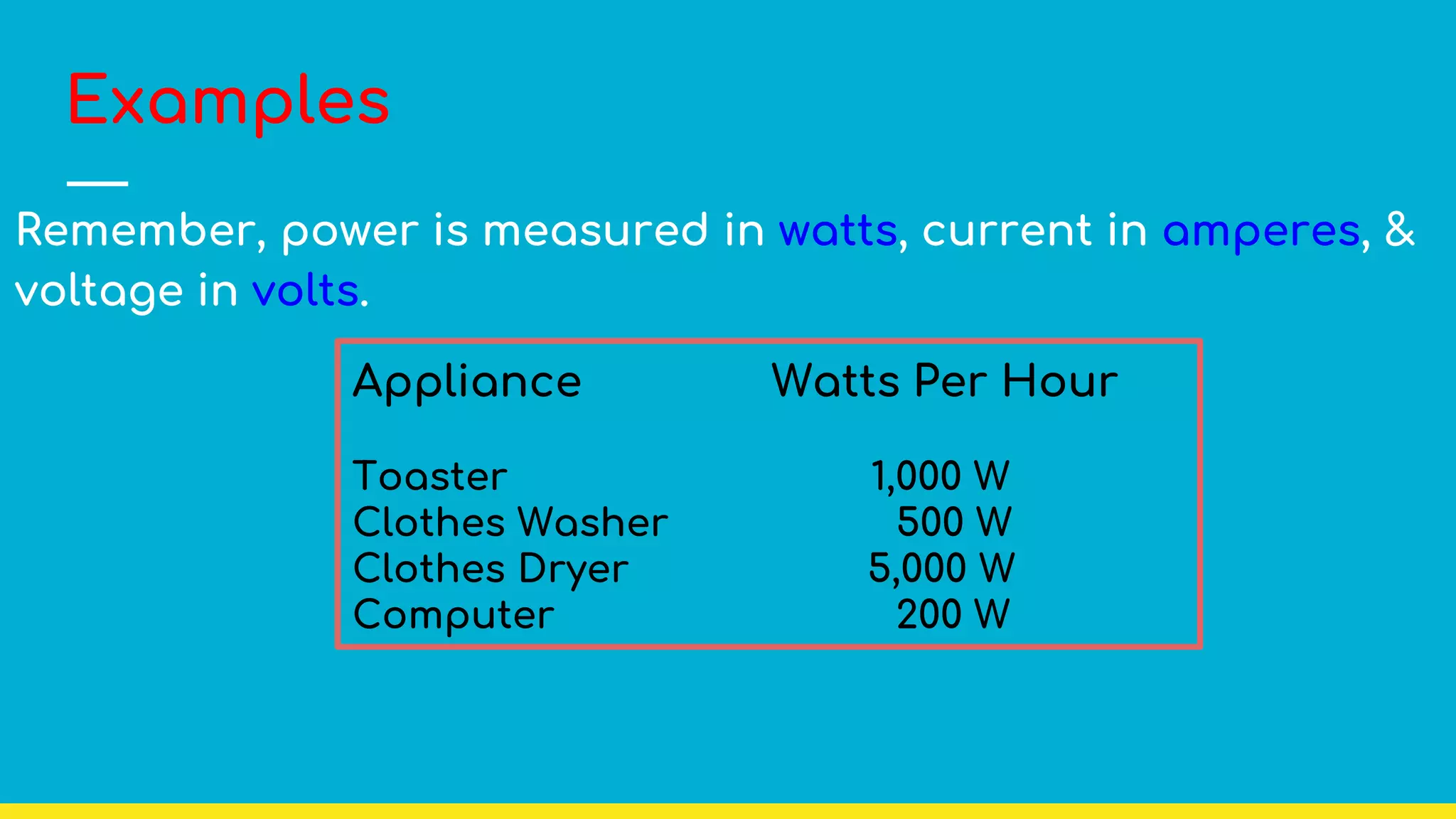
Remember, power is measured in watts, current in amperes, &
voltage in volts.
Appliance Watts Per Hour
Toaster 1,000 W
Clothes Washer 500 W
Clothes Dryer 5,000 W
Computer 200 W
Conservation of Energy in Circuits
Electrical energy also follows the law of the conservation of
energy. So where does the energy from a battery go? As the
current travels through a circuit, electrical energy is
converted to thermal energy, light, or kinetic energy, such as
the movement of a battery-powered toy.
Magnetic Force
Magnets
Remember that a magnet has a positive & a negative end, or
pole (a pole is a strongly charged region of a magnet).
Magnetic force is the attractive & repulsive force between
poles. Opposite charged poles attract & like charged poles
repel (just like electrical charges).
Sometimes referred to as North &
South Pole
Magnetic Fields
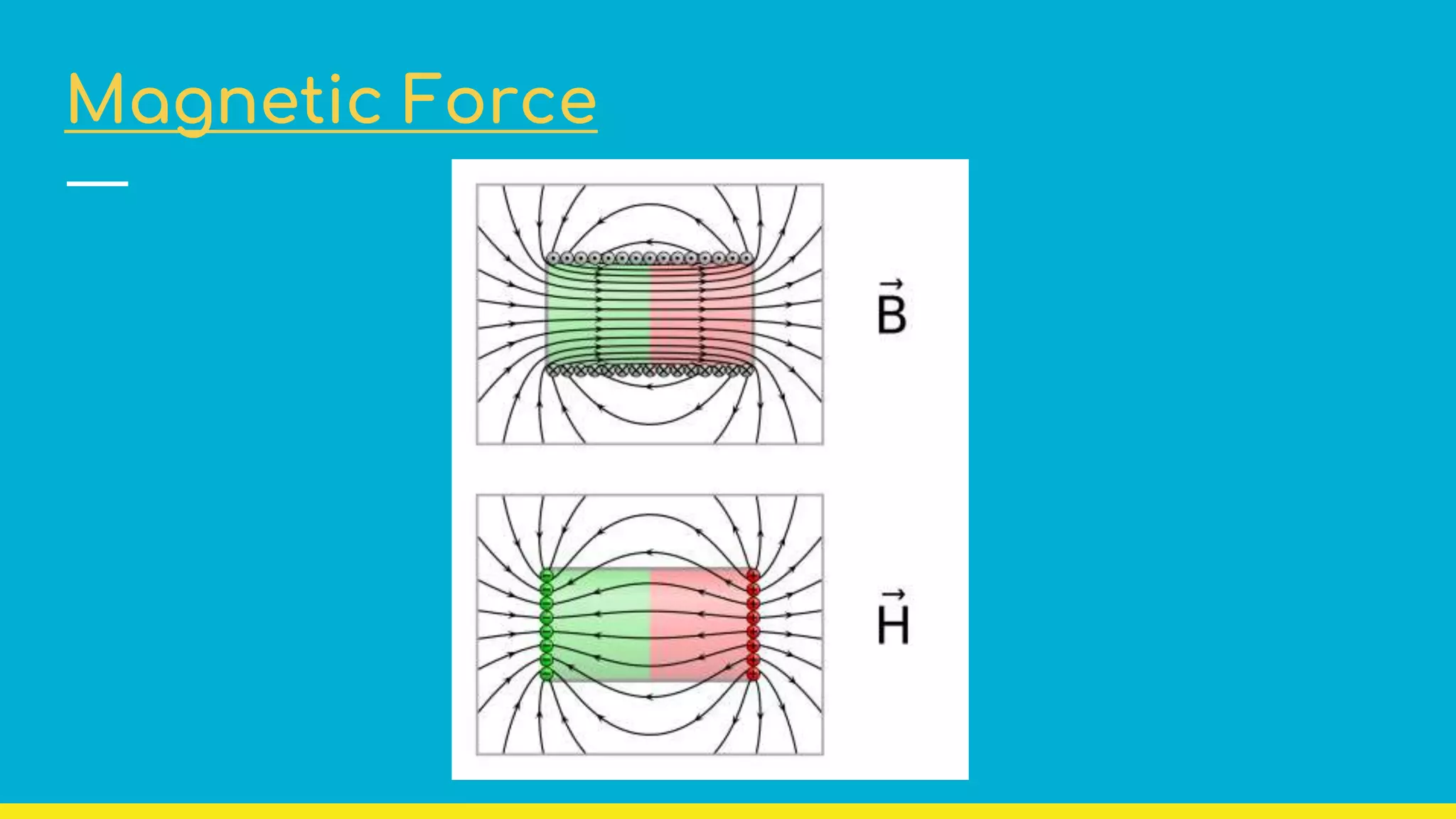
The area around a magnet that exhibits magnetic force is
called a magnetic field. Magnetic field lines show the direction
& strength of the magnetic field. Magnetic field lines go from
the north to south pole, & the closer the field lines are, the
stronger the force.
Electromagnetism
Electric charges in motion creates magnetic fields. Because a
current is a moving charge, any wire that has an electrical
current flowing through it is also surrounded by a magnetic
field. When a current-carrying wire is wrapped in a coil, the
magnetic field lines around each piece of wire create a
stronger magnetic field. The more times the wire is wrapped
around the coil, the stronger the magnetic field.
Earth Magnetics: North & South Poles
The Earth is like a giant magnet & has a magnetic field, too. A
compass needle is actually a small magnet, which has a north
pole & a south pole. When a compass is pointing north, it is
actually the south pole of the compass´s magnet being
attracted to the magnetic North Pole, which is how the North
& South Poles got their names.
Motors
Because a current-carrying wire has a magnetic field, the wire
can either be attracted to or repelled by other magnets. Some
motors use the attractive & repulsive forces between current-
carrying wire & magnets to create movement in the wire. When
the current-carrying wire is made into a loop & placed in a
magnetic field, it continually spins, which creates kinetic
energy that can be transformed into electric energy.
Motors Definition
motors: a device that
converts electric energy
into kinetic energy
Concepts in Comparison
Using the same concept (but reversed), we can transform
mechanical kinetic energy into electric energy by moving a
wire through a magnetic field (or moving a magnet through a
coil of wire). By doing so, we cause electrons to move, creating
current.
What is a Generator?
A generator turns the kinetic energy of a wire in a magnetic
field into electricity. In a generator, a power source spins a
loop of wire through a magnetic field, producing a current in
the loop, a process called electromagnetic induction. Power
plants use generators to create electricity, & a variety of
sources provide the kinetic energy used to rotate the coils of
wire through a magnetic field.
Generators Definition
generator: a device that
converts kinetic energy into
electric energy
Question 1
Which pole of a compass needle points north?
The south pole of the needle (opposite poles
attract).
Question 2
Two wires each have a current running through
them & are placed next to each other. Will one
wire be affected by a force from the other, & if so,
why?
Yes, it will be affected by a force from the other wire
because both wires have a current running through
them & therefore both have magnetic fields.
Question 3
How does an electric field change with distance &
increasing change?
Electric fields get weaker with increasing distance
from the charge, & the larger the charge, the
stronger the field.
Question 4
You have to change the lightbulb in a flashlight, &
the new lightbulb has a larger resistance. If the
voltage of the battery doesn´t change, what
happens to the current going through the
flashlight?
V = IR, so if resistance increases & voltage stays the
same, there is less current.
Question 5
When does an atom have a negative charge?
An atom is negatively charged when it has more
electrons than protons.
Question 6
If you place a negatively charged hairbrush close
to your hair, what kind of charge will your hair
have?
The negative charge on the hairbrush will induce a
positive charge on your hair. As a result, your hair
will be attracted to the brush (& repelled by other
strands of hair.
Question 7
What happens to the resistance of a wire as it gets
wider?
As a wire gets wider, it has less resistance.
Question 8
What happens to the resistance of a wire as it gets
longer?
As a wire gets longer, it has more resistance.
Question 9
If Christmas tree lights are wired in a series, & one
burns out, do all of the other lights go out as well?
If the lights are in series, & one burns out, all of the
others go out as well because the circuit is broken;
it is no longer a closed loop.
Question 10
If Christmas tree lights are wired in a parallel, &
one burns out, do all of the other lights go out as
well?
If the lights are wired in parallel, the electricity can
still flow in a closed loop through the other lights,
so the lights continue to work.

Electricity & Magnetism

  • 1.
    Electricity & Magnetism ByEmmanuel Dikolelay
  • 2.
    Introduction Electricity & Magnetismare intertwined because they are both caused by the interaction of positive & negative charges in matter. When charges in matter interact, they can produce both electric & magnetic forces.
  • 3.
  • 4.
    Electric Charge &Force All atoms have electrons, which are negatively charged particles, & protons, which are positively charged particles. When the number of protons & electrons in an atom are the same, the positive & negative charges cancel each other out & the atom is neutral.
  • 5.
    Positive & NegativeCharges However, atoms lose & gain electrons pretty easily. When an atom gains electrons, it has more negative than positive charges, so it carries a negative charge. When an atom loses electrons, it becomes positively charged. Positively & negatively charged atoms are called ions.
  • 6.
    Electric Forces Because likecharges repel & unlike charges attract, ions create attractive & repulsive forces, called electric forces. The negative electrons want to move to where it´s more positive. And that's what electricity is all about: the flow of electrons!
  • 7.
    Electric Forces (cont.) Thesize of the electric force depends on how changed the atoms are & how far apart they are. Electric force increases with increasing charges & decreasing distance between charges.
  • 8.
    Static Electricity/Charge Electrons moverelatively easily from one atom to another. When an electric charge builds up on an object & transfers from one body to another it is called a static charge or static electricity. Things rubbing together, like rubbing a balloon on your hair, can create static charges because you´re literally rubbing the electrons off your hair & onto the balloon!
  • 9.
    Static/Electrical Discharge When youfeel an electric shock, you´re experiencing the opposite, the quick discharge of electrons, called an electric discharge or static discharge. Lightning is actually an enormous electric discharge.
  • 10.
    Electric Fields The areaaround an electric charge that experiences the force exerted by that charge is called an electric field. The farther you are from the charge, the weaker the field is; an electric field gets stronger as you get closer to the charge. Also, the larger the charge is, the larger the field is. Electric field lines show the direction of the electric force, & the field lines point toward a negative charge & away from a positive charge.
  • 11.
    Explanation electric field: thearea around an electric charge that experiences the force exerted by the electric charge
  • 12.
    Induction When you placea charged object near another object, it can cause the nearby objects to become charged as well. For example, if you put a balloon that is negatively charged close to a wall, the balloon will repel other electrons in that part of the wall, pushing them away from the surface, & creating a localized temporary positive charge. Sometimes you can get a balloon to stick to a wall or window because of this temporary change. The separation of charges caused by a electric field called induction.
  • 13.
    Definition induction: the separationof charges caused by an electric field
  • 14.
    Insulators & Conductors Aninsulator is a material that doesn´t allow electrons to move easily, so charges don´t flow. A conductor on the other hand, is a material that is good at transmitting energy because it is made of a material through which electrons move easily. Gold, copper, & most other metals are good conductors while insulators include glass, plastic, rubber, porcelain, & styrofoam. Usually, electrical wires are made of a conductor wrapped in an insulator, like plastic, to prevent the electricity from flowing into other conductors, such as your body. OUCH!
  • 15.
    Resistors A resistor issomething that resists the flow of electrons but still lets them through. They usually heat up, light up, or both when electrons flow through them. Examples include the thin wire (filament) in a regular light bulb, the heating coils in your toaster, & even the human body.
  • 16.
    Electric Current When electriccharges move, they create an electric current. Electric current is measured by the amount of charge that flows by a certain point every second, & the SI unit for electric current is an ampere (A), or amp. electric current: the number of electrons that pass a given point in a certain amount of time
  • 17.
    Types of Currents Thereare 2 types of current: direct current (DC): the electric charges in the current move in one direction the entire time, like the electrical current created by a battery alternating current (AC): a flow of electrical charges that alternate direction periodically. The electricity from an outlet provides AC current.
  • 18.
    Electrical Circuit An electriccurrent will continuously flow if the charges can travel in a closed conducting loop, called a circuit. The electric field keeps the charge moving.
  • 19.
  • 20.
    Electrical Conductor Electrical conductor,such as a wire, which connects to the power source to form a closed loop (a connection with no openings or breaks).
  • 21.
    Load Load (not necessary,but usually there), a device that the circuit is powering, like a lightbulb, fan, or speaker.
  • 22.
    Power Source Power Sourceof electrical energy, such as a battery.
  • 23.
    Switch Switch (not necessary,but frequently there), a device to open & close a circuit. For example, a draw bridge on a road.
  • 24.
    Series Circuit If anelectron is like a car, a circuit is like the road: The circuit provides an electron with all the path it can take. When there is only one way an electron can travel through a circuit, the circuit is called a series circuit. In a series circuit, all of the current flows in one direction through every element in the circuit, & if the circuit is opened at any point, the electrical flow in the entire circuit will stop. So, if a lightbulb in a circuit burns out, causing a break in the circuit, electricity will stop flowing.
  • 25.
  • 26.
    Parallel Circuit A parallelcircuit is like traveling on a road with a fork in it, a car can take either a right or left. In a parallel circuit, the electrons can take more than one path. When one path is broken, the current can continue to flow because the electrons still have an alternate path to follow.
  • 27.
  • 28.
    Batteries Batteries provide theenergy source that pushes the electric charges around a circuit. When connected to a circuit, a battery creates an electric field with a positive & negative terminal at each end of the battery (which is the + or - sign you see on different sides of the battery). The electrons, which are the moving charges in a current, are attracted to the positive terminal & repelled by the negative terminal. They travel like traffic on a road (as long as the circuit is a closed loop).
  • 29.
    Voltage The energy offlowing electrons in a circuit is called voltage. Voltage, measured in volts (v), is the electric potential difference between two points in a circuit, such as the positive & negative terminals of a battery. Voltage provides potential energy to an electron, just like gravity provides potential energy to a ball held above the ground. The higher the voltage, the greater the potential difference, & the more energy the current can supply. So a 9-volt battery will make a small lightbulb glow much lighter brighter than a AA battery would (which is 15 volts).
  • 30.
    Voltage Definition voltage: theamount of potential energy an electron in a circuit can gain
  • 31.
    Resistance As electrons movein a current, they can bump into things, which makes it harder to travel. Resistance, measured in ohms (abbreviated as R & symbolized as ), measures how difficult it is for electrons to travel through something, in other words, the resistance to flow.
  • 32.
    Resistance: Wires Wires withless resistance can hold more efficient circuits, energy in high-resistance wires can be lost in the form of thermal energy from collisions. Resistance in a wire increases as the wire gets thinner &/or longer.
  • 33.
    Example Think of awire like a water hose; As the hose gets longer &/or narrower, the water has a harder time making it through the hose. Longer &/or narrower hoses have more resistance to flow. The same rules apply for a wire.
  • 34.
    Another Example A lightbulbprovides resistance in a circuit: The filament of a lightbulb is really thin, & as electrons flow through the filament, they collide & heat up the filament, releasing energy in the form of heat & light.
  • 35.
    Ohm's Law Ohm's Lawshows the relationship between the voltage, current, & resistance in a circuit. Sometimes in the formula, current can sometimes be abbreviated as I. voltage = current x resistance
  • 36.
    Measurements Voltage is measuredin volts (V), current in ampere (A), & resistance in ohms (). Ohm's Law shows that if voltage increases, current, resistance, or both will increase as well. It also shows that if voltage stays the same: When resistance decreases, current increases When resistance increases, current decreases
  • 37.
    Electric Power Power isthe rate at which electrical energy is transformed into other forms of energy; for example, the power of a toaster is the rate at which the toaster converts electricity into heat. The equation for power is: current = voltage x power
  • 38.
    Examples Remember, power ismeasured in watts, current in amperes, & voltage in volts. Appliance Watts Per Hour Toaster 1,000 W Clothes Washer 500 W Clothes Dryer 5,000 W Computer 200 W
  • 39.
    Conservation of Energyin Circuits Electrical energy also follows the law of the conservation of energy. So where does the energy from a battery go? As the current travels through a circuit, electrical energy is converted to thermal energy, light, or kinetic energy, such as the movement of a battery-powered toy.
  • 40.
  • 41.
    Magnets Remember that amagnet has a positive & a negative end, or pole (a pole is a strongly charged region of a magnet). Magnetic force is the attractive & repulsive force between poles. Opposite charged poles attract & like charged poles repel (just like electrical charges). Sometimes referred to as North & South Pole
  • 42.
    Magnetic Fields The areaaround a magnet that exhibits magnetic force is called a magnetic field. Magnetic field lines show the direction & strength of the magnetic field. Magnetic field lines go from the north to south pole, & the closer the field lines are, the stronger the force.
  • 43.
    Electromagnetism Electric charges inmotion creates magnetic fields. Because a current is a moving charge, any wire that has an electrical current flowing through it is also surrounded by a magnetic field. When a current-carrying wire is wrapped in a coil, the magnetic field lines around each piece of wire create a stronger magnetic field. The more times the wire is wrapped around the coil, the stronger the magnetic field.
  • 44.
    Earth Magnetics: North& South Poles The Earth is like a giant magnet & has a magnetic field, too. A compass needle is actually a small magnet, which has a north pole & a south pole. When a compass is pointing north, it is actually the south pole of the compass´s magnet being attracted to the magnetic North Pole, which is how the North & South Poles got their names.
  • 45.
    Motors Because a current-carryingwire has a magnetic field, the wire can either be attracted to or repelled by other magnets. Some motors use the attractive & repulsive forces between current- carrying wire & magnets to create movement in the wire. When the current-carrying wire is made into a loop & placed in a magnetic field, it continually spins, which creates kinetic energy that can be transformed into electric energy.
  • 46.
    Motors Definition motors: adevice that converts electric energy into kinetic energy
  • 47.
    Concepts in Comparison Usingthe same concept (but reversed), we can transform mechanical kinetic energy into electric energy by moving a wire through a magnetic field (or moving a magnet through a coil of wire). By doing so, we cause electrons to move, creating current.
  • 48.
    What is aGenerator? A generator turns the kinetic energy of a wire in a magnetic field into electricity. In a generator, a power source spins a loop of wire through a magnetic field, producing a current in the loop, a process called electromagnetic induction. Power plants use generators to create electricity, & a variety of sources provide the kinetic energy used to rotate the coils of wire through a magnetic field.
  • 49.
    Generators Definition generator: adevice that converts kinetic energy into electric energy
  • 50.
    Question 1 Which poleof a compass needle points north? The south pole of the needle (opposite poles attract).
  • 51.
    Question 2 Two wireseach have a current running through them & are placed next to each other. Will one wire be affected by a force from the other, & if so, why? Yes, it will be affected by a force from the other wire because both wires have a current running through them & therefore both have magnetic fields.
  • 52.
    Question 3 How doesan electric field change with distance & increasing change? Electric fields get weaker with increasing distance from the charge, & the larger the charge, the stronger the field.
  • 53.
    Question 4 You haveto change the lightbulb in a flashlight, & the new lightbulb has a larger resistance. If the voltage of the battery doesn´t change, what happens to the current going through the flashlight? V = IR, so if resistance increases & voltage stays the same, there is less current.
  • 54.
    Question 5 When doesan atom have a negative charge? An atom is negatively charged when it has more electrons than protons.
  • 55.
    Question 6 If youplace a negatively charged hairbrush close to your hair, what kind of charge will your hair have? The negative charge on the hairbrush will induce a positive charge on your hair. As a result, your hair will be attracted to the brush (& repelled by other strands of hair.
  • 56.
    Question 7 What happensto the resistance of a wire as it gets wider? As a wire gets wider, it has less resistance.
  • 57.
    Question 8 What happensto the resistance of a wire as it gets longer? As a wire gets longer, it has more resistance.
  • 58.
    Question 9 If Christmastree lights are wired in a series, & one burns out, do all of the other lights go out as well? If the lights are in series, & one burns out, all of the others go out as well because the circuit is broken; it is no longer a closed loop.
  • 59.
    Question 10 If Christmastree lights are wired in a parallel, & one burns out, do all of the other lights go out as well? If the lights are wired in parallel, the electricity can still flow in a closed loop through the other lights, so the lights continue to work.

Editor's Notes