Static Electricity The  build up  of an electric charge on the  surface  of an object. The charge builds up but  does not flow. Static electricity is  potential energy . It does  not  move.  It is  stored .
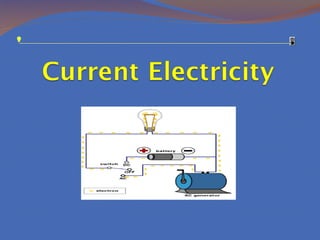
Electricity that  moves … Current : The flow of electrons from one place to another. Measured in  amperes  (amps) Kinetic  energy
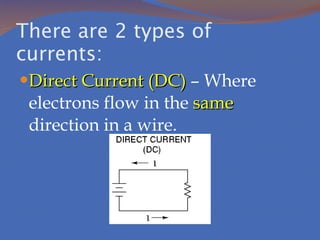
There are 2 types of currents: Direct Current (DC)  – Where electrons flow in the  same  direction in a wire.
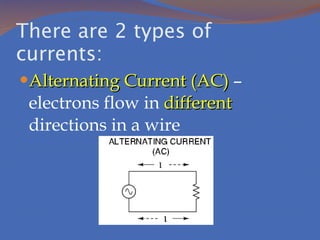
There are 2 types of currents: Alternating Current (AC)  – electrons flow in  different  directions in a wire
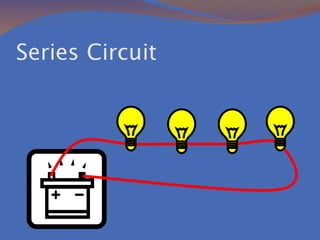
There are 2 types of circuits: Series Circuit : the components are lined up along  one  path.  If the circuit is broken,  all  components turn off.
 
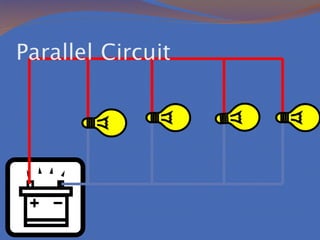
There are 2 types of circuits: Parallel Circuit  – there are  several  branching paths to the components.  If the circuit is broken at any one branch,  only the components on that branch will turn off .
 
Conductors vs. Insulators Conductors  – material through which electric current flows  easily . Insulators  – materials through which electric current  cannot move .
Examples Conductors : Metal Water Insulators : Styrofoam Rubber Plastic Paper
What is Resistance? The  opposition  to the flow of an electric current, producing  heat . The  greater  the resistance, the  less  current gets through. Good  conductors have  low  resistance. Measured in  ohms.
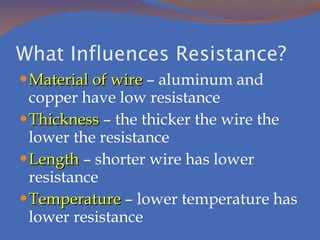
What Influences Resistance? Material of wire  – aluminum and copper have low resistance Thickness  – the thicker the wire the lower the resistance Length  – shorter wire has lower resistance Temperature  – lower temperature has lower resistance
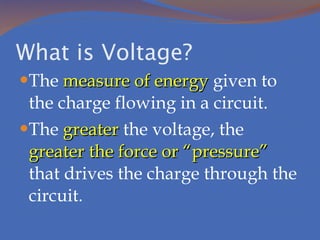
What is Voltage? The  measure of energy  given to the charge flowing in a circuit. The  greater  the voltage, the  greater the force or “pressure”  that drives the charge through the circuit.
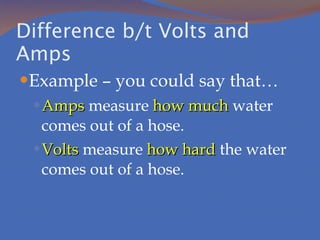
Difference b/t Volts and Amps Example – you could say that… Amps  measure  how much  water comes out of a hose. Volts  measure  how hard  the water comes out of a hose.
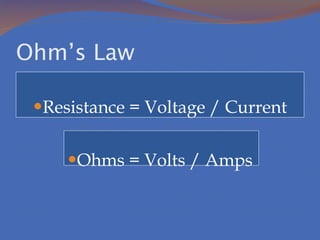
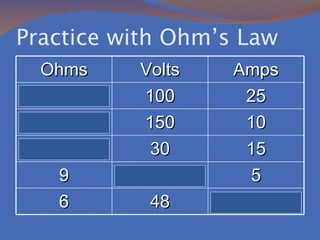
Ohm’s Law Resistance = Voltage / Current Ohms = Volts / Amps
Practice with Ohm’s Law Ohms Volts Amps 4 100 25 15 150 10 2 30 15 9 45 5 6 48 8
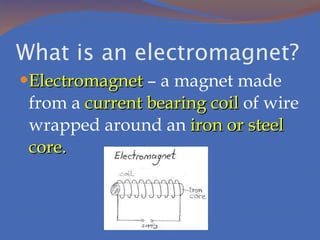
What is an electromagnet? Electromagnet  – a magnet made from a  current bearing coil  of wire wrapped around an  iron or steel core.
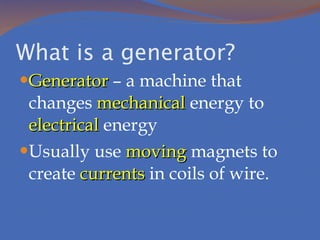
What is a generator? Generator  – a machine that changes  mechanical  energy to  electrical  energy Usually use  moving  magnets to create  currents  in coils of wire.
What is a motor? Motor  – a device that changes  electrical  energy to  mechanical  energy that can do  work .

Electri

  • 1.
  • 2.
    Static Electricity The build up of an electric charge on the surface of an object. The charge builds up but does not flow. Static electricity is potential energy . It does not move. It is stored .
  • 3.
    Electricity that moves … Current : The flow of electrons from one place to another. Measured in amperes (amps) Kinetic energy
  • 4.
    There are 2types of currents: Direct Current (DC) – Where electrons flow in the same direction in a wire.
  • 5.
    There are 2types of currents: Alternating Current (AC) – electrons flow in different directions in a wire
  • 6.
    There are 2types of circuits: Series Circuit : the components are lined up along one path. If the circuit is broken, all components turn off.
  • 7.
  • 8.
    There are 2types of circuits: Parallel Circuit – there are several branching paths to the components. If the circuit is broken at any one branch, only the components on that branch will turn off .
  • 9.
  • 10.
    Conductors vs. InsulatorsConductors – material through which electric current flows easily . Insulators – materials through which electric current cannot move .
  • 11.
    Examples Conductors :Metal Water Insulators : Styrofoam Rubber Plastic Paper
  • 12.
    What is Resistance?The opposition to the flow of an electric current, producing heat . The greater the resistance, the less current gets through. Good conductors have low resistance. Measured in ohms.
  • 13.
    What Influences Resistance?Material of wire – aluminum and copper have low resistance Thickness – the thicker the wire the lower the resistance Length – shorter wire has lower resistance Temperature – lower temperature has lower resistance
  • 14.
    What is Voltage?The measure of energy given to the charge flowing in a circuit. The greater the voltage, the greater the force or “pressure” that drives the charge through the circuit.
  • 15.
    Difference b/t Voltsand Amps Example – you could say that… Amps measure how much water comes out of a hose. Volts measure how hard the water comes out of a hose.
  • 16.
    Ohm’s Law Resistance= Voltage / Current Ohms = Volts / Amps
  • 17.
    Practice with Ohm’sLaw Ohms Volts Amps 4 100 25 15 150 10 2 30 15 9 45 5 6 48 8
  • 18.
    What is anelectromagnet? Electromagnet – a magnet made from a current bearing coil of wire wrapped around an iron or steel core.
  • 19.
    What is agenerator? Generator – a machine that changes mechanical energy to electrical energy Usually use moving magnets to create currents in coils of wire.
  • 20.
    What is amotor? Motor – a device that changes electrical energy to mechanical energy that can do work .