Electricity SNC1D0
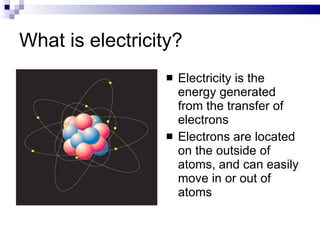
What is electricity? Electricity is the energy generated from the transfer of electrons Electrons are located on the outside of atoms, and can easily move in or out of atoms
Electric Charges When objects have no loss or gain of electrons, they can be considered “neutral” When an object gains electrons, it becomes “negatively” charged When an object loses electrons, it becomes “positively” charged
Law of Electric Charges “ Like charges repel one another, and unlike charges attract one another.” An object with opposite charges will attract each other A charged object and a neutral object will attract each other Same charged objects repel each other Neutral objects have no effect on each other
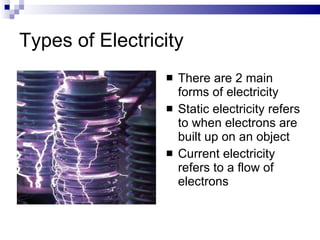
Types of Electricity There are 2 main forms of electricity Static electricity refers to when electrons are built up on an object Current electricity refers to a flow of electrons
Conductors and Insulators Conductors are materials that allow electrons to flow freely through them (metals) Insulators are materials that do not allow easy flow of electrons (rubber, plastics)
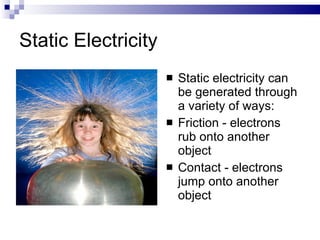
Static Electricity Static electricity can be generated through a variety of ways: Friction - electrons rub onto another object Contact - electrons jump onto another object
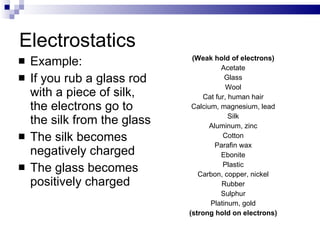
Electrostatics Electrostatics refers to the ability for something to hold onto electrons, the study of static electricity Something with a greater hold on electrons can “steal” electrons from something with a weaker hold (Weak hold of electrons) Acetate Glass Wool Cat fur, human hair Calcium, magnesium, lead Silk Aluminum, zinc Cotton Parafin wax Ebonite Plastic Carbon, copper, nickel Rubber Sulphur Platinum, gold (strong hold on electrons)
Electrostatics Example: If you rub a glass rod with a piece of silk, the electrons go to the silk from the glass The silk becomes negatively charged The glass becomes positively charged (Weak hold of electrons) Acetate Glass Wool Cat fur, human hair Calcium, magnesium, lead Silk Aluminum, zinc Cotton Parafin wax Ebonite Plastic Carbon, copper, nickel Rubber Sulphur Platinum, gold (strong hold on electrons)
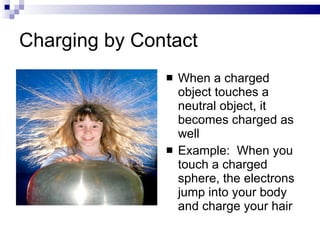
Charging by Contact When a charged object touches a neutral object, it becomes charged as well Example:  When you touch a charged sphere, the electrons jump into your body and charge your hair
Method of Creating Static Charges
Current Electricity Current electricity refers to a flow of electrons A continuous source of electrons flow from one place to another

Electricity

  • 1.
  • 2.
    What is electricity?Electricity is the energy generated from the transfer of electrons Electrons are located on the outside of atoms, and can easily move in or out of atoms
  • 3.
    Electric Charges Whenobjects have no loss or gain of electrons, they can be considered “neutral” When an object gains electrons, it becomes “negatively” charged When an object loses electrons, it becomes “positively” charged
  • 4.
    Law of ElectricCharges “ Like charges repel one another, and unlike charges attract one another.” An object with opposite charges will attract each other A charged object and a neutral object will attract each other Same charged objects repel each other Neutral objects have no effect on each other
  • 5.
    Types of ElectricityThere are 2 main forms of electricity Static electricity refers to when electrons are built up on an object Current electricity refers to a flow of electrons
  • 6.
    Conductors and InsulatorsConductors are materials that allow electrons to flow freely through them (metals) Insulators are materials that do not allow easy flow of electrons (rubber, plastics)
  • 7.
    Static Electricity Staticelectricity can be generated through a variety of ways: Friction - electrons rub onto another object Contact - electrons jump onto another object
  • 8.
    Electrostatics Electrostatics refersto the ability for something to hold onto electrons, the study of static electricity Something with a greater hold on electrons can “steal” electrons from something with a weaker hold (Weak hold of electrons) Acetate Glass Wool Cat fur, human hair Calcium, magnesium, lead Silk Aluminum, zinc Cotton Parafin wax Ebonite Plastic Carbon, copper, nickel Rubber Sulphur Platinum, gold (strong hold on electrons)
  • 9.
    Electrostatics Example: Ifyou rub a glass rod with a piece of silk, the electrons go to the silk from the glass The silk becomes negatively charged The glass becomes positively charged (Weak hold of electrons) Acetate Glass Wool Cat fur, human hair Calcium, magnesium, lead Silk Aluminum, zinc Cotton Parafin wax Ebonite Plastic Carbon, copper, nickel Rubber Sulphur Platinum, gold (strong hold on electrons)
  • 10.
    Charging by ContactWhen a charged object touches a neutral object, it becomes charged as well Example: When you touch a charged sphere, the electrons jump into your body and charge your hair
  • 11.
    Method of CreatingStatic Charges
  • 12.
    Current Electricity Currentelectricity refers to a flow of electrons A continuous source of electrons flow from one place to another