ELECTRICIT
Y• How do voltage and resistance affect
electric current?
• What are the safety precautions needed in
using electricity?
CURRENT
& VOLTAGE
CIRCUIT
Is any arrangement of materials
that provides a path for electrons
to flow.
It consists of a source of electrical
energy, connecting wires and a
load.
ELECTRIC
CURRENT
-> is the movement of charged particles in a
specific direction.
-> is a measure of the number of electrical
charges passing through a cross section of a
conductor in a given time.
I =
𝑞
𝑡
Where: I = current
q = electrical Charge
t = time
What is the direction
of current?
CONVENTIONAL CURRENT OR SIMPLY
CURRENT
-> is the movement of charges from the
positive side of the battery to the negative
side.
ELECTRON CURRENT
-> is the direction of the flow of electrons is
from the negative terminal to the positive
terminal.
**The direction of current does not affect what
the current does.
ELECTRIC
CURRENT
 The unit, ampere (A), is named after
Andre-Marie Ampere, a French physicist
who made important contributions to the
theory of electricity and magnetism.
 1 ampere means that there is 1 coulomb of
charge passing through a cross section of a
wire every 1 second.
ammeter measures electric current or
measures how much charges flow in a
certain cross section at a given time, it has
to be connected in series.
Shows how the ammeter is connected in a circuit.
The positive terminal of an ammeter is connected
to the positive terminal of the energy source (e.g.
battery) while the negative terminal is connected to
the negative terminal of the energy source.
ELECTRIC
CURRENT
May be:
1. Direct Current (DC)
2. Alternating Current (AC)
What makes the
charges move in a
closed circuit?
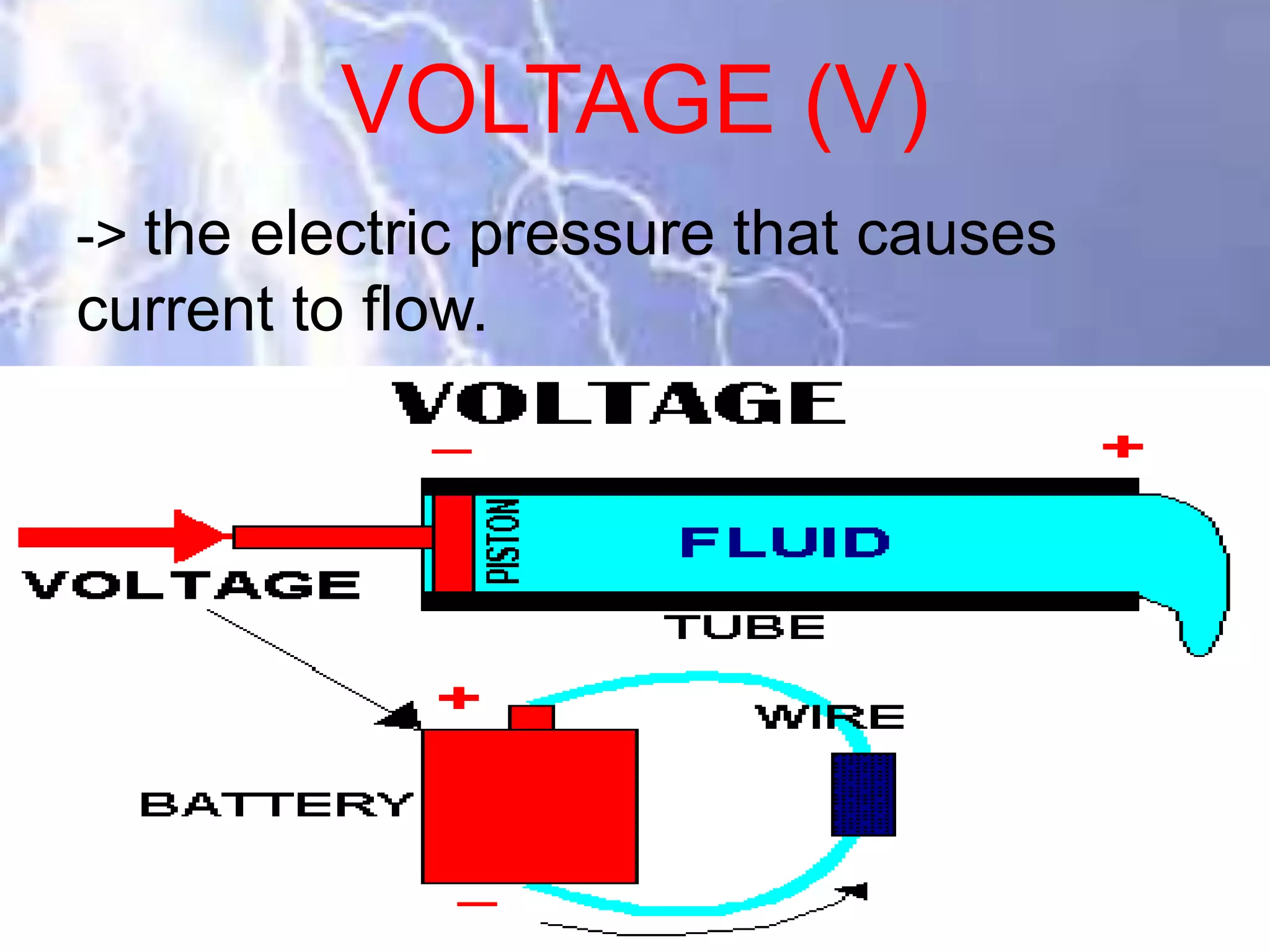
VOLTAGE (V)
-> the electric pressure that causes
current to flow.
VOLTAGE (V)
-> is the potential difference between two points in an
electric field.
-> is the work done on the charges as it passes through a
load is measured as the voltage across the load.
V=
Where: V = voltage
W = Work
q = charge
*A voltmeter measures voltage.
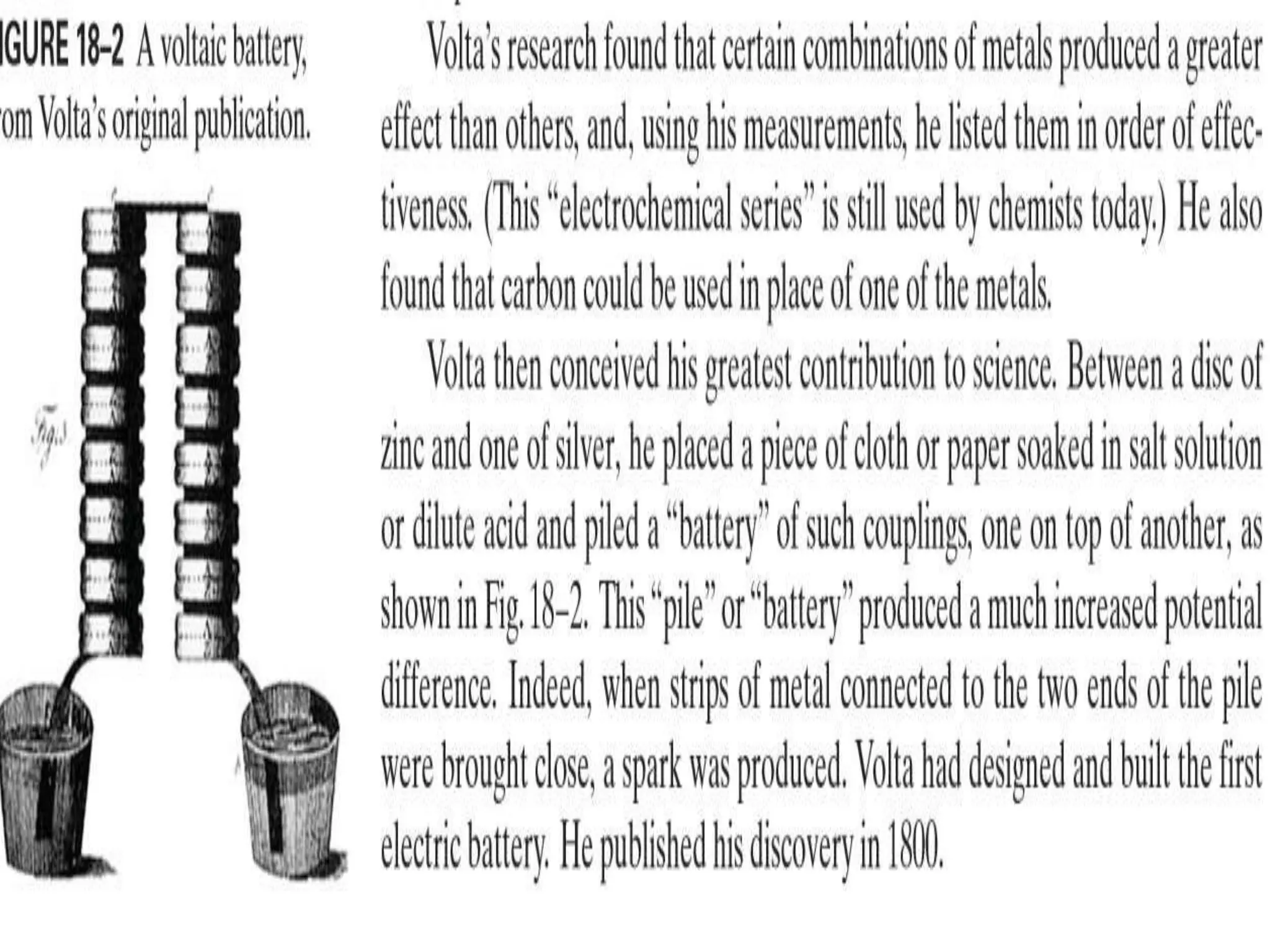
*The unit of voltage is volt (V), named after Alessandro Volta
who invented the voltaic pile, the forerunner of what we now
call the dry cell.
𝑊
𝑞
VOLTAGE (V)
The voltmeter must be connected parallel or
across the load. The positive terminal of a
voltmeter is connected to the positive terminal of
the bulb while the negative terminal is connected
to the negative terminal of the bulb.
Calculating Current and Voltage
Samples:
1. A charge of 825 coulombs was passed
through a wire in 1 minute. What was the
average electric current during that
interval?
2. Calculate the Voltage if 300 Joules of
work is used to move a charge of 150 C?
CURRENT &
RESISTANCE
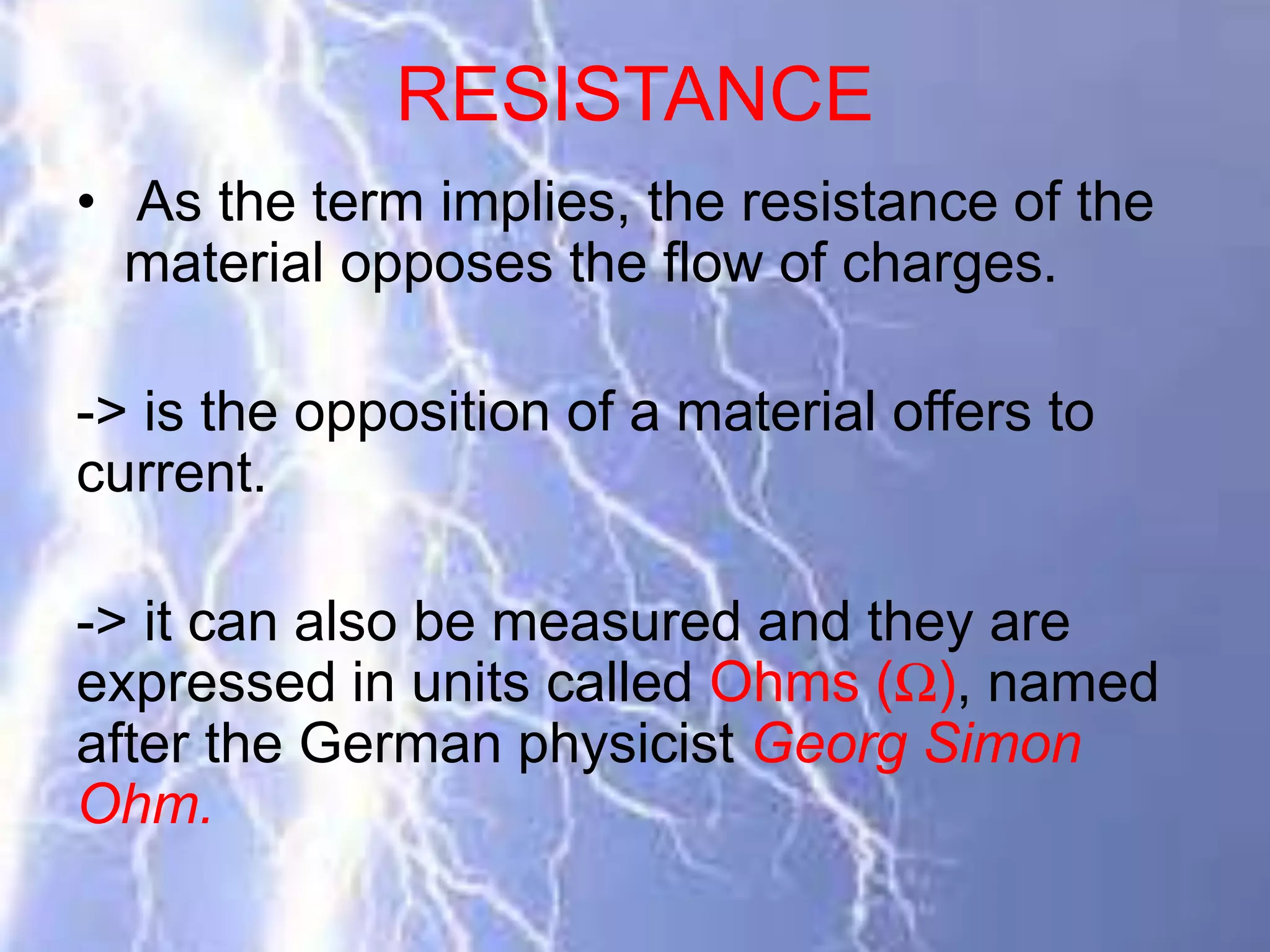
RESISTANCE
• As the term implies, the resistance of the
material opposes the flow of charges.
-> is the opposition of a material offers to
current.
-> it can also be measured and they are
expressed in units called Ohms (Ω), named
after the German physicist Georg Simon
Ohm.
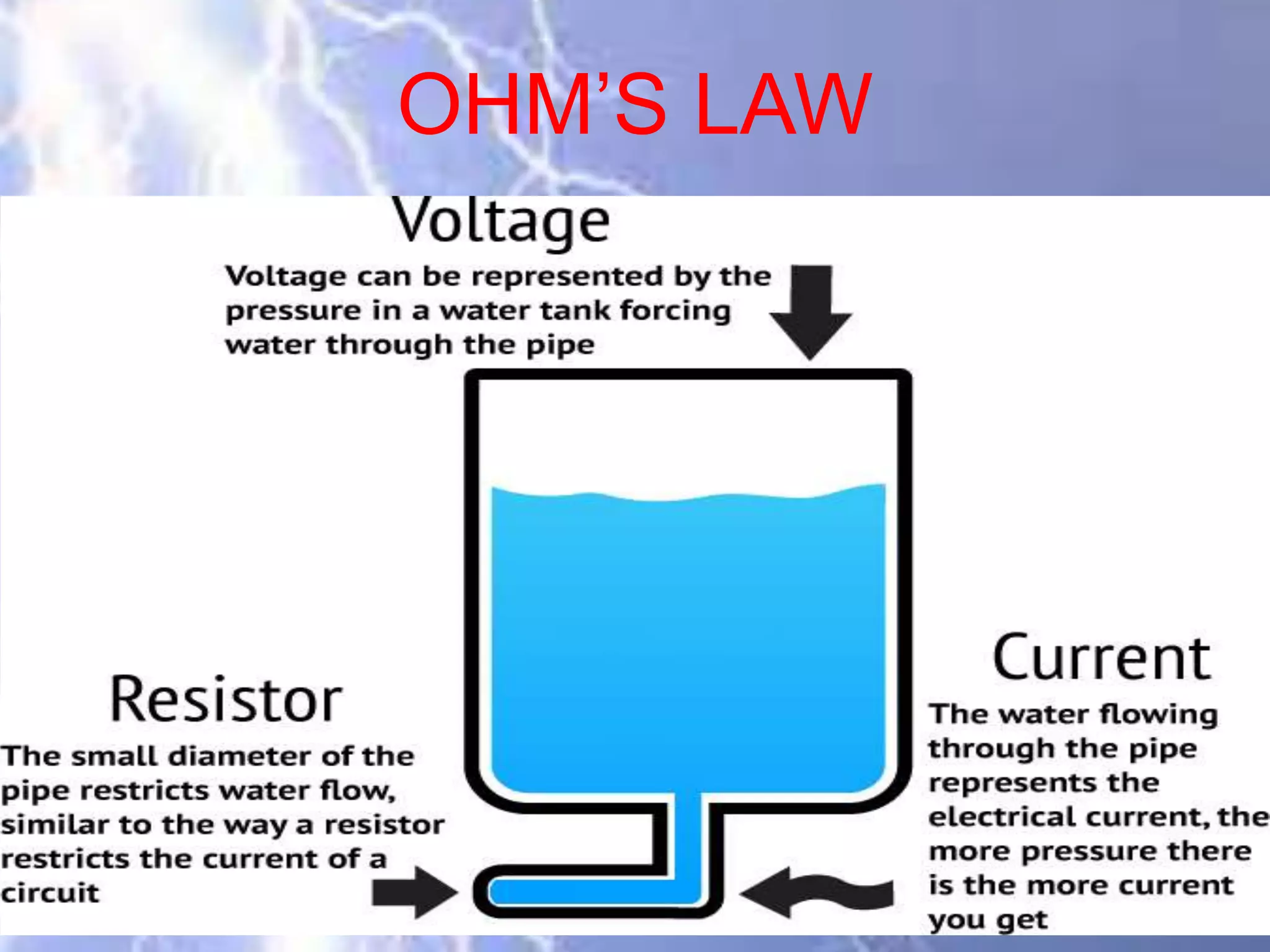
OHM’S LAW
States that “Current is directly proportional
to the Voltage and inversely proportional to
the resistance.”
I =
𝑉
𝑅
Where: I = Current
V = Voltage
R = Resistance
OHM’S LAW
Factors Affect Resistance
1. A lower resistance would mean that there
is less opposition in the flow of charges
and therefore bigger current.
2. Different materials have different
amounts of resistance.
– Conductors definitely have very little resistance
and therefore allow more charges to pass through.
– Insulators are materials that have very high
resistance and therefore flow of charges would be
difficult.
Factors Affect Resistance
3. The length and thickness of the conducting
wire are factors that affect resistance
encountered by current. The longer the wire the
greater will be its resistance and the greater the
cross sectional area (a measure of the thickness
of the wire), the lower will be its resistance.
4. The resistance of an object also changes when
the object becomes wet.
Ex. Dry human skin for instance has a resistance
of 100,000 Ω but when it gets wet its resistance is
reduced to 1,000 Ω .
QUANTITY SYMBOL EQUATION/S SI UNIT OTHER UNIT/S
UNIT NAMED
AFTER
DEVICE USED
TO MEASURE
CURRENT I
I =
𝑞
𝑡
I =
𝑉
𝑅
Ampere
(A)
C/s
(Coulomb per
Second)
V/Ω
(Volt per ohm)
Andre-
Marie
Ampere
Ammeter
VOLTAGE V
V = IR
V =
𝑾
𝒒
Volt
(V)
J/C
(Joule per
Coulomb)
Alessandr
o Volta
Voltmeter
RESISTANCE R R =
𝑽
𝑰
Ohm
(Ω)
V/A
(Volt per Ampere)
Georg
Simon
Ohm
Ohm
meter
OHM’S LAW
ASSIGNMENT
Bring the following by group:
3 connecting wires
2 identical bulbs with holder
2 dry cells with holder
Page 61
Electrical
Connections
TYPES OF CONNECTION
SERIES CONNECTION
-> is the loads are connected to form a
single pathway for electric charges to
pass.
PARALLEL CONNECTION
-> is the loads are connected to form
branches, each of which provides a
Why do wires heat up when
there is too much current?
HEATING EFFECT OF
CURRENT
1. Overloading of the circuit
ex. plugging a lot of appliances in a
common outlet like an extension cord.
2. Short circuits - happen when wires with
defective rubber insulation touch each
other so the current does not pass to the
supposed path it should take.
Why do wires heat up when
there is too much current?
In the wires, the electrons that flow in a
closed circuit collide with the atoms of the
conducting wire. As the collisions take place
the kinetic energy of the metal atoms
increases. The increased kinetic energy of
the atoms is dissipated as heat.
Remember:
The higher the current passing through
the wire, the more collisions between the
electrons and the atoms of the wire take
place. In the end the wire will become
hot.
Stay Safe! 

current, voltage and resistance

  • 1.
    ELECTRICIT Y• How dovoltage and resistance affect electric current? • What are the safety precautions needed in using electricity?
  • 2.
  • 3.
    CIRCUIT Is any arrangementof materials that provides a path for electrons to flow. It consists of a source of electrical energy, connecting wires and a load.
  • 5.
    ELECTRIC CURRENT -> is themovement of charged particles in a specific direction. -> is a measure of the number of electrical charges passing through a cross section of a conductor in a given time. I = 𝑞 𝑡 Where: I = current q = electrical Charge t = time
  • 6.
    What is thedirection of current?
  • 7.
    CONVENTIONAL CURRENT ORSIMPLY CURRENT -> is the movement of charges from the positive side of the battery to the negative side. ELECTRON CURRENT -> is the direction of the flow of electrons is from the negative terminal to the positive terminal. **The direction of current does not affect what the current does.
  • 8.
    ELECTRIC CURRENT  The unit,ampere (A), is named after Andre-Marie Ampere, a French physicist who made important contributions to the theory of electricity and magnetism.  1 ampere means that there is 1 coulomb of charge passing through a cross section of a wire every 1 second. ammeter measures electric current or measures how much charges flow in a certain cross section at a given time, it has to be connected in series.
  • 9.
    Shows how theammeter is connected in a circuit. The positive terminal of an ammeter is connected to the positive terminal of the energy source (e.g. battery) while the negative terminal is connected to the negative terminal of the energy source.
  • 10.
    ELECTRIC CURRENT May be: 1. DirectCurrent (DC) 2. Alternating Current (AC)
  • 11.
    What makes the chargesmove in a closed circuit?
  • 12.
    VOLTAGE (V) -> theelectric pressure that causes current to flow.
  • 13.
    VOLTAGE (V) -> isthe potential difference between two points in an electric field. -> is the work done on the charges as it passes through a load is measured as the voltage across the load. V= Where: V = voltage W = Work q = charge *A voltmeter measures voltage. *The unit of voltage is volt (V), named after Alessandro Volta who invented the voltaic pile, the forerunner of what we now call the dry cell. 𝑊 𝑞
  • 15.
    VOLTAGE (V) The voltmetermust be connected parallel or across the load. The positive terminal of a voltmeter is connected to the positive terminal of the bulb while the negative terminal is connected to the negative terminal of the bulb.
  • 16.
    Calculating Current andVoltage Samples: 1. A charge of 825 coulombs was passed through a wire in 1 minute. What was the average electric current during that interval? 2. Calculate the Voltage if 300 Joules of work is used to move a charge of 150 C?
  • 17.
  • 18.
    RESISTANCE • As theterm implies, the resistance of the material opposes the flow of charges. -> is the opposition of a material offers to current. -> it can also be measured and they are expressed in units called Ohms (Ω), named after the German physicist Georg Simon Ohm.
  • 19.
    OHM’S LAW States that“Current is directly proportional to the Voltage and inversely proportional to the resistance.” I = 𝑉 𝑅 Where: I = Current V = Voltage R = Resistance
  • 20.
  • 21.
    Factors Affect Resistance 1.A lower resistance would mean that there is less opposition in the flow of charges and therefore bigger current. 2. Different materials have different amounts of resistance. – Conductors definitely have very little resistance and therefore allow more charges to pass through. – Insulators are materials that have very high resistance and therefore flow of charges would be difficult.
  • 22.
    Factors Affect Resistance 3.The length and thickness of the conducting wire are factors that affect resistance encountered by current. The longer the wire the greater will be its resistance and the greater the cross sectional area (a measure of the thickness of the wire), the lower will be its resistance. 4. The resistance of an object also changes when the object becomes wet. Ex. Dry human skin for instance has a resistance of 100,000 Ω but when it gets wet its resistance is reduced to 1,000 Ω .
  • 23.
    QUANTITY SYMBOL EQUATION/SSI UNIT OTHER UNIT/S UNIT NAMED AFTER DEVICE USED TO MEASURE CURRENT I I = 𝑞 𝑡 I = 𝑉 𝑅 Ampere (A) C/s (Coulomb per Second) V/Ω (Volt per ohm) Andre- Marie Ampere Ammeter VOLTAGE V V = IR V = 𝑾 𝒒 Volt (V) J/C (Joule per Coulomb) Alessandr o Volta Voltmeter RESISTANCE R R = 𝑽 𝑰 Ohm (Ω) V/A (Volt per Ampere) Georg Simon Ohm Ohm meter
  • 24.
  • 25.
    ASSIGNMENT Bring the followingby group: 3 connecting wires 2 identical bulbs with holder 2 dry cells with holder Page 61
  • 26.
  • 27.
    TYPES OF CONNECTION SERIESCONNECTION -> is the loads are connected to form a single pathway for electric charges to pass. PARALLEL CONNECTION -> is the loads are connected to form branches, each of which provides a
  • 30.
    Why do wiresheat up when there is too much current?
  • 31.
    HEATING EFFECT OF CURRENT 1.Overloading of the circuit ex. plugging a lot of appliances in a common outlet like an extension cord. 2. Short circuits - happen when wires with defective rubber insulation touch each other so the current does not pass to the supposed path it should take.
  • 32.
    Why do wiresheat up when there is too much current? In the wires, the electrons that flow in a closed circuit collide with the atoms of the conducting wire. As the collisions take place the kinetic energy of the metal atoms increases. The increased kinetic energy of the atoms is dissipated as heat.
  • 33.
    Remember: The higher thecurrent passing through the wire, the more collisions between the electrons and the atoms of the wire take place. In the end the wire will become hot.
  • 34.