i. Electricity
ii. Electric Current
iii. Electric Potential & Potential Difference
iv. Electromotive Force (emf)
v. Electric Circuit and components
vi. Current and Voltage Measurements
vii. OHM’s Law
viii. Factors Affecting Resistance
ix. Combination of Resistors(Series &
Parallel)
x. Heating Effect of Electricity and its apps.
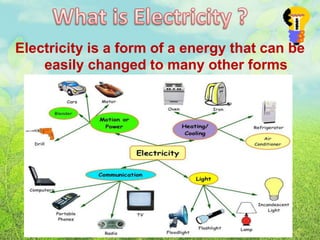
Electricity is a form of a energy that can be
easily changed to many other forms
 Electric Current is the flow of electric charge
 Measured as the rate of flow of electric
charge
 Denoted by I
 I=Q/t
 SI unit -> Amperes(A)
NOTE-Direction of CONVENTIONAL Current is opposite to direction of flow of electrons.
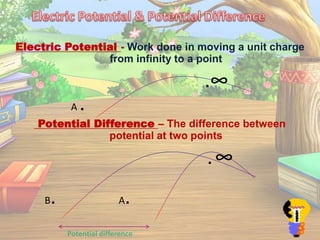
Electric Potential - Work done in moving a unit charge
from infinity to a point
.∞
A .
Potential Difference – The difference between
potential at two points
.∞
B. A.
Potential difference
Final GPE
Initial GPE
Potential
Difference
pd
Electromotive force is the same as
voltage.
E.m.f refers to the amount of energy
supplied by the electric source (eg.
battery) to each unit of electric charge
E.m.f is also measured by a voltmeter
To make an electrical appliance work,
electricity must flow through it.
The path along which the electric
current moves is called the electric
circuit.
Component Symbols – a cell
• The cell stores chemical
energy and transfers it to
electrical energy when a
circuit is connected.
• The long line is the positive end
• The short line is the negative
end
Battery
• When two or more cells
are connected together
we call this a Battery.
• The cells chemical
energy is used up
pushing a current
round a circuit.
• It is important that each
cell faces the right way
Switch
• A switch can be open (as
shown) or closed
• When the switch is
open, the circuit is
incomplete – no
electricity can flow
Bulb / Lamp
• The lamp lights up
when electricity
flows through it
Wires
The wires which carry electricity consist of two parts:
• The metal wires (conductor).
• The plastic coating around the metal wires (insulator).
• Prevents people from being electrocuted.
wires
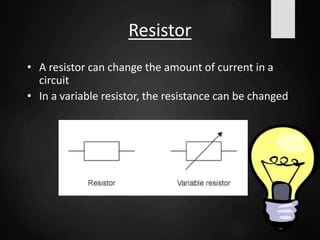
Resistor
• A resistor can change the amount of current in a
circuit
• In a variable resistor, the resistance can be changed.
Fuse
• A fuse is a safety
device
• When the current
is too high, the
fuse breaks
Example
The wire inside a 3A fuse will melt when the current is greater
than 3A.
Circuit Symbols
Voltmeter
Ammeter
Variable Resistor
Switch
Bulb
Motor
Cell
Battery
 It must be connected in series in the circuit.
 Positive side of ammeter must be connected
nearest to the positive terminal of the battery
(electric cell), and vice versa.
 Voltmeters must be connected in parallel to
the circuit.
 The positive side of voltmeter is connected
to the positive terminal of the cell, and vice
versa.
At constant temperature, Current flowing
through a conductor is directly
proportional to potential difference
across its ends
V∝I
V/I = Constant
= R
V =IR
R -> Ressiatance (Ω or ohm)
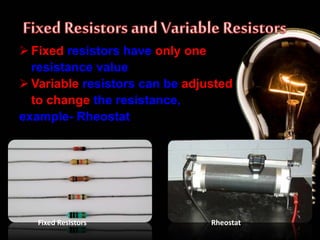
 Fixed resistors have only one
resistance value
 Variable resistors can be adjusted
to change the resistance,
example- Rheostat
Fixed Resistors Rheostat
Length of Conductor ->> R∝l
Cross-sectional Area of conductor ->> R ∝ 1/A
Nature of material of conductor
Temperature of conductor
R∝l/A
ρ – Constant of proportionality called Resistivity
Unit of Resistivity – Ωm
Metals and Alloys have very low resistivity whereas
insulators have very high resistivity
R= ρl/A
Thereare 2 ways of joining
resistors together
a) Series
b) Parallel
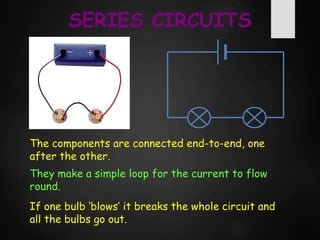
The components are connected end-to-end, one
after the other.
They make a simple loop for the current to flow
round.
SERIES CIRCUITS
If one bulb ‘blows’ it breaks the whole circuit and
all the bulbs go out.
PARALLEL CIRCUITS
The current has a choice of routes (paths).
The components are connected side by side.
If one bulb ‘blows’ there would still be a complete circuit
to the other bulb so it stays lit.
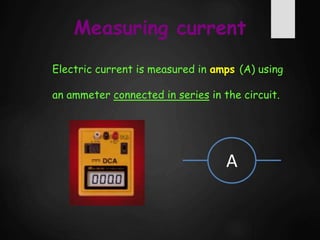
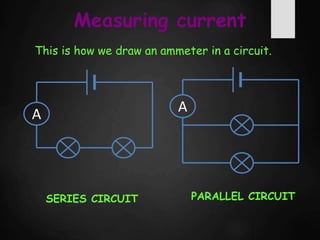
Measuring current
Electric current is measured in amps (A) using
an ammeter connected in series in the circuit.
A
Measuring current
A A
This is how we draw an ammeter in a circuit.
SERIES CIRCUIT PARALLEL CIRCUIT
Measuring current
SERIES CIRCUIT
PARALLEL CIRCUIT
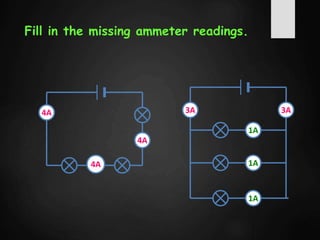
• current is the same
at all points in the
circuit.
6A 6A
6A
• current is shared
between the
components
4A4A
3A
1A
Fill in the missing ammeter readings.
?
?
4A
4A
4A
3A?
?
1A
?
3A
1A
1A
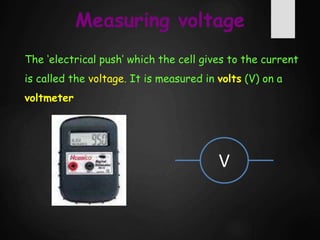
Measuring voltage
The ‘electrical push’ which the cell gives to the current
is called the voltage. It is measured in volts (V) on a
voltmeter
V
Different cells produce different voltages.
The bigger the voltage supplied by the cell, the bigger
the current (the cell gives a bigger push to the
electrons).
measuring voltage
Measuring voltage
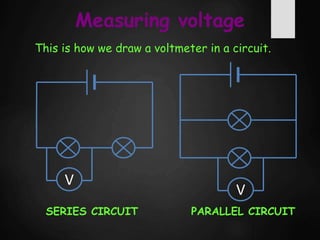
Unlike an ammeter a voltmeter is connected across
the components (in parallel)
Scientist usually use the term Potential Difference
(pd) when they talk about voltage.
Measuring voltage
V
This is how we draw a voltmeter in a circuit.
SERIES CIRCUIT PARALLEL CIRCUIT
V
V
Measuring voltage
V
V
V
Series circuit
1.5V
• voltage is shared between the components
1.5V
3V
• voltage is the same in all parts of the circuit.
3V
Parallel circuit
3V
3V
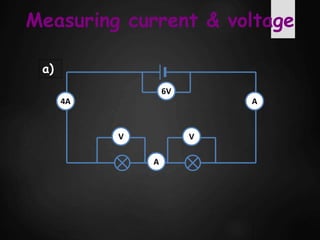
Measuring current & voltage
V V
6V
4A
A
A
a)
Measuring current & voltage
V
V
6V
4A A
A
A
b)
Answers
3V 3V
6V
4A 4A
6V
6V
6V
4A 4A
2A
2A
4A
a) b)
When an electric current flows through a wire,
the wire heats up. Electrical energy has been
converted into heat energy.
The greater the resistance of the wire, the
greater the amount of heat produced. This
heating effect is used in common electrical
appliances.
Iron Kettle
 The work done in moving the charge Q through a potential
difference V is VQ
 Therefore, the source must supply energy equal to VQ in time t.
 So, power input to the circuit by the source is
P = V(Q/t)
P=VI
Energy supplied to the circuit by the source in time t is
P × t
orH= VIt H=I²Rt
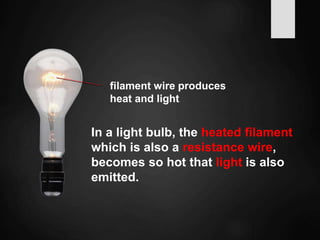
filament wire produces
heat and light
In a light bulb, the heated filament
which is also a resistance wire,
becomes so hot that light is also
emitted.
A kettle uses both copper and nichrome wires.
Copper has low resistance while nichrome has high resistance.
Which material, copper or nichrome, should be used for the heating
element, and for the external wire?
Use copper wire
for the external
wire as it has low
resistance &
produces less heat
Use nichrome wire for the heating
element as it has high resistance&
produces a lot of heat
Summary
 Uses of electricity in our daily life
 Sources of Electricity (Main electricity and
electric cells)
 Define electric current and electric circuit
 4 different parts of circuits and their symbols
• Connecting wires
• Bulbs
• Switch
• Electric cell
Electric Current
• Positive and negative
• Pushes electrons out of the
negative terminal and round the
circuit
• Flow back to the positive terminal
of the cell
• Electrons are not used up only
energy is used up
What is Voltage?
• To measure the energy the electrons
receive
• An electron can have a large amount
of potential energy at one point in the
circuit
• It can also have a low amount of
potential energy at another point
• The difference in potential energy
between the two points is known as
voltage
What is a resistor?
• Appliances need to ensure that
the correct size of current flows
to operate properly
• To control the size of the current,
electrical components called
resistors are used in the circuits
Arrangement of resistors
• Parallel
– For resistors in parallel, current
from the electric cell divided among
the resistor
– More resistors added more
electrical charges are able to flow
through the resistors at the same
time
– Current in circuit increases
– Overall resistance of the parallel
circuit decreases
Heating Effect
• Resistance in circuit wires affects
the amount of electric current
flowing
• Electric current flows through the
wire, the wire gets heated up
• Electrical energy to heat energy
Electricity and Electric Current

Electricity and Electric Current

  • 2.
    i. Electricity ii. ElectricCurrent iii. Electric Potential & Potential Difference iv. Electromotive Force (emf) v. Electric Circuit and components vi. Current and Voltage Measurements vii. OHM’s Law viii. Factors Affecting Resistance ix. Combination of Resistors(Series & Parallel) x. Heating Effect of Electricity and its apps.
  • 3.
    Electricity is aform of a energy that can be easily changed to many other forms
  • 4.
     Electric Currentis the flow of electric charge  Measured as the rate of flow of electric charge  Denoted by I  I=Q/t  SI unit -> Amperes(A) NOTE-Direction of CONVENTIONAL Current is opposite to direction of flow of electrons.
  • 5.
    Electric Potential -Work done in moving a unit charge from infinity to a point .∞ A . Potential Difference – The difference between potential at two points .∞ B. A. Potential difference
  • 6.
  • 8.
  • 10.
    Electromotive force isthe same as voltage. E.m.f refers to the amount of energy supplied by the electric source (eg. battery) to each unit of electric charge E.m.f is also measured by a voltmeter
  • 11.
    To make anelectrical appliance work, electricity must flow through it. The path along which the electric current moves is called the electric circuit.
  • 12.
    Component Symbols –a cell • The cell stores chemical energy and transfers it to electrical energy when a circuit is connected. • The long line is the positive end • The short line is the negative end
  • 13.
    Battery • When twoor more cells are connected together we call this a Battery. • The cells chemical energy is used up pushing a current round a circuit. • It is important that each cell faces the right way
  • 14.
    Switch • A switchcan be open (as shown) or closed • When the switch is open, the circuit is incomplete – no electricity can flow
  • 15.
    Bulb / Lamp •The lamp lights up when electricity flows through it
  • 16.
    Wires The wires whichcarry electricity consist of two parts: • The metal wires (conductor). • The plastic coating around the metal wires (insulator). • Prevents people from being electrocuted. wires
  • 17.
    Resistor • A resistorcan change the amount of current in a circuit • In a variable resistor, the resistance can be changed.
  • 19.
    Fuse • A fuseis a safety device • When the current is too high, the fuse breaks Example The wire inside a 3A fuse will melt when the current is greater than 3A.
  • 20.
  • 21.
     It mustbe connected in series in the circuit.  Positive side of ammeter must be connected nearest to the positive terminal of the battery (electric cell), and vice versa.
  • 22.
     Voltmeters mustbe connected in parallel to the circuit.  The positive side of voltmeter is connected to the positive terminal of the cell, and vice versa.
  • 23.
    At constant temperature,Current flowing through a conductor is directly proportional to potential difference across its ends V∝I V/I = Constant = R V =IR R -> Ressiatance (Ω or ohm)
  • 24.
     Fixed resistorshave only one resistance value  Variable resistors can be adjusted to change the resistance, example- Rheostat Fixed Resistors Rheostat
  • 25.
    Length of Conductor->> R∝l Cross-sectional Area of conductor ->> R ∝ 1/A Nature of material of conductor Temperature of conductor R∝l/A ρ – Constant of proportionality called Resistivity Unit of Resistivity – Ωm Metals and Alloys have very low resistivity whereas insulators have very high resistivity R= ρl/A
  • 26.
    Thereare 2 waysof joining resistors together a) Series b) Parallel
  • 27.
    The components areconnected end-to-end, one after the other. They make a simple loop for the current to flow round. SERIES CIRCUITS If one bulb ‘blows’ it breaks the whole circuit and all the bulbs go out.
  • 28.
    PARALLEL CIRCUITS The currenthas a choice of routes (paths). The components are connected side by side. If one bulb ‘blows’ there would still be a complete circuit to the other bulb so it stays lit.
  • 29.
    Measuring current Electric currentis measured in amps (A) using an ammeter connected in series in the circuit. A
  • 30.
    Measuring current A A Thisis how we draw an ammeter in a circuit. SERIES CIRCUIT PARALLEL CIRCUIT
  • 31.
    Measuring current SERIES CIRCUIT PARALLELCIRCUIT • current is the same at all points in the circuit. 6A 6A 6A • current is shared between the components 4A4A 3A 1A
  • 32.
    Fill in themissing ammeter readings. ? ? 4A 4A 4A 3A? ? 1A ? 3A 1A 1A
  • 33.
    Measuring voltage The ‘electricalpush’ which the cell gives to the current is called the voltage. It is measured in volts (V) on a voltmeter V
  • 34.
    Different cells producedifferent voltages. The bigger the voltage supplied by the cell, the bigger the current (the cell gives a bigger push to the electrons). measuring voltage
  • 35.
    Measuring voltage Unlike anammeter a voltmeter is connected across the components (in parallel) Scientist usually use the term Potential Difference (pd) when they talk about voltage.
  • 36.
    Measuring voltage V This ishow we draw a voltmeter in a circuit. SERIES CIRCUIT PARALLEL CIRCUIT V
  • 37.
  • 38.
    Series circuit 1.5V • voltageis shared between the components 1.5V 3V
  • 39.
    • voltage isthe same in all parts of the circuit. 3V Parallel circuit 3V 3V
  • 40.
    Measuring current &voltage V V 6V 4A A A a)
  • 41.
    Measuring current &voltage V V 6V 4A A A A b)
  • 42.
  • 43.
    When an electriccurrent flows through a wire, the wire heats up. Electrical energy has been converted into heat energy. The greater the resistance of the wire, the greater the amount of heat produced. This heating effect is used in common electrical appliances. Iron Kettle
  • 44.
     The workdone in moving the charge Q through a potential difference V is VQ  Therefore, the source must supply energy equal to VQ in time t.  So, power input to the circuit by the source is P = V(Q/t) P=VI Energy supplied to the circuit by the source in time t is P × t orH= VIt H=I²Rt
  • 45.
    filament wire produces heatand light In a light bulb, the heated filament which is also a resistance wire, becomes so hot that light is also emitted.
  • 46.
    A kettle usesboth copper and nichrome wires. Copper has low resistance while nichrome has high resistance. Which material, copper or nichrome, should be used for the heating element, and for the external wire? Use copper wire for the external wire as it has low resistance & produces less heat Use nichrome wire for the heating element as it has high resistance& produces a lot of heat
  • 47.
    Summary  Uses ofelectricity in our daily life  Sources of Electricity (Main electricity and electric cells)  Define electric current and electric circuit  4 different parts of circuits and their symbols • Connecting wires • Bulbs • Switch • Electric cell
  • 48.
    Electric Current • Positiveand negative • Pushes electrons out of the negative terminal and round the circuit • Flow back to the positive terminal of the cell • Electrons are not used up only energy is used up
  • 49.
    What is Voltage? •To measure the energy the electrons receive • An electron can have a large amount of potential energy at one point in the circuit • It can also have a low amount of potential energy at another point • The difference in potential energy between the two points is known as voltage
  • 50.
    What is aresistor? • Appliances need to ensure that the correct size of current flows to operate properly • To control the size of the current, electrical components called resistors are used in the circuits
  • 51.
    Arrangement of resistors •Parallel – For resistors in parallel, current from the electric cell divided among the resistor – More resistors added more electrical charges are able to flow through the resistors at the same time – Current in circuit increases – Overall resistance of the parallel circuit decreases
  • 52.
    Heating Effect • Resistancein circuit wires affects the amount of electric current flowing • Electric current flows through the wire, the wire gets heated up • Electrical energy to heat energy