SERIES AND
PARALLEL
HOW WE WIRE THE WORLD
Learning Objectives:
Know differences between series and parallel circuits.
Starter:
Match up the symbols with the words and pictures of
components.
• How many can you get right (we haven’t covered them all in class
yet!)?!?!
Series and parallel circuits
types of circuittypes of circuit
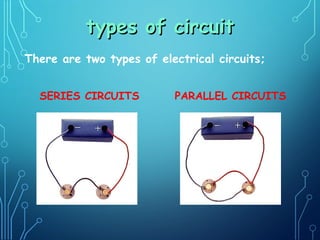
There are two types of electrical circuits;
SERIES CIRCUITS PARALLEL CIRCUITS
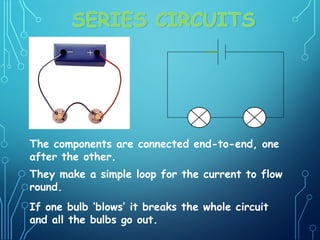
The components are connected end-to-end, one
after the other.
They make a simple loop for the current to flow
round.
If one bulb ‘blows’ it breaks the whole circuit
and all the bulbs go out.
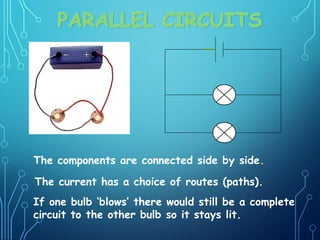
The current has a choice of routes (paths).
The components are connected side by side.
If one bulb ‘blows’ there would still be a complete
circuit to the other bulb so it stays lit.
SERIES CIRCUIT PARALLEL
CIRCUIT
Wires need to be drawn
with a ruler and must not
cross each other.
http://www.bbc.co.uk/learningzone/clips/series-and-parallel-cir
IES OR PARALLEL?
1.Would it be better
to have the lights
on a Christmas tree
in series or
parallel? Why?
2. Are the lights in
your house
connected up in
series or parallel?
How can you tell?
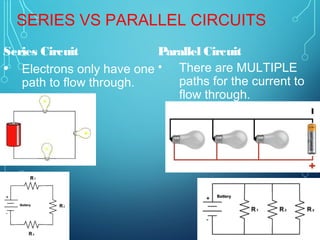
SERIES VS PARALLEL CIRCUITS
Series Circuit
• Electrons only have one
path to flow through.
Parallel Circuit
• There are MULTIPLE
paths for the current to
flow through.
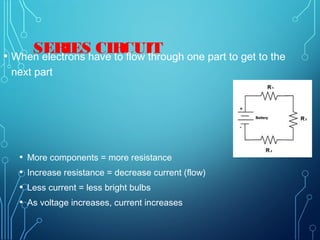
SERIES CIRCUIT• When electrons have to flow through one part to get to the
next part
• More components = more resistance
• Increase resistance = decrease current (flow)
• Less current = less bright bulbs
• As voltage increases, current increases
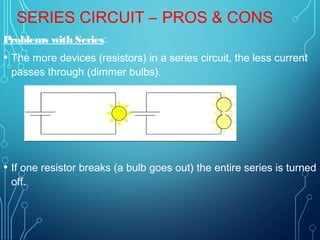
SERIES CIRCUIT – PROS & CONS
Problems with Series:
• The more devices (resistors) in a series circuit, the less current
passes through (dimmer bulbs).
• If one resistor breaks (a bulb goes out) the entire series is turned
off.
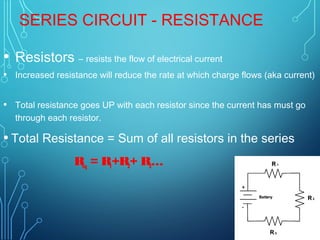
SERIES CIRCUIT - RESISTANCE
• Resistors – resists the flow of electrical current
• Increased resistance will reduce the rate at which charge flows (aka current)
• Total resistance goes UP with each resistor since the current has must go
through each resistor.
• Total Resistance = Sum of all resistors in the series
Req = R1+R2+ R3…
SERIES CIRCUIT - CURRENT
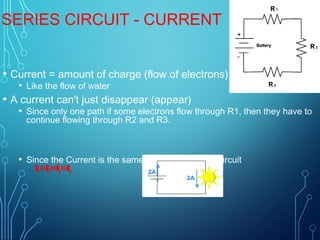
• Current = amount of charge (flow of electrons)
• Like the flow of water
• A current can't just disappear (appear)
• Since only one path if some electrons flow through R1, then they have to
continue flowing through R2 and R3.
• Since the Current is the same through the entire circuit
IT=I1=I2=I3
SERIES CIRCUIT - VOLTAGE
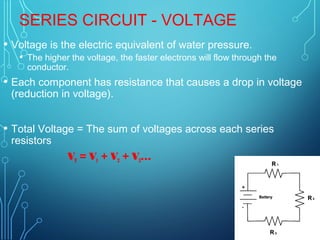
• Voltage is the electric equivalent of water pressure.
• The higher the voltage, the faster electrons will flow through the
conductor.
• Each component has resistance that causes a drop in voltage
(reduction in voltage).
• Total Voltage = The sum of voltages across each series
resistors
VT = V1 + V2 + V3…
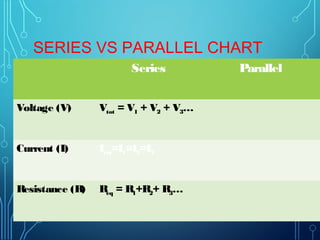
SERIES VS PARALLEL CHART
Series Parallel
Voltage (V) Vtot = V1 + V2 + V3…
Current (I) Itot=I1=I2=I3
Resistance (R) Req = R1+R2+ R3…
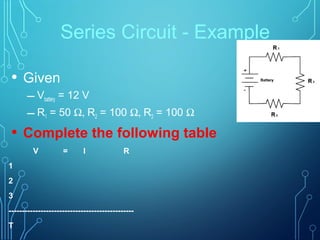
Series Circuit - Example
• Given
– Vbattery = 12 V
– R1 = 50 Ω, R2 = 100 Ω, R3 = 100 Ω
• Complete the following table
V = I R
1
2
3
-----------------------------------------------
T
PARALLEL CIRCUIT – PROS AND
CONS
Advantages
• The more devices (resistors) in a parallel circuit, does
not decrease the current (does not dim bulbs).
• If one resistor breaks (a bulb goes out) the rest do not.
Problems
• Current doesn’t stay the same for entire circuit
• So energy is used up quicker
• So the total current increases = faster electrons = hotter wire = fire?
WHICH IS BETTER? SERIES OR
PARALLEL?
Parallel
• Most things are wired in parallel
• Because of the fact that the more you plug in, the
intensity doesn’t decrease.
• Of course, this also increases the risk of fire
• This is why homes have fuses or circuit breakers.
They turn off everything in the circuit when current
moves too fast.
TOLL BOOTH
EXPLANATION•Adding toll booths in series increases
resistance and slows the current flow.
•Adding toll booths in parallel lowers
resistance and increases the current
flow.
Parallel Circuit - Resistance
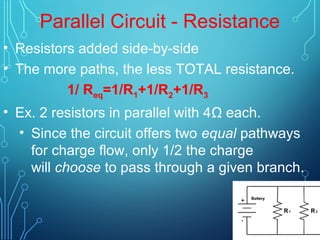
• Resistors added side-by-side
• The more paths, the less TOTAL resistance.
1/ Req=1/R1+1/R2+1/R3
• Ex. 2 resistors in parallel with 4Ω each.
• Since the circuit offers two equal pathways
for charge flow, only 1/2 the charge
will choose to pass through a given branch.
PARALLEL CIRCUIT - CURRENT
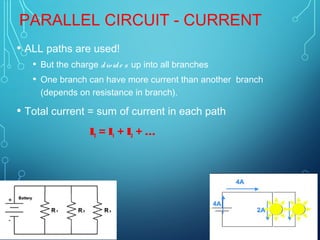
• ALL paths are used!
• But the charge divide s  up into all branches
• One branch can have more current than another branch
(depends on resistance in branch).
• Total current = sum of current in each path
IT = I1 + I2 + …
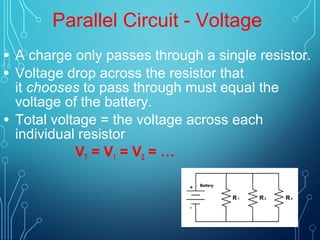
Parallel Circuit - Voltage
• A charge only passes through a single resistor.
• Voltage drop across the resistor that
it chooses to pass through must equal the
voltage of the battery.
• Total voltage = the voltage across each
individual resistor
VT = V1 = V2 = …
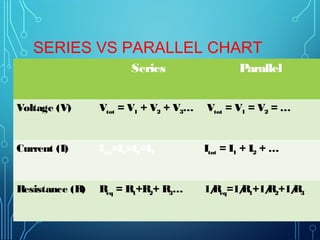
SERIES VS PARALLEL CHART
Series Parallel
Voltage (V) Vtot = V1 + V2 + V3… Vtot = V1 = V2 = …
Current (I) Itot=I1=I2=I3 Itot = I1 + I2 + …
Resistance (R) Req = R1+R2+ R3… 1/Req=1/R1+1/R2+1/R3
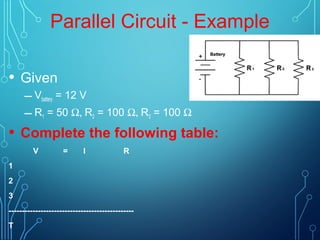
Parallel Circuit - Example
• Given
– Vbattery = 12 V
– R1 = 50 Ω, R2 = 100 Ω, R3 = 100 Ω
• Complete the following table:
V = I R
1
2
3
-----------------------------------------------
T
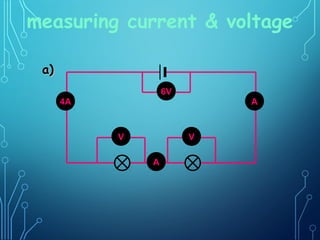
measuring current & voltage
V V
6V
4A
A
A
a)a)
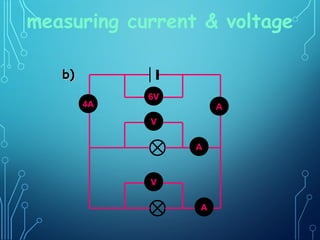
measuring current & voltage
V
V
6V
4A A
A
A
b)b)
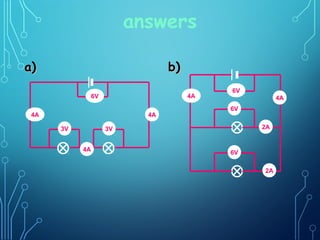
answers
3V 3V
6V
4A 4A
6V
6V
6V
4A 4A
2A
2A
4A
a)a) b)b)
VOLTAGE, CURRENT, AND
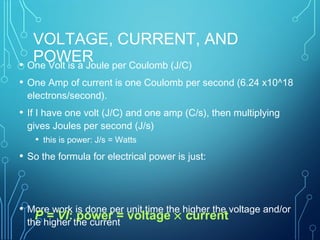
POWER• One Volt is a Joule per Coulomb (J/C)
• One Amp of current is one Coulomb per second (6.24 x10^18
electrons/second).
• If I have one volt (J/C) and one amp (C/s), then multiplying
gives Joules per second (J/s)
• this is power: J/s = Watts
• So the formula for electrical power is just:
• More work is done per unit time the higher the voltage and/or
the higher the current
P = VI: power = voltage × current
TWO TYPES OF
CURRENT
•DC—Direct Current
•produced by solar cells and chemical cells
(batteries)
•Current only flows in one direction.
•AC—Alternating Current
•Current flows back and forth (alternates)
•Found in homes
•Generators produce AC current
REFERENCE
• bhsd228.schoolwires.net
• https://education.jlab.org/jsat/powerpoint/0708_electricity.pp

Series and Parallel Circuits

  • 1.
  • 2.
    Learning Objectives: Know differencesbetween series and parallel circuits. Starter: Match up the symbols with the words and pictures of components. • How many can you get right (we haven’t covered them all in class yet!)?!?! Series and parallel circuits
  • 3.
    types of circuittypesof circuit There are two types of electrical circuits; SERIES CIRCUITS PARALLEL CIRCUITS
  • 4.
    The components areconnected end-to-end, one after the other. They make a simple loop for the current to flow round. If one bulb ‘blows’ it breaks the whole circuit and all the bulbs go out.
  • 5.
    The current hasa choice of routes (paths). The components are connected side by side. If one bulb ‘blows’ there would still be a complete circuit to the other bulb so it stays lit.
  • 6.
    SERIES CIRCUIT PARALLEL CIRCUIT Wiresneed to be drawn with a ruler and must not cross each other.
  • 7.
  • 9.
    IES OR PARALLEL? 1.Wouldit be better to have the lights on a Christmas tree in series or parallel? Why? 2. Are the lights in your house connected up in series or parallel? How can you tell?
  • 10.
    SERIES VS PARALLELCIRCUITS Series Circuit • Electrons only have one path to flow through. Parallel Circuit • There are MULTIPLE paths for the current to flow through.
  • 11.
    SERIES CIRCUIT• Whenelectrons have to flow through one part to get to the next part • More components = more resistance • Increase resistance = decrease current (flow) • Less current = less bright bulbs • As voltage increases, current increases
  • 12.
    SERIES CIRCUIT –PROS & CONS Problems with Series: • The more devices (resistors) in a series circuit, the less current passes through (dimmer bulbs). • If one resistor breaks (a bulb goes out) the entire series is turned off.
  • 13.
    SERIES CIRCUIT -RESISTANCE • Resistors – resists the flow of electrical current • Increased resistance will reduce the rate at which charge flows (aka current) • Total resistance goes UP with each resistor since the current has must go through each resistor. • Total Resistance = Sum of all resistors in the series Req = R1+R2+ R3…
  • 14.
    SERIES CIRCUIT -CURRENT • Current = amount of charge (flow of electrons) • Like the flow of water • A current can't just disappear (appear) • Since only one path if some electrons flow through R1, then they have to continue flowing through R2 and R3. • Since the Current is the same through the entire circuit IT=I1=I2=I3
  • 15.
    SERIES CIRCUIT -VOLTAGE • Voltage is the electric equivalent of water pressure. • The higher the voltage, the faster electrons will flow through the conductor. • Each component has resistance that causes a drop in voltage (reduction in voltage). • Total Voltage = The sum of voltages across each series resistors VT = V1 + V2 + V3…
  • 16.
    SERIES VS PARALLELCHART Series Parallel Voltage (V) Vtot = V1 + V2 + V3… Current (I) Itot=I1=I2=I3 Resistance (R) Req = R1+R2+ R3…
  • 17.
    Series Circuit -Example • Given – Vbattery = 12 V – R1 = 50 Ω, R2 = 100 Ω, R3 = 100 Ω • Complete the following table V = I R 1 2 3 ----------------------------------------------- T
  • 18.
    PARALLEL CIRCUIT –PROS AND CONS Advantages • The more devices (resistors) in a parallel circuit, does not decrease the current (does not dim bulbs). • If one resistor breaks (a bulb goes out) the rest do not. Problems • Current doesn’t stay the same for entire circuit • So energy is used up quicker • So the total current increases = faster electrons = hotter wire = fire?
  • 19.
    WHICH IS BETTER?SERIES OR PARALLEL? Parallel • Most things are wired in parallel • Because of the fact that the more you plug in, the intensity doesn’t decrease. • Of course, this also increases the risk of fire • This is why homes have fuses or circuit breakers. They turn off everything in the circuit when current moves too fast.
  • 20.
    TOLL BOOTH EXPLANATION•Adding tollbooths in series increases resistance and slows the current flow. •Adding toll booths in parallel lowers resistance and increases the current flow.
  • 21.
    Parallel Circuit -Resistance • Resistors added side-by-side • The more paths, the less TOTAL resistance. 1/ Req=1/R1+1/R2+1/R3 • Ex. 2 resistors in parallel with 4Ω each. • Since the circuit offers two equal pathways for charge flow, only 1/2 the charge will choose to pass through a given branch.
  • 22.
    PARALLEL CIRCUIT -CURRENT • ALL paths are used! • But the charge divide s  up into all branches • One branch can have more current than another branch (depends on resistance in branch). • Total current = sum of current in each path IT = I1 + I2 + …
  • 23.
    Parallel Circuit -Voltage • A charge only passes through a single resistor. • Voltage drop across the resistor that it chooses to pass through must equal the voltage of the battery. • Total voltage = the voltage across each individual resistor VT = V1 = V2 = …
  • 24.
    SERIES VS PARALLELCHART Series Parallel Voltage (V) Vtot = V1 + V2 + V3… Vtot = V1 = V2 = … Current (I) Itot=I1=I2=I3 Itot = I1 + I2 + … Resistance (R) Req = R1+R2+ R3… 1/Req=1/R1+1/R2+1/R3
  • 25.
    Parallel Circuit -Example • Given – Vbattery = 12 V – R1 = 50 Ω, R2 = 100 Ω, R3 = 100 Ω • Complete the following table: V = I R 1 2 3 ----------------------------------------------- T
  • 26.
    measuring current &voltage V V 6V 4A A A a)a)
  • 27.
    measuring current &voltage V V 6V 4A A A A b)b)
  • 28.
  • 29.
    VOLTAGE, CURRENT, AND POWER•One Volt is a Joule per Coulomb (J/C) • One Amp of current is one Coulomb per second (6.24 x10^18 electrons/second). • If I have one volt (J/C) and one amp (C/s), then multiplying gives Joules per second (J/s) • this is power: J/s = Watts • So the formula for electrical power is just: • More work is done per unit time the higher the voltage and/or the higher the current P = VI: power = voltage × current
  • 30.
    TWO TYPES OF CURRENT •DC—DirectCurrent •produced by solar cells and chemical cells (batteries) •Current only flows in one direction. •AC—Alternating Current •Current flows back and forth (alternates) •Found in homes •Generators produce AC current
  • 31.

Editor's Notes

  • #16 That reduction in voltage is what is known as a voltage drop, and it comes about as the result of the work the battery has to do to illuminate the bulb. Each and every component in a circuit, including the wiring, offers a certain amount of resistance to the flow of electrical current and will cause an associated voltage drop.