CURRENT
• Current: flowof electrical charges
(electrons) within a conductor or how fast
charge is moving.
• The symbol I indicates the electric current,
and q shows that the electric current is
directly proportional to the amount of charges
that pass through a conductor for every unit of
time, t.
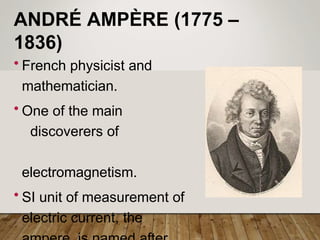
ANDRÉ AMPÈRE (1775–
1836)
• French physicist and
mathematician.
• One of the main
discoverers of
electromagnetism.
• SI unit of measurement of
electric current, the
6.
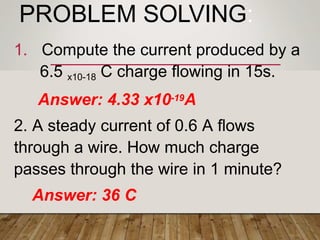
PROBLEM SOLVING:
1. Computethe current produced by a
6.5 x10⁻¹⁸ C charge flowing in 15s.
Answer: 4.33 x10⁻¹⁹A
2. A steady current of 0.6 A flows
through a wire. How much charge
passes through the wire in 1 minute?
Answer: 36 C
7.
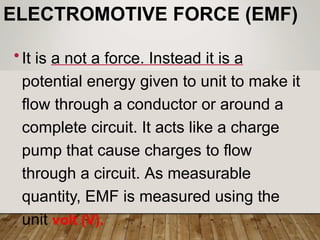
ELECTROMOTIVE FORCE (EMF)
•Itis a not a force. Instead it is a
potential energy given to unit to make it
flow through a conductor or around a
complete circuit. It acts like a charge
pump that cause charges to flow
through a circuit. As measurable
quantity, EMF is measured using the
unit volt (V).
8.
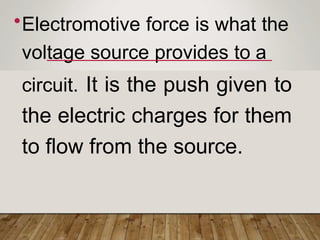
•Electromotive force iswhat the
voltage source provides to a
circuit. It is the push given to
the electric charges for them
to flow from the source.
9.
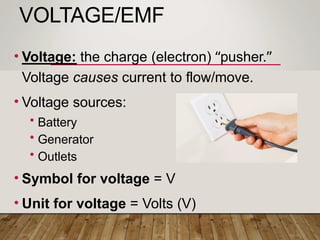
VOLTAGE/EMF
• Voltage: thecharge (electron) “pusher.”
Voltage causes current to flow/move.
• Voltage sources:
• Battery
• Generator
• Outlets
• Symbol for voltage = V
• Unit for voltage = Volts (V)
10.
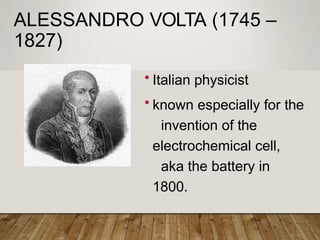
ALESSANDRO VOLTA (1745–
1827)
• Italian physicist
• known especially for the
invention of the
electrochemical cell,
aka the battery in
1800.
11.
VOLTAGE AT HOME
•Power utilities use large generators to
provide the 120V that is delivered to
your home outlets.
• When you plug in something to the outlet
(lamp, blow dryer, TV, etc) the voltage
is applied across the circuit, allowing
the charge to flow (electric current).
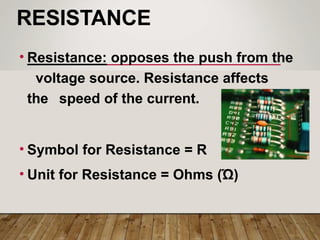
RESISTANCE
• Resistance: opposesthe push from the
voltage source. Resistance affects
the speed of the current.
• Symbol for Resistance = R
• Unit for Resistance = Ohms (Ώ)
14.
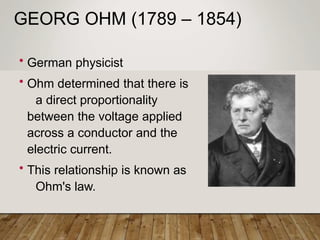
GEORG OHM (1789– 1854)
• German physicist
• Ohm determined that there is
a direct proportionality
between the voltage applied
across a conductor and the
electric current.
• This relationship is known as
Ohm's law.
15.
VOLTAGE AND CURRENT
•If the voltage in a circuit increases, the
current will increase.
• If the voltage in a circuit decreases, the
current will decrease.
• This is a direct/proportional
relationship.
16.
RESISTANCE AND CURRENT
•If the resistance in a circuit increases,
the current will decrease.
• If the resistance in a circuit decreases,
the current will increase.
• This is an inversely proportional
relationship.
17.
OHM’S LAW
• Statethe relationship between current,
voltage, and resistance.
• German physicist George Ohm had the
law named after him, because of his
extensive research.
18.
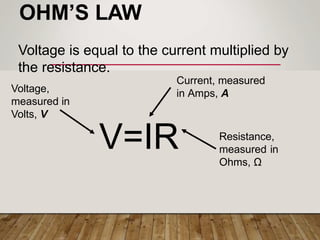
V=IR
OHM’S LAW
Voltage isequal to the current multiplied by
the resistance.
Voltage,
measured in
Volts, V
Current, measured
in Amps, A
Resistance,
measured in
Ohms, Ω
19.
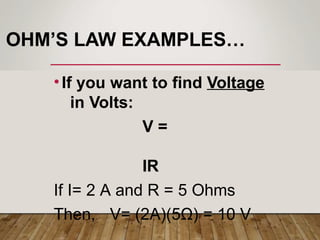
OHM’S LAW EXAMPLES…
•Ifyou want to find Voltage
in Volts:
V =
IR
If I= 2 A and R = 5 Ohms
Then, V= (2A)(5Ω) = 10 V
20.
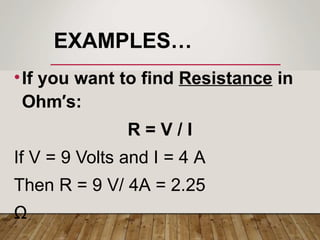
EXAMPLES…
•If you wantto find Resistance in
Ohm’s:
R = V / I
If V = 9 Volts and I = 4 A
Then R = 9 V/ 4A = 2.25
Ω
21.
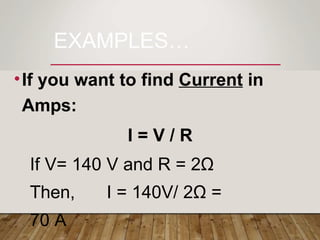
EXAMPLES…
•If you wantto find Current in
Amps:
I = V / R
If V= 140 V and R = 2Ω
Then, I = 140V/ 2Ω =
70 A
22.
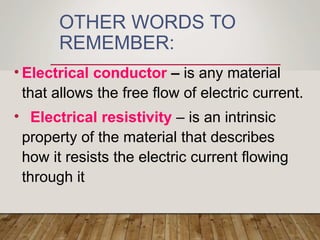
OTHER WORDS TO
REMEMBER:
•Electrical conductor – is any material
that allows the free flow of electric current.
• Electrical resistivity – is an intrinsic
property of the material that describes
how it resists the electric current flowing
through it
23.
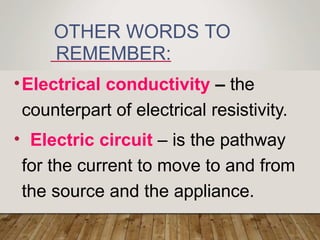
OTHER WORDS TO
REMEMBER:
•Electricalconductivity – the
counterpart of electrical resistivity.
• Electric circuit – is the pathway
for the current to move to and from
the source and the appliance.
24.
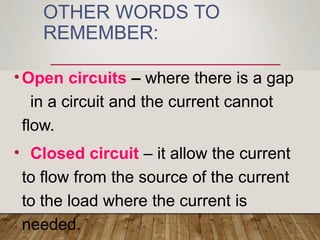
OTHER WORDS TO
REMEMBER:
•Opencircuits – where there is a gap
in a circuit and the current cannot
flow.
• Closed circuit – it allow the current
to flow from the source of the current
to the load where the current is
needed.
25.
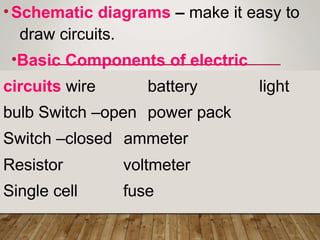
•Schematic diagrams –make it easy to
draw circuits.
•Basic Components of electric
circuits wire battery light
bulb Switch –open power pack
Switch –closed ammeter
Resistor
Single cell
voltmeter
fuse
26.
• Resistor –is an electronic component
used to provide a specific amount of
resistance. It can be considered as a load
• Types of Circuits:
• A. Series Circuit
B. Parallel Circuit:
27.
•“However difficult lifemay
seem, there is always
something you can
do and succeed at.”
― STEPHEN HAWKING




![Electric current, potential difference and reietance [Autosaved] [Autosaved]....](https://cdn.slidesharecdn.com/ss_thumbnails/electriccurrentpotentialdifferenceandreietanceautosavedautosaved-230603173933-3538dcc3-thumbnail.jpg?width=640&height=640&fit=bounds)


