WELCOME TO OUR PRESENTATION
Presentation on PHYSICS - II
Lecturer
Shalauddin
Department of General Education Development (GED)
Daffodil International University , Bangladesh
PRESENTATED BY :
Khokan Chandra Biswas
PRESENTATED TO:
Electricity, Electric Charge , Electric
Current and Electric Circuit.
Presentation Topic :
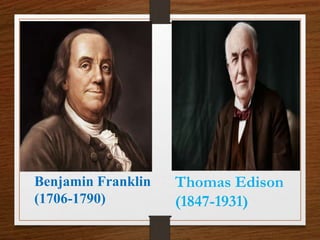
Benjamin Franklin
(1706-1790)
Thomas Edison
(1847-1931)
What is Electricity ?
Electricity is a form of energy that can be easily changed to
other forms.
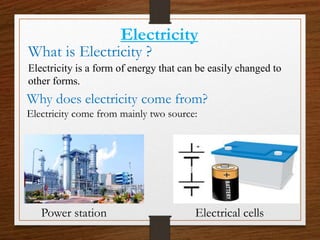
Why does electricity come from?
Electricity come from mainly two source:
Electricity
Power station Electrical cells
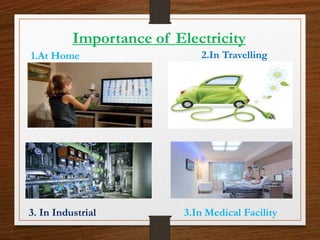
Importance of Electricity
1.At Home 2.In Travelling
3.In Medical Facility3. In Industrial
Electric Charge
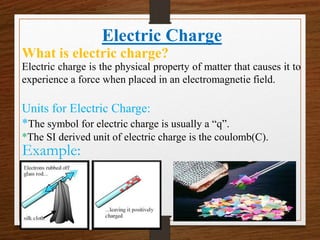
What is electric charge?
Electric charge is the physical property of matter that causes it to
experience a force when placed in an electromagnetie field.
Units for Electric Charge:
*The symbol for electric charge is usually a “q”.
*The SI derived unit of electric charge is the coulomb(C).
Example:
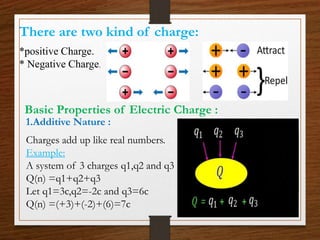
There are two kind of charge:
*positive Charge.
* Negative Charge.
Basic Properties of Electric Charge :
1.Additive Nature :
Charges add up like real numbers.
Example:
A system of 3 charges q1,q2 and q3
Q(n) =q1+q2+q3
Let q1=3c,q2=-2c and q3=6c
Q(n) =(+3)+(-2)+(6)=7c
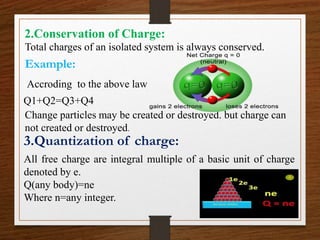
2.Conservation of Charge:
Total charges of an isolated system is always conserved.
Example:
Change particles may be created or destroyed. but charge can
not created or destroyed.
3.Quantization of charge:
All free charge are integral multiple of a basic unit of charge
denoted by e.
Q(any body)=ne
Where n=any integer.
Q1+Q2=Q3+Q4
Accroding to the above law
Why all object are charged?
All object are matter ,which is composed of atoms.Every atoms
has the potential to charge is electronic composition by adding
or substracting electrons ,which induced a negative or positive
charge.
*pollution controllers
*Smokestacks
*Air freshners
*Xerography
*Painting cars
Application of Charge:
Electric Current
What is electric Current?
An electrical current is the rate of flow of electric charges in a
circuit.
Units for Electric Charge:
The SI unit of current is the ampere ; one ampere is defined to
be one coulomb per second(1A=1C/S).
Type of Current:
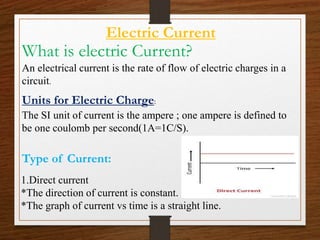
1.Direct current
*The direction of current is constant.
*The graph of current vs time is a straight line.
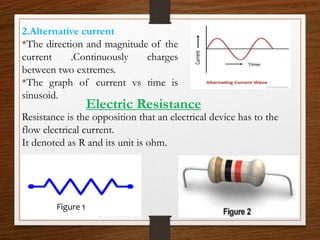
2.Alternative current
*The direction and magnitude of the
current .Continuously charges
between two extremes.
*The graph of current vs time is
sinusoid.
Electric Resistance
Resistance is the opposition that an electrical device has to the
flow electrical current.
It denoted as R and its unit is ohm.
Figure 1
Resistivity
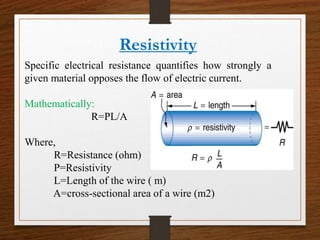
Specific electrical resistance quantifies how strongly a
given material opposes the flow of electric current.
Mathematically:
R=PL/A
Where,
R=Resistance (ohm)
P=Resistivity
L=Length of the wire ( m)
A=cross-sectional area of a wire (m2)
Conductivity
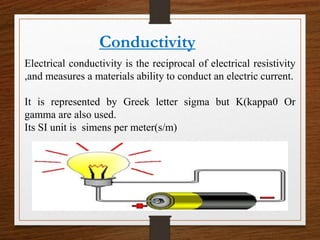
Electrical conductivity is the reciprocal of electrical resistivity
,and measures a materials ability to conduct an electric current.
It is represented by Greek letter sigma but K(kappa0 Or
gamma are also used.
Its SI unit is simens per meter(s/m)
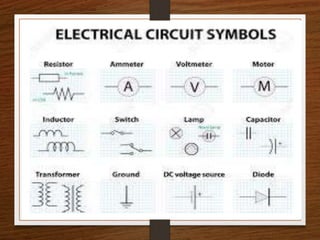
Electric Circuit
An electric circuit is a conducting path , extermal to the battery
,which allows charge to flow from one terminal to other.
Ohms law
The current through a conductor between two point is directly
proportional to the voltage across the two points .
Mathematically:
V=IR
There are two kind of electric circuit:
1.Series Circuit
2.Parallel circuit
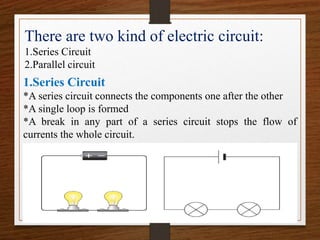
1.Series Circuit
*A series circuit connects the components one after the other
*A single loop is formed
*A break in any part of a series circuit stops the flow of
currents the whole circuit.
2.Parallel Circuit
*A parallel circuit divides into two or more branches.
*The current divides and flows through each parallel branch
*If a component breaks or is removed, the components remain
on.
THANK
YOU

Electricity,electric charge,electric current and electric circuit

  • 1.
    WELCOME TO OURPRESENTATION
  • 2.
    Presentation on PHYSICS- II Lecturer Shalauddin Department of General Education Development (GED) Daffodil International University , Bangladesh PRESENTATED BY : Khokan Chandra Biswas PRESENTATED TO:
  • 3.
    Electricity, Electric Charge, Electric Current and Electric Circuit. Presentation Topic :
  • 4.
  • 5.
    What is Electricity? Electricity is a form of energy that can be easily changed to other forms. Why does electricity come from? Electricity come from mainly two source: Electricity Power station Electrical cells
  • 6.
    Importance of Electricity 1.AtHome 2.In Travelling 3.In Medical Facility3. In Industrial
  • 7.
    Electric Charge What iselectric charge? Electric charge is the physical property of matter that causes it to experience a force when placed in an electromagnetie field. Units for Electric Charge: *The symbol for electric charge is usually a “q”. *The SI derived unit of electric charge is the coulomb(C). Example:
  • 8.
    There are twokind of charge: *positive Charge. * Negative Charge. Basic Properties of Electric Charge : 1.Additive Nature : Charges add up like real numbers. Example: A system of 3 charges q1,q2 and q3 Q(n) =q1+q2+q3 Let q1=3c,q2=-2c and q3=6c Q(n) =(+3)+(-2)+(6)=7c
  • 9.
    2.Conservation of Charge: Totalcharges of an isolated system is always conserved. Example: Change particles may be created or destroyed. but charge can not created or destroyed. 3.Quantization of charge: All free charge are integral multiple of a basic unit of charge denoted by e. Q(any body)=ne Where n=any integer. Q1+Q2=Q3+Q4 Accroding to the above law
  • 10.
    Why all objectare charged? All object are matter ,which is composed of atoms.Every atoms has the potential to charge is electronic composition by adding or substracting electrons ,which induced a negative or positive charge. *pollution controllers *Smokestacks *Air freshners *Xerography *Painting cars Application of Charge:
  • 11.
    Electric Current What iselectric Current? An electrical current is the rate of flow of electric charges in a circuit. Units for Electric Charge: The SI unit of current is the ampere ; one ampere is defined to be one coulomb per second(1A=1C/S). Type of Current: 1.Direct current *The direction of current is constant. *The graph of current vs time is a straight line.
  • 12.
    2.Alternative current *The directionand magnitude of the current .Continuously charges between two extremes. *The graph of current vs time is sinusoid. Electric Resistance Resistance is the opposition that an electrical device has to the flow electrical current. It denoted as R and its unit is ohm. Figure 1
  • 13.
    Resistivity Specific electrical resistancequantifies how strongly a given material opposes the flow of electric current. Mathematically: R=PL/A Where, R=Resistance (ohm) P=Resistivity L=Length of the wire ( m) A=cross-sectional area of a wire (m2)
  • 14.
    Conductivity Electrical conductivity isthe reciprocal of electrical resistivity ,and measures a materials ability to conduct an electric current. It is represented by Greek letter sigma but K(kappa0 Or gamma are also used. Its SI unit is simens per meter(s/m)
  • 15.
    Electric Circuit An electriccircuit is a conducting path , extermal to the battery ,which allows charge to flow from one terminal to other. Ohms law The current through a conductor between two point is directly proportional to the voltage across the two points . Mathematically: V=IR
  • 16.
    There are twokind of electric circuit: 1.Series Circuit 2.Parallel circuit 1.Series Circuit *A series circuit connects the components one after the other *A single loop is formed *A break in any part of a series circuit stops the flow of currents the whole circuit.
  • 17.
    2.Parallel Circuit *A parallelcircuit divides into two or more branches. *The current divides and flows through each parallel branch *If a component breaks or is removed, the components remain on.
  • 19.