 Identify and describe the scientific principles
related to electricity.
 Describe electrical terminology.
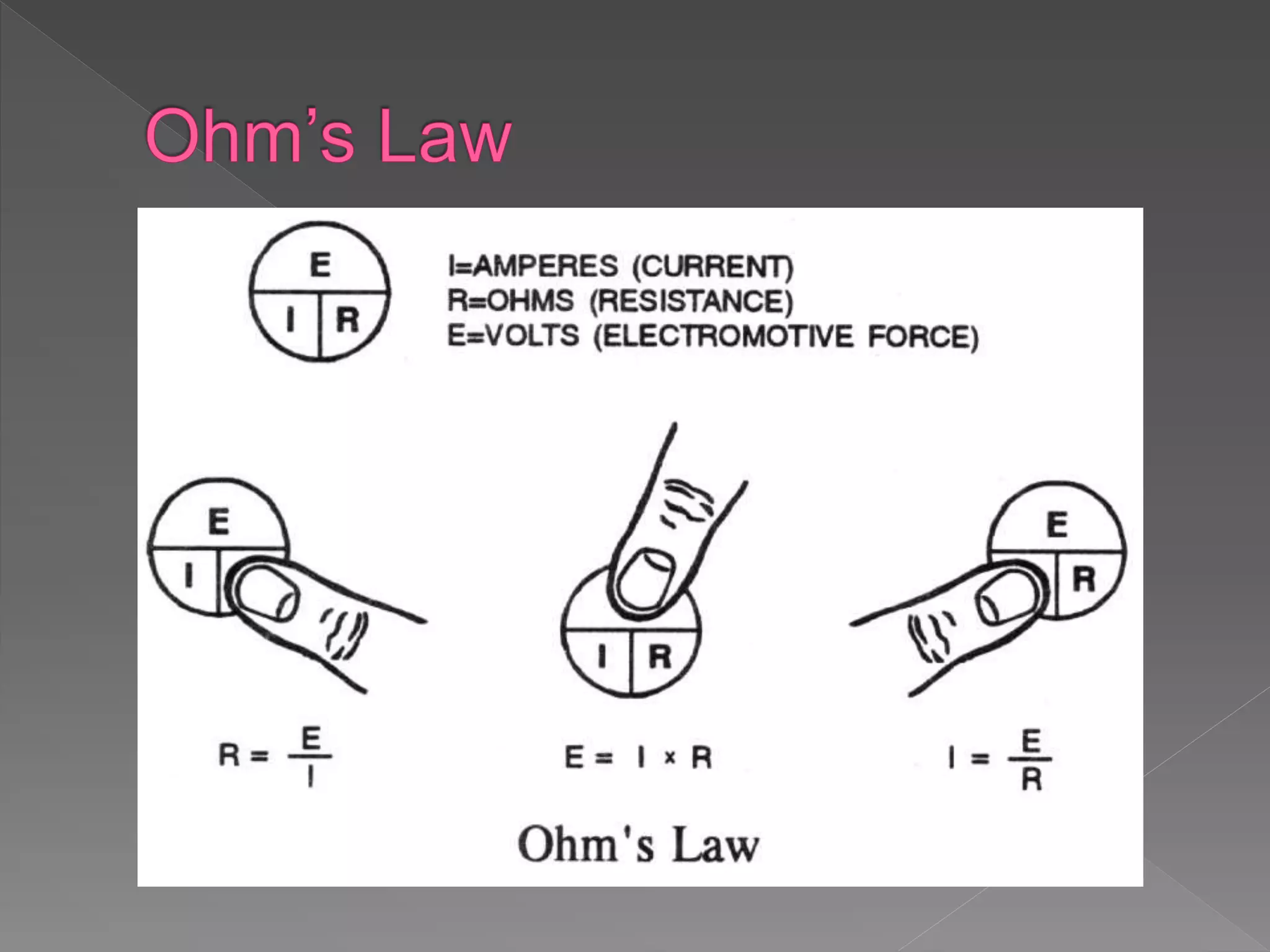
 Define Ohm’s law.
 Explain electrical power and energy
relationships.
 Perform electrical calculations.
 List and describe the basic types of
electrical circuits.
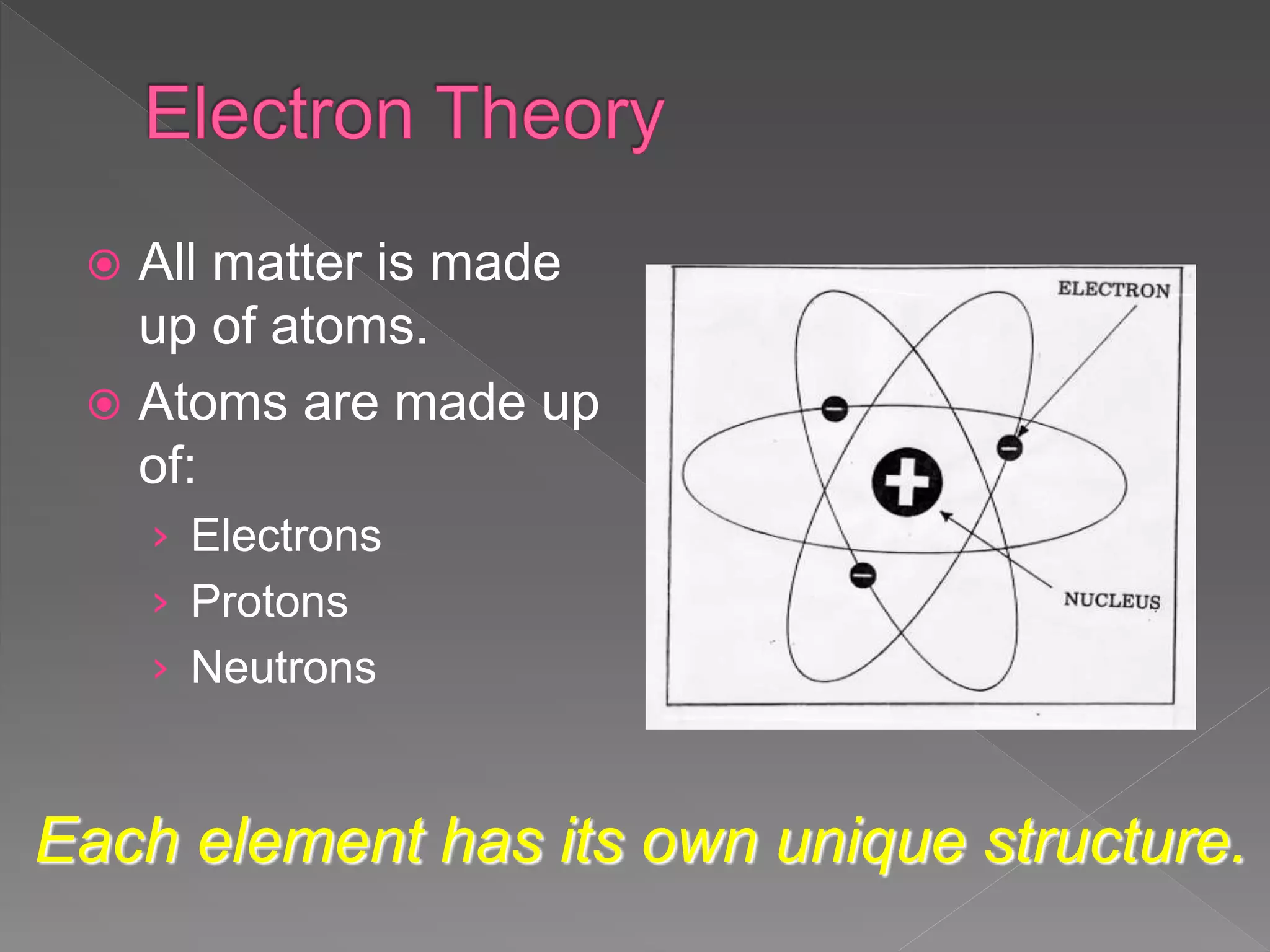
 All matter is made
up of atoms.
 Atoms are made up
of:
› Electrons
› Protons
› Neutrons
Each element has its own unique structure.
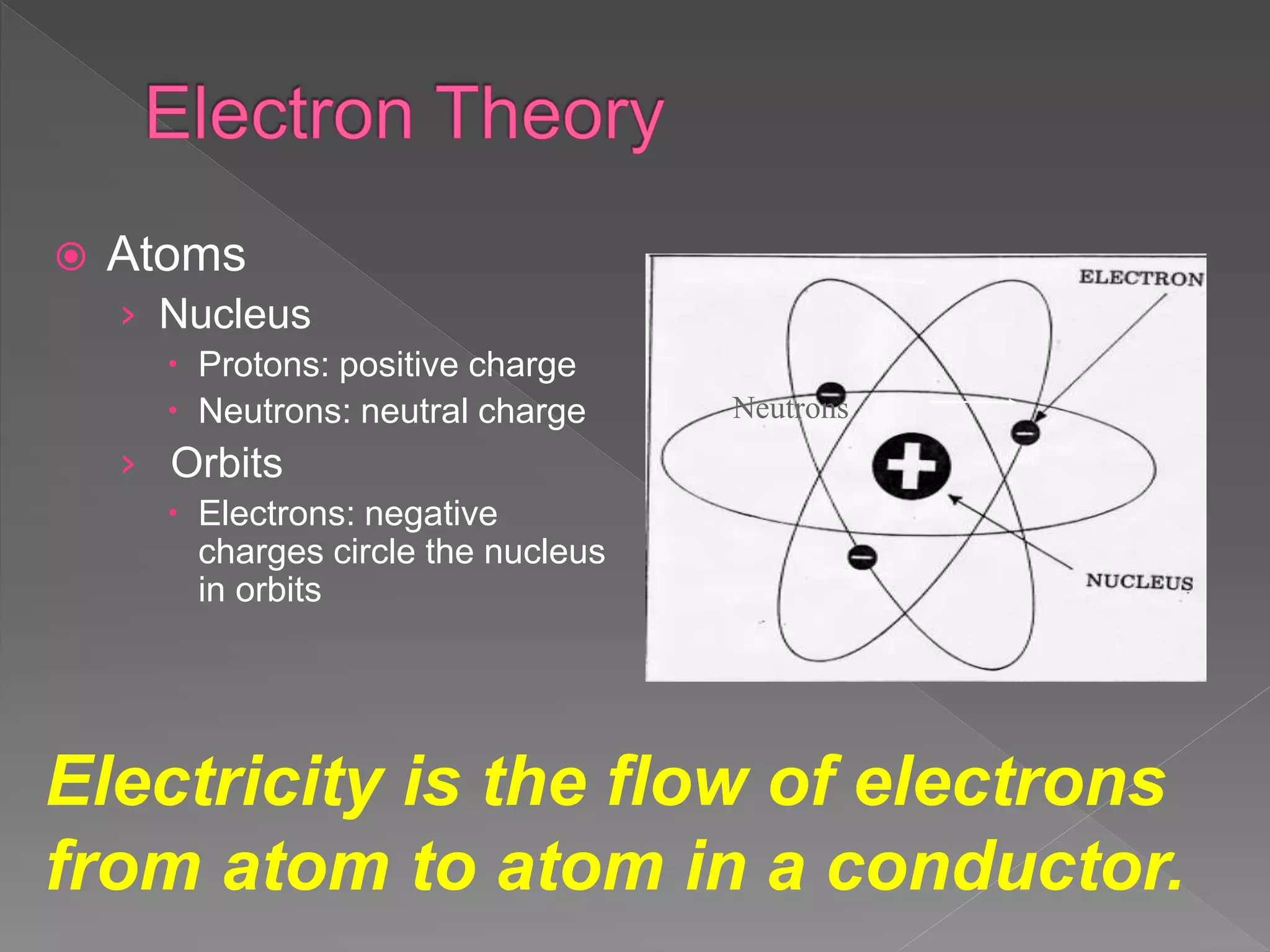
 Atoms
› Nucleus
 Protons: positive charge
 Neutrons: neutral charge
› Orbits
 Electrons: negative
charges circle the nucleus
in orbits
Neutrons
Electricity is the flow of electrons
from atom to atom in a conductor.
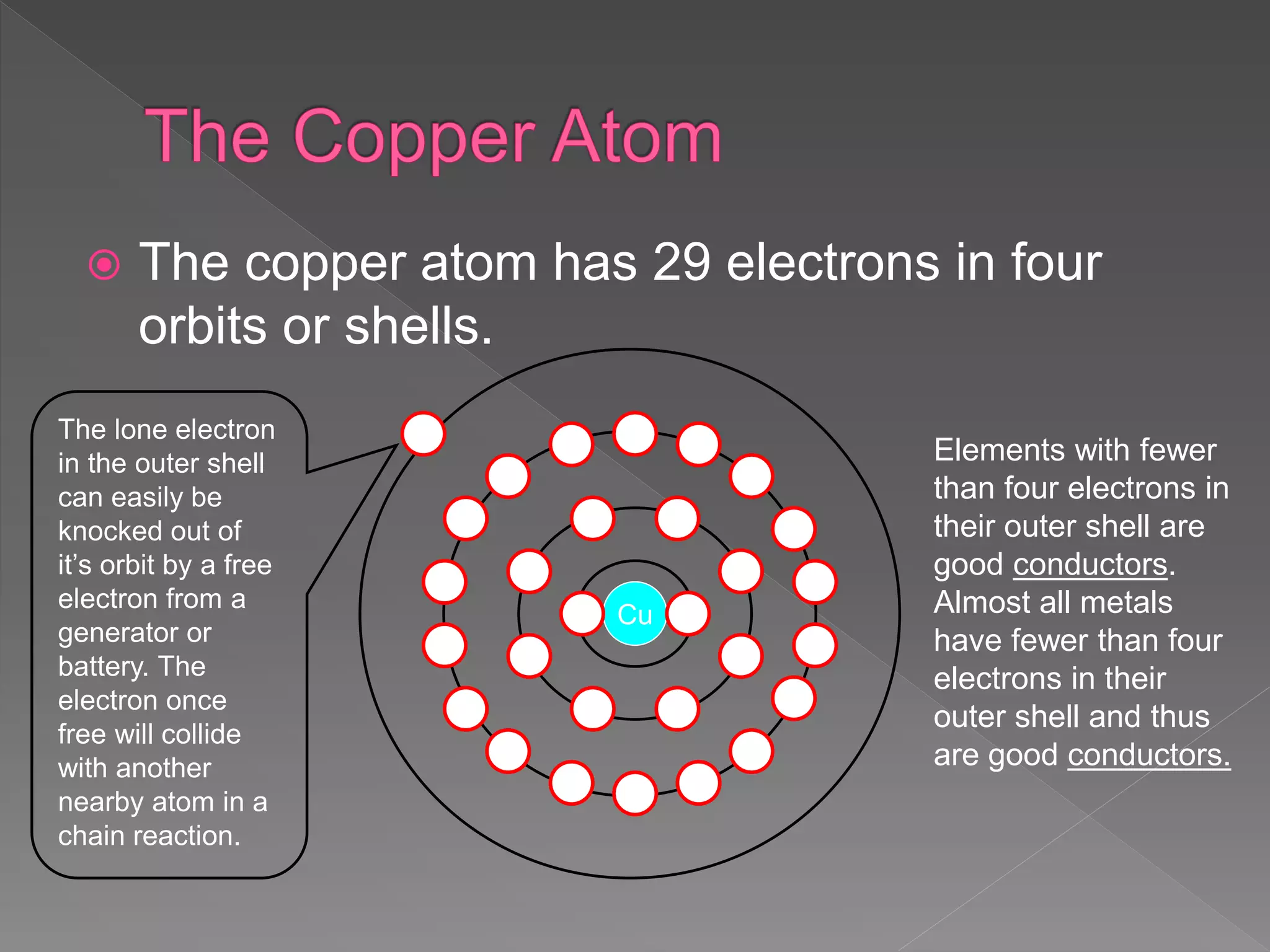
 The copper atom has 29 electrons in four
orbits or shells.
Cu
e- e-
e- e-
e-
e-
e-
e-
e-
e-
e-
e-
e-
e-
e-
e-
e-
e-
e-
e-
e-
e- e-
e-
e-
e-
e-
e-
e-
Elements with fewer
than four electrons in
their outer shell are
good conductors.
Almost all metals
have fewer than four
electrons in their
outer shell and thus
are good conductors.
The lone electron
in the outer shell
can easily be
knocked out of
it’s orbit by a free
electron from a
generator or
battery. The
electron once
free will collide
with another
nearby atom in a
chain reaction.
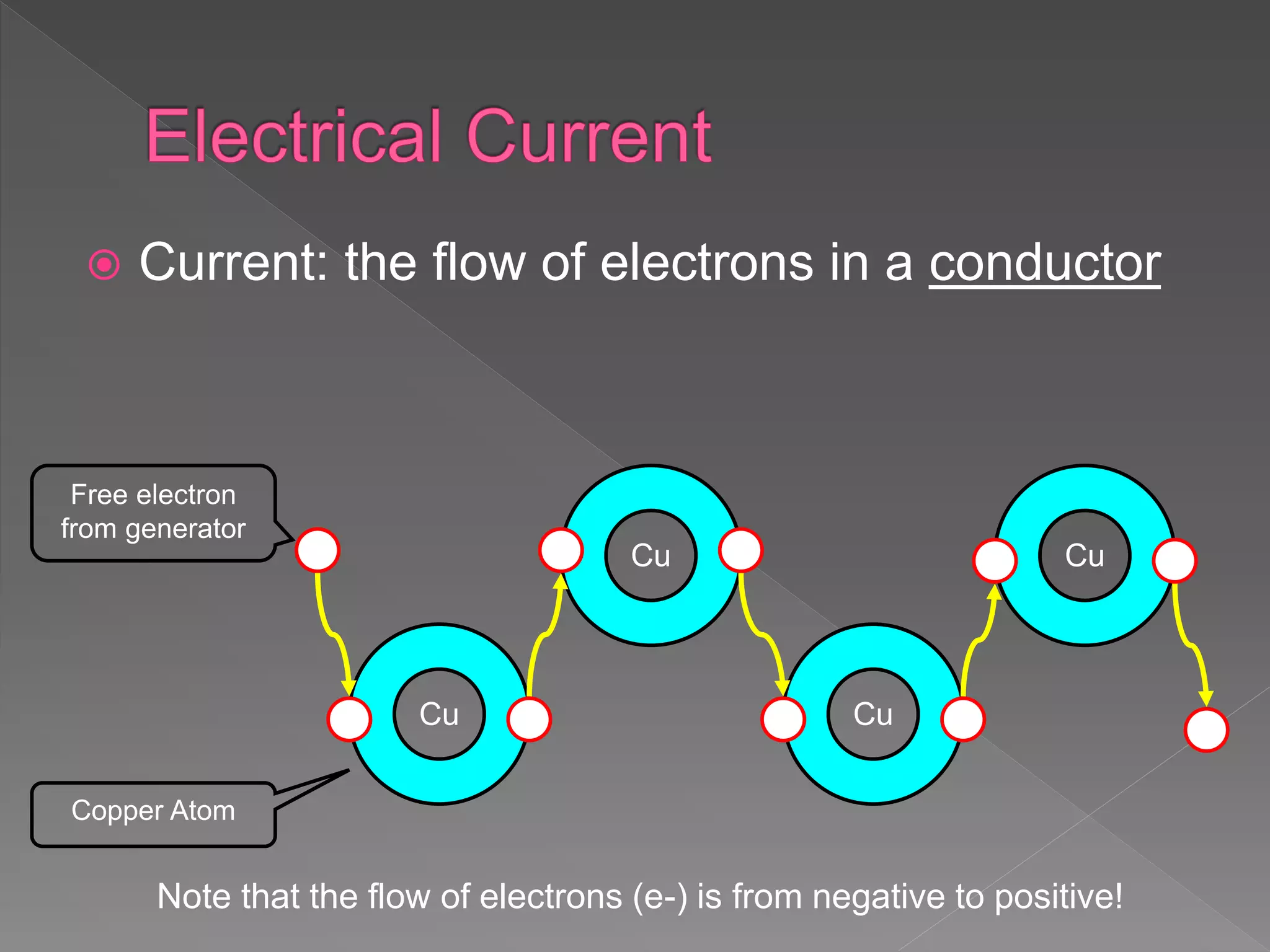
 Current: the flow of electrons in a conductor
Cu
Cu
Cu
Cu
e-
e-
e-
e-
e-
Free electron
from generator
e-
e-
e-
e-
e-
Copper Atom
Note that the flow of electrons (e-) is from negative to positive!
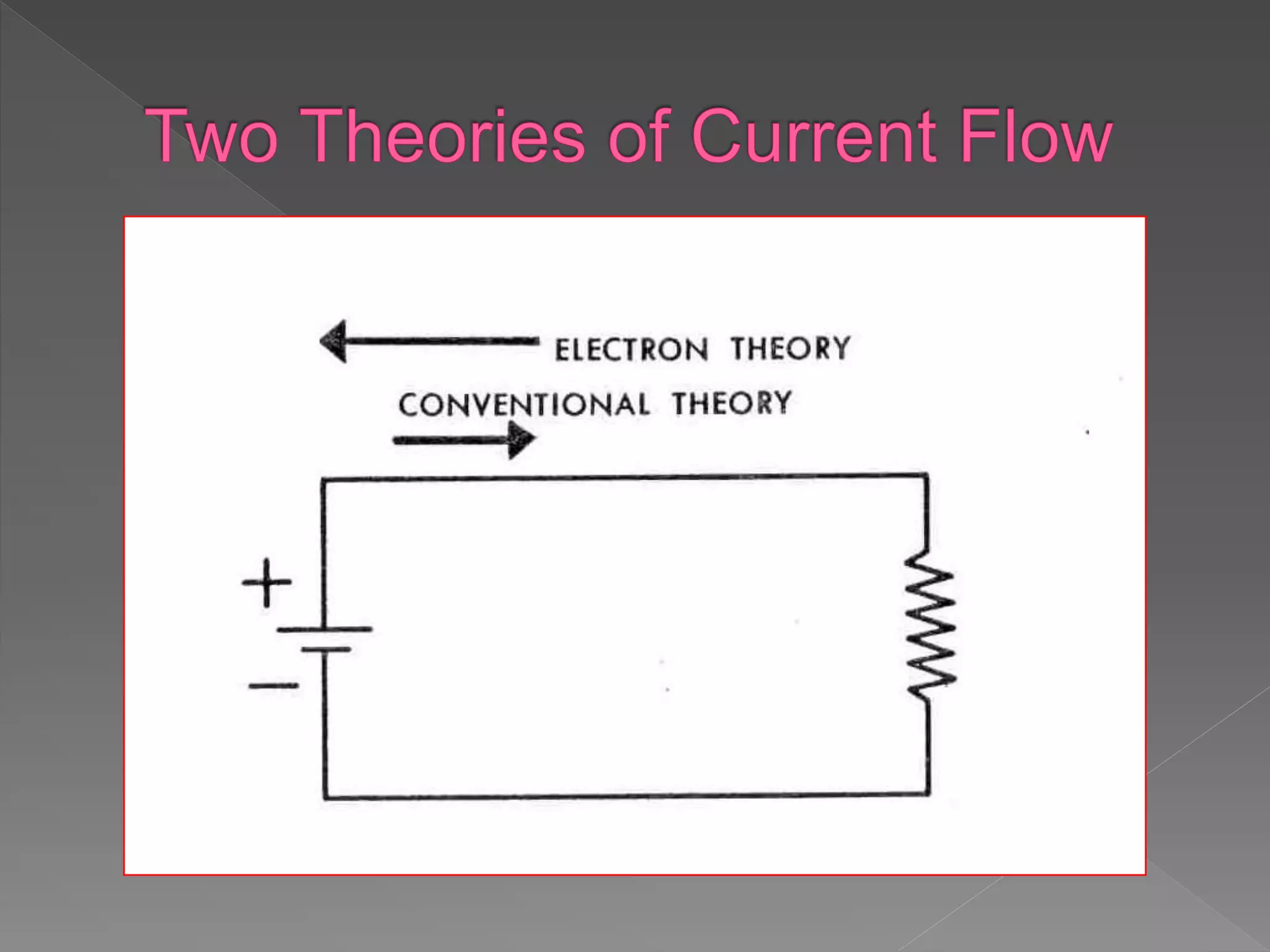
 In reality we know that electrons flow from
negative to positive (Electron Theory).
 However most electrical diagrams are based
on the idea that electricity flows from positive
to negative (Conventional Theory).
 This seldom causes problems unless we are
working with a DC circuit.
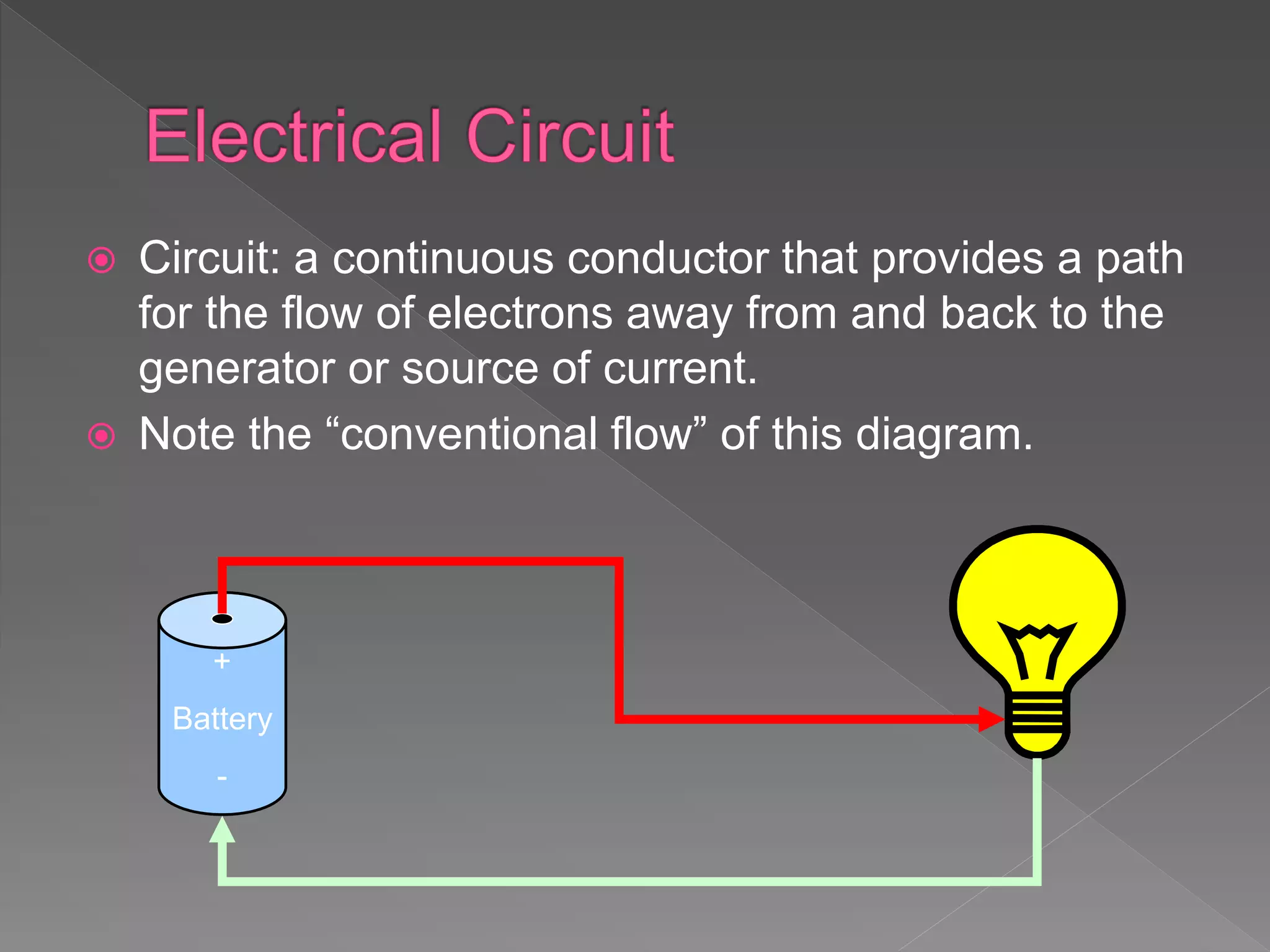
 Circuit: a continuous conductor that provides a path
for the flow of electrons away from and back to the
generator or source of current.
 Note the “conventional flow” of this diagram.
+
Battery
-
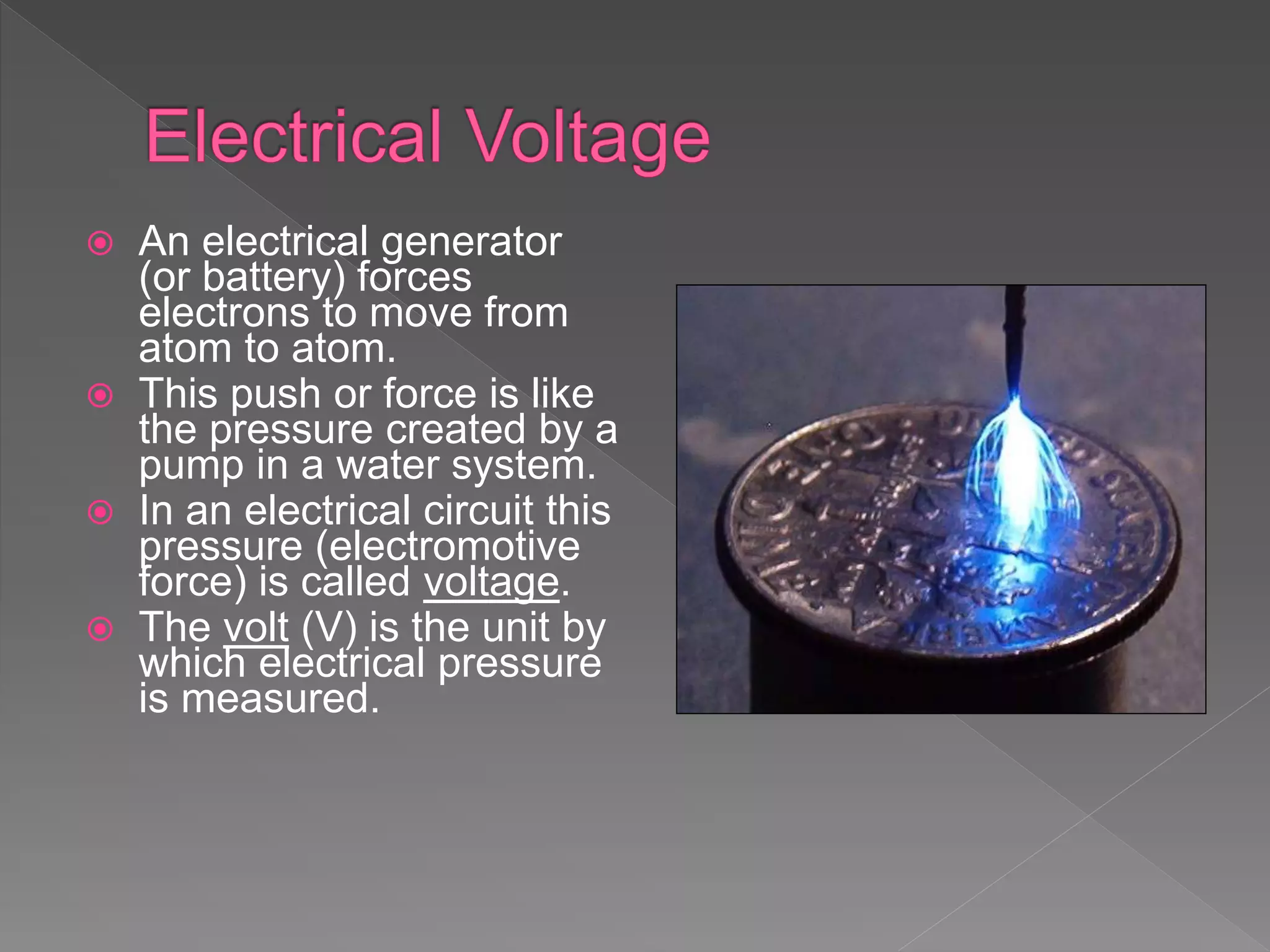
 An electrical generator
(or battery) forces
electrons to move from
atom to atom.
 This push or force is like
the pressure created by a
pump in a water system.
 In an electrical circuit this
pressure (electromotive
force) is called voltage.
 The volt (V) is the unit by
which electrical pressure
is measured.
 While voltage refers to the electrical
pressure of a circuit, current or amperage
refers to the electrical flow of a circuit.
 Current or amperage is the amount of
electric charges (or electrons) flowing past a
point in a circuit every second.
 One ampere (amp or A) is equal to 6.28
billion billion (or 6.28 x 10¹⁸) electrons per
second.
 Opposition to flow in electrical circuits is called
resistance (or impedance).
 Measured in Ohms by using an ohmmeter.
 One ohm, or R is the amount of electrical
resistance overcome by one volt to cause one
amp of current to flow.
 Electrical current follows the path of least
resistance.
 Electricity can encounter resistance by the type
of conductor, the size of conductor and even
corrosion on the connections.
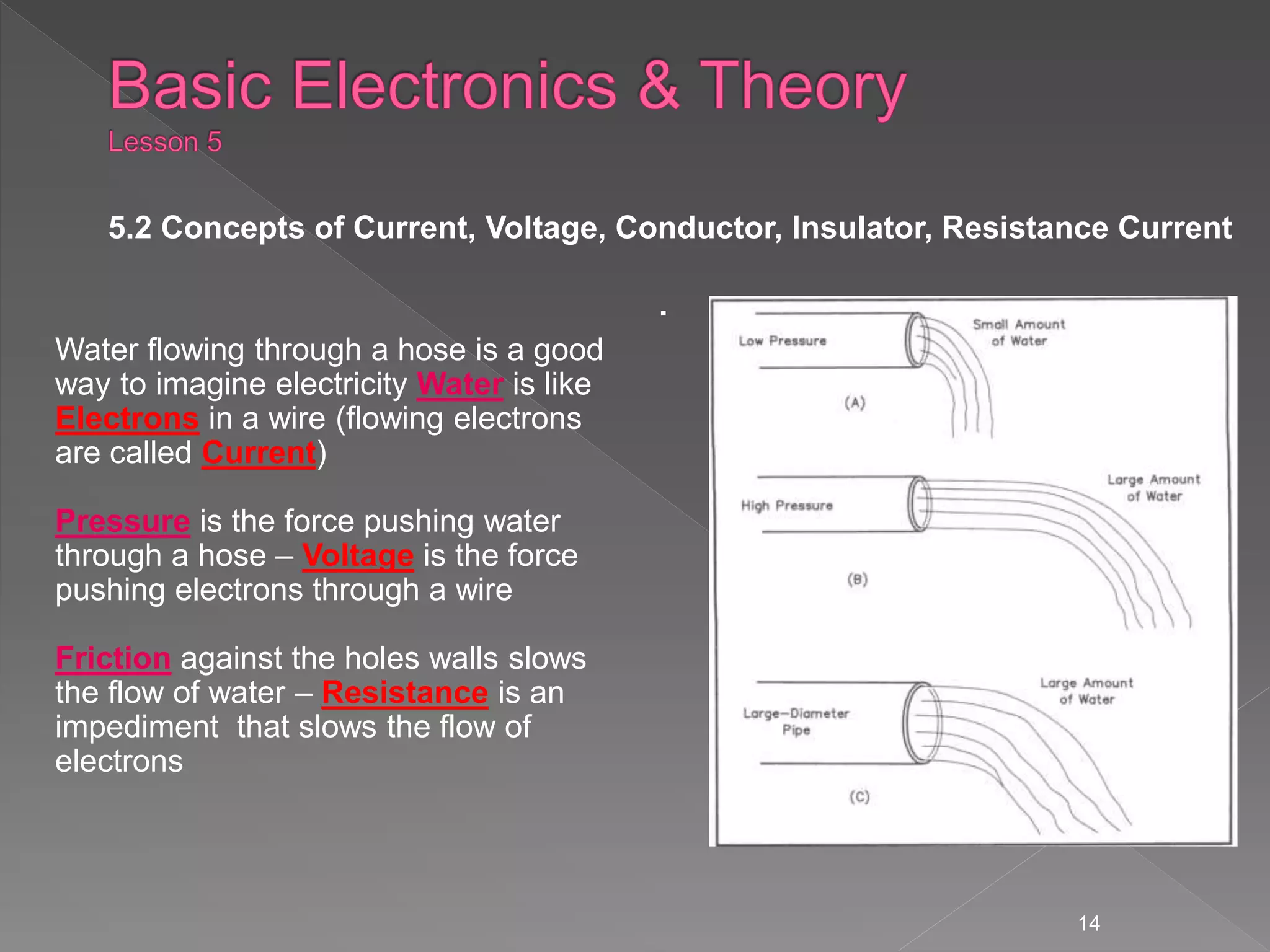
Water flowing through a hose is a good
way to imagine electricity Water is like
Electrons in a wire (flowing electrons
are called Current)
Pressure is the force pushing water
through a hose – Voltage is the force
pushing electrons through a wire
Friction against the holes walls slows
the flow of water – Resistance is an
impediment that slows the flow of
electrons
.
14
5.2 Concepts of Current, Voltage, Conductor, Insulator, Resistance Current
 There are 2 types of current
› The form is determined by the directions the current
flows through a conductor
 Direct Current (DC)
› Flows in only one direction from negative toward
positive pole of source
 Alternating Current (AC)
› Flows back and forth because the poles of the source
alternate between positive and negative
15
16
5.2 Concepts of Current, Voltage, Conductor, Insulator,
Resistance Conductors and Insulators
There are some materials that electricity flows through easily. These
materials are called conductors. Most conductors are metals.
Four good electrical conductors are gold, silver, aluminum and copper.
Insulators are materials that do not let electricity flow through them.
Four good insulators are glass, air, plastic, and porcelain.
17
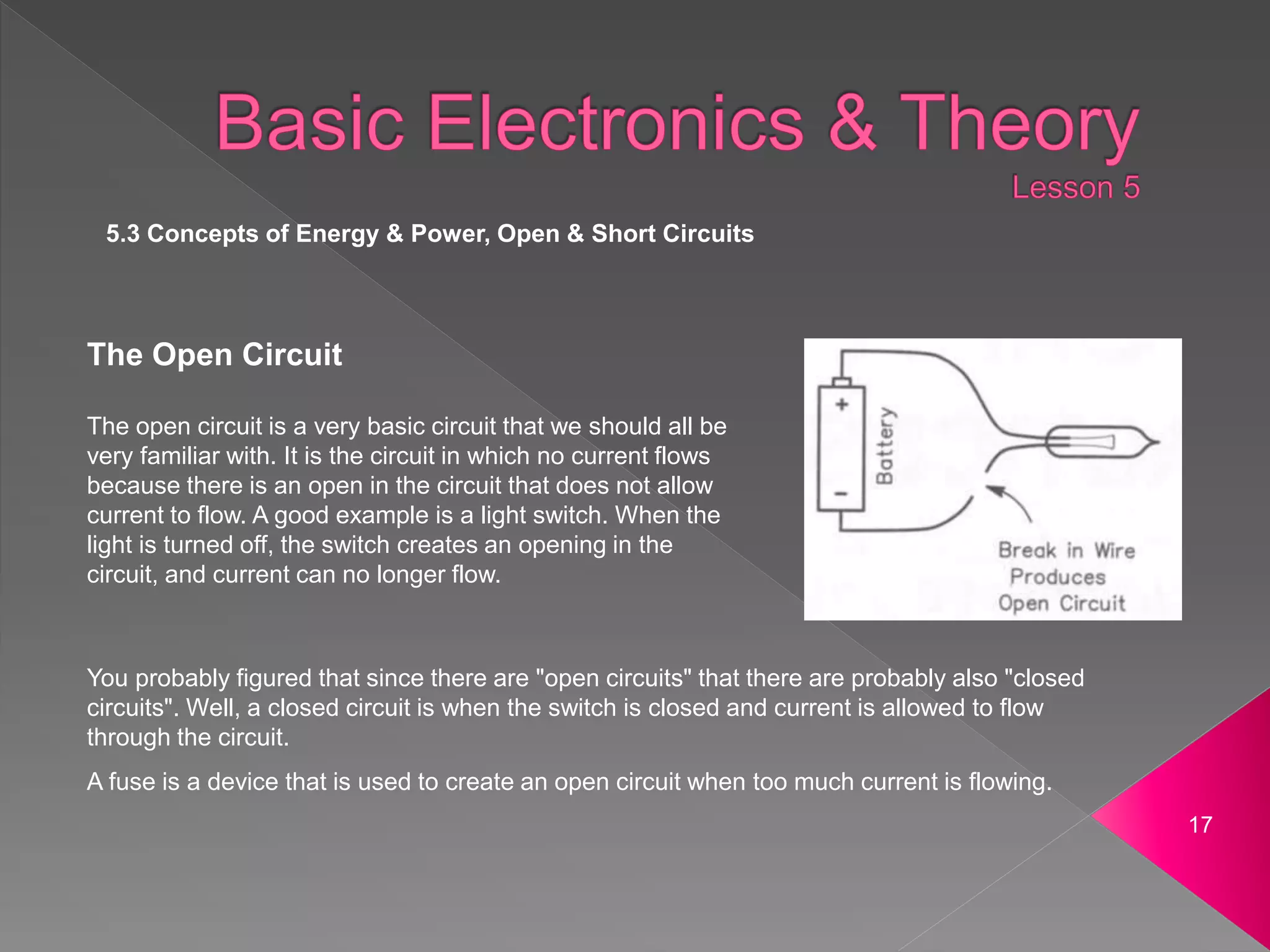
The Open Circuit
The open circuit is a very basic circuit that we should all be
very familiar with. It is the circuit in which no current flows
because there is an open in the circuit that does not allow
current to flow. A good example is a light switch. When the
light is turned off, the switch creates an opening in the
circuit, and current can no longer flow.
You probably figured that since there are "open circuits" that there are probably also "closed
circuits". Well, a closed circuit is when the switch is closed and current is allowed to flow
through the circuit.
A fuse is a device that is used to create an open circuit when too much current is flowing.
5.3 Concepts of Energy & Power, Open & Short Circuits
18
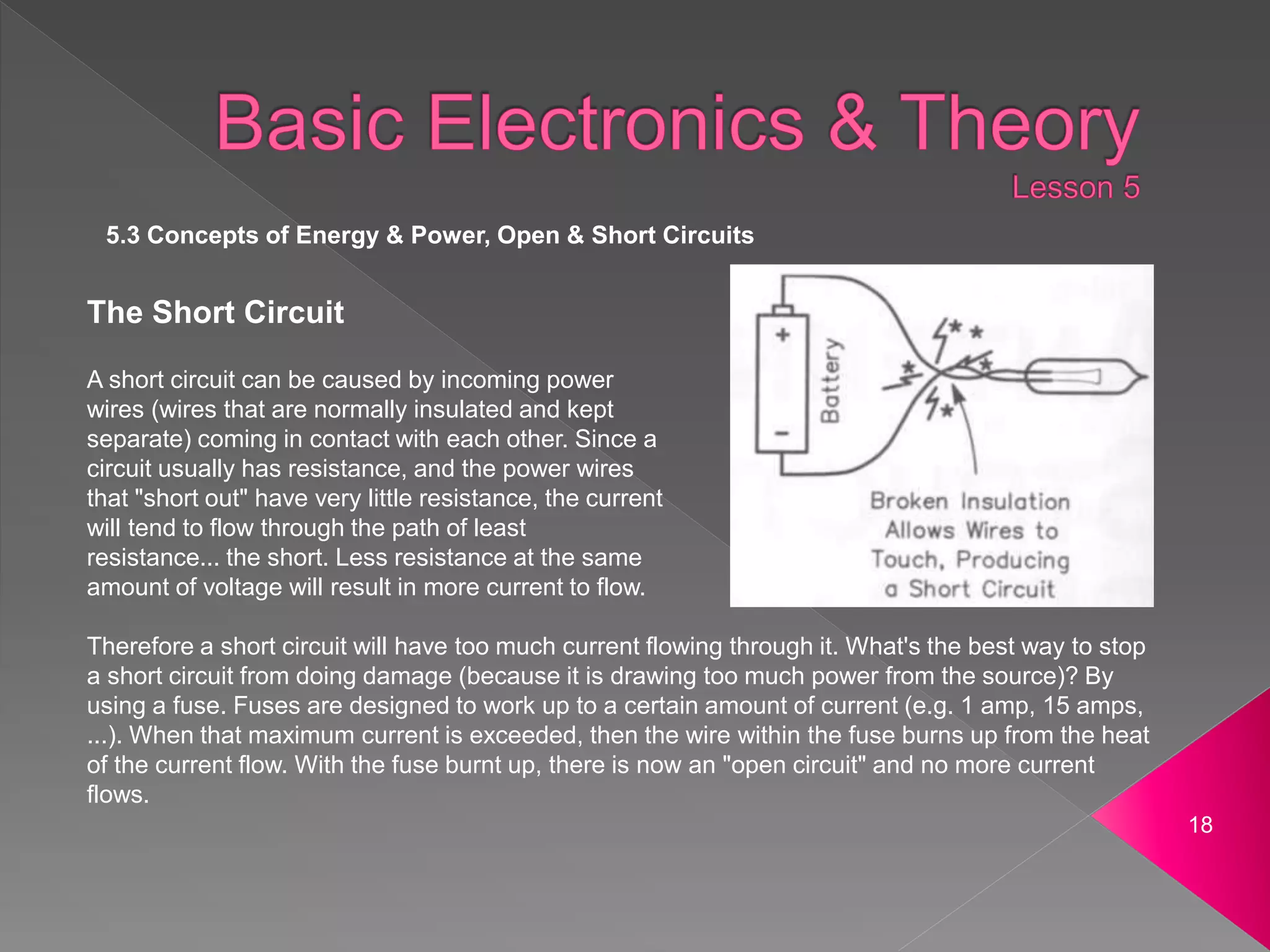
The Short Circuit
A short circuit can be caused by incoming power
wires (wires that are normally insulated and kept
separate) coming in contact with each other. Since a
circuit usually has resistance, and the power wires
that "short out" have very little resistance, the current
will tend to flow through the path of least
resistance... the short. Less resistance at the same
amount of voltage will result in more current to flow.
Therefore a short circuit will have too much current flowing through it. What's the best way to stop
a short circuit from doing damage (because it is drawing too much power from the source)? By
using a fuse. Fuses are designed to work up to a certain amount of current (e.g. 1 amp, 15 amps,
...). When that maximum current is exceeded, then the wire within the fuse burns up from the heat
of the current flow. With the fuse burnt up, there is now an "open circuit" and no more current
flows.
5.3 Concepts of Energy & Power, Open & Short Circuits
19
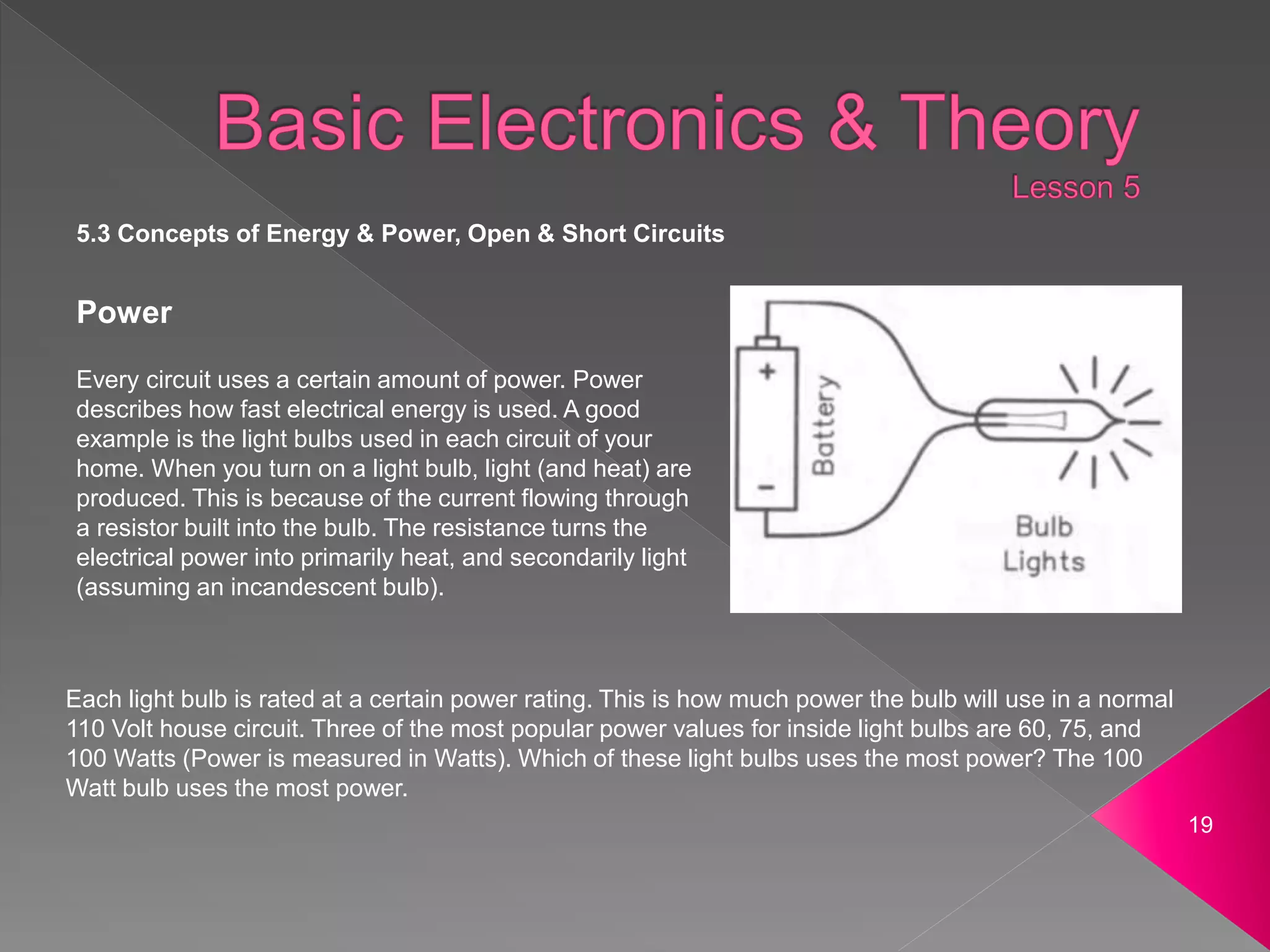
Power
Every circuit uses a certain amount of power. Power
describes how fast electrical energy is used. A good
example is the light bulbs used in each circuit of your
home. When you turn on a light bulb, light (and heat) are
produced. This is because of the current flowing through
a resistor built into the bulb. The resistance turns the
electrical power into primarily heat, and secondarily light
(assuming an incandescent bulb).
Each light bulb is rated at a certain power rating. This is how much power the bulb will use in a normal
110 Volt house circuit. Three of the most popular power values for inside light bulbs are 60, 75, and
100 Watts (Power is measured in Watts). Which of these light bulbs uses the most power? The 100
Watt bulb uses the most power.
5.3 Concepts of Energy & Power, Open & Short Circuits
 5.4 Ohm’s Law
 E = electromotive force (a.k.a. Voltage)
 I = intensity (French term for Current)
 R = resistance
 Voltage: E = I x R (Volts)
 Current: I = E / R (Amps)
 Resistance: R = E / I (Ohms)
20
21
5.4 Ohm’s Law Calculating Voltage and Current and Resistance
Current?
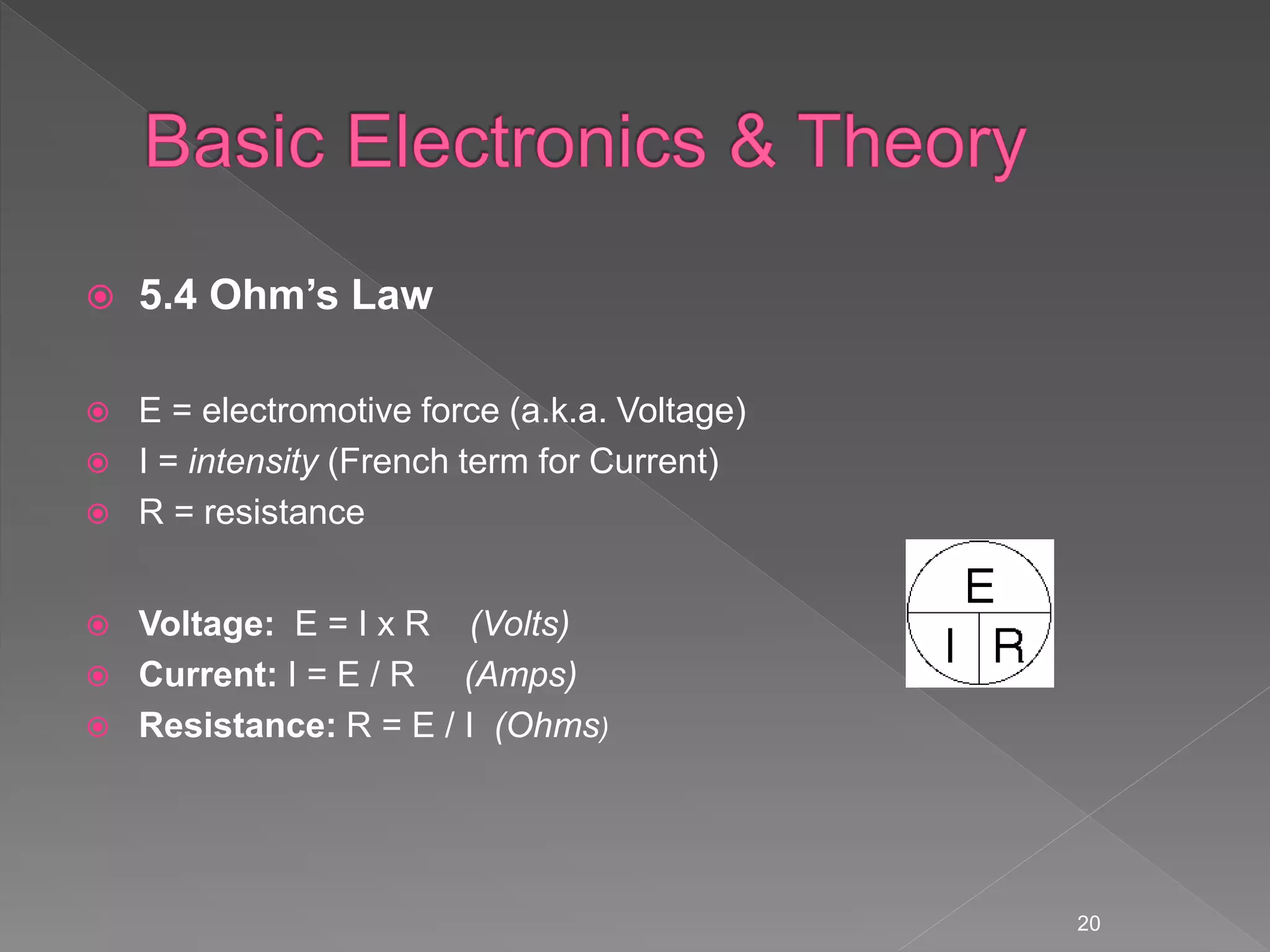
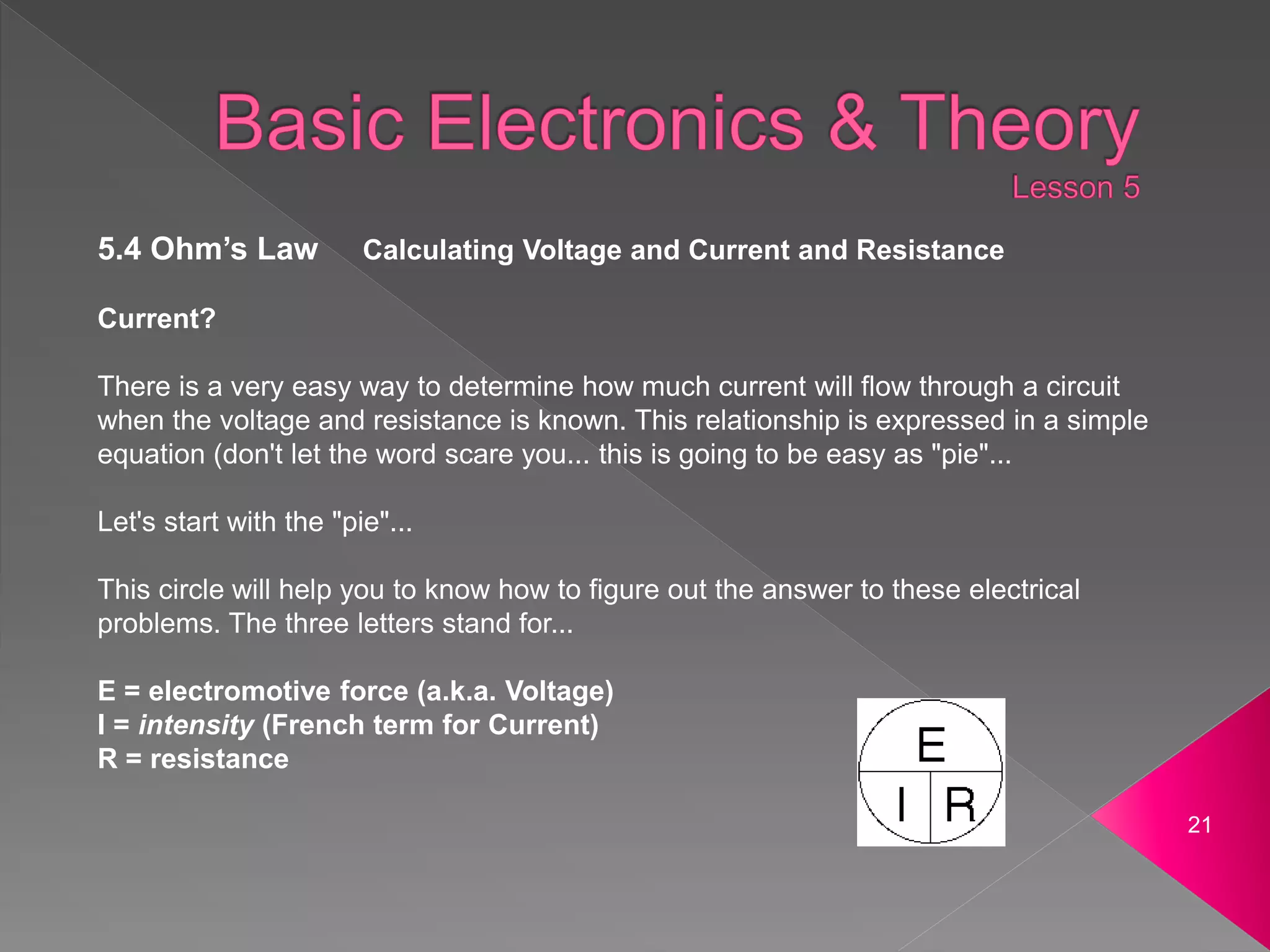
There is a very easy way to determine how much current will flow through a circuit
when the voltage and resistance is known. This relationship is expressed in a simple
equation (don't let the word scare you... this is going to be easy as "pie"...
Let's start with the "pie"...
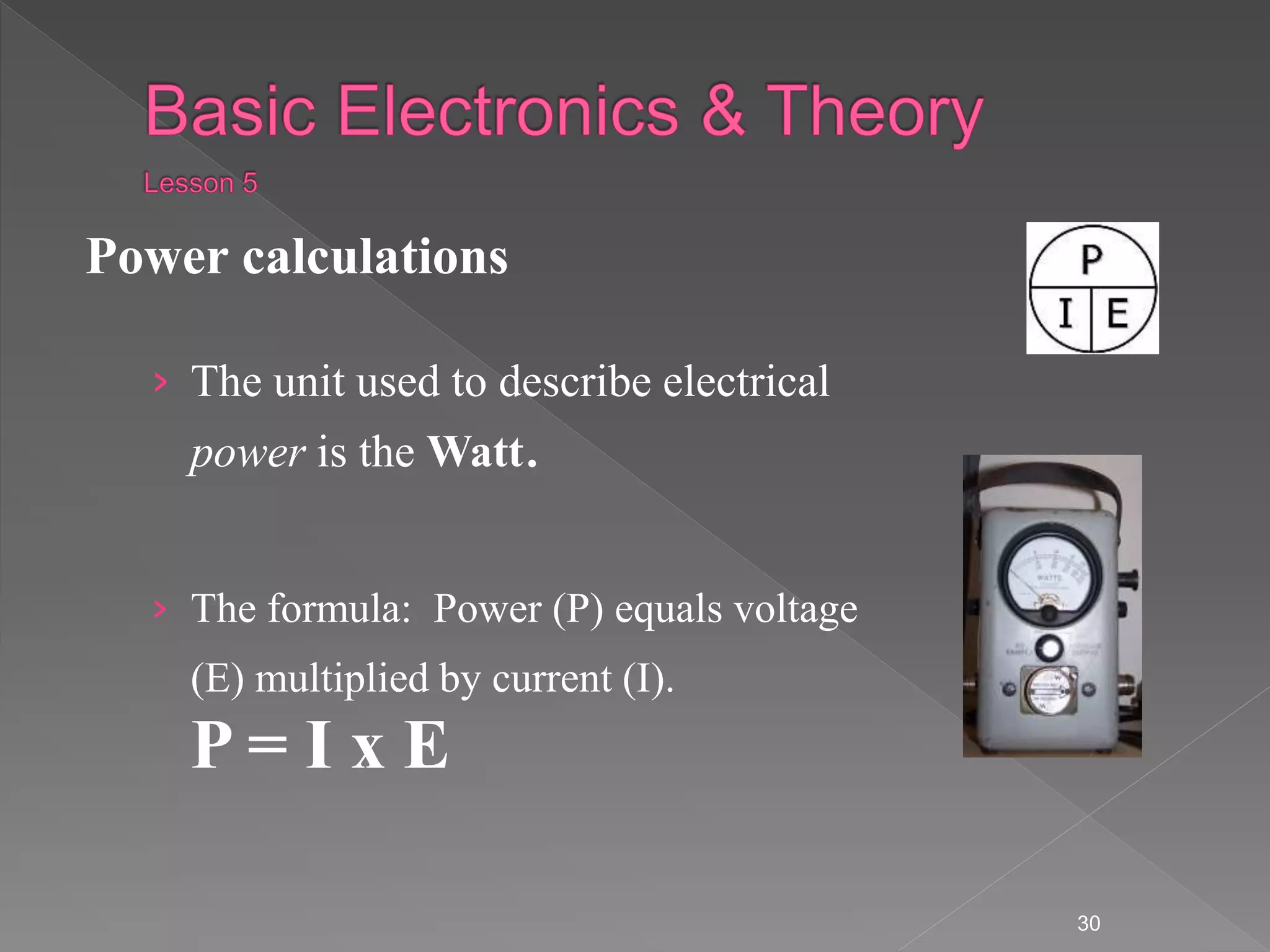
This circle will help you to know how to figure out the answer to these electrical
problems. The three letters stand for...
E = electromotive force (a.k.a. Voltage)
I = intensity (French term for Current)
R = resistance
22
5.4 Ohm’s Law Calculating Voltage and Current and Resistance
Current?
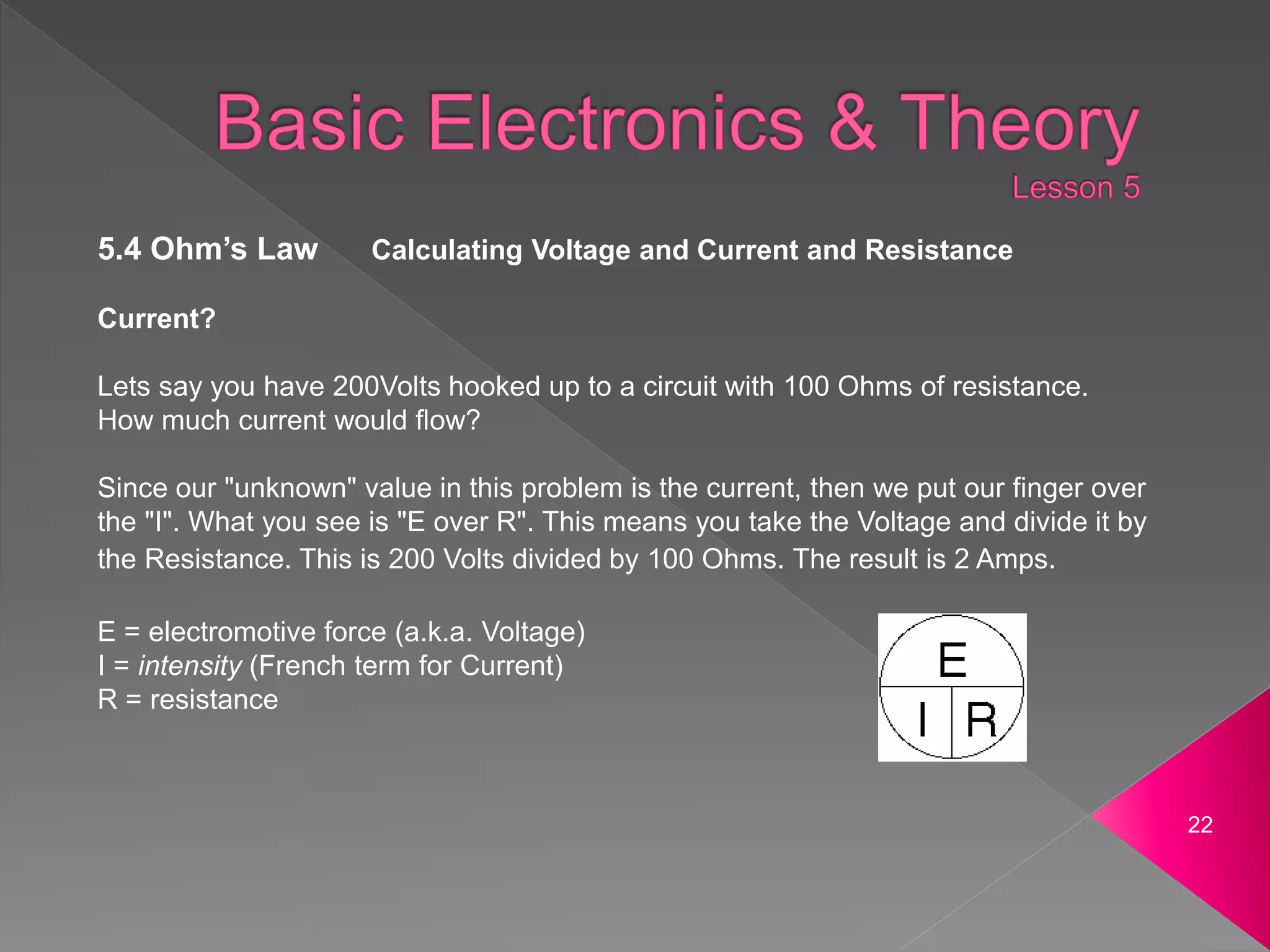
Lets say you have 200Volts hooked up to a circuit with 100 Ohms of resistance.
How much current would flow?
Since our "unknown" value in this problem is the current, then we put our finger over
the "I". What you see is "E over R". This means you take the Voltage and divide it by
the Resistance. This is 200 Volts divided by 100 Ohms. The result is 2 Amps.
E = electromotive force (a.k.a. Voltage)
I = intensity (French term for Current)
R = resistance
23
5.4 Ohm’s Law Calculating Voltage and Current and Resistance
Voltage?
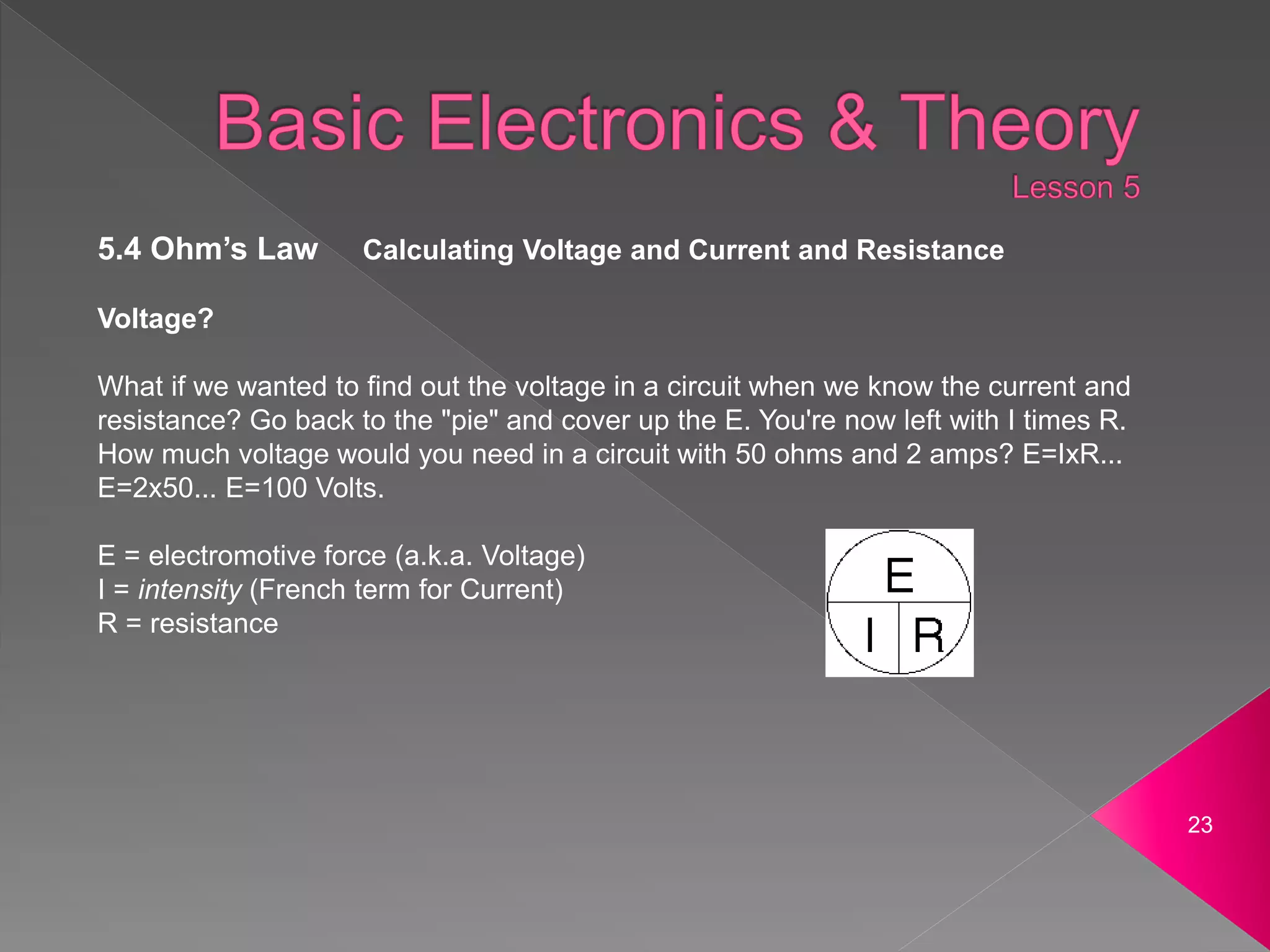
What if we wanted to find out the voltage in a circuit when we know the current and
resistance? Go back to the "pie" and cover up the E. You're now left with I times R.
How much voltage would you need in a circuit with 50 ohms and 2 amps? E=IxR...
E=2x50... E=100 Volts.
E = electromotive force (a.k.a. Voltage)
I = intensity (French term for Current)
R = resistance
24
5.4 Ohm’s Law Calculating Voltage and Current and Resistance
Resistance?
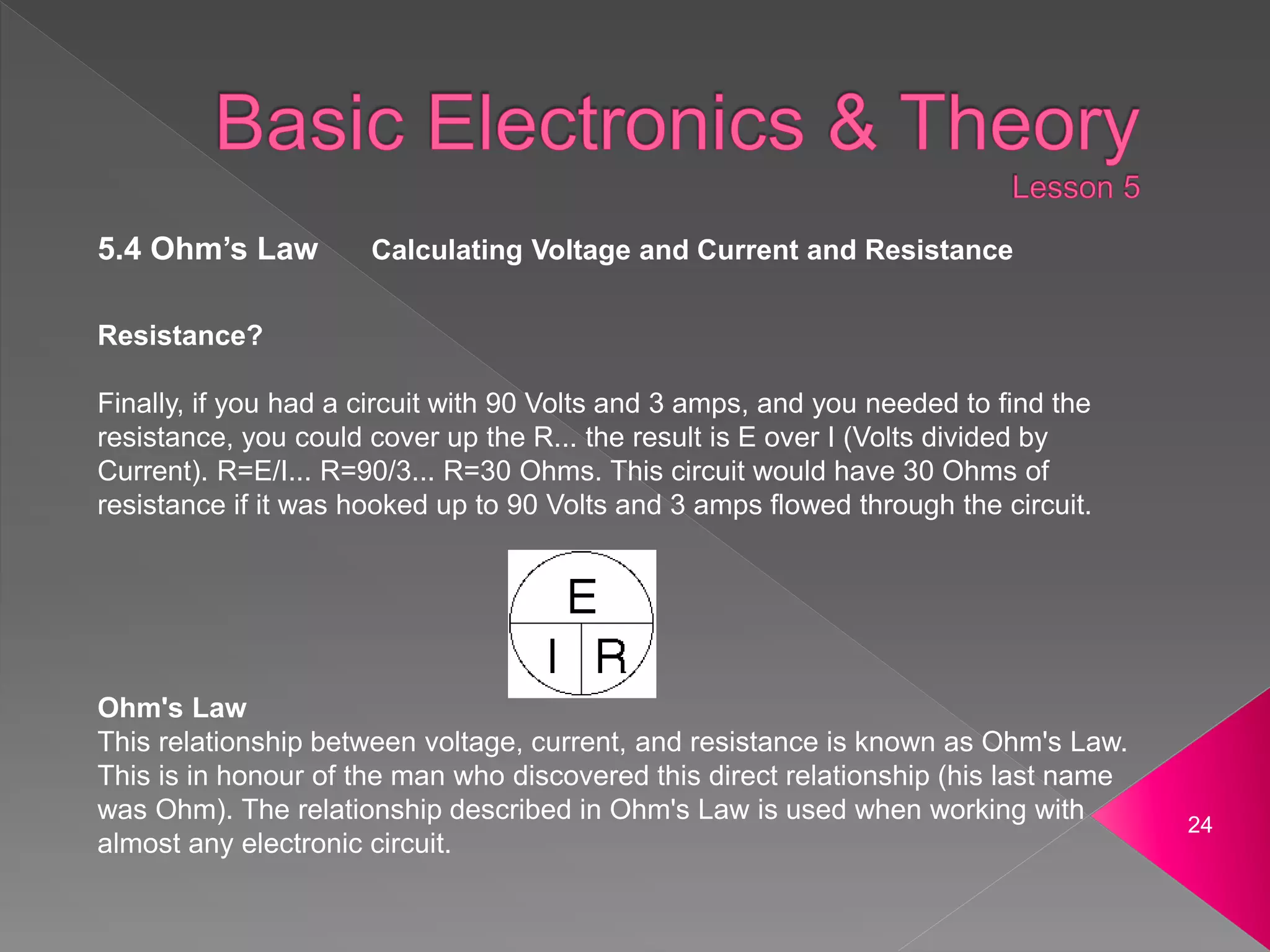
Finally, if you had a circuit with 90 Volts and 3 amps, and you needed to find the
resistance, you could cover up the R... the result is E over I (Volts divided by
Current). R=E/I... R=90/3... R=30 Ohms. This circuit would have 30 Ohms of
resistance if it was hooked up to 90 Volts and 3 amps flowed through the circuit.
Ohm's Law
This relationship between voltage, current, and resistance is known as Ohm's Law.
This is in honour of the man who discovered this direct relationship (his last name
was Ohm). The relationship described in Ohm's Law is used when working with
almost any electronic circuit.
Memorizing Ohm's law
Memorizing Ohm's law may sound like a time consuming and daunting task, but if remember
this little story you'll have it committed to memory for life within a few minutes!
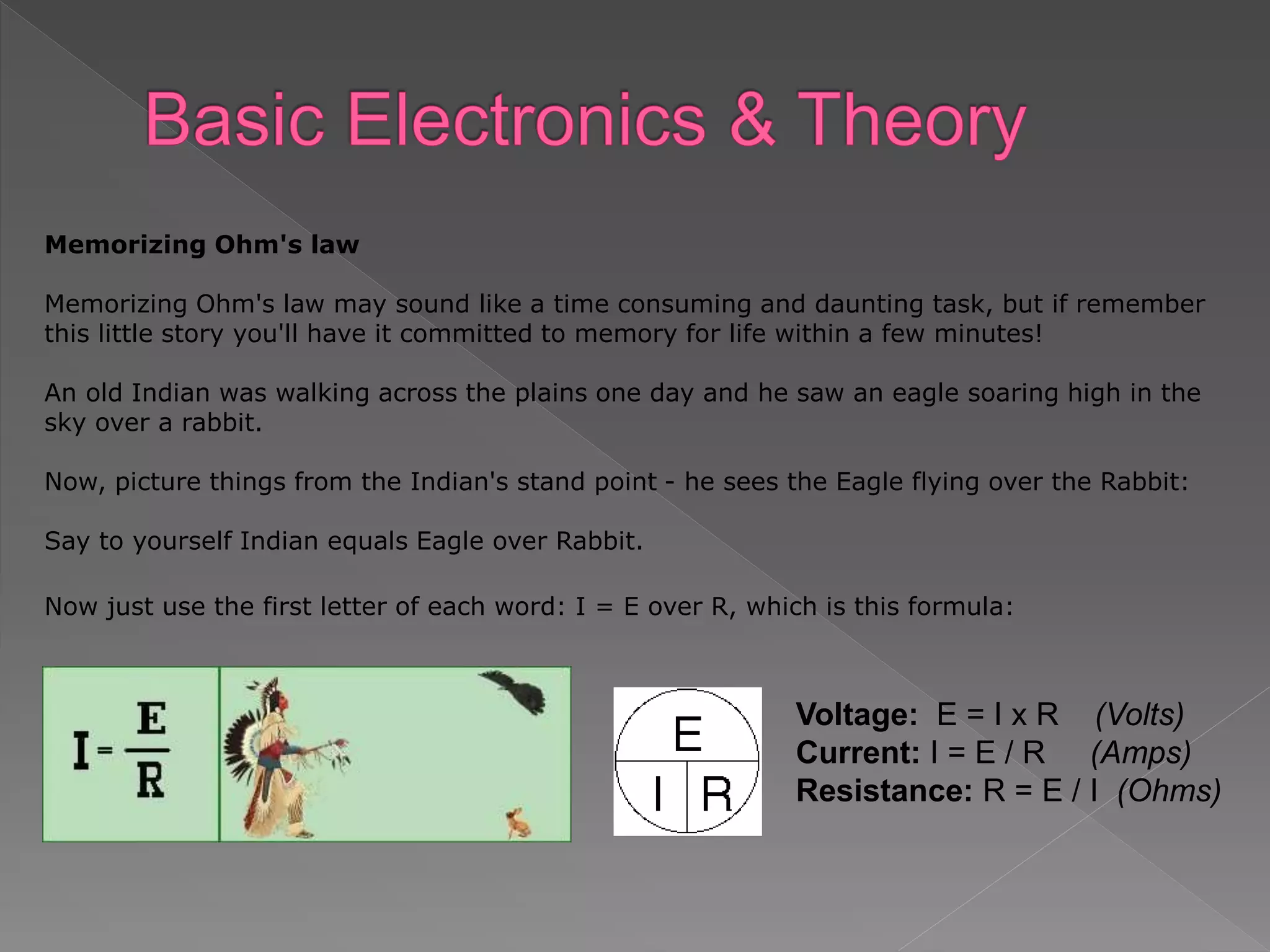
An old Indian was walking across the plains one day and he saw an eagle soaring high in the
sky over a rabbit.
Now, picture things from the Indian's stand point - he sees the Eagle flying over the Rabbit:
Say to yourself Indian equals Eagle over Rabbit.
Now just use the first letter of each word: I = E over R, which is this formula:
Voltage: E = I x R (Volts)
Current: I = E / R (Amps)
Resistance: R = E / I (Ohms)
Memorizing Ohm's law
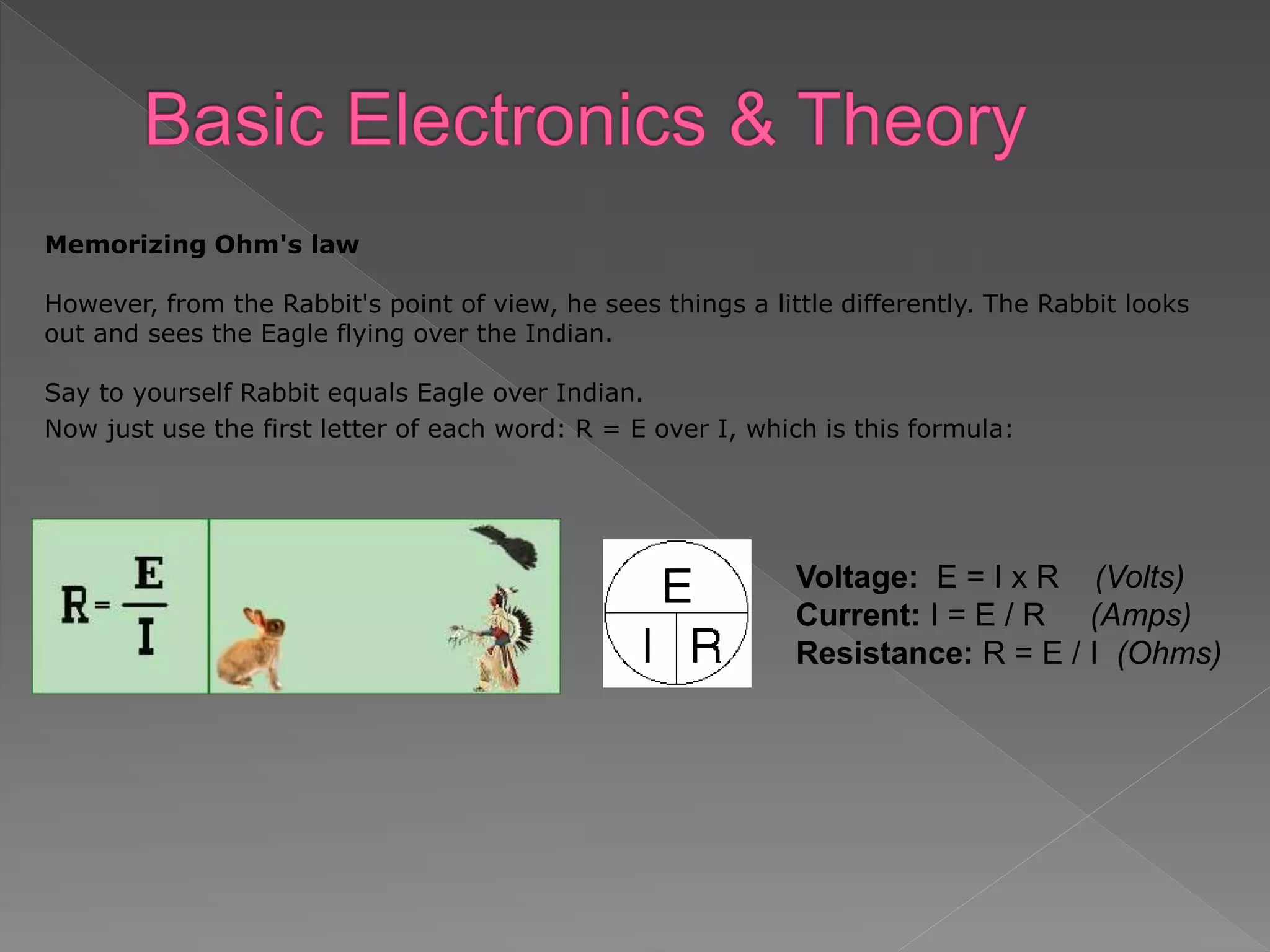
However, from the Rabbit's point of view, he sees things a little differently. The Rabbit looks
out and sees the Eagle flying over the Indian.
Say to yourself Rabbit equals Eagle over Indian.
Now just use the first letter of each word: R = E over I, which is this formula:
Voltage: E = I x R (Volts)
Current: I = E / R (Amps)
Resistance: R = E / I (Ohms)
Memorizing Ohm's law
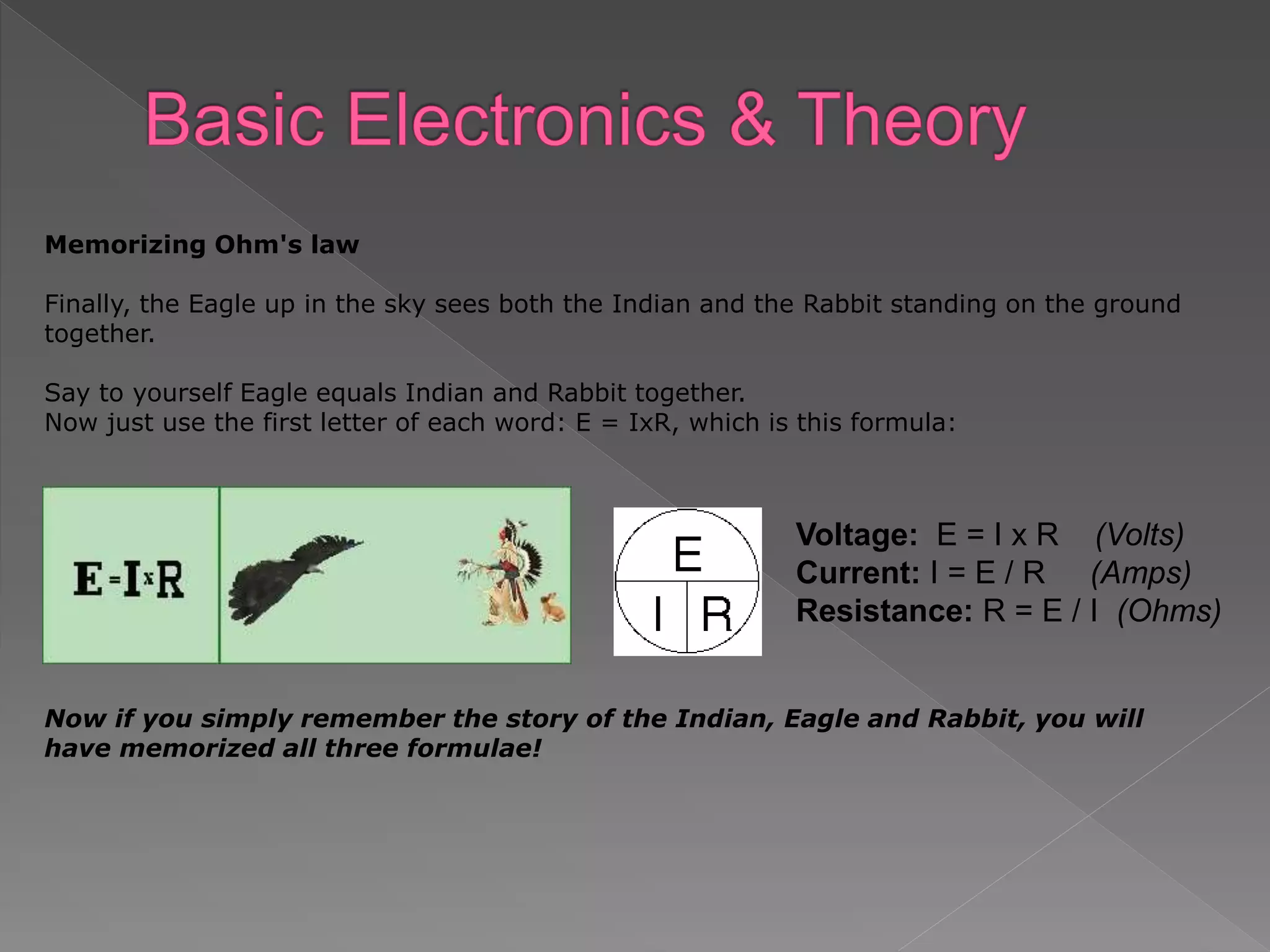
Finally, the Eagle up in the sky sees both the Indian and the Rabbit standing on the ground
together.
Say to yourself Eagle equals Indian and Rabbit together.
Now just use the first letter of each word: E = IxR, which is this formula:
Now if you simply remember the story of the Indian, Eagle and Rabbit, you will
have memorized all three formulae!
Voltage: E = I x R (Volts)
Current: I = E / R (Amps)
Resistance: R = E / I (Ohms)
Memorizing Ohm's law
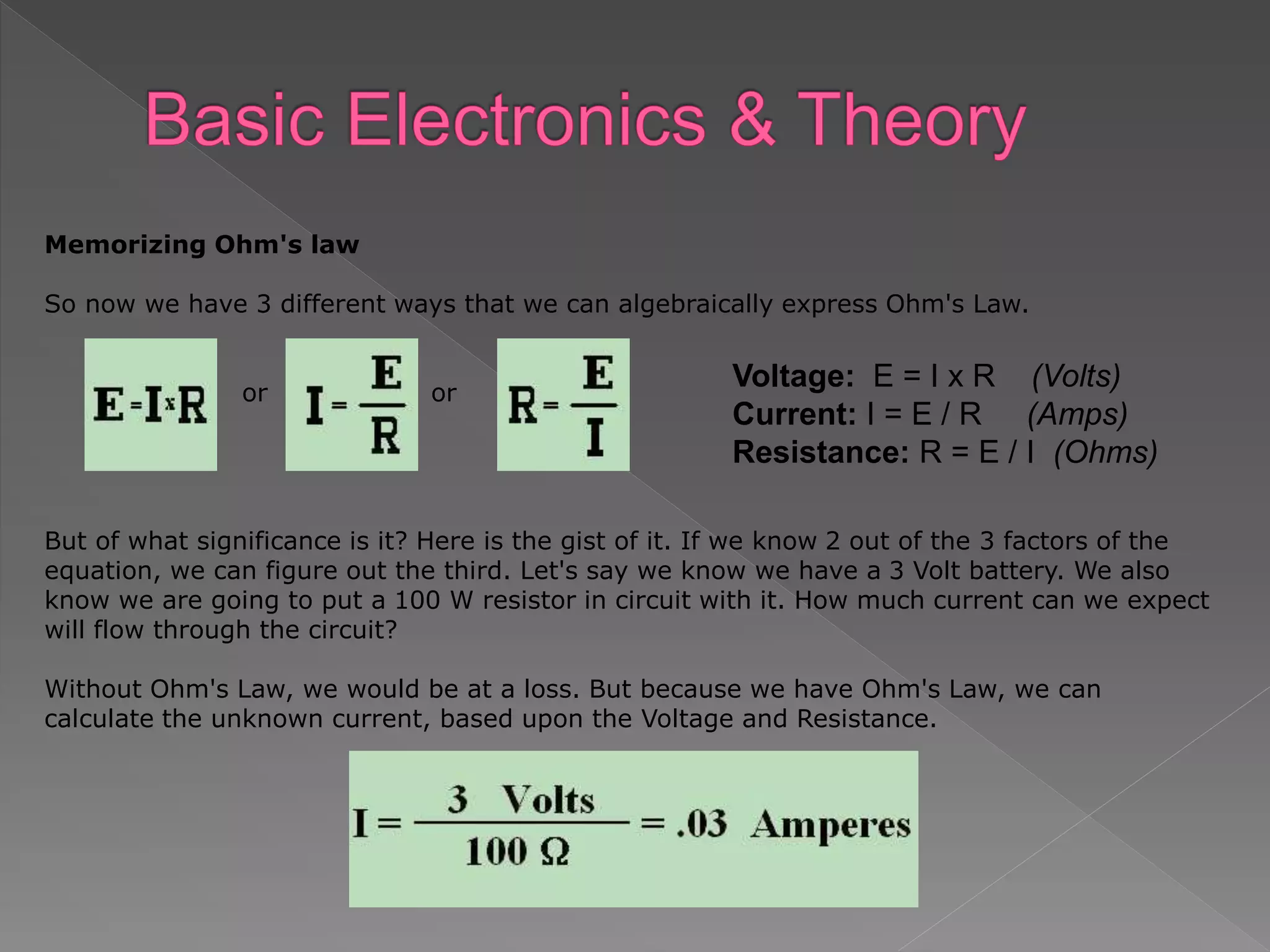
So now we have 3 different ways that we can algebraically express Ohm's Law.
or or
But of what significance is it? Here is the gist of it. If we know 2 out of the 3 factors of the
equation, we can figure out the third. Let's say we know we have a 3 Volt battery. We also
know we are going to put a 100 W resistor in circuit with it. How much current can we expect
will flow through the circuit?
Without Ohm's Law, we would be at a loss. But because we have Ohm's Law, we can
calculate the unknown current, based upon the Voltage and Resistance.
Voltage: E = I x R (Volts)
Current: I = E / R (Amps)
Resistance: R = E / I (Ohms)
Power calculations
› The unit used to describe electrical
power is the Watt.
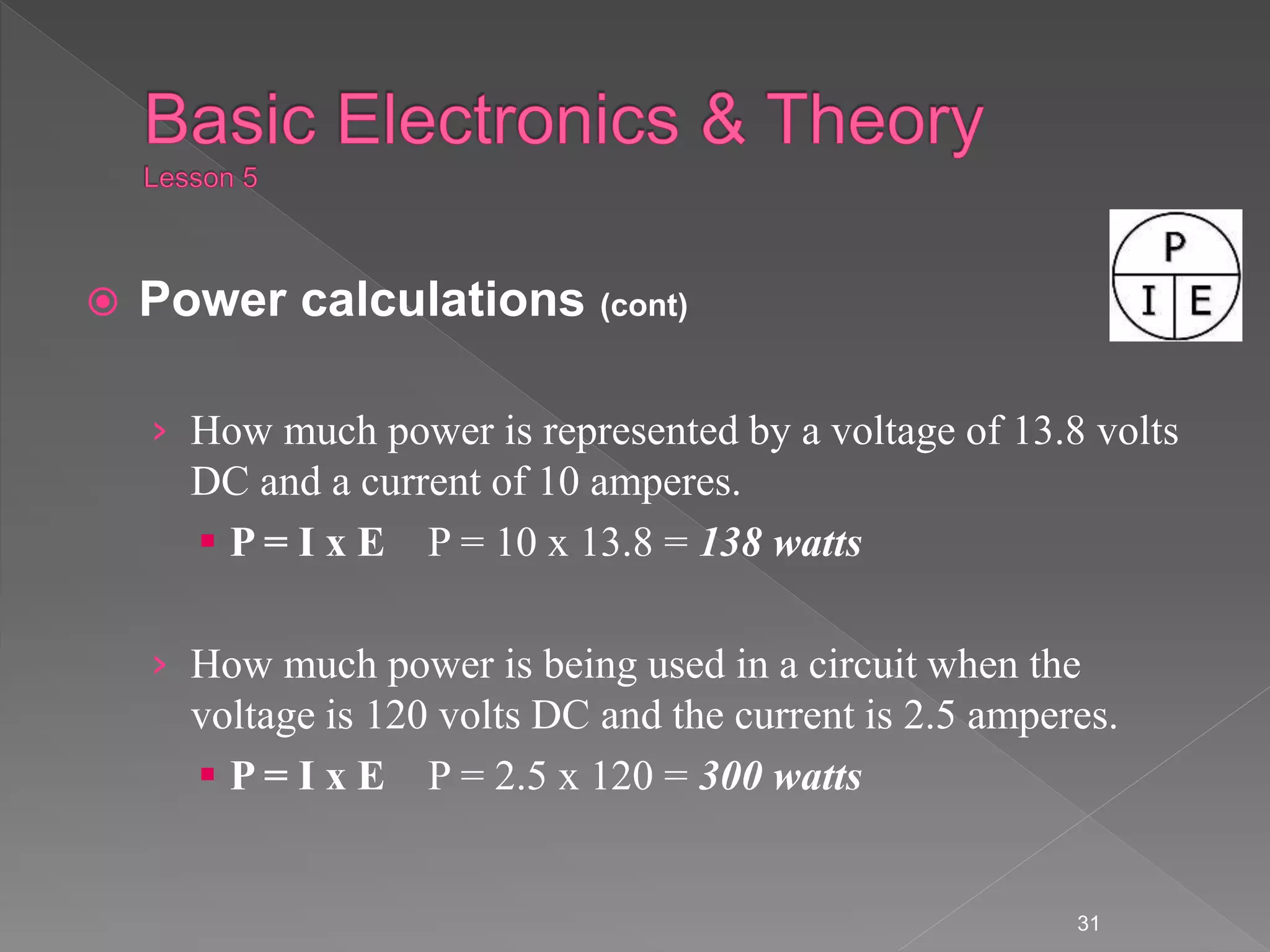
› The formula: Power (P) equals voltage
(E) multiplied by current (I).
P = I x E
30
 Power calculations (cont)
› How much power is represented by a voltage of 13.8 volts
DC and a current of 10 amperes.
 P = I x E P = 10 x 13.8 = 138 watts
› How much power is being used in a circuit when the
voltage is 120 volts DC and the current is 2.5 amperes.
 P = I x E P = 2.5 x 120 = 300 watts
31
 Power calculations (cont)
› You can you determine how many watts are being drawn
[consumed] by your transceiver when you are transmitting
by measuring the DC voltage at the transceiver and
multiplying by the current drawn when you transmit.
› How many amperes is flowing in a circuit when the
applied voltage is 120 volts DC and the load is 1200 watts.
 I = P/E I = 1200/120 = 10 amperes.
32
Memorizing Ohm's law
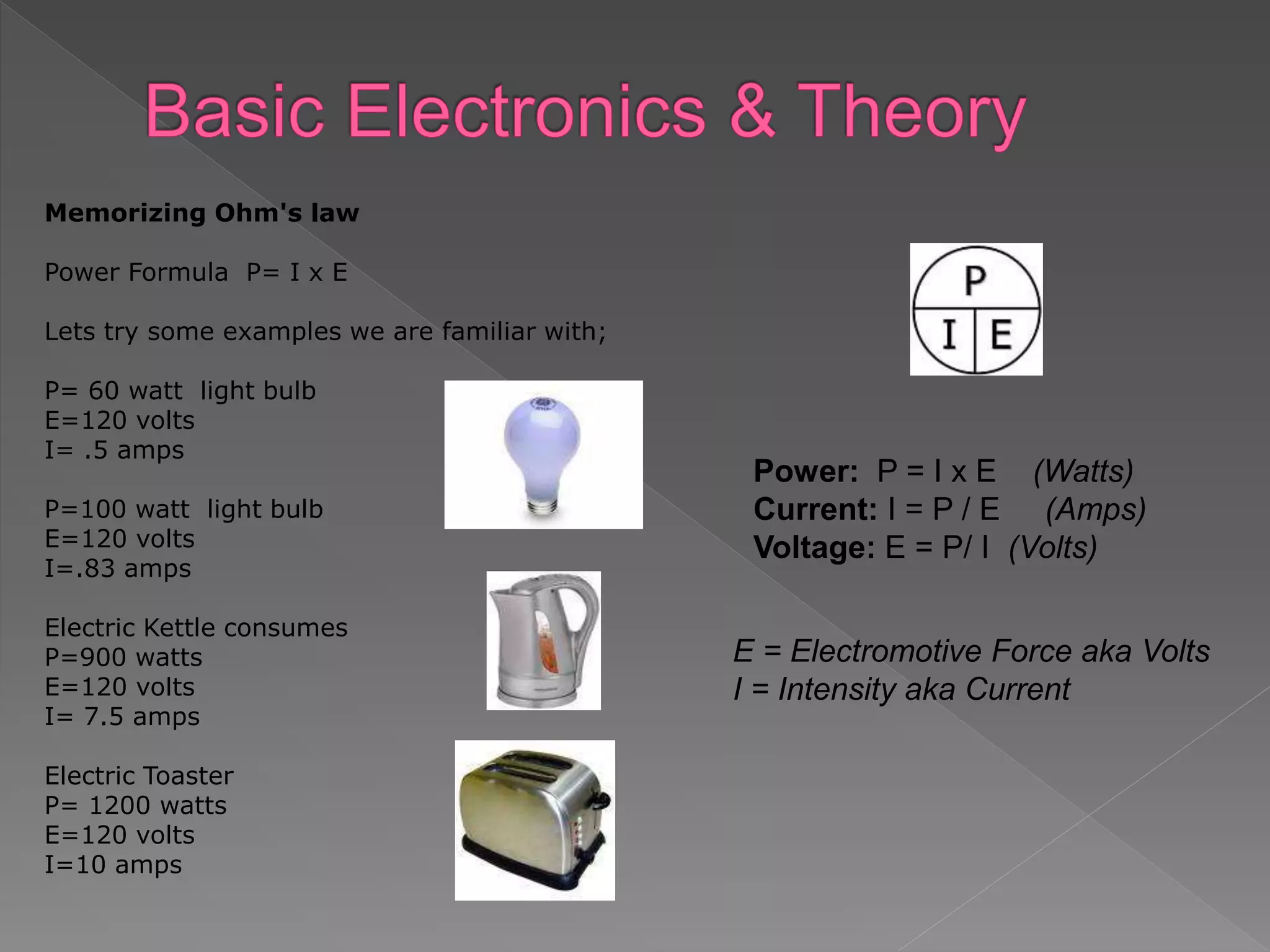
Power Formula P= I x E
Lets try some examples we are familiar with;
P= 60 watt light bulb
E=120 volts
I= .5 amps
P=100 watt light bulb
E=120 volts
I=.83 amps
Electric Kettle consumes
P=900 watts
E=120 volts
I= 7.5 amps
Electric Toaster
P= 1200 watts
E=120 volts
I=10 amps
Power: P = I x E (Watts)
Current: I = P / E (Amps)
Voltage: E = P/ I (Volts)
E = Electromotive Force aka Volts
I = Intensity aka Current
34
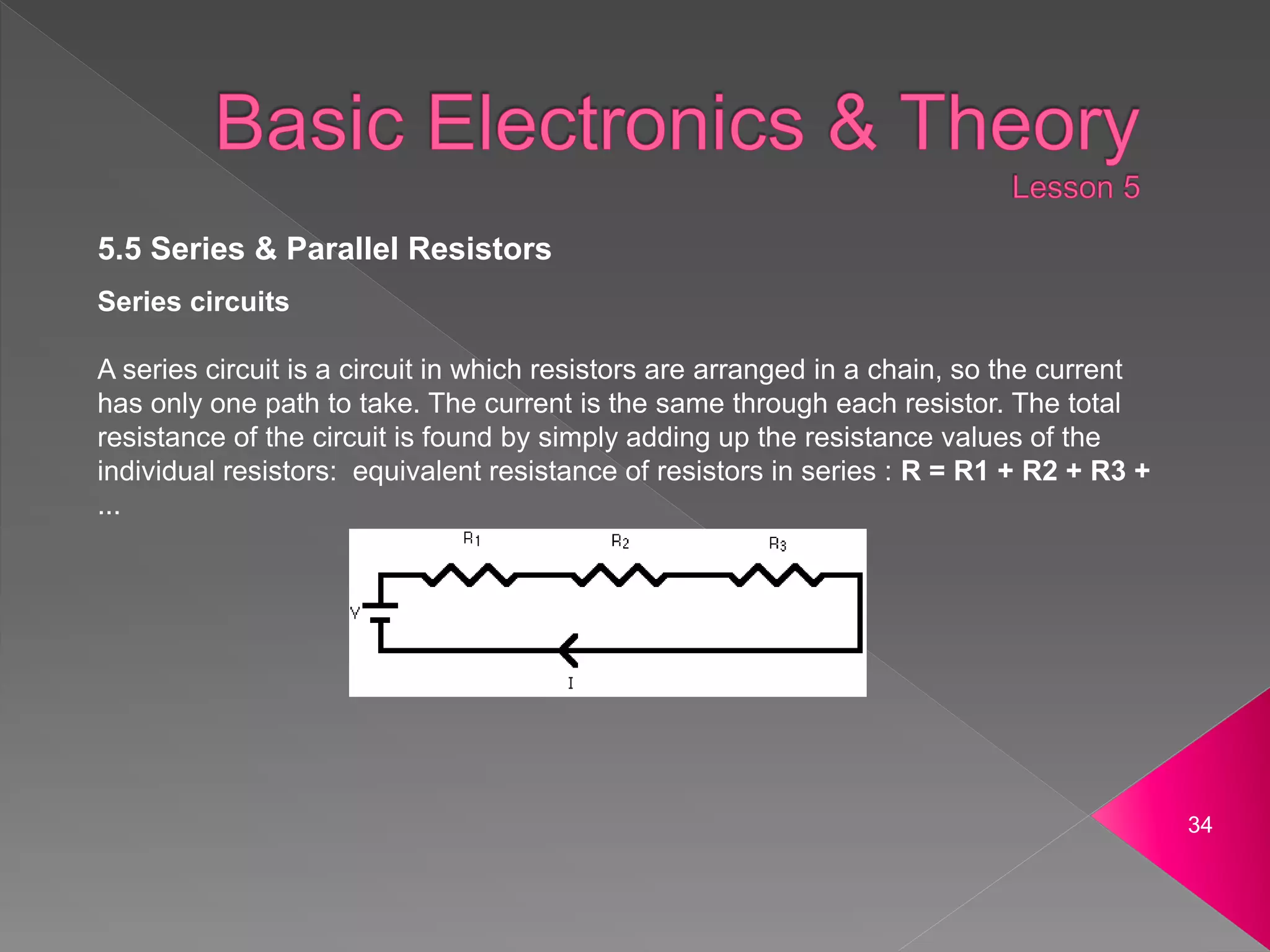
5.5 Series & Parallel Resistors
Series circuits
A series circuit is a circuit in which resistors are arranged in a chain, so the current
has only one path to take. The current is the same through each resistor. The total
resistance of the circuit is found by simply adding up the resistance values of the
individual resistors: equivalent resistance of resistors in series : R = R1 + R2 + R3 +
...
35
5.5 Series & Parallel Resistors
Series circuits
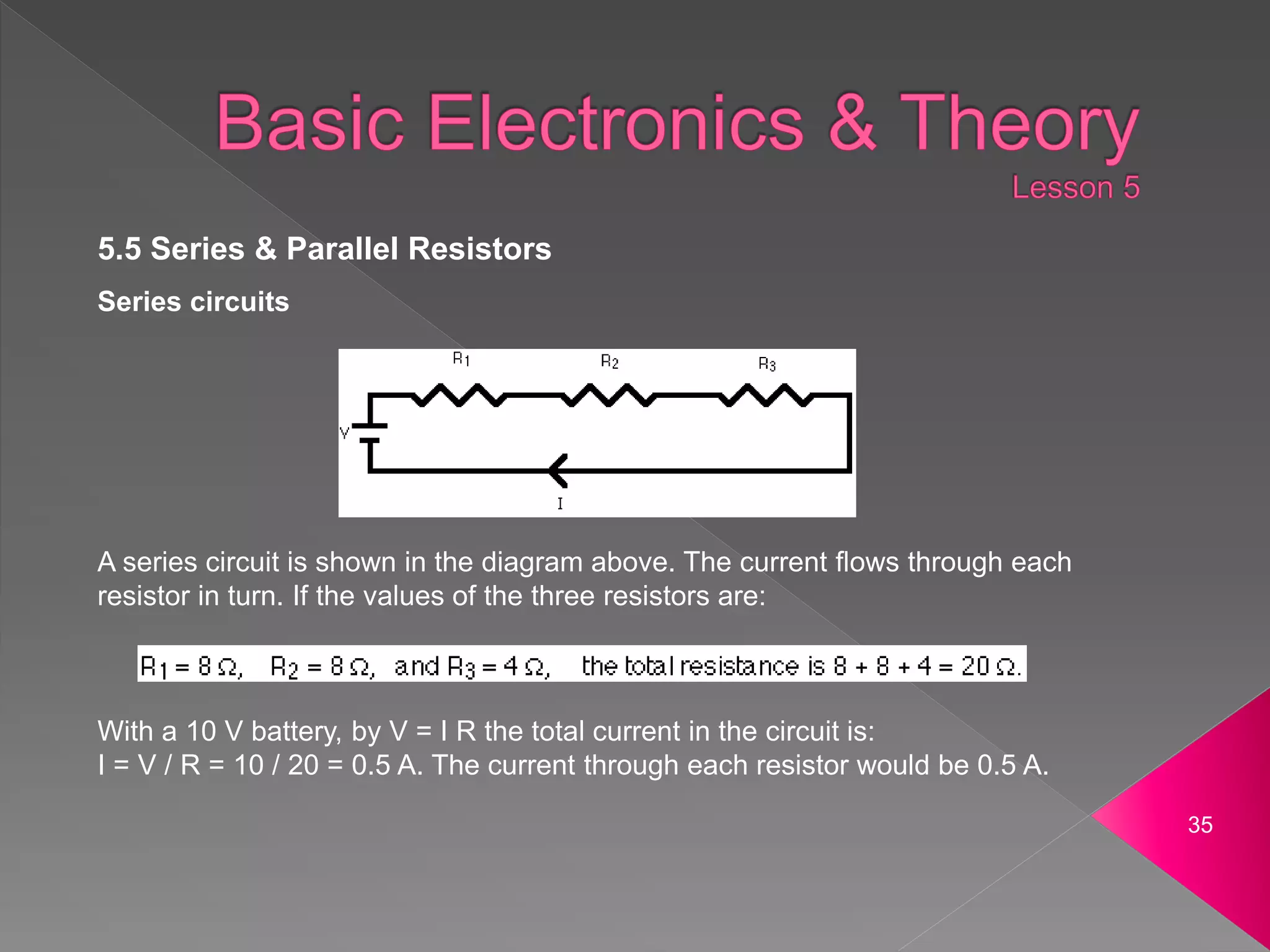
A series circuit is shown in the diagram above. The current flows through each
resistor in turn. If the values of the three resistors are:
With a 10 V battery, by V = I R the total current in the circuit is:
I = V / R = 10 / 20 = 0.5 A. The current through each resistor would be 0.5 A.
36
5.5 Series & Parallel Resistors
Series circuits
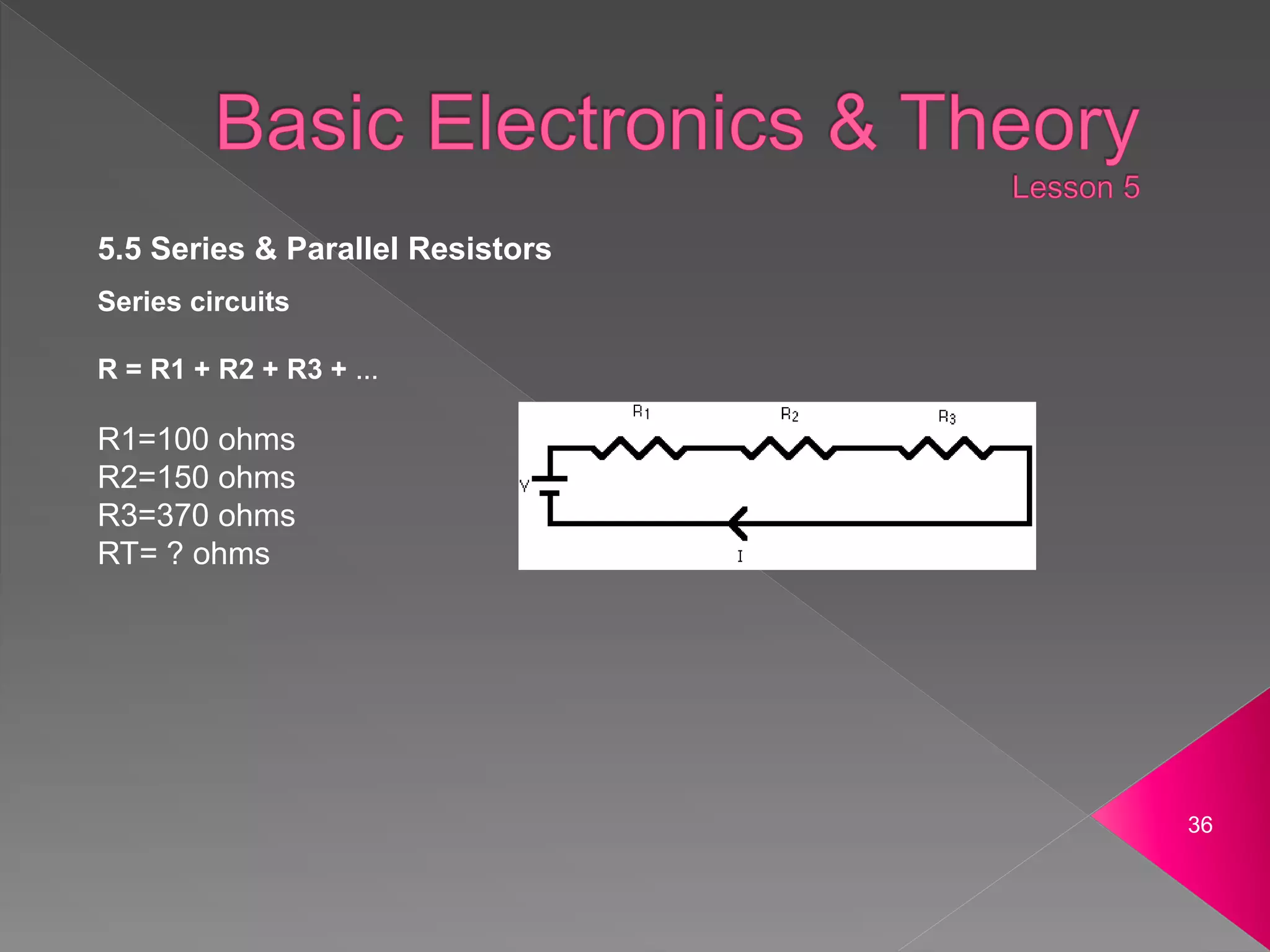
R = R1 + R2 + R3 + ...
R1=100 ohms
R2=150 ohms
R3=370 ohms
RT= ? ohms
37
5.5 Series & Parallel Resistors
Series circuits
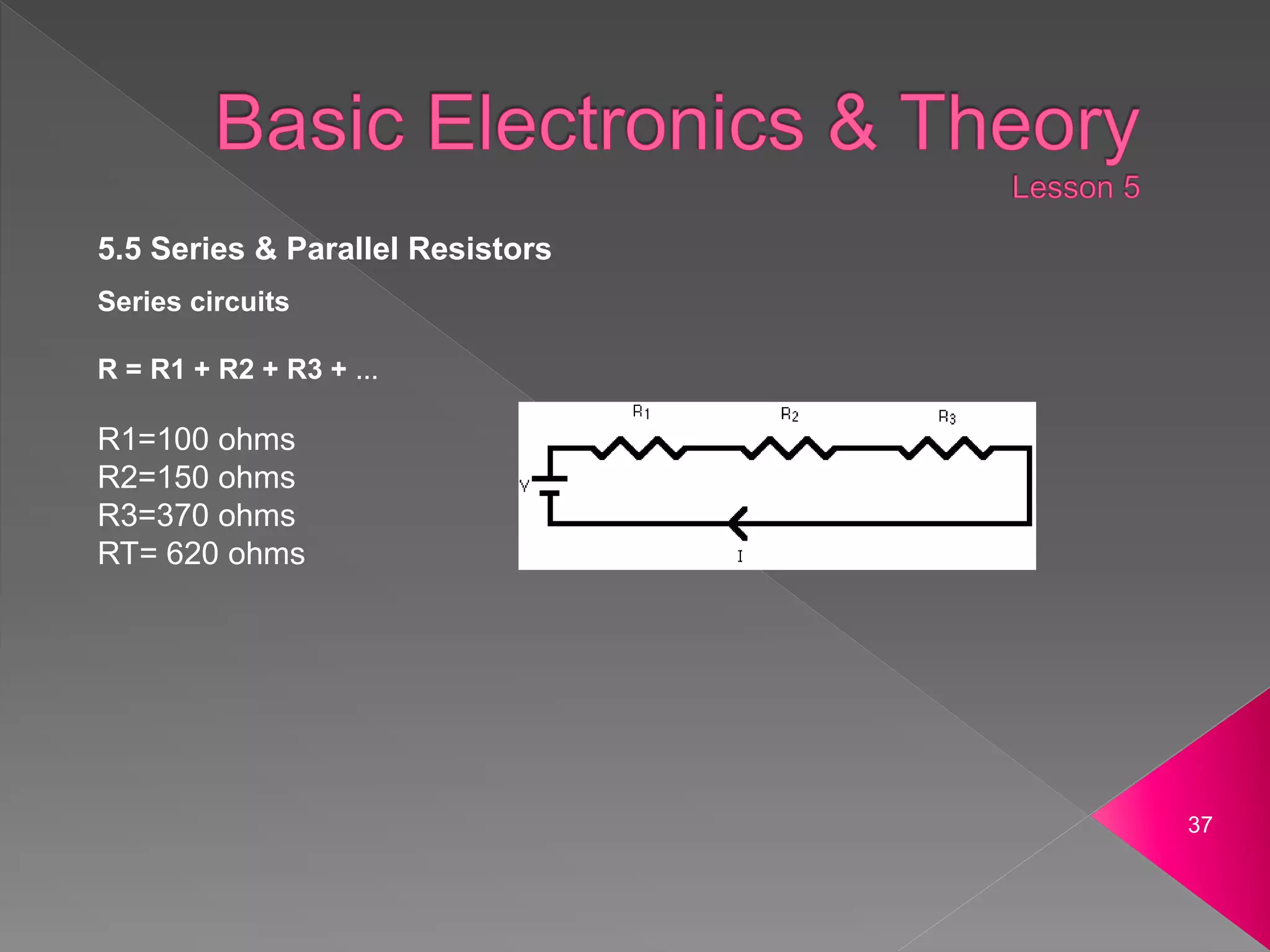
R = R1 + R2 + R3 + ...
R1=100 ohms
R2=150 ohms
R3=370 ohms
RT= 620 ohms
38
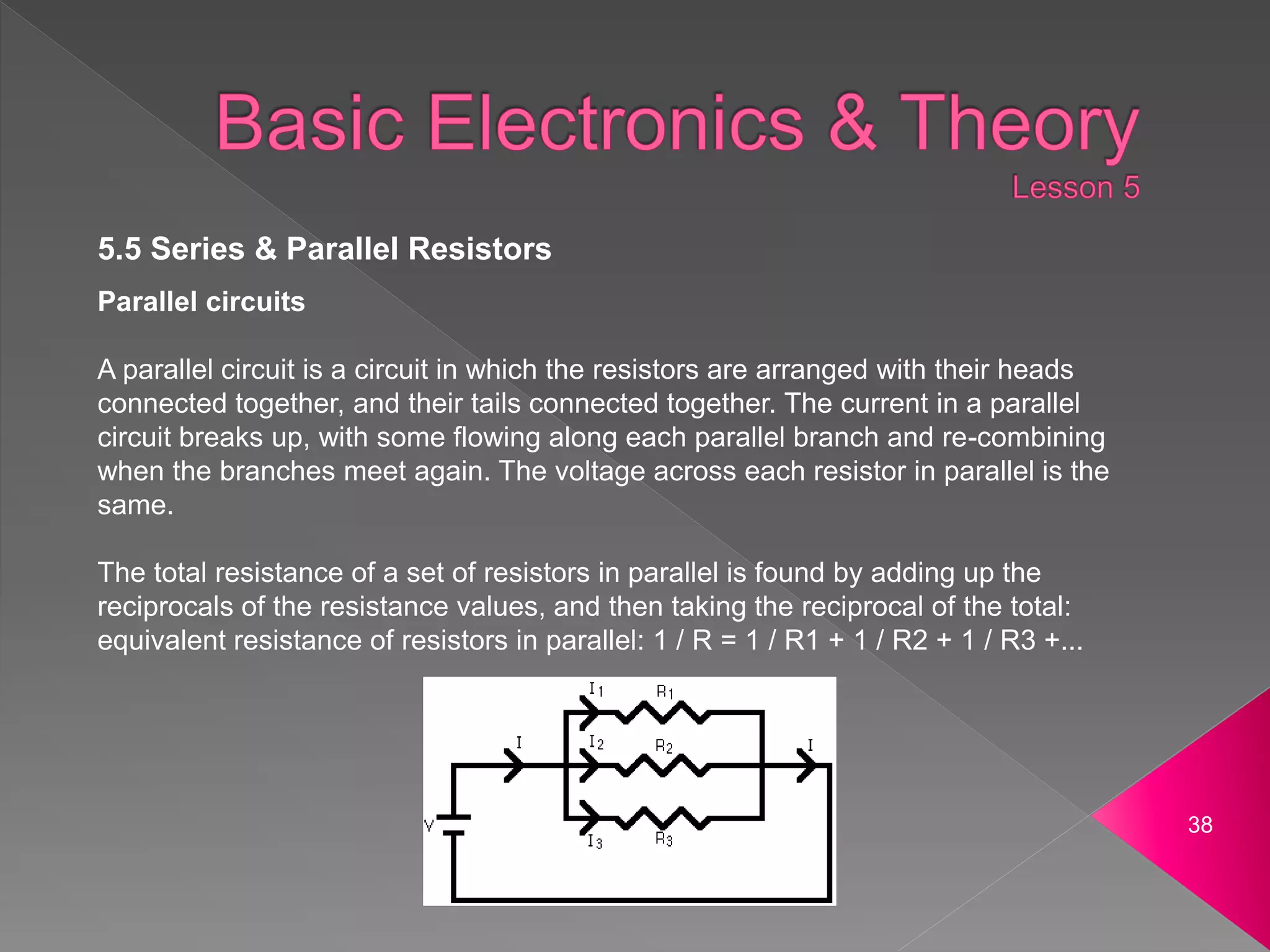
5.5 Series & Parallel Resistors
Parallel circuits
A parallel circuit is a circuit in which the resistors are arranged with their heads
connected together, and their tails connected together. The current in a parallel
circuit breaks up, with some flowing along each parallel branch and re-combining
when the branches meet again. The voltage across each resistor in parallel is the
same.
The total resistance of a set of resistors in parallel is found by adding up the
reciprocals of the resistance values, and then taking the reciprocal of the total:
equivalent resistance of resistors in parallel: 1 / R = 1 / R1 + 1 / R2 + 1 / R3 +...
39
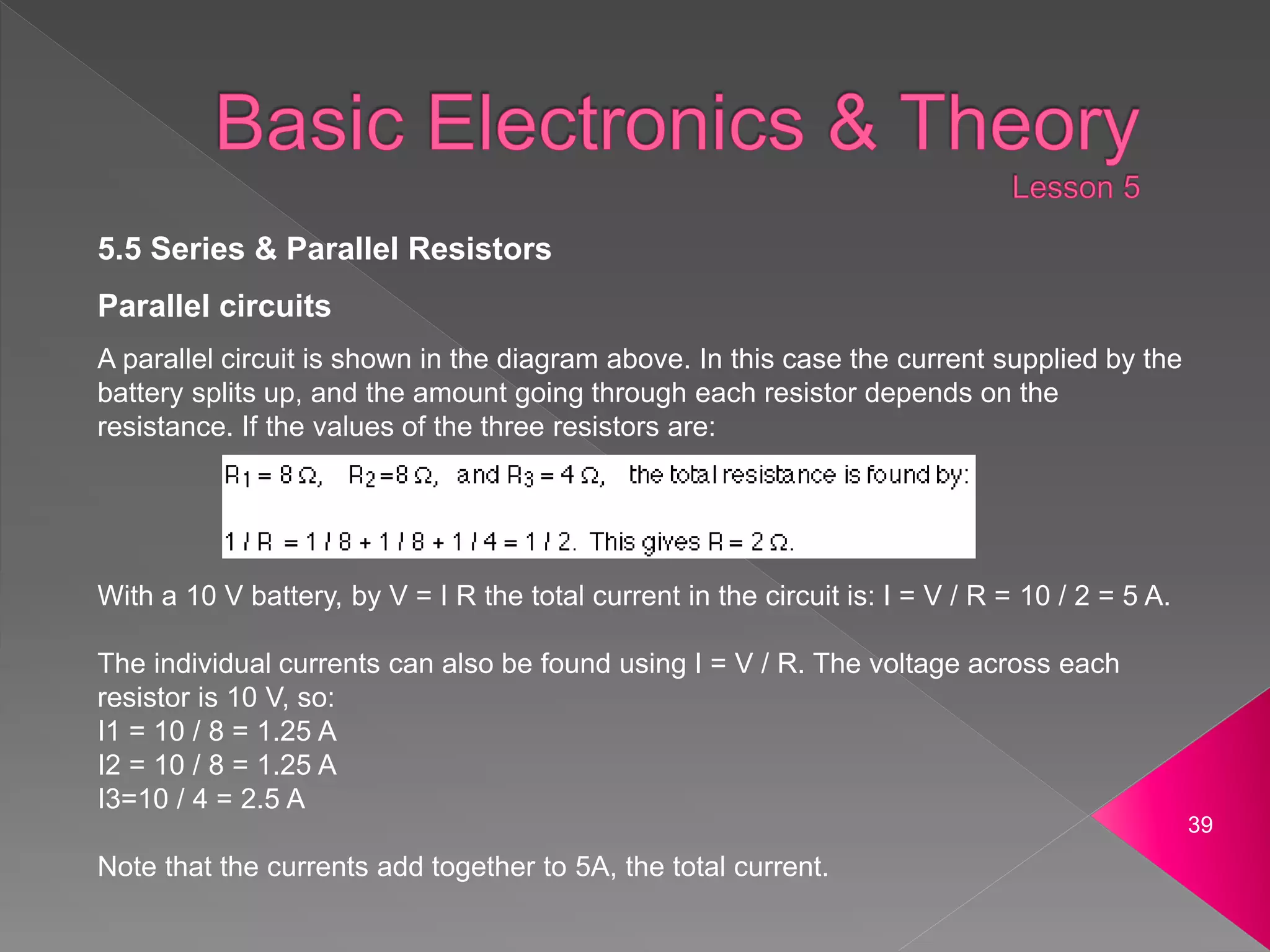
5.5 Series & Parallel Resistors
Parallel circuits
A parallel circuit is shown in the diagram above. In this case the current supplied by the
battery splits up, and the amount going through each resistor depends on the
resistance. If the values of the three resistors are:
With a 10 V battery, by V = I R the total current in the circuit is: I = V / R = 10 / 2 = 5 A.
The individual currents can also be found using I = V / R. The voltage across each
resistor is 10 V, so:
I1 = 10 / 8 = 1.25 A
I2 = 10 / 8 = 1.25 A
I3=10 / 4 = 2.5 A
Note that the currents add together to 5A, the total current.
40
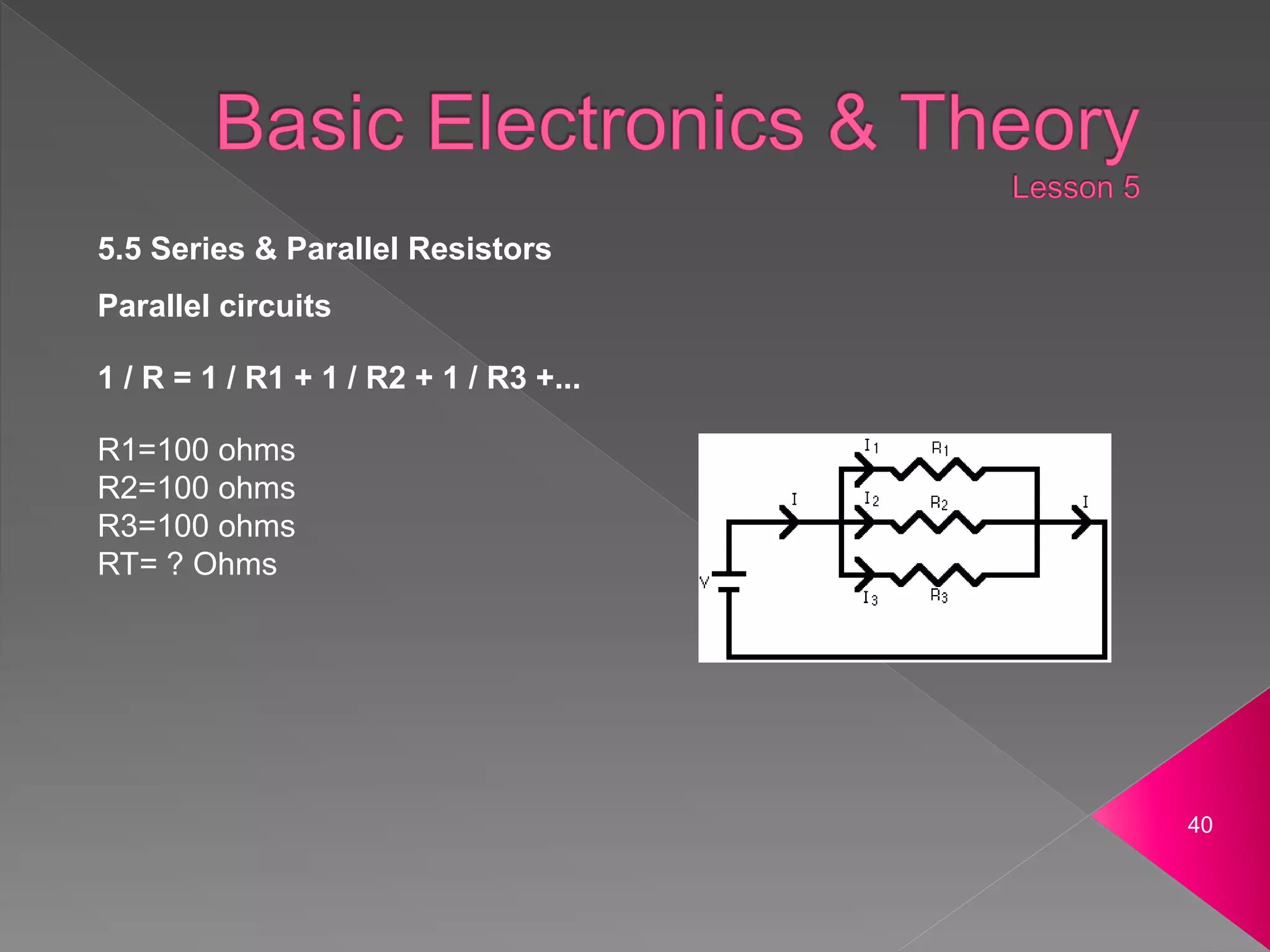
5.5 Series & Parallel Resistors
Parallel circuits
1 / R = 1 / R1 + 1 / R2 + 1 / R3 +...
R1=100 ohms
R2=100 ohms
R3=100 ohms
RT= ? Ohms
41
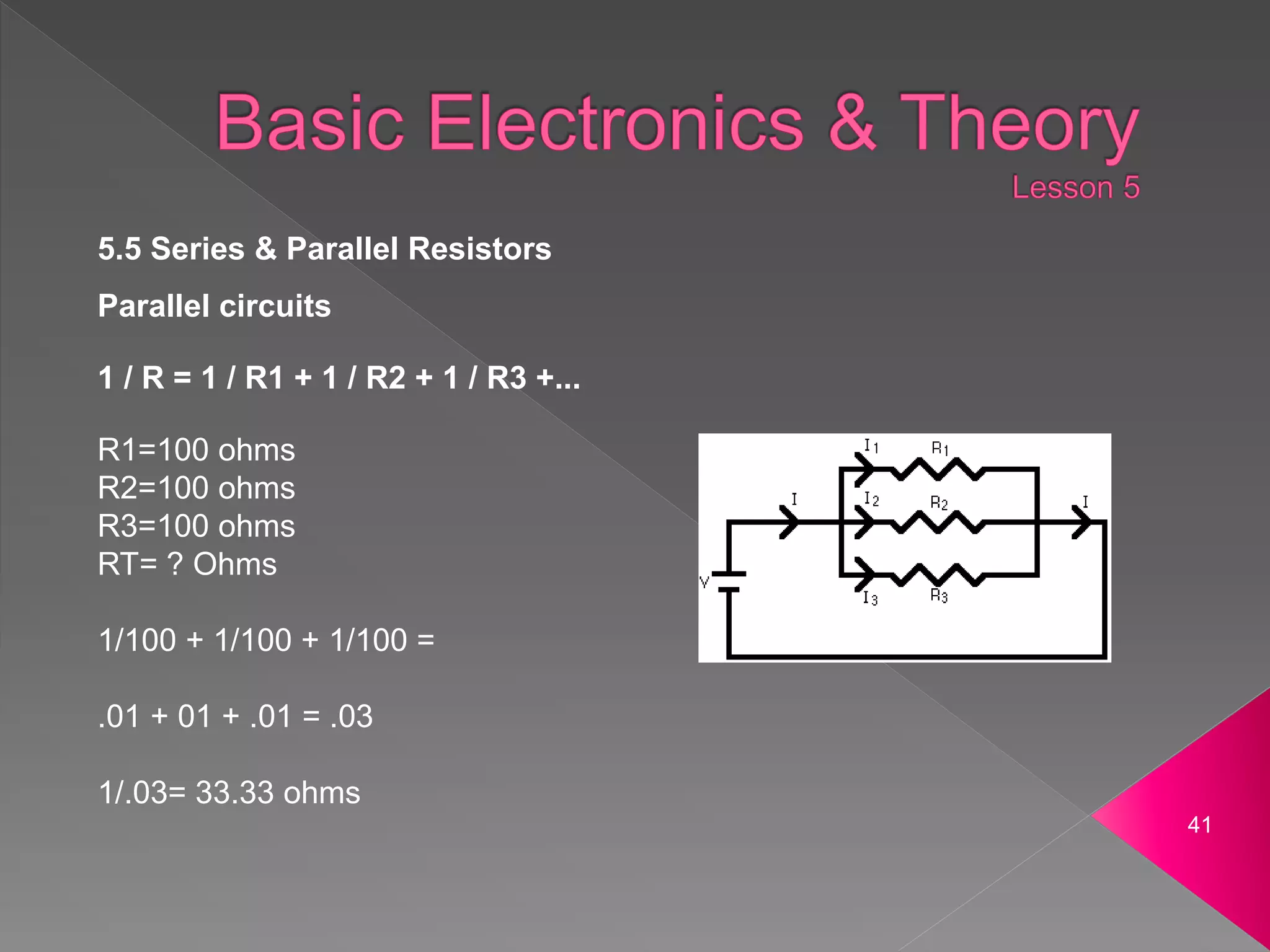
5.5 Series & Parallel Resistors
Parallel circuits
1 / R = 1 / R1 + 1 / R2 + 1 / R3 +...
R1=100 ohms
R2=100 ohms
R3=100 ohms
RT= ? Ohms
1/100 + 1/100 + 1/100 =
.01 + 01 + .01 = .03
1/.03= 33.33 ohms
42
5.5 Series & Parallel Resistors
A parallel resistor short-cut
If the resistors in parallel are identical, it can be very easy to work out the equivalent resistance.
In this case the equivalent resistance of N identical resistors is the resistance of one resistor
divided by N, the number of resistors. So, two 40-ohm resistors in parallel are equivalent to one
20-ohm resistor; five 50-ohm resistors in parallel are equivalent to one 10-ohm resistor, etc.
When calculating the equivalent resistance of a set of parallel resistors, people often forget to flip
the 1/R upside down, putting 1/5 of an ohm instead of 5 ohms, for instance. Here's a way to
check your answer. If you have two or more resistors in parallel, look for the one with the
smallest resistance. The equivalent resistance will always be between the smallest resistance
divided by the number of resistors, and the smallest resistance. Here's an example.
You have three resistors in parallel, with values 6 ohms, 9 ohms, and 18 ohms. The smallest
resistance is 6 ohms, so the equivalent resistance must be between 2 ohms and 6 ohms (2 = 6
/3, where 3 is the number of resistors).
Doing the calculation gives 1/6 + 1/12 + 1/18 = 6/18. Flipping this upside down gives 18/6 = 3
ohms, which is certainly between 2 and 6.
43
5.5 Series & Parallel Resistors
Circuits with series and parallel components
Many circuits have a combination of series and parallel resistors. Generally, the total resistance in a
circuit like this is found by reducing the different series and parallel combinations step-by step to end up
with a single equivalent resistance for the circuit. This allows the current to be determined easily. The
current flowing through each resistor can then be found by undoing the reduction process.
General rules for doing the reduction process include:
Two (or more) resistors with their heads directly connected together and their tails directly connected
together are in parallel, and they can be reduced to one resistor using the equivalent resistance
equation for resistors in parallel.
Two resistors connected together so that the tail of one is connected to the head of the next, with no
other path for the current to take along the line connecting them, are in series and can be reduced to
one equivalent resistor.
Finally, remember that for resistors in series, the current is the same for each resistor, and for
resistors in parallel, the voltage is the same for each one
44
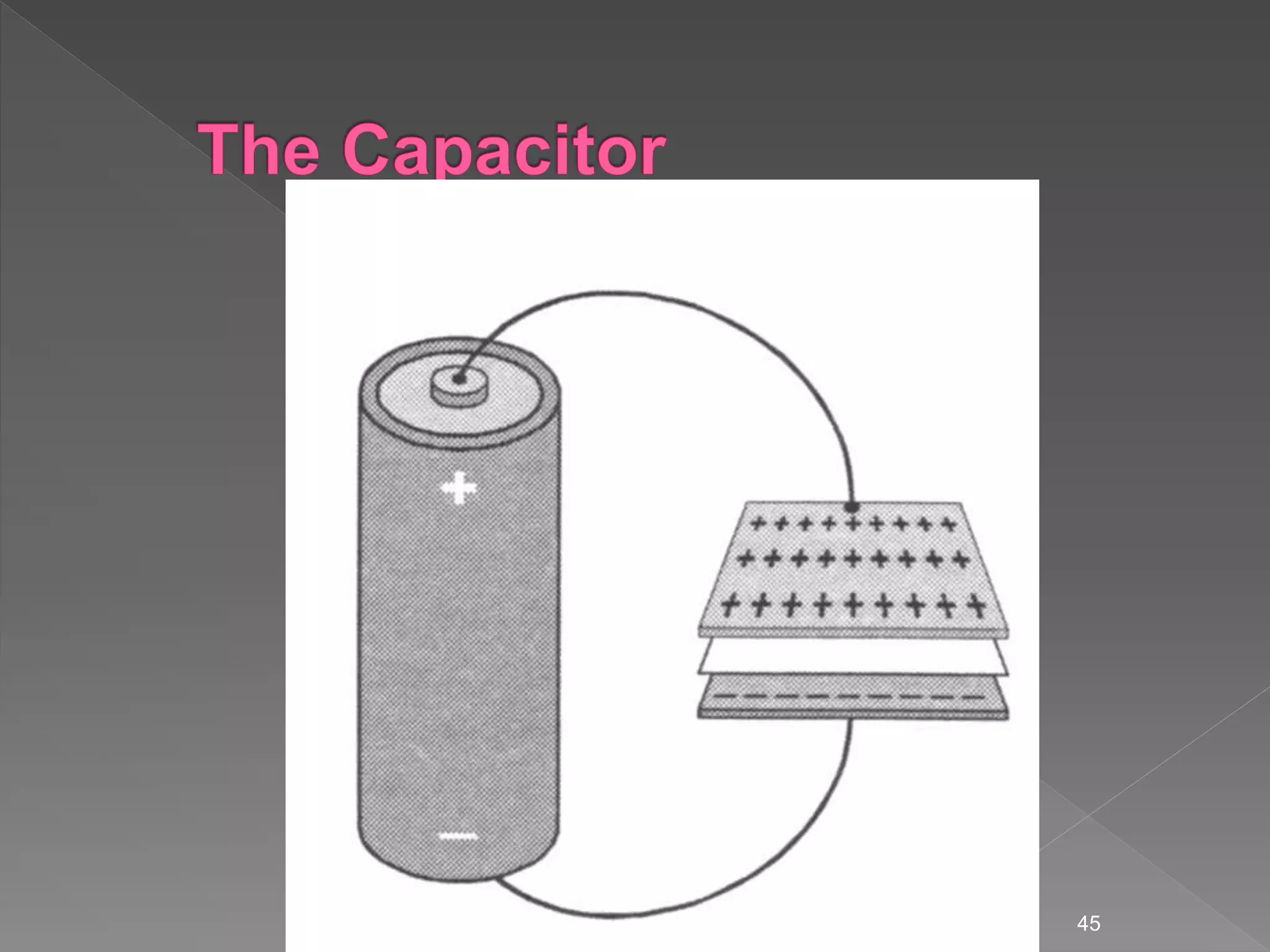
5.9 Capacitance
45
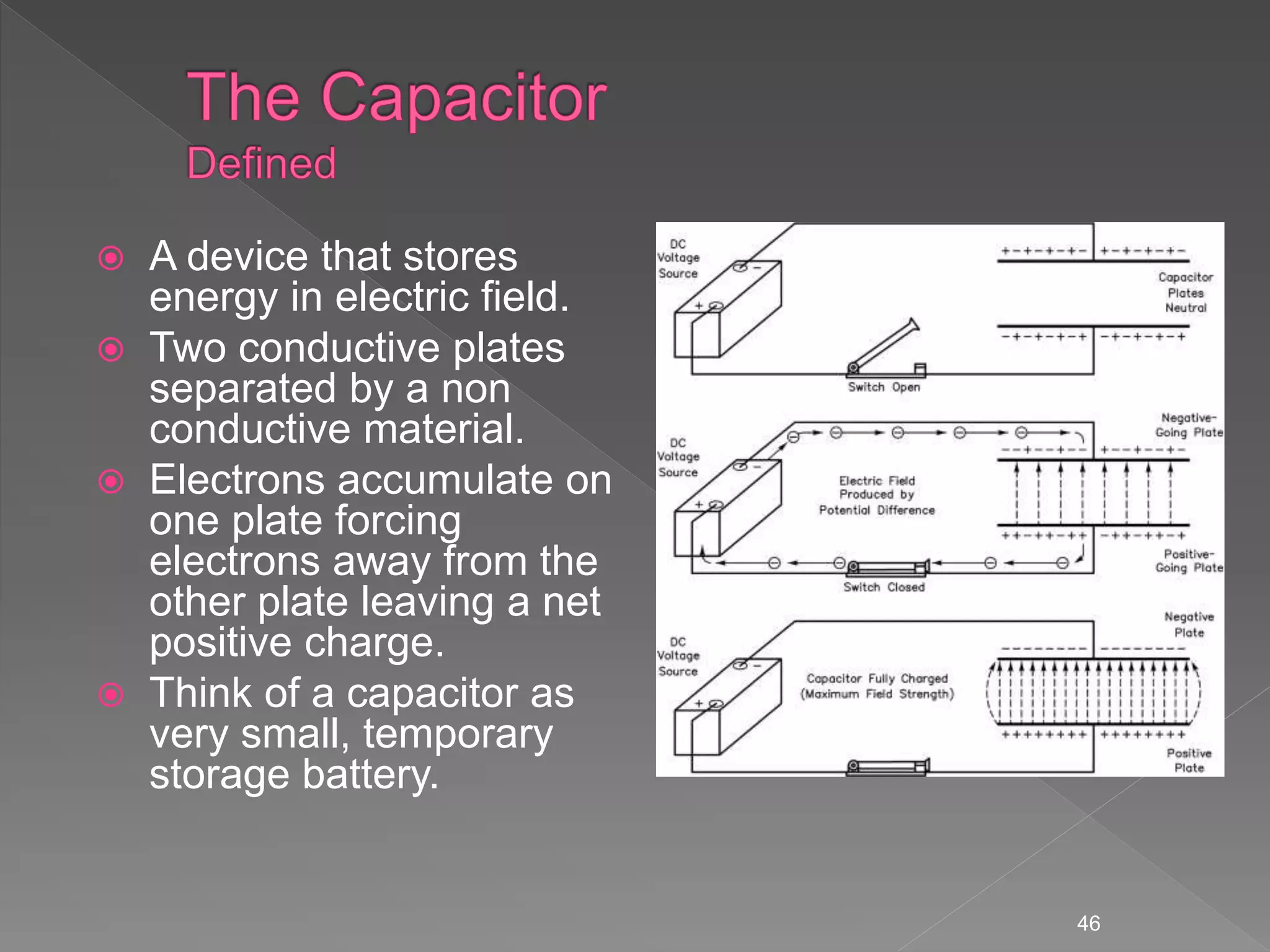
 A device that stores
energy in electric field.
 Two conductive plates
separated by a non
conductive material.
 Electrons accumulate on
one plate forcing
electrons away from the
other plate leaving a net
positive charge.
 Think of a capacitor as
very small, temporary
storage battery.
46
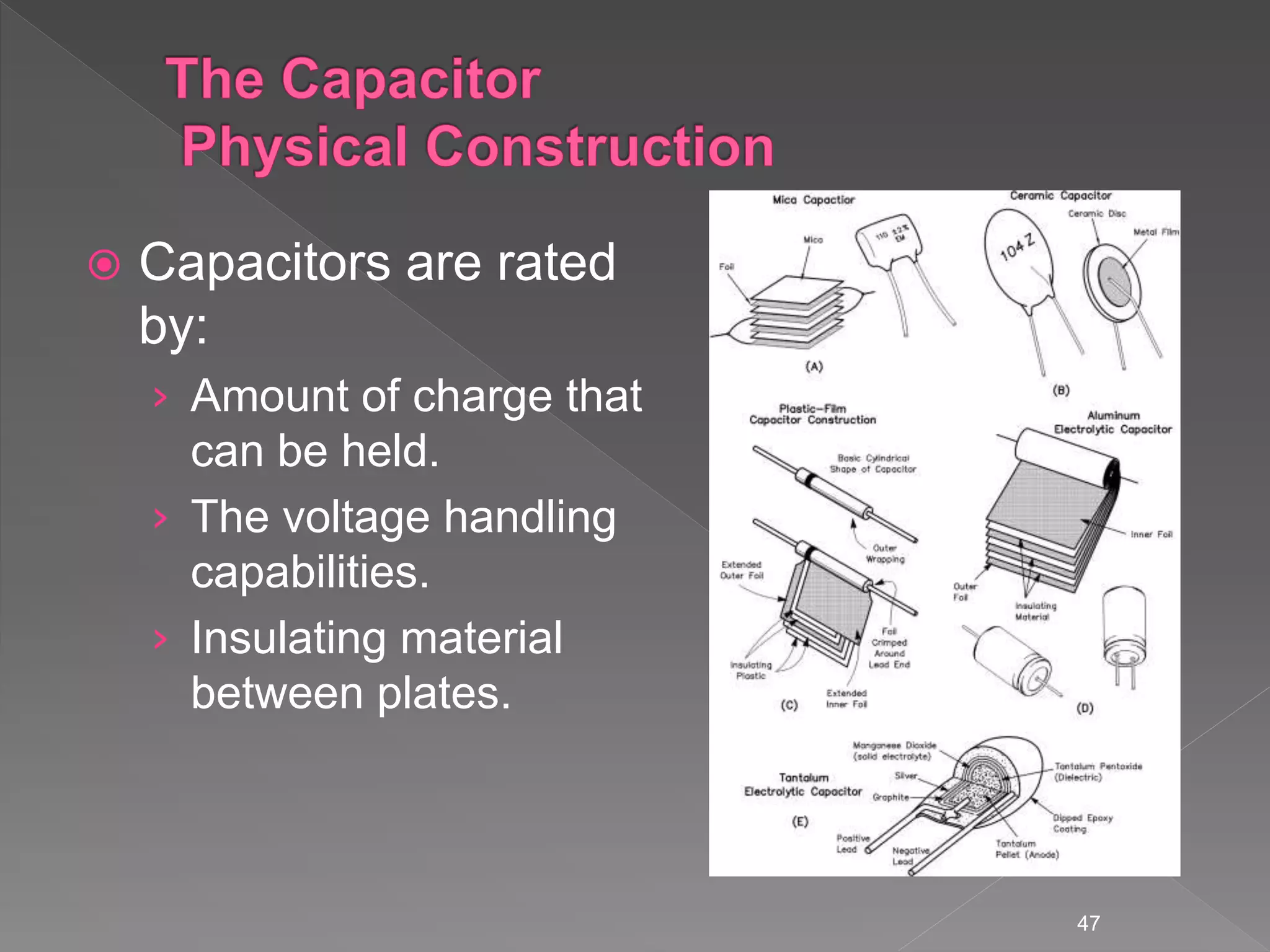
 Capacitors are rated
by:
› Amount of charge that
can be held.
› The voltage handling
capabilities.
› Insulating material
between plates.
47
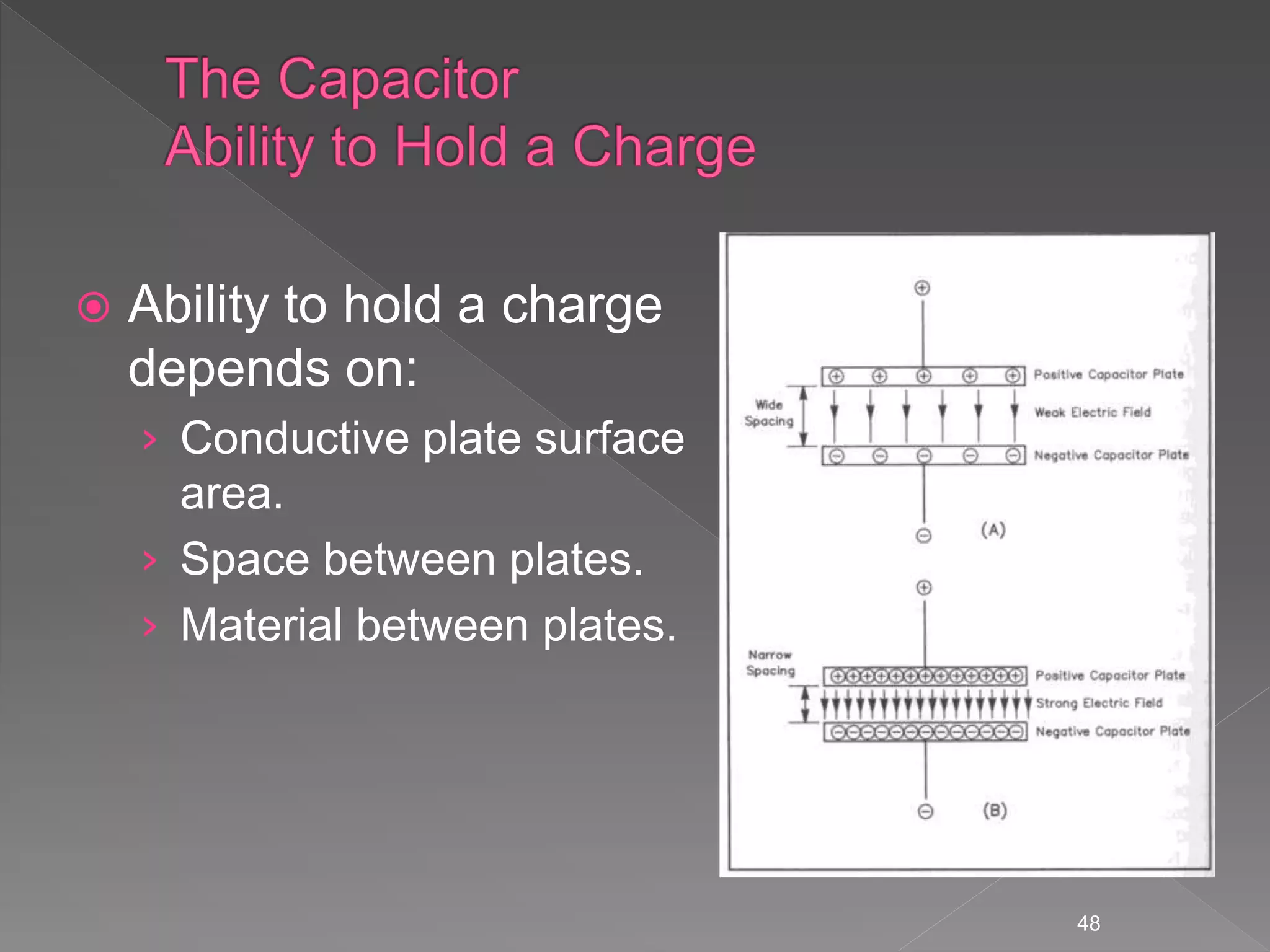
 Ability to hold a charge
depends on:
› Conductive plate surface
area.
› Space between plates.
› Material between plates.
48
49
 When connected to a DC source, the
capacitor charges and holds the charge as
long as the DC voltage is applied.
 The capacitor essentially blocks DC current
from passing through.
50
 When AC voltage is applied, during one half of
the cycle the capacitor accepts a charge in one
direction.
 During the next half of the cycle, the capacitor is
discharged then recharged in the reverse
direction.
 During the next half cycle the pattern reverses.
 It acts as if AC current passes through a
capacitor
51
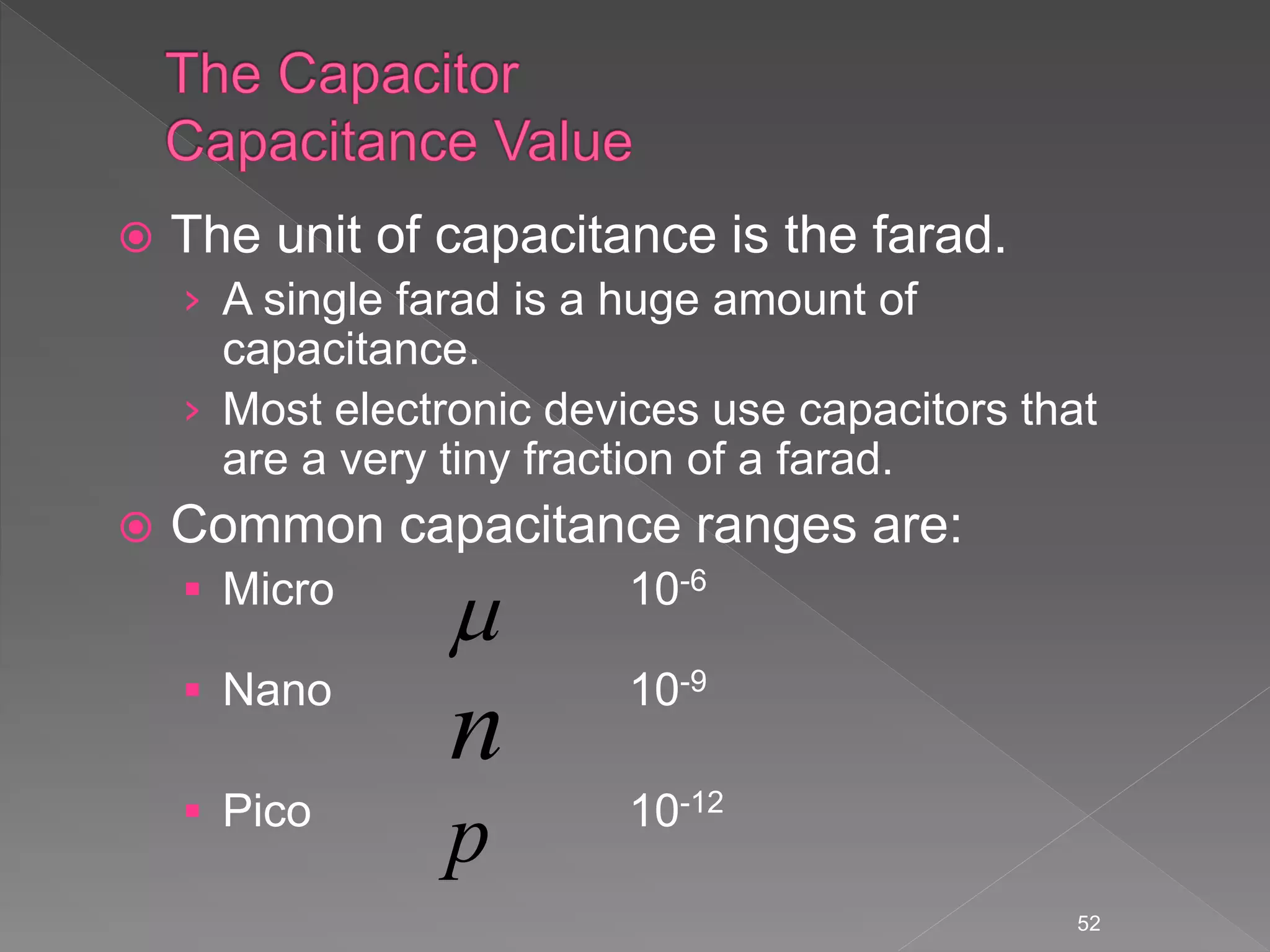
 The unit of capacitance is the farad.
› A single farad is a huge amount of
capacitance.
› Most electronic devices use capacitors that
are a very tiny fraction of a farad.
 Common capacitance ranges are:
 Micro 10-6
 Nano 10-9
 Pico 10-12
52

p
n
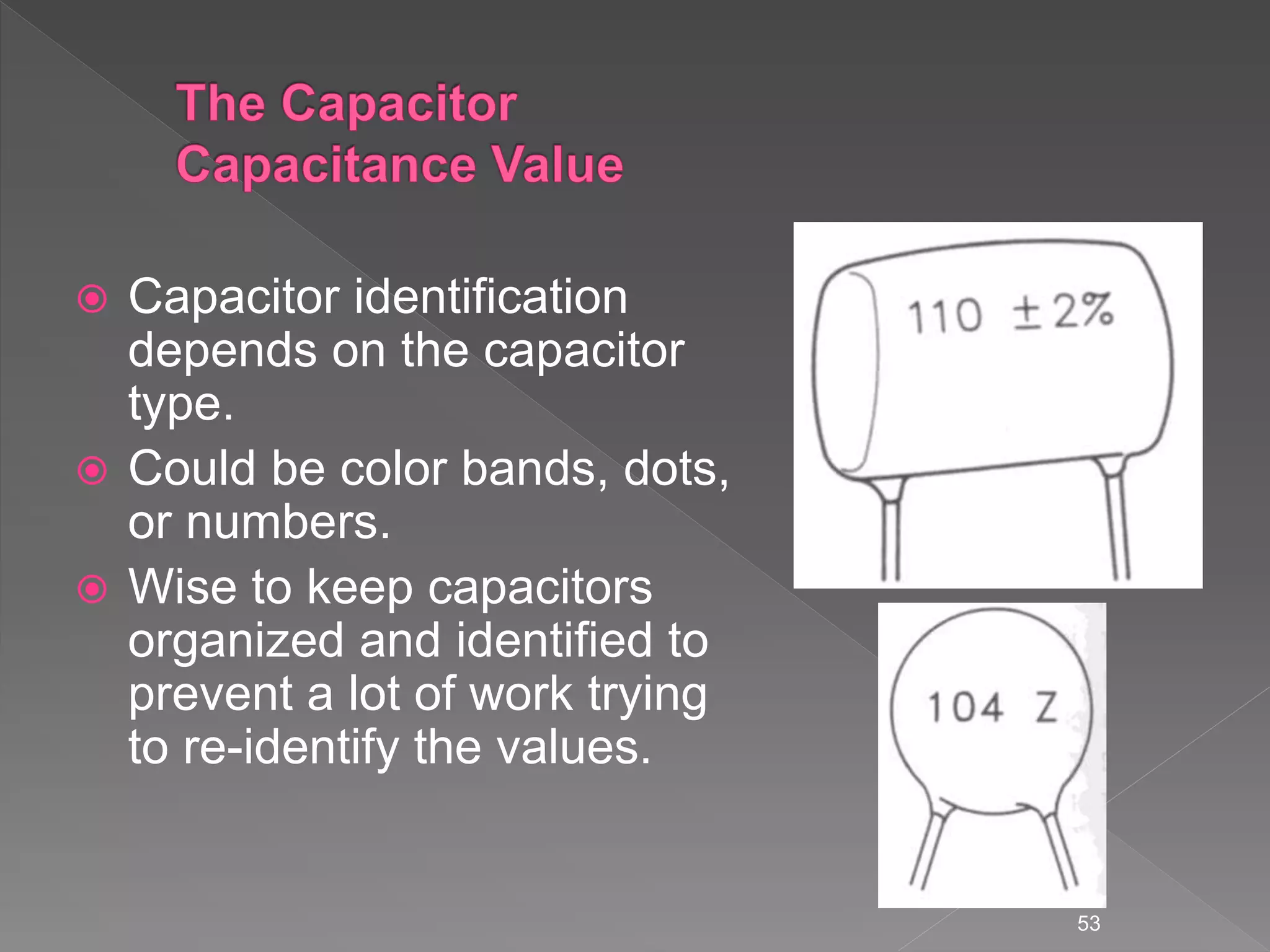
 Capacitor identification
depends on the capacitor
type.
 Could be color bands, dots,
or numbers.
 Wise to keep capacitors
organized and identified to
prevent a lot of work trying
to re-identify the values.
53
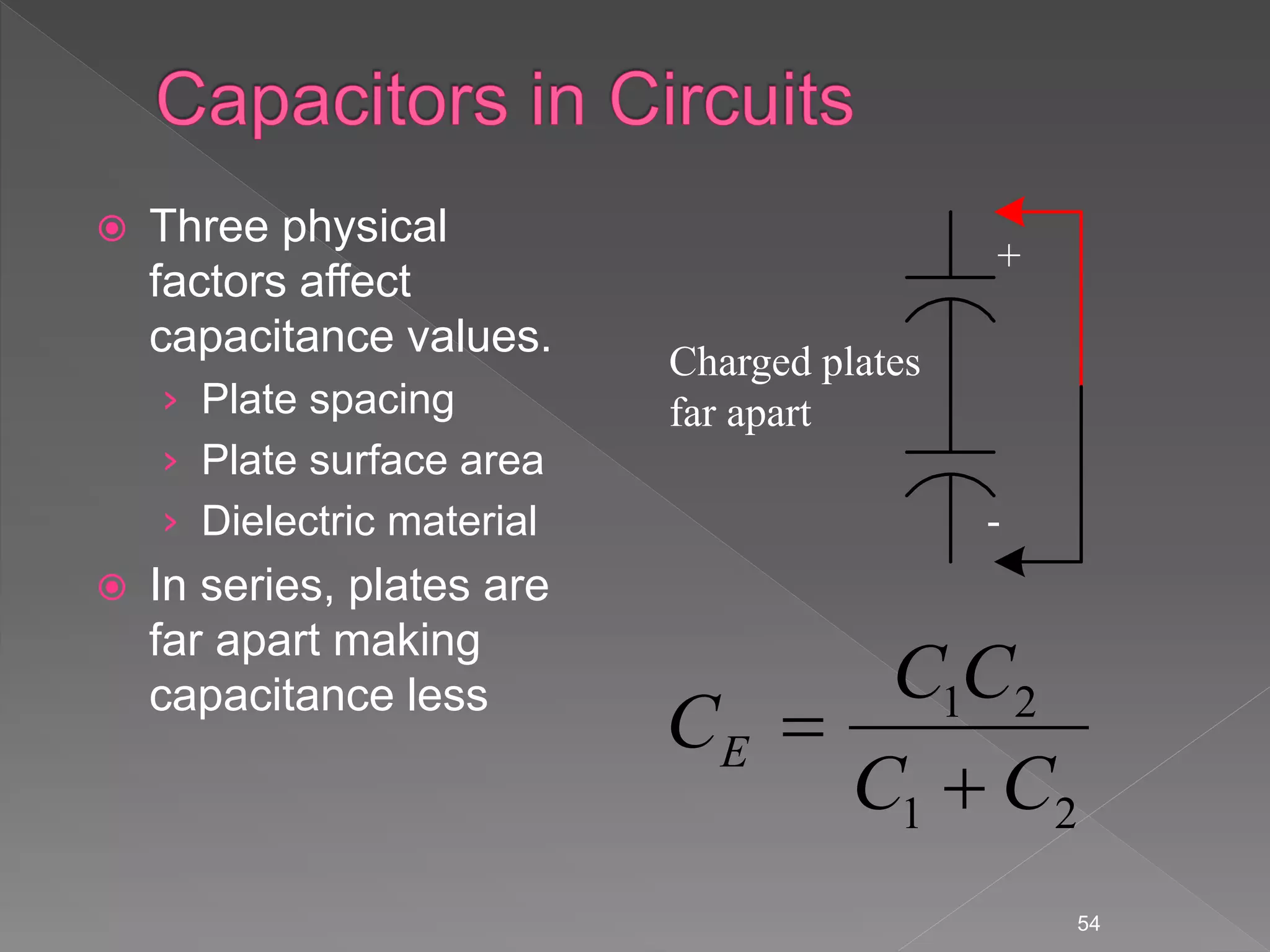
 Three physical
factors affect
capacitance values.
› Plate spacing
› Plate surface area
› Dielectric material
 In series, plates are
far apart making
capacitance less
54
+
-
Charged plates
far apart
2
1
2
1
C
C
C
C
CE


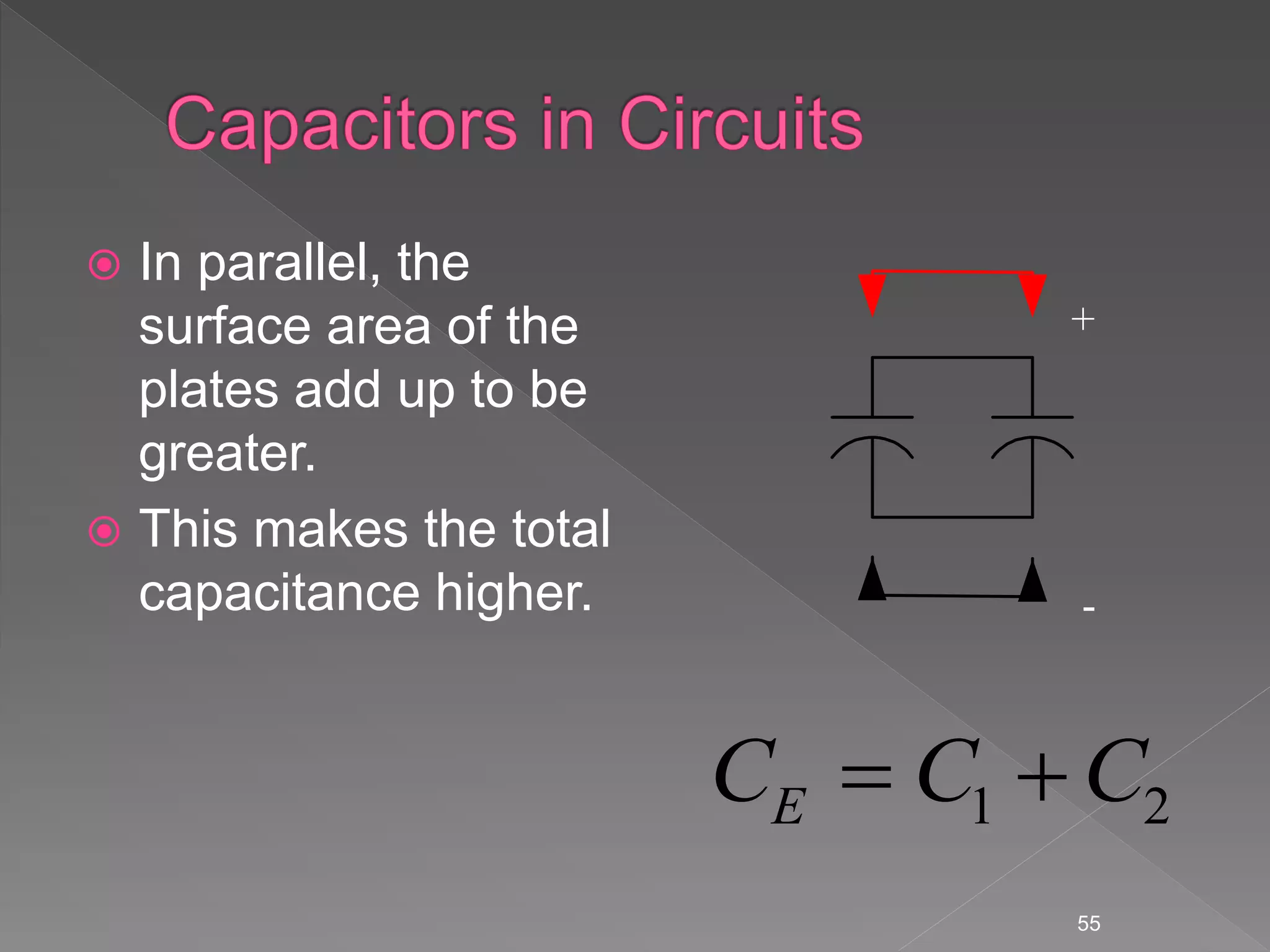
 In parallel, the
surface area of the
plates add up to be
greater.
 This makes the total
capacitance higher.
55
+
-
2
1 C
C
CE 

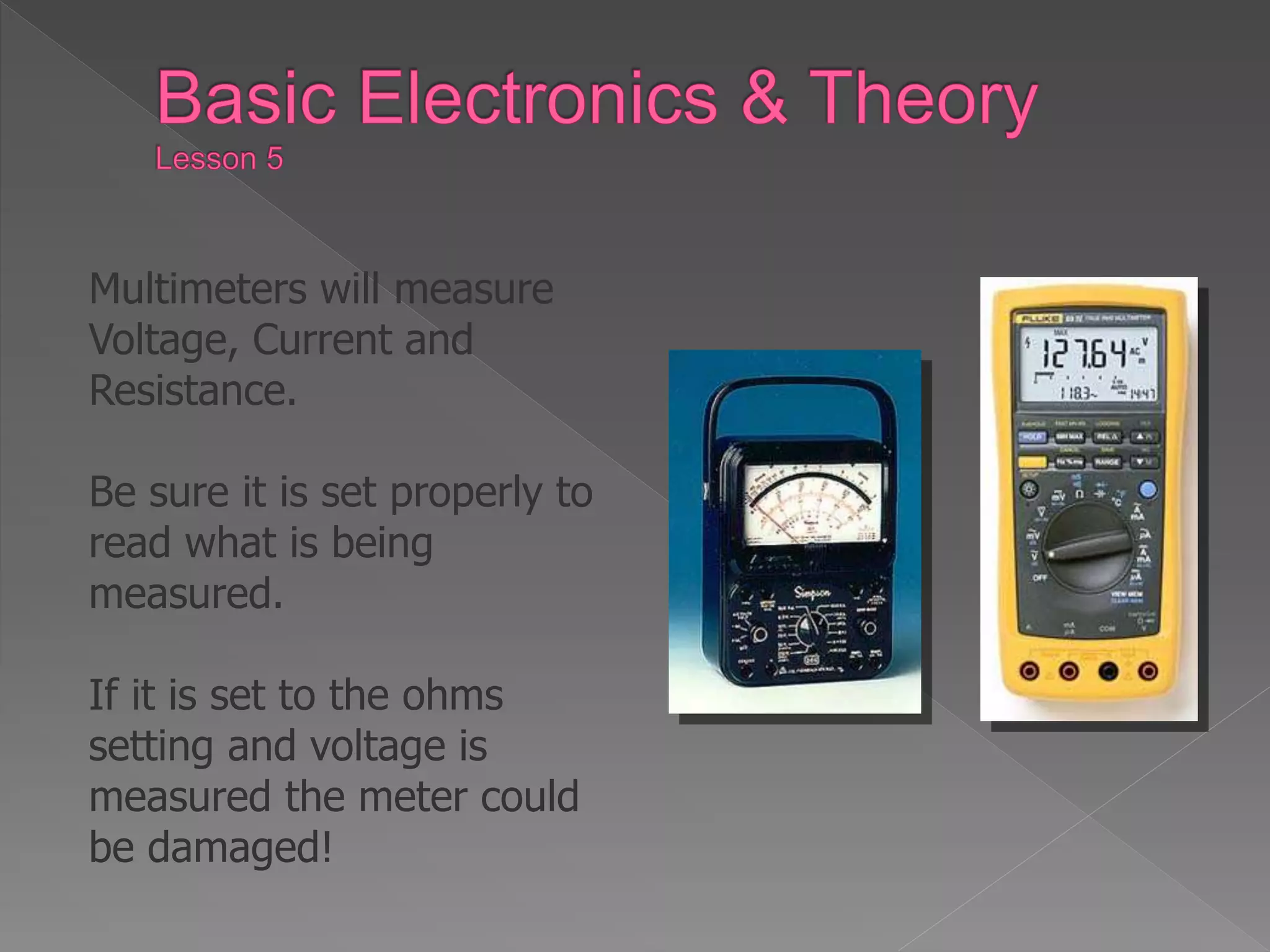
Multimeters will measure
Voltage, Current and
Resistance.
Be sure it is set properly to
read what is being
measured.
If it is set to the ohms
setting and voltage is
measured the meter could
be damaged!
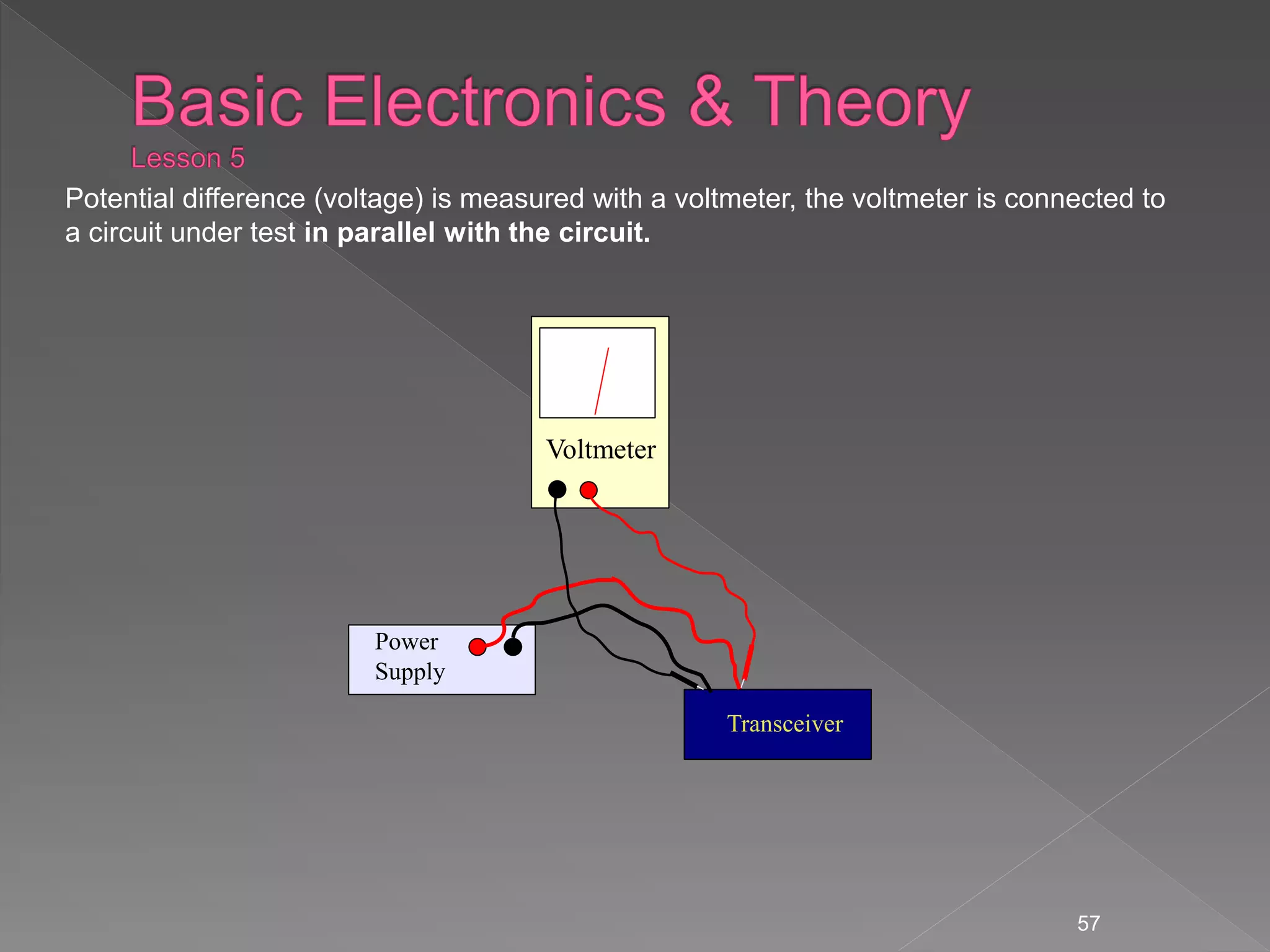
Potential difference (voltage) is measured with a voltmeter, the voltmeter is connected to
a circuit under test in parallel with the circuit.
57
Power
Supply
Transceiver
Voltmeter
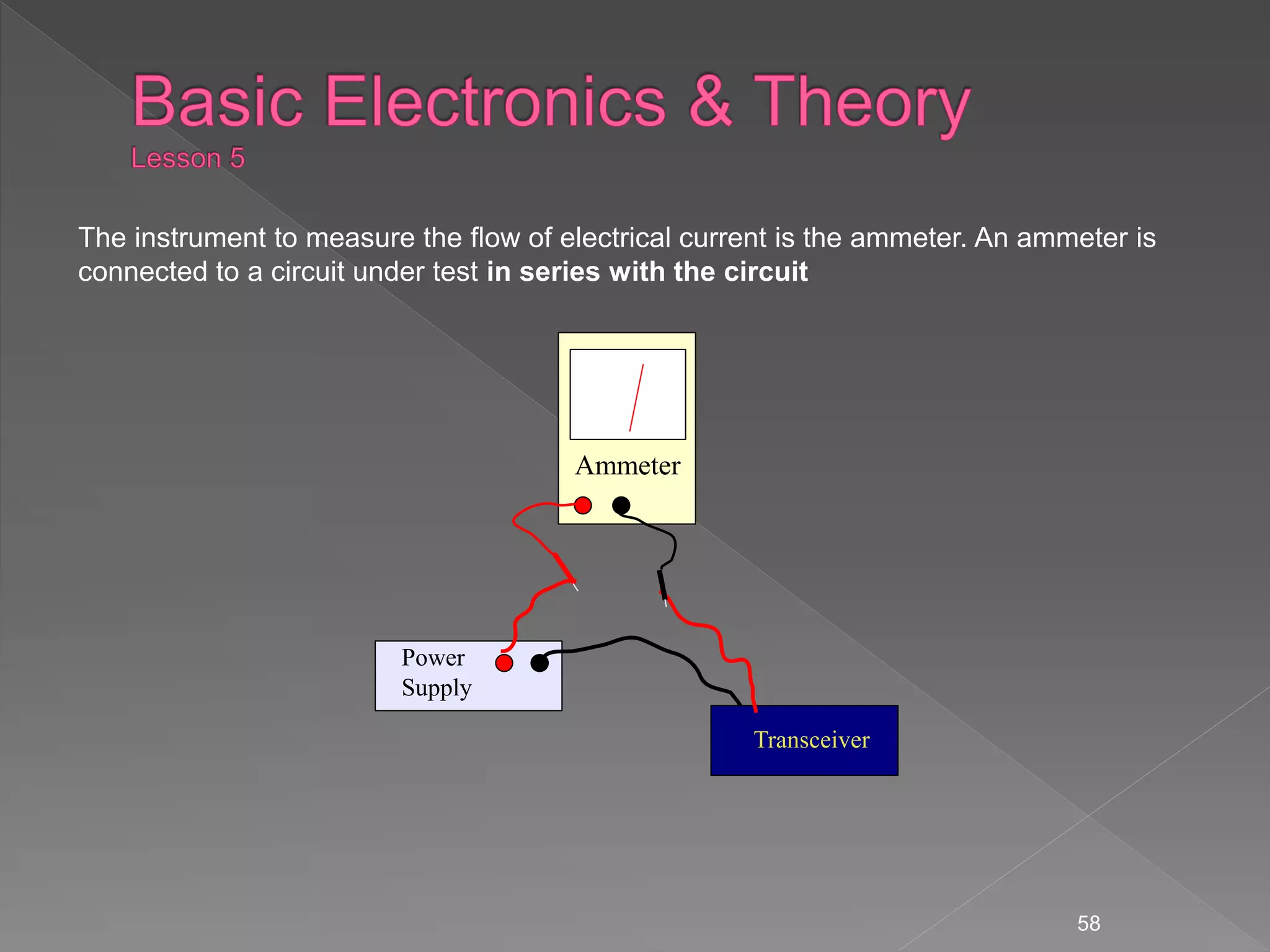
The instrument to measure the flow of electrical current is the ammeter. An ammeter is
connected to a circuit under test in series with the circuit
58
Power
Supply
Transceiver
Ammeter
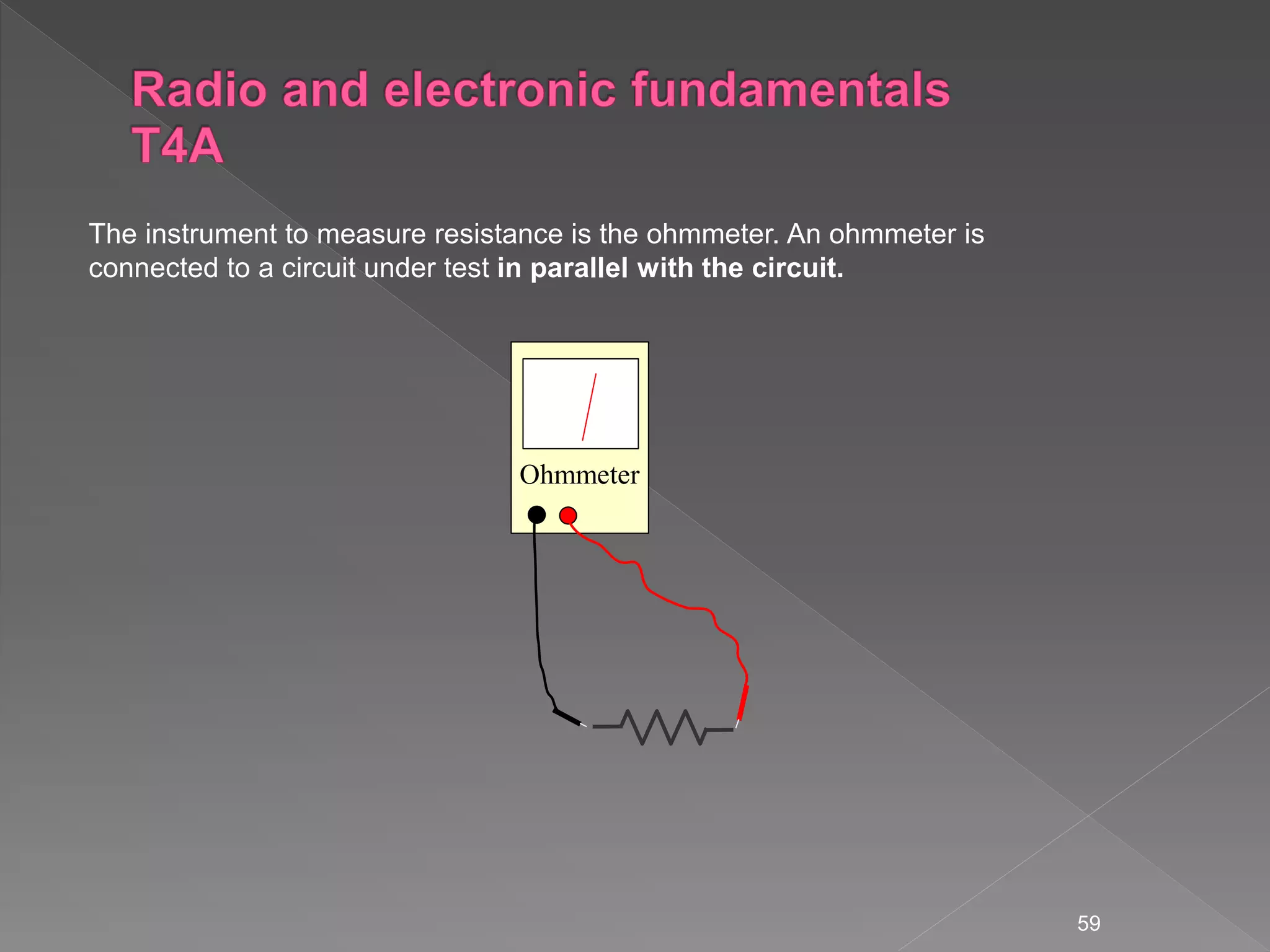
The instrument to measure resistance is the ohmmeter. An ohmmeter is
connected to a circuit under test in parallel with the circuit.
59
Ohmmeter
60
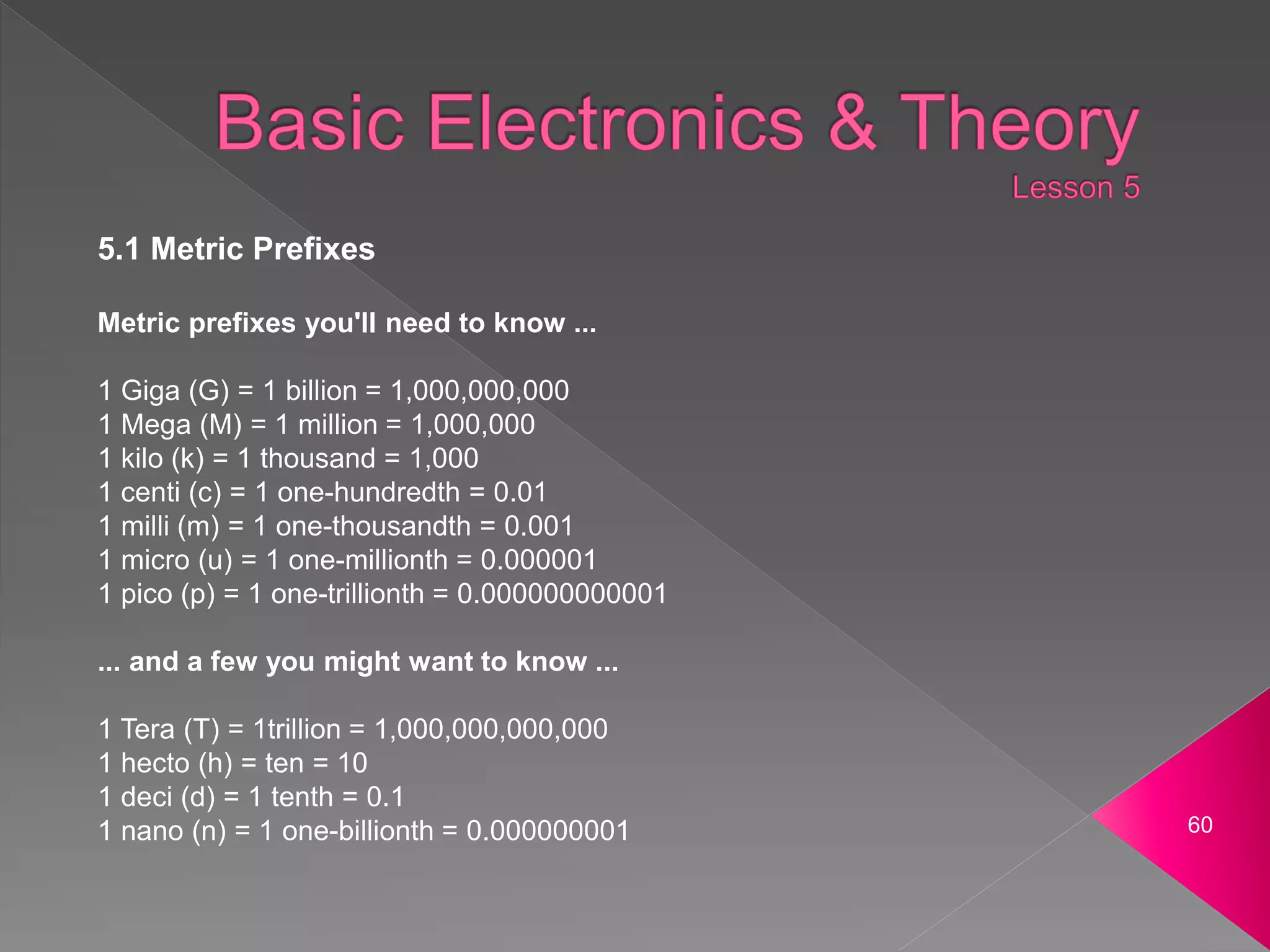
5.1 Metric Prefixes
Metric prefixes you'll need to know ...
1 Giga (G) = 1 billion = 1,000,000,000
1 Mega (M) = 1 million = 1,000,000
1 kilo (k) = 1 thousand = 1,000
1 centi (c) = 1 one-hundredth = 0.01
1 milli (m) = 1 one-thousandth = 0.001
1 micro (u) = 1 one-millionth = 0.000001
1 pico (p) = 1 one-trillionth = 0.000000000001
... and a few you might want to know ...
1 Tera (T) = 1trillion = 1,000,000,000,000
1 hecto (h) = ten = 10
1 deci (d) = 1 tenth = 0.1
1 nano (n) = 1 one-billionth = 0.000000001

Basic Electrical Theory.ppt

  • 2.
     Identify anddescribe the scientific principles related to electricity.  Describe electrical terminology.  Define Ohm’s law.  Explain electrical power and energy relationships.
  • 3.
     Perform electricalcalculations.  List and describe the basic types of electrical circuits.
  • 4.
     All matteris made up of atoms.  Atoms are made up of: › Electrons › Protons › Neutrons Each element has its own unique structure.
  • 5.
     Atoms › Nucleus Protons: positive charge  Neutrons: neutral charge › Orbits  Electrons: negative charges circle the nucleus in orbits Neutrons Electricity is the flow of electrons from atom to atom in a conductor.
  • 6.
     The copperatom has 29 electrons in four orbits or shells. Cu e- e- e- e- e- e- e- e- e- e- e- e- e- e- e- e- e- e- e- e- e- e- e- e- e- e- e- e- e- Elements with fewer than four electrons in their outer shell are good conductors. Almost all metals have fewer than four electrons in their outer shell and thus are good conductors. The lone electron in the outer shell can easily be knocked out of it’s orbit by a free electron from a generator or battery. The electron once free will collide with another nearby atom in a chain reaction.
  • 7.
     Current: theflow of electrons in a conductor Cu Cu Cu Cu e- e- e- e- e- Free electron from generator e- e- e- e- e- Copper Atom Note that the flow of electrons (e-) is from negative to positive!
  • 8.
     In realitywe know that electrons flow from negative to positive (Electron Theory).  However most electrical diagrams are based on the idea that electricity flows from positive to negative (Conventional Theory).  This seldom causes problems unless we are working with a DC circuit.
  • 10.
     Circuit: acontinuous conductor that provides a path for the flow of electrons away from and back to the generator or source of current.  Note the “conventional flow” of this diagram. + Battery -
  • 11.
     An electricalgenerator (or battery) forces electrons to move from atom to atom.  This push or force is like the pressure created by a pump in a water system.  In an electrical circuit this pressure (electromotive force) is called voltage.  The volt (V) is the unit by which electrical pressure is measured.
  • 12.
     While voltagerefers to the electrical pressure of a circuit, current or amperage refers to the electrical flow of a circuit.  Current or amperage is the amount of electric charges (or electrons) flowing past a point in a circuit every second.  One ampere (amp or A) is equal to 6.28 billion billion (or 6.28 x 10¹⁸) electrons per second.
  • 13.
     Opposition toflow in electrical circuits is called resistance (or impedance).  Measured in Ohms by using an ohmmeter.  One ohm, or R is the amount of electrical resistance overcome by one volt to cause one amp of current to flow.  Electrical current follows the path of least resistance.  Electricity can encounter resistance by the type of conductor, the size of conductor and even corrosion on the connections.
  • 14.
    Water flowing througha hose is a good way to imagine electricity Water is like Electrons in a wire (flowing electrons are called Current) Pressure is the force pushing water through a hose – Voltage is the force pushing electrons through a wire Friction against the holes walls slows the flow of water – Resistance is an impediment that slows the flow of electrons . 14 5.2 Concepts of Current, Voltage, Conductor, Insulator, Resistance Current
  • 15.
     There are2 types of current › The form is determined by the directions the current flows through a conductor  Direct Current (DC) › Flows in only one direction from negative toward positive pole of source  Alternating Current (AC) › Flows back and forth because the poles of the source alternate between positive and negative 15
  • 16.
    16 5.2 Concepts ofCurrent, Voltage, Conductor, Insulator, Resistance Conductors and Insulators There are some materials that electricity flows through easily. These materials are called conductors. Most conductors are metals. Four good electrical conductors are gold, silver, aluminum and copper. Insulators are materials that do not let electricity flow through them. Four good insulators are glass, air, plastic, and porcelain.
  • 17.
    17 The Open Circuit Theopen circuit is a very basic circuit that we should all be very familiar with. It is the circuit in which no current flows because there is an open in the circuit that does not allow current to flow. A good example is a light switch. When the light is turned off, the switch creates an opening in the circuit, and current can no longer flow. You probably figured that since there are "open circuits" that there are probably also "closed circuits". Well, a closed circuit is when the switch is closed and current is allowed to flow through the circuit. A fuse is a device that is used to create an open circuit when too much current is flowing. 5.3 Concepts of Energy & Power, Open & Short Circuits
  • 18.
    18 The Short Circuit Ashort circuit can be caused by incoming power wires (wires that are normally insulated and kept separate) coming in contact with each other. Since a circuit usually has resistance, and the power wires that "short out" have very little resistance, the current will tend to flow through the path of least resistance... the short. Less resistance at the same amount of voltage will result in more current to flow. Therefore a short circuit will have too much current flowing through it. What's the best way to stop a short circuit from doing damage (because it is drawing too much power from the source)? By using a fuse. Fuses are designed to work up to a certain amount of current (e.g. 1 amp, 15 amps, ...). When that maximum current is exceeded, then the wire within the fuse burns up from the heat of the current flow. With the fuse burnt up, there is now an "open circuit" and no more current flows. 5.3 Concepts of Energy & Power, Open & Short Circuits
  • 19.
    19 Power Every circuit usesa certain amount of power. Power describes how fast electrical energy is used. A good example is the light bulbs used in each circuit of your home. When you turn on a light bulb, light (and heat) are produced. This is because of the current flowing through a resistor built into the bulb. The resistance turns the electrical power into primarily heat, and secondarily light (assuming an incandescent bulb). Each light bulb is rated at a certain power rating. This is how much power the bulb will use in a normal 110 Volt house circuit. Three of the most popular power values for inside light bulbs are 60, 75, and 100 Watts (Power is measured in Watts). Which of these light bulbs uses the most power? The 100 Watt bulb uses the most power. 5.3 Concepts of Energy & Power, Open & Short Circuits
  • 20.
     5.4 Ohm’sLaw  E = electromotive force (a.k.a. Voltage)  I = intensity (French term for Current)  R = resistance  Voltage: E = I x R (Volts)  Current: I = E / R (Amps)  Resistance: R = E / I (Ohms) 20
  • 21.
    21 5.4 Ohm’s LawCalculating Voltage and Current and Resistance Current? There is a very easy way to determine how much current will flow through a circuit when the voltage and resistance is known. This relationship is expressed in a simple equation (don't let the word scare you... this is going to be easy as "pie"... Let's start with the "pie"... This circle will help you to know how to figure out the answer to these electrical problems. The three letters stand for... E = electromotive force (a.k.a. Voltage) I = intensity (French term for Current) R = resistance
  • 22.
    22 5.4 Ohm’s LawCalculating Voltage and Current and Resistance Current? Lets say you have 200Volts hooked up to a circuit with 100 Ohms of resistance. How much current would flow? Since our "unknown" value in this problem is the current, then we put our finger over the "I". What you see is "E over R". This means you take the Voltage and divide it by the Resistance. This is 200 Volts divided by 100 Ohms. The result is 2 Amps. E = electromotive force (a.k.a. Voltage) I = intensity (French term for Current) R = resistance
  • 23.
    23 5.4 Ohm’s LawCalculating Voltage and Current and Resistance Voltage? What if we wanted to find out the voltage in a circuit when we know the current and resistance? Go back to the "pie" and cover up the E. You're now left with I times R. How much voltage would you need in a circuit with 50 ohms and 2 amps? E=IxR... E=2x50... E=100 Volts. E = electromotive force (a.k.a. Voltage) I = intensity (French term for Current) R = resistance
  • 24.
    24 5.4 Ohm’s LawCalculating Voltage and Current and Resistance Resistance? Finally, if you had a circuit with 90 Volts and 3 amps, and you needed to find the resistance, you could cover up the R... the result is E over I (Volts divided by Current). R=E/I... R=90/3... R=30 Ohms. This circuit would have 30 Ohms of resistance if it was hooked up to 90 Volts and 3 amps flowed through the circuit. Ohm's Law This relationship between voltage, current, and resistance is known as Ohm's Law. This is in honour of the man who discovered this direct relationship (his last name was Ohm). The relationship described in Ohm's Law is used when working with almost any electronic circuit.
  • 26.
    Memorizing Ohm's law MemorizingOhm's law may sound like a time consuming and daunting task, but if remember this little story you'll have it committed to memory for life within a few minutes! An old Indian was walking across the plains one day and he saw an eagle soaring high in the sky over a rabbit. Now, picture things from the Indian's stand point - he sees the Eagle flying over the Rabbit: Say to yourself Indian equals Eagle over Rabbit. Now just use the first letter of each word: I = E over R, which is this formula: Voltage: E = I x R (Volts) Current: I = E / R (Amps) Resistance: R = E / I (Ohms)
  • 27.
    Memorizing Ohm's law However,from the Rabbit's point of view, he sees things a little differently. The Rabbit looks out and sees the Eagle flying over the Indian. Say to yourself Rabbit equals Eagle over Indian. Now just use the first letter of each word: R = E over I, which is this formula: Voltage: E = I x R (Volts) Current: I = E / R (Amps) Resistance: R = E / I (Ohms)
  • 28.
    Memorizing Ohm's law Finally,the Eagle up in the sky sees both the Indian and the Rabbit standing on the ground together. Say to yourself Eagle equals Indian and Rabbit together. Now just use the first letter of each word: E = IxR, which is this formula: Now if you simply remember the story of the Indian, Eagle and Rabbit, you will have memorized all three formulae! Voltage: E = I x R (Volts) Current: I = E / R (Amps) Resistance: R = E / I (Ohms)
  • 29.
    Memorizing Ohm's law Sonow we have 3 different ways that we can algebraically express Ohm's Law. or or But of what significance is it? Here is the gist of it. If we know 2 out of the 3 factors of the equation, we can figure out the third. Let's say we know we have a 3 Volt battery. We also know we are going to put a 100 W resistor in circuit with it. How much current can we expect will flow through the circuit? Without Ohm's Law, we would be at a loss. But because we have Ohm's Law, we can calculate the unknown current, based upon the Voltage and Resistance. Voltage: E = I x R (Volts) Current: I = E / R (Amps) Resistance: R = E / I (Ohms)
  • 30.
    Power calculations › Theunit used to describe electrical power is the Watt. › The formula: Power (P) equals voltage (E) multiplied by current (I). P = I x E 30
  • 31.
     Power calculations(cont) › How much power is represented by a voltage of 13.8 volts DC and a current of 10 amperes.  P = I x E P = 10 x 13.8 = 138 watts › How much power is being used in a circuit when the voltage is 120 volts DC and the current is 2.5 amperes.  P = I x E P = 2.5 x 120 = 300 watts 31
  • 32.
     Power calculations(cont) › You can you determine how many watts are being drawn [consumed] by your transceiver when you are transmitting by measuring the DC voltage at the transceiver and multiplying by the current drawn when you transmit. › How many amperes is flowing in a circuit when the applied voltage is 120 volts DC and the load is 1200 watts.  I = P/E I = 1200/120 = 10 amperes. 32
  • 33.
    Memorizing Ohm's law PowerFormula P= I x E Lets try some examples we are familiar with; P= 60 watt light bulb E=120 volts I= .5 amps P=100 watt light bulb E=120 volts I=.83 amps Electric Kettle consumes P=900 watts E=120 volts I= 7.5 amps Electric Toaster P= 1200 watts E=120 volts I=10 amps Power: P = I x E (Watts) Current: I = P / E (Amps) Voltage: E = P/ I (Volts) E = Electromotive Force aka Volts I = Intensity aka Current
  • 34.
    34 5.5 Series &Parallel Resistors Series circuits A series circuit is a circuit in which resistors are arranged in a chain, so the current has only one path to take. The current is the same through each resistor. The total resistance of the circuit is found by simply adding up the resistance values of the individual resistors: equivalent resistance of resistors in series : R = R1 + R2 + R3 + ...
  • 35.
    35 5.5 Series &Parallel Resistors Series circuits A series circuit is shown in the diagram above. The current flows through each resistor in turn. If the values of the three resistors are: With a 10 V battery, by V = I R the total current in the circuit is: I = V / R = 10 / 20 = 0.5 A. The current through each resistor would be 0.5 A.
  • 36.
    36 5.5 Series &Parallel Resistors Series circuits R = R1 + R2 + R3 + ... R1=100 ohms R2=150 ohms R3=370 ohms RT= ? ohms
  • 37.
    37 5.5 Series &Parallel Resistors Series circuits R = R1 + R2 + R3 + ... R1=100 ohms R2=150 ohms R3=370 ohms RT= 620 ohms
  • 38.
    38 5.5 Series &Parallel Resistors Parallel circuits A parallel circuit is a circuit in which the resistors are arranged with their heads connected together, and their tails connected together. The current in a parallel circuit breaks up, with some flowing along each parallel branch and re-combining when the branches meet again. The voltage across each resistor in parallel is the same. The total resistance of a set of resistors in parallel is found by adding up the reciprocals of the resistance values, and then taking the reciprocal of the total: equivalent resistance of resistors in parallel: 1 / R = 1 / R1 + 1 / R2 + 1 / R3 +...
  • 39.
    39 5.5 Series &Parallel Resistors Parallel circuits A parallel circuit is shown in the diagram above. In this case the current supplied by the battery splits up, and the amount going through each resistor depends on the resistance. If the values of the three resistors are: With a 10 V battery, by V = I R the total current in the circuit is: I = V / R = 10 / 2 = 5 A. The individual currents can also be found using I = V / R. The voltage across each resistor is 10 V, so: I1 = 10 / 8 = 1.25 A I2 = 10 / 8 = 1.25 A I3=10 / 4 = 2.5 A Note that the currents add together to 5A, the total current.
  • 40.
    40 5.5 Series &Parallel Resistors Parallel circuits 1 / R = 1 / R1 + 1 / R2 + 1 / R3 +... R1=100 ohms R2=100 ohms R3=100 ohms RT= ? Ohms
  • 41.
    41 5.5 Series &Parallel Resistors Parallel circuits 1 / R = 1 / R1 + 1 / R2 + 1 / R3 +... R1=100 ohms R2=100 ohms R3=100 ohms RT= ? Ohms 1/100 + 1/100 + 1/100 = .01 + 01 + .01 = .03 1/.03= 33.33 ohms
  • 42.
    42 5.5 Series &Parallel Resistors A parallel resistor short-cut If the resistors in parallel are identical, it can be very easy to work out the equivalent resistance. In this case the equivalent resistance of N identical resistors is the resistance of one resistor divided by N, the number of resistors. So, two 40-ohm resistors in parallel are equivalent to one 20-ohm resistor; five 50-ohm resistors in parallel are equivalent to one 10-ohm resistor, etc. When calculating the equivalent resistance of a set of parallel resistors, people often forget to flip the 1/R upside down, putting 1/5 of an ohm instead of 5 ohms, for instance. Here's a way to check your answer. If you have two or more resistors in parallel, look for the one with the smallest resistance. The equivalent resistance will always be between the smallest resistance divided by the number of resistors, and the smallest resistance. Here's an example. You have three resistors in parallel, with values 6 ohms, 9 ohms, and 18 ohms. The smallest resistance is 6 ohms, so the equivalent resistance must be between 2 ohms and 6 ohms (2 = 6 /3, where 3 is the number of resistors). Doing the calculation gives 1/6 + 1/12 + 1/18 = 6/18. Flipping this upside down gives 18/6 = 3 ohms, which is certainly between 2 and 6.
  • 43.
    43 5.5 Series &Parallel Resistors Circuits with series and parallel components Many circuits have a combination of series and parallel resistors. Generally, the total resistance in a circuit like this is found by reducing the different series and parallel combinations step-by step to end up with a single equivalent resistance for the circuit. This allows the current to be determined easily. The current flowing through each resistor can then be found by undoing the reduction process. General rules for doing the reduction process include: Two (or more) resistors with their heads directly connected together and their tails directly connected together are in parallel, and they can be reduced to one resistor using the equivalent resistance equation for resistors in parallel. Two resistors connected together so that the tail of one is connected to the head of the next, with no other path for the current to take along the line connecting them, are in series and can be reduced to one equivalent resistor. Finally, remember that for resistors in series, the current is the same for each resistor, and for resistors in parallel, the voltage is the same for each one
  • 44.
  • 45.
  • 46.
     A devicethat stores energy in electric field.  Two conductive plates separated by a non conductive material.  Electrons accumulate on one plate forcing electrons away from the other plate leaving a net positive charge.  Think of a capacitor as very small, temporary storage battery. 46
  • 47.
     Capacitors arerated by: › Amount of charge that can be held. › The voltage handling capabilities. › Insulating material between plates. 47
  • 48.
     Ability tohold a charge depends on: › Conductive plate surface area. › Space between plates. › Material between plates. 48
  • 49.
  • 50.
     When connectedto a DC source, the capacitor charges and holds the charge as long as the DC voltage is applied.  The capacitor essentially blocks DC current from passing through. 50
  • 51.
     When ACvoltage is applied, during one half of the cycle the capacitor accepts a charge in one direction.  During the next half of the cycle, the capacitor is discharged then recharged in the reverse direction.  During the next half cycle the pattern reverses.  It acts as if AC current passes through a capacitor 51
  • 52.
     The unitof capacitance is the farad. › A single farad is a huge amount of capacitance. › Most electronic devices use capacitors that are a very tiny fraction of a farad.  Common capacitance ranges are:  Micro 10-6  Nano 10-9  Pico 10-12 52  p n
  • 53.
     Capacitor identification dependson the capacitor type.  Could be color bands, dots, or numbers.  Wise to keep capacitors organized and identified to prevent a lot of work trying to re-identify the values. 53
  • 54.
     Three physical factorsaffect capacitance values. › Plate spacing › Plate surface area › Dielectric material  In series, plates are far apart making capacitance less 54 + - Charged plates far apart 2 1 2 1 C C C C CE  
  • 55.
     In parallel,the surface area of the plates add up to be greater.  This makes the total capacitance higher. 55 + - 2 1 C C CE  
  • 56.
    Multimeters will measure Voltage,Current and Resistance. Be sure it is set properly to read what is being measured. If it is set to the ohms setting and voltage is measured the meter could be damaged!
  • 57.
    Potential difference (voltage)is measured with a voltmeter, the voltmeter is connected to a circuit under test in parallel with the circuit. 57 Power Supply Transceiver Voltmeter
  • 58.
    The instrument tomeasure the flow of electrical current is the ammeter. An ammeter is connected to a circuit under test in series with the circuit 58 Power Supply Transceiver Ammeter
  • 59.
    The instrument tomeasure resistance is the ohmmeter. An ohmmeter is connected to a circuit under test in parallel with the circuit. 59 Ohmmeter
  • 60.
    60 5.1 Metric Prefixes Metricprefixes you'll need to know ... 1 Giga (G) = 1 billion = 1,000,000,000 1 Mega (M) = 1 million = 1,000,000 1 kilo (k) = 1 thousand = 1,000 1 centi (c) = 1 one-hundredth = 0.01 1 milli (m) = 1 one-thousandth = 0.001 1 micro (u) = 1 one-millionth = 0.000001 1 pico (p) = 1 one-trillionth = 0.000000000001 ... and a few you might want to know ... 1 Tera (T) = 1trillion = 1,000,000,000,000 1 hecto (h) = ten = 10 1 deci (d) = 1 tenth = 0.1 1 nano (n) = 1 one-billionth = 0.000000001