MULTIPLICATION
Remember…….                                   Multiplication…
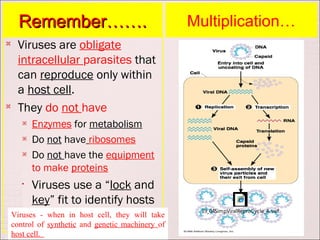
    Viruses are obligate
     intracellular parasites that
     can reproduce only within
     a host cell.
    They do not have
          Enzymes for metabolism
       
           Do not have ribosomes
       
           Do not have the equipment
           to make proteins
       •   Viruses use a “lock and
           key” fit to identify hosts
                                                      19_04SimpViralReproCycle_A.swf
    Viruses - when in host cell, they will take
    control of synthetic and genetic machinery of
    host cell.
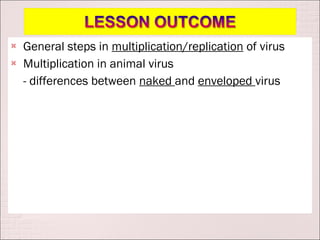
   General steps in multiplication/replication of virus
   Multiplication in animal virus
    - differences between naked and enveloped virus
    Multiplication/Replication cycles involving 5 steps:

1.   Adsorption: the attachment of viruses to host cells
2.   Penetration: entry of virions (or their genome) into host
     cells
3.   Synthesis: new nucleic acids, capsid proteins, and
     other viral components- transcription, translation and
     genome replication
4.   Maturation: assembly of newly synthesized viral
     components into complete virions
5.   Release: departure (pemergian) of new virions from host cells
1.   Adsorption: the attachment of viruses to host cells
2.   Penetration: entry of virions (or their genome) into host
     cells
3.   Uncoating: to separate nucleic acid from protein coat; -
     envelop and capsid are dissolved; the nucleic acid is
     released
4.   Synthesis: new nucleic acids, capsid proteins, and
     other viral components- transcription, translation and
     genome replication
5.   Maturation: assembly of newly synthesized viral
     components into complete virions
6.   Release: departure of new virions from host cells
   Invasion begins when the virus encounters a
    susceptible host cell and adsorbs specifically to
    receptor sites on the cell membrane

   The membrane receptors that viruses attach to are
    usually glycoproteins the cell requires for its normal
    function.
    Ex. - rabies virus → the acetylcholine receptor of nerve
    cells.
         - human immunodeficiency virus (HIV or AIDS
           virus) → CD4 protein on certain white blood cells.
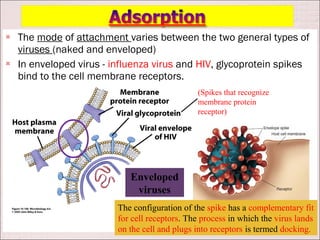
   The mode of attachment varies between the two general types of
    viruses (naked and enveloped)
   In enveloped virus - influenza virus and HIV, glycoprotein spikes
    bind to the cell membrane receptors.
                                                (Spikes that recognize
                                                membrane protein
                                                receptor)


                             Enveloped
                              viruses
                          The configuration of the spike has a complementary fit
                          for cell receptors. The process in which the virus lands
                          on the cell and plugs into receptors is termed docking.
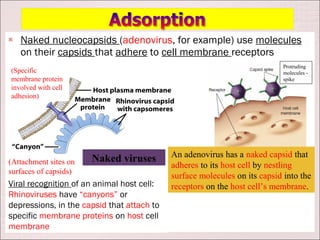
   Naked nucleocapsids (adenovirus, for example) use molecules
    on their capsids that adhere to cell membrane receptors
                                                                           Protruding
(Specific                                                                  molecules -
membrane protein                                                           spike
involved with cell
adhesion)


                                            An adenovirus has a naked capsid that
(Attachment sites on   Naked viruses
                                            adheres to its host cell by nestling
surfaces of capsids)
                                            surface molecules on its capsid into the
Viral recognition of an animal host cell:   receptors on the host cell’s membrane.
Rhinoviruses have “canyons” or
depressions, in the capsid that attach to
specific membrane proteins on host cell
membrane
   Virus can invade its host cell - through making an exact fit with a
    specific host molecule.

   Host range, may be as
    i) restricted as hepatitis B, which infects only liver cells of
    humans
    ii) intermediate like the poliovirus, which infects intestinal
    and nerve cells of primates (humans, apes, and monkeys)
    iii) broad as the rabies virus, which can infect various cells
    of all mammals.

   Host cells that lack compatible virus receptors are resistant
    to adsorption and invasion by that virus – why human liver
    cells are not infected by the canine hepatitis virus and dog liver
    cells cannot host the human hepatitis A virus.
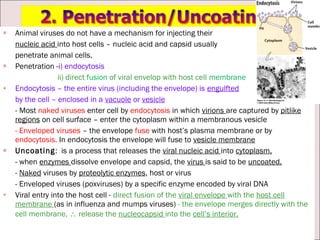
   Animal viruses do not have a mechanism for injecting their
    nucleic acid into host cells – nucleic acid and capsid usually
    penetrate animal cells.
   Penetration -i) endocytosis
                  ii) direct fusion of viral envelop with host cell membrane
   Endocytosis – the entire virus (including the envelope) is engulfted
    by the cell – enclosed in a vacuole or vesicle
    - Most naked viruses enter cell by endocytosis in which virions are captured by pitlike
    regions on cell surface – enter the cytoplasm within a membranous vesicle
    - Enveloped viruses – the envelope fuse with host’s plasma membrane or by
    endocytosis. In endocytosis the envelope will fuse to vesicle membrane
   Uncoating: is a process that releases the viral nucleic acid into cytoplasm.
    - when enzymes dissolve envelope and capsid, the virus is said to be uncoated.
    - Naked viruses by proteolytic enzymes, host or virus
    - Enveloped viruses (poxviruses) by a specific enzyme encoded by viral DNA
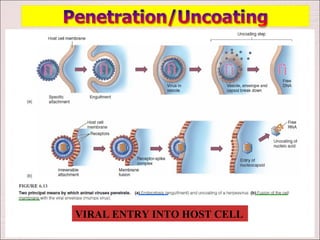
   Viral entry into the host cell - direct fusion of the viral envelope with the host cell
    membrane (as in influenza and mumps viruses) - the envelope merges directly with the
    cell membrane, ∴ release the nucleocapsid into the cell’s interior.
VIRAL ENTRY INTO HOST CELL
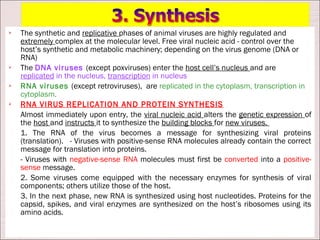
   The synthetic and replicative phases of animal viruses are highly regulated and
    extremely complex at the molecular level. Free viral nucleic acid - control over the
    host’s synthetic and metabolic machinery; depending on the virus genome (DNA or
    RNA)
   The DNA viruses (except poxviruses) enter the host cell’s nucleus and are
    replicated in the nucleus, transcription in nucleus
   RNA viruses (except retroviruses), are replicated in the cytoplasm, transcription in
    cytoplasm.
   RNA VIRUS REPLICATION AND PROTEIN SYNTHESIS
    Almost immediately upon entry, the viral nucleic acid alters the genetic expression of
    the host and instructs it to synthesize the building blocks for new viruses.
    1. The RNA of the virus becomes a message for synthesizing viral proteins
    (translation). - Viruses with positive-sense RNA molecules already contain the correct
    message for translation into proteins.
    - Viruses with negative-sense RNA molecules must first be converted into a positive-
    sense message.
    2. Some viruses come equipped with the necessary enzymes for synthesis of viral
    components; others utilize those of the host.
    3. In the next phase, new RNA is synthesized using host nucleotides. Proteins for the
    capsid, spikes, and viral enzymes are synthesized on the host’s ribosomes using its
    amino acids.
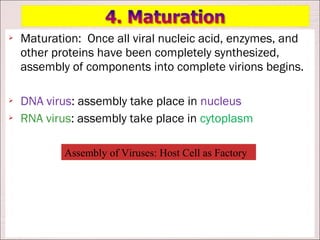
   Maturation: Once all viral nucleic acid, enzymes, and
    other proteins have been completely synthesized,
    assembly of components into complete virions begins.

   DNA virus: assembly take place in nucleus
   RNA virus: assembly take place in cytoplasm

            Assembly of Viruses: Host Cell as Factory
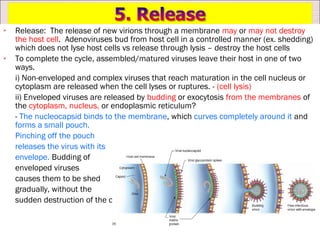
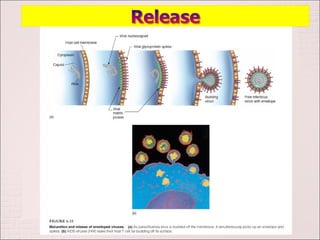
   Release: The release of new virions through a membrane may or may not destroy
    the host cell. Adenoviruses bud from host cell in a controlled manner (ex. shedding)
    which does not lyse host cells vs release through lysis – destroy the host cells
   To complete the cycle, assembled/matured viruses leave their host in one of two
    ways.
    i) Non-enveloped and complex viruses that reach maturation in the cell nucleus or
    cytoplasm are released when the cell lyses or ruptures. - (cell lysis)
    ii) Enveloped viruses are released by budding or exocytosis from the membranes of
    the cytoplasm, nucleus, or endoplasmic reticulum?
    - The nucleocapsid binds to the membrane, which curves completely around it and
    forms a small pouch.
    Pinching off the pouch
    releases the virus with its
    envelope. Budding of
    enveloped viruses
    causes them to be shed
    gradually, without the
    sudden destruction of the cell.
   Regardless of how the virus leaves, most active viral infections are
    ultimately lethal/deadly to the cell because of accumulated damage.

   Lethal damages include a permanent shutdown of metabolism and
    genetic expression, destruction of cell membrane and organelles,
    toxicity of virus components, and release of lysosomes.

   A fully formed, extracellular virus particle that is virulent (able to
    establish infection in a host) is called a virion

   The number of virions released by infected cells is variable, controlled
    by factors such as the size of the virus and the health of the host cell.
    About 3,000 to 4,000 virions are released from a single cell infected
    with poxviruses, whereas a poliovirus-infected cell can release over
    100,000 virions - even a small number of new virions happens to
    meet another susceptible cell and infect it, the potential for rapid viral
    proliferation is immense.
Modes of infection and replication of
        animal viruses – enveloped virus, DNA genome
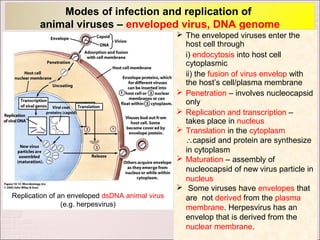
                                                  The enveloped viruses enter the
                                                   host cell through
                                                   i) endocytosis into host cell
                                                   cytoplasmic
                                                   ii) the fusion of virus envelop with
                                                   the host’s cell/plasma membrane
                                                  Penetration – involves nucleocapsid
                                                   only
                                                  Replication and transcription –
                                                   takes place in nucleus
                                                  Translation in the cytoplasm
                                                   ∴capsid and protein are synthesize
                                                   in cytoplasm
                                                  Maturation – assembly of
                                                   nucleocapsid of new virus particle in
                                                   nucleus
                                                  Some viruses have envelopes that
Replication of an enveloped dsDNA animal virus     are not derived from the plasma
                (e.g. herpesvirus)                 membrane. Herpesvirus has an
                                                   envelop that is derived from the
                                                   nuclear membrane.
Synthesis in DNA animal viruses
     Synthesis of new genetic material and proteins depends on the
      viruses
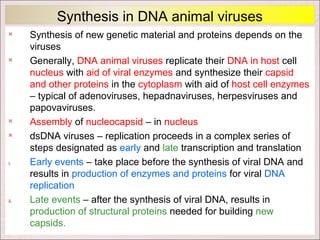
     Generally, DNA animal viruses replicate their DNA in host cell
      nucleus with aid of viral enzymes and synthesize their capsid
      and other proteins in the cytoplasm with aid of host cell enzymes
      – typical of adenoviruses, hepadnaviruses, herpesviruses and
      papovaviruses.
     Assembly of nucleocapsid – in nucleus
     dsDNA viruses – replication proceeds in a complex series of
      steps designated as early and late transcription and translation
i.    Early events – take place before the synthesis of viral DNA and
      results in production of enzymes and proteins for viral DNA
      replication
ii.   Late events – after the synthesis of viral DNA, results in
      production of structural proteins needed for building new
      capsids.
Modes of infection and replication of animal viruses -
                      enveloped virus, RNA genome


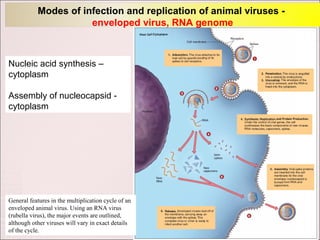
Nucleic acid synthesis –
cytoplasm

Assembly of nucleocapsid -
cytoplasm


General features in the multiplication cycle of an
enveloped animal virus. Using an RNA virus
(rubella virus), the major events are outlined,
although other viruses will vary in exact details
of the cycle.
Modes of infection and replication of
animal viruses – enveloped virus, RNA genome
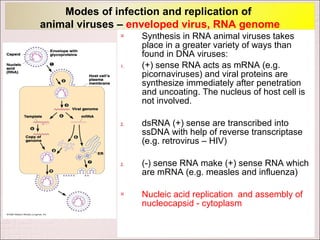
                  Synthesis in RNA animal viruses takes
                   place in a greater variety of ways than
                   found in DNA viruses:
              1.   (+) sense RNA acts as mRNA (e.g.
                   picornaviruses) and viral proteins are
                   synthesize immediately after penetration
                   and uncoating. The nucleus of host cell is
                   not involved.

              2.   dsRNA (+) sense are transcribed into
                   ssDNA with help of reverse transcriptase
                   (e.g. retrovirus – HIV)

              2.   (-) sense RNA make (+) sense RNA which
                   are mRNA (e.g. measles and influenza)

                  Nucleic acid replication and assembly of
                   nucleocapsid - cytoplasm
Modes of infection and replication of
  animal viruses – RNA genome
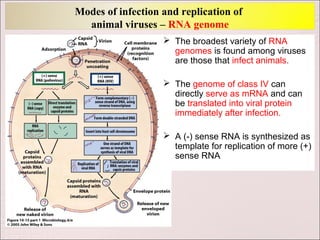
                    The broadest variety of RNA
                     genomes is found among viruses
                     are those that infect animals.

                    The genome of class IV can
                     directly serve as mRNA and can
                     be translated into viral protein
                     immediately after infection.

                    A (-) sense RNA is synthesized as
                     template for replication of more (+)
                     sense RNA
MULTIPLICATION (II)
  PRACTICAL 5:
 - Each group is required to bring their own sample
   – as shown in pg 13 in the lab manual.
- Each group bring 3 samples: soil, sewage water
   and chicken faeces
   Bacteriophage – multiplication steps
   Lytic cycle and Lysogenic cycle
   Virulent, temperate virus, prophage – definition
   Different – bacteriophage and animal multiplication
    how the viruses enter the host cells, release
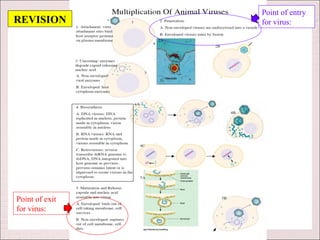
Point of entry
REVISION        for virus:


Point of exit
for virus:
REMEMBER….
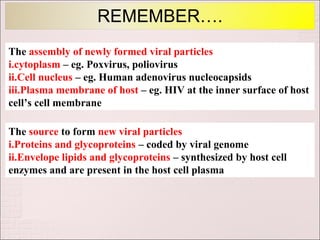
The assembly of newly formed viral particles
i.cytoplasm – eg. Poxvirus, poliovirus
ii.Cell nucleus – eg. Human adenovirus nucleocapsids
iii.Plasma membrane of host – eg. HIV at the inner surface of host
cell’s cell membrane

The source to form new viral particles
i.Proteins and glycoproteins – coded by viral genome
ii.Envelope lipids and glycoproteins – synthesized by host cell
enzymes and are present in the host cell plasma
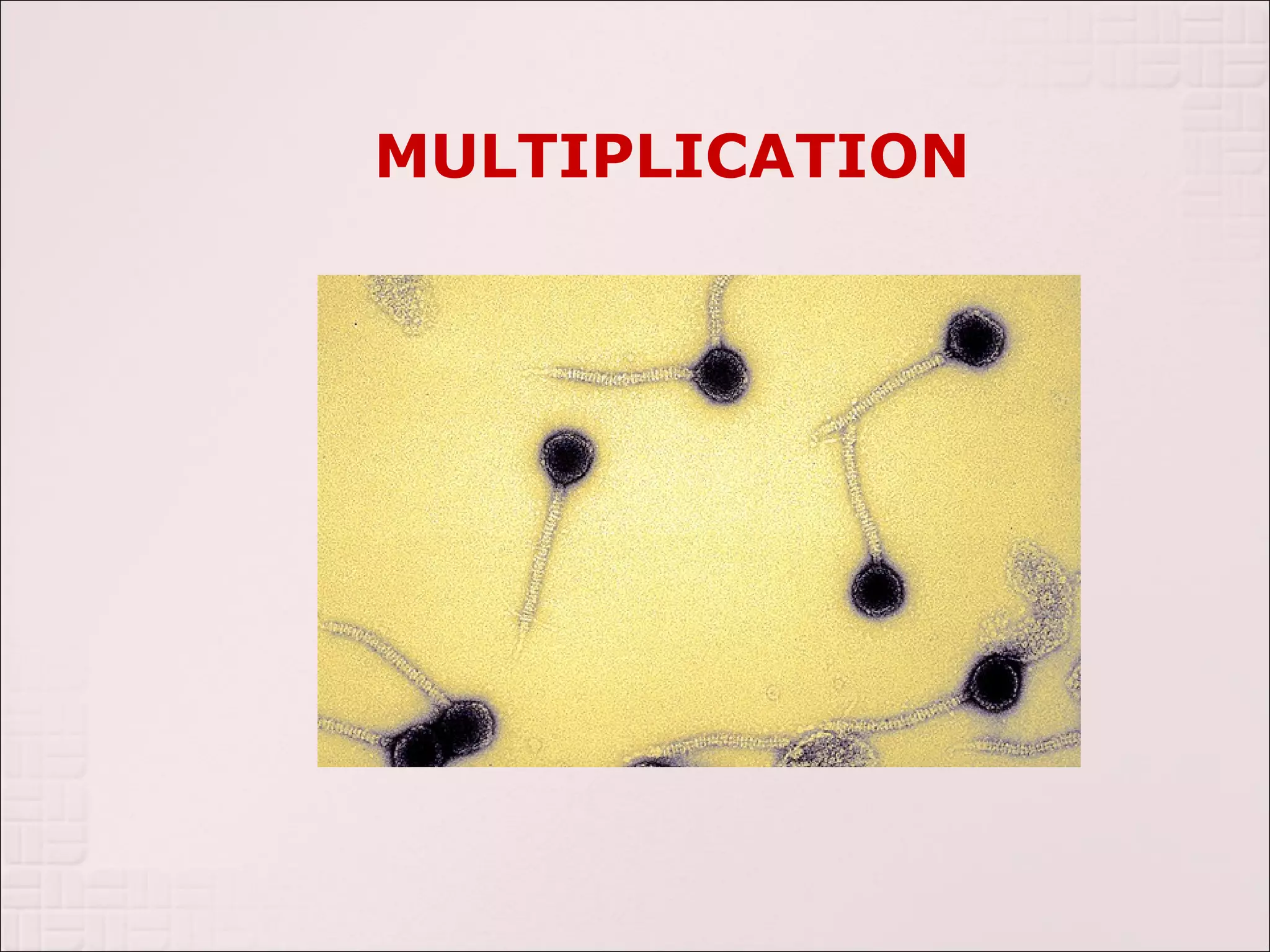
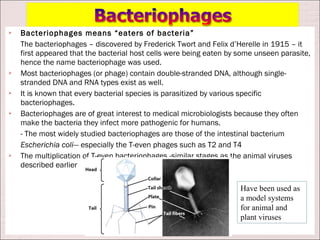
   Bacteriophages means “eaters of bacteria”
    The bacteriophages – discovered by Frederick Twort and Felix d’Herelle in 1915 – it
    first appeared that the bacterial host cells were being eaten by some unseen parasite,
    hence the name bacteriophage was used.
   Most bacteriophages (or phage) contain double-stranded DNA, although single-
    stranded DNA and RNA types exist as well.
   It is known that every bacterial species is parasitized by various specific
    bacteriophages.
   Bacteriophages are of great interest to medical microbiologists because they often
    make the bacteria they infect more pathogenic for humans.
    - The most widely studied bacteriophages are those of the intestinal bacterium
    Escherichia coli— especially the T-even phages such as T2 and T4
   The multiplication of T-even bacteriophages -similar stages as the animal viruses
    described earlier

                                                                     Have been used as
                                                                     a model systems
                                                                     for animal and
                                                                     plant viruses
   Bacteriophages have specialized structures for attaching to
    bacterial cell walls – adsorption involve attachment of specific
    tail fibers to bacteria’s cell wall

   They adsorb to host bacteria using specific receptors on the
    bacterial surface
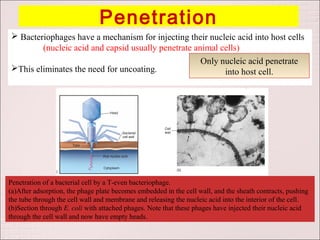
Penetration
 Bacteriophages have a mechanism for injecting their nucleic acid into host cells
        (nucleic acid and capsid usually penetrate animal cells)
                                                     Only nucleic acid penetrate
This eliminates the need for uncoating.                   into host cell.


Penetration of a bacterial cell by a T-even bacteriophage.
(a)After adsorption, the phage plate becomes embedded in the cell wall, and the sheath contracts, pushing
the tube through the cell wall and membrane and releasing the nucleic acid into the interior of the cell.
(b)Section through E. coli with attached phages. Note that these phages have injected their nucleic acid
through the cell wall and now have empty heads.
   Entry of the nucleic acid causes the cessation of host cell DNA
    replication and protein synthesis. Soon the host cell machinery
    is used for viral replication and synthesis of viral proteins.


                       Maturation
 As the host cell produces new phage parts, the parts spontaneously
assemble into bacteriophages.

An average-sized Escherichia coli cell can contain up to 200 new
phage units at the end of this period.
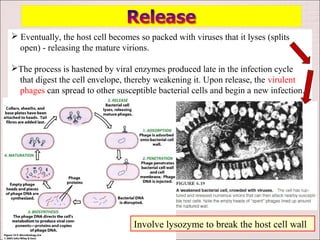
 Eventually, the host cell becomes so packed with viruses that it lyses (splits
  open) - releasing the mature virions.

The process is hastened by viral enzymes produced late in the infection cycle
 that digest the cell envelope, thereby weakening it. Upon release, the virulent
 phages can spread to other susceptible bacterial cells and begin a new infection.


                                   Involve lysozyme to break the host cell wall
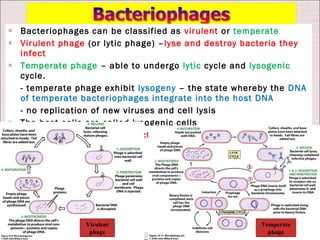
   Bacteriophages can be classified as virulent or temperate
   Virulent phage (or lytic phage) – lyse and destroy bacteria they
    infect
   Temperate phage – able to undergo lytic cycle and lysogenic
    cycle.
    - temperate phage exhibit lysogeny – the state whereby the DNA
    of temperate bacteriophages integrate into the host DNA
    - no replication of new viruses and cell lysis
   The host cells are called lysogenic cells
   The viral DNA within the bacteria chromosome is called
    prophage


                  Virulent                                Temperate
                   phage                                    phage
   Undergo adsorption and penetration into the bacterial host but are not replicated or
    released immediately.
    - viral DNA enters an inactive prophage state, during which it is inserted into the
    bacterial chromosome. This viral DNA will be retained by the bacterial cell and copied
    during its normal cell division so that the cell’s progeny will also have the temperate
    phage DNA.
    - This condition, in which the host chromosome carries bacteriophage DNA, is termed
    lysogeny.

   Because viral particles are not produced, the bacterial cells carrying temperate
    phages do not lyse, and host cells appear entirely normal. On occasion, in a process
    called induction, the prophage in a lysogenic cell will be activated and progress
    directly into viral replication and the lytic cycle.
    - Lysogeny is a less deadly form of parasitism than the full lytic cycle and is thought to
    be an advancement that allows the virus to spread without killing the host.

   Because of the intimate association between the genetic material of the virus and
    host, phages occasionally serve as transporters of bacterial genes from one
    bacterium to another and consequently can play a profound role in bacterial genetics.
    This phenomenon, called transduction, is one way that genes for toxin production and
    drug resistance are transferred between bacteria
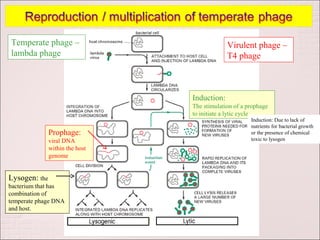
Temperate phage –                             Virulent phage –
lambda phage                                  T4 phage


                                 Induction:
                                 The stimulation of a prophage
                                 to initiate a lytic cycle
                                                       Induction: Due to lack of
                                                       nutrients for bacterial growth
               Prophage:                               or the presence of chemical
               viral DNA                               toxic to lysogen
               within the host
               genome


Lysogen: the
bacterium that has
combination of
temperate phage DNA
and host.
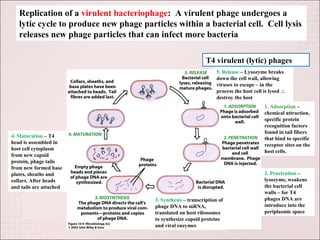
Replication of a virulent bacteriophage: A virulent phage undergoes a
   lytic cycle to produce new phage particles within a bacterial cell. Cell lysis
   releases new phage particles that can infect more bacteria

                                                               T4 virulent (lytic) phages
                                                                    5. Release – Lysozyme breaks
                                                                    down the cell wall, allowing
                                                                    viruses to escape – in the
                                                                    process the host cell is lysed ∴
                                                                    destroy the host
                                                                                          1. Adsorption –
                                                                                          chemical attraction,
                                                                                          specific protein
                                                                                          recognition factors
                                                                                          found in tail fibers
4. Maturation – T4                                                                        that bind to specific
head is assembled in                                                                      receptor sites on the
host cell cytoplasm                                                                       host cells.
from new capsid
protein, phage tails
from new formed base
plates, sheaths and                                                                       2. Penetration –
collars. After heads                                                                      lysozyme, weakens
and tails are attached                                                                    the bacterial cell
                                                                                          walls – for T4
                                        3. Synthesis – transcription of                   phages DNA are
                                        phage DNA to mRNA,                                introduce into the
                                        translated on host ribosomes                      periplasmic space
                                        to synthesize capsid proteins
                                        and viral enzymes
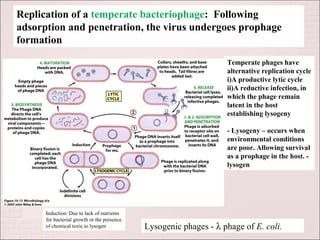
Replication of a temperate bacteriophage: Following
adsorption and penetration, the virus undergoes prophage
formation

                                                                   Temperate phages have
                                                                   alternative replication cycle
                                                                   i)A productive lytic cycle
                                                                   ii)A reductive infection, in
                                                                   which the phage remain
                                                                   latent in the host
                                                                   establishing lysogeny

                                                                   - Lysogeny – occurs when
                                                                   environmental conditions
                                                                   are poor. Allowing survival
                                                                   as a prophage in the host. -
                                                                   lysogen


      Induction: Due to lack of nutrients
      for bacterial growth or the presence
      of chemical toxic to lysogen           Lysogenic phages - λ phage of E. coli.
   Occasionally phage genes in the bacterial chromosome cause the
    production of toxins or enzymes that cause pathology in the human.

   When a bacterium acquires a new trait from its temperate phage, it is
    called lysogenic conversion.
    - The phenomenon was first discovered in the 1950s in the bacterium that
    causes diphtheria, Corynebacterium diphtheriae. The diphtheria toxin
    responsible for the deadly nature of the disease is a bacteriophage
    product.
    ∴ C. diphtheriae without the phage are harmless.

   Other bacteria that are made virulent by their prophages are Vibrio
    cholerae, the agent of cholera, and Clostridium botulinum, the cause of
    botulism.
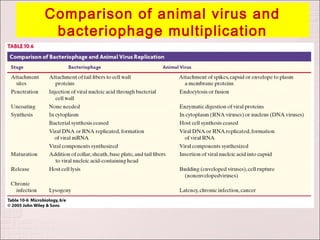
Comparison of animal virus and
 bacteriophage multiplication
   Latent viral infections :
    - herpesviruses - herpes simplex virus. These
    dsDNA viruses that can exhibit a lytic cycle and
    also able to remain latent within the cells of host.
    Once activated by a cold, fever, stress or
    immunosuppression, they replicate resulting in cell
    lysis.
    - HIV virus – provirus will become latent until
    induction whereby HIV virus show AIDS symptom.

   Latent infection: - infection of a cell where the
    replication cycle is not completed, but the virus
    genome is maintained in the host cell without
    replicating or causing harm .
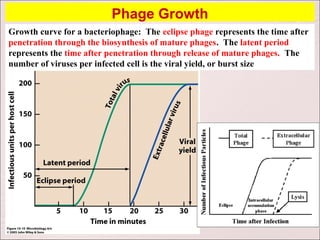
Phage Growth
Growth curve for a bacteriophage: The eclipse phage represents the time after
penetration through the biosynthesis of mature phages. The latent period
represents the time after penetration through release of mature phages. The
number of viruses per infected cell is the viral yield, or burst size
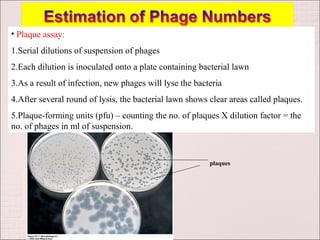
• Plaque assay:
1.Serial dilutions of suspension of phages
2.Each dilution is inoculated onto a plate containing bacterial lawn
3.As a result of infection, new phages will lyse the bacteria
4.After several round of lysis, the bacterial lawn shows clear areas called plaques.
5.Plaque-forming units (pfu) – counting the no. of plaques X dilution factor = the
no. of phages in ml of suspension.


                                                         plaques

Chapter 3 multiplication

  • 1.
  • 2.
    Remember……. Multiplication…  Viruses are obligate intracellular parasites that can reproduce only within a host cell.  They do not have  Enzymes for metabolism  Do not have ribosomes  Do not have the equipment to make proteins • Viruses use a “lock and key” fit to identify hosts 19_04SimpViralReproCycle_A.swf Viruses - when in host cell, they will take control of synthetic and genetic machinery of host cell.
  • 3.
    General steps in multiplication/replication of virus  Multiplication in animal virus - differences between naked and enveloped virus
  • 4.
    Multiplication/Replication cycles involving 5 steps: 1. Adsorption: the attachment of viruses to host cells 2. Penetration: entry of virions (or their genome) into host cells 3. Synthesis: new nucleic acids, capsid proteins, and other viral components- transcription, translation and genome replication 4. Maturation: assembly of newly synthesized viral components into complete virions 5. Release: departure (pemergian) of new virions from host cells
  • 5.
    1. Adsorption: the attachment of viruses to host cells 2. Penetration: entry of virions (or their genome) into host cells 3. Uncoating: to separate nucleic acid from protein coat; - envelop and capsid are dissolved; the nucleic acid is released 4. Synthesis: new nucleic acids, capsid proteins, and other viral components- transcription, translation and genome replication 5. Maturation: assembly of newly synthesized viral components into complete virions 6. Release: departure of new virions from host cells
  • 6.
    Invasion begins when the virus encounters a susceptible host cell and adsorbs specifically to receptor sites on the cell membrane  The membrane receptors that viruses attach to are usually glycoproteins the cell requires for its normal function. Ex. - rabies virus → the acetylcholine receptor of nerve cells. - human immunodeficiency virus (HIV or AIDS virus) → CD4 protein on certain white blood cells.
  • 7.
    The mode of attachment varies between the two general types of viruses (naked and enveloped)  In enveloped virus - influenza virus and HIV, glycoprotein spikes bind to the cell membrane receptors. (Spikes that recognize membrane protein receptor) Enveloped viruses The configuration of the spike has a complementary fit for cell receptors. The process in which the virus lands on the cell and plugs into receptors is termed docking.
  • 8.
    Naked nucleocapsids (adenovirus, for example) use molecules on their capsids that adhere to cell membrane receptors Protruding (Specific molecules - membrane protein spike involved with cell adhesion) An adenovirus has a naked capsid that (Attachment sites on Naked viruses adheres to its host cell by nestling surfaces of capsids) surface molecules on its capsid into the Viral recognition of an animal host cell: receptors on the host cell’s membrane. Rhinoviruses have “canyons” or depressions, in the capsid that attach to specific membrane proteins on host cell membrane
  • 9.
    Virus can invade its host cell - through making an exact fit with a specific host molecule.  Host range, may be as i) restricted as hepatitis B, which infects only liver cells of humans ii) intermediate like the poliovirus, which infects intestinal and nerve cells of primates (humans, apes, and monkeys) iii) broad as the rabies virus, which can infect various cells of all mammals.  Host cells that lack compatible virus receptors are resistant to adsorption and invasion by that virus – why human liver cells are not infected by the canine hepatitis virus and dog liver cells cannot host the human hepatitis A virus.
  • 10.
    Animal viruses do not have a mechanism for injecting their nucleic acid into host cells – nucleic acid and capsid usually penetrate animal cells.  Penetration -i) endocytosis ii) direct fusion of viral envelop with host cell membrane  Endocytosis – the entire virus (including the envelope) is engulfted by the cell – enclosed in a vacuole or vesicle - Most naked viruses enter cell by endocytosis in which virions are captured by pitlike regions on cell surface – enter the cytoplasm within a membranous vesicle - Enveloped viruses – the envelope fuse with host’s plasma membrane or by endocytosis. In endocytosis the envelope will fuse to vesicle membrane  Uncoating: is a process that releases the viral nucleic acid into cytoplasm. - when enzymes dissolve envelope and capsid, the virus is said to be uncoated. - Naked viruses by proteolytic enzymes, host or virus - Enveloped viruses (poxviruses) by a specific enzyme encoded by viral DNA  Viral entry into the host cell - direct fusion of the viral envelope with the host cell membrane (as in influenza and mumps viruses) - the envelope merges directly with the cell membrane, ∴ release the nucleocapsid into the cell’s interior.
  • 11.
  • 12.
    The synthetic and replicative phases of animal viruses are highly regulated and extremely complex at the molecular level. Free viral nucleic acid - control over the host’s synthetic and metabolic machinery; depending on the virus genome (DNA or RNA)  The DNA viruses (except poxviruses) enter the host cell’s nucleus and are replicated in the nucleus, transcription in nucleus  RNA viruses (except retroviruses), are replicated in the cytoplasm, transcription in cytoplasm.  RNA VIRUS REPLICATION AND PROTEIN SYNTHESIS Almost immediately upon entry, the viral nucleic acid alters the genetic expression of the host and instructs it to synthesize the building blocks for new viruses. 1. The RNA of the virus becomes a message for synthesizing viral proteins (translation). - Viruses with positive-sense RNA molecules already contain the correct message for translation into proteins. - Viruses with negative-sense RNA molecules must first be converted into a positive- sense message. 2. Some viruses come equipped with the necessary enzymes for synthesis of viral components; others utilize those of the host. 3. In the next phase, new RNA is synthesized using host nucleotides. Proteins for the capsid, spikes, and viral enzymes are synthesized on the host’s ribosomes using its amino acids.
  • 13.
    Maturation: Once all viral nucleic acid, enzymes, and other proteins have been completely synthesized, assembly of components into complete virions begins.  DNA virus: assembly take place in nucleus  RNA virus: assembly take place in cytoplasm Assembly of Viruses: Host Cell as Factory
  • 14.
    Release: The release of new virions through a membrane may or may not destroy the host cell. Adenoviruses bud from host cell in a controlled manner (ex. shedding) which does not lyse host cells vs release through lysis – destroy the host cells  To complete the cycle, assembled/matured viruses leave their host in one of two ways. i) Non-enveloped and complex viruses that reach maturation in the cell nucleus or cytoplasm are released when the cell lyses or ruptures. - (cell lysis) ii) Enveloped viruses are released by budding or exocytosis from the membranes of the cytoplasm, nucleus, or endoplasmic reticulum? - The nucleocapsid binds to the membrane, which curves completely around it and forms a small pouch. Pinching off the pouch releases the virus with its envelope. Budding of enveloped viruses causes them to be shed gradually, without the sudden destruction of the cell.
  • 15.
    Regardless of how the virus leaves, most active viral infections are ultimately lethal/deadly to the cell because of accumulated damage.  Lethal damages include a permanent shutdown of metabolism and genetic expression, destruction of cell membrane and organelles, toxicity of virus components, and release of lysosomes.  A fully formed, extracellular virus particle that is virulent (able to establish infection in a host) is called a virion  The number of virions released by infected cells is variable, controlled by factors such as the size of the virus and the health of the host cell. About 3,000 to 4,000 virions are released from a single cell infected with poxviruses, whereas a poliovirus-infected cell can release over 100,000 virions - even a small number of new virions happens to meet another susceptible cell and infect it, the potential for rapid viral proliferation is immense.
  • 17.
    Modes of infectionand replication of animal viruses – enveloped virus, DNA genome  The enveloped viruses enter the host cell through i) endocytosis into host cell cytoplasmic ii) the fusion of virus envelop with the host’s cell/plasma membrane  Penetration – involves nucleocapsid only  Replication and transcription – takes place in nucleus  Translation in the cytoplasm ∴capsid and protein are synthesize in cytoplasm  Maturation – assembly of nucleocapsid of new virus particle in nucleus  Some viruses have envelopes that Replication of an enveloped dsDNA animal virus are not derived from the plasma (e.g. herpesvirus) membrane. Herpesvirus has an envelop that is derived from the nuclear membrane.
  • 18.
    Synthesis in DNAanimal viruses  Synthesis of new genetic material and proteins depends on the viruses  Generally, DNA animal viruses replicate their DNA in host cell nucleus with aid of viral enzymes and synthesize their capsid and other proteins in the cytoplasm with aid of host cell enzymes – typical of adenoviruses, hepadnaviruses, herpesviruses and papovaviruses.  Assembly of nucleocapsid – in nucleus  dsDNA viruses – replication proceeds in a complex series of steps designated as early and late transcription and translation i. Early events – take place before the synthesis of viral DNA and results in production of enzymes and proteins for viral DNA replication ii. Late events – after the synthesis of viral DNA, results in production of structural proteins needed for building new capsids.
  • 19.
    Modes of infectionand replication of animal viruses - enveloped virus, RNA genome Nucleic acid synthesis – cytoplasm Assembly of nucleocapsid - cytoplasm General features in the multiplication cycle of an enveloped animal virus. Using an RNA virus (rubella virus), the major events are outlined, although other viruses will vary in exact details of the cycle.
  • 20.
    Modes of infectionand replication of animal viruses – enveloped virus, RNA genome  Synthesis in RNA animal viruses takes place in a greater variety of ways than found in DNA viruses: 1. (+) sense RNA acts as mRNA (e.g. picornaviruses) and viral proteins are synthesize immediately after penetration and uncoating. The nucleus of host cell is not involved. 2. dsRNA (+) sense are transcribed into ssDNA with help of reverse transcriptase (e.g. retrovirus – HIV) 2. (-) sense RNA make (+) sense RNA which are mRNA (e.g. measles and influenza)  Nucleic acid replication and assembly of nucleocapsid - cytoplasm
  • 21.
    Modes of infectionand replication of animal viruses – RNA genome  The broadest variety of RNA genomes is found among viruses are those that infect animals.  The genome of class IV can directly serve as mRNA and can be translated into viral protein immediately after infection.  A (-) sense RNA is synthesized as template for replication of more (+) sense RNA
  • 22.
  • 23.
     PRACTICAL5: - Each group is required to bring their own sample – as shown in pg 13 in the lab manual. - Each group bring 3 samples: soil, sewage water and chicken faeces
  • 24.
    Bacteriophage – multiplication steps  Lytic cycle and Lysogenic cycle  Virulent, temperate virus, prophage – definition  Different – bacteriophage and animal multiplication how the viruses enter the host cells, release
  • 25.
    Point of entry REVISION for virus: Point of exit for virus:
  • 26.
    REMEMBER…. The assembly ofnewly formed viral particles i.cytoplasm – eg. Poxvirus, poliovirus ii.Cell nucleus – eg. Human adenovirus nucleocapsids iii.Plasma membrane of host – eg. HIV at the inner surface of host cell’s cell membrane The source to form new viral particles i.Proteins and glycoproteins – coded by viral genome ii.Envelope lipids and glycoproteins – synthesized by host cell enzymes and are present in the host cell plasma
  • 27.
    Bacteriophages means “eaters of bacteria” The bacteriophages – discovered by Frederick Twort and Felix d’Herelle in 1915 – it first appeared that the bacterial host cells were being eaten by some unseen parasite, hence the name bacteriophage was used.  Most bacteriophages (or phage) contain double-stranded DNA, although single- stranded DNA and RNA types exist as well.  It is known that every bacterial species is parasitized by various specific bacteriophages.  Bacteriophages are of great interest to medical microbiologists because they often make the bacteria they infect more pathogenic for humans. - The most widely studied bacteriophages are those of the intestinal bacterium Escherichia coli— especially the T-even phages such as T2 and T4  The multiplication of T-even bacteriophages -similar stages as the animal viruses described earlier Have been used as a model systems for animal and plant viruses
  • 28.
    Bacteriophages have specialized structures for attaching to bacterial cell walls – adsorption involve attachment of specific tail fibers to bacteria’s cell wall  They adsorb to host bacteria using specific receptors on the bacterial surface
  • 29.
    Penetration  Bacteriophages havea mechanism for injecting their nucleic acid into host cells (nucleic acid and capsid usually penetrate animal cells) Only nucleic acid penetrate This eliminates the need for uncoating. into host cell. Penetration of a bacterial cell by a T-even bacteriophage. (a)After adsorption, the phage plate becomes embedded in the cell wall, and the sheath contracts, pushing the tube through the cell wall and membrane and releasing the nucleic acid into the interior of the cell. (b)Section through E. coli with attached phages. Note that these phages have injected their nucleic acid through the cell wall and now have empty heads.
  • 30.
    Entry of the nucleic acid causes the cessation of host cell DNA replication and protein synthesis. Soon the host cell machinery is used for viral replication and synthesis of viral proteins. Maturation  As the host cell produces new phage parts, the parts spontaneously assemble into bacteriophages. An average-sized Escherichia coli cell can contain up to 200 new phage units at the end of this period.
  • 31.
     Eventually, thehost cell becomes so packed with viruses that it lyses (splits open) - releasing the mature virions. The process is hastened by viral enzymes produced late in the infection cycle that digest the cell envelope, thereby weakening it. Upon release, the virulent phages can spread to other susceptible bacterial cells and begin a new infection. Involve lysozyme to break the host cell wall
  • 32.
    Bacteriophages can be classified as virulent or temperate  Virulent phage (or lytic phage) – lyse and destroy bacteria they infect  Temperate phage – able to undergo lytic cycle and lysogenic cycle. - temperate phage exhibit lysogeny – the state whereby the DNA of temperate bacteriophages integrate into the host DNA - no replication of new viruses and cell lysis  The host cells are called lysogenic cells  The viral DNA within the bacteria chromosome is called prophage Virulent Temperate phage phage
  • 33.
    Undergo adsorption and penetration into the bacterial host but are not replicated or released immediately. - viral DNA enters an inactive prophage state, during which it is inserted into the bacterial chromosome. This viral DNA will be retained by the bacterial cell and copied during its normal cell division so that the cell’s progeny will also have the temperate phage DNA. - This condition, in which the host chromosome carries bacteriophage DNA, is termed lysogeny.  Because viral particles are not produced, the bacterial cells carrying temperate phages do not lyse, and host cells appear entirely normal. On occasion, in a process called induction, the prophage in a lysogenic cell will be activated and progress directly into viral replication and the lytic cycle. - Lysogeny is a less deadly form of parasitism than the full lytic cycle and is thought to be an advancement that allows the virus to spread without killing the host.  Because of the intimate association between the genetic material of the virus and host, phages occasionally serve as transporters of bacterial genes from one bacterium to another and consequently can play a profound role in bacterial genetics. This phenomenon, called transduction, is one way that genes for toxin production and drug resistance are transferred between bacteria
  • 34.
    Temperate phage – Virulent phage – lambda phage T4 phage Induction: The stimulation of a prophage to initiate a lytic cycle Induction: Due to lack of nutrients for bacterial growth Prophage: or the presence of chemical viral DNA toxic to lysogen within the host genome Lysogen: the bacterium that has combination of temperate phage DNA and host.
  • 35.
    Replication of avirulent bacteriophage: A virulent phage undergoes a lytic cycle to produce new phage particles within a bacterial cell. Cell lysis releases new phage particles that can infect more bacteria T4 virulent (lytic) phages 5. Release – Lysozyme breaks down the cell wall, allowing viruses to escape – in the process the host cell is lysed ∴ destroy the host 1. Adsorption – chemical attraction, specific protein recognition factors found in tail fibers 4. Maturation – T4 that bind to specific head is assembled in receptor sites on the host cell cytoplasm host cells. from new capsid protein, phage tails from new formed base plates, sheaths and 2. Penetration – collars. After heads lysozyme, weakens and tails are attached the bacterial cell walls – for T4 3. Synthesis – transcription of phages DNA are phage DNA to mRNA, introduce into the translated on host ribosomes periplasmic space to synthesize capsid proteins and viral enzymes
  • 36.
    Replication of atemperate bacteriophage: Following adsorption and penetration, the virus undergoes prophage formation Temperate phages have alternative replication cycle i)A productive lytic cycle ii)A reductive infection, in which the phage remain latent in the host establishing lysogeny - Lysogeny – occurs when environmental conditions are poor. Allowing survival as a prophage in the host. - lysogen Induction: Due to lack of nutrients for bacterial growth or the presence of chemical toxic to lysogen Lysogenic phages - λ phage of E. coli.
  • 37.
    Occasionally phage genes in the bacterial chromosome cause the production of toxins or enzymes that cause pathology in the human.  When a bacterium acquires a new trait from its temperate phage, it is called lysogenic conversion. - The phenomenon was first discovered in the 1950s in the bacterium that causes diphtheria, Corynebacterium diphtheriae. The diphtheria toxin responsible for the deadly nature of the disease is a bacteriophage product. ∴ C. diphtheriae without the phage are harmless.  Other bacteria that are made virulent by their prophages are Vibrio cholerae, the agent of cholera, and Clostridium botulinum, the cause of botulism.
  • 38.
    Comparison of animalvirus and bacteriophage multiplication
  • 39.
    Latent viral infections : - herpesviruses - herpes simplex virus. These dsDNA viruses that can exhibit a lytic cycle and also able to remain latent within the cells of host. Once activated by a cold, fever, stress or immunosuppression, they replicate resulting in cell lysis. - HIV virus – provirus will become latent until induction whereby HIV virus show AIDS symptom.  Latent infection: - infection of a cell where the replication cycle is not completed, but the virus genome is maintained in the host cell without replicating or causing harm .
  • 40.
    Phage Growth Growth curvefor a bacteriophage: The eclipse phage represents the time after penetration through the biosynthesis of mature phages. The latent period represents the time after penetration through release of mature phages. The number of viruses per infected cell is the viral yield, or burst size
  • 41.
    • Plaque assay: 1.Serialdilutions of suspension of phages 2.Each dilution is inoculated onto a plate containing bacterial lawn 3.As a result of infection, new phages will lyse the bacteria 4.After several round of lysis, the bacterial lawn shows clear areas called plaques. 5.Plaque-forming units (pfu) – counting the no. of plaques X dilution factor = the no. of phages in ml of suspension. plaques