
Microbiology
An introduction
Presented by
D. Mona
Othman
Albureikan
Lectures
(23, 24, 25, 26,
27)
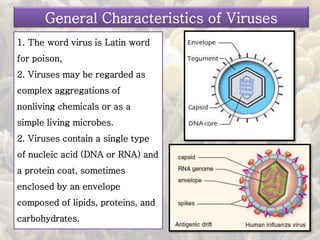
1. The word virus is Latin word
for poison,
2. Viruses may be regarded as
complex aggregations of
nonliving chemicals or as a
simple living microbes.
2. Viruses contain a single type
of nucleic acid (DNA or RNA) and
a protein coat, sometimes
enclosed by an envelope
composed of lipids, proteins, and
carbohydrates.
General Characteristics of Viruses
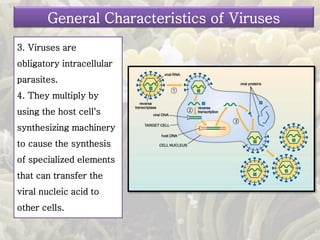
3. Viruses are
obligatory intracellular
parasites.
4. They multiply by
using the host cell's
synthesizing machinery
to cause the synthesis
of specialized elements
that can transfer the
viral nucleic acid to
other cells.
General Characteristics of Viruses
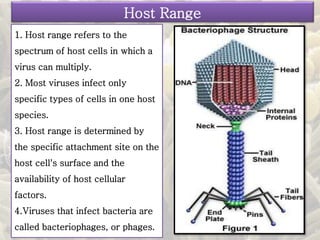
1. Host range refers to the
spectrum of host cells in which a
virus can multiply.
2. Most viruses infect only
specific types of cells in one host
species.
3. Host range is determined by
the specific attachment site on the
host cell's surface and the
availability of host cellular
factors.
4.Viruses that infect bacteria are
called bacteriophages, or phages.
Host Range
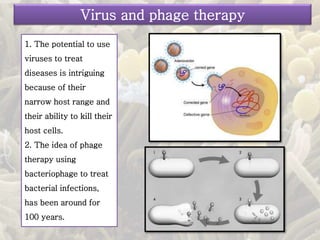
1. The potential to use
viruses to treat
diseases is intriguing
because of their
narrow host range and
their ability to kill their
host cells.
2. The idea of phage
therapy using
bacteriophage to treat
bacterial infections,
has been around for
100 years.
Virus and phage therapy
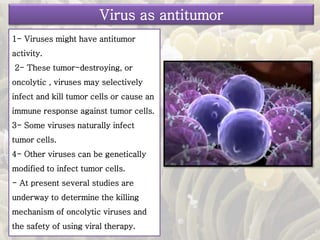
1- Viruses might have antitumor
activity.
2- These tumor-destroying, or
oncolytic , viruses may selectively
infect and kill tumor cells or cause an
immune response against tumor cells.
3- Some viruses naturally infect
tumor cells.
4- Other viruses can be genetically
modified to infect tumor cells.
- At present several studies are
underway to determine the killing
mechanism of oncolytic viruses and
the safety of using viral therapy.
Virus as antitumor
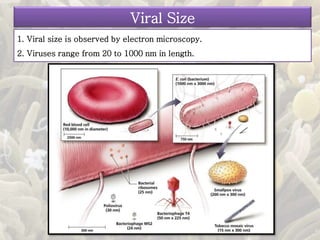
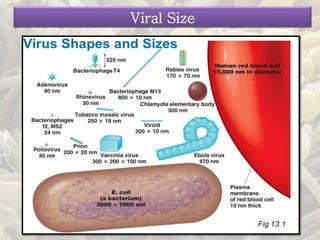
1. Viral size is observed by electron microscopy.
2. Viruses range from 20 to 1000 nm in length.
Viral Size
Viral Size
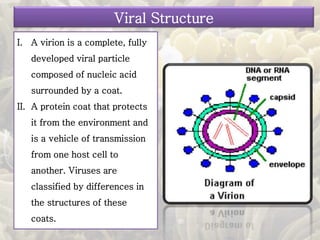
I. A virion is a complete, fully
developed viral particle
composed of nucleic acid
surrounded by a coat.
II. A protein coat that protects
it from the environment and
is a vehicle of transmission
from one host cell to
another. Viruses are
classified by differences in
the structures of these
coats.
Viral Structure
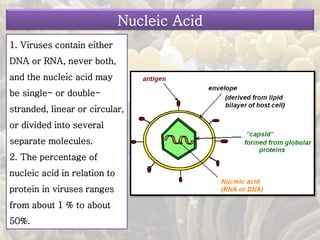
1. Viruses contain either
DNA or RNA, never both,
and the nucleic acid may
be single- or double-
stranded, linear or circular,
or divided into several
separate molecules.
2. The percentage of
nucleic acid in relation to
protein in viruses ranges
from about 1 % to about
50%.
Nucleic Acid
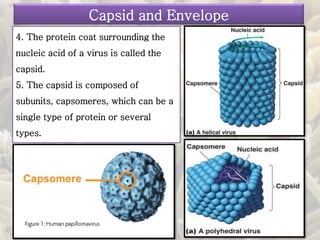
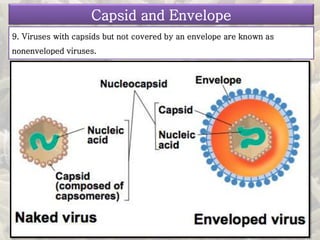
4. The protein coat surrounding the
nucleic acid of a virus is called the
capsid.
5. The capsid is composed of
subunits, capsomeres, which can be a
single type of protein or several
types.
Capsid and Envelope
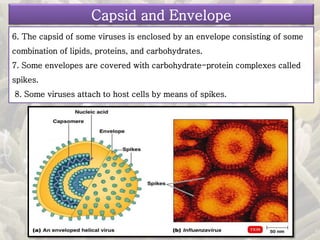
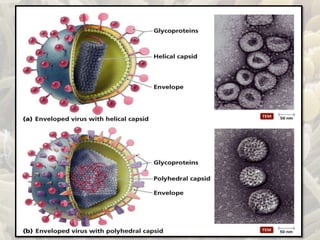
6. The capsid of some viruses is enclosed by an envelope consisting of some
combination of lipids, proteins, and carbohydrates.
7. Some envelopes are covered with carbohydrate-protein complexes called
spikes.
8. Some viruses attach to host cells by means of spikes.
Capsid and Envelope
Capsid and Envelope
9. Viruses with capsids but not covered by an envelope are known as
nonenveloped viruses.
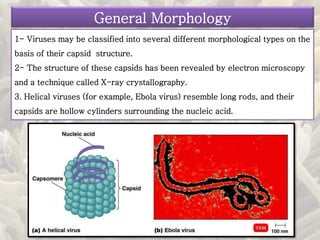
1- Viruses may be classified into several different morphological types on the
basis of their capsid structure.
2- The structure of these capsids has been revealed by electron microscopy
and a technique called X-ray crystallography.
3. Helical viruses (for example, Ebola virus) resemble long rods, and their
capsids are hollow cylinders surrounding the nucleic acid.
General Morphology
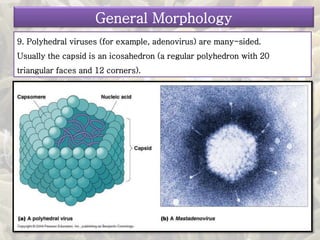
9. Polyhedral viruses (for example, adenovirus) are many-sided.
Usually the capsid is an icosahedron (a regular polyhedron with 20
triangular faces and 12 corners).
General Morphology
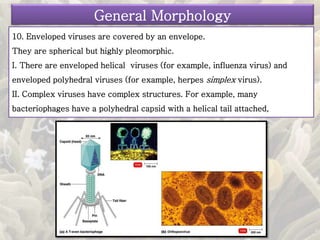
10. Enveloped viruses are covered by an envelope.
They are spherical but highly pleomorphic.
I. There are enveloped helical viruses (for example, influenza virus) and
enveloped polyhedral viruses (for example, herpes simplex virus).
II. Complex viruses have complex structures. For example, many
bacteriophages have a polyhedral capsid with a helical tail attached,
General Morphology
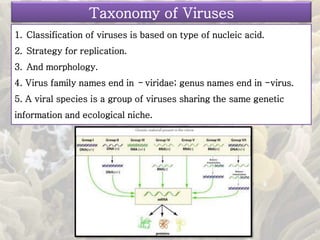
1. Classification of viruses is based on type of nucleic acid.
2. Strategy for replication.
3. And morphology.
4. Virus family names end in - viridae; genus names end in -virus.
5. A viral species is a group of viruses sharing the same genetic
information and ecological niche.
Taxonomy of Viruses
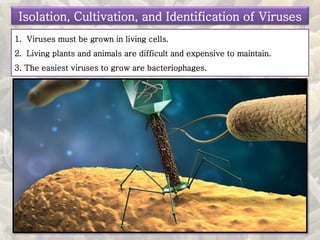
1. Viruses must be grown in living cells.
2. Living plants and animals are difficult and expensive to maintain.
3. The easiest viruses to grow are bacteriophages.
Isolation, Cultivation, and Identification of Viruses
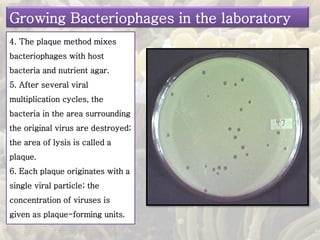
4. The plaque method mixes
bacteriophages with host
bacteria and nutrient agar.
5. After several viral
multiplication cycles, the
bacteria in the area surrounding
the original virus are destroyed;
the area of lysis is called a
plaque.
6. Each plaque originates with a
single viral particle; the
concentration of viruses is
given as plaque-forming units.
Growing Bacteriophages in the laboratory
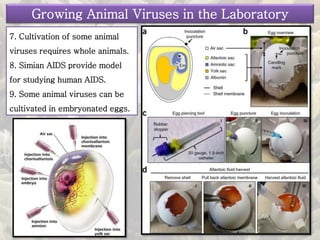
7. Cultivation of some animal
viruses requires whole animals.
8. Simian AIDS provide model
for studying human AIDS.
9. Some animal viruses can be
cultivated in embryonated eggs.
Growing Animal Viruses in the Laboratory
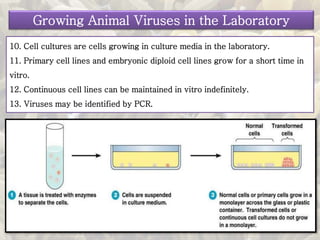
10. Cell cultures are cells growing in culture media in the laboratory.
11. Primary cell lines and embryonic diploid cell lines grow for a short time in
vitro.
12. Continuous cell lines can be maintained in vitro indefinitely.
13. Viruses may be identified by PCR.
Growing Animal Viruses in the Laboratory
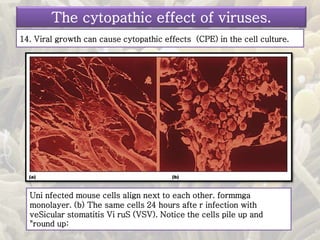
The cytopathic effect of viruses.
Uni nfected mouse cells align next to each other. formmga
monolayer. (b) The same cells 24 hours afte r infection with
veSicular stomatitis Vi ruS (VSV). Notice the cells pile up and
"round up:
14. Viral growth can cause cytopathic effects (CPE) in the cell culture.
Viral Multiplication
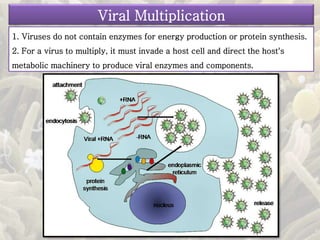
1. Viruses do not contain enzymes for energy production or protein synthesis.
2. For a virus to multiply, it must invade a host cell and direct the host's
metabolic machinery to produce viral enzymes and components.
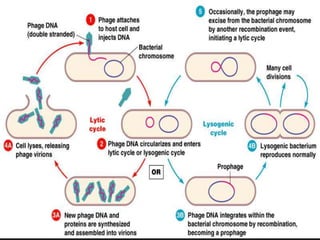
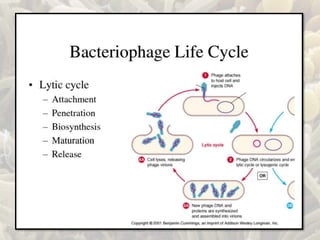
1. During the lytic cycle, a phage causes the lysis and death of a host
cell.
2. Some viruses can either cause lysis or have their DNA incorporated
as a prophage into the DNA of the host cell.
3. The latter situation is called lysogeny.
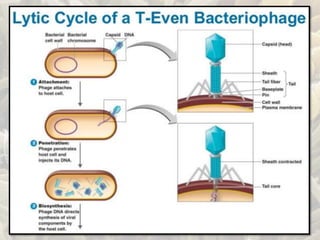
4. During the attachment phase of the lytic cycle, sites on the phage's
tail fibers attach to complementary receptor sites on the bacterial cell.
5. In penetration, phage lysozyme opens a portion of the bacterial cell
wall, the tail sheath contracts to force the tail core through the cell
wall, and phage DNA enters the bacterial cell.
6. The capsid remains outside.
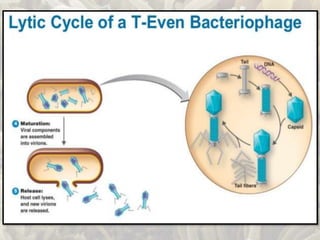
Multiplication of Bacteriophages
7. In biosynthesis, transcription of phage DNA produces mRNA coding
for proteins necessary for phage multiplication.
8. Phage DNA is replicated, and capsid proteins are produced.
9. During the eclipse period, separate phage DNA and protein can be
found.
10. During maturation, phage DNA and capsids are assembled into
complete viruses.
11. During release, phage lysozyme breaks down the bacterial cell
wall, and the new phages are released.
12. During the lysogenic cycle, the prophage is replicated each time
the cell divides.
Multiplication of Bacteriophages
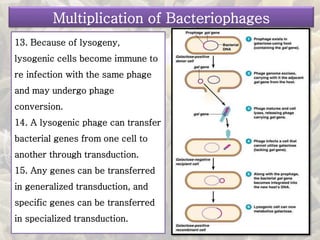
13. Because of lysogeny,
lysogenic cells become immune to
re infection with the same phage
and may undergo phage
conversion.
14. A lysogenic phage can transfer
bacterial genes from one cell to
another through transduction.
15. Any genes can be transferred
in generalized transduction, and
specific genes can be transferred
in specialized transduction.
Multiplication of Bacteriophages
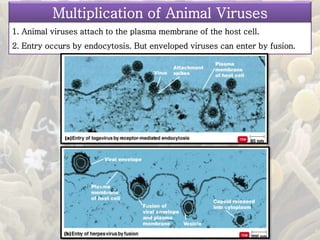
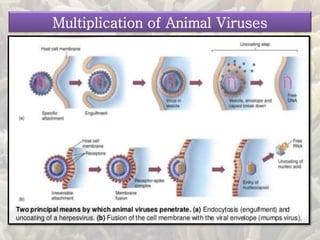
1. Animal viruses attach to the plasma membrane of the host cell.
2. Entry occurs by endocytosis. But enveloped viruses can enter by fusion.
Multiplication of Animal Viruses
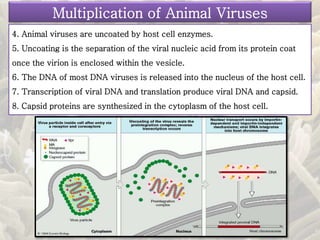
4. Animal viruses are uncoated by host cell enzymes.
5. Uncoating is the separation of the viral nucleic acid from its protein coat
once the virion is enclosed within the vesicle.
6. The DNA of most DNA viruses is released into the nucleus of the host cell.
7. Transcription of viral DNA and translation produce viral DNA and capsid.
8. Capsid proteins are synthesized in the cytoplasm of the host cell.
Multiplication of Animal Viruses
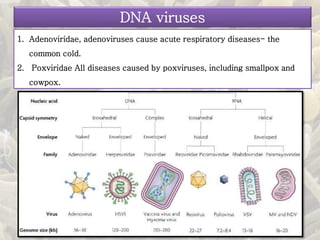
1. Adenoviridae, adenoviruses cause acute respiratory diseases- the
common cold.
2. Poxviridae All diseases caused by poxviruses, including smallpox and
cowpox.
DNA viruses
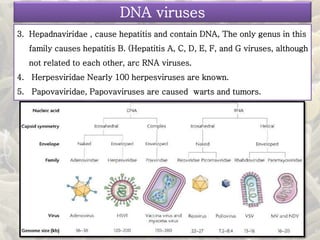
3. Hepadnaviridae , cause hepatitis and contain DNA, The only genus in this
family causes hepatitis B. (Hepatitis A, C, D, E, F, and G viruses, although
not related to each other, arc RNA viruses.
4. Herpesviridae Nearly 100 herpesviruses are known.
5. Papovaviridae, Papovaviruses are caused warts and tumors.
DNA viruses
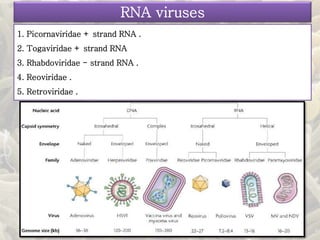
1. Picornaviridae + strand RNA .
2. Togaviridae + strand RNA
3. Rhabdoviridae - strand RNA .
4. Reoviridae .
5. Retroviridae .
RNA viruses
Maturation and Release
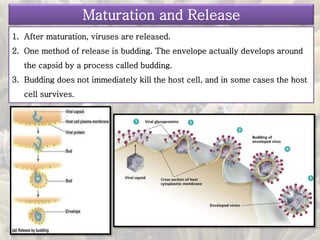
1. After maturation, viruses are released.
2. One method of release is budding. The envelope actually develops around
the capsid by a process called budding.
3. Budding does not immediately kill the host cell, and in some cases the host
cell survives.
Maturation and Release
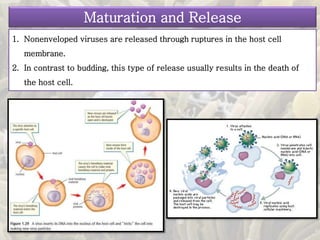
1. Nonenveloped viruses are released through ruptures in the host cell
membrane.
2. In contrast to budding, this type of release usually results in the death of
the host cell.
1. Several types of cancer are now known to be caused by viruses.
2. Viruses capable of inducing tumors in animals are called oncogenic viruses,
or oncoviruses
Viruses and Cancer
The Transformation of Normal Cells Into Tumor Cells
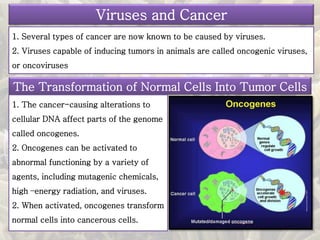
1. The cancer-causing alterations to
cellular DNA affect parts of the genome
called oncogenes.
2. Oncogenes can be activated to
abnormal functioning by a variety of
agents, including mutagenic chemicals,
high –energy radiation, and viruses.
2. When activated, oncogenes transform
normal cells into cancerous cells.
3. Viruses capable of producing tumors are called oncogenic viruses.
4. Several DNA viruses are oncogenic.
5. The genetic material of oncogenic viruses becomes integrated into the host
cell 's DNA.
6. Transformed cells lose contact inhibition, contain virus-specific antigens
(T antigen), and can produce tumors when injected into susceptible animals.
Viruses and Cancer
The Transformation of Normal Cells Into Tumor Cells
RNA Oncogenic Viruses
DNA Oncogenic Viruses
- Lymphoma and liver cancer.
- Human leukemia and lymphoma.
latent Viral Infections
I. A latent viral infection is one in which the virus remains
in the host cell for long periods without producing an
infection.
Persistent Viral Infections
I. Persistent viral infections are disease processes that
occur over a long period and are generally fatal.
2. Persistent viral infections are caused by conventional
viruses; viruses accumulate over a long period .
I. Prions are infectious proteins first discovered in
the 1980s.
2. Prion diseases, (mad cow disease), involve the
degeneration of brain tissue.
3. Pathogenic agents that are able to induce
abnormal folding of specific normal cellular proteins
called prion proteins.
4. Prion proteins are found in the brain.
5. The functions of these normal prion proteins are
still not completely understood.
6. The abnormal folding of the prion proteins leads
to brain damage.
7. Prion diseases are usually rapidly progressive and
always fatal.
8. They are affect both humans and animals.
9. Prion diseases are the result of an altered protein.
Prions
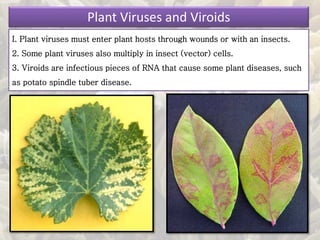
I. Plant viruses must enter plant hosts through wounds or with an insects.
2. Some plant viruses also multiply in insect (vector) cells.
3. Viroids are infectious pieces of RNA that cause some plant diseases, such
as potato spindle tuber disease.
Plant Viruses and Viroids
References
‱ Microbiology: An Introduction Plus
MasteringMicrobiology with eText - Access Card
Package (11th Edition) Hardcover – January 2, 2012
by Gerard J. Tortora, Berdell R. Funke, Christine L.
Case.
‱ Some pictures from different sits.

Presentation 9

  • 1.
    Microbiology An introduction Presented by D.Mona Othman Albureikan Lectures (23, 24, 25, 26, 27)
  • 2.
    1. The wordvirus is Latin word for poison, 2. Viruses may be regarded as complex aggregations of nonliving chemicals or as a simple living microbes. 2. Viruses contain a single type of nucleic acid (DNA or RNA) and a protein coat, sometimes enclosed by an envelope composed of lipids, proteins, and carbohydrates. General Characteristics of Viruses
  • 3.
    3. Viruses are obligatoryintracellular parasites. 4. They multiply by using the host cell's synthesizing machinery to cause the synthesis of specialized elements that can transfer the viral nucleic acid to other cells. General Characteristics of Viruses
  • 4.
    1. Host rangerefers to the spectrum of host cells in which a virus can multiply. 2. Most viruses infect only specific types of cells in one host species. 3. Host range is determined by the specific attachment site on the host cell's surface and the availability of host cellular factors. 4.Viruses that infect bacteria are called bacteriophages, or phages. Host Range
  • 5.
    1. The potentialto use viruses to treat diseases is intriguing because of their narrow host range and their ability to kill their host cells. 2. The idea of phage therapy using bacteriophage to treat bacterial infections, has been around for 100 years. Virus and phage therapy
  • 6.
    1- Viruses mighthave antitumor activity. 2- These tumor-destroying, or oncolytic , viruses may selectively infect and kill tumor cells or cause an immune response against tumor cells. 3- Some viruses naturally infect tumor cells. 4- Other viruses can be genetically modified to infect tumor cells. - At present several studies are underway to determine the killing mechanism of oncolytic viruses and the safety of using viral therapy. Virus as antitumor
  • 7.
    1. Viral sizeis observed by electron microscopy. 2. Viruses range from 20 to 1000 nm in length. Viral Size
  • 8.
  • 9.
    I. A virionis a complete, fully developed viral particle composed of nucleic acid surrounded by a coat. II. A protein coat that protects it from the environment and is a vehicle of transmission from one host cell to another. Viruses are classified by differences in the structures of these coats. Viral Structure
  • 10.
    1. Viruses containeither DNA or RNA, never both, and the nucleic acid may be single- or double- stranded, linear or circular, or divided into several separate molecules. 2. The percentage of nucleic acid in relation to protein in viruses ranges from about 1 % to about 50%. Nucleic Acid
  • 11.
    4. The proteincoat surrounding the nucleic acid of a virus is called the capsid. 5. The capsid is composed of subunits, capsomeres, which can be a single type of protein or several types. Capsid and Envelope
  • 12.
    6. The capsidof some viruses is enclosed by an envelope consisting of some combination of lipids, proteins, and carbohydrates. 7. Some envelopes are covered with carbohydrate-protein complexes called spikes. 8. Some viruses attach to host cells by means of spikes. Capsid and Envelope
  • 13.
    Capsid and Envelope 9.Viruses with capsids but not covered by an envelope are known as nonenveloped viruses.
  • 15.
    1- Viruses maybe classified into several different morphological types on the basis of their capsid structure. 2- The structure of these capsids has been revealed by electron microscopy and a technique called X-ray crystallography. 3. Helical viruses (for example, Ebola virus) resemble long rods, and their capsids are hollow cylinders surrounding the nucleic acid. General Morphology
  • 16.
    9. Polyhedral viruses(for example, adenovirus) are many-sided. Usually the capsid is an icosahedron (a regular polyhedron with 20 triangular faces and 12 corners). General Morphology
  • 17.
    10. Enveloped virusesare covered by an envelope. They are spherical but highly pleomorphic. I. There are enveloped helical viruses (for example, influenza virus) and enveloped polyhedral viruses (for example, herpes simplex virus). II. Complex viruses have complex structures. For example, many bacteriophages have a polyhedral capsid with a helical tail attached, General Morphology
  • 18.
    1. Classification ofviruses is based on type of nucleic acid. 2. Strategy for replication. 3. And morphology. 4. Virus family names end in - viridae; genus names end in -virus. 5. A viral species is a group of viruses sharing the same genetic information and ecological niche. Taxonomy of Viruses
  • 19.
    1. Viruses mustbe grown in living cells. 2. Living plants and animals are difficult and expensive to maintain. 3. The easiest viruses to grow are bacteriophages. Isolation, Cultivation, and Identification of Viruses
  • 20.
    4. The plaquemethod mixes bacteriophages with host bacteria and nutrient agar. 5. After several viral multiplication cycles, the bacteria in the area surrounding the original virus are destroyed; the area of lysis is called a plaque. 6. Each plaque originates with a single viral particle; the concentration of viruses is given as plaque-forming units. Growing Bacteriophages in the laboratory
  • 21.
    7. Cultivation ofsome animal viruses requires whole animals. 8. Simian AIDS provide model for studying human AIDS. 9. Some animal viruses can be cultivated in embryonated eggs. Growing Animal Viruses in the Laboratory
  • 22.
    10. Cell culturesare cells growing in culture media in the laboratory. 11. Primary cell lines and embryonic diploid cell lines grow for a short time in vitro. 12. Continuous cell lines can be maintained in vitro indefinitely. 13. Viruses may be identified by PCR. Growing Animal Viruses in the Laboratory
  • 23.
    The cytopathic effectof viruses. Uni nfected mouse cells align next to each other. formmga monolayer. (b) The same cells 24 hours afte r infection with veSicular stomatitis Vi ruS (VSV). Notice the cells pile up and "round up: 14. Viral growth can cause cytopathic effects (CPE) in the cell culture.
  • 24.
    Viral Multiplication 1. Virusesdo not contain enzymes for energy production or protein synthesis. 2. For a virus to multiply, it must invade a host cell and direct the host's metabolic machinery to produce viral enzymes and components.
  • 29.
    1. During thelytic cycle, a phage causes the lysis and death of a host cell. 2. Some viruses can either cause lysis or have their DNA incorporated as a prophage into the DNA of the host cell. 3. The latter situation is called lysogeny. 4. During the attachment phase of the lytic cycle, sites on the phage's tail fibers attach to complementary receptor sites on the bacterial cell. 5. In penetration, phage lysozyme opens a portion of the bacterial cell wall, the tail sheath contracts to force the tail core through the cell wall, and phage DNA enters the bacterial cell. 6. The capsid remains outside. Multiplication of Bacteriophages
  • 30.
    7. In biosynthesis,transcription of phage DNA produces mRNA coding for proteins necessary for phage multiplication. 8. Phage DNA is replicated, and capsid proteins are produced. 9. During the eclipse period, separate phage DNA and protein can be found. 10. During maturation, phage DNA and capsids are assembled into complete viruses. 11. During release, phage lysozyme breaks down the bacterial cell wall, and the new phages are released. 12. During the lysogenic cycle, the prophage is replicated each time the cell divides. Multiplication of Bacteriophages
  • 31.
    13. Because oflysogeny, lysogenic cells become immune to re infection with the same phage and may undergo phage conversion. 14. A lysogenic phage can transfer bacterial genes from one cell to another through transduction. 15. Any genes can be transferred in generalized transduction, and specific genes can be transferred in specialized transduction. Multiplication of Bacteriophages
  • 32.
    1. Animal virusesattach to the plasma membrane of the host cell. 2. Entry occurs by endocytosis. But enveloped viruses can enter by fusion. Multiplication of Animal Viruses
  • 33.
  • 34.
    4. Animal virusesare uncoated by host cell enzymes. 5. Uncoating is the separation of the viral nucleic acid from its protein coat once the virion is enclosed within the vesicle. 6. The DNA of most DNA viruses is released into the nucleus of the host cell. 7. Transcription of viral DNA and translation produce viral DNA and capsid. 8. Capsid proteins are synthesized in the cytoplasm of the host cell. Multiplication of Animal Viruses
  • 35.
    1. Adenoviridae, adenovirusescause acute respiratory diseases- the common cold. 2. Poxviridae All diseases caused by poxviruses, including smallpox and cowpox. DNA viruses
  • 36.
    3. Hepadnaviridae ,cause hepatitis and contain DNA, The only genus in this family causes hepatitis B. (Hepatitis A, C, D, E, F, and G viruses, although not related to each other, arc RNA viruses. 4. Herpesviridae Nearly 100 herpesviruses are known. 5. Papovaviridae, Papovaviruses are caused warts and tumors. DNA viruses
  • 37.
    1. Picornaviridae +strand RNA . 2. Togaviridae + strand RNA 3. Rhabdoviridae - strand RNA . 4. Reoviridae . 5. Retroviridae . RNA viruses
  • 38.
    Maturation and Release 1.After maturation, viruses are released. 2. One method of release is budding. The envelope actually develops around the capsid by a process called budding. 3. Budding does not immediately kill the host cell, and in some cases the host cell survives.
  • 39.
    Maturation and Release 1.Nonenveloped viruses are released through ruptures in the host cell membrane. 2. In contrast to budding, this type of release usually results in the death of the host cell.
  • 40.
    1. Several typesof cancer are now known to be caused by viruses. 2. Viruses capable of inducing tumors in animals are called oncogenic viruses, or oncoviruses Viruses and Cancer The Transformation of Normal Cells Into Tumor Cells 1. The cancer-causing alterations to cellular DNA affect parts of the genome called oncogenes. 2. Oncogenes can be activated to abnormal functioning by a variety of agents, including mutagenic chemicals, high –energy radiation, and viruses. 2. When activated, oncogenes transform normal cells into cancerous cells.
  • 41.
    3. Viruses capableof producing tumors are called oncogenic viruses. 4. Several DNA viruses are oncogenic. 5. The genetic material of oncogenic viruses becomes integrated into the host cell 's DNA. 6. Transformed cells lose contact inhibition, contain virus-specific antigens (T antigen), and can produce tumors when injected into susceptible animals. Viruses and Cancer The Transformation of Normal Cells Into Tumor Cells RNA Oncogenic Viruses DNA Oncogenic Viruses - Lymphoma and liver cancer. - Human leukemia and lymphoma.
  • 42.
    latent Viral Infections I.A latent viral infection is one in which the virus remains in the host cell for long periods without producing an infection. Persistent Viral Infections I. Persistent viral infections are disease processes that occur over a long period and are generally fatal. 2. Persistent viral infections are caused by conventional viruses; viruses accumulate over a long period .
  • 43.
    I. Prions areinfectious proteins first discovered in the 1980s. 2. Prion diseases, (mad cow disease), involve the degeneration of brain tissue. 3. Pathogenic agents that are able to induce abnormal folding of specific normal cellular proteins called prion proteins. 4. Prion proteins are found in the brain. 5. The functions of these normal prion proteins are still not completely understood. 6. The abnormal folding of the prion proteins leads to brain damage. 7. Prion diseases are usually rapidly progressive and always fatal. 8. They are affect both humans and animals. 9. Prion diseases are the result of an altered protein. Prions
  • 44.
    I. Plant virusesmust enter plant hosts through wounds or with an insects. 2. Some plant viruses also multiply in insect (vector) cells. 3. Viroids are infectious pieces of RNA that cause some plant diseases, such as potato spindle tuber disease. Plant Viruses and Viroids
  • 45.
    References ‱ Microbiology: AnIntroduction Plus MasteringMicrobiology with eText - Access Card Package (11th Edition) Hardcover – January 2, 2012 by Gerard J. Tortora, Berdell R. Funke, Christine L. Case. ‱ Some pictures from different sits.