KUVEMPU UNIVERSITY
Department of P.G. Studies and Research in
Applied Botany
Jnanasahyadri, Shankaraghatta
Shivamogga Dist.577451
Seminar on
"Viral Replication"
Submitted by:
Gopalkrishna.H.R
MSc I semester,
Department of Applied Botany,
Kuvempu University
Introduction:
 Replication of virus is very complicated process
 Viruses never reproduce by division
 They are replicated by a process in which all
components of virus are produced separately and
are assembled into intact virons.
 For replication of virus host is necessary
 Visuses are host specific
 Host may be a bacteria, plant or an animal
Replication of viruses are studied for first time by
experimenting on bacteriophage of the T series
[T2, T4 and T6].
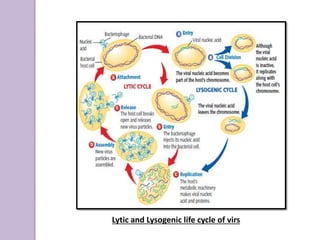
There are 2 types of life cycle commonly seen in
visuses
 They are
i] Lytic Cycle
ii] Lysogenic Cycle
Lytic and Lysogenic life cycle of virs
Key steps in the Viral Replication Cycle:
1. Attachment
2. Penetration (Entry)
3. Uncoating
4. Genome replication
5. Assembly
6. Maturation
7. Release
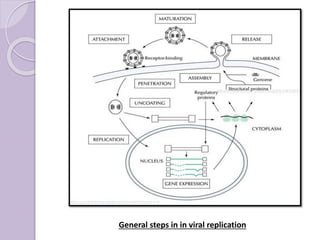
General steps in in viral replication
1. Attachment:
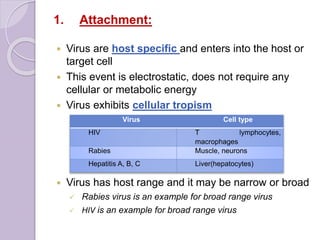
 Virus are host specific and enters into the host or
target cell
 This event is electrostatic, does not require any
cellular or metabolic energy
 Virus exhibits cellular tropism
 Virus has host range and it may be narrow or broad
 Rabies virus is an example for broad range virus
 HIV is an example for broad range virus
Virus Cell type
HIV T lymphocytes,
macrophages
Rabies Muscle, neurons
Hepatitis A, B, C Liver(hepatocytes)
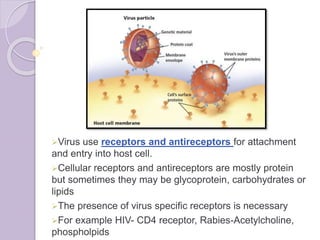
Virus use receptors and antireceptors for attachment
and entry into host cell.
Cellular receptors and antireceptors are mostly protein
but sometimes they may be glycoprotein, carbohydrates or
lipids
The presence of virus specific receptors is necessary
For example HIV- CD4 receptor, Rabies-Acetylcholine,
phospholpids
2) Penetration [entry]:
Penetration is energy dependent process
Virus may penetrate into host by
1. Endocytosis
2. Translocation
3. Fusion
3)Uncoating:
 Refers to the removal or degradation of
capsid (uncoating), there by releasing the
genome into host cell
 The virus genome is transported to the site
where transcription/replication can begin
 In some there is no degradation of capsid
as capsid proteins play a role in viral
transcription and replication
4) Genome replication:
 Viral genetic material or genome is multiplied within
the host
 Simultaneously viral structural proteins like capsids
are synthesised
 Type of genetic material varies from virus to virus
 With respect to this all viruses are divided into
seven groups by Dr.David Baltimor in 1971
 Dr.David Baltimor shared “NOBLE PRIZE “with
Renato Dulbecco, Howard Martin Temin in 1975 for
their work on "interaction between tumour viruses
and the genetic material of the cell"
Seven groups as follows:
I. Double stranded DNA
II. Single stranded DNA
III. Double stranded RNA
IV. Single stranded (+)ve sense RNA
V. Single stranded (-)ve sense RNA
VI. Single stranded (+)ve sense RNA
with DNA intermediate
VII. Double stranded DNA with RNA
intermediate
1.Double stranded DNA:
Example: Poxvirus, Herpes virus
Replication of genome of double stranded DNA virus
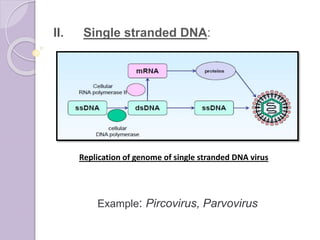
II. Single stranded DNA:
Example: Pircovirus, Parvovirus
Replication of genome of single stranded DNA virus
III. Double stranded RNA:
Example: Reoviruses, Orbibiruses
Replication of genome of double stranded RNA virus
IV. Single stranded (+)ve sense RNA:
Example: Toga virus & Hepatitis E virus
Replication of genome of +sense single stranded RNA virus
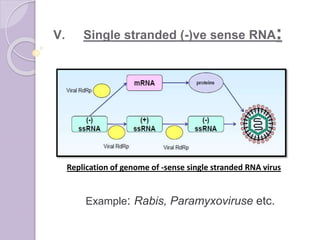
V. Single stranded (-)ve sense RNA:
Example: Rabis, Paramyxoviruse etc.
Replication of genome of -sense single stranded RNA virus
vi. Single stranded (+)ve sense RNA with
DNA intermediate:
Example: Retrovirus
Replication of genome of single stranded (+)ve sense RNA virus with DNA intermediate
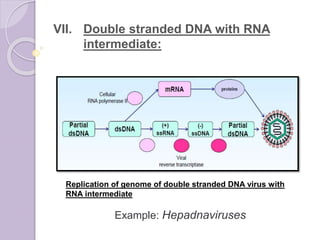
VII. Double stranded DNA with RNA
intermediate:
Example: Hepadnaviruses
Replication of genome of double stranded DNA virus with
RNA intermediate
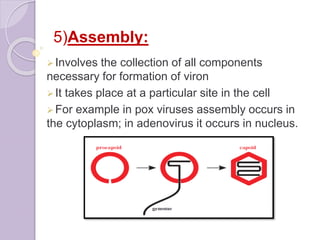
5)Assembly:
Involves the collection of all components
necessary for formation of viron
It takes place at a particular site in the cell
For example in pox viruses assembly occurs in
the cytoplasm; in adenovirus it occurs in nucleus.
6) Maturation:
Maturation is the stage of life cycle at which the
virus become infectious
It involves structural change in virus particles
For some viruses maturation occurs only after
release of viurs particle from the cell
7) Release:
Newly formed viruses are released to outside of
the cell either by lysis (as in bacteriophage) or by
budding(as in paramyxovirus, retrovirus)
Generally non enveloped viruses release by
cell lysis which results in the death of host cell
Release of virus by budding may or may not kill
cell
Conclusion:
In general terms, virus replication involves three
broad stages carried out by all types of virus; the initiation
of infection, replication and expression of the genome,
and, finally, release of mature virions from the infected
cell. At a detailed level, there are many differences in the
replication processes of different viruses which are
imposed by the biology of the host cell and the nature of
the virus genome. It is possible to derive an overview of
virus replication and the common stages which, in one
form or another, are followed by all viruses.
Bibliography:
 Cann, Alan J.. Principles of Molecular Virology, Burlington, MA,
USA: Academic Press, (2005)(4th Edition) :page no. 108-129.
 John B. Carter and Venetia A. Saunders.- Virology-principles and
applications, John Wiley & Sons Ltd (2007)
 Roger Y.Stanier, John L. Ingraham, Mark L.Wheelis, Page R.
Painter- General Microbiology, Macmillan Press LTD, (5th edition):
page no. 219-228.
 K.C.Sawant, A Textbook of Virus, Dominant Publishers and
Distributors,(2009) (1st Edition) : page no.49-60
 http://www.columbia.edu/itc/hs/medical/pathophys/id/2004/lecture/
notes/viral_rep_Hammer.pdf
 https://en.wikipedia.org/w/index.php?title=Special:Book&bookcmd
=rendering&return_to=Viral+replication&collection_id=1b11e8252
1fac6c63fdacbbdc6faa2a
 http://www2.oakland.edu/biology/chaudhry/pics/virusreplication02
web.pdf
Viral replication

Viral replication

  • 1.
    KUVEMPU UNIVERSITY Department ofP.G. Studies and Research in Applied Botany Jnanasahyadri, Shankaraghatta Shivamogga Dist.577451 Seminar on "Viral Replication" Submitted by: Gopalkrishna.H.R MSc I semester, Department of Applied Botany, Kuvempu University
  • 2.
    Introduction:  Replication ofvirus is very complicated process  Viruses never reproduce by division  They are replicated by a process in which all components of virus are produced separately and are assembled into intact virons.  For replication of virus host is necessary  Visuses are host specific  Host may be a bacteria, plant or an animal
  • 3.
    Replication of virusesare studied for first time by experimenting on bacteriophage of the T series [T2, T4 and T6]. There are 2 types of life cycle commonly seen in visuses  They are i] Lytic Cycle ii] Lysogenic Cycle
  • 4.
    Lytic and Lysogeniclife cycle of virs
  • 5.
    Key steps inthe Viral Replication Cycle: 1. Attachment 2. Penetration (Entry) 3. Uncoating 4. Genome replication 5. Assembly 6. Maturation 7. Release
  • 6.
    General steps inin viral replication
  • 7.
    1. Attachment:  Virusare host specific and enters into the host or target cell  This event is electrostatic, does not require any cellular or metabolic energy  Virus exhibits cellular tropism  Virus has host range and it may be narrow or broad  Rabies virus is an example for broad range virus  HIV is an example for broad range virus Virus Cell type HIV T lymphocytes, macrophages Rabies Muscle, neurons Hepatitis A, B, C Liver(hepatocytes)
  • 8.
    Virus use receptorsand antireceptors for attachment and entry into host cell. Cellular receptors and antireceptors are mostly protein but sometimes they may be glycoprotein, carbohydrates or lipids The presence of virus specific receptors is necessary For example HIV- CD4 receptor, Rabies-Acetylcholine, phospholpids
  • 9.
    2) Penetration [entry]: Penetrationis energy dependent process Virus may penetrate into host by 1. Endocytosis 2. Translocation 3. Fusion
  • 10.
    3)Uncoating:  Refers tothe removal or degradation of capsid (uncoating), there by releasing the genome into host cell  The virus genome is transported to the site where transcription/replication can begin  In some there is no degradation of capsid as capsid proteins play a role in viral transcription and replication
  • 11.
    4) Genome replication: Viral genetic material or genome is multiplied within the host  Simultaneously viral structural proteins like capsids are synthesised  Type of genetic material varies from virus to virus  With respect to this all viruses are divided into seven groups by Dr.David Baltimor in 1971  Dr.David Baltimor shared “NOBLE PRIZE “with Renato Dulbecco, Howard Martin Temin in 1975 for their work on "interaction between tumour viruses and the genetic material of the cell"
  • 12.
    Seven groups asfollows: I. Double stranded DNA II. Single stranded DNA III. Double stranded RNA IV. Single stranded (+)ve sense RNA V. Single stranded (-)ve sense RNA VI. Single stranded (+)ve sense RNA with DNA intermediate VII. Double stranded DNA with RNA intermediate
  • 13.
    1.Double stranded DNA: Example:Poxvirus, Herpes virus Replication of genome of double stranded DNA virus
  • 14.
    II. Single strandedDNA: Example: Pircovirus, Parvovirus Replication of genome of single stranded DNA virus
  • 15.
    III. Double strandedRNA: Example: Reoviruses, Orbibiruses Replication of genome of double stranded RNA virus
  • 16.
    IV. Single stranded(+)ve sense RNA: Example: Toga virus & Hepatitis E virus Replication of genome of +sense single stranded RNA virus
  • 17.
    V. Single stranded(-)ve sense RNA: Example: Rabis, Paramyxoviruse etc. Replication of genome of -sense single stranded RNA virus
  • 18.
    vi. Single stranded(+)ve sense RNA with DNA intermediate: Example: Retrovirus Replication of genome of single stranded (+)ve sense RNA virus with DNA intermediate
  • 19.
    VII. Double strandedDNA with RNA intermediate: Example: Hepadnaviruses Replication of genome of double stranded DNA virus with RNA intermediate
  • 20.
    5)Assembly: Involves the collectionof all components necessary for formation of viron It takes place at a particular site in the cell For example in pox viruses assembly occurs in the cytoplasm; in adenovirus it occurs in nucleus.
  • 21.
    6) Maturation: Maturation isthe stage of life cycle at which the virus become infectious It involves structural change in virus particles For some viruses maturation occurs only after release of viurs particle from the cell
  • 22.
    7) Release: Newly formedviruses are released to outside of the cell either by lysis (as in bacteriophage) or by budding(as in paramyxovirus, retrovirus) Generally non enveloped viruses release by cell lysis which results in the death of host cell Release of virus by budding may or may not kill cell
  • 23.
    Conclusion: In general terms,virus replication involves three broad stages carried out by all types of virus; the initiation of infection, replication and expression of the genome, and, finally, release of mature virions from the infected cell. At a detailed level, there are many differences in the replication processes of different viruses which are imposed by the biology of the host cell and the nature of the virus genome. It is possible to derive an overview of virus replication and the common stages which, in one form or another, are followed by all viruses.
  • 24.
    Bibliography:  Cann, AlanJ.. Principles of Molecular Virology, Burlington, MA, USA: Academic Press, (2005)(4th Edition) :page no. 108-129.  John B. Carter and Venetia A. Saunders.- Virology-principles and applications, John Wiley & Sons Ltd (2007)  Roger Y.Stanier, John L. Ingraham, Mark L.Wheelis, Page R. Painter- General Microbiology, Macmillan Press LTD, (5th edition): page no. 219-228.  K.C.Sawant, A Textbook of Virus, Dominant Publishers and Distributors,(2009) (1st Edition) : page no.49-60  http://www.columbia.edu/itc/hs/medical/pathophys/id/2004/lecture/ notes/viral_rep_Hammer.pdf  https://en.wikipedia.org/w/index.php?title=Special:Book&bookcmd =rendering&return_to=Viral+replication&collection_id=1b11e8252 1fac6c63fdacbbdc6faa2a  http://www2.oakland.edu/biology/chaudhry/pics/virusreplication02 web.pdf