Structure of viruses
Dr. Dhole N. A.
Department of Botany,
Digambarrao Bindu ACS College, Bhokar
• Virus are very small infectious agents with size ranging from 20-
300nm in diameter.
• Viruses are non-cellular entities so they are also called as particles.
• Virus lacks their own independent metabolism and cannot replicate
outside the host cell. So they are also called as obligate intracellular
parasites.
• Virus that infects bacteria are called bacteriophage or simply phage.
Animal virus infects animals and similarly plant virus infects plants.
• Viruses of all shapes and sizes consist of a nucleic acid core, an outer
protein coating or capsid, and sometimes an outer envelope.
The basic structural components of a virus are;
1.Genome
2.Capsid
3.Envelope
4.Enzymes
• Genome:
1.Virus contains either DNA or RNA as genetic material but not both. Virus
which contains DNA as genetic material are called DNA virus and those
containing RNA are called RNA virus.
2.Unlike other living cell where ds DNA is always a genetic material, a viral
genome may consists of linear or circular ds DNA, single stranded DNA,
ss linear RNA or ds linear RNA.
3.Examples; Reo virus is a RNA virus which contains ds RNA genome.
Parvovirus contains ss DNA, Papovavirus contains ds circular DNA as
genetic materials.
Capsid:
1. Capsid is the outer layer. Sometime it is refered as coat or shell.
2. Capsid serves as impenetrable shell around the nucleic acid core.
3. Capsid also helps to introduce viral genome into host cell during
infection.
4. The protein coat or capsid is made up of number of morphological
similar sub units called capsomere. Each capsomere is further
composed of protomere.
5. Capsomere are arranged precisely and tightly together in a repetitive
pattern to form complete capsid.
6. The number of capsomere in a capsid varies from virus to virus.
7. The complete complex of nucleic acid and protein coat of a virus
particle is called as virus nucleo-capsid.
8. Structure of capsid give the symmetry to the virus. Virus particle may
be either cubicl or helical or binal or complex symmetry.
• Envelope:
1. Some virus contains envelope that surrounds nucleocapsid. The
virus without envelope is called naked virus.
2. The envelope is a bilayer of lipoprotein and glycoprotein.
3. The envelope is acquired by the progeny virus from host cell during
virus release by budding process.
4. In some virus the glycoprotein projects out in the form of spike
called peplomere. Some of the peplomers or glycoprotein spike
such as Haemaglutinin and Neuraminidase which are involved in
binding of virus to host cell.
• Enzymes:
• Some virus contains enzymes which play central role during infection
process. Eg. Some bacteriophage contains an enzyme lysozyme,
which makes small hole in bacterial cell that allows viral nucleic acid
to get in.
• Some virus contains their own nucleic acid polymerase which
transcribe the viral genome into mRNA during replication process.
Eg. Retro virus are RNA virus that replicates inside host cell as DNA
intermediate. These virus possess an RNA dependent DNA
polymerase called reverse transcriptase.
Morphology of virus:
• Viruses are acellular, meaning they are biological entities that do not
have a cellular structure.
• Therefore, they lack most of the components of cells, such as
organelles, ribosomes, and the plasma membrane.
• A virion consists of a nucleic acid core, an outer protein coating or
capsid, and sometimes an outer envelope made of protein and
phospholipid membranes derived from the host cell.
• The capsid is made up of protein subunits called capsomeres.
• Viruses may also contain additional proteins, such as enzymes.
• The most obvious difference between members of viral families is
their morphology, which is quite diverse.
• Viruses come in many shapes and sizes, but these are consistent and
distinct for each viral family.
• In general, the shapes of viruses are classified into four groups:
filamentous, isometric (or icosahedral), enveloped, and head and tail.
• Filamentous viruses are long and cylindrical.
• Many plant viruses are filamentous, including TMV (tobacco mosaic
virus).
• Isometric viruses have shapes that are roughly spherical, such as
poliovirus or herpesviruses.
• Enveloped viruses have membranes surrounding capsids.
• Animal viruses, such as HIV, are frequently enveloped.
• Many viruses use some sort of glycoprotein to attach to their host
cells via molecules on the cell called viral receptors.
• or these viruses, attachment is a requirement for later penetration of
the cell membrane, allowing them to complete their replication inside
the cell.
• The receptors that viruses use are molecules that are normally found
on cell surfaces and have their own physiological functions.
• Viruses have simply evolved to make use of these molecules for their
own replication.
• Overall, the shape of the virion and the presence or absence of an
envelope tell us little about what disease the virus may cause.
• Virus infect to which species it might infect, but they are still useful
means to begin the viral classification.
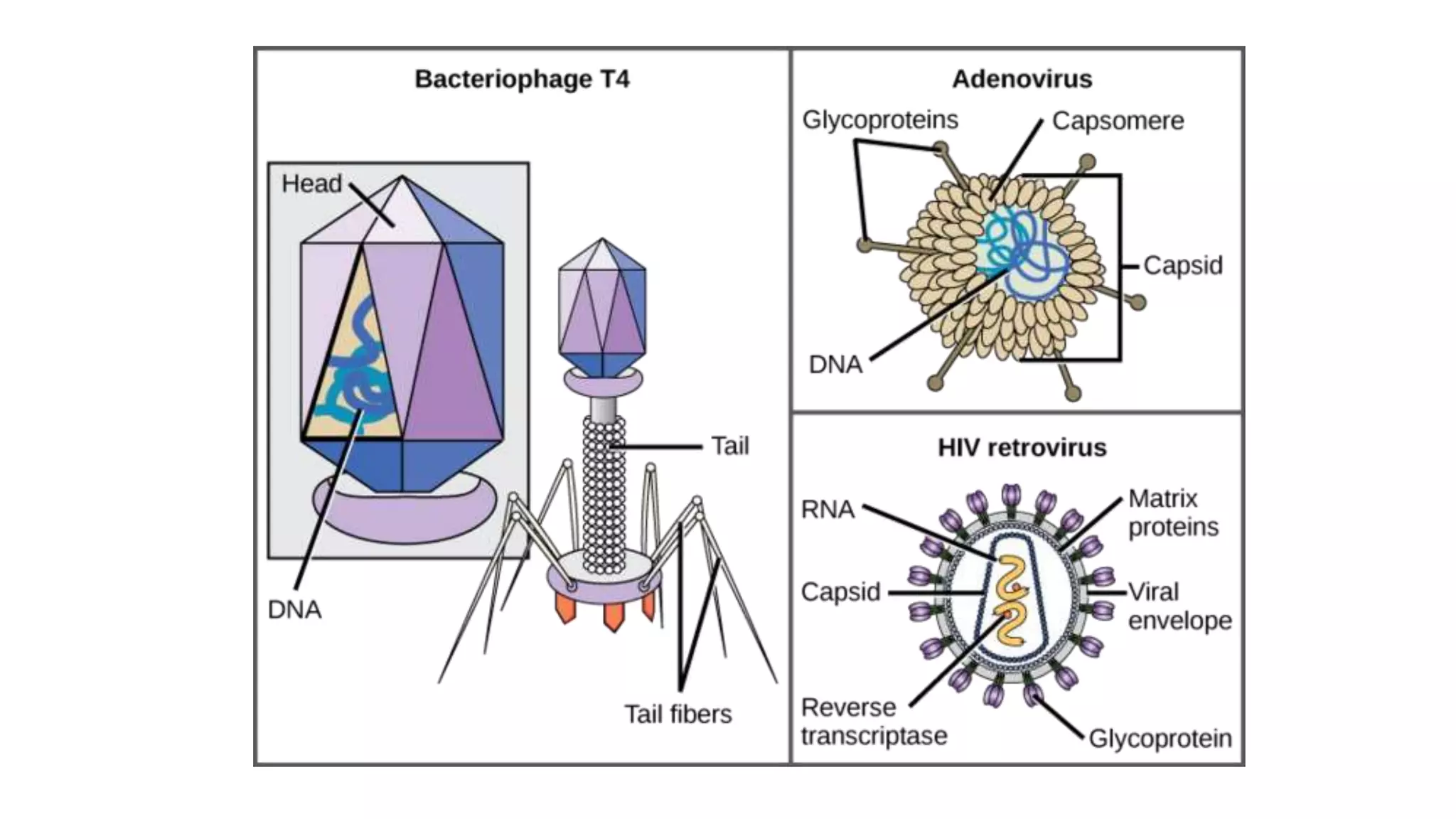
• Among the most complex virions known, the T4 bacteriophage,
which infects the Escherichia coli bacterium.
• It has a tail structure that the virus uses to attach to host cells and a
head structure that houses its DNA.
• Adenovirus, a non-enveloped animal virus that causes respiratory
illnesses in humans, uses glycoprotein spikes protruding from its
capsomeres to attach to host cells.
• Non-enveloped viruses also include those that cause polio
(poliovirus), plantar warts (papillomavirus), and hepatitis A (hepatitis
A virus).
• Enveloped virions like HIV consist of nucleic acid and capsid proteins
surrounded by a phospholipid bilayer envelope and its associated
proteins.
• Glycoproteins embedded in the viral envelope are used to attach to
host cells.
• Other envelope proteins include the matrix proteins that stabilize the
envelope and often play a role in the assembly of progeny virions.
• Chicken pox, influenza, and mumps are examples of diseases caused
by viruses with envelopes.
• Because of the fragility of the envelope, non-enveloped viruses are
more resistant to changes in temperature, pH, and some disinfectants
than are enveloped viruses.
Types of Nucleic Acid:
• Nearly all living organisms that use DNA as their genetic material,
viruses may use either DNA or RNA.
• The virus core contains the genome or total genetic content of the
virus.
• Viral genomes tend to be small, containing only those genes that
encode proteins that the virus cannot obtain from the host cell.
• This genetic material may be single or double stranded.
• It may also be linear or circular.
• While most viruses contain a single nucleic acid, others have genomes
that have several, called segments.
• In DNA viruses, the viral DNA directs the host cell’s replication
proteins to synthesize new copies of the viral genome and to
transcribe and translate that genome into viral proteins.
• DNA viruses cause human diseases, such as chickenpox, hepatitis B
etc.
• RNA viruses contain only RNA as their genetic material.
• To replicate their genomes in the host cell, the RNA viruses encode
enzymes that can replicate RNA into DNA, which cannot be done by
the host cell.
• These RNA polymerase enzymes are more likely to make copying
errors than DNA polymerases and, therefore, often make mistakes
during transcription.
• For this reason, mutations in RNA viruses occur more frequently than
in DNA viruses.
• This causes them to change and adapt more rapidly to their host.
• Human diseases caused by RNA viruses include hepatitis C, and
rabies.
Viruses have a variety of shapes and structures:
• Viruses display a wide diversity of shapes and sizes, called
morphologies.
• In general, there are five main morphological virus types:
1.Helical
2.Icosahedral
3.Prolate
4.Envelope
5.Complex
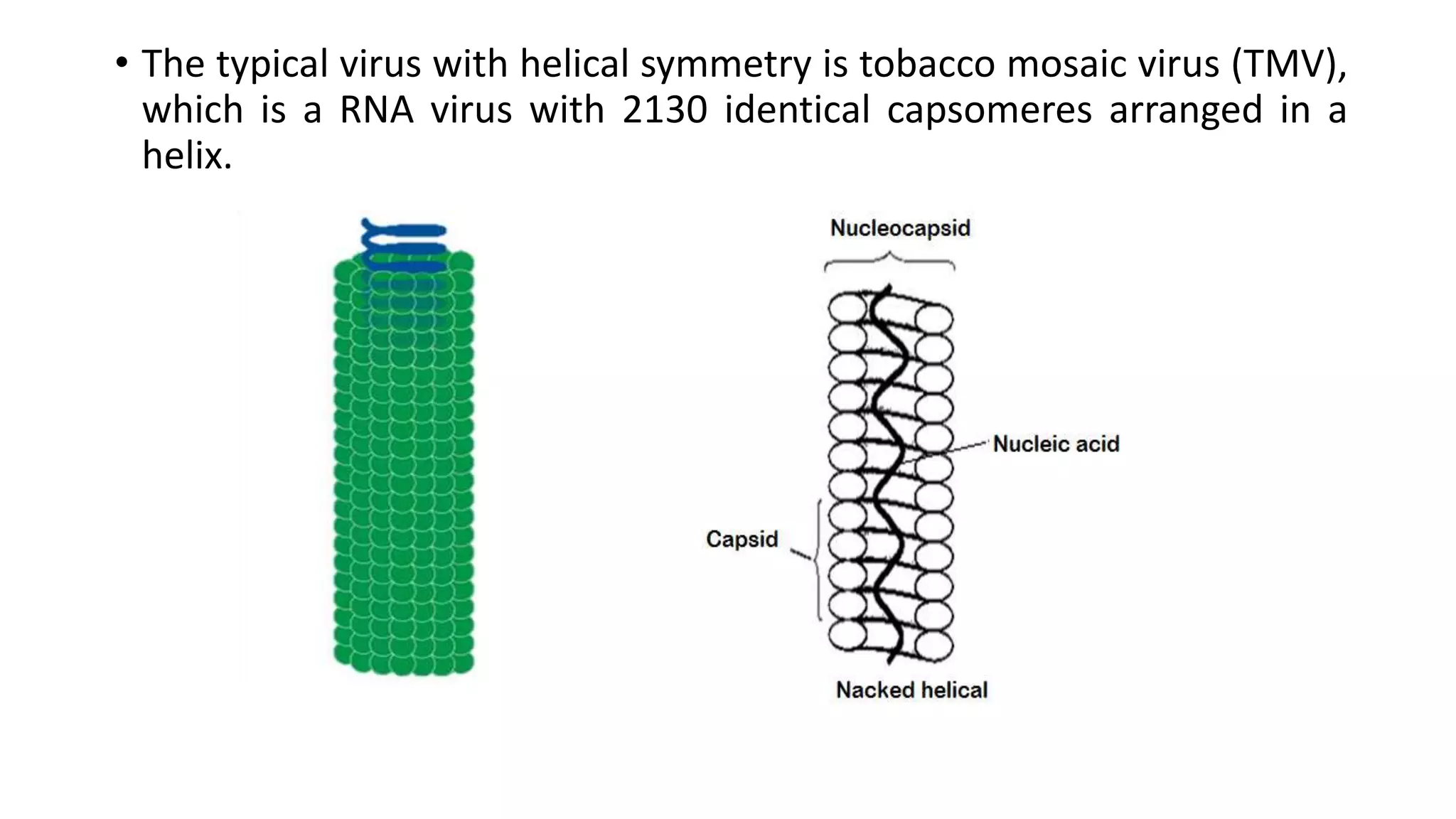
1. Helical:
• These viruses are composed of a single type of capsomer stacked
around a central axis to form a helical structure, which may have a
central cavity, or hollow tube.
• This virus structure has a capsid with a central cavity or hollow tube
that is made by proteins arranged in a circular fashion, creating a disc
like shape.
• The disc shapes are attached helically creating a tube with room for
the nucleic acid in the middle.
• All filamentous viruses are helical in shape.
• They are usually 15-19nm wide and range in length from 300 to
500nm depending on the genome size.
• Most of the helical viruses are enveloped and all are RNA viruses
• The typical virus with helical symmetry is tobacco mosaic virus (TMV),
which is a RNA virus with 2130 identical capsomeres arranged in a
helix.
2. Icosahedral:
• Most animal viruses are icosahedral or near-spherical with
icosahedral symmetry.
• An icosahedral is a polygon with 12 vertices (corner), 20 facet (sides)
and 30 edges.
• Each facet is an equilateral triange.
• Icosahedral capsid is the most stable and found in human pathogenic
virus eg. Adenovirus, Picornavirus, Papovavirus, herpes virus etc.
• Icosahedral capsid are of two types
a) Pentagon; Pentagonal capsomere at the vertices
b) Hexagon; Hexagonal capsomere at the vertices
Icosahedral
3. Prolate:
This is an isosahedron elongated along one axis and is a common
arrangement of the heads of bacteriophages.
https://doi.org/10.1073/pnas.0400444101
4. Envelope:
• This virus structure is a conventional icosahedral or helical structure
that is surrounded by a lipid bilayer membrane, meaning the virus is
encased or enveloped.
• The envelope of the virus is formed when the virus is exiting the cell
via budding, and the infectivity of these viruses is mostly dependent
on the envelope.
• The most well-known examples of enveloped viruses are the influenza
virus, Hepatitis C and HIV.
5. Complex:
• These viruses possess a capsid that is neither purely helical nor purely
icosahedral, and that may possess extra structures such as protein
tails or a complex outer wall.
• These virus structures have a combination of icosahedral and helical
shape and may have a complex outer wall or head-tail morphology.
• The head-tail morphology structure is unique to viruses that only
infect bacteria and are known as bacteriophages. The head of the
virus has an icosahedral shape with a helical shaped tail.
• The bacteriophage uses its tail to attach to the bacterium, creates a
hole in the cell wall, and then inserts its DNA into the cell using the
tail as a channel.
Bacteriophage:
References:
• https://courses.lumenlearning.com/boundless-
microbiology/chapter/structure-of-viruses/
• https://morgridge.org/outreach/teaching-resources/virology-
immunology/virus-structure/
• https://www.pnas.org/content/101/16/6003.long
• https://www.ncbi.nlm.nih.gov/books/NBK21523/
Thank you

3. structure of viruses

  • 1.
    Structure of viruses Dr.Dhole N. A. Department of Botany, Digambarrao Bindu ACS College, Bhokar
  • 2.
    • Virus arevery small infectious agents with size ranging from 20- 300nm in diameter. • Viruses are non-cellular entities so they are also called as particles. • Virus lacks their own independent metabolism and cannot replicate outside the host cell. So they are also called as obligate intracellular parasites. • Virus that infects bacteria are called bacteriophage or simply phage. Animal virus infects animals and similarly plant virus infects plants. • Viruses of all shapes and sizes consist of a nucleic acid core, an outer protein coating or capsid, and sometimes an outer envelope.
  • 3.
    The basic structuralcomponents of a virus are; 1.Genome 2.Capsid 3.Envelope 4.Enzymes • Genome: 1.Virus contains either DNA or RNA as genetic material but not both. Virus which contains DNA as genetic material are called DNA virus and those containing RNA are called RNA virus. 2.Unlike other living cell where ds DNA is always a genetic material, a viral genome may consists of linear or circular ds DNA, single stranded DNA, ss linear RNA or ds linear RNA. 3.Examples; Reo virus is a RNA virus which contains ds RNA genome. Parvovirus contains ss DNA, Papovavirus contains ds circular DNA as genetic materials.
  • 4.
    Capsid: 1. Capsid isthe outer layer. Sometime it is refered as coat or shell. 2. Capsid serves as impenetrable shell around the nucleic acid core. 3. Capsid also helps to introduce viral genome into host cell during infection. 4. The protein coat or capsid is made up of number of morphological similar sub units called capsomere. Each capsomere is further composed of protomere.
  • 5.
    5. Capsomere arearranged precisely and tightly together in a repetitive pattern to form complete capsid. 6. The number of capsomere in a capsid varies from virus to virus. 7. The complete complex of nucleic acid and protein coat of a virus particle is called as virus nucleo-capsid. 8. Structure of capsid give the symmetry to the virus. Virus particle may be either cubicl or helical or binal or complex symmetry.
  • 6.
    • Envelope: 1. Somevirus contains envelope that surrounds nucleocapsid. The virus without envelope is called naked virus. 2. The envelope is a bilayer of lipoprotein and glycoprotein. 3. The envelope is acquired by the progeny virus from host cell during virus release by budding process. 4. In some virus the glycoprotein projects out in the form of spike called peplomere. Some of the peplomers or glycoprotein spike such as Haemaglutinin and Neuraminidase which are involved in binding of virus to host cell.
  • 7.
    • Enzymes: • Somevirus contains enzymes which play central role during infection process. Eg. Some bacteriophage contains an enzyme lysozyme, which makes small hole in bacterial cell that allows viral nucleic acid to get in. • Some virus contains their own nucleic acid polymerase which transcribe the viral genome into mRNA during replication process. Eg. Retro virus are RNA virus that replicates inside host cell as DNA intermediate. These virus possess an RNA dependent DNA polymerase called reverse transcriptase.
  • 8.
    Morphology of virus: •Viruses are acellular, meaning they are biological entities that do not have a cellular structure. • Therefore, they lack most of the components of cells, such as organelles, ribosomes, and the plasma membrane. • A virion consists of a nucleic acid core, an outer protein coating or capsid, and sometimes an outer envelope made of protein and phospholipid membranes derived from the host cell. • The capsid is made up of protein subunits called capsomeres. • Viruses may also contain additional proteins, such as enzymes. • The most obvious difference between members of viral families is their morphology, which is quite diverse.
  • 9.
    • Viruses comein many shapes and sizes, but these are consistent and distinct for each viral family. • In general, the shapes of viruses are classified into four groups: filamentous, isometric (or icosahedral), enveloped, and head and tail. • Filamentous viruses are long and cylindrical. • Many plant viruses are filamentous, including TMV (tobacco mosaic virus). • Isometric viruses have shapes that are roughly spherical, such as poliovirus or herpesviruses. • Enveloped viruses have membranes surrounding capsids. • Animal viruses, such as HIV, are frequently enveloped.
  • 10.
    • Many virusesuse some sort of glycoprotein to attach to their host cells via molecules on the cell called viral receptors. • or these viruses, attachment is a requirement for later penetration of the cell membrane, allowing them to complete their replication inside the cell. • The receptors that viruses use are molecules that are normally found on cell surfaces and have their own physiological functions. • Viruses have simply evolved to make use of these molecules for their own replication. • Overall, the shape of the virion and the presence or absence of an envelope tell us little about what disease the virus may cause. • Virus infect to which species it might infect, but they are still useful means to begin the viral classification.
  • 11.
    • Among themost complex virions known, the T4 bacteriophage, which infects the Escherichia coli bacterium. • It has a tail structure that the virus uses to attach to host cells and a head structure that houses its DNA. • Adenovirus, a non-enveloped animal virus that causes respiratory illnesses in humans, uses glycoprotein spikes protruding from its capsomeres to attach to host cells. • Non-enveloped viruses also include those that cause polio (poliovirus), plantar warts (papillomavirus), and hepatitis A (hepatitis A virus). • Enveloped virions like HIV consist of nucleic acid and capsid proteins surrounded by a phospholipid bilayer envelope and its associated proteins.
  • 13.
    • Glycoproteins embeddedin the viral envelope are used to attach to host cells. • Other envelope proteins include the matrix proteins that stabilize the envelope and often play a role in the assembly of progeny virions. • Chicken pox, influenza, and mumps are examples of diseases caused by viruses with envelopes. • Because of the fragility of the envelope, non-enveloped viruses are more resistant to changes in temperature, pH, and some disinfectants than are enveloped viruses.
  • 14.
    Types of NucleicAcid: • Nearly all living organisms that use DNA as their genetic material, viruses may use either DNA or RNA. • The virus core contains the genome or total genetic content of the virus. • Viral genomes tend to be small, containing only those genes that encode proteins that the virus cannot obtain from the host cell. • This genetic material may be single or double stranded. • It may also be linear or circular. • While most viruses contain a single nucleic acid, others have genomes that have several, called segments.
  • 15.
    • In DNAviruses, the viral DNA directs the host cell’s replication proteins to synthesize new copies of the viral genome and to transcribe and translate that genome into viral proteins. • DNA viruses cause human diseases, such as chickenpox, hepatitis B etc. • RNA viruses contain only RNA as their genetic material. • To replicate their genomes in the host cell, the RNA viruses encode enzymes that can replicate RNA into DNA, which cannot be done by the host cell. • These RNA polymerase enzymes are more likely to make copying errors than DNA polymerases and, therefore, often make mistakes during transcription.
  • 16.
    • For thisreason, mutations in RNA viruses occur more frequently than in DNA viruses. • This causes them to change and adapt more rapidly to their host. • Human diseases caused by RNA viruses include hepatitis C, and rabies.
  • 17.
    Viruses have avariety of shapes and structures: • Viruses display a wide diversity of shapes and sizes, called morphologies. • In general, there are five main morphological virus types: 1.Helical 2.Icosahedral 3.Prolate 4.Envelope 5.Complex
  • 18.
    1. Helical: • Theseviruses are composed of a single type of capsomer stacked around a central axis to form a helical structure, which may have a central cavity, or hollow tube. • This virus structure has a capsid with a central cavity or hollow tube that is made by proteins arranged in a circular fashion, creating a disc like shape. • The disc shapes are attached helically creating a tube with room for the nucleic acid in the middle. • All filamentous viruses are helical in shape. • They are usually 15-19nm wide and range in length from 300 to 500nm depending on the genome size. • Most of the helical viruses are enveloped and all are RNA viruses
  • 19.
    • The typicalvirus with helical symmetry is tobacco mosaic virus (TMV), which is a RNA virus with 2130 identical capsomeres arranged in a helix.
  • 20.
    2. Icosahedral: • Mostanimal viruses are icosahedral or near-spherical with icosahedral symmetry. • An icosahedral is a polygon with 12 vertices (corner), 20 facet (sides) and 30 edges. • Each facet is an equilateral triange. • Icosahedral capsid is the most stable and found in human pathogenic virus eg. Adenovirus, Picornavirus, Papovavirus, herpes virus etc. • Icosahedral capsid are of two types a) Pentagon; Pentagonal capsomere at the vertices b) Hexagon; Hexagonal capsomere at the vertices
  • 21.
  • 22.
    3. Prolate: This isan isosahedron elongated along one axis and is a common arrangement of the heads of bacteriophages. https://doi.org/10.1073/pnas.0400444101
  • 23.
    4. Envelope: • Thisvirus structure is a conventional icosahedral or helical structure that is surrounded by a lipid bilayer membrane, meaning the virus is encased or enveloped. • The envelope of the virus is formed when the virus is exiting the cell via budding, and the infectivity of these viruses is mostly dependent on the envelope. • The most well-known examples of enveloped viruses are the influenza virus, Hepatitis C and HIV.
  • 25.
    5. Complex: • Theseviruses possess a capsid that is neither purely helical nor purely icosahedral, and that may possess extra structures such as protein tails or a complex outer wall. • These virus structures have a combination of icosahedral and helical shape and may have a complex outer wall or head-tail morphology. • The head-tail morphology structure is unique to viruses that only infect bacteria and are known as bacteriophages. The head of the virus has an icosahedral shape with a helical shaped tail. • The bacteriophage uses its tail to attach to the bacterium, creates a hole in the cell wall, and then inserts its DNA into the cell using the tail as a channel.
  • 26.
  • 27.
  • 28.