MIC 319
FUNDAMENTALS
OF AGRICULTURAL
MICROBIOLOGY

CHAPTER 6
ORGANIC MATTER DECOMPOSITION
BY
SITI NORAZURA JAMAL
03 006/ 06 483 2132
norazura6775@ns.uitm.edu.my
Outline
•
•
•
•

Process of organic matter decomposition
Factors affecting organic matter decomposition
Significant to microorganism
Basic plant
SOIL
•
•
•
•

Properties of soil
Microorganisms in the soil
Plant nutrients in the soil
Sources of plant nutrients in the
soil
• Basic plant nutrient cycle
1) Properties of soil
• There are 3 major properties of soil:
 Physical- soil structure and texture
 Chemical-chemical component; PH, nutrients
 Biological-micro and macro fauna/flora

• Soil organic matter (OM) is any material
produced originally by living organisms (plant or
animal) that is returned to the soil and goes
through the decomposition process.
2) Microorganisms in the soil
• Contain 5 major groups of microorganism:






Bacteria
Actinomycetes
Fungi
Algae
Protozoa
2) Microorganisms in the soil
• All these microorganism participate in the
various activities that take place in the soil.
• Among the activities are:
 Decomposition of organic matter
 Nutrient cycling
 Nutrients transport/flow
 Protection
3) Plant nutrients in the soil
• There are at least 16 essential chemical elements
for plant growth.
• Plant must have these nutrients to performance
the various physiological functions.
 C,H and Oxygen (O2), (from air & water)
 N, phosphorus (P), potassium (K), Ca, Mg, sulfur (S), iron (Fe),
manganese (Mn), Zn, copper (Cu), boron (B), molybdenum (Mo),
and chlorine (Cl) (from soil).
 Sodium (Na), silicon (SI), and nickel (Ni), Cobalt (Co). (Required by
certain plants)
4) Sources of plant nutrients in the
soil
1) Weathering of soil minerals
2) Decomposition of plant residue, animal
remains and soil microorganisms
3) Application of fertilizers and limiting
materials
4) Application of manures, composts, biosoilds
(sewage sludge) and other organic
amendments
4) Sources of plant nutrients in the
soil
5) N-fixation by legumes
6) Ground rock powders or dusts including
greensand, basalt and rock phosphate
7) Inorganic industrial by-products
8) Atmosphere deposition, such as N and S
from acid rain or N-fixation by lightning
discharge
9) Deposition of nutrient rich sediment from
erosion and flooding
5) Basic Plant Nutrient Cycle
5) Basic plant Nutrient Cycle
• The basic nutrient cycle highlights the central role
of soil organic matter and microorganisms.
• Cycling of many plant nutrients, especially N,P, S,
and micronutrients, closely follows the carbon
cycle.
• Plant residue and manure from animals that are
fed forage, grains, and other plant derived foods
are returned to the soil.
5) Basic plant Nutrient Cycle
• This OM pool of carbon compounds becomes food
for bacteria, fungi and other decomposers.
• As OM is broken down to sampler compounds,
plant nutrients are released in available forms for
root uptake and the cycle begins again.
• Plant-available nutrients such as K, Ca,Mg, P, and
trace metal micronutrients are also released when
soil minerals dissolve.
DECOMPOSITION OF
ORGANIC MATTER (OM)
DECOMPOSITION OF OM
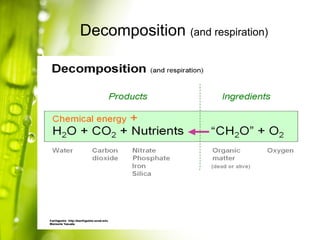
• Definition:
 Breakdown of dead plant and animal material and
release of inorganic nutrients
 Decomposition is a biological breakdown and
biochemical transformation of complex organic
molecules of dead material into simpler organic
and inorganic molecules (Juma, 1998).
Decomposition (and respiration)
SOURCE OF ORGANIC MATTER
•
•
•
•

Plant remains
Animal tissue and excretory products
Cells of microorganisms
However, plant is the main contribution to OM.
ORGANIC CONSTITUENTS OF
PLANTS
1)
2)
3)
4)

Cellulose most abundant 15 to 60% of dry weight.
Hemicellulose, 10 to 30 %
Lignin, 5 to 30%
Water soluble fraction include simple sugar,
amino acids, aliphatic acids, 5 to 30 % of tissue
weight
5) Ether and alcohol-soluble constituents; fats, oils,
waxes, resins and a number of pigments.
6) Proteins
WHY ORGANISMS DECOMPOSE
OM?
• Supplying energy for growth
• Supplying carbon for new cell synthesis
• The cells of most microorganisms commonly
contain approximately 50 % carbon. This is
derived mainly from the substrates.
WHY DO WE CARE ABOUT
DECOMPOSITION?

Decomposition is important in releasing nutrients tied
up in dead organic matter and return it back to the
soil.
WHO ARE THE DECOMPOSERS?
A.




SOIL FAUNA
earthworms, arthropods
Fragmentation (cominution) increases surface area.
Distributes OM within soil profile

B. SOIL MICROORGANISM
 Heterotrophic bacteria, fungi
 Derive energy, carbon and nutrients from dead OM in
the process they release CO2 through respiration.

RESPONSIBLE FOR BULK OF DECOMPOSITION!
DECOMPOSITION PROCESS
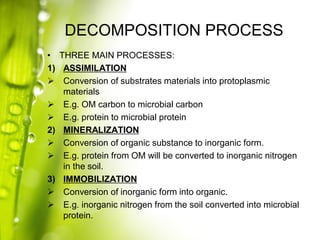
• THREE MAIN PROCESSES:
1) ASSIMILATION
 Conversion of substrates materials into protoplasmic
materials
 E.g. OM carbon to microbial carbon
 E.g. protein to microbial protein
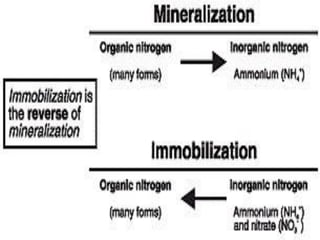
2) MINERALIZATION
 Conversion of organic substance to inorganic form.
 E.g. protein from OM will be converted to inorganic nitrogen
in the soil.
3) IMMOBILIZATION
 Conversion of inorganic form into organic.
 E.g. inorganic nitrogen from the soil converted into microbial
protein.
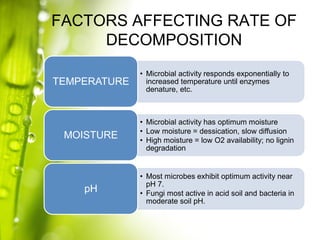
FACTORS AFFECTING RATE OF
DECOMPOSITION
TEMPERATURE

• Microbial activity responds exponentially to
increased temperature until enzymes
denature, etc.

MOISTURE

• Microbial activity has optimum moisture
• Low moisture = dessication, slow diffusion
• High moisture = low O2 availability; no lignin
degradation

pH

• Most microbes exhibit optimum activity near
pH 7.
• Fungi most active in acid soil and bacteria in
moderate soil pH.
WHAT IS THE C:N RATIO?
• The carbon-to-nitrogen (C:N) ratio is often used as
an indication of mineralization or immobilization
whether will occur.
• The C:N ratio is the total concentration of C divided
by the total concentration of N.
C:N OF SOME ORGANIC
MATTER
ORGANIC MATTER

C:N RATIO

Legumes

13-25:1

Manure

20-30:1

Straw

80:1

Sawdust

400-600:1

Microorganisms

5-10:1
• The C:N ratio is the most commonly used in soils
because N is the most limiting elements.
• A microbe with a C:N ratio of 8:1 would require OM
with a C:N ratio of 24:1
• The C:N ratio in lower in microorganisms = 8
• Since microbes incorporate only about 1/3 of the C
metabolized into biomass, the substrate material
must have C:N ratio = 24 to satisfy the N
requirement of microbes.
• If the C:N ratio = 24, available soil N is consumed
by microbes and plant available N decrease
C:N RATIO RANGE
• Because there is a suite of microorganism and OM
quality, generally we can predict whether
mineralization or immobilization will take place
base on the C:N ration range
• When surface of soil layer have a:
C:N > 30:1 >> Immobilization highly likely to occur
C:N < 20:1 >> Mineralization is likely to occur
C:N between 20-30:1 >> both processes may occur
but will generally in balance
SUBSTRATE QUALITY:CARBON
• Different carbon compounds are decomposed at
different rates.
 Cellulose faster
 Lignin slower decomposition as compared to
cellulose
• C:N of the OM determine the rate:
 High slower, this is due to insufficient of N for
microorganisms to assimilate carbon
 Low faster, nitrogen is sufficient for rapid
assimilation of carbon.

organic matter decomposition

  • 1.
    MIC 319 FUNDAMENTALS OF AGRICULTURAL MICROBIOLOGY CHAPTER6 ORGANIC MATTER DECOMPOSITION BY SITI NORAZURA JAMAL 03 006/ 06 483 2132 norazura6775@ns.uitm.edu.my
  • 2.
    Outline • • • • Process of organicmatter decomposition Factors affecting organic matter decomposition Significant to microorganism Basic plant
  • 3.
    SOIL • • • • Properties of soil Microorganismsin the soil Plant nutrients in the soil Sources of plant nutrients in the soil • Basic plant nutrient cycle
  • 4.
    1) Properties ofsoil • There are 3 major properties of soil:  Physical- soil structure and texture  Chemical-chemical component; PH, nutrients  Biological-micro and macro fauna/flora • Soil organic matter (OM) is any material produced originally by living organisms (plant or animal) that is returned to the soil and goes through the decomposition process.
  • 5.
    2) Microorganisms inthe soil • Contain 5 major groups of microorganism:      Bacteria Actinomycetes Fungi Algae Protozoa
  • 6.
    2) Microorganisms inthe soil • All these microorganism participate in the various activities that take place in the soil. • Among the activities are:  Decomposition of organic matter  Nutrient cycling  Nutrients transport/flow  Protection
  • 7.
    3) Plant nutrientsin the soil • There are at least 16 essential chemical elements for plant growth. • Plant must have these nutrients to performance the various physiological functions.  C,H and Oxygen (O2), (from air & water)  N, phosphorus (P), potassium (K), Ca, Mg, sulfur (S), iron (Fe), manganese (Mn), Zn, copper (Cu), boron (B), molybdenum (Mo), and chlorine (Cl) (from soil).  Sodium (Na), silicon (SI), and nickel (Ni), Cobalt (Co). (Required by certain plants)
  • 8.
    4) Sources ofplant nutrients in the soil 1) Weathering of soil minerals 2) Decomposition of plant residue, animal remains and soil microorganisms 3) Application of fertilizers and limiting materials 4) Application of manures, composts, biosoilds (sewage sludge) and other organic amendments
  • 9.
    4) Sources ofplant nutrients in the soil 5) N-fixation by legumes 6) Ground rock powders or dusts including greensand, basalt and rock phosphate 7) Inorganic industrial by-products 8) Atmosphere deposition, such as N and S from acid rain or N-fixation by lightning discharge 9) Deposition of nutrient rich sediment from erosion and flooding
  • 10.
    5) Basic PlantNutrient Cycle
  • 11.
    5) Basic plantNutrient Cycle • The basic nutrient cycle highlights the central role of soil organic matter and microorganisms. • Cycling of many plant nutrients, especially N,P, S, and micronutrients, closely follows the carbon cycle. • Plant residue and manure from animals that are fed forage, grains, and other plant derived foods are returned to the soil.
  • 12.
    5) Basic plantNutrient Cycle • This OM pool of carbon compounds becomes food for bacteria, fungi and other decomposers. • As OM is broken down to sampler compounds, plant nutrients are released in available forms for root uptake and the cycle begins again. • Plant-available nutrients such as K, Ca,Mg, P, and trace metal micronutrients are also released when soil minerals dissolve.
  • 13.
  • 14.
    DECOMPOSITION OF OM •Definition:  Breakdown of dead plant and animal material and release of inorganic nutrients  Decomposition is a biological breakdown and biochemical transformation of complex organic molecules of dead material into simpler organic and inorganic molecules (Juma, 1998).
  • 15.
  • 16.
    SOURCE OF ORGANICMATTER • • • • Plant remains Animal tissue and excretory products Cells of microorganisms However, plant is the main contribution to OM.
  • 17.
    ORGANIC CONSTITUENTS OF PLANTS 1) 2) 3) 4) Cellulosemost abundant 15 to 60% of dry weight. Hemicellulose, 10 to 30 % Lignin, 5 to 30% Water soluble fraction include simple sugar, amino acids, aliphatic acids, 5 to 30 % of tissue weight 5) Ether and alcohol-soluble constituents; fats, oils, waxes, resins and a number of pigments. 6) Proteins
  • 19.
    WHY ORGANISMS DECOMPOSE OM? •Supplying energy for growth • Supplying carbon for new cell synthesis • The cells of most microorganisms commonly contain approximately 50 % carbon. This is derived mainly from the substrates.
  • 20.
    WHY DO WECARE ABOUT DECOMPOSITION? Decomposition is important in releasing nutrients tied up in dead organic matter and return it back to the soil.
  • 21.
    WHO ARE THEDECOMPOSERS? A.    SOIL FAUNA earthworms, arthropods Fragmentation (cominution) increases surface area. Distributes OM within soil profile B. SOIL MICROORGANISM  Heterotrophic bacteria, fungi  Derive energy, carbon and nutrients from dead OM in the process they release CO2 through respiration. RESPONSIBLE FOR BULK OF DECOMPOSITION!
  • 23.
    DECOMPOSITION PROCESS • THREEMAIN PROCESSES: 1) ASSIMILATION  Conversion of substrates materials into protoplasmic materials  E.g. OM carbon to microbial carbon  E.g. protein to microbial protein 2) MINERALIZATION  Conversion of organic substance to inorganic form.  E.g. protein from OM will be converted to inorganic nitrogen in the soil. 3) IMMOBILIZATION  Conversion of inorganic form into organic.  E.g. inorganic nitrogen from the soil converted into microbial protein.
  • 25.
    FACTORS AFFECTING RATEOF DECOMPOSITION TEMPERATURE • Microbial activity responds exponentially to increased temperature until enzymes denature, etc. MOISTURE • Microbial activity has optimum moisture • Low moisture = dessication, slow diffusion • High moisture = low O2 availability; no lignin degradation pH • Most microbes exhibit optimum activity near pH 7. • Fungi most active in acid soil and bacteria in moderate soil pH.
  • 26.
    WHAT IS THEC:N RATIO? • The carbon-to-nitrogen (C:N) ratio is often used as an indication of mineralization or immobilization whether will occur. • The C:N ratio is the total concentration of C divided by the total concentration of N.
  • 27.
    C:N OF SOMEORGANIC MATTER ORGANIC MATTER C:N RATIO Legumes 13-25:1 Manure 20-30:1 Straw 80:1 Sawdust 400-600:1 Microorganisms 5-10:1
  • 28.
    • The C:Nratio is the most commonly used in soils because N is the most limiting elements. • A microbe with a C:N ratio of 8:1 would require OM with a C:N ratio of 24:1 • The C:N ratio in lower in microorganisms = 8 • Since microbes incorporate only about 1/3 of the C metabolized into biomass, the substrate material must have C:N ratio = 24 to satisfy the N requirement of microbes. • If the C:N ratio = 24, available soil N is consumed by microbes and plant available N decrease
  • 29.
    C:N RATIO RANGE •Because there is a suite of microorganism and OM quality, generally we can predict whether mineralization or immobilization will take place base on the C:N ration range • When surface of soil layer have a: C:N > 30:1 >> Immobilization highly likely to occur C:N < 20:1 >> Mineralization is likely to occur C:N between 20-30:1 >> both processes may occur but will generally in balance
  • 30.
    SUBSTRATE QUALITY:CARBON • Differentcarbon compounds are decomposed at different rates.  Cellulose faster  Lignin slower decomposition as compared to cellulose • C:N of the OM determine the rate:  High slower, this is due to insufficient of N for microorganisms to assimilate carbon  Low faster, nitrogen is sufficient for rapid assimilation of carbon.