BacteriophageBacteriophage
Viruses that infect bacteria.
Occur widely in nature in close association
with bacteria.
Readily isolated from faeces, sewage and
other natural sources.
MorphologyMorphology
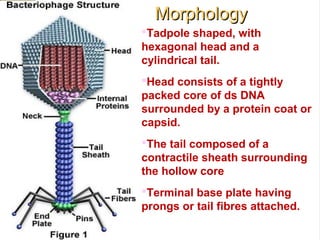
Tadpole shaped, with
hexagonal head and a
cylindrical tail.
Head consists of a tightly
packed core of ds DNA
surrounded by a protein coat or
capsid.
The tail composed of a
contractile sheath surrounding
the hollow core
Terminal base plate having
prongs or tail fibres attached.
Life CycleLife Cycle
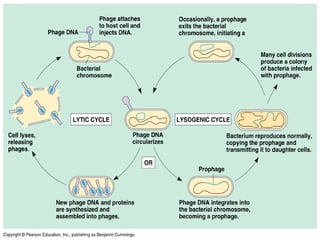
 Phages exhibit two different types of
life cycle,
1.Virulent or Lytic cycle:
2.Temperate or Lysogenic cycle:
Lytic cycleLytic cycle
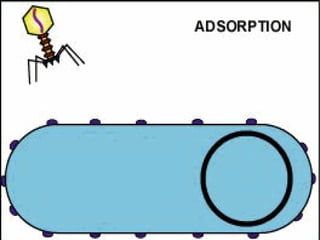
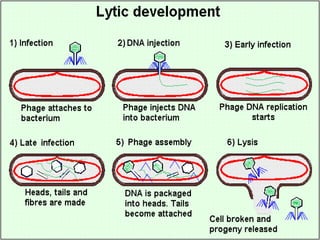
1. Adsorption:
Phage particles come into contact with bacterial cells by
random collision.
Phage attaches to the surface of a susceptible bacterium
by its tail.
It is a specific process and depends on the presence of
receptor sites on the bacterial cell for the terminal base
plate of the phage.
Cofactors like cations are necessary for adsorption.
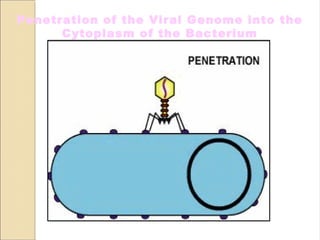
 2. Penetration :
 The phage DNA is injected into the bacterial body
through the hollow core.
 The infection of a bacterium by the nucleic acid is
known as transfection.
 The base plate and the tail fibres are held firmly
against the bacterial cell.
 The hollow core pierces the cell wall.
 The contractile tail sheath injects the phage DNA .
 After penetration, the empty head and tail of the
phage remain outside the bacterium.
3. Synthesis of Phage components3. Synthesis of Phage components
Synthesis of bacterial protein, DNA and RNA
ceases
First products to be synthesised are called early
proteins which are enzymes.
Subsequently late proteins appear which
include protein subunits of the phage head and
tail.
•
4.4.Assembly & Maturation:Assembly & Maturation:
Phage DNA, head protein and tail
protein are synthesized separately in
the bacterial cell.
• Assembly of the phage components
into the mature infective phage
particles is known
as maturation.
5.Release of Progeny Phage5.Release of Progeny Phage
 Typically occurs by lysis of the bacterial cell.
 Bacterial cell wall is weakened and it assumes
a spherical shape.
 Resulting in the release of mature daughter
phages.
Lysogenic CycleLysogenic Cycle
Phages enter into a symbiotic relationship.
Following entry into the host cell, the temperate phage
nucleic acid becomes integrated with the bacterial
chromosome.
The integrated phage nucleic acid is known as the
prophage.
The prophage behaves like segment of the host
chromosome and replicates synchronously with it.
 This phenomenon is called lysogeny
 Bacterium that carries a prophage within its genome is
called a Lysogenic bacterium.
 The prophage confers certain new properties on the
Lysogenic bacterium
 This is known as Lysogenic conversion or phage
conversion.
Lysogenic bacterium is resistant to reinfection by the
same or related phages.
This is known as superinfection immunity.
Penetration of the Viral Genome into the
Cytoplasm of the Bacterium
Functions….Functions….
 Bacteriophages may act as carriers of genes
from one bacterium to another.
 This is known as Transduction
 Eg: Plasmid mediate drug resistance in
staphylococci.
 Eg: Toxin production by the diphtheria
bacillus determined by the presence of beta
phage.
Phage typingPhage typing

The specificity of phage-bacterium
interaction is made use of in the
identification and typing of bacteria.

Important application:

For intraspecies typing of bacteria.

Eg: Phage typing of S.typhi and
Staphylococci.

Bacteriophage

  • 1.
    BacteriophageBacteriophage Viruses that infectbacteria. Occur widely in nature in close association with bacteria. Readily isolated from faeces, sewage and other natural sources.
  • 2.
    MorphologyMorphology Tadpole shaped, with hexagonalhead and a cylindrical tail. Head consists of a tightly packed core of ds DNA surrounded by a protein coat or capsid. The tail composed of a contractile sheath surrounding the hollow core Terminal base plate having prongs or tail fibres attached.
  • 3.
    Life CycleLife Cycle Phages exhibit two different types of life cycle, 1.Virulent or Lytic cycle: 2.Temperate or Lysogenic cycle:
  • 4.
    Lytic cycleLytic cycle 1.Adsorption: Phage particles come into contact with bacterial cells by random collision. Phage attaches to the surface of a susceptible bacterium by its tail. It is a specific process and depends on the presence of receptor sites on the bacterial cell for the terminal base plate of the phage. Cofactors like cations are necessary for adsorption.
  • 5.
     2. Penetration:  The phage DNA is injected into the bacterial body through the hollow core.  The infection of a bacterium by the nucleic acid is known as transfection.  The base plate and the tail fibres are held firmly against the bacterial cell.  The hollow core pierces the cell wall.  The contractile tail sheath injects the phage DNA .  After penetration, the empty head and tail of the phage remain outside the bacterium.
  • 7.
    3. Synthesis ofPhage components3. Synthesis of Phage components Synthesis of bacterial protein, DNA and RNA ceases First products to be synthesised are called early proteins which are enzymes. Subsequently late proteins appear which include protein subunits of the phage head and tail. •
  • 8.
    4.4.Assembly & Maturation:Assembly& Maturation: Phage DNA, head protein and tail protein are synthesized separately in the bacterial cell. • Assembly of the phage components into the mature infective phage particles is known as maturation.
  • 9.
    5.Release of ProgenyPhage5.Release of Progeny Phage  Typically occurs by lysis of the bacterial cell.  Bacterial cell wall is weakened and it assumes a spherical shape.  Resulting in the release of mature daughter phages.
  • 12.
    Lysogenic CycleLysogenic Cycle Phagesenter into a symbiotic relationship. Following entry into the host cell, the temperate phage nucleic acid becomes integrated with the bacterial chromosome. The integrated phage nucleic acid is known as the prophage. The prophage behaves like segment of the host chromosome and replicates synchronously with it.
  • 13.
     This phenomenonis called lysogeny  Bacterium that carries a prophage within its genome is called a Lysogenic bacterium.  The prophage confers certain new properties on the Lysogenic bacterium  This is known as Lysogenic conversion or phage conversion. Lysogenic bacterium is resistant to reinfection by the same or related phages. This is known as superinfection immunity.
  • 14.
    Penetration of theViral Genome into the Cytoplasm of the Bacterium
  • 15.
    Functions….Functions….  Bacteriophages mayact as carriers of genes from one bacterium to another.  This is known as Transduction  Eg: Plasmid mediate drug resistance in staphylococci.  Eg: Toxin production by the diphtheria bacillus determined by the presence of beta phage.
  • 17.
    Phage typingPhage typing  Thespecificity of phage-bacterium interaction is made use of in the identification and typing of bacteria.  Important application:  For intraspecies typing of bacteria.  Eg: Phage typing of S.typhi and Staphylococci.