LIFE CYCLE OF VIRUS
Presented by :Urooj Umer
Presented to : Ma’am Maria
CMS no :404570
CONTENTS
 Virus
 Bacteriophage
 Forms of bacteriophage
 Structure of bacteriophage
 Life cycle of virus
 Lytic cycle
Steps in replication of bacteriophage
 Lysogenic cycle
 Difference between lytic and lysogenic cycle.
 References
VIRUS
 LITERAL MEANING
The word virus is derived from LATIN word
called VENOME meaning POISON .
 DEFINITION
Viruses are non cellular infectious entities
which contain either DNA or RNA normally
encased in proteinaceous coat and
reproduce only in living cells .
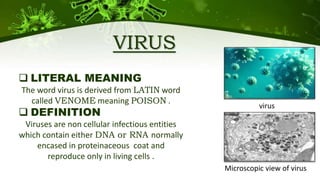
Microscopic view of virus
virus
BACTERIOPHAGE
DISCOVERY
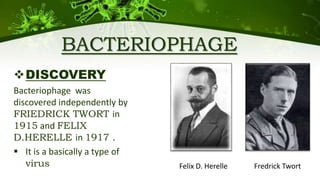
Bacteriophage was
discovered independently by
FRIEDRICK TWORT in
1915 and FELIX
D.HERELLE in 1917 .
 It is a basically a type of
virus Felix D. Herelle Fredrick Twort
CONTI….
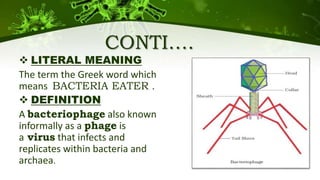
 LITERAL MEANING
The term the Greek word which
means BACTERIA EATER .
 DEFINITION
A bacteriophage also known
informally as a phage is
a virus that infects and
replicates within bacteria and
archaea.
STRUCTURE OF BACTERIOPHAGE
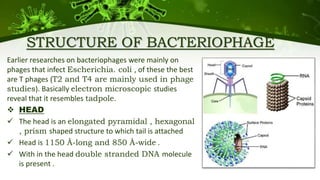
Earlier researches on bacteriophages were mainly on
phages that infect Escherichia. coli , of these the best
are T phages (T2 and T4 are mainly used in phage
studies). Basically electron microscopic studies
reveal that it resembles tadpole.
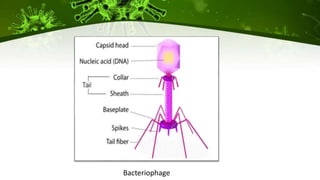
 HEAD
 The head is an elongated pyramidal , hexagonal
, prism shaped structure to which tail is attached
 Head is 1150 Å-long and 850 Å-wide .
 With in the head double stranded DNA molecule
is present .
CONT….
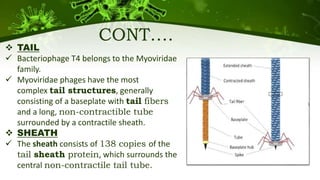
 TAIL
 Bacteriophage T4 belongs to the Myoviridae
family.
 Myoviridae phages have the most
complex tail structures, generally
consisting of a baseplate with tail fibers
and a long, non-contractible tube
surrounded by a contractile sheath.
 SHEATH
 The sheath consists of 138 copies of the
tail sheath protein, which surrounds the
central non-contractile tail tube.
CONT…
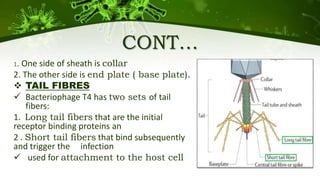
1. One side of sheath is collar
2. The other side is end plate ( base plate).
 TAIL FIBRES
 Bacteriophage T4 has two sets of tail
fibers:
1. Long tail fibers that are the initial
receptor binding proteins an
2 . Short tail fibers that bind subsequently
and trigger the infection
 used for attachment to the host cell
Bacteriophage
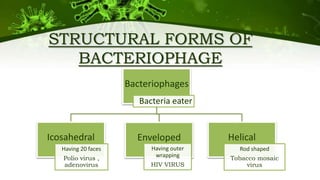
STRUCTURAL FORMS OF
BACTERIOPHAGE
Bacteriophages
Bacteria eater
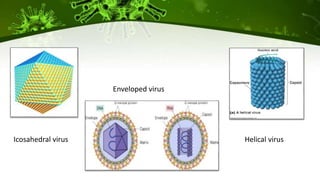
Icosahedral
Having 20 faces
Polio virus ,
adenovirus
Enveloped
Having outer
wrapping
HIV VIRUS
Helical
Rod shaped
Tobacco mosaic
virus
Icosahedral virus
Enveloped virus
Helical virus
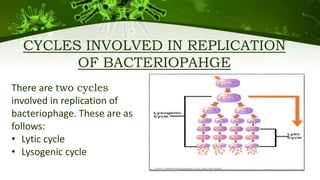
CYCLES INVOLVED IN REPLICATION
OF BACTERIOPAHGE
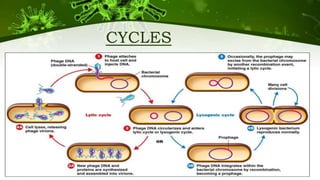
There are two cycles
involved in replication of
bacteriophage. These are as
follows:
• Lytic cycle
• Lysogenic cycle
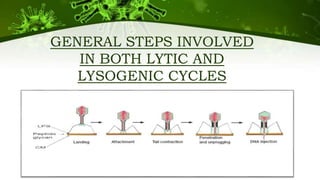
GENERAL STEPS INVOLVED
IN BOTH LYTIC AND
LYSOGENIC CYCLES
LYCTIC CYCLE
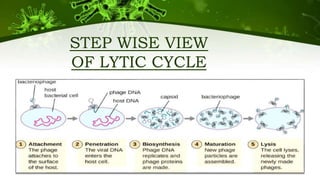
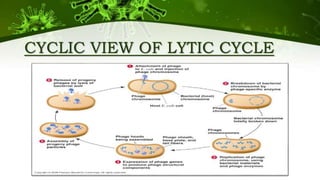
• In the lytic cycle, the viral DNA exists as a
separate free floating molecule within
the bacterial cell, and replicates
separately from the host bacterial
• The lytic cycle is named for the process of
lysis, which occurs when a virus has
infected a cell, replicated new virus
particles, and bursts through the cell
membrane.
CONT…
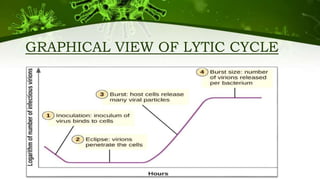
• About 25 minutes after the initial infection approx
200 new bacteriophages are formed and then
bacterial cell bursts , called lysis.
• The phage at this stage is called virulent phage.
(A bacteriophage that causes the destruction
of the host bacterium by lysis )
• It is also called master – slave relationship
STEP WISE VIEW
OF LYTIC CYCLE
CYCLIC VIEW OF LYTIC CYCLE
GRAPHICAL VIEW OF LYTIC CYCLE
LYSOGENIC CYCLE
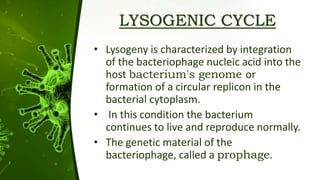
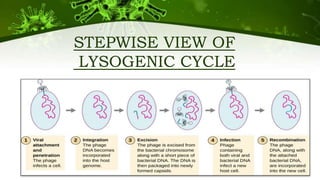
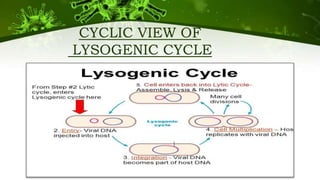
• Lysogeny is characterized by integration
of the bacteriophage nucleic acid into the
host bacterium's genome or
formation of a circular replicon in the
bacterial cytoplasm.
• In this condition the bacterium
continues to live and reproduce normally.
• The genetic material of the
bacteriophage, called a prophage.
CONT...
• Sometimes the viral DNA gets detached from the host’s
chromosome and lytic cycle stats again . This is called
induction .
• Induction involves either a spontaneous or
environmentally induced excision of prophage from the
bacterial chromosome
• The phage that causes Lysogeny is called temperate
phage .
• This is also called host guest relationship.
STEPWISE VIEW OF
LYSOGENIC CYCLE
CYCLIC VIEW OF
LYSOGENIC CYCLE
CYCLES
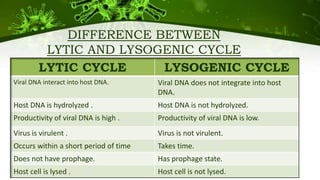
LYTIC CYCLE LYSOGENIC CYCLE
Viral DNA interact into host DNA. Viral DNA does not integrate into host
DNA.
Host DNA is hydrolyzed . Host DNA is not hydrolyzed.
Productivity of viral DNA is high . Productivity of viral DNA is low.
Virus is virulent . Virus is not virulent.
Occurs within a short period of time Takes time.
Does not have prophage. Has prophage state.
Host cell is lysed . Host cell is not lysed.
DIFFERENCE BETWEEN
LYTIC AND LYSOGENIC CYCLE
REFERENCES
• https://en.wikipedia.org/wiki/Lysogenic_cycle
• https://pediaa.com/difference-between-lytic-cycle-and-
lysogenic-cycle/
• ocratic.org/questions/what-are-the-differences-between-a-
lytic-infection-and-a-lysogenic-infection
• https://www.researchgate.net/figure/Phage-life-cycles-and-
types-of-phage-mediated-transduction-A-Temperate-phage-
life_fig1_318170069
• https://www.slideshare.net/suganyakunju/bacteriophages-
71259201
virus life cycle

virus life cycle

  • 1.
    LIFE CYCLE OFVIRUS Presented by :Urooj Umer Presented to : Ma’am Maria CMS no :404570
  • 2.
    CONTENTS  Virus  Bacteriophage Forms of bacteriophage  Structure of bacteriophage  Life cycle of virus  Lytic cycle Steps in replication of bacteriophage  Lysogenic cycle  Difference between lytic and lysogenic cycle.  References
  • 3.
    VIRUS  LITERAL MEANING Theword virus is derived from LATIN word called VENOME meaning POISON .  DEFINITION Viruses are non cellular infectious entities which contain either DNA or RNA normally encased in proteinaceous coat and reproduce only in living cells . Microscopic view of virus virus
  • 4.
    BACTERIOPHAGE DISCOVERY Bacteriophage was discovered independentlyby FRIEDRICK TWORT in 1915 and FELIX D.HERELLE in 1917 .  It is a basically a type of virus Felix D. Herelle Fredrick Twort
  • 5.
    CONTI….  LITERAL MEANING Theterm the Greek word which means BACTERIA EATER .  DEFINITION A bacteriophage also known informally as a phage is a virus that infects and replicates within bacteria and archaea.
  • 6.
    STRUCTURE OF BACTERIOPHAGE Earlierresearches on bacteriophages were mainly on phages that infect Escherichia. coli , of these the best are T phages (T2 and T4 are mainly used in phage studies). Basically electron microscopic studies reveal that it resembles tadpole.  HEAD  The head is an elongated pyramidal , hexagonal , prism shaped structure to which tail is attached  Head is 1150 Å-long and 850 Å-wide .  With in the head double stranded DNA molecule is present .
  • 7.
    CONT….  TAIL  BacteriophageT4 belongs to the Myoviridae family.  Myoviridae phages have the most complex tail structures, generally consisting of a baseplate with tail fibers and a long, non-contractible tube surrounded by a contractile sheath.  SHEATH  The sheath consists of 138 copies of the tail sheath protein, which surrounds the central non-contractile tail tube.
  • 8.
    CONT… 1. One sideof sheath is collar 2. The other side is end plate ( base plate).  TAIL FIBRES  Bacteriophage T4 has two sets of tail fibers: 1. Long tail fibers that are the initial receptor binding proteins an 2 . Short tail fibers that bind subsequently and trigger the infection  used for attachment to the host cell
  • 9.
  • 10.
    STRUCTURAL FORMS OF BACTERIOPHAGE Bacteriophages Bacteriaeater Icosahedral Having 20 faces Polio virus , adenovirus Enveloped Having outer wrapping HIV VIRUS Helical Rod shaped Tobacco mosaic virus
  • 11.
  • 12.
    CYCLES INVOLVED INREPLICATION OF BACTERIOPAHGE There are two cycles involved in replication of bacteriophage. These are as follows: • Lytic cycle • Lysogenic cycle
  • 13.
    GENERAL STEPS INVOLVED INBOTH LYTIC AND LYSOGENIC CYCLES
  • 14.
    LYCTIC CYCLE • Inthe lytic cycle, the viral DNA exists as a separate free floating molecule within the bacterial cell, and replicates separately from the host bacterial • The lytic cycle is named for the process of lysis, which occurs when a virus has infected a cell, replicated new virus particles, and bursts through the cell membrane.
  • 15.
    CONT… • About 25minutes after the initial infection approx 200 new bacteriophages are formed and then bacterial cell bursts , called lysis. • The phage at this stage is called virulent phage. (A bacteriophage that causes the destruction of the host bacterium by lysis ) • It is also called master – slave relationship
  • 16.
    STEP WISE VIEW OFLYTIC CYCLE
  • 17.
    CYCLIC VIEW OFLYTIC CYCLE
  • 18.
    GRAPHICAL VIEW OFLYTIC CYCLE
  • 19.
    LYSOGENIC CYCLE • Lysogenyis characterized by integration of the bacteriophage nucleic acid into the host bacterium's genome or formation of a circular replicon in the bacterial cytoplasm. • In this condition the bacterium continues to live and reproduce normally. • The genetic material of the bacteriophage, called a prophage.
  • 20.
    CONT... • Sometimes theviral DNA gets detached from the host’s chromosome and lytic cycle stats again . This is called induction . • Induction involves either a spontaneous or environmentally induced excision of prophage from the bacterial chromosome • The phage that causes Lysogeny is called temperate phage . • This is also called host guest relationship.
  • 21.
  • 22.
  • 23.
  • 24.
    LYTIC CYCLE LYSOGENICCYCLE Viral DNA interact into host DNA. Viral DNA does not integrate into host DNA. Host DNA is hydrolyzed . Host DNA is not hydrolyzed. Productivity of viral DNA is high . Productivity of viral DNA is low. Virus is virulent . Virus is not virulent. Occurs within a short period of time Takes time. Does not have prophage. Has prophage state. Host cell is lysed . Host cell is not lysed. DIFFERENCE BETWEEN LYTIC AND LYSOGENIC CYCLE
  • 25.
    REFERENCES • https://en.wikipedia.org/wiki/Lysogenic_cycle • https://pediaa.com/difference-between-lytic-cycle-and- lysogenic-cycle/ •ocratic.org/questions/what-are-the-differences-between-a- lytic-infection-and-a-lysogenic-infection • https://www.researchgate.net/figure/Phage-life-cycles-and- types-of-phage-mediated-transduction-A-Temperate-phage- life_fig1_318170069 • https://www.slideshare.net/suganyakunju/bacteriophages- 71259201