PRESENTED BY .....
Asraful Islam Rayhan
R0ll- 131039
DEPT. OF PHARMACY
JESSORE UNIVERSITY OF SCIENCE &
TECHNOLOGY
Outline………….
 Definition of virus
 General properties of virus
 Size
 Structure
 Classification
 Morphology and
 Multiplication 0f viruses
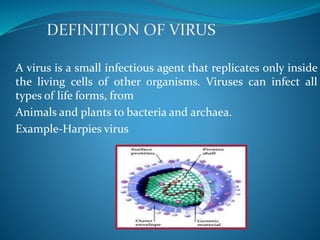
A virus is a small infectious agent that replicates only inside
the living cells of other organisms. Viruses can infect all
types of life forms, from
Animals and plants to bacteria and archaea.
Example-Harpies virus
Properties Of virus
 Viruses are inert (nucleoprotein ) filterable Agents
 Viruses are obligate intracellular parasites
 Viruses cannot make energy or proteins independent of a
host cell
 Viral genome are RNA or DNA but not both.
 Viruses have a naked capsid or envelope with attached
proteins
 Viruses do not have the genetic capability to multiply by
division.
 Viruses are non-living entities
Consequences of Virus
Properties
 Viruses are not living
 Viruses must be infectious to endure in nature
 Viruses must be able to use host cell processes to
produce their components (viral messenger RNA,
protein, and identical copies of the genome)
 Viruses must encode any required processes not
provided by the cell
 Viral components must self-assemble
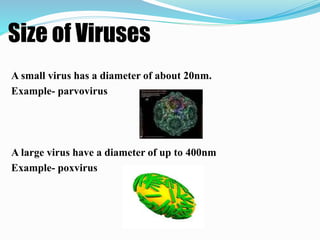
Size of Viruses
A small virus has a diameter of about 20nm.
Example- parvovirus
A large virus have a diameter of up to 400nm
Example- poxvirus
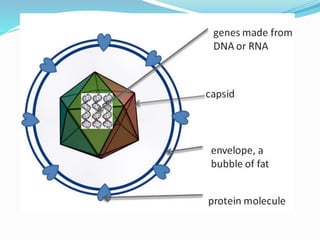
Structure of Viruses
Virions are complete, fully developed viral particles
composed of nucleic acid surrounded by a protein coat.
Some viruses have an envelope composed of a
phospholipid bilayer with viral glycoproteins.
It contain- nucleic acid, Capsid , Envelope…
1. Nucleic acid……
 Viral genomes are either DNA or RNA (not both).
 Nucleic acid may be single- or double-stranded
 Nucleic acid may be circular or linear or separate
molecules.
 Nucleic acid protein ranges from about 1% - 50%.
2. Capsid……
 The protein shell, or coat, that encloses the
nucleic acid genome.
 Functions: a. Protect the viral nucleic acid. b.
Participate in the viral infection. c. Share the
antigenicity
3.Envelope…
* The outer covering of some viruses.
*The envelope is derived from the host cell plasma
membrane when the virus buds out.
Classification of Viruses
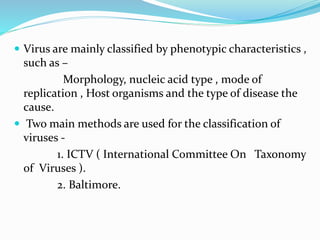
 Virus are mainly classified by phenotypic characteristics ,
such as –
Morphology, nucleic acid type , mode of
replication , Host organisms and the type of disease the
cause.
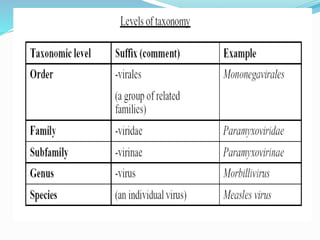
 Two main methods are used for the classification of
viruses -
1. ICTV ( International Committee On Taxonomy
of Viruses ).
2. Baltimore.
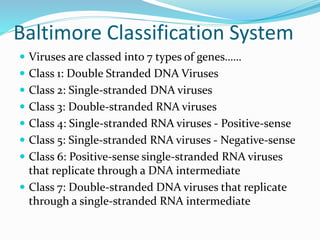
Baltimore Classification System
 Viruses are classed into 7 types of genes……
 Class 1: Double Stranded DNA Viruses
 Class 2: Single-stranded DNA viruses
 Class 3: Double-stranded RNA viruses
 Class 4: Single-stranded RNA viruses - Positive-sense
 Class 5: Single-stranded RNA viruses - Negative-sense
 Class 6: Positive-sense single-stranded RNA viruses
that replicate through a DNA intermediate
 Class 7: Double-stranded DNA viruses that replicate
through a single-stranded RNA intermediate
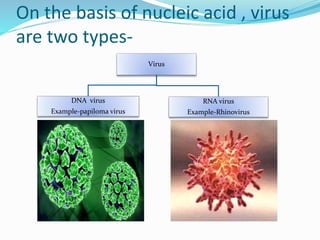
On the basis of nucleic acid , virus
are two types-
Virus
DNA virus
Example-papiloma virus
RNA virus
Example-Rhinovirus
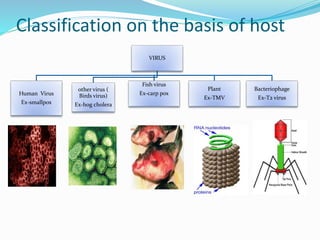
Classification on the basis of host
VIRUS
Human Virus
Ex-smallpox
0ther virus (
Birds virus)
Ex-hog cholera
Fish virus
Ex-carp pox
Plant
Ex-TMV
Bacteriophage
Ex-T2 virus
Morphology….
 Viruses may be classified into several different
morphological types on the basis of their capsid
architecture.
The structure of these capsids has been revealed by
electron microscopy and a technique called X-ray
crystallography.
1.Helical Viruses
 Helical viruses resemble long rods that may be rigid or
flexible.
 The viral nucleic acid is found within a hollow,
cylindrical capsid that has a helical structure .
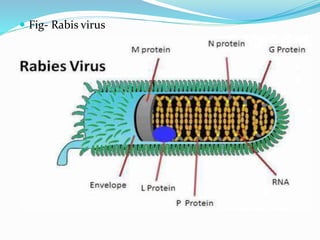
 Example-Rabis virus
 Fig- Rabis virus
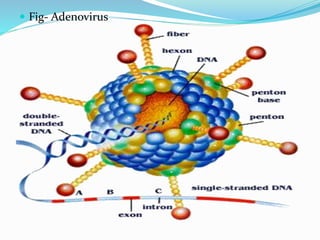
2. Polyhedral Viruses
 Many animal, plant, and bacterial viruses are
polyhedral.
 The capsid of most polyhedral virus of an icosahedron,
a regular polyhedron with 20 triangular faces and 12
corners is in the shape.
 Example- Adenovirus
 Fig- Adenovirus
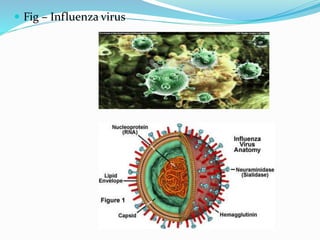
3. Enveloped Viruses
 The capsid of some viruses is covered by an envelope.
 Enveloped viruses are roughly sphericaL .
 When helical or polyhedral viruses are enclosed by
envelopes, they are called enveloped helical or
enveloped polyhedral viruses.
 Example- Influenza virus
 Fig – Influenza virus
4. Complex Viruses
 Some viruses, particularly bacterial viruses, have
complicated structures and are called complex viruses.
 the capsid (head) is polyhedral and that the tail
sheath is helicaL
 The head contains the nucleic acid.
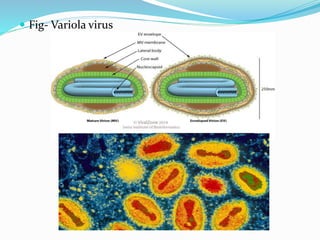
 Example- variola virus
 Fig- Variola virus
Multiplication of Virus
Viral Multiplication
 For a virus multiplication it must induce a living host
to synthesize all the essential components needed to
make more virus.
 The components must then be assembled into new
virions that escape from the cell.
 The phases of viral multiplication can be divided into
five steps
The five steps of multiplication
given below
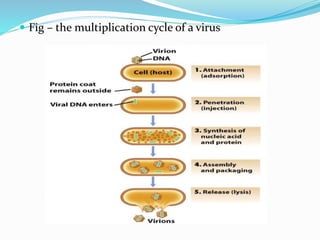
1. Attachdment (adsorption) of the virion to
susceptible host cell.
2. Penetration (entry , injection ) of the virion or its
nucleic acid into the cell.
3. Synthesis of virus nucleic acid and protein by cell
metabolism as redirected by the virus.
 4. Assembly of capsids and packaging of viral genomes
Into new virions. This whole process is called
maturation.
5. Release of mature virion from the cell.
 Fig – the multiplication cycle of a virus
Growth curve of virus
Descriptions of growth curve
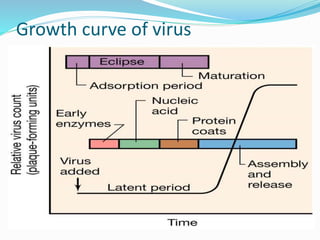
 Following adsorption, the infectivity of the virus particles
disappears, a phenomenon called eclipse. This is due to the
uncoating of the virus particles.
 During the latent period, replication of viral nucleic acid
and protein occurs.
 The maturation period follows, when virus nucleic acid
and protein are assembled into mature virus particles. At
this time, if the cells are broken open, active virus can be
detected.
 Finally, release occurs, either with or without cell lysis.
 The timing of the one-step growth cycle varies with the virus
and host. 20-60min in many bacterial viruses. 8-40h in most
animal hosts
Presentation 0n virus (09 12-2014)

Presentation 0n virus (09 12-2014)

  • 2.
    PRESENTED BY ..... AsrafulIslam Rayhan R0ll- 131039 DEPT. OF PHARMACY JESSORE UNIVERSITY OF SCIENCE & TECHNOLOGY
  • 3.
    Outline………….  Definition ofvirus  General properties of virus  Size  Structure  Classification  Morphology and  Multiplication 0f viruses
  • 4.
    A virus isa small infectious agent that replicates only inside the living cells of other organisms. Viruses can infect all types of life forms, from Animals and plants to bacteria and archaea. Example-Harpies virus
  • 5.
    Properties Of virus Viruses are inert (nucleoprotein ) filterable Agents  Viruses are obligate intracellular parasites  Viruses cannot make energy or proteins independent of a host cell  Viral genome are RNA or DNA but not both.  Viruses have a naked capsid or envelope with attached proteins  Viruses do not have the genetic capability to multiply by division.  Viruses are non-living entities
  • 6.
    Consequences of Virus Properties Viruses are not living  Viruses must be infectious to endure in nature  Viruses must be able to use host cell processes to produce their components (viral messenger RNA, protein, and identical copies of the genome)  Viruses must encode any required processes not provided by the cell  Viral components must self-assemble
  • 7.
    Size of Viruses Asmall virus has a diameter of about 20nm. Example- parvovirus A large virus have a diameter of up to 400nm Example- poxvirus
  • 8.
    Structure of Viruses Virionsare complete, fully developed viral particles composed of nucleic acid surrounded by a protein coat. Some viruses have an envelope composed of a phospholipid bilayer with viral glycoproteins. It contain- nucleic acid, Capsid , Envelope…
  • 10.
    1. Nucleic acid…… Viral genomes are either DNA or RNA (not both).  Nucleic acid may be single- or double-stranded  Nucleic acid may be circular or linear or separate molecules.  Nucleic acid protein ranges from about 1% - 50%.
  • 11.
    2. Capsid……  Theprotein shell, or coat, that encloses the nucleic acid genome.  Functions: a. Protect the viral nucleic acid. b. Participate in the viral infection. c. Share the antigenicity
  • 12.
    3.Envelope… * The outercovering of some viruses. *The envelope is derived from the host cell plasma membrane when the virus buds out.
  • 13.
  • 14.
     Virus aremainly classified by phenotypic characteristics , such as – Morphology, nucleic acid type , mode of replication , Host organisms and the type of disease the cause.  Two main methods are used for the classification of viruses - 1. ICTV ( International Committee On Taxonomy of Viruses ). 2. Baltimore.
  • 16.
    Baltimore Classification System Viruses are classed into 7 types of genes……  Class 1: Double Stranded DNA Viruses  Class 2: Single-stranded DNA viruses  Class 3: Double-stranded RNA viruses  Class 4: Single-stranded RNA viruses - Positive-sense  Class 5: Single-stranded RNA viruses - Negative-sense  Class 6: Positive-sense single-stranded RNA viruses that replicate through a DNA intermediate  Class 7: Double-stranded DNA viruses that replicate through a single-stranded RNA intermediate
  • 17.
    On the basisof nucleic acid , virus are two types- Virus DNA virus Example-papiloma virus RNA virus Example-Rhinovirus
  • 18.
    Classification on thebasis of host VIRUS Human Virus Ex-smallpox 0ther virus ( Birds virus) Ex-hog cholera Fish virus Ex-carp pox Plant Ex-TMV Bacteriophage Ex-T2 virus
  • 19.
    Morphology….  Viruses maybe classified into several different morphological types on the basis of their capsid architecture. The structure of these capsids has been revealed by electron microscopy and a technique called X-ray crystallography.
  • 20.
    1.Helical Viruses  Helicalviruses resemble long rods that may be rigid or flexible.  The viral nucleic acid is found within a hollow, cylindrical capsid that has a helical structure .  Example-Rabis virus
  • 21.
  • 22.
    2. Polyhedral Viruses Many animal, plant, and bacterial viruses are polyhedral.  The capsid of most polyhedral virus of an icosahedron, a regular polyhedron with 20 triangular faces and 12 corners is in the shape.  Example- Adenovirus
  • 23.
  • 24.
    3. Enveloped Viruses The capsid of some viruses is covered by an envelope.  Enveloped viruses are roughly sphericaL .  When helical or polyhedral viruses are enclosed by envelopes, they are called enveloped helical or enveloped polyhedral viruses.  Example- Influenza virus
  • 25.
     Fig –Influenza virus
  • 26.
    4. Complex Viruses Some viruses, particularly bacterial viruses, have complicated structures and are called complex viruses.  the capsid (head) is polyhedral and that the tail sheath is helicaL  The head contains the nucleic acid.  Example- variola virus
  • 27.
  • 28.
  • 29.
    Viral Multiplication  Fora virus multiplication it must induce a living host to synthesize all the essential components needed to make more virus.  The components must then be assembled into new virions that escape from the cell.  The phases of viral multiplication can be divided into five steps
  • 30.
    The five stepsof multiplication given below 1. Attachdment (adsorption) of the virion to susceptible host cell. 2. Penetration (entry , injection ) of the virion or its nucleic acid into the cell. 3. Synthesis of virus nucleic acid and protein by cell metabolism as redirected by the virus.
  • 31.
     4. Assemblyof capsids and packaging of viral genomes Into new virions. This whole process is called maturation. 5. Release of mature virion from the cell.
  • 32.
     Fig –the multiplication cycle of a virus
  • 33.
  • 34.
    Descriptions of growthcurve  Following adsorption, the infectivity of the virus particles disappears, a phenomenon called eclipse. This is due to the uncoating of the virus particles.  During the latent period, replication of viral nucleic acid and protein occurs.  The maturation period follows, when virus nucleic acid and protein are assembled into mature virus particles. At this time, if the cells are broken open, active virus can be detected.  Finally, release occurs, either with or without cell lysis.  The timing of the one-step growth cycle varies with the virus and host. 20-60min in many bacterial viruses. 8-40h in most animal hosts