I
N
T
E
R
N
A
L
U
S
E
O
N
L
Y
ODC Architecture
I
N
T
E
R
N
A
L
U
S
E
O
N
L
Y
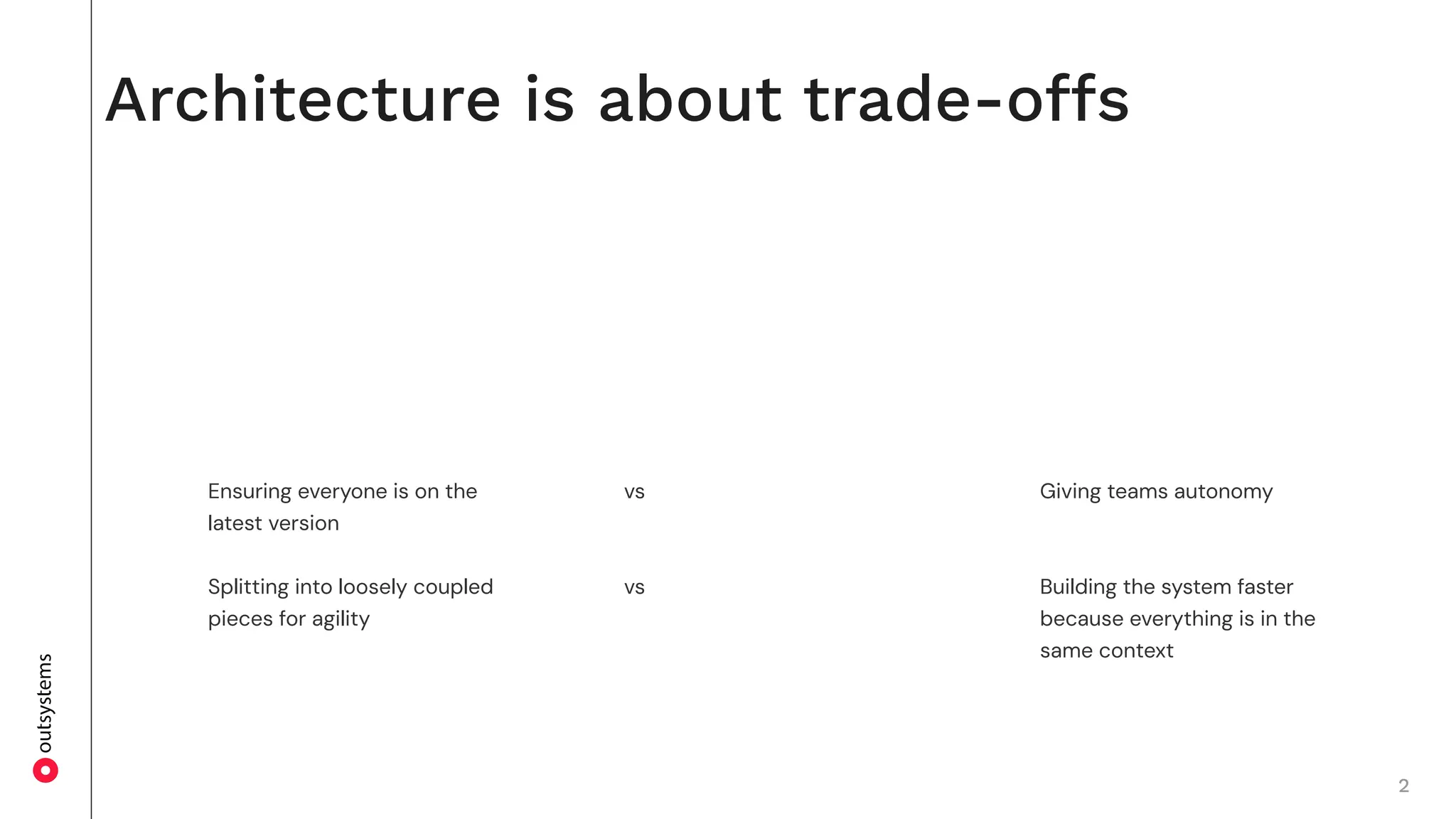
Architecture is about trade-offs
2
Ensuring everyone is on the
latest version
Splitting into loosely coupled
pieces for agility
vs
vs
Giving teams autonomy
Building the system faster
because everything is in the
same context
I
N
T
E
R
N
A
L
U
S
E
O
N
L
Y
I N T E R N A L U S E O N L Y
Crash course DDD:
I
N
T
E
R
N
A
L
U
S
E
O
N
L
Y
I N T E R N A L U S E O N L Y
I
N
T
E
R
N
A
L
U
S
E
O
N
L
Y
I N T E R N A L U S E O N L Y
I
N
T
E
R
N
A
L
U
S
E
O
N
L
Y
I N T E R N A L U S E O N L Y
I
N
T
E
R
N
A
L
U
S
E
O
N
L
Y
I N T E R N A L U S E O N L Y
Exam
Trade-off 2: To split or not to split
B2E B2C Auto Health Multirisk
Broker Portal Client Website
Client Mobile App
Auto
Auto Simulator
Auto Services
Health
Health Simulator
Health Services
Multirsk
Multirsk Simulator
Multirsk Services
Auto Plates IS
Mobile Plugins
Legacy Calc Engine Xif
Broker Portal Client Auto Health Multirisk
Plugins
Integration External Logic
Business
Owner 1
Business
Owner 2
Business
Owner 4
Business
Owner 3
Business
Owner 5
Business
Sponsor 1
Business
Sponsor 1
Business
Sponsor 2
Business
Sponsor 3
Business
Sponsor 4
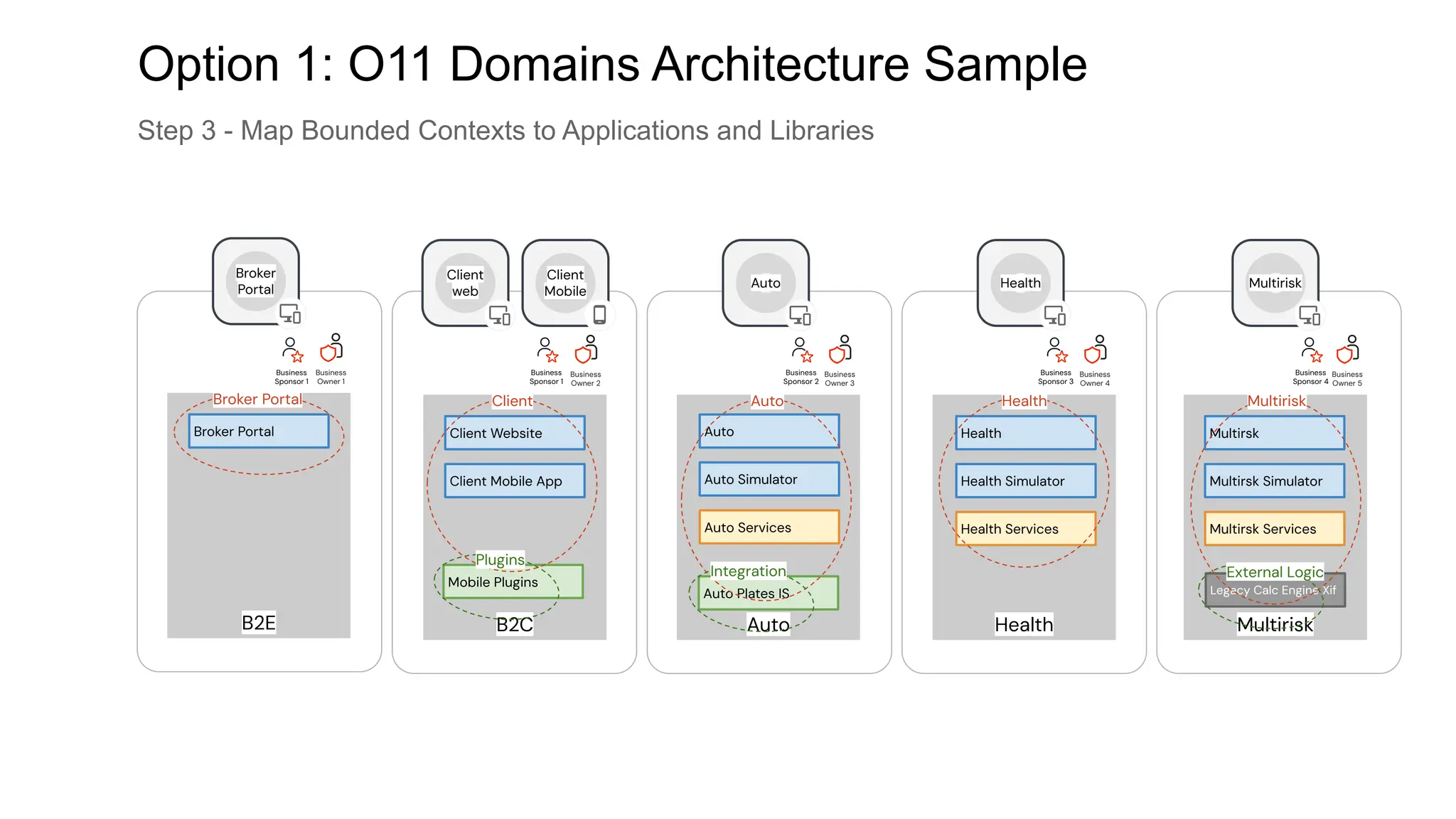
Option 1: O11 Domains Architecture Sample
Step 3 - Map Bounded Contexts to Applications and Libraries
B2E B2C Auto Health Multirisk
Broker Portal Client Website
Client Mobile App
Auto
Auto Simulator
Auto Services
Health
Health Simulator
Health Services
Multirsk
Multirsk Simulator
Multirsk Services
Auto Plates IS
Mobile Plugins
Legacy Calc Engine Xif
Broker Portal Client Auto Health Multirisk
Plugins
Integration External Logic
Business
Owner 1
Business
Owner 2
Business
Owner 4
Business
Owner 3
Business
Owner 5
Business
Sponsor 1
Business
Sponsor 1
Business
Sponsor 2
Business
Sponsor 3
Business
Sponsor 4
Broker
Portal
Client
web
Auto Health Multirisk
Client
Mobile
10
Option 2: O11 Domains Architecture Sample
Step 3 - Map Bounded Contexts to Applications and Libraries
B2E B2C Auto Health Multirisk
Broker Portal Client Website
Client Mobile App
Auto
Auto Simulator
Auto Services
Health
Health Simulator
Health Services
Multirsk
Multirsk Simulator
Multirsk Services
Auto Plates IS
Mobile Plugins
Legacy Calc Engine Xif
Broker Portal Client Auto Health Multirisk
Plugins
Integration External Logic
Business
Owner 1
Business
Owner 2
Business
Owner 4
Business
Owner 3
Business
Owner 5
Touch &
Face Id
Plugin
Camera
Plugin
Auto Plates
Connector
Calc Engine
External
Logic
Business
Sponsor 1
Business
Sponsor 1
Business
Sponsor 2
Business
Sponsor 3
Business
Sponsor 4
Broker
Portal
Client
web
Auto Health Multirisk
Client
Mobile
11
Option 3: O11 Domains Architecture Sample
Step 3 - Map Bounded Contexts to Applications and Libraries
B2E B2C Auto Health Multirisk
Broker Portal Client Website
Client Mobile App
Auto
Auto Simulator
Auto Services
Health
Health Simulator
Health Services
Multirsk
Multirsk Simulator
Multirsk Services
Auto Plates IS
Mobile Plugins
Legacy Calc Engine Xif
Broker Portal Client Auto Health Multirisk
Plugins
Integration External Logic
Business
Owner 1
Business
Owner 2
Business
Owner 4
Business
Owner 3
Business
Owner 5
Touch &
Face Id
Plugin
Camera
Plugin
Auto Plates
Connector
Calc Engine
External
Logic
Business
Sponsor 1
Business
Sponsor 1
Business
Sponsor 2
Business
Sponsor 3
Business
Sponsor 4
Broker
Portal
Client
web
Auto Health Multirisk
In this use case, we have detected that a domain would have to be
mapped into two ODC Apps since we have a mobile application inside.
Due to that reason, further decoupling is required.
Client
Mobile
I
N
T
E
R
N
A
L
U
S
E
O
N
L
Y
Trade-off 2: To split or not to split
12
Insurance
Services
Simulation
Services
CRM
Services
Web
Theme
Mobile
Theme
Patterns
Broker
Portal
Client
web
Health Auto Multirisk
Client
Mobile
Client (browser)
Broker (browser)
Client (mobile)
Touch &
Face Id
Plugin
Camera
Plugin
Auto Plates
Connector
Calc Engine
External
Logic
Plates API
I
N
T
E
R
N
A
L
U
S
E
O
N
L
Y
Team 1
Front-end Team
13
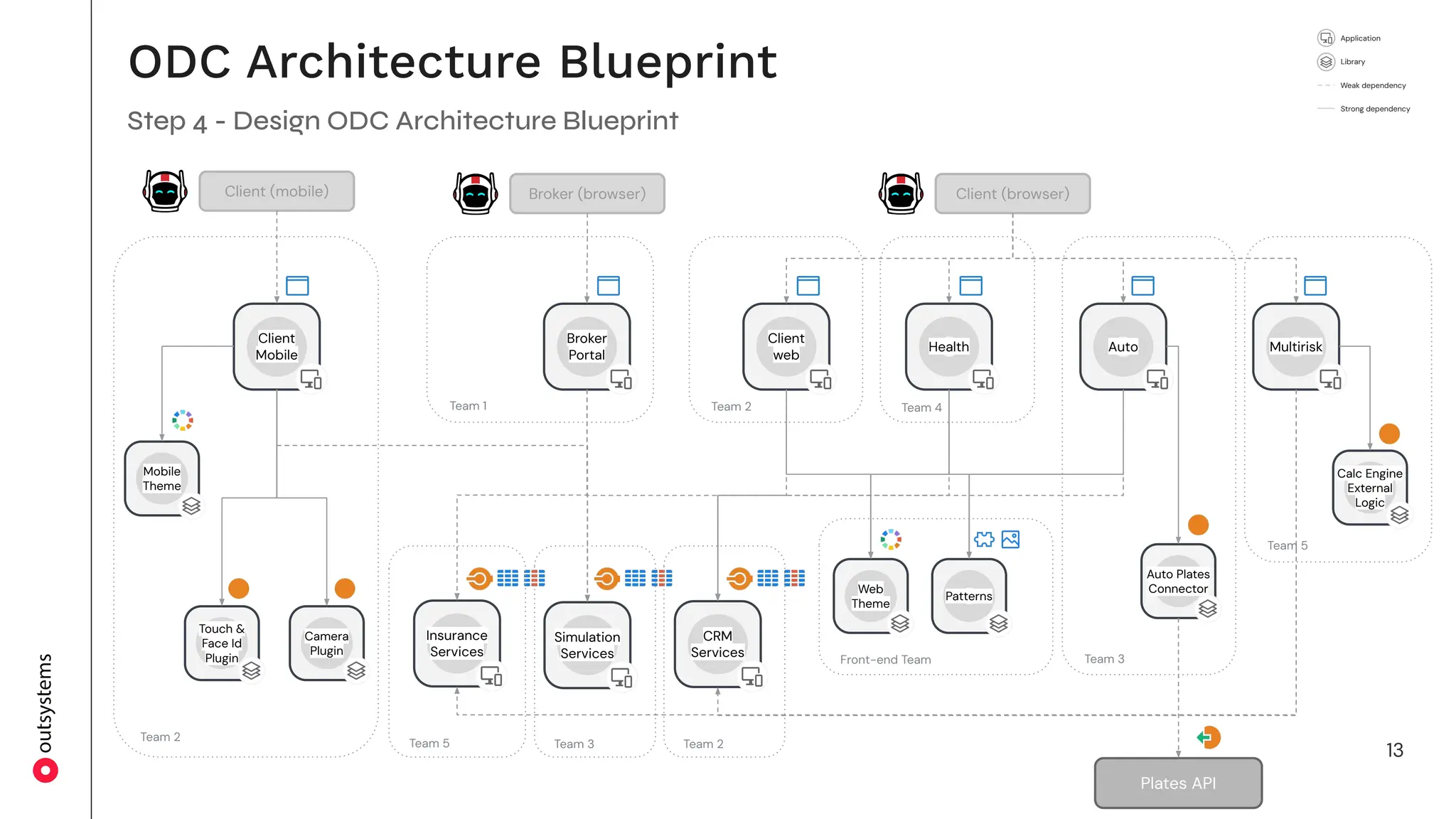
ODC Architecture Blueprint
Step 4 - Design ODC Architecture Blueprint
Insurance
Services
Simulation
Services
CRM
Services
Web
Theme
Mobile
Theme
Patterns
Broker
Portal
Client
web
Health Auto Multirisk
Client
Mobile
Client (browser)
Broker (browser)
Client (mobile)
Touch &
Face Id
Plugin
Camera
Plugin
Auto Plates
Connector
Calc Engine
External
Logic
Plates API
Library
Application
Strong dependency
Weak dependency
Team 2
Team 2 Team 4
Team 3
Team 5
Team 5 Team 3 Team 2
I
N
T
E
R
N
A
L
U
S
E
O
N
L
Y
Team 1
Front-end Team
14
ODC Architecture Blueprint
Step 4 - Design ODC Architecture Blueprint
Insurance
Services
Simulation
Services
CRM
Services
Web
Theme
Mobile
Theme
Patterns
Broker
Portal
Client
web
Health Auto Multirisk
Client
Mobile
Client (browser)
Broker (browser)
Client (mobile)
Touch &
Face Id
Plugin
Camera
Plugin
Auto Plates
Connector
Calc Engine
External
Logic
Plates API
Library
Application
Strong dependency
Weak dependency
Team 2
Team 2 Team 4
Team 3
Team 5
Team 5 Team 3 Team 2
I
N
T
E
R
N
A
L
U
S
E
O
N
L
Y
Architecture Basic Concepts
I
N
T
E
R
N
A
L
U
S
E
O
N
L
Y
Application
● Encapsulate business concepts, UI, logic and data of a specific business context
● Are loosely coupled between each other by definition
● Have independent life cycles
● Can be used to:
○ Hold user interfaces, Screens and business Blocks
○ Expose APIs in a microservices approach trough Service Actions
○ Implement asynchronous processing using Timers
Applications
What is an application in ODC?
Build applications to solve a business use cases
User Interfaces
Web / Mobile
Microservices
Service Actions / REST APIs
Asynchronous
Processing
I
N
T
E
R
N
A
L
U
S
E
O
N
L
Y
17
Application Elements
Processes Interface Logic Data
Application
Screen
Timer Service Action Entity
Block
Theme
Client Action
Server Action
Structure
Static Entity
Rest Expose
Rest Consume
Entity Diagram
Exception
Role
Client Variable
Settings
Resource
Image
Script
External Site
Element can be reused in other applications
I
N
T
E
R
N
A
L
U
S
E
O
N
L
Y
Each Application is packaged
into a container when Published
Only weak references are
allowed between Applications
Application
Application
ODC KB
ODC Application
Applications are packaged into loosely coupled containers
I
N
T
E
R
N
A
L
U
S
E
O
N
L
Y
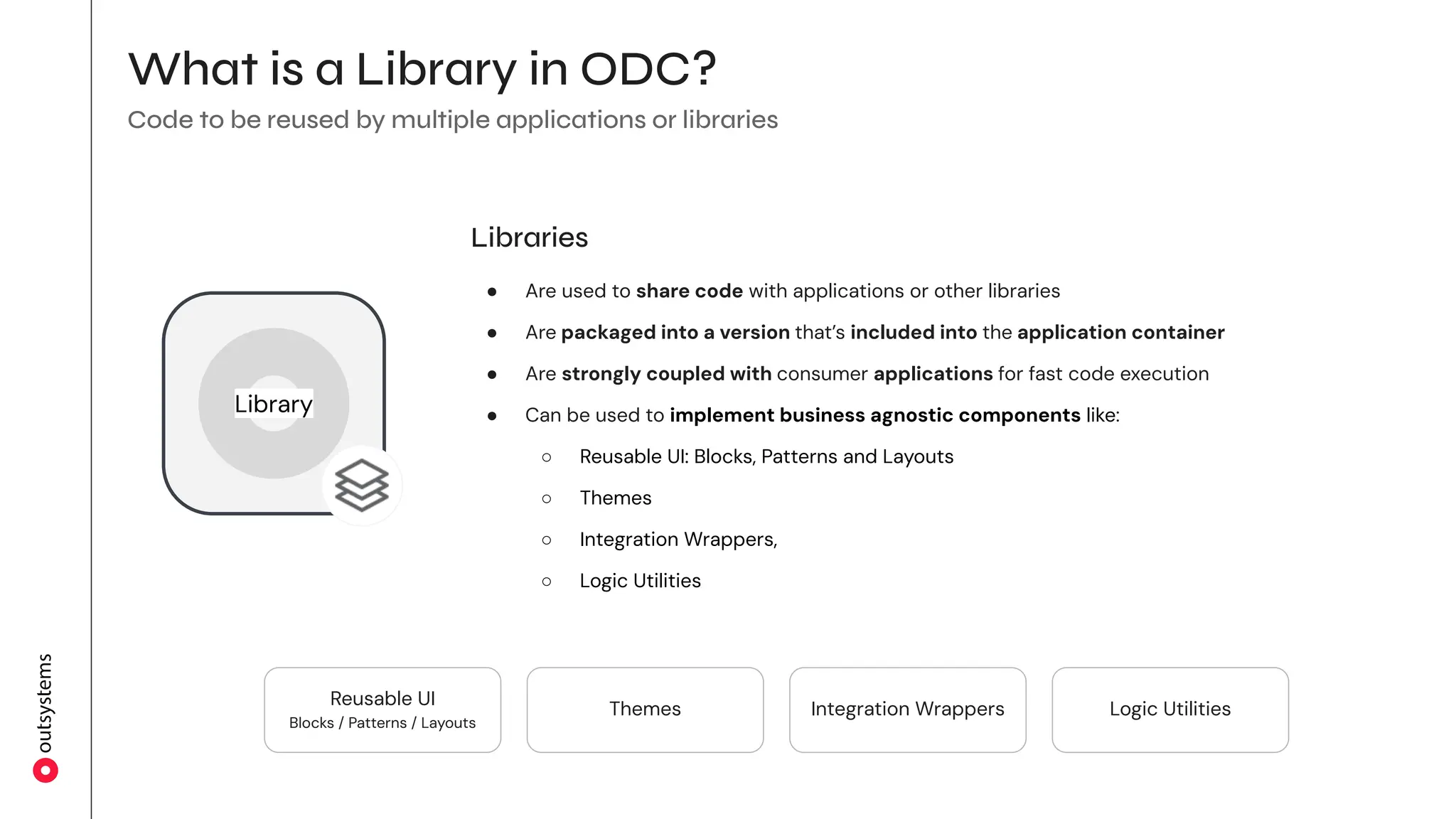
Library
What is a Library in ODC?
Code to be reused by multiple applications or libraries
Reusable UI
Blocks / Patterns / Layouts
Themes Integration Wrappers Logic Utilities
● Are used to share code with applications or other libraries
● Are packaged into a version that’s included into the application container
● Are strongly coupled with consumer applications for fast code execution
● Can be used to implement business agnostic components like:
○ Reusable UI: Blocks, Patterns and Layouts
○ Themes
○ Integration Wrappers,
○ Logic Utilities
Libraries
I
N
T
E
R
N
A
L
U
S
E
O
N
L
Y
20
Library Elements
Processes Interface Logic Data
Screen
Timer Service Action Entity
Block
Theme
Client Action
Server Action
Structure
Static Entity
Rest Expose
Rest Consume
Entity Diagram
Exception
Role
Client Variable
Settings
Resource
Image
Script
External Site
Library
Element can be reused in other applications or libraries
I
N
T
E
R
N
A
L
U
S
E
O
N
L
Y
A Library version is packaged when
Library is Published
Library Application
Only strong references are allowed
when consuming Libraries
ODC Library
Libraries are packaged into each consumer Application
The packaged Library version is packaged
together with the Application container
when Application is Published
I
N
T
E
R
N
A
L
U
S
E
O
N
L
Y
Library Application
Development
Quality Production
…
A Library version is packaged together with the
Application container when Application is Published
Each Application container is
deployed into each stage and
respective configurations are applied
ODC CI/CD
Build once in Development and deploy to following stages
Different Configuration Values
can be set at each stage
I
N
T
E
R
N
A
L
U
S
E
O
N
L
Y
Different configuration values can be set in
each Stage that the Application is Deployed,
overriding default value defined in
development time through Service Studio
Quality Production
…
Development
Application
2. Apply Values
1. Edit Configurations
3. New Configuration Applied
Applying configurations through the
portal is an asynchronous process, so
values might not be updated immediately
after being set in the portal
Configurations
Applying configurations through the Portal
I
N
T
E
R
N
A
L
U
S
E
O
N
L
Y
Application
Slack
Slack API
Although the Settings are defined at the
Library level, since the Application is
consuming the Library, we are able to
configure Settings at Application Level
through the Portal
SlackToken (Secret)
IsActive (Setting)
Settings can be marked as being
secrets, providing a secure way to
store sensitive information
encrypted in a vault
Slack
Slack
Settings
Configuring Library Settings and using them to Store Application Secrets
I
N
T
E
R
N
A
L
U
S
E
O
N
L
Y
Application
Slack
Slack API
Although the Integration is being used at
the Library level, since the Application is
consuming the Library, we are able to
configure the Integration Endpoint at
Application Level through the Portal
Slack
Integrations
Configuring Library Integrations Endpoints
I
N
T
E
R
N
A
L
U
S
E
O
N
L
Y
Trade-off 1: Let’s play: should it be an
app or a library?
When I release everyone will have to adopt
My elements are business aware
I have my own runtime context 26
Library
Application
When I release everyone can adopt at their own pace
I contain business agnostic elements
I do not have my own runtime context
I
N
T
E
R
N
A
L
U
S
E
O
N
L
Y
Let’s play: should it be an app or a
library?
27
Sharing Theme and Patterns
across Applications
I
N
T
E
R
N
A
L
U
S
E
O
N
L
Y
Theme
Application 1 Application 2
Patterns
Business agnostic Patterns
Libraries promote reusability since
they can be consumed by multiple
applications
Using Libraries to share Look & Feel
Sharing Theme and Patterns across Applications
Client (browser) Client (browser)
Library
Application
Strong dependency
Weak dependency
I
N
T
E
R
N
A
L
U
S
E
O
N
L
Y
Mobile
Theme
Web
The base theme has the common CSS that will be
inherited by the consumer themes.
The base theme can be completely custom or it can be
OutSystems UI (the default option)
Using Theme inheritance
Themes can inherit from each other, making it easier to share common parts of look & feel between apps
Client (browser) Client (browser)
Library
Application
Strong dependency
Weak dependency
Mobile
Web
Theme
Base
Theme
Each consumer theme will inherit the
common CSS from the base theme, while
implementing the specific CSS and/or
overriding CSS coming from base theme
I
N
T
E
R
N
A
L
U
S
E
O
N
L
Y
Let’s play: should it be an app or a
library?
30
Sharing Theme and Patterns
across Applications
Reusable blocks
that contain data
I
N
T
E
R
N
A
L
U
S
E
O
N
L
Y
Sharing blocks across Applications
Blocks can only be shared by consuming Libraries, thus data has to be passed through input parameters
Application 1
Client (browser)
Application 2
GetHeaderInfo
Header
HeaderInfo
Header Information is retrieved from
the GetHeaderInfo Service Action and
passed as an input to the Header
Block when the screen is rendered
Client (browser)
Header
Header
HeaderInfo
Header Block is defined at
Library Level (Patterns)
Application 2 has the Header Info and
shares it with other Applications
through a Service Action.
In Application 2, Header Information
can be used directly
Patterns
Library
Application
Strong dependency
Weak dependency
I
N
T
E
R
N
A
L
U
S
E
O
N
L
Y
Sharing a App Switcher Menu
Having a common menu across applications can be achieved by sharing a block using a Library
Application 1 Application 2 Application 3
Menu Items are defined in static
links, using external Urls, pointing to
each application Screen
Client (browser) Client (browser) Client (browser)
Menu
Menu
Library
Application
Strong dependency
Weak dependency
I
N
T
E
R
N
A
L
U
S
E
O
N
L
Y
Let’s play: should it be an app or a
library?
33
Sharing Theme and Patterns
across Applications
Reusable blocks
that contain data
Integration Service
Wrappers that promote
reusability and reduce
third-party change impacts
I
N
T
E
R
N
A
L
U
S
E
O
N
L
Y
ERP API
ERP
Connector This type of integrations are the ideal
candidates to be Forge Components
Direct Integration
Integration Service Wrappers promote reusability and reduce third-party change impacts
Library
Application
Strong dependency
Weak dependency
An Integration Service Wrapper promotes
reusability of Integrations across applications
through a strong dependency, avoiding potential
performance overhead of using a weak
dependency.
Impacts driven by changes on third-party APIs
are also mitigated by this encapsulation
Application 1 Application 2
I
N
T
E
R
N
A
L
U
S
E
O
N
L
Y
Each system is interfaced with a
different library. All libraries provide
an API with the same signatures
This library abstracts the existence of
different systems into a single service,
routing requests to the correct library
Transparency Service Pattern
Abstracting different systems into a single service definition
Notification
Teams API
Slack API Email Service
Slack Teams Email
Application 2
Library
Application
Strong dependency
Weak dependency
Application 1
I
N
T
E
R
N
A
L
U
S
E
O
N
L
Y
Let’s play: should it be an app or a
library?
36
Sharing Theme and Patterns
across Applications
Reusable blocks
that contain data
Integration Service
Wrappers that promote
reusability and reduce
third-party change impacts
Sharing data between
systems
I
N
T
E
R
N
A
L
U
S
E
O
N
L
Y
Sharing reference data
Ref. Data is typically business agnostic, with slow change pace, that can be reused across multiple use cases
Application 1 Application 2 Application 3
Client (browser) Client (browser) Client (browser)
Library
Application
Strong dependency
Weak dependency
Location
RefData
Country
City
To promote reusability, applications can
be used to hold and share Reference
Data across multiple applications
Reference Data Applications should
follow the design process steps, to
ensure: concepts are grouped the right
way, ownership is well defined and
lifecycle independence is respected
Reference data can be leveraged by
consumer applications in aggregates
by referencing the public entities
I
N
T
E
R
N
A
L
U
S
E
O
N
L
Y
Sharing business entities with plain data
Consuming public business entities has a lower development effort and should be used for entities with plain
data and stable data model
Application 1 Application 2 Application 3
Client (browser) Client (browser) Client (browser)
Library
Application
Strong dependency
Weak dependency
Billing Supplier
An Entity exposed as Public should have a
low change pace as business evolves. Should
share plain data that doesn’t involve
complex business rules and doesn't require
high business knowledge from consumer
Teams to make sense of data.
Consuming Public Entities is easy and
reduces development effort as consumer
applications can use entities in
aggregates or Advanced queries in
read-only mode, facilitating data
mashup
I
N
T
E
R
N
A
L
U
S
E
O
N
L
Y
Sharing business entities with business rules
Sharing data through public entities can reduce business encapsulation depending on the use case
Application 1 Application 2 Application 3
Client (browser) Client (browser) Client (browser)
Library
Application
Strong dependency
Weak dependency
Billing
InvoiceHeader
InvoiceItems
In these use cases, sharing public Entities
can cause teams to lose isolation by
potentially spreading business rules
across the consumer applications, making
it harder to maintain and keep quality.
Consumers can also suffer more impacts
of frequent breaking changes of data
model that happen at business pace
InvoicePayments
⚠
We should be careful when sharing data that
requires business knowledge by the
consumer Teams (e.g.: involving multiple
joins and filters to make sense of data or
when there are validations or calculations
or other business rules)
I
N
T
E
R
N
A
L
U
S
E
O
N
L
Y
Sharing business entities with business rules
Exposing business data through service actions ensures higher business concepts encapsulation
Application 1 Application 2 Application 3
Client (browser) Client (browser) Client (browser)
Library
Application
Strong dependency
Weak dependency
Billing InvoiceHeader
InvoiceItems
The business data model is not
exposed directly to consumer
applications, keeping a black box
abstraction, by having the business
rules centralized in a single place.
Only the relevant data attributes
should be included.
Exposing a Service Action to be consumed
by the applications has some extra
development effort over consuming public
entities, specially for data mashup, but it
can improve reusability and isolation of
business logic.
InvoicePayments
GetInvoicesWithDetails
InvoicesWithDetailsList
InvoiceWithDetails
I
N
T
E
R
N
A
L
U
S
E
O
N
L
Y
Let’s play: should it be an app or a
library?
41
Sharing Theme and Patterns
across Applications
Reusable blocks
that contain data
Integration Service
Wrappers that promote
reusability and reduce
third-party change impacts
Sharing data between
systems
I
N
T
E
R
N
A
L
U
S
E
O
N
L
Y
ERP API
ERP
Connector
In some scenarios, having a cold cache for our data is very
important to prevent overloading our source APIs, but
also to ensure a better performance when we have slow
APIs.
This approach should be used when our Application can
cope with some delay to have data updated. Otherwise a
direct integration is required for real-time data integration.
Integration with Cold Cache
Using a Cold cache to reduce load on API and increase Application Performance
Library
Application
Strong dependency
Weak dependency
Application 1
Customer
In this approach, a timer runs frequently to pull data
from the API connector to populate an entity with data
coming from the source API.
For better performance and more frequent updating a
differential synchronization approach is
recommended. Although the API needs to support it, by
allowing to query for new, updated and deleted records
since last call.
The synchronization logic can be
optimized by leveraging the built-in
bulk inserts (CreateOrUpdateSome…)
SyncCustomer
I
N
T
E
R
N
A
L
U
S
E
O
N
L
Y
Application 1 Application 2 Customer
Each Application has its own role.
Although being different roles, they
can have the same name.
Customer
ODC Portal
Application 1 Customer
Application 2 Customer
✔
✔
Client (browser) Client (browser)
Assigning each role in each application to
the user will enable us to use them to
validate our use cases in each application
Validating Personas Across Applications
Using the out-of-the box feature to validate persona level access
I
N
T
E
R
N
A
L
U
S
E
O
N
L
Y
Application 1 Application 2
Customer
Specific features might require access validation with greater
granularity, to accomplish that a role that represents the
feature access is created in both applications. Then the
access is also validated on both applications
Agent
ODC Portal
Application 1 Agent
Application 1 CustomerReports
✔
✔
Client (browser)
In the ODC portal, the roles are assigned to
user in each application so that the
validation can be done in each application
Validating Specific Permissions Across Applications
Using the out-of-the box feature to validate higher granularity level of access
CustomerReports CustomerReports
GetCustomerReports
Application 2 CustomerReports
✔
I
N
T
E
R
N
A
L
U
S
E
O
N
L
Y
Application 1 Application 2 Customer
IsCustomerRole?
This Approach should be avoided, since each time the
IsCustomerRole is being called through a ServiceAction,
overhead is potentially introduced and applications lose
the ability to scale independently
Specially taking into consideration that checking for a role
can be executed many times in the context of a Screen
⚠
Client (browser) Client (browser)
Pitfalls of Validating Roles Across Applications
Why should avoid using service actions to share roles?
I
N
T
E
R
N
A
L
U
S
E
O
N
L
Y
A fun new architecture
challenge!
(for certain values of fun)
I
N
T
E
R
N
A
L
U
S
E
O
N
L
Y
● Producers and consumer Applications are loosely coupled
● No point-to-point integrations, it's easy to add new consumers to the system using Publish /
Subscribe pattern
● Consumers respond to events immediately as they arrive, making it ideal for Asynchronous &
Parallel Processing use cases
● Highly scalable and distributed systems with increased Parallel Batch Processing capabilities
Benefits of Event Driven Architecture
Event Driven Architecture with ODC
Leveraging ODC Events capability to implement Event Driven Architecture patterns
Publish / Subscribe
Asynchronous &
Parallel Processing
Parallel Batch
Processing
Trigger Event
N
E
W
I
N
T
E
R
N
A
L
U
S
E
O
N
L
Y
Events in ODC
Internal Properties of Events in ODC
Event Payload
Maximum payload of 10KB per Event
Only primitive types (except binaries) supported as Event parameters (no Structures, Lists or Entity
Records allowed)
Event Queues
Each Event Type has its own queue
Maximum Queue size of 10K events per Event Type
Event Delivery
Each Event is delivered only once to consuming Applications
Delivery Order of the Events is not guaranteed
Maximum of 10 retry attempts per Event
The intervals between retry attempts are determined by the Backoff Policy (2, 4 , 8, 16, 32 min)
Event Execution
Maximum 100 threads per Application for Event execution
Maximum duration of each Event Execution thread is 2 min
N
E
W
ODC KB
I
N
T
E
R
N
A
L
U
S
E
O
N
L
Y
Event Architecture Basic Concepts
How to represent Events in ODC Architecture Blueprints?
Application 1
Client (browser)
Application 2
Client (browser)
Library
Application
Strong dependency
Weak dependency
N
E
W
Application 1
Client (browser)
Application 2
Client (browser)
Event Stream
Publish Subscribe
How Events actually work
How we chose to represent it,
keeping it simple.
Notice the dotted line and the
Icon on top to differentiate from
other types of weak dependencies.
I
N
T
E
R
N
A
L
U
S
E
O
N
L
Y
Event Architecture Basic Concepts
How do Events work in ODC?
Application 1
Client (browser)
Application 2
Event
Client (browser)
Library
Application
Strong dependency
Weak dependency
Event
An Event can also be triggered and
consumed in same Application, launching
an asynchronous Event execution thread
Event
An Event can be consumed
in any Application
An Event can only be
triggered in the Application
it has been defined
N
E
W
I
N
T
E
R
N
A
L
U
S
E
O
N
L
Y
Thank you!

ODC, Data Fabric and Architecture User Group

  • 1.
  • 2.
    I N T E R N A L U S E O N L Y Architecture is abouttrade-offs 2 Ensuring everyone is on the latest version Splitting into loosely coupled pieces for agility vs vs Giving teams autonomy Building the system faster because everything is in the same context
  • 3.
    I N T E R N A L U S E O N L Y I N TE R N A L U S E O N L Y Crash course DDD:
  • 4.
    I N T E R N A L U S E O N L Y I N TE R N A L U S E O N L Y
  • 5.
    I N T E R N A L U S E O N L Y I N TE R N A L U S E O N L Y
  • 6.
    I N T E R N A L U S E O N L Y I N TE R N A L U S E O N L Y
  • 7.
    I N T E R N A L U S E O N L Y I N TE R N A L U S E O N L Y Exam
  • 8.
    Trade-off 2: Tosplit or not to split B2E B2C Auto Health Multirisk Broker Portal Client Website Client Mobile App Auto Auto Simulator Auto Services Health Health Simulator Health Services Multirsk Multirsk Simulator Multirsk Services Auto Plates IS Mobile Plugins Legacy Calc Engine Xif Broker Portal Client Auto Health Multirisk Plugins Integration External Logic Business Owner 1 Business Owner 2 Business Owner 4 Business Owner 3 Business Owner 5 Business Sponsor 1 Business Sponsor 1 Business Sponsor 2 Business Sponsor 3 Business Sponsor 4
  • 9.
    Option 1: O11Domains Architecture Sample Step 3 - Map Bounded Contexts to Applications and Libraries B2E B2C Auto Health Multirisk Broker Portal Client Website Client Mobile App Auto Auto Simulator Auto Services Health Health Simulator Health Services Multirsk Multirsk Simulator Multirsk Services Auto Plates IS Mobile Plugins Legacy Calc Engine Xif Broker Portal Client Auto Health Multirisk Plugins Integration External Logic Business Owner 1 Business Owner 2 Business Owner 4 Business Owner 3 Business Owner 5 Business Sponsor 1 Business Sponsor 1 Business Sponsor 2 Business Sponsor 3 Business Sponsor 4 Broker Portal Client web Auto Health Multirisk Client Mobile
  • 10.
    10 Option 2: O11Domains Architecture Sample Step 3 - Map Bounded Contexts to Applications and Libraries B2E B2C Auto Health Multirisk Broker Portal Client Website Client Mobile App Auto Auto Simulator Auto Services Health Health Simulator Health Services Multirsk Multirsk Simulator Multirsk Services Auto Plates IS Mobile Plugins Legacy Calc Engine Xif Broker Portal Client Auto Health Multirisk Plugins Integration External Logic Business Owner 1 Business Owner 2 Business Owner 4 Business Owner 3 Business Owner 5 Touch & Face Id Plugin Camera Plugin Auto Plates Connector Calc Engine External Logic Business Sponsor 1 Business Sponsor 1 Business Sponsor 2 Business Sponsor 3 Business Sponsor 4 Broker Portal Client web Auto Health Multirisk Client Mobile
  • 11.
    11 Option 3: O11Domains Architecture Sample Step 3 - Map Bounded Contexts to Applications and Libraries B2E B2C Auto Health Multirisk Broker Portal Client Website Client Mobile App Auto Auto Simulator Auto Services Health Health Simulator Health Services Multirsk Multirsk Simulator Multirsk Services Auto Plates IS Mobile Plugins Legacy Calc Engine Xif Broker Portal Client Auto Health Multirisk Plugins Integration External Logic Business Owner 1 Business Owner 2 Business Owner 4 Business Owner 3 Business Owner 5 Touch & Face Id Plugin Camera Plugin Auto Plates Connector Calc Engine External Logic Business Sponsor 1 Business Sponsor 1 Business Sponsor 2 Business Sponsor 3 Business Sponsor 4 Broker Portal Client web Auto Health Multirisk In this use case, we have detected that a domain would have to be mapped into two ODC Apps since we have a mobile application inside. Due to that reason, further decoupling is required. Client Mobile
  • 12.
    I N T E R N A L U S E O N L Y Trade-off 2: Tosplit or not to split 12 Insurance Services Simulation Services CRM Services Web Theme Mobile Theme Patterns Broker Portal Client web Health Auto Multirisk Client Mobile Client (browser) Broker (browser) Client (mobile) Touch & Face Id Plugin Camera Plugin Auto Plates Connector Calc Engine External Logic Plates API
  • 13.
    I N T E R N A L U S E O N L Y Team 1 Front-end Team 13 ODCArchitecture Blueprint Step 4 - Design ODC Architecture Blueprint Insurance Services Simulation Services CRM Services Web Theme Mobile Theme Patterns Broker Portal Client web Health Auto Multirisk Client Mobile Client (browser) Broker (browser) Client (mobile) Touch & Face Id Plugin Camera Plugin Auto Plates Connector Calc Engine External Logic Plates API Library Application Strong dependency Weak dependency Team 2 Team 2 Team 4 Team 3 Team 5 Team 5 Team 3 Team 2
  • 14.
    I N T E R N A L U S E O N L Y Team 1 Front-end Team 14 ODCArchitecture Blueprint Step 4 - Design ODC Architecture Blueprint Insurance Services Simulation Services CRM Services Web Theme Mobile Theme Patterns Broker Portal Client web Health Auto Multirisk Client Mobile Client (browser) Broker (browser) Client (mobile) Touch & Face Id Plugin Camera Plugin Auto Plates Connector Calc Engine External Logic Plates API Library Application Strong dependency Weak dependency Team 2 Team 2 Team 4 Team 3 Team 5 Team 5 Team 3 Team 2
  • 15.
  • 16.
    I N T E R N A L U S E O N L Y Application ● Encapsulate businessconcepts, UI, logic and data of a specific business context ● Are loosely coupled between each other by definition ● Have independent life cycles ● Can be used to: ○ Hold user interfaces, Screens and business Blocks ○ Expose APIs in a microservices approach trough Service Actions ○ Implement asynchronous processing using Timers Applications What is an application in ODC? Build applications to solve a business use cases User Interfaces Web / Mobile Microservices Service Actions / REST APIs Asynchronous Processing
  • 17.
    I N T E R N A L U S E O N L Y 17 Application Elements Processes InterfaceLogic Data Application Screen Timer Service Action Entity Block Theme Client Action Server Action Structure Static Entity Rest Expose Rest Consume Entity Diagram Exception Role Client Variable Settings Resource Image Script External Site Element can be reused in other applications
  • 18.
    I N T E R N A L U S E O N L Y Each Application ispackaged into a container when Published Only weak references are allowed between Applications Application Application ODC KB ODC Application Applications are packaged into loosely coupled containers
  • 19.
    I N T E R N A L U S E O N L Y Library What is aLibrary in ODC? Code to be reused by multiple applications or libraries Reusable UI Blocks / Patterns / Layouts Themes Integration Wrappers Logic Utilities ● Are used to share code with applications or other libraries ● Are packaged into a version that’s included into the application container ● Are strongly coupled with consumer applications for fast code execution ● Can be used to implement business agnostic components like: ○ Reusable UI: Blocks, Patterns and Layouts ○ Themes ○ Integration Wrappers, ○ Logic Utilities Libraries
  • 20.
    I N T E R N A L U S E O N L Y 20 Library Elements Processes InterfaceLogic Data Screen Timer Service Action Entity Block Theme Client Action Server Action Structure Static Entity Rest Expose Rest Consume Entity Diagram Exception Role Client Variable Settings Resource Image Script External Site Library Element can be reused in other applications or libraries
  • 21.
    I N T E R N A L U S E O N L Y A Library versionis packaged when Library is Published Library Application Only strong references are allowed when consuming Libraries ODC Library Libraries are packaged into each consumer Application The packaged Library version is packaged together with the Application container when Application is Published
  • 22.
    I N T E R N A L U S E O N L Y Library Application Development Quality Production … ALibrary version is packaged together with the Application container when Application is Published Each Application container is deployed into each stage and respective configurations are applied ODC CI/CD Build once in Development and deploy to following stages Different Configuration Values can be set at each stage
  • 23.
    I N T E R N A L U S E O N L Y Different configuration valuescan be set in each Stage that the Application is Deployed, overriding default value defined in development time through Service Studio Quality Production … Development Application 2. Apply Values 1. Edit Configurations 3. New Configuration Applied Applying configurations through the portal is an asynchronous process, so values might not be updated immediately after being set in the portal Configurations Applying configurations through the Portal
  • 24.
    I N T E R N A L U S E O N L Y Application Slack Slack API Although theSettings are defined at the Library level, since the Application is consuming the Library, we are able to configure Settings at Application Level through the Portal SlackToken (Secret) IsActive (Setting) Settings can be marked as being secrets, providing a secure way to store sensitive information encrypted in a vault Slack Slack Settings Configuring Library Settings and using them to Store Application Secrets
  • 25.
    I N T E R N A L U S E O N L Y Application Slack Slack API Although theIntegration is being used at the Library level, since the Application is consuming the Library, we are able to configure the Integration Endpoint at Application Level through the Portal Slack Integrations Configuring Library Integrations Endpoints
  • 26.
    I N T E R N A L U S E O N L Y Trade-off 1: Let’splay: should it be an app or a library? When I release everyone will have to adopt My elements are business aware I have my own runtime context 26 Library Application When I release everyone can adopt at their own pace I contain business agnostic elements I do not have my own runtime context
  • 27.
    I N T E R N A L U S E O N L Y Let’s play: shouldit be an app or a library? 27 Sharing Theme and Patterns across Applications
  • 28.
    I N T E R N A L U S E O N L Y Theme Application 1 Application2 Patterns Business agnostic Patterns Libraries promote reusability since they can be consumed by multiple applications Using Libraries to share Look & Feel Sharing Theme and Patterns across Applications Client (browser) Client (browser) Library Application Strong dependency Weak dependency
  • 29.
    I N T E R N A L U S E O N L Y Mobile Theme Web The base themehas the common CSS that will be inherited by the consumer themes. The base theme can be completely custom or it can be OutSystems UI (the default option) Using Theme inheritance Themes can inherit from each other, making it easier to share common parts of look & feel between apps Client (browser) Client (browser) Library Application Strong dependency Weak dependency Mobile Web Theme Base Theme Each consumer theme will inherit the common CSS from the base theme, while implementing the specific CSS and/or overriding CSS coming from base theme
  • 30.
    I N T E R N A L U S E O N L Y Let’s play: shouldit be an app or a library? 30 Sharing Theme and Patterns across Applications Reusable blocks that contain data
  • 31.
    I N T E R N A L U S E O N L Y Sharing blocks acrossApplications Blocks can only be shared by consuming Libraries, thus data has to be passed through input parameters Application 1 Client (browser) Application 2 GetHeaderInfo Header HeaderInfo Header Information is retrieved from the GetHeaderInfo Service Action and passed as an input to the Header Block when the screen is rendered Client (browser) Header Header HeaderInfo Header Block is defined at Library Level (Patterns) Application 2 has the Header Info and shares it with other Applications through a Service Action. In Application 2, Header Information can be used directly Patterns Library Application Strong dependency Weak dependency
  • 32.
    I N T E R N A L U S E O N L Y Sharing a AppSwitcher Menu Having a common menu across applications can be achieved by sharing a block using a Library Application 1 Application 2 Application 3 Menu Items are defined in static links, using external Urls, pointing to each application Screen Client (browser) Client (browser) Client (browser) Menu Menu Library Application Strong dependency Weak dependency
  • 33.
    I N T E R N A L U S E O N L Y Let’s play: shouldit be an app or a library? 33 Sharing Theme and Patterns across Applications Reusable blocks that contain data Integration Service Wrappers that promote reusability and reduce third-party change impacts
  • 34.
    I N T E R N A L U S E O N L Y ERP API ERP Connector Thistype of integrations are the ideal candidates to be Forge Components Direct Integration Integration Service Wrappers promote reusability and reduce third-party change impacts Library Application Strong dependency Weak dependency An Integration Service Wrapper promotes reusability of Integrations across applications through a strong dependency, avoiding potential performance overhead of using a weak dependency. Impacts driven by changes on third-party APIs are also mitigated by this encapsulation Application 1 Application 2
  • 35.
    I N T E R N A L U S E O N L Y Each system isinterfaced with a different library. All libraries provide an API with the same signatures This library abstracts the existence of different systems into a single service, routing requests to the correct library Transparency Service Pattern Abstracting different systems into a single service definition Notification Teams API Slack API Email Service Slack Teams Email Application 2 Library Application Strong dependency Weak dependency Application 1
  • 36.
    I N T E R N A L U S E O N L Y Let’s play: shouldit be an app or a library? 36 Sharing Theme and Patterns across Applications Reusable blocks that contain data Integration Service Wrappers that promote reusability and reduce third-party change impacts Sharing data between systems
  • 37.
    I N T E R N A L U S E O N L Y Sharing reference data Ref.Data is typically business agnostic, with slow change pace, that can be reused across multiple use cases Application 1 Application 2 Application 3 Client (browser) Client (browser) Client (browser) Library Application Strong dependency Weak dependency Location RefData Country City To promote reusability, applications can be used to hold and share Reference Data across multiple applications Reference Data Applications should follow the design process steps, to ensure: concepts are grouped the right way, ownership is well defined and lifecycle independence is respected Reference data can be leveraged by consumer applications in aggregates by referencing the public entities
  • 38.
    I N T E R N A L U S E O N L Y Sharing business entitieswith plain data Consuming public business entities has a lower development effort and should be used for entities with plain data and stable data model Application 1 Application 2 Application 3 Client (browser) Client (browser) Client (browser) Library Application Strong dependency Weak dependency Billing Supplier An Entity exposed as Public should have a low change pace as business evolves. Should share plain data that doesn’t involve complex business rules and doesn't require high business knowledge from consumer Teams to make sense of data. Consuming Public Entities is easy and reduces development effort as consumer applications can use entities in aggregates or Advanced queries in read-only mode, facilitating data mashup
  • 39.
    I N T E R N A L U S E O N L Y Sharing business entitieswith business rules Sharing data through public entities can reduce business encapsulation depending on the use case Application 1 Application 2 Application 3 Client (browser) Client (browser) Client (browser) Library Application Strong dependency Weak dependency Billing InvoiceHeader InvoiceItems In these use cases, sharing public Entities can cause teams to lose isolation by potentially spreading business rules across the consumer applications, making it harder to maintain and keep quality. Consumers can also suffer more impacts of frequent breaking changes of data model that happen at business pace InvoicePayments ⚠ We should be careful when sharing data that requires business knowledge by the consumer Teams (e.g.: involving multiple joins and filters to make sense of data or when there are validations or calculations or other business rules)
  • 40.
    I N T E R N A L U S E O N L Y Sharing business entitieswith business rules Exposing business data through service actions ensures higher business concepts encapsulation Application 1 Application 2 Application 3 Client (browser) Client (browser) Client (browser) Library Application Strong dependency Weak dependency Billing InvoiceHeader InvoiceItems The business data model is not exposed directly to consumer applications, keeping a black box abstraction, by having the business rules centralized in a single place. Only the relevant data attributes should be included. Exposing a Service Action to be consumed by the applications has some extra development effort over consuming public entities, specially for data mashup, but it can improve reusability and isolation of business logic. InvoicePayments GetInvoicesWithDetails InvoicesWithDetailsList InvoiceWithDetails
  • 41.
    I N T E R N A L U S E O N L Y Let’s play: shouldit be an app or a library? 41 Sharing Theme and Patterns across Applications Reusable blocks that contain data Integration Service Wrappers that promote reusability and reduce third-party change impacts Sharing data between systems
  • 42.
    I N T E R N A L U S E O N L Y ERP API ERP Connector In somescenarios, having a cold cache for our data is very important to prevent overloading our source APIs, but also to ensure a better performance when we have slow APIs. This approach should be used when our Application can cope with some delay to have data updated. Otherwise a direct integration is required for real-time data integration. Integration with Cold Cache Using a Cold cache to reduce load on API and increase Application Performance Library Application Strong dependency Weak dependency Application 1 Customer In this approach, a timer runs frequently to pull data from the API connector to populate an entity with data coming from the source API. For better performance and more frequent updating a differential synchronization approach is recommended. Although the API needs to support it, by allowing to query for new, updated and deleted records since last call. The synchronization logic can be optimized by leveraging the built-in bulk inserts (CreateOrUpdateSome…) SyncCustomer
  • 43.
    I N T E R N A L U S E O N L Y Application 1 Application2 Customer Each Application has its own role. Although being different roles, they can have the same name. Customer ODC Portal Application 1 Customer Application 2 Customer ✔ ✔ Client (browser) Client (browser) Assigning each role in each application to the user will enable us to use them to validate our use cases in each application Validating Personas Across Applications Using the out-of-the box feature to validate persona level access
  • 44.
    I N T E R N A L U S E O N L Y Application 1 Application2 Customer Specific features might require access validation with greater granularity, to accomplish that a role that represents the feature access is created in both applications. Then the access is also validated on both applications Agent ODC Portal Application 1 Agent Application 1 CustomerReports ✔ ✔ Client (browser) In the ODC portal, the roles are assigned to user in each application so that the validation can be done in each application Validating Specific Permissions Across Applications Using the out-of-the box feature to validate higher granularity level of access CustomerReports CustomerReports GetCustomerReports Application 2 CustomerReports ✔
  • 45.
    I N T E R N A L U S E O N L Y Application 1 Application2 Customer IsCustomerRole? This Approach should be avoided, since each time the IsCustomerRole is being called through a ServiceAction, overhead is potentially introduced and applications lose the ability to scale independently Specially taking into consideration that checking for a role can be executed many times in the context of a Screen ⚠ Client (browser) Client (browser) Pitfalls of Validating Roles Across Applications Why should avoid using service actions to share roles?
  • 46.
    I N T E R N A L U S E O N L Y A fun newarchitecture challenge! (for certain values of fun)
  • 47.
    I N T E R N A L U S E O N L Y ● Producers andconsumer Applications are loosely coupled ● No point-to-point integrations, it's easy to add new consumers to the system using Publish / Subscribe pattern ● Consumers respond to events immediately as they arrive, making it ideal for Asynchronous & Parallel Processing use cases ● Highly scalable and distributed systems with increased Parallel Batch Processing capabilities Benefits of Event Driven Architecture Event Driven Architecture with ODC Leveraging ODC Events capability to implement Event Driven Architecture patterns Publish / Subscribe Asynchronous & Parallel Processing Parallel Batch Processing Trigger Event N E W
  • 48.
    I N T E R N A L U S E O N L Y Events in ODC InternalProperties of Events in ODC Event Payload Maximum payload of 10KB per Event Only primitive types (except binaries) supported as Event parameters (no Structures, Lists or Entity Records allowed) Event Queues Each Event Type has its own queue Maximum Queue size of 10K events per Event Type Event Delivery Each Event is delivered only once to consuming Applications Delivery Order of the Events is not guaranteed Maximum of 10 retry attempts per Event The intervals between retry attempts are determined by the Backoff Policy (2, 4 , 8, 16, 32 min) Event Execution Maximum 100 threads per Application for Event execution Maximum duration of each Event Execution thread is 2 min N E W ODC KB
  • 49.
    I N T E R N A L U S E O N L Y Event Architecture BasicConcepts How to represent Events in ODC Architecture Blueprints? Application 1 Client (browser) Application 2 Client (browser) Library Application Strong dependency Weak dependency N E W Application 1 Client (browser) Application 2 Client (browser) Event Stream Publish Subscribe How Events actually work How we chose to represent it, keeping it simple. Notice the dotted line and the Icon on top to differentiate from other types of weak dependencies.
  • 50.
    I N T E R N A L U S E O N L Y Event Architecture BasicConcepts How do Events work in ODC? Application 1 Client (browser) Application 2 Event Client (browser) Library Application Strong dependency Weak dependency Event An Event can also be triggered and consumed in same Application, launching an asynchronous Event execution thread Event An Event can be consumed in any Application An Event can only be triggered in the Application it has been defined N E W
  • 51.