Virology
Properties of Viruses
• Contain a single type of nucleic acid, either DNA
or RNA, not both. The DNA and RNA can either
be double stranded (ds) or single stranded (ss)
depending upon the virus.
• Surrounded by a protein coat called a capsid.
– Capsids made up of smaller units called capsomeres.
• Some are enveloped, meaning that the capsid is
surrounded by another layer made up of lipids,
proteins, and carbohydrates.
– Only animal viruses have envelopes. Animal viruses
are viruses capable of infecting humans as opposed to
phages, which infect bacteria.
– Some enveloped viruses may be covered in “spikes”.
Spikes are protein or carbohydrate complexes used for
attachment to the target cell.
– Spikes can mutate and then the virus can reinfect the
same individual. Influenza virus is an example of a
virus that does this.
• Viruses multiply inside living cells using cell
machinery to replicate nucleic acid and make
proteins.
• Viruses cause synthesis of specialized structures
that can transfer viral nucleic acid to other cells
General Morphology
• There are some general shapes that animal viruses
tend to have.
• Helical: see figure 6.5 for a great description of
this structure.
• Polyhedral: has multiple sides. An example of a
polyhedral shape is icosahedral.
• Complex virus: this is a virus that does not fit into
one of the above categories. An example of this
kind of virus would be a bacteriophage
• Virion: A virion is a complete, fully developed,
infectious viral particle.
• Host Range: Each virus has a different host
range. The host range is the number of different
host cells a virus can infect.
– The attachment proteins on the outside of the virus
determine the host range for a virus. If they are
compatible with proteins on the host cell membrane
found on many cells then the host range will be large.
If the viral proteins are only compatible with a protein
found on a few host cell membranes then the host range
will be small.
Cultivation
• Since viruses are obligate intracellular pathogens
tissue cultures have to be grown in order to
cultivate viral particles.
– Tissue cultures are started with small tissue samples of
organs that viruses are known to infect, such as kidney
or lung cells.
• Primary cell line: The initial tissue sample that is
used to start a tissue culture, derived from tissue
slices is called the primary cell line.
– Generally tissue samples last only a few generations.
• Continuous cell lines: transformed, or altered, cells
(cancerous) can be maintained through an indefinite
number of generations. Essentially a cancerous cell is one
in which the programmed cell death response has been
turned off. The cell will grow and divide indefinitely.
• Cytopathic effect: When tissue cultures are grown, the
cells grow in a single layer, called a monolayer, on the
bottom of a plastic flask. When the tissue monolayer is
infected with a virus it will cause cell deterioration. The
changes in the appearance of the cells and the monolayer
as a whole are called cytopathic effects. The changes in
the cells and monolayer can be used for diagnosis for some
viruses because they will create a distinct change.
– For example, RSV (respiratory syncytial virus) causes the infected
cells to join together forming large cells with many nuclei.
Multiplication of Animal Viruses
• Use Fig. 6.11 in your textbook.
• 1. Attachment (adsorption): attachment proteins
on the virus attach to receptor sites on host cells.
– Attachment is complete when multiple sites have been
bound by viral particles.
• 2. Penetration: endocytosis or fusion with plasma
membrane. The virus is engulfed into the cell.
• 3. Uncoating: separation of viral nucleic acid
from capsid (and envelope if the virus has an
envelope).
– Controlled by enzymes inside the host cell or inside the
virus itself.
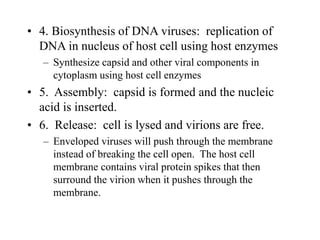
• 4. Biosynthesis of DNA viruses: replication of
DNA in nucleus of host cell using host enzymes
– Synthesize capsid and other viral components in
cytoplasm using host cell enzymes
• 5. Assembly: capsid is formed and the nucleic
acid is inserted.
• 6. Release: cell is lysed and virions are free.
– Enveloped viruses will push through the membrane
instead of breaking the cell open. The host cell
membrane contains viral protein spikes that then
surround the virion when it pushes through the
membrane.
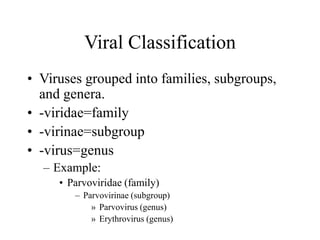
Viral Classification
• Viruses grouped into families, subgroups,
and genera.
• -viridae=family
• -virinae=subgroup
• -virus=genus
– Example:
• Parvoviridae (family)
– Parvovirinae (subgroup)
» Parvovirus (genus)
» Erythrovirus (genus)
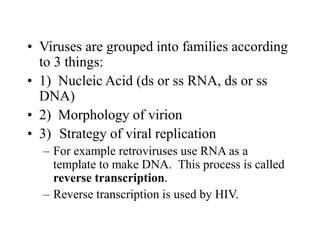
• Viruses are grouped into families according
to 3 things:
• 1) Nucleic Acid (ds or ss RNA, ds or ss
DNA)
• 2) Morphology of virion
• 3) Strategy of viral replication
– For example retroviruses use RNA as a
template to make DNA. This process is called
reverse transcription.
– Reverse transcription is used by HIV.
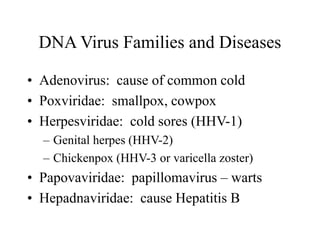
DNA Virus Families and Diseases
• Adenovirus: cause of common cold
• Poxviridae: smallpox, cowpox
• Herpesviridae: cold sores (HHV-1)
– Genital herpes (HHV-2)
– Chickenpox (HHV-3 or varicella zoster)
• Papovaviridae: papillomavirus – warts
• Hepadnaviridae: cause Hepatitis B
RNA Virus Families and Diseases
• Picornaviridae: causes polio
• Togaviridae: West Nile Encephalitis
• Rhabdoviridae: rabies
• Reoviridae: cause respiratory and intestinal
tract infections
• Retroviridae: HIV

Virology.ppt

  • 1.
  • 2.
    Properties of Viruses •Contain a single type of nucleic acid, either DNA or RNA, not both. The DNA and RNA can either be double stranded (ds) or single stranded (ss) depending upon the virus. • Surrounded by a protein coat called a capsid. – Capsids made up of smaller units called capsomeres. • Some are enveloped, meaning that the capsid is surrounded by another layer made up of lipids, proteins, and carbohydrates. – Only animal viruses have envelopes. Animal viruses are viruses capable of infecting humans as opposed to phages, which infect bacteria.
  • 3.
    – Some envelopedviruses may be covered in “spikes”. Spikes are protein or carbohydrate complexes used for attachment to the target cell. – Spikes can mutate and then the virus can reinfect the same individual. Influenza virus is an example of a virus that does this. • Viruses multiply inside living cells using cell machinery to replicate nucleic acid and make proteins. • Viruses cause synthesis of specialized structures that can transfer viral nucleic acid to other cells
  • 4.
    General Morphology • Thereare some general shapes that animal viruses tend to have. • Helical: see figure 6.5 for a great description of this structure. • Polyhedral: has multiple sides. An example of a polyhedral shape is icosahedral. • Complex virus: this is a virus that does not fit into one of the above categories. An example of this kind of virus would be a bacteriophage
  • 5.
    • Virion: Avirion is a complete, fully developed, infectious viral particle. • Host Range: Each virus has a different host range. The host range is the number of different host cells a virus can infect. – The attachment proteins on the outside of the virus determine the host range for a virus. If they are compatible with proteins on the host cell membrane found on many cells then the host range will be large. If the viral proteins are only compatible with a protein found on a few host cell membranes then the host range will be small.
  • 6.
    Cultivation • Since virusesare obligate intracellular pathogens tissue cultures have to be grown in order to cultivate viral particles. – Tissue cultures are started with small tissue samples of organs that viruses are known to infect, such as kidney or lung cells. • Primary cell line: The initial tissue sample that is used to start a tissue culture, derived from tissue slices is called the primary cell line. – Generally tissue samples last only a few generations.
  • 7.
    • Continuous celllines: transformed, or altered, cells (cancerous) can be maintained through an indefinite number of generations. Essentially a cancerous cell is one in which the programmed cell death response has been turned off. The cell will grow and divide indefinitely. • Cytopathic effect: When tissue cultures are grown, the cells grow in a single layer, called a monolayer, on the bottom of a plastic flask. When the tissue monolayer is infected with a virus it will cause cell deterioration. The changes in the appearance of the cells and the monolayer as a whole are called cytopathic effects. The changes in the cells and monolayer can be used for diagnosis for some viruses because they will create a distinct change. – For example, RSV (respiratory syncytial virus) causes the infected cells to join together forming large cells with many nuclei.
  • 8.
    Multiplication of AnimalViruses • Use Fig. 6.11 in your textbook. • 1. Attachment (adsorption): attachment proteins on the virus attach to receptor sites on host cells. – Attachment is complete when multiple sites have been bound by viral particles. • 2. Penetration: endocytosis or fusion with plasma membrane. The virus is engulfed into the cell. • 3. Uncoating: separation of viral nucleic acid from capsid (and envelope if the virus has an envelope). – Controlled by enzymes inside the host cell or inside the virus itself.
  • 9.
    • 4. Biosynthesisof DNA viruses: replication of DNA in nucleus of host cell using host enzymes – Synthesize capsid and other viral components in cytoplasm using host cell enzymes • 5. Assembly: capsid is formed and the nucleic acid is inserted. • 6. Release: cell is lysed and virions are free. – Enveloped viruses will push through the membrane instead of breaking the cell open. The host cell membrane contains viral protein spikes that then surround the virion when it pushes through the membrane.
  • 10.
    Viral Classification • Virusesgrouped into families, subgroups, and genera. • -viridae=family • -virinae=subgroup • -virus=genus – Example: • Parvoviridae (family) – Parvovirinae (subgroup) » Parvovirus (genus) » Erythrovirus (genus)
  • 11.
    • Viruses aregrouped into families according to 3 things: • 1) Nucleic Acid (ds or ss RNA, ds or ss DNA) • 2) Morphology of virion • 3) Strategy of viral replication – For example retroviruses use RNA as a template to make DNA. This process is called reverse transcription. – Reverse transcription is used by HIV.
  • 12.
    DNA Virus Familiesand Diseases • Adenovirus: cause of common cold • Poxviridae: smallpox, cowpox • Herpesviridae: cold sores (HHV-1) – Genital herpes (HHV-2) – Chickenpox (HHV-3 or varicella zoster) • Papovaviridae: papillomavirus – warts • Hepadnaviridae: cause Hepatitis B
  • 13.
    RNA Virus Familiesand Diseases • Picornaviridae: causes polio • Togaviridae: West Nile Encephalitis • Rhabdoviridae: rabies • Reoviridae: cause respiratory and intestinal tract infections • Retroviridae: HIV