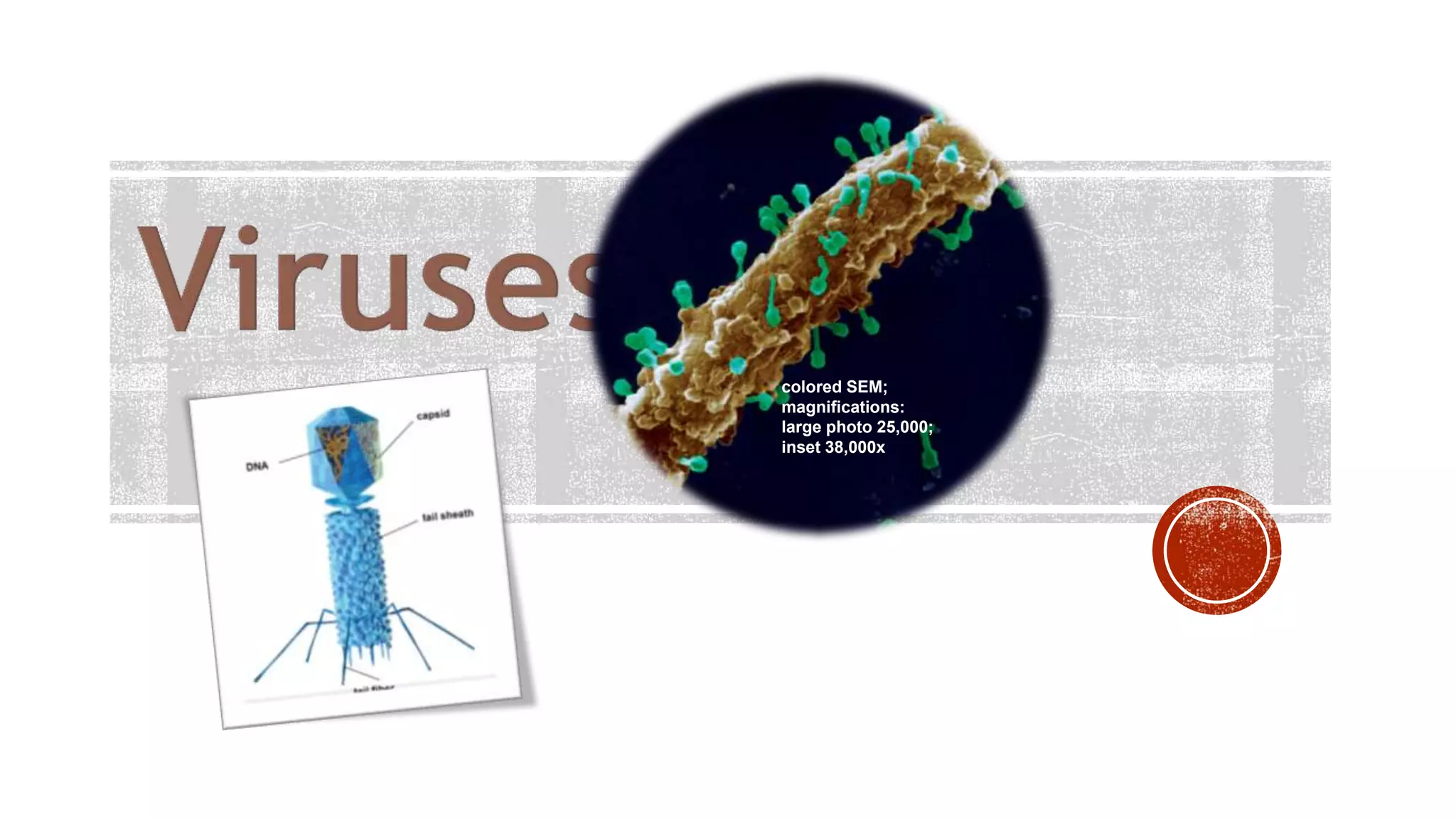
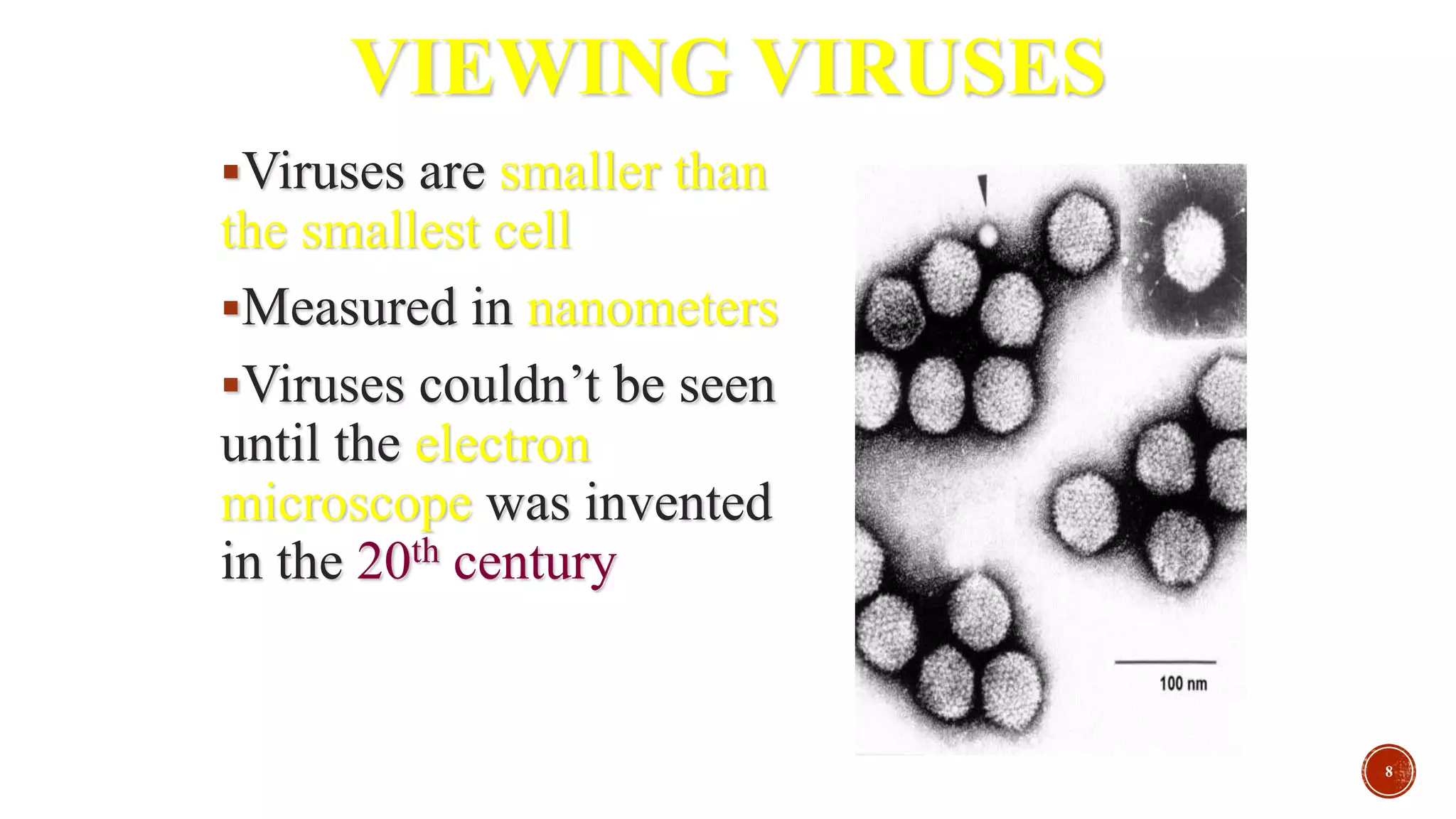
colored SEM;
magnifications:
large photo 25,000;
inset 38,000x
T4 phage
 M13 (General properties and structure,classification,reproduction)
 Retrovirus
 Herpes simplex virus (Classification, reproduction )
Cytocidal infection and cell damage
 TMV (Morphology, taxonomy, and reproduction)

WHAT ARE
VIRUSES?
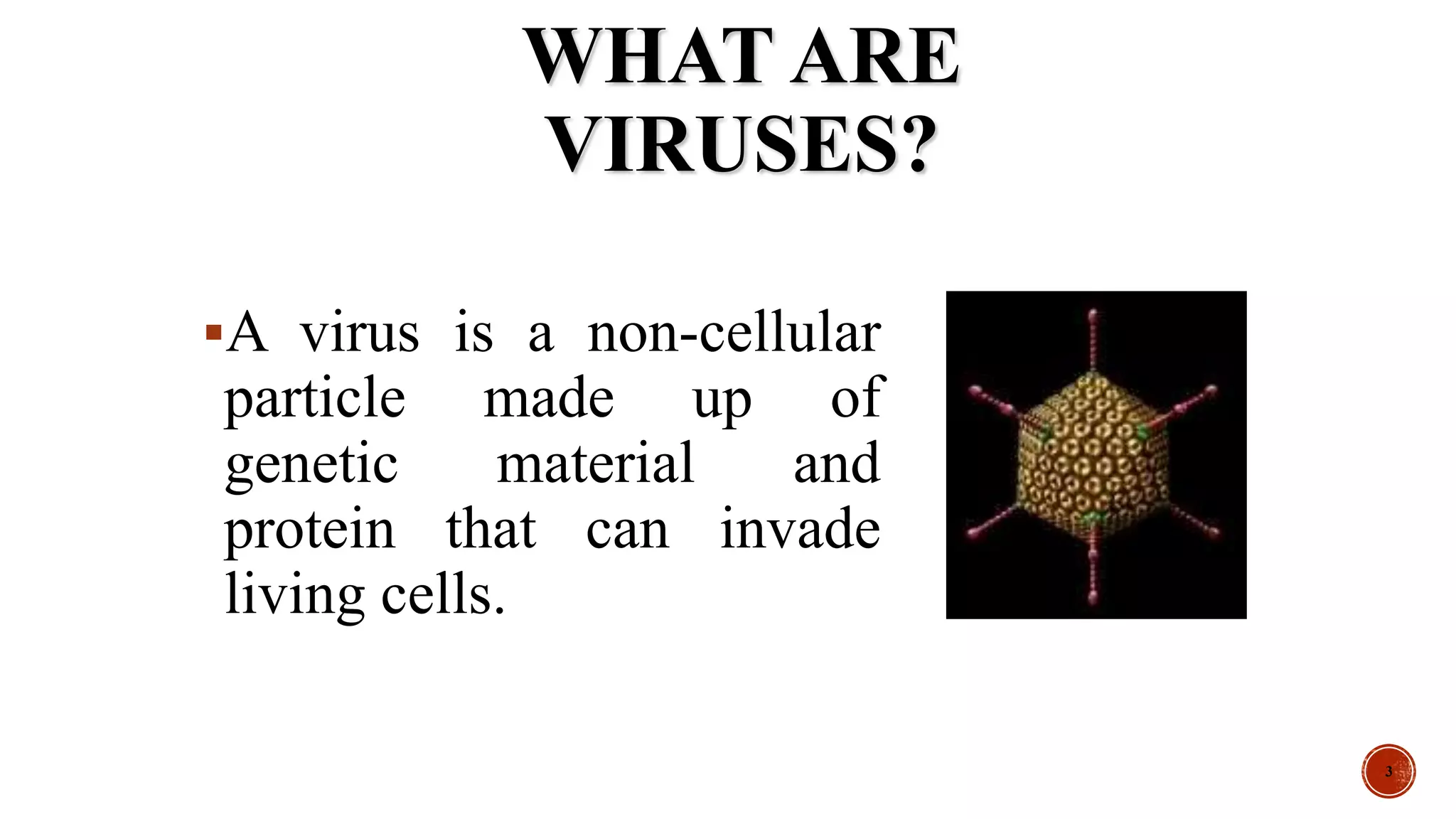
A virus is a non-cellular
particle made up of
genetic material and
protein that can invade
living cells.
3
VIRAL HISTORY
copyright cmassengale
4
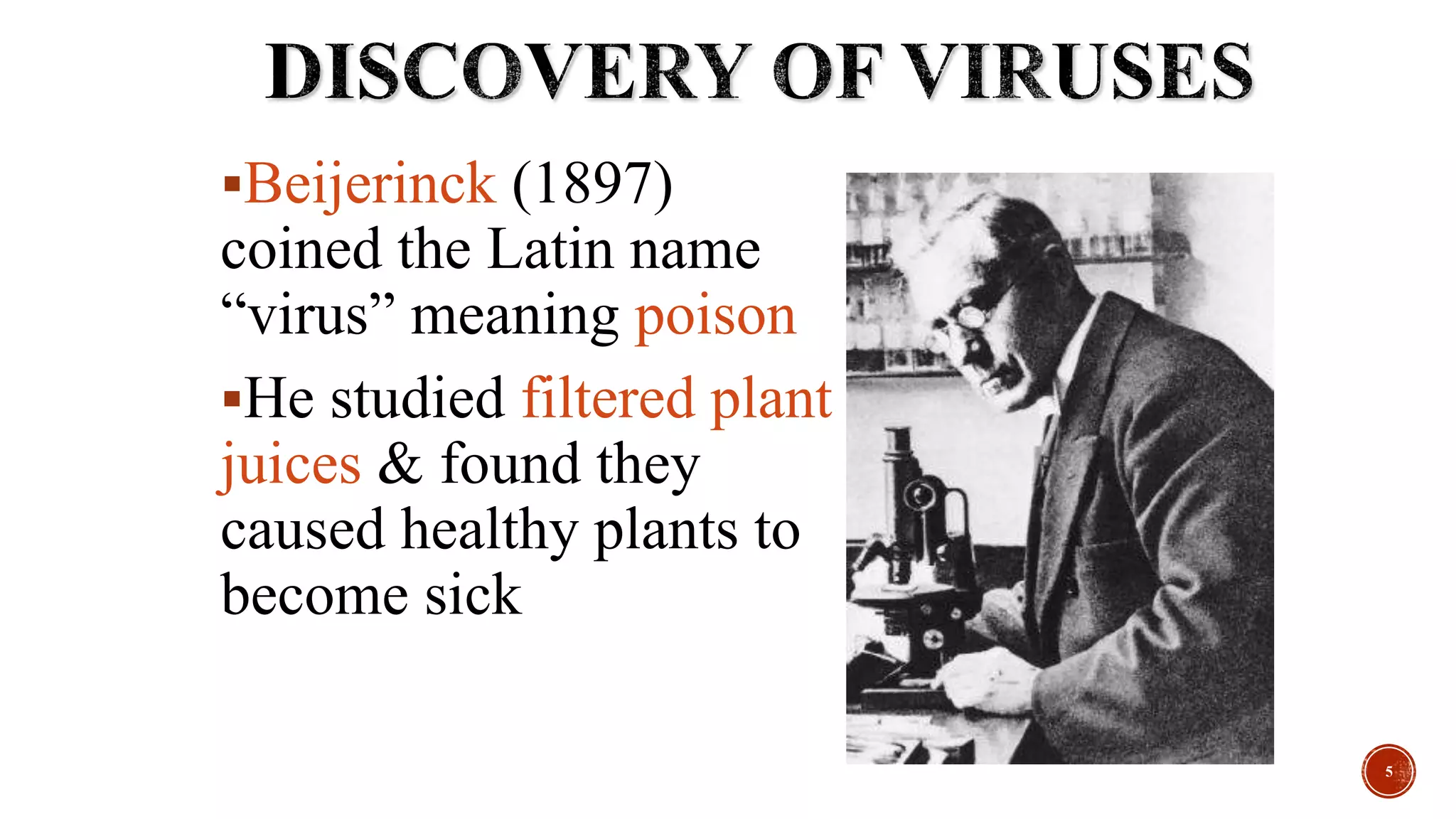
Beijerinck (1897)
coined the Latin name
“virus” meaning poison
He studied filtered plant
juices & found they
caused healthy plants to
become sick
copyright cmassengale 5
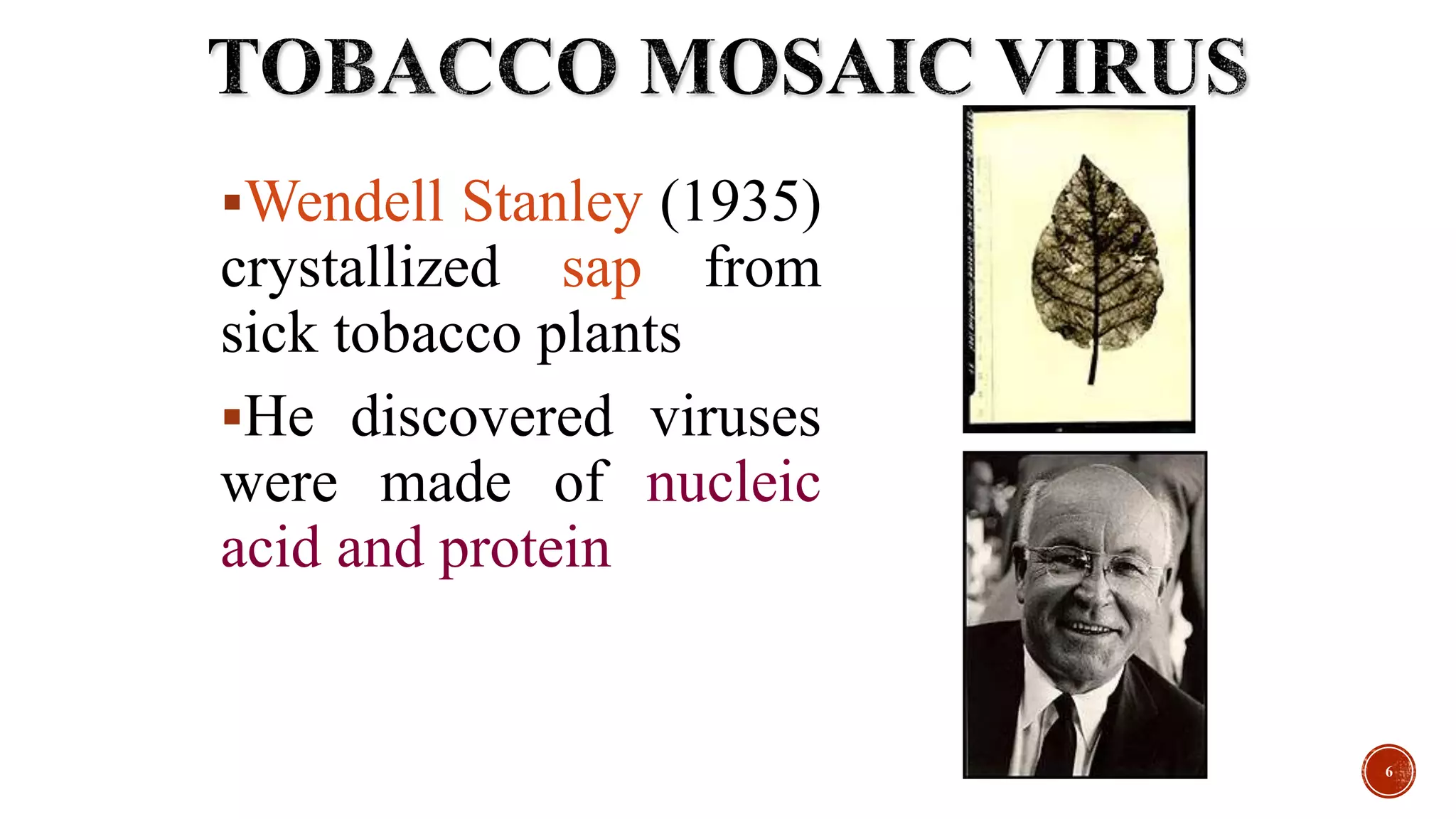
Wendell Stanley (1935)
crystallized sap from
sick tobacco plants
He discovered viruses
were made of nucleic
acid and protein
copyright cmassengale 6
Edward Jenner (1796)
developed a smallpox
vaccine using milder
cowpox viruses
Deadly viruses are said to
be virulent
Smallpox has been
eradicated in the world
today
copyright cmassengale 7
VIEWING VIRUSES
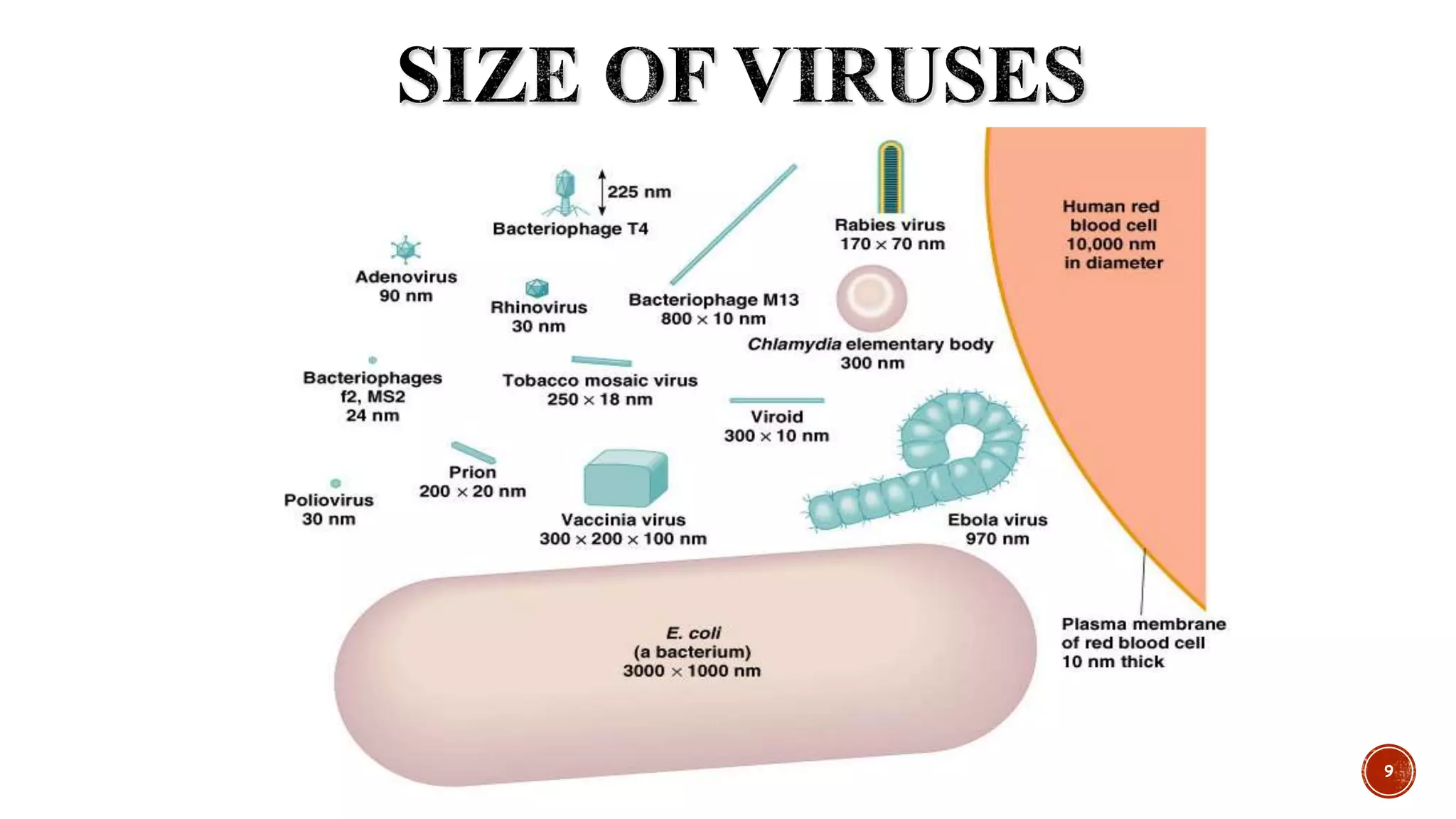
Viruses are smaller than
the smallest cell
Measured in nanometers
Viruses couldn’t be seen
until the electron
microscope was invented
in the 20th century
copyright cmassengale 8
copyright cmassengale 9
VIRAL
STRUCTURE
copyright cmassengale
10
Non living structures
Noncellular
Contain a protein coat called the capsid
Have a nucleic acid core containing DNA or
RNA
Capable of reproducing only when inside a
HOST cell
copyright cmassengale 11
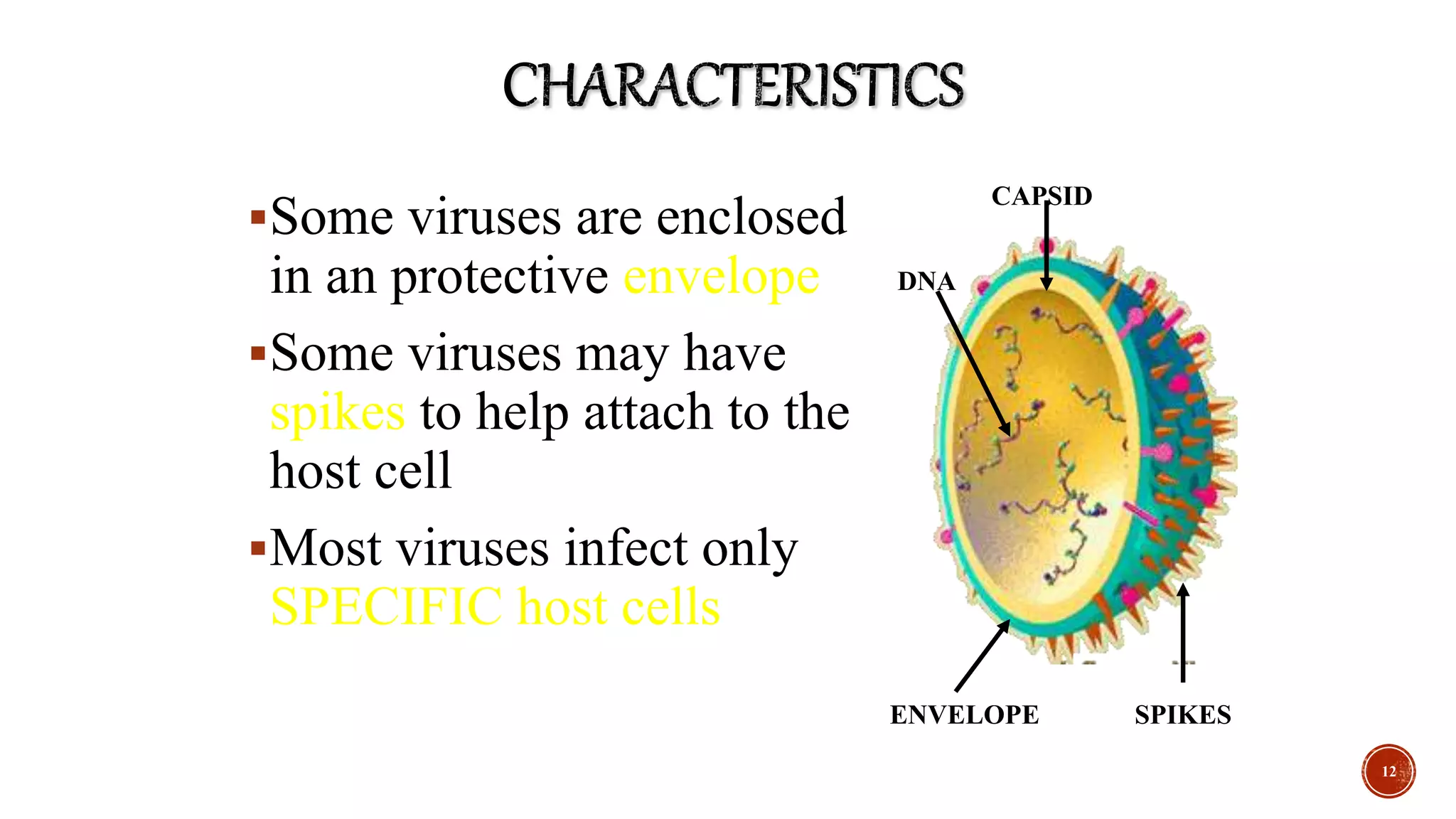
Some viruses are enclosed
in an protective envelope
Some viruses may have
spikes to help attach to the
host cell
Most viruses infect only
SPECIFIC host cells
copyright cmassengale 12
CAPSID
ENVELOPE
DNA
SPIKES
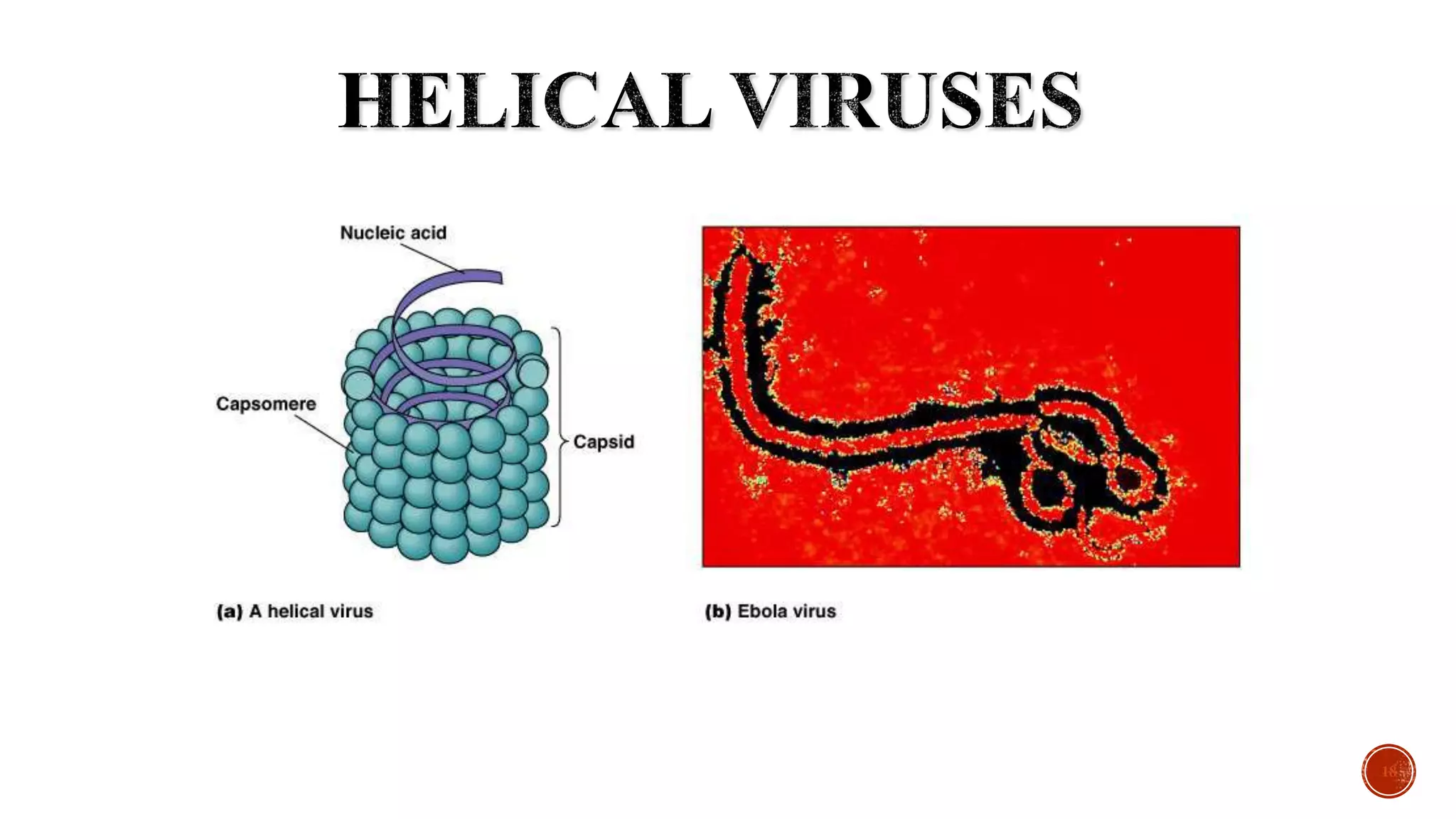
Viral capsids (coats)
are made of
individual protein
subunits
Individual subunits
are called
capsomeres
copyright cmassengale 13
CAPSOMERES
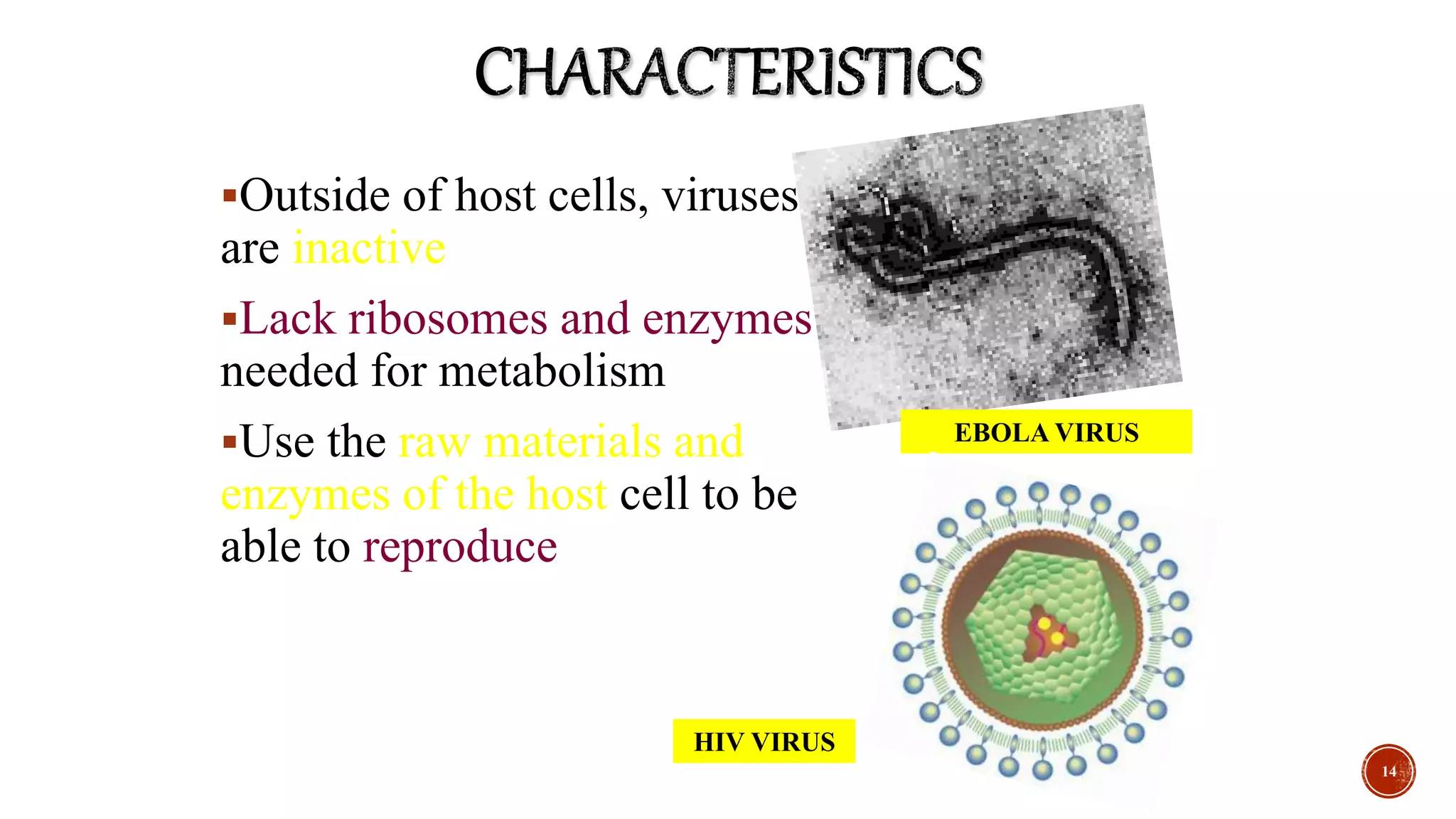
Outside of host cells, viruses
are inactive
Lack ribosomes and enzymes
needed for metabolism
Use the raw materials and
enzymes of the host cell to be
able to reproduce
copyright cmassengale 14
EBOLA VIRUS
HIV VIRUS
capsid nucleic acid
lipid
envelope
surface
proteins
capsid
nucleic acid
lipid envelope
Surface proteins capsidsurface
proteins
nucleic acid
helical
(rabies)
polyhedral
(foot-and-mouth
disease)
enveloped
(influenza)
CHARACTERISTICS
•Some viruses cause disease
•Smallpox, measles,
mononucleosis, influenza,
colds, warts, AIDS, Ebola
•Some viruses may cause some
cancers like leukemia
•Virus-free cells are rare
copyright cmassengale 16
MEASLES
•Viruses come in a variety of shapes
•Some may be helical shape like the
Ebola virus
•Some may be polyhedral shapes
like the influenza virus
•Others have more complex shapes
like bacteriophages
copyright cmassengale 17
18
19
20-sided with 12 corners
Vary in the number of
capsomers
Each capsomer may be
made of 1 or several
proteins
Some are enveloped
20
21
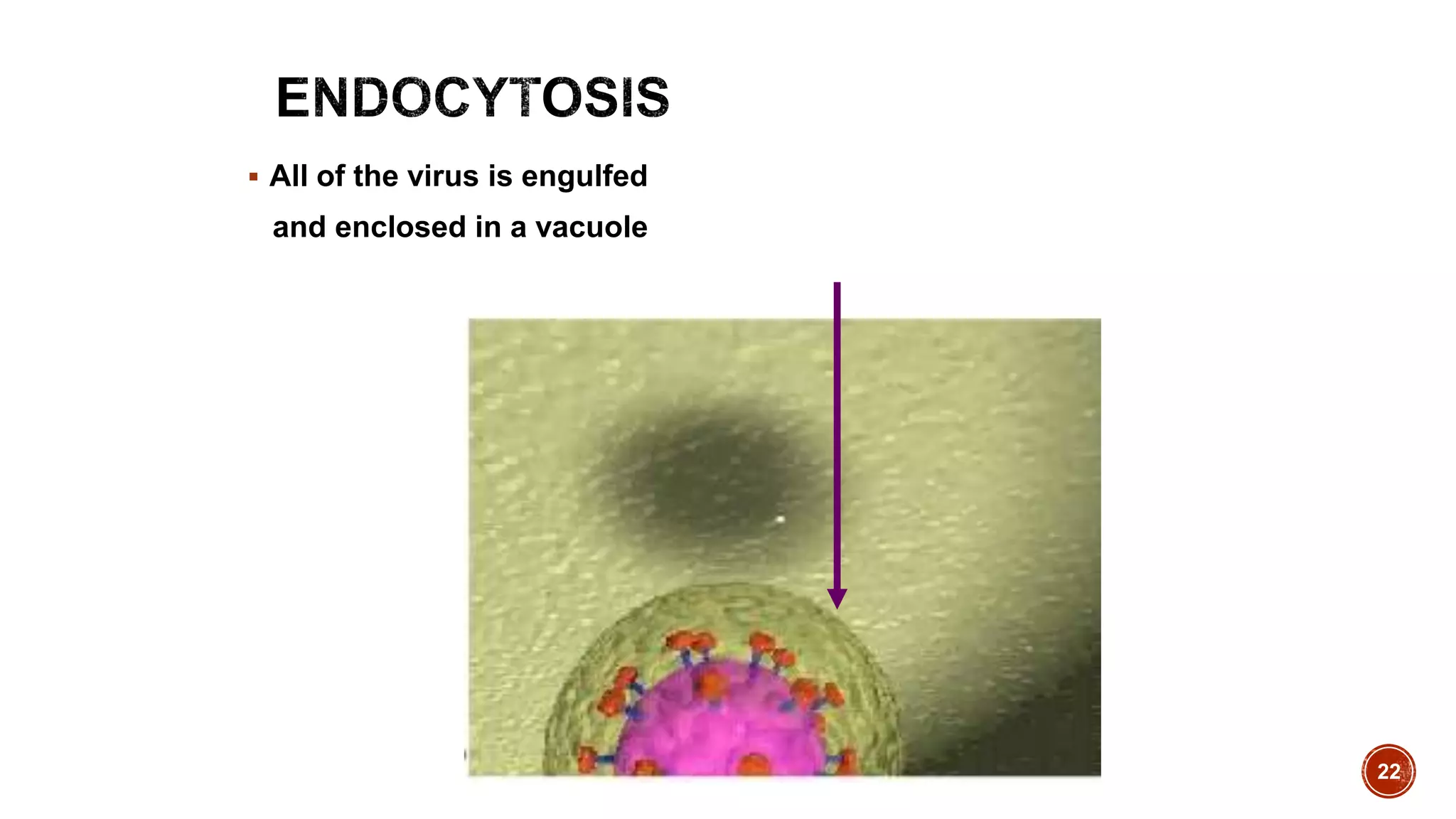
 Viral entry into host cells occurs through one of the following
methods:
Endocytosis
Direct fusion
Nucleic acid translocation
22
 All of the virus is engulfed
and enclosed in a vacuole
23
 Host cell membrane fuses with the virus
24
Non enveloped virus injecting its
nucleic acid to the host cell
Viruses are obligate intracellular parasites, which
means they can replicate only within a host cell
Each virus has a host range, a limited number of
host cells that it can infect
© 2011 Pearson Education, Inc.
Once a viral genome has entered a cell, the cell
begins to manufacture viral proteins
The virus makes use of host enzymes, ribosomes,
tRNAs, amino acids, ATP, and other molecules
Viral nucleic acid molecules and capsomeres
spontaneously self-assemble into new viruses
© 2011 Pearson Education, Inc.
VIRUS
2
1
3
4
Entry and
uncoating
Replication
Transcription
and manufacture of
capsid proteins
Self-assembly of
new virus particles
and their exit from
the cell
DNA
Capsid
HOST
CELL
Viral DNA
Viral
DNA
mRNA
Capsid
proteins
Phages are the best understood of all viruses
Phages have two reproductive mechanisms: the
lytic cycle and the lysogenic cycle
© 2011 Pearson Education, Inc.
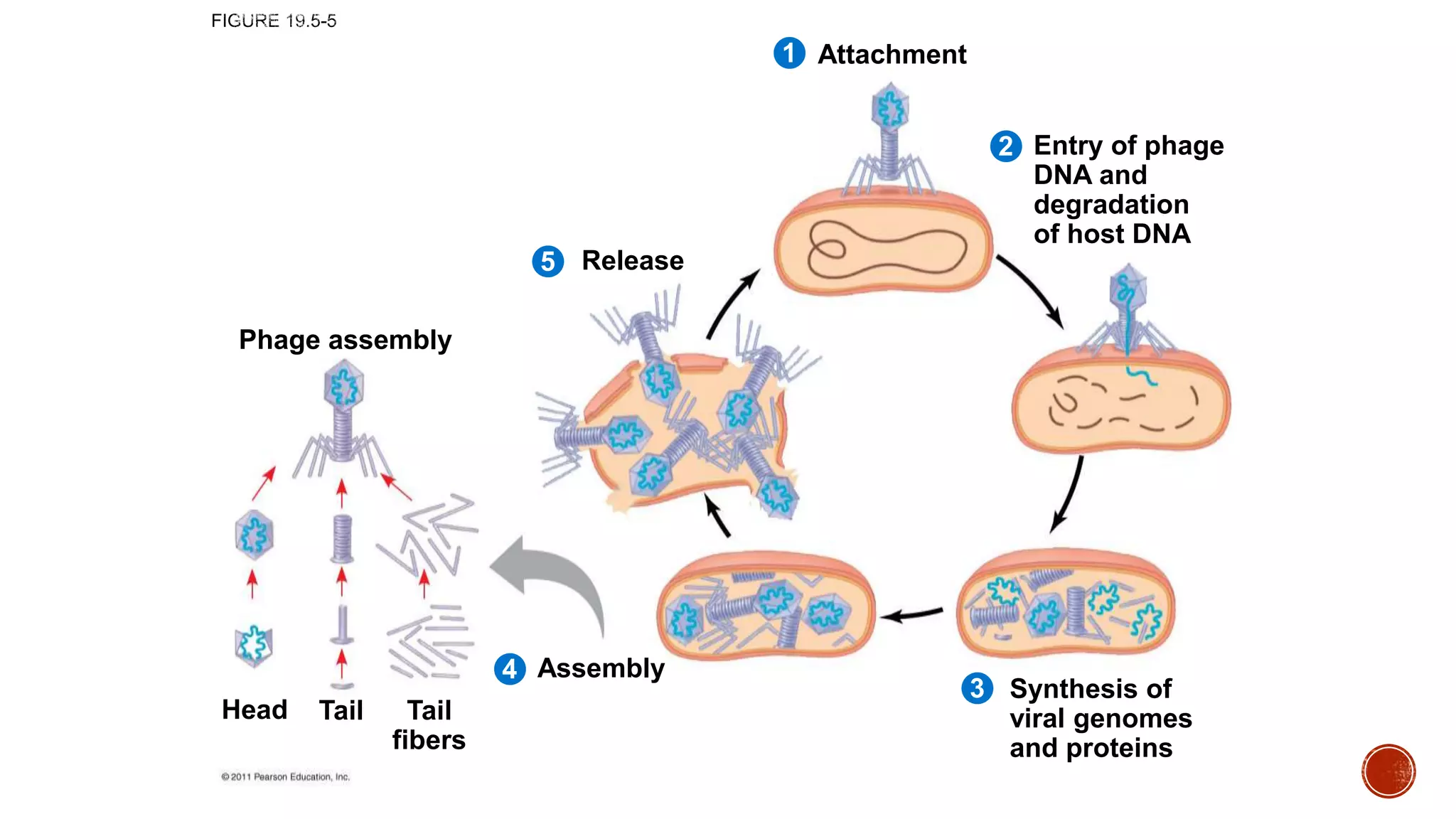
The lytic cycle is a phage replicative cycle that
culminates in the death of the host cell
The lytic cycle produces new phages and lyses
(breaks open) the host’s cell wall, releasing the
progeny viruses
A phage that reproduces only by the lytic cycle is
called a virulent phage
Bacteria have defenses against phages, including
restriction enzymes that recognize and cut up
certain phage DNA
© 2011 Pearson Education, Inc.
Animation: Phage T4 Lytic Cycle
Attachment1
Attachment
2
1
Entry of phage
DNA and
degradation
of host DNA
Attachment
2
1
3
Entry of phage
DNA and
degradation
of host DNA
Synthesis of
viral genomes
and proteins
Attachment
2
1
4
3
Entry of phage
DNA and
degradation
of host DNA
Synthesis of
viral genomes
and proteins
Assembly
Phage assembly
Head Tail Tail
fibers
Attachment
2
1
5
4
3
Entry of phage
DNA and
degradation
of host DNA
Release
Synthesis of
viral genomes
and proteins
Assembly
Phage assembly
Head Tail Tail
fibers
The lysogenic cycle replicates the phage genome
without destroying the host
The viral DNA molecule is incorporated into the
host cell’s chromosome
This integrated viral DNA is known as a prophage
Every time the host divides, it copies the phage
DNA and passes the copies to daughter cells
© 2011 Pearson Education, Inc.
Animation: Phage Lambda Lysogenic and Lytic Cycles
An environmental signal can trigger the virus
genome to exit the bacterial chromosome and
switch to the lytic mode
Phages that use both the lytic and lysogenic cycles
are called temperate phages
© 2011 Pearson Education, Inc.
lytic cycle
is induced
or
Phage DNA
circularizes.
Certain factors
determine whether
lysogenic cycle
is entered
Lysogenic cycle
Prophage
Daughter cell
with prophage
Occasionally, a prophage
exits the bacterial chromosome,
initiating a lytic cycle.
Cell divisions
produce a
population of
bacteria infected
with the prophage.
The bacterium reproduces,
copying the prophage and
transmitting it to daughter
cells.
Phage DNA integrates into
the bacterial chromosome,
becoming a prophage.
New phage DNA and proteins
are synthesized and assembled
into phages.
The cell lyses, releasing phages.
Phage
Phage
DNA
The phage
injects its DNA.
Bacterial
chromosome
Lytic cycle
lytic cycle
is induced
or
Phage DNA
circularizes.
Certain factors
determine whether
lysogenic cycle
is entered
Lysogenic cycle
Prophage
Daughter cell
with prophage
Occasionally, a prophage
exits the bacterial chromosome,
initiating a lytic cycle.
Cell divisions
produce a
population of
bacteria infected
with the prophage.
The bacterium reproduces,
copying the prophage and
transmitting it to daughter
cells.
Phage DNA integrates into
the bacterial chromosome,
becoming a prophage.
The lytic cycle of the bacteriophage: a lunar analogy
Lytic Cycle Lysogenic Cycle
The lytic cycle causes the host bacterium to undergo
cell lysis, that is, cell destruction.
The lysogenic cycle does not cause cell lysis or cell
destruction.
The lytic cycle can lead to production of 100 to 200
progeny phages.
The DNA of the phage gets integrated into the
bacterial chromosome and no progeny are produced
mostly.
Lytic cycle cannot be converted into the lysogenic
cycle.
Lysogenic cycle can be converted into lysogenic cycle
when the host cell is exposed to chemical or physical
agents.
TAXONOMY OF
VIRUSES
40
Family names end in -viridae
Genus names end in -virus
Viral species: A group of viruses sharing the
same genetic information and ecological niche
(host).
 Common names are used for species
Subspecies are designated by a number
copyright cmassengale 41
Herpesviridae
Herpesvirus
Human herpes virus 1, HHV 2, HHV 3
Retroviridae
Lentivirus
Human Immunodeficiency Virus 1, HIV 2
copyright cmassengale 42
copyright cmassengale 43
COMMON COLD
 Smaller than viruses
 Strands or circles of RNA
 No protein-coding genes
 No protein coat
 Cause many plant diseases
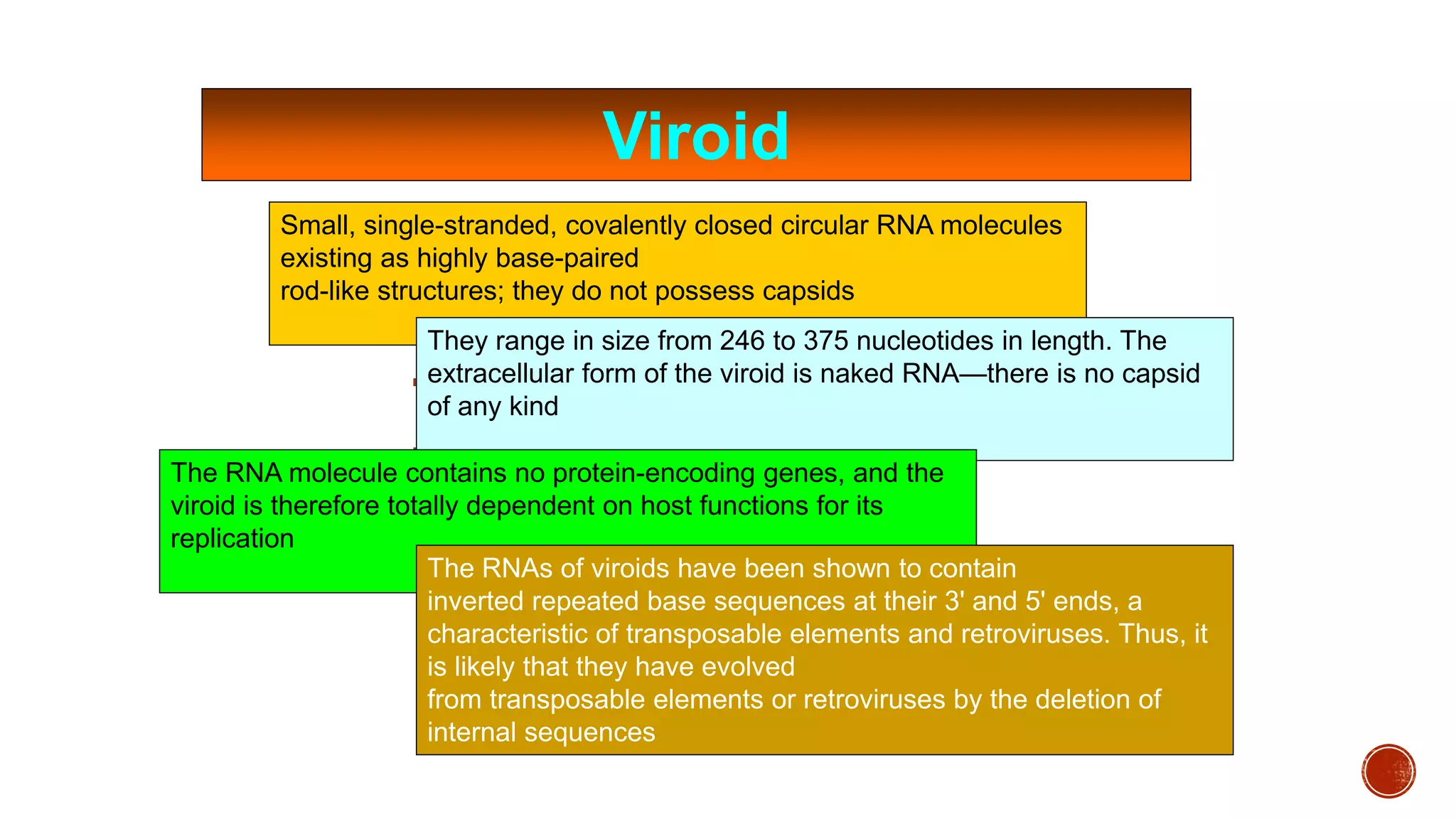
Viroid
Small, single-stranded, covalently closed circular RNA molecules
existing as highly base-paired
rod-like structures; they do not possess capsids
They range in size from 246 to 375 nucleotides in length. The
extracellular form of the viroid is naked RNA—there is no capsid
of any kind
The RNA molecule contains no protein-encoding genes, and the
viroid is therefore totally dependent on host functions for its
replication
The RNAs of viroids have been shown to contain
inverted repeated base sequences at their 3' and 5' ends, a
characteristic of transposable elements and retroviruses. Thus, it
is likely that they have evolved
from transposable elements or retroviruses by the deletion of
internal sequences
44
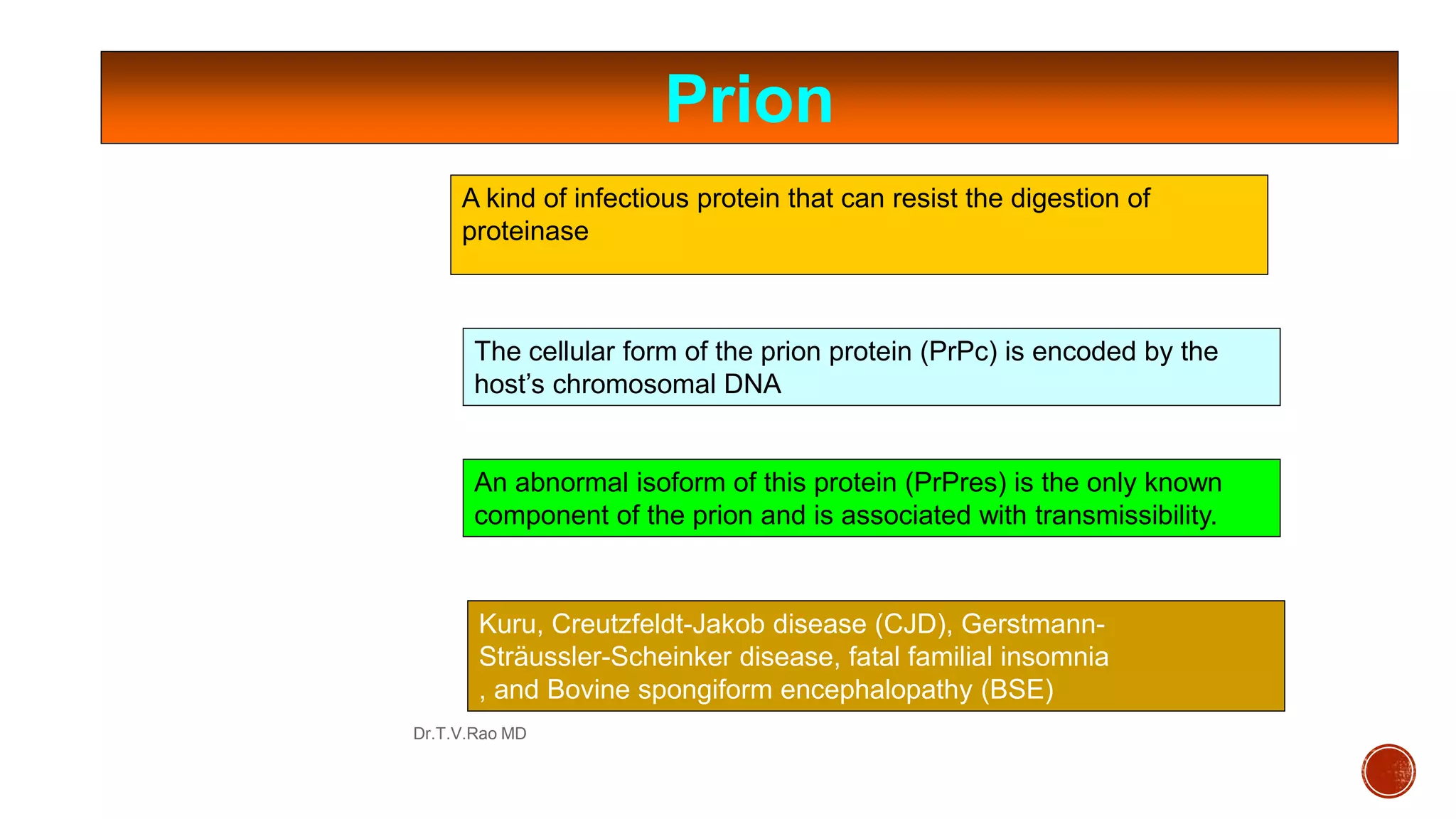
Prion
A kind of infectious protein that can resist the digestion of
proteinase
The cellular form of the prion protein (PrPc) is encoded by the
host’s chromosomal DNA
An abnormal isoform of this protein (PrPres) is the only known
component of the prion and is associated with transmissibility.
Kuru, Creutzfeldt-Jakob disease (CJD), Gerstmann-
Sträussler-Scheinker disease, fatal familial insomnia
, and Bovine spongiform encephalopathy (BSE)
Dr.T.V.Rao MD 45
•RNA or DNA Virus
•Do or do NOT have an envelope
•Capsid shape
•HOST they infect
copyright cmassengale 46

Viruses-size,shape & types

  • 1.
  • 2.
    T4 phage  M13(General properties and structure,classification,reproduction)  Retrovirus  Herpes simplex virus (Classification, reproduction ) Cytocidal infection and cell damage  TMV (Morphology, taxonomy, and reproduction) 
  • 3.
    WHAT ARE VIRUSES? A virusis a non-cellular particle made up of genetic material and protein that can invade living cells. 3
  • 4.
  • 5.
    Beijerinck (1897) coined theLatin name “virus” meaning poison He studied filtered plant juices & found they caused healthy plants to become sick copyright cmassengale 5
  • 6.
    Wendell Stanley (1935) crystallizedsap from sick tobacco plants He discovered viruses were made of nucleic acid and protein copyright cmassengale 6
  • 7.
    Edward Jenner (1796) developeda smallpox vaccine using milder cowpox viruses Deadly viruses are said to be virulent Smallpox has been eradicated in the world today copyright cmassengale 7
  • 8.
    VIEWING VIRUSES Viruses aresmaller than the smallest cell Measured in nanometers Viruses couldn’t be seen until the electron microscope was invented in the 20th century copyright cmassengale 8
  • 9.
  • 10.
  • 11.
    Non living structures Noncellular Containa protein coat called the capsid Have a nucleic acid core containing DNA or RNA Capable of reproducing only when inside a HOST cell copyright cmassengale 11
  • 12.
    Some viruses areenclosed in an protective envelope Some viruses may have spikes to help attach to the host cell Most viruses infect only SPECIFIC host cells copyright cmassengale 12 CAPSID ENVELOPE DNA SPIKES
  • 13.
    Viral capsids (coats) aremade of individual protein subunits Individual subunits are called capsomeres copyright cmassengale 13 CAPSOMERES
  • 14.
    Outside of hostcells, viruses are inactive Lack ribosomes and enzymes needed for metabolism Use the raw materials and enzymes of the host cell to be able to reproduce copyright cmassengale 14 EBOLA VIRUS HIV VIRUS
  • 15.
    capsid nucleic acid lipid envelope surface proteins capsid nucleicacid lipid envelope Surface proteins capsidsurface proteins nucleic acid helical (rabies) polyhedral (foot-and-mouth disease) enveloped (influenza)
  • 16.
    CHARACTERISTICS •Some viruses causedisease •Smallpox, measles, mononucleosis, influenza, colds, warts, AIDS, Ebola •Some viruses may cause some cancers like leukemia •Virus-free cells are rare copyright cmassengale 16 MEASLES
  • 17.
    •Viruses come ina variety of shapes •Some may be helical shape like the Ebola virus •Some may be polyhedral shapes like the influenza virus •Others have more complex shapes like bacteriophages copyright cmassengale 17
  • 18.
  • 19.
    19 20-sided with 12corners Vary in the number of capsomers Each capsomer may be made of 1 or several proteins Some are enveloped
  • 20.
  • 21.
    21  Viral entryinto host cells occurs through one of the following methods: Endocytosis Direct fusion Nucleic acid translocation
  • 22.
    22  All ofthe virus is engulfed and enclosed in a vacuole
  • 23.
    23  Host cellmembrane fuses with the virus
  • 24.
    24 Non enveloped virusinjecting its nucleic acid to the host cell
  • 25.
    Viruses are obligateintracellular parasites, which means they can replicate only within a host cell Each virus has a host range, a limited number of host cells that it can infect © 2011 Pearson Education, Inc.
  • 26.
    Once a viralgenome has entered a cell, the cell begins to manufacture viral proteins The virus makes use of host enzymes, ribosomes, tRNAs, amino acids, ATP, and other molecules Viral nucleic acid molecules and capsomeres spontaneously self-assemble into new viruses © 2011 Pearson Education, Inc.
  • 27.
    VIRUS 2 1 3 4 Entry and uncoating Replication Transcription and manufactureof capsid proteins Self-assembly of new virus particles and their exit from the cell DNA Capsid HOST CELL Viral DNA Viral DNA mRNA Capsid proteins
  • 28.
    Phages are thebest understood of all viruses Phages have two reproductive mechanisms: the lytic cycle and the lysogenic cycle © 2011 Pearson Education, Inc.
  • 29.
    The lytic cycleis a phage replicative cycle that culminates in the death of the host cell The lytic cycle produces new phages and lyses (breaks open) the host’s cell wall, releasing the progeny viruses A phage that reproduces only by the lytic cycle is called a virulent phage Bacteria have defenses against phages, including restriction enzymes that recognize and cut up certain phage DNA © 2011 Pearson Education, Inc. Animation: Phage T4 Lytic Cycle
  • 30.
  • 31.
    Attachment 2 1 Entry of phage DNAand degradation of host DNA
  • 32.
    Attachment 2 1 3 Entry of phage DNAand degradation of host DNA Synthesis of viral genomes and proteins
  • 33.
    Attachment 2 1 4 3 Entry of phage DNAand degradation of host DNA Synthesis of viral genomes and proteins Assembly Phage assembly Head Tail Tail fibers
  • 34.
    Attachment 2 1 5 4 3 Entry of phage DNAand degradation of host DNA Release Synthesis of viral genomes and proteins Assembly Phage assembly Head Tail Tail fibers
  • 35.
    The lysogenic cyclereplicates the phage genome without destroying the host The viral DNA molecule is incorporated into the host cell’s chromosome This integrated viral DNA is known as a prophage Every time the host divides, it copies the phage DNA and passes the copies to daughter cells © 2011 Pearson Education, Inc. Animation: Phage Lambda Lysogenic and Lytic Cycles
  • 36.
    An environmental signalcan trigger the virus genome to exit the bacterial chromosome and switch to the lytic mode Phages that use both the lytic and lysogenic cycles are called temperate phages © 2011 Pearson Education, Inc.
  • 37.
    lytic cycle is induced or PhageDNA circularizes. Certain factors determine whether lysogenic cycle is entered Lysogenic cycle Prophage Daughter cell with prophage Occasionally, a prophage exits the bacterial chromosome, initiating a lytic cycle. Cell divisions produce a population of bacteria infected with the prophage. The bacterium reproduces, copying the prophage and transmitting it to daughter cells. Phage DNA integrates into the bacterial chromosome, becoming a prophage.
  • 38.
    New phage DNAand proteins are synthesized and assembled into phages. The cell lyses, releasing phages. Phage Phage DNA The phage injects its DNA. Bacterial chromosome Lytic cycle lytic cycle is induced or Phage DNA circularizes. Certain factors determine whether lysogenic cycle is entered Lysogenic cycle Prophage Daughter cell with prophage Occasionally, a prophage exits the bacterial chromosome, initiating a lytic cycle. Cell divisions produce a population of bacteria infected with the prophage. The bacterium reproduces, copying the prophage and transmitting it to daughter cells. Phage DNA integrates into the bacterial chromosome, becoming a prophage.
  • 39.
    The lytic cycleof the bacteriophage: a lunar analogy Lytic Cycle Lysogenic Cycle The lytic cycle causes the host bacterium to undergo cell lysis, that is, cell destruction. The lysogenic cycle does not cause cell lysis or cell destruction. The lytic cycle can lead to production of 100 to 200 progeny phages. The DNA of the phage gets integrated into the bacterial chromosome and no progeny are produced mostly. Lytic cycle cannot be converted into the lysogenic cycle. Lysogenic cycle can be converted into lysogenic cycle when the host cell is exposed to chemical or physical agents.
  • 40.
  • 41.
    Family names endin -viridae Genus names end in -virus Viral species: A group of viruses sharing the same genetic information and ecological niche (host).  Common names are used for species Subspecies are designated by a number copyright cmassengale 41
  • 42.
    Herpesviridae Herpesvirus Human herpes virus1, HHV 2, HHV 3 Retroviridae Lentivirus Human Immunodeficiency Virus 1, HIV 2 copyright cmassengale 42
  • 43.
  • 44.
     Smaller thanviruses  Strands or circles of RNA  No protein-coding genes  No protein coat  Cause many plant diseases Viroid Small, single-stranded, covalently closed circular RNA molecules existing as highly base-paired rod-like structures; they do not possess capsids They range in size from 246 to 375 nucleotides in length. The extracellular form of the viroid is naked RNA—there is no capsid of any kind The RNA molecule contains no protein-encoding genes, and the viroid is therefore totally dependent on host functions for its replication The RNAs of viroids have been shown to contain inverted repeated base sequences at their 3' and 5' ends, a characteristic of transposable elements and retroviruses. Thus, it is likely that they have evolved from transposable elements or retroviruses by the deletion of internal sequences 44
  • 45.
    Prion A kind ofinfectious protein that can resist the digestion of proteinase The cellular form of the prion protein (PrPc) is encoded by the host’s chromosomal DNA An abnormal isoform of this protein (PrPres) is the only known component of the prion and is associated with transmissibility. Kuru, Creutzfeldt-Jakob disease (CJD), Gerstmann- Sträussler-Scheinker disease, fatal familial insomnia , and Bovine spongiform encephalopathy (BSE) Dr.T.V.Rao MD 45
  • 46.
    •RNA or DNAVirus •Do or do NOT have an envelope •Capsid shape •HOST they infect copyright cmassengale 46