ď‚—Viruses are obligate intracellular

parasites
ď‚—They can only replicate in living
cells.
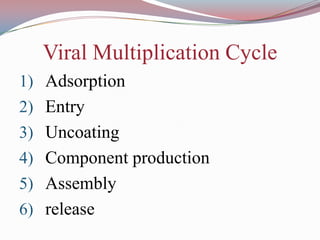
Viral Multiplication Cycle
1) Adsorption
2) Entry
3) Uncoating
4) Component production
5) Assembly
6) release
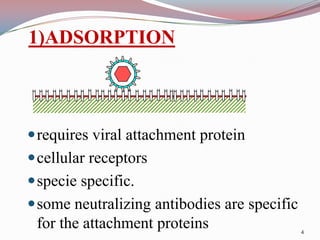
1)ADSORPTION

ď‚— requires viral attachment protein
ď‚— cellular receptors
ď‚— specie specific.
ď‚— some neutralizing antibodies are specific

for the attachment proteins

4
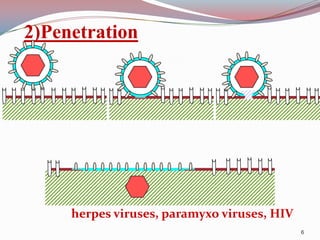
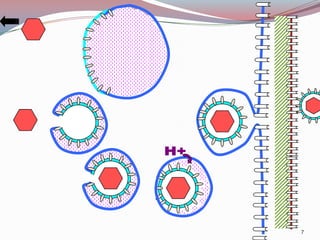
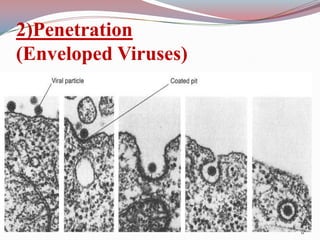
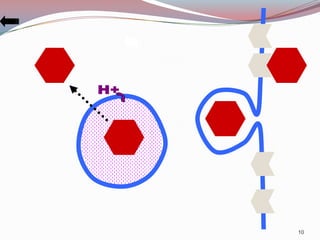
2)Penetration (enveloped viruses)
Either
• Fusion with plasma membrane
or
• Entry via endosomes, fusion with
acidic endosome membrane
2)Penetration

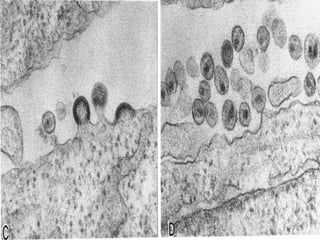
herpes viruses, paramyxo viruses, HIV
6
7
2)Penetration
(Enveloped Viruses)

8
2)Penetration (non enveloped)
ď‚—Only via

endosomes (endocytosis or
viropexis)
10
3)Uncoating & eclipse
ď‚—release of viral genome
ď‚—Viral particle can no more be

detected.
4)Synthesis of Viral Nucleic Acid
and Protein
ď‚—Nucleic acid may be made in the

nucleus or the cytoplasm
ď‚—Protein synthesis is always in the
cytoplasm
ď‚—Latent viruses.
12
Transcription/Translation/Synthes
is:
DNA viruses:
• replicate their DNA in host cell
nucleus. Exception - Poxviruses
• synthesize capsid and other
proteins in cytoplasm
Transcription, translation and
synthesis:
RNA viruses:
ď‚§ Most RNA viruses replicate in the
cytoplasm
ď‚§ Few exceptions e.g. Influenza virus,
retroviruses.
5)Assembly:
Takes place in cell nucleus,
cytoplasm or (with most
enveloped viruses) at the plasma
membrane
6)Release
Either
ď‚—Lysis
Or
ď‚—Budding through plasma membrane

16
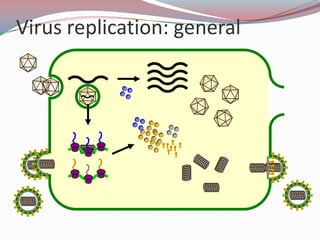
Virus replication: general
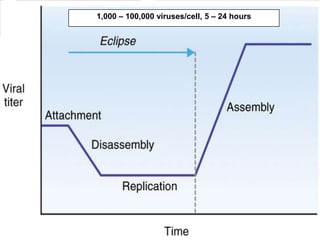
1,000 – 100,000 viruses/cell, 5 – 24 hours
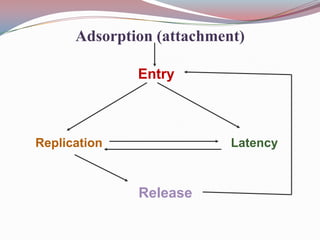
Adsorption (attachment)
Entry

Replication

Latency

Release

Viral multiplication