BACTERIAL
DISEASES


    Prepared by:
          Dr. Rea Corpuz
Bacterial Diseases

 (1) Syphillis

 (2) Tuberculosis

 (3) Leprosy

 (4) Actinomycosis

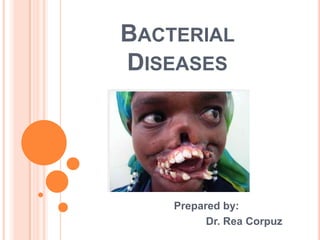
 (5) Cancrum Oris (NOMA)

 (6) Gonorrhea
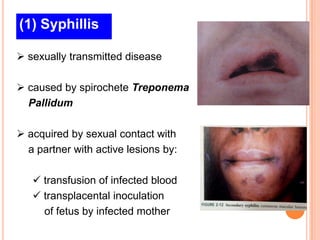
(1) Syphillis

 sexually transmitted disease

 caused by spirochete Treponema
  Pallidum

 acquired by sexual contact with
  a partner with active lesions by:

    transfusion of infected blood
    transplacental inoculation
     of fetus by infected mother
(1) Syphillis

 Pathogenesis

   when disease is spread
    through direct contact

   a hard ulcer, or chancre
   forms at site of spirochete

   later there is development
    of painless, non-suppurative
    regional lymphadenopathy
(1) Syphillis

 Pathogenesis

   chancre heals spontaneously
    after several weeks without
    treatment, leaving patient
    with no apparent signs of
    disease
(1) Syphillis

 Pathogenesis

   after a latent period of several
    weeks, secondary syphilis
    develops

     • patients infected via
       transfusion bypass primary
       stage & begin with
       secondary syphilis
(1) Syphillis

 Pathogenesis

   secondary syphilis

     • fever
     • flulike symptoms
     • mucucutaneous lesions
     • lymphadenopathy

     • stage resolves spontaneously,
     • patient enters latency period
(1) Syphillis

 Clinical Features

    Primary Phase

    Secondary Phase

    Tertiary Phase

    Congenital Phase
(1) Syphillis

 Clinical Features

    Primary Phase

      • does not produce exudate

      • location is usually on genitalia

      • lesions heals without therapy
        in 3-12 weeks, with little or
        no scarring
(1) Syphillis

 Clinical Features

    Primary Phase

      • Chancre, a chronic ulcer
        at site of infection
(1) Syphillis

 Clinical Features

    Secondary Phase

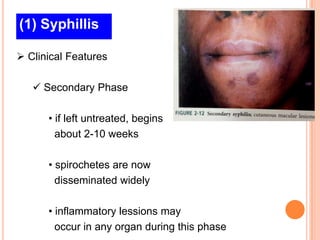
      • if left untreated, begins
        about 2-10 weeks

      • spirochetes are now
        disseminated widely

      • inflammatory lessions may
        occur in any organ during this phase
(1) Syphillis

 Clinical Features

    Secondary Phase

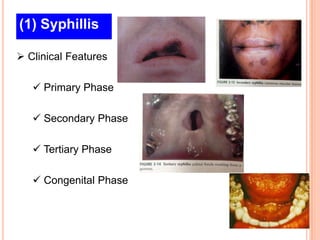
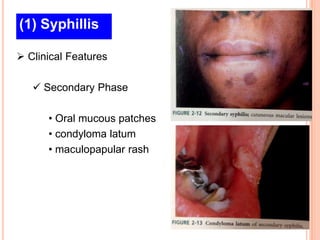
      • Oral mucous patches
      • condyloma latum
      • maculopapular rash
(1) Syphillis

 Clinical Features

    Tertiary Phase

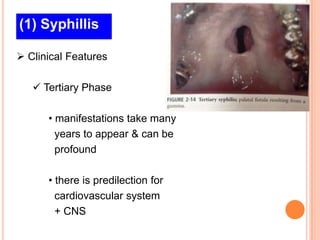
      • manifestations take many
        years to appear & can be
        profound

      • there is predilection for
        cardiovascular system
        + CNS
(1) Syphillis

 Clinical Features

    Tertiary Phase

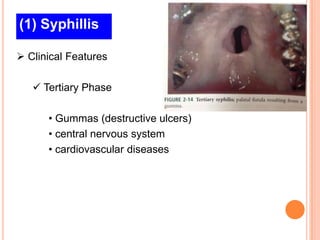
      • Gummas (destructive ulcers)
      • central nervous system
      • cardiovascular diseases
(1) Syphillis

 Clinical Features

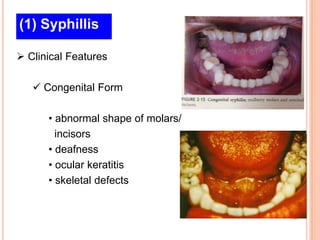
    Congenital Form

      • abnormal shape of molars/
        incisors
      • deafness
      • ocular keratitis
      • skeletal defects
(1) Syphillis

 Treatment

   drug of choice for treating
   all stages of syphillis
   is penicillin

   Treponema Pallidum is
    sensitive to antibiotics such as:

     • Penicillin
     • Erythromycin
     • Tetracycline
(2) Tuberculosis

 infects about 1/3 of world’s
  population

 kills approximately 3 million
  people per year

 most important cause of death
  in the world
(2) Tuberculosis

 caused by aerobic, non-spore
 forming bacillus Mycobacterium
 Tuberculosis

    has thick, waxy coat

    does not react with Gram stains
(2) Tuberculosis

 Pathogenesis

   spread is through small
    airborne droplets

     • carry organism to
       pulmonary air spaces
(2) Tuberculosis

 Clinical Features

    skin testing + chest radiograph

      • provide only indicators
        of infection
(2) Tuberculosis

 Clinical Features

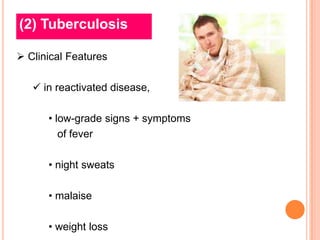
    in reactivated disease,

      • low-grade signs + symptoms
         of fever

      • night sweats

      • malaise

      • weight loss
(2) Tuberculosis

 Clinical Features

    with progression,

      • cough
      • hemoptysis
      • chest pain (pleural involvement)
(2) Tuberculosis

 Clinical Features

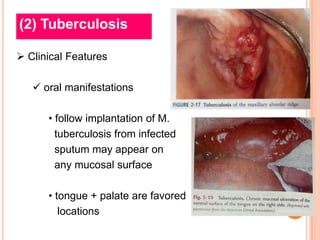
    oral manifestations

      • follow implantation of M.
        tuberculosis from infected
        sputum may appear on
        any mucosal surface

      • tongue + palate are favored
         locations
(2) Tuberculosis

 Clinical Features

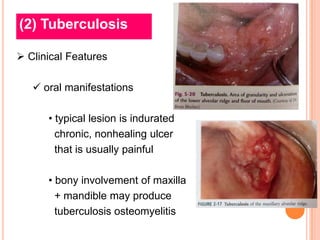
    oral manifestations

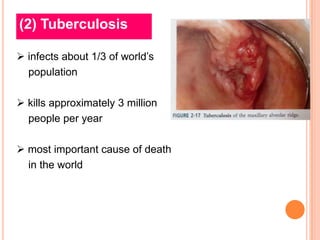
      • typical lesion is indurated
        chronic, nonhealing ulcer
        that is usually painful

      • bony involvement of maxilla
        + mandible may produce
        tuberculosis osteomyelitis
(2) Tuberculosis

 Treatment

   First line drugs likely to
    used fro treatment of TB
    include

     • isoniazid
     • rifampin
     • pyrazinamide
     • exambuthol
(2) Tuberculosis

 Treatment

   drug combinations are often
    used in 6, 9, or 12 month
    treatment regimens

   may be extended as long
    as 2 years.
(2) Tuberculosis

 Treatment

   Bacille Calmette Guerin
    (BCG) vaccine is effective
    in controlling childhood TB,

   but loses efficacy in adulthood
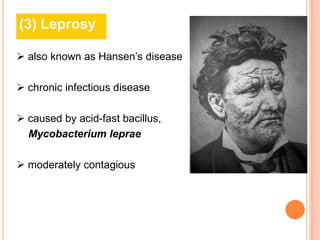
(3) Leprosy

 also known as Hansen’s disease

 chronic infectious disease

 caused by acid-fast bacillus,
  Mycobacterium leprae

 moderately contagious
(3) Leprosy

 transmission of disease
  requires frequent direct contact
 with an infected individual
 for a long period

 inoculation through respiratory
  tract is also believed to be
  a potential mode of transmission
(3) Leprosy

 Clinical Features

    there is clinical spectrum
     of disease that ranges from
     a limited form (tuberculoid
     leprosy) to a generalized
     form (lepromatous leprosy)

    latter has a more seriously
     damaging course
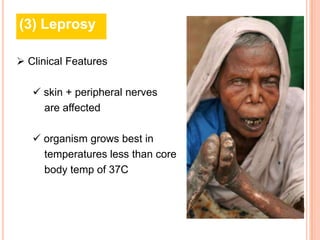
(3) Leprosy

 Clinical Features

    skin + peripheral nerves
     are affected

    organism grows best in
     temperatures less than core
     body temp of 37C
(3) Leprosy

 Clinical Features

    cutaneous lesions appear
     as erythematous plaques
     or nodules

      • represents granulomatous
        response to organism

    similar lesions may occur
     intraorally or intranasally
(3) Leprosy

 Clinical Features

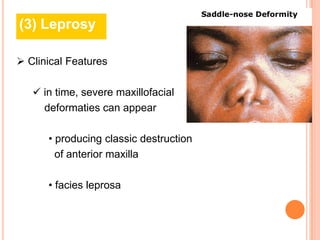
    in time, severe maxillofacial
     deformaties can appear

      • producing classic destruction
        of anterior maxilla

      • facies leprosa
(3) Leprosy

 Treatment

   chemotherapeutic approach
    in which, several drugs are
    used for protracted period,
    typically years
(3) Leprosy

 Treatment

   commonly used drugs:

     • dapsone
     • rifampin
     • clofazimine
     • minocycline

     • teratogen thalidomide
          useful to manage complications
           of leprosy therapy
(4) Actinomycosis

 chronic bacterial disease

 exhibits some clinical + microscopic
  features that are fungilike

 caused by Actinomyces israelii

    an anaerobic or microaerophilic
    gram-positive bacterium

    not regarded as contagious because
     infection cannot be transmitted from
     one individual to another
(4) Actinomycosis

 infections usually appear after

    trauma
    surgery
    previous infection
(4) Actinomycosis

 Clinical Features

    most infections are seen:

      • thorax      usually preceded
      • abdomen      by trauma or direct
      • head + neck extension of contagious
                     infectiom
(4) Actinomycosis

 Clinical Features

    when it occurs in head + neck

      • condition is usually designated
        cervicofacial actinomycosis

           swelling of mandible
           skin lesion are indurated
           having woody hard consistency
           results to osteomyelitis that
           may drain through gingiva
(4) Actinomycosis

 Radiographic Feature

    radiolucency

    irregular + ill-defined margins
(4) Actinomycosis

 Treatment

   Long-term, high-dose
    penicillin

   For sever cases, intravenous
    penicillin followed by oral
    penicillin

   Tetracycline + Erythromycin
    can be used
(4) Actinomycosis

 Treatment

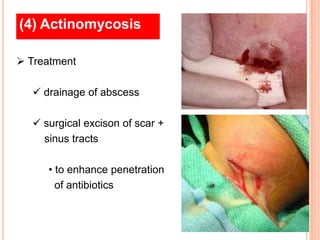
   drainage of abscess

   surgical excison of scar +
    sinus tracts

     • to enhance penetration
       of antibiotics
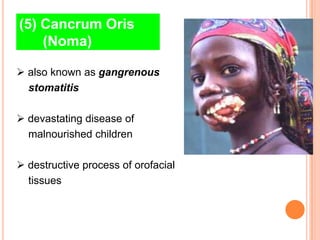
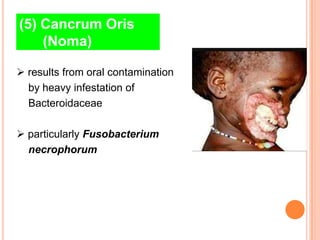
(5) Cancrum Oris
    (Noma)

 also known as gangrenous
  stomatitis

 devastating disease of
  malnourished children

 destructive process of orofacial
  tissues
(5) Cancrum Oris
    (Noma)

 results from oral contamination
  by heavy infestation of
  Bacteroidaceae

 particularly Fusobacterium
  necrophorum
(5) Cancrum Oris
    (Noma)

 consortium of other
  microorganisms:

    Borrelia vincentii

    Staphylococcus aureus

    Prevotella intermedia
(5) Cancrum Oris
    (Noma)

 these opportunistic pathogens
  invade oral tissues whose
  defense are weakened by:

    malnutrition

    acute necrotizing gingivitis

    debilitating conditions
(5) Cancrum Oris
    (Noma)

 these opportunistic pathogens
  invade oral tissues whose
  defense are weakened by:

    trauma

    other oral mucosal ulcers
(5) Cancrum Oris
    (Noma)

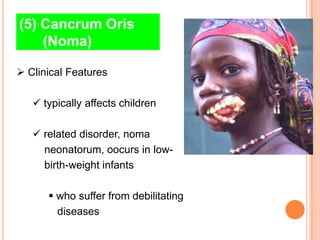
 Clinical Features

    typically affects children

    related disorder, noma
     neonatorum, oocurs in low-
     birth-weight infants

       who suffer from debilitating
        diseases
(5) Cancrum Oris
    (Noma)

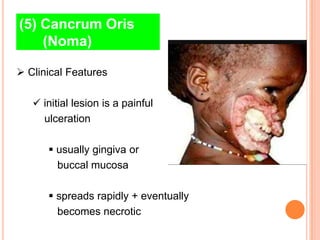
 Clinical Features

    initial lesion is a painful
     ulceration

       usually gingiva or
        buccal mucosa

       spreads rapidly + eventually
        becomes necrotic
(5) Cancrum Oris
    (Noma)

 Clinical Features

    denudation of involved bone
     may follow

    leading to necrosis +
     sequestration
(5) Cancrum Oris
    (Noma)

 Clinical Features

    teeth in affected area may
     become loose + exfoliate

    penetration of organisms
     into

      • cheek
      • lip
      • palate
(5) Cancrum Oris
    (Noma)

 Treatment

   fluids
   electrolytes
   general nutrition are
    restored
   along with antibiotics

     • clindamycin
     • piperacillin
     • aminoglycoside gentamicin
(5) Cancrum Oris
    (Noma)

 Treatment

   fluids
   electrolytes
   general nutrition are
    restored
   along with antibiotics

     • clindamycin
     • piperacillin
     • aminoglycoside gentamicin
(5) Cancrum Oris
    (Noma)

 Treatment

   debridement of necrotic
    tissue may also be
    beneficial if destruction
    is extensive
(6) Gonorrhea

 one of the most prevalent
  bacterial disease in humans

 caused by gram-negative
  diplococcus Neisseria
  gonorrhoeae

    infects columnar epithelium of
      • lower genital tract
      • rectum
      • pharynx
      • eyes
(6) Gonorrhea

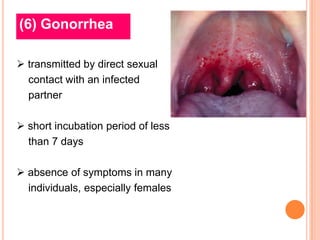
 transmitted by direct sexual
  contact with an infected
  partner

 short incubation period of less
  than 7 days

 absence of symptoms in many
  individuals, especially females
(6) Gonorrhea

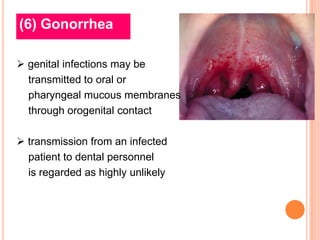
 genital infections may be
  transmitted to oral or
  pharyngeal mucous membranes
  through orogenital contact

 transmission from an infected
  patient to dental personnel
  is regarded as highly unlikely
(6) Gonorrhea

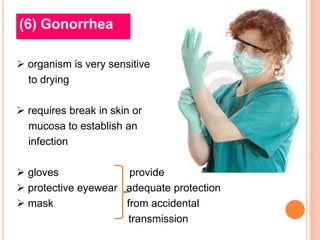
 organism is very sensitive
  to drying

 requires break in skin or
  mucosa to establish an
  infection

 gloves              provide
 protective eyewear adequate protection
 mask               from accidental
                     transmission
(6) Gonorrhea

 Clinical Features

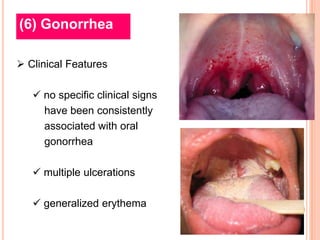
    no specific clinical signs
     have been consistently
     associated with oral
     gonorrhea

    multiple ulcerations

    generalized erythema
(6) Gonorrhea

 Clinical Features

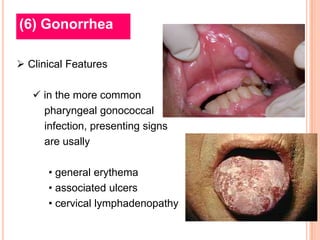
    in the more common
     pharyngeal gonococcal
     infection, presenting signs
     are usally

      • general erythema
      • associated ulcers
      • cervical lymphadenopathy
(6) Gonorrhea

 Clinical Features

    chief complaint may be
     sore throat,

    although many patients
     are asymptomatic
(6) Gonorrhea

 Treatment

   uncomplicated gonorrhea
    responds to single dose
    of appropriately selected
    antibiotic
References:
 Books
  Neville, et. al: Oral and Maxillofacial Pathology
        3rd Edition
        • (pages 24-32)

Bacterial infections (4)

  • 1.
    BACTERIAL DISEASES Prepared by: Dr. Rea Corpuz
  • 2.
    Bacterial Diseases  (1)Syphillis  (2) Tuberculosis  (3) Leprosy  (4) Actinomycosis  (5) Cancrum Oris (NOMA)  (6) Gonorrhea
  • 3.
    (1) Syphillis  sexuallytransmitted disease  caused by spirochete Treponema Pallidum  acquired by sexual contact with a partner with active lesions by:  transfusion of infected blood  transplacental inoculation of fetus by infected mother
  • 4.
    (1) Syphillis  Pathogenesis  when disease is spread through direct contact  a hard ulcer, or chancre forms at site of spirochete  later there is development of painless, non-suppurative regional lymphadenopathy
  • 5.
    (1) Syphillis  Pathogenesis  chancre heals spontaneously after several weeks without treatment, leaving patient with no apparent signs of disease
  • 6.
    (1) Syphillis  Pathogenesis  after a latent period of several weeks, secondary syphilis develops • patients infected via transfusion bypass primary stage & begin with secondary syphilis
  • 7.
    (1) Syphillis  Pathogenesis  secondary syphilis • fever • flulike symptoms • mucucutaneous lesions • lymphadenopathy • stage resolves spontaneously, • patient enters latency period
  • 8.
    (1) Syphillis  ClinicalFeatures  Primary Phase  Secondary Phase  Tertiary Phase  Congenital Phase
  • 9.
    (1) Syphillis  ClinicalFeatures  Primary Phase • does not produce exudate • location is usually on genitalia • lesions heals without therapy in 3-12 weeks, with little or no scarring
  • 10.
    (1) Syphillis  ClinicalFeatures  Primary Phase • Chancre, a chronic ulcer at site of infection
  • 11.
    (1) Syphillis  ClinicalFeatures  Secondary Phase • if left untreated, begins about 2-10 weeks • spirochetes are now disseminated widely • inflammatory lessions may occur in any organ during this phase
  • 12.
    (1) Syphillis  ClinicalFeatures  Secondary Phase • Oral mucous patches • condyloma latum • maculopapular rash
  • 13.
    (1) Syphillis  ClinicalFeatures  Tertiary Phase • manifestations take many years to appear & can be profound • there is predilection for cardiovascular system + CNS
  • 14.
    (1) Syphillis  ClinicalFeatures  Tertiary Phase • Gummas (destructive ulcers) • central nervous system • cardiovascular diseases
  • 15.
    (1) Syphillis  ClinicalFeatures  Congenital Form • abnormal shape of molars/ incisors • deafness • ocular keratitis • skeletal defects
  • 16.
    (1) Syphillis  Treatment  drug of choice for treating all stages of syphillis is penicillin  Treponema Pallidum is sensitive to antibiotics such as: • Penicillin • Erythromycin • Tetracycline
  • 17.
    (2) Tuberculosis  infectsabout 1/3 of world’s population  kills approximately 3 million people per year  most important cause of death in the world
  • 18.
    (2) Tuberculosis  causedby aerobic, non-spore forming bacillus Mycobacterium Tuberculosis  has thick, waxy coat  does not react with Gram stains
  • 19.
    (2) Tuberculosis  Pathogenesis  spread is through small airborne droplets • carry organism to pulmonary air spaces
  • 20.
    (2) Tuberculosis  ClinicalFeatures  skin testing + chest radiograph • provide only indicators of infection
  • 21.
    (2) Tuberculosis  ClinicalFeatures  in reactivated disease, • low-grade signs + symptoms of fever • night sweats • malaise • weight loss
  • 22.
    (2) Tuberculosis  ClinicalFeatures  with progression, • cough • hemoptysis • chest pain (pleural involvement)
  • 23.
    (2) Tuberculosis  ClinicalFeatures  oral manifestations • follow implantation of M. tuberculosis from infected sputum may appear on any mucosal surface • tongue + palate are favored locations
  • 24.
    (2) Tuberculosis  ClinicalFeatures  oral manifestations • typical lesion is indurated chronic, nonhealing ulcer that is usually painful • bony involvement of maxilla + mandible may produce tuberculosis osteomyelitis
  • 25.
    (2) Tuberculosis  Treatment  First line drugs likely to used fro treatment of TB include • isoniazid • rifampin • pyrazinamide • exambuthol
  • 26.
    (2) Tuberculosis  Treatment  drug combinations are often used in 6, 9, or 12 month treatment regimens  may be extended as long as 2 years.
  • 27.
    (2) Tuberculosis  Treatment  Bacille Calmette Guerin (BCG) vaccine is effective in controlling childhood TB,  but loses efficacy in adulthood
  • 28.
    (3) Leprosy  alsoknown as Hansen’s disease  chronic infectious disease  caused by acid-fast bacillus, Mycobacterium leprae  moderately contagious
  • 29.
    (3) Leprosy  transmissionof disease requires frequent direct contact with an infected individual for a long period  inoculation through respiratory tract is also believed to be a potential mode of transmission
  • 30.
    (3) Leprosy  ClinicalFeatures  there is clinical spectrum of disease that ranges from a limited form (tuberculoid leprosy) to a generalized form (lepromatous leprosy)  latter has a more seriously damaging course
  • 31.
    (3) Leprosy  ClinicalFeatures  skin + peripheral nerves are affected  organism grows best in temperatures less than core body temp of 37C
  • 32.
    (3) Leprosy  ClinicalFeatures  cutaneous lesions appear as erythematous plaques or nodules • represents granulomatous response to organism  similar lesions may occur intraorally or intranasally
  • 33.
    (3) Leprosy  ClinicalFeatures  in time, severe maxillofacial deformaties can appear • producing classic destruction of anterior maxilla • facies leprosa
  • 34.
    (3) Leprosy  Treatment  chemotherapeutic approach in which, several drugs are used for protracted period, typically years
  • 35.
    (3) Leprosy  Treatment  commonly used drugs: • dapsone • rifampin • clofazimine • minocycline • teratogen thalidomide  useful to manage complications of leprosy therapy
  • 36.
    (4) Actinomycosis  chronicbacterial disease  exhibits some clinical + microscopic features that are fungilike  caused by Actinomyces israelii  an anaerobic or microaerophilic gram-positive bacterium  not regarded as contagious because infection cannot be transmitted from one individual to another
  • 37.
    (4) Actinomycosis  infectionsusually appear after  trauma  surgery  previous infection
  • 38.
    (4) Actinomycosis  ClinicalFeatures  most infections are seen: • thorax usually preceded • abdomen by trauma or direct • head + neck extension of contagious infectiom
  • 39.
    (4) Actinomycosis  ClinicalFeatures  when it occurs in head + neck • condition is usually designated cervicofacial actinomycosis  swelling of mandible  skin lesion are indurated  having woody hard consistency  results to osteomyelitis that may drain through gingiva
  • 40.
    (4) Actinomycosis  RadiographicFeature  radiolucency  irregular + ill-defined margins
  • 41.
    (4) Actinomycosis  Treatment  Long-term, high-dose penicillin  For sever cases, intravenous penicillin followed by oral penicillin  Tetracycline + Erythromycin can be used
  • 42.
    (4) Actinomycosis  Treatment  drainage of abscess  surgical excison of scar + sinus tracts • to enhance penetration of antibiotics
  • 43.
    (5) Cancrum Oris (Noma)  also known as gangrenous stomatitis  devastating disease of malnourished children  destructive process of orofacial tissues
  • 44.
    (5) Cancrum Oris (Noma)  results from oral contamination by heavy infestation of Bacteroidaceae  particularly Fusobacterium necrophorum
  • 45.
    (5) Cancrum Oris (Noma)  consortium of other microorganisms:  Borrelia vincentii  Staphylococcus aureus  Prevotella intermedia
  • 46.
    (5) Cancrum Oris (Noma)  these opportunistic pathogens invade oral tissues whose defense are weakened by:  malnutrition  acute necrotizing gingivitis  debilitating conditions
  • 47.
    (5) Cancrum Oris (Noma)  these opportunistic pathogens invade oral tissues whose defense are weakened by:  trauma  other oral mucosal ulcers
  • 48.
    (5) Cancrum Oris (Noma)  Clinical Features  typically affects children  related disorder, noma neonatorum, oocurs in low- birth-weight infants  who suffer from debilitating diseases
  • 49.
    (5) Cancrum Oris (Noma)  Clinical Features  initial lesion is a painful ulceration  usually gingiva or buccal mucosa  spreads rapidly + eventually becomes necrotic
  • 50.
    (5) Cancrum Oris (Noma)  Clinical Features  denudation of involved bone may follow  leading to necrosis + sequestration
  • 51.
    (5) Cancrum Oris (Noma)  Clinical Features  teeth in affected area may become loose + exfoliate  penetration of organisms into • cheek • lip • palate
  • 52.
    (5) Cancrum Oris (Noma)  Treatment  fluids  electrolytes  general nutrition are restored  along with antibiotics • clindamycin • piperacillin • aminoglycoside gentamicin
  • 53.
    (5) Cancrum Oris (Noma)  Treatment  fluids  electrolytes  general nutrition are restored  along with antibiotics • clindamycin • piperacillin • aminoglycoside gentamicin
  • 54.
    (5) Cancrum Oris (Noma)  Treatment  debridement of necrotic tissue may also be beneficial if destruction is extensive
  • 55.
    (6) Gonorrhea  oneof the most prevalent bacterial disease in humans  caused by gram-negative diplococcus Neisseria gonorrhoeae  infects columnar epithelium of • lower genital tract • rectum • pharynx • eyes
  • 56.
    (6) Gonorrhea  transmittedby direct sexual contact with an infected partner  short incubation period of less than 7 days  absence of symptoms in many individuals, especially females
  • 57.
    (6) Gonorrhea  genitalinfections may be transmitted to oral or pharyngeal mucous membranes through orogenital contact  transmission from an infected patient to dental personnel is regarded as highly unlikely
  • 58.
    (6) Gonorrhea  organismis very sensitive to drying  requires break in skin or mucosa to establish an infection  gloves provide  protective eyewear adequate protection  mask from accidental transmission
  • 59.
    (6) Gonorrhea  ClinicalFeatures  no specific clinical signs have been consistently associated with oral gonorrhea  multiple ulcerations  generalized erythema
  • 60.
    (6) Gonorrhea  ClinicalFeatures  in the more common pharyngeal gonococcal infection, presenting signs are usally • general erythema • associated ulcers • cervical lymphadenopathy
  • 61.
    (6) Gonorrhea  ClinicalFeatures  chief complaint may be sore throat,  although many patients are asymptomatic
  • 62.
    (6) Gonorrhea  Treatment  uncomplicated gonorrhea responds to single dose of appropriately selected antibiotic
  • 63.
    References:  Books Neville, et. al: Oral and Maxillofacial Pathology 3rd Edition • (pages 24-32)