Dr. Riham Hazem Raafat
Lecturer of Pulmonary Medicine
Ain Shams University
Objectives
 Briefly review pulmonary anatomy and
physiology
 Review lung volumes and capacities
 Provide an overview of PFTs
 Discuss spirometry and review its clinical
applications
Anatomy
 Lungs comprised
of
• Airways
• Alveoli
Weibel ER: Morphometry of the Human
Lung. Berlin and New York: Springer-
Verlag, 1963
The Airways
 Conducting zone: no gas
exchange occurs
Anatomic dead space
 Transitional zone: alveoli
appear, but are not great
in number
 Respiratory zone: contain
the alveolar sacs
The Alveoli
 Approximately 300
million alveoli
 1/3 mm diameter
 Total surface area if
they were complete
spheres 85 sq. meters
(size of a tennis court)
Murray & Nadel: Textbook of Respiratory
Medicine, 3rd ed., Copyright © 2000 W. B.
Saunders Company
Pulmonary Functions
Respiration
Process by which cells utilize O2 produce Co2 &
exchange the gases with atmosphere
Normal Lung Function
The lungs maintain normal O2 & Co2 press & content
in the arterial blood in all physiological circumstances.
Constant art. blood gases is maintained by efficient
transfer of gas between alveolar air & blood passing
through the alveolar capillaries.
There are 3 components of pulmonary gas
exchange:
Ventilation: amount of air which ventilates alveoli
each min. (4 lit/min). It must be evenly distributed to
all perfused alveoli.
Perfusion: amount of blood which pass through
pulmonary cap. Per min. = 5 lit/min
Diffusion: across the alveolar cap. mem., the transfer of
gas between alveolar air & pulm cap bld being
determined by the gas tension gradients bet. them =
DLCO 20 ml/ mmHg/min.
V/ QV/ Q 4/54/5= == 0.80.8
Mechanics of Breathing
 Inspiration
• Active process
 Expiration
• Quiet breathing: passive
• Can become active
Lung Volumes
 4 Volumes
 4 Capacities
• Sum of 2 or
more lung
volumes
IRV
TV
ERV
RV
IC
FRC
VC
TLC
RV
Tidal Volume (TV)
 Volume of air
inspired and
expired during
normal quiet
breathing
 N – ~6-8 ml/kg.
IRV
TV
ERV
RV
IC
FRC
VC
TLC
RV
Inspiratory Reserve Volume (IRV)
 The maximum
amount of air
that can be
inhaled after a
normal tidal
volume
inspiration
 N- 1900 ml- 3300
ml.
IRV
TV
ERV
RV
IC
FRC
VC
TLC
RV
Expiratory Reserve Volume (ERV)
 Maximum
amount of air that
can be exhaled
from the resting
expiratory level
 N- 700 ml- 1000 ml.
IRV
TV
ERV
RV
IC
FRC
VC
TLC
RV
Residual Volume (RV)
 Volume of air
remaining in the
lungs at the end
of maximum
expiration
 N- 1700 ml- 2100
ml. (20-25ml/kg)
IRV
TV
ERV
RV
IC
FRC
VC
TLC
RV
Vital Capacity (VC)
 Volume of air that can
be exhaled from the
lungs after a maximum
inspiration
 FVC: when VC exhaled
forcefully
 SVC: when VC is
exhaled slowly
 VC = IRV + TV + ERV
 N- 3100 ml- 4800 ml.
(60-70ml/kg)
IRV
TV
ERV
RV
IC
FRC
VC
TLC
RV
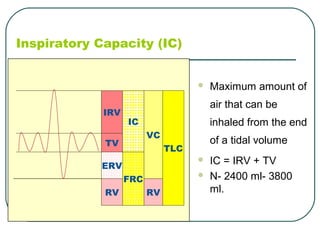
Inspiratory Capacity (IC)
 Maximum amount of
air that can be
inhaled from the end
of a tidal volume
 IC = IRV + TV
 N- 2400 ml- 3800
ml.
IRV
TV
ERV
RV
IC
FRC
VC
TLC
RV
Functional Residual Capacity (FRC)
 Volume of air remaining
in the lungs at the end of
a TV expiration
 The elastic force of the
chest wall is exactly
balanced by the elastic
force of the lungs
 FRC = ERV + RV
 N- 2300 ml- 3300 ml.
(30-35ml/kg)
IRV
TV
ERV
RV
IC
FRC
VC
TLC
RV
Total Lung Capacity (TLC)
 Volume of air in the
lungs after a maximum
inspiration
 TLC = IRV + TV +
ERV + RV (VC + RV)
 N- 4000 ml- 6000 ml.
(80-100ml/kg)
IRV
TV
ERV
RV
IC
FRC
VC
TLC
RV
Pulmonary Function Tests
 Evaluates one or more major aspects of the
respiratory system:
• Lung volumes
• Airway function
• Gas exchange
• It is a valuable tool for evaluating the respiratory system,
representing an important adjunct to the patient history,
various lung imaging studies, and invasive testing such
as bronchoscopy and open-lung biopsy.
• Insight into underlying pathophysiology can often be gained
by comparing the measured values for pulmonary function
tests obtained on a patient at any particular point with
normative values derived from population studies.
The percentage of predicted normal is used to grade the
severity of the abnormality.
Definition
PFTs can include:
1) Simple screening Spirometry,
2) Formal Lung Volume measurement,
3) Diffusing Capacity for Carbon Monoxide, and
4) Arterial Blood Gases.
These studies may collectively be referred to as:
complete pulmonary function survey.
Indications
 Detect disease
 Evaluate extent and monitor course of
disease
 Evaluate treatment
 Measure effects of exposures
 Assess risk for surgical procedures
Contraindications
Pulmonary Function Tests
 Airway function
• Simple spirometry
• Forced vital capacity
maneuver
• Maximal voluntary
ventilation
• Maximal
inspiratory/expiratory
pressures
• Airway resistance
• Lung volumes and
ventilation
–Functional residual
capacity
–Total lung capacity,
residual volume
–Minute ventilation,
alveolar ventilation,
dead space
–Distribution of
ventilation
 Diffusing capacity
tests
 Blood gases and
gas exchange tests
• Blood gas analysis
• Pulse oximetry
• Capnography
 Cardiopulmonary
exercise tests
Categories Of PFTs:
A. Ventilatory function tests
• Airway functions:-
a. Simple Spirometry (Ventilation testing)
1. Static lung volumes  TLC, FRC, RV
2. Dynamic lung volume  FVC & MVV
b. Airway resistance (Raw) ,and compliance (C1)
• Graphic representation
• Bronchodilator response
• Bronchoprovocation testing
B. Lung Volume Tests (static lung volume tests)
C. Tests for Gas Exchange
• Diffusion Lung capacity (DLCO)
• Arterial Blood Gases
• Pulse Oximetry & Capnography
D. Simple and complex cardiopulmonary exercise
testing (6MWT, CPET)
E. Respiratory Muscle Tests (Spirometry, MIP, MEP,
MVV, Sniff Test, Mouth Pressures, Pdi, EMG, US)
F. Bed Side PFTs
Spirometry
 Measurement of the pattern of air movement
into and out of the lungs during controlled
ventilatory maneuvers.
 Often done as a maximal expiratory
maneuver.
Indications:
1. Symptoms and clinical signs
• Dyspnea with or without or wheezing
• Chest pain or orthopnea
• Cough for a longer time with or without phlegm production
• Cyanosis
• Decreased or unusual breath sounds
2. Abnormal chest x-ray (e.g. Hyperinflation)
3. Abnormal blood gases (hypoxemia, hypercapnia)
4. Abnormal laboratory findings (e.g. polycythemia)
5. Monitoring of known pulmonary diseases
6. Assessing severity or progression of disease (e.g.
asthma, COPD)
• Control of therapy, e.g. Bronchodilatator or steroids. (no therapy
without control)
• Assessing reversibility (asthma versus COPD)  > 12 % FEV1 (4
inhalations 100 mcg each of B2 ag or 40 mcg each of anticholin.)
7- Further Indications for spirometry:
• Periodic examinations in high-risk groups
• Course of FEV1 in smokers
• Risk stratification of patients for surgery
• Check-up
• Evaluating disability or impairment
• Extrapulmonary diseases with lung involvement
Diagnostic
1- To evaluate symptoms, signs or abnormal laboratory
tests
o Symptoms: dyspnea, wheezing, orthopnea, cough,
phlegm production, chest pain
o Signs: diminished breath sounds, overinflation, expiratory
slowing, cyanosis, chest deformity, unexplained crackles
o Abnormal lab: hypoxemia, hypercapnia, polycythemia,
abn CXR
2- To screen individuals at risk of having pulmonary
disease
o Smokers
o Individuals in occupations with exposures to injurious
subs.
o Some routine physical examinations
4- Assess pre-operative risk:
 Age > 70 yrs.
 Morbid obesity
 Thoracic or Cardiac surgery
 Upper abdominal surgery
 Smoking history and cough
 Any known pulmonary disease
3- Measure the effect of disease on pulmonary function
5- Assess prognosis (after ttt, lung transplant ...etc.)
6- Assess health status before beginning strenuous
physical activity
Pre-operative Risk Assessment for
Pulmonary Resection Surgery
1- To assess therapeutic intervention
o Bronchodilator therapy
o Steroid treatment for asthma, ILD, etc.
o Management of congestive heart failure
o Other (antibiotics in cystic fibrosis, etc.)
2- To describe course of diseases that affect lung function
o Pulmonary diseases (Ob Aw, ILD)
o Cardiac diseases (CHF)
o Neuromuscular diseases (Guillian-Barre Syndrome)
3- To monitor people exposed to injurious agents
4- To monitor for adverse reactions to drugs with known
pulmonary toxicity
Monitoring
Disability/impairment
evaluations
1- To assess patients as part of a rehabilitation
program (medical, industrial, vocational)
2- To assess risks as part of an insurance evaluation
3- To assess individuals for legal reasons
Public health
• Epidemiological surveys
• Derivation of reference equations
• Clinical research
Relative contraindications for
spirometry
1. Acute disorders affecting test performance (e.g. vomiting,
nausea, vertigo)
2. Hemoptysis of unknown origin (FVC maneuver may
aggravate underlying condition.)
3. Pneumothorax
4. Recent abdominal or thoracic surgery
5. Recent eye surgery (increases in intraocular pressure
during spirometry)
6. Recent myocardial infarction or unstable angina
7. Thoracic, abdominal, or cerebral aneurysms (risk of
rupture because of increased thoracic pressure)
Only Absolute Contraindication is:
Myocardial Infarction
within the Previous Month
Possible side-effects
1. Serious complications are rare: Syncope, dizziness, light-
headedness
2. Paroxysmal coughing
3. Bronchospasm (e.g. Asthma)
4. Increased intracranial pressure
5. Thoracic pain
6. Pneumothorax (very rare)
7. Nosocomial infections (very rare)
Limitations
 Test results can show abnormalities of lung function, but these
are not disease-specific.
• A reduction of vital capacity is regarded as a sign of respiratory
disease, but it cannot allow differentiation between restriction and
obstruction.
• Spirometry can detect obstructive abnormalities at relatively early
stages, but it may not be sensitive to restrictive abnormalities
before extensive damage has occurred.
Infection control and safety during
spirometry
1. Spirometers should be cleaned according to the
manufacturer´s recommendations
2. Change of mouthpiece
3. In infectious pts (e.g. MRSA, HIV, hepatitis B, TB), as well
as in patients with immunodeficiency (e.g. chemotherapy,
post-transplantation, CF) bacteria filters should always be
used.
4. A mask should be worn by the technologist when testing
subjects who have active TB or other serious diseases that
can be transmitted by coughing.
5. Proper hand washing & Gloves should be worn when
handling potentially contaminated equipment
Preparation & instructions to the
patient
1- Information about the purpose: before starting, explain to
the pt. how fast & how much he can exhale from his lungs.
2. Tell the pt. that only the maximal effort will lead to a
reliable result. This may enhance his motivation to follow
the instructions correctly.
3. Demonstrating of breathing maneuver: Possible even
without spirometer. This can save a lot of time spent on
repeated measurements.
Guidelines for Holding Medical
Drugs
Technique
 Have patient seated comfortably (upright, head
straight or slightly extended, no tight clothes)
 Open circuit technique or Closed-circuit technique
• Place nose clip on
• Have patient breathe on mouthpiece (lips tightly sealed)
• Have patient take a deep breath as fast as possible
• Blow out as hard as they can until you tell them to stop
• 3 trials done as previous (not > 6)
* Parameters measured in standing position are 2-7% increased than sitting parameters
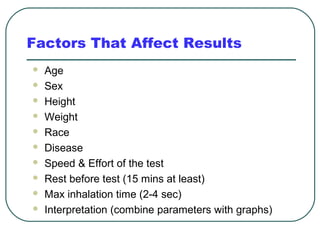
Factors That Affect Results
 Age
 Sex
 Height
 Weight
 Race
 Disease
 Speed & Effort of the test
 Rest before test (15 mins at least)
 Max inhalation time (2-4 sec)
 Interpretation (combine parameters with graphs)
Acceptability &
Reproducibility Criteria:
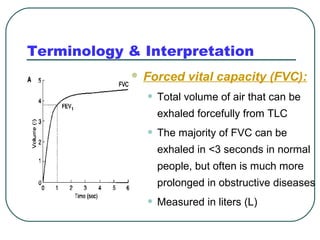
Terminology & Interpretation
 Forced vital capacity (FVC):
• Total volume of air that can be
exhaled forcefully from TLC
• The majority of FVC can be
exhaled in <3 seconds in normal
people, but often is much more
prolonged in obstructive diseases
• Measured in liters (L)
• Interpretation of % predicted:
– Mild - 70-79% of predicted
– Moderate - 60-69% of predicted
– Moderately severe - 50-59%
– Severe - 35-49% of predicted
– Very severe - Less than 35% of predicted
• Forced expiratory volume in
1 second: (FEV1)
– Volume of air forcefully expired
from full inflation (TLC) in the
first second
– Measured in liters (L)
– Normal people can exhale more
than 75-80% of their FVC in the
first second; thus the FEV1/FVC
can be utilized to characterize
lung disease
• Interpretation of % predicted:
– Mild - 70-79% of predicted
– Moderate - 60-69% of predicted
– Moderately severe - 50-59%
– Severe - 35-49% of predicted
– Very severe - Less than 35% of predicted
FVC
*N.B. FEV1 begins to decrease after age 20.
• The annual decline is small at first but accelerates with aging. The
forced vital capacity (FVC) decreases as well, by about 14 to 30
mL/yr in men and 15 to 24 mL/yr in women.
• Until age 40, decreases in FEV1 and FVC are thought to result
from changes in body weight and strength rather than from loss of
tissue.
• After age 40, decreases in FEV1 and FVC are due to aging itself
and superimposed cumulative effects of inflammatory injury from
respiratory illness, smoking, and exposure to oxidant injuries or
environmental toxins.
• For example, cigarette smoking repeatedly induces inflammatory
mediators, humoral protection (elastase and antielastase, oxidant
and antioxidant), neutrophil recruitment, and tissue repair,
culminating in inflammatory lung destruction and airway obstruction
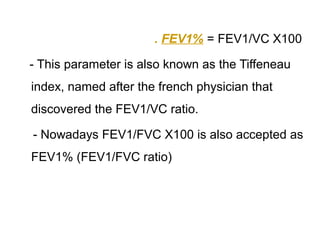
. FEV1% = FEV1/VC X100
- This parameter is also known as the Tiffeneau
index, named after the french physician that
discovered the FEV1/VC ratio.
- Nowadays FEV1/FVC X100 is also accepted as
FEV1% (FEV1/FVC ratio)
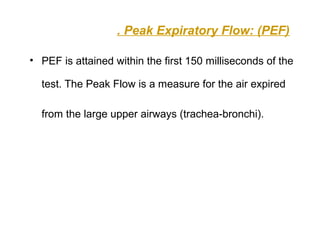
. Peak Expiratory Flow: (PEF)
• PEF is attained within the first 150 milliseconds of the
test. The Peak Flow is a measure for the air expired
from the large upper airways (trachea-bronchi).
• Forced expiratory flow 25-
75% (FEF25-75)
– Mean forced expiratory flow
during middle half of FVC
– Measured in L/sec
– May reflect effort independent
expiration and the status of the
small airways
– Depends heavily on FVC
– Early termination artificially
increases it.
• Interpretation of % predicted:
– >60% Normal
– 40-60% Mild obstruction
– 20-40% Moderate obstruction
– <10% Severe obstruction
• MVV
• It's the maximum volume of
air which can be respired in
1min. By deepest and fastest
breathing (test of entire
respiratory system).
• MVV = FEV1 x 35
• Reflects the status of the
respiratory muscles,
compliance of the thorax-
lung complex, and airway
resistance
• N- 150-175 L/min
Normal Values of PFT
 BMI  21- 25 kg/m2
 FEV1  N: 80% to 120%
 FVC  N: 80% to 120%
 FEV1 /FVC  N: >70%, within 5% of the predicted ratio
 FEF25-75%  N: >60-125%.
 PEFR  N: 80-100%.
 TLC  N: 80% to 120%
 FRC  N: 80% to 120%
 RV  N: 65% to 135%
 RV/TLC  N: 25-35%
 FRC/TLC  N: 50%
 DLCO  (N 15-32 ml/min/mmHg) >80% to < 120%
 KCo Krogh coefficient = DLCO/VA Diffusing capacity for carbon monoxide per
unit of alveolar volume
Categories of Disease
* N.B: The lower limit of normal is defined as the result
of the mean predicted value (based on the patient's
sex, age, and height) minus 1.64 times, the standard
error of the estimate from the population study on
which the reference equation is based.
Flow-Volume Loop
 Illustrates maximum expiratory
and inspiratory flow-volume
curves
 Normally:
FEF50 / FIF50 = 0.8
• Steep exp. Curve 1st
(max
effort) then linear drop
(dynamic compression of AWs)
• It's a curve representing the relation between flow rates
and volume during VC divided into maximum expiratory
(from TLC to RV, not effort dependant) and inspiratory
(from RV to TLC, effort dependant) flow volume curves.
• Measured by: patient must breathe several breaths in
tidal breathing  maximum inspiration to TLC 
maximum expiration to RV  maximum inspiration again.
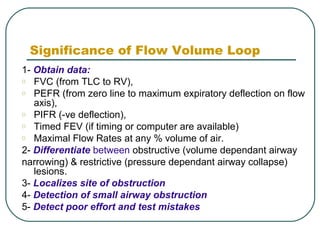
Significance of Flow Volume Loop
1- Obtain data:
o FVC (from TLC to RV),
o PEFR (from zero line to maximum expiratory deflection on flow
axis),
o PIFR (-ve deflection),
o Timed FEV (if timing or computer are available)
o Maximal Flow Rates at any % volume of air.
2- Differentiate between obstructive (volume dependant airway
narrowing) & restrictive (pressure dependant airway collapse)
lesions.
3- Localizes site of obstruction
4- Detection of small airway obstruction
5- Detect poor effort and test mistakes
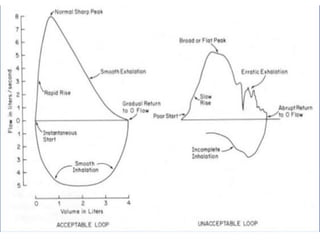
Detecting poor effort & Mistakes in
performing the test
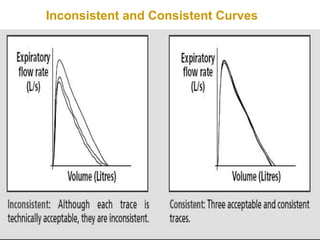
Inconsistent and Consistent Curves
Normal & abnormal FV Loops
Significance:
A) Assessing whether the end-of-test criteria have been met,
whereas the flow-volume loop is most valuable in
evaluating the start-of-test criteria.
B) The zero time point on the volume-time tracing has been
carefully defined and extrapolated to provide a uniform
start point for measurement. It corrects for a possible
delayed start that may not actually reflect airflow
Volume-Time Tracing
Inconsistent & Consistent curves
Detecting abnormalities
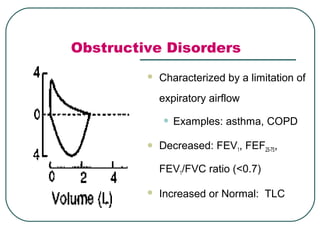
Obstructive Disorders
 Characterized by a limitation of
expiratory airflow
• Examples: asthma, COPD
 Decreased: FEV1, FEF25-75,
FEV1/FVC ratio (<0.7)
 Increased or Normal: TLC
 Slow rise in upstroke
 May not reach plateau
* N.B: Severe obstruction FVC <
IVC No error! The open loop is
caused by airway closure at the
end of the forced expiration.
This phenomenon disappears in
part during slow exhalation

Restrictive Lung Disease
 Characterized by diminished lung
volume due to:
• change in alteration in lung
parenchyma (interstitial lung
disease)
• disease of pleura, chest wall (e.g.
scoliosis), or neuromuscular
apparatus (e.g. muscular
dystrophy)
 Decreased TLC, FVC
 Normal or increased: FEV1/FVC ratio
 Rapid upstroke as in
normal spirometry
 Plateau volume is low
Large Airway Obstruction
 Characterized by a
truncated inspiratory
or expiratory loop
Fixed Upper Airway Obstruction
 Post-intubation stenosis
 Large goiters compressing trachea
 Endotracheal neoplasms
 Stenosis of both main bronchi
 Obstruction of internal airway
Variable Extrathoracic Obstruction
 Bilateral or unilateral
vocal cord palsy
 Adhesions of vocal cord
 Vocal cord constriction
 Obstructive sleep
apnea
 Burns
Variable Intrathoracic Obstruction
 Obstruction of lower
trachea
 Obstruction of main
bronchi
*EMPEY Index:
It’s the ratio of FEV1 to PEF
Indicator for large airway obstruction
Significant value: greater than 8
The higher the index the more severe the obstruction
Used as a clinical screen in the absence of F-V Loop
for presence of UAO
Specific Situations
 Assessment of reversibility of airway obstruction
 Assessment of small airway affection
 Assessment of diaphragmatic strength by performing
upright and supine spirometry  reduction of FVC > 90%
of the upright FVC suggests weakness or paralysis (pitfall:
if pt’s BMI > 45)
 Pre-operative assessment: Postoperative FEV1 =
Preoperative FEV1 X Q% of the remaining lung.
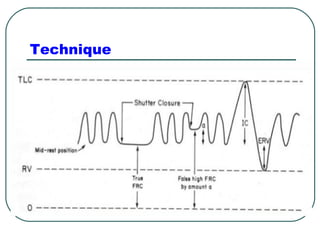
Lung Volumes
 Measured through various methods
• Dilutional: helium, 100% oxygen
• Body plethysmography
• Nitrogen washout
Static Lung Volumes
 Total lung capacity (TLC)
• Total volume of air in the lungs at the end of an maximal
inspiration
 Residual volume (RV)
• Volume of air remaining in the lungs at the end of a
maximal expiration
 Functional residual volume (FRC)
• Volume of air remaining in the lungs at the end of tidal
expiration
Changes in Lung Volumes in Various
Disease States
Technique
Interpreting Volumes:
Causes of Abnormal Lung
Volumes
 Reduced TLC
• Restrictive defect (intrapulmonary or extrapulmonary)
 Raised TLC
• COPD esp. emphysema
• Transiently during/recovering from asthma exacerbation
 Increased RV
• Airways disease (air-trapping)
• Respiratory muscle weakness (extrapulmonary)
 Raised FRC
• COPD incl. emphysema
 Reduced FRC
• Fibrotic lung disease (intrapulmonary)
• Obesity (extrapulmonary)
DLCo
- Defined as the rate at which gas enters into blood.
A) High affinity for Hb which is approx. 200 times that of O2 , so does not
rapidly build up in plasma
B) Under N condition it has low blood conc ≈ 0
C) Therefore, pulm conc.≈0
- Pt inspires a dilute mixture of CO and hold the breath for 10 secs.
 CO taken up is determined by infrared analysis:
DLCO = CO ml/min/mmhg
PACO – PcCO
N range 20- 30 ml/min./mmhg  80-120% of predicted
 TLCO = transfer factor for the lung for carbon monoxide i.e.
Total diffusing capacity for the lung
• Same as DLCO
 KCO = transfer coefficient i.e. Diffusing capacity of the lung
per unit volume, standardised for alveolar volume (VA)
 VA = Lung volume in which carbon monoxide diffuses into
during a single breath-hold technique
TLCO = KCO x VA
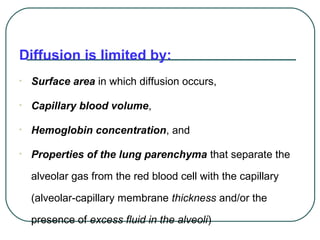
Diffusion is limited by:
• Surface area in which diffusion occurs,
• Capillary blood volume,
• Hemoglobin concentration, and
• Properties of the lung parenchyma that separate the
alveolar gas from the red blood cell with the capillary
(alveolar-capillary membrane thickness and/or the
presence of excess fluid in the alveoli)
Technique
Interpreting DLCo
Degree of severity DL,CO % predDegree of severity DL,CO % pred
 Mild >60% -80%>
 Moderate 40–60%
 Severe <40
Abnormal Diffusion Capacity
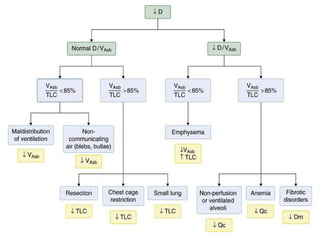
 Low TLC: Low TLCO and Low/Normal KCO =
Intrapulmonary Restrictive Defect
• Interstitial lung diseases e.g. Idiopathic pulmonary fibrosis,
sarcoidosis, CTD, HP
• Cardiac e.g. Pulmonary oedema
• Pulmonary vascular disease e.g. Pulmonary HTN (may
have normal TLCO)
 High TLC: Low TLCO + KCO
• emphysema (in the context of obstruction)
• Low TLCO but high KCO =
Extrapulmonary Restrictive Defect
– Obesity
– Respiratory muscle weakness (neuromusclar)
– Pleural disease e.g. effusion, encasement
– Skeletal e.g. Ankolysing spond., thoracoplasty, severe
kyphoscoliosis
– Severe dermatological disease e.g. Scleroderma
AND Post pneumonectomy
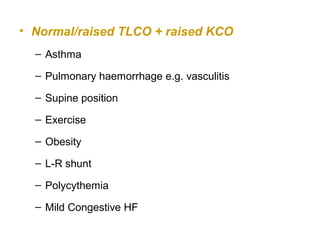
• Normal/raised TLCO + raised KCO
– Asthma
– Pulmonary haemorrhage e.g. vasculitis
– Supine position
– Exercise
– Obesity
– L-R shunt
– Polycythemia
– Mild Congestive HF
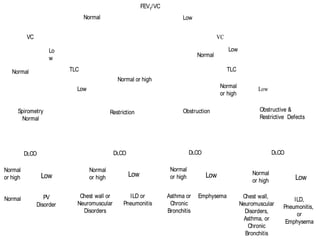
FEV1/VC
VC VC
Spirometry
Normal
DLCO
Normal PV
Disorder
TLC TLC
Restriction Obstruction Obstructive &
Restrictive Defects
DLCO
Chest wall or
Neuromuscular
Disorders
ILD or
Pneumonitis
DLCO DLCO
Asthma or
Chronic
Bronchitis
Emphysema Chest wall,
Neuromuscular
Disorders,
Asthma, or
Chronic
Bronchitis
ILD,
Pneumonitis,
or
Emphysema
Normal
or high Low Low Low Low
Normal
Lo
w
Low
Normal or high
Low
LowNormal
or high
Normal Low
Normal
Normal
or high
Normal
or high
Normal
or high
FEV1/VC
VC VC
Spirometry
Normal
DLCO
Normal PV
Disorder
TLC TLC
Restriction Obstruction Obstructive &
Restrictive Defects
DLCO
Chest wall or
Neuromuscular
Disorders
ILD or
Pneumonitis
DLCO DLCO
Asthma or
Chronic
Bronchitis
Emphysema Chest wall,
Neuromuscular
Disorders,
Asthma, or
Chronic
Bronchitis
ILD,
Pneumonitis,
or
Emphysema
Normal
or high Low Low Low Low
Normal
Lo
w
Low
Normal or high
Low
LowNormal
or high
Normal Low
Normal
Normal
or high
Normal
or high
Normal
or high
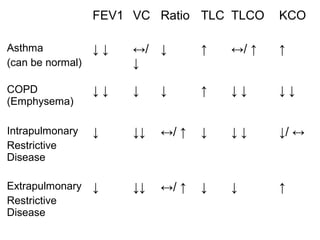
FEV1 VC Ratio TLC TLCO KCO
Asthma
(can be normal)
↓ ↓ ↔/
↓
↓ ↑ ↔/ ↑ ↑
COPD
(Emphysema)
↓ ↓ ↓ ↓ ↑ ↓ ↓ ↓ ↓
Intrapulmonary
Restrictive
Disease
↓ ↓↓ ↔/ ↑ ↓ ↓ ↓ ↓/ ↔
Extrapulmonary
Restrictive
Disease
↓ ↓↓ ↔/ ↑ ↓ ↓ ↑
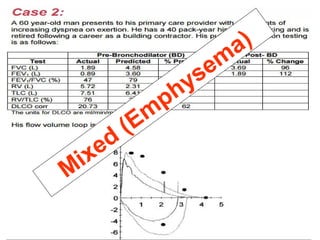
Quiz
NO
RM
AL
Mixed
(Em
physem
a)
Obstruction
(Fixed
UAW
)
Restriction
(ILD)
Mixed Mainly Restrictive
(Diaphragmatic W
eakness)
Case 6:
 A 51-year-old woman
presents for evaluation
of shortness of breath,
cough, and wheezing,
especially in the
summer. Her
symptoms are relieved
with albuterol,
salmeterol, and
fluticasone inhalers.
She does not smoke.
Her spirometry values
shows.
Case 7:
 A 68-year-old woman
presents for evaluation of
shortness of breath without
cough or wheezing. She has
RA (for which she takes
prednisone and
methotrexate) and
hypertension (for which she
takes metoprolol and
hydrochlorothiazide).
 Her O2sat is 94% by pulse
oximetry while breathing
room air.
 Her Hg conc. is 12.3 g/dL.
Case 8:
 60 year old man with a 60 pack/year smoking history
and dyspnea on exertion. An arterial blood gas
demonstrates PaO2 = 56 and PaCO2 = 44.
Case 9:
 50 year old man with a 65 pack/year smoking
history and cough. His chest x-ray shows a diffuse
reticulonodular pattern.
Case 10:
36 year old man with muscular dystrophy. He is
presently wheelchair bound and an ABG demonstrates
a PaO2 = 60 and PaCO2 = 52.
Impulse Oscillometry
Methods of measurement of airway resistanceMethods of measurement of airway resistance
 Occlusion technique
 Impulse oscillometry
 Bodyplethysmography
Advantages of IOS
 Very simple to perform
 No special breathing necessary
 Minimal (no) co-operation
 Use with small children (down to 2 years)
 No forced manoeuvre necessary
 No box necessary
 Peripheral and Central Resistance separated
 Reversibility Test (decrease R > 20-25%)
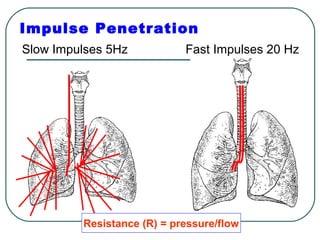
Impulse Penetration
Slow Impulses 5Hz Fast Impulses 20 Hz
Resistance (R) = pressure/flow
Lung Reactance (X)
 Reactance is how the alveoli, diaphragm,
chest wall, all react to the pressure wave.
 Low reactance means there is little stretch and
recoil of the lungs
Interpretation of IOS
 R5 total airway resistance normal if
Lower than 150% of R5 predicted
 R20 proximal airway resistance normal if
Lower than 150% of R20 predicted
 X5 Distal capacitive reactance normal if
Higher than X5 predicted – 0.2 kps/l/s
Normal R & X
Peripheral AW
Obstruction
Central AW
Obstruction
Normal R & X
Restrictive Lung
Disease
Central AW
Obstruction
Tests For Cardio-Pulmonary
Interactions
 Reflects gas exchange, ventilation, tissue O2, CO2.
 QUALITATIVE-
History, examination, ABG, Stair climbing test
 QUANTITATIVE- 6 minute walk test, CPET
1) Stair Climbing Test
• If able to climb 3 flights of stairs without stopping/dyspnoea -
↓ed morbidity & mortality
• If not able to climb 2 flights – high risk
2) 6MWT or CPET:
- Gold standard
- C.P. reserve is measured by estimating max. O2 uptake
during exercise
- Modified if pt. can’t walk – bicycle/ arm exercises
- If pt. is able to walk for >2000 feet during 6 min
- VO2 max > 15 ml/kg/min
- If 1080 feet in 6 mins : VO2 of 12ml/kg/min
- Simultaneously oximetry is done & if Spo2 falls >4%- high
risk
Indications of Exercise Testing
A) Evaluate exercise intolerance or level of fitness
B) Document or diagnose exercise limitation as a result of fatigue,
dyspnea, or pain
1. Cardiovascular diseases
a. Myocardial ischemia or dyskinesia
b. Cardiomyopathy
c. Congestive heart failure
d. Peripheral vascular disease
e. Selection for heart transplantation
2. Pulmonary diseases
a. Airway obstruction (including cystic fibrosis) or hyperreactivity
b. Interstitial lung disease
c. Pulmonary vascular disease
3. Mixed cardiovascular and pulmonary etiologies
4. Unexplained dyspnea
C) Exercise evaluation for cardiac or pulmonary rehabilitation
1. Exercise desaturation/hypoxemia
2. Oxygen prescription
D) Assess preoperative risk, particularly lung resection or reduction
E) Assess disability, particularly related to occupational lung disease
F) Evaluate therapeutic interventions
Bed Side PFTs
1) Sabrasez breath holding test:
Ask the patient to take a full but not too deep breath &
hold it as long as possible.
- >25 SEC.- NORMAL Cardiopulmonary Reserve (CPR)
- 15-25 SEC- LIMITED CPR
- <15 SEC- VERY POOR CPR (Contraindication for elective
surgery)
25- 30 SEC - 3500 ml VC (normal-3100-4800ml)
20 – 25 SEC - 3000 ml VC
15 - 20 SEC - 2500 ml VC
10 - 15 SEC - 2000 ml VC
5 - 10 SEC - 1500 ml VC
2) Single breath count:
After deep breath, hold it and start counting till the next
breath.
Indicates vital capacity
N- 30-40 COUNT
3) Schneider’s Match Blowing Test:
(Measures Maximum Breathing Capacity)
Ask the patient to blow a match stick from a distance of 6”
(15 cms) with-
 Mouth wide open
 Chin rested/supported
 No purse lipping
 No head movement
 No air movement in the room
 Mouth and match at the same level
• Can not blow out a match
– MBC < 60 L/min
– FEV1 < 1.6L
• Able to blow out a match
– MBC > 60 L/min
– FEV1 > 1.6L
• MODIFIED MATCH TEST:
DISTANCE MBC (N-150-175 L/min)
9” >150 L/MIN.
6” >60 L/MIN.
3” > 40 L/MIN.
4) Cough Test: DEEP BREATH F/BY COUGH
 Ability to Cough
 Strength
 Effectiveness
-VC ~ 3 TIMES TV FOR EFFECTIVE COUGH.
A wet productive cough / self propagated paraoxysms of
coughing – patient susceptible for pulmonary Complication.
5) Wheeze Test:
Patient asked to take 5 deep breaths, then auscultated
between shoulder blades to check presence or absence of
wheeze.
6) Forced Expiratory Time:
After deep breath, exhale maximally and forcefully &
keep stethoscope over trachea & listen.
N FET – 3-5 SECS.
OBS.LUNG DIS. - > 6 SEC
RES. LUNG DIS.- < 3 SEC
7) Debono’s Whistle Blowing Test: MEASURES PEFR.
Pt blows down a wide bore tube at the end of which is a
whistle, on the side is a hole with adjustable knob.
As subject blows → whistle blows, leak hole is gradually
increased till the intensity of whistle disappears. At the last
position at which the whistle can be blown , the PEFR can
be read off the scale.
8) Wright Respirometer:
measures TV, MV
• Simple and rapid
• Can be connected to endotracheal tube
or face mask
• Prior explanation to patients needed.
• Ideally done in sitting position
• MV- instrument records for 1 min and reads directly.
• TV-calculated by dividing MV by counting Respiratory
Rate.
9) Pulse Oximetry
10) ABG.
THANK YOU
 https://quizlet.com/8265409/pulmonary-
function-tests-spirometry-flash-cards/

Pulmonary Function Testing

  • 1.
    Dr. Riham HazemRaafat Lecturer of Pulmonary Medicine Ain Shams University
  • 2.
    Objectives  Briefly reviewpulmonary anatomy and physiology  Review lung volumes and capacities  Provide an overview of PFTs  Discuss spirometry and review its clinical applications
  • 3.
  • 4.
    Weibel ER: Morphometryof the Human Lung. Berlin and New York: Springer- Verlag, 1963 The Airways  Conducting zone: no gas exchange occurs Anatomic dead space  Transitional zone: alveoli appear, but are not great in number  Respiratory zone: contain the alveolar sacs
  • 5.
    The Alveoli  Approximately300 million alveoli  1/3 mm diameter  Total surface area if they were complete spheres 85 sq. meters (size of a tennis court) Murray & Nadel: Textbook of Respiratory Medicine, 3rd ed., Copyright © 2000 W. B. Saunders Company
  • 6.
    Pulmonary Functions Respiration Process bywhich cells utilize O2 produce Co2 & exchange the gases with atmosphere Normal Lung Function The lungs maintain normal O2 & Co2 press & content in the arterial blood in all physiological circumstances. Constant art. blood gases is maintained by efficient transfer of gas between alveolar air & blood passing through the alveolar capillaries.
  • 7.
    There are 3components of pulmonary gas exchange: Ventilation: amount of air which ventilates alveoli each min. (4 lit/min). It must be evenly distributed to all perfused alveoli. Perfusion: amount of blood which pass through pulmonary cap. Per min. = 5 lit/min Diffusion: across the alveolar cap. mem., the transfer of gas between alveolar air & pulm cap bld being determined by the gas tension gradients bet. them = DLCO 20 ml/ mmHg/min. V/ QV/ Q 4/54/5= == 0.80.8
  • 8.
    Mechanics of Breathing Inspiration • Active process  Expiration • Quiet breathing: passive • Can become active
  • 9.
    Lung Volumes  4Volumes  4 Capacities • Sum of 2 or more lung volumes IRV TV ERV RV IC FRC VC TLC RV
  • 10.
    Tidal Volume (TV) Volume of air inspired and expired during normal quiet breathing  N – ~6-8 ml/kg. IRV TV ERV RV IC FRC VC TLC RV
  • 11.
    Inspiratory Reserve Volume(IRV)  The maximum amount of air that can be inhaled after a normal tidal volume inspiration  N- 1900 ml- 3300 ml. IRV TV ERV RV IC FRC VC TLC RV
  • 12.
    Expiratory Reserve Volume(ERV)  Maximum amount of air that can be exhaled from the resting expiratory level  N- 700 ml- 1000 ml. IRV TV ERV RV IC FRC VC TLC RV
  • 13.
    Residual Volume (RV) Volume of air remaining in the lungs at the end of maximum expiration  N- 1700 ml- 2100 ml. (20-25ml/kg) IRV TV ERV RV IC FRC VC TLC RV
  • 14.
    Vital Capacity (VC) Volume of air that can be exhaled from the lungs after a maximum inspiration  FVC: when VC exhaled forcefully  SVC: when VC is exhaled slowly  VC = IRV + TV + ERV  N- 3100 ml- 4800 ml. (60-70ml/kg) IRV TV ERV RV IC FRC VC TLC RV
  • 15.
    Inspiratory Capacity (IC) Maximum amount of air that can be inhaled from the end of a tidal volume  IC = IRV + TV  N- 2400 ml- 3800 ml. IRV TV ERV RV IC FRC VC TLC RV
  • 16.
    Functional Residual Capacity(FRC)  Volume of air remaining in the lungs at the end of a TV expiration  The elastic force of the chest wall is exactly balanced by the elastic force of the lungs  FRC = ERV + RV  N- 2300 ml- 3300 ml. (30-35ml/kg) IRV TV ERV RV IC FRC VC TLC RV
  • 17.
    Total Lung Capacity(TLC)  Volume of air in the lungs after a maximum inspiration  TLC = IRV + TV + ERV + RV (VC + RV)  N- 4000 ml- 6000 ml. (80-100ml/kg) IRV TV ERV RV IC FRC VC TLC RV
  • 18.
    Pulmonary Function Tests Evaluates one or more major aspects of the respiratory system: • Lung volumes • Airway function • Gas exchange
  • 19.
    • It isa valuable tool for evaluating the respiratory system, representing an important adjunct to the patient history, various lung imaging studies, and invasive testing such as bronchoscopy and open-lung biopsy. • Insight into underlying pathophysiology can often be gained by comparing the measured values for pulmonary function tests obtained on a patient at any particular point with normative values derived from population studies. The percentage of predicted normal is used to grade the severity of the abnormality. Definition
  • 20.
    PFTs can include: 1)Simple screening Spirometry, 2) Formal Lung Volume measurement, 3) Diffusing Capacity for Carbon Monoxide, and 4) Arterial Blood Gases. These studies may collectively be referred to as: complete pulmonary function survey.
  • 21.
    Indications  Detect disease Evaluate extent and monitor course of disease  Evaluate treatment  Measure effects of exposures  Assess risk for surgical procedures
  • 22.
  • 23.
    Pulmonary Function Tests Airway function • Simple spirometry • Forced vital capacity maneuver • Maximal voluntary ventilation • Maximal inspiratory/expiratory pressures • Airway resistance • Lung volumes and ventilation –Functional residual capacity –Total lung capacity, residual volume –Minute ventilation, alveolar ventilation, dead space –Distribution of ventilation
  • 24.
     Diffusing capacity tests Blood gases and gas exchange tests • Blood gas analysis • Pulse oximetry • Capnography  Cardiopulmonary exercise tests
  • 25.
    Categories Of PFTs: A.Ventilatory function tests • Airway functions:- a. Simple Spirometry (Ventilation testing) 1. Static lung volumes  TLC, FRC, RV 2. Dynamic lung volume  FVC & MVV b. Airway resistance (Raw) ,and compliance (C1) • Graphic representation • Bronchodilator response • Bronchoprovocation testing
  • 26.
    B. Lung VolumeTests (static lung volume tests) C. Tests for Gas Exchange • Diffusion Lung capacity (DLCO) • Arterial Blood Gases • Pulse Oximetry & Capnography D. Simple and complex cardiopulmonary exercise testing (6MWT, CPET) E. Respiratory Muscle Tests (Spirometry, MIP, MEP, MVV, Sniff Test, Mouth Pressures, Pdi, EMG, US) F. Bed Side PFTs
  • 27.
    Spirometry  Measurement ofthe pattern of air movement into and out of the lungs during controlled ventilatory maneuvers.  Often done as a maximal expiratory maneuver.
  • 29.
    Indications: 1. Symptoms andclinical signs • Dyspnea with or without or wheezing • Chest pain or orthopnea • Cough for a longer time with or without phlegm production • Cyanosis • Decreased or unusual breath sounds 2. Abnormal chest x-ray (e.g. Hyperinflation) 3. Abnormal blood gases (hypoxemia, hypercapnia) 4. Abnormal laboratory findings (e.g. polycythemia) 5. Monitoring of known pulmonary diseases
  • 30.
    6. Assessing severityor progression of disease (e.g. asthma, COPD) • Control of therapy, e.g. Bronchodilatator or steroids. (no therapy without control) • Assessing reversibility (asthma versus COPD)  > 12 % FEV1 (4 inhalations 100 mcg each of B2 ag or 40 mcg each of anticholin.) 7- Further Indications for spirometry: • Periodic examinations in high-risk groups • Course of FEV1 in smokers • Risk stratification of patients for surgery • Check-up • Evaluating disability or impairment • Extrapulmonary diseases with lung involvement
  • 31.
    Diagnostic 1- To evaluatesymptoms, signs or abnormal laboratory tests o Symptoms: dyspnea, wheezing, orthopnea, cough, phlegm production, chest pain o Signs: diminished breath sounds, overinflation, expiratory slowing, cyanosis, chest deformity, unexplained crackles o Abnormal lab: hypoxemia, hypercapnia, polycythemia, abn CXR 2- To screen individuals at risk of having pulmonary disease o Smokers o Individuals in occupations with exposures to injurious subs. o Some routine physical examinations
  • 32.
    4- Assess pre-operativerisk:  Age > 70 yrs.  Morbid obesity  Thoracic or Cardiac surgery  Upper abdominal surgery  Smoking history and cough  Any known pulmonary disease 3- Measure the effect of disease on pulmonary function 5- Assess prognosis (after ttt, lung transplant ...etc.) 6- Assess health status before beginning strenuous physical activity
  • 33.
    Pre-operative Risk Assessmentfor Pulmonary Resection Surgery
  • 34.
    1- To assesstherapeutic intervention o Bronchodilator therapy o Steroid treatment for asthma, ILD, etc. o Management of congestive heart failure o Other (antibiotics in cystic fibrosis, etc.) 2- To describe course of diseases that affect lung function o Pulmonary diseases (Ob Aw, ILD) o Cardiac diseases (CHF) o Neuromuscular diseases (Guillian-Barre Syndrome) 3- To monitor people exposed to injurious agents 4- To monitor for adverse reactions to drugs with known pulmonary toxicity Monitoring
  • 35.
    Disability/impairment evaluations 1- To assesspatients as part of a rehabilitation program (medical, industrial, vocational) 2- To assess risks as part of an insurance evaluation 3- To assess individuals for legal reasons
  • 36.
    Public health • Epidemiologicalsurveys • Derivation of reference equations • Clinical research
  • 37.
    Relative contraindications for spirometry 1.Acute disorders affecting test performance (e.g. vomiting, nausea, vertigo) 2. Hemoptysis of unknown origin (FVC maneuver may aggravate underlying condition.) 3. Pneumothorax 4. Recent abdominal or thoracic surgery 5. Recent eye surgery (increases in intraocular pressure during spirometry) 6. Recent myocardial infarction or unstable angina 7. Thoracic, abdominal, or cerebral aneurysms (risk of rupture because of increased thoracic pressure)
  • 38.
    Only Absolute Contraindicationis: Myocardial Infarction within the Previous Month
  • 39.
    Possible side-effects 1. Seriouscomplications are rare: Syncope, dizziness, light- headedness 2. Paroxysmal coughing 3. Bronchospasm (e.g. Asthma) 4. Increased intracranial pressure 5. Thoracic pain 6. Pneumothorax (very rare) 7. Nosocomial infections (very rare)
  • 40.
    Limitations  Test resultscan show abnormalities of lung function, but these are not disease-specific. • A reduction of vital capacity is regarded as a sign of respiratory disease, but it cannot allow differentiation between restriction and obstruction. • Spirometry can detect obstructive abnormalities at relatively early stages, but it may not be sensitive to restrictive abnormalities before extensive damage has occurred.
  • 41.
    Infection control andsafety during spirometry 1. Spirometers should be cleaned according to the manufacturer´s recommendations 2. Change of mouthpiece 3. In infectious pts (e.g. MRSA, HIV, hepatitis B, TB), as well as in patients with immunodeficiency (e.g. chemotherapy, post-transplantation, CF) bacteria filters should always be used. 4. A mask should be worn by the technologist when testing subjects who have active TB or other serious diseases that can be transmitted by coughing. 5. Proper hand washing & Gloves should be worn when handling potentially contaminated equipment
  • 42.
    Preparation & instructionsto the patient 1- Information about the purpose: before starting, explain to the pt. how fast & how much he can exhale from his lungs. 2. Tell the pt. that only the maximal effort will lead to a reliable result. This may enhance his motivation to follow the instructions correctly. 3. Demonstrating of breathing maneuver: Possible even without spirometer. This can save a lot of time spent on repeated measurements.
  • 43.
  • 44.
    Technique  Have patientseated comfortably (upright, head straight or slightly extended, no tight clothes)  Open circuit technique or Closed-circuit technique • Place nose clip on • Have patient breathe on mouthpiece (lips tightly sealed) • Have patient take a deep breath as fast as possible • Blow out as hard as they can until you tell them to stop • 3 trials done as previous (not > 6) * Parameters measured in standing position are 2-7% increased than sitting parameters
  • 47.
    Factors That AffectResults  Age  Sex  Height  Weight  Race  Disease  Speed & Effort of the test  Rest before test (15 mins at least)  Max inhalation time (2-4 sec)  Interpretation (combine parameters with graphs)
  • 48.
  • 50.
    Terminology & Interpretation Forced vital capacity (FVC): • Total volume of air that can be exhaled forcefully from TLC • The majority of FVC can be exhaled in <3 seconds in normal people, but often is much more prolonged in obstructive diseases • Measured in liters (L)
  • 51.
    • Interpretation of% predicted: – Mild - 70-79% of predicted – Moderate - 60-69% of predicted – Moderately severe - 50-59% – Severe - 35-49% of predicted – Very severe - Less than 35% of predicted
  • 52.
    • Forced expiratoryvolume in 1 second: (FEV1) – Volume of air forcefully expired from full inflation (TLC) in the first second – Measured in liters (L) – Normal people can exhale more than 75-80% of their FVC in the first second; thus the FEV1/FVC can be utilized to characterize lung disease
  • 53.
    • Interpretation of% predicted: – Mild - 70-79% of predicted – Moderate - 60-69% of predicted – Moderately severe - 50-59% – Severe - 35-49% of predicted – Very severe - Less than 35% of predicted FVC
  • 54.
    *N.B. FEV1 beginsto decrease after age 20. • The annual decline is small at first but accelerates with aging. The forced vital capacity (FVC) decreases as well, by about 14 to 30 mL/yr in men and 15 to 24 mL/yr in women. • Until age 40, decreases in FEV1 and FVC are thought to result from changes in body weight and strength rather than from loss of tissue. • After age 40, decreases in FEV1 and FVC are due to aging itself and superimposed cumulative effects of inflammatory injury from respiratory illness, smoking, and exposure to oxidant injuries or environmental toxins. • For example, cigarette smoking repeatedly induces inflammatory mediators, humoral protection (elastase and antielastase, oxidant and antioxidant), neutrophil recruitment, and tissue repair, culminating in inflammatory lung destruction and airway obstruction
  • 55.
    . FEV1% =FEV1/VC X100 - This parameter is also known as the Tiffeneau index, named after the french physician that discovered the FEV1/VC ratio. - Nowadays FEV1/FVC X100 is also accepted as FEV1% (FEV1/FVC ratio)
  • 56.
    . Peak ExpiratoryFlow: (PEF) • PEF is attained within the first 150 milliseconds of the test. The Peak Flow is a measure for the air expired from the large upper airways (trachea-bronchi).
  • 57.
    • Forced expiratoryflow 25- 75% (FEF25-75) – Mean forced expiratory flow during middle half of FVC – Measured in L/sec – May reflect effort independent expiration and the status of the small airways – Depends heavily on FVC – Early termination artificially increases it.
  • 58.
    • Interpretation of% predicted: – >60% Normal – 40-60% Mild obstruction – 20-40% Moderate obstruction – <10% Severe obstruction
  • 59.
    • MVV • It'sthe maximum volume of air which can be respired in 1min. By deepest and fastest breathing (test of entire respiratory system). • MVV = FEV1 x 35 • Reflects the status of the respiratory muscles, compliance of the thorax- lung complex, and airway resistance • N- 150-175 L/min
  • 60.
    Normal Values ofPFT  BMI  21- 25 kg/m2  FEV1  N: 80% to 120%  FVC  N: 80% to 120%  FEV1 /FVC  N: >70%, within 5% of the predicted ratio  FEF25-75%  N: >60-125%.  PEFR  N: 80-100%.  TLC  N: 80% to 120%  FRC  N: 80% to 120%  RV  N: 65% to 135%  RV/TLC  N: 25-35%  FRC/TLC  N: 50%  DLCO  (N 15-32 ml/min/mmHg) >80% to < 120%  KCo Krogh coefficient = DLCO/VA Diffusing capacity for carbon monoxide per unit of alveolar volume
  • 61.
  • 62.
    * N.B: Thelower limit of normal is defined as the result of the mean predicted value (based on the patient's sex, age, and height) minus 1.64 times, the standard error of the estimate from the population study on which the reference equation is based.
  • 63.
    Flow-Volume Loop  Illustratesmaximum expiratory and inspiratory flow-volume curves  Normally: FEF50 / FIF50 = 0.8 • Steep exp. Curve 1st (max effort) then linear drop (dynamic compression of AWs)
  • 64.
    • It's acurve representing the relation between flow rates and volume during VC divided into maximum expiratory (from TLC to RV, not effort dependant) and inspiratory (from RV to TLC, effort dependant) flow volume curves. • Measured by: patient must breathe several breaths in tidal breathing  maximum inspiration to TLC  maximum expiration to RV  maximum inspiration again.
  • 65.
    Significance of FlowVolume Loop 1- Obtain data: o FVC (from TLC to RV), o PEFR (from zero line to maximum expiratory deflection on flow axis), o PIFR (-ve deflection), o Timed FEV (if timing or computer are available) o Maximal Flow Rates at any % volume of air. 2- Differentiate between obstructive (volume dependant airway narrowing) & restrictive (pressure dependant airway collapse) lesions. 3- Localizes site of obstruction 4- Detection of small airway obstruction 5- Detect poor effort and test mistakes
  • 68.
    Detecting poor effort& Mistakes in performing the test
  • 69.
  • 70.
  • 72.
    Significance: A) Assessing whetherthe end-of-test criteria have been met, whereas the flow-volume loop is most valuable in evaluating the start-of-test criteria. B) The zero time point on the volume-time tracing has been carefully defined and extrapolated to provide a uniform start point for measurement. It corrects for a possible delayed start that may not actually reflect airflow Volume-Time Tracing
  • 74.
  • 75.
  • 77.
    Obstructive Disorders  Characterizedby a limitation of expiratory airflow • Examples: asthma, COPD  Decreased: FEV1, FEF25-75, FEV1/FVC ratio (<0.7)  Increased or Normal: TLC
  • 78.
     Slow risein upstroke  May not reach plateau * N.B: Severe obstruction FVC < IVC No error! The open loop is caused by airway closure at the end of the forced expiration. This phenomenon disappears in part during slow exhalation 
  • 79.
    Restrictive Lung Disease Characterized by diminished lung volume due to: • change in alteration in lung parenchyma (interstitial lung disease) • disease of pleura, chest wall (e.g. scoliosis), or neuromuscular apparatus (e.g. muscular dystrophy)  Decreased TLC, FVC  Normal or increased: FEV1/FVC ratio
  • 80.
     Rapid upstrokeas in normal spirometry  Plateau volume is low
  • 82.
    Large Airway Obstruction Characterized by a truncated inspiratory or expiratory loop
  • 83.
    Fixed Upper AirwayObstruction  Post-intubation stenosis  Large goiters compressing trachea  Endotracheal neoplasms  Stenosis of both main bronchi  Obstruction of internal airway
  • 84.
    Variable Extrathoracic Obstruction Bilateral or unilateral vocal cord palsy  Adhesions of vocal cord  Vocal cord constriction  Obstructive sleep apnea  Burns
  • 85.
    Variable Intrathoracic Obstruction Obstruction of lower trachea  Obstruction of main bronchi
  • 87.
    *EMPEY Index: It’s theratio of FEV1 to PEF Indicator for large airway obstruction Significant value: greater than 8 The higher the index the more severe the obstruction Used as a clinical screen in the absence of F-V Loop for presence of UAO
  • 88.
    Specific Situations  Assessmentof reversibility of airway obstruction  Assessment of small airway affection  Assessment of diaphragmatic strength by performing upright and supine spirometry  reduction of FVC > 90% of the upright FVC suggests weakness or paralysis (pitfall: if pt’s BMI > 45)  Pre-operative assessment: Postoperative FEV1 = Preoperative FEV1 X Q% of the remaining lung.
  • 91.
    Lung Volumes  Measuredthrough various methods • Dilutional: helium, 100% oxygen • Body plethysmography • Nitrogen washout
  • 93.
    Static Lung Volumes Total lung capacity (TLC) • Total volume of air in the lungs at the end of an maximal inspiration  Residual volume (RV) • Volume of air remaining in the lungs at the end of a maximal expiration  Functional residual volume (FRC) • Volume of air remaining in the lungs at the end of tidal expiration
  • 94.
    Changes in LungVolumes in Various Disease States
  • 95.
  • 96.
  • 97.
    Causes of AbnormalLung Volumes  Reduced TLC • Restrictive defect (intrapulmonary or extrapulmonary)  Raised TLC • COPD esp. emphysema • Transiently during/recovering from asthma exacerbation  Increased RV • Airways disease (air-trapping) • Respiratory muscle weakness (extrapulmonary)
  • 98.
     Raised FRC •COPD incl. emphysema  Reduced FRC • Fibrotic lung disease (intrapulmonary) • Obesity (extrapulmonary)
  • 100.
    DLCo - Defined asthe rate at which gas enters into blood. A) High affinity for Hb which is approx. 200 times that of O2 , so does not rapidly build up in plasma B) Under N condition it has low blood conc ≈ 0 C) Therefore, pulm conc.≈0 - Pt inspires a dilute mixture of CO and hold the breath for 10 secs.  CO taken up is determined by infrared analysis: DLCO = CO ml/min/mmhg PACO – PcCO N range 20- 30 ml/min./mmhg  80-120% of predicted
  • 101.
     TLCO =transfer factor for the lung for carbon monoxide i.e. Total diffusing capacity for the lung • Same as DLCO  KCO = transfer coefficient i.e. Diffusing capacity of the lung per unit volume, standardised for alveolar volume (VA)  VA = Lung volume in which carbon monoxide diffuses into during a single breath-hold technique TLCO = KCO x VA
  • 102.
    Diffusion is limitedby: • Surface area in which diffusion occurs, • Capillary blood volume, • Hemoglobin concentration, and • Properties of the lung parenchyma that separate the alveolar gas from the red blood cell with the capillary (alveolar-capillary membrane thickness and/or the presence of excess fluid in the alveoli)
  • 104.
  • 106.
    Interpreting DLCo Degree ofseverity DL,CO % predDegree of severity DL,CO % pred  Mild >60% -80%>  Moderate 40–60%  Severe <40
  • 107.
    Abnormal Diffusion Capacity Low TLC: Low TLCO and Low/Normal KCO = Intrapulmonary Restrictive Defect • Interstitial lung diseases e.g. Idiopathic pulmonary fibrosis, sarcoidosis, CTD, HP • Cardiac e.g. Pulmonary oedema • Pulmonary vascular disease e.g. Pulmonary HTN (may have normal TLCO)  High TLC: Low TLCO + KCO • emphysema (in the context of obstruction)
  • 108.
    • Low TLCObut high KCO = Extrapulmonary Restrictive Defect – Obesity – Respiratory muscle weakness (neuromusclar) – Pleural disease e.g. effusion, encasement – Skeletal e.g. Ankolysing spond., thoracoplasty, severe kyphoscoliosis – Severe dermatological disease e.g. Scleroderma AND Post pneumonectomy
  • 109.
    • Normal/raised TLCO+ raised KCO – Asthma – Pulmonary haemorrhage e.g. vasculitis – Supine position – Exercise – Obesity – L-R shunt – Polycythemia – Mild Congestive HF
  • 112.
    FEV1/VC VC VC Spirometry Normal DLCO Normal PV Disorder TLCTLC Restriction Obstruction Obstructive & Restrictive Defects DLCO Chest wall or Neuromuscular Disorders ILD or Pneumonitis DLCO DLCO Asthma or Chronic Bronchitis Emphysema Chest wall, Neuromuscular Disorders, Asthma, or Chronic Bronchitis ILD, Pneumonitis, or Emphysema Normal or high Low Low Low Low Normal Lo w Low Normal or high Low LowNormal or high Normal Low Normal Normal or high Normal or high Normal or high FEV1/VC VC VC Spirometry Normal DLCO Normal PV Disorder TLC TLC Restriction Obstruction Obstructive & Restrictive Defects DLCO Chest wall or Neuromuscular Disorders ILD or Pneumonitis DLCO DLCO Asthma or Chronic Bronchitis Emphysema Chest wall, Neuromuscular Disorders, Asthma, or Chronic Bronchitis ILD, Pneumonitis, or Emphysema Normal or high Low Low Low Low Normal Lo w Low Normal or high Low LowNormal or high Normal Low Normal Normal or high Normal or high Normal or high
  • 113.
    FEV1 VC RatioTLC TLCO KCO Asthma (can be normal) ↓ ↓ ↔/ ↓ ↓ ↑ ↔/ ↑ ↑ COPD (Emphysema) ↓ ↓ ↓ ↓ ↑ ↓ ↓ ↓ ↓ Intrapulmonary Restrictive Disease ↓ ↓↓ ↔/ ↑ ↓ ↓ ↓ ↓/ ↔ Extrapulmonary Restrictive Disease ↓ ↓↓ ↔/ ↑ ↓ ↓ ↑
  • 114.
  • 115.
  • 117.
  • 119.
  • 121.
  • 123.
  • 124.
    Case 6:  A51-year-old woman presents for evaluation of shortness of breath, cough, and wheezing, especially in the summer. Her symptoms are relieved with albuterol, salmeterol, and fluticasone inhalers. She does not smoke. Her spirometry values shows.
  • 125.
    Case 7:  A68-year-old woman presents for evaluation of shortness of breath without cough or wheezing. She has RA (for which she takes prednisone and methotrexate) and hypertension (for which she takes metoprolol and hydrochlorothiazide).  Her O2sat is 94% by pulse oximetry while breathing room air.  Her Hg conc. is 12.3 g/dL.
  • 126.
    Case 8:  60year old man with a 60 pack/year smoking history and dyspnea on exertion. An arterial blood gas demonstrates PaO2 = 56 and PaCO2 = 44.
  • 127.
    Case 9:  50year old man with a 65 pack/year smoking history and cough. His chest x-ray shows a diffuse reticulonodular pattern.
  • 128.
    Case 10: 36 yearold man with muscular dystrophy. He is presently wheelchair bound and an ABG demonstrates a PaO2 = 60 and PaCO2 = 52.
  • 129.
    Impulse Oscillometry Methods ofmeasurement of airway resistanceMethods of measurement of airway resistance  Occlusion technique  Impulse oscillometry  Bodyplethysmography
  • 131.
    Advantages of IOS Very simple to perform  No special breathing necessary  Minimal (no) co-operation  Use with small children (down to 2 years)  No forced manoeuvre necessary  No box necessary  Peripheral and Central Resistance separated  Reversibility Test (decrease R > 20-25%)
  • 132.
    Impulse Penetration Slow Impulses5Hz Fast Impulses 20 Hz Resistance (R) = pressure/flow
  • 133.
    Lung Reactance (X) Reactance is how the alveoli, diaphragm, chest wall, all react to the pressure wave.  Low reactance means there is little stretch and recoil of the lungs
  • 134.
    Interpretation of IOS R5 total airway resistance normal if Lower than 150% of R5 predicted  R20 proximal airway resistance normal if Lower than 150% of R20 predicted  X5 Distal capacitive reactance normal if Higher than X5 predicted – 0.2 kps/l/s
  • 135.
    Normal R &X Peripheral AW Obstruction Central AW Obstruction
  • 136.
    Normal R &X Restrictive Lung Disease Central AW Obstruction
  • 137.
    Tests For Cardio-Pulmonary Interactions Reflects gas exchange, ventilation, tissue O2, CO2.  QUALITATIVE- History, examination, ABG, Stair climbing test  QUANTITATIVE- 6 minute walk test, CPET
  • 138.
    1) Stair ClimbingTest • If able to climb 3 flights of stairs without stopping/dyspnoea - ↓ed morbidity & mortality • If not able to climb 2 flights – high risk 2) 6MWT or CPET: - Gold standard - C.P. reserve is measured by estimating max. O2 uptake during exercise - Modified if pt. can’t walk – bicycle/ arm exercises - If pt. is able to walk for >2000 feet during 6 min - VO2 max > 15 ml/kg/min - If 1080 feet in 6 mins : VO2 of 12ml/kg/min - Simultaneously oximetry is done & if Spo2 falls >4%- high risk
  • 139.
    Indications of ExerciseTesting A) Evaluate exercise intolerance or level of fitness B) Document or diagnose exercise limitation as a result of fatigue, dyspnea, or pain 1. Cardiovascular diseases a. Myocardial ischemia or dyskinesia b. Cardiomyopathy c. Congestive heart failure d. Peripheral vascular disease e. Selection for heart transplantation 2. Pulmonary diseases a. Airway obstruction (including cystic fibrosis) or hyperreactivity b. Interstitial lung disease c. Pulmonary vascular disease 3. Mixed cardiovascular and pulmonary etiologies 4. Unexplained dyspnea C) Exercise evaluation for cardiac or pulmonary rehabilitation 1. Exercise desaturation/hypoxemia 2. Oxygen prescription D) Assess preoperative risk, particularly lung resection or reduction E) Assess disability, particularly related to occupational lung disease F) Evaluate therapeutic interventions
  • 141.
    Bed Side PFTs 1)Sabrasez breath holding test: Ask the patient to take a full but not too deep breath & hold it as long as possible. - >25 SEC.- NORMAL Cardiopulmonary Reserve (CPR) - 15-25 SEC- LIMITED CPR - <15 SEC- VERY POOR CPR (Contraindication for elective surgery) 25- 30 SEC - 3500 ml VC (normal-3100-4800ml) 20 – 25 SEC - 3000 ml VC 15 - 20 SEC - 2500 ml VC 10 - 15 SEC - 2000 ml VC 5 - 10 SEC - 1500 ml VC
  • 142.
    2) Single breathcount: After deep breath, hold it and start counting till the next breath. Indicates vital capacity N- 30-40 COUNT
  • 143.
    3) Schneider’s MatchBlowing Test: (Measures Maximum Breathing Capacity) Ask the patient to blow a match stick from a distance of 6” (15 cms) with-  Mouth wide open  Chin rested/supported  No purse lipping  No head movement  No air movement in the room  Mouth and match at the same level
  • 144.
    • Can notblow out a match – MBC < 60 L/min – FEV1 < 1.6L • Able to blow out a match – MBC > 60 L/min – FEV1 > 1.6L • MODIFIED MATCH TEST: DISTANCE MBC (N-150-175 L/min) 9” >150 L/MIN. 6” >60 L/MIN. 3” > 40 L/MIN.
  • 145.
    4) Cough Test:DEEP BREATH F/BY COUGH  Ability to Cough  Strength  Effectiveness -VC ~ 3 TIMES TV FOR EFFECTIVE COUGH. A wet productive cough / self propagated paraoxysms of coughing – patient susceptible for pulmonary Complication. 5) Wheeze Test: Patient asked to take 5 deep breaths, then auscultated between shoulder blades to check presence or absence of wheeze.
  • 146.
    6) Forced ExpiratoryTime: After deep breath, exhale maximally and forcefully & keep stethoscope over trachea & listen. N FET – 3-5 SECS. OBS.LUNG DIS. - > 6 SEC RES. LUNG DIS.- < 3 SEC 7) Debono’s Whistle Blowing Test: MEASURES PEFR. Pt blows down a wide bore tube at the end of which is a whistle, on the side is a hole with adjustable knob. As subject blows → whistle blows, leak hole is gradually increased till the intensity of whistle disappears. At the last position at which the whistle can be blown , the PEFR can be read off the scale.
  • 147.
    8) Wright Respirometer: measuresTV, MV • Simple and rapid • Can be connected to endotracheal tube or face mask • Prior explanation to patients needed. • Ideally done in sitting position • MV- instrument records for 1 min and reads directly. • TV-calculated by dividing MV by counting Respiratory Rate. 9) Pulse Oximetry 10) ABG.
  • 148.
  • 149.