

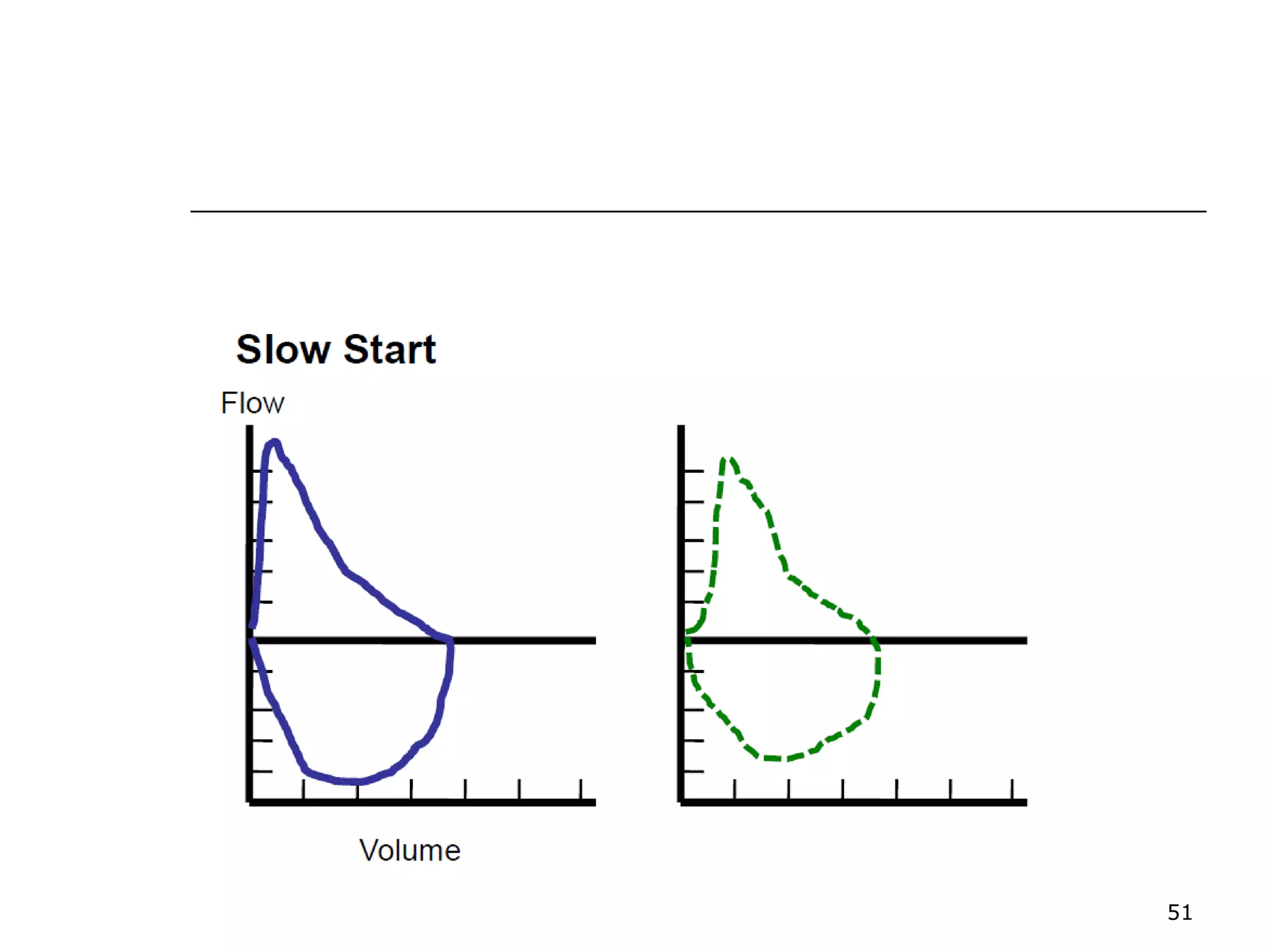
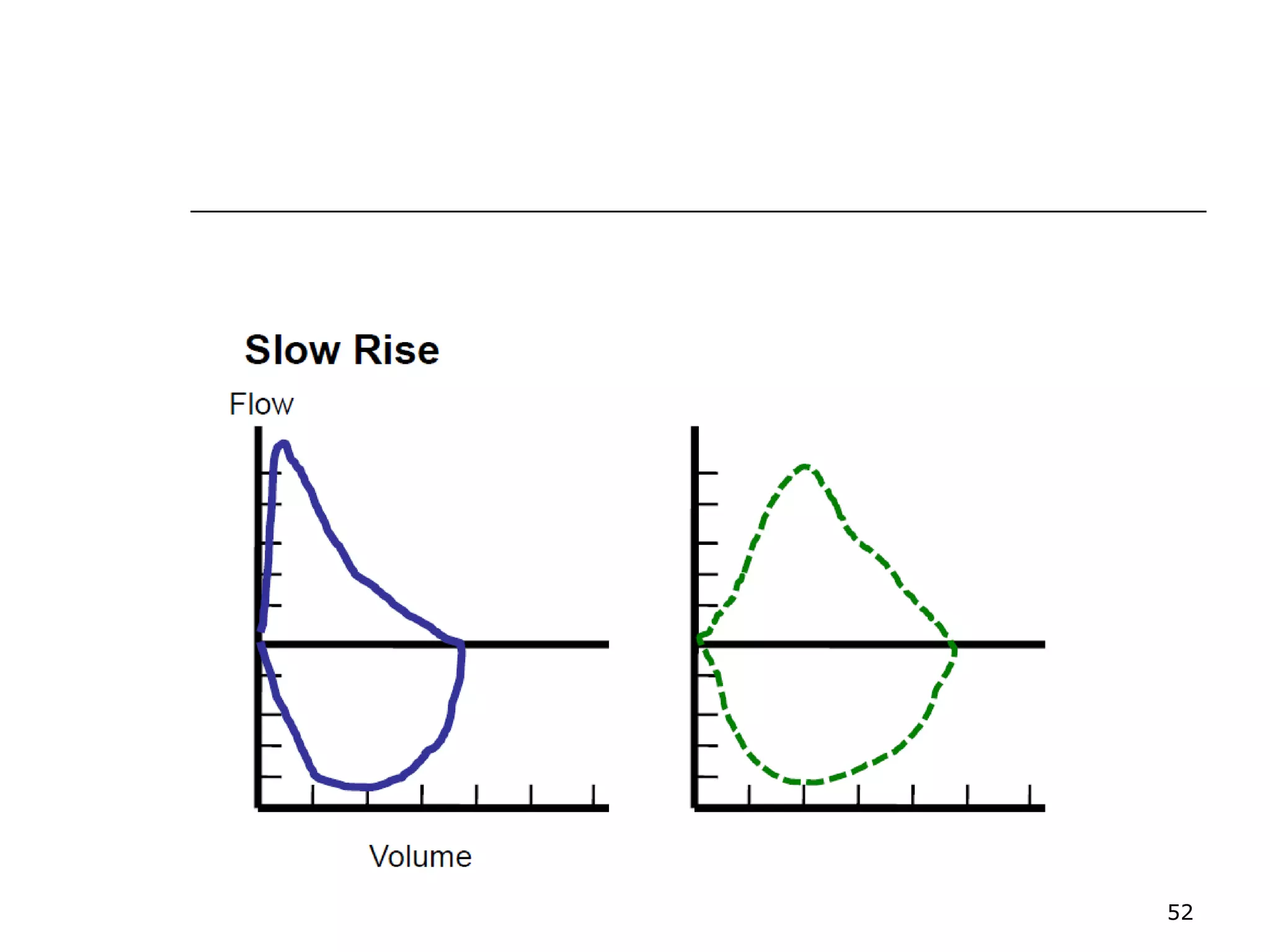
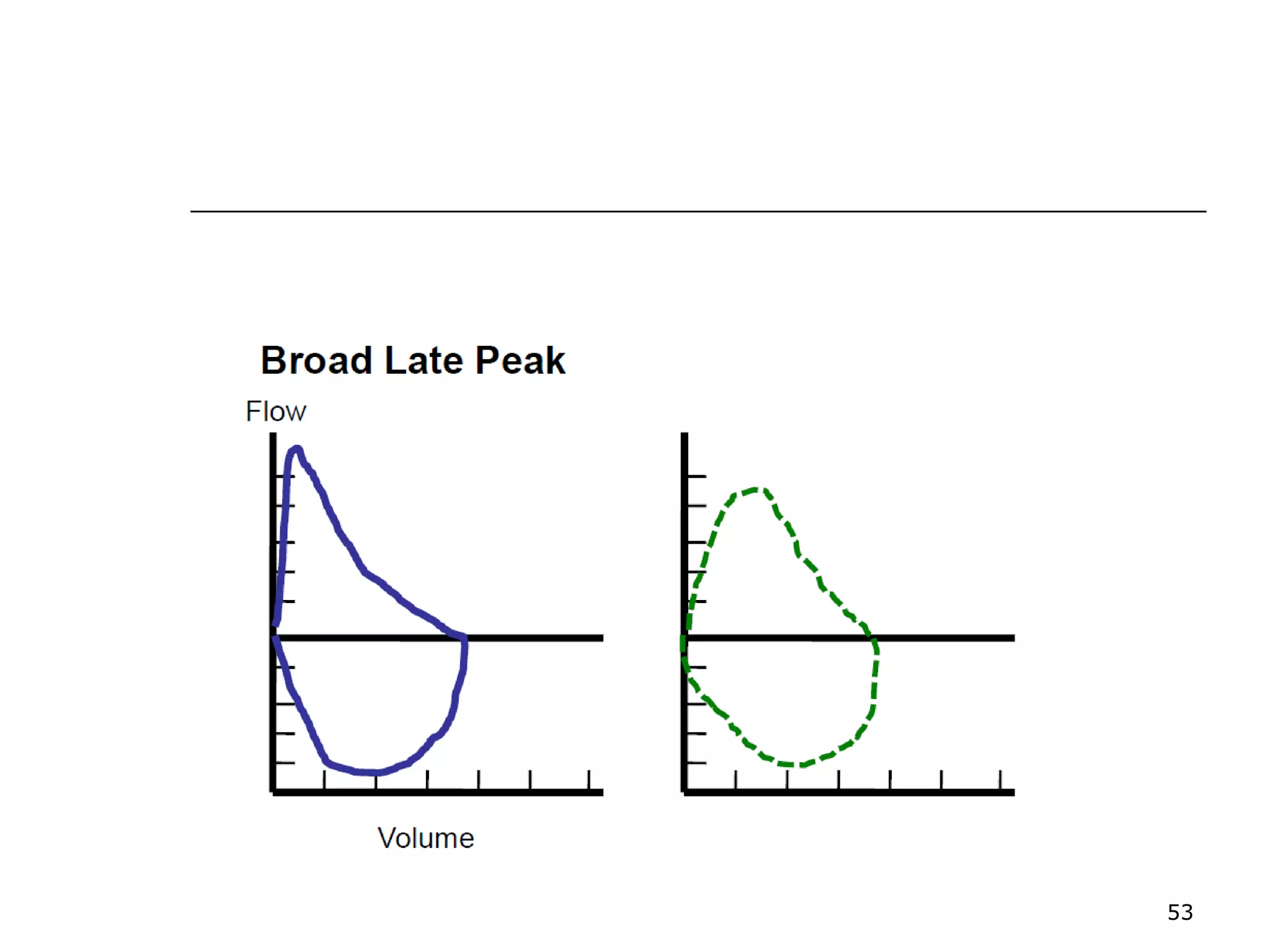
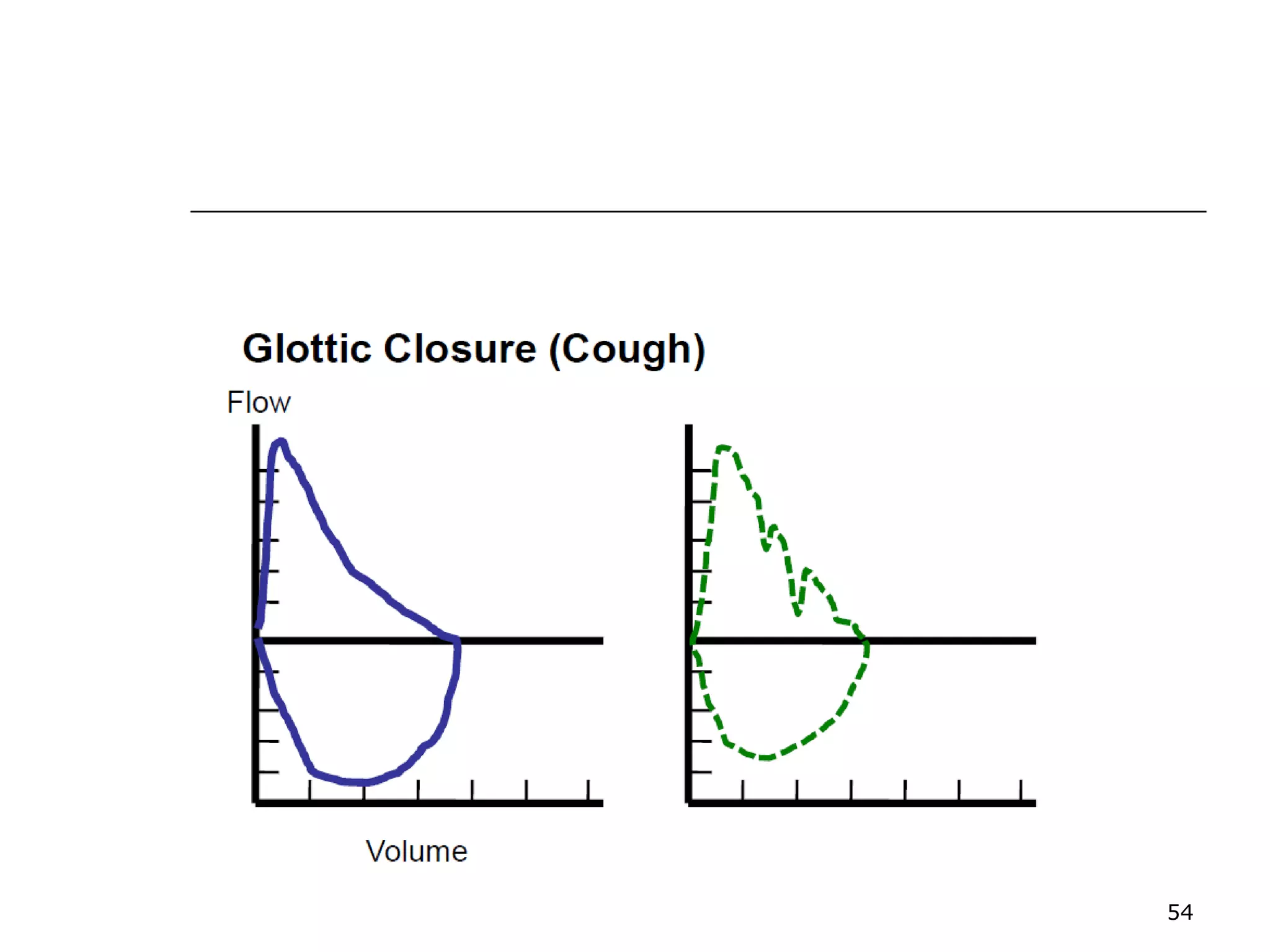

Spirometry 
Interpretation
Data generated 
 Volume time curve (spirogram) 
 FEV1, FVC, Ratio 
 Flow volume loop 
 Peak flow 
 FVC 
 FEF 25-75% 
MEF 75, 50, and 25 
 Inspiratory flow data
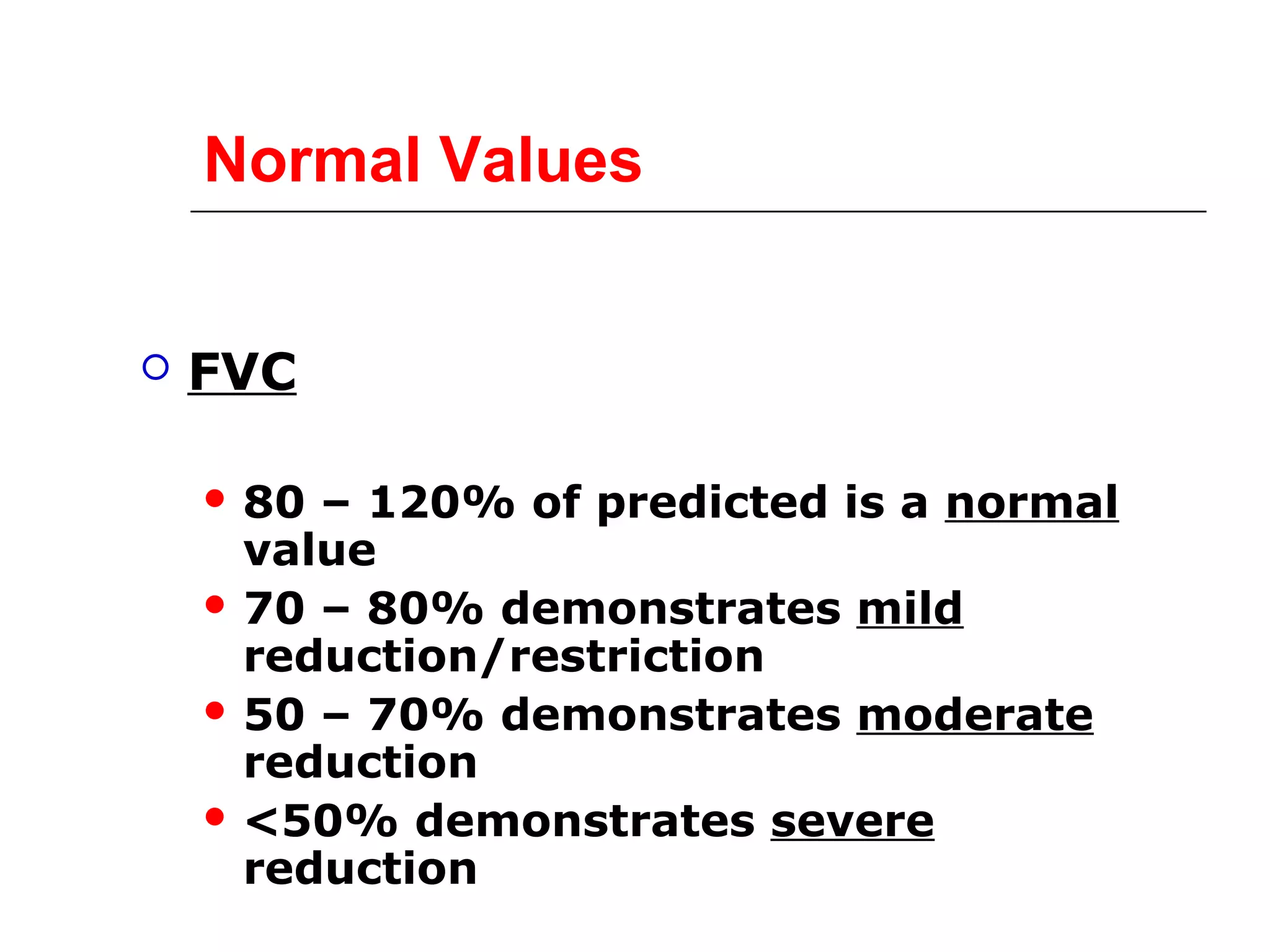
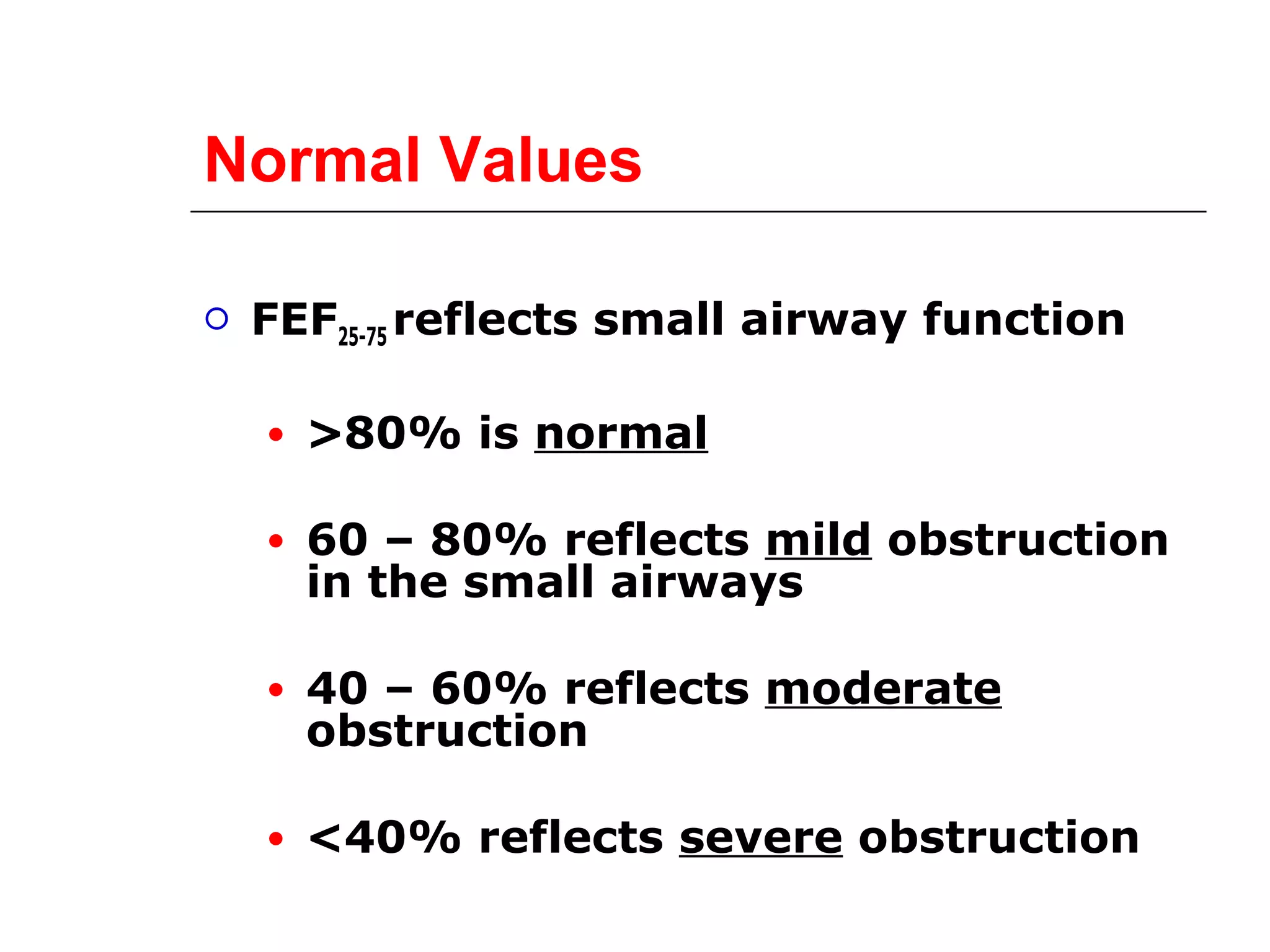
Normal Values 
 FVC 
 80 – 120% of predicted is a normal 
value 
 70 – 80% demonstrates mild 
reduction/restriction 
 50 – 70% demonstrates moderate 
reduction 
<50% demonstrates severe 
reduction
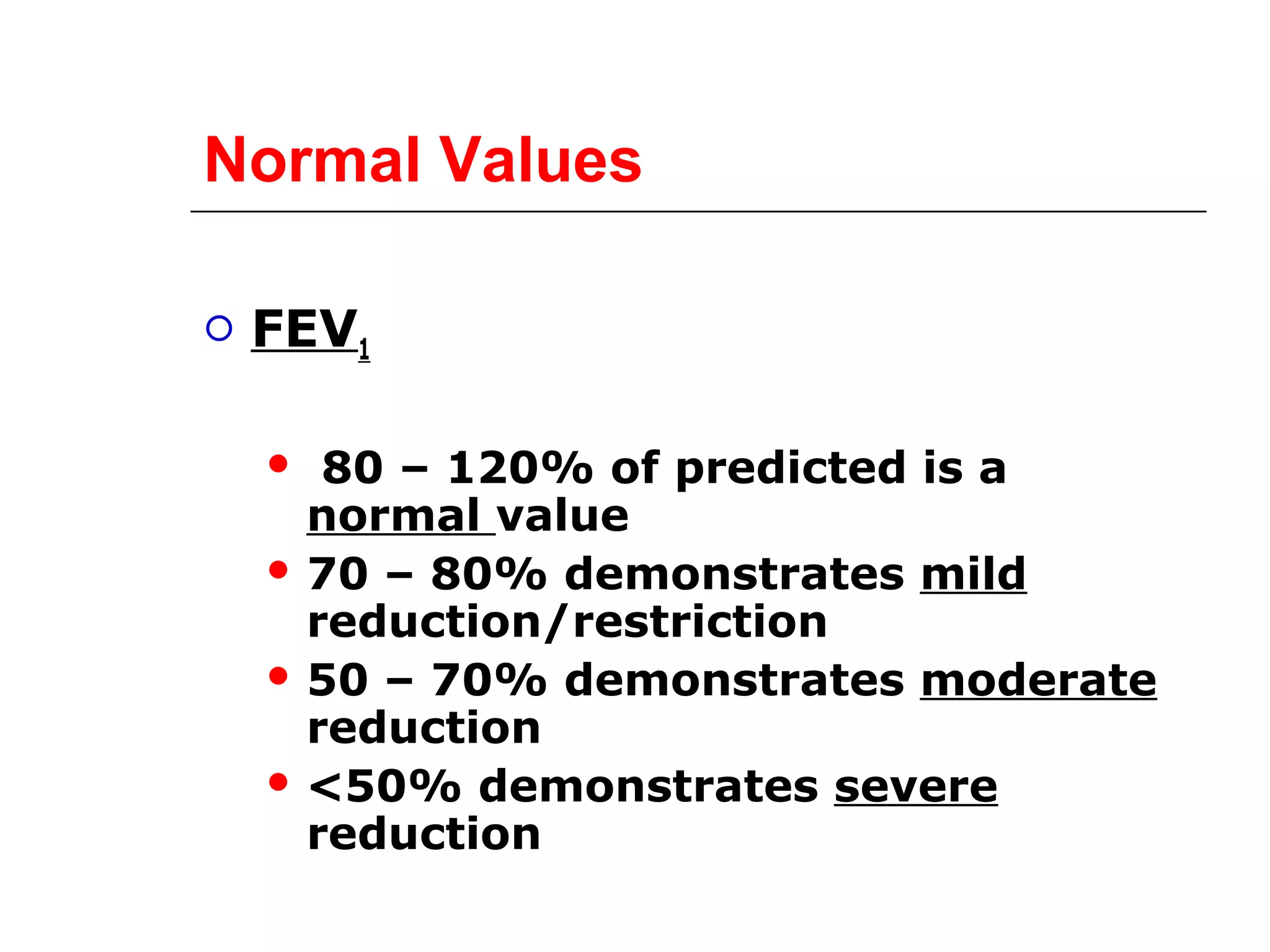
Normal Values 
 FEV1 
 80 – 120% of predicted is a 
normal value 
 70 – 80% demonstrates mild 
reduction/restriction 
 50 – 70% demonstrates moderate 
reduction 
<50% demonstrates severe 
reduction
Normal Values 
 FEF25-75 reflects small airway function 
● >80% is normal 
● 60 – 80% reflects mild obstruction 
in the small airways 
● 40 – 60% reflects moderate 
obstruction 
● <40% reflects severe obstruction
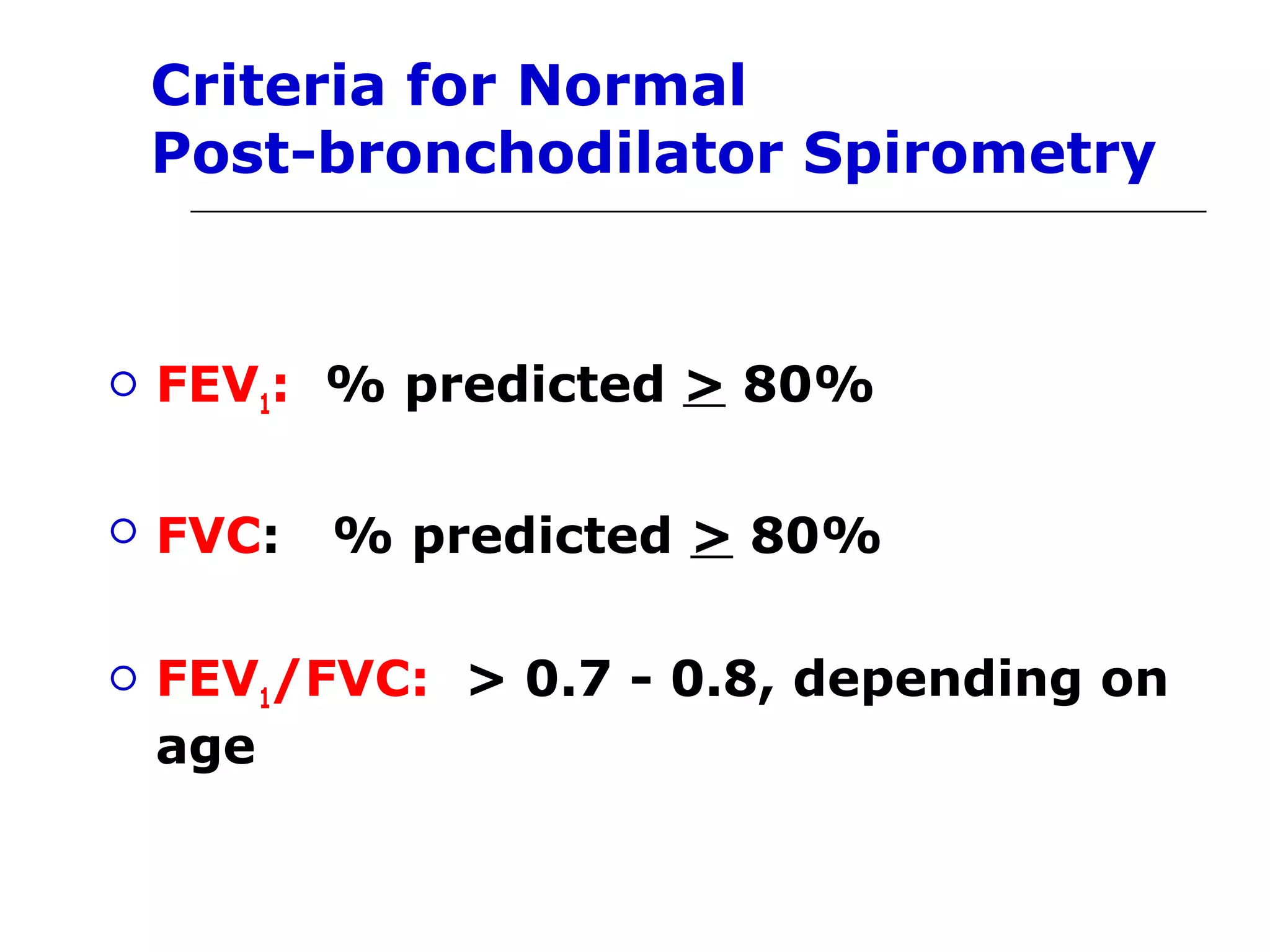
Criteria for Normal 
Post-bronchodilator Spirometry 
 FEV1: % predicted > 80% 
 FVC: % predicted > 80% 
 FEV1/FVC: > 0.7 - 0.8, depending on 
age
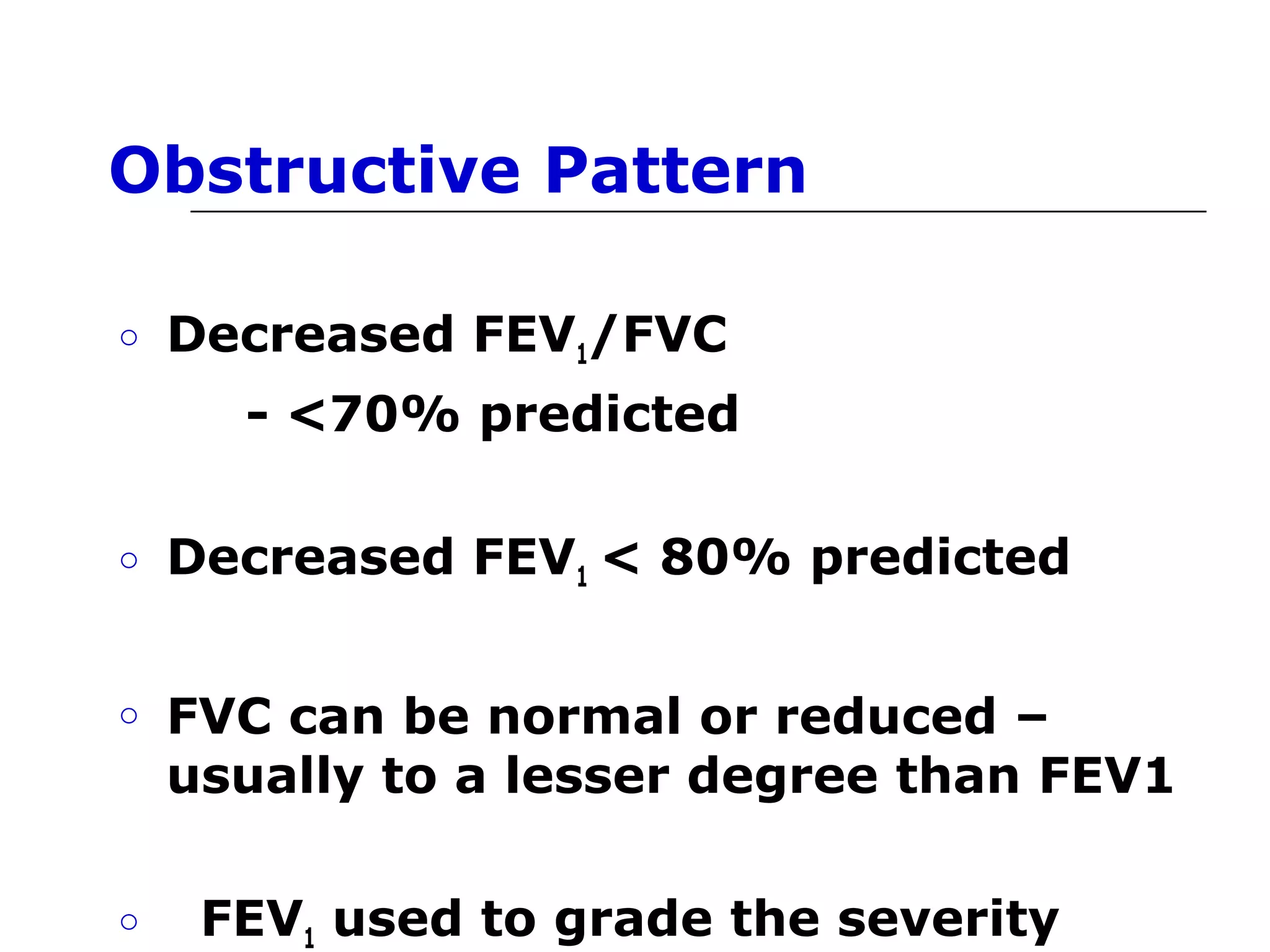
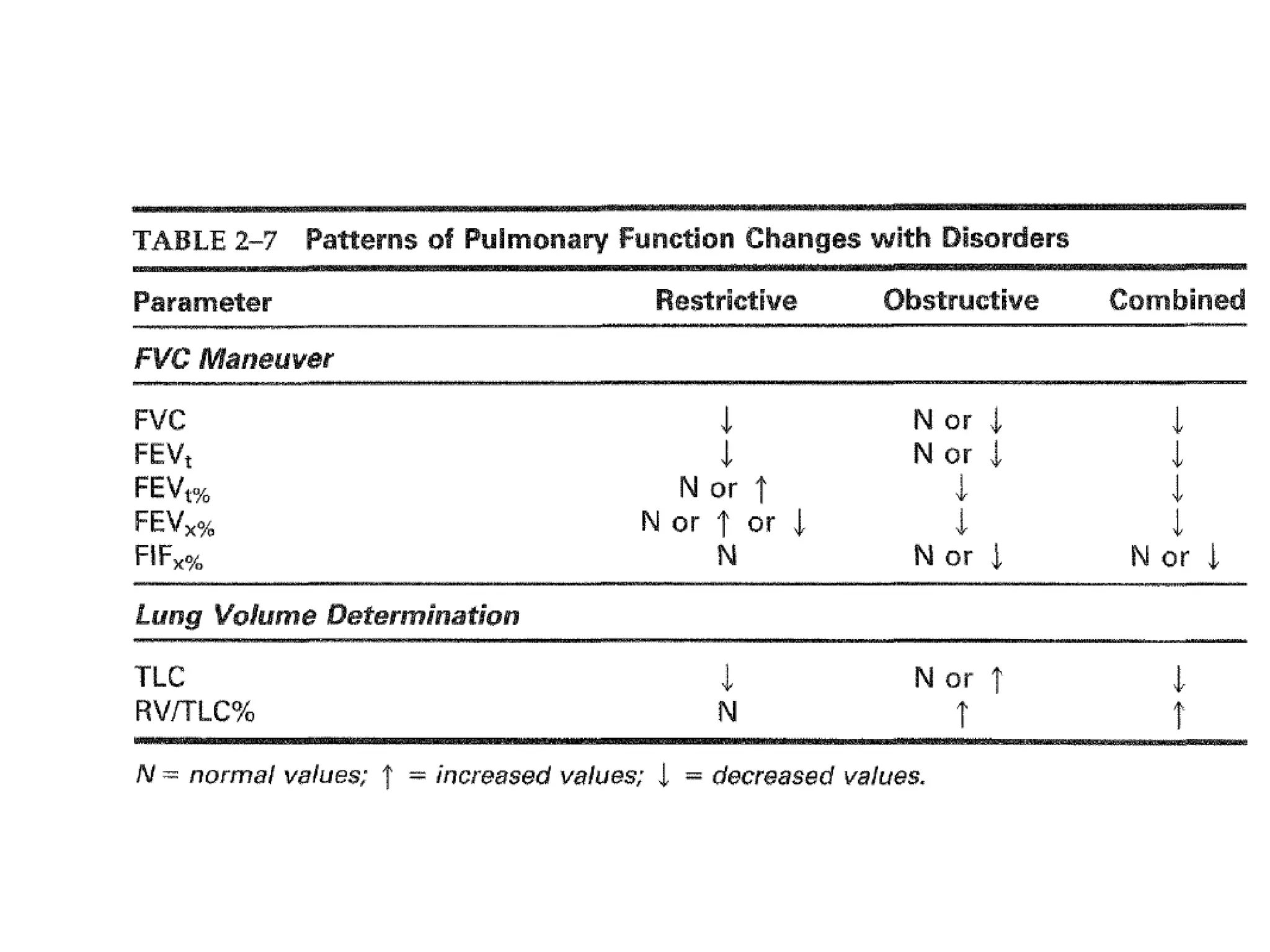
Obstructive Pattern 
o Decreased FEV1/FVC 
- <70% predicted 
o Decreased FEV1 < 80% predicted 
o FVC can be normal or reduced – 
usually to a lesser degree than FEV1 
o FEV1 used to grade the severity
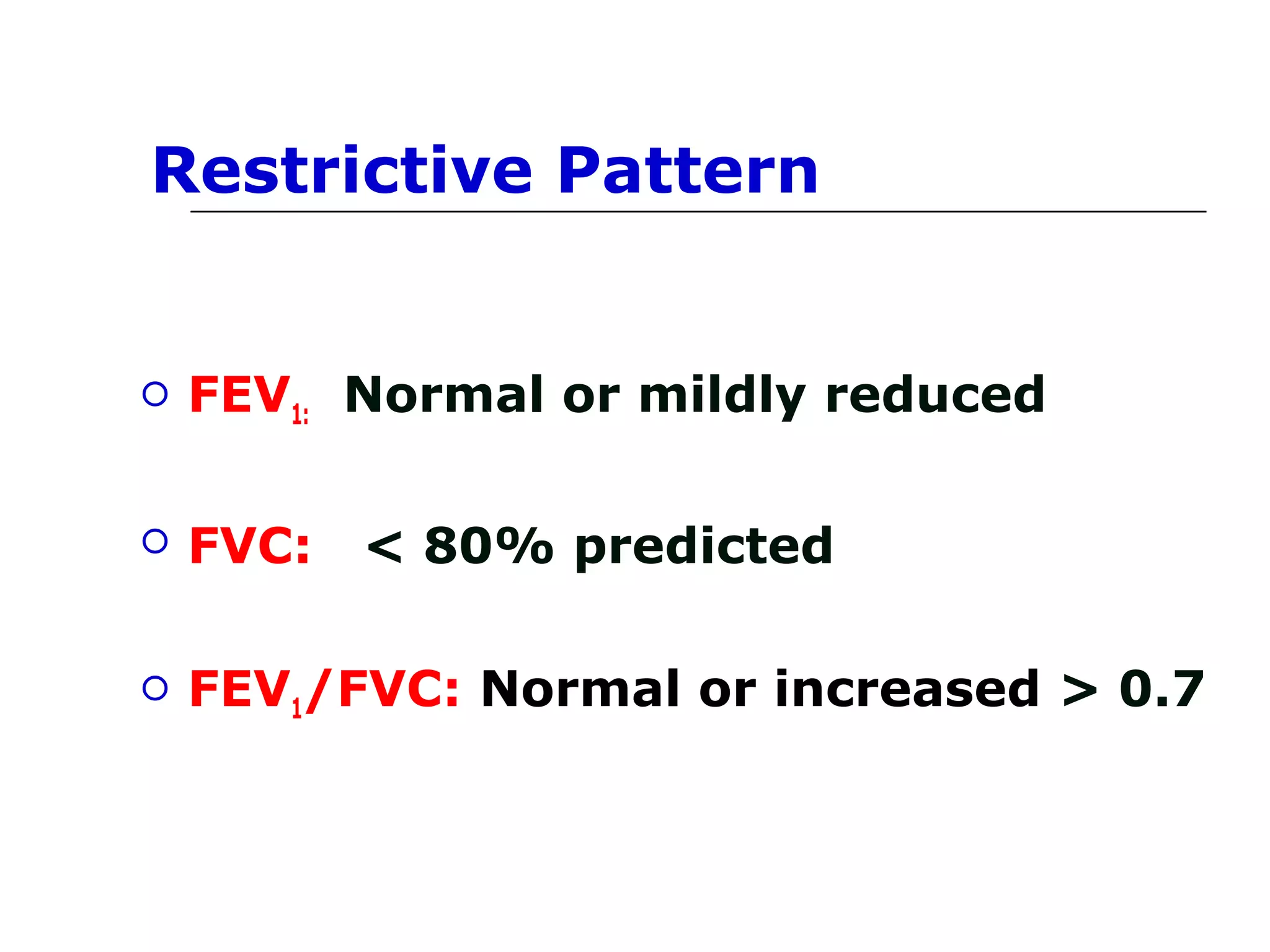
Restrictive Pattern 
 FEV1: Normal or mildly reduced 
 FVC: < 80% predicted 
 FEV1/FVC: Normal or increased > 0.7
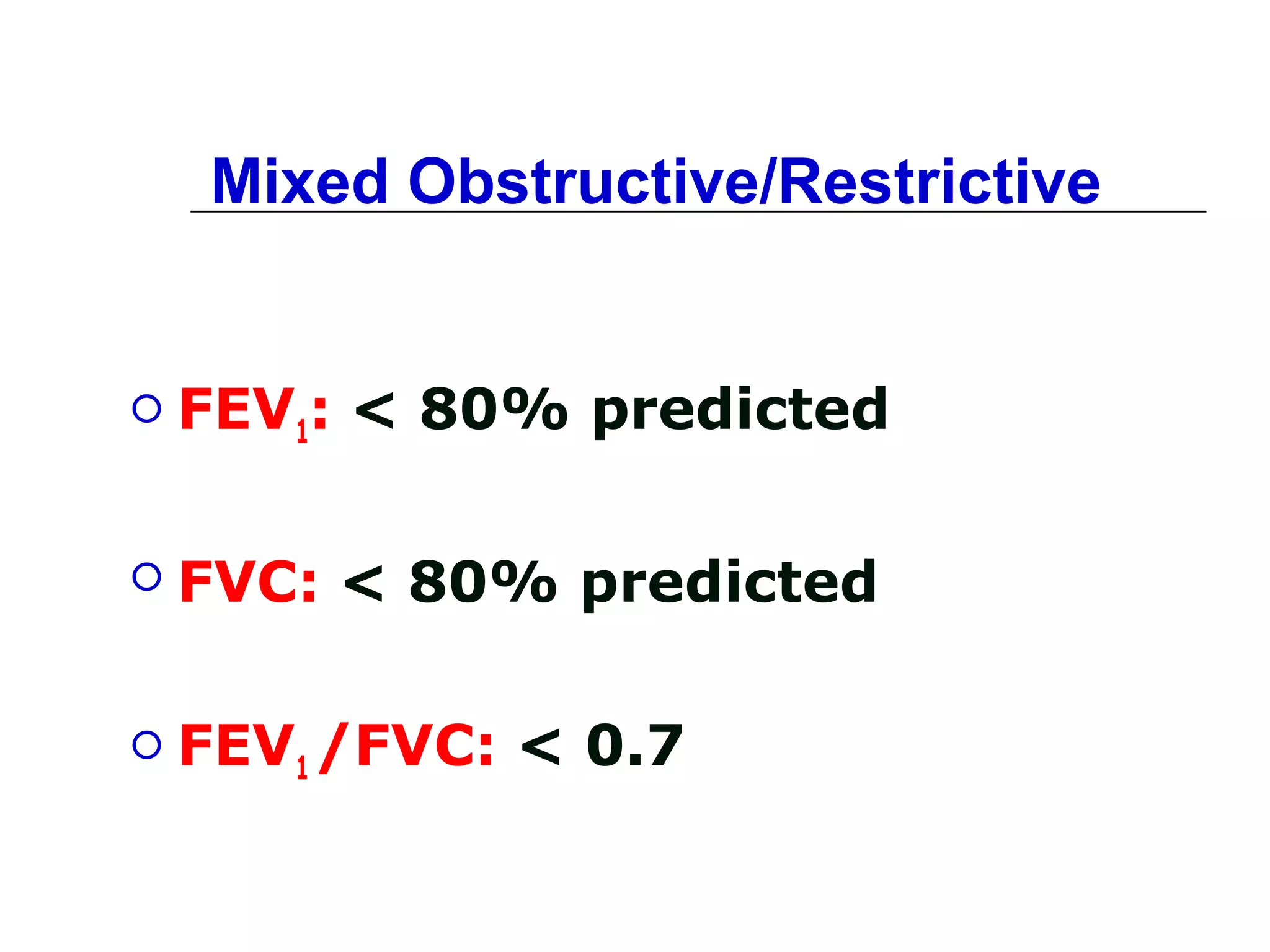
Mixed Obstructive/Restrictive 
 FEV1: < 80% predicted 
 FVC: < 80% predicted 
 FEV1 /FVC: < 0.7
12
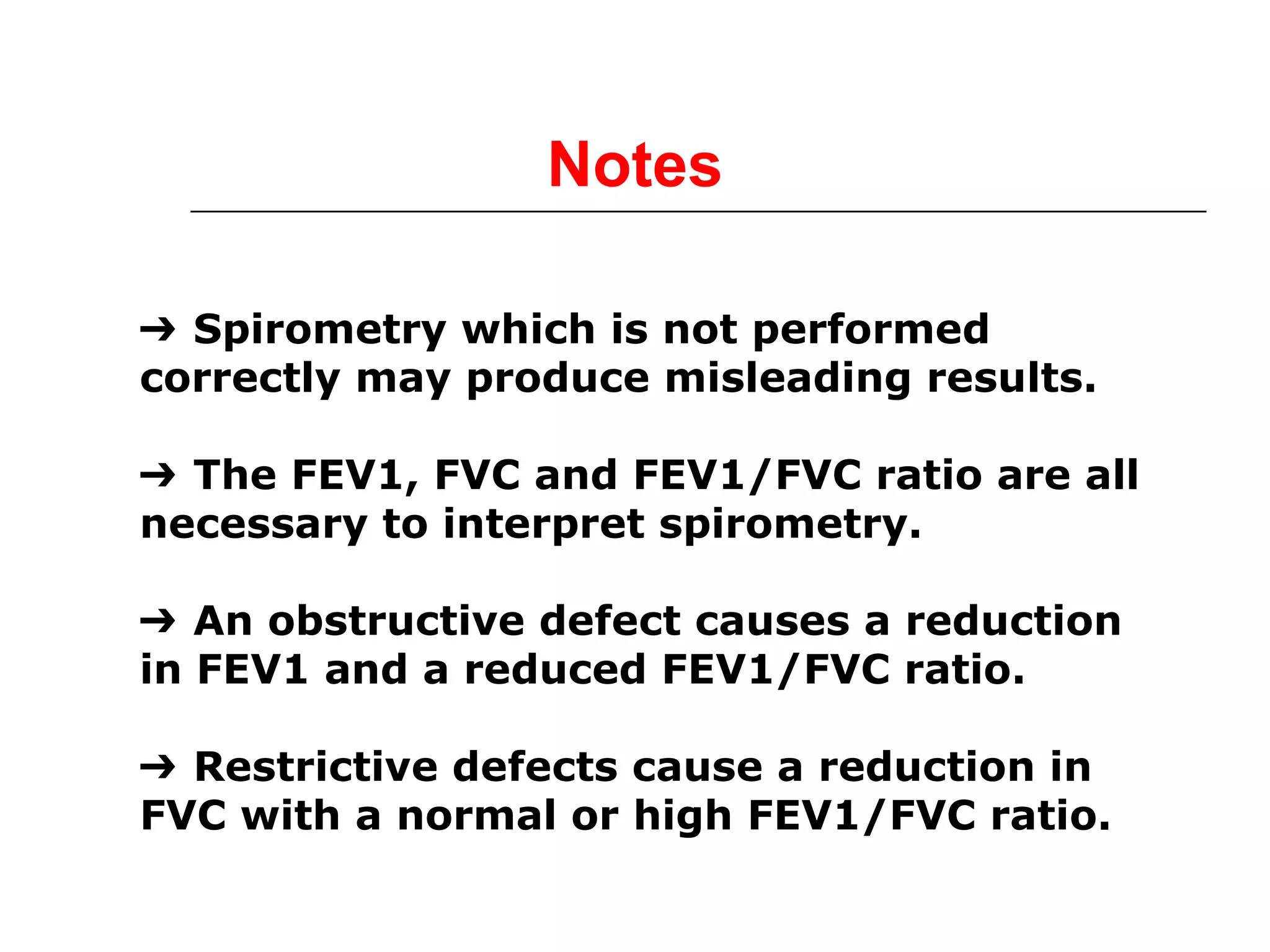
Notes 
➔ Spirometry which is not performed 
correctly may produce misleading results. 
➔ The FEV1, FVC and FEV1/FVC ratio are all 
necessary to interpret spirometry. 
➔ An obstructive defect causes a reduction 
in FEV1 and a reduced FEV1/FVC ratio. 
➔ Restrictive defects cause a reduction in 
FVC with a normal or high FEV1/FVC ratio.
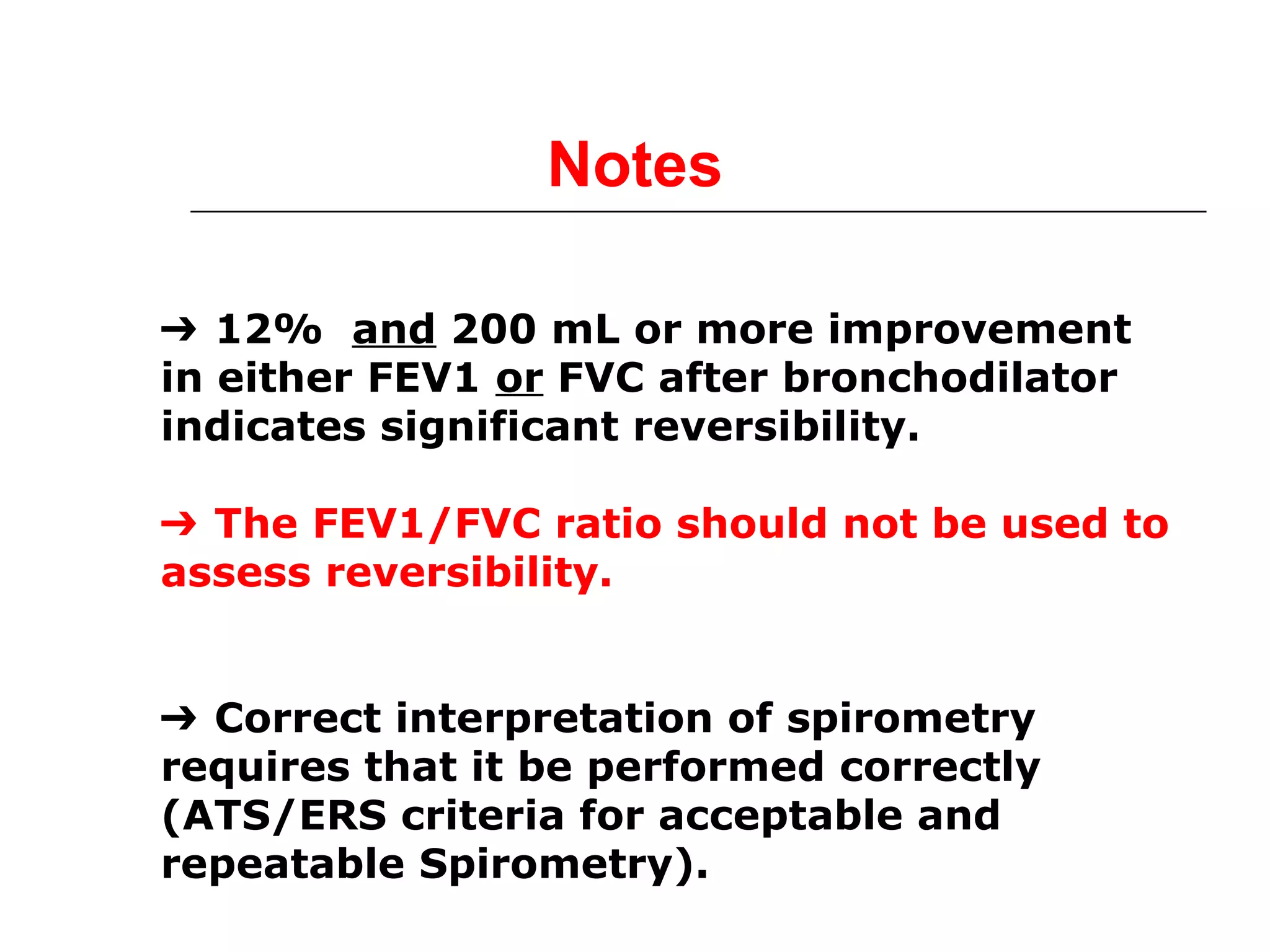
Notes 
➔ 12% and 200 mL or more improvement 
in either FEV1 or FVC after bronchodilator 
indicates significant reversibility. 
➔ The FEV1/FVC ratio should not be used to 
assess reversibility. 
➔ Correct interpretation of spirometry 
requires that it be performed correctly 
(ATS/ERS criteria for acceptable and 
repeatable Spirometry).
To obtain an accurate recording the subject 
should be told to: 
• Sit up straight 
• Get a good seal around the mouthpiece of the 
spirometer 
• Rapidly inhale maximally (‘breathe in all the 
way’) 
• Without delay, blow out as hard and as fast 
as possible (‘blast out’) 
• Continue to exhale (‘keep going … keep 
going’) until the patient can blow no more.
Expiration should continue for at least 6 
seconds (3 seconds in children under 10 
years old) and up to 15 seconds if necessary 
(some patients will find this exhausting and 
prolonged manoeuvres should be used with 
caution) 
Manoeuvres are repeated until at least three 
technically acceptable manoeuvres (NO 
coughs, air leaks, false starts) are completed.
If required, more tests should be done to try 
to meet repeatability criteria (no more than 
8 attempts in total). 
Poor measurement technique can produce 
results which mimic disease patterns. 
Common errors occur when the patient fails 
to inhale fully before the test, stops blowing 
too early (apparent restrictive defect), or 
doesn’t blow out hard enough (apparent 
obstructive defect).
TECHNIQUE OF SPIROMETRY 
The patient must be clinically stable, should sit 
straight, with head erect, nose clip in place, and 
holding the mouthpiece tightly between the lips. 
Initially, he or she should breathe in and out at 
the tidal volume ( V T : normal quiet breathing) 
to record the tidal flow–volume loop. 
Then, when the patient is ready, the technician 
instructs him/her to inhale maximally to TLC , 
and then exhale as fast and as completely as 
possible to record the FVC .
TECHNIQUE OF SPIROMETRY 
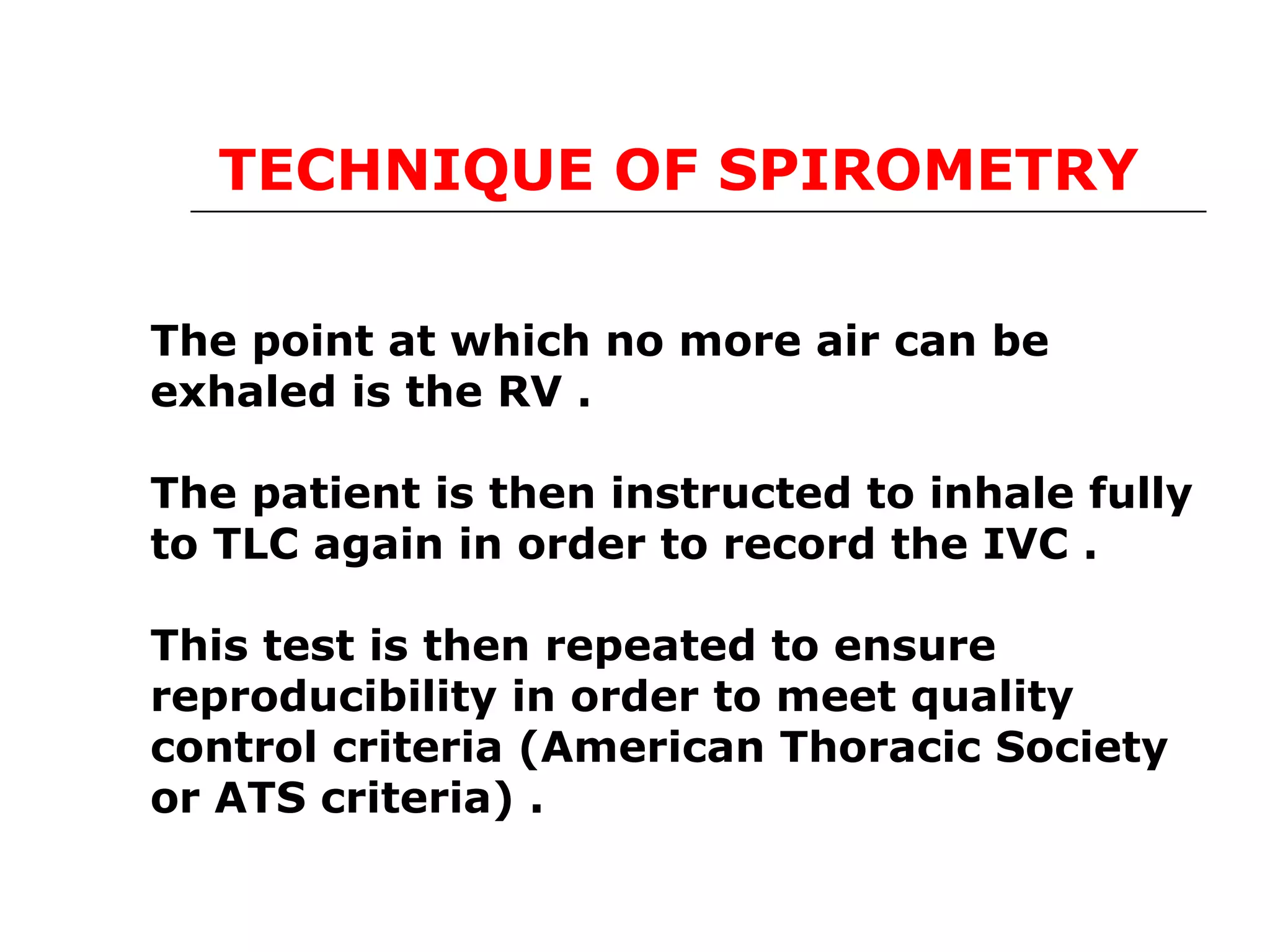
The point at which no more air can be 
exhaled is the RV . 
The patient is then instructed to inhale fully 
to TLC again in order to record the IVC . 
This test is then repeated to ensure 
reproducibility in order to meet quality 
control criteria (American Thoracic Society 
or ATS criteria) .
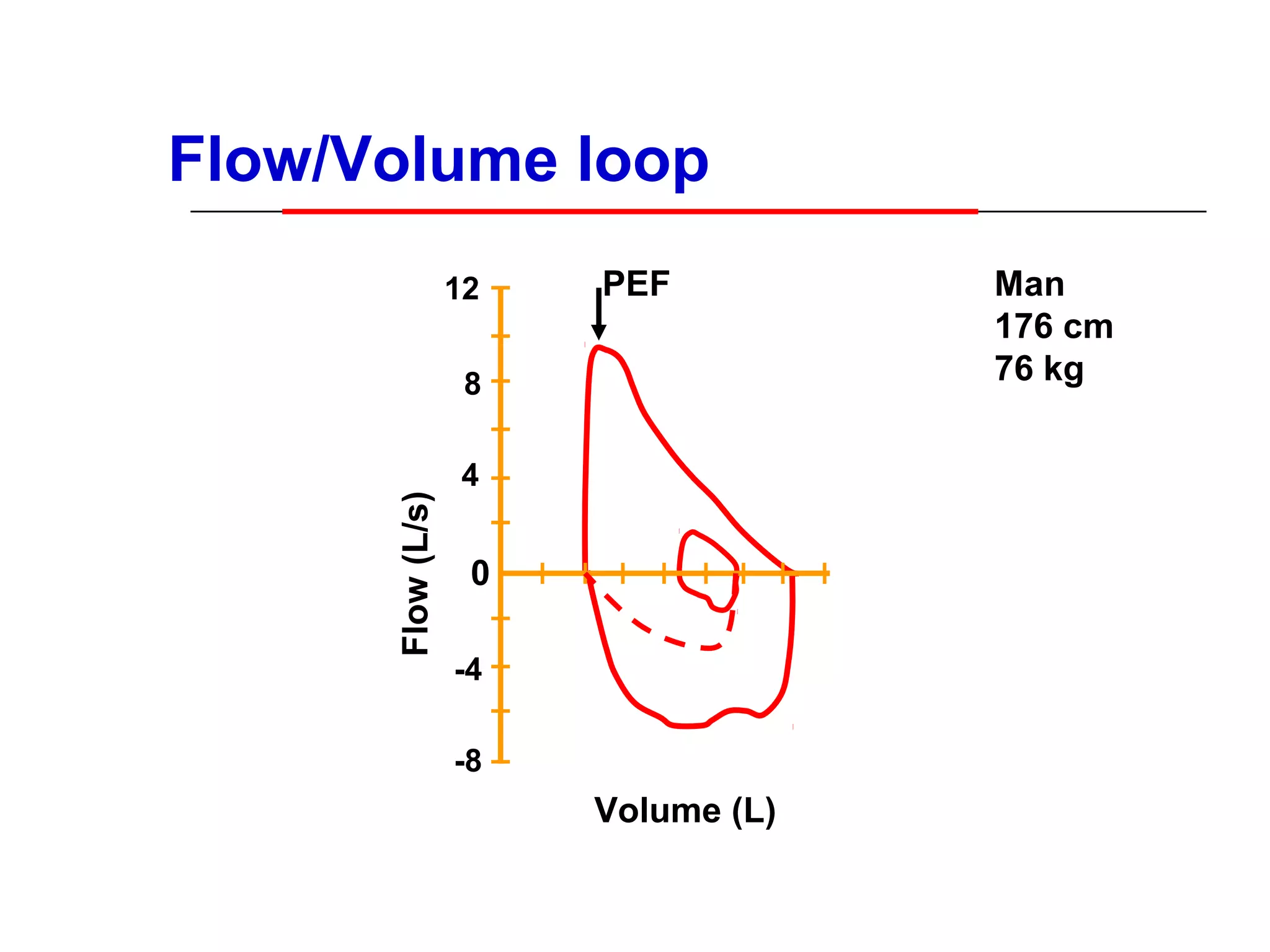
Flow/Volume loop 
12 
8 
4 
0 
-4 
-8 
Flow (L/s) 
PEF 
Man 
176 cm 
76 kg 
Volume (L)
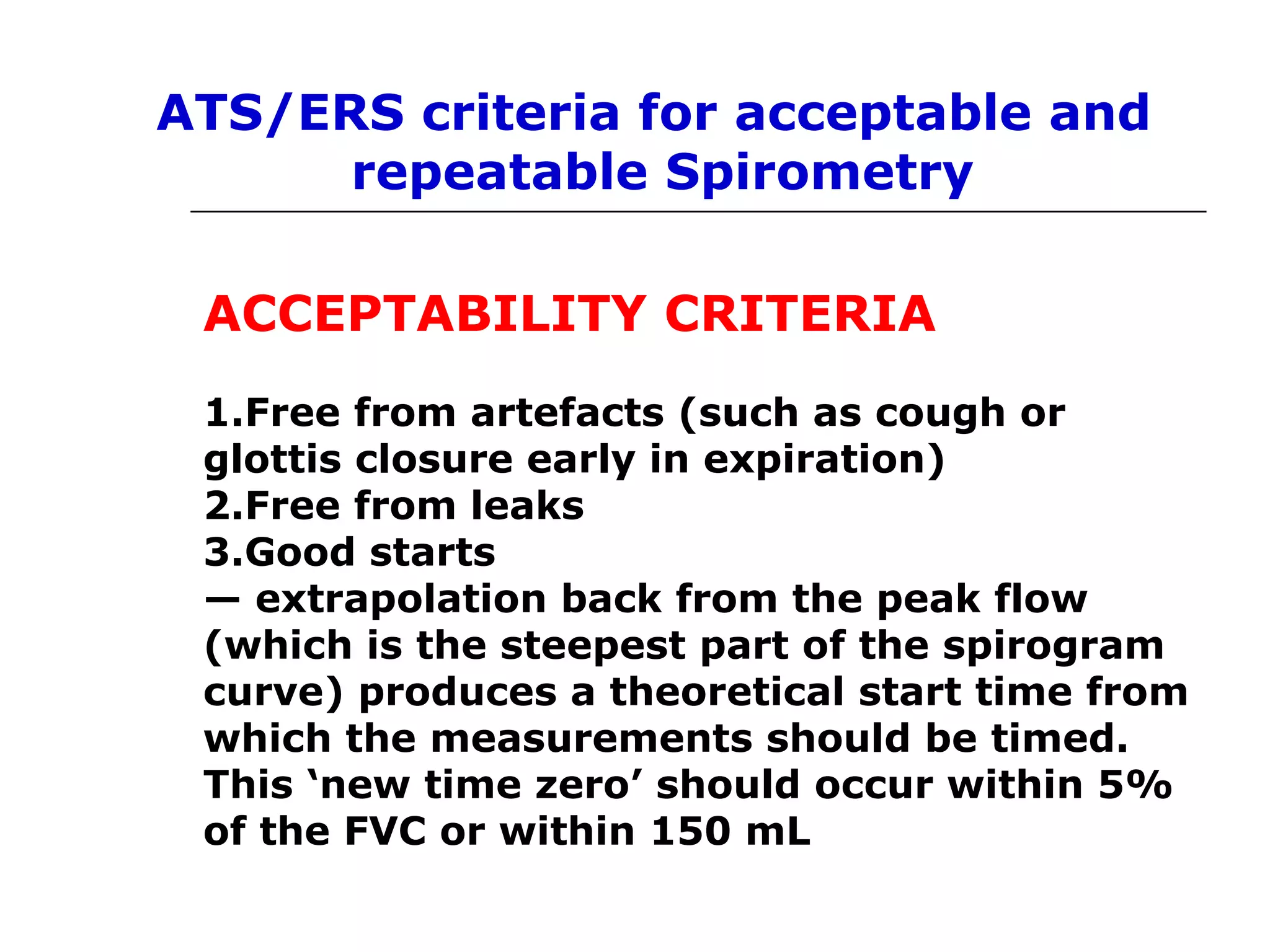
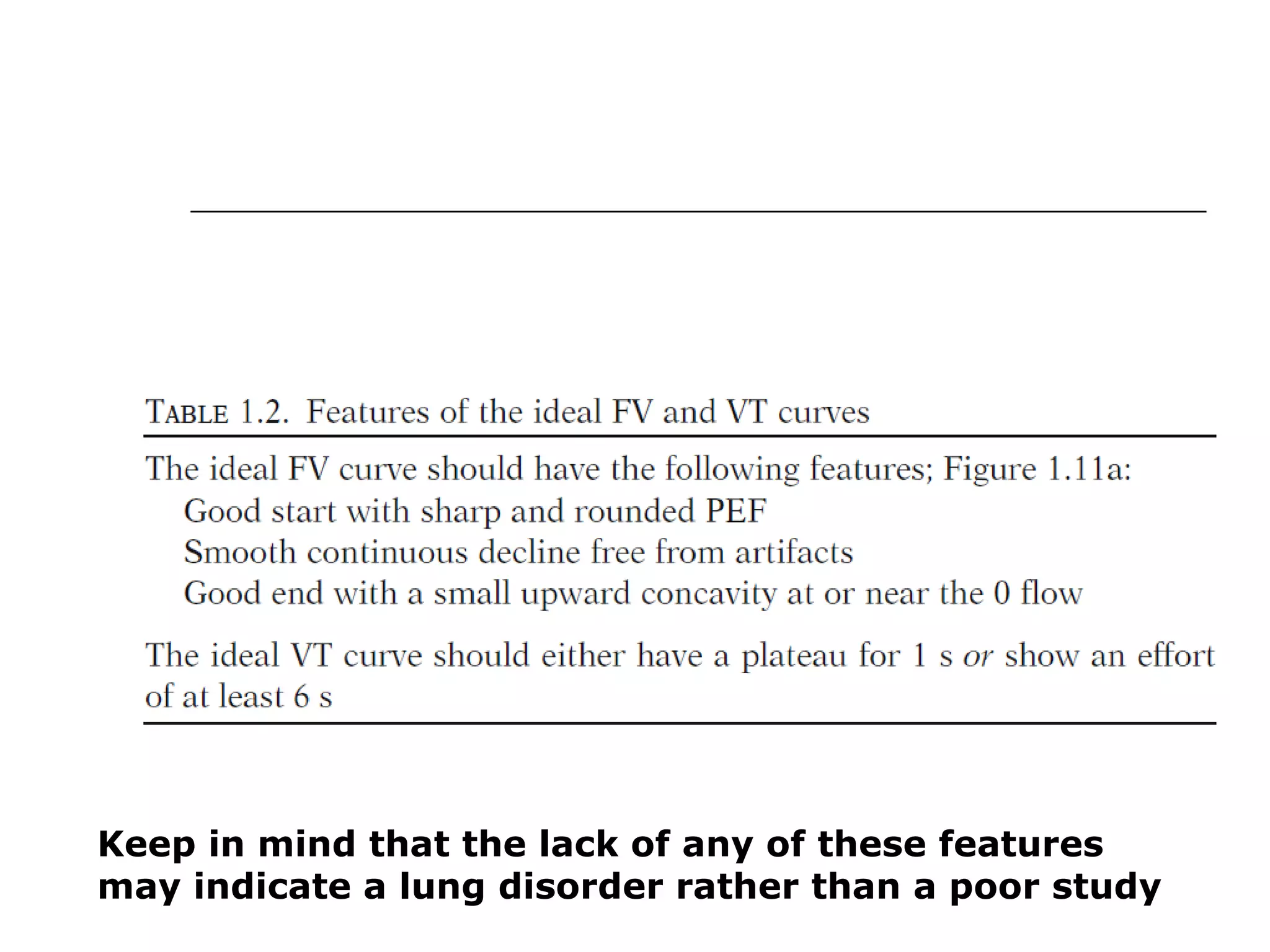
ATS/ERS criteria for acceptable and 
repeatable Spirometry 
ACCEPTABILITY CRITERIA 
1.Free from artefacts (such as cough or 
glottis closure early in expiration) 
2.Free from leaks 
3.Good starts 
— extrapolation back from the peak flow 
(which is the steepest part of the spirogram 
curve) produces a theoretical start time from 
which the measurements should be timed. 
This ‘new time zero’ should occur within 5% 
of the FVC or within 150 mL
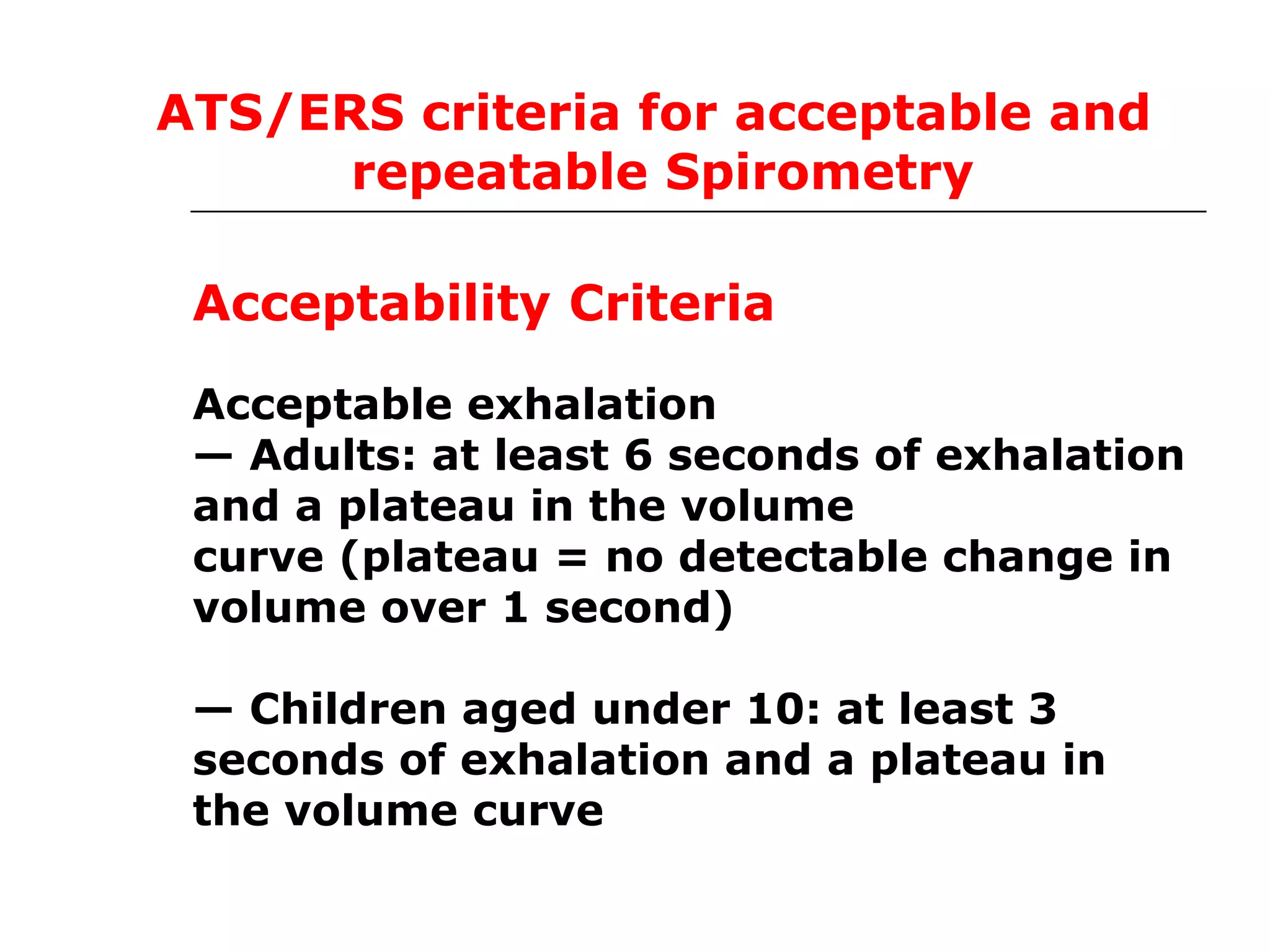
ATS/ERS criteria for acceptable and 
repeatable Spirometry 
Acceptability Criteria 
Acceptable exhalation 
— Adults: at least 6 seconds of exhalation 
and a plateau in the volume 
curve (plateau = no detectable change in 
volume over 1 second) 
— Children aged under 10: at least 3 
seconds of exhalation and a plateau in 
the volume curve
Acceptability 
The ATS mandates three acceptable maneuvers. 
The number of trials that can be performed on an 
individual should not exceed 8. 
An acceptable trial should have 
a good start, a good end, and absence of artifacts. 
1. Good start of the test: 
• If the study needs back extrapolation, the 
extrapolation volume should not exceed 5% of 
FVC or 150 ml, whichever is larger.
Note : Back extrapolation applies to the VT curve and 
means that if the start of the test is not optimal, 
correction can be made by shifting the time axis forward, 
provided that the extrapolation volume is within either 
one of the limits mentioned earlier. 
To simplify this, consider that a patient’s FVC is 2 L and 
the study requires a back extrapolation correction, and 
5% of the FVC (2 L) is 100 ml. Because 150 ml is larger 
than 5% of the patient’s FVC (100 ml), 150 ml should be 
used as the upper limit of extrapolated volume. 
Then, if the measured extrapolated volume is greater 
than 150 ml, the result cannot be accepted.
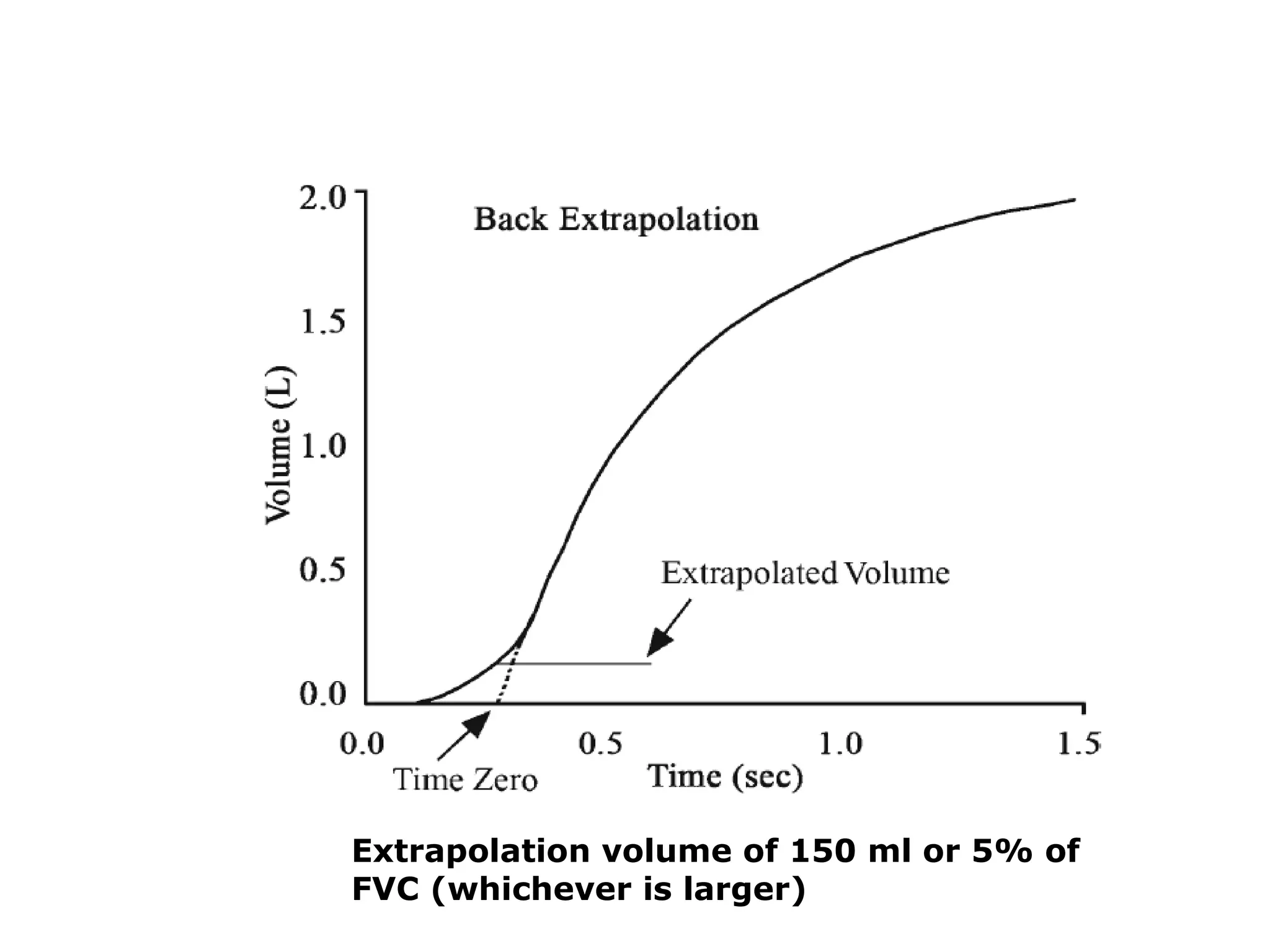
Extrapolation volume of 150 ml or 5% of 
FVC (whichever is larger)
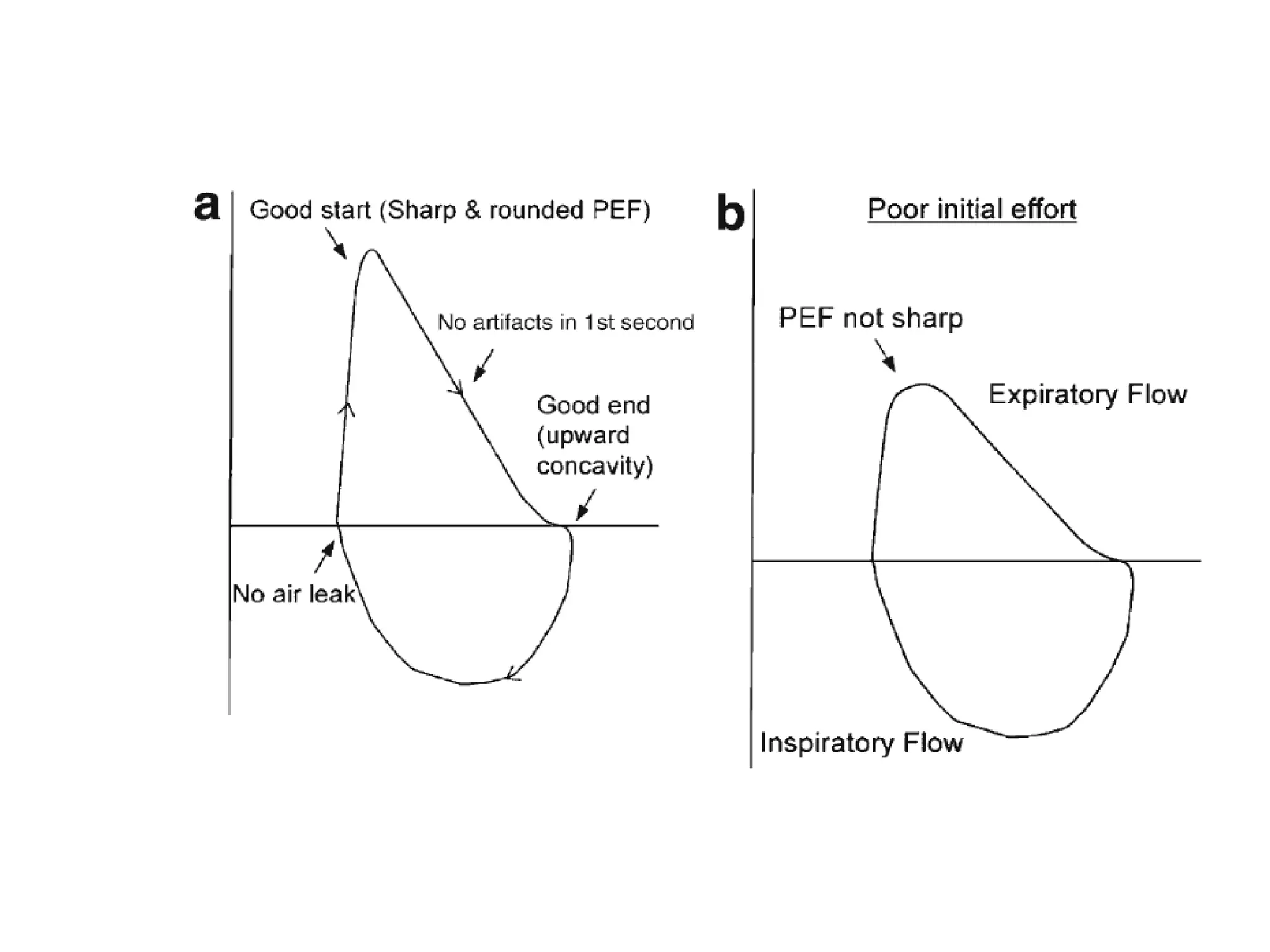
Note : A good start of the study can be 
identified qualitatively on the FV curve as a 
rapid rise of flow to PEF from the baseline (0 
point), with the PEF being sharp and 
rounded. 
The FEV 1 can be over- or underestimated 
with submaximal effort, which may mimic 
lung disorders such as those due to airway 
obstruction or lung restriction;
2. Smooth flow–volume (FV) curve, free of artifacts : 
These artifacts will show in both volume–time (VT) and 
FV curves but will be more pronounced in the FV curve. 
These artifacts include the following: 
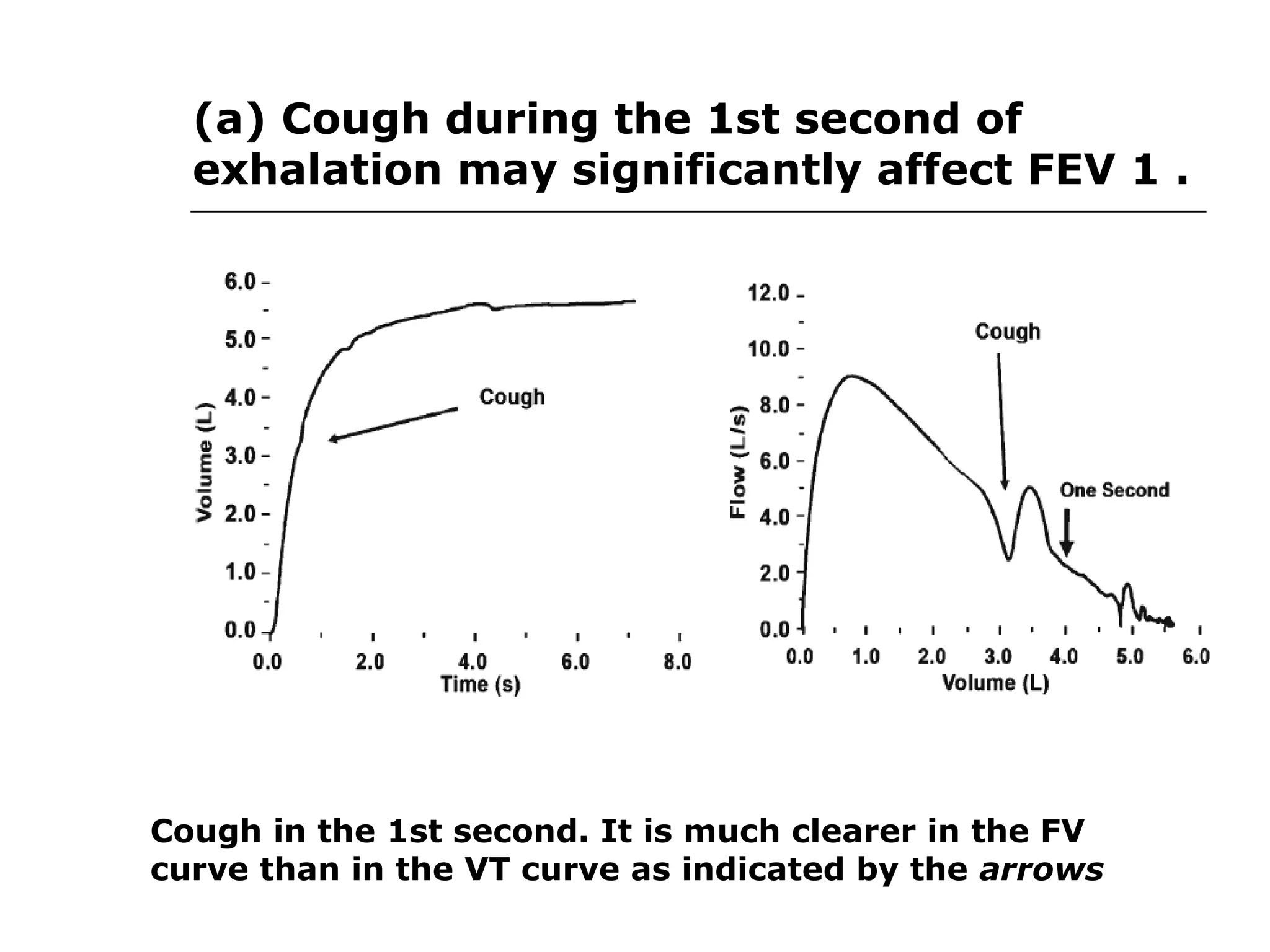
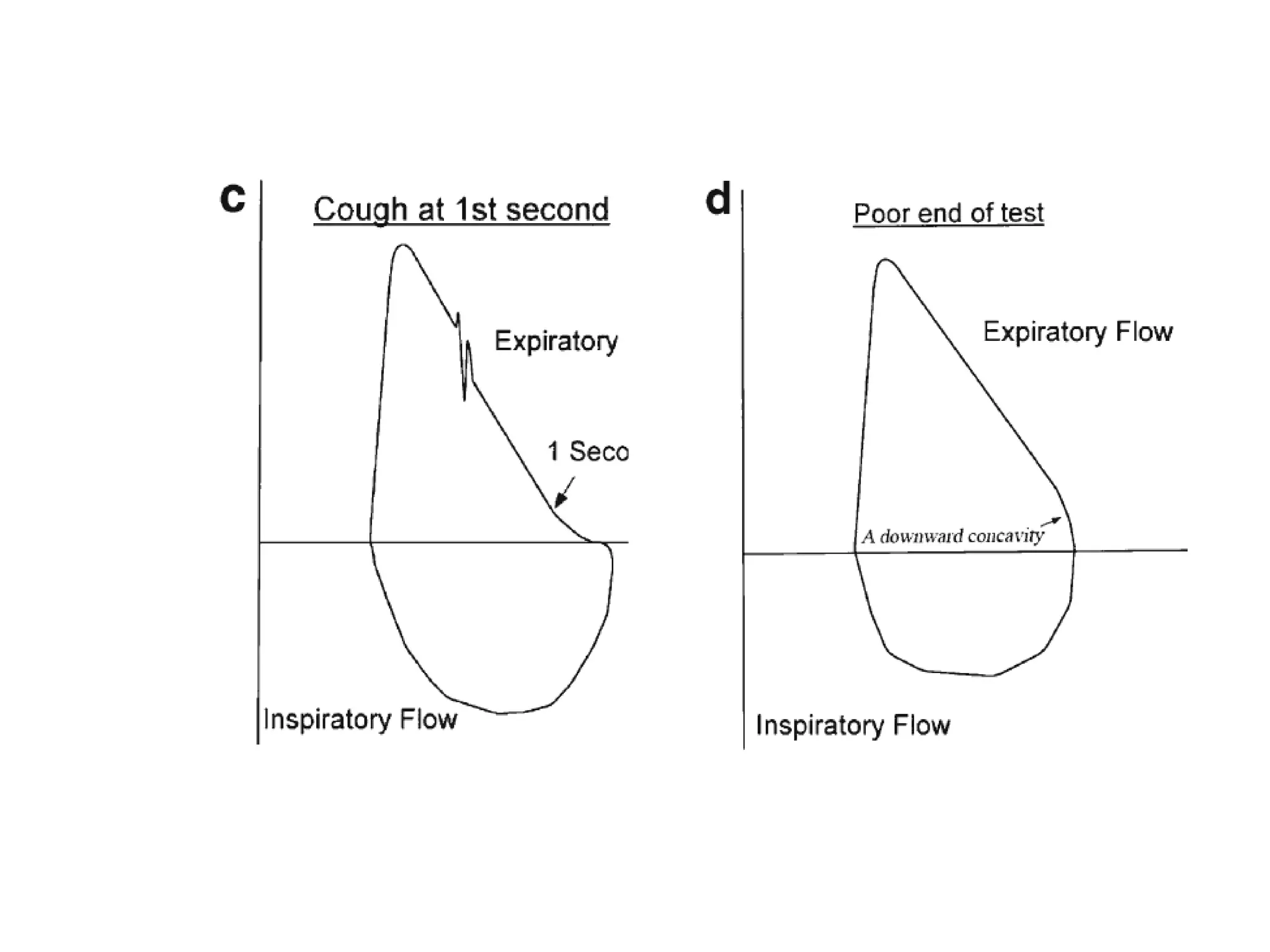
(a) Cough during the 1st second of exhalation may 
significantly affect FEV 1 . 
The FV curve is sensitive in detecting this artifact; 
Coughing after the 1st second is less likely to make 
a significant difference in the FVC and so it is accepted 
provided that it does not distort the shape of the FV 
curve (judged by the technician).
(a) Cough during the 1st second of 
exhalation may significantly affect FEV 1 . 
Cough in the 1st second. It is much clearer in the FV 
curve than in the VT curve as indicated by the arrows
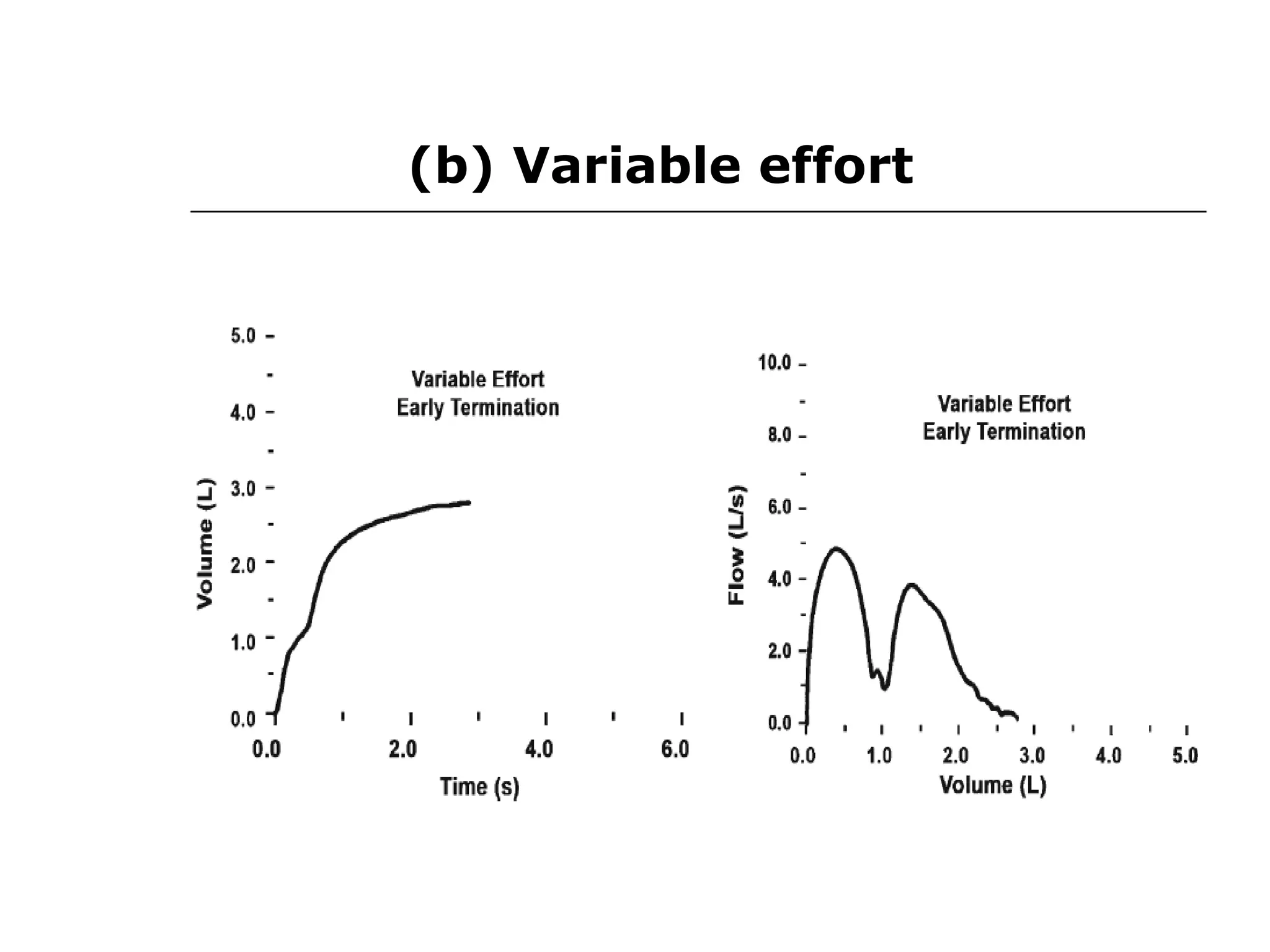
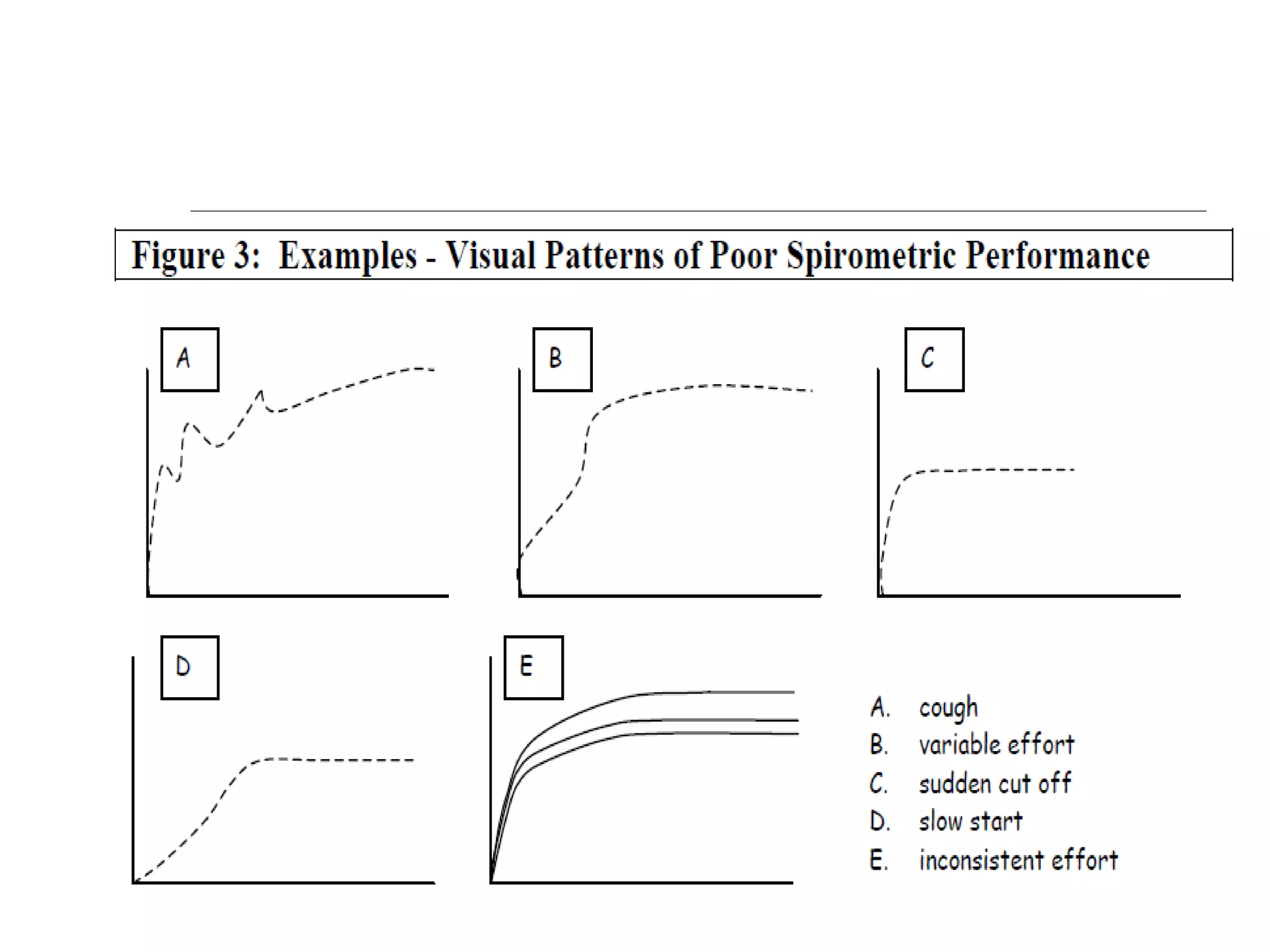
(b) Variable effort
(c) Glottis closure; 
(d) Early termination of effort. 
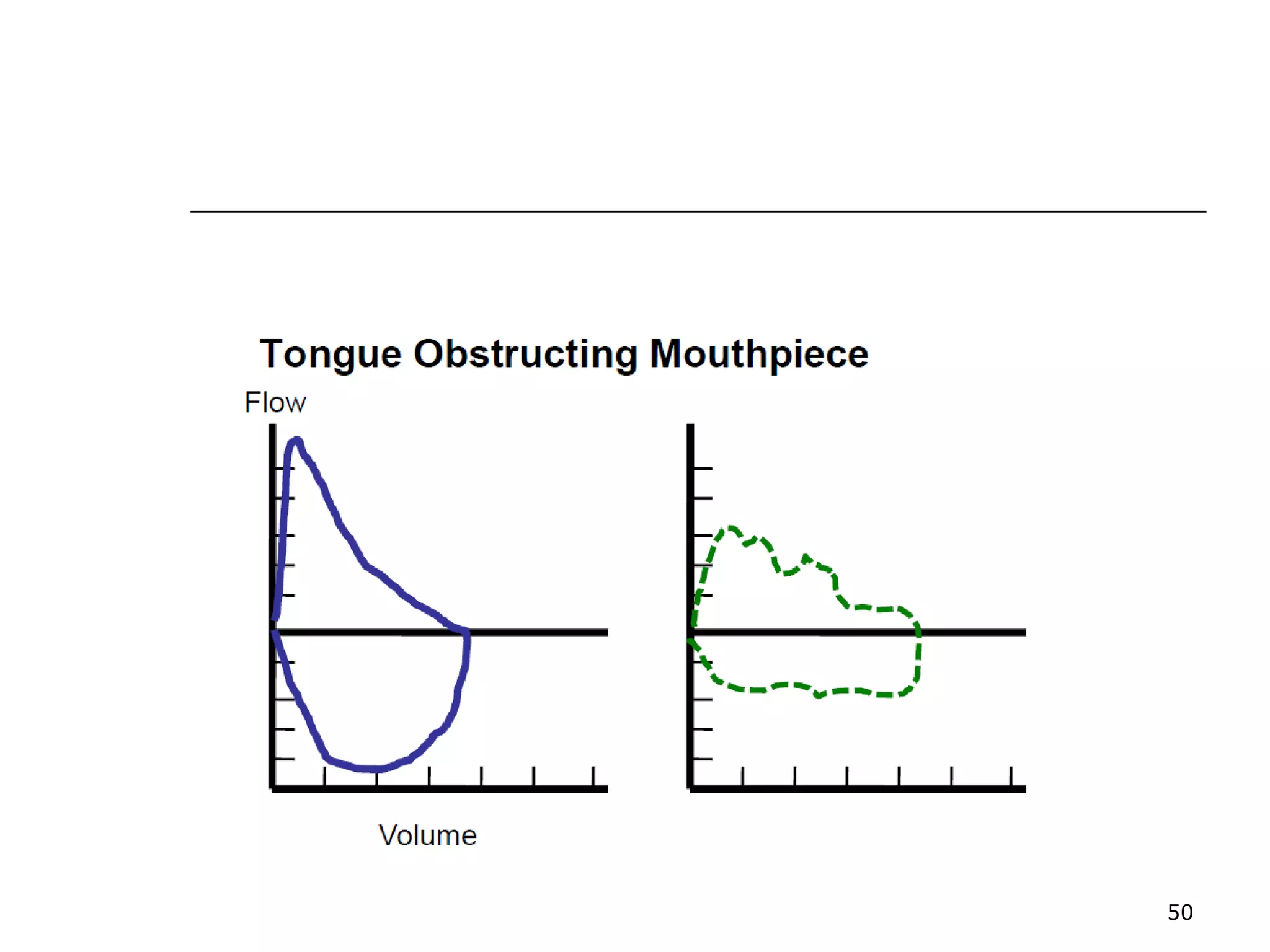
(e) Obstructed mouthpiece, by applying the 
tongue through the mouthpiece or biting it 
with the teeth. 
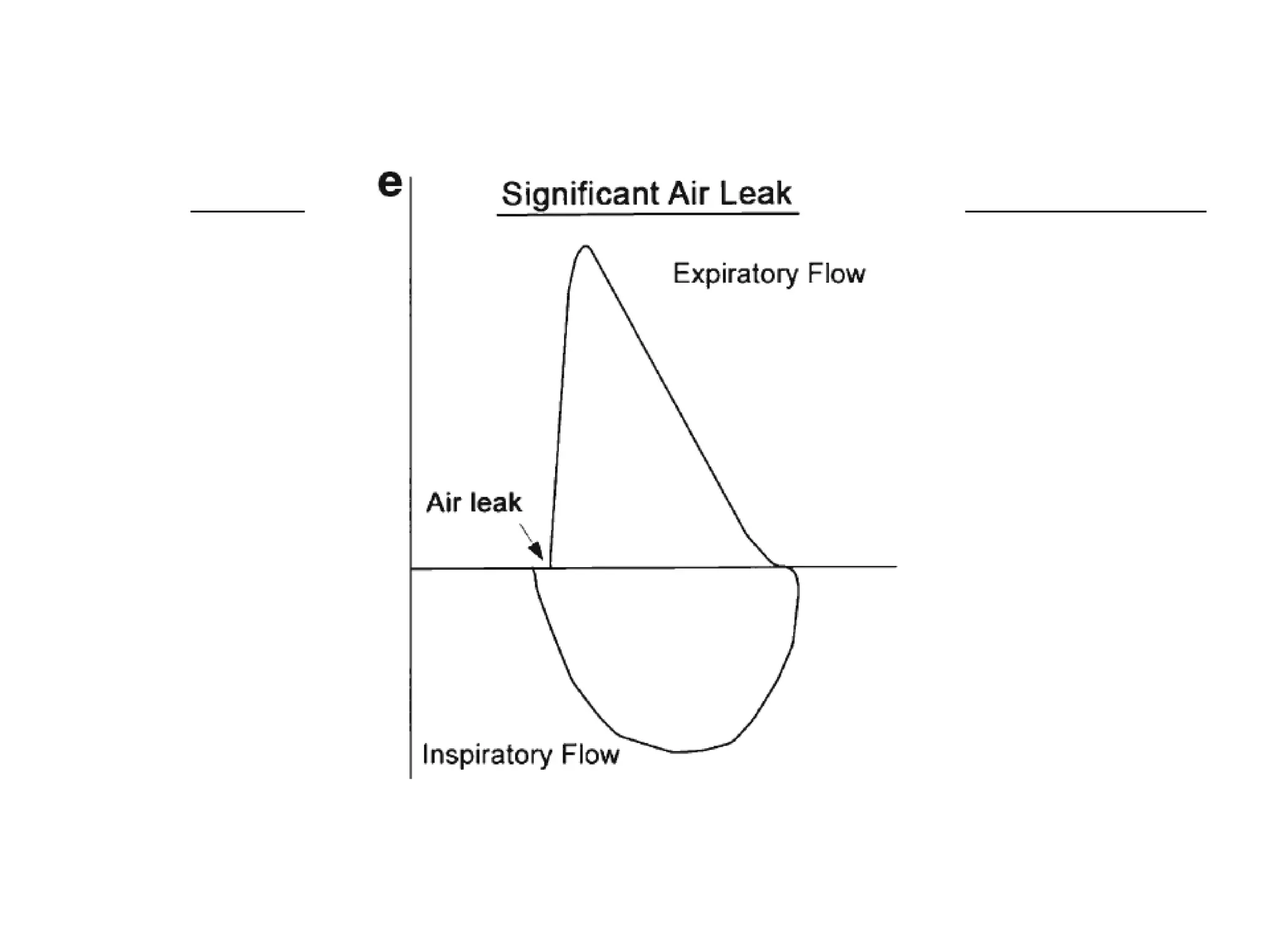
(f) Air leak : 
• The air leak source could be due to loose tube 
connections or, more commonly, because the 
patient weakly applies lips around the 
mouthpiece. Air leak can be detected from the 
FV loop
3. Good end of the test (demonstrated in the 
VT curve): 
(a) Plateau of VT curve of at least 1 s, 
i.e.volume is not changing much with time 
indicating that the patient is approaching the 
residual volume (RV). 
OR 
(b) Reasonable duration of effort (FET) : 
• Six seconds is the minimum accepted duration 
(3 s for children) . 
• Ten seconds is the optimal. 
.
• FET of >15 s is unlikely to change the 
clinical decision and may result in the 
patient’s exhaustion. 
Patients with obstructive disorders can 
exhale for more than 40 s before reaching 
their RV, i.e., before reaching a plateau in the 
VT Curve 
Normal individuals, however, can empty 
their lung (i.e., reach a plateau) within 4 s
(c) The patient cannot or should not continue 
to exhale. 
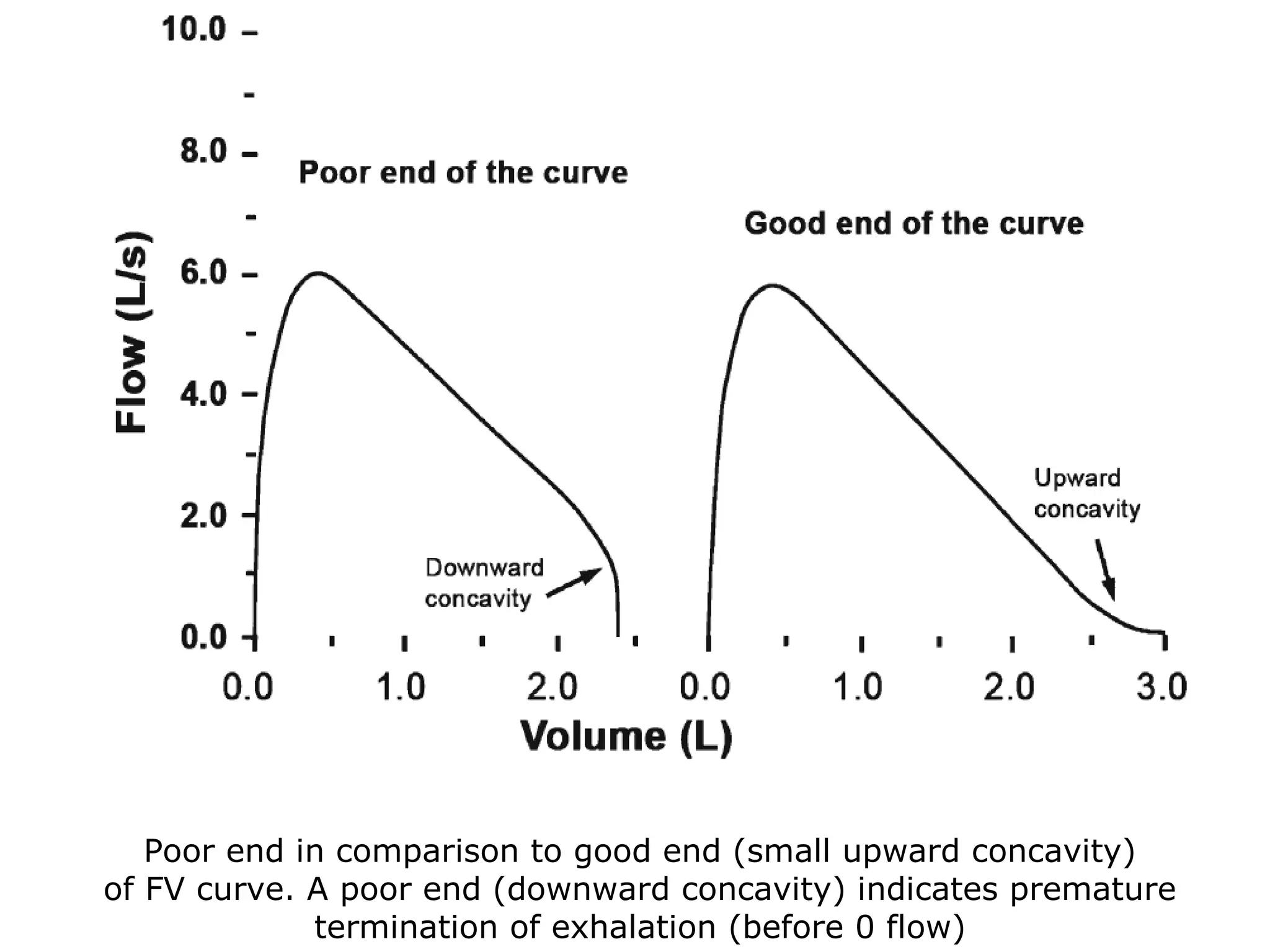
Note : A good end of the study can be shown in 
the FV curve as an upward concavity at the 
end of the curve. 
A downward concavity, however, indicates 
that the patient either stopped exhaling 
(prematurely) or started inhaling before 
reaching the RV . 
This poor technique may result in 
underestimation of the FVC.
Poor end in comparison to good end (small upward concavity) 
of FV curve. A poor end (downward concavity) indicates premature 
termination of exhalation (before 0 flow)
ATS/ERS criteria for acceptable and 
repeatable Spirometry 
REPEATABILITY CRITERIA 
• Three acceptable manoeuvres (meeting above criteria) 
• The two largest FVC measurements within 150mL of 
each other 
• The two largest FEV1 measurements within 150mL of 
each other 
When both acceptability and repeatability criteria are 
met, the test can be concluded. 
Up to 8 manoeuvres should be performed until the 
criteria are met or the patient is unable to continue. 
As a minimum, the three satisfactory (or best) 
manoeuvres should be saved.
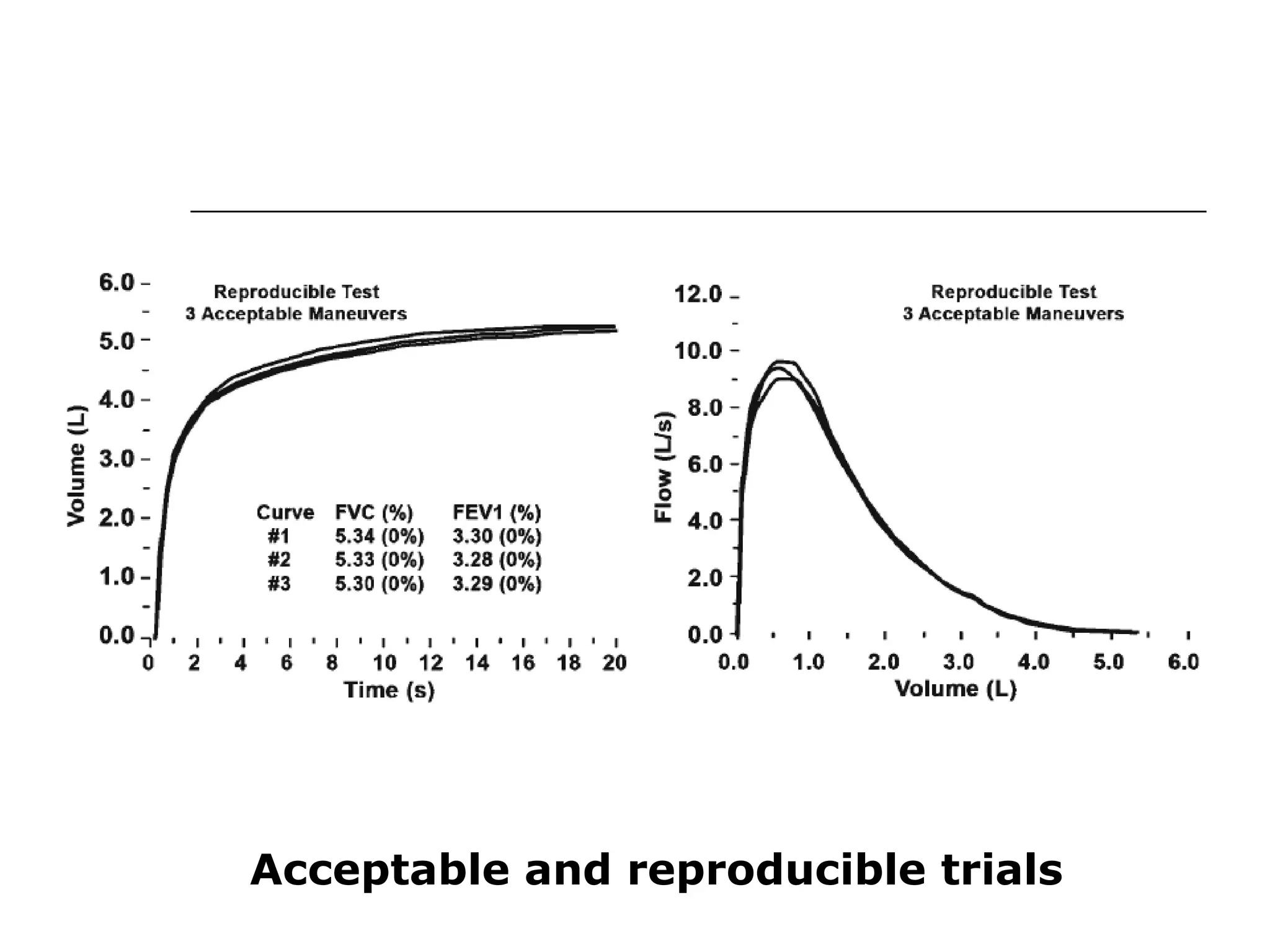
Reproducibility 
After obtaining three acceptable maneuvers, the 
following reproducibility criteria should be 
applied: 
– The two largest values of FVC must be within 
150 ml of each other. 
– The two largest values of FEV 1 must be within 
150 ml of each other. 
If the studies are not reproducible, then the 
studies should be repeated until the ATS criteria 
are met or a total of eight trials are completed or 
the patient either cannot or should not continue 
testing.
• The final values should be chosen based on the following : 
– FEV1 and FVC should be reported as the highest values from 
any acceptable/reproducible trial (not necessarily from the 
same trial). 
– The other flow parameters should be taken from the best 
test curve (which is the curve with the highest sum of FVC + 
FEV1). 
– If reproducibility cannot be achieved after eight trials, 
the best test curve (the highest acceptable trial) should be 
reported. The technician should comment on this deviation 
from protocol so that the interpreting physician understands 
that the results may not be accurate. 
.
Acceptable and reproducible trials
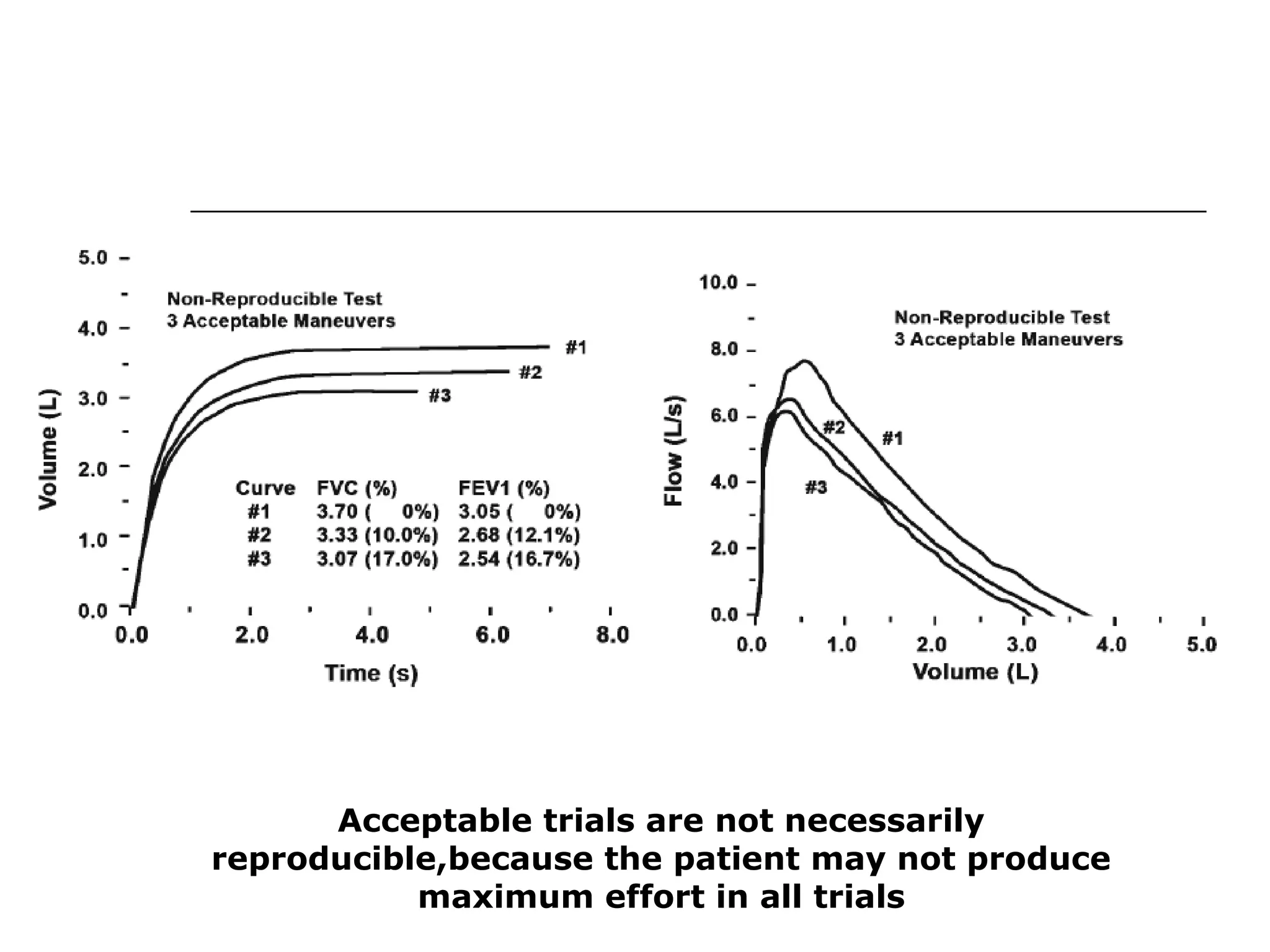
Acceptable trials are not necessarily 
reproducible,because the patient may not produce 
maximum effort in all trials
Keep in mind that the lack of any of these features 
may indicate a lung disorder rather than a poor study
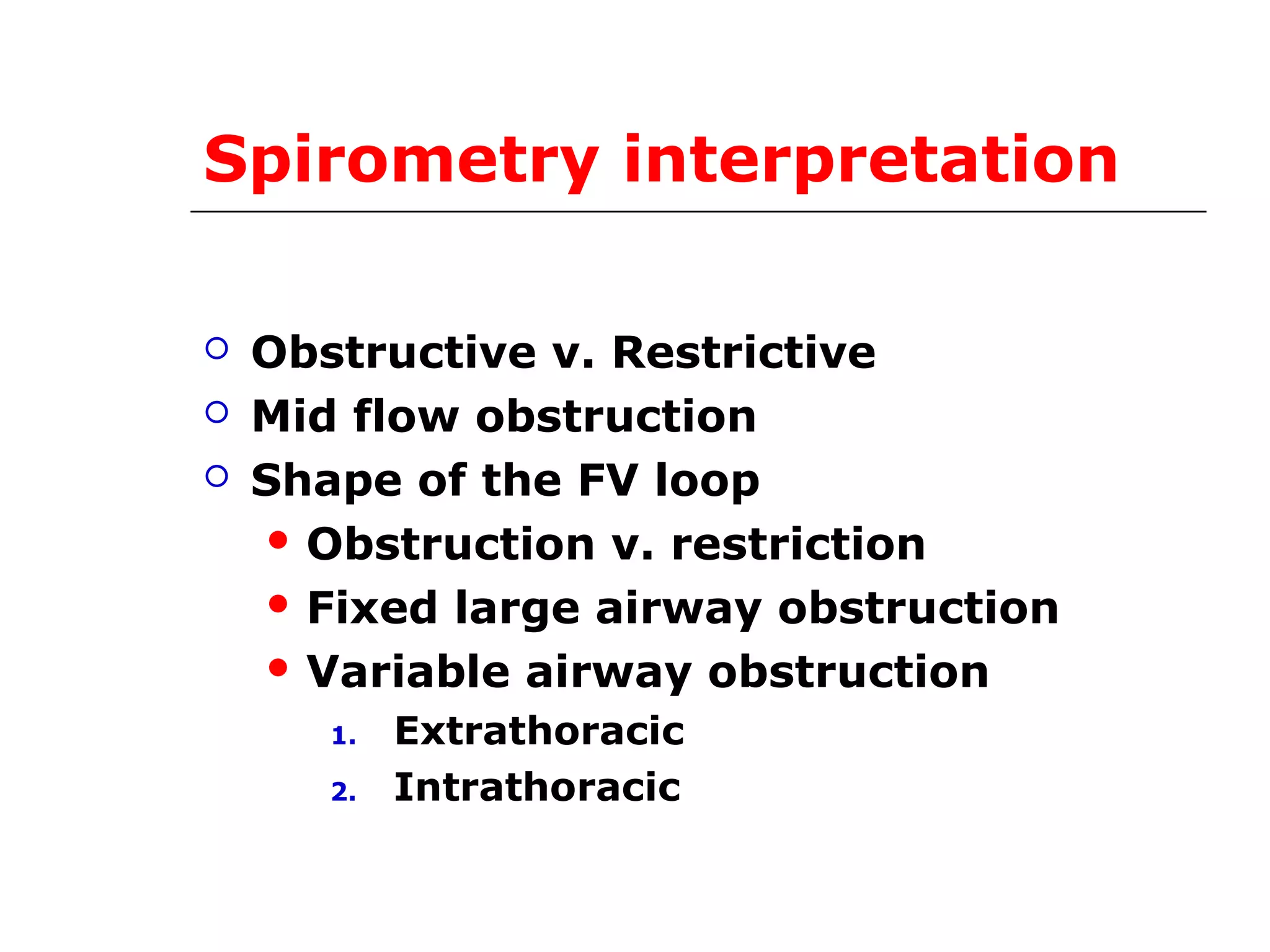
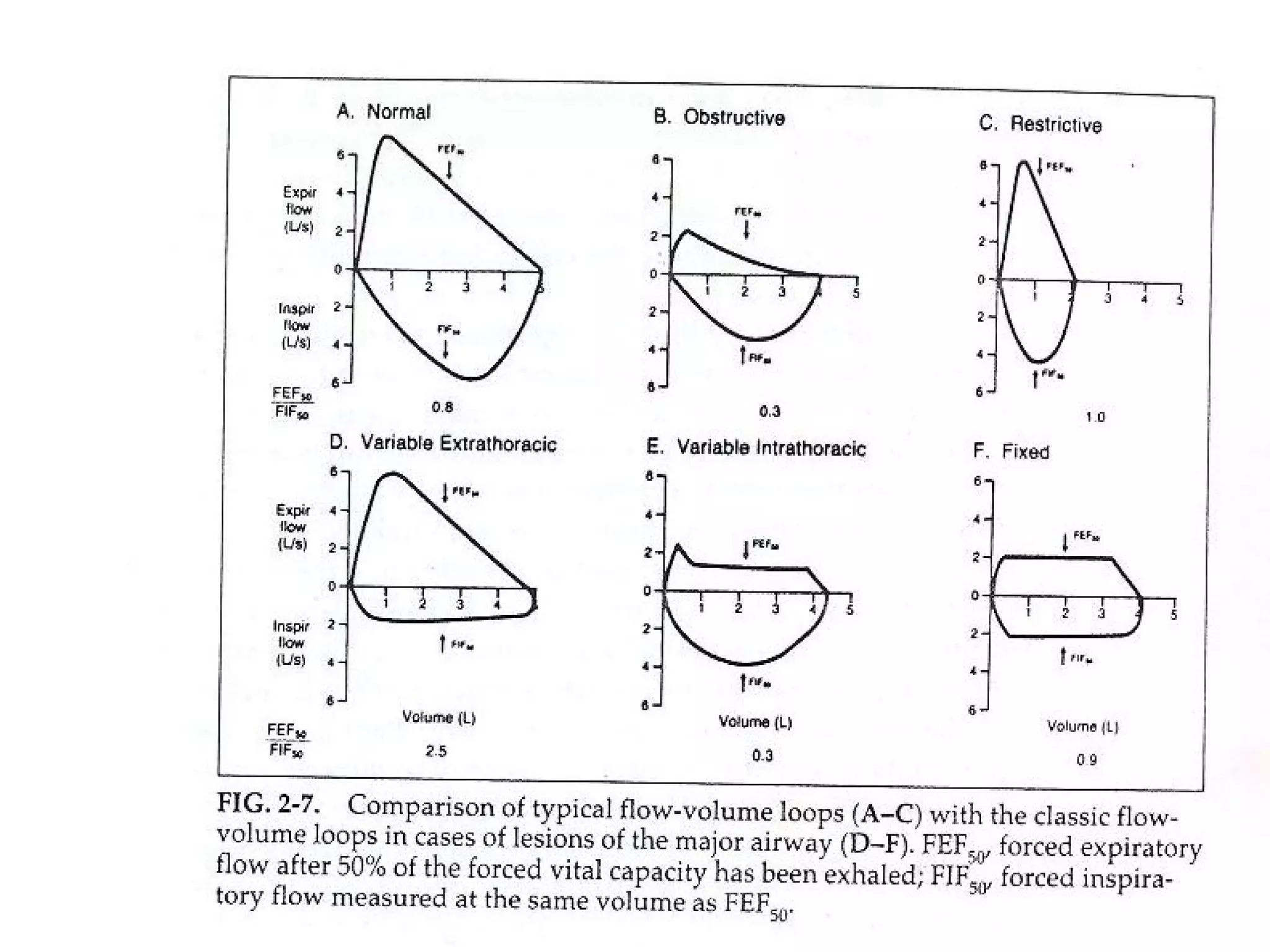
Spirometry interpretation 
 Obstructive v. Restrictive 
 Mid flow obstruction 
 Shape of the FV loop 
Obstruction v. restriction 
 Fixed large airway obstruction 
 Variable airway obstruction 
1. Extrathoracic 
2. Intrathoracic
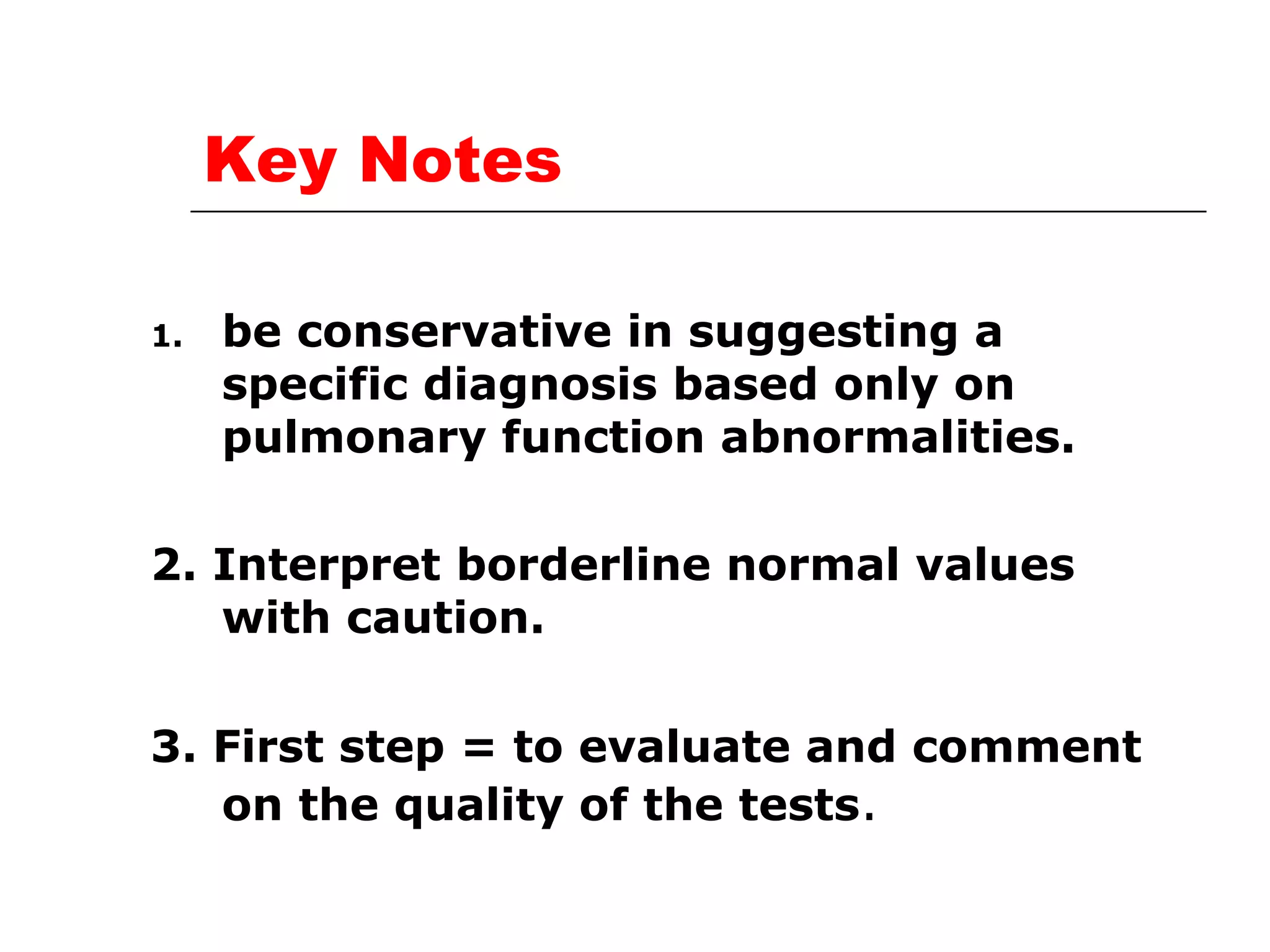
Key Notes 
1. be conservative in suggesting a 
specific diagnosis based only on 
pulmonary function abnormalities. 
2. Interpret borderline normal values 
with caution. 
3. First step = to evaluate and comment 
on the quality of the tests.
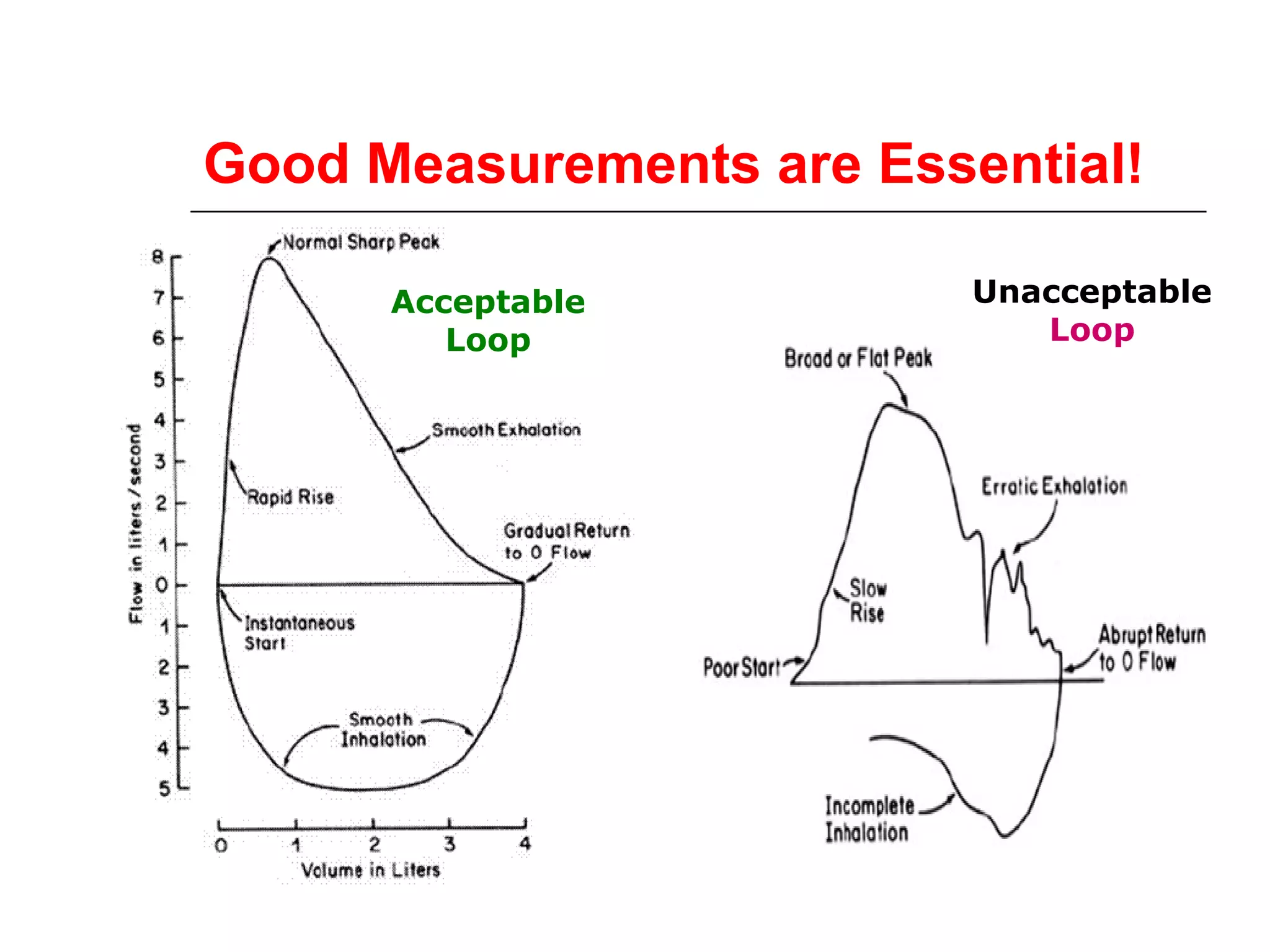
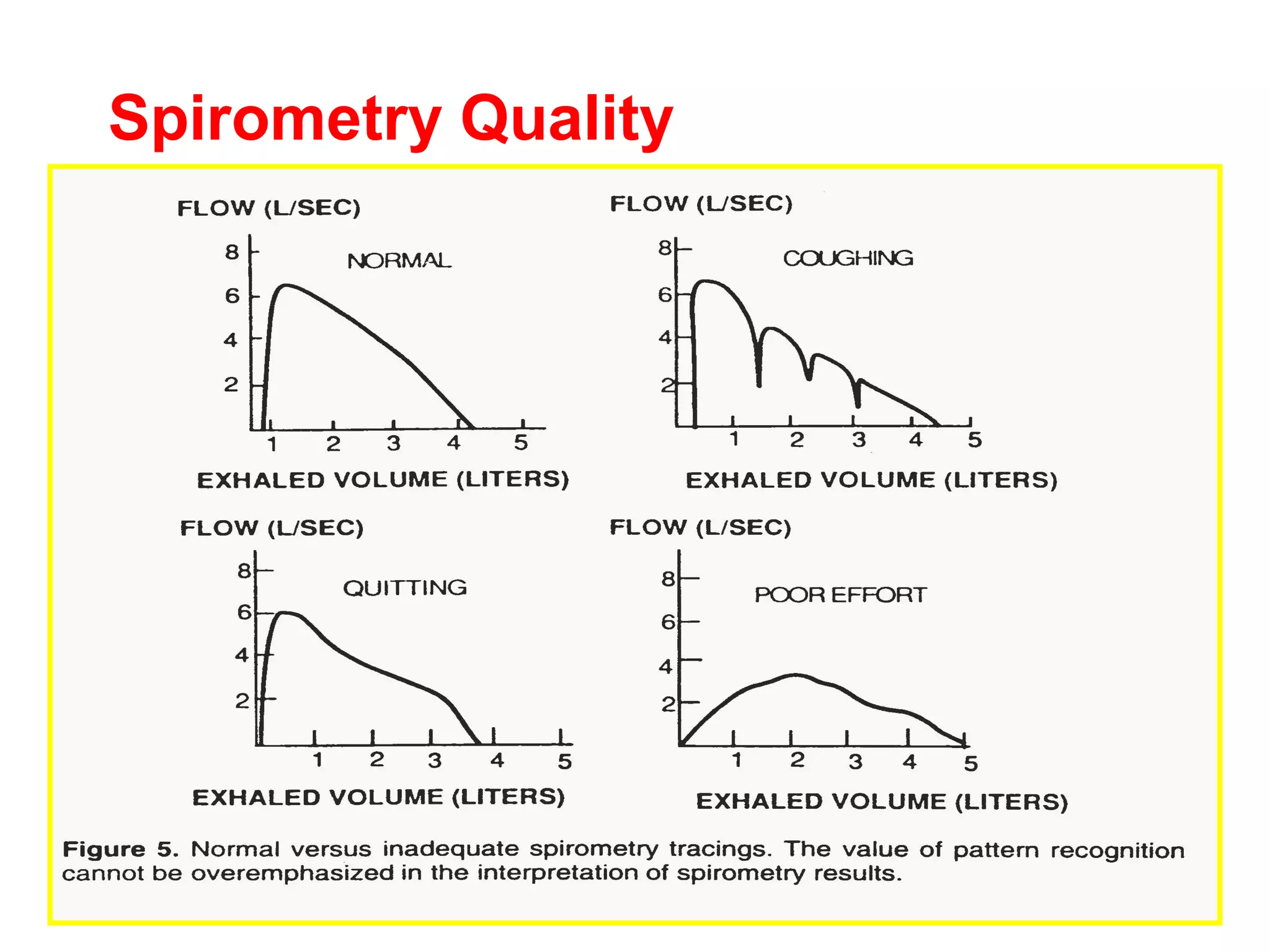
Good Measurements are Essential! 
Acceptable 
Loop 
Unacceptable 
Loop
Spirometry Quality
48
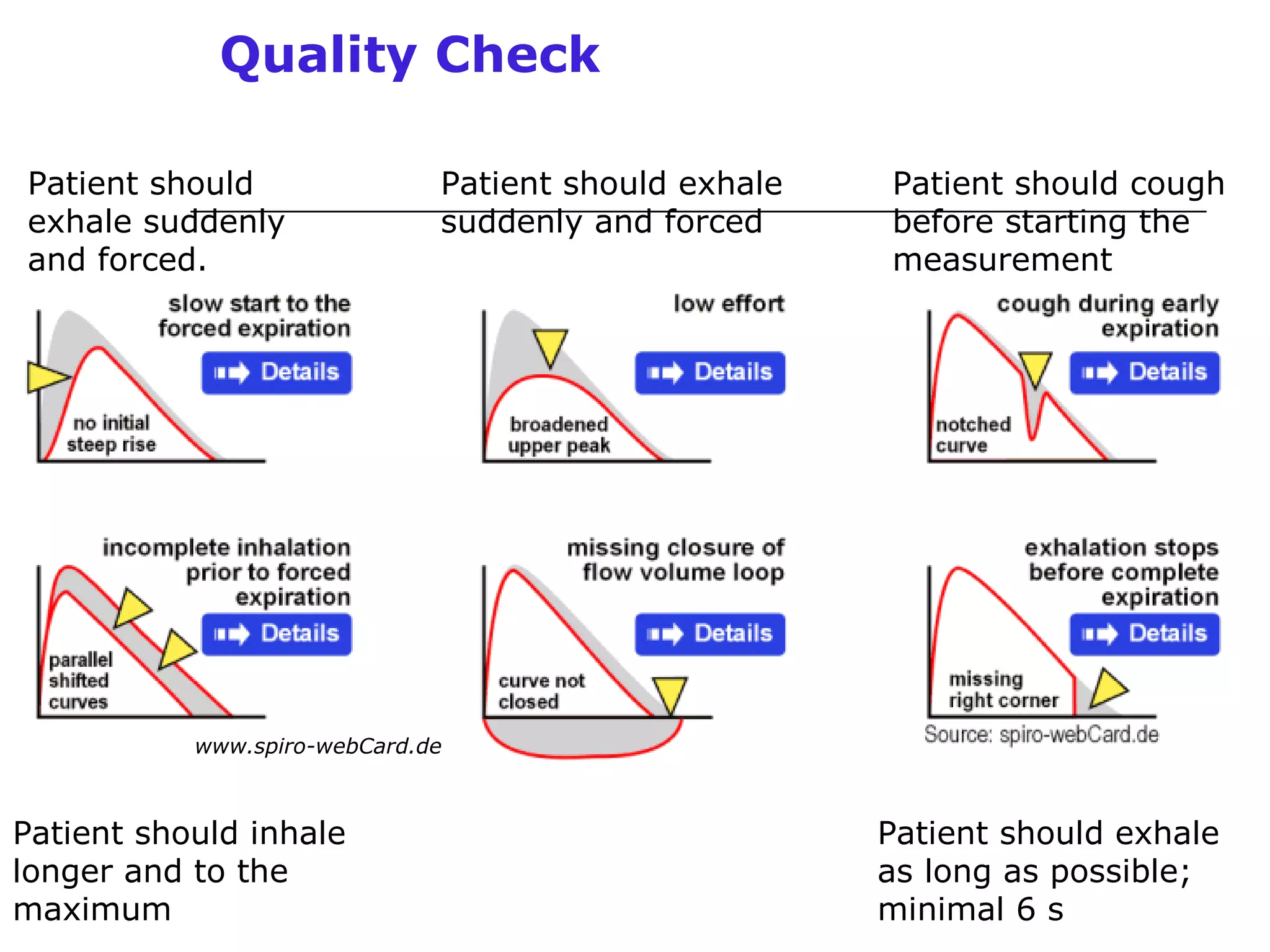
Quality Check 
Patient should 
exhale suddenly 
and forced. 
Patient should exhale 
suddenly and forced 
Patient should cough 
before starting the 
measurement 
Patient should inhale 
longer and to the 
maximum 
Patient should exhale 
as long as possible; 
minimal 6 s 
www.spiro-webCard.de
50
51
52
53
54
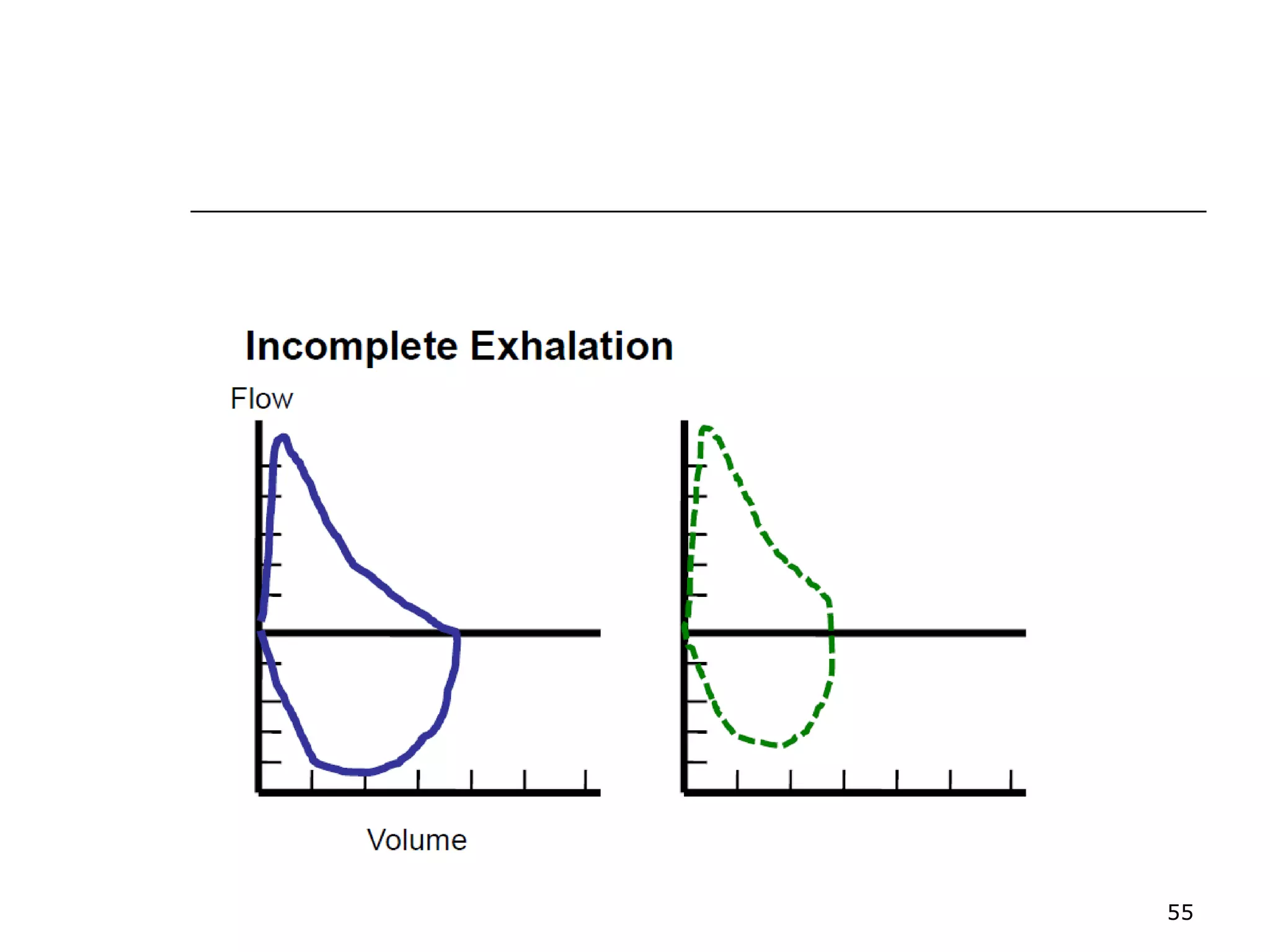
55
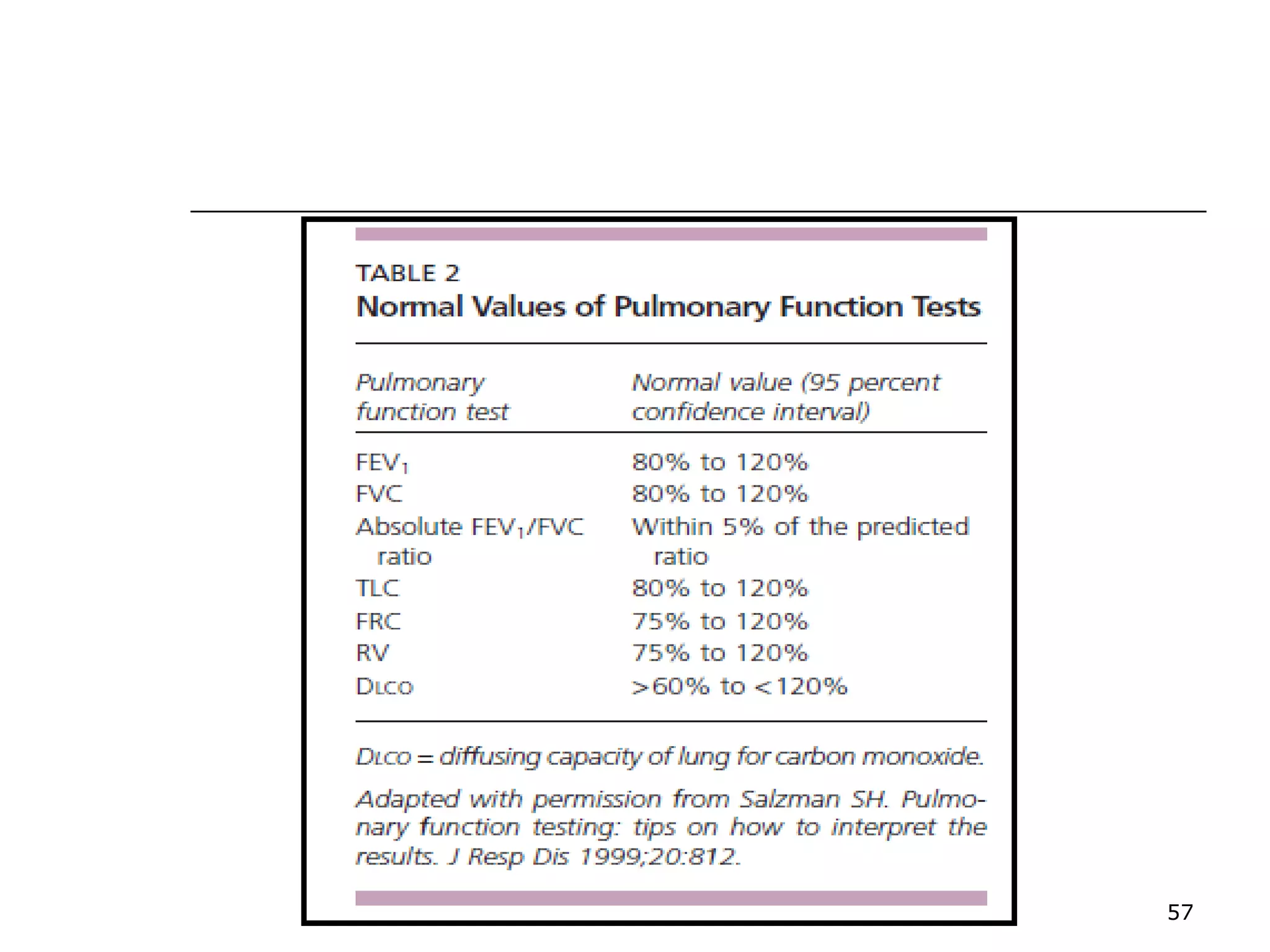
57
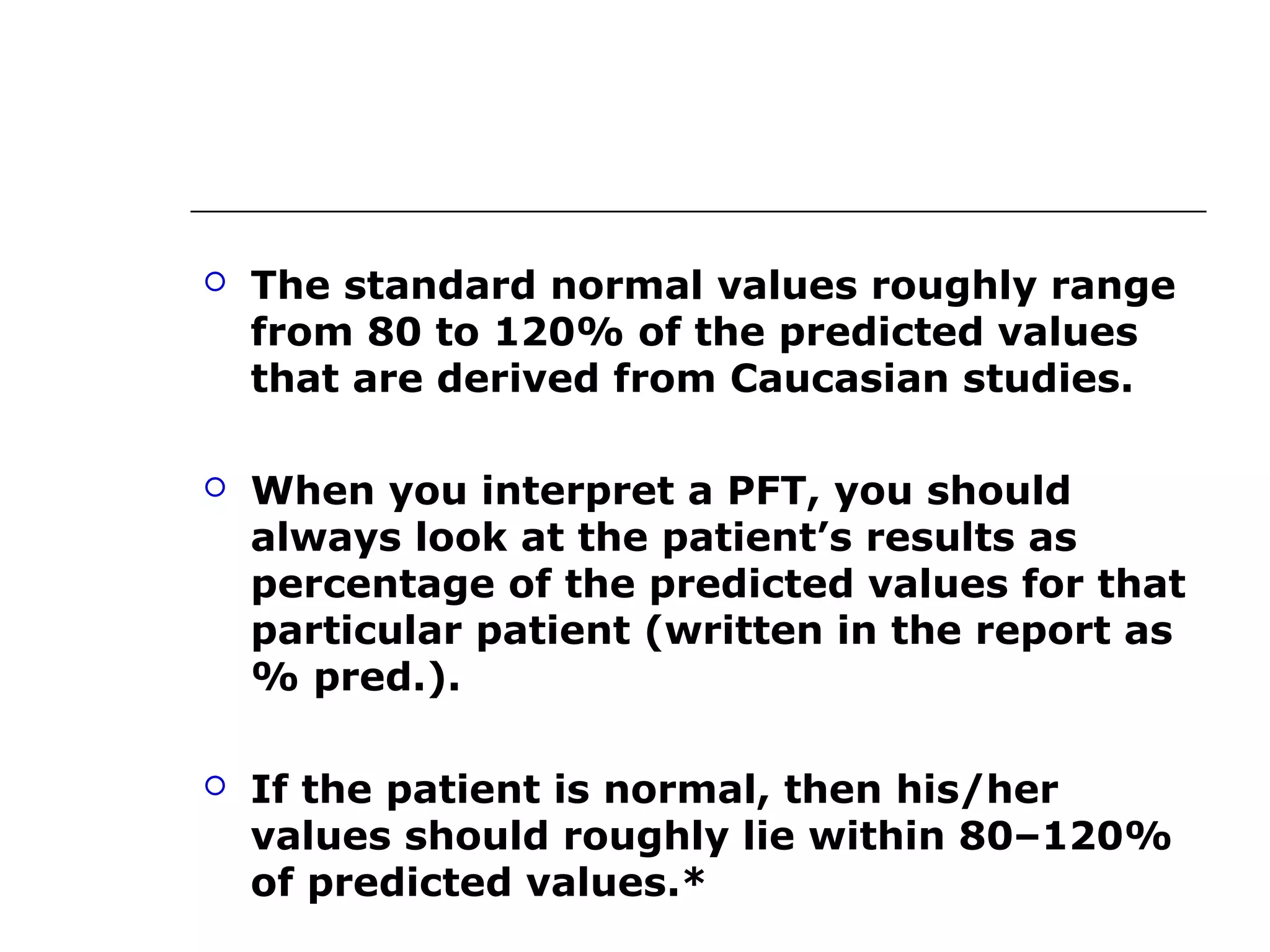
 The standard normal values roughly range 
from 80 to 120% of the predicted values 
that are derived from Caucasian studies. 
 When you interpret a PFT, you should 
always look at the patient’s results as 
percentage of the predicted values for that 
particular patient (written in the report as 
% pred.). 
 If the patient is normal, then his/her 
values should roughly lie within 80–120% 
of predicted values.*
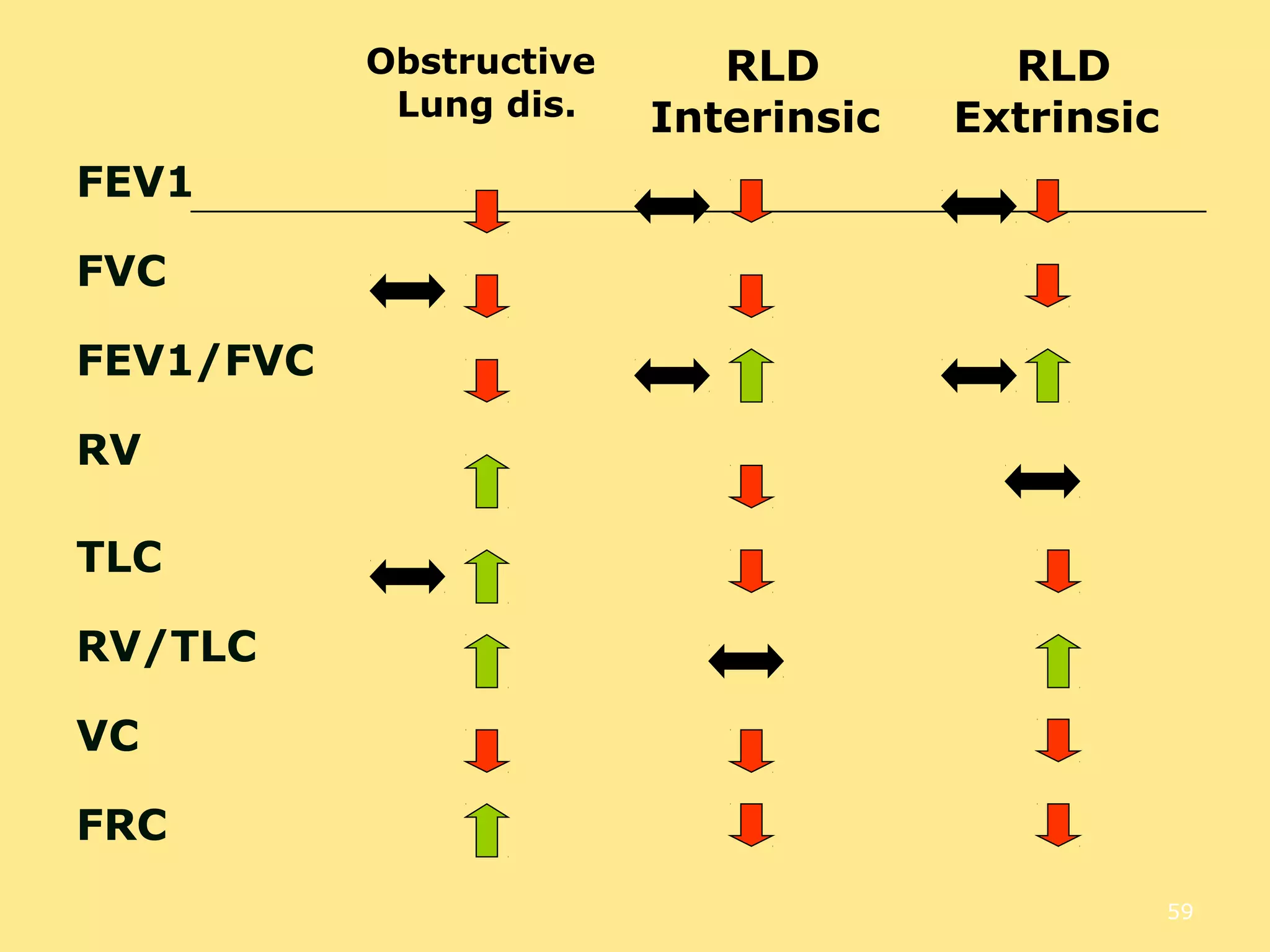
59 
Obstructive 
Lung dis. 
RLD 
Interinsic 
RLD 
Extrinsic 
FEV1 
FVC 
FEV1/FVC 
RV 
TLC 
RV/TLC 
VC 
FRC
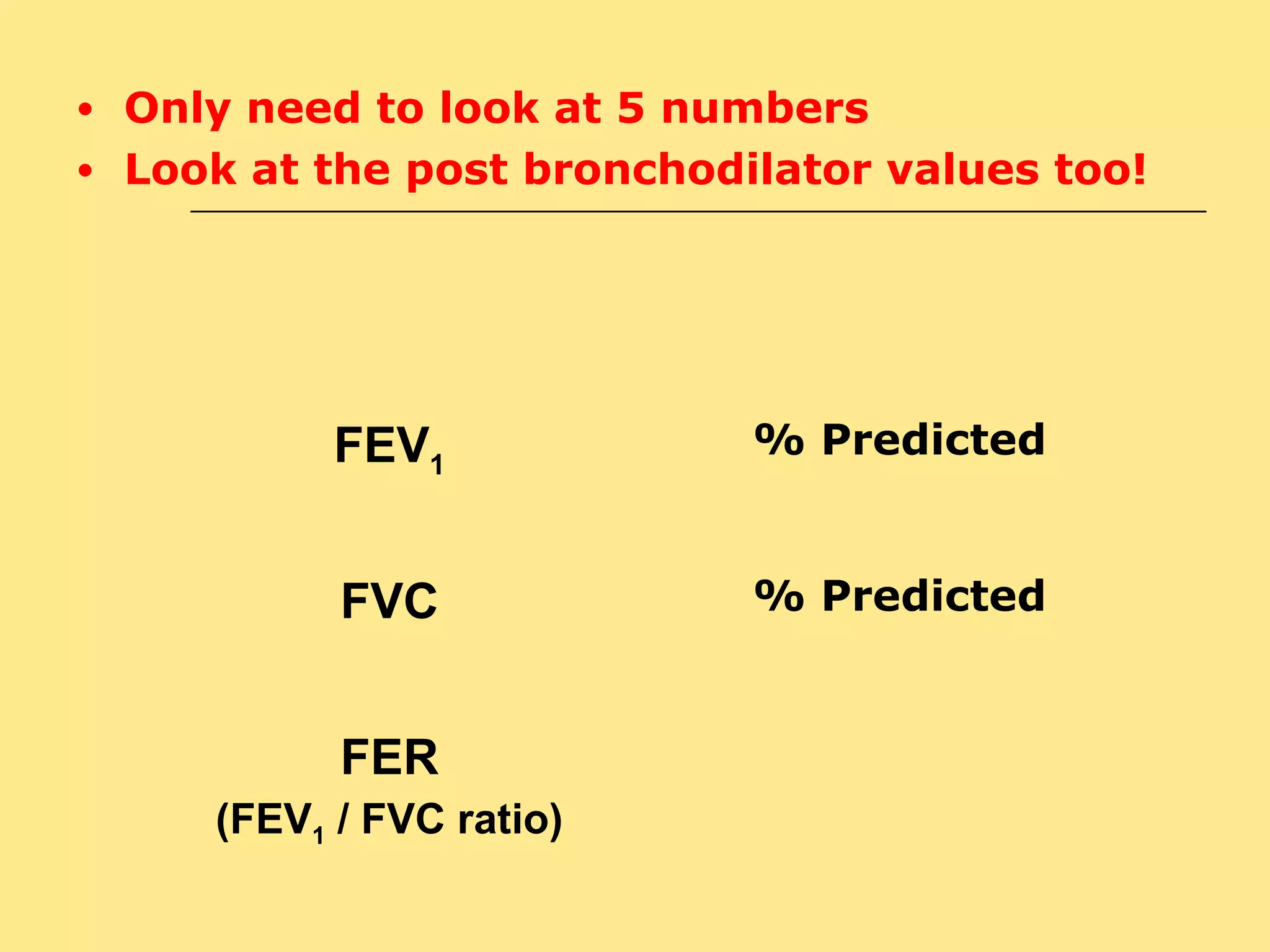
● Only need to look at 5 numbers 
● Look at the post bronchodilator values too! 
FEV1 
% Predicted 
FVC % Predicted 
FER 
(FEV1 / FVC ratio)
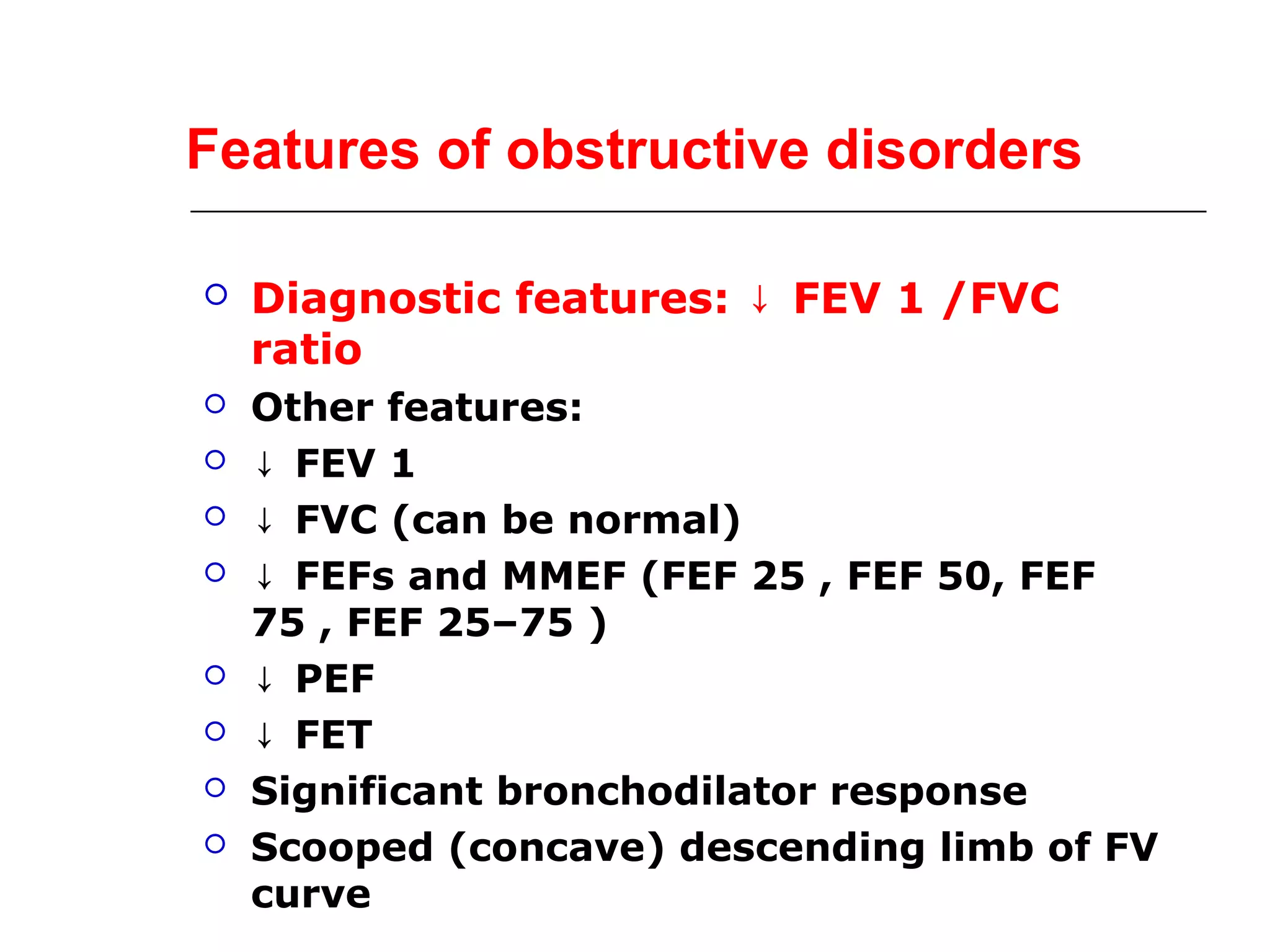
Features of obstructive disorders 
 Diagnostic features: ↓ FEV 1 /FVC 
ratio 
 Other features: 
 ↓ FEV 1 
 ↓ FVC (can be normal) 
 ↓ FEFs and MMEF (FEF 25 , FEF 50, FEF 
75 , FEF 25–75 ) 
 ↓ PEF 
 ↓ FET 
 Significant bronchodilator response 
 Scooped (concave) descending limb of FV 
curve
Obstructive Disorders 
 The two major obstructive disorders are 
bronchial asthma and COPD . 
 The key to the diagnosis of these 
disorders is the drop in FEV 1 /FVC ratio. 
 
 FEV 1 may be reduced too and is used to 
define the severity of obstruction 
 FVC may be reduced in obstructive 
disorders but usually not to the same 
degree as FEV 1 .
Obstructive Disorders 
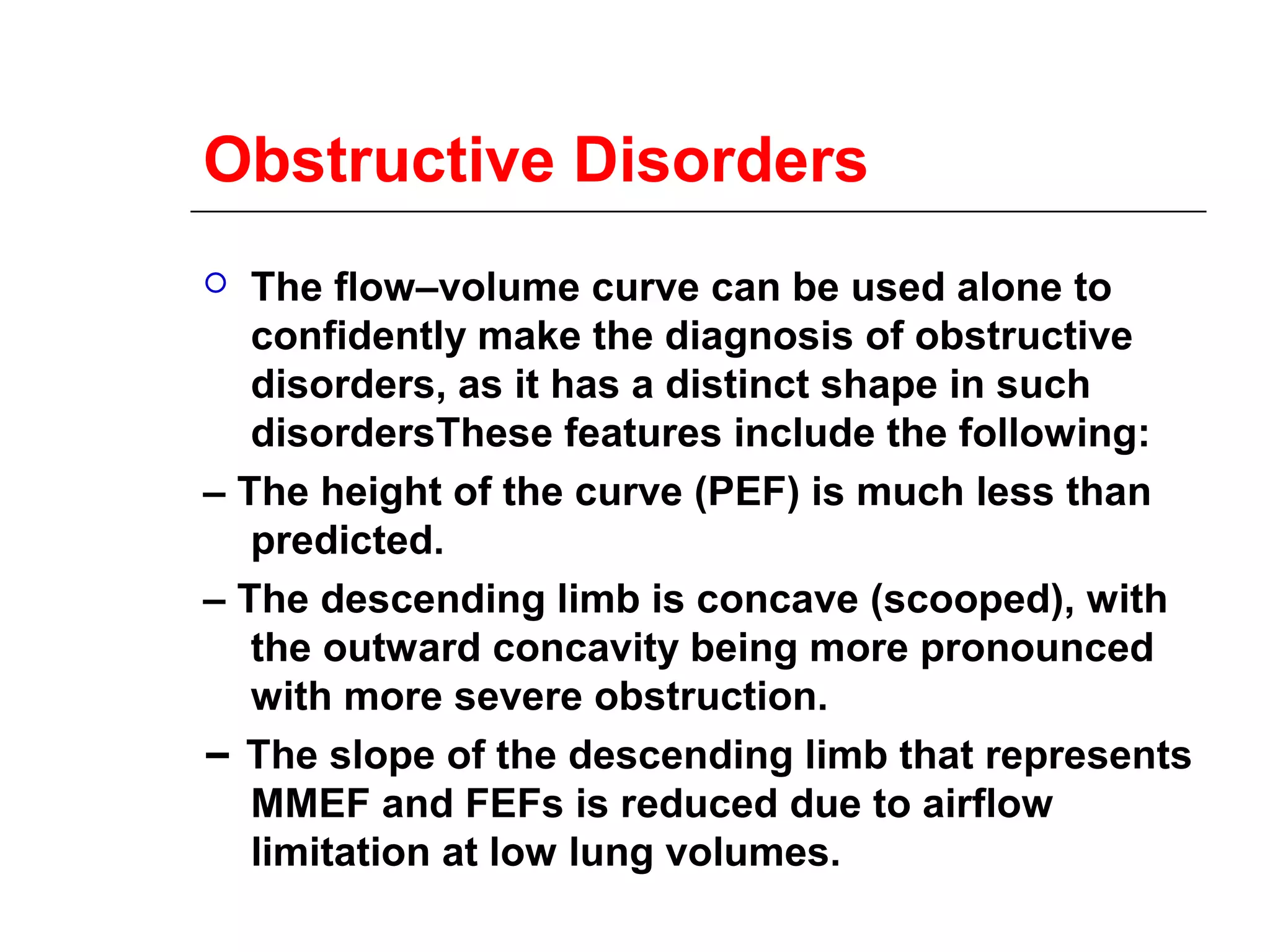
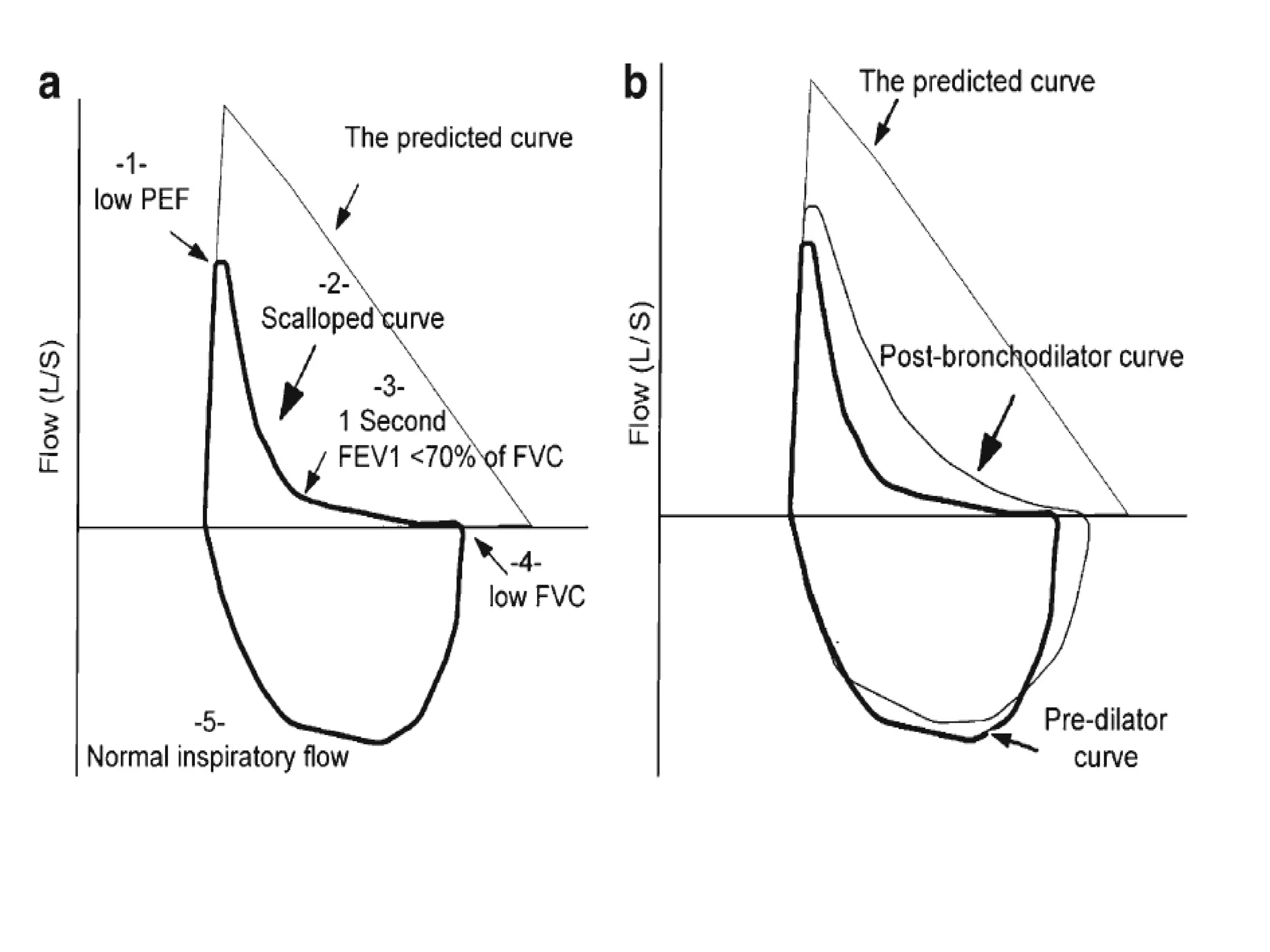
 The flow–volume curve can be used alone to 
confidently make the diagnosis of obstructive 
disorders, as it has a distinct shape in such 
disordersThese features include the following: 
– The height of the curve (PEF) is much less than 
predicted. 
– The descending limb is concave (scooped), with 
the outward concavity being more pronounced 
with more severe obstruction. 
– The slope of the descending limb that represents 
MMEF and FEFs is reduced due to airflow 
limitation at low lung volumes.
Obstructive Disorders 
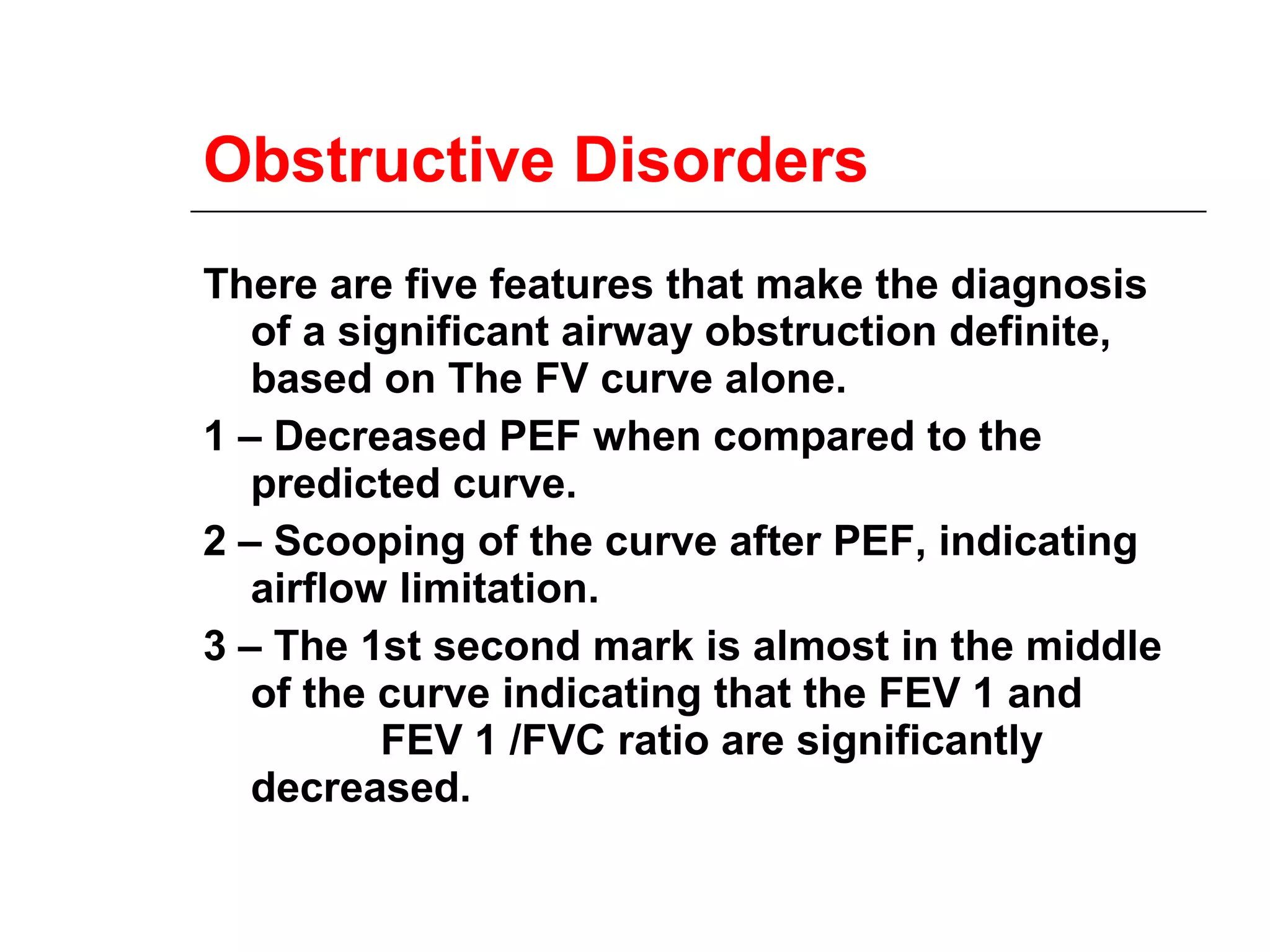
There are five features that make the diagnosis 
of a significant airway obstruction definite, 
based on The FV curve alone. 
1 – Decreased PEF when compared to the 
predicted curve. 
2 – Scooping of the curve after PEF, indicating 
airflow limitation. 
3 – The 1st second mark is almost in the middle 
of the curve indicating that the FEV 1 and 
FEV 1 /FVC ratio are significantly 
decreased.
Obstructive Disorders 
4 – FVC is decreased when compared to the 
predicted curve. 
5 – The inspiratory component of the curve is normal, 
excluding a central airway obstruction. 
( b ) There is a clear response to bronchodilators 
indicating reversibility and supporting the 
diagnosis of an obstructive disorder, most likely 
bronchial asthma
 Lack of bronchodilator response does not 
exclude bronchial asthma as 
responsiveness can vary over time. 
 Similarly many patients with COPD can 
show reversibility. 
 Reversibility in the correct clinical 
context (i.e. young nonsmoker) supports 
the diagnosis of asthma.
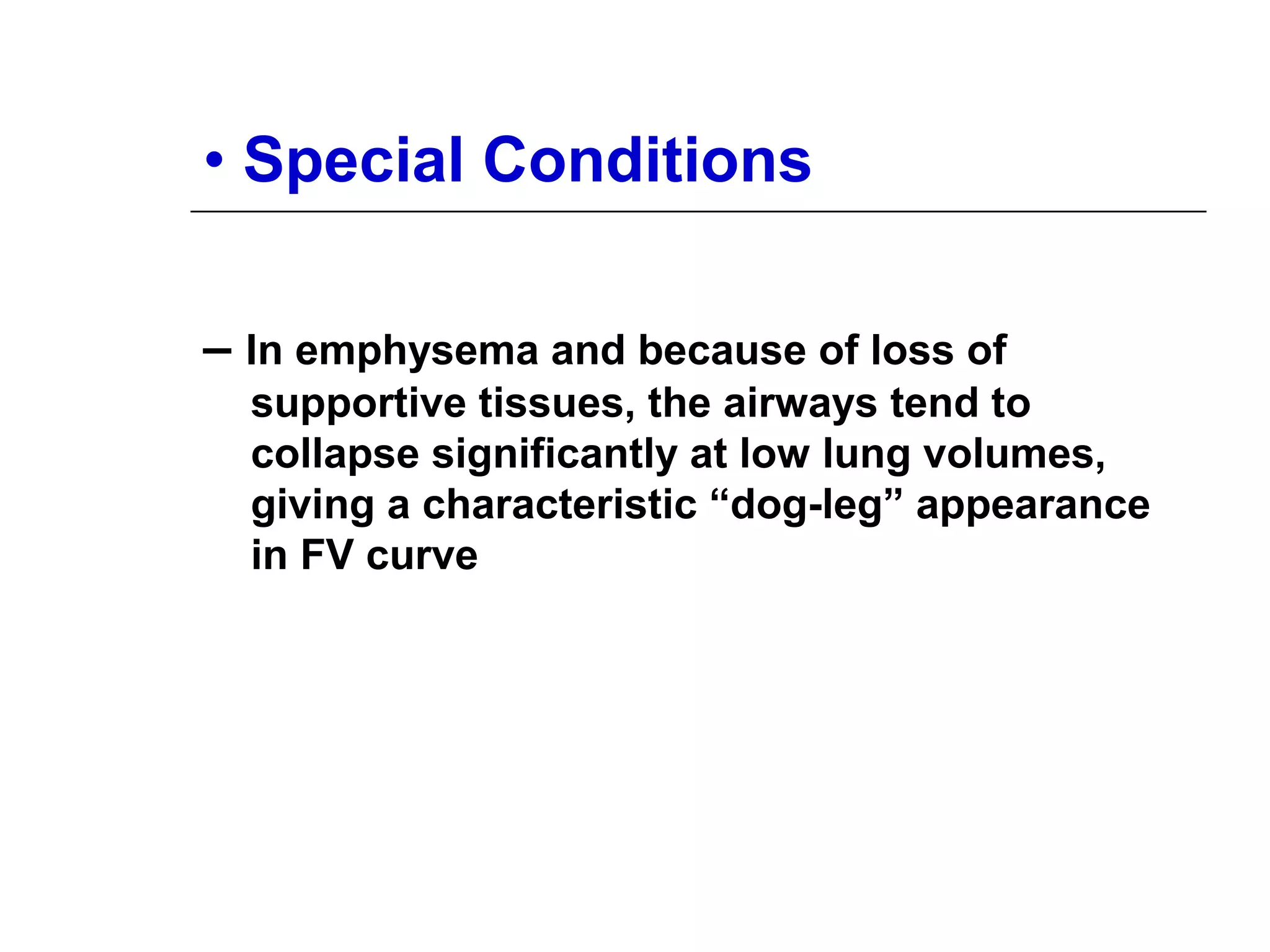
• Special Conditions 
– In mild (or early) airway obstruction, the 
classic reduction in FEV1 and FEV1/FVC ratio 
may not be seen. 
– The morphology of the FV curve can give a 
clue, as the distal upward concavity may 
show to be more pronounced and prolonged 
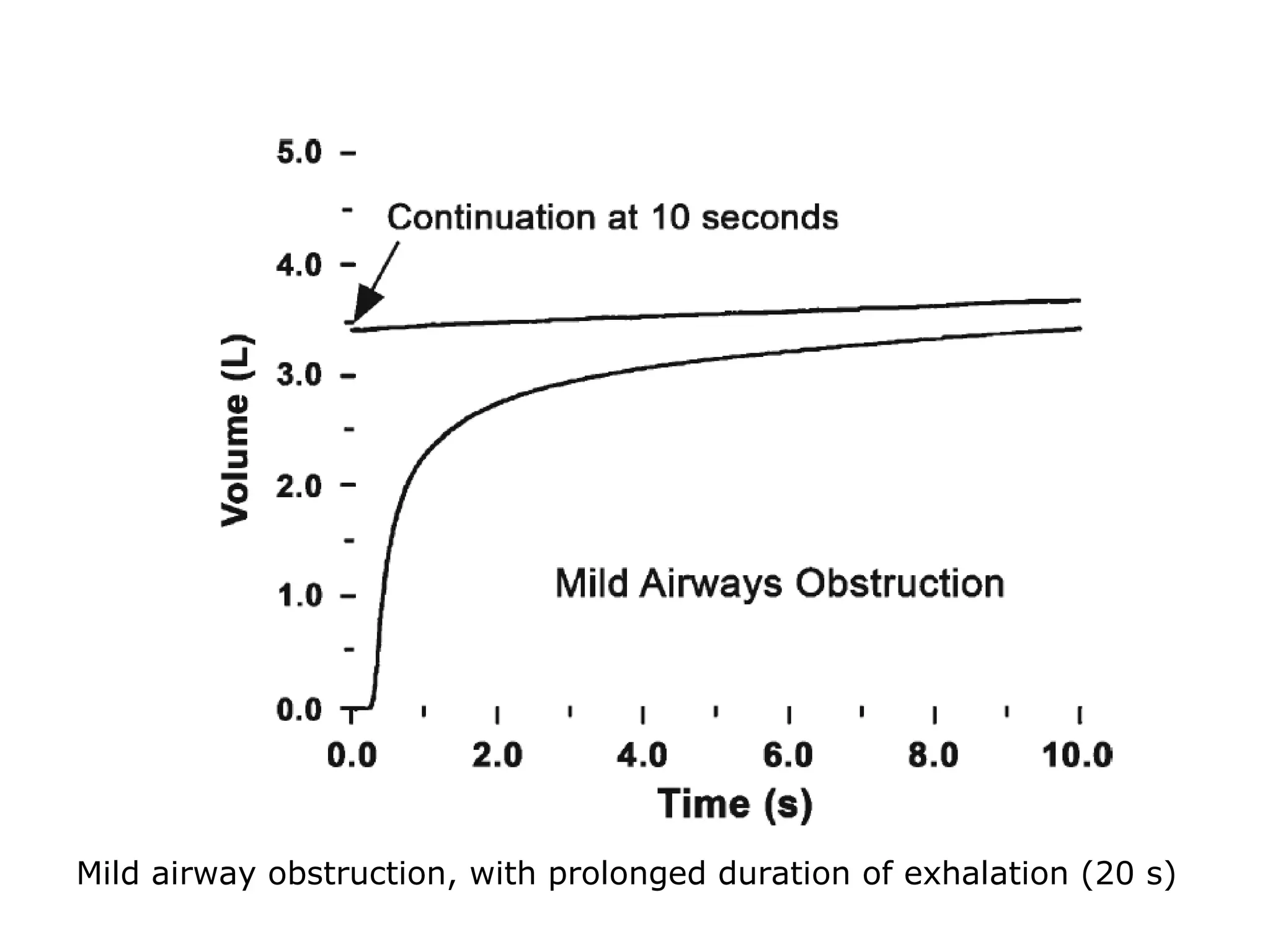
– Another clue is the prolonged FET evident in 
the VT curve
Mild airway obstruction, with prolonged duration of exhalation (20 s)
• Special Conditions 
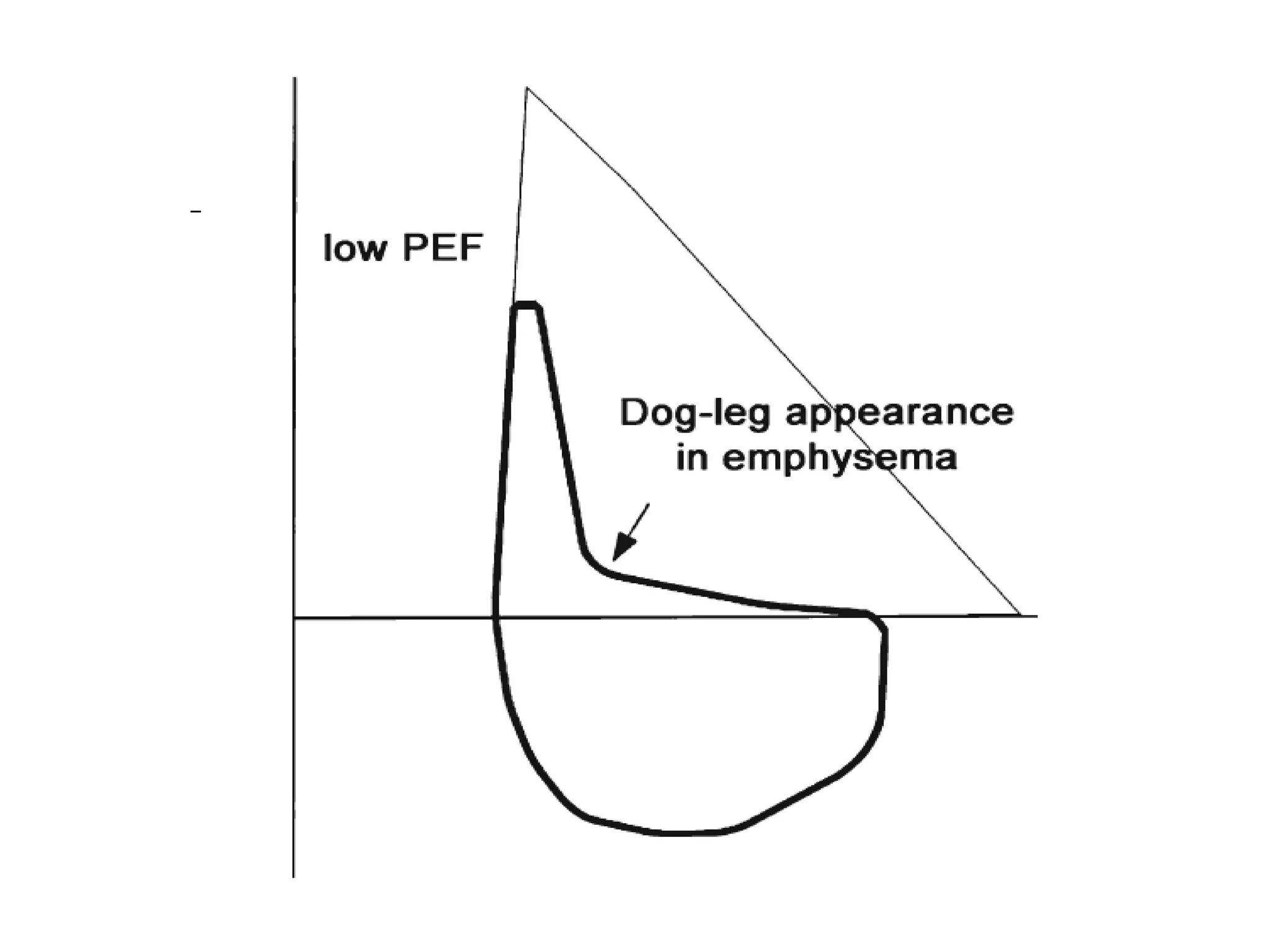
– In emphysema and because of loss of 
supportive tissues, the airways tend to 
collapse significantly at low lung volumes, 
giving a characteristic “dog-leg” appearance 
in FV curve
Features of restrictive disorders 
 Most important features: ↓ FVC 
and normal or ↑ FEV 1 /FVC ratio 
 Other features: 
 ↓ FEV 1 (proportional to FVC), but it 
can be normal 
 ↓ MMEF 
 PEF: normal, increased, or decreased 
 Steep descending limb of FV curve
Restrictive Disorders 
 In restrictive disorders, such as pulmonary 
fibrosis, the key to the diagnosis is the drop in 
FVC, as the volume of the air spaces is 
significantly lower than normal. 
 
 The lung elasticity increases and the lungs 
retract. 
 The FEV 1 /FVC ratio has to be preserved or 
increased.
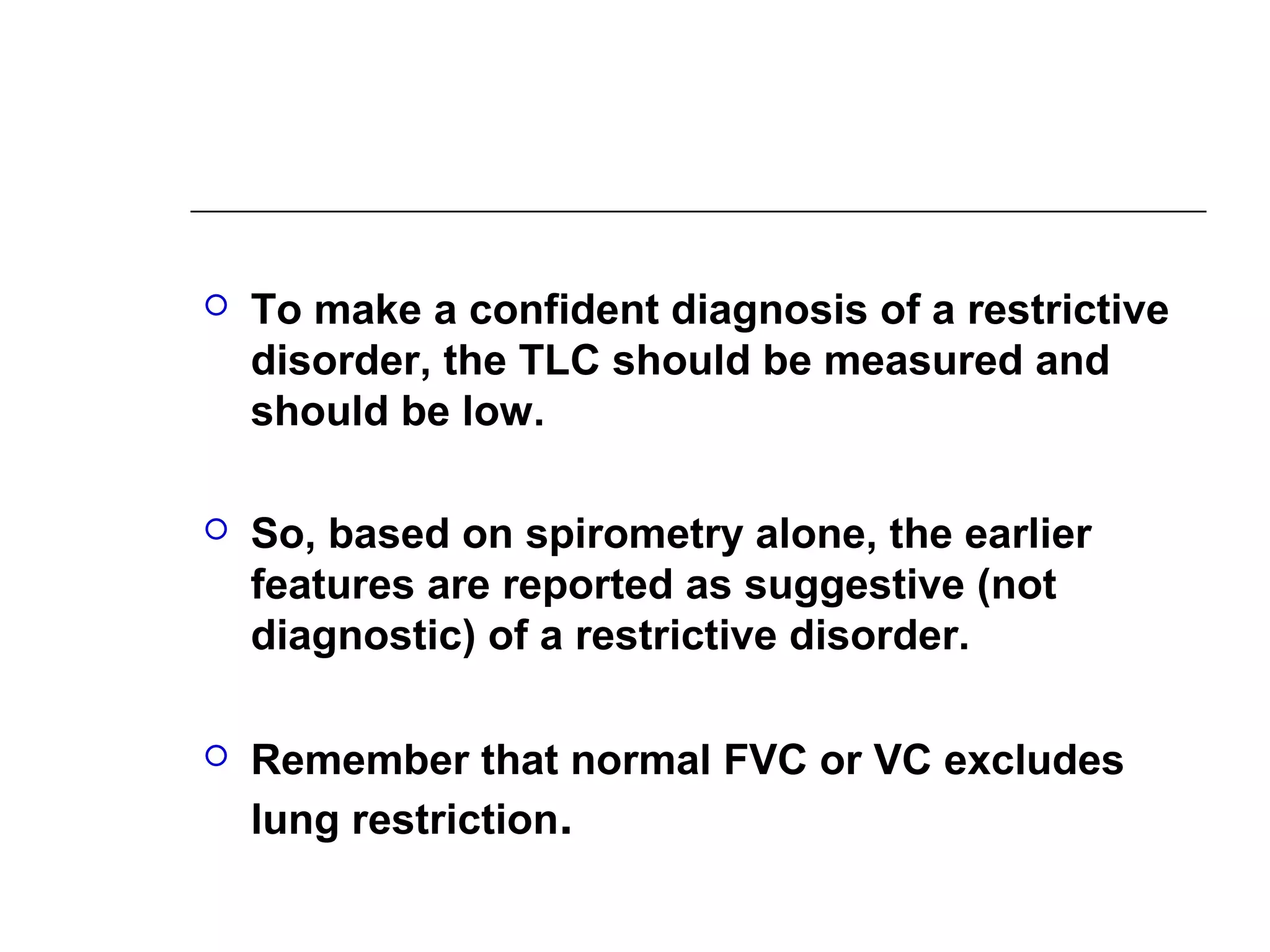
 To make a confident diagnosis of a restrictive 
disorder, the TLC should be measured and 
should be low. 
 So, based on spirometry alone, the earlier 
features are reported as suggestive (not 
diagnostic) of a restrictive disorder. 
 Remember that normal FVC or VC excludes 
lung restriction.
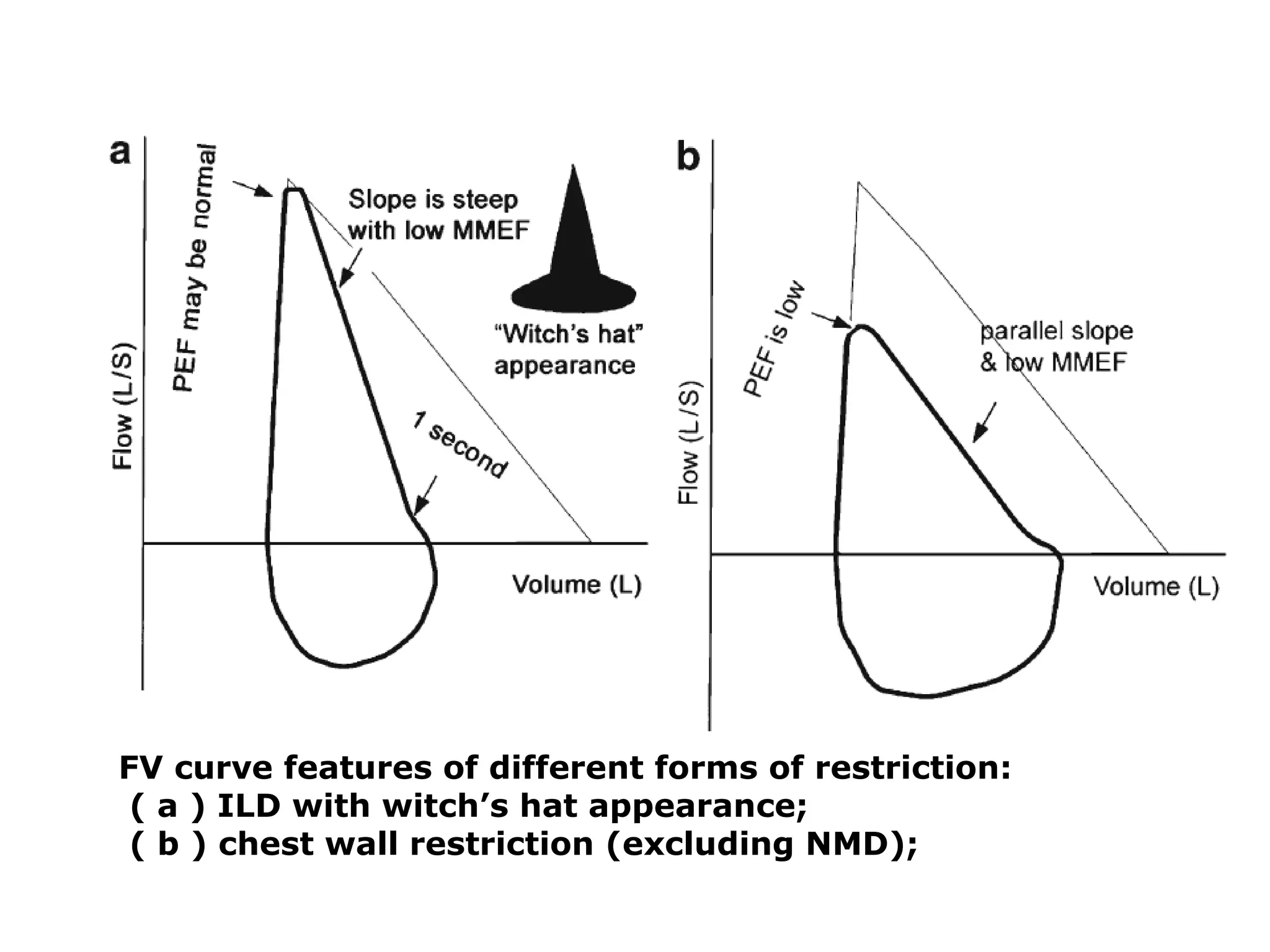
FV curve features of different forms of restriction: 
( a ) ILD with witch’s hat appearance; 
( b ) chest wall restriction (excluding NMD);
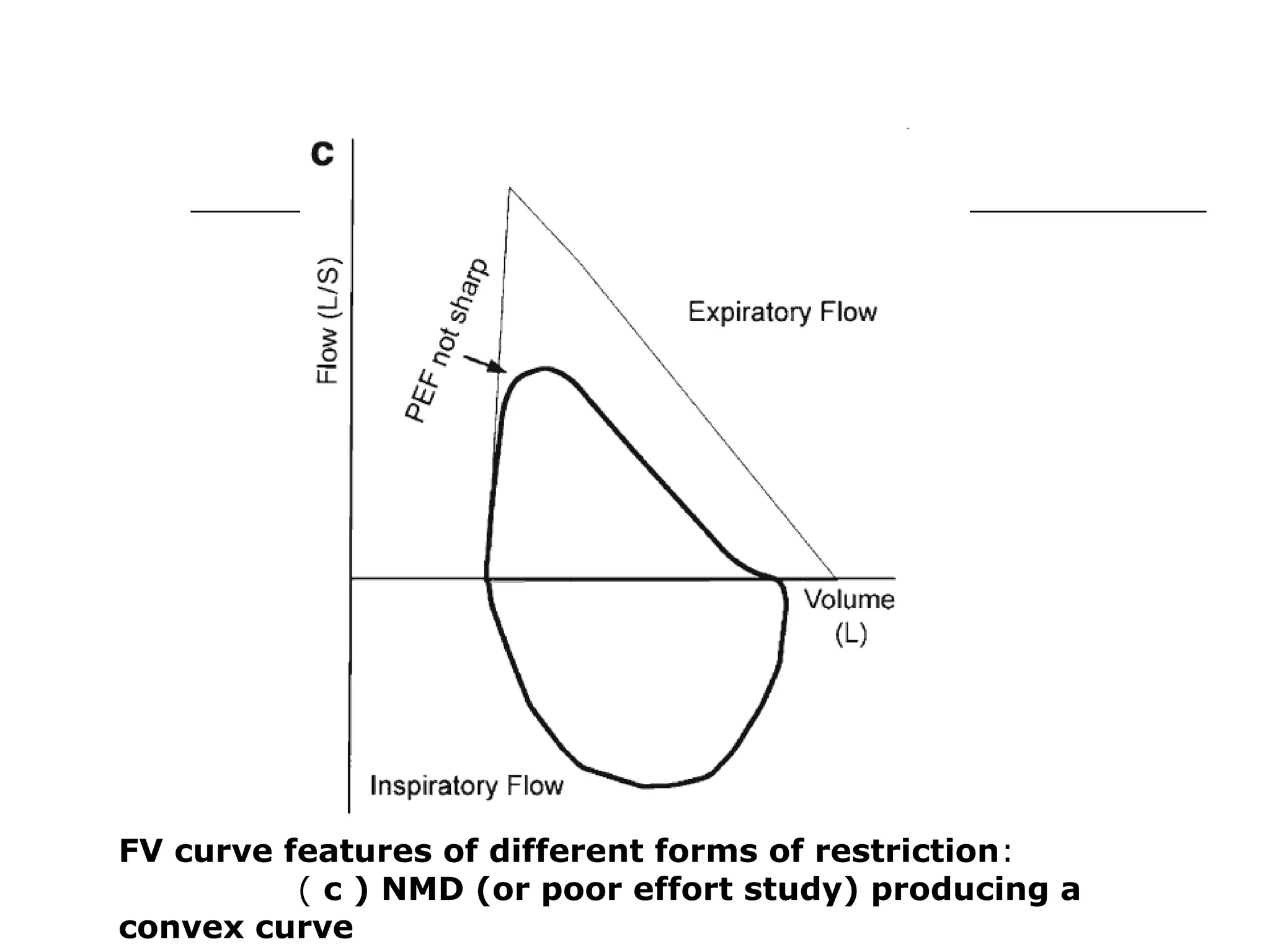
FV curve features of different forms of restriction: 
( c ) NMD (or poor effort study) producing a 
convex curve
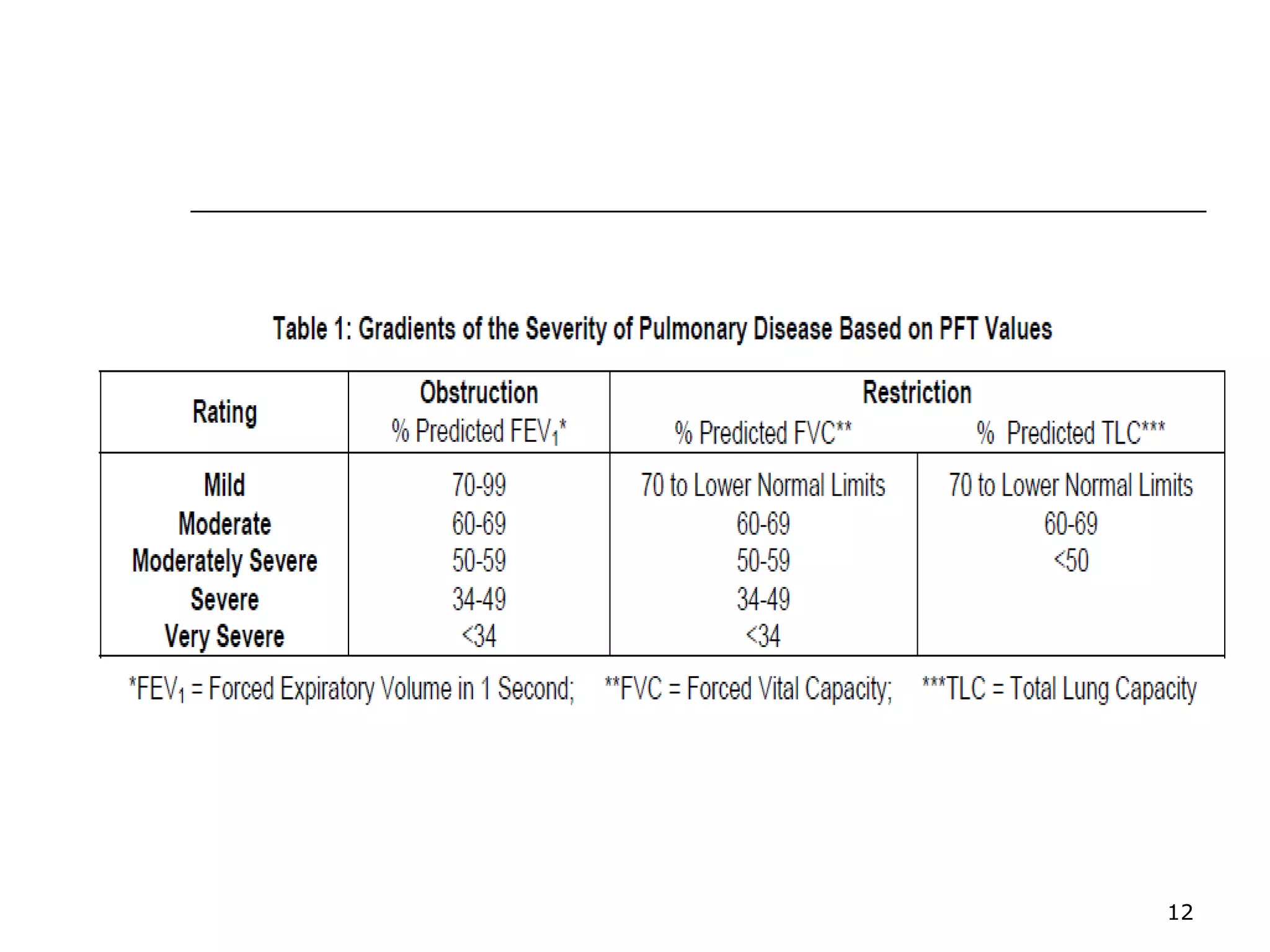
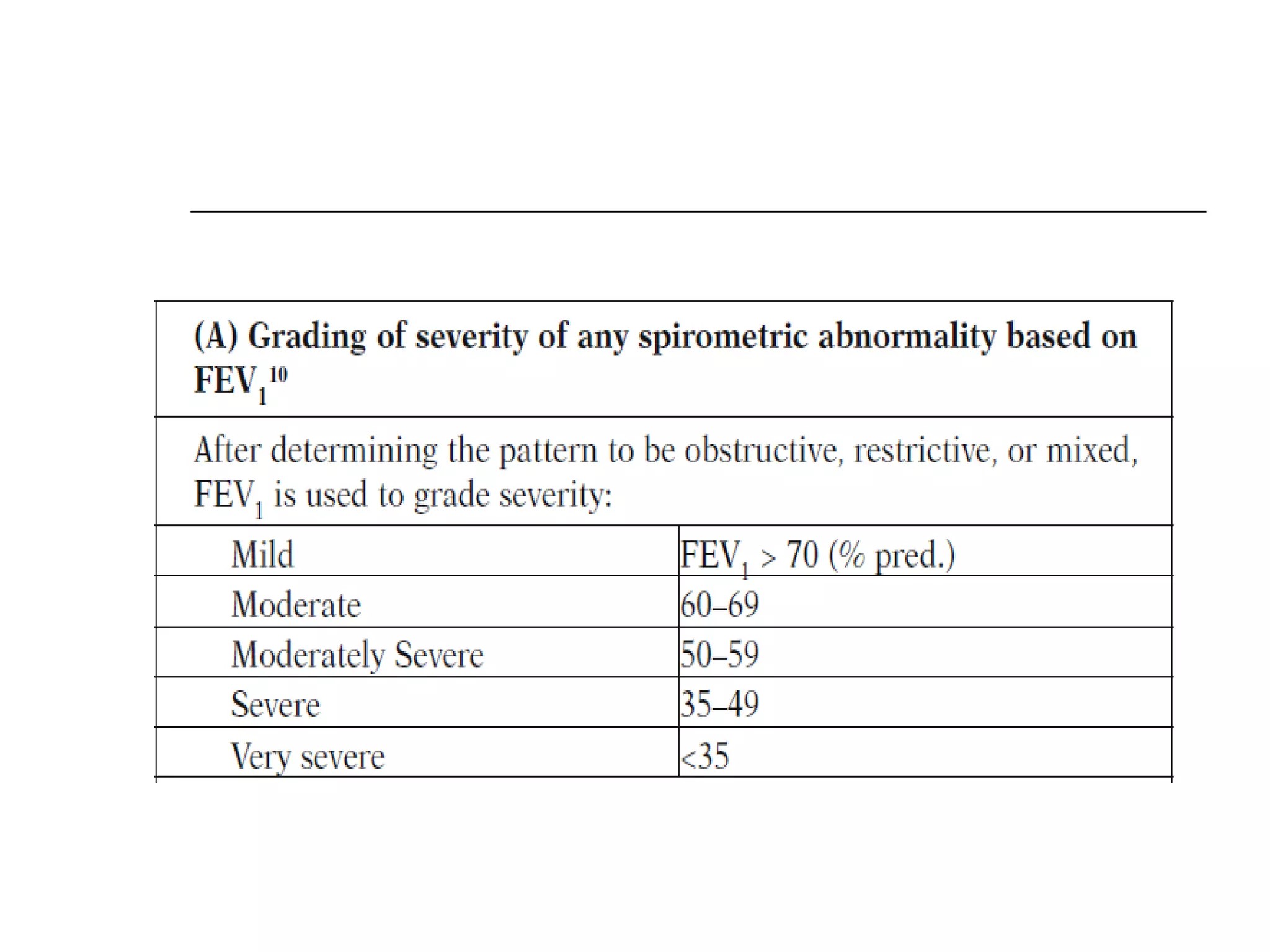
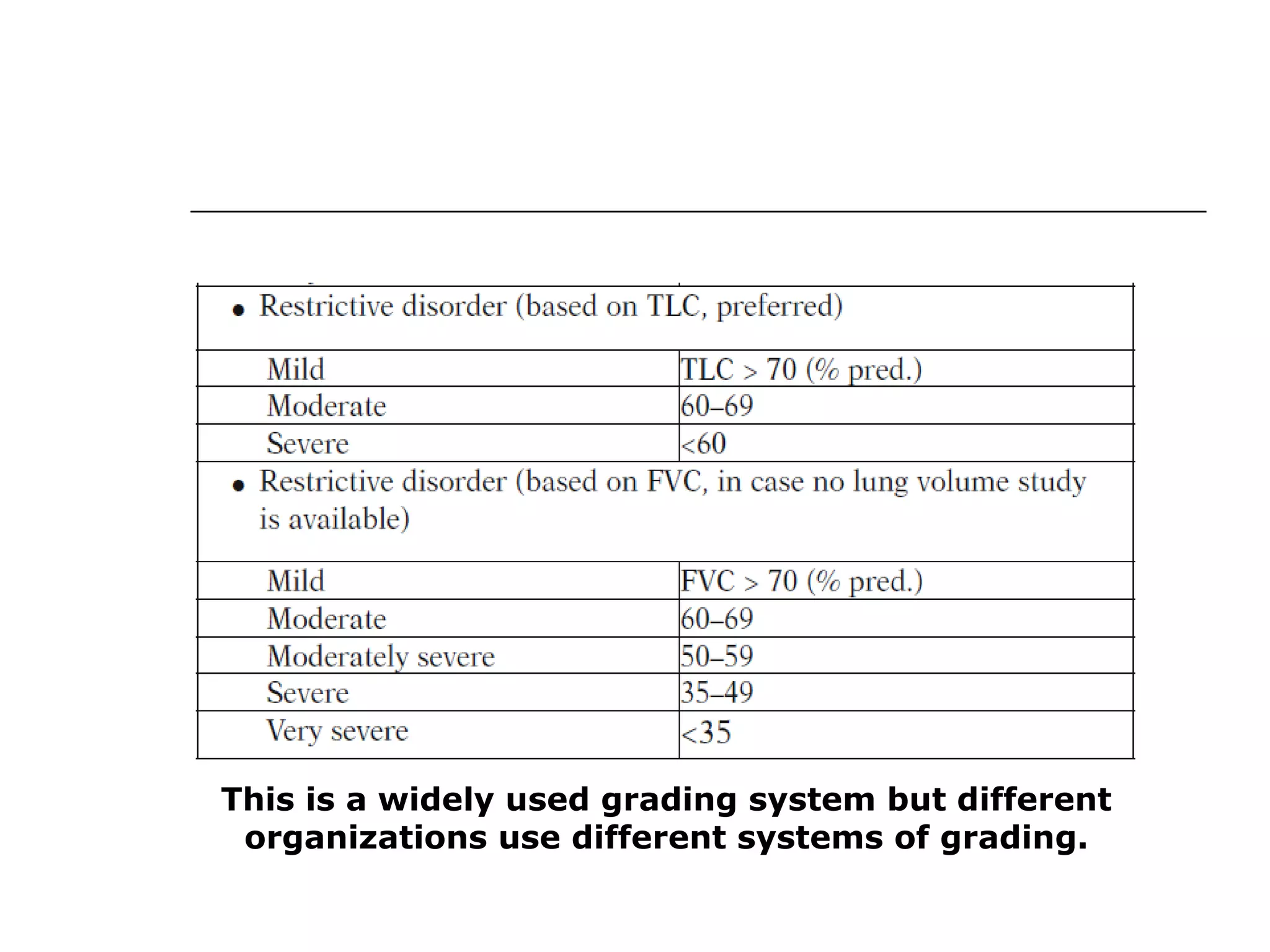
This is a widely used grading system but different 
organizations use different systems of grading.
GRADING OF SEVERITY 
 Different variables and values were used to 
grade severity of different pulmonary disorders 
 Recently, FEV 1 has been selected to grade 
severity of any spirometric abnormality 
(obstructive, restrictive, or mixed) 
 The traditional way of grading severity of 
obstructive and restrictive disorders involve the 
following:
GRADING OF SEVERITY 
 The traditional way of grading severity 
of obstructive and restrictive disorders 
involve the following: 
– In obstructive disorders, the FEV1/FVC 
ratio should be <0.7, and 
– The value of FEV1 is used to determine 
severity
GRADING OF SEVERITY 
– In restrictive disorders, however, FEV1/FVC 
ratio is normal and the TLC is less than 
80% predicted. 
– The ATS suggested using the TLC to grade 
the severity of restrictive disorders, which 
cannot be measured in simple spirometry. 
– Where only spirometry is available, FVC 
may be used to make that grading. 
– The TLC, however, should be known before 
confidently diagnosing a restrictive 
disorder
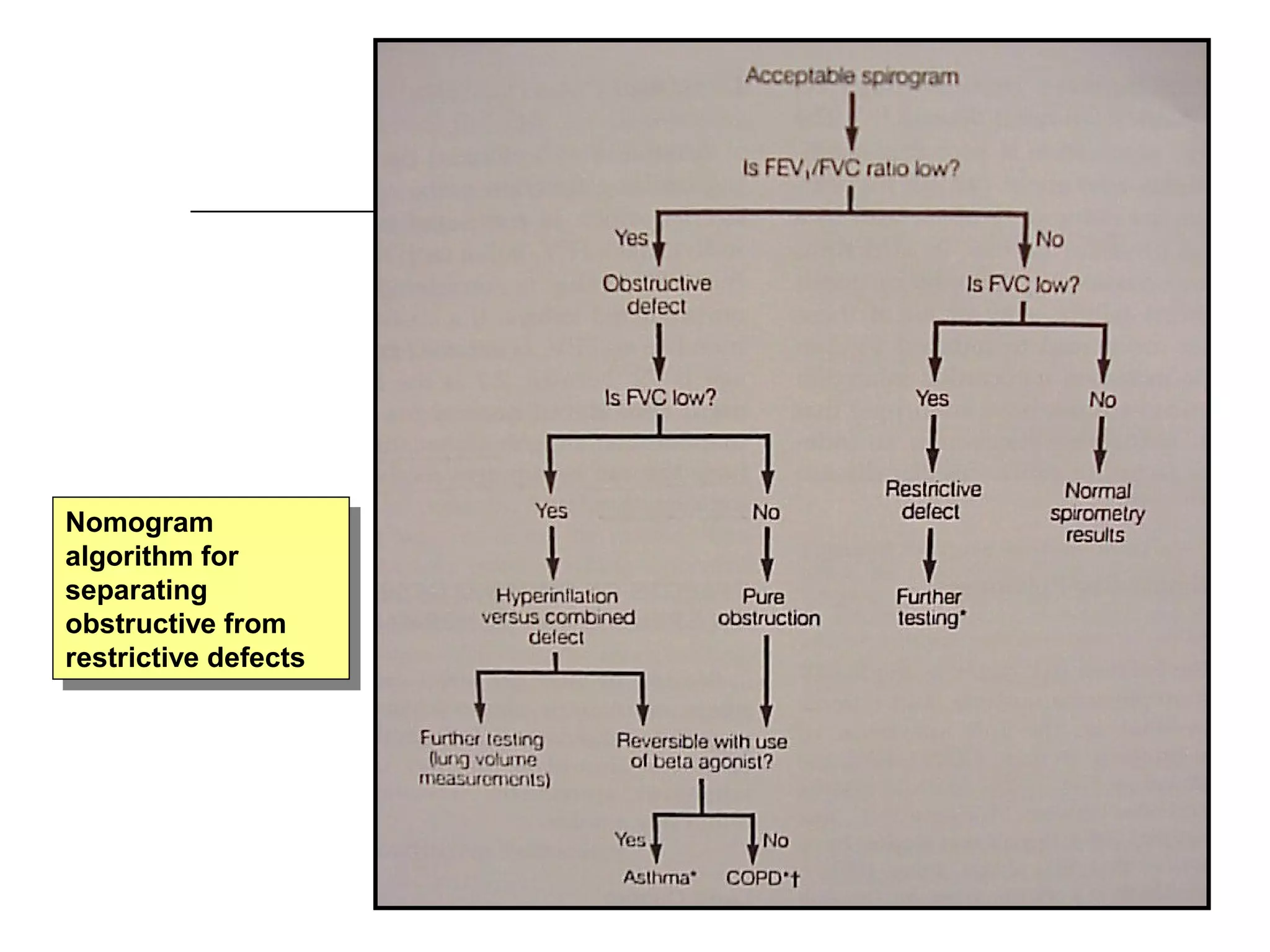
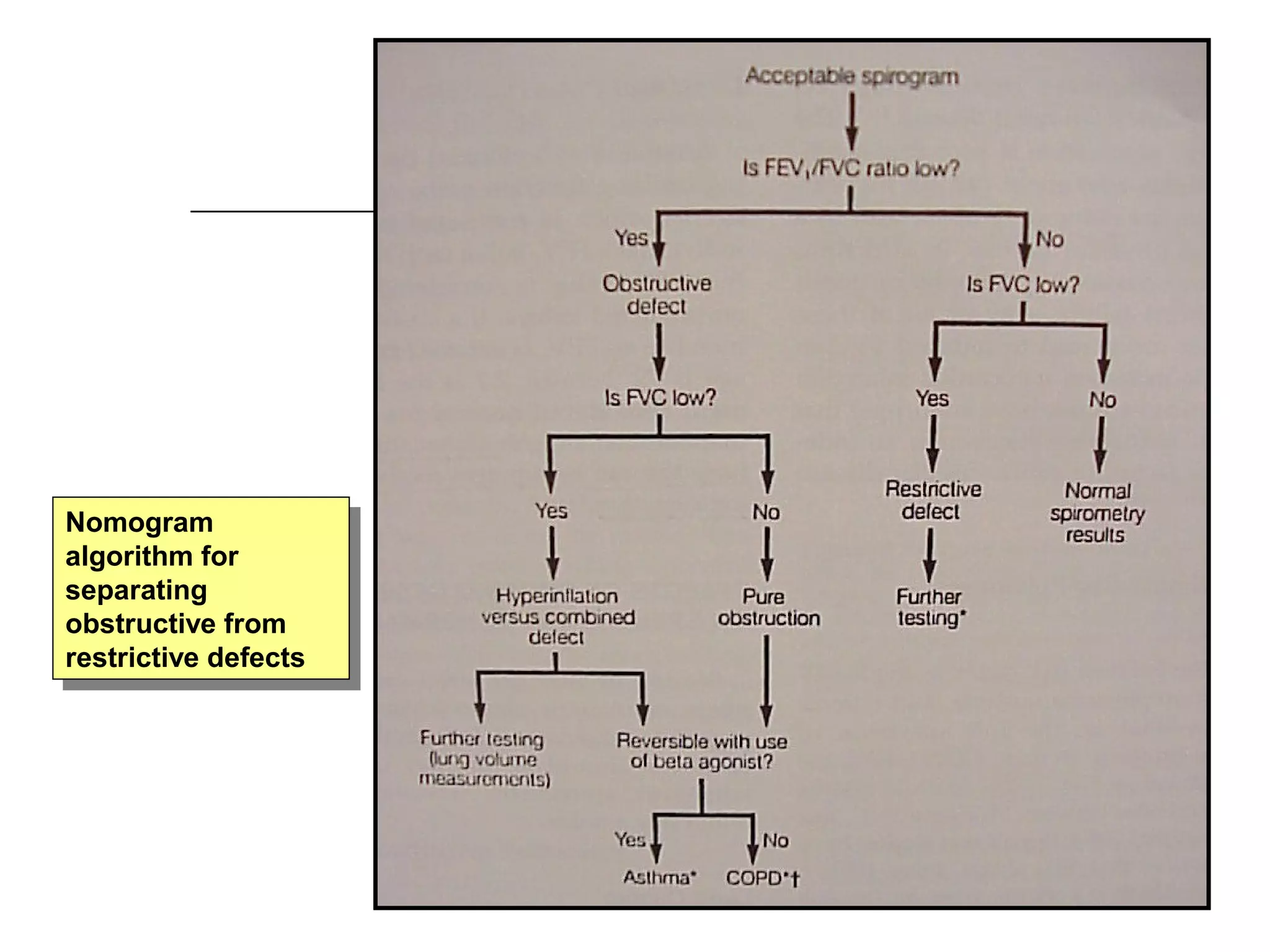
Nomogram 
algorithm for 
separating 
obstructive from 
restrictive defects 
Nomogram 
algorithm for 
separating 
obstructive from 
restrictive defects
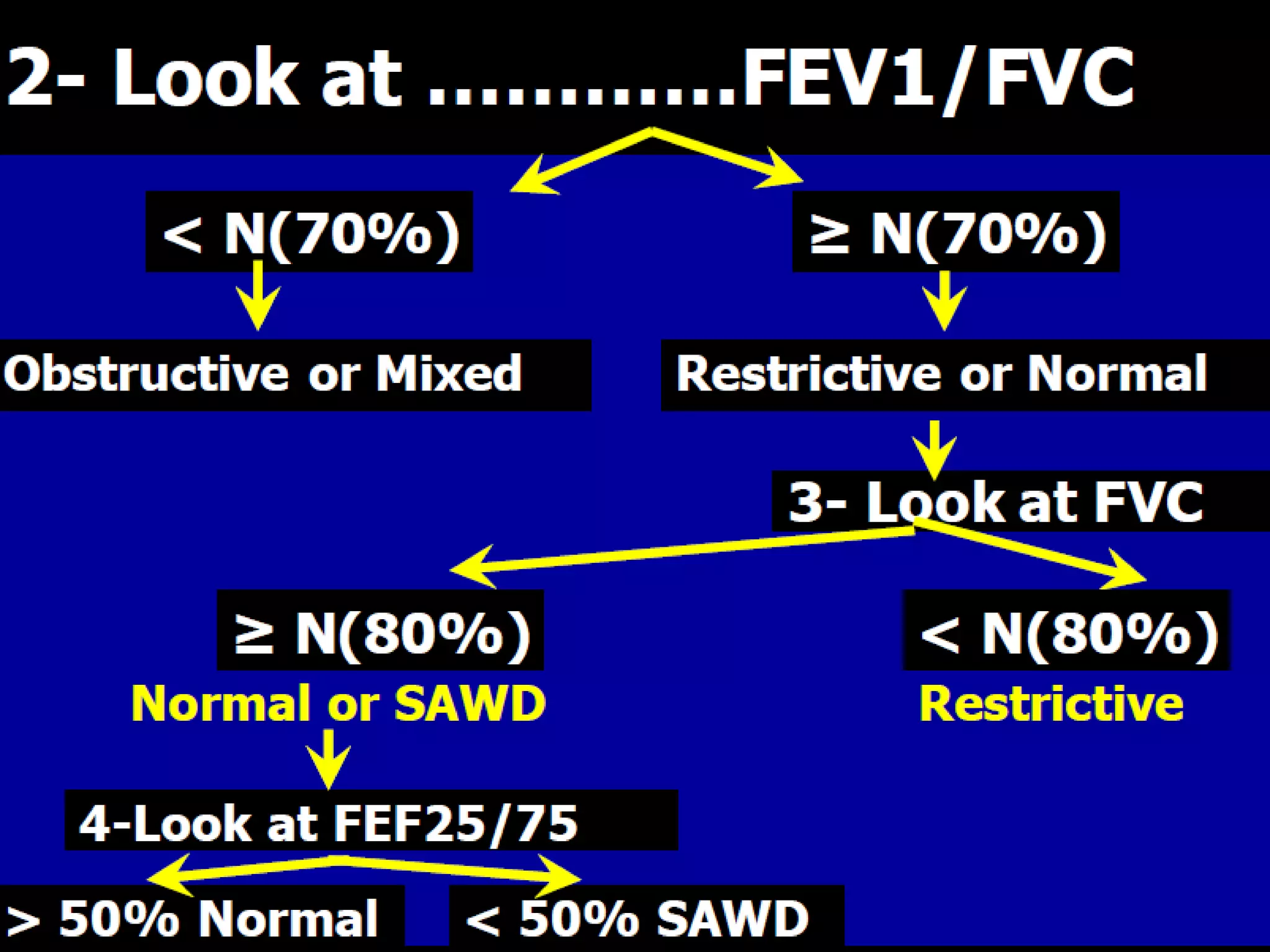
Spirometry interpretation 
Inhaled B2 
reverse 
11/13/14 
FEV1/FVC 
Obstruction 
Mixed* 
* 
FVCต้อง 
ตำ่ำ 
FVC 
Normal 
Mixed Restriction* FEF25-75% 
Small 
airway 
disease 
Normal 
spirometry 
Reversible 
airway 
obstruction 
Irreversible 
airway 
obstruction 
Low 
Low 
Low Normal 
Yes No 
Normal or Increase 
* Definite Dx ดู 
TLC
85
86
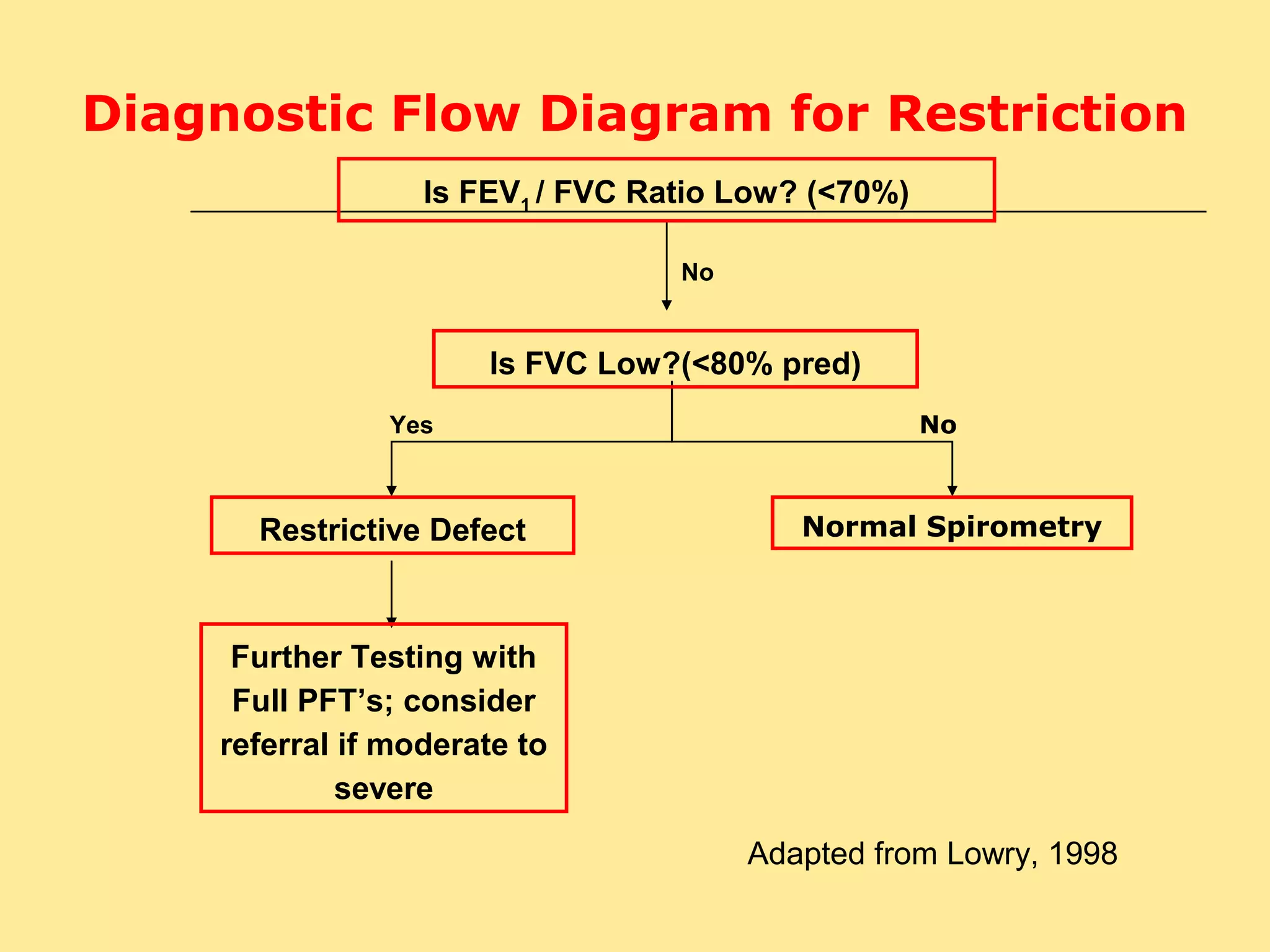
Diagnostic Flow Diagram for Restriction 
Is FEV1 / FVC Ratio Low? (<70%) 
Is FVC Low?(<80% pred) 
Yes No 
Restrictive Defect Normal Spirometry 
Further Testing with 
Full PFT’s; consider 
referral if moderate to 
severe 
No 
Adapted from Lowry, 1998
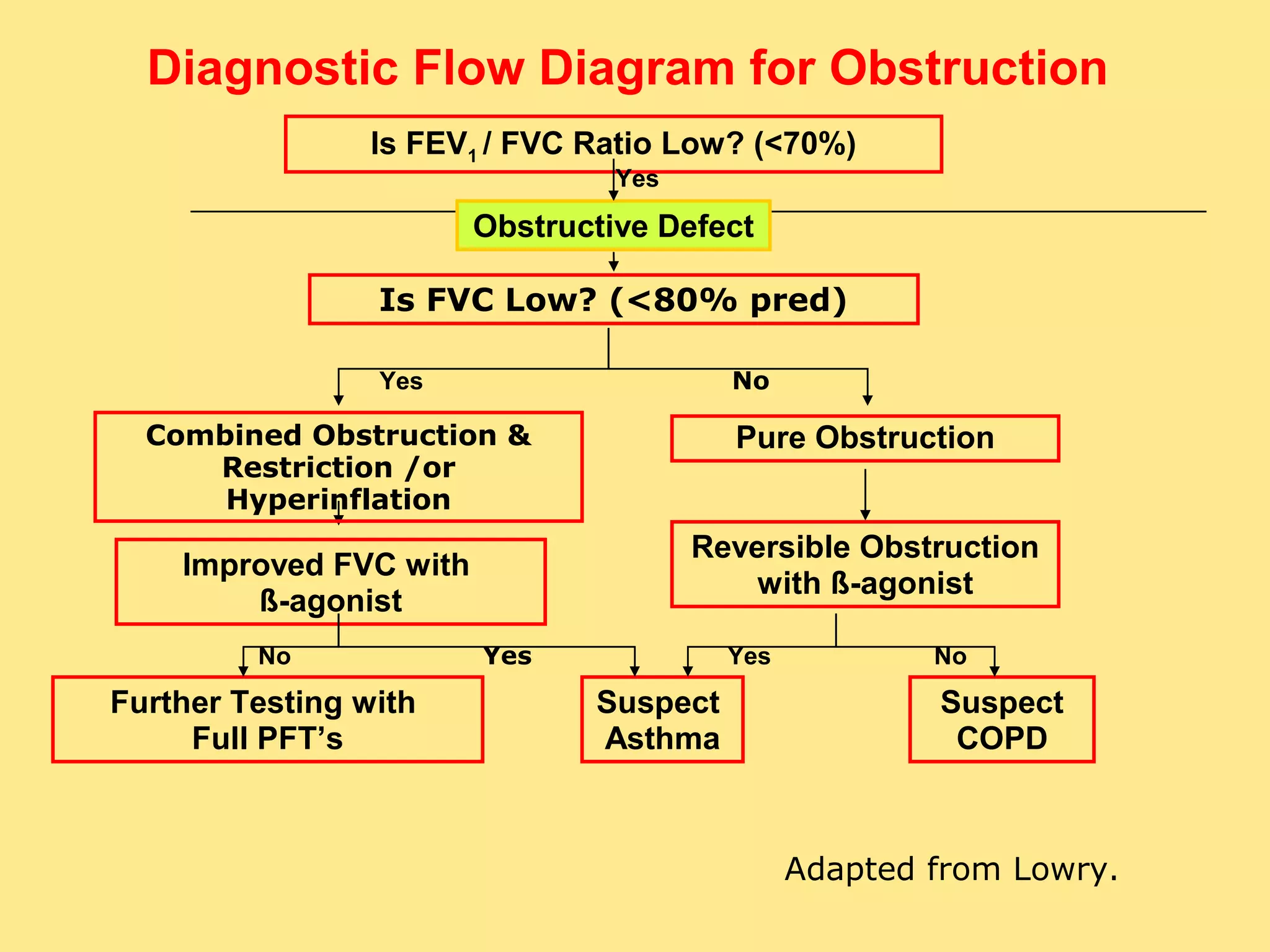
Diagnostic Flow Diagram for Obstruction 
Obstructive Defect 
Is FVC Low? (<80% pred) 
Combined Obstruction & 
Restriction /or 
Hyperinflation 
No Yes 
Pure Obstruction 
Improved FVC with 
ß-agonist 
Reversible Obstruction 
with ß-agonist 
Further Testing with 
Full PFT’s 
Suspect 
Asthma 
Suspect 
COPD 
Is FEV1 / FVC Ratio Low? (<70%) 
Yes 
Yes No 
Yes No 
Adapted from Lowry.
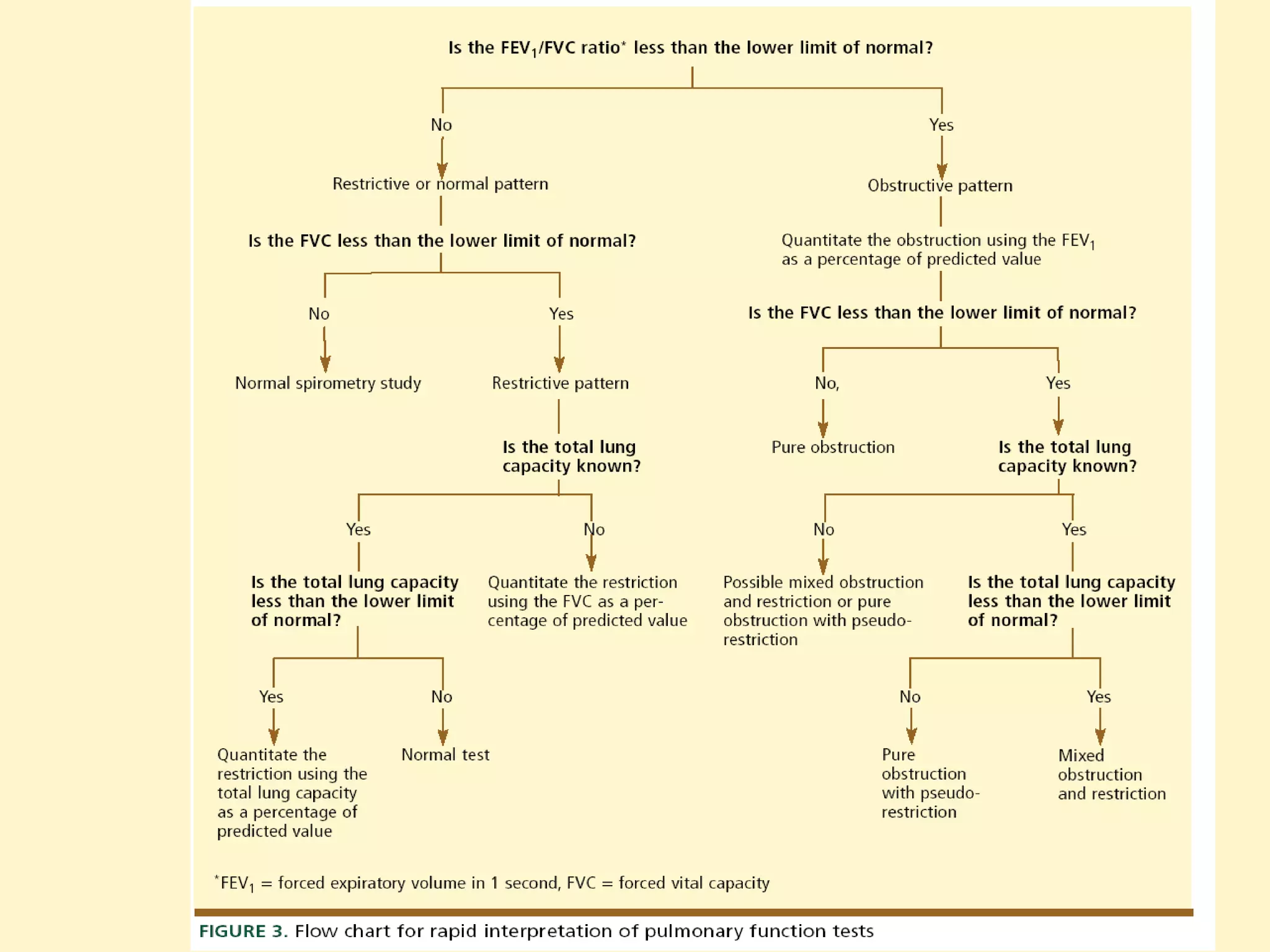
Nomogram 
algorithm for 
separating 
obstructive from 
restrictive defects 
Nomogram 
algorithm for 
separating 
obstructive from 
restrictive defects
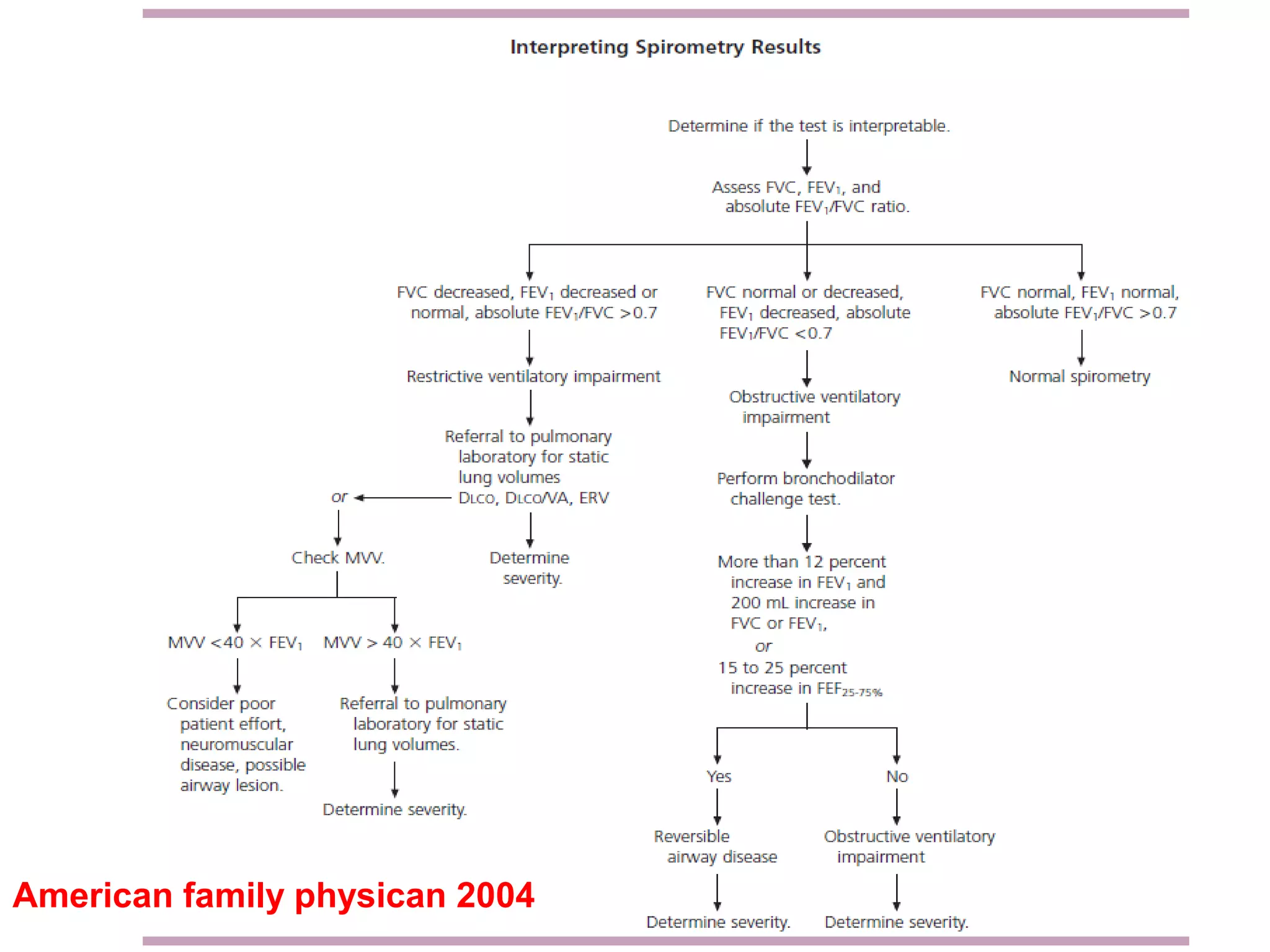
90 American family physican 2004
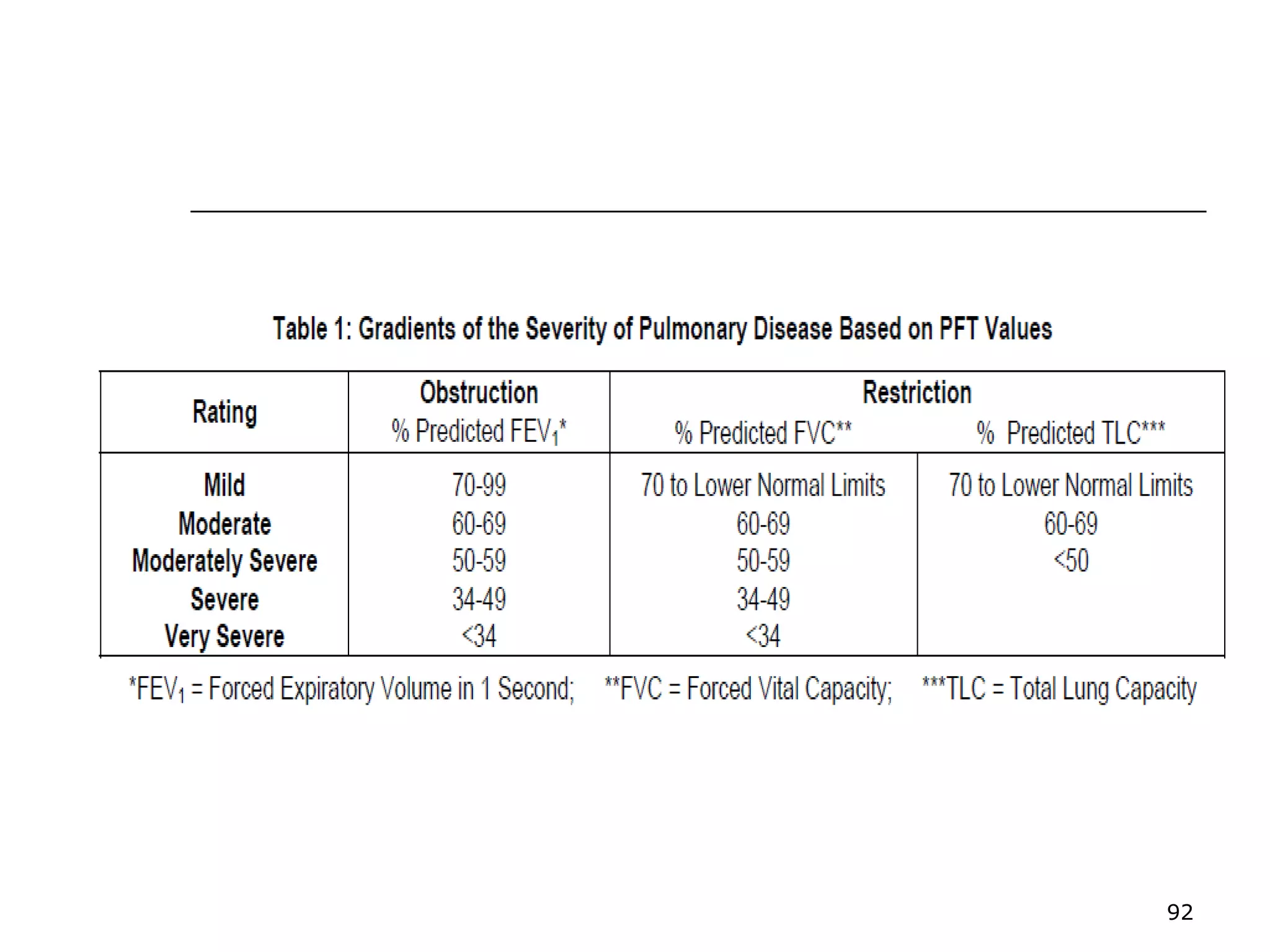
92
 Know the 3 aspects of lung function 
test: 
1) spirometry 
2) volumes 
3) diffusion
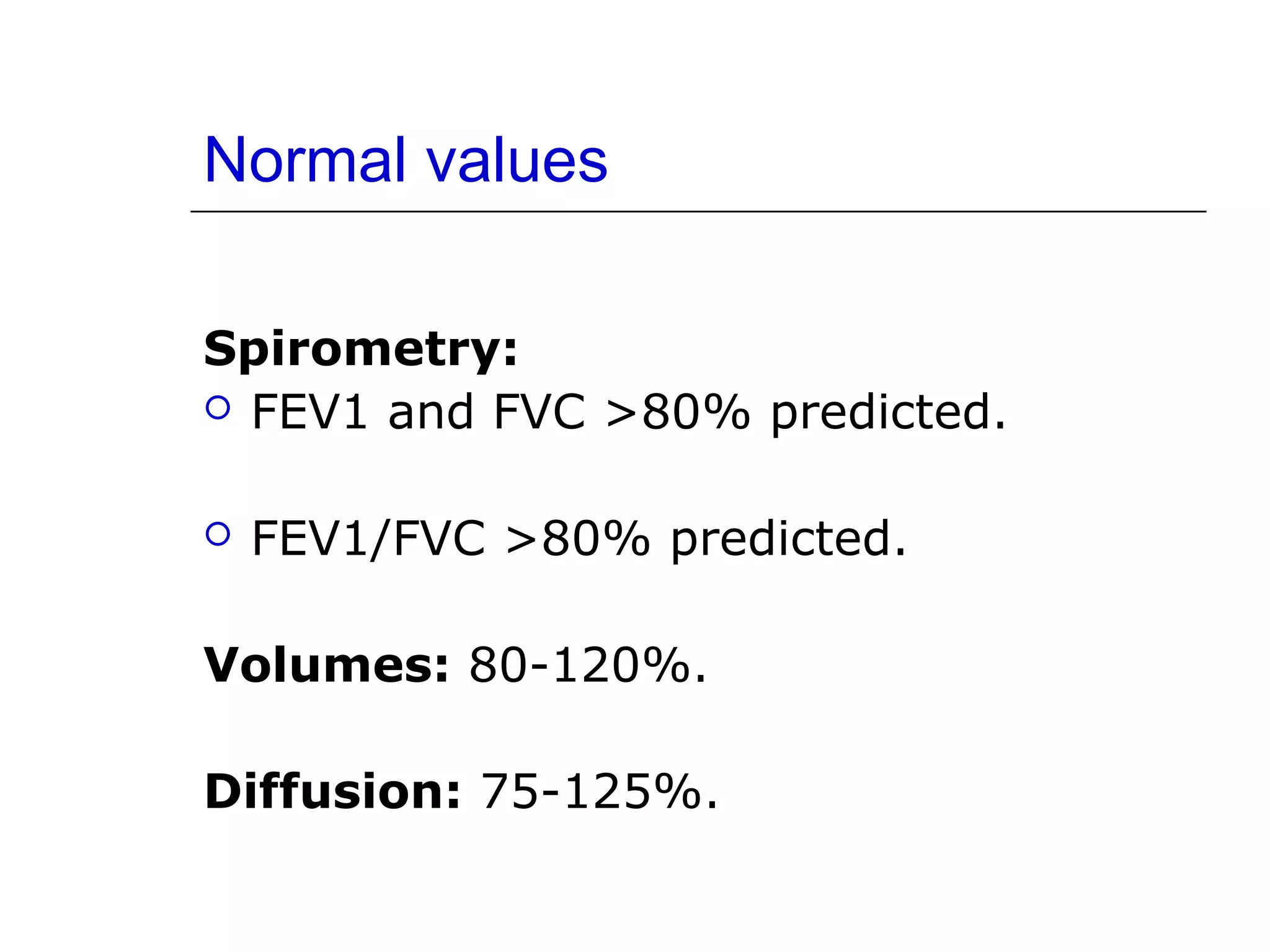
Normal values 
Spirometry: 
 FEV1 and FVC >80% predicted. 
 FEV1/FVC >80% predicted. 
Volumes: 80-120%. 
Diffusion: 75-125%.
 Low FVC suggest possible restriction 
but need to look at TLC to confirm 
(TLC <80%) 
 High FRC and TLC (>120% 
predicted) suggest hyperinflation. 
 High RV/TLC suggest gas trapping.
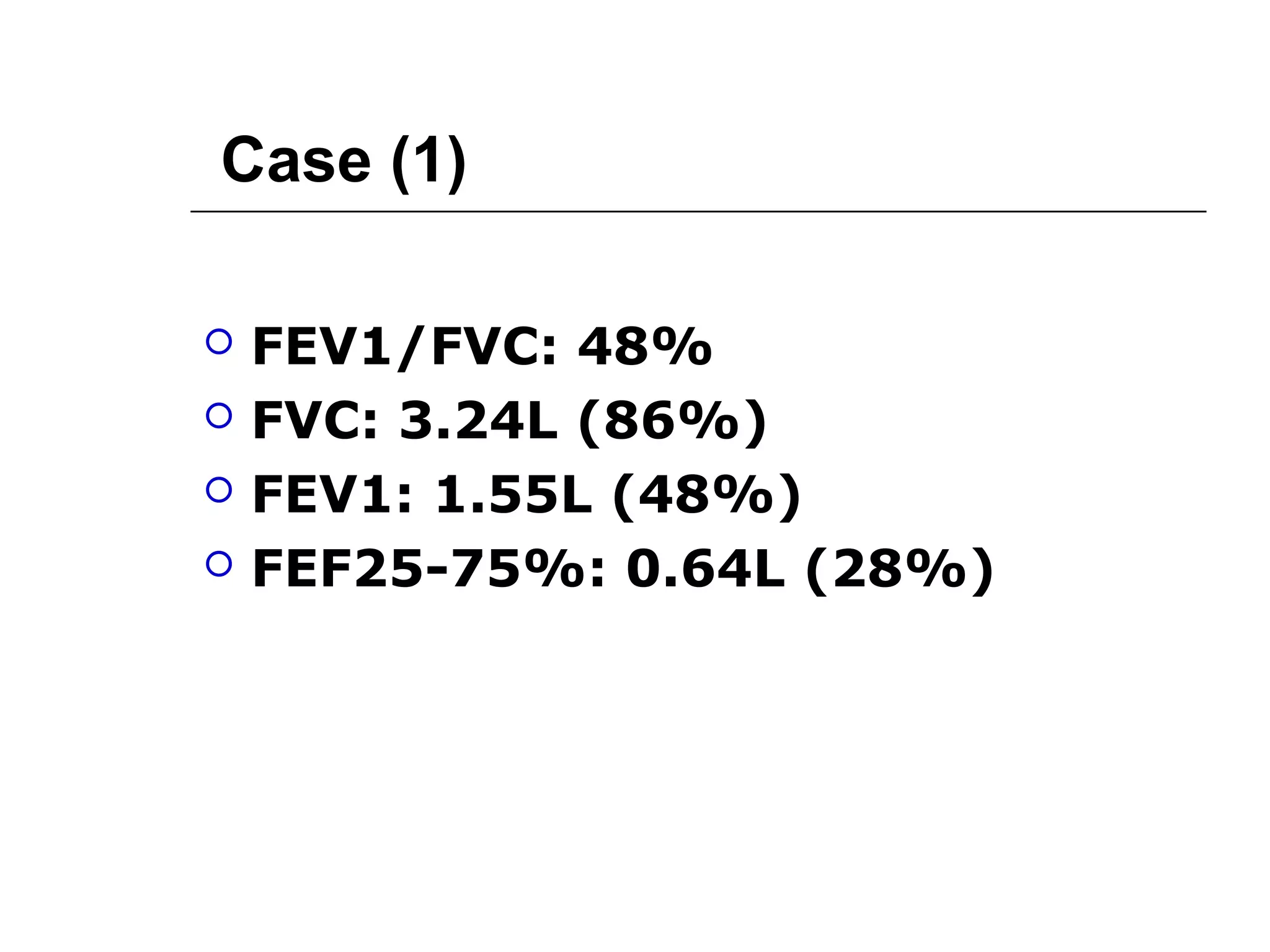
Case (1) 
 FEV1/FVC: 48% 
 FVC: 3.24L (86%) 
 FEV1: 1.55L (48%) 
 FEF25-75%: 0.64L (28%)
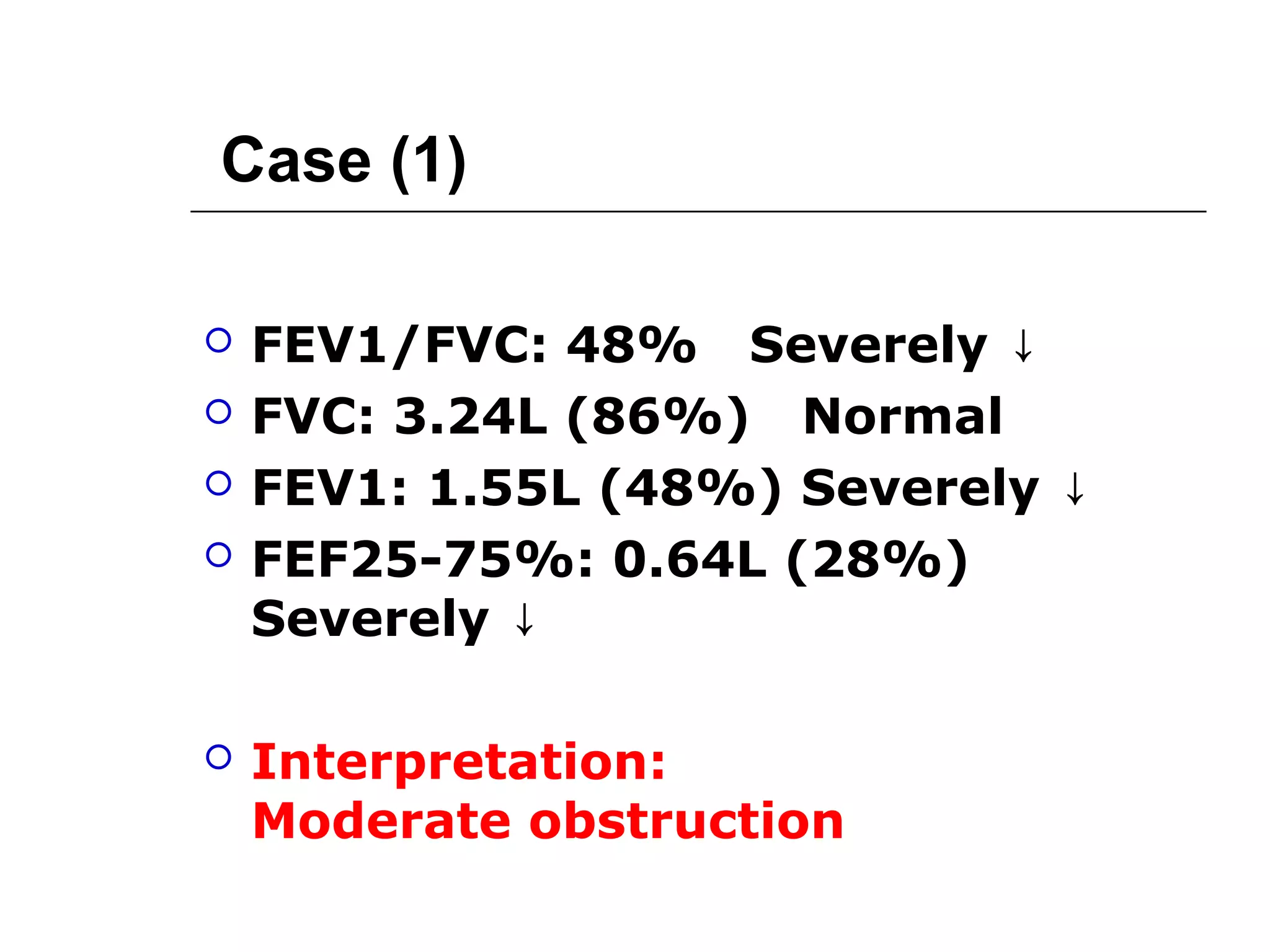
Case (1) 
 FEV1/FVC: 48% Severely ↓ 
 FVC: 3.24L (86%) Normal 
 FEV1: 1.55L (48%) Severely ↓ 
 FEF25-75%: 0.64L (28%) 
Severely ↓ 
 Interpretation: 
Moderate obstruction
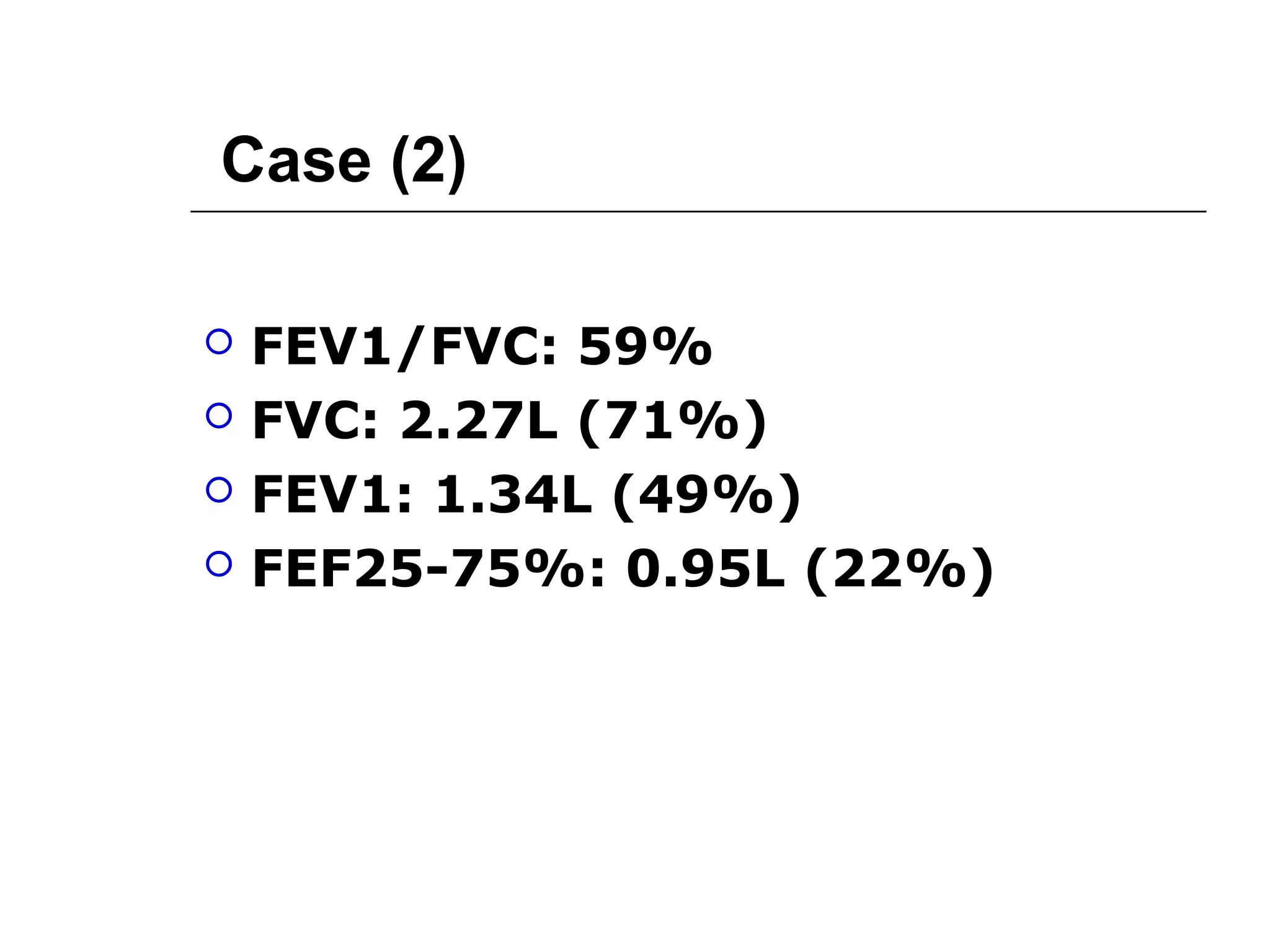
Case (2) 
 FEV1/FVC: 59% 
 FVC: 2.27L (71%) 
 FEV1: 1.34L (49%) 
 FEF25-75%: 0.95L (22%)
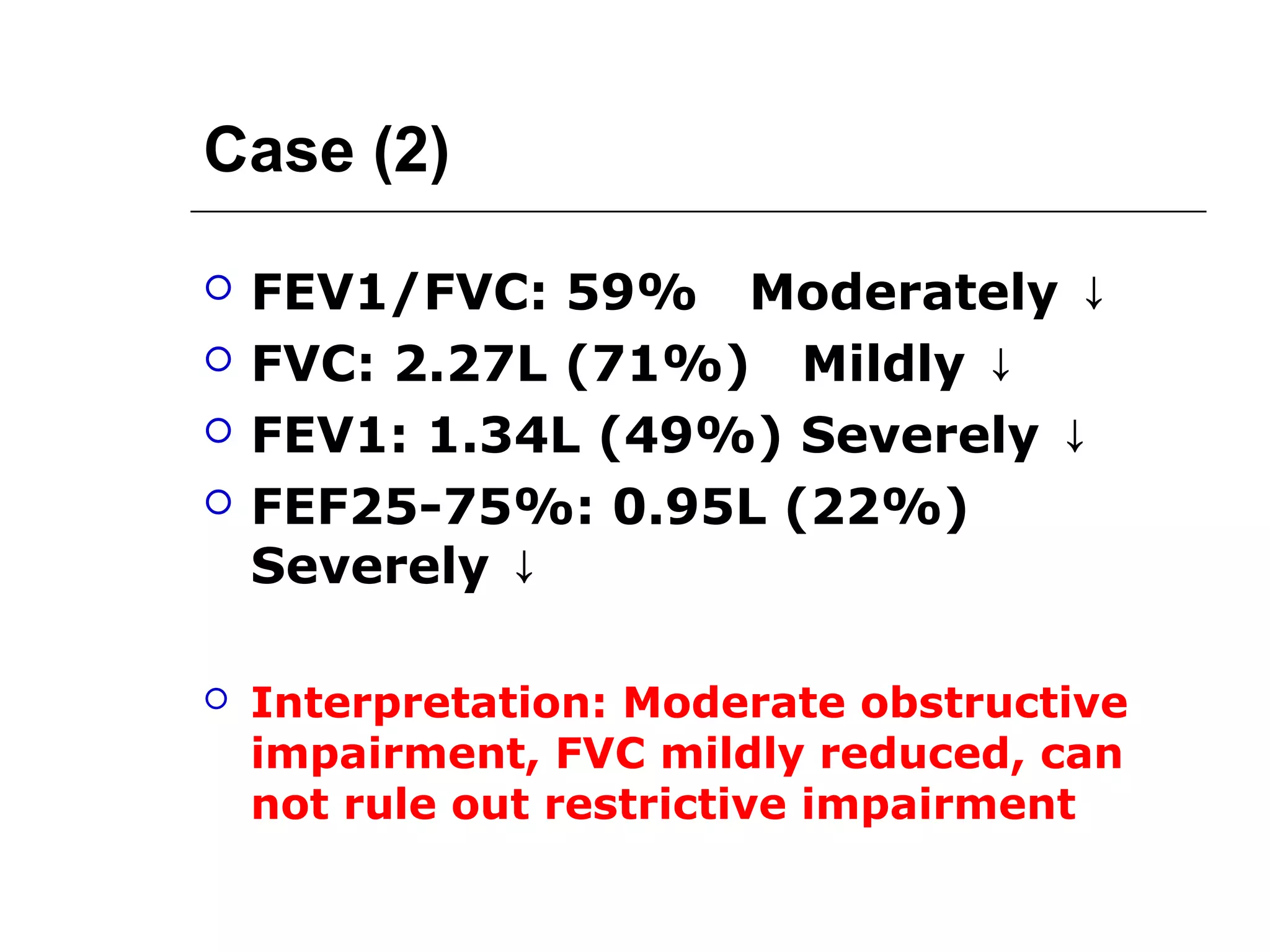
Case (2) 
 FEV1/FVC: 59% Moderately ↓ 
 FVC: 2.27L (71%) Mildly ↓ 
 FEV1: 1.34L (49%) Severely ↓ 
 FEF25-75%: 0.95L (22%) 
Severely ↓ 
 Interpretation: Moderate obstructive 
impairment, FVC mildly reduced, can 
not rule out restrictive impairment
Case (3) 
 FEV1/FVC: 86% 
 FVC: 2.49 L (61%) 
 FEV1: 1.96 L (64%) 
 FEF25-75%: 2.83 L (98%) 
 FRC: 1.94 L (59%) 
 TLC: 4.03 L (70%) 
 RV: 1.38 L (65%) 
 DLCO: 55% 
Interpretation: Moderate Restrictive pattern 
with moderately reduced DLCO
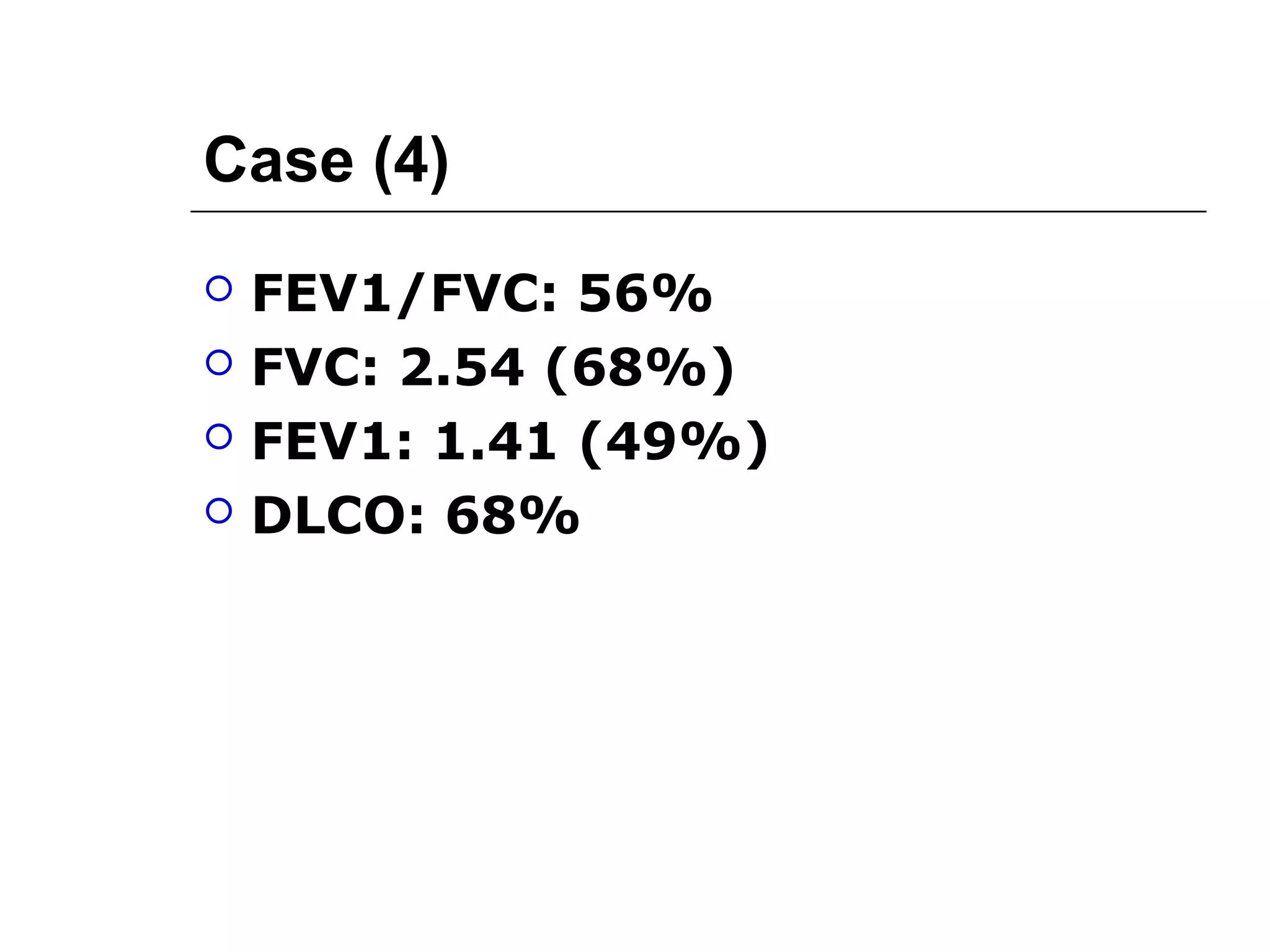
Case (4) 
 FEV1/FVC: 56% 
 FVC: 2.54 (68%) 
 FEV1: 1.41 (49%) 
 DLCO: 68%
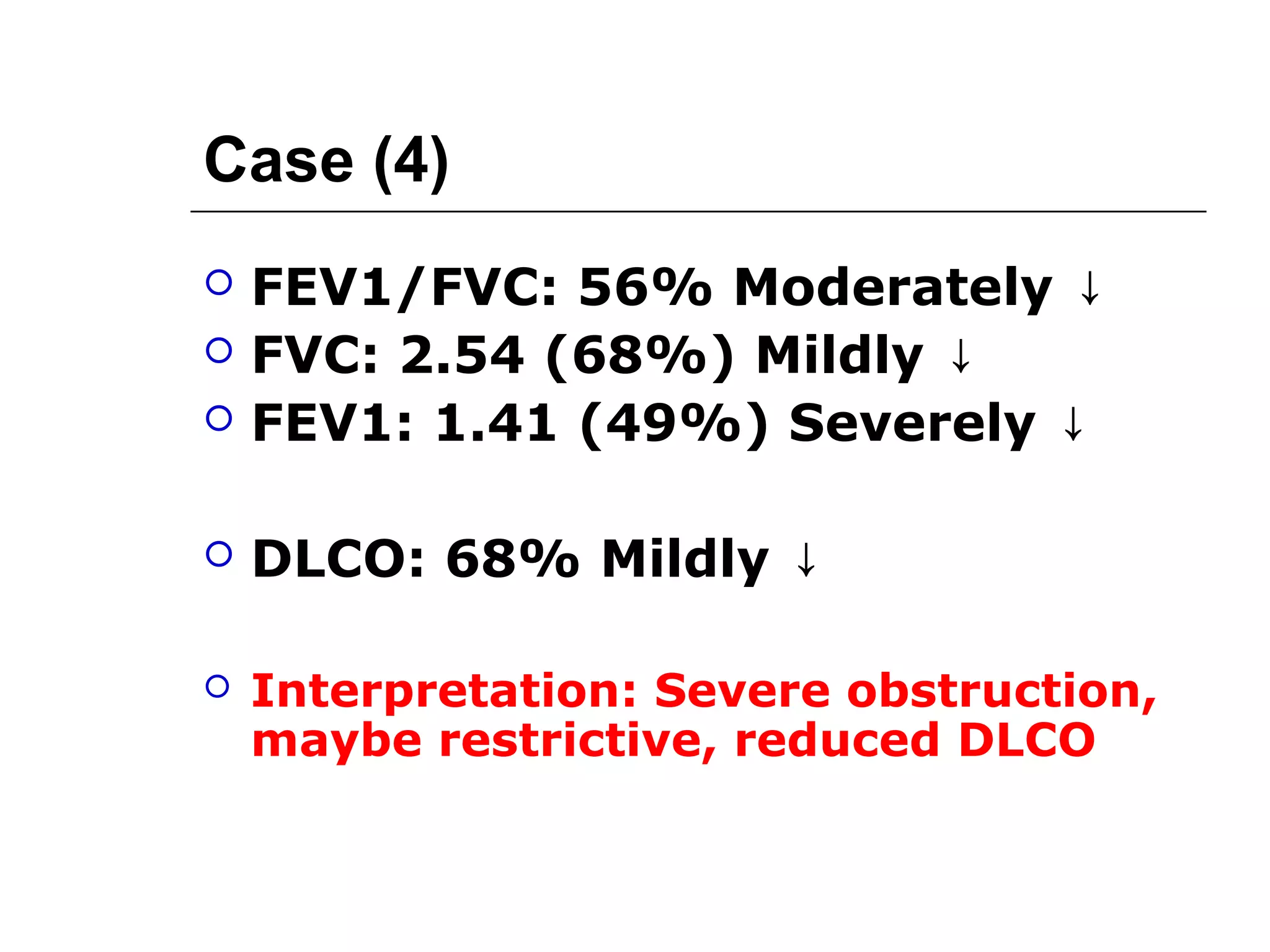
Case (4) 
 FEV1/FVC: 56% Moderately ↓ 
 FVC: 2.54 (68%) Mildly ↓ 
 FEV1: 1.41 (49%) Severely ↓ 
 DLCO: 68% Mildly ↓ 
 Interpretation: Severe obstruction, 
maybe restrictive, reduced DLCO
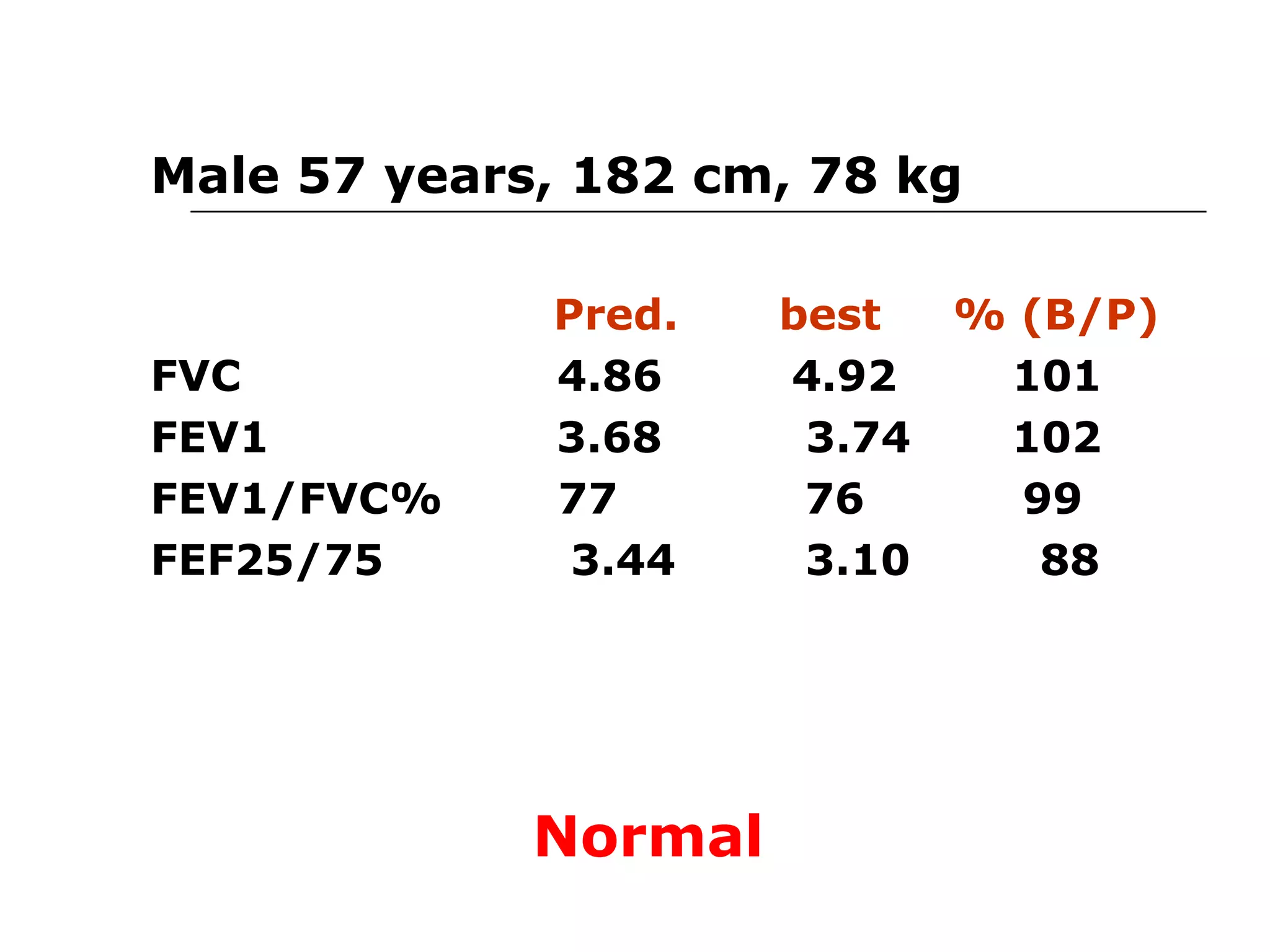
Male 57 years, 182 cm, 78 kg 
Pred. best % (B/P) 
FVC 4.86 4.92 101 
FEV1 3.68 3.74 102 
FEV1/FVC% 77 76 99 
FEF25/75 3.44 3.10 88 
Normal
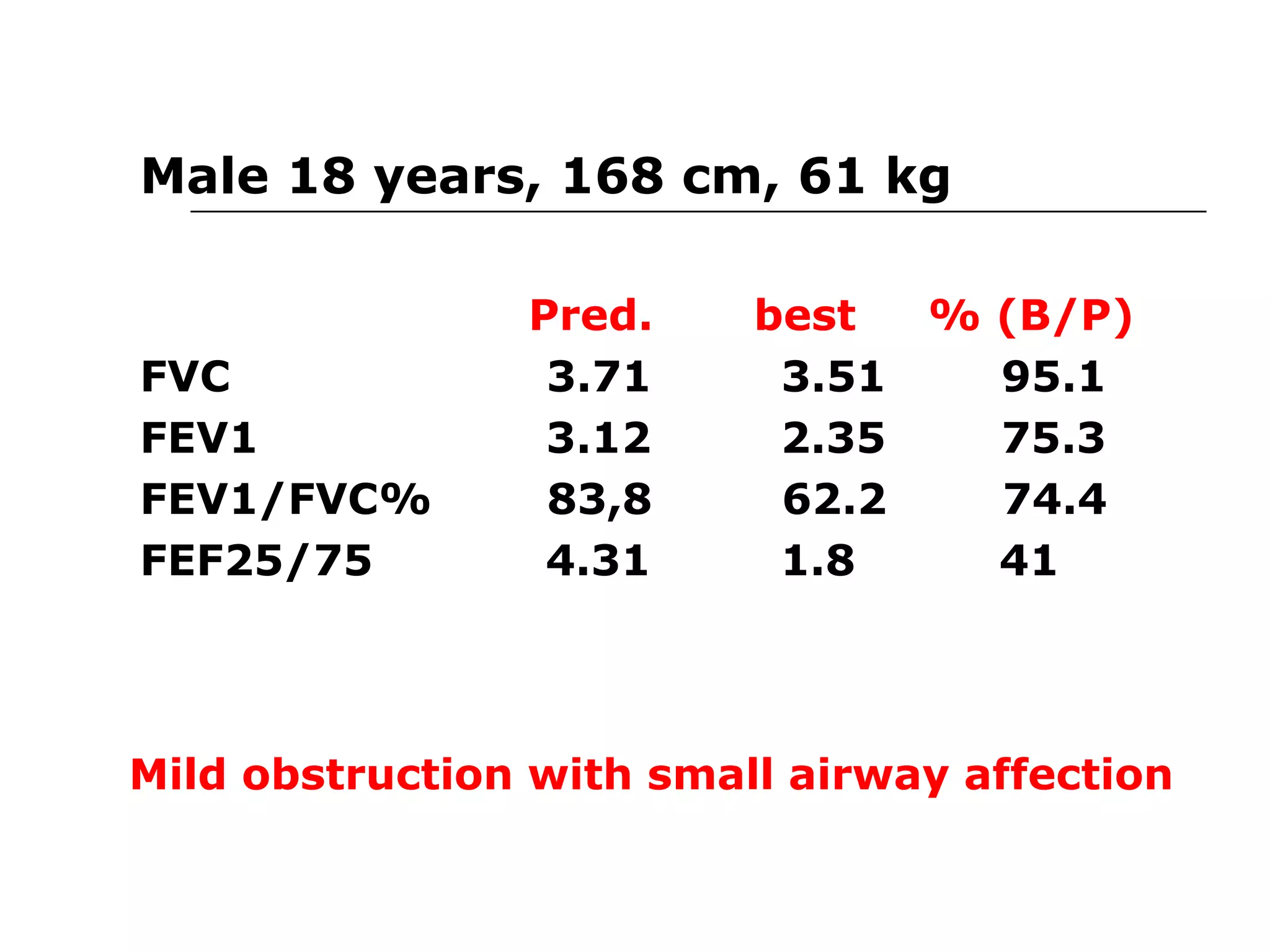
Male 18 years, 168 cm, 61 kg 
Pred. best % (B/P) 
FVC 3.71 3.51 95.1 
FEV1 3.12 2.35 75.3 
FEV1/FVC% 83,8 62.2 74.4 
FEF25/75 4.31 1.8 41 
Mild obstruction with small airway affection
Male 54 years, 178 cm, 92 kg 
Pred. best % (B/P) 
FVC 4.60 3.25 78 
FEV1 3.55 0.76 22 
FEV1/FVC% 77 22 29 
FEF25/75 3.51 0.22 6.1 
Severe obstruction with small airway 
affection
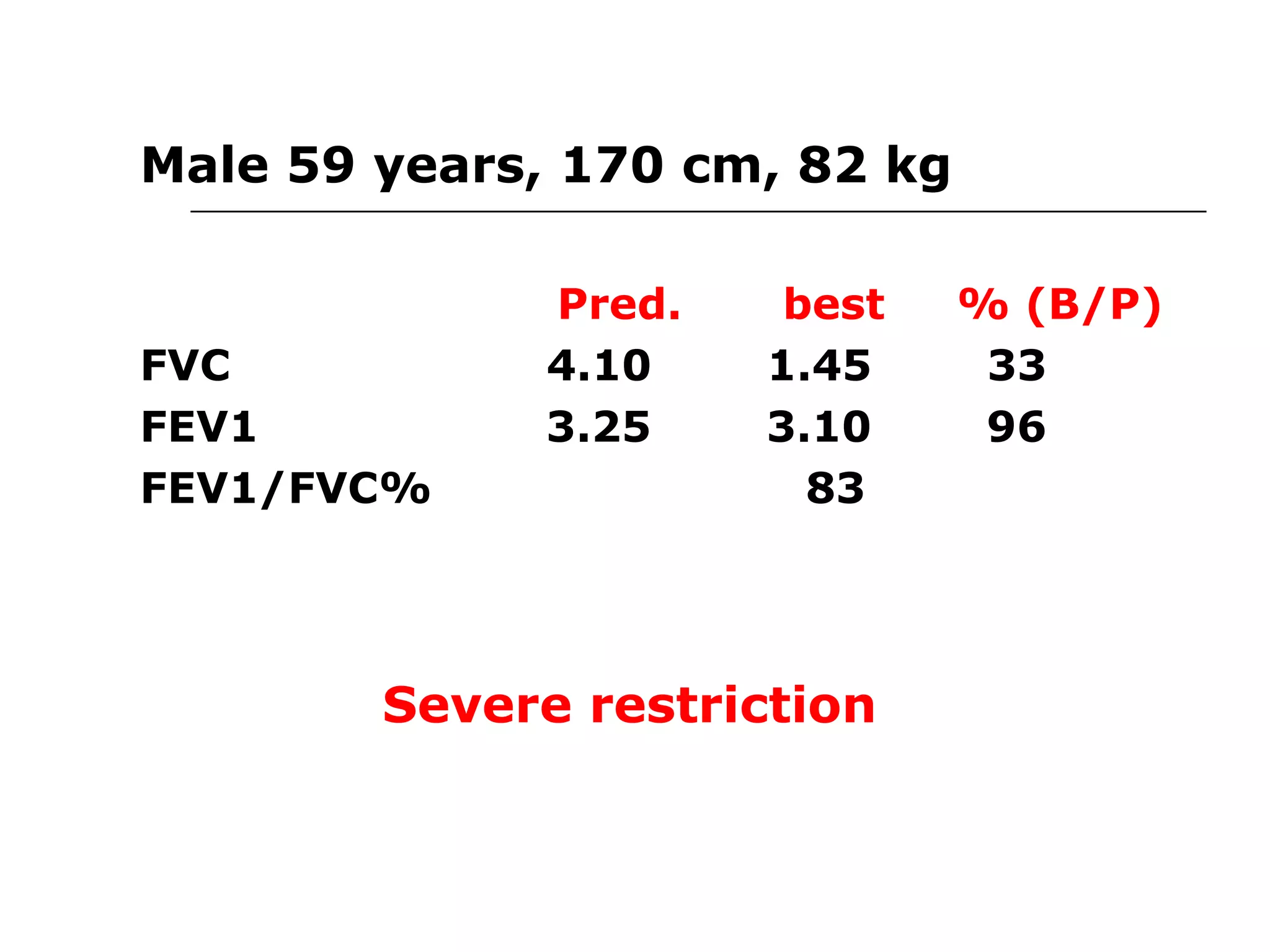
Male 59 years, 170 cm, 82 kg 
Pred. best % (B/P) 
FVC 4.10 1.45 33 
FEV1 3.25 3.10 96 
FEV1/FVC% 83 
Severe restriction
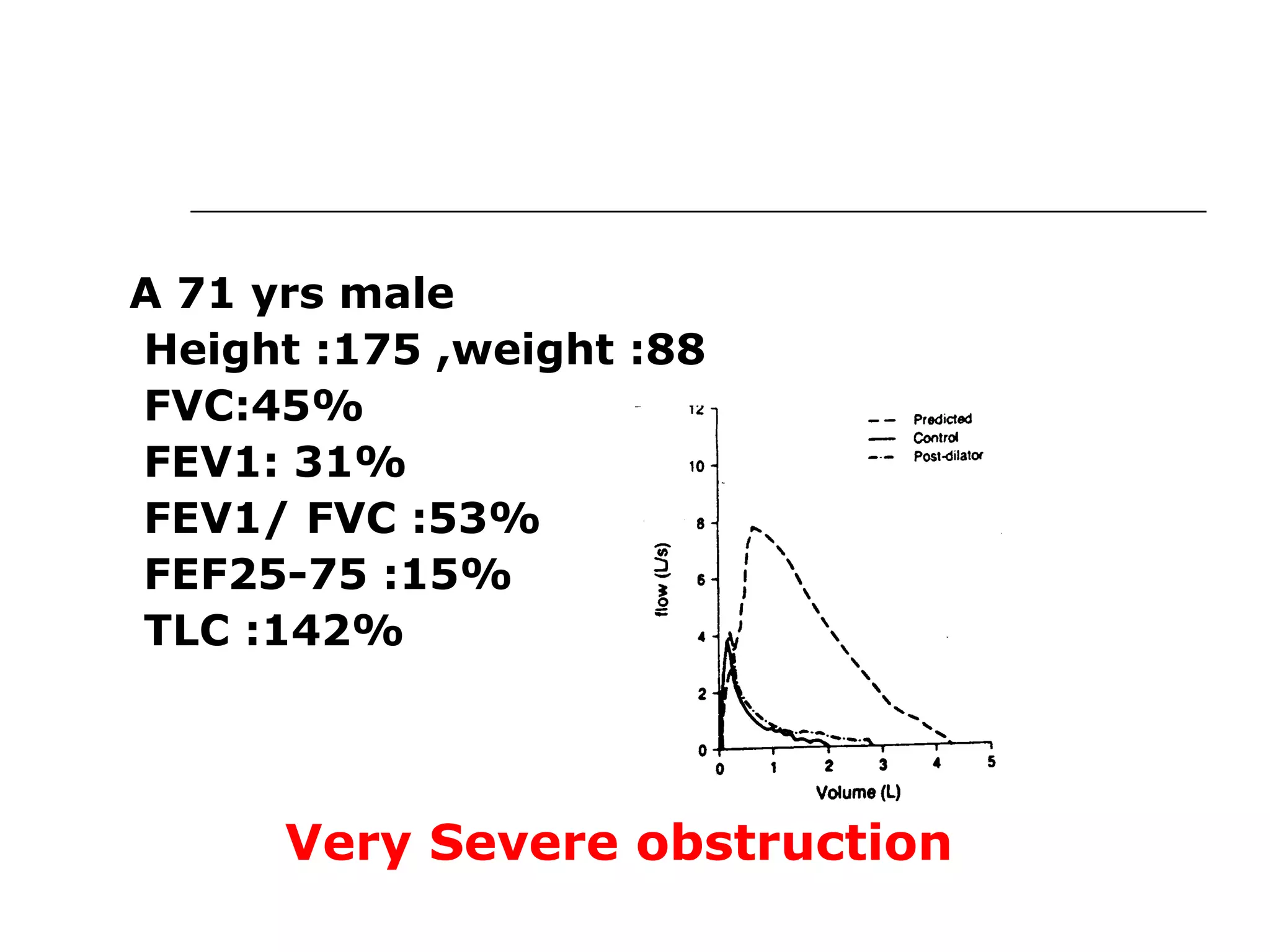
A 71 yrs male 
Height :175 ,weight :88 
FVC:45% 
FEV1: 31% 
FEV1/ FVC :53% 
FEF25-75 :15% 
TLC :142% 
Very Severe obstruction
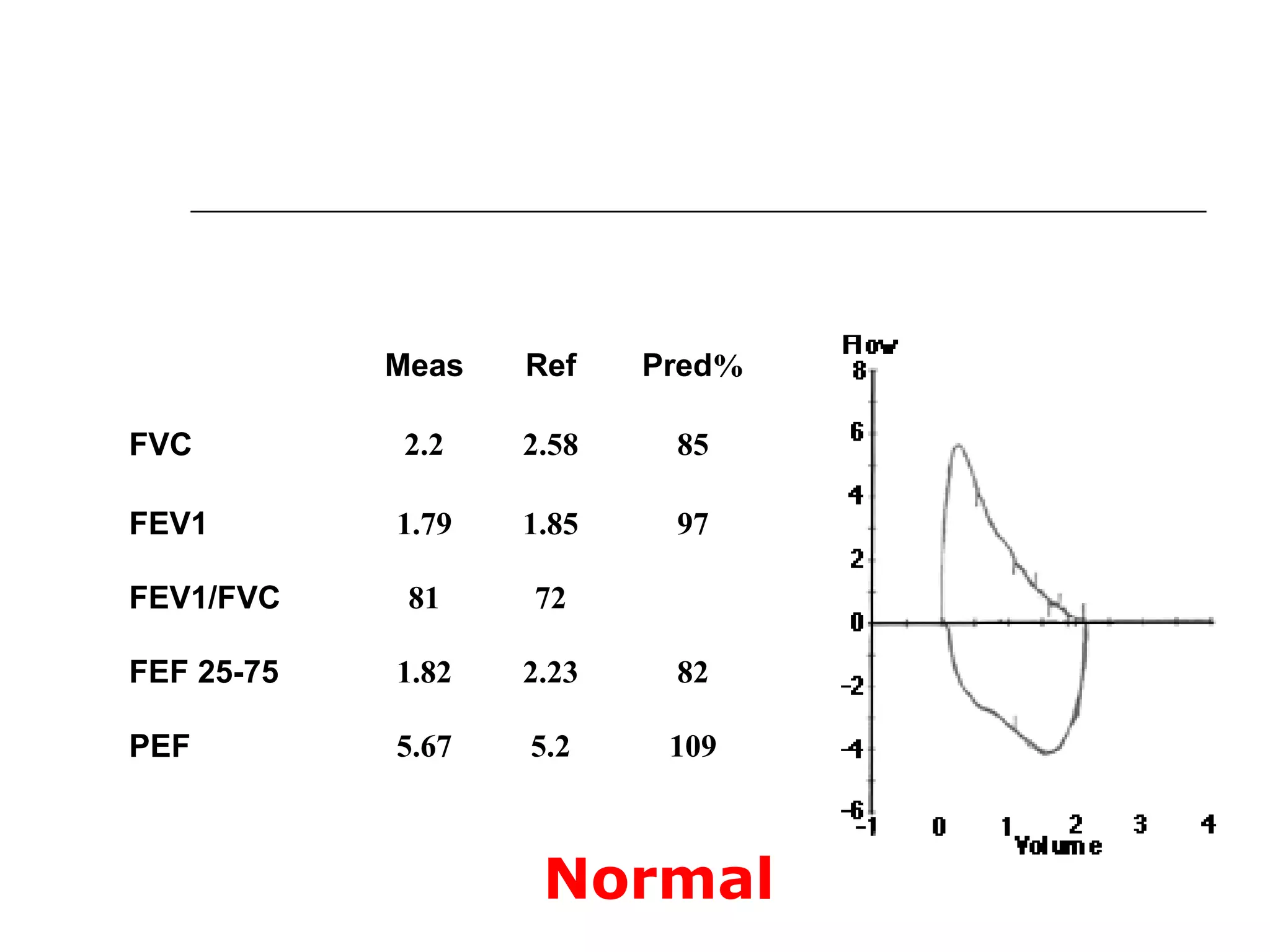
Meas Ref Pred% 
FVC 2.2 2.58 85 
FEV1 1.79 1.85 97 
FEV1/FVC 81 72 
FEF 25-75 1.82 2.23 82 
PEF 5.67 5.2 109 
Normal
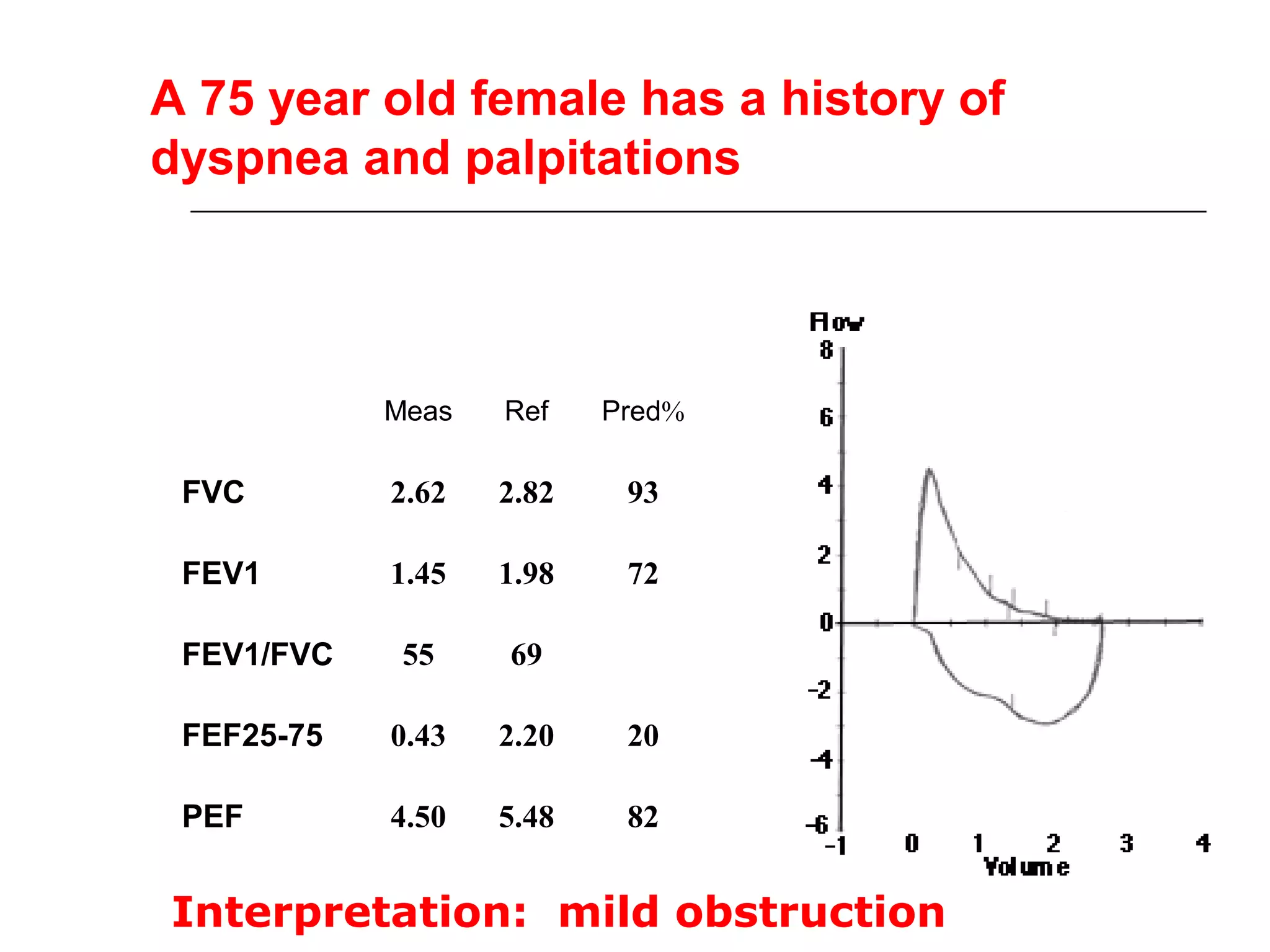
A 75 year old female has a history of 
dyspnea and palpitations 
Meas Ref Pred% 
FVC 2.62 2.82 93 
FEV1 1.45 1.98 72 
FEV1/FVC 55 69 
FEF25-75 0.43 2.20 20 
PEF 4.50 5.48 82 
Interpretation: mild obstruction
Interpretation: moderate obstruction
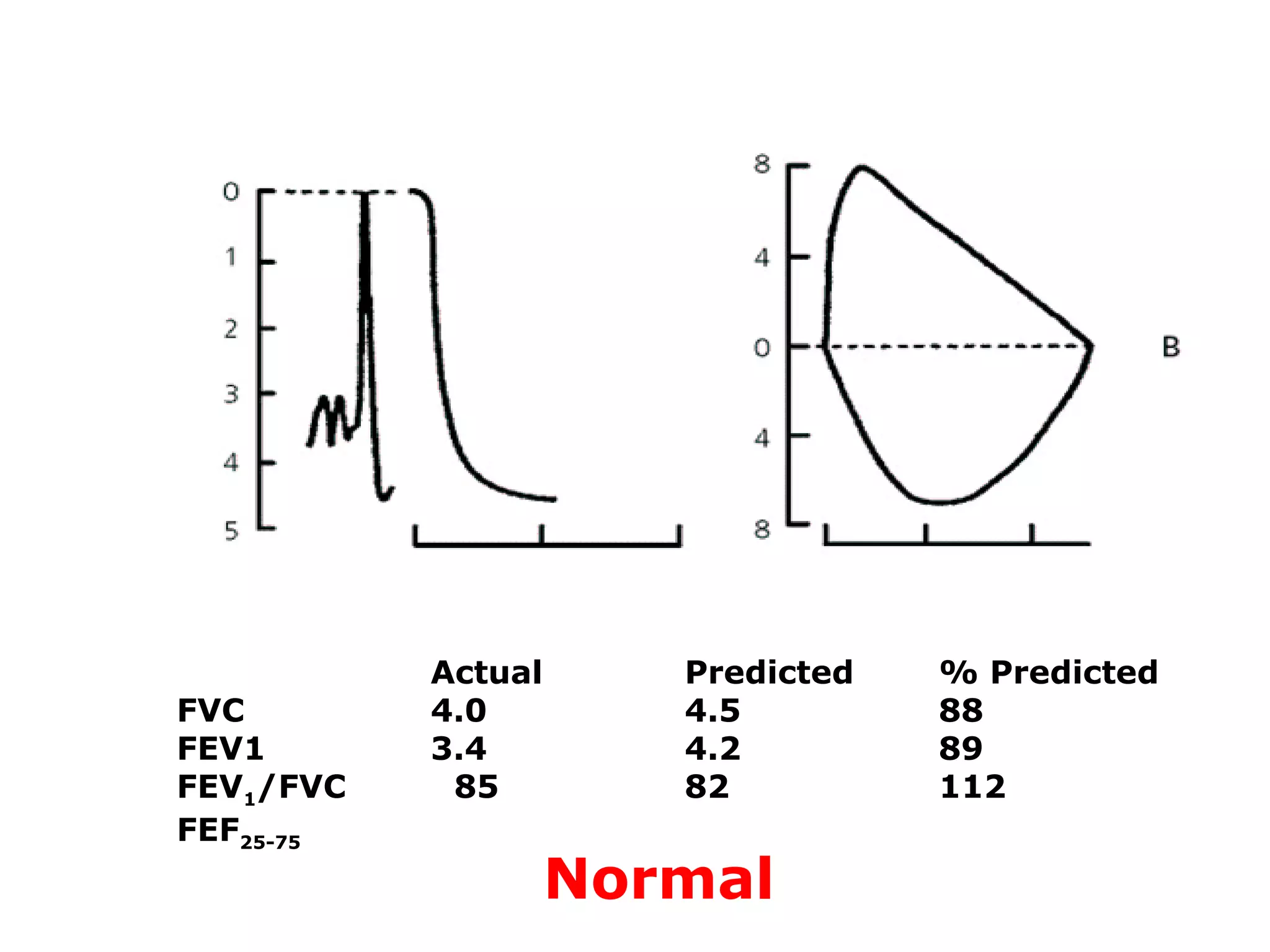
Actual Predicted % Predicted 
FVC 4.0 4.5 88 
FEV1 3.4 4.2 89 
FEV1/FVC 85 82 112 
FEF25-75 
Normal
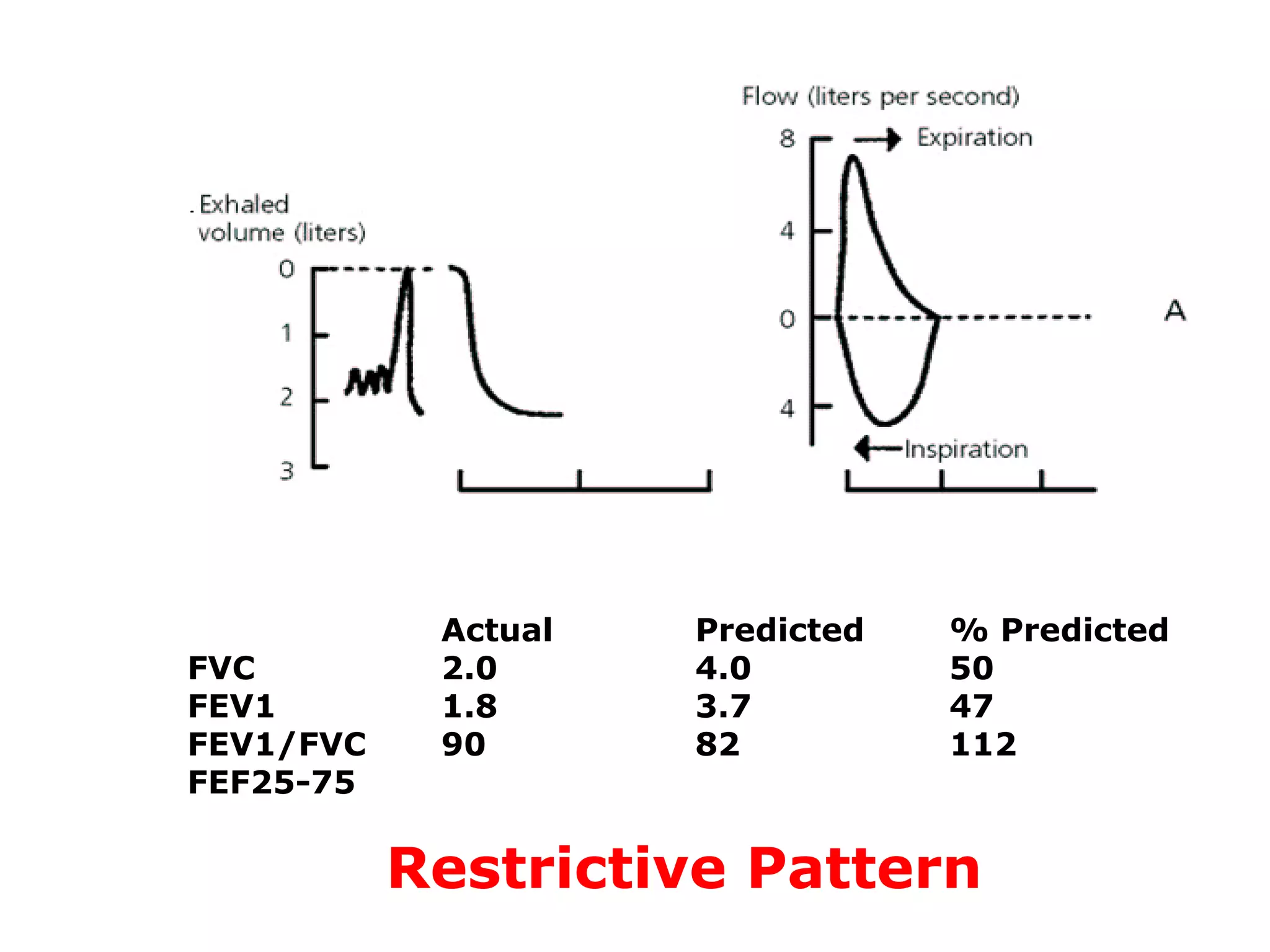
Actual Predicted % Predicted 
FVC 2.0 4.0 50 
FEV1 1.8 3.7 47 
FEV1/FVC 90 82 112 
FEF25-75 
Restrictive Pattern
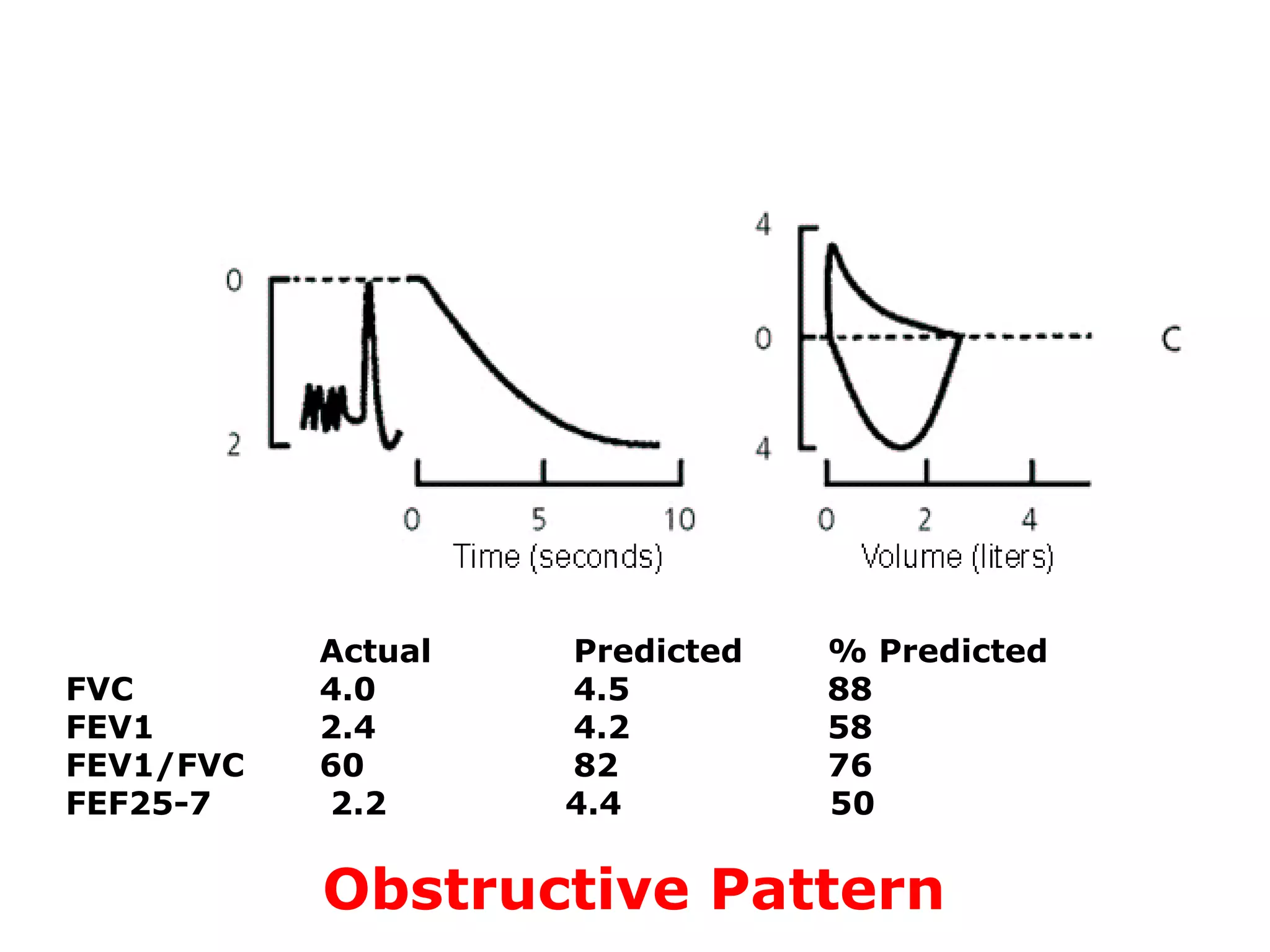
Actual Predicted % Predicted 
FVC 4.0 4.5 88 
FEV1 2.4 4.2 58 
FEV1/FVC 60 82 76 
FEF25-7 2.2 4.4 50 
Obstructive Pattern
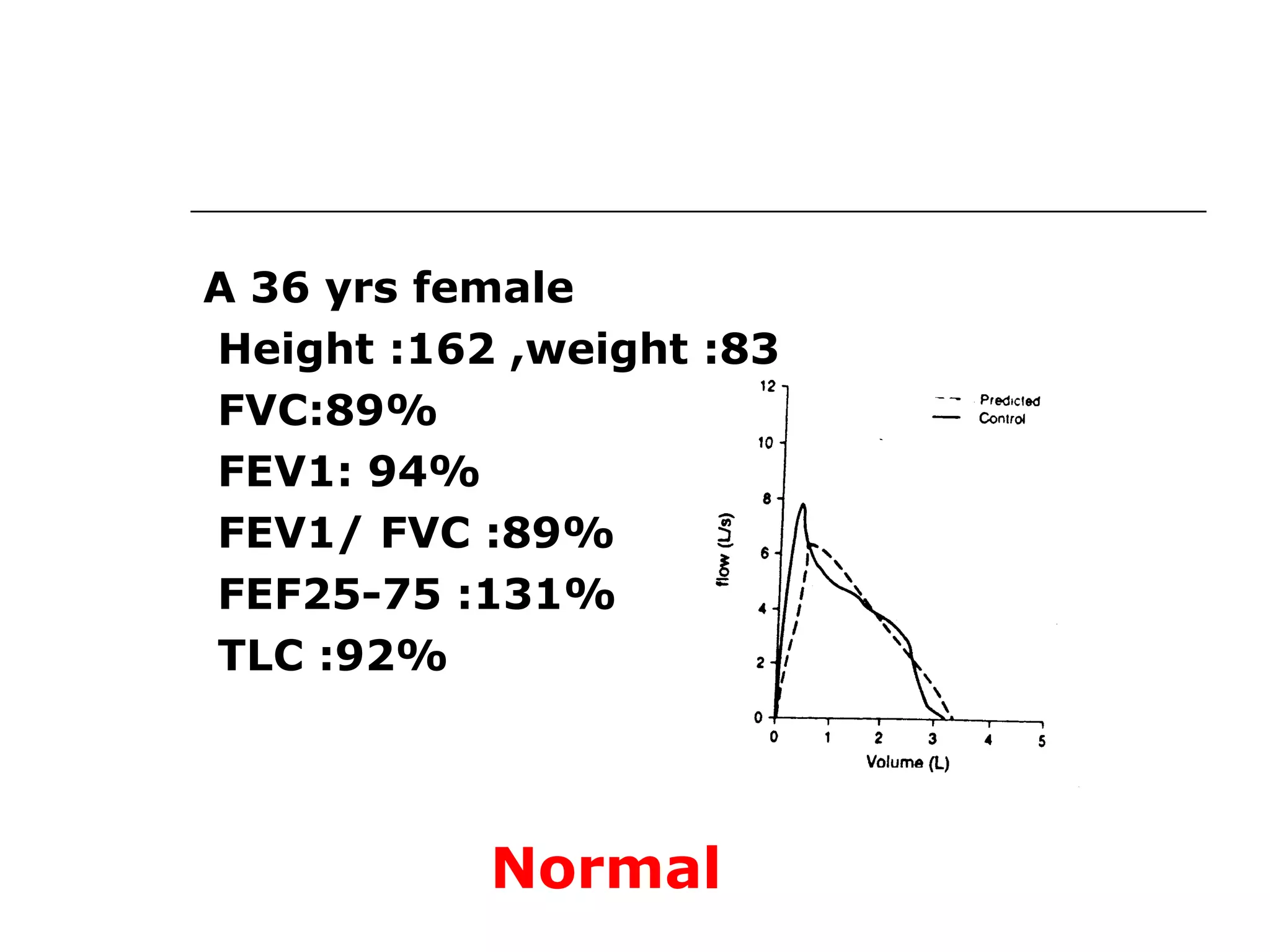
A 36 yrs female 
Height :162 ,weight :83 
FVC:89% 
FEV1: 94% 
FEV1/ FVC :89% 
FEF25-75 :131% 
TLC :92% 
Normal
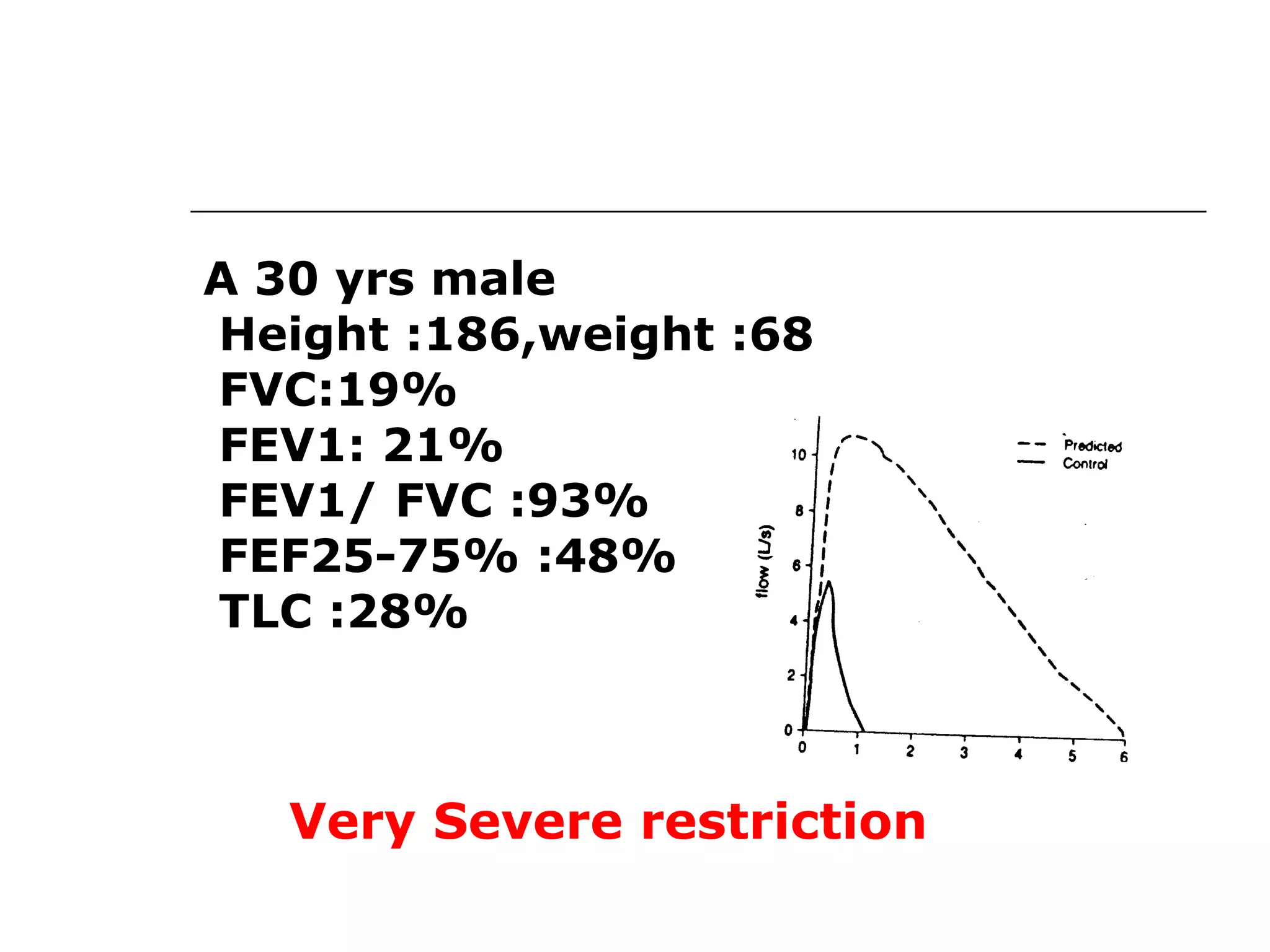
A 30 yrs male 
Height :186,weight :68 
FVC:19% 
FEV1: 21% 
FEV1/ FVC :93% 
FEF25-75% :48% 
TLC :28% 
Very Severe restriction
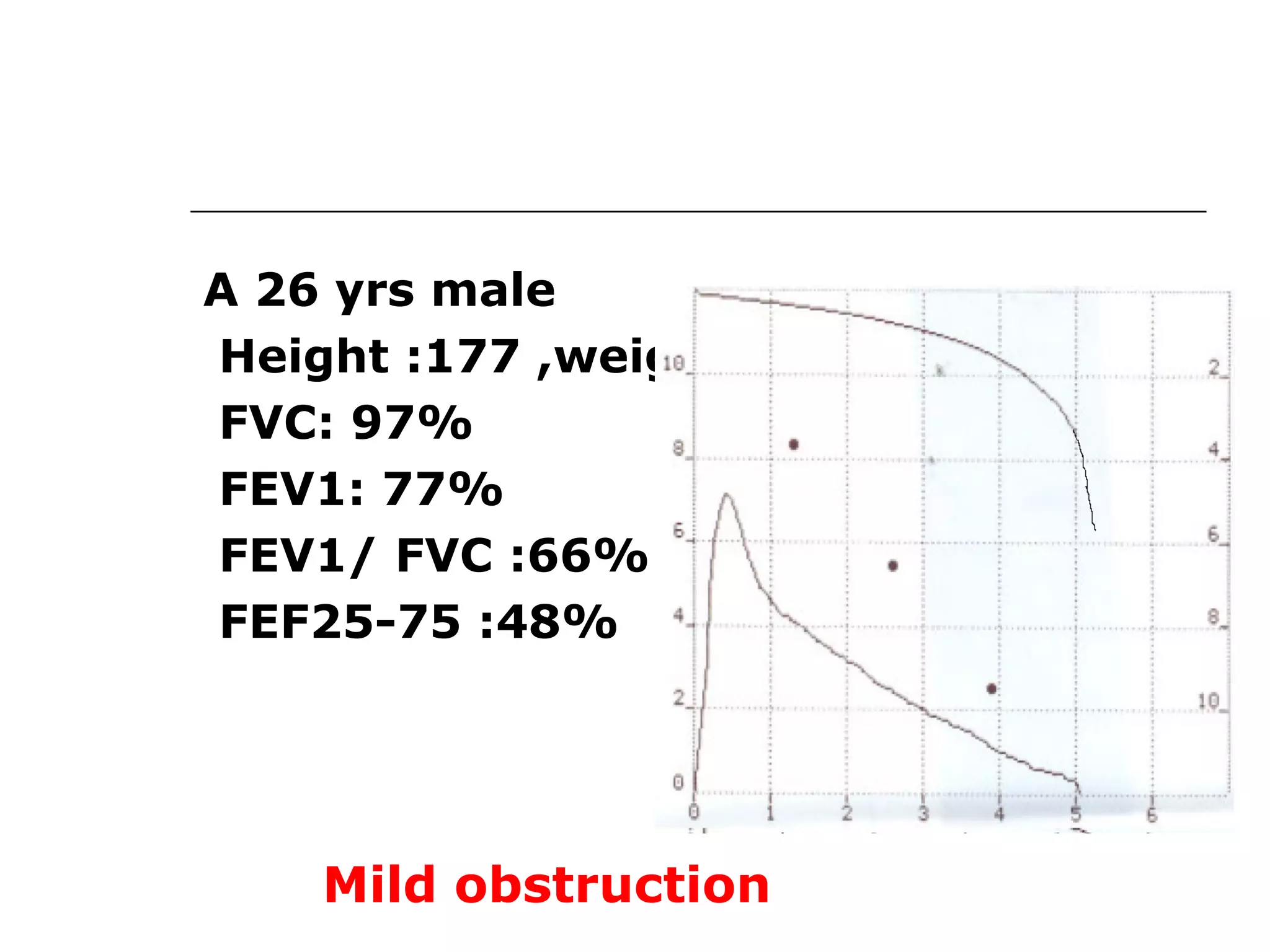
A 26 yrs male 
Height :177 ,weight :67 
FVC: 97% 
FEV1: 77% 
FEV1/ FVC :66% 
FEF25-75 :48% 
Mild obstruction
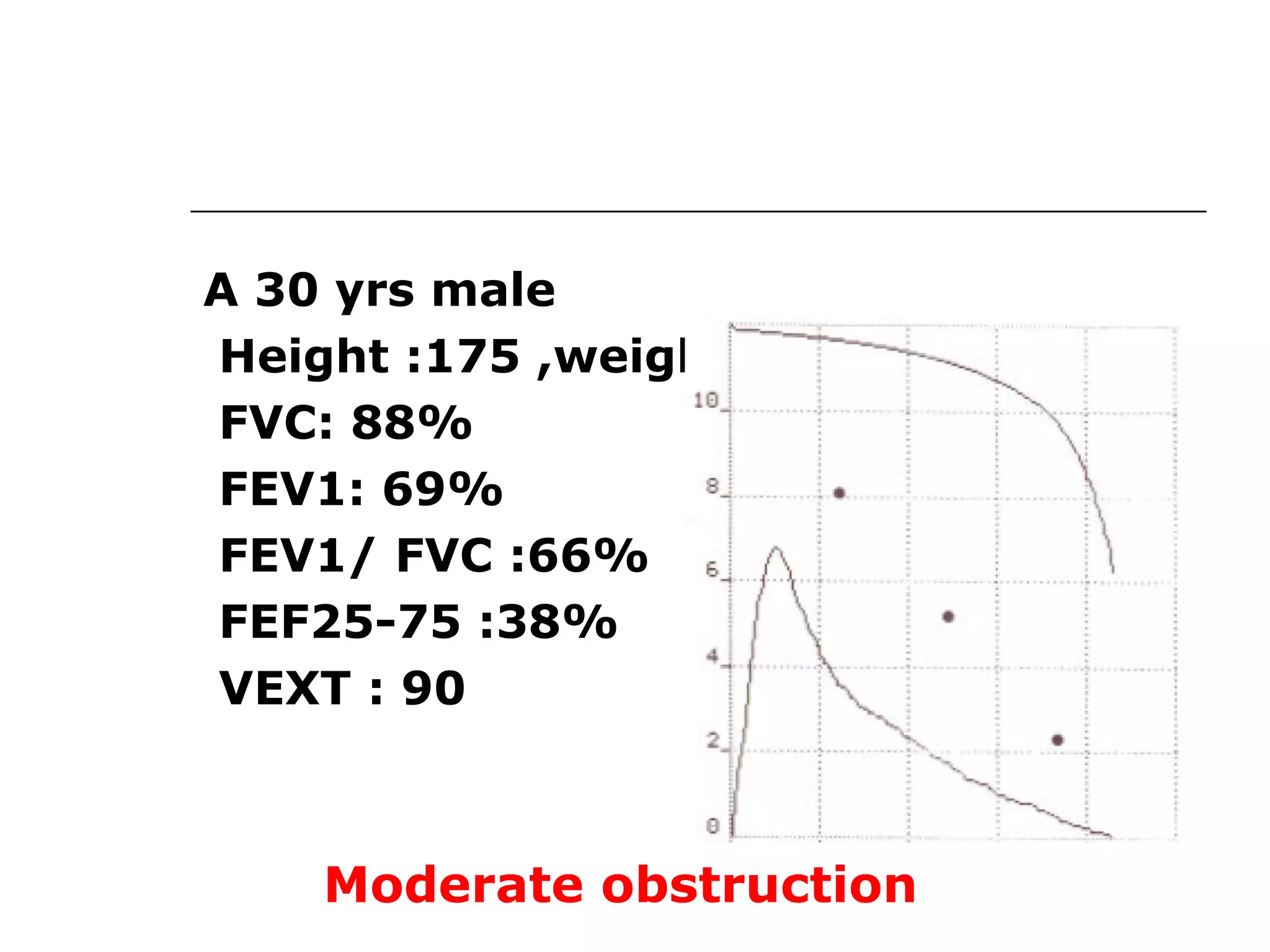
A 30 yrs male 
Height :175 ,weight :70 
FVC: 88% 
FEV1: 69% 
FEV1/ FVC :66% 
FEF25-75 :38% 
VEXT : 90 
Moderate obstruction
Case Study 1 
 A 53-year-old white male presents for 
annual visit. 
 Although he quit 10 years ago he is a 
previous cigarette smoker with a 20 
pack-year history. 
 During the past 12 months, he has had 
3 episodes of bronchitis. 
 His history of tobacco use and recent 
episodes of acute bronchitis lead you 
to perform spirometry.
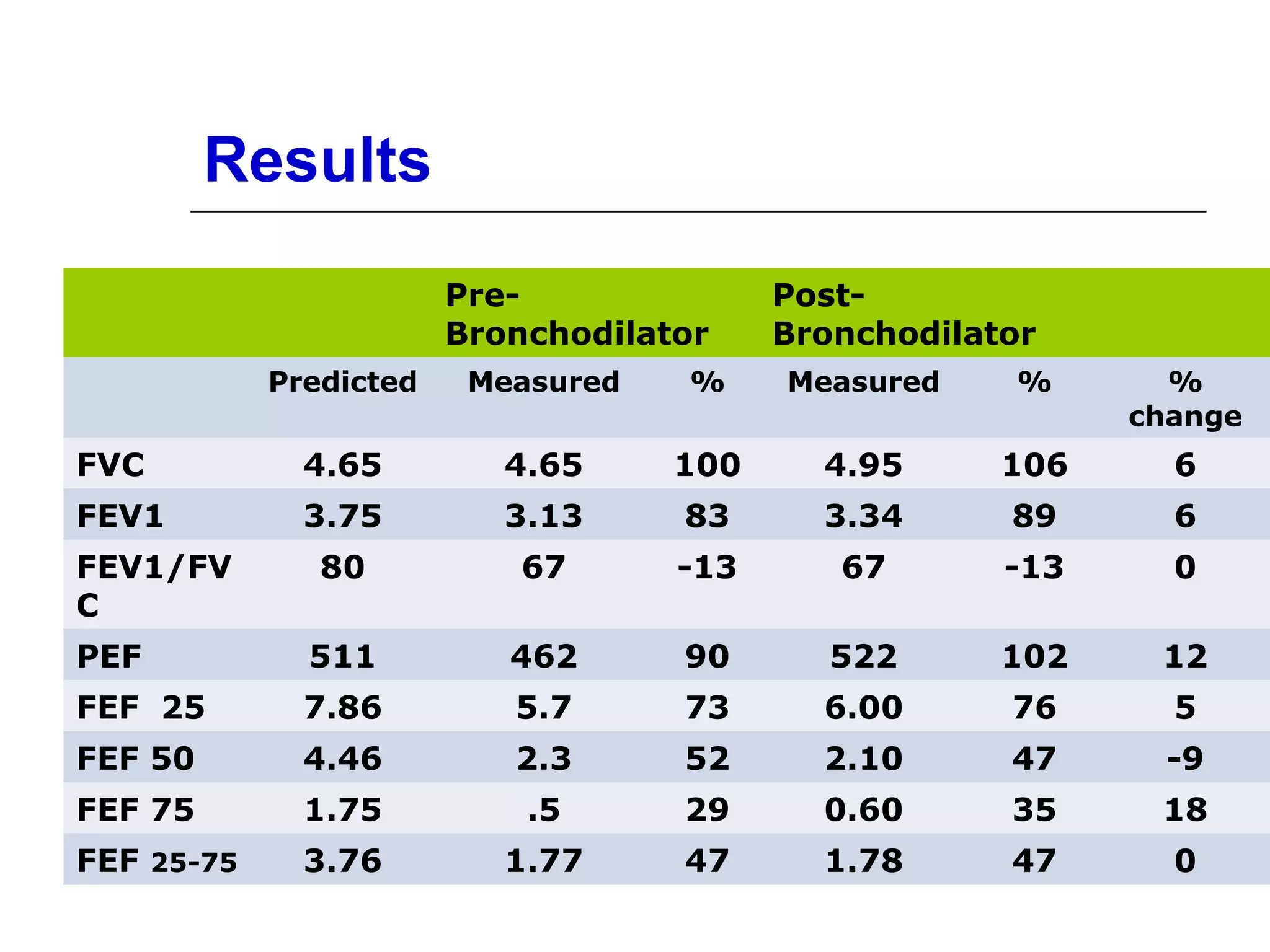
Results 
Pre- 
Bronchodilator 
Post- 
Bronchodilator 
Predicted Measured % Measured % % 
change 
FVC 4.65 4.65 100 4.95 106 6 
FEV1 3.75 3.13 83 3.34 89 6 
FEV1/FV 
80 67 -13 67 -13 0 
C 
PEF 511 462 90 522 102 12 
FEF 25 7.86 5.7 73 6.00 76 5 
FEF 50 4.46 2.3 52 2.10 47 -9 
FEF 75 1.75 .5 29 0.60 35 18 
FEF 25-75 3.76 1.77 47 1.78 47 0
Results 
Pre- 
Bronchodilator 
Post- 
Bronchodilator 
Predicted Measured % Measured % % 
change 
FVC 4.65 4.65 100 4.95 106 6 
FEV1 3.75 3.13 83 3.34 89 6 
FEV1/FVC 80 67 -13 67 -13 0 
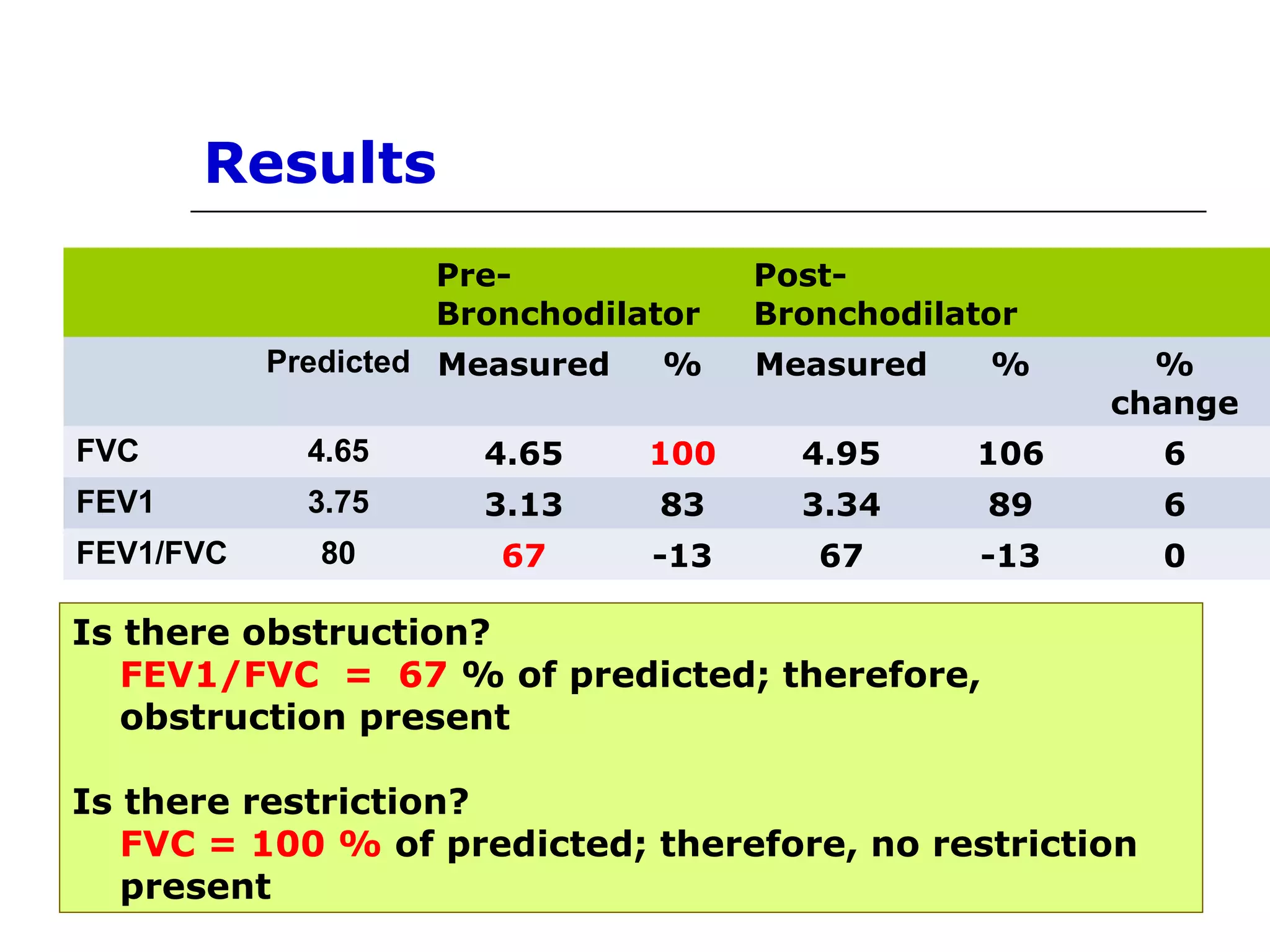
Is there obstruction? 
FEV1/FVC = 67 % of predicted; therefore, 
obstruction present 
Is there restriction? 
FVC = 100 % of predicted; therefore, no restriction 
present
Results 
Pre-Bronchodilator Post-Bronchodilator 
Predicte 
d 
Measured % Measured % % change 
FVC 4.65 4.65 100 4.95 106 6 
FEV1 3.75 3.13 83 3.34 89 6 
FEV1/FVC 80 67 -13 67 -13 0 
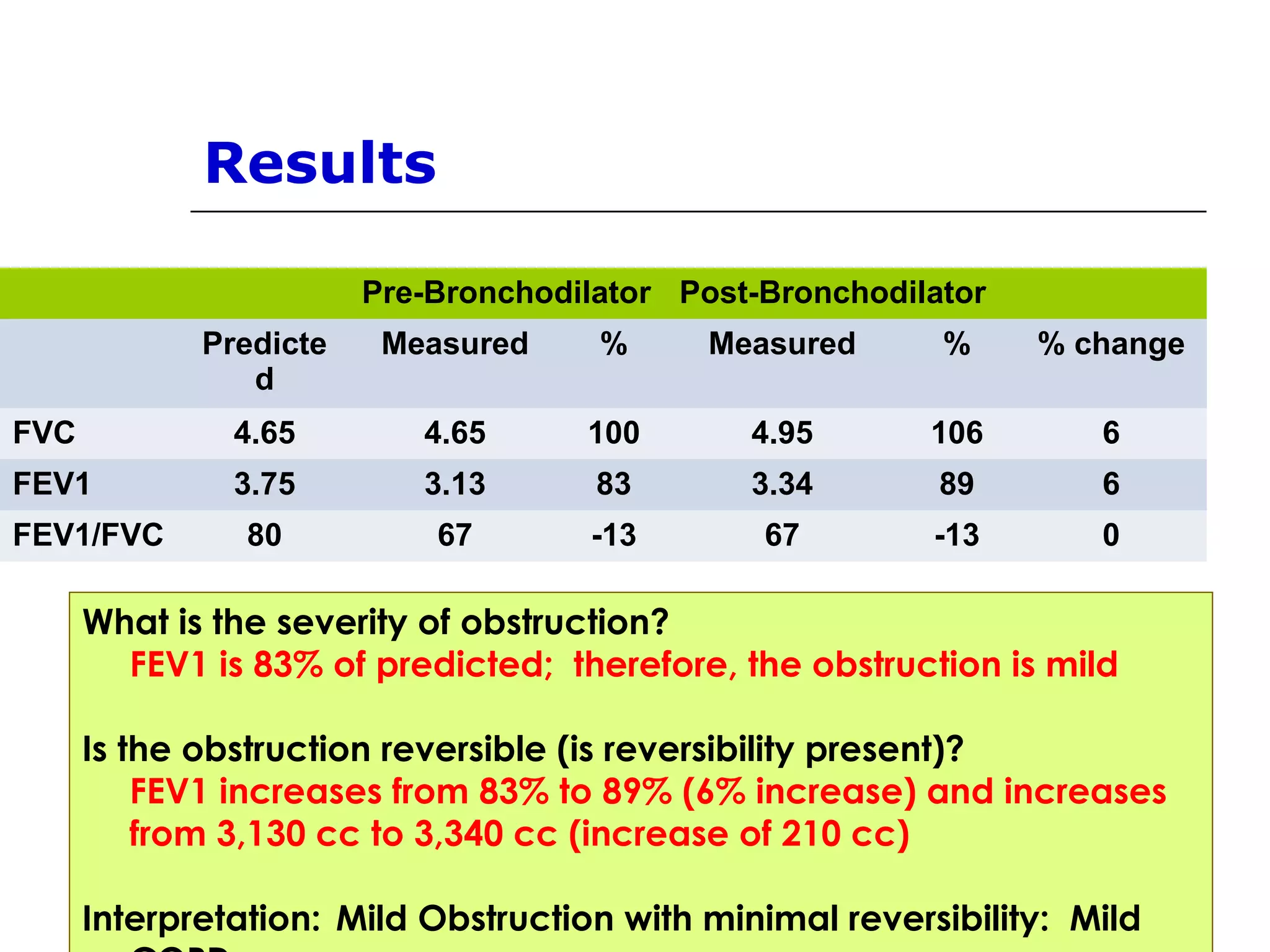
What is the severity of obstruction? 
FEV1 is 83% of predicted; therefore, the obstruction is mild 
Is the obstruction reversible (is reversibility present)? 
FEV1 increases from 83% to 89% (6% increase) and increases 
from 3,130 cc to 3,340 cc (increase of 210 cc) 
Interpretation: Mild Obstruction with minimal reversibility: Mild 
COPD
Case Study 2 
A 33 year old female presents to the office 
complaining of dyspnea and cough for the 
past 2 days. Her cough is productive of a 
white mucous. 
Her past medical history is significant for 
asthma since childhood, obesity, 
gastroesophageal reflux disease (GERD), 
and an occasional migraine headache. She 
is a nonsmoker and has no known 
allergies.
Case Study 2 (cont) 
Her current medications include the 
following: 
1. Albuterol 2 puffs po qid prn 
wheezing, cough, or dyspnea 
2. Fluticasone 110 micrograms 2 puffs 
po bid 
3. Ranitidine 150 mg po bid 
Her father recently died secondary to 
advanced COPD. 
Due to her symptoms, you order 
spirometry.
Results 
Pre-Bronchodilator Post-Bronchodilator 
Predicte 
d 
Measured % Measured % % change 
FVC 3.78 1.92 51 2.7 71 34 
FEV1 3.24 1.11 34 1.61 50 36 
FEV1/ FVC 86 58 -28 60 -26 3 
Obstruction? 
FEV1/FVC = 60%; therefore, obstruction present 
Restriction? 
FVC = 51% of predicted; therefore, restriction 
present
Results 
Pre-Bronchodilator Post-Bronchodilator 
Predicte 
d 
Measured % Measured % % change 
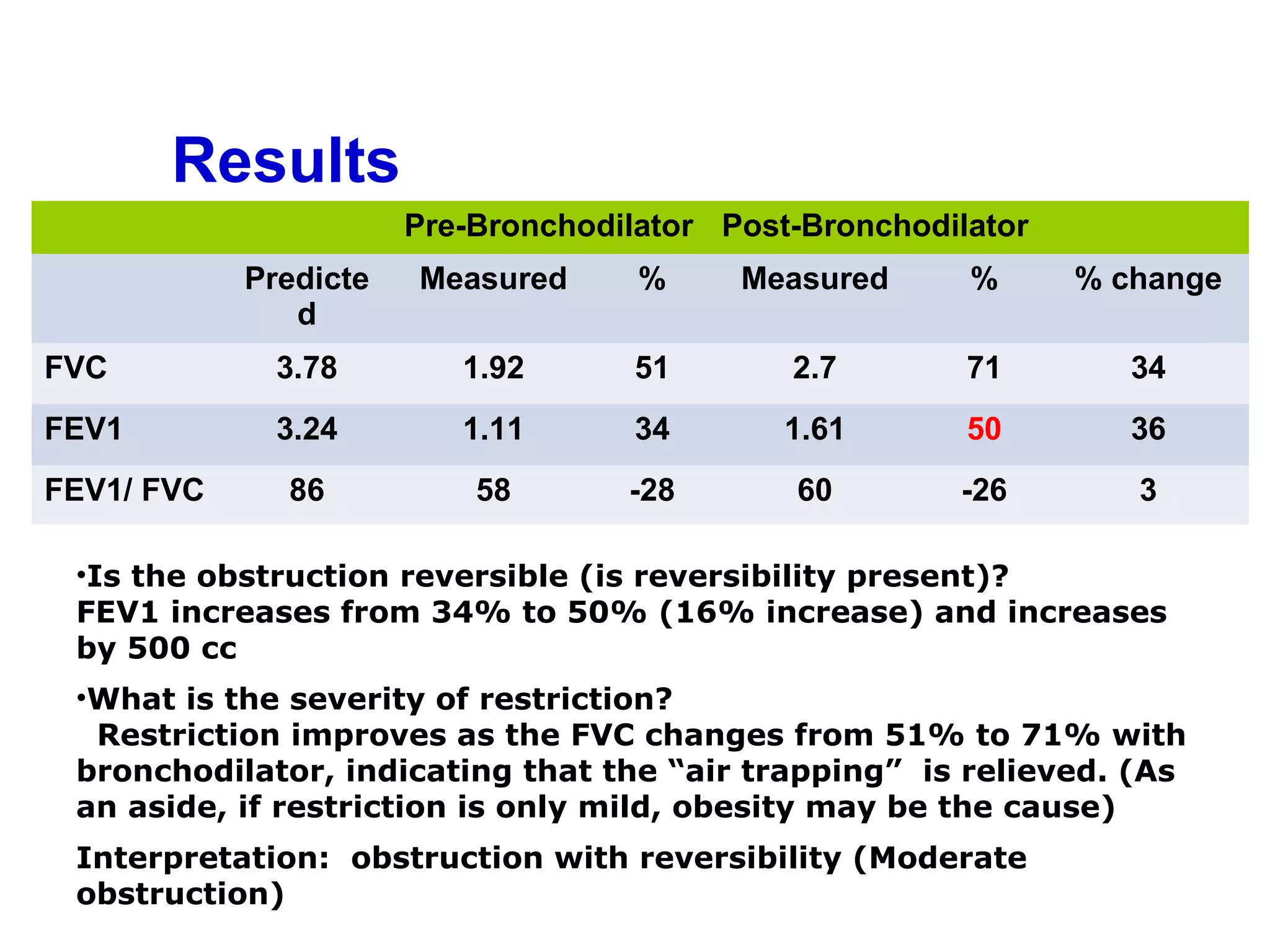
FVC 3.78 1.92 51 2.7 71 34 
FEV1 3.24 1.11 34 1.61 50 36 
FEV1/ FVC 86 58 -28 60 -26 3 
•Is the obstruction reversible (is reversibility present)? 
FEV1 increases from 34% to 50% (16% increase) and increases 
by 500 cc 
•What is the severity of restriction? 
Restriction improves as the FVC changes from 51% to 71% with 
bronchodilator, indicating that the “air trapping” is relieved. (As 
an aside, if restriction is only mild, obesity may be the cause) 
Interpretation: obstruction with reversibility (Moderate 
obstruction)

Spirometry Interpretation

  • 1.
  • 4.
    Data generated Volume time curve (spirogram)  FEV1, FVC, Ratio  Flow volume loop  Peak flow  FVC  FEF 25-75% MEF 75, 50, and 25  Inspiratory flow data
  • 5.
    Normal Values FVC  80 – 120% of predicted is a normal value  70 – 80% demonstrates mild reduction/restriction  50 – 70% demonstrates moderate reduction <50% demonstrates severe reduction
  • 6.
    Normal Values FEV1  80 – 120% of predicted is a normal value  70 – 80% demonstrates mild reduction/restriction  50 – 70% demonstrates moderate reduction <50% demonstrates severe reduction
  • 7.
    Normal Values FEF25-75 reflects small airway function ● >80% is normal ● 60 – 80% reflects mild obstruction in the small airways ● 40 – 60% reflects moderate obstruction ● <40% reflects severe obstruction
  • 8.
    Criteria for Normal Post-bronchodilator Spirometry  FEV1: % predicted > 80%  FVC: % predicted > 80%  FEV1/FVC: > 0.7 - 0.8, depending on age
  • 9.
    Obstructive Pattern oDecreased FEV1/FVC - <70% predicted o Decreased FEV1 < 80% predicted o FVC can be normal or reduced – usually to a lesser degree than FEV1 o FEV1 used to grade the severity
  • 10.
    Restrictive Pattern FEV1: Normal or mildly reduced  FVC: < 80% predicted  FEV1/FVC: Normal or increased > 0.7
  • 11.
    Mixed Obstructive/Restrictive FEV1: < 80% predicted  FVC: < 80% predicted  FEV1 /FVC: < 0.7
  • 12.
  • 13.
    Notes ➔ Spirometrywhich is not performed correctly may produce misleading results. ➔ The FEV1, FVC and FEV1/FVC ratio are all necessary to interpret spirometry. ➔ An obstructive defect causes a reduction in FEV1 and a reduced FEV1/FVC ratio. ➔ Restrictive defects cause a reduction in FVC with a normal or high FEV1/FVC ratio.
  • 14.
    Notes ➔ 12%and 200 mL or more improvement in either FEV1 or FVC after bronchodilator indicates significant reversibility. ➔ The FEV1/FVC ratio should not be used to assess reversibility. ➔ Correct interpretation of spirometry requires that it be performed correctly (ATS/ERS criteria for acceptable and repeatable Spirometry).
  • 15.
    To obtain anaccurate recording the subject should be told to: • Sit up straight • Get a good seal around the mouthpiece of the spirometer • Rapidly inhale maximally (‘breathe in all the way’) • Without delay, blow out as hard and as fast as possible (‘blast out’) • Continue to exhale (‘keep going … keep going’) until the patient can blow no more.
  • 16.
    Expiration should continuefor at least 6 seconds (3 seconds in children under 10 years old) and up to 15 seconds if necessary (some patients will find this exhausting and prolonged manoeuvres should be used with caution) Manoeuvres are repeated until at least three technically acceptable manoeuvres (NO coughs, air leaks, false starts) are completed.
  • 17.
    If required, moretests should be done to try to meet repeatability criteria (no more than 8 attempts in total). Poor measurement technique can produce results which mimic disease patterns. Common errors occur when the patient fails to inhale fully before the test, stops blowing too early (apparent restrictive defect), or doesn’t blow out hard enough (apparent obstructive defect).
  • 18.
    TECHNIQUE OF SPIROMETRY The patient must be clinically stable, should sit straight, with head erect, nose clip in place, and holding the mouthpiece tightly between the lips. Initially, he or she should breathe in and out at the tidal volume ( V T : normal quiet breathing) to record the tidal flow–volume loop. Then, when the patient is ready, the technician instructs him/her to inhale maximally to TLC , and then exhale as fast and as completely as possible to record the FVC .
  • 19.
    TECHNIQUE OF SPIROMETRY The point at which no more air can be exhaled is the RV . The patient is then instructed to inhale fully to TLC again in order to record the IVC . This test is then repeated to ensure reproducibility in order to meet quality control criteria (American Thoracic Society or ATS criteria) .
  • 20.
    Flow/Volume loop 12 8 4 0 -4 -8 Flow (L/s) PEF Man 176 cm 76 kg Volume (L)
  • 21.
    ATS/ERS criteria foracceptable and repeatable Spirometry ACCEPTABILITY CRITERIA 1.Free from artefacts (such as cough or glottis closure early in expiration) 2.Free from leaks 3.Good starts — extrapolation back from the peak flow (which is the steepest part of the spirogram curve) produces a theoretical start time from which the measurements should be timed. This ‘new time zero’ should occur within 5% of the FVC or within 150 mL
  • 22.
    ATS/ERS criteria foracceptable and repeatable Spirometry Acceptability Criteria Acceptable exhalation — Adults: at least 6 seconds of exhalation and a plateau in the volume curve (plateau = no detectable change in volume over 1 second) — Children aged under 10: at least 3 seconds of exhalation and a plateau in the volume curve
  • 23.
    Acceptability The ATSmandates three acceptable maneuvers. The number of trials that can be performed on an individual should not exceed 8. An acceptable trial should have a good start, a good end, and absence of artifacts. 1. Good start of the test: • If the study needs back extrapolation, the extrapolation volume should not exceed 5% of FVC or 150 ml, whichever is larger.
  • 24.
    Note : Backextrapolation applies to the VT curve and means that if the start of the test is not optimal, correction can be made by shifting the time axis forward, provided that the extrapolation volume is within either one of the limits mentioned earlier. To simplify this, consider that a patient’s FVC is 2 L and the study requires a back extrapolation correction, and 5% of the FVC (2 L) is 100 ml. Because 150 ml is larger than 5% of the patient’s FVC (100 ml), 150 ml should be used as the upper limit of extrapolated volume. Then, if the measured extrapolated volume is greater than 150 ml, the result cannot be accepted.
  • 25.
    Extrapolation volume of150 ml or 5% of FVC (whichever is larger)
  • 26.
    Note : Agood start of the study can be identified qualitatively on the FV curve as a rapid rise of flow to PEF from the baseline (0 point), with the PEF being sharp and rounded. The FEV 1 can be over- or underestimated with submaximal effort, which may mimic lung disorders such as those due to airway obstruction or lung restriction;
  • 27.
    2. Smooth flow–volume(FV) curve, free of artifacts : These artifacts will show in both volume–time (VT) and FV curves but will be more pronounced in the FV curve. These artifacts include the following: (a) Cough during the 1st second of exhalation may significantly affect FEV 1 . The FV curve is sensitive in detecting this artifact; Coughing after the 1st second is less likely to make a significant difference in the FVC and so it is accepted provided that it does not distort the shape of the FV curve (judged by the technician).
  • 28.
    (a) Cough duringthe 1st second of exhalation may significantly affect FEV 1 . Cough in the 1st second. It is much clearer in the FV curve than in the VT curve as indicated by the arrows
  • 29.
  • 30.
    (c) Glottis closure; (d) Early termination of effort. (e) Obstructed mouthpiece, by applying the tongue through the mouthpiece or biting it with the teeth. (f) Air leak : • The air leak source could be due to loose tube connections or, more commonly, because the patient weakly applies lips around the mouthpiece. Air leak can be detected from the FV loop
  • 31.
    3. Good endof the test (demonstrated in the VT curve): (a) Plateau of VT curve of at least 1 s, i.e.volume is not changing much with time indicating that the patient is approaching the residual volume (RV). OR (b) Reasonable duration of effort (FET) : • Six seconds is the minimum accepted duration (3 s for children) . • Ten seconds is the optimal. .
  • 32.
    • FET of>15 s is unlikely to change the clinical decision and may result in the patient’s exhaustion. Patients with obstructive disorders can exhale for more than 40 s before reaching their RV, i.e., before reaching a plateau in the VT Curve Normal individuals, however, can empty their lung (i.e., reach a plateau) within 4 s
  • 33.
    (c) The patientcannot or should not continue to exhale. Note : A good end of the study can be shown in the FV curve as an upward concavity at the end of the curve. A downward concavity, however, indicates that the patient either stopped exhaling (prematurely) or started inhaling before reaching the RV . This poor technique may result in underestimation of the FVC.
  • 34.
    Poor end incomparison to good end (small upward concavity) of FV curve. A poor end (downward concavity) indicates premature termination of exhalation (before 0 flow)
  • 38.
    ATS/ERS criteria foracceptable and repeatable Spirometry REPEATABILITY CRITERIA • Three acceptable manoeuvres (meeting above criteria) • The two largest FVC measurements within 150mL of each other • The two largest FEV1 measurements within 150mL of each other When both acceptability and repeatability criteria are met, the test can be concluded. Up to 8 manoeuvres should be performed until the criteria are met or the patient is unable to continue. As a minimum, the three satisfactory (or best) manoeuvres should be saved.
  • 39.
    Reproducibility After obtainingthree acceptable maneuvers, the following reproducibility criteria should be applied: – The two largest values of FVC must be within 150 ml of each other. – The two largest values of FEV 1 must be within 150 ml of each other. If the studies are not reproducible, then the studies should be repeated until the ATS criteria are met or a total of eight trials are completed or the patient either cannot or should not continue testing.
  • 40.
    • The finalvalues should be chosen based on the following : – FEV1 and FVC should be reported as the highest values from any acceptable/reproducible trial (not necessarily from the same trial). – The other flow parameters should be taken from the best test curve (which is the curve with the highest sum of FVC + FEV1). – If reproducibility cannot be achieved after eight trials, the best test curve (the highest acceptable trial) should be reported. The technician should comment on this deviation from protocol so that the interpreting physician understands that the results may not be accurate. .
  • 41.
  • 42.
    Acceptable trials arenot necessarily reproducible,because the patient may not produce maximum effort in all trials
  • 43.
    Keep in mindthat the lack of any of these features may indicate a lung disorder rather than a poor study
  • 44.
    Spirometry interpretation Obstructive v. Restrictive  Mid flow obstruction  Shape of the FV loop Obstruction v. restriction  Fixed large airway obstruction  Variable airway obstruction 1. Extrathoracic 2. Intrathoracic
  • 45.
    Key Notes 1.be conservative in suggesting a specific diagnosis based only on pulmonary function abnormalities. 2. Interpret borderline normal values with caution. 3. First step = to evaluate and comment on the quality of the tests.
  • 46.
    Good Measurements areEssential! Acceptable Loop Unacceptable Loop
  • 47.
  • 48.
  • 49.
    Quality Check Patientshould exhale suddenly and forced. Patient should exhale suddenly and forced Patient should cough before starting the measurement Patient should inhale longer and to the maximum Patient should exhale as long as possible; minimal 6 s www.spiro-webCard.de
  • 50.
  • 51.
  • 52.
  • 53.
  • 54.
  • 55.
  • 57.
  • 58.
     The standardnormal values roughly range from 80 to 120% of the predicted values that are derived from Caucasian studies.  When you interpret a PFT, you should always look at the patient’s results as percentage of the predicted values for that particular patient (written in the report as % pred.).  If the patient is normal, then his/her values should roughly lie within 80–120% of predicted values.*
  • 59.
    59 Obstructive Lungdis. RLD Interinsic RLD Extrinsic FEV1 FVC FEV1/FVC RV TLC RV/TLC VC FRC
  • 61.
    ● Only needto look at 5 numbers ● Look at the post bronchodilator values too! FEV1 % Predicted FVC % Predicted FER (FEV1 / FVC ratio)
  • 62.
    Features of obstructivedisorders  Diagnostic features: ↓ FEV 1 /FVC ratio  Other features:  ↓ FEV 1  ↓ FVC (can be normal)  ↓ FEFs and MMEF (FEF 25 , FEF 50, FEF 75 , FEF 25–75 )  ↓ PEF  ↓ FET  Significant bronchodilator response  Scooped (concave) descending limb of FV curve
  • 63.
    Obstructive Disorders The two major obstructive disorders are bronchial asthma and COPD .  The key to the diagnosis of these disorders is the drop in FEV 1 /FVC ratio.   FEV 1 may be reduced too and is used to define the severity of obstruction  FVC may be reduced in obstructive disorders but usually not to the same degree as FEV 1 .
  • 64.
    Obstructive Disorders The flow–volume curve can be used alone to confidently make the diagnosis of obstructive disorders, as it has a distinct shape in such disordersThese features include the following: – The height of the curve (PEF) is much less than predicted. – The descending limb is concave (scooped), with the outward concavity being more pronounced with more severe obstruction. – The slope of the descending limb that represents MMEF and FEFs is reduced due to airflow limitation at low lung volumes.
  • 66.
    Obstructive Disorders Thereare five features that make the diagnosis of a significant airway obstruction definite, based on The FV curve alone. 1 – Decreased PEF when compared to the predicted curve. 2 – Scooping of the curve after PEF, indicating airflow limitation. 3 – The 1st second mark is almost in the middle of the curve indicating that the FEV 1 and FEV 1 /FVC ratio are significantly decreased.
  • 67.
    Obstructive Disorders 4– FVC is decreased when compared to the predicted curve. 5 – The inspiratory component of the curve is normal, excluding a central airway obstruction. ( b ) There is a clear response to bronchodilators indicating reversibility and supporting the diagnosis of an obstructive disorder, most likely bronchial asthma
  • 68.
     Lack ofbronchodilator response does not exclude bronchial asthma as responsiveness can vary over time.  Similarly many patients with COPD can show reversibility.  Reversibility in the correct clinical context (i.e. young nonsmoker) supports the diagnosis of asthma.
  • 69.
    • Special Conditions – In mild (or early) airway obstruction, the classic reduction in FEV1 and FEV1/FVC ratio may not be seen. – The morphology of the FV curve can give a clue, as the distal upward concavity may show to be more pronounced and prolonged – Another clue is the prolonged FET evident in the VT curve
  • 70.
    Mild airway obstruction,with prolonged duration of exhalation (20 s)
  • 71.
    • Special Conditions – In emphysema and because of loss of supportive tissues, the airways tend to collapse significantly at low lung volumes, giving a characteristic “dog-leg” appearance in FV curve
  • 73.
    Features of restrictivedisorders  Most important features: ↓ FVC and normal or ↑ FEV 1 /FVC ratio  Other features:  ↓ FEV 1 (proportional to FVC), but it can be normal  ↓ MMEF  PEF: normal, increased, or decreased  Steep descending limb of FV curve
  • 74.
    Restrictive Disorders In restrictive disorders, such as pulmonary fibrosis, the key to the diagnosis is the drop in FVC, as the volume of the air spaces is significantly lower than normal.   The lung elasticity increases and the lungs retract.  The FEV 1 /FVC ratio has to be preserved or increased.
  • 75.
     To makea confident diagnosis of a restrictive disorder, the TLC should be measured and should be low.  So, based on spirometry alone, the earlier features are reported as suggestive (not diagnostic) of a restrictive disorder.  Remember that normal FVC or VC excludes lung restriction.
  • 76.
    FV curve featuresof different forms of restriction: ( a ) ILD with witch’s hat appearance; ( b ) chest wall restriction (excluding NMD);
  • 77.
    FV curve featuresof different forms of restriction: ( c ) NMD (or poor effort study) producing a convex curve
  • 79.
    This is awidely used grading system but different organizations use different systems of grading.
  • 80.
    GRADING OF SEVERITY  Different variables and values were used to grade severity of different pulmonary disorders  Recently, FEV 1 has been selected to grade severity of any spirometric abnormality (obstructive, restrictive, or mixed)  The traditional way of grading severity of obstructive and restrictive disorders involve the following:
  • 81.
    GRADING OF SEVERITY  The traditional way of grading severity of obstructive and restrictive disorders involve the following: – In obstructive disorders, the FEV1/FVC ratio should be <0.7, and – The value of FEV1 is used to determine severity
  • 82.
    GRADING OF SEVERITY – In restrictive disorders, however, FEV1/FVC ratio is normal and the TLC is less than 80% predicted. – The ATS suggested using the TLC to grade the severity of restrictive disorders, which cannot be measured in simple spirometry. – Where only spirometry is available, FVC may be used to make that grading. – The TLC, however, should be known before confidently diagnosing a restrictive disorder
  • 83.
    Nomogram algorithm for separating obstructive from restrictive defects Nomogram algorithm for separating obstructive from restrictive defects
  • 84.
    Spirometry interpretation InhaledB2 reverse 11/13/14 FEV1/FVC Obstruction Mixed* * FVCต้อง ตำ่ำ FVC Normal Mixed Restriction* FEF25-75% Small airway disease Normal spirometry Reversible airway obstruction Irreversible airway obstruction Low Low Low Normal Yes No Normal or Increase * Definite Dx ดู TLC
  • 85.
  • 86.
  • 87.
    Diagnostic Flow Diagramfor Restriction Is FEV1 / FVC Ratio Low? (<70%) Is FVC Low?(<80% pred) Yes No Restrictive Defect Normal Spirometry Further Testing with Full PFT’s; consider referral if moderate to severe No Adapted from Lowry, 1998
  • 88.
    Diagnostic Flow Diagramfor Obstruction Obstructive Defect Is FVC Low? (<80% pred) Combined Obstruction & Restriction /or Hyperinflation No Yes Pure Obstruction Improved FVC with ß-agonist Reversible Obstruction with ß-agonist Further Testing with Full PFT’s Suspect Asthma Suspect COPD Is FEV1 / FVC Ratio Low? (<70%) Yes Yes No Yes No Adapted from Lowry.
  • 89.
    Nomogram algorithm for separating obstructive from restrictive defects Nomogram algorithm for separating obstructive from restrictive defects
  • 90.
    90 American familyphysican 2004
  • 92.
  • 93.
     Know the3 aspects of lung function test: 1) spirometry 2) volumes 3) diffusion
  • 94.
    Normal values Spirometry:  FEV1 and FVC >80% predicted.  FEV1/FVC >80% predicted. Volumes: 80-120%. Diffusion: 75-125%.
  • 95.
     Low FVCsuggest possible restriction but need to look at TLC to confirm (TLC <80%)  High FRC and TLC (>120% predicted) suggest hyperinflation.  High RV/TLC suggest gas trapping.
  • 96.
    Case (1) FEV1/FVC: 48%  FVC: 3.24L (86%)  FEV1: 1.55L (48%)  FEF25-75%: 0.64L (28%)
  • 97.
    Case (1) FEV1/FVC: 48% Severely ↓  FVC: 3.24L (86%) Normal  FEV1: 1.55L (48%) Severely ↓  FEF25-75%: 0.64L (28%) Severely ↓  Interpretation: Moderate obstruction
  • 98.
    Case (2) FEV1/FVC: 59%  FVC: 2.27L (71%)  FEV1: 1.34L (49%)  FEF25-75%: 0.95L (22%)
  • 99.
    Case (2) FEV1/FVC: 59% Moderately ↓  FVC: 2.27L (71%) Mildly ↓  FEV1: 1.34L (49%) Severely ↓  FEF25-75%: 0.95L (22%) Severely ↓  Interpretation: Moderate obstructive impairment, FVC mildly reduced, can not rule out restrictive impairment
  • 100.
    Case (3) FEV1/FVC: 86%  FVC: 2.49 L (61%)  FEV1: 1.96 L (64%)  FEF25-75%: 2.83 L (98%)  FRC: 1.94 L (59%)  TLC: 4.03 L (70%)  RV: 1.38 L (65%)  DLCO: 55% Interpretation: Moderate Restrictive pattern with moderately reduced DLCO
  • 101.
    Case (4) FEV1/FVC: 56%  FVC: 2.54 (68%)  FEV1: 1.41 (49%)  DLCO: 68%
  • 102.
    Case (4) FEV1/FVC: 56% Moderately ↓  FVC: 2.54 (68%) Mildly ↓  FEV1: 1.41 (49%) Severely ↓  DLCO: 68% Mildly ↓  Interpretation: Severe obstruction, maybe restrictive, reduced DLCO
  • 103.
    Male 57 years,182 cm, 78 kg Pred. best % (B/P) FVC 4.86 4.92 101 FEV1 3.68 3.74 102 FEV1/FVC% 77 76 99 FEF25/75 3.44 3.10 88 Normal
  • 104.
    Male 18 years,168 cm, 61 kg Pred. best % (B/P) FVC 3.71 3.51 95.1 FEV1 3.12 2.35 75.3 FEV1/FVC% 83,8 62.2 74.4 FEF25/75 4.31 1.8 41 Mild obstruction with small airway affection
  • 105.
    Male 54 years,178 cm, 92 kg Pred. best % (B/P) FVC 4.60 3.25 78 FEV1 3.55 0.76 22 FEV1/FVC% 77 22 29 FEF25/75 3.51 0.22 6.1 Severe obstruction with small airway affection
  • 106.
    Male 59 years,170 cm, 82 kg Pred. best % (B/P) FVC 4.10 1.45 33 FEV1 3.25 3.10 96 FEV1/FVC% 83 Severe restriction
  • 107.
    A 71 yrsmale Height :175 ,weight :88 FVC:45% FEV1: 31% FEV1/ FVC :53% FEF25-75 :15% TLC :142% Very Severe obstruction
  • 108.
    Meas Ref Pred% FVC 2.2 2.58 85 FEV1 1.79 1.85 97 FEV1/FVC 81 72 FEF 25-75 1.82 2.23 82 PEF 5.67 5.2 109 Normal
  • 109.
    A 75 yearold female has a history of dyspnea and palpitations Meas Ref Pred% FVC 2.62 2.82 93 FEV1 1.45 1.98 72 FEV1/FVC 55 69 FEF25-75 0.43 2.20 20 PEF 4.50 5.48 82 Interpretation: mild obstruction
  • 111.
  • 113.
    Actual Predicted %Predicted FVC 4.0 4.5 88 FEV1 3.4 4.2 89 FEV1/FVC 85 82 112 FEF25-75 Normal
  • 114.
    Actual Predicted %Predicted FVC 2.0 4.0 50 FEV1 1.8 3.7 47 FEV1/FVC 90 82 112 FEF25-75 Restrictive Pattern
  • 115.
    Actual Predicted %Predicted FVC 4.0 4.5 88 FEV1 2.4 4.2 58 FEV1/FVC 60 82 76 FEF25-7 2.2 4.4 50 Obstructive Pattern
  • 116.
    A 36 yrsfemale Height :162 ,weight :83 FVC:89% FEV1: 94% FEV1/ FVC :89% FEF25-75 :131% TLC :92% Normal
  • 117.
    A 30 yrsmale Height :186,weight :68 FVC:19% FEV1: 21% FEV1/ FVC :93% FEF25-75% :48% TLC :28% Very Severe restriction
  • 118.
    A 26 yrsmale Height :177 ,weight :67 FVC: 97% FEV1: 77% FEV1/ FVC :66% FEF25-75 :48% Mild obstruction
  • 119.
    A 30 yrsmale Height :175 ,weight :70 FVC: 88% FEV1: 69% FEV1/ FVC :66% FEF25-75 :38% VEXT : 90 Moderate obstruction
  • 120.
    Case Study 1  A 53-year-old white male presents for annual visit.  Although he quit 10 years ago he is a previous cigarette smoker with a 20 pack-year history.  During the past 12 months, he has had 3 episodes of bronchitis.  His history of tobacco use and recent episodes of acute bronchitis lead you to perform spirometry.
  • 121.
    Results Pre- Bronchodilator Post- Bronchodilator Predicted Measured % Measured % % change FVC 4.65 4.65 100 4.95 106 6 FEV1 3.75 3.13 83 3.34 89 6 FEV1/FV 80 67 -13 67 -13 0 C PEF 511 462 90 522 102 12 FEF 25 7.86 5.7 73 6.00 76 5 FEF 50 4.46 2.3 52 2.10 47 -9 FEF 75 1.75 .5 29 0.60 35 18 FEF 25-75 3.76 1.77 47 1.78 47 0
  • 122.
    Results Pre- Bronchodilator Post- Bronchodilator Predicted Measured % Measured % % change FVC 4.65 4.65 100 4.95 106 6 FEV1 3.75 3.13 83 3.34 89 6 FEV1/FVC 80 67 -13 67 -13 0 Is there obstruction? FEV1/FVC = 67 % of predicted; therefore, obstruction present Is there restriction? FVC = 100 % of predicted; therefore, no restriction present
  • 123.
    Results Pre-Bronchodilator Post-Bronchodilator Predicte d Measured % Measured % % change FVC 4.65 4.65 100 4.95 106 6 FEV1 3.75 3.13 83 3.34 89 6 FEV1/FVC 80 67 -13 67 -13 0 What is the severity of obstruction? FEV1 is 83% of predicted; therefore, the obstruction is mild Is the obstruction reversible (is reversibility present)? FEV1 increases from 83% to 89% (6% increase) and increases from 3,130 cc to 3,340 cc (increase of 210 cc) Interpretation: Mild Obstruction with minimal reversibility: Mild COPD
  • 124.
    Case Study 2 A 33 year old female presents to the office complaining of dyspnea and cough for the past 2 days. Her cough is productive of a white mucous. Her past medical history is significant for asthma since childhood, obesity, gastroesophageal reflux disease (GERD), and an occasional migraine headache. She is a nonsmoker and has no known allergies.
  • 125.
    Case Study 2(cont) Her current medications include the following: 1. Albuterol 2 puffs po qid prn wheezing, cough, or dyspnea 2. Fluticasone 110 micrograms 2 puffs po bid 3. Ranitidine 150 mg po bid Her father recently died secondary to advanced COPD. Due to her symptoms, you order spirometry.
  • 126.
    Results Pre-Bronchodilator Post-Bronchodilator Predicte d Measured % Measured % % change FVC 3.78 1.92 51 2.7 71 34 FEV1 3.24 1.11 34 1.61 50 36 FEV1/ FVC 86 58 -28 60 -26 3 Obstruction? FEV1/FVC = 60%; therefore, obstruction present Restriction? FVC = 51% of predicted; therefore, restriction present
  • 127.
    Results Pre-Bronchodilator Post-Bronchodilator Predicte d Measured % Measured % % change FVC 3.78 1.92 51 2.7 71 34 FEV1 3.24 1.11 34 1.61 50 36 FEV1/ FVC 86 58 -28 60 -26 3 •Is the obstruction reversible (is reversibility present)? FEV1 increases from 34% to 50% (16% increase) and increases by 500 cc •What is the severity of restriction? Restriction improves as the FVC changes from 51% to 71% with bronchodilator, indicating that the “air trapping” is relieved. (As an aside, if restriction is only mild, obesity may be the cause) Interpretation: obstruction with reversibility (Moderate obstruction)

Editor's Notes

  • #10 Image source: http://www.spirxpert.com/index.html FEV1 is decreased out of proportion to FVC, which causes the ratio to decrease as well.
  • #88 Restrictive patterns are not nearly as common in primary care as obstructive patterns. Therefore, a normal FEV1/FVC ratio with a low FVC leads to a diagnosis of restrictive abnormality. While a mild defect may only represent poor conditioning or obesity, a moderate to severe defect requires further pulmonary function testing with CO diffusion and lung volume measurement. Restrictive lung diseases are uncommon and may signify a serious underlying disease (i.e. pulmonary fibrosis). Spirometry results consistent with restrictive lung disease may require a referral to a pulmonologist. Lowry, 1998
  • #89 The obstructive pattern noted on the previous slides comprise a majority of results in primary care. If the FVC is normal (that is, greater than 80% of predicted), then pure obstruction is present. Generally, if the obstruction shows a significant reversal with a bronchodilator (&amp;gt;12% or &amp;gt;200ml improvement), then the diagnosis is asthma. If there is no significant change in the post-bronchodilator measurement, then the diagnosis is COPD. If the FEV1/FVC ratio is reduced and the FVC is low, then a combined defect is present and needs further review. A patient with significant air-trapping and hyperinflation will have a reduced FVC. Thus, a patient with severe asthma may have a combined defect that will greatly improve with bronchodilator. A lack of response to a bronchodilator requires further investigation with full pulmonary function testing that includes CO diffusion and lung volume measurements. Lowry, 1998
  • #109 Normal
  • #121 This case study will assist in the interpretation of spirometry testing.
  • #122 In the usual spirometry report, the number of values provided may cause confusion in interpretation. The following slide will present the values with the most clinical importance.
  • #123 The three numbers highlighted in red provide the most clinical information: The FEV1/FVC ratio is 67% indicating obstruction. FVC is 100% indicating no restriction. The FEV1 is 83% of predicted with no significant reversibility. Interpretation: Mild Obstruction Ferguson, 2000
  • #124 The further interpretation of the results indicate the mild obstruction present has minimal reversibility due to the finding that the FEV1 increases from 83% to 89% (6% increase) and increases from 3,130 cc to 3,340 cc (increase of 210 cc) Based upon the results of this spirometry test, the patient is motivated to make lifestyle changes. He is a woodworker and he wears a mask protection all the time now and has much improved ventilation in the workplace and avoids second-hand smoke and other irritants. Ferguson, 2000
  • #125 This patient has been known to you for several years and is often considered the most severe asthmatic in your practice.
  • #127 The results of this test provide the following information: Obstruction persists after bronchodilator treatment Restriction improves after “air trapping” relieved by bronchodilator
  • #128 Upon further review, the following information is noted: Obstruction present and persists after bronchodilation so some component of “minimally reversible airways disease” is present. Restriction improves as the FVC changes from 51% to 71% with bronchodilator, indicating that the “air trapping” is relieved. (As an aside, if restriction is only mild, obesity may be the cause) The significant reversibility indicates that both asthma and COPD are present. After treatment with an inhaled corticosteroids and repeat spirometry in three months, all of the “air trapping” and even reversibility may be gone. As she is young in age, an underlying hereditary condition (i.e. alpha-1-antitrypsin deficiency) may be present Therefore, you diagnose asthma and COPD. You order alpha-1-antitrypsin testing and will repeat spirometry in 3 months.