LUNG VOLUME
REDUCTION SURGERY
(L V R S)
Presenter- Dr.Jyotindra Singh
NIZAMS INSTITUTE ,HYDERABAD
LVRS BACKGROUND
Lung volume reduction surgery (LVRS), or reduction pneumoplasty
(also referred to as lung shaving or lung contouring), is performed on
patients with severe emphysema in order to allow the remaining
compressed lung to expand and thus improve respiratory function.
 In advanced stages of emphysema there is a sequence of events
that start with hyperinflation, followed by a reduction in
diaphragmatic mobility, an increase in resting pleural pressures that
intensifies expiratory muscle recruitment and reduces elastic recoil of
the lungs.
The medical treatment of this condition includes bronchodilators,
costicosteroids, oxygen and the management of exacerbations and
infections but it does not impact on survival
LVRS BACKGROUND
The current options for the surgical treatment are surgical ablation
of bulous disease (bullectomy), lung volume reduction surgery (LVRS)
and lung transplantation.
Dr. Brantigan in 1957 was the first person to
present the concept of LVRS.
His concept, based on
“Under normal circumstances, the elasticity
of expanded lung is transmitted to the small
airways which held opened by
circumferential elastic pull”
He proposed
“Resection of the most useless area and
Down sizing the lung would help to restore
the outward pull
on the small airway”
LVRS BACKGROUND
 Several decades later – Delarue and Dahan - unilateral
thoracotomy approach - pulmonary haemodynamics.
 1991 – Wakabayashi-unilateral parenchymal laser ablation
by thoracoscopic approach.
In 1995, Cooper and Associate a modification of
Brantigan’s volume reduction operation,in which lung tissue
was resected from both lungs via median sternotomy.
In 2001, Cooper and associate report 6 cases of endobronchial
bypass procedure by creating extra-anatomic broncho-pulmonary
passage and placing a stent. His concern? How long the stent stay
open.
LVRS BACKGROUND
This was followed by randomized studies that demonstrated
functional benefits and acceptable mortality in patients with low
exercise capacity and upper lobe predominant heterogeneous disease
(Ciccone, Meyers et al. 2003).
 NETT RESEARCH GROUP
Carried between January 1998 and July 2002
17hospitals, data coordinating center JHSPH
Patients randomized to medical or surgery treatment
Secondary end points included quality of life, pulmonary function,
6-min walk distance
N Engl J Med 2001
What is Emphysema?
 Permanent abnormal
enlargement of the acini
 Destruction of alveolar
walls without obvious
fibrosis
(
Specifically, two things combined:
Two kinds of emphysema
EMPHYSEMA TYPES
Primary emphysema
 1-2% of cases
 Inherited lack of alpha-1
antitrypsin, a protective
protein (inhibits neutrophil
elastase)
Secondary emphysema
 Also caused by inability to
inhibit proteolytic enzymes
in the lungs
 From inhaled toxins (e.g.,
cigarette smoke)
 20% of smokers at risk
Wayne McLaren…Former
Marlboro Man
Age 30…a robust young man
Age 51…riding into the sunset
Bullous Emphesyma CENTRIACINAR EMPHYSEMA
[
“Bullae are large dilated airspaces that
bulge out from beneath the pleura.”
Respiratory bronchioles in proximal portion of
acinus are lost
Alveoli distal to terminal bronchiole intact
Occurs in smokers with chronic bronchitis
Usually in upper lobes
PRINCIPLE
 1. VENTILATION/PERFUSION MISMATCH
Patients with end-stage emphysema have distended airspaces; these
may be inadequately ventilated.
These distended airspaces may continue to expand and compress
adjacent, well-perfused alveoli, which then become similarly
dysfunctional.
Resection of such damaged lung would remove some component of
the ventilation/perfusion mismatch and potentially allow reexpansion
of adjacent alveoli
PRINCIPLE -2
AIRWAY RESISTANCE
The combination of the loss of the
driving force of elastic recoil and the
reduced tethering effect leads to
closure of terminal bronchioles earlier
in the expiratory cycle than what
would normally occur.
Over time, these forces result in
increased airway resistance and
hyperinflation of the lung.
LVR entails resection of hyperinflated
and nonfunctional lung
PRINCIPE -3
Loss of elastic recol
Expansion of rib cage
and flattening the
diaphragm
Increase
resting volume
Inefficient
respiratory muscle
Increase
work of breathing
Dyspnea
CHEST WALL & DIAPHRAGM
Chest Wall and Diaphraghm
 Excision of nonfunctional hyperinflated lung
will lead to a smaller overall lung volume.
This provides the opportunity for the chest wall to
shrink down to a less hyperexpanded position and the
diaphragm to resume its more dome-like appearance.
Theoretically this return of the chest wall and diaphragm
to their more normal shape and position will restore some
of the functional capacity and muscular strength, leading
to greater volumes of air movement throughout
the respiratory cycle
Chest radiographs obtained at TLC and FRC in one patient before (Pre-op) and
at 6 months and 12 months after LVRS. Top six views: anteroposterior views.
HAEMODYNAMICS LVR would theoretically decrease the
size of the lung within the chest cavity
and, by decreasing airway resistance,
would lead to a lowering of the
intrathoracic pressure throughout the
respiratory cycle.
 It might therefore improve venous
return, decrease pulmonary vascular
resistance, and thus improve right heart
output and overall cardiac index.
 This was in part the pathophysiologic
mechanism for improvement promoted
by DeLarue13 and Dahan
 LVR
 Decrease size of lung within
chest cavity
 lowering of intrathoracic
pressure
 Improve venous return,decrease
PVR
 Improve right heart output
&cardiac index
Hemodynamics
PRE OPERATIVE ASSESMENT
CHEST X RAY
HRCT scan
Quantitative V/Q scan
Lung-volume measurement/ PFT
Maximal exercise testing-6-minute walk test
(140 m)
 CARDIOVASCULAR WORKUP
CHEST X RAY
 Marked HYPER
INFLATED lungs is noted
with flattend and low
diaphragm
 Intercostal space
becomes widen
 A horizontal pattern of ribs
 A long thin heart shadow
 Decreased markings of
lung peripheral vessels
. (A) Preoperative plain chest radiographs reveal marked emphysematous
changes with bullae over the apical zones of both lungs that were more
predominant on the right.
(B) A follow-up chest radiograph 3 months after surgery shows a less flattened
diaphragm and apparent lung marking over the right upper lung zone.
CT SCAN
Document the presence of emphysema
Rule out the presence of infiltrative processes/ occult lung
cancer
Presence of solitary nodule undetected on X- RAY
HRCT – whether Emphysema is homogenous or heterogenous
Upper lobe predominant or lower lobe predominant
Three major types of emphysema distribution were defined: markedly heterogeneous (upper panel),
intermediately heterogeneous (middle panel), and homogeneous (lower panel).
HRCT shows diffuse emphysematous changes over both lungs, with bulla formation that predominates over
both upper lung zones, indicating vanishing tissue in the upper lungs.
(D) HRCT taken three months after surgery shows an apparent disappearance of bullae with more
pronounced vasculature in the right lung but with little change to the left lung.
Ventillation & Perfusion
scintigrams
 significant lack of
perfusion in the upper
lobes
 Persistent retention of
gas in same region
 Indicates heterogenous
disease with severe
involvement in upper
lobe
Lung perfusion single positron emission computed tomography scan showing underperfused areas
(darkened zones) in the right lower lobe lateral basal segment and in the anterior segment of the left upper
lobe.
PULMONARY FUNCTION TEST
 Optimal candidates are those with severe obstructive
disease (forced expiratory volume in one second [FEV1]
<40% predicted) without a significant restrictive component
or reversible bronchoconstriction.
 Plethysmography must demonstrate significantly increased
total lung capacity (TLC) >120% predicted as well as
elevated residual volume (RV) >150% predicted.
 Initial testing also includes determination of resting arterial
blood gases (PO2 and PCO2). The diffusing capacity (DLCO)
is also measured and, proves to be an important parameter
that can occasionally contraindicate surgical intervention.
 Ideally, patients who are candidates for LVR have a PO2
>60, a PCO2 <55 mm Hg, and a DLCO >20% predicted.
Pulmonary function test
The BODE score
Four factors predict increased risk of death:
 BODY MASS INDEX
 The degree of airflow obstruction (FEV1)
 Dyspnea
 Exercise tolerance (6 MW distance)
-------------------------------------------------------
 Patients with higher BODE score - are at higher risk of death
 BODE index has a stronger ability to discriminate the probability of
survival among patients than FEV1
 The BODE score predicts hospitalization better than FEV1
Computation of the BODE score
Variable Points on BODE Index
0 1 2 3
FEV1
% predicted
> 65 50-64 36-49 <35
6MW distance m >350 250-349 150-249 < 149
MRC dyspnea
scale
0-1 2 3 4
BMI > 21 < 21
CARDIO VASCULAR WORK UP
 Doppler echocardiography is routinely used to rule out significant
cardiomyopathy and valvular heart disease.
Early in the clinical experience, Doppler echocardiography was
utilized to try to identify those patients with pulmonary hypertension,
because such patients were felt to have an elevated risk of mortality.
 However, Fisher and coworkers documented relatively mediocre
sensitivity (60%) and specificity (74%) when echocardiography was
utilized in this fashion.
Patients in whom pulmonary hypertension is suspected on the basis
of signs, symptoms or radiographic findings should therefore undergo
right heart catheterization to determine whether pulmonary pressures
contraindicate LVR
PATIENT SELECTION
NOT ALL PATIENTS BENEFIT FROM
LVRS
Severe emphysema not reversible by
medical treatment.
Poor exercise performance.
Marked hyperinflation.
Indication :
Patient selection
The National Emphysema Treatment Trial (NETT) was a prospective, randomized,
multicenter trial which compared the results of LVRS to medical therapy which
showed that there were 3 groups of patients that tend to benefit from LVRS
Group 1: Patients with predominantly upper lobe emphysema and low exercise
capacity. These patients have improved survival and functional outcomes after
LVRS compared to medical therapy.
Group 2: Patients with predominantly upper lobe emphysema and high exercise
capacity. These patients have improved functional outcomes after LVRS but no
difference in survival compared to medical therapy.
Group 3: Patients with non-upper lobe emphysema and low exercise capacity.
These patients have improved survival after LVRS but no difference in survival
compared to medical therapy.
INCLUSION CRITERIA
History and physical examination;
BMI ≤31.1 kg/m2 (men) or ≤32.3 kg/m2 (women) at randomization; stable on ≤20 mg
prednisone (or equivalent) daily
 Radiographic HRCT scan evidence of bilateral emphysema
 Pulmonary function (pre-rehabilitation) FEV1≤45% predicted (≥15% predicted if ≥70 years);
 TLC ≥100% predicted; RV ≥150% predicted
 Arterial blood gas (pre-rehabilitation) PCO2 ≤60 mm Hg (Denver: PCO2≤55 mm
Hg) PO2 ≥45 mm Hg (Denver: PO2 ≥30 mm Hg) on room air
 Cardiac assessment Approval for surgery before randomization by cardiologist if any of
the following are present: unstable angina; LVEF cannot be estimated from the echocardiogram; LVEF
≤45%; dobutamine-radionuclide cardiac scan indicates coronary artery disease or ventricular dysfunction;
arrhythmia (≥5 PVCs per minute; cardiac rhythm, other than sinus; PACs at rest)
INCLUSION CRITERIA Surgical assessment Approval for surgery by pulmonary physician, thoracic
surgeon, and anesthesiologist after rehabilitation and before randomization
Exercise Post-rehabilitation 6-minute walk ≥140 meters; able to complete 3
minutes of unloaded pedaling in exercise tolerance test (before and after
rehabilitation)
 Consent Signed consent forms for screening, rehabilitation, and randomization
 Smoking Plasma cotinine ≤13.7 ng/mL (or arterial carboxyhemoglobin ≤2.5% if
using nicotine products); nonsmoking for 4 months before initial interview and
throughout screening
 Rehabiliation -Must complete pre-randomization assessments, rehabilitation
program, and all post-rehabilitation and randomization assessments
Exclusionary Criteria
 Previous operation Lung transplantation; LVRS; median sternotomy or lobectomy
 Cardiovascular Arrhythmia that might pose a risk during exercise or training; resting bradycardia (<50
beats/min); frequent multifocal PVCs; complex ventricular arrhythmia; sustained SVT; history of exercise-
related syncope; MI within 6 months and LVEF <45%; congestive heart failure within 6 months and LVEF
<45%; uncontrolled hypertension (systolic >200 mm Hg, diastolic >110 mg Hg)
 Pulmonary History of recurrent infections with clinically significant sputum production; pleural or interstitial
disease that precludes surgery; clinically significant bronchiectasis; pulmonary nodule necessitating
surgery; giant bulla (greater than one third the volume of the lung); pulmonary hypertension; peak systolic
PPA ≥45 mm Hg (≥50 mm Hg in Denver) or mean PPA ≥35 mm Hg (≥38 mm Hg in Denver); (right heart
catheterization is required to rule out pulmonary hypertension if peak systolic PPA on echocardiogram ≥
45 mm Hg); requirement for ≥ 6 L oxygen to keep saturation 90% or greater with exercise
 Radiographic CT evidence for diffuse emphysema judged unsuitable for LVRS
 General Unplanned weight loss of <10% usual weight in 90 days before enrollment; evidence of systemic
disease or neoplasia expected to compromise survival during 5-year period; 6-minute walk distance ≤140
meters after rehabilitation; any disease or condition that interferes with completion of initial or follow-up
assessments; unwillingness or inability to complete screening or baseline data collection procedures
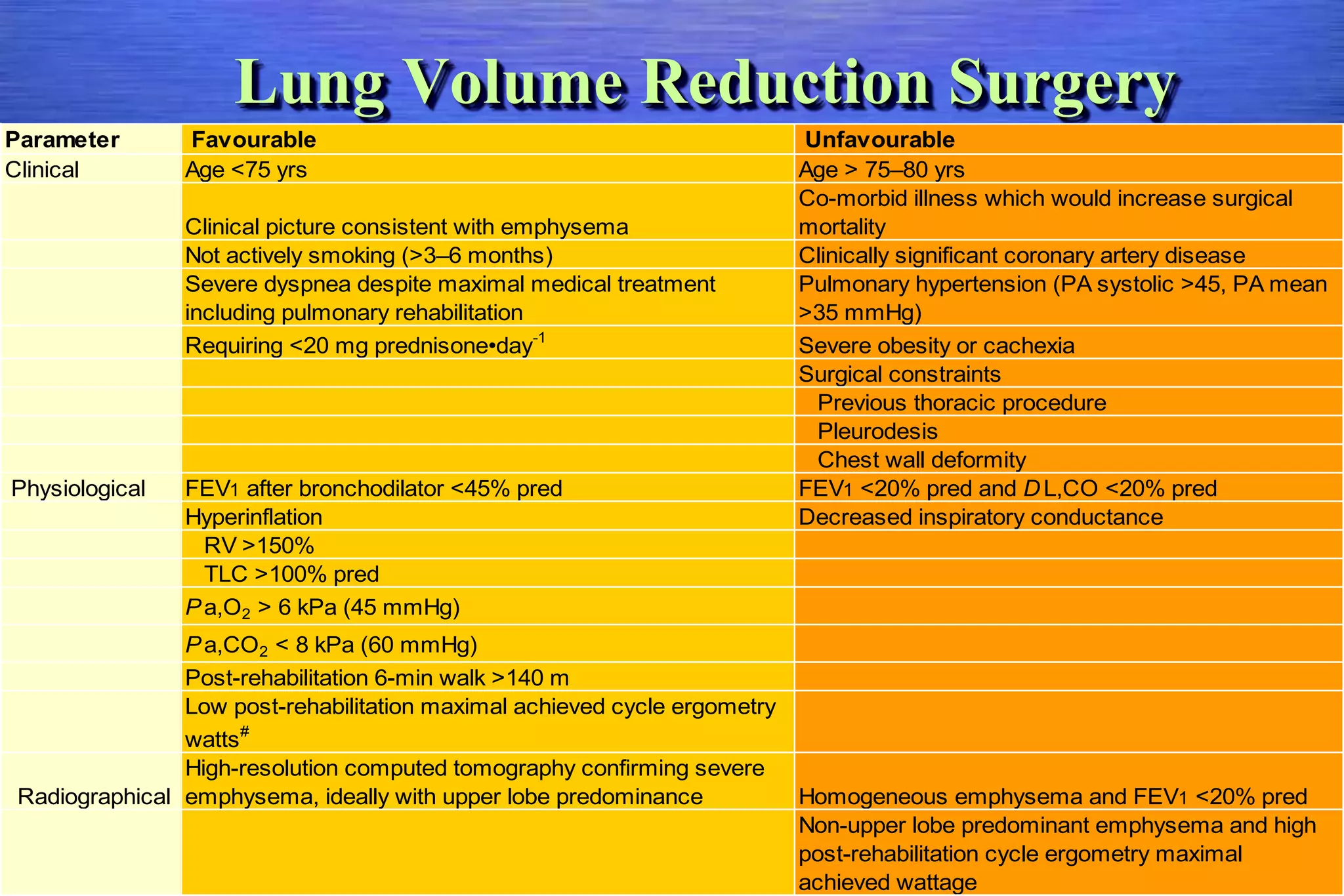
Lung Volume Reduction Surgery
Parameter Favourable Unfavourable
Clinical Age <75 yrs Age > 75–80 yrs
Clinical picture consistent with emphysema
Co-morbid illness which would increase surgical
mortality
Not actively smoking (>3–6 months) Clinically significant coronary artery disease
Severe dyspnea despite maximal medical treatment
including pulmonary rehabilitation
Pulmonary hypertension (PA systolic >45, PA mean
>35 mmHg)
Requiring <20 mg prednisone•day-1
Severe obesity or cachexia
Surgical constraints
Previous thoracic procedure
Pleurodesis
Chest wall deformity
Physiological FEV1 after bronchodilator <45% pred FEV1 <20% pred and D L,CO <20% pred
Hyperinflation Decreased inspiratory conductance
RV >150%
TLC >100% pred
Pa,O2 > 6 kPa (45 mmHg)
Pa,CO2 < 8 kPa (60 mmHg)
Post-rehabilitation 6-min walk >140 m
Low post-rehabilitation maximal achieved cycle ergometry
watts#
Radiographical
High-resolution computed tomography confirming severe
emphysema, ideally with upper lobe predominance Homogeneous emphysema and FEV1 <20% pred
Non-upper lobe predominant emphysema and high
post-rehabilitation cycle ergometry maximal
achieved wattage
Pulmonary Rehabilitation
 Most programs insist on a 6- to 8-week course of pulmonary
rehabilitation prior to LVR in order to optimize the patient's physical
condition and thus avoid any unnecessary morbidity or mortality from
the operation itself.
 Rehabilitation comprises a number of elements, including nutritional
counseling, psychosocial counseling, and skill training with regard to
breathing strategies and management of anxiety.
 The exercise component includes maneuvers to improve both strength
and flexibility as well as to maximize lower- and upper-body aerobic
capacity. This entails upper-body weight training as well as treadmill
work with supplemental oxygen as necessary.
SURGICAL
INTERVENTION
LVRS performed by means of bilateral VATS
or median sternotomy (buttressed or non
buttressed with bovine peri cardium).
Resection is directed to the target areas
identified by means of analysis of the CT
scan and perfusion scan as the lung and
the lung zones with the most pronounced
emphysematous alteration and greatest
reduction in perfusion.
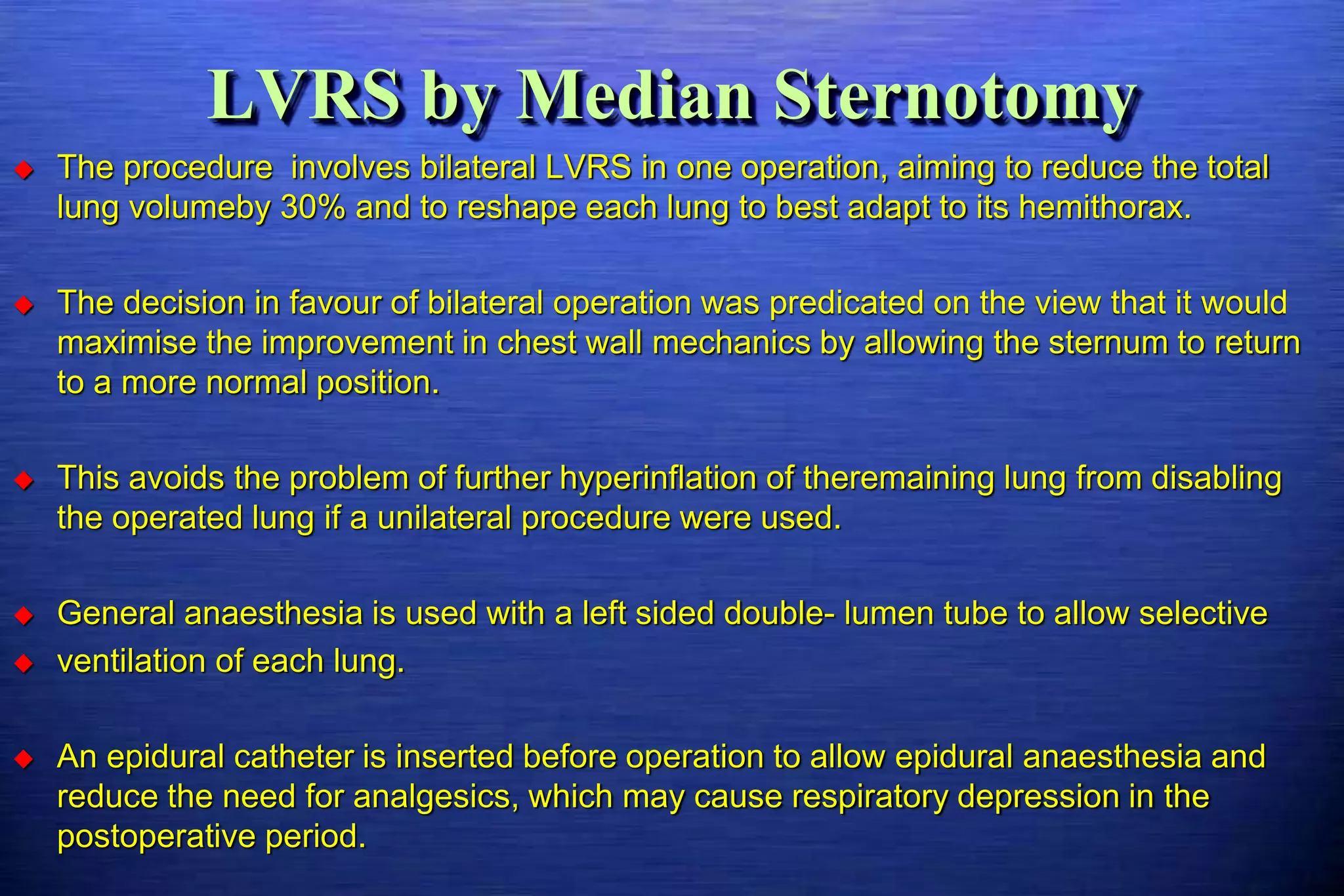
LVRS by Median Sternotomy
 The procedure involves bilateral LVRS in one operation, aiming to reduce the total
lung volumeby 30% and to reshape each lung to best adapt to its hemithorax.
 The decision in favour of bilateral operation was predicated on the view that it would
maximise the improvement in chest wall mechanics by allowing the sternum to return
to a more normal position.
 This avoids the problem of further hyperinflation of theremaining lung from disabling
the operated lung if a unilateral procedure were used.
 General anaesthesia is used with a left sided double- lumen tube to allow selective
 ventilation of each lung.
 An epidural catheter is inserted before operation to allow epidural anaesthesia and
reduce the need for analgesics, which may cause respiratory depression in the
postoperative period.
LVRS by Median Sternotomy
 Median sternotomy is carried out to carefully preserve the pleural membranes so that mobilisation of the apical
pleurae can be achieved to provide apical pleural tents after resection, so that the lung apices will be covered by
pleura, the space above the pleura will fill with fluid and intrapleural air spaces will be avoided.
 The most severely affected side is operated on first.
 Ventilation to that lung is ceased and the pleural cavity is opened.
 Absorption collapse occurs in the more normal lung parts
 The worstaffected areas remain inflated. These observations are considered with the information from the CT and
ventilation-perfusion scans, to decide on the most strategic areas for resection.
 Resection of each lung is limited to 30% and the stapled resection line is shaped to tailor the lung to best fit the
hemithorax.
 Linear staplers with the staple blades lined by reinforcing strips of bovine pericardium have proved to be a most
effective way to secure an airless staple line.
 Air leaks are meticulously dealt with, the opposite lung is then reduced and both pleural cavities are drained with
low-pressure suction. Immediate
LVRS by Bilateral Thoraco-Sternotomy – the “Clam-Shell”
Incision
 Whilst the median sternotomy approach has many advantages, particularly its avoidance of damage to the
lateral chest wall, exposure of the posterior surface of the lung, and in particular, the lower lobes is difficult.
The clam-shell incision is an inviting alternative that overcomes some of these problems
Video Assisted Thoracoscopic Surgery
 The widespread current use of video-assisted
thoracoscopy (VATS), owes much to the
pioneering work of Wakabayashi and co-workers5,
who used a VATS approach to ablate
emphysematous bullae using carbon dioxide laser.
 The use of laser techniques in non-bullous
emphysema has been shown to be less effective
than stapling in a prospective trial by McKenna
and colleagues16. They compare 33 patients in
whom Neodymium:YAG laser was used, with 39
patients in whom staplers were used.
 Both groups were exposed to unilateral operation
with low mortality, but the frequency of functional
improvement was greater in the stapled group at
32.9% compared with 13.4% in the laser group
Non-LVRS Approaches to Volume Reduction
 • Compression/banding devices
 • Endobronchial sealants
 • Endobronchial sealants/plugs
 • Endobronchial fenestration
with bypass
 • Endobronchial valves
– Spiration valve (IBV valve)
– Emphasys valve (Zephyr)
BRONCHOSCOPIC LVRS
 Performed in OT under general anesthesia
 Patient intubated and FB is advanced through ET
 Target segmental bronchus is visualised and a guidewire is inserted
into the operating channel of bronchoscope to reach the desired
segment.
 Leaving the guidewire in place, the bronchoscope is withdrawn and the
delivery catheter is passed on the guidewire.
 After the removal of the latter the valve is delivered.
 Between three and five valves
 Postoperative hospital stay ~ 2 day
Unilateral Versus Bilateral Approach
 Early during the modern evolution of LVR surgery, there was a controversy regarding whether to perform the
procedure unilaterally or bilaterally.
 Cooper8 and other investigators performing median sternotomy routinely performed simultaneous bilateral
procedures. Those performing a thoracoscopic LVR surgery initially performed unilateral procedures. This
rapidly evolved to a simultaneous bilateral thoracoscopic procedure, but—not surprisingly—it was clear from
early results that the morbidity of a bilateral thoracoscopic procedure exceeded that of a unilateral procedure.
Thus the question arose as to whether LVR should be done unilaterally, bilaterally in a sequential fashion, or in a
simultaneous bilateral procedure.
 Studies by McKenna and Argenziano suggested that a bilateral LVR surgery yielded significantly greater
improvements in spirometric indices than did unilateral procedures. Interestingly, the former author noted no
increased morbidity for the
 Because of the improved spirometric and quality-of-life results following bilateral LVR, the bilateral approach has
become the routine for most surgeons undertaking this intervention.
 Unilateral approach- These include patients in whom one pleural cavity or the other will be obliterated by dense
adhesions, such as those with a history of prior unilateral thoracotomy, empyema, or pleurodesis. The unilateral
approach should also be entertained in those whose emphysema is asymmetric and primarily unilateral. For
such patients, unilateral LVR can still provide significant benefit
Who benefits from LVRS Maximum
 Many reports support the claim that
improvement following LVRS is better
in patients whose target areas are in
the upper lobes than in patients with
lower-lobe targets.
 A high ratio of emphysema in the
upper lobe to the lower lobe on CT or
perfusion scan predicted short-term
functional improvements well
 Recently, it has been shown that
LVRS yields a survival advantage for
patients with both predominantly
upper-lobe emphysema and low
baseline exercise capacity, whereas it
does not afford patients with non–
upper-lobe emphysema and high
exercise capacity the benefit.
Does lung functions improve after LVRS?
Source: JTCS 2002: 123:845
Konrad et al have reported
115 patients underwent LVRS.
Symptoms and lung functions
were assessedbefore the
operation and 3, 6 and every 6
months after the operation.
CONCLUDE FEV1.0 peaks within
6 months postoperative then
decline in the fist year and
slows down in succeeding
years to baseline.
PATIENTS AT HIGH RISK
OF DEATH AFTER LVRS
A total of 1033 patients had been randomized by
June 2001.
69 Patients had FEVI < 20% of their predicted value and
homogenous distribution of emphysema on CT scan or their
DLCO < 20% of predicted value.
The 30-days mortality rate after surgery was 16% as compared
with the rate of 0% among 70 medically treated patients (P <
0.001).
Concluded: Very low DLCO
Very low FEV1.0
Homogenous distribution of emphysema are
at high risk of death after LVRS.
Source: NEJM 345: 1075 – 1083 Oct. 2001
ISSUES AFTER L V R S
DEVELOPMENT OF PULMONARY
HYPERTENSION
Weg. et al reported that development of
pulmonary hypertension may occur after
LVRS.
9 Patients were involved in a prospective
study with an average age of 64 years
After LVRS (PA) systolic pressure rose to
47.69 ± 12.4 mmHg but the changes in PAP
did not correlate with the changes in
symptoms.
Source: AM.J. Respir. Crit Care, 1999
COMPLICATIONS
 INTRAOPERATIVE
 None 91%
 Hypotension 0.4%
 Arrhythmia 1.2%
 Hypoxemia 2.2%
 Cardiac arrest 0.4%
 Uncontrolled air leak 1.0%
Postoperative (within 30 d of surgery)
 None 41.3%
 Major pulmonary morbidity* 29.8%
 Failure to wean 8.0%
 Tracheostomy 8.2%
 Pneumonia 18.2%
 Reintubation 21.8%
 Ventilation . 2 d 13.6%
 Major cardiovascular morbidity* 20.0%
 Arrhythmia requiring Rx 18.6%
 Myocardial infarction 1.0%
 Pulmonary embolus 0.8%
 Reoperation for air leak 3.3%
 Readmit to ICU 11.7%
 Mediastinitis 0.6%
 Sternal debridement 0.6%
 Sepsis 2.5%
 Epidural catheter complications 0.8%
 Readmit to hospital 2.5%
 Urinary retention
The National Emphysema
Treatment Trial (NETT)
NETT Design
 17 clinical centers
 Randomized 1,218 patients to medical therapy or medical therapy plus
LVRS
 Screened 3,777
 Pulmonary function
 FEV1 15% to 45%
 TLC >105%
 RV > 150%
 No significant cardiac disease or pulmonary HTN
 No other pulmonary diseases present
 Bilateral emphysema amenable to LVRS
 Upper lobe predominant
 Diffuse
NETT Research Group Chest, 1999
Durability of LVRS
Naunheim et al, Ann Thorac Surg 2006
UL/Low Exercise UL/high Exercise
Exercise performance all patients
10 watt improvement
Months LVRS Medical Rx p value
6 28% 4% <0.001
12 22% 5% <0.001
24 15% 3% <0.001
NETT Research Group NEJM, 2003
Who should not get surgery?
NETT Research Group NEJM, 2001
Video Assisted Thorascopy (VATS)
vs Median Sternotomy (MS)
 8 centers used MS
 3 used VATS
 6 randomized to either
 Total patients: 359 MS vs 152 VATS
 Randomized patients: 77 MS vs 71 VATS
McKenna et al, J Thorac Cardiovasc Surg, 2004
VATS vs MS
 30 day mortality
 2.8% MS vs 2.0% VATS (p = 0.76)
 90 day mortality
 5.9% MS vs 4.6% (p = 0.67)
 No mortality difference for randomized patients
 Intra-operative hypoxemia more common in VATS
(0.8% vs 5.3%)
 No difference in days with air leak
 Median hospital LOS of 10 d in MS vs 9 in VATS
(p=0.01)
 Randomized patients: 15d for MS vs 9d for VATS
(p<0.001) McKenna et al, J Thorac Cardiovasc Surg, 2004
Most important lessons from NETT?
 LVRS works!!
 Interventions to improve survival
 Smoking cessation
 Oxygen
 LVRS
 LVRS improves
 Oxygenation and oxygen requirements
 Favorable alters breathing patterns
 Reduces exacerbations
TAKE HOME MESSAGE
There are no long term data as yet.
LVRS improved the life of many patients.
We are still on a learning curve in predicting
outcome after LVRS.
Lung volume reduction surgery

Lung volume reduction surgery

  • 2.
    LUNG VOLUME REDUCTION SURGERY (LV R S) Presenter- Dr.Jyotindra Singh NIZAMS INSTITUTE ,HYDERABAD
  • 3.
    LVRS BACKGROUND Lung volumereduction surgery (LVRS), or reduction pneumoplasty (also referred to as lung shaving or lung contouring), is performed on patients with severe emphysema in order to allow the remaining compressed lung to expand and thus improve respiratory function.  In advanced stages of emphysema there is a sequence of events that start with hyperinflation, followed by a reduction in diaphragmatic mobility, an increase in resting pleural pressures that intensifies expiratory muscle recruitment and reduces elastic recoil of the lungs. The medical treatment of this condition includes bronchodilators, costicosteroids, oxygen and the management of exacerbations and infections but it does not impact on survival
  • 4.
    LVRS BACKGROUND The currentoptions for the surgical treatment are surgical ablation of bulous disease (bullectomy), lung volume reduction surgery (LVRS) and lung transplantation. Dr. Brantigan in 1957 was the first person to present the concept of LVRS. His concept, based on “Under normal circumstances, the elasticity of expanded lung is transmitted to the small airways which held opened by circumferential elastic pull” He proposed “Resection of the most useless area and Down sizing the lung would help to restore the outward pull on the small airway”
  • 5.
    LVRS BACKGROUND  Severaldecades later – Delarue and Dahan - unilateral thoracotomy approach - pulmonary haemodynamics.  1991 – Wakabayashi-unilateral parenchymal laser ablation by thoracoscopic approach. In 1995, Cooper and Associate a modification of Brantigan’s volume reduction operation,in which lung tissue was resected from both lungs via median sternotomy. In 2001, Cooper and associate report 6 cases of endobronchial bypass procedure by creating extra-anatomic broncho-pulmonary passage and placing a stent. His concern? How long the stent stay open.
  • 6.
    LVRS BACKGROUND This wasfollowed by randomized studies that demonstrated functional benefits and acceptable mortality in patients with low exercise capacity and upper lobe predominant heterogeneous disease (Ciccone, Meyers et al. 2003).  NETT RESEARCH GROUP Carried between January 1998 and July 2002 17hospitals, data coordinating center JHSPH Patients randomized to medical or surgery treatment Secondary end points included quality of life, pulmonary function, 6-min walk distance N Engl J Med 2001
  • 7.
    What is Emphysema? Permanent abnormal enlargement of the acini  Destruction of alveolar walls without obvious fibrosis ( Specifically, two things combined:
  • 8.
    Two kinds ofemphysema EMPHYSEMA TYPES Primary emphysema  1-2% of cases  Inherited lack of alpha-1 antitrypsin, a protective protein (inhibits neutrophil elastase) Secondary emphysema  Also caused by inability to inhibit proteolytic enzymes in the lungs  From inhaled toxins (e.g., cigarette smoke)  20% of smokers at risk Wayne McLaren…Former Marlboro Man Age 30…a robust young man Age 51…riding into the sunset
  • 9.
    Bullous Emphesyma CENTRIACINAREMPHYSEMA [ “Bullae are large dilated airspaces that bulge out from beneath the pleura.” Respiratory bronchioles in proximal portion of acinus are lost Alveoli distal to terminal bronchiole intact Occurs in smokers with chronic bronchitis Usually in upper lobes
  • 10.
    PRINCIPLE  1. VENTILATION/PERFUSIONMISMATCH Patients with end-stage emphysema have distended airspaces; these may be inadequately ventilated. These distended airspaces may continue to expand and compress adjacent, well-perfused alveoli, which then become similarly dysfunctional. Resection of such damaged lung would remove some component of the ventilation/perfusion mismatch and potentially allow reexpansion of adjacent alveoli
  • 13.
  • 14.
    AIRWAY RESISTANCE The combinationof the loss of the driving force of elastic recoil and the reduced tethering effect leads to closure of terminal bronchioles earlier in the expiratory cycle than what would normally occur. Over time, these forces result in increased airway resistance and hyperinflation of the lung. LVR entails resection of hyperinflated and nonfunctional lung
  • 15.
    PRINCIPE -3 Loss ofelastic recol Expansion of rib cage and flattening the diaphragm Increase resting volume Inefficient respiratory muscle Increase work of breathing Dyspnea CHEST WALL & DIAPHRAGM
  • 16.
    Chest Wall andDiaphraghm  Excision of nonfunctional hyperinflated lung will lead to a smaller overall lung volume. This provides the opportunity for the chest wall to shrink down to a less hyperexpanded position and the diaphragm to resume its more dome-like appearance. Theoretically this return of the chest wall and diaphragm to their more normal shape and position will restore some of the functional capacity and muscular strength, leading to greater volumes of air movement throughout the respiratory cycle
  • 17.
    Chest radiographs obtainedat TLC and FRC in one patient before (Pre-op) and at 6 months and 12 months after LVRS. Top six views: anteroposterior views.
  • 18.
    HAEMODYNAMICS LVR wouldtheoretically decrease the size of the lung within the chest cavity and, by decreasing airway resistance, would lead to a lowering of the intrathoracic pressure throughout the respiratory cycle.  It might therefore improve venous return, decrease pulmonary vascular resistance, and thus improve right heart output and overall cardiac index.  This was in part the pathophysiologic mechanism for improvement promoted by DeLarue13 and Dahan  LVR  Decrease size of lung within chest cavity  lowering of intrathoracic pressure  Improve venous return,decrease PVR  Improve right heart output &cardiac index
  • 19.
  • 20.
    PRE OPERATIVE ASSESMENT CHESTX RAY HRCT scan Quantitative V/Q scan Lung-volume measurement/ PFT Maximal exercise testing-6-minute walk test (140 m)  CARDIOVASCULAR WORKUP
  • 21.
    CHEST X RAY Marked HYPER INFLATED lungs is noted with flattend and low diaphragm  Intercostal space becomes widen  A horizontal pattern of ribs  A long thin heart shadow  Decreased markings of lung peripheral vessels
  • 23.
    . (A) Preoperativeplain chest radiographs reveal marked emphysematous changes with bullae over the apical zones of both lungs that were more predominant on the right. (B) A follow-up chest radiograph 3 months after surgery shows a less flattened diaphragm and apparent lung marking over the right upper lung zone.
  • 25.
    CT SCAN Document thepresence of emphysema Rule out the presence of infiltrative processes/ occult lung cancer Presence of solitary nodule undetected on X- RAY HRCT – whether Emphysema is homogenous or heterogenous Upper lobe predominant or lower lobe predominant
  • 26.
    Three major typesof emphysema distribution were defined: markedly heterogeneous (upper panel), intermediately heterogeneous (middle panel), and homogeneous (lower panel).
  • 27.
    HRCT shows diffuseemphysematous changes over both lungs, with bulla formation that predominates over both upper lung zones, indicating vanishing tissue in the upper lungs. (D) HRCT taken three months after surgery shows an apparent disappearance of bullae with more pronounced vasculature in the right lung but with little change to the left lung.
  • 29.
    Ventillation & Perfusion scintigrams significant lack of perfusion in the upper lobes  Persistent retention of gas in same region  Indicates heterogenous disease with severe involvement in upper lobe
  • 30.
    Lung perfusion singlepositron emission computed tomography scan showing underperfused areas (darkened zones) in the right lower lobe lateral basal segment and in the anterior segment of the left upper lobe.
  • 31.
    PULMONARY FUNCTION TEST Optimal candidates are those with severe obstructive disease (forced expiratory volume in one second [FEV1] <40% predicted) without a significant restrictive component or reversible bronchoconstriction.  Plethysmography must demonstrate significantly increased total lung capacity (TLC) >120% predicted as well as elevated residual volume (RV) >150% predicted.  Initial testing also includes determination of resting arterial blood gases (PO2 and PCO2). The diffusing capacity (DLCO) is also measured and, proves to be an important parameter that can occasionally contraindicate surgical intervention.  Ideally, patients who are candidates for LVR have a PO2 >60, a PCO2 <55 mm Hg, and a DLCO >20% predicted.
  • 32.
  • 35.
    The BODE score Fourfactors predict increased risk of death:  BODY MASS INDEX  The degree of airflow obstruction (FEV1)  Dyspnea  Exercise tolerance (6 MW distance) -------------------------------------------------------  Patients with higher BODE score - are at higher risk of death  BODE index has a stronger ability to discriminate the probability of survival among patients than FEV1  The BODE score predicts hospitalization better than FEV1
  • 36.
    Computation of theBODE score Variable Points on BODE Index 0 1 2 3 FEV1 % predicted > 65 50-64 36-49 <35 6MW distance m >350 250-349 150-249 < 149 MRC dyspnea scale 0-1 2 3 4 BMI > 21 < 21
  • 37.
    CARDIO VASCULAR WORKUP  Doppler echocardiography is routinely used to rule out significant cardiomyopathy and valvular heart disease. Early in the clinical experience, Doppler echocardiography was utilized to try to identify those patients with pulmonary hypertension, because such patients were felt to have an elevated risk of mortality.  However, Fisher and coworkers documented relatively mediocre sensitivity (60%) and specificity (74%) when echocardiography was utilized in this fashion. Patients in whom pulmonary hypertension is suspected on the basis of signs, symptoms or radiographic findings should therefore undergo right heart catheterization to determine whether pulmonary pressures contraindicate LVR
  • 38.
    PATIENT SELECTION NOT ALLPATIENTS BENEFIT FROM LVRS Severe emphysema not reversible by medical treatment. Poor exercise performance. Marked hyperinflation. Indication :
  • 40.
    Patient selection The NationalEmphysema Treatment Trial (NETT) was a prospective, randomized, multicenter trial which compared the results of LVRS to medical therapy which showed that there were 3 groups of patients that tend to benefit from LVRS Group 1: Patients with predominantly upper lobe emphysema and low exercise capacity. These patients have improved survival and functional outcomes after LVRS compared to medical therapy. Group 2: Patients with predominantly upper lobe emphysema and high exercise capacity. These patients have improved functional outcomes after LVRS but no difference in survival compared to medical therapy. Group 3: Patients with non-upper lobe emphysema and low exercise capacity. These patients have improved survival after LVRS but no difference in survival compared to medical therapy.
  • 41.
    INCLUSION CRITERIA History andphysical examination; BMI ≤31.1 kg/m2 (men) or ≤32.3 kg/m2 (women) at randomization; stable on ≤20 mg prednisone (or equivalent) daily  Radiographic HRCT scan evidence of bilateral emphysema  Pulmonary function (pre-rehabilitation) FEV1≤45% predicted (≥15% predicted if ≥70 years);  TLC ≥100% predicted; RV ≥150% predicted  Arterial blood gas (pre-rehabilitation) PCO2 ≤60 mm Hg (Denver: PCO2≤55 mm Hg) PO2 ≥45 mm Hg (Denver: PO2 ≥30 mm Hg) on room air  Cardiac assessment Approval for surgery before randomization by cardiologist if any of the following are present: unstable angina; LVEF cannot be estimated from the echocardiogram; LVEF ≤45%; dobutamine-radionuclide cardiac scan indicates coronary artery disease or ventricular dysfunction; arrhythmia (≥5 PVCs per minute; cardiac rhythm, other than sinus; PACs at rest)
  • 42.
    INCLUSION CRITERIA Surgicalassessment Approval for surgery by pulmonary physician, thoracic surgeon, and anesthesiologist after rehabilitation and before randomization Exercise Post-rehabilitation 6-minute walk ≥140 meters; able to complete 3 minutes of unloaded pedaling in exercise tolerance test (before and after rehabilitation)  Consent Signed consent forms for screening, rehabilitation, and randomization  Smoking Plasma cotinine ≤13.7 ng/mL (or arterial carboxyhemoglobin ≤2.5% if using nicotine products); nonsmoking for 4 months before initial interview and throughout screening  Rehabiliation -Must complete pre-randomization assessments, rehabilitation program, and all post-rehabilitation and randomization assessments
  • 43.
    Exclusionary Criteria  Previousoperation Lung transplantation; LVRS; median sternotomy or lobectomy  Cardiovascular Arrhythmia that might pose a risk during exercise or training; resting bradycardia (<50 beats/min); frequent multifocal PVCs; complex ventricular arrhythmia; sustained SVT; history of exercise- related syncope; MI within 6 months and LVEF <45%; congestive heart failure within 6 months and LVEF <45%; uncontrolled hypertension (systolic >200 mm Hg, diastolic >110 mg Hg)  Pulmonary History of recurrent infections with clinically significant sputum production; pleural or interstitial disease that precludes surgery; clinically significant bronchiectasis; pulmonary nodule necessitating surgery; giant bulla (greater than one third the volume of the lung); pulmonary hypertension; peak systolic PPA ≥45 mm Hg (≥50 mm Hg in Denver) or mean PPA ≥35 mm Hg (≥38 mm Hg in Denver); (right heart catheterization is required to rule out pulmonary hypertension if peak systolic PPA on echocardiogram ≥ 45 mm Hg); requirement for ≥ 6 L oxygen to keep saturation 90% or greater with exercise  Radiographic CT evidence for diffuse emphysema judged unsuitable for LVRS  General Unplanned weight loss of <10% usual weight in 90 days before enrollment; evidence of systemic disease or neoplasia expected to compromise survival during 5-year period; 6-minute walk distance ≤140 meters after rehabilitation; any disease or condition that interferes with completion of initial or follow-up assessments; unwillingness or inability to complete screening or baseline data collection procedures
  • 44.
    Lung Volume ReductionSurgery Parameter Favourable Unfavourable Clinical Age <75 yrs Age > 75–80 yrs Clinical picture consistent with emphysema Co-morbid illness which would increase surgical mortality Not actively smoking (>3–6 months) Clinically significant coronary artery disease Severe dyspnea despite maximal medical treatment including pulmonary rehabilitation Pulmonary hypertension (PA systolic >45, PA mean >35 mmHg) Requiring <20 mg prednisone•day-1 Severe obesity or cachexia Surgical constraints Previous thoracic procedure Pleurodesis Chest wall deformity Physiological FEV1 after bronchodilator <45% pred FEV1 <20% pred and D L,CO <20% pred Hyperinflation Decreased inspiratory conductance RV >150% TLC >100% pred Pa,O2 > 6 kPa (45 mmHg) Pa,CO2 < 8 kPa (60 mmHg) Post-rehabilitation 6-min walk >140 m Low post-rehabilitation maximal achieved cycle ergometry watts# Radiographical High-resolution computed tomography confirming severe emphysema, ideally with upper lobe predominance Homogeneous emphysema and FEV1 <20% pred Non-upper lobe predominant emphysema and high post-rehabilitation cycle ergometry maximal achieved wattage
  • 45.
    Pulmonary Rehabilitation  Mostprograms insist on a 6- to 8-week course of pulmonary rehabilitation prior to LVR in order to optimize the patient's physical condition and thus avoid any unnecessary morbidity or mortality from the operation itself.  Rehabilitation comprises a number of elements, including nutritional counseling, psychosocial counseling, and skill training with regard to breathing strategies and management of anxiety.  The exercise component includes maneuvers to improve both strength and flexibility as well as to maximize lower- and upper-body aerobic capacity. This entails upper-body weight training as well as treadmill work with supplemental oxygen as necessary.
  • 46.
    SURGICAL INTERVENTION LVRS performed bymeans of bilateral VATS or median sternotomy (buttressed or non buttressed with bovine peri cardium). Resection is directed to the target areas identified by means of analysis of the CT scan and perfusion scan as the lung and the lung zones with the most pronounced emphysematous alteration and greatest reduction in perfusion.
  • 48.
    LVRS by MedianSternotomy  The procedure involves bilateral LVRS in one operation, aiming to reduce the total lung volumeby 30% and to reshape each lung to best adapt to its hemithorax.  The decision in favour of bilateral operation was predicated on the view that it would maximise the improvement in chest wall mechanics by allowing the sternum to return to a more normal position.  This avoids the problem of further hyperinflation of theremaining lung from disabling the operated lung if a unilateral procedure were used.  General anaesthesia is used with a left sided double- lumen tube to allow selective  ventilation of each lung.  An epidural catheter is inserted before operation to allow epidural anaesthesia and reduce the need for analgesics, which may cause respiratory depression in the postoperative period.
  • 50.
    LVRS by MedianSternotomy  Median sternotomy is carried out to carefully preserve the pleural membranes so that mobilisation of the apical pleurae can be achieved to provide apical pleural tents after resection, so that the lung apices will be covered by pleura, the space above the pleura will fill with fluid and intrapleural air spaces will be avoided.  The most severely affected side is operated on first.  Ventilation to that lung is ceased and the pleural cavity is opened.  Absorption collapse occurs in the more normal lung parts  The worstaffected areas remain inflated. These observations are considered with the information from the CT and ventilation-perfusion scans, to decide on the most strategic areas for resection.  Resection of each lung is limited to 30% and the stapled resection line is shaped to tailor the lung to best fit the hemithorax.  Linear staplers with the staple blades lined by reinforcing strips of bovine pericardium have proved to be a most effective way to secure an airless staple line.  Air leaks are meticulously dealt with, the opposite lung is then reduced and both pleural cavities are drained with low-pressure suction. Immediate
  • 51.
    LVRS by BilateralThoraco-Sternotomy – the “Clam-Shell” Incision  Whilst the median sternotomy approach has many advantages, particularly its avoidance of damage to the lateral chest wall, exposure of the posterior surface of the lung, and in particular, the lower lobes is difficult. The clam-shell incision is an inviting alternative that overcomes some of these problems
  • 52.
    Video Assisted ThoracoscopicSurgery  The widespread current use of video-assisted thoracoscopy (VATS), owes much to the pioneering work of Wakabayashi and co-workers5, who used a VATS approach to ablate emphysematous bullae using carbon dioxide laser.  The use of laser techniques in non-bullous emphysema has been shown to be less effective than stapling in a prospective trial by McKenna and colleagues16. They compare 33 patients in whom Neodymium:YAG laser was used, with 39 patients in whom staplers were used.  Both groups were exposed to unilateral operation with low mortality, but the frequency of functional improvement was greater in the stapled group at 32.9% compared with 13.4% in the laser group
  • 54.
    Non-LVRS Approaches toVolume Reduction  • Compression/banding devices  • Endobronchial sealants  • Endobronchial sealants/plugs  • Endobronchial fenestration with bypass  • Endobronchial valves – Spiration valve (IBV valve) – Emphasys valve (Zephyr)
  • 55.
    BRONCHOSCOPIC LVRS  Performedin OT under general anesthesia  Patient intubated and FB is advanced through ET  Target segmental bronchus is visualised and a guidewire is inserted into the operating channel of bronchoscope to reach the desired segment.  Leaving the guidewire in place, the bronchoscope is withdrawn and the delivery catheter is passed on the guidewire.  After the removal of the latter the valve is delivered.  Between three and five valves  Postoperative hospital stay ~ 2 day
  • 57.
    Unilateral Versus BilateralApproach  Early during the modern evolution of LVR surgery, there was a controversy regarding whether to perform the procedure unilaterally or bilaterally.  Cooper8 and other investigators performing median sternotomy routinely performed simultaneous bilateral procedures. Those performing a thoracoscopic LVR surgery initially performed unilateral procedures. This rapidly evolved to a simultaneous bilateral thoracoscopic procedure, but—not surprisingly—it was clear from early results that the morbidity of a bilateral thoracoscopic procedure exceeded that of a unilateral procedure. Thus the question arose as to whether LVR should be done unilaterally, bilaterally in a sequential fashion, or in a simultaneous bilateral procedure.  Studies by McKenna and Argenziano suggested that a bilateral LVR surgery yielded significantly greater improvements in spirometric indices than did unilateral procedures. Interestingly, the former author noted no increased morbidity for the  Because of the improved spirometric and quality-of-life results following bilateral LVR, the bilateral approach has become the routine for most surgeons undertaking this intervention.  Unilateral approach- These include patients in whom one pleural cavity or the other will be obliterated by dense adhesions, such as those with a history of prior unilateral thoracotomy, empyema, or pleurodesis. The unilateral approach should also be entertained in those whose emphysema is asymmetric and primarily unilateral. For such patients, unilateral LVR can still provide significant benefit
  • 58.
    Who benefits fromLVRS Maximum  Many reports support the claim that improvement following LVRS is better in patients whose target areas are in the upper lobes than in patients with lower-lobe targets.  A high ratio of emphysema in the upper lobe to the lower lobe on CT or perfusion scan predicted short-term functional improvements well  Recently, it has been shown that LVRS yields a survival advantage for patients with both predominantly upper-lobe emphysema and low baseline exercise capacity, whereas it does not afford patients with non– upper-lobe emphysema and high exercise capacity the benefit.
  • 60.
    Does lung functionsimprove after LVRS? Source: JTCS 2002: 123:845 Konrad et al have reported 115 patients underwent LVRS. Symptoms and lung functions were assessedbefore the operation and 3, 6 and every 6 months after the operation. CONCLUDE FEV1.0 peaks within 6 months postoperative then decline in the fist year and slows down in succeeding years to baseline.
  • 61.
    PATIENTS AT HIGHRISK OF DEATH AFTER LVRS A total of 1033 patients had been randomized by June 2001. 69 Patients had FEVI < 20% of their predicted value and homogenous distribution of emphysema on CT scan or their DLCO < 20% of predicted value. The 30-days mortality rate after surgery was 16% as compared with the rate of 0% among 70 medically treated patients (P < 0.001). Concluded: Very low DLCO Very low FEV1.0 Homogenous distribution of emphysema are at high risk of death after LVRS. Source: NEJM 345: 1075 – 1083 Oct. 2001
  • 62.
  • 63.
    DEVELOPMENT OF PULMONARY HYPERTENSION Weg.et al reported that development of pulmonary hypertension may occur after LVRS. 9 Patients were involved in a prospective study with an average age of 64 years After LVRS (PA) systolic pressure rose to 47.69 ± 12.4 mmHg but the changes in PAP did not correlate with the changes in symptoms. Source: AM.J. Respir. Crit Care, 1999
  • 64.
    COMPLICATIONS  INTRAOPERATIVE  None91%  Hypotension 0.4%  Arrhythmia 1.2%  Hypoxemia 2.2%  Cardiac arrest 0.4%  Uncontrolled air leak 1.0% Postoperative (within 30 d of surgery)  None 41.3%  Major pulmonary morbidity* 29.8%  Failure to wean 8.0%  Tracheostomy 8.2%  Pneumonia 18.2%  Reintubation 21.8%  Ventilation . 2 d 13.6%  Major cardiovascular morbidity* 20.0%  Arrhythmia requiring Rx 18.6%  Myocardial infarction 1.0%  Pulmonary embolus 0.8%  Reoperation for air leak 3.3%  Readmit to ICU 11.7%  Mediastinitis 0.6%  Sternal debridement 0.6%  Sepsis 2.5%  Epidural catheter complications 0.8%  Readmit to hospital 2.5%  Urinary retention
  • 66.
  • 67.
    NETT Design  17clinical centers  Randomized 1,218 patients to medical therapy or medical therapy plus LVRS  Screened 3,777  Pulmonary function  FEV1 15% to 45%  TLC >105%  RV > 150%  No significant cardiac disease or pulmonary HTN  No other pulmonary diseases present  Bilateral emphysema amenable to LVRS  Upper lobe predominant  Diffuse NETT Research Group Chest, 1999
  • 68.
    Durability of LVRS Naunheimet al, Ann Thorac Surg 2006 UL/Low Exercise UL/high Exercise
  • 69.
    Exercise performance allpatients 10 watt improvement Months LVRS Medical Rx p value 6 28% 4% <0.001 12 22% 5% <0.001 24 15% 3% <0.001 NETT Research Group NEJM, 2003
  • 70.
    Who should notget surgery? NETT Research Group NEJM, 2001
  • 71.
    Video Assisted Thorascopy(VATS) vs Median Sternotomy (MS)  8 centers used MS  3 used VATS  6 randomized to either  Total patients: 359 MS vs 152 VATS  Randomized patients: 77 MS vs 71 VATS McKenna et al, J Thorac Cardiovasc Surg, 2004
  • 72.
    VATS vs MS 30 day mortality  2.8% MS vs 2.0% VATS (p = 0.76)  90 day mortality  5.9% MS vs 4.6% (p = 0.67)  No mortality difference for randomized patients  Intra-operative hypoxemia more common in VATS (0.8% vs 5.3%)  No difference in days with air leak  Median hospital LOS of 10 d in MS vs 9 in VATS (p=0.01)  Randomized patients: 15d for MS vs 9d for VATS (p<0.001) McKenna et al, J Thorac Cardiovasc Surg, 2004
  • 73.
    Most important lessonsfrom NETT?  LVRS works!!  Interventions to improve survival  Smoking cessation  Oxygen  LVRS  LVRS improves  Oxygenation and oxygen requirements  Favorable alters breathing patterns  Reduces exacerbations
  • 74.
    TAKE HOME MESSAGE Thereare no long term data as yet. LVRS improved the life of many patients. We are still on a learning curve in predicting outcome after LVRS.