SPIROMETRY
Blow to know
Tapeshwar Yadav
(Lecturer)
BMLT, DNHE,
M.Sc. Medical Biochemistry
What is Spirometry?
 a simple and safe test
 that measures lung volumes
 with a graphical display
 gives an estimation of lung function
 Allows for diagnosis of
airflow obstruction
 Permits good follow-up
for asthma and COPD
Spirometry
in Practice
• A technique used to measure air flow in and out of
the lungs.
• A recording of lung volumes and capacities defined
by the respiratory process. These recordings may be
static (untimed) or dynamic (timed).
• Assesses the integrated mechanical functions of
lungs, chest wall and respiratory muscles.
•The gold standard for diagnosis, assessment and
monitoring of COPD.
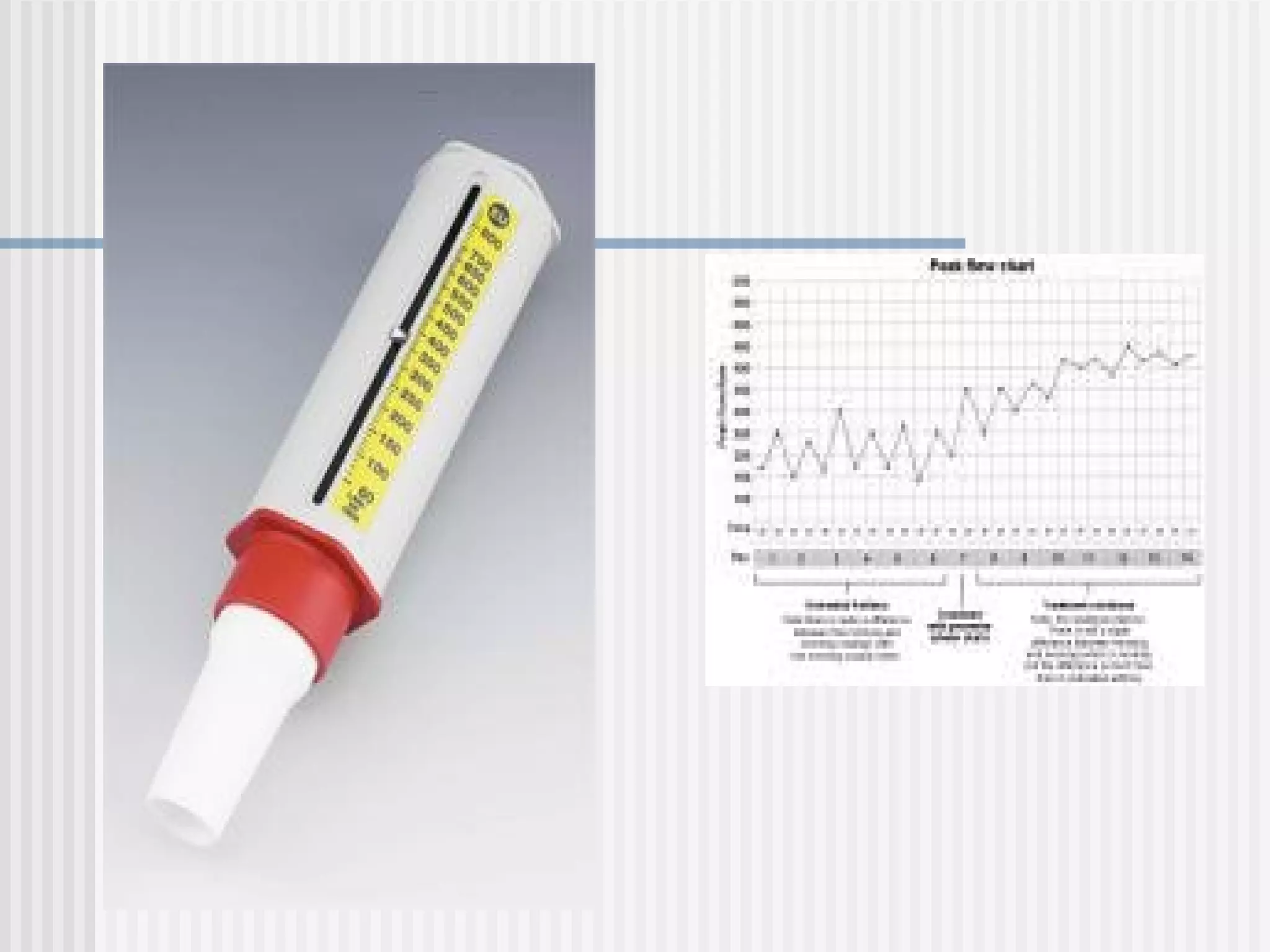
• Better than PEFR (which is effort dependent) for
demonstrating airway obstruction in BA.
• The most commonly used PFT.
Indications
• Measure airflow obstruction to help make a
definitive diagnosis of COPD
• Detect airflow obstruction in smokers who may
have few or no symptoms
• Assess one aspect of response to therapy
• Perform pre-operative assessment
• Distinguish between obstruction and restriction
as causes of breathlessness
• Perform pre-employment screening in certain
professions
Hand-held spirometer
Spirometer in the fifties..
In the lung function lab
Spirobank
Simplicity
SpiroPro
SpiroStar
Datospir 70
Many types are available..
MicroLoop
What do we measure
with a spirometer?
Adverse Effects
• Light headedness
• Headache
• Fainting: reduced venous return
or vasovagal attack (reflex)
• Transient urinary incontinence
5 10 15
2
4
6
8
Time (s)
Volume(L)
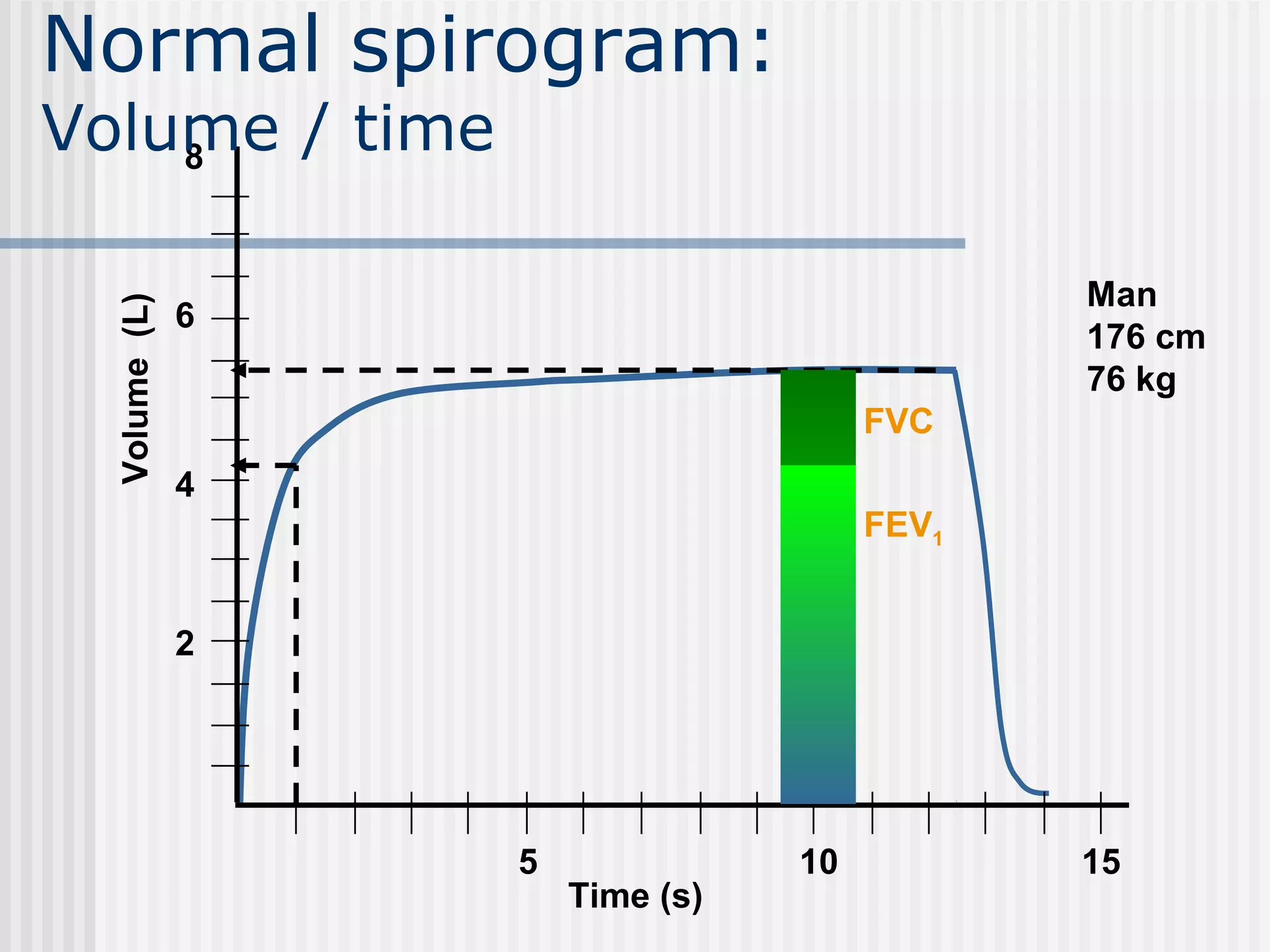
Normal spirogram:
Volume / time
Man
176 cm
76 kg
FVC
FEV1
Two important
parameters
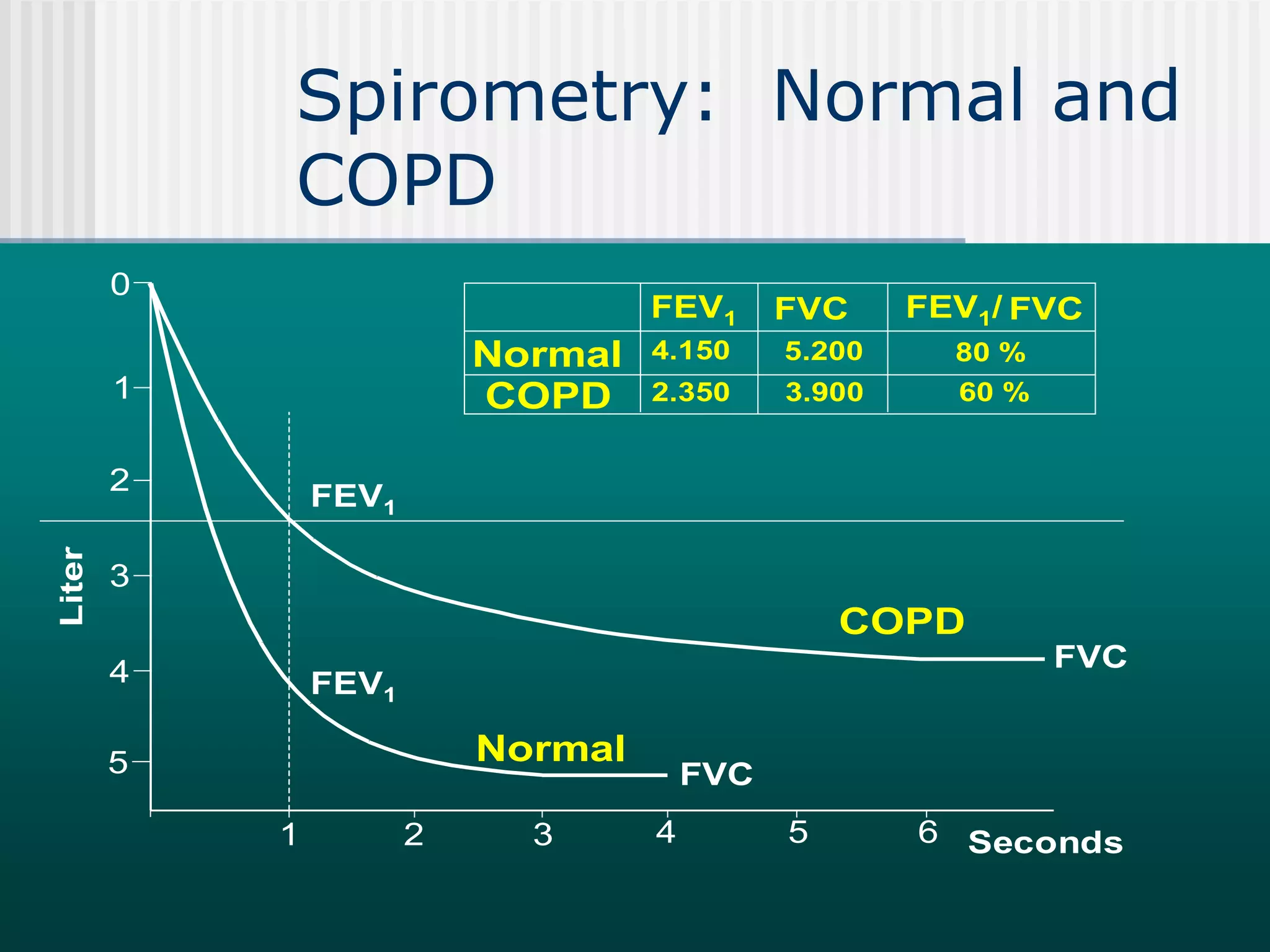
 FVC - Forced Vital Capacity. This is the
total amount of air that you blow out
in one breath.
 FEV1 - Forced Expiratory Volume in
one Second. This is the amount of air
you can blow out within one second.
With normal lungs and airways you
can normally blow out most of the air
from your lungs within one second.
Spirometry: Normal and
COPD
0
5
1
4
2
3
Liter
1 65432
FVC
FVC
FEV1
FEV1
Normal
COPD
3.900
5.200
2.350
4.150 80 %
60 %
Normal
COPD
FVCFEV1 FVCFEV1/
Seconds
Normal
Obstructive
Restrictive
0
-4
-8
4
8
12
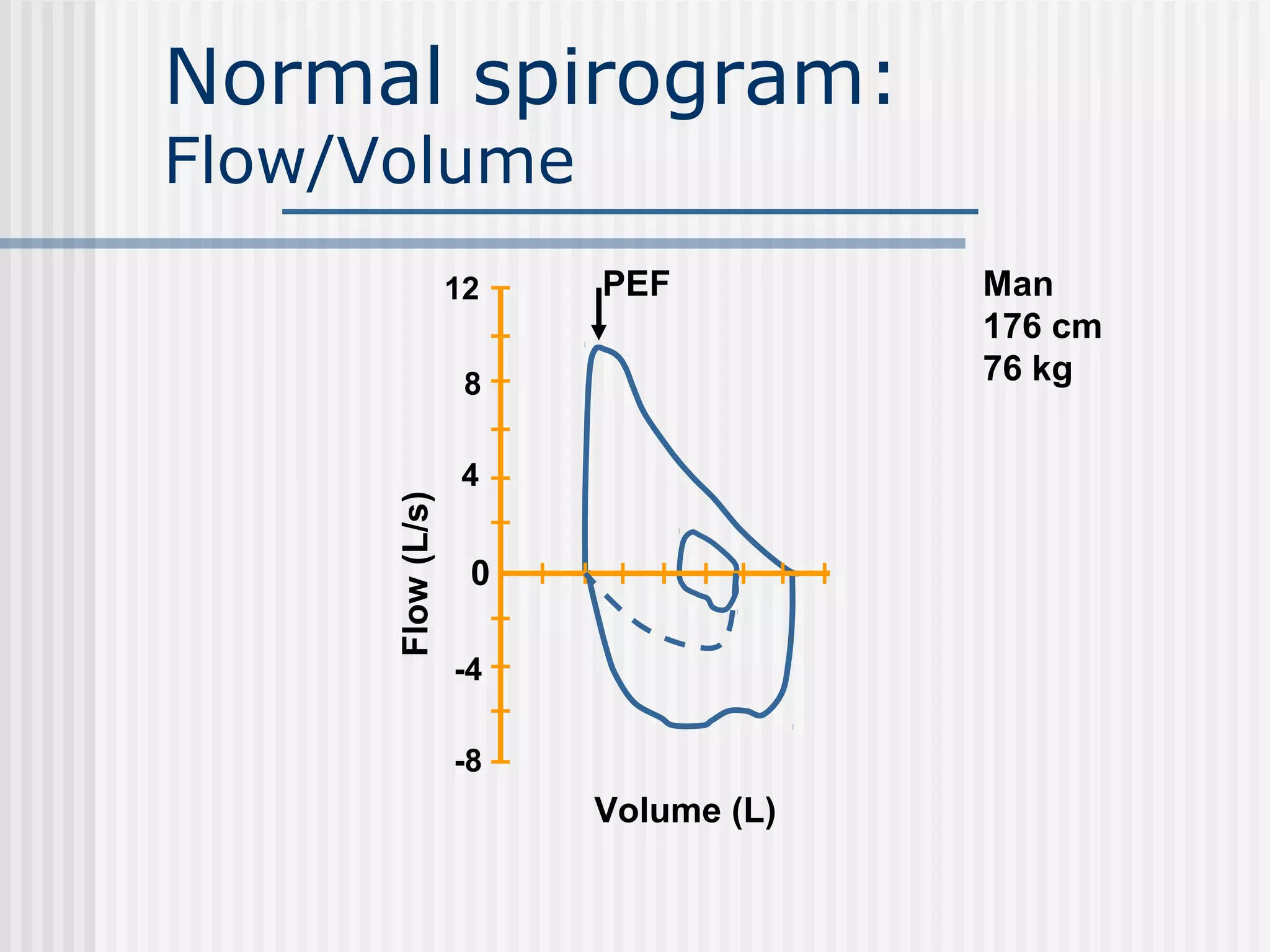
Flow(L/s)
PEF
Normal spirogram:
Flow/Volume
Man
176 cm
76 kg
Volume (L)
Spirometry and ageing
0 1 2 3 4 5 6
0
2
4
6
8
10
Vol (l)
Flow(l/s)
25 yrs
175 cm
male
75 yrs
171 cm
male
Spirometry allows for
 Early detection of airflow obstruction
(often late signs and symptoms)
 Better diagnosis (helps to distinguish
between asthma and COPD)
 Correct follow-up (compare with blood
pressure meter in hypertension patients)
Reversibility Testing
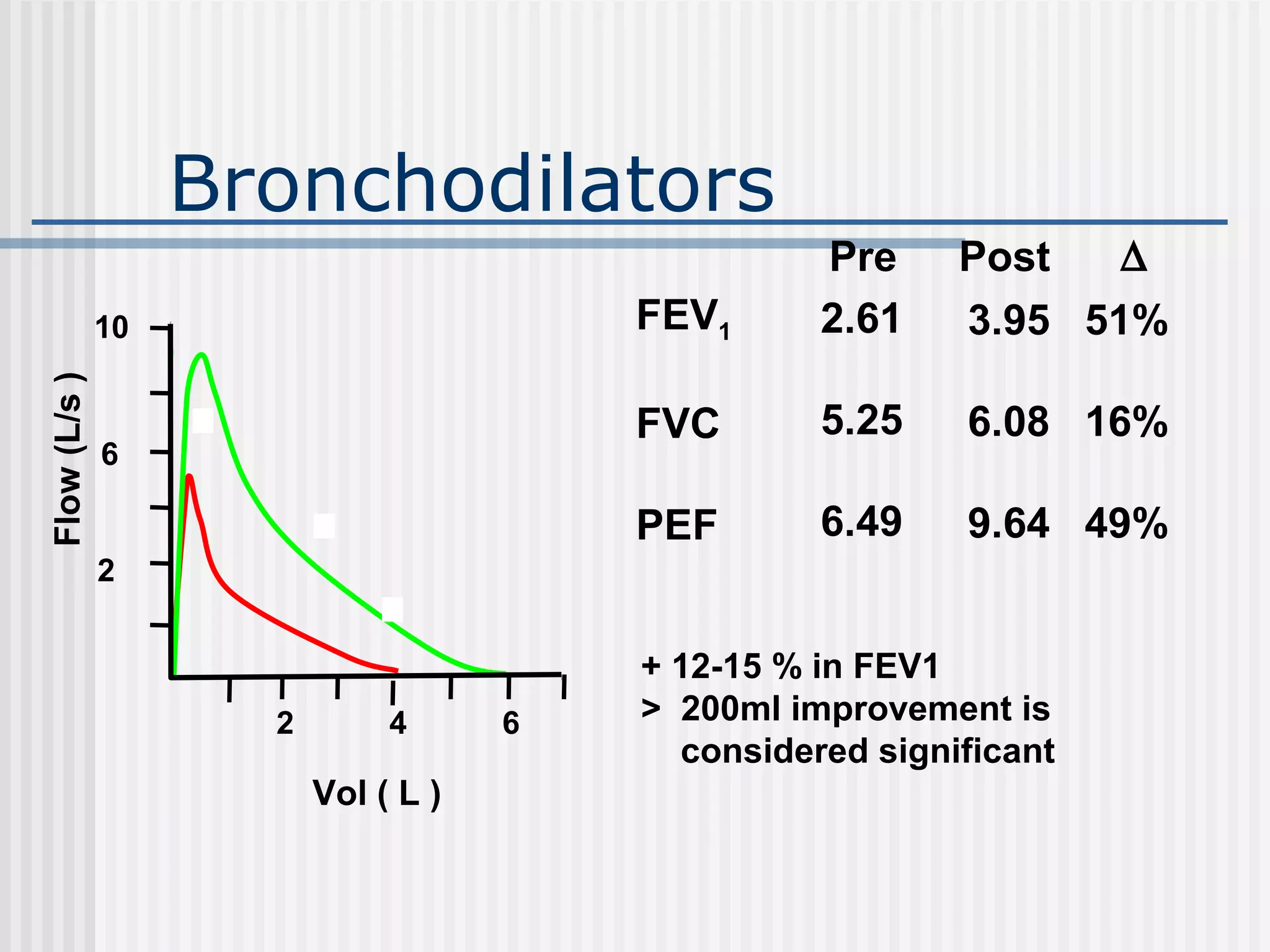
 If airflow obstruction is present, the
test person is given a bronchodilator
(inhalation device)
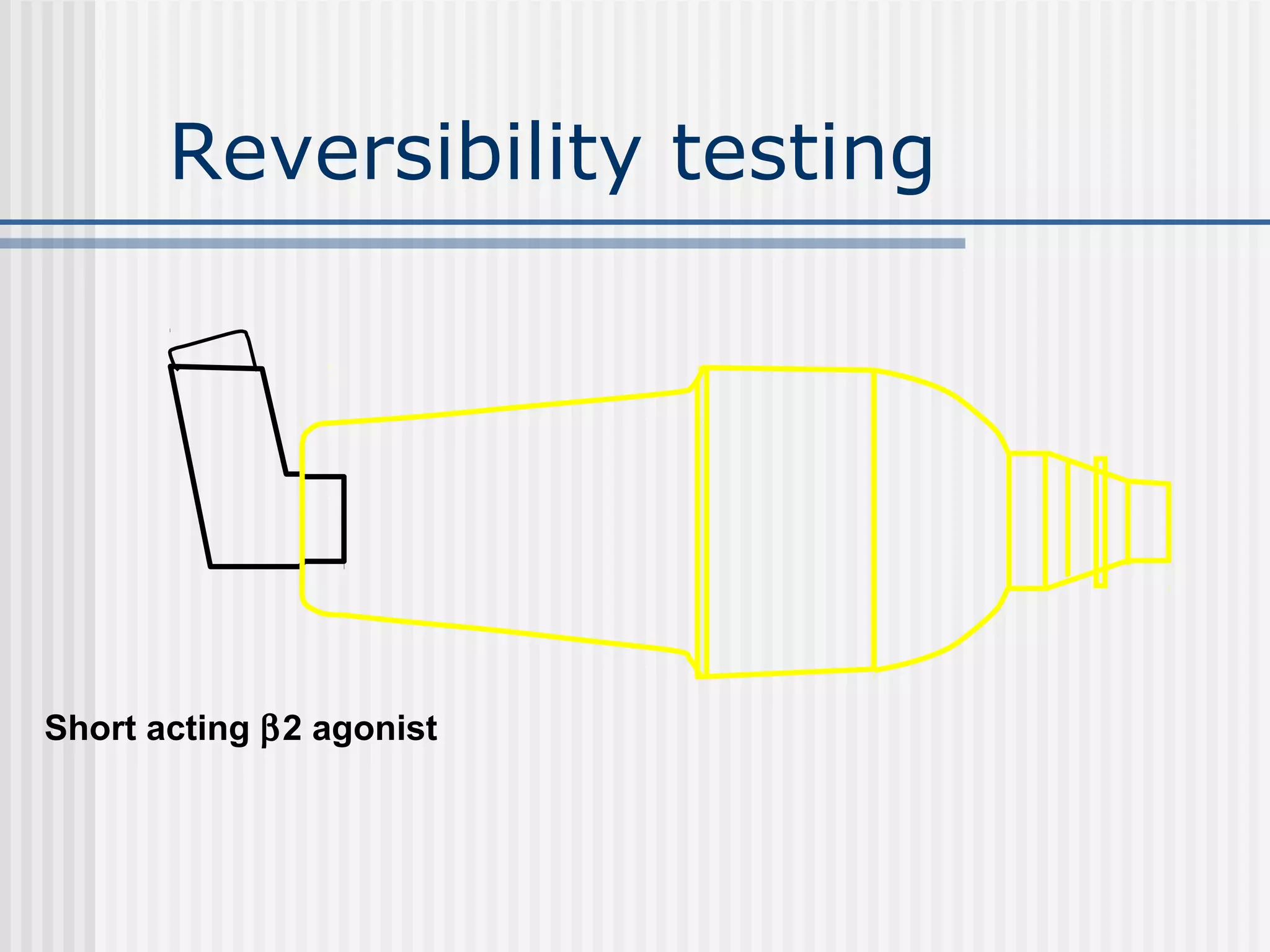
Reversibility testing
Short acting β2 agonist
Bronchodilators
FEV1
FVC
PEF
2.61
5.25
6.49
Pre
+ 12-15 % in FEV1
> 200ml improvement is
considered significant
3.95
6.08
9.64
51%
16%
49%
Post ∆
2
6
10
2 4 6
Vol ( L )
Flow(L/s)
Reversibility Testing
 Airflow obstruction disappears:
REVERSIBLE OBSTRUCTION
(probably asthma)
 Airflow obstruction remains:
IRREVERSIBLE OBSTRUCTION
(probably COPD)
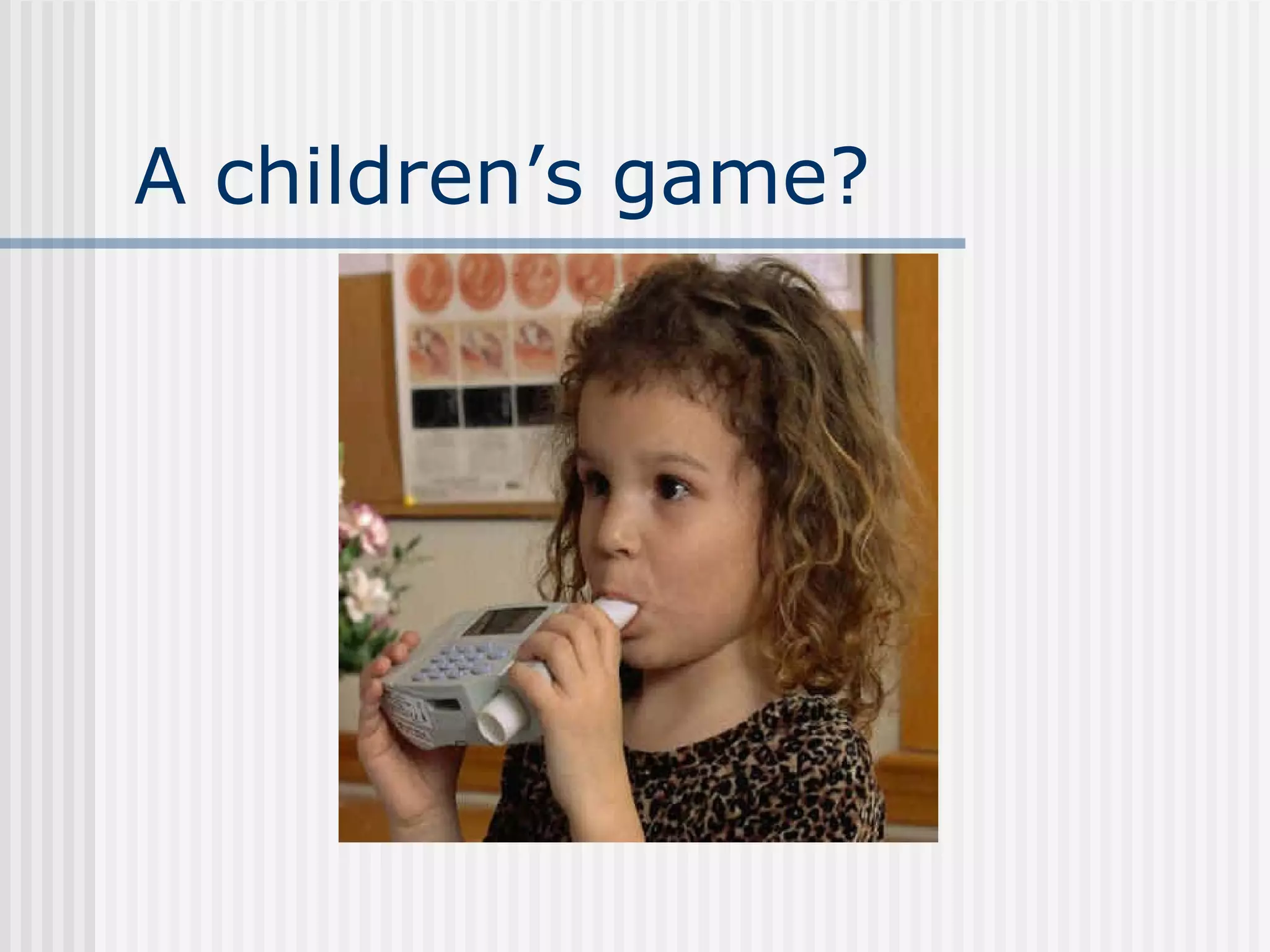
A children’s game?
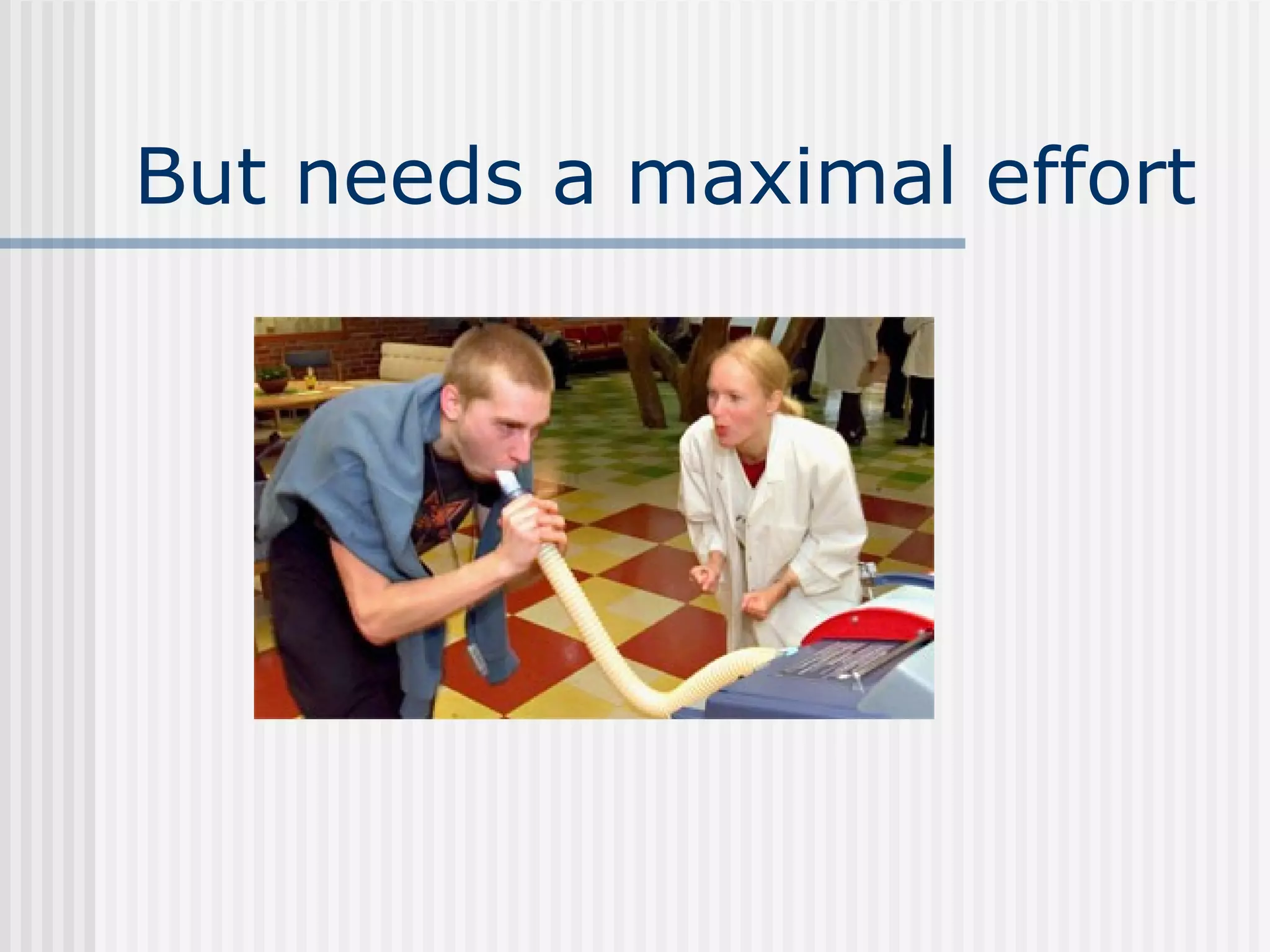
But needs a maximal effort
Where can I get
spirometry?
 Hospital services
 Pneumologist
 Many general practitioners
 new technique for primary care
 Lung function lab
SPIROMETRY
 Is a safe and simple test
 Provides useful data
 Is underused until now…
Blow to know !

Spirometry