Ventilator Management in Different Disease Entities
Mechanical Ventilation Use of sophisticated life support technology aimed at maintaining tissue oxygenation and removal of carbon dioxide Support or replace the normal ventilatory pump in moving air into and out of the lungs – inadequate or absent spontaneous breathing
Mechanical Ventilation Not without risk – complications and hazards an be life threatening Decision to initiate mechanical ventilation Serious one Sound clinical judgment Clear understanding of the indications and associated goals
Indications for Mechanical  Ventilatory Support Respiratory failure  An inability of the heart and lungs to provide adequate tissue oxygenation or removal of carbon dioxide Acute respiratory failure PaO2 < 60 mm Hg SpO2 < 90%  With or without  PaCO2 > 45 mm Hg
Acute Respiratory Failure Hypoxemic respiratory failure – lung failure Hypercapnic respiratory failure – pump failure Acute ventilatory failure A sudden increase in PaCO2 with a corresponding decrease in pH Chronic ventilatory failure Elevated PaCO2 with a normal or near normal pH
Initial Ventilator Setup Key Decisions Indications for ventilatory support present Negative pressure versus positive pressure ventilation Non-invasive versus invasive positive pressure ventilation Type and method of establishment of an airway Pressure versus volume ventilation Partial or full ventilatory support Choice of ventilator Mode of ventilation Assist-control ventilation versus SIMV (with or without pressure support) Pressure support Pressure control Mixed or dual control modes Other newer modes of adjuncts
Indications for Mechanical Ventilation in ARDS  Hypoxemia Application of PEEP Delivery of high FiO2 Increased work of breathing Use of ventilator to reduce work of breathing Impending or acute ventilatory failure Maintenance of normal pH and/or PaCO2
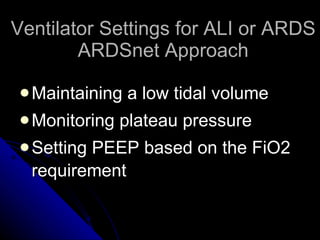
Ventilator Settings for ALI or ARDS ARDSnet Approach Maintaining a low tidal volume  Monitoring plateau pressure Setting PEEP based on the FiO2 requirement
Lower Tidal Volume Ventilation Strategy NIH ARDS Network Calculate predicted body weight Male : PBW (kg) = 50 ± 2.3 [(height in inches)-60]  = 50 ± 0.91[(height in cm) –152.4] Female :  PBW (kg) = 45.5 ± 2.3 [(height in inches)-60]  = 45.5 ± 0.91[(height in cm) –152.4] Ventilator mode : Volume assist/control until weaning
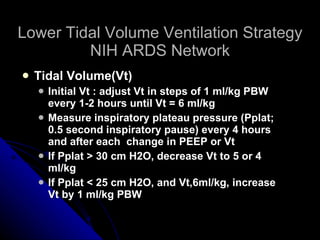
Lower Tidal Volume Ventilation Strategy NIH ARDS Network Tidal Volume(Vt) Initial Vt : adjust Vt in steps of 1 ml/kg PBW every 1-2 hours until Vt = 6 ml/kg Measure inspiratory plateau pressure (Pplat; 0.5 second inspiratory pause) every 4 hours and after each  change in PEEP or Vt If Pplat > 30 cm H2O, decrease Vt to 5 or 4 ml/kg If Pplat < 25 cm H2O, and Vt,6ml/kg, increase Vt by 1 ml/kg PBW
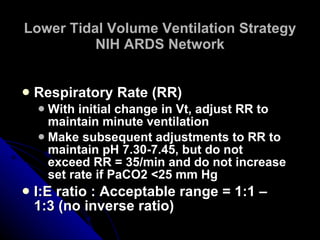
Lower Tidal Volume Ventilation Strategy NIH ARDS Network Respiratory Rate (RR) With initial change in Vt, adjust RR to maintain minute ventilation Make subsequent adjustments to RR to maintain pH 7.30-7.45, but do not exceed RR = 35/min and do not increase set rate if PaCO2 <25 mm Hg I:E ratio : Acceptable range = 1:1 – 1:3 (no inverse ratio)
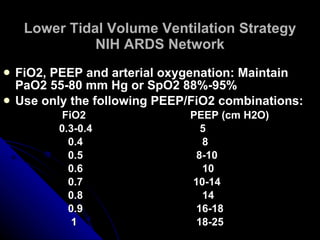
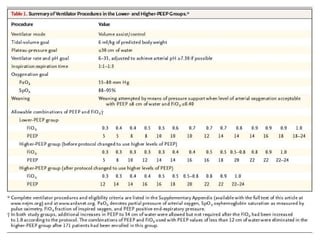
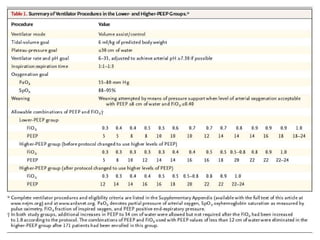
Lower Tidal Volume Ventilation Strategy NIH ARDS Network FiO2, PEEP and arterial oxygenation: Maintain PaO2 55-80 mm Hg or SpO2 88%-95% Use only the following PEEP/FiO2 combinations: FiO2  PEEP (cm H2O) 0.3-0.4  5 0.4  8 0.5  8-10 0.6  10 0.7  10-14 0.8  14 0.9  16-18 1  18-25
Lower Tidal Volume Ventilation Strategy NIH ARDS Network Acidosis management If pH<7.30, increase RR until pH>1≧7.30 or RR=35/min If pH remains <7.30 with RR = 35, consider bicarbonate infusion If pH <7.15, Vt may be increased (Pplat may exceed 30 cm H2O) Alkalosis management If pH > 7.45 and patient not triggering ventilator, decrease set RR but not below 6/min
Lower Tidal Volume Ventilation Strategy NIH ARDS Network Weaning Initiate weaning by pressure support when all of the following criteria are present: FiO2 <0.4 and PEEP<8cm H2O Not receiving neuromuscular blocking agents Inspiratory efforts are apparent (ventilator rate may be decreased to 50%of baseline level for up to 5 minutes to detect inspiratory effort) Systolic arterial pressure > 90 mm Hg without vasopressor support
Traditional Tidal Volume  NIH ARDS Network Volume assist control Tidal Volume(Vt) : 12 ml/kg predicted  body weight Plateau pressure : < 50 cm H2O Ventilator rate setting needed to achieve a pH goal of 7.3-7.45  : 6-35 breath/min I;E ratio  : 1:1 – 1:3
Patients Excluded in  NIH ARDS Network Study 36 hours had elapsed since they met the first three criteria Younger than 18 years of age Participated in other trials within 30 days before the three criteria were met Pregnant Neuromuscular disease that impair spontaneous breathing Sickle cell disease Severe chronic respiratory disease
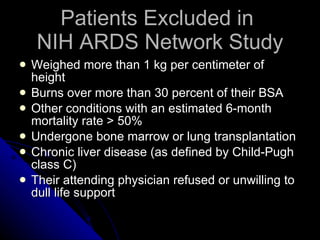
Patients Excluded in  NIH ARDS Network Study Weighed more than 1 kg per centimeter of height Burns over more than 30 percent of their BSA Other conditions with an estimated 6-month mortality rate > 50% Undergone bone marrow or lung transplantation Chronic liver disease (as defined by Child-Pugh class C) Their attending physician refused or unwilling to dull life support
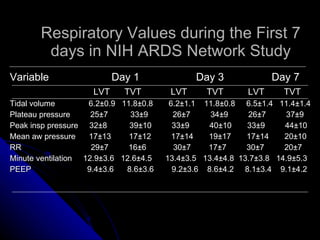
Respiratory Values during the First 7 days in NIH ARDS Network Study Variable  Day 1  Day 3  Day 7 LVT  TVT  LVT  TVT  LVT  TVT Tidal volume  6.2±0.9  11.8±0.8  6.2±1.1  11.8±0.8  6.5±1.4  11.4±1.4 Plateau pressure  25±7  33±9  26±7  34±9  26±7  37±9 Peak insp pressure  32±8  39±10  33±9  40±10  33±9  44±10 Mean aw pressure  17±13  17±12  17±14  19±17  17±14  20±10 RR  29±7  16±6  30±7  17±7  30±7  20±7 Minute ventilation  12.9±3.6  12.6±4.5  13.4±3.5  13.4±4.8  13.7±3.8  14.9±5.3 PEEP  9.4±3.6  8.6±3.6  9.2±3.6  8.6±4.2  8.1±3.4  9.1±4.2
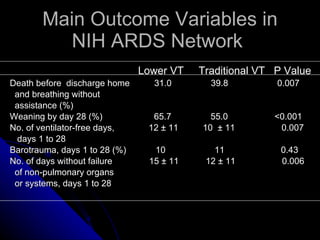
Main Outcome Variables in NIH ARDS Network  Lower VT  Traditional VT  P Value Death before  discharge home  31.0  39.8  0.007 and breathing without  assistance (%) Weaning by day 28 (%)  65.7  55.0  <0.001 No. of ventilator-free days,  12 ± 11  10  ± 11  0.007 days 1 to 28 Barotrauma, days 1 to 28 (%)  10  11  0.43 No. of days without failure  15 ± 11  12 ± 11  0.006 of non-pulmonary organs or systems, days 1 to 28
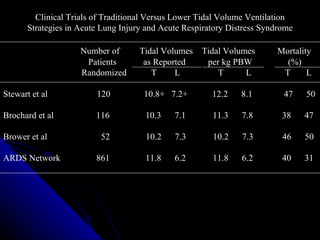
Clinical Trials of Traditional Versus Lower Tidal Volume Ventilation Strategies in Acute Lung Injury and Acute Respiratory Distress Syndrome Number of  Tidal Volumes  Tidal Volumes  Mortality  Patients  as Reported  per kg PBW  (%) Randomized  T  L  T  L  T  L Stewart et al  120  10.8+  7.2+  12.2  8.1  47  50 Brochard et al  116  10.3  7.1  11.3  7.8  38  47 Brower et al  52  10.2  7.3  10.2  7.3  46  50 ARDS Network  861  11.8  6.2  11.8  6.2  40  31
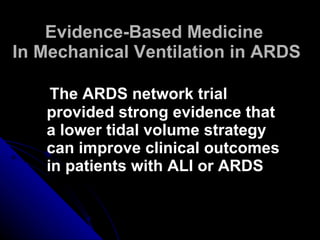
Evidence-Based Medicine  In Mechanical Ventilation in ARDS The ARDS network trial provided strong evidence that a lower tidal volume strategy can improve clinical outcomes in patients with ALI or ARDS
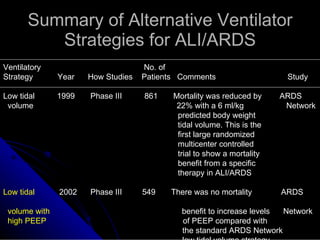
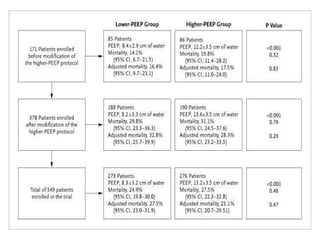
Summary of Alternative Ventilator Strategies for ALI/ARDS Ventilatory  No. of Strategy  Year  How Studies  Patients  Comments  Study  Low tidal  1999  Phase III  861  Mortality was reduced by  ARDS  volume  22% with a 6 ml/kg  Network predicted body weight tidal volume. This is the  first large randomized multicenter controlled  trial to show a mortality  benefit from a specific  therapy in ALI/ARDS Low tidal   2002  Phase III  549  There was no mortality  ARDS  volume with   benefit to increase levels  Network high PEEP   of PEEP compared with the standard ARDS Network  low tidal volume strategy
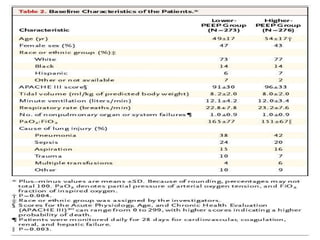
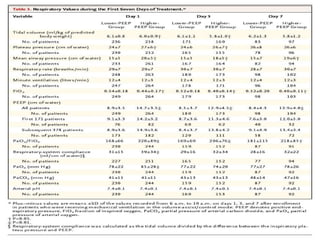
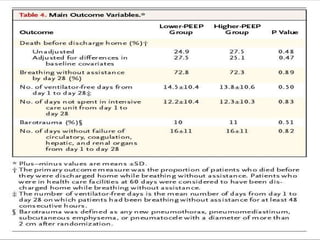
Higher versus Lower Positive End-Expiratory Pressures in Patients with the Acute Respiratory Distress Syndrome ARDS Network NEJM 2002
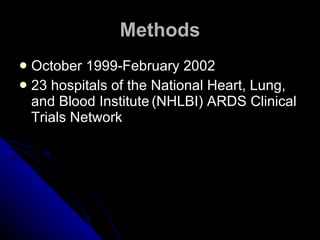
Methods October 1999-February 2002 23 hospitals of the National Heart, Lung, and Blood Institute   (NHLBI) ARDS Clinical Trials Network
Patient Intubation with MV due to  a sudden decrease in the ratio of   the PaO 2 /FiO 2 ≦   300 a recent appearance of bilateral pulmonary   infiltrates consistent with the presence of edema no clinical   evidence of left atrial hypertension (defined by PAWP≦18 mmHg)
Criteria of exclusion <13 y/o participated   in other trials involving ALI within the preceding   30 days;  Pregnant;  IICP severe neuromuscular disease,  sickle cell disease,   severe chronic respiratory disease,
Criteria of exclusion BW>   1 kg/cm,  Burns> 40 % BSA,  Severe chronic liver disease,  Vasculitis   with diffuse alveolar hemorrhage,  A coexisting condition   associated with an estimated 6-month mortality rate >50 %;  Post- BMT or lung transplant;   Their attending physician refused to allow enrollment.


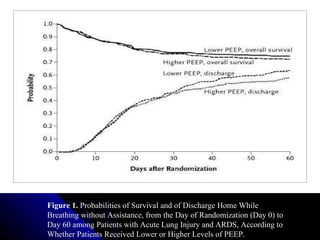
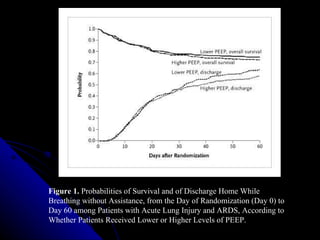
Figure 1.  Probabilities of Survival and of Discharge Home While Breathing without Assistance, from the Day of Randomization (Day 0) to Day 60 among Patients with Acute Lung Injury and ARDS, According to Whether Patients Received Lower or Higher Levels of PEEP.
 
 
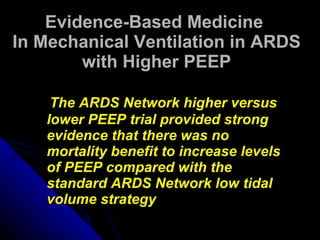
Evidence-Based Medicine  In Mechanical Ventilation in ARDS with Higher PEEP The ARDS Network higher versus lower PEEP trial provided strong evidence that there was no mortality benefit to increase levels of PEEP compared with the standard ARDS Network low tidal volume strategy
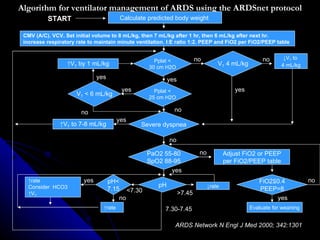
Algorithm for ventilator management of ARDS using the ARDSnet protocol Calculate predicted body weight  CMV (A/C). VCV. Set initial volume to 8 mL/kg, then 7 mL/kg after 1 hr, then 6 mL/kg after next hr.  increase respiratory rate to maintain minute ventilation. I:E ratio 1:2. PEEP and FiO2 per FiO2/PEEP table Pplat < 30 cm H2O Adjust FiO2 or PEEP per FiO2/PEEP table ↑ rate ↑ V T  by 1 mL/kg ↑ V T  to 7-8 mL/kg ↓ V T  to  4 mL/kg ↓ rate ↑ rate Consider  HCO3  ↑ V T   Evaluate for weaning V T  4 mL/kg Pplat < 25 cm H2O V T  < 6 mL/kg Severe dyspnea PaO2 55-80 SpO2 88-95 FiO2≦0.4 PEEP=8 pH pH< 7.15 START no no no no no no no no yes yes yes yes yes yes yes yes 7.30-7.45 >7.45 <7.30 ARDS Network N Engl J Med 2000; 342:1301
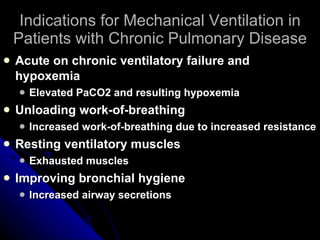
Indications for Mechanical Ventilation in Patients with Chronic Pulmonary Disease Acute on chronic ventilatory failure and hypoxemia Elevated PaCO2 and resulting hypoxemia Unloading work-of-breathing Increased work-of-breathing due to increased resistance Resting ventilatory muscles Exhausted muscles Improving bronchial hygiene Increased airway secretions
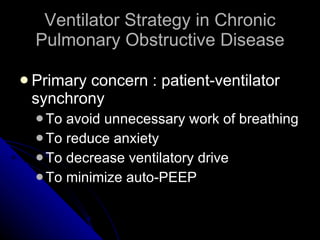
Ventilator Strategy in Chronic Pulmonary Obstructive Disease Primary concern : patient-ventilator synchrony To avoid unnecessary work of breathing To reduce anxiety To decrease ventilatory drive To minimize auto-PEEP
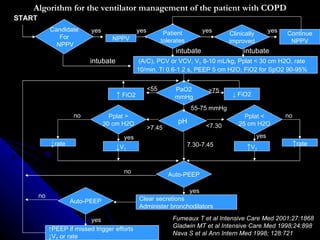
Algorithm for the ventilator management of the patient with COPD (A/C), PCV or VCV, V T  8-10 mL/kg, Pplat < 30 cm H2O, rate  10/min, Ti 0.6-1.2 s, PEEP 5 cm H2O, FiO2 for SpO2 90-95% Clear secretions Administer bronchodilators ↑ PEEP if missed trigger efforts ↓ V T  or rate ↓  FiO2 ↑   FiO2 ↑ rate ↑ V T NPPV Continue NPPV Candidate For NPPV Patient tolerates Clinically improved PaO2 mmHg pH Pplat < 25 cm H2O Pplat > 30 cm H2O ↓ rate ↓ V T Auto-PEEP Auto-PEEP START yes yes yes yes yes yes no no yes no yes no >75 55-75 mmHg <55 7.30-7.45 <7.30 >7.45 intubate intubate intubate Fumeaux T et al Intensive Care Med 2001;27:1868 Gladwin MT et al Intensive Care Med 1998;24:898 Nava S et al Ann Intern Med 1998; 128:721
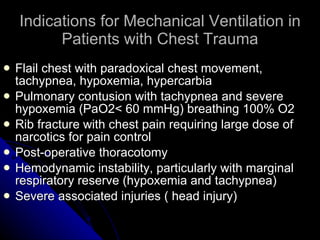
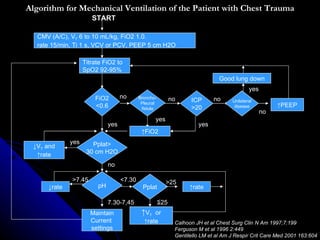
Indications for Mechanical Ventilation in Patients with Chest Trauma Flail chest with paradoxical chest movement, tachypnea, hypoxemia, hypercarbia Pulmonary contusion with tachypnea and severe hypoxemia (PaO2< 60 mmHg) breathing 100% O2 Rib fracture with chest pain requiring large dose of narcotics for pain control Post-operative thoracotomy Hemodynamic instability, particularly with marginal respiratory reserve (hypoxemia and tachypnea) Severe associated injuries ( head injury)
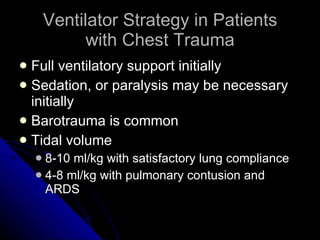
Ventilator Strategy in Patients with Chest Trauma Full ventilatory support initially Sedation, or paralysis may be necessary initially Barotrauma is common Tidal volume 8-10 ml/kg with satisfactory lung compliance 4-8 ml/kg with pulmonary contusion and ARDS
Algorithm for Mechanical Ventilation of the Patient with Chest Trauma START Calhoon JH et al Chest Surg Clin N Am 1997;7:199 Ferguson M et al 1996 2:449 Gentilello LM et al Am J Respir Crit Care Med 2001 163:604 CMV (A/C), V T  6 to 10 mL/kg, FiO2 1.0. rate 15/min, Ti 1 s, VCV or PCV, PEEP 5 cm H2O Titrate FiO2 to SpO2 92-95% Good lung down ↑ PEEP ↓ V T  and ↑ rate ↑ FiO2 Maintain Current  settings ↓ rate ↑ rate ↑ V T   or ↑ rate FiO2 <0.6 Broncho- Pleural fistula ICP >20 Unilateral disease Pplat> 30 cm H2O Pplat pH no no no no yes yes yes yes yes Unilateral disease no >25 ≦ 25 >7.45 7.30-7,45 <7.30
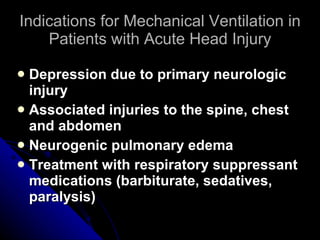
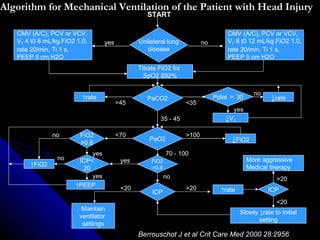
Indications for Mechanical Ventilation in Patients with Acute Head Injury Depression due to primary neurologic injury Associated injuries to the spine, chest and abdomen Neurogenic pulmonary edema Treatment with respiratory suppressant medications (barbiturate, sedatives, paralysis)
Algorithm for Mechanical Ventilation of the Patient with Head Injury Unilateral lung disease CMV (A/C), PCV or VCV, V T  4 t0 8 mL/kg.FiO2 1.0, rate 20/min, Ti 1 s,  PEEP 5 cm H2O CMV (A/C), PCV or VCV, V T  8 t0 12 mL/kg.FiO2 1.0, rate 20/min, Ti 1 s,  PEEP 5 cm H2O Titrate FiO2 for  SpO2 ≧92% PaCO2 Pplat > 30 PaO2 FiO2 >0.6 ICP ICP ICP< 20 FiO2 >0.6 Maintain ventilator  settings More aggressive Medical therapy Slowly ↓rate to initial setting ↑ rate ↓ rate ↓ V T ↑ rate ↓ FiO2 ↑ FiO2 ↑ PEEP START yes yes no no no yes <35 >45 35 - 45 >100 70 - 100 <70 no no yes >20 <20 >20 <20 no Berrouschot J et al Crit Care Med 2000 28:2956 yes
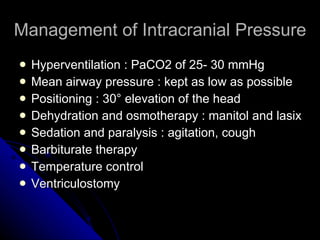
Management of Intracranial Pressure Hyperventilation : PaCO2 of 25- 30 mmHg Mean airway pressure : kept as low as possible Positioning : 30 ° elevation of the head Dehydration and osmotherapy : manitol and lasix Sedation and paralysis : agitation, cough Barbiturate therapy Temperature control Ventriculostomy
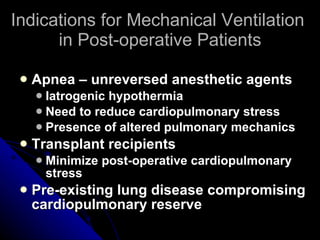
Indications for Mechanical Ventilation  in Post-operative Patients Apnea – unreversed anesthetic agents Iatrogenic hypothermia Need to reduce cardiopulmonary stress Presence of altered pulmonary mechanics Transplant recipients Minimize post-operative cardiopulmonary stress Pre-existing lung disease compromising cardiopulmonary reserve
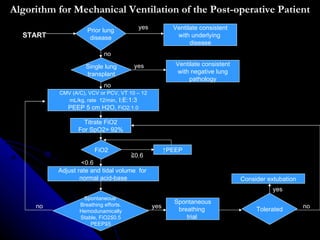
Algorithm for Mechanical Ventilation of the Post-operative Patient Ventilate consistent with underlying  disease Ventilate consistent with negative lung pathology Consider extubation Spontaneous breathing  trial  Titrate FiO2 For SpO2> 92% CMV (A/C), VCV or PCV, VT 10 – 12 mL/kg, rate  12/min , I;E:1:3 PEEP 5 cm H2O,  FiO2:1.0 Adjust rate and tidal volume  for  normal acid-base ↑ PEEP Prior lung disease Single lung transplant Tolerated Spontaneous  Breathing efforts. Hemodunamically Stable, FiO2≦0.5 PEEP≦5 FiO2 START yes yes no no yes no yes no ≧ 0.6 <0.6
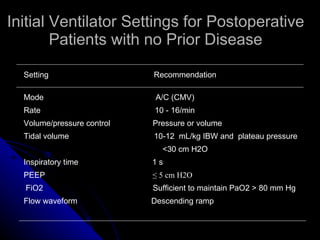
Initial Ventilator Settings for Postoperative Patients with no Prior Disease Setting  Recommendation Mode  A/C (CMV) Rate  10 - 16/min Volume/pressure control  Pressure or volume Tidal volume  10-12  mL/kg IBW and  plateau pressure  <30 cm H2O Inspiratory time  1 s PEEP  ≤ 5 cm H2O FiO2  Sufficient to maintain PaO2 > 80 mm Hg Flow waveform  Descending ramp
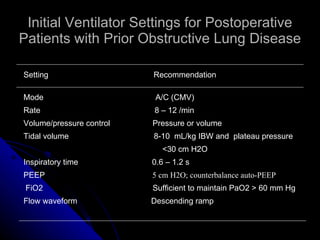
Initial Ventilator Settings for Postoperative Patients with Prior Obstructive Lung Disease Setting  Recommendation Mode  A/C (CMV) Rate  8 – 12 /min Volume/pressure control  Pressure or volume Tidal volume  8-10  mL/kg IBW and  plateau pressure  <30 cm H2O Inspiratory time  0.6 – 1.2 s PEEP  5 cm H2O; counterbalance auto-PEEP FiO2  Sufficient to maintain PaO2 > 60 mm Hg Flow waveform  Descending ramp
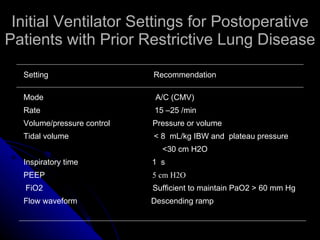
Initial Ventilator Settings for Postoperative Patients with Prior Restrictive Lung Disease Setting  Recommendation Mode  A/C (CMV) Rate  15 –25 /min Volume/pressure control  Pressure or volume Tidal volume  <  8  mL/kg IBW and  plateau pressure  <30 cm H2O Inspiratory time  1  s PEEP  5 cm H2O FiO2  Sufficient to maintain PaO2 > 60 mm Hg Flow waveform  Descending ramp
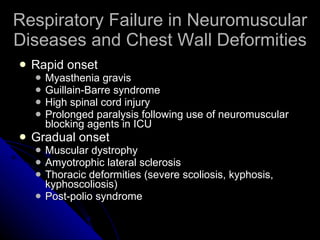
Respiratory Failure in Neuromuscular Diseases and Chest Wall Deformities Rapid onset Myasthenia gravis Guillain-Barre syndrome High spinal cord injury Prolonged paralysis following use of neuromuscular blocking agents in ICU Gradual onset Muscular dystrophy Amyotrophic lateral sclerosis Thoracic deformities (severe scoliosis, kyphosis, kyphoscoliosis)  Post-polio syndrome
Indications for Mechanical Ventilation in Patients with Neuromuscular Disease Progressive ventilatory failure Acute ventilatory failure Oxygenation is not usually an issue – except in patients with acquired critical illness neuromusculopathy  following prolonged mechanical ventilation
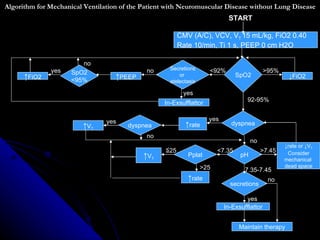
Algorithm for Mechanical Ventilation of the Patient with Neuromuscular Disease without Lung Disease CMV (A/C), VCV, V T  15 mL/kg, FiO2 0.40 Rate 10/min, Ti 1 s, PEEP 0 cm H2O ↓ FiO2 ↑ FiO2 ↑ PEEP In-Exsufflattor ↑ V T ↑ V T ↑ rate ↑ rate In-Exsufflattor Maintain therapy ↓ rate or ↓V T Consider mechanical  dead space Secretions or  atelectasis dyspnea dyspnea secretions pH Pplat SpO2 <95% SpO2 START yes yes yes no no yes no no no yes >7.45 7.35-7.45 <7.35 >25 ≦ 25 >95% <92% 92-95%
Methods to Treat Atelectasis In-exsufflator Maximal insufflation capacity Hyperinflation Assisted cough Peak cough flow > 160 L/min
 
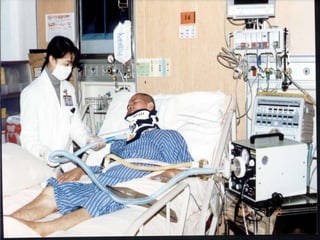
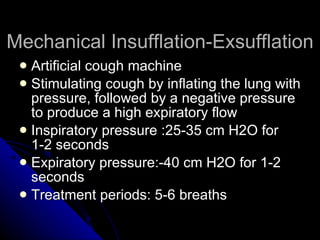
Mechanical Insufflation-Exsufflation Artificial cough machine Stimulating cough by inflating the lung with pressure, followed by a negative pressure to produce a high expiratory flow Inspiratory pressure :25-35 cm H2O for 1-2 seconds Expiratory pressure:-40 cm H2O for 1-2 seconds Treatment periods: 5-6 breaths
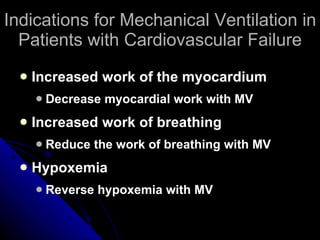
Indications for Mechanical Ventilation in Patients with Cardiovascular Failure Increased work of the myocardium Decrease myocardial work with MV Increased work of breathing Reduce the work of breathing with MV Hypoxemia Reverse hypoxemia with MV
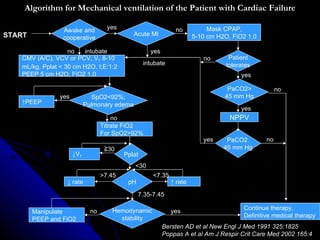
Algorithm for Mechanical ventilation of the Patient with Cardiac Failure Bersten AD et al New Engl J Med 1991 325:1825 Poppas A et al Am J Respir Crit Care Med 2002 165:4 Awake and cooperative Patient tolerates PaCO2> 45 mm Hg PaCO2. 45 mm Hg Acute MI Pplat pH Hemodynamic stability SpO2<92%; Pulmonary edema CMV (A/C), VCV or PCV, V T  8-10 mL/kg, Pplat < 30 cm H2O, I;E:1:2 PEEP 5 cm H2O, FiO2 1.0 Mask CPAP, 5-10 cm H2O, FiO2 1.0 Continue therapy, Definitive medical therapy Titrate FiO2 For SpO2>92% ↑ PEEP NPPV Manipulate  PEEP and FiO2 ↑  rate ↓ V T ↓  rate START yes yes yes yes yes no no yes no no no no intubate intubate <30 ≧ 30 <7.35 7.35-7.45 >7.45 no yes
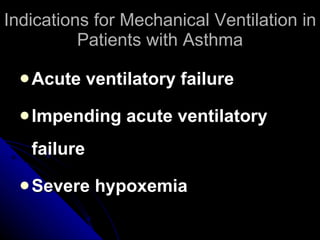
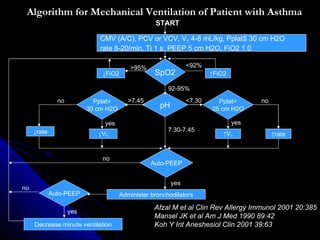
Indications for Mechanical Ventilation in Patients with Asthma Acute ventilatory failure Impending acute ventilatory failure Severe hypoxemia
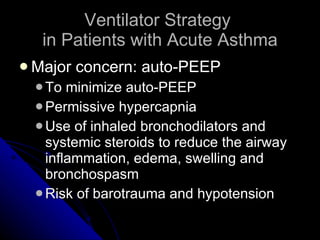
Ventilator Strategy  in Patients with Acute Asthma Major concern: auto-PEEP To minimize auto-PEEP Permissive hypercapnia Use of inhaled bronchodilators and systemic steroids to reduce the airway inflammation, edema, swelling and bronchospasm Risk of barotrauma and hypotension
Algorithm for Mechanical Ventilation of Patient with Asthma START Decrease minute ventilation CMV (A/C), PCV or VCV, V T  4-8 mL/kg, Pplat≦ 30 cm H2O rate 8-20/min, Ti 1 s, PEEP 5 cm H2O, FiO2 1.0 SpO2 Auto-PEEP Auto-PEEP Pplat< 25 cm H2O pH Pplat> 30 cm H2O Administer bronchodilators ↑ V T ↑ rate ↑ FiO2 ↓ FiO2 ↓ V T ↓ rate yes yes yes yes no no no 92-95% >95% <92% >7.45 <7.30 7.30-7.45 Afzal M et al Clin Rev Allergy Immunol 2001 20:385 Mansel JK et al Am J Med 1990 89:42 Koh Y Int Aneshesiol Clin 2001 39:63 no
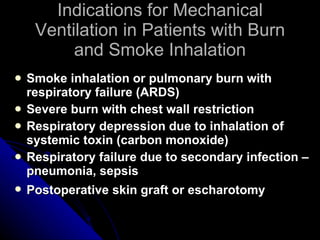
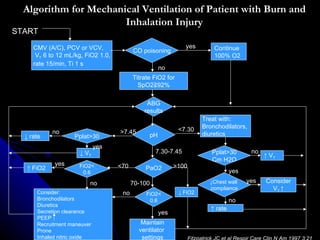
Indications for Mechanical Ventilation in Patients with Burn and Smoke Inhalation Smoke inhalation or pulmonary burn with respiratory failure (ARDS) Severe burn with chest wall restriction Respiratory depression due to inhalation of systemic toxin (carbon monoxide) Respiratory failure due to secondary infection – pneumonia, sepsis Postoperative skin graft or escharotomy
Algorithm for Mechanical Ventilation of Patient with Burn and Inhalation Injury Fitzpatrick JC et al Respir Care Clin N Am 1997 3:21 CMV (A/C), PCV or VCV, V T  6 to 12 mL/kg, FiO2 1.0, rate 15/min, Ti 1 s Consider: Bronchodilators Diuretics Secretion clearance PEEP Recruitment maneuver Prone Inhaled nitric oxide Treat with: Bronchodilators,  diuretics Titrate FiO2 for SpO2≧92% Maintain ventilator  settings ↑  rate ↑  V T ↑  FiO2 ↓  V T ↓  rate Consider V T  ↑ ↓  FiO2 ↓ Chest wall  compliance Pplat>30 pH PaO2 FiO2< 0.6 FiO2< 0.6 ABG results Pplat>30 Cm H2O yes yes yes yes yes no no no no no no <7.30 >7.45 7.30-7.45 >100 <70 70-100 Continue  100% O2 CO poisoning yes START
Indications for Mechanical Ventilation in Patients with Bronchopleural Fistula Bronchopleural fistula is not by itself an indication for mechanical ventilation, but may be necessary in the following settings: Apnea Acute ventilatory failure Impending acute ventilatory failure Oxygen deficit
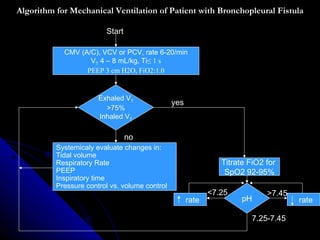
Algorithm for Mechanical Ventilation of Patient with Bronchopleural Fistula CMV (A/C), VCV or PCV, rate 6-20/min V T  4 – 8 mL/kg, Ti ≤ 1 s PEEP 3 cm H2O, FiO2:1.0 Exhaled V T >75% Inhaled V T Systemicaly evaluate changes in: Tidal volume Respiratory Rate PEEP Inspiratory time Pressure control vs. volume control Titrate FiO2 for  SpO2 92-95% pH rate rate Start yes no 7.25-7.45 >7.45 <7.25
Indications for Mechanical Ventilation in Patients with Drug Overdose Apnea Acute respiratory failure Impending acute respiratory failure
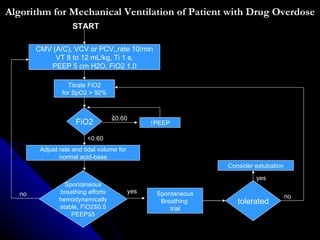
Algorithm for Mechanical Ventilation of Patient with Drug Overdose CMV (A/C), VCV or PCV,,rate 10/min VT 8 to 12 mL/kg, Ti 1 s, PEEP 5 cm H2O, FiO2 1.0 Spontaneous Breathing  trial Consider extubation ↑ PEEP Titrate FiO2 for SpO2 > 92% Adjust rate and tidal volume for normal acid-base FiO2 tolerated Spontaneous breathing efforts hemodynamically stable, FiO2≦0.5 PEEP≦5 START yes yes no no <0.60 ≧ 0.60
謝謝  ! 如有問題請發問  !
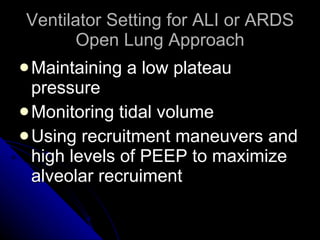
Ventilator Setting for ALI or ARDS Open Lung Approach Maintaining a low plateau pressure Monitoring tidal volume Using recruitment maneuvers and high levels of PEEP to maximize alveolar recruiment
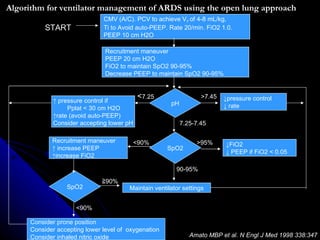
Algorithm for ventilator management of ARDS using the open lung approach Consider prone position Consider accepting lower level of  oxygenation Consider inhaled nitric oxide CMV (A/C). PCV to achieve V T  of 4-8 mL/kg,  Ti to Avoid auto-PEEP. Rate 20/min. FiO2 1.0.  PEEP 10 cm H2O Recruitment maneuver  PEEP 20 cm H2O FiO2 to maintain SpO2 90-95% Decrease PEEP to maintain SpO2 90-95% ↑  pressure control if  Pplat < 30 cm H2O ↑ rate (avoid auto-PEEP) Consider accepting lower pH Recruitment maneuver ↑  increase PEEP ↑ increase FiO2 Maintain ventilator settings ↓ FiO2 ↓  PEEP if FiO2 < 0.05 ↓ pressure control ↓  rate SpO2 SpO2 pH <90% ≧ 90% 90-95% >95% <90% 7.25-7.45 < 7.25 >7.45 START Amato MBP et al. N Engl J Med 1998 338:347
The ARDSnet protocol for ventilation of patients with ALI and ARDS Initial ventilator tidal volume and rate adjustment Calculate predicted body weight Male = 50 + 2.3 [ht (in) – 60 ] kg Female = 45.5 + 2.3 [ht (in) – 60 ] kg Mode : volume Assist-Control Set initial tidal volume to 8 mL/kg PBW Reduce tidal volume to 7 mL/kg PBW after 1-2 hrs and then to 6 mL/kg PBW after a further 1-2 hrs Set initial ventilator rate to maintain baseline minute ventilation (not > 35 /min) ARDS Network N Engl J Med 2000; 342:1301
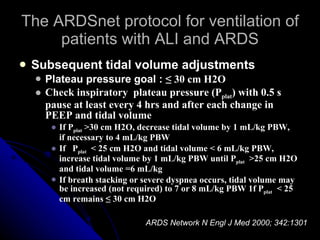
The ARDSnet protocol for ventilation of patients with ALI and ARDS Subsequent tidal volume adjustments Plateau pressure goal :  ≤ 30 cm H2O Check inspiratory  plateau pressure (P plat ) with 0.5 s pause at least every 4 hrs and after each change in  PEEP and tidal volume If P plat  >30 cm H2O, decrease tidal volume by 1 mL/kg PBW,  if necessary to 4 mL/kg PBW If  P plat   < 25 cm H2O and tidal volume < 6 mL/kg PBW, increase tidal volume by 1 mL/kg PBW until P plat   >25 cm H2O and tidal volume =6 mL/kg  If breath stacking or severe dyspnea occurs, tidal volume may be increased (not required) to 7 or 8 mL/kg PBW 1f P plat   < 25 cm remains ≤ 30 cm H2O ARDS Network N Engl J Med 2000; 342:1301
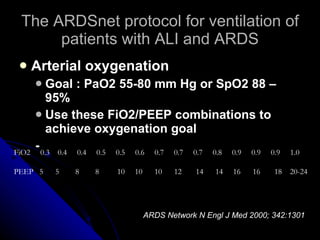
The ARDSnet protocol for ventilation of patients with ALI and ARDS Arterial oxygenation Goal : PaO2 55-80 mm Hg or SpO2 88 – 95% Use these FiO2/PEEP combinations to achieve oxygenation goal - FiO2  0.3  0.4  0.4  0.5  0.5  0.6  0.7  0.7  0.7  0.8  0.9  0.9  0.9  1.0  PEEP  5  5  8  8  10  10  10  12  14  14  16  16  18  20-24  ARDS Network N Engl J Med 2000; 342:1301
 
Figure 1.  Probabilities of Survival and of Discharge Home While Breathing without Assistance, from the Day of Randomization (Day 0) to Day 60 among Patients with Acute Lung Injury and ARDS, According to Whether Patients Received Lower or Higher Levels of PEEP.
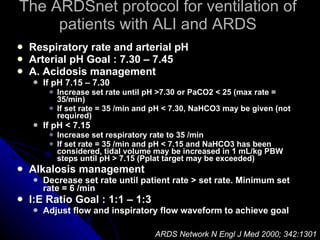
The ARDSnet protocol for ventilation of patients with ALI and ARDS Respiratory rate and arterial pH Arterial pH Goal : 7.30 – 7.45 A. Acidosis management If pH 7.15 – 7.30 Increase set rate until pH >7.30 or PaCO2 < 25 (max rate = 35/min) If set rate = 35 /min and pH < 7.30, NaHCO3 may be given (not required) If pH < 7.15 Increase set respiratory rate to 35 /min If set rate = 35 /min and pH < 7.15 and NaHCO3 has been considered, tidal volume may be increased in 1 mL/kg PBW steps until pH > 7.15 (Pplat target may be exceeded) Alkalosis management Decrease set rate until patient rate > set rate. Minimum set rate = 6 /min I:E Ratio Goal : 1:1 – 1:3 Adjust flow and inspiratory flow waveform to achieve goal ARDS Network N Engl J Med 2000; 342:1301
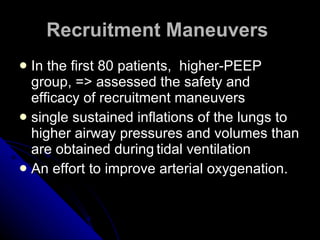
Recruitment Maneuvers   In the first 80 patients,  higher-PEEP   group, => assessed the safety and efficacy of recruitment maneuvers single sustained inflations of the lungs to   higher airway pressures and volumes than are obtained during   tidal ventilation An effort to improve arterial oxygenation.
Recruitment Maneuvers One or two such maneuvers were conducted during the first four   days, by applying CPAP 35 to 40 cmH2O for 30 seconds.  The subsequent   mean increase in arterial oxygenation was small and transient. Discontinued recruitment maneuvers for the remainder   of the trial.
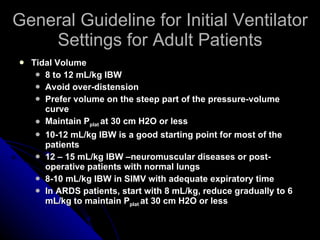
General Guideline for Initial Ventilator Settings for Adult Patients Tidal Volume 8 to 12 mL/kg IBW Avoid over-distension Prefer volume on the steep part of the pressure-volume curve Maintain P plat  at 30 cm H2O or less 10-12 mL/kg IBW is a good starting point for most of the patients 12 – 15 mL/kg IBW –neuromuscular diseases or post-operative patients with normal lungs  8-10 mL/kg IBW in SIMV with adequate expiratory time  In ARDS patients, start with 8 mL/kg, reduce gradually to 6 mL/kg to maintain P plat  at 30 cm H2O or less
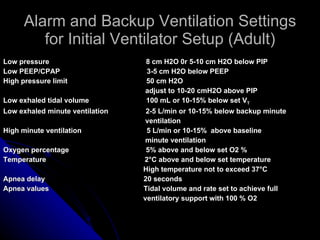
Alarm and Backup Ventilation Settings for Initial Ventilator Setup (Adult) Low pressure  8 cm H2O 0r 5-10 cm H2O below PIP Low PEEP/CPAP  3-5 cm H2O below PEEP High pressure limit  50 cm H2O  adjust to 10-20 cmH2O above PIP Low exhaled tidal volume  100 mL or 10-15% below set V T Low exhaled minute ventilation  2-5 L/min or 10-15% below backup minute ventilation High minute ventilation  5 L/min or 10-15%  above baseline  minute ventilation  Oxygen percentage  5% above and below set O2 % Temperature  2°C above and below set temperature High temperature not to exceed 37°C Apnea delay  20 seconds Apnea values  Tidal volume and rate set to achieve full  ventilatory support with 100 % O2

Ventilator Management In Different Disease Entities

  • 1.
    Ventilator Management inDifferent Disease Entities
  • 2.
    Mechanical Ventilation Useof sophisticated life support technology aimed at maintaining tissue oxygenation and removal of carbon dioxide Support or replace the normal ventilatory pump in moving air into and out of the lungs – inadequate or absent spontaneous breathing
  • 3.
    Mechanical Ventilation Notwithout risk – complications and hazards an be life threatening Decision to initiate mechanical ventilation Serious one Sound clinical judgment Clear understanding of the indications and associated goals
  • 4.
    Indications for Mechanical Ventilatory Support Respiratory failure An inability of the heart and lungs to provide adequate tissue oxygenation or removal of carbon dioxide Acute respiratory failure PaO2 < 60 mm Hg SpO2 < 90% With or without PaCO2 > 45 mm Hg
  • 5.
    Acute Respiratory FailureHypoxemic respiratory failure – lung failure Hypercapnic respiratory failure – pump failure Acute ventilatory failure A sudden increase in PaCO2 with a corresponding decrease in pH Chronic ventilatory failure Elevated PaCO2 with a normal or near normal pH
  • 6.
    Initial Ventilator SetupKey Decisions Indications for ventilatory support present Negative pressure versus positive pressure ventilation Non-invasive versus invasive positive pressure ventilation Type and method of establishment of an airway Pressure versus volume ventilation Partial or full ventilatory support Choice of ventilator Mode of ventilation Assist-control ventilation versus SIMV (with or without pressure support) Pressure support Pressure control Mixed or dual control modes Other newer modes of adjuncts
  • 7.
    Indications for MechanicalVentilation in ARDS Hypoxemia Application of PEEP Delivery of high FiO2 Increased work of breathing Use of ventilator to reduce work of breathing Impending or acute ventilatory failure Maintenance of normal pH and/or PaCO2
  • 8.
    Ventilator Settings forALI or ARDS ARDSnet Approach Maintaining a low tidal volume Monitoring plateau pressure Setting PEEP based on the FiO2 requirement
  • 9.
    Lower Tidal VolumeVentilation Strategy NIH ARDS Network Calculate predicted body weight Male : PBW (kg) = 50 ± 2.3 [(height in inches)-60] = 50 ± 0.91[(height in cm) –152.4] Female : PBW (kg) = 45.5 ± 2.3 [(height in inches)-60] = 45.5 ± 0.91[(height in cm) –152.4] Ventilator mode : Volume assist/control until weaning
  • 10.
    Lower Tidal VolumeVentilation Strategy NIH ARDS Network Tidal Volume(Vt) Initial Vt : adjust Vt in steps of 1 ml/kg PBW every 1-2 hours until Vt = 6 ml/kg Measure inspiratory plateau pressure (Pplat; 0.5 second inspiratory pause) every 4 hours and after each change in PEEP or Vt If Pplat > 30 cm H2O, decrease Vt to 5 or 4 ml/kg If Pplat < 25 cm H2O, and Vt,6ml/kg, increase Vt by 1 ml/kg PBW
  • 11.
    Lower Tidal VolumeVentilation Strategy NIH ARDS Network Respiratory Rate (RR) With initial change in Vt, adjust RR to maintain minute ventilation Make subsequent adjustments to RR to maintain pH 7.30-7.45, but do not exceed RR = 35/min and do not increase set rate if PaCO2 <25 mm Hg I:E ratio : Acceptable range = 1:1 – 1:3 (no inverse ratio)
  • 12.
    Lower Tidal VolumeVentilation Strategy NIH ARDS Network FiO2, PEEP and arterial oxygenation: Maintain PaO2 55-80 mm Hg or SpO2 88%-95% Use only the following PEEP/FiO2 combinations: FiO2 PEEP (cm H2O) 0.3-0.4 5 0.4 8 0.5 8-10 0.6 10 0.7 10-14 0.8 14 0.9 16-18 1 18-25
  • 13.
    Lower Tidal VolumeVentilation Strategy NIH ARDS Network Acidosis management If pH<7.30, increase RR until pH>1≧7.30 or RR=35/min If pH remains <7.30 with RR = 35, consider bicarbonate infusion If pH <7.15, Vt may be increased (Pplat may exceed 30 cm H2O) Alkalosis management If pH > 7.45 and patient not triggering ventilator, decrease set RR but not below 6/min
  • 14.
    Lower Tidal VolumeVentilation Strategy NIH ARDS Network Weaning Initiate weaning by pressure support when all of the following criteria are present: FiO2 <0.4 and PEEP<8cm H2O Not receiving neuromuscular blocking agents Inspiratory efforts are apparent (ventilator rate may be decreased to 50%of baseline level for up to 5 minutes to detect inspiratory effort) Systolic arterial pressure > 90 mm Hg without vasopressor support
  • 15.
    Traditional Tidal Volume NIH ARDS Network Volume assist control Tidal Volume(Vt) : 12 ml/kg predicted body weight Plateau pressure : < 50 cm H2O Ventilator rate setting needed to achieve a pH goal of 7.3-7.45 : 6-35 breath/min I;E ratio : 1:1 – 1:3
  • 16.
    Patients Excluded in NIH ARDS Network Study 36 hours had elapsed since they met the first three criteria Younger than 18 years of age Participated in other trials within 30 days before the three criteria were met Pregnant Neuromuscular disease that impair spontaneous breathing Sickle cell disease Severe chronic respiratory disease
  • 17.
    Patients Excluded in NIH ARDS Network Study Weighed more than 1 kg per centimeter of height Burns over more than 30 percent of their BSA Other conditions with an estimated 6-month mortality rate > 50% Undergone bone marrow or lung transplantation Chronic liver disease (as defined by Child-Pugh class C) Their attending physician refused or unwilling to dull life support
  • 18.
    Respiratory Values duringthe First 7 days in NIH ARDS Network Study Variable Day 1 Day 3 Day 7 LVT TVT LVT TVT LVT TVT Tidal volume 6.2±0.9 11.8±0.8 6.2±1.1 11.8±0.8 6.5±1.4 11.4±1.4 Plateau pressure 25±7 33±9 26±7 34±9 26±7 37±9 Peak insp pressure 32±8 39±10 33±9 40±10 33±9 44±10 Mean aw pressure 17±13 17±12 17±14 19±17 17±14 20±10 RR 29±7 16±6 30±7 17±7 30±7 20±7 Minute ventilation 12.9±3.6 12.6±4.5 13.4±3.5 13.4±4.8 13.7±3.8 14.9±5.3 PEEP 9.4±3.6 8.6±3.6 9.2±3.6 8.6±4.2 8.1±3.4 9.1±4.2
  • 19.
    Main Outcome Variablesin NIH ARDS Network Lower VT Traditional VT P Value Death before discharge home 31.0 39.8 0.007 and breathing without assistance (%) Weaning by day 28 (%) 65.7 55.0 <0.001 No. of ventilator-free days, 12 ± 11 10 ± 11 0.007 days 1 to 28 Barotrauma, days 1 to 28 (%) 10 11 0.43 No. of days without failure 15 ± 11 12 ± 11 0.006 of non-pulmonary organs or systems, days 1 to 28
  • 20.
    Clinical Trials ofTraditional Versus Lower Tidal Volume Ventilation Strategies in Acute Lung Injury and Acute Respiratory Distress Syndrome Number of Tidal Volumes Tidal Volumes Mortality Patients as Reported per kg PBW (%) Randomized T L T L T L Stewart et al 120 10.8+ 7.2+ 12.2 8.1 47 50 Brochard et al 116 10.3 7.1 11.3 7.8 38 47 Brower et al 52 10.2 7.3 10.2 7.3 46 50 ARDS Network 861 11.8 6.2 11.8 6.2 40 31
  • 21.
    Evidence-Based Medicine In Mechanical Ventilation in ARDS The ARDS network trial provided strong evidence that a lower tidal volume strategy can improve clinical outcomes in patients with ALI or ARDS
  • 22.
    Summary of AlternativeVentilator Strategies for ALI/ARDS Ventilatory No. of Strategy Year How Studies Patients Comments Study Low tidal 1999 Phase III 861 Mortality was reduced by ARDS volume 22% with a 6 ml/kg Network predicted body weight tidal volume. This is the first large randomized multicenter controlled trial to show a mortality benefit from a specific therapy in ALI/ARDS Low tidal 2002 Phase III 549 There was no mortality ARDS volume with benefit to increase levels Network high PEEP of PEEP compared with the standard ARDS Network low tidal volume strategy
  • 23.
    Higher versus LowerPositive End-Expiratory Pressures in Patients with the Acute Respiratory Distress Syndrome ARDS Network NEJM 2002
  • 24.
    Methods October 1999-February2002 23 hospitals of the National Heart, Lung, and Blood Institute (NHLBI) ARDS Clinical Trials Network
  • 25.
    Patient Intubation withMV due to a sudden decrease in the ratio of the PaO 2 /FiO 2 ≦ 300 a recent appearance of bilateral pulmonary infiltrates consistent with the presence of edema no clinical evidence of left atrial hypertension (defined by PAWP≦18 mmHg)
  • 26.
    Criteria of exclusion<13 y/o participated in other trials involving ALI within the preceding 30 days; Pregnant; IICP severe neuromuscular disease, sickle cell disease, severe chronic respiratory disease,
  • 27.
    Criteria of exclusionBW> 1 kg/cm, Burns> 40 % BSA, Severe chronic liver disease, Vasculitis with diffuse alveolar hemorrhage, A coexisting condition associated with an estimated 6-month mortality rate >50 %; Post- BMT or lung transplant; Their attending physician refused to allow enrollment.
  • 28.
  • 29.
  • 30.
  • 31.
    Figure 1. Probabilities of Survival and of Discharge Home While Breathing without Assistance, from the Day of Randomization (Day 0) to Day 60 among Patients with Acute Lung Injury and ARDS, According to Whether Patients Received Lower or Higher Levels of PEEP.
  • 32.
  • 33.
  • 34.
    Evidence-Based Medicine In Mechanical Ventilation in ARDS with Higher PEEP The ARDS Network higher versus lower PEEP trial provided strong evidence that there was no mortality benefit to increase levels of PEEP compared with the standard ARDS Network low tidal volume strategy
  • 35.
    Algorithm for ventilatormanagement of ARDS using the ARDSnet protocol Calculate predicted body weight CMV (A/C). VCV. Set initial volume to 8 mL/kg, then 7 mL/kg after 1 hr, then 6 mL/kg after next hr. increase respiratory rate to maintain minute ventilation. I:E ratio 1:2. PEEP and FiO2 per FiO2/PEEP table Pplat < 30 cm H2O Adjust FiO2 or PEEP per FiO2/PEEP table ↑ rate ↑ V T by 1 mL/kg ↑ V T to 7-8 mL/kg ↓ V T to 4 mL/kg ↓ rate ↑ rate Consider HCO3 ↑ V T Evaluate for weaning V T 4 mL/kg Pplat < 25 cm H2O V T < 6 mL/kg Severe dyspnea PaO2 55-80 SpO2 88-95 FiO2≦0.4 PEEP=8 pH pH< 7.15 START no no no no no no no no yes yes yes yes yes yes yes yes 7.30-7.45 >7.45 <7.30 ARDS Network N Engl J Med 2000; 342:1301
  • 36.
    Indications for MechanicalVentilation in Patients with Chronic Pulmonary Disease Acute on chronic ventilatory failure and hypoxemia Elevated PaCO2 and resulting hypoxemia Unloading work-of-breathing Increased work-of-breathing due to increased resistance Resting ventilatory muscles Exhausted muscles Improving bronchial hygiene Increased airway secretions
  • 37.
    Ventilator Strategy inChronic Pulmonary Obstructive Disease Primary concern : patient-ventilator synchrony To avoid unnecessary work of breathing To reduce anxiety To decrease ventilatory drive To minimize auto-PEEP
  • 38.
    Algorithm for theventilator management of the patient with COPD (A/C), PCV or VCV, V T 8-10 mL/kg, Pplat < 30 cm H2O, rate 10/min, Ti 0.6-1.2 s, PEEP 5 cm H2O, FiO2 for SpO2 90-95% Clear secretions Administer bronchodilators ↑ PEEP if missed trigger efforts ↓ V T or rate ↓ FiO2 ↑ FiO2 ↑ rate ↑ V T NPPV Continue NPPV Candidate For NPPV Patient tolerates Clinically improved PaO2 mmHg pH Pplat < 25 cm H2O Pplat > 30 cm H2O ↓ rate ↓ V T Auto-PEEP Auto-PEEP START yes yes yes yes yes yes no no yes no yes no >75 55-75 mmHg <55 7.30-7.45 <7.30 >7.45 intubate intubate intubate Fumeaux T et al Intensive Care Med 2001;27:1868 Gladwin MT et al Intensive Care Med 1998;24:898 Nava S et al Ann Intern Med 1998; 128:721
  • 39.
    Indications for MechanicalVentilation in Patients with Chest Trauma Flail chest with paradoxical chest movement, tachypnea, hypoxemia, hypercarbia Pulmonary contusion with tachypnea and severe hypoxemia (PaO2< 60 mmHg) breathing 100% O2 Rib fracture with chest pain requiring large dose of narcotics for pain control Post-operative thoracotomy Hemodynamic instability, particularly with marginal respiratory reserve (hypoxemia and tachypnea) Severe associated injuries ( head injury)
  • 40.
    Ventilator Strategy inPatients with Chest Trauma Full ventilatory support initially Sedation, or paralysis may be necessary initially Barotrauma is common Tidal volume 8-10 ml/kg with satisfactory lung compliance 4-8 ml/kg with pulmonary contusion and ARDS
  • 41.
    Algorithm for MechanicalVentilation of the Patient with Chest Trauma START Calhoon JH et al Chest Surg Clin N Am 1997;7:199 Ferguson M et al 1996 2:449 Gentilello LM et al Am J Respir Crit Care Med 2001 163:604 CMV (A/C), V T 6 to 10 mL/kg, FiO2 1.0. rate 15/min, Ti 1 s, VCV or PCV, PEEP 5 cm H2O Titrate FiO2 to SpO2 92-95% Good lung down ↑ PEEP ↓ V T and ↑ rate ↑ FiO2 Maintain Current settings ↓ rate ↑ rate ↑ V T or ↑ rate FiO2 <0.6 Broncho- Pleural fistula ICP >20 Unilateral disease Pplat> 30 cm H2O Pplat pH no no no no yes yes yes yes yes Unilateral disease no >25 ≦ 25 >7.45 7.30-7,45 <7.30
  • 42.
    Indications for MechanicalVentilation in Patients with Acute Head Injury Depression due to primary neurologic injury Associated injuries to the spine, chest and abdomen Neurogenic pulmonary edema Treatment with respiratory suppressant medications (barbiturate, sedatives, paralysis)
  • 43.
    Algorithm for MechanicalVentilation of the Patient with Head Injury Unilateral lung disease CMV (A/C), PCV or VCV, V T 4 t0 8 mL/kg.FiO2 1.0, rate 20/min, Ti 1 s, PEEP 5 cm H2O CMV (A/C), PCV or VCV, V T 8 t0 12 mL/kg.FiO2 1.0, rate 20/min, Ti 1 s, PEEP 5 cm H2O Titrate FiO2 for SpO2 ≧92% PaCO2 Pplat > 30 PaO2 FiO2 >0.6 ICP ICP ICP< 20 FiO2 >0.6 Maintain ventilator settings More aggressive Medical therapy Slowly ↓rate to initial setting ↑ rate ↓ rate ↓ V T ↑ rate ↓ FiO2 ↑ FiO2 ↑ PEEP START yes yes no no no yes <35 >45 35 - 45 >100 70 - 100 <70 no no yes >20 <20 >20 <20 no Berrouschot J et al Crit Care Med 2000 28:2956 yes
  • 44.
    Management of IntracranialPressure Hyperventilation : PaCO2 of 25- 30 mmHg Mean airway pressure : kept as low as possible Positioning : 30 ° elevation of the head Dehydration and osmotherapy : manitol and lasix Sedation and paralysis : agitation, cough Barbiturate therapy Temperature control Ventriculostomy
  • 45.
    Indications for MechanicalVentilation in Post-operative Patients Apnea – unreversed anesthetic agents Iatrogenic hypothermia Need to reduce cardiopulmonary stress Presence of altered pulmonary mechanics Transplant recipients Minimize post-operative cardiopulmonary stress Pre-existing lung disease compromising cardiopulmonary reserve
  • 46.
    Algorithm for MechanicalVentilation of the Post-operative Patient Ventilate consistent with underlying disease Ventilate consistent with negative lung pathology Consider extubation Spontaneous breathing trial Titrate FiO2 For SpO2> 92% CMV (A/C), VCV or PCV, VT 10 – 12 mL/kg, rate 12/min , I;E:1:3 PEEP 5 cm H2O, FiO2:1.0 Adjust rate and tidal volume for normal acid-base ↑ PEEP Prior lung disease Single lung transplant Tolerated Spontaneous Breathing efforts. Hemodunamically Stable, FiO2≦0.5 PEEP≦5 FiO2 START yes yes no no yes no yes no ≧ 0.6 <0.6
  • 47.
    Initial Ventilator Settingsfor Postoperative Patients with no Prior Disease Setting Recommendation Mode A/C (CMV) Rate 10 - 16/min Volume/pressure control Pressure or volume Tidal volume 10-12 mL/kg IBW and plateau pressure <30 cm H2O Inspiratory time 1 s PEEP ≤ 5 cm H2O FiO2 Sufficient to maintain PaO2 > 80 mm Hg Flow waveform Descending ramp
  • 48.
    Initial Ventilator Settingsfor Postoperative Patients with Prior Obstructive Lung Disease Setting Recommendation Mode A/C (CMV) Rate 8 – 12 /min Volume/pressure control Pressure or volume Tidal volume 8-10 mL/kg IBW and plateau pressure <30 cm H2O Inspiratory time 0.6 – 1.2 s PEEP 5 cm H2O; counterbalance auto-PEEP FiO2 Sufficient to maintain PaO2 > 60 mm Hg Flow waveform Descending ramp
  • 49.
    Initial Ventilator Settingsfor Postoperative Patients with Prior Restrictive Lung Disease Setting Recommendation Mode A/C (CMV) Rate 15 –25 /min Volume/pressure control Pressure or volume Tidal volume < 8 mL/kg IBW and plateau pressure <30 cm H2O Inspiratory time 1 s PEEP 5 cm H2O FiO2 Sufficient to maintain PaO2 > 60 mm Hg Flow waveform Descending ramp
  • 50.
    Respiratory Failure inNeuromuscular Diseases and Chest Wall Deformities Rapid onset Myasthenia gravis Guillain-Barre syndrome High spinal cord injury Prolonged paralysis following use of neuromuscular blocking agents in ICU Gradual onset Muscular dystrophy Amyotrophic lateral sclerosis Thoracic deformities (severe scoliosis, kyphosis, kyphoscoliosis) Post-polio syndrome
  • 51.
    Indications for MechanicalVentilation in Patients with Neuromuscular Disease Progressive ventilatory failure Acute ventilatory failure Oxygenation is not usually an issue – except in patients with acquired critical illness neuromusculopathy following prolonged mechanical ventilation
  • 52.
    Algorithm for MechanicalVentilation of the Patient with Neuromuscular Disease without Lung Disease CMV (A/C), VCV, V T 15 mL/kg, FiO2 0.40 Rate 10/min, Ti 1 s, PEEP 0 cm H2O ↓ FiO2 ↑ FiO2 ↑ PEEP In-Exsufflattor ↑ V T ↑ V T ↑ rate ↑ rate In-Exsufflattor Maintain therapy ↓ rate or ↓V T Consider mechanical dead space Secretions or atelectasis dyspnea dyspnea secretions pH Pplat SpO2 <95% SpO2 START yes yes yes no no yes no no no yes >7.45 7.35-7.45 <7.35 >25 ≦ 25 >95% <92% 92-95%
  • 53.
    Methods to TreatAtelectasis In-exsufflator Maximal insufflation capacity Hyperinflation Assisted cough Peak cough flow > 160 L/min
  • 54.
  • 55.
    Mechanical Insufflation-Exsufflation Artificialcough machine Stimulating cough by inflating the lung with pressure, followed by a negative pressure to produce a high expiratory flow Inspiratory pressure :25-35 cm H2O for 1-2 seconds Expiratory pressure:-40 cm H2O for 1-2 seconds Treatment periods: 5-6 breaths
  • 56.
    Indications for MechanicalVentilation in Patients with Cardiovascular Failure Increased work of the myocardium Decrease myocardial work with MV Increased work of breathing Reduce the work of breathing with MV Hypoxemia Reverse hypoxemia with MV
  • 57.
    Algorithm for Mechanicalventilation of the Patient with Cardiac Failure Bersten AD et al New Engl J Med 1991 325:1825 Poppas A et al Am J Respir Crit Care Med 2002 165:4 Awake and cooperative Patient tolerates PaCO2> 45 mm Hg PaCO2. 45 mm Hg Acute MI Pplat pH Hemodynamic stability SpO2<92%; Pulmonary edema CMV (A/C), VCV or PCV, V T 8-10 mL/kg, Pplat < 30 cm H2O, I;E:1:2 PEEP 5 cm H2O, FiO2 1.0 Mask CPAP, 5-10 cm H2O, FiO2 1.0 Continue therapy, Definitive medical therapy Titrate FiO2 For SpO2>92% ↑ PEEP NPPV Manipulate PEEP and FiO2 ↑ rate ↓ V T ↓ rate START yes yes yes yes yes no no yes no no no no intubate intubate <30 ≧ 30 <7.35 7.35-7.45 >7.45 no yes
  • 58.
    Indications for MechanicalVentilation in Patients with Asthma Acute ventilatory failure Impending acute ventilatory failure Severe hypoxemia
  • 59.
    Ventilator Strategy in Patients with Acute Asthma Major concern: auto-PEEP To minimize auto-PEEP Permissive hypercapnia Use of inhaled bronchodilators and systemic steroids to reduce the airway inflammation, edema, swelling and bronchospasm Risk of barotrauma and hypotension
  • 60.
    Algorithm for MechanicalVentilation of Patient with Asthma START Decrease minute ventilation CMV (A/C), PCV or VCV, V T 4-8 mL/kg, Pplat≦ 30 cm H2O rate 8-20/min, Ti 1 s, PEEP 5 cm H2O, FiO2 1.0 SpO2 Auto-PEEP Auto-PEEP Pplat< 25 cm H2O pH Pplat> 30 cm H2O Administer bronchodilators ↑ V T ↑ rate ↑ FiO2 ↓ FiO2 ↓ V T ↓ rate yes yes yes yes no no no 92-95% >95% <92% >7.45 <7.30 7.30-7.45 Afzal M et al Clin Rev Allergy Immunol 2001 20:385 Mansel JK et al Am J Med 1990 89:42 Koh Y Int Aneshesiol Clin 2001 39:63 no
  • 61.
    Indications for MechanicalVentilation in Patients with Burn and Smoke Inhalation Smoke inhalation or pulmonary burn with respiratory failure (ARDS) Severe burn with chest wall restriction Respiratory depression due to inhalation of systemic toxin (carbon monoxide) Respiratory failure due to secondary infection – pneumonia, sepsis Postoperative skin graft or escharotomy
  • 62.
    Algorithm for MechanicalVentilation of Patient with Burn and Inhalation Injury Fitzpatrick JC et al Respir Care Clin N Am 1997 3:21 CMV (A/C), PCV or VCV, V T 6 to 12 mL/kg, FiO2 1.0, rate 15/min, Ti 1 s Consider: Bronchodilators Diuretics Secretion clearance PEEP Recruitment maneuver Prone Inhaled nitric oxide Treat with: Bronchodilators, diuretics Titrate FiO2 for SpO2≧92% Maintain ventilator settings ↑ rate ↑ V T ↑ FiO2 ↓ V T ↓ rate Consider V T ↑ ↓ FiO2 ↓ Chest wall compliance Pplat>30 pH PaO2 FiO2< 0.6 FiO2< 0.6 ABG results Pplat>30 Cm H2O yes yes yes yes yes no no no no no no <7.30 >7.45 7.30-7.45 >100 <70 70-100 Continue 100% O2 CO poisoning yes START
  • 63.
    Indications for MechanicalVentilation in Patients with Bronchopleural Fistula Bronchopleural fistula is not by itself an indication for mechanical ventilation, but may be necessary in the following settings: Apnea Acute ventilatory failure Impending acute ventilatory failure Oxygen deficit
  • 64.
    Algorithm for MechanicalVentilation of Patient with Bronchopleural Fistula CMV (A/C), VCV or PCV, rate 6-20/min V T 4 – 8 mL/kg, Ti ≤ 1 s PEEP 3 cm H2O, FiO2:1.0 Exhaled V T >75% Inhaled V T Systemicaly evaluate changes in: Tidal volume Respiratory Rate PEEP Inspiratory time Pressure control vs. volume control Titrate FiO2 for SpO2 92-95% pH rate rate Start yes no 7.25-7.45 >7.45 <7.25
  • 65.
    Indications for MechanicalVentilation in Patients with Drug Overdose Apnea Acute respiratory failure Impending acute respiratory failure
  • 66.
    Algorithm for MechanicalVentilation of Patient with Drug Overdose CMV (A/C), VCV or PCV,,rate 10/min VT 8 to 12 mL/kg, Ti 1 s, PEEP 5 cm H2O, FiO2 1.0 Spontaneous Breathing trial Consider extubation ↑ PEEP Titrate FiO2 for SpO2 > 92% Adjust rate and tidal volume for normal acid-base FiO2 tolerated Spontaneous breathing efforts hemodynamically stable, FiO2≦0.5 PEEP≦5 START yes yes no no <0.60 ≧ 0.60
  • 67.
    謝謝 !如有問題請發問 !
  • 68.
    Ventilator Setting forALI or ARDS Open Lung Approach Maintaining a low plateau pressure Monitoring tidal volume Using recruitment maneuvers and high levels of PEEP to maximize alveolar recruiment
  • 69.
    Algorithm for ventilatormanagement of ARDS using the open lung approach Consider prone position Consider accepting lower level of oxygenation Consider inhaled nitric oxide CMV (A/C). PCV to achieve V T of 4-8 mL/kg, Ti to Avoid auto-PEEP. Rate 20/min. FiO2 1.0. PEEP 10 cm H2O Recruitment maneuver PEEP 20 cm H2O FiO2 to maintain SpO2 90-95% Decrease PEEP to maintain SpO2 90-95% ↑ pressure control if Pplat < 30 cm H2O ↑ rate (avoid auto-PEEP) Consider accepting lower pH Recruitment maneuver ↑ increase PEEP ↑ increase FiO2 Maintain ventilator settings ↓ FiO2 ↓ PEEP if FiO2 < 0.05 ↓ pressure control ↓ rate SpO2 SpO2 pH <90% ≧ 90% 90-95% >95% <90% 7.25-7.45 < 7.25 >7.45 START Amato MBP et al. N Engl J Med 1998 338:347
  • 70.
    The ARDSnet protocolfor ventilation of patients with ALI and ARDS Initial ventilator tidal volume and rate adjustment Calculate predicted body weight Male = 50 + 2.3 [ht (in) – 60 ] kg Female = 45.5 + 2.3 [ht (in) – 60 ] kg Mode : volume Assist-Control Set initial tidal volume to 8 mL/kg PBW Reduce tidal volume to 7 mL/kg PBW after 1-2 hrs and then to 6 mL/kg PBW after a further 1-2 hrs Set initial ventilator rate to maintain baseline minute ventilation (not > 35 /min) ARDS Network N Engl J Med 2000; 342:1301
  • 71.
    The ARDSnet protocolfor ventilation of patients with ALI and ARDS Subsequent tidal volume adjustments Plateau pressure goal : ≤ 30 cm H2O Check inspiratory plateau pressure (P plat ) with 0.5 s pause at least every 4 hrs and after each change in PEEP and tidal volume If P plat >30 cm H2O, decrease tidal volume by 1 mL/kg PBW, if necessary to 4 mL/kg PBW If P plat < 25 cm H2O and tidal volume < 6 mL/kg PBW, increase tidal volume by 1 mL/kg PBW until P plat >25 cm H2O and tidal volume =6 mL/kg If breath stacking or severe dyspnea occurs, tidal volume may be increased (not required) to 7 or 8 mL/kg PBW 1f P plat < 25 cm remains ≤ 30 cm H2O ARDS Network N Engl J Med 2000; 342:1301
  • 72.
    The ARDSnet protocolfor ventilation of patients with ALI and ARDS Arterial oxygenation Goal : PaO2 55-80 mm Hg or SpO2 88 – 95% Use these FiO2/PEEP combinations to achieve oxygenation goal - FiO2 0.3 0.4 0.4 0.5 0.5 0.6 0.7 0.7 0.7 0.8 0.9 0.9 0.9 1.0 PEEP 5 5 8 8 10 10 10 12 14 14 16 16 18 20-24 ARDS Network N Engl J Med 2000; 342:1301
  • 73.
  • 74.
    Figure 1. Probabilities of Survival and of Discharge Home While Breathing without Assistance, from the Day of Randomization (Day 0) to Day 60 among Patients with Acute Lung Injury and ARDS, According to Whether Patients Received Lower or Higher Levels of PEEP.
  • 75.
    The ARDSnet protocolfor ventilation of patients with ALI and ARDS Respiratory rate and arterial pH Arterial pH Goal : 7.30 – 7.45 A. Acidosis management If pH 7.15 – 7.30 Increase set rate until pH >7.30 or PaCO2 < 25 (max rate = 35/min) If set rate = 35 /min and pH < 7.30, NaHCO3 may be given (not required) If pH < 7.15 Increase set respiratory rate to 35 /min If set rate = 35 /min and pH < 7.15 and NaHCO3 has been considered, tidal volume may be increased in 1 mL/kg PBW steps until pH > 7.15 (Pplat target may be exceeded) Alkalosis management Decrease set rate until patient rate > set rate. Minimum set rate = 6 /min I:E Ratio Goal : 1:1 – 1:3 Adjust flow and inspiratory flow waveform to achieve goal ARDS Network N Engl J Med 2000; 342:1301
  • 76.
    Recruitment Maneuvers In the first 80 patients, higher-PEEP group, => assessed the safety and efficacy of recruitment maneuvers single sustained inflations of the lungs to higher airway pressures and volumes than are obtained during tidal ventilation An effort to improve arterial oxygenation.
  • 77.
    Recruitment Maneuvers Oneor two such maneuvers were conducted during the first four days, by applying CPAP 35 to 40 cmH2O for 30 seconds. The subsequent mean increase in arterial oxygenation was small and transient. Discontinued recruitment maneuvers for the remainder of the trial.
  • 78.
    General Guideline forInitial Ventilator Settings for Adult Patients Tidal Volume 8 to 12 mL/kg IBW Avoid over-distension Prefer volume on the steep part of the pressure-volume curve Maintain P plat at 30 cm H2O or less 10-12 mL/kg IBW is a good starting point for most of the patients 12 – 15 mL/kg IBW –neuromuscular diseases or post-operative patients with normal lungs 8-10 mL/kg IBW in SIMV with adequate expiratory time In ARDS patients, start with 8 mL/kg, reduce gradually to 6 mL/kg to maintain P plat at 30 cm H2O or less
  • 79.
    Alarm and BackupVentilation Settings for Initial Ventilator Setup (Adult) Low pressure 8 cm H2O 0r 5-10 cm H2O below PIP Low PEEP/CPAP 3-5 cm H2O below PEEP High pressure limit 50 cm H2O adjust to 10-20 cmH2O above PIP Low exhaled tidal volume 100 mL or 10-15% below set V T Low exhaled minute ventilation 2-5 L/min or 10-15% below backup minute ventilation High minute ventilation 5 L/min or 10-15% above baseline minute ventilation Oxygen percentage 5% above and below set O2 % Temperature 2°C above and below set temperature High temperature not to exceed 37°C Apnea delay 20 seconds Apnea values Tidal volume and rate set to achieve full ventilatory support with 100 % O2