Pulmonary Function Test
Sarfraz Saleemi MD
Pulmonary Medicine
King Faisal Specialist Hospital & Research Center
Riyadh, Saudi Arabia
TYPES OF TESTS
 Spirometry
 Flow Volume Loop
 Bronchodilator response
 Lung volumes
 Diffusion capacity (DLCO)
 Bronchoprovocation testing – Methacholine, exercise etc;
 Maximum respiratory pressures – NIF, PEF, MVV, supine FVC
 6 MINUTE WALK TESTING
 cardiopulmonary exercise testing
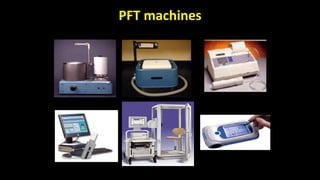
PFT machines
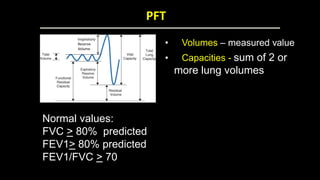
PFT
• Volumes – measured value
• Capacities - sum of 2 or
more lung volumes
Inspiratory
Reserve
Volume
Normal values:
FVC > 80% predicted
FEV1> 80% predicted
FEV1/FVC > 70
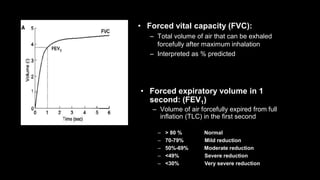
• Forced vital capacity (FVC):
– Total volume of air that can be exhaled
forcefully after maximum inhalation
– Interpreted as % predicted
• Forced expiratory volume in 1
second: (FEV1)
– Volume of air forcefully expired from full
inflation (TLC) in the first second
– > 80 % Normal
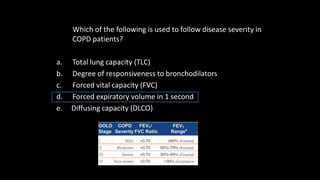
– 70-79% Mild reduction
– 50%-69% Moderate reduction
– <49% Severe reduction
– <30% Very severe reduction
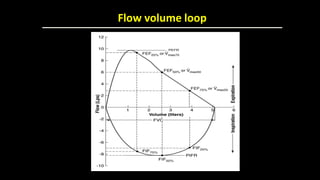
Flow volume loop
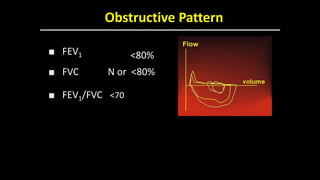
Obstructive Pattern
■ FEV1 <80%
■ FVC N or <80%
■ FEV1/FVC <70
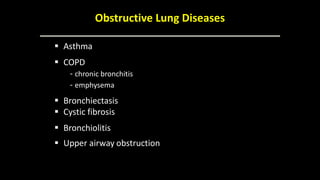
Obstructive Lung Diseases
 Asthma
 COPD
- chronic bronchitis
- emphysema
 Bronchiectasis
 Cystic fibrosis
 Bronchiolitis
 Upper airway obstruction
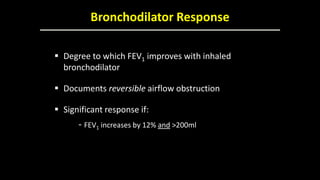
Bronchodilator Response
 Degree to which FEV1 improves with inhaled
bronchodilator
 Documents reversible airflow obstruction
 Significant response if:
- FEV1 increases by 12% and >200ml
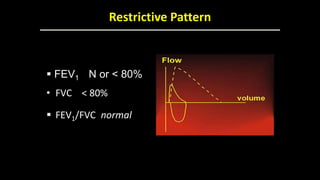
Restrictive Pattern
• FVC < 80%
 FEV1/FVC normal
 FEV1 N or < 80%
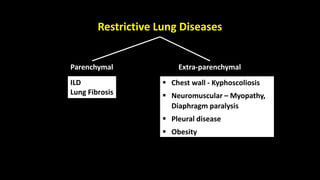
Restrictive Lung Diseases
 Chest wall - Kyphoscoliosis
 Neuromuscular – Myopathy,
Diaphragm paralysis
 Pleural disease
 Obesity
ILD
Lung Fibrosis
Parenchymal Extra-parenchymal
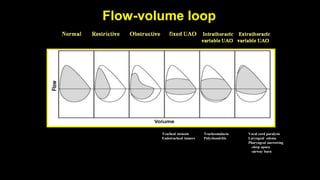
Flow-volume loop
Tracheal stenosis
Endotracheal tumors
Tracheomalacia
Polychondritis
Vocal cord paralysis
Laryngeal edema
Pharyngeal narrowing
-sleep apnea
-airway burn
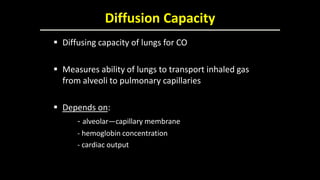
Diffusion Capacity
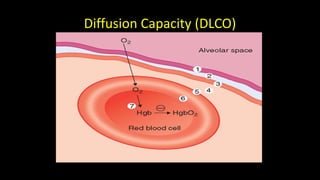
 Diffusing capacity of lungs for CO
 Measures ability of lungs to transport inhaled gas
from alveoli to pulmonary capillaries
 Depends on:
- alveolar—capillary membrane
- hemoglobin concentration
- cardiac output
Diffusion Capacity (DLCO)
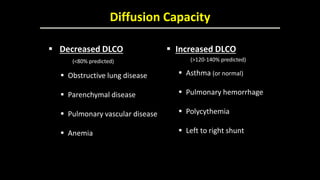
Diffusion Capacity
 Decreased DLCO
(<80% predicted)
 Obstructive lung disease
 Parenchymal disease
 Pulmonary vascular disease
 Anemia
 Increased DLCO
(>120-140% predicted)
 Asthma (or normal)
 Pulmonary hemorrhage
 Polycythemia
 Left to right shunt
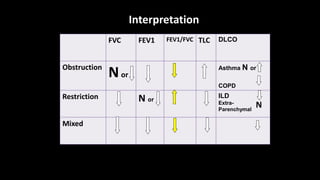
FVC FEV1 FEV1/FVC TLC DLCO
Obstruction
Nor
Asthma N or
COPD
Restriction N or
ILD
Extra-
Parenchymal
Mixed
Interpretation
N
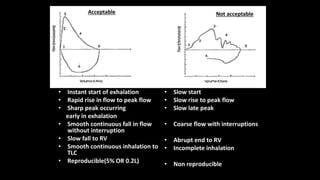
• Instant start of exhalation
• Rapid rise in flow to peak flow
• Sharp peak occurring
early in exhalation
• Smooth continuous fall in flow
without interruption
• Slow fall to RV
• Smooth continuous inhalation to
TLC
• Reproducible(5% OR 0.2L)
• Slow start
• Slow rise to peak flow
• Slow late peak
• Coarse flow with interruptions
• Abrupt end to RV
• Incomplete inhalation
• Non reproducible
Acceptable Not acceptable
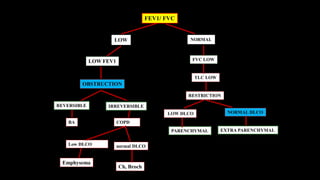
FEV1/ FVC
LOW
OBSTRUCTION
LOW FEV1
REVERSIBLE
BA
IRREVERSIBLE
COPD
NORMAL
FVC LOW
TLC LOW
RESTRICTION
LOW DLCO NORMAL DLCO
PARENCHYMAL EXTRA PARENCHYMAL
Low DLCO normal DLCO
Emphysema
Ch, Broch
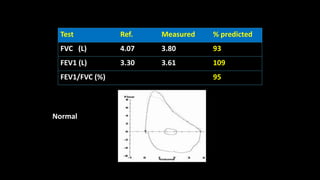
Test Ref. Measured % predicted
FVC (L) 4.07 3.80 93
FEV1 (L) 3.30 3.61 109
FEV1/FVC (%) 95
Normal
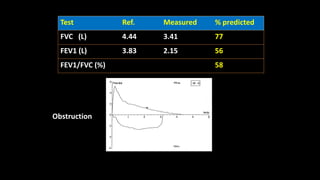
Test Ref. Measured % predicted
FVC (L) 4.44 3.41 77
FEV1 (L) 3.83 2.15 56
FEV1/FVC (%) 58
Obstruction
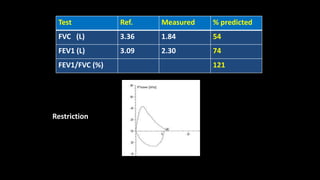
Test Ref. Measured % predicted
FVC (L) 3.36 1.84 54
FEV1 (L) 3.09 2.30 74
FEV1/FVC (%) 121
Restriction
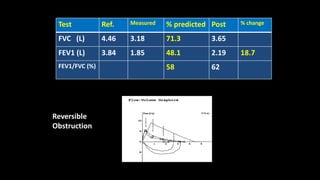
Test Ref. Measured % predicted Post % change
FVC (L) 4.46 3.18 71.3 3.65
FEV1 (L) 3.84 1.85 48.1 2.19 18.7
FEV1/FVC (%) 58 62
Reversible
Obstruction
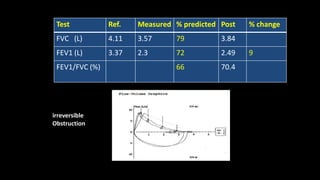
Test Ref. Measured % predicted Post % change
FVC (L) 4.11 3.57 79 3.84
FEV1 (L) 3.37 2.3 72 2.49 9
FEV1/FVC (%) 66 70.4
irreversible
Obstruction
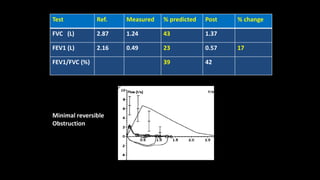
Test Ref. Measured % predicted Post % change
FVC (L) 2.87 1.24 43 1.37
FEV1 (L) 2.16 0.49 23 0.57 17
FEV1/FVC (%) 39 42
Minimal reversible
Obstruction
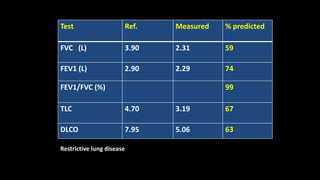
Test Ref. Measured % predicted
FVC (L) 3.90 2.31 59
FEV1 (L) 2.90 2.29 74
FEV1/FVC (%) 99
TLC 4.70 3.19 67
DLCO 7.95 5.06 63
Restrictive lung disease
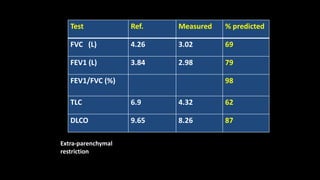
Test Ref. Measured % predicted
FVC (L) 4.26 3.02 69
FEV1 (L) 3.84 2.98 79
FEV1/FVC (%) 98
TLC 6.9 4.32 62
DLCO 9.65 8.26 87
Extra-parenchymal
restriction
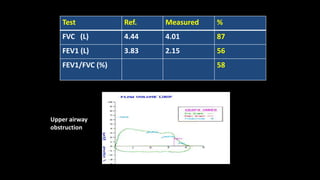
Test Ref. Measured %
FVC (L) 4.44 4.01 87
FEV1 (L) 3.83 2.15 56
FEV1/FVC (%) 58
Upper airway
obstruction
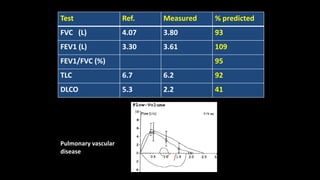
Test Ref. Measured % predicted
FVC (L) 4.07 3.80 93
FEV1 (L) 3.30 3.61 109
FEV1/FVC (%) 95
TLC 6.7 6.2 92
DLCO 5.3 2.2 41
Pulmonary vascular
disease
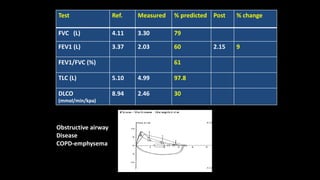
Test Ref. Measured % predicted Post % change
FVC (L) 4.11 3.30 79
FEV1 (L) 3.37 2.03 60 2.15 9
FEV1/FVC (%) 61
TLC (L) 5.10 4.99 97.8
DLCO
(mmol/min/kpa)
8.94 2.46 30
Obstructive airway
Disease
COPD-emphysema
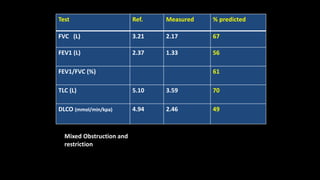
Test Ref. Measured % predicted
FVC (L) 3.21 2.17 67
FEV1 (L) 2.37 1.33 56
FEV1/FVC (%) 61
TLC (L) 5.10 3.59 70
DLCO (mmol/min/kpa) 4.94 2.46 49
Mixed Obstruction and
restriction
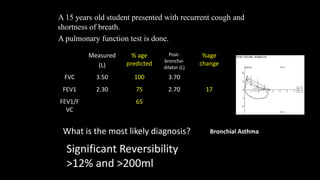
A 15 years old student presented with recurrent cough and
shortness of breath.
A pulmonary function test is done.
Measured
(L)
% age
predicted
Post-
broncho-
dilator (L)
%age
change
FVC 3.50 100 3.70
FEV1 2.30 75 2.70 17
FEV1/F
VC
65
What is the most likely diagnosis?
Significant Reversibility
>12% and >200ml
Bronchial Asthma
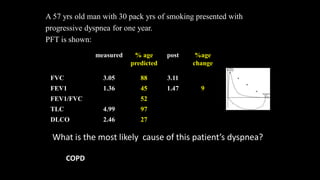
A 57 yrs old man with 30 pack yrs of smoking presented with
progressive dyspnea for one year.
PFT is shown:
measured % age
predicted
post %age
change
FVC 3.05 88 3.11
FEV1 1.36 45 1.47 9
FEV1/FVC 52
TLC 4.99 97
DLCO 2.46 27
What is the most likely cause of this patient’s dyspnea?
COPD
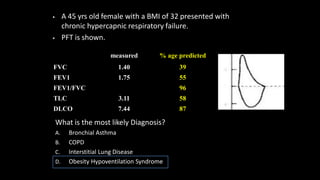
What is the most likely Diagnosis?
A. Bronchial Asthma
B. COPD
C. Interstitial Lung Disease
D. Obesity Hypoventilation Syndrome
measured % age predicted
FVC 1.40 39
FEV1 1.75 55
FEV1/FVC 96
TLC 3.11 58
DLCO 7.44 87
• A 45 yrs old female with a BMI of 32 presented with
chronic hypercapnic respiratory failure.
• PFT is shown.
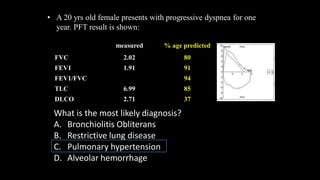
• A 20 yrs old female presents with progressive dyspnea for one
year. PFT result is shown:
measured % age predicted
FVC 2.02 80
FEV1 1.91 91
FEV1/FVC 94
TLC 6.99 85
DLCO 2.71 37
What is the most likely diagnosis?
A. Bronchiolitis Obliterans
B. Restrictive lung disease
C. Pulmonary hypertension
D. Alveolar hemorrhage
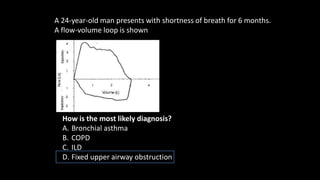
A 24-year-old man presents with shortness of breath for 6 months.
A flow-volume loop is shown
How is the most likely diagnosis?
A. Bronchial asthma
B. COPD
C. ILD
D. Fixed upper airway obstruction
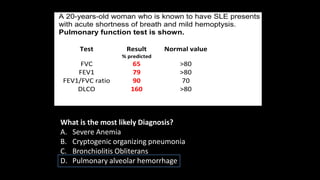
A 20-years-old woman who is known to have SLE presents
with acute shortness of breath and mild hemoptysis.
Pulmonary function test is shown.
Test Result
% predicted
Normal value
FVC 65 >80
FEV1 79 >80
FEV1/FVC ratio 90 70
DLCO 160 >80
What is the most likely Diagnosis?
A. Severe Anemia
B. Cryptogenic organizing pneumonia
C. Bronchiolitis Obliterans
D. Pulmonary alveolar hemorrhage
Which of the following is used to follow disease severity in
COPD patients?
a. Total lung capacity (TLC)
b. Degree of responsiveness to bronchodilators
c. Forced vital capacity (FVC)
d. Forced expiratory volume in 1 second
e. Diffusing capacity (DLCO)
Thanks

pulmonary Function Test Interpreation

  • 1.
    Pulmonary Function Test SarfrazSaleemi MD Pulmonary Medicine King Faisal Specialist Hospital & Research Center Riyadh, Saudi Arabia
  • 2.
    TYPES OF TESTS Spirometry  Flow Volume Loop  Bronchodilator response  Lung volumes  Diffusion capacity (DLCO)  Bronchoprovocation testing – Methacholine, exercise etc;  Maximum respiratory pressures – NIF, PEF, MVV, supine FVC  6 MINUTE WALK TESTING  cardiopulmonary exercise testing
  • 3.
  • 4.
    PFT • Volumes –measured value • Capacities - sum of 2 or more lung volumes Inspiratory Reserve Volume Normal values: FVC > 80% predicted FEV1> 80% predicted FEV1/FVC > 70
  • 5.
    • Forced vitalcapacity (FVC): – Total volume of air that can be exhaled forcefully after maximum inhalation – Interpreted as % predicted • Forced expiratory volume in 1 second: (FEV1) – Volume of air forcefully expired from full inflation (TLC) in the first second – > 80 % Normal – 70-79% Mild reduction – 50%-69% Moderate reduction – <49% Severe reduction – <30% Very severe reduction
  • 6.
  • 7.
    Obstructive Pattern ■ FEV1<80% ■ FVC N or <80% ■ FEV1/FVC <70
  • 8.
    Obstructive Lung Diseases Asthma  COPD - chronic bronchitis - emphysema  Bronchiectasis  Cystic fibrosis  Bronchiolitis  Upper airway obstruction
  • 9.
    Bronchodilator Response  Degreeto which FEV1 improves with inhaled bronchodilator  Documents reversible airflow obstruction  Significant response if: - FEV1 increases by 12% and >200ml
  • 10.
    Restrictive Pattern • FVC< 80%  FEV1/FVC normal  FEV1 N or < 80%
  • 11.
    Restrictive Lung Diseases Chest wall - Kyphoscoliosis  Neuromuscular – Myopathy, Diaphragm paralysis  Pleural disease  Obesity ILD Lung Fibrosis Parenchymal Extra-parenchymal
  • 12.
    Flow-volume loop Tracheal stenosis Endotrachealtumors Tracheomalacia Polychondritis Vocal cord paralysis Laryngeal edema Pharyngeal narrowing -sleep apnea -airway burn
  • 13.
    Diffusion Capacity  Diffusingcapacity of lungs for CO  Measures ability of lungs to transport inhaled gas from alveoli to pulmonary capillaries  Depends on: - alveolar—capillary membrane - hemoglobin concentration - cardiac output
  • 14.
  • 15.
    Diffusion Capacity  DecreasedDLCO (<80% predicted)  Obstructive lung disease  Parenchymal disease  Pulmonary vascular disease  Anemia  Increased DLCO (>120-140% predicted)  Asthma (or normal)  Pulmonary hemorrhage  Polycythemia  Left to right shunt
  • 16.
    FVC FEV1 FEV1/FVCTLC DLCO Obstruction Nor Asthma N or COPD Restriction N or ILD Extra- Parenchymal Mixed Interpretation N
  • 17.
    • Instant startof exhalation • Rapid rise in flow to peak flow • Sharp peak occurring early in exhalation • Smooth continuous fall in flow without interruption • Slow fall to RV • Smooth continuous inhalation to TLC • Reproducible(5% OR 0.2L) • Slow start • Slow rise to peak flow • Slow late peak • Coarse flow with interruptions • Abrupt end to RV • Incomplete inhalation • Non reproducible Acceptable Not acceptable
  • 18.
    FEV1/ FVC LOW OBSTRUCTION LOW FEV1 REVERSIBLE BA IRREVERSIBLE COPD NORMAL FVCLOW TLC LOW RESTRICTION LOW DLCO NORMAL DLCO PARENCHYMAL EXTRA PARENCHYMAL Low DLCO normal DLCO Emphysema Ch, Broch
  • 19.
    Test Ref. Measured% predicted FVC (L) 4.07 3.80 93 FEV1 (L) 3.30 3.61 109 FEV1/FVC (%) 95 Normal
  • 20.
    Test Ref. Measured% predicted FVC (L) 4.44 3.41 77 FEV1 (L) 3.83 2.15 56 FEV1/FVC (%) 58 Obstruction
  • 21.
    Test Ref. Measured% predicted FVC (L) 3.36 1.84 54 FEV1 (L) 3.09 2.30 74 FEV1/FVC (%) 121 Restriction
  • 22.
    Test Ref. Measured% predicted Post % change FVC (L) 4.46 3.18 71.3 3.65 FEV1 (L) 3.84 1.85 48.1 2.19 18.7 FEV1/FVC (%) 58 62 Reversible Obstruction
  • 23.
    Test Ref. Measured% predicted Post % change FVC (L) 4.11 3.57 79 3.84 FEV1 (L) 3.37 2.3 72 2.49 9 FEV1/FVC (%) 66 70.4 irreversible Obstruction
  • 24.
    Test Ref. Measured% predicted Post % change FVC (L) 2.87 1.24 43 1.37 FEV1 (L) 2.16 0.49 23 0.57 17 FEV1/FVC (%) 39 42 Minimal reversible Obstruction
  • 25.
    Test Ref. Measured% predicted FVC (L) 3.90 2.31 59 FEV1 (L) 2.90 2.29 74 FEV1/FVC (%) 99 TLC 4.70 3.19 67 DLCO 7.95 5.06 63 Restrictive lung disease
  • 26.
    Test Ref. Measured% predicted FVC (L) 4.26 3.02 69 FEV1 (L) 3.84 2.98 79 FEV1/FVC (%) 98 TLC 6.9 4.32 62 DLCO 9.65 8.26 87 Extra-parenchymal restriction
  • 27.
    Test Ref. Measured% FVC (L) 4.44 4.01 87 FEV1 (L) 3.83 2.15 56 FEV1/FVC (%) 58 Upper airway obstruction
  • 28.
    Test Ref. Measured% predicted FVC (L) 4.07 3.80 93 FEV1 (L) 3.30 3.61 109 FEV1/FVC (%) 95 TLC 6.7 6.2 92 DLCO 5.3 2.2 41 Pulmonary vascular disease
  • 29.
    Test Ref. Measured% predicted Post % change FVC (L) 4.11 3.30 79 FEV1 (L) 3.37 2.03 60 2.15 9 FEV1/FVC (%) 61 TLC (L) 5.10 4.99 97.8 DLCO (mmol/min/kpa) 8.94 2.46 30 Obstructive airway Disease COPD-emphysema
  • 30.
    Test Ref. Measured% predicted FVC (L) 3.21 2.17 67 FEV1 (L) 2.37 1.33 56 FEV1/FVC (%) 61 TLC (L) 5.10 3.59 70 DLCO (mmol/min/kpa) 4.94 2.46 49 Mixed Obstruction and restriction
  • 31.
    A 15 yearsold student presented with recurrent cough and shortness of breath. A pulmonary function test is done. Measured (L) % age predicted Post- broncho- dilator (L) %age change FVC 3.50 100 3.70 FEV1 2.30 75 2.70 17 FEV1/F VC 65 What is the most likely diagnosis? Significant Reversibility >12% and >200ml Bronchial Asthma
  • 32.
    A 57 yrsold man with 30 pack yrs of smoking presented with progressive dyspnea for one year. PFT is shown: measured % age predicted post %age change FVC 3.05 88 3.11 FEV1 1.36 45 1.47 9 FEV1/FVC 52 TLC 4.99 97 DLCO 2.46 27 What is the most likely cause of this patient’s dyspnea? COPD
  • 33.
    What is themost likely Diagnosis? A. Bronchial Asthma B. COPD C. Interstitial Lung Disease D. Obesity Hypoventilation Syndrome measured % age predicted FVC 1.40 39 FEV1 1.75 55 FEV1/FVC 96 TLC 3.11 58 DLCO 7.44 87 • A 45 yrs old female with a BMI of 32 presented with chronic hypercapnic respiratory failure. • PFT is shown.
  • 34.
    • A 20yrs old female presents with progressive dyspnea for one year. PFT result is shown: measured % age predicted FVC 2.02 80 FEV1 1.91 91 FEV1/FVC 94 TLC 6.99 85 DLCO 2.71 37 What is the most likely diagnosis? A. Bronchiolitis Obliterans B. Restrictive lung disease C. Pulmonary hypertension D. Alveolar hemorrhage
  • 35.
    A 24-year-old manpresents with shortness of breath for 6 months. A flow-volume loop is shown How is the most likely diagnosis? A. Bronchial asthma B. COPD C. ILD D. Fixed upper airway obstruction
  • 36.
    A 20-years-old womanwho is known to have SLE presents with acute shortness of breath and mild hemoptysis. Pulmonary function test is shown. Test Result % predicted Normal value FVC 65 >80 FEV1 79 >80 FEV1/FVC ratio 90 70 DLCO 160 >80 What is the most likely Diagnosis? A. Severe Anemia B. Cryptogenic organizing pneumonia C. Bronchiolitis Obliterans D. Pulmonary alveolar hemorrhage
  • 37.
    Which of thefollowing is used to follow disease severity in COPD patients? a. Total lung capacity (TLC) b. Degree of responsiveness to bronchodilators c. Forced vital capacity (FVC) d. Forced expiratory volume in 1 second e. Diffusing capacity (DLCO)
  • 38.