PULMONARY FUNCTION
TESTS
Dr. M HELMI AFIFIDr. M HELMI AFIFI
(MBBCh,MS,MD,MHA)(MBBCh,MS,MD,MHA)
Prof. of Anaesthesia & Intensive CareProf. of Anaesthesia & Intensive Care
Menoufiya University, EgyptMenoufiya University, Egypt
Pulmonary Function Tests
• A wide variety of objective tests to assess
lung function
www.anaesthesia.co.in
GOALS
 To predict the presence of pulmonary
dysfunction
To know the functional nature of disease
(obstructive or restrictive. )
To assess the severity of disease
To assess the progression of disease
To assess the response to treatment
To identify patients at increased risk of morbidity
and mortality, undergoing pulmonary resection.
 To wean patient from ventilator in icu.
Medicolegal- to assess lung impairment as a
result of occupational hazard.
Epidemiological surveys- to assess the
hazards to document incidence of disease
To identify patients at perioperative risk of
pulmonary complications
GOALS, CONTINUED……..
INDICATIONS FOR PREOPERATIVE
SPIROMETRY
• ACP GUIDELINES
Lung resection
H/o smoking, dyspnoea
Cardiac surgery
Upper abdominal surgery
Lower abdominal surgery
Uncharacterized pulmonary disease(defined as
history of pulmonary Disease or symptoms and
no PFT in last 60 days)
BED SIDE PFT
Single breath count:
After deep breath, hold it and start counting till the
next breath.
 N- 30-40 COUNT
 Indicates vital capacity
BED SIDE PFT
SCHNEIDER’S MATCH BLOWING TEST: MEASURES
Maximum Breathing Capacity.
Ask to blow a match stick from a distance of
6” (15 cms) with-
 Mouth wide open
 Chin rested/supported
 No purse lipping
 No head movement
 No air movement in the room
 Mouth and match at the same level
• Can not blow out a match
– MBC < 60 L/min
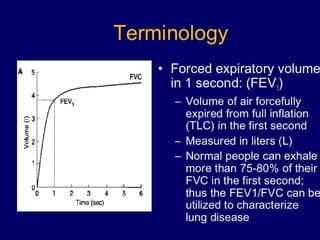
– FEV1 < 1.6L
• Able to blow out a match
– MBC > 60 L/min
– FEV1 > 1.6L
• MODIFIED MATCH TEST:
DISTANCE MBC
9” >150 L/MIN.
6” >60 L/MIN.
3” > 40 L/MIN.
BED SIDE TEST
COUGH TEST: DEEP BREATH F/BY COUGH
 ABILITY TO COUGH
 STRENGTH
 EFFECTIVENESS
INADEQUATE COUGH IF: FVC<20 ML/KG
FEV1 < 15 ML/KG
PEFR < 200 L/MIN.
VC ~ 3 TIMES TV FOR EFFECTIVE COUGH.
A wet productive cough / self propagated paraoxysms
of coughing – patient susceptible for pulmonary
Complication.
BED SIDE PFT
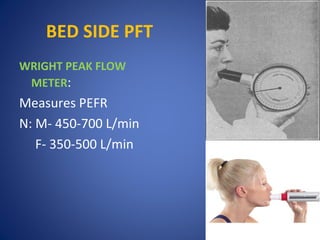
WRIGHT PEAK FLOW
METER:
Measures PEFR
N: M- 450-700 L/min
F- 350-500 L/min
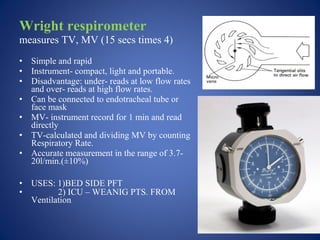
Wright respirometer
measures TV, MV (15 secs times 4)
• Simple and rapid
• Instrument- compact, light and portable.
• Disadvantage: under- reads at low flow rates
and over- reads at high flow rates.
• Can be connected to endotracheal tube or
face mask
• MV- instrument record for 1 min and read
directly
• TV-calculated and dividing MV by counting
Respiratory Rate.
• Accurate measurement in the range of 3.7-
20l/min.(±10%)
• USES: 1)BED SIDE PFT
• 2) ICU – WEANIG PTS. FROM
Ventilation.
www.anaesthesia.co.in
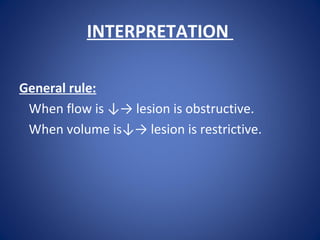
INTERPRETATION
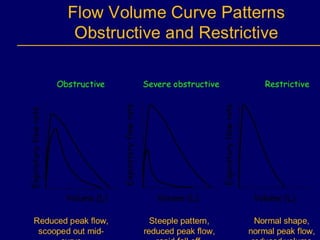
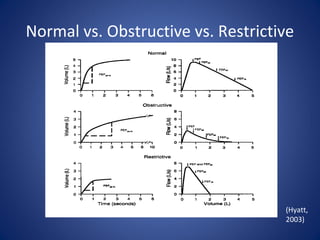
General rule:
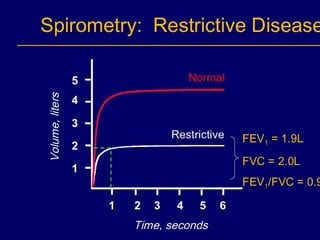
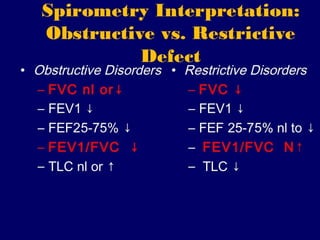
When flow is ↓→ lesion is obstructive.
When volume is↓→ lesion is restrictive.
www.anaesthesia.co.in
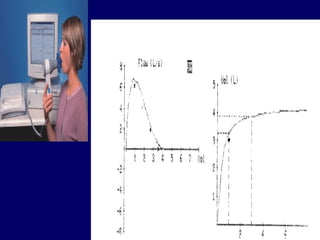
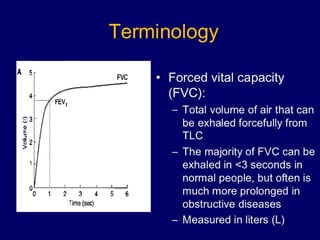
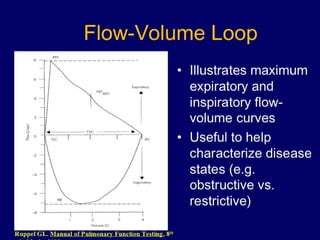
Flow-Volume Loops
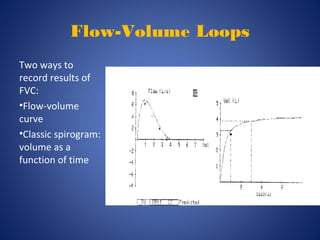
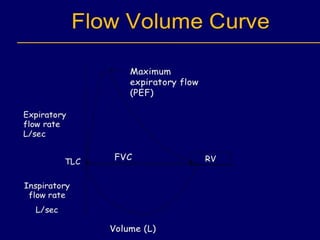
Two ways to
record results of
FVC:
•Flow-volume
curve
•Classic spirogram:
volume as a
function of time
www.anaesthesia.co.in
Normal vs. Obstructive vs. Restrictive
(Hyatt,
2003)
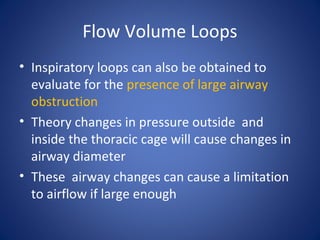
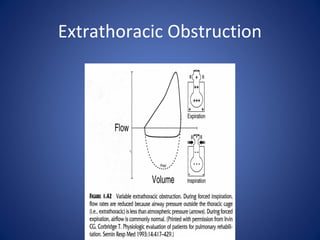
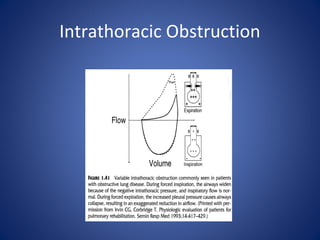
Flow Volume Loops
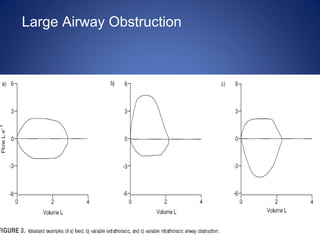
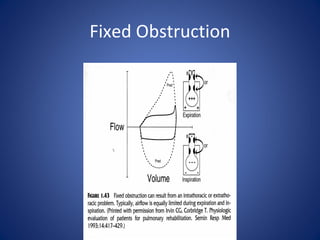
• Inspiratory loops can also be obtained to
evaluate for the presence of large airway
obstruction
• Theory changes in pressure outside and
inside the thoracic cage will cause changes in
airway diameter
• These airway changes can cause a limitation
to airflow if large enough
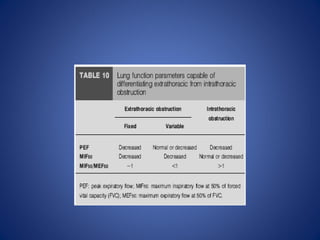
Extrathoracic Obstruction
Intrathoracic Obstruction
Fixed Obstruction
Large Airway Obstruction
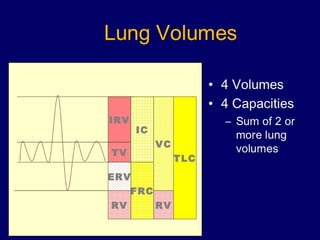
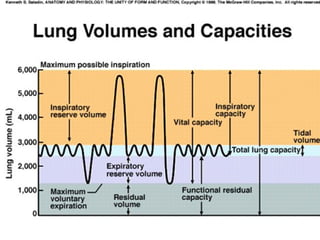
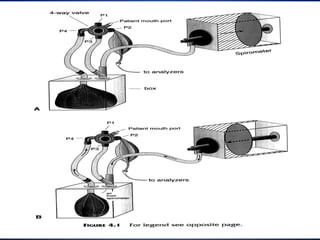
MEASUREMENTS OF VOLUMES
• TLC, RV, FRC – MEASURED USING
Nitrogen washout method
Inert gas (helium) dilution method
Total body plethysmography
www.anaesthesia.co.in
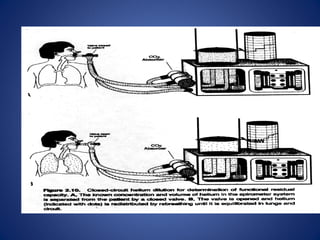
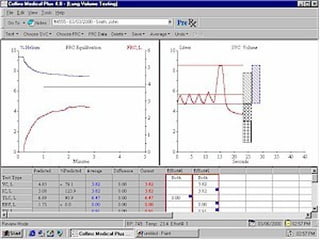
Helium Dilution Technique
• Uses an inert gas, helium and by a closed
circuit technique, allow it to come to
equilibrium and FRC is measured
• May underestimate lung volumes in bullous
lung disease
Nitrogen Washout
• Determine FRC by multiple breath open circuit
nitrogen washout
• Involves having nitrogen in patients lung being
washed out by inhaling 100% O2 for several
minutes.
• Widely used, easy to perform but may
underestimate bullous lung disease
Nitrogen Washout
• Performed by having the patient breath
comfortably for several minutes and then
turn in to 100% O2 at FRC.
• Monitor N2 concentrations and test ends
when falls below 1%
• Easy to see leaks
Nitrogen Washout
• Concept is C1V1= C2V2
– C1 = Nitrogen concentration at the start of the
test
– V1 = FRC volume
– C2 =N2 concentration in exhaled volume
– V2 = Total exhaled volume during O2 breathing
period
– Nitrogen is measured by photoelectric principle
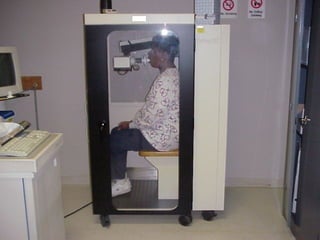
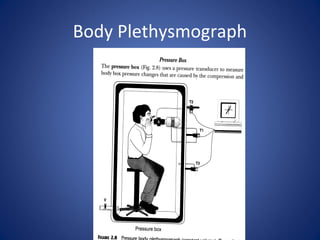
Body Plethsymography
• Is a sealed box with a fixed volume
• Uses Boyle’s Law that changes in pressure are
brought about by changes in volume for the
person seated in the box
• P1V1= P2V2
Body Plethysmograph
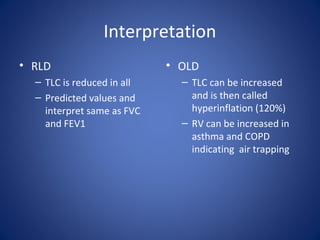
Interpretation
• RLD
– TLC is reduced in all
– Predicted values and
interpret same as FVC
and FEV1
• OLD
– TLC can be increased
and is then called
hyperinflation (120%)
– RV can be increased in
asthma and COPD
indicating air trapping
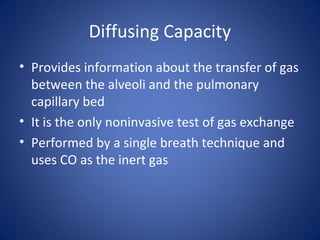
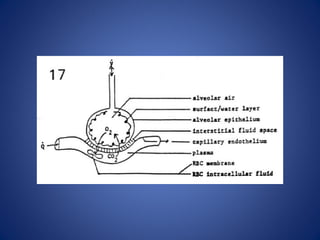
Diffusing Capacity
• Provides information about the transfer of gas
between the alveoli and the pulmonary
capillary bed
• It is the only noninvasive test of gas exchange
• Performed by a single breath technique and
uses CO as the inert gas
Diffusing Capacity
• Diffusion of a gas is dependent of the area,
the concentrations, the thickness of the
membrane and the diffusing properties of the
gas
• Diffusion is the rate at which a gas is
transferred across the alveolar capillary
membrane, the plasma, the RBC and
ultimately combined with Hgb
Diffusing Capacity
• CO is typically used because it is freely
diffusable
• It usually is not present in significant amounts
in the blood except in some heavy smokers
• Helium or methane is also used to measure
volume
• A single maximal inspiration is taken and held
for 10 sec
Diffusing Capacity
• Normal result is >80%
• Can be reduced in interstitial diseases such as
sarcoid or asbestosis
• Can be reduced also in emphysema or
pulmonary vascular diseases
• False low measurements in anemia or lung
resection
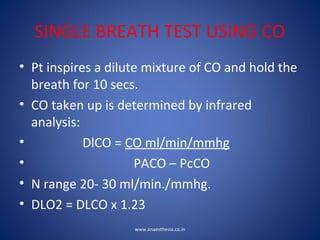
SINGLE BREATH TEST USING CO
• Pt inspires a dilute mixture of CO and hold the
breath for 10 secs.
• CO taken up is determined by infrared
analysis:
• DlCO = CO ml/min/mmhg
• PACO – PcCO
• N range 20- 30 ml/min./mmhg.
• DLO2 = DLCO x 1.23
www.anaesthesia.co.in
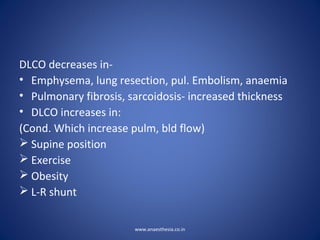
DLCO decreases in-
• Emphysema, lung resection, pul. Embolism, anaemia
• Pulmonary fibrosis, sarcoidosis- increased thickness
• DLCO increases in:
(Cond. Which increase pulm, bld flow)
 Supine position
 Exercise
 Obesity
 L-R shunt
www.anaesthesia.co.in
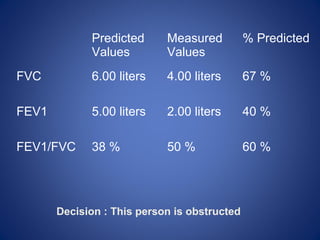
Predicted
Values
Measured
Values
% Predicted
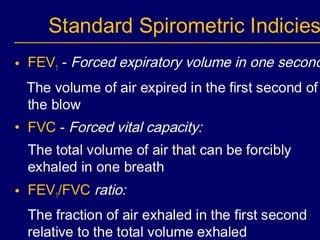
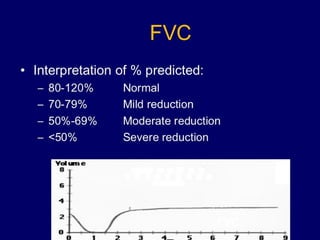
FVC 6.00 liters 4.00 liters 67 %
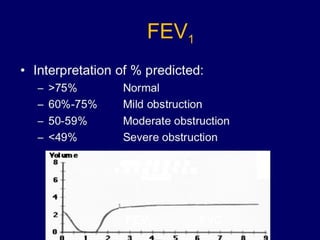
FEV1 5.00 liters 2.00 liters 40 %
FEV1/FVC 38 % 50 % 60 %
Decision : This person is obstructed
Predicted
Values
Measured
Values
%
Predicted
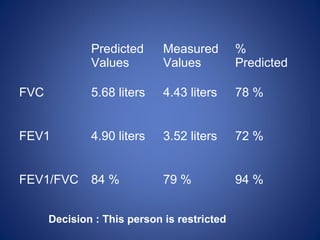
FVC 5.68 liters 4.43 liters 78 %
FEV1 4.90 liters 3.52 liters 72 %
FEV1/FVC 84 % 79 % 94 %
Decision : This person is restricted
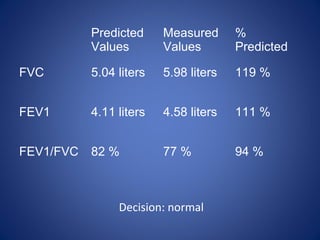
Decision: normal
Predicted
Values
Measured
Values
%
Predicted
FVC 5.04 liters 5.98 liters 119 %
FEV1 4.11 liters 4.58 liters 111 %
FEV1/FVC 82 % 77 % 94 %
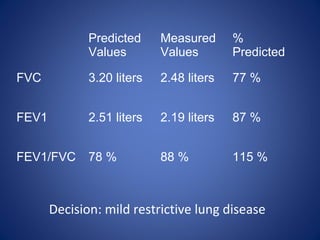
Decision: mild restrictive lung disease
Predicted
Values
Measured
Values
%
Predicted
FVC 3.20 liters 2.48 liters 77 %
FEV1 2.51 liters 2.19 liters 87 %
FEV1/FVC 78 % 88 % 115 %
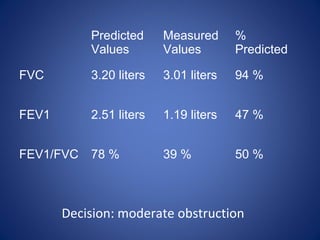
Decision: moderate obstruction
Predicted
Values
Measured
Values
%
Predicted
FVC 3.20 liters 3.01 liters 94 %
FEV1 2.51 liters 1.19 liters 47 %
FEV1/FVC 78 % 39 % 50 %
www.anaesthesia.co.in“Dr Helmi, may I be excused? My brain is full”

14. pulmonary-function-tests

  • 1.
    PULMONARY FUNCTION TESTS Dr. MHELMI AFIFIDr. M HELMI AFIFI (MBBCh,MS,MD,MHA)(MBBCh,MS,MD,MHA) Prof. of Anaesthesia & Intensive CareProf. of Anaesthesia & Intensive Care Menoufiya University, EgyptMenoufiya University, Egypt
  • 2.
    Pulmonary Function Tests •A wide variety of objective tests to assess lung function www.anaesthesia.co.in
  • 3.
    GOALS  To predictthe presence of pulmonary dysfunction To know the functional nature of disease (obstructive or restrictive. ) To assess the severity of disease To assess the progression of disease To assess the response to treatment To identify patients at increased risk of morbidity and mortality, undergoing pulmonary resection.
  • 4.
     To weanpatient from ventilator in icu. Medicolegal- to assess lung impairment as a result of occupational hazard. Epidemiological surveys- to assess the hazards to document incidence of disease To identify patients at perioperative risk of pulmonary complications GOALS, CONTINUED……..
  • 5.
    INDICATIONS FOR PREOPERATIVE SPIROMETRY •ACP GUIDELINES Lung resection H/o smoking, dyspnoea Cardiac surgery Upper abdominal surgery Lower abdominal surgery Uncharacterized pulmonary disease(defined as history of pulmonary Disease or symptoms and no PFT in last 60 days)
  • 6.
    BED SIDE PFT Singlebreath count: After deep breath, hold it and start counting till the next breath.  N- 30-40 COUNT  Indicates vital capacity
  • 7.
    BED SIDE PFT SCHNEIDER’SMATCH BLOWING TEST: MEASURES Maximum Breathing Capacity. Ask to blow a match stick from a distance of 6” (15 cms) with-  Mouth wide open  Chin rested/supported  No purse lipping  No head movement  No air movement in the room  Mouth and match at the same level
  • 8.
    • Can notblow out a match – MBC < 60 L/min – FEV1 < 1.6L • Able to blow out a match – MBC > 60 L/min – FEV1 > 1.6L • MODIFIED MATCH TEST: DISTANCE MBC 9” >150 L/MIN. 6” >60 L/MIN. 3” > 40 L/MIN.
  • 9.
    BED SIDE TEST COUGHTEST: DEEP BREATH F/BY COUGH  ABILITY TO COUGH  STRENGTH  EFFECTIVENESS INADEQUATE COUGH IF: FVC<20 ML/KG FEV1 < 15 ML/KG PEFR < 200 L/MIN. VC ~ 3 TIMES TV FOR EFFECTIVE COUGH. A wet productive cough / self propagated paraoxysms of coughing – patient susceptible for pulmonary Complication.
  • 10.
    BED SIDE PFT WRIGHTPEAK FLOW METER: Measures PEFR N: M- 450-700 L/min F- 350-500 L/min
  • 11.
    Wright respirometer measures TV,MV (15 secs times 4) • Simple and rapid • Instrument- compact, light and portable. • Disadvantage: under- reads at low flow rates and over- reads at high flow rates. • Can be connected to endotracheal tube or face mask • MV- instrument record for 1 min and read directly • TV-calculated and dividing MV by counting Respiratory Rate. • Accurate measurement in the range of 3.7- 20l/min.(±10%) • USES: 1)BED SIDE PFT • 2) ICU – WEANIG PTS. FROM Ventilation.
  • 12.
  • 13.
  • 15.
  • 16.
  • 17.
  • 18.
  • 19.
  • 20.
  • 21.
  • 22.
  • 23.
  • 24.
  • 25.
  • 26.
  • 27.
    INTERPRETATION General rule: When flowis ↓→ lesion is obstructive. When volume is↓→ lesion is restrictive.
  • 28.
  • 29.
  • 30.
  • 31.
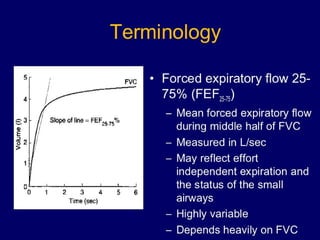
    Flow-Volume Loops Two waysto record results of FVC: •Flow-volume curve •Classic spirogram: volume as a function of time
  • 32.
  • 33.
  • 34.
  • 35.
    Normal vs. Obstructivevs. Restrictive (Hyatt, 2003)
  • 36.
    Flow Volume Loops •Inspiratory loops can also be obtained to evaluate for the presence of large airway obstruction • Theory changes in pressure outside and inside the thoracic cage will cause changes in airway diameter • These airway changes can cause a limitation to airflow if large enough
  • 37.
  • 38.
  • 39.
  • 40.
  • 42.
    MEASUREMENTS OF VOLUMES •TLC, RV, FRC – MEASURED USING Nitrogen washout method Inert gas (helium) dilution method Total body plethysmography www.anaesthesia.co.in
  • 43.
    Helium Dilution Technique •Uses an inert gas, helium and by a closed circuit technique, allow it to come to equilibrium and FRC is measured • May underestimate lung volumes in bullous lung disease
  • 46.
    Nitrogen Washout • DetermineFRC by multiple breath open circuit nitrogen washout • Involves having nitrogen in patients lung being washed out by inhaling 100% O2 for several minutes. • Widely used, easy to perform but may underestimate bullous lung disease
  • 47.
    Nitrogen Washout • Performedby having the patient breath comfortably for several minutes and then turn in to 100% O2 at FRC. • Monitor N2 concentrations and test ends when falls below 1% • Easy to see leaks
  • 48.
    Nitrogen Washout • Conceptis C1V1= C2V2 – C1 = Nitrogen concentration at the start of the test – V1 = FRC volume – C2 =N2 concentration in exhaled volume – V2 = Total exhaled volume during O2 breathing period – Nitrogen is measured by photoelectric principle
  • 49.
    Body Plethsymography • Isa sealed box with a fixed volume • Uses Boyle’s Law that changes in pressure are brought about by changes in volume for the person seated in the box • P1V1= P2V2
  • 51.
  • 52.
    Interpretation • RLD – TLCis reduced in all – Predicted values and interpret same as FVC and FEV1 • OLD – TLC can be increased and is then called hyperinflation (120%) – RV can be increased in asthma and COPD indicating air trapping
  • 53.
    Diffusing Capacity • Providesinformation about the transfer of gas between the alveoli and the pulmonary capillary bed • It is the only noninvasive test of gas exchange • Performed by a single breath technique and uses CO as the inert gas
  • 55.
    Diffusing Capacity • Diffusionof a gas is dependent of the area, the concentrations, the thickness of the membrane and the diffusing properties of the gas • Diffusion is the rate at which a gas is transferred across the alveolar capillary membrane, the plasma, the RBC and ultimately combined with Hgb
  • 56.
    Diffusing Capacity • COis typically used because it is freely diffusable • It usually is not present in significant amounts in the blood except in some heavy smokers • Helium or methane is also used to measure volume • A single maximal inspiration is taken and held for 10 sec
  • 58.
    Diffusing Capacity • Normalresult is >80% • Can be reduced in interstitial diseases such as sarcoid or asbestosis • Can be reduced also in emphysema or pulmonary vascular diseases • False low measurements in anemia or lung resection
  • 59.
    SINGLE BREATH TESTUSING CO • Pt inspires a dilute mixture of CO and hold the breath for 10 secs. • CO taken up is determined by infrared analysis: • DlCO = CO ml/min/mmhg • PACO – PcCO • N range 20- 30 ml/min./mmhg. • DLO2 = DLCO x 1.23 www.anaesthesia.co.in
  • 60.
    DLCO decreases in- •Emphysema, lung resection, pul. Embolism, anaemia • Pulmonary fibrosis, sarcoidosis- increased thickness • DLCO increases in: (Cond. Which increase pulm, bld flow)  Supine position  Exercise  Obesity  L-R shunt www.anaesthesia.co.in
  • 61.
    Predicted Values Measured Values % Predicted FVC 6.00liters 4.00 liters 67 % FEV1 5.00 liters 2.00 liters 40 % FEV1/FVC 38 % 50 % 60 % Decision : This person is obstructed
  • 62.
    Predicted Values Measured Values % Predicted FVC 5.68 liters4.43 liters 78 % FEV1 4.90 liters 3.52 liters 72 % FEV1/FVC 84 % 79 % 94 % Decision : This person is restricted
  • 63.
    Decision: normal Predicted Values Measured Values % Predicted FVC 5.04liters 5.98 liters 119 % FEV1 4.11 liters 4.58 liters 111 % FEV1/FVC 82 % 77 % 94 %
  • 64.
    Decision: mild restrictivelung disease Predicted Values Measured Values % Predicted FVC 3.20 liters 2.48 liters 77 % FEV1 2.51 liters 2.19 liters 87 % FEV1/FVC 78 % 88 % 115 %
  • 65.
    Decision: moderate obstruction Predicted Values Measured Values % Predicted FVC3.20 liters 3.01 liters 94 % FEV1 2.51 liters 1.19 liters 47 % FEV1/FVC 78 % 39 % 50 %
  • 66.
    www.anaesthesia.co.in“Dr Helmi, mayI be excused? My brain is full”