Spirometry of Obstructive
Lung Diseases

Gamal Rabie Agmy, MD, FCCP
Professor of Chest Diseases, Assiut University
Pulmonary Disorders Effects on
Pulmonary Function
Obstructive:
Any process that interferes with air flow either
into or out of the lungs.
Large or small airways.
Restrictive:
 Any process that interferes with the bellows
action of the lungs or chest wall.
 Reduced lung volumes.
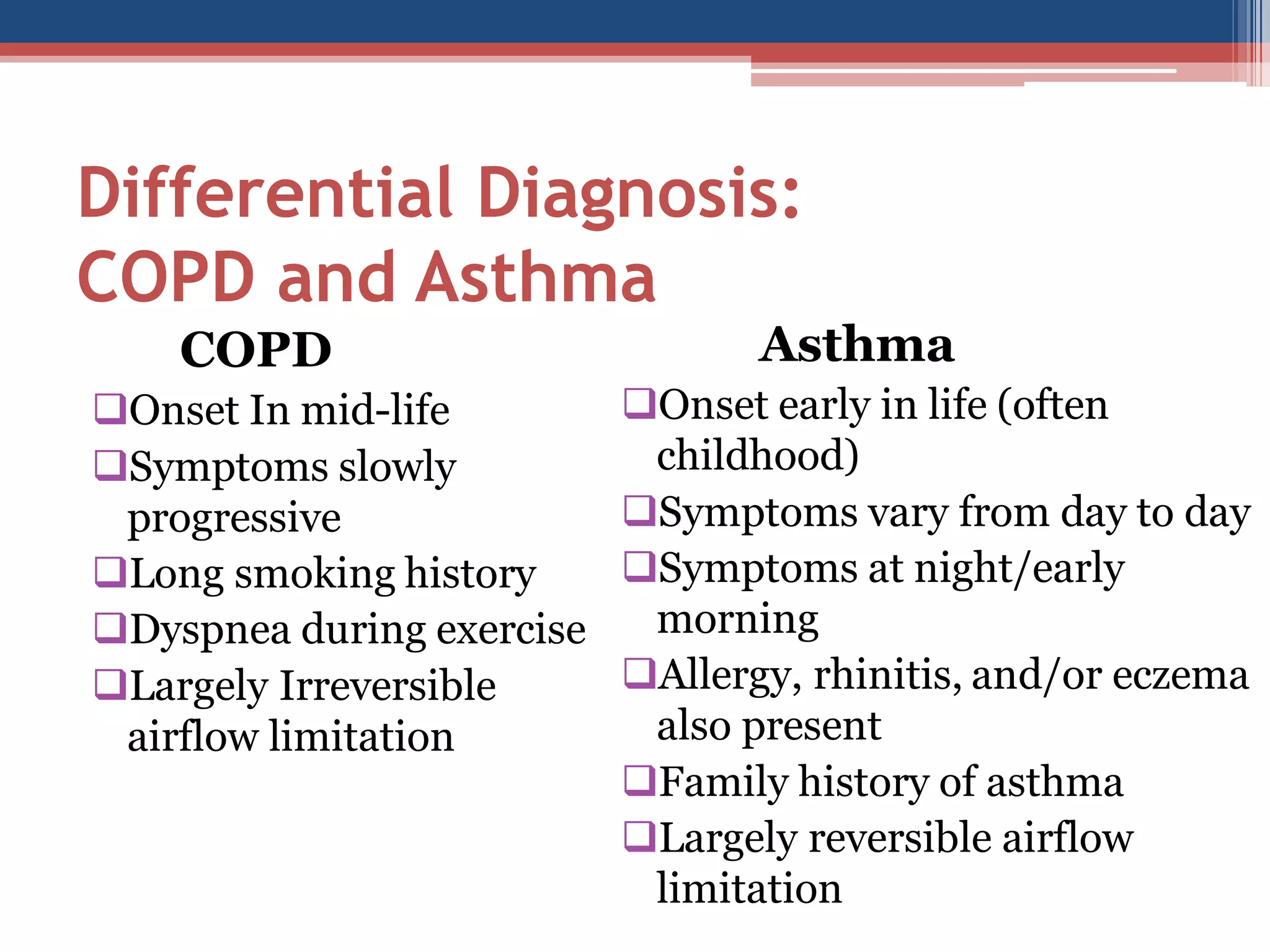
Differential Diagnosis:
COPD and Asthma
COPD
Onset In mid-life
Symptoms slowly
progressive
Long smoking history
Dyspnea during exercise
Largely Irreversible
airflow limitation

Asthma

Onset early in life (often
childhood)
Symptoms vary from day to day
Symptoms at night/early
morning
Allergy, rhinitis, and/or eczema
also present
Family history of asthma
Largely reversible airflow
limitation
Inflammatory Cascade in
COPD & Asthma
Measures of Assessment and
Monitoring of Asthma
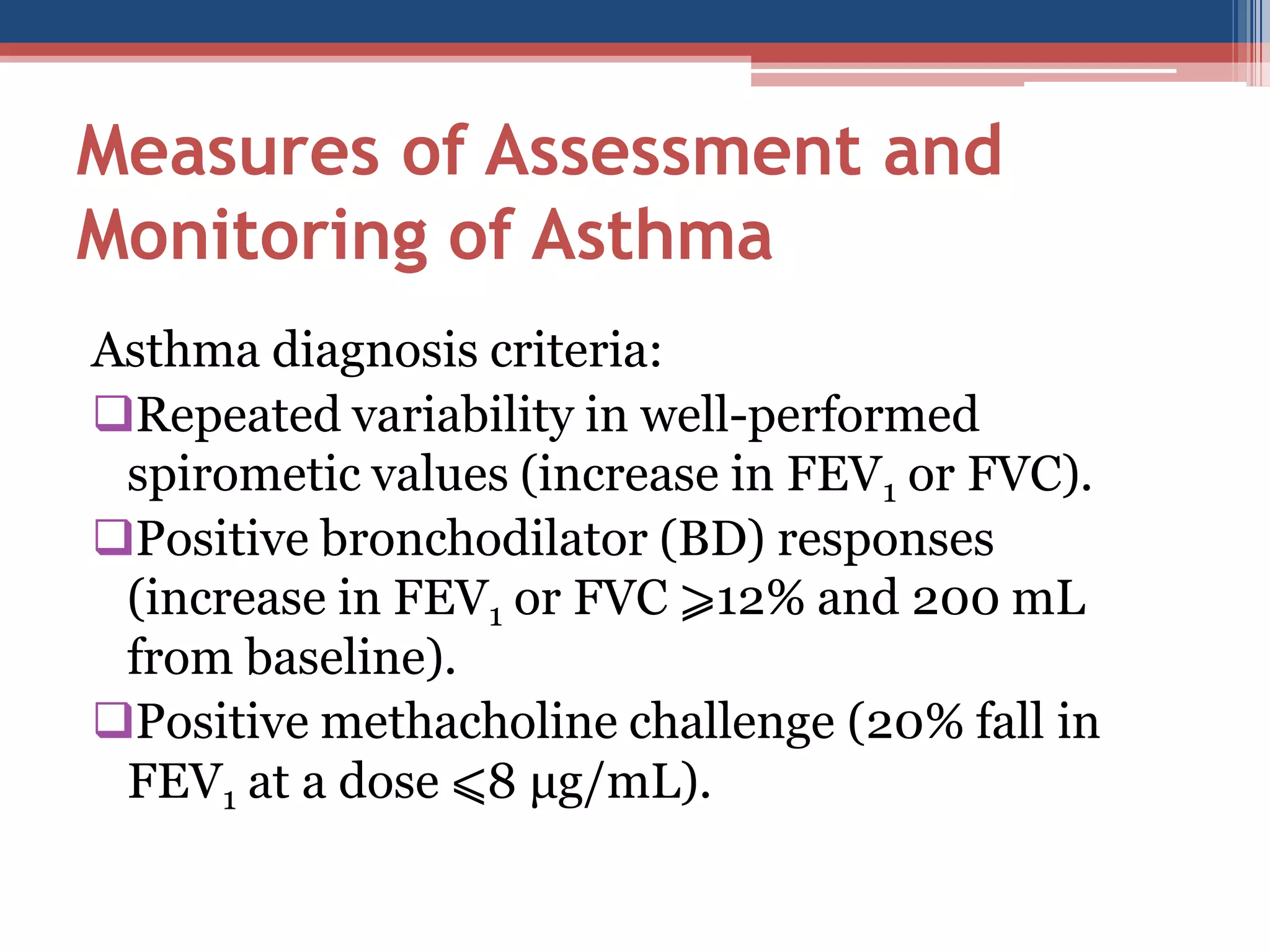
Asthma diagnosis criteria:
Repeated variability in well-performed
spirometic values (increase in FEV1 or FVC).
Positive bronchodilator (BD) responses
(increase in FEV1 or FVC ⩾12% and 200 mL
from baseline).
Positive methacholine challenge (20% fall in
FEV1 at a dose ⩽8 μg/mL).
Objective lung function
measurements in Asthma
Spirometry:
▫ Forced Expiratory Maneuvers.

Exhaled Nitric Oxide.
Peak Flows.
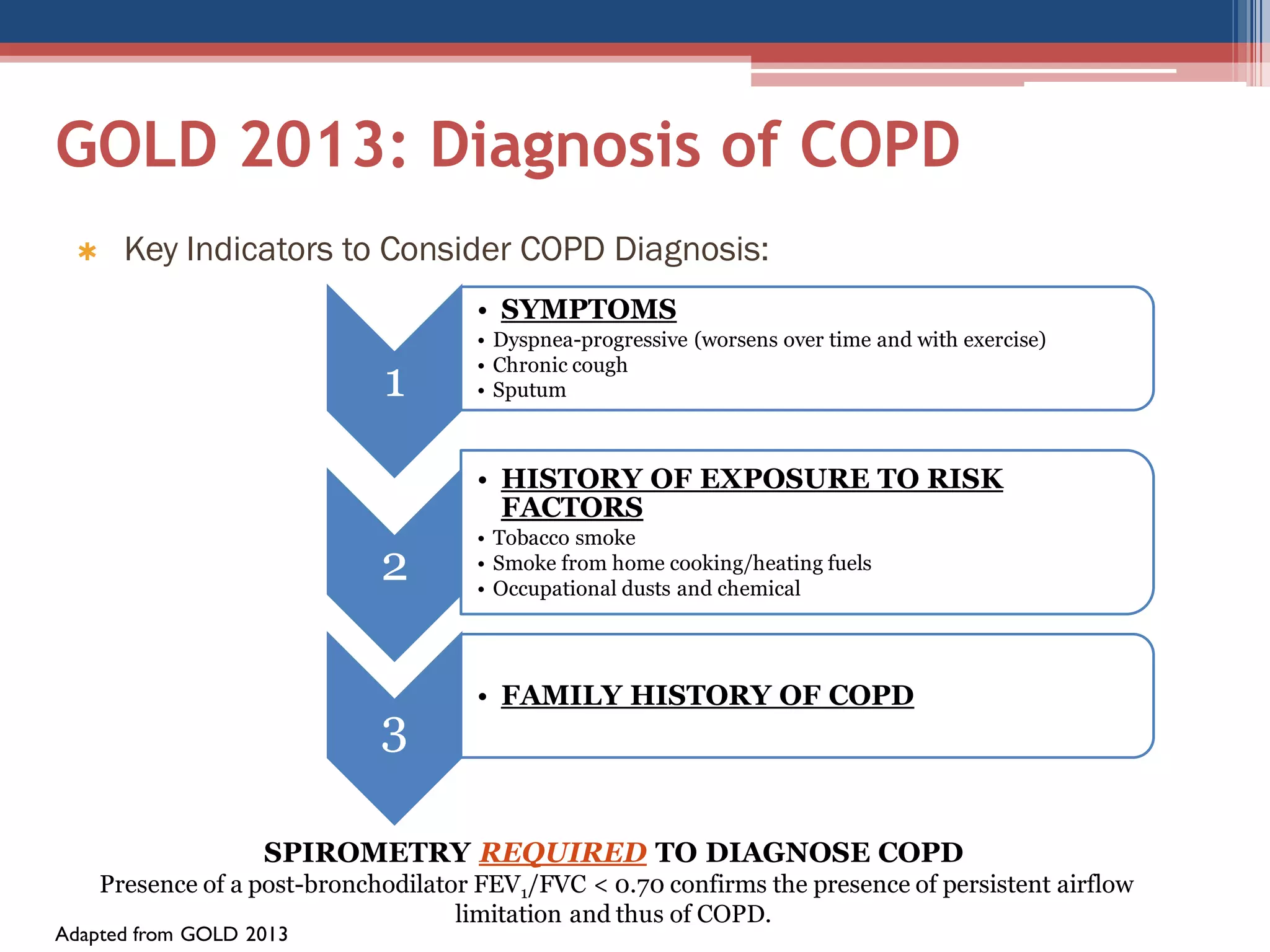
GOLD 2013: Diagnosis of COPD


Key Indicators to Consider COPD Diagnosis:
• SYMPTOMS

1

• Dyspnea-progressive (worsens over time and with exercise)
• Chronic cough
• Sputum

• HISTORY OF EXPOSURE TO RISK
FACTORS

2
3

• Tobacco smoke
• Smoke from home cooking/heating fuels
• Occupational dusts and chemical

• FAMILY HISTORY OF COPD

SPIROMETRY REQUIRED TO DIAGNOSE COPD
Presence of a post-bronchodilator FEV1/FVC < 0.70 confirms the presence of persistent airflow
limitation and thus of COPD.

Adapted from GOLD 2013
Simple Interpretation of
Pulmonary Function Tests

Gamal Rabie Agmy, MD, FCCP
Professor of Chest Diseases, Assiut University
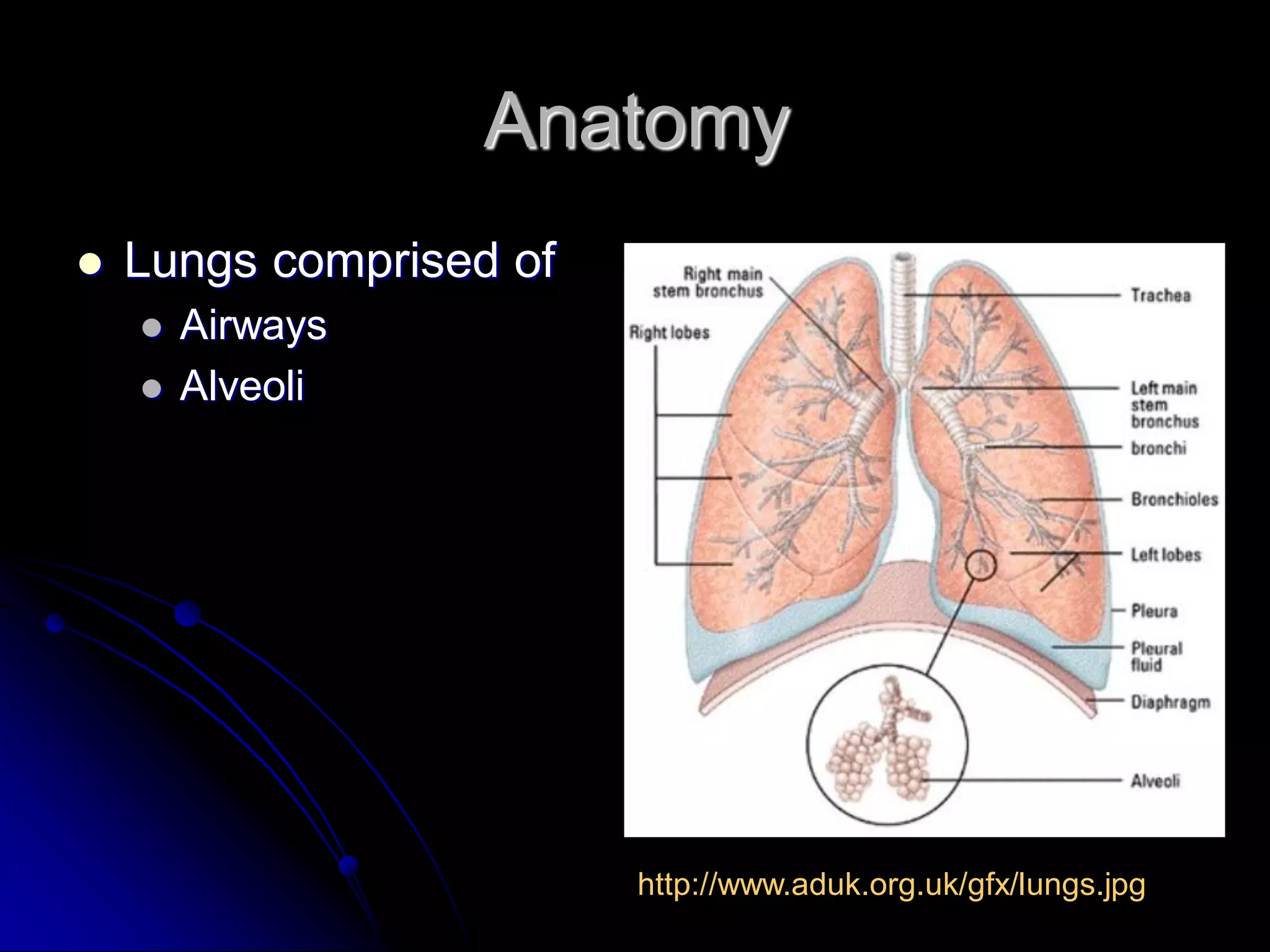
Anatomy


Lungs comprised of




Airways
Alveoli

http://www.aduk.org.uk/gfx/lungs.jpg
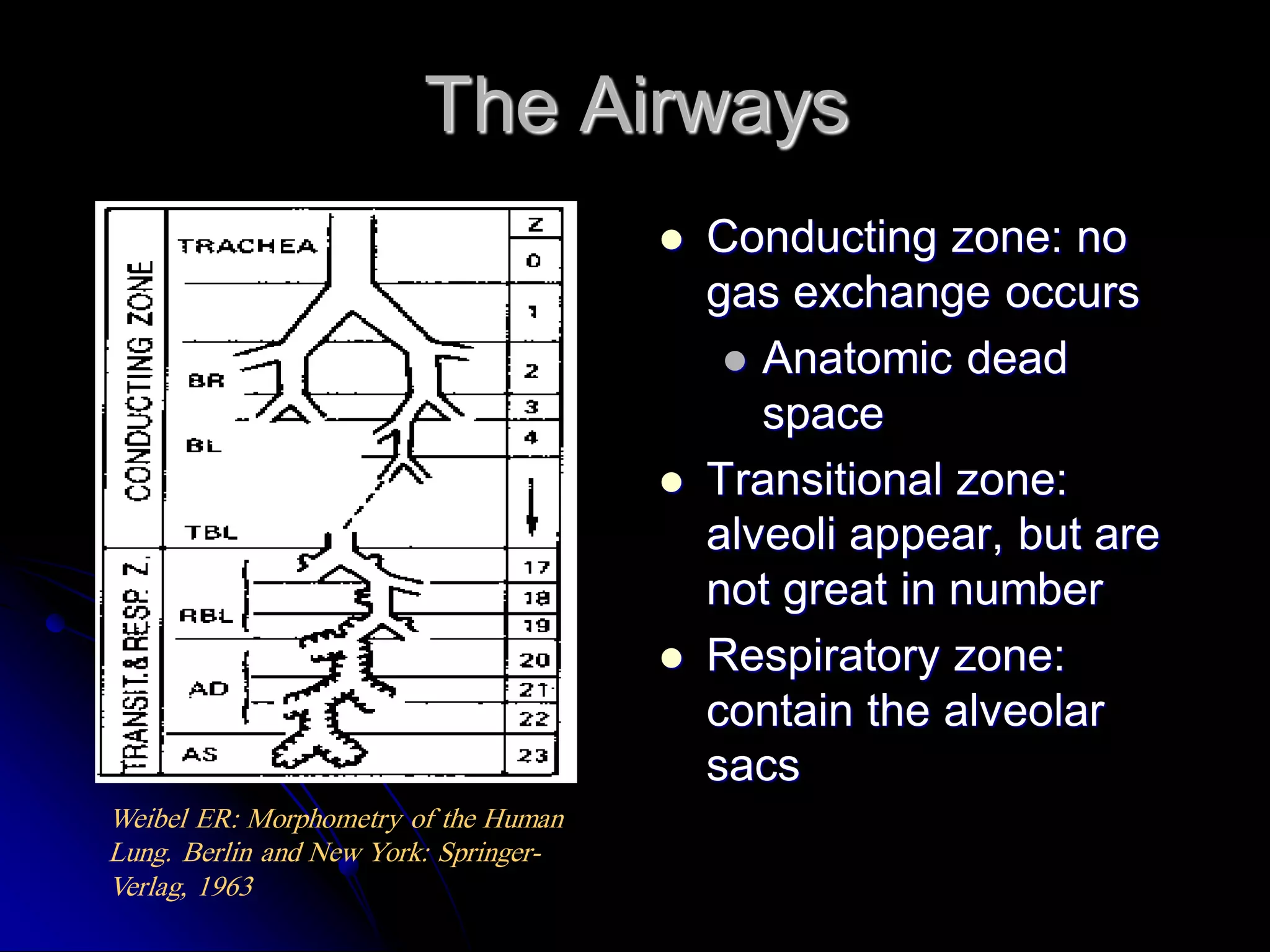
The Airways






Weibel ER: Morphometry of the Human
Lung. Berlin and New York: SpringerVerlag, 1963

Conducting zone: no
gas exchange occurs
 Anatomic dead
space
Transitional zone:
alveoli appear, but are
not great in number
Respiratory zone:
contain the alveolar
sacs
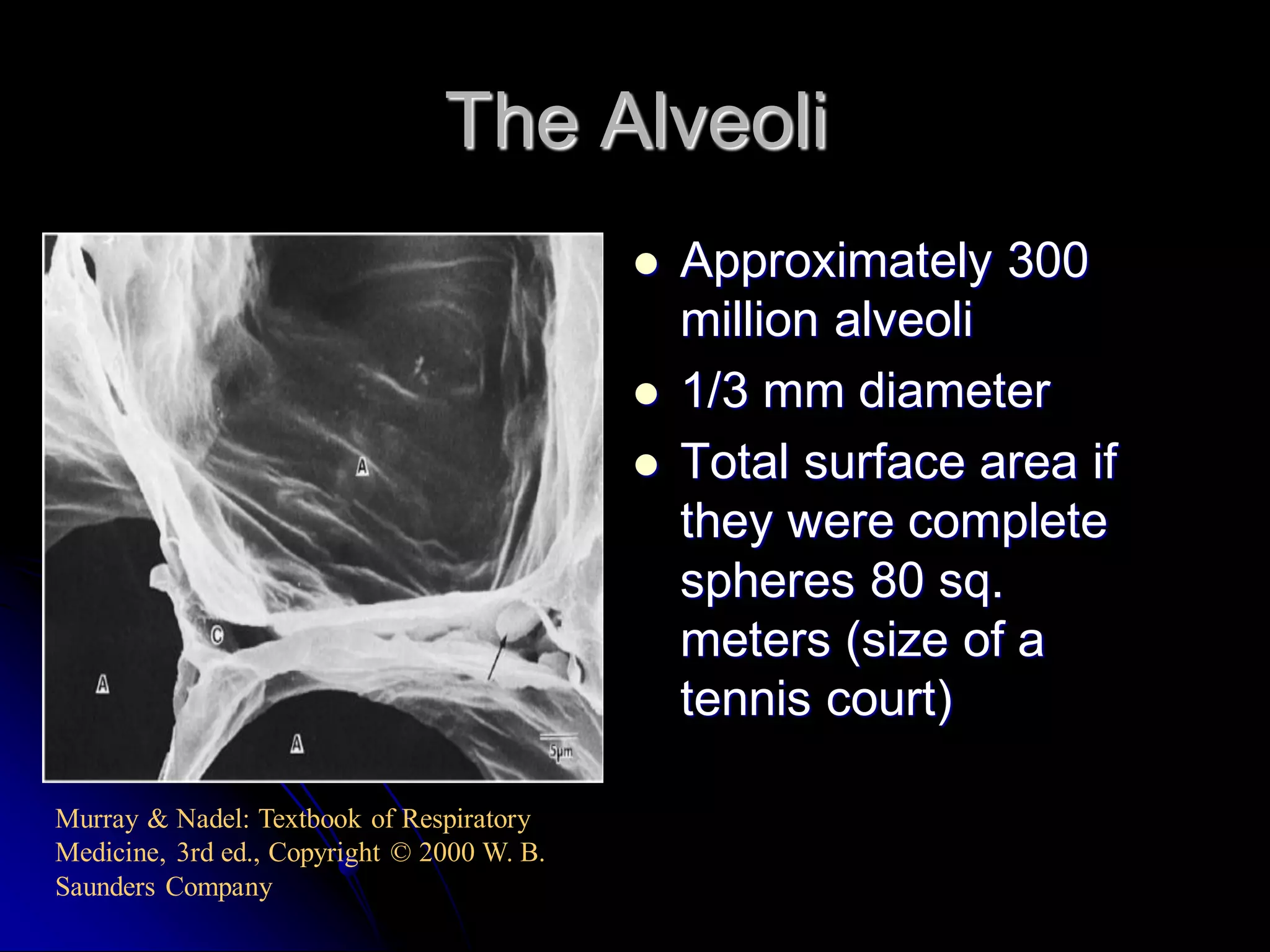
The Alveoli





Murray & Nadel: Textbook of Respiratory
Medicine, 3rd ed., Copyright © 2000 W. B.
Saunders Company

Approximately 300
million alveoli
1/3 mm diameter
Total surface area if
they were complete
spheres 80 sq.
meters (size of a
tennis court)
Mechanics of Breathing


Inspiration




Active process

Expiration
Quiet breathing: passive
 Can become active

Pulmonary Function Tests


Airway function








Simple spirometry
Forced vital capacity
maneuver
Maximal voluntary
ventilation
Maximal
inspiratory/expiratory
pressures
Airway resistance



Lung volumes and
ventilation






Functional residual
capacity
Total lung capacity,
residual volume
Minute ventilation,
alveolar ventilation,
dead space
Distribution of
ventilation
Pulmonary Function Tests




Diffusing capacity
tests
Blood gases and gas
exchange tests








Blood gas analysis
Pulse oximetry
Capnography

Cardiopulmonary
exercise tests
Metabolic
measurements





Resting energy
expenditure
Substrate utilization

Chemical analysis of
exhaled breath
Terminology


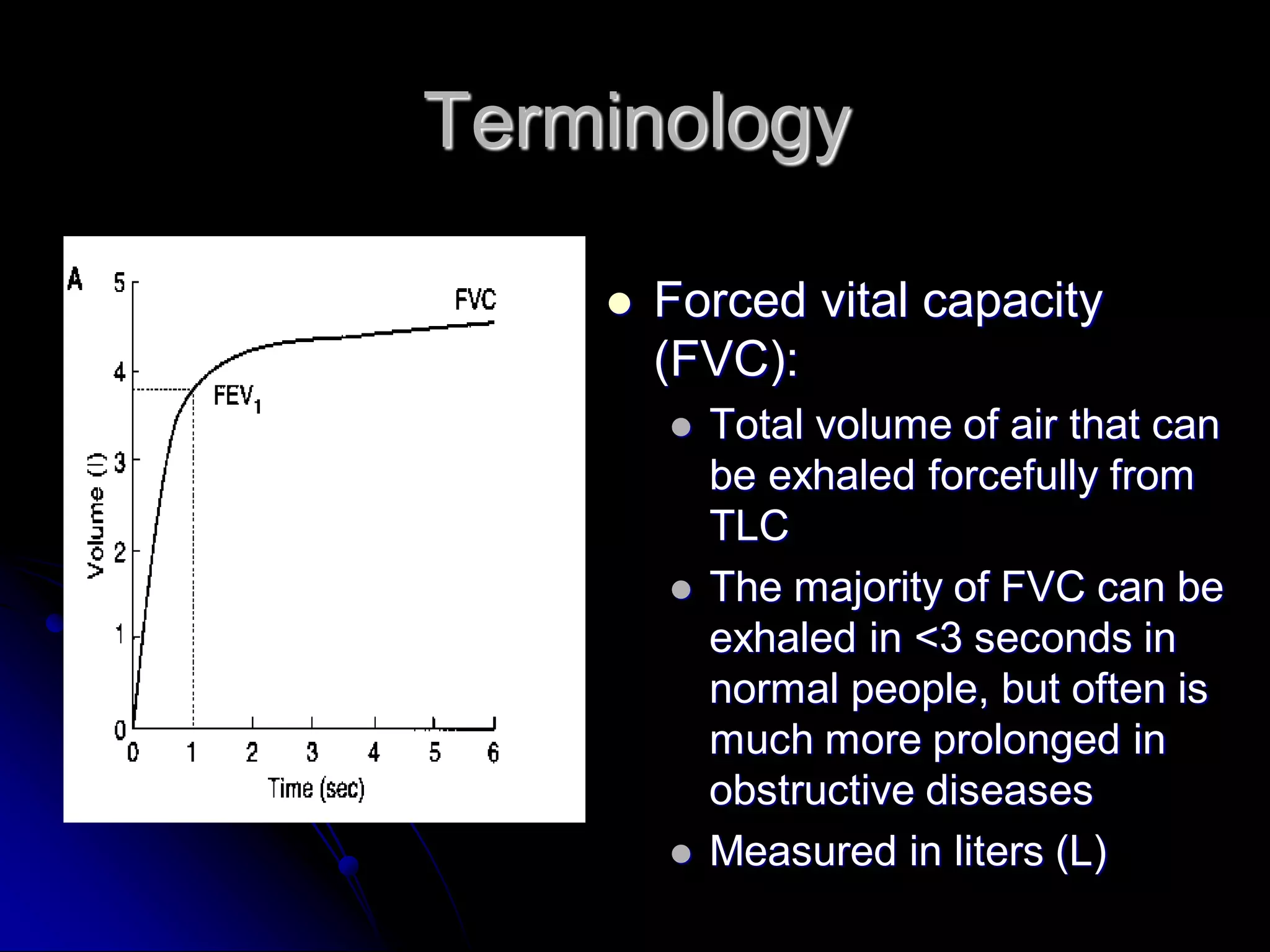
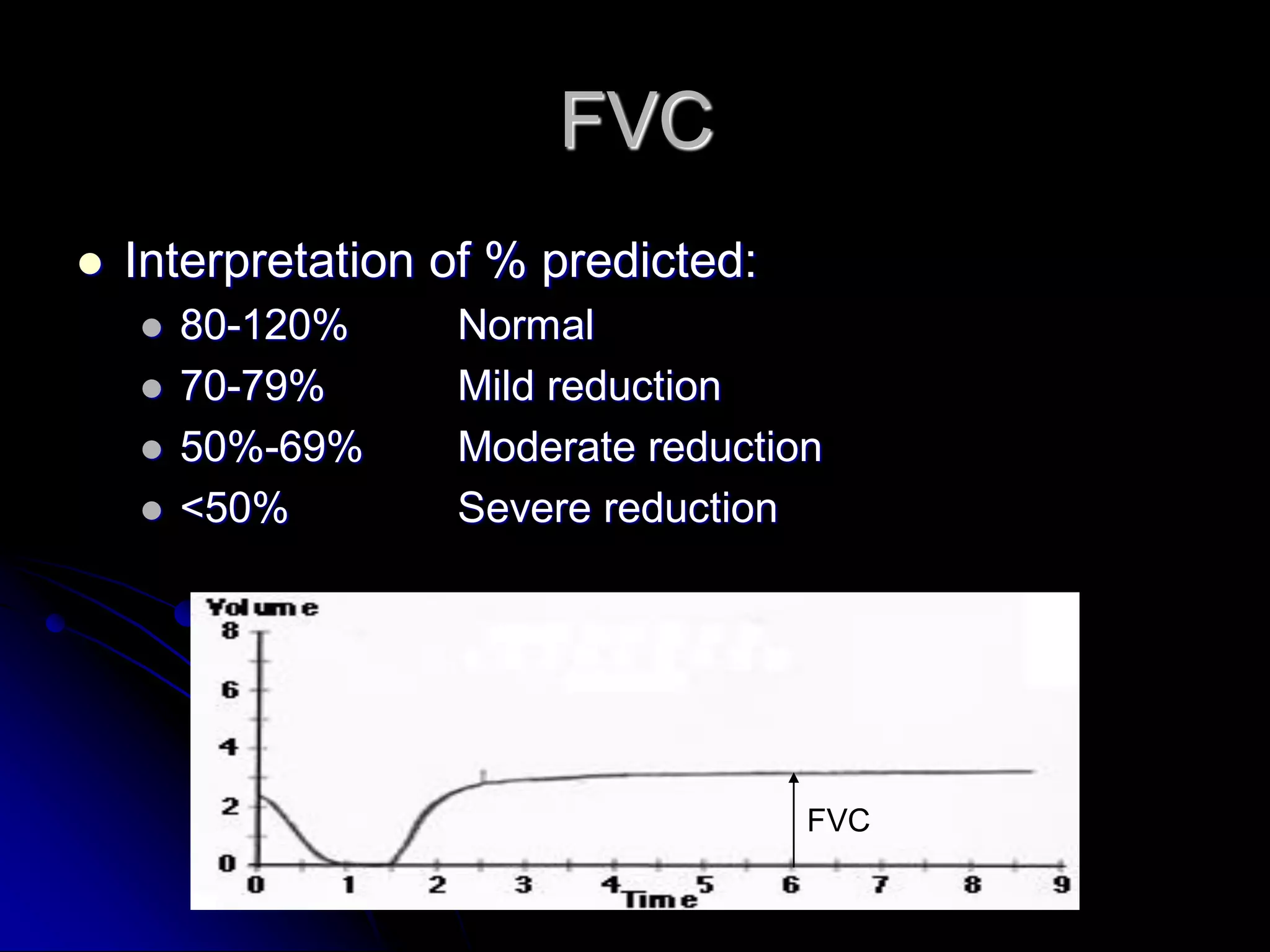
Forced vital capacity
(FVC):






Total volume of air that can
be exhaled forcefully from
TLC
The majority of FVC can be
exhaled in <3 seconds in
normal people, but often is
much more prolonged in
obstructive diseases
Measured in liters (L)
FVC


Interpretation of % predicted:






80-120%
70-79%
50%-69%
<50%

Normal
Mild reduction
Moderate reduction
Severe reduction

FVC
Terminology


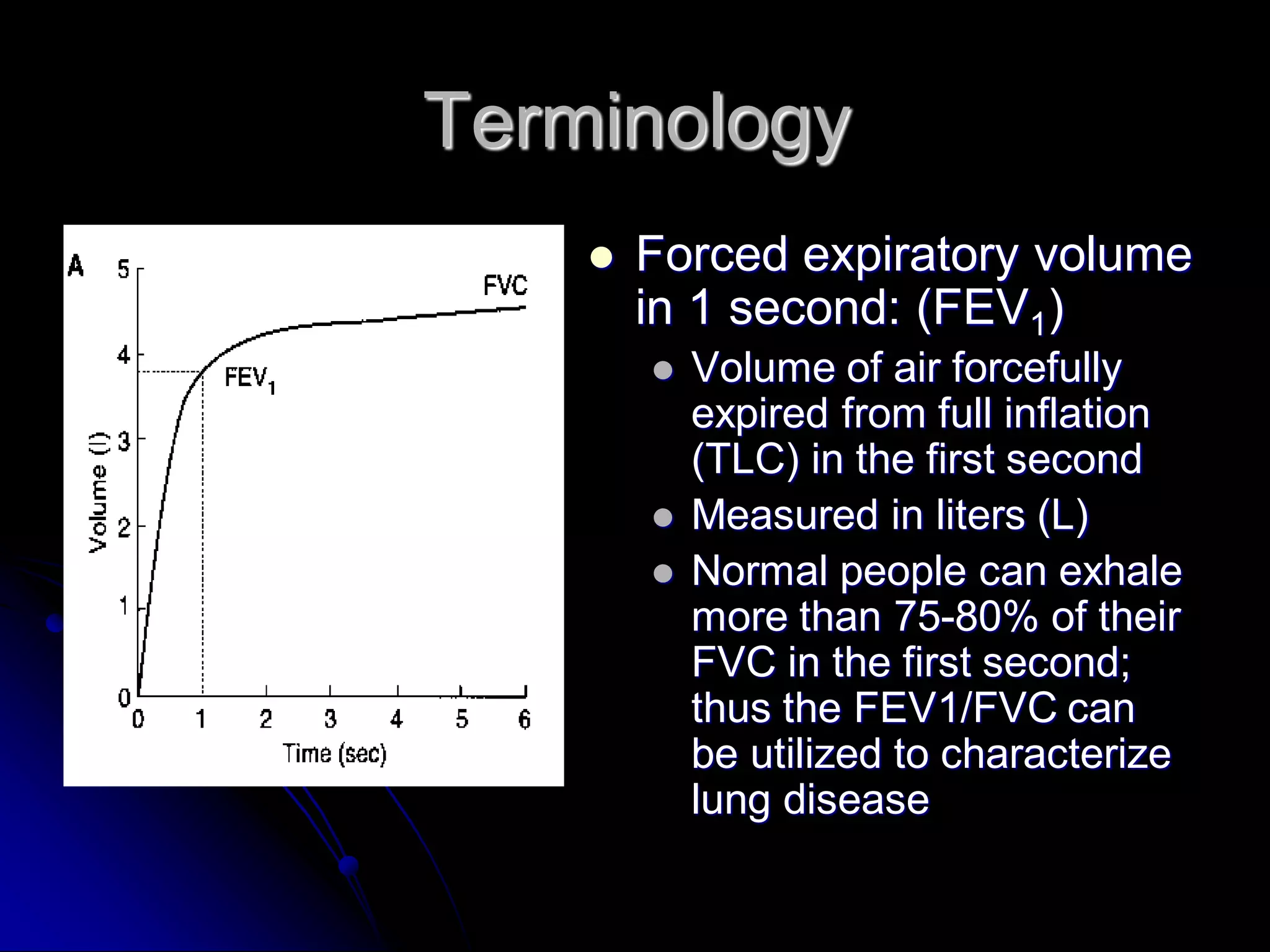
Forced expiratory volume
in 1 second: (FEV1)






Volume of air forcefully
expired from full inflation
(TLC) in the first second
Measured in liters (L)
Normal people can exhale
more than 75-80% of their
FVC in the first second;
thus the FEV1/FVC can
be utilized to characterize
lung disease
FEV1


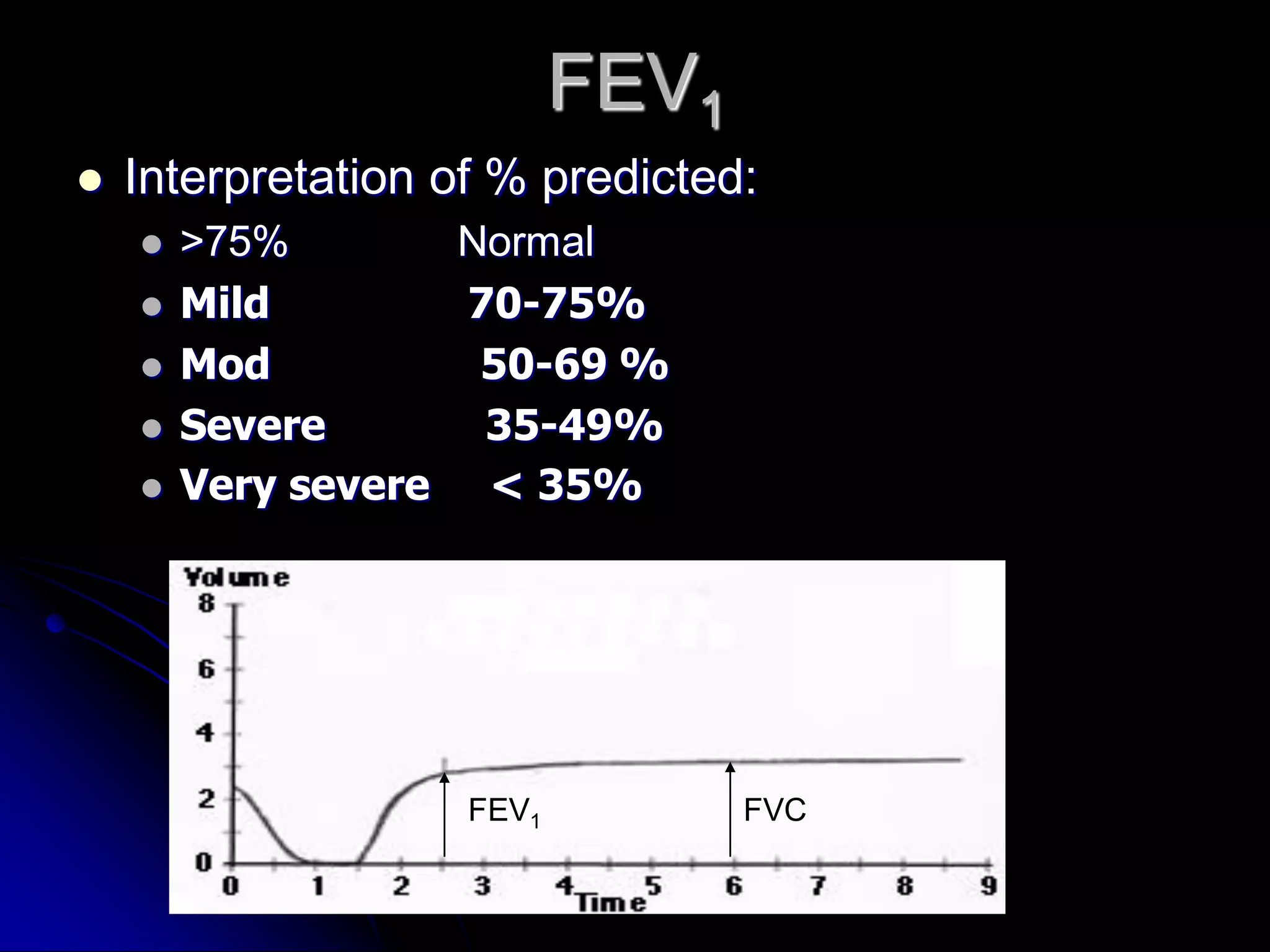
Interpretation of % predicted:






>75%
Normal
Mild
70-75%
Mod
50-69 %
Severe
35-49%
Very severe < 35%

FEV1

FVC
Terminology


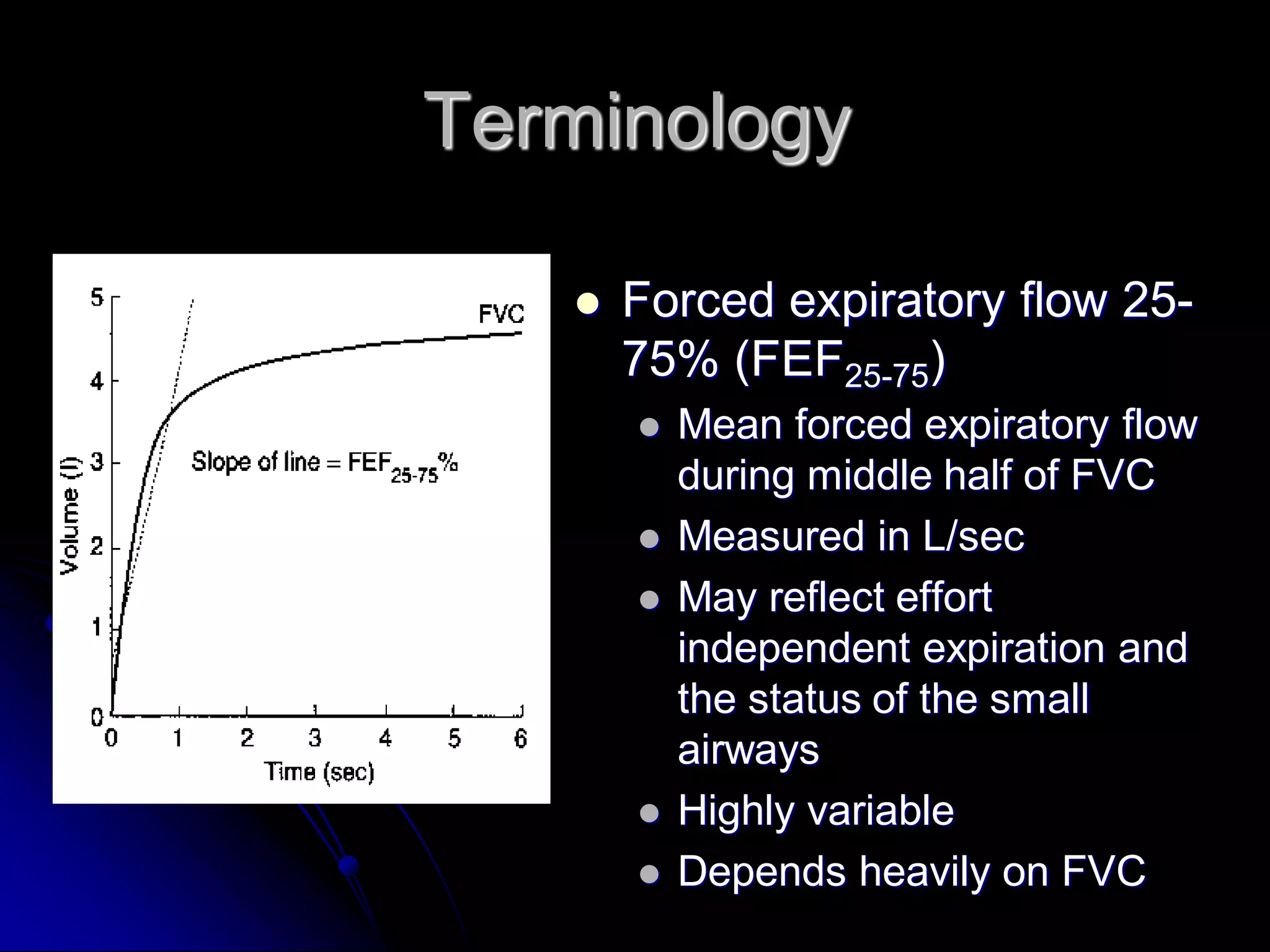
Forced expiratory flow 2575% (FEF25-75)








Mean forced expiratory flow
during middle half of FVC
Measured in L/sec
May reflect effort
independent expiration and
the status of the small
airways
Highly variable
Depends heavily on FVC
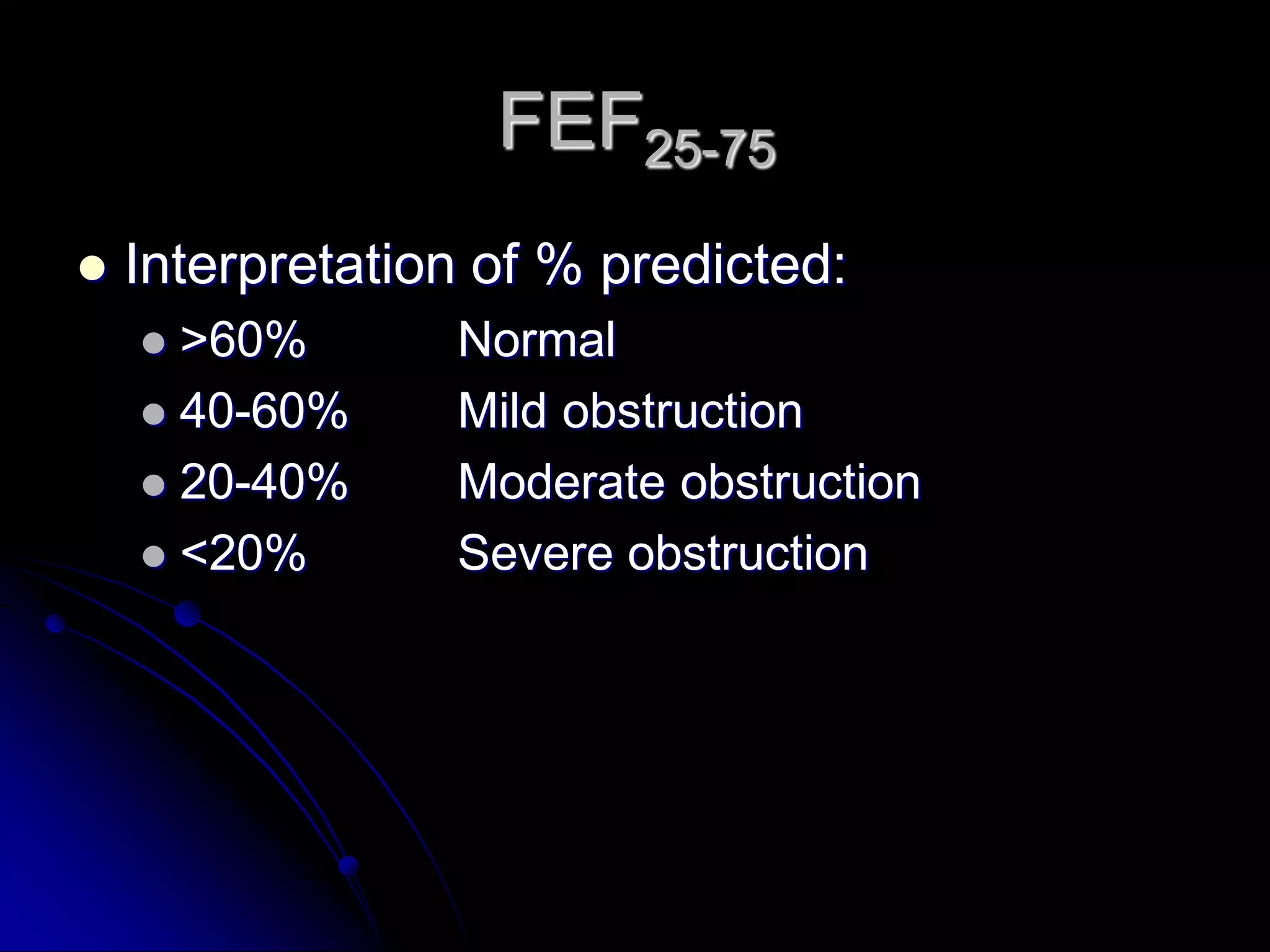
FEF25-75


Interpretation of % predicted:
>60%
 40-60%
 20-40%
 <20%


Normal
Mild obstruction
Moderate obstruction
Severe obstruction
Acceptability Criteria
Good start of test
 No coughing
 No variable flow
 No early termination
 Reproducibility

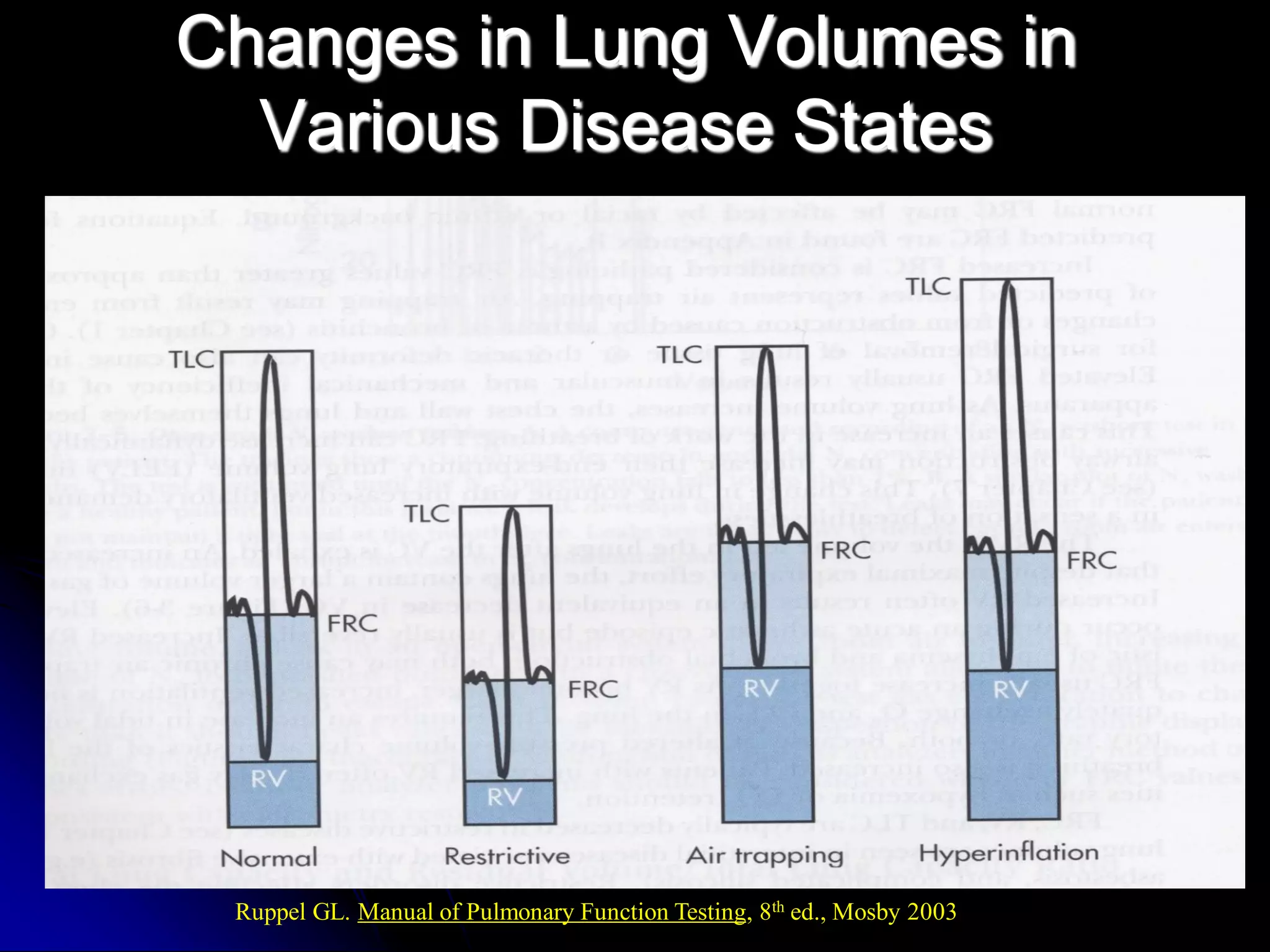
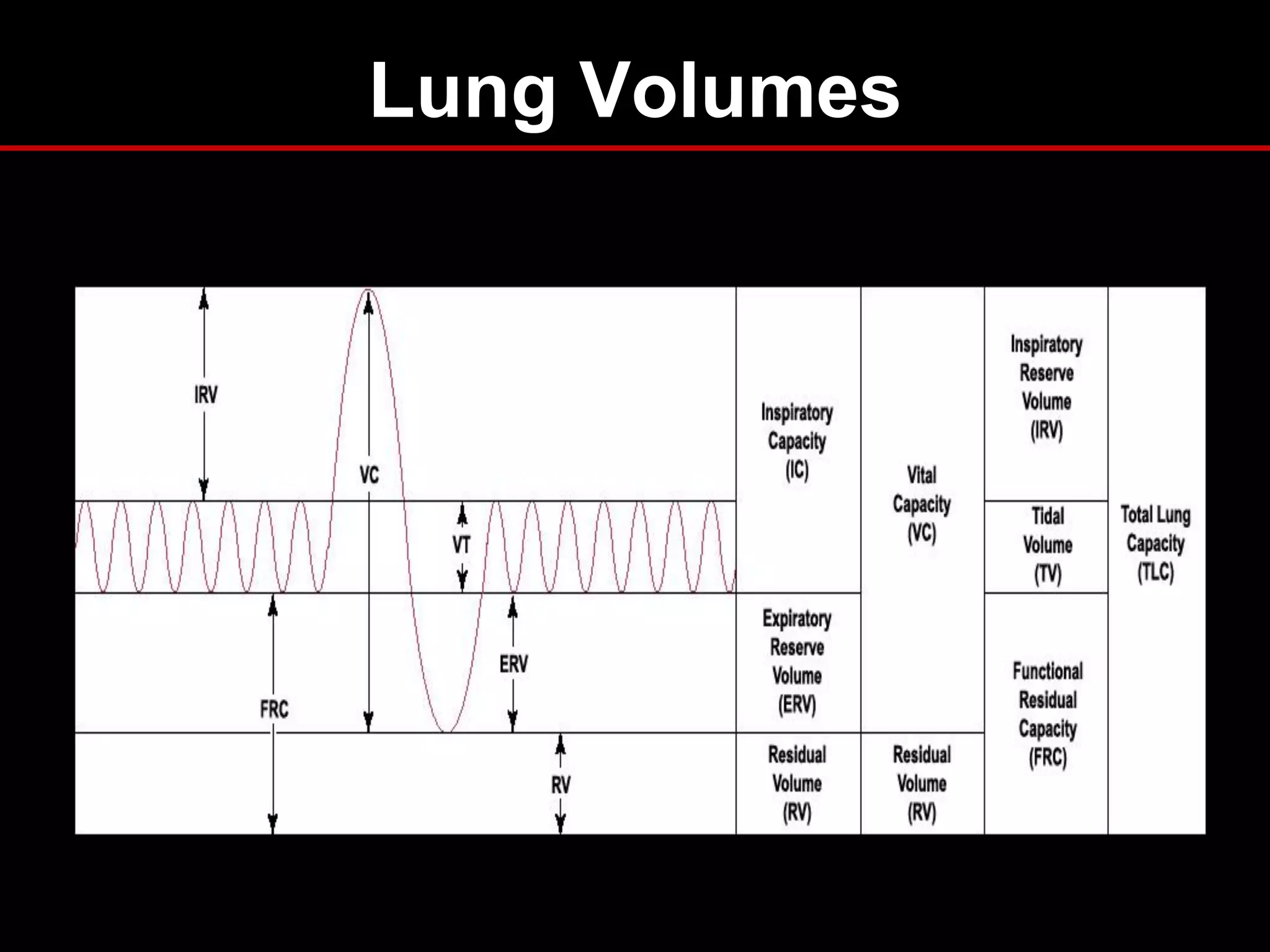
Changes in Lung Volumes in
Various Disease States

Ruppel GL. Manual of Pulmonary Function Testing, 8th ed., Mosby 2003
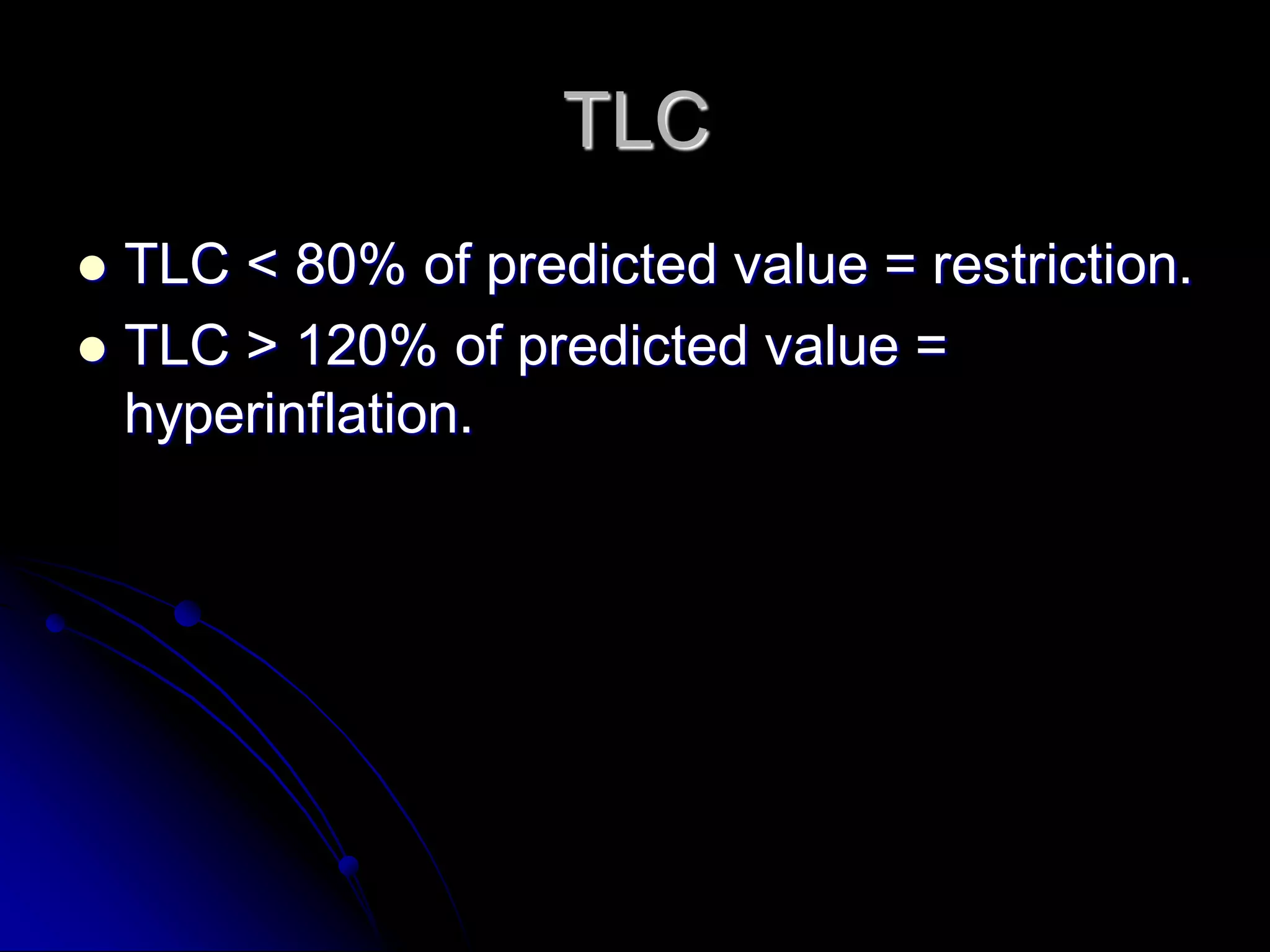
TLC
TLC < 80% of predicted value = restriction.
 TLC > 120% of predicted value =
hyperinflation.

Lung Volumes
Spirometry
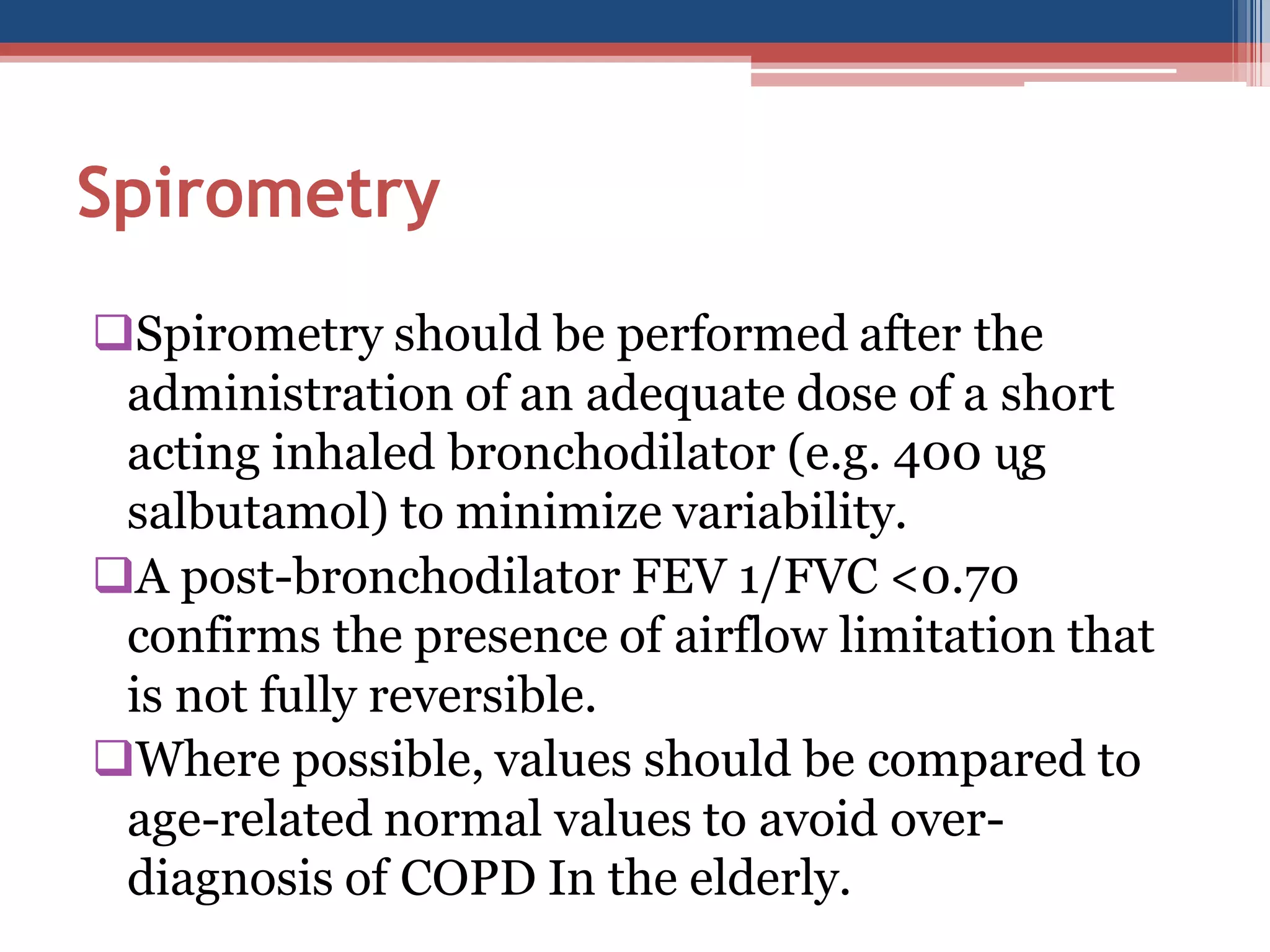
Spirometry should be performed after the
administration of an adequate dose of a short
acting inhaled bronchodilator (e.g. 400 ᶙg
salbutamol) to minimize variability.
A post-bronchodilator FEV 1/FVC <0.70
confirms the presence of airflow limitation that
is not fully reversible.
Where possible, values should be compared to
age-related normal values to avoid overdiagnosis of COPD In the elderly.
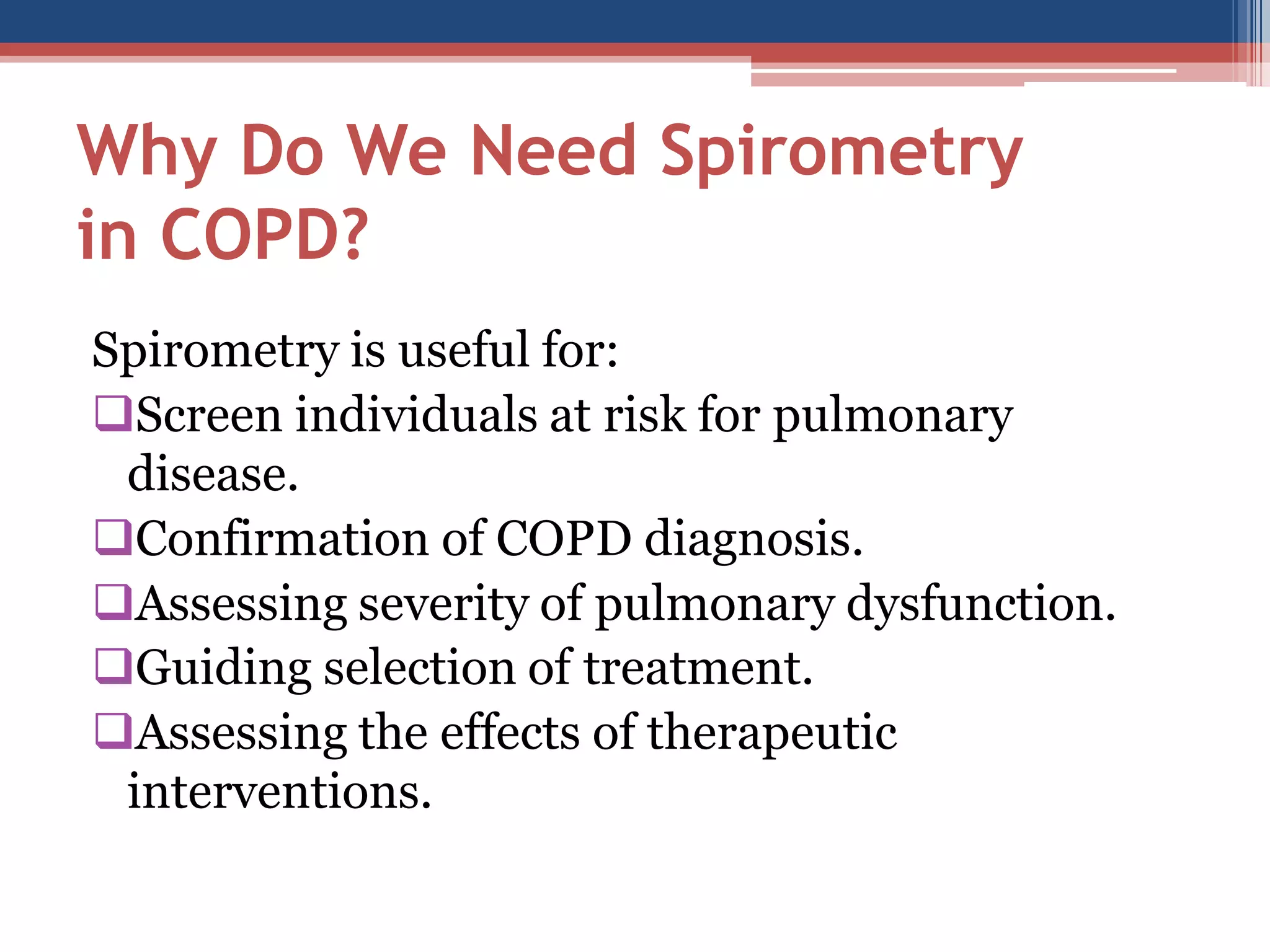
Why Do We Need Spirometry
in COPD?
Spirometry is useful for:
Screen individuals at risk for pulmonary
disease.
Confirmation of COPD diagnosis.
Assessing severity of pulmonary dysfunction.
Guiding selection of treatment.
Assessing the effects of therapeutic
interventions.
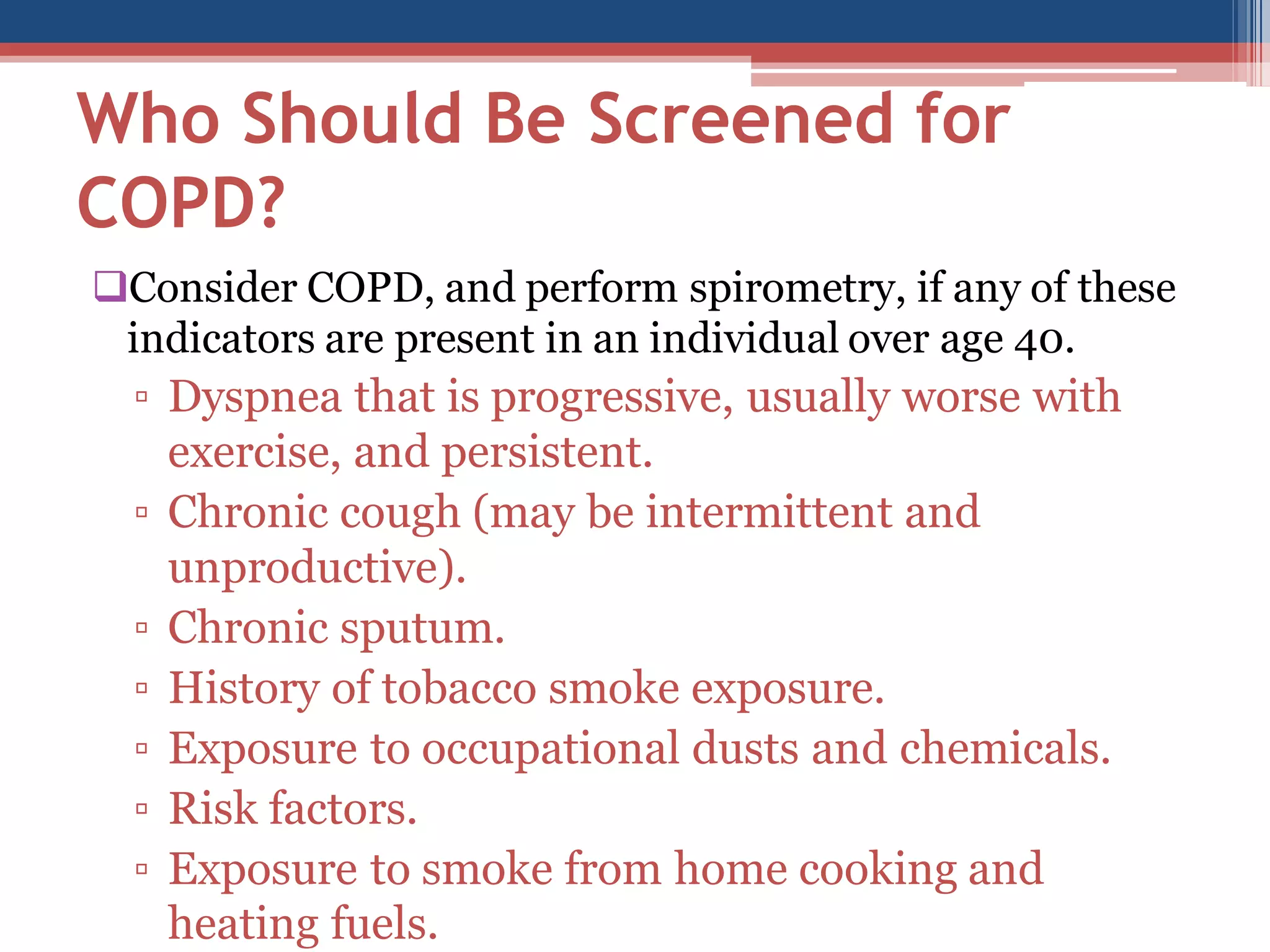
Who Should Be Screened for
COPD?
Consider COPD, and perform spirometry, if any of these
indicators are present in an individual over age 40.

▫ Dyspnea that is progressive, usually worse with
exercise, and persistent.
▫ Chronic cough (may be intermittent and
unproductive).
▫ Chronic sputum.
▫ History of tobacco smoke exposure.
▫ Exposure to occupational dusts and chemicals.
▫ Risk factors.
▫ Exposure to smoke from home cooking and
heating fuels.
Spirometry Origin
Most basic of Pulmonary Function Tests
Clinical Tools Origin - Mid 1800' s
▫ John Hutchinson.
▫ Water-sealed spirometry to measure vital capacity
(VC).
Reasons for Performing
Spirometry
Diagnostic Purposes.
Monitoring Lung Disease.
Assessing Disability.
Spirometry
Spirometry with flow volume loops assesses the
mechanical properties of the respiratory system
by measuring expiratory volumes and flow rates.
▫ Maximal inspiratory and expiratory effort.
▫ At least 3 tests of acceptable effort are performed
to ensure reproducibility.
21st Century Spirometry
Measurements of:
Forced Vital Capacity (FVC).
Forced Expiratory Volume in one second
(FEV1).
Forced Expiratory Volume in six seconds
(FEV6).
Forced Expiratory Flow over various Intervals
(FEFx).
Peak Expiratory Flow (PEF).
Definitions and Terms
FEV1 - forced expiratory volume 1 - the volume of
air that is forcefully exhaled in one second.

FEV6 - forced expiratory volume 6 - the volume of
air that Is forcefully exhaled in six seconds.

FVC- forced vital capacity- the volume of air that
can be maximally forcefully exhaled.

FEV1/FVC- ratio of FEV1 to FVC, expressed as a
percentage.
Definitions and Terms
FEV/FVC- ratio of FEV6 to FVC, expressed as a
percentage.
FEF25 -75 - forced expiratory flow - the average
forced expiratory flow during the mid (25 - 75%) portion
of the FVC.

PEF- peak expiratory flow rate - the peak flow rate
during expiration.
Spirometry
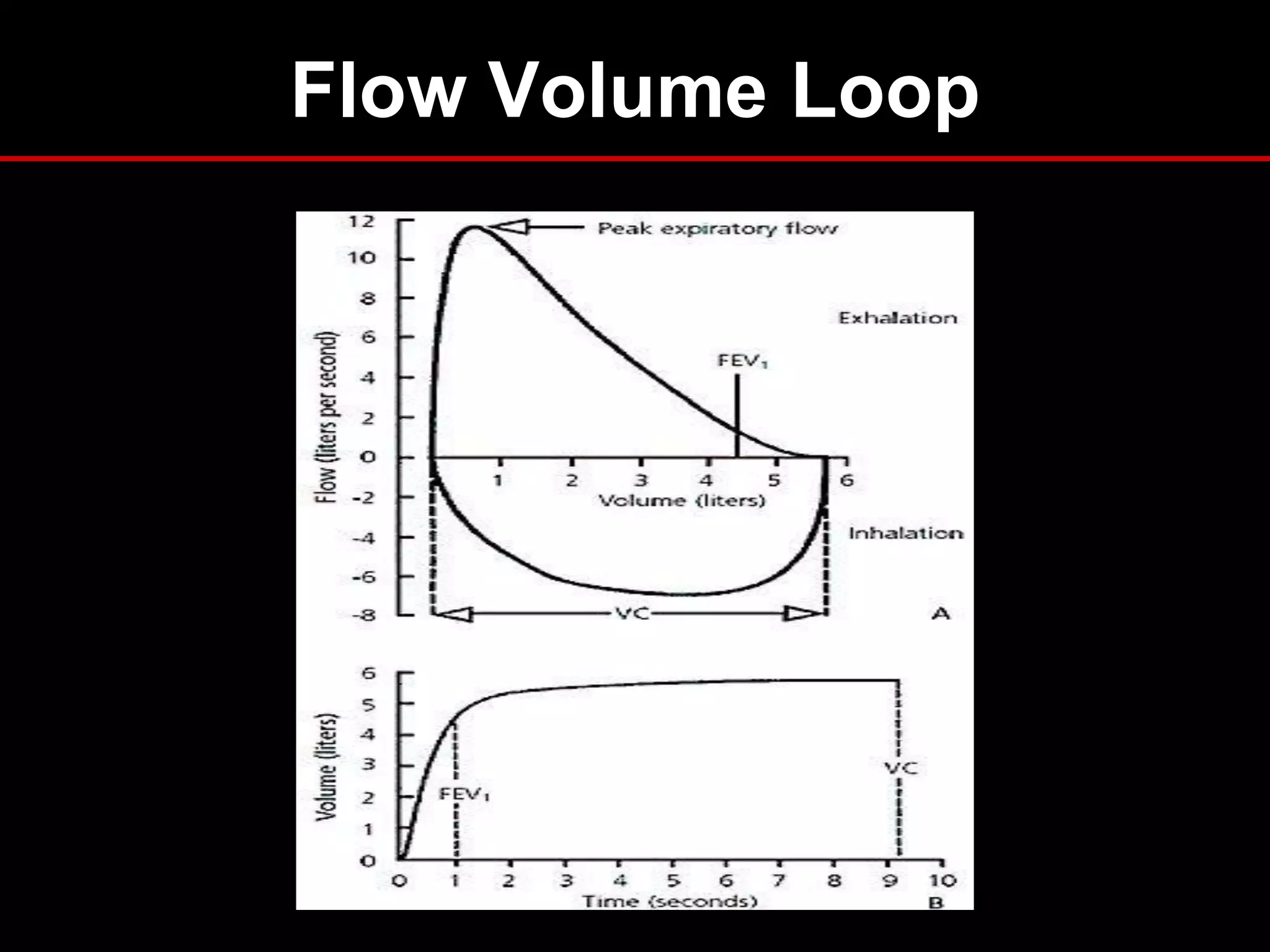
Flow volume loops provide a graphic illustration
of a patient's spirometric efforts.
Flow is plotted against volume to display a
continuous loop from inspiration to expiration.
The volume versus time curve is a an alternative
way of plotting spirometric results.
The overall shape of the flow volume loop is
important in Interpreting spirometric results.
Acceptability & Repeatability
Acceptability
At least three (3) acceptable maneuvers
Good start to the test.
No hesitation or coughing for the 1st second.
FVC lasts at least 6 seconds with a plateau of at
least 1 second.
No valsalva maneuver or obstruction of the
mouthpiece.
FIVC shows apparent maximal effort.
Repeatability
Repeatability criteria act as guideline to
determine need for additional efforts.
▫ Largest and 2nd largest FVC must be within 150
mL.
▫ Largest and 2nd largest FEV 1 must be 150 mL.
▫ PEF values may be variable (within 15%).

If three acceptable reproducible maneuvers are
not recorded, up to B attempts may be recorded.
Spirometry Value
Spirometry is typically reported in both absolute
values and as a predicted percentage of normal.
Normal values vary and are dependent on:
▫
▫
▫
▫

Gender,
Race,
Age, and
Height.
Reporting Standards
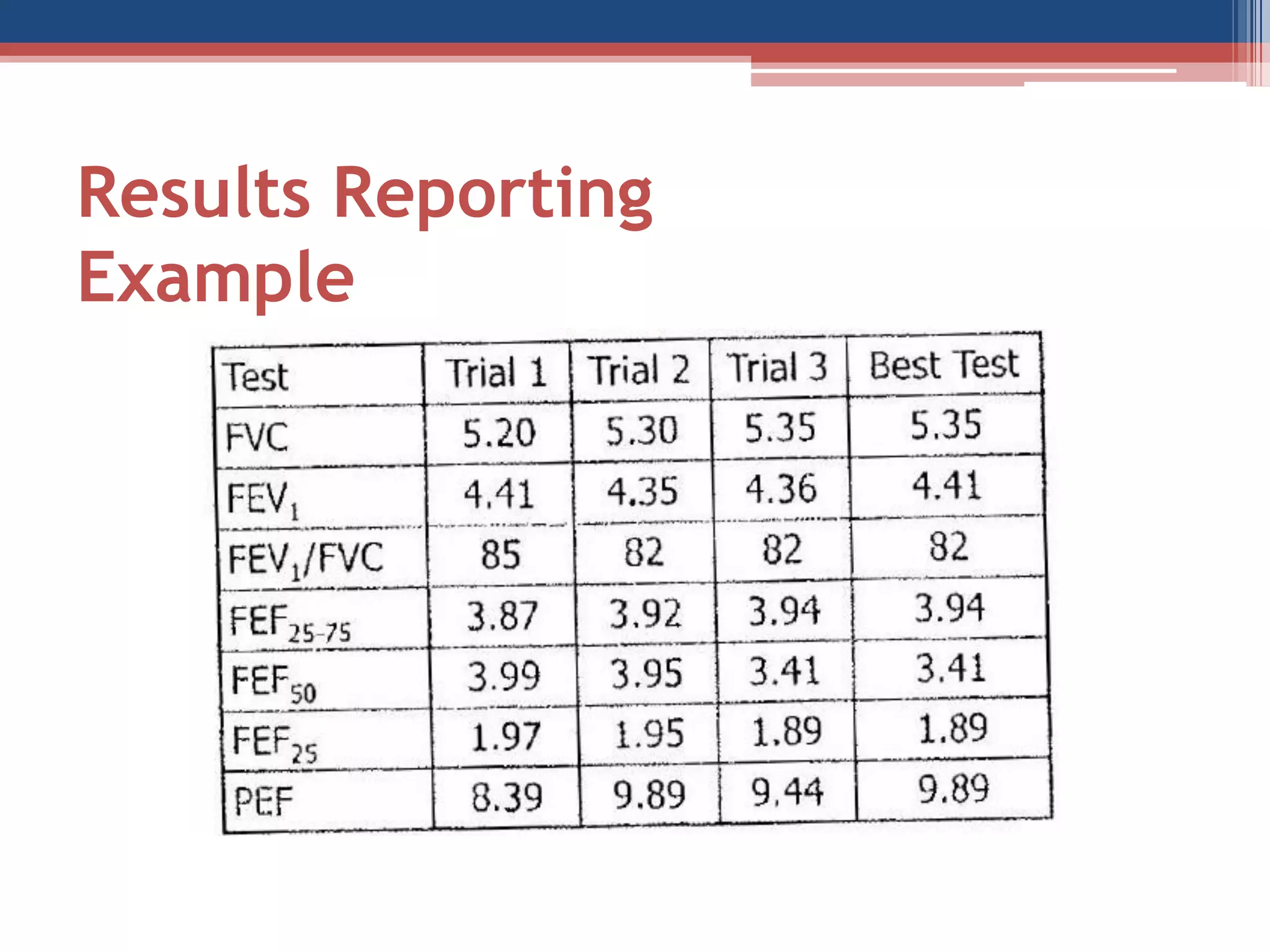
Largest FVC obtained from all acceptable efforts
should be reported.
Largest FEV1 obtained from all acceptable trials
should be reported.
May or may not come from largest FVC effort.
All other flows, should come from the effort with
the largest sum of FEV 1 & FVC.
PEF should be the largest value obtained from
at least 3 acceptable maneuvers.
Results Reporting
Example
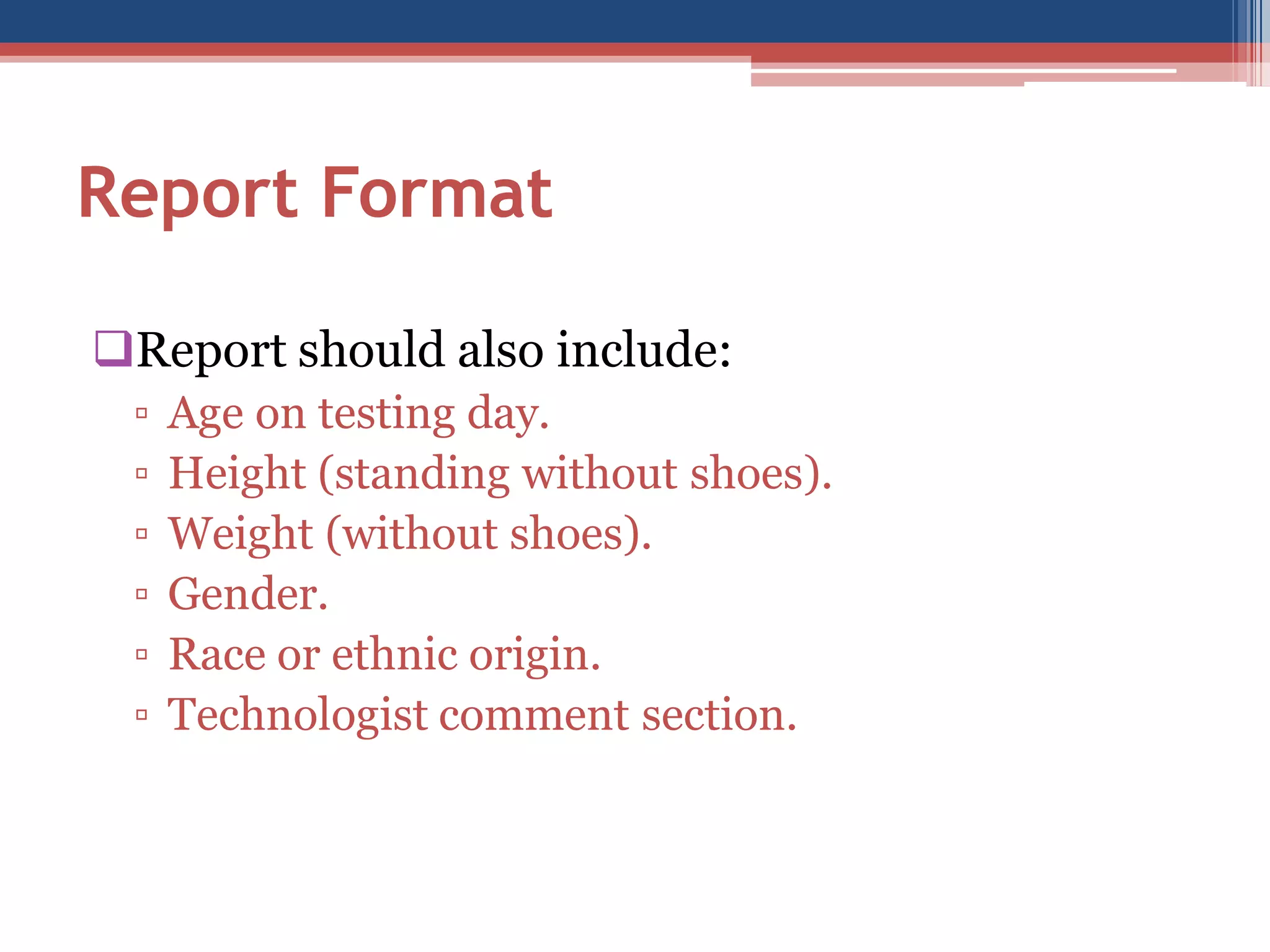
Report Format
Report should also include:
▫
▫
▫
▫
▫
▫

Age on testing day.
Height (standing without shoes).
Weight (without shoes).
Gender.
Race or ethnic origin.
Technologist comment section.
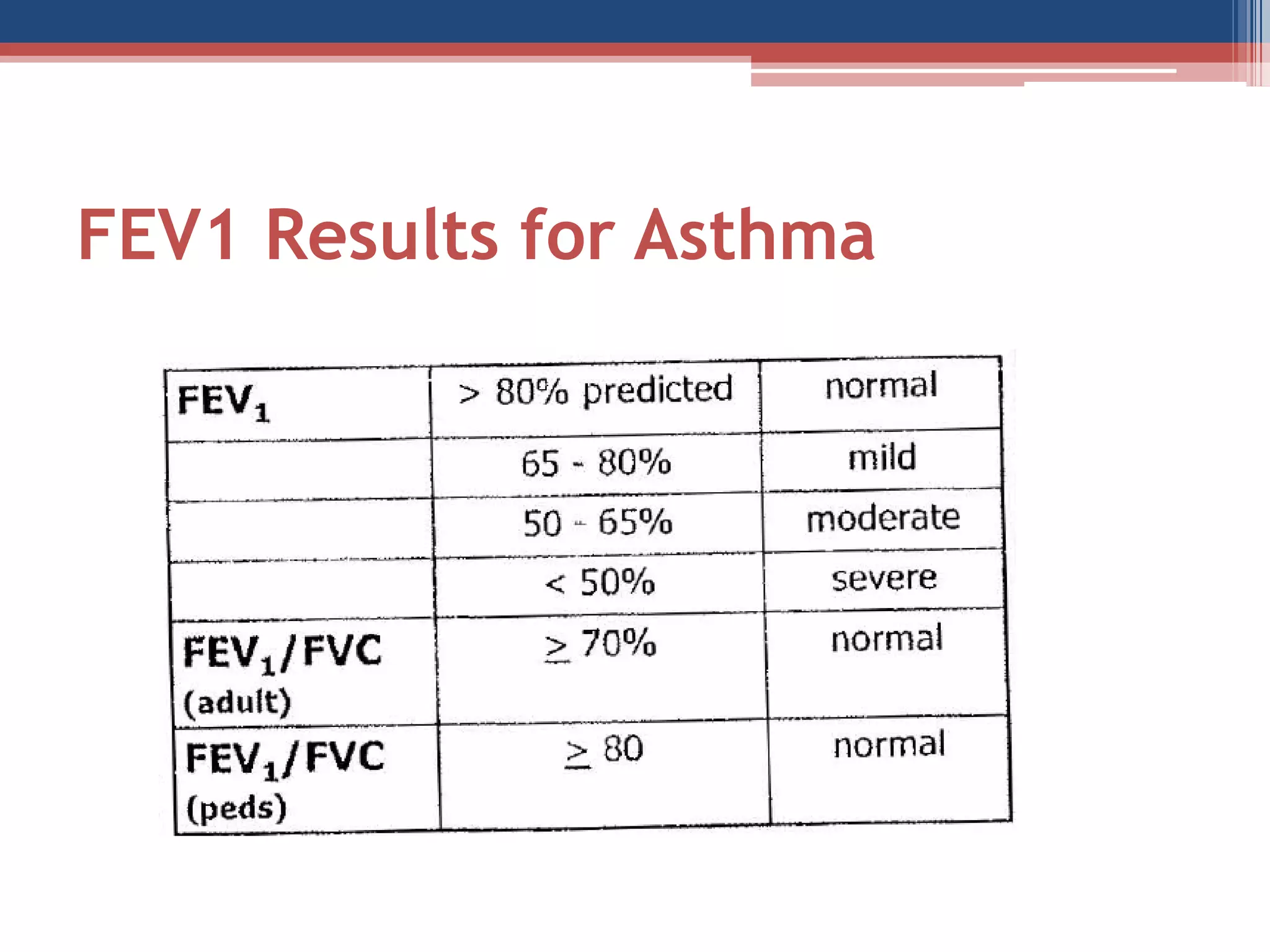
FEV1 Results for Asthma
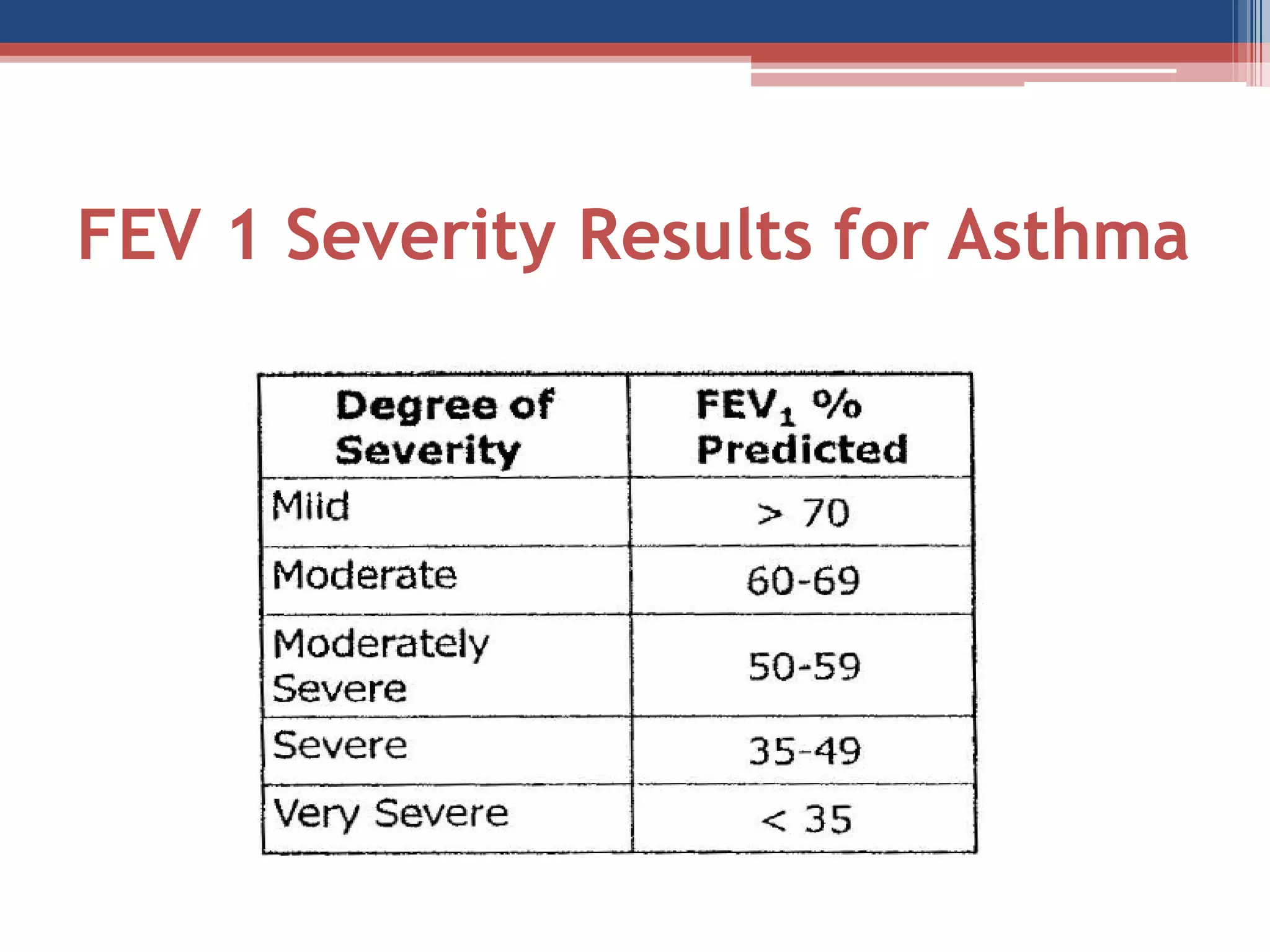
FEV 1 Severity Results for Asthma
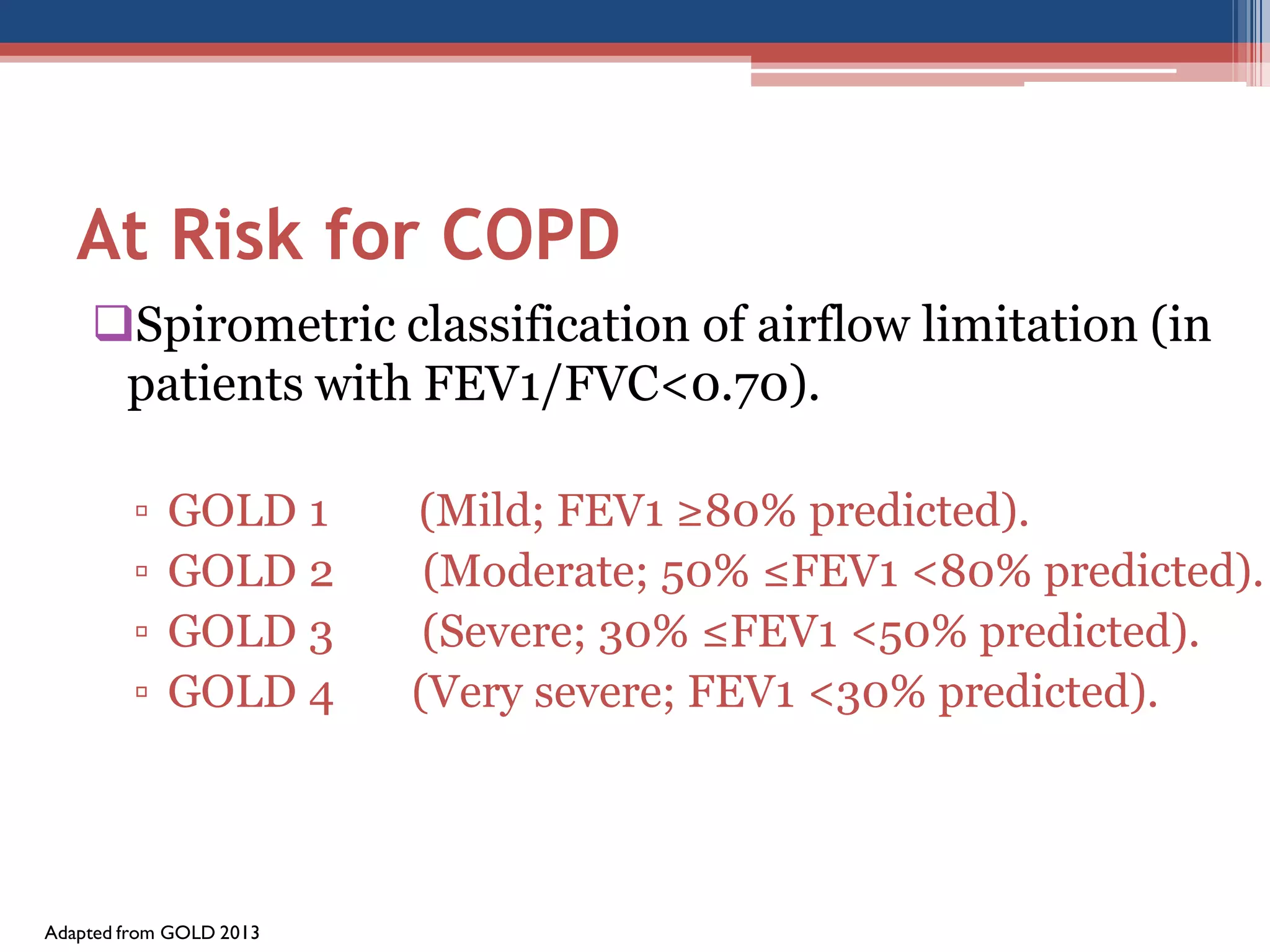
At Risk for COPD
Spirometric classification of airflow limitation (in
patients with FEV1/FVC<0.70).
▫
▫
▫
▫

GOLD 1
GOLD 2
GOLD 3
GOLD 4

Adapted from GOLD 2013

(Mild; FEV1 ≥80% predicted).
(Moderate; 50% ≤FEV1 <80% predicted).
(Severe; 30% ≤FEV1 <50% predicted).
(Very severe; FEV1 <30% predicted).
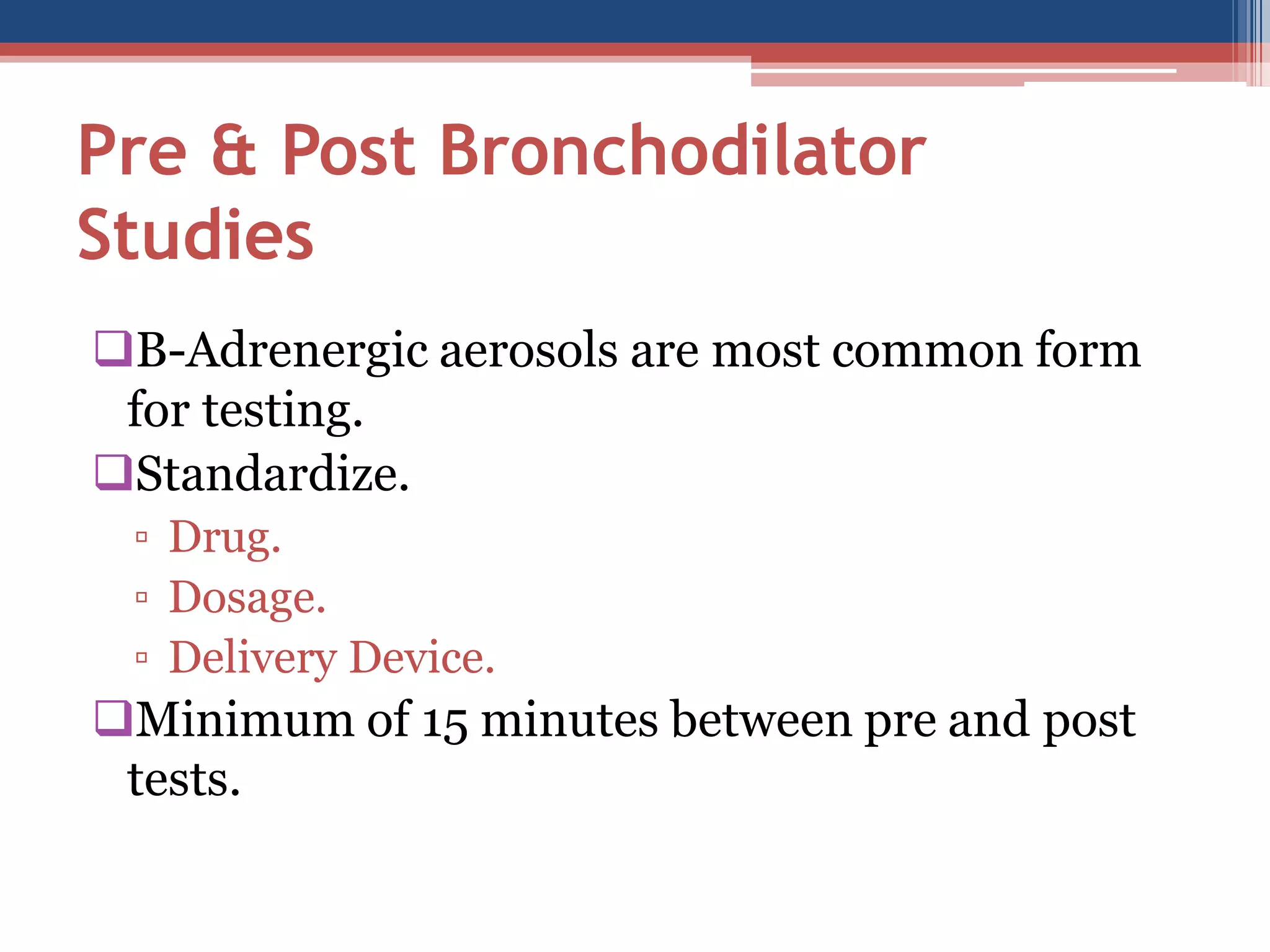
Pre & Post Bronchodilator
Studies
B-Adrenergic aerosols are most common form
for testing.
Standardize.
▫ Drug.
▫ Dosage.
▫ Delivery Device.

Minimum of 15 minutes between pre and post
tests.
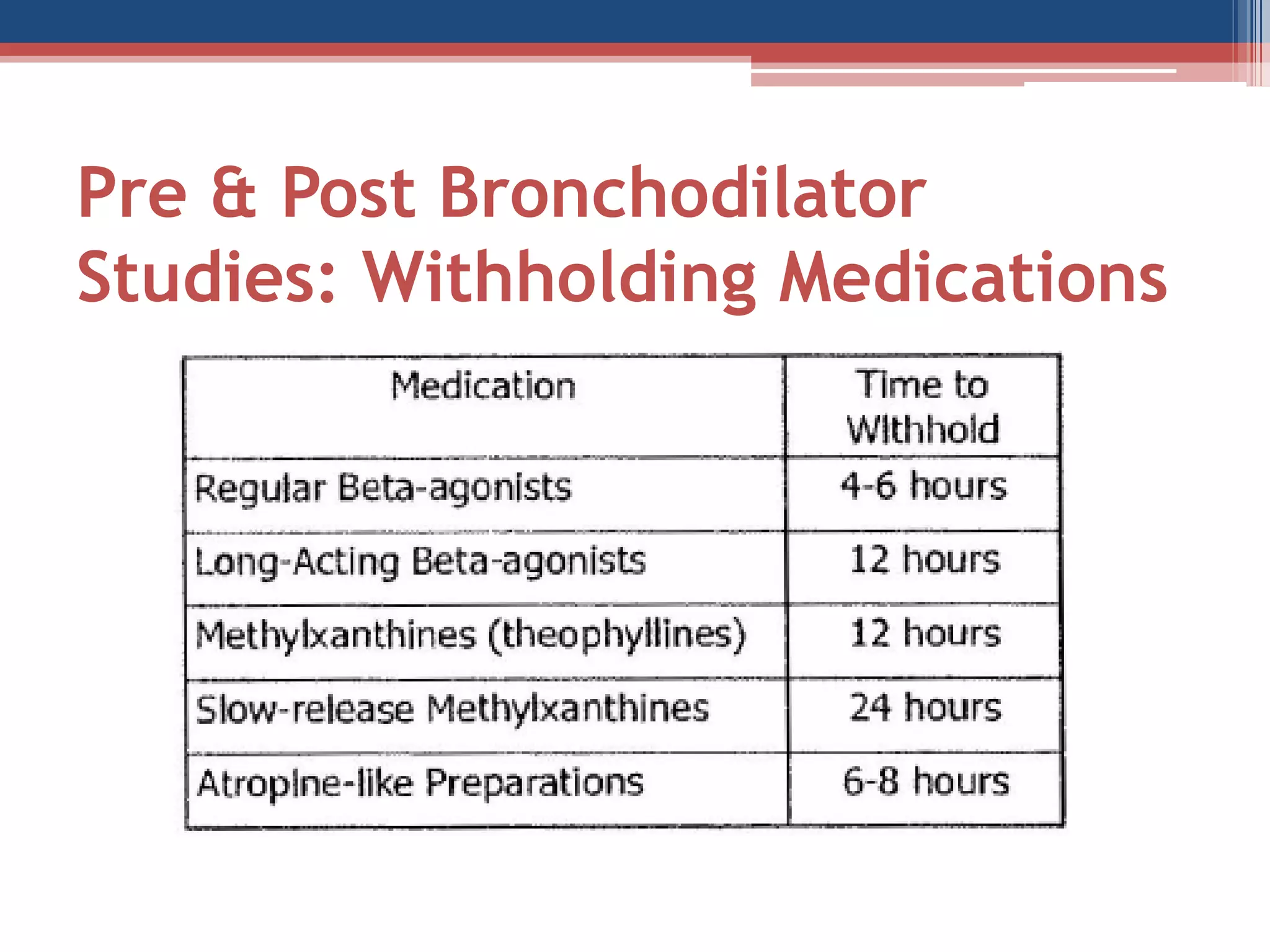
Pre & Post Bronchodilator
Studies: Withholding Medications
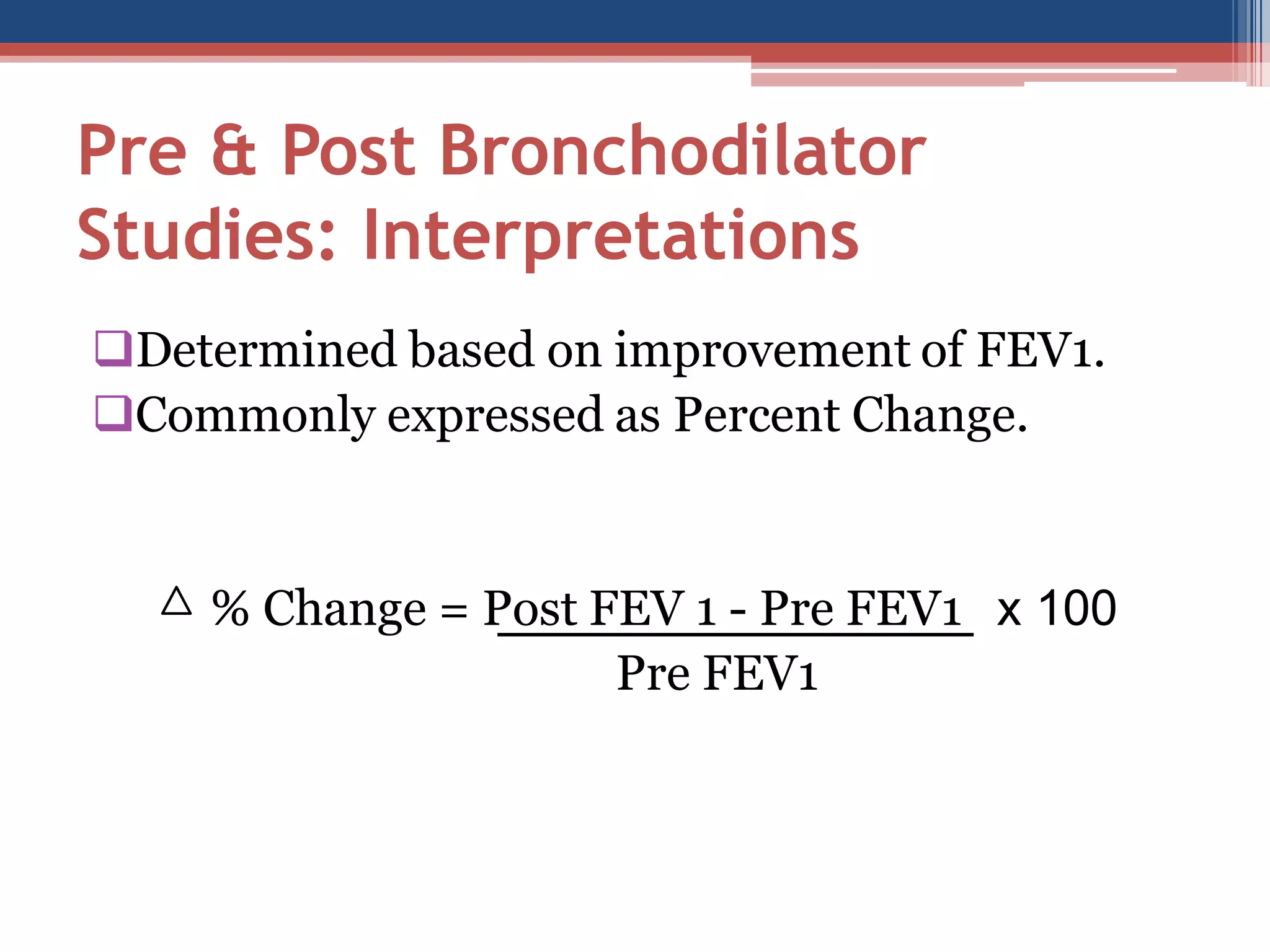
Pre & Post Bronchodilator
Studies: Interpretations
Determined based on improvement of FEV1.
Commonly expressed as Percent Change.

% Change = Post FEV 1 - Pre FEV1 x 100
Pre FEV1
Reversibility
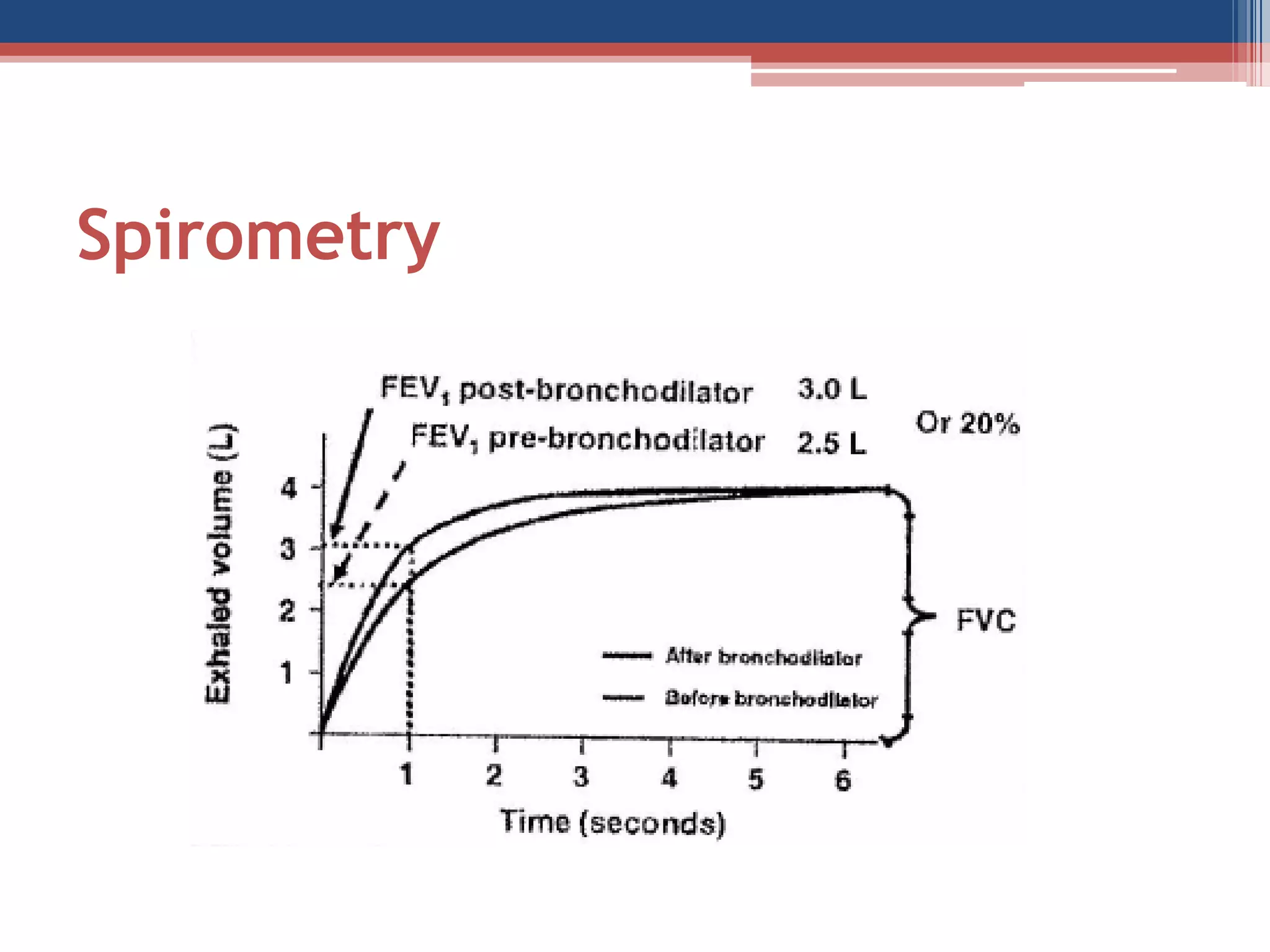
Reversibility of airways obstruction can be
assessed with the use of bronchodilators.
> 12% increase in the FEV1 and 200 ml
improvement in FEV1
OR
> 12% increase in the FVC and 200 ml
improvement in FVC.
Spirometry
Asthma Challenge Testing
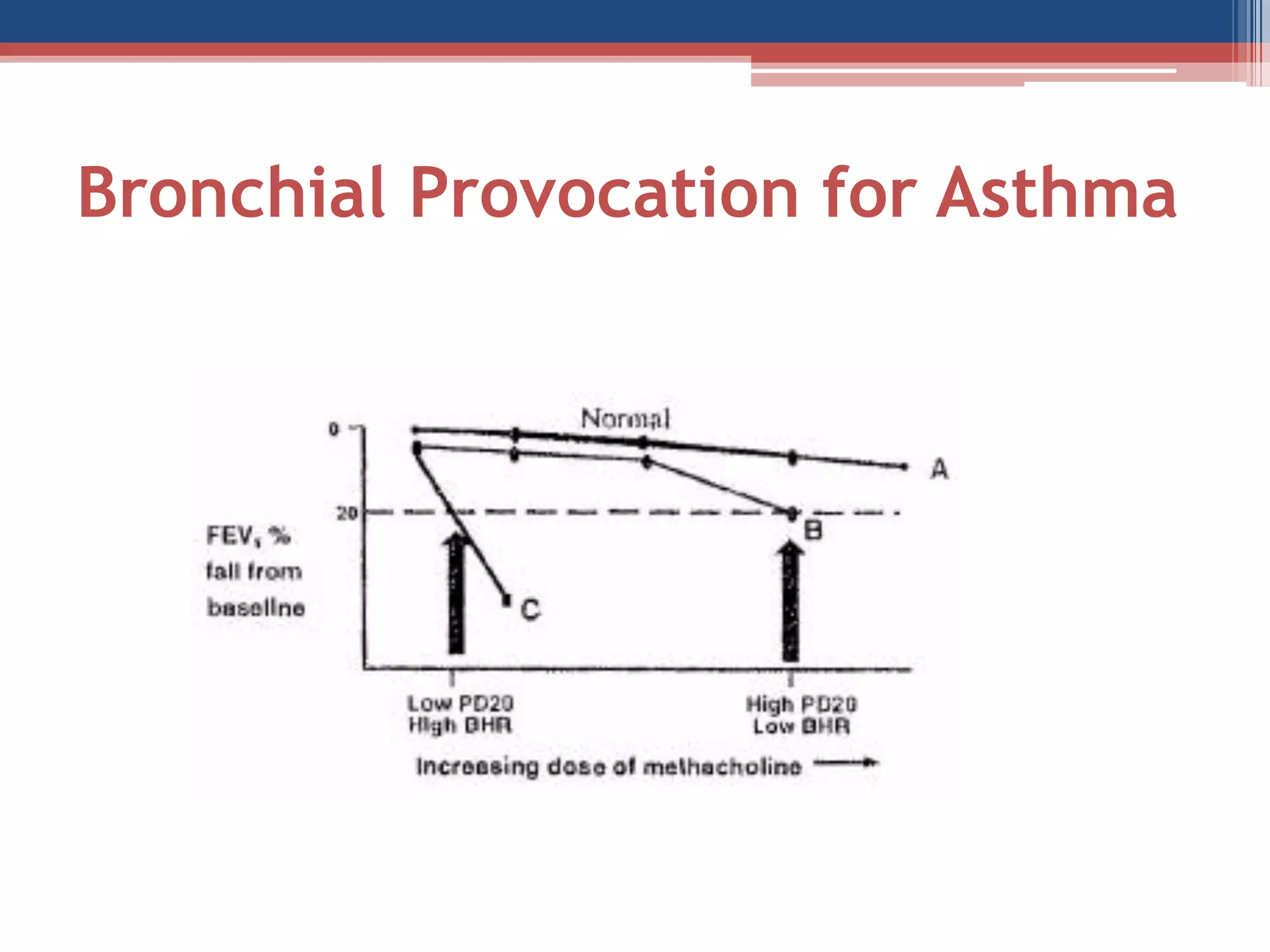
Spirometry can be used to detect the bronchial
hyperreactivity that characterizes asthma.
Increasing concentrations of histamine or
methacholine.
Patients with asthma will demonstrate
symptoms and produce spirometric results
consistent with airways obstruction at much
lower threshold concentration than normals.
Bronchial Provocation for Asthma
Spirometry
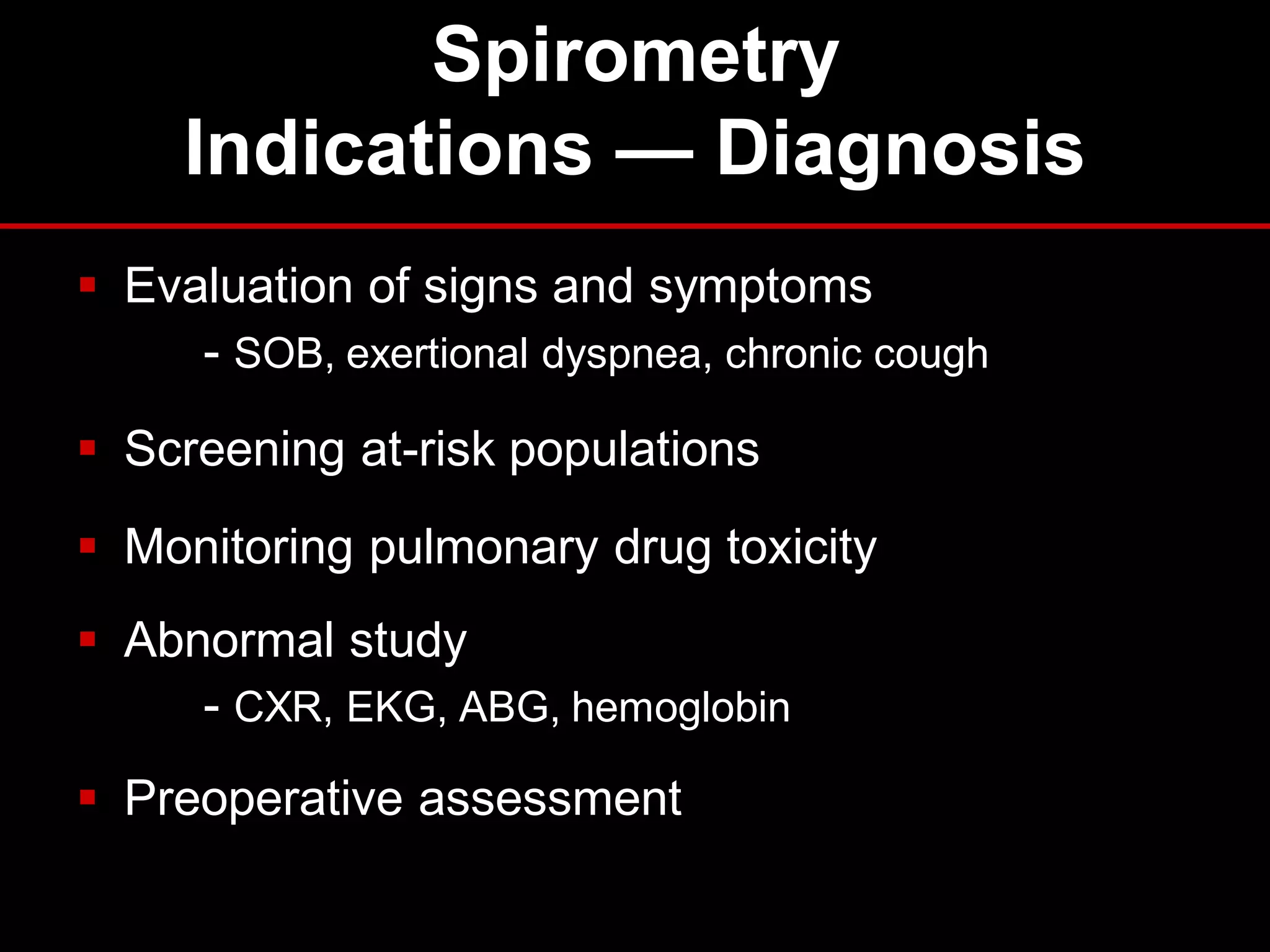
Indications — Diagnosis
 Evaluation of signs and symptoms
- SOB, exertional dyspnea, chronic cough
 Screening at-risk populations
 Monitoring pulmonary drug toxicity
 Abnormal study
- CXR, EKG, ABG, hemoglobin
 Preoperative assessment
Spirometry
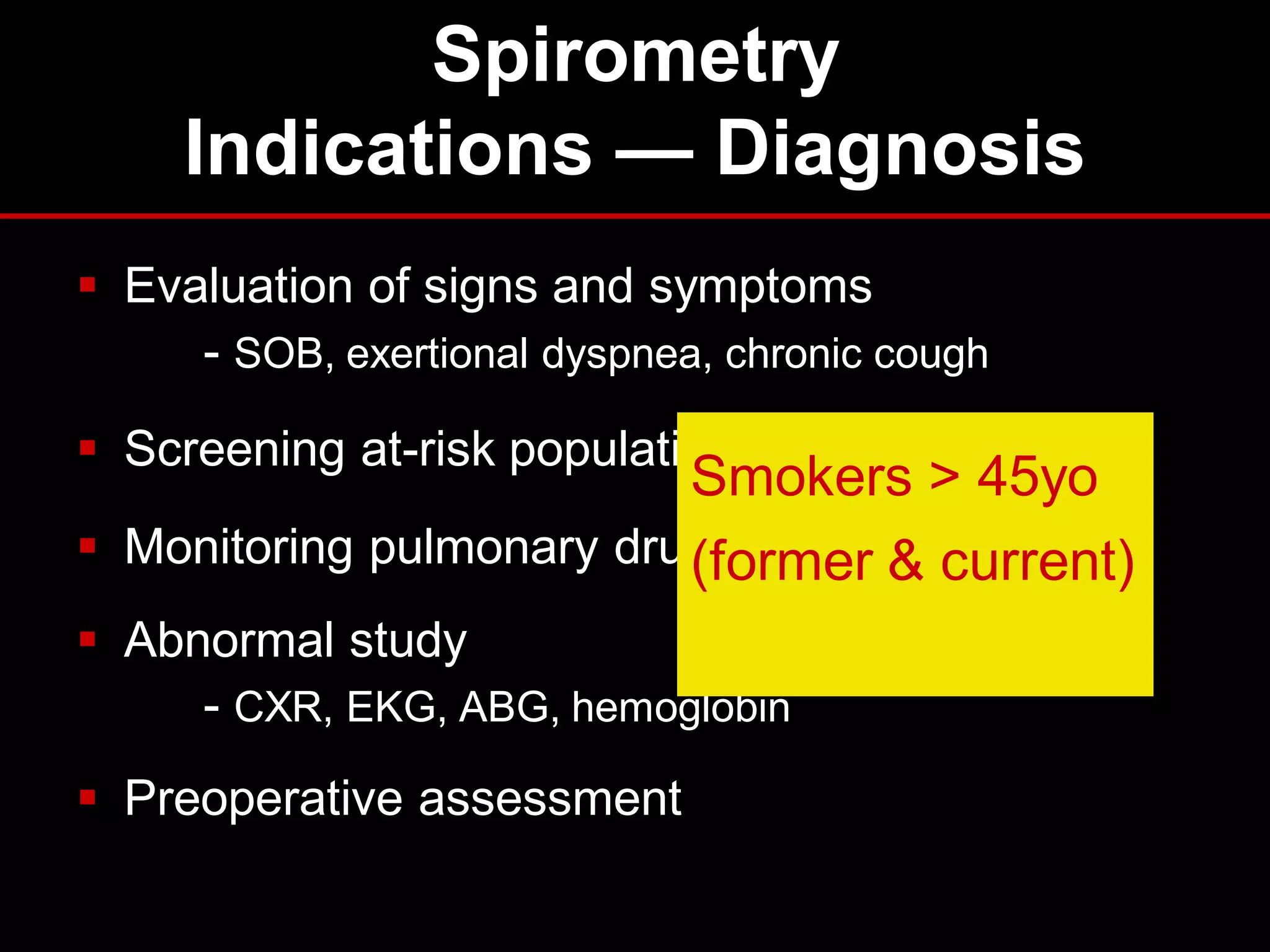
Indications — Diagnosis
 Evaluation of signs and symptoms
- SOB, exertional dyspnea, chronic cough
 Screening at-risk populations

Smokers > 45yo
 Monitoring pulmonary drug toxicity & current)
(former
 Abnormal study
- CXR, EKG, ABG, hemoglobin
 Preoperative assessment
Spirometry
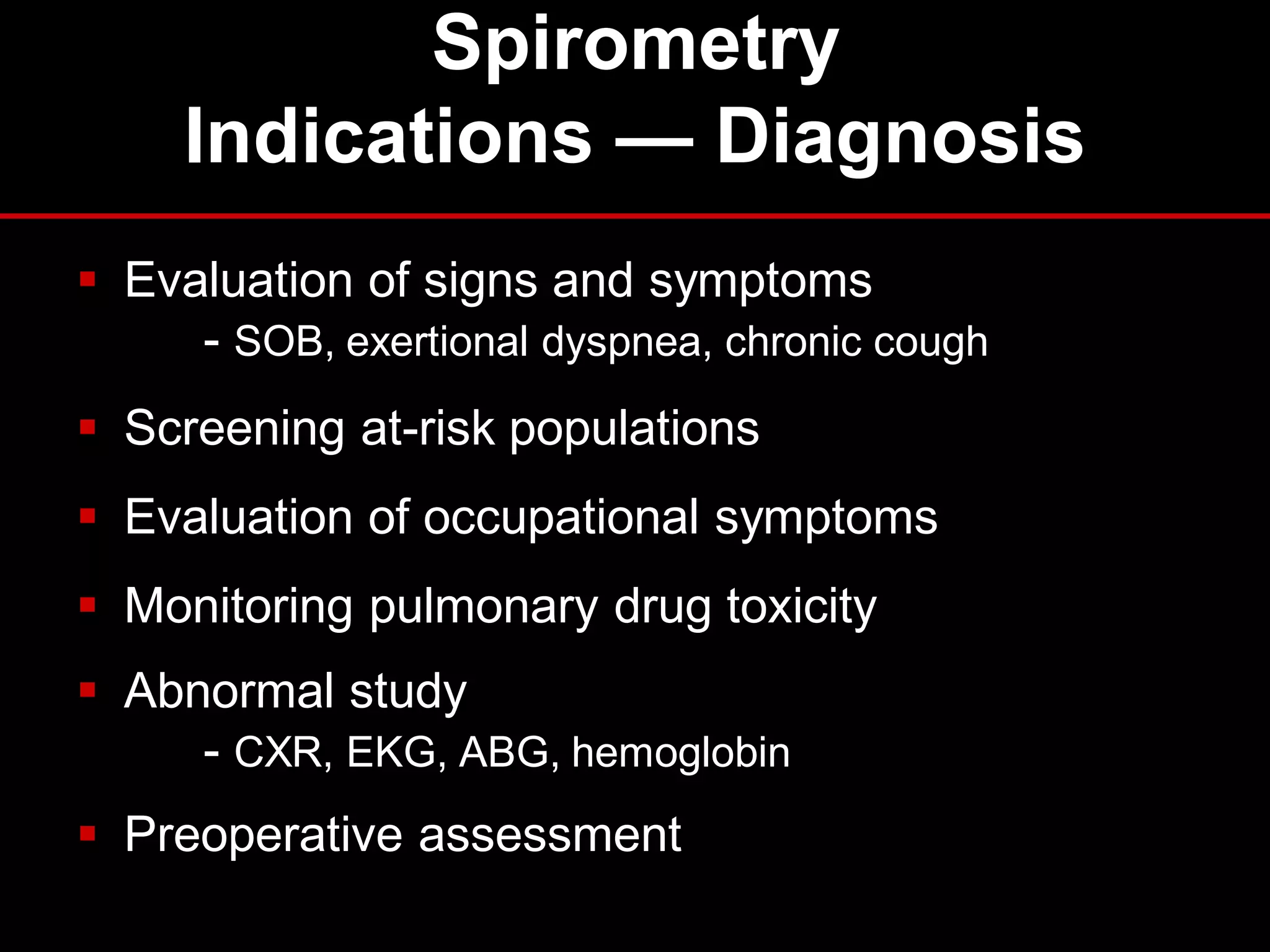
Indications — Diagnosis
 Evaluation of signs and symptoms
- SOB, exertional dyspnea, chronic cough
 Screening at-risk populations
 Evaluation of occupational symptoms

 Monitoring pulmonary drug toxicity
 Abnormal study
- CXR, EKG, ABG, hemoglobin
 Preoperative assessment
Spirometry
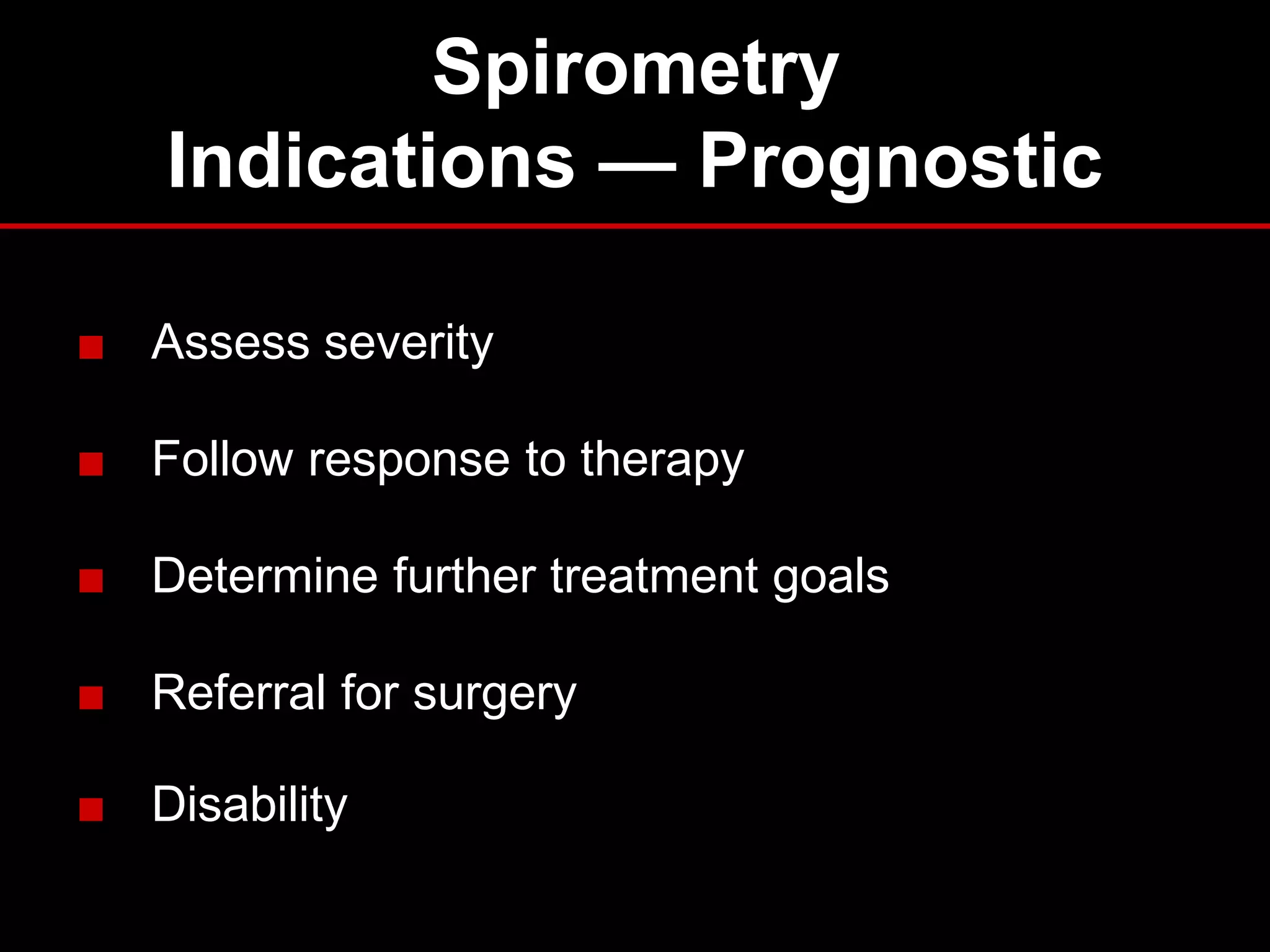
Indications — Prognostic
■ Assess severity

■ Follow response to therapy
■ Determine further treatment goals
■ Referral for surgery
■ Disability
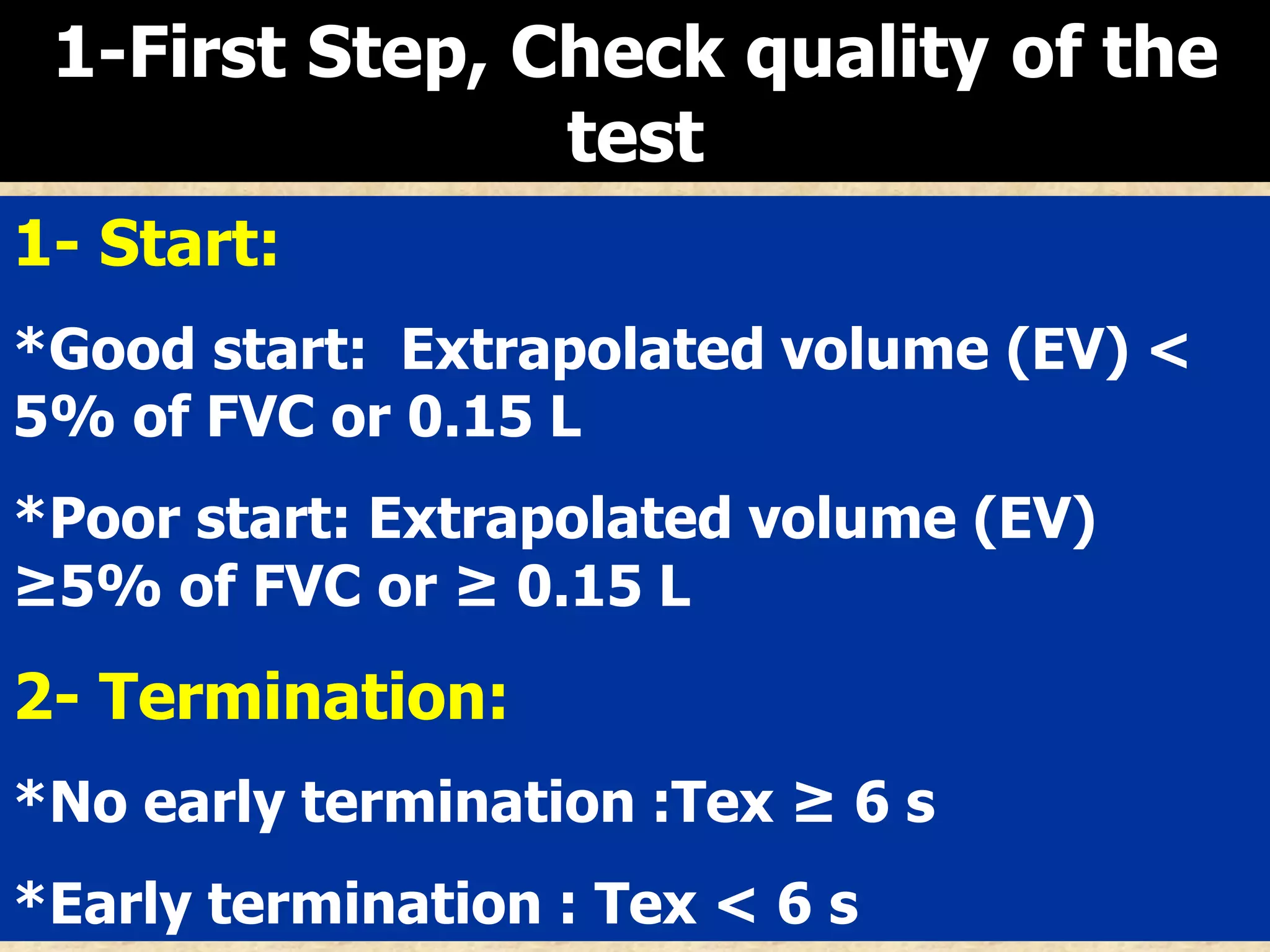
1-First Step, Check quality of the
test
1- Start:
*Good start: Extrapolated volume (EV) <
5% of FVC or 0.15 L
*Poor start: Extrapolated volume (EV)
≥5% of FVC or ≥ 0.15 L

2- Termination:
*No early termination :Tex ≥ 6 s
*Early termination : Tex < 6 s
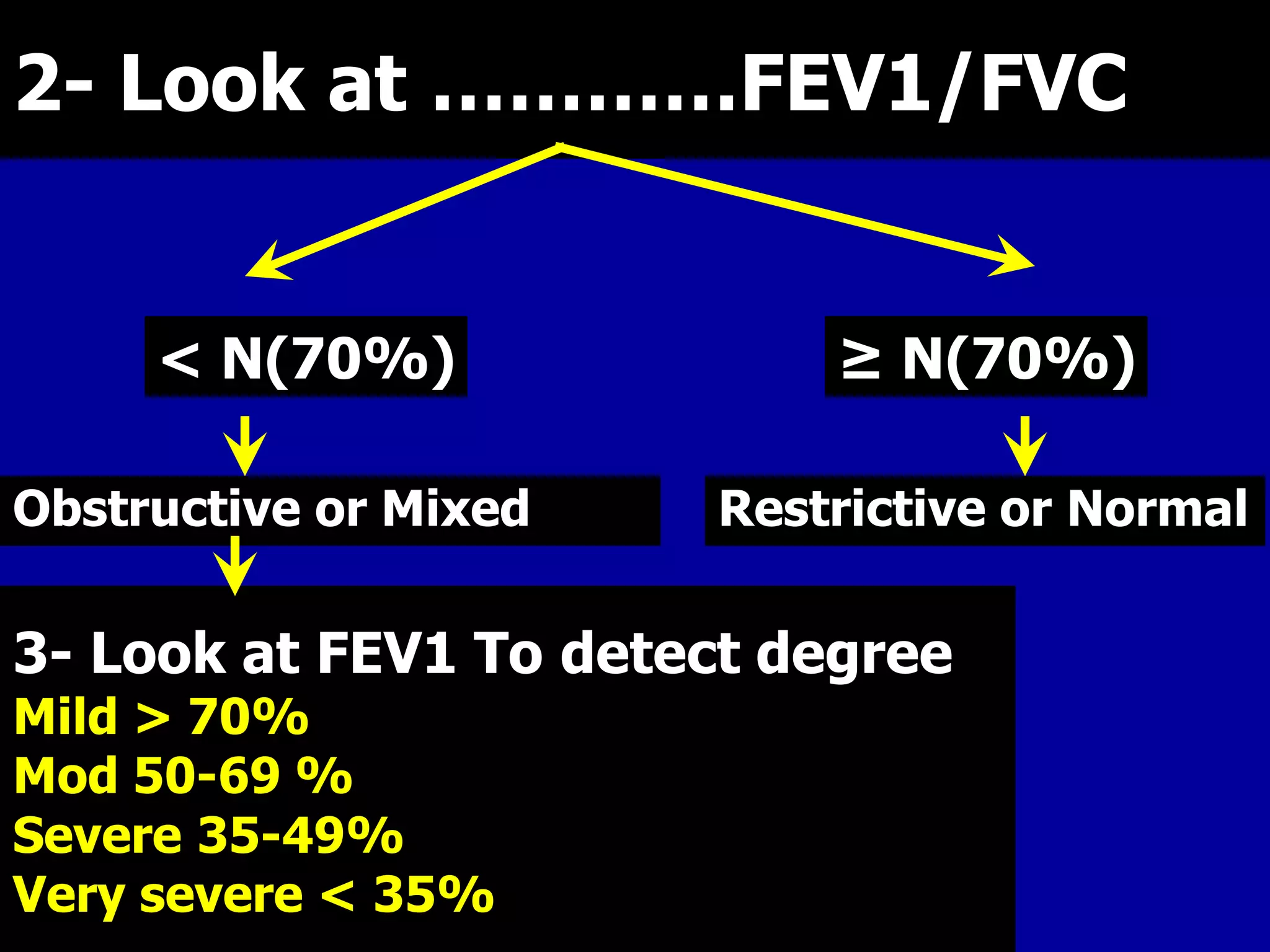
2- Look at …………FEV1/FVC

< N(70%)
Obstructive or Mixed

≥ N(70%)
Restrictive or Normal

3- Look at FEV1 To detect degree
Mild > 70%
Mod 50-69 %
Severe 35-49%
Very severe < 35%
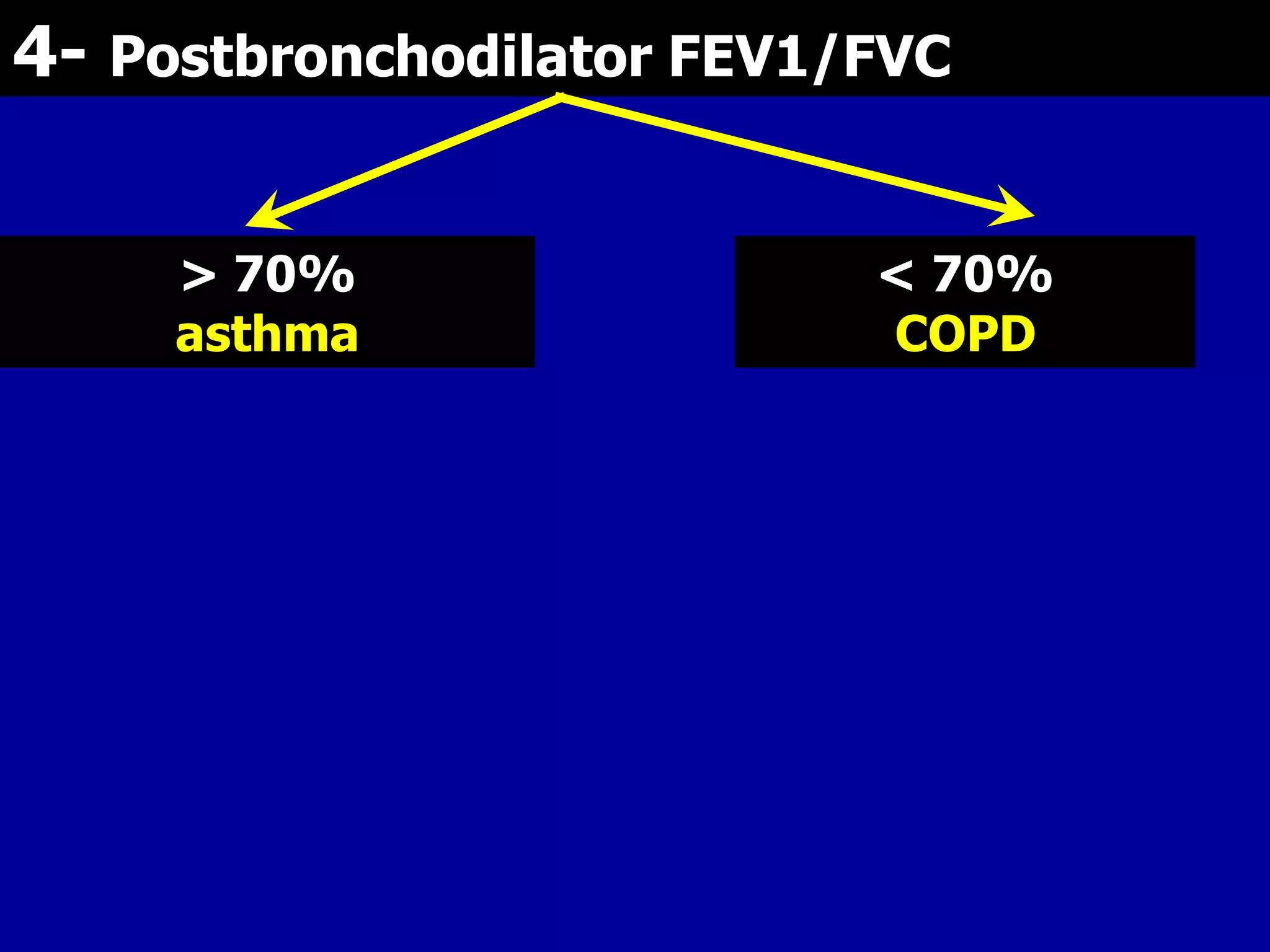
4- Postbronchodilator FEV1/FVC
> 70%
asthma

< 70%
COPD
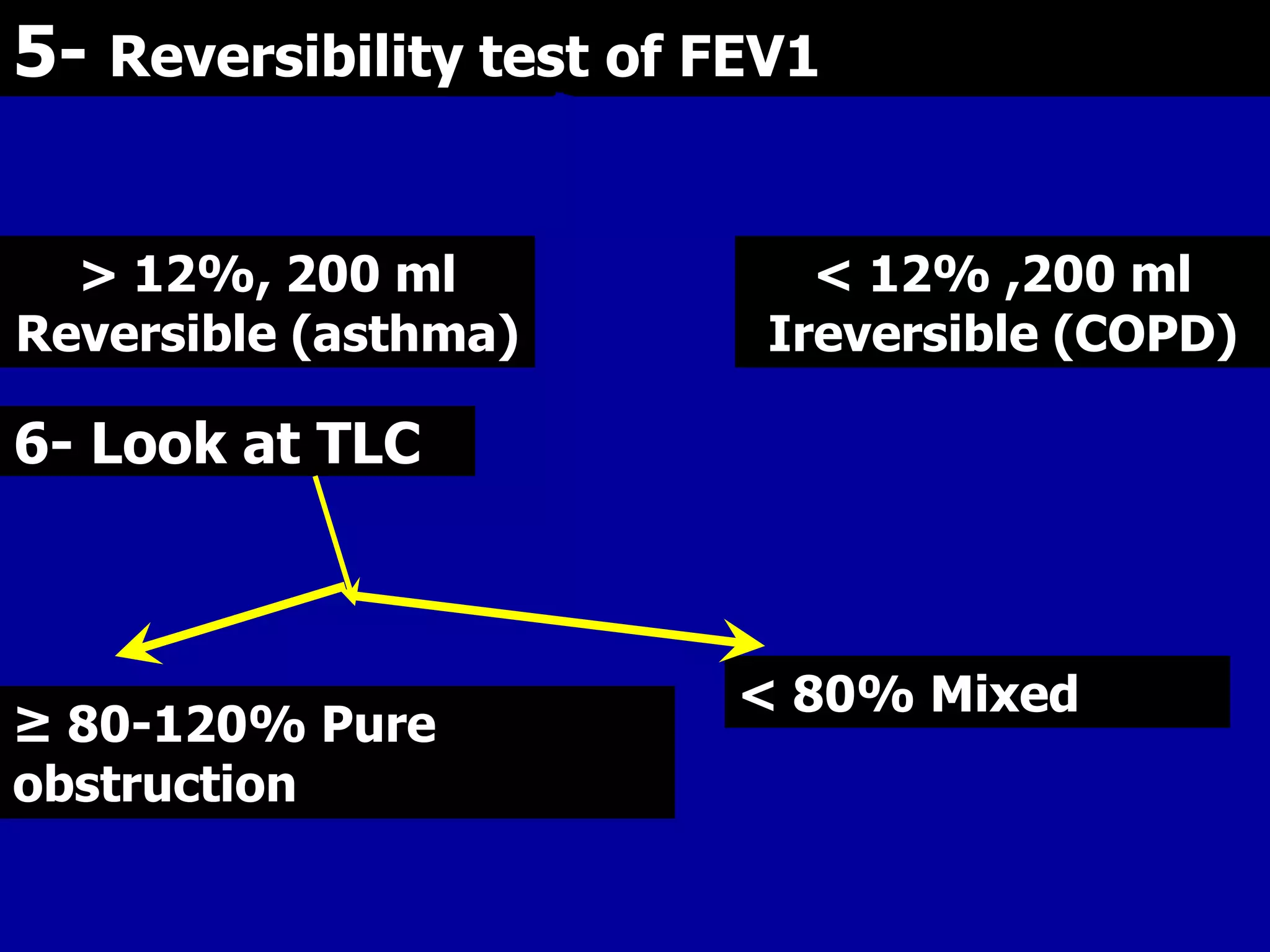
5- Reversibility test of FEV1
> 12%, 200 ml
Reversible (asthma)

< 12% ,200 ml
Ireversible (COPD)

6- Look at TLC

≥ 80-120% Pure
obstruction

< 80% Mixed
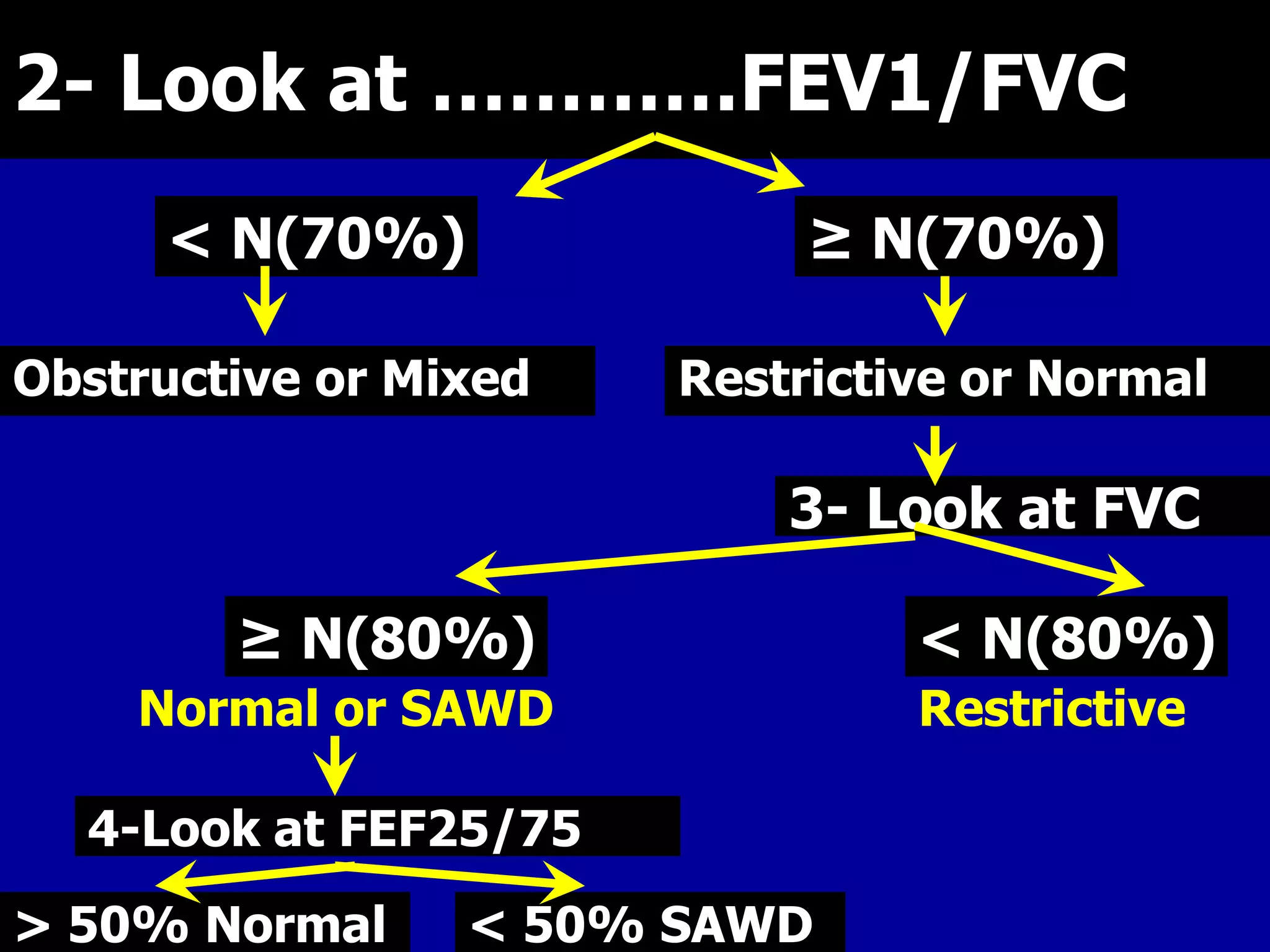
2- Look at …………FEV1/FVC
< N(70%)

≥ N(70%)

Obstructive or Mixed

Restrictive or Normal

3- Look at FVC
≥ N(80%)
Normal or SAWD

4-Look at FEF25/75
> 50% Normal

< 50% SAWD

< N(80%)
Restrictive
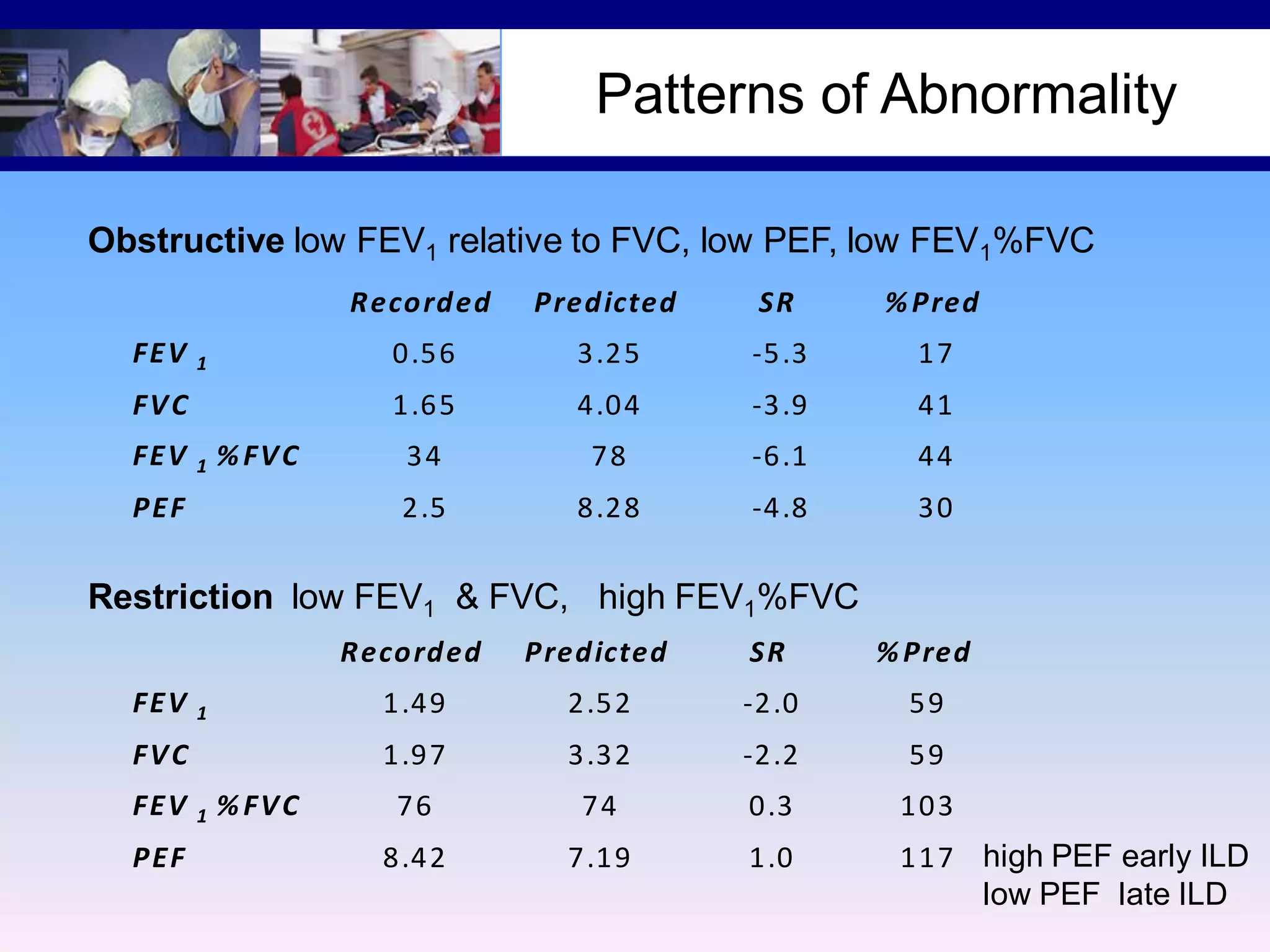
Patterns of Abnormality
Obstructive low FEV1 relative to FVC, low PEF, low FEV1%FVC
R eco rd ed

Pred icted

SR

% Pred

0.56

3.25

-5.3

17

1.65

4.04

-3.9

41

FEV 1 % FV C

34

78

-6.1

44

PEF

2.5

8.28

-4.8

30

FEV

1

FV C

Restriction low FEV1 & FVC, high FEV1%FVC
R eco rd ed
FEV

1

FV C
FEV 1 % FV C
PEF

Pred icted

SR

% Pred

1.49

2.52

-2.0

59

1.97

3.32

-2.2

59

76

74

0.3

103

8.42

7.19

1.0

117 high PEF early ILD
low PEF late ILD
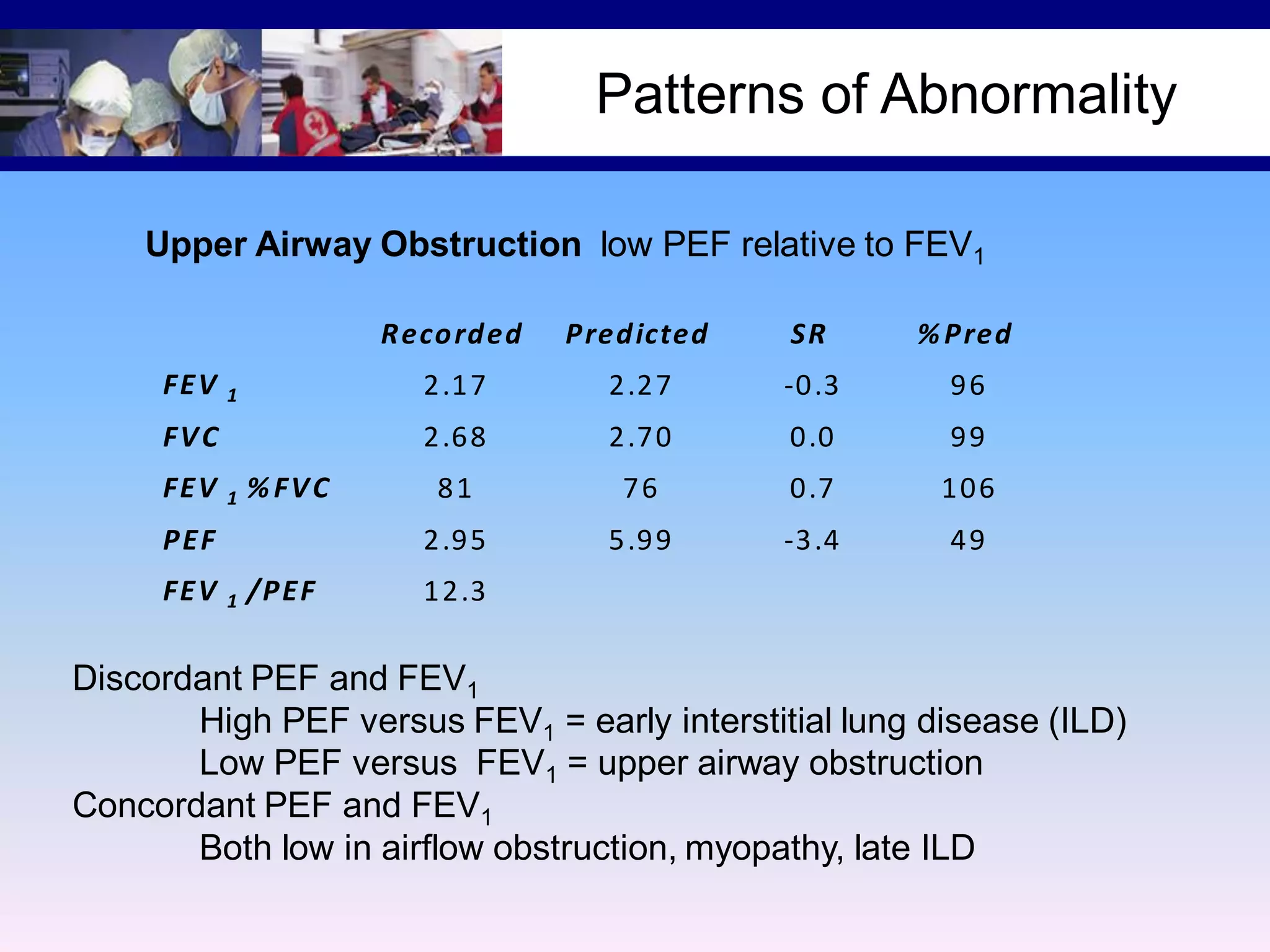
Patterns of Abnormality
Upper Airway Obstruction low PEF relative to FEV1
R eco rd ed

Pred icted

SR

% Pred

2.17

2.27

-0.3

96

2.68

2.70

0.0

99

81

76

0.7

106

PEF

2.95

5.99

-3.4

49

FEV 1 /PEF

12.3

FEV

1

FV C
FEV 1 % FV C

Discordant PEF and FEV1
High PEF versus FEV1 = early interstitial lung disease (ILD)
Low PEF versus FEV1 = upper airway obstruction
Concordant PEF and FEV1
Both low in airflow obstruction, myopathy, late ILD
Flow

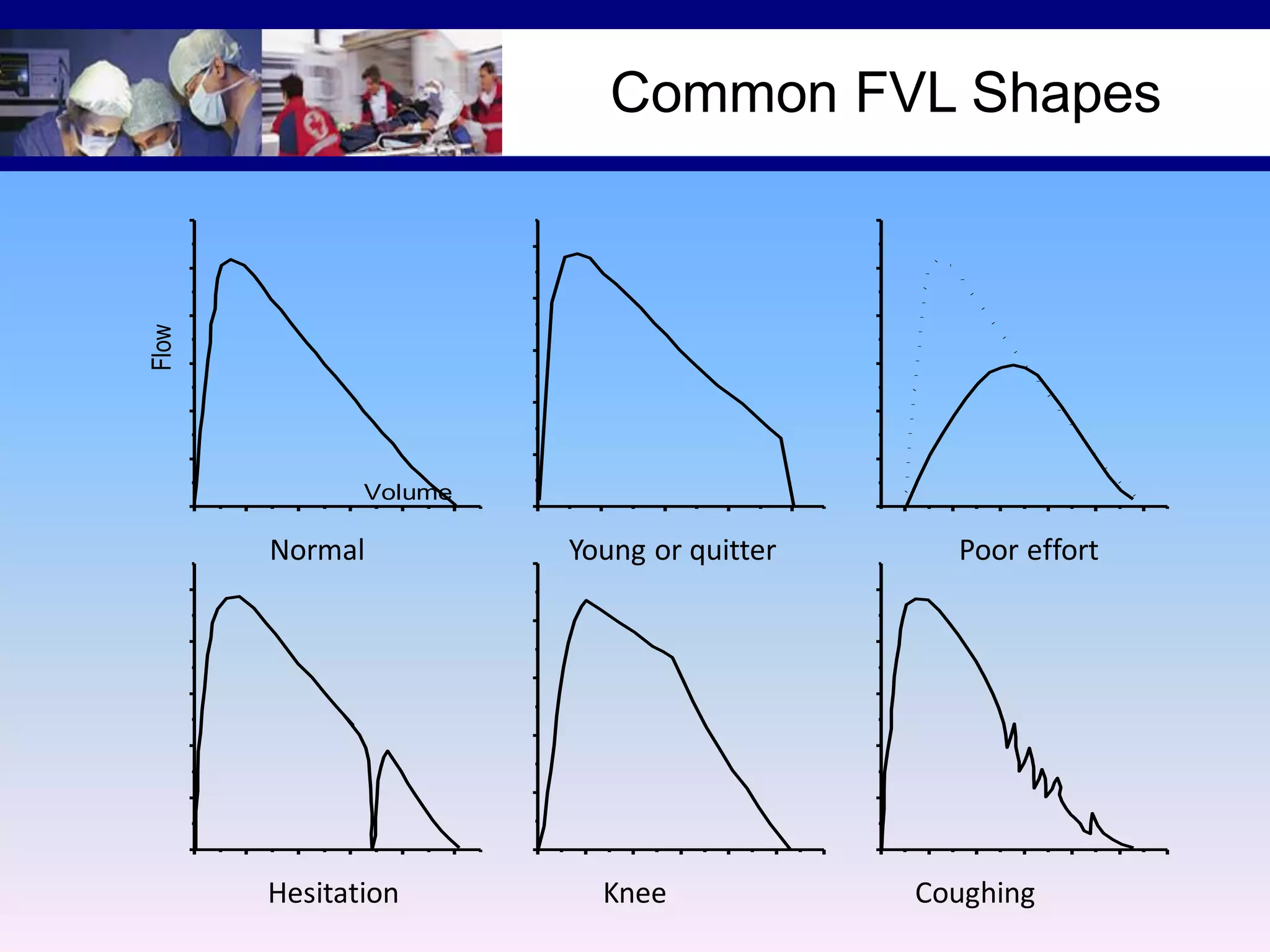
Common FVL Shapes

Volume

Normal

Hesitation

Young or quitter

Knee

Poor effort

Coughing
12

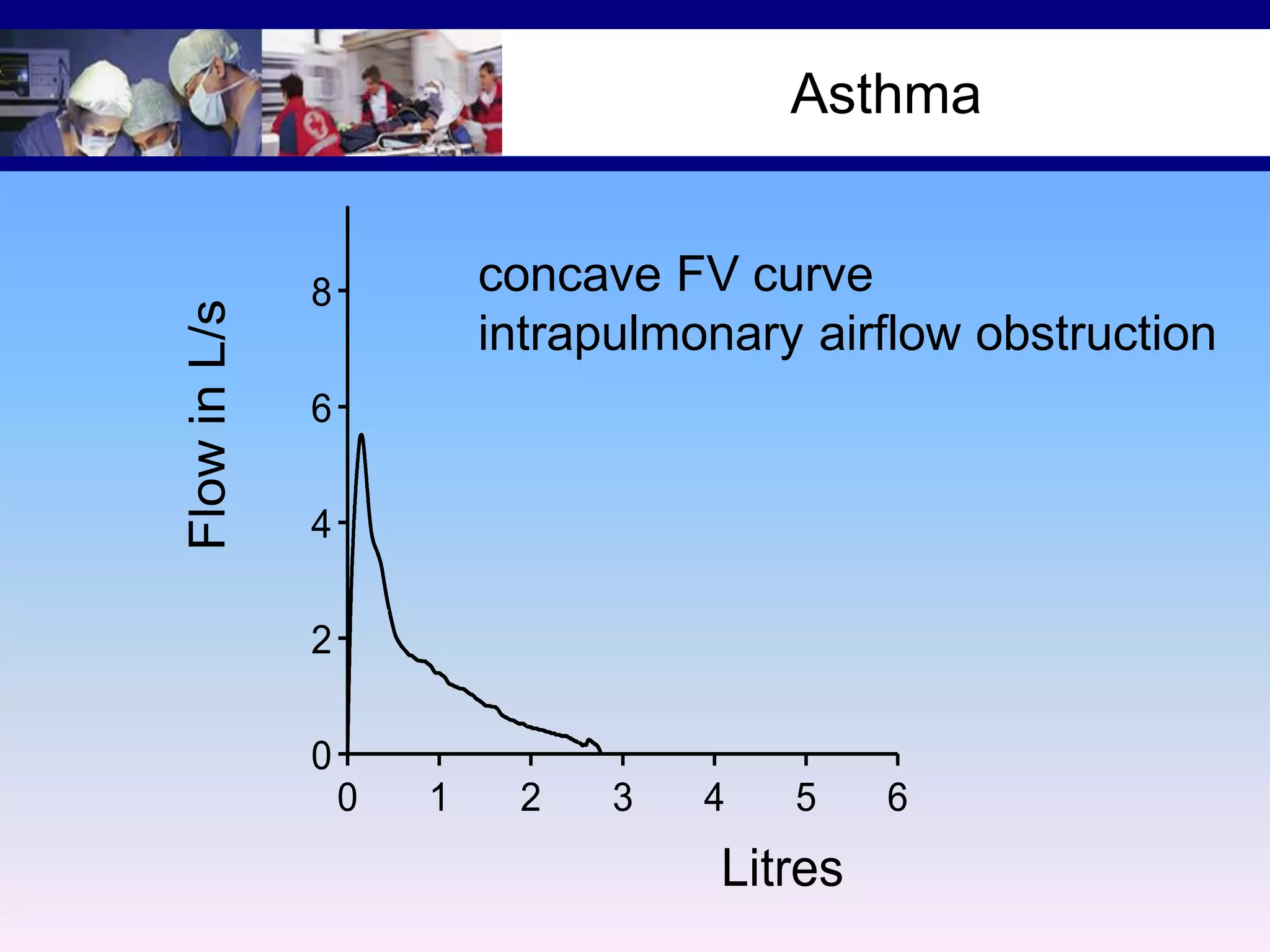
Asthma

Flow in L/s

10

concave FV curve
intrapulmonary airflow obstruction

8
6
4
2
0
0

1

2

3

4

5

Litres

6
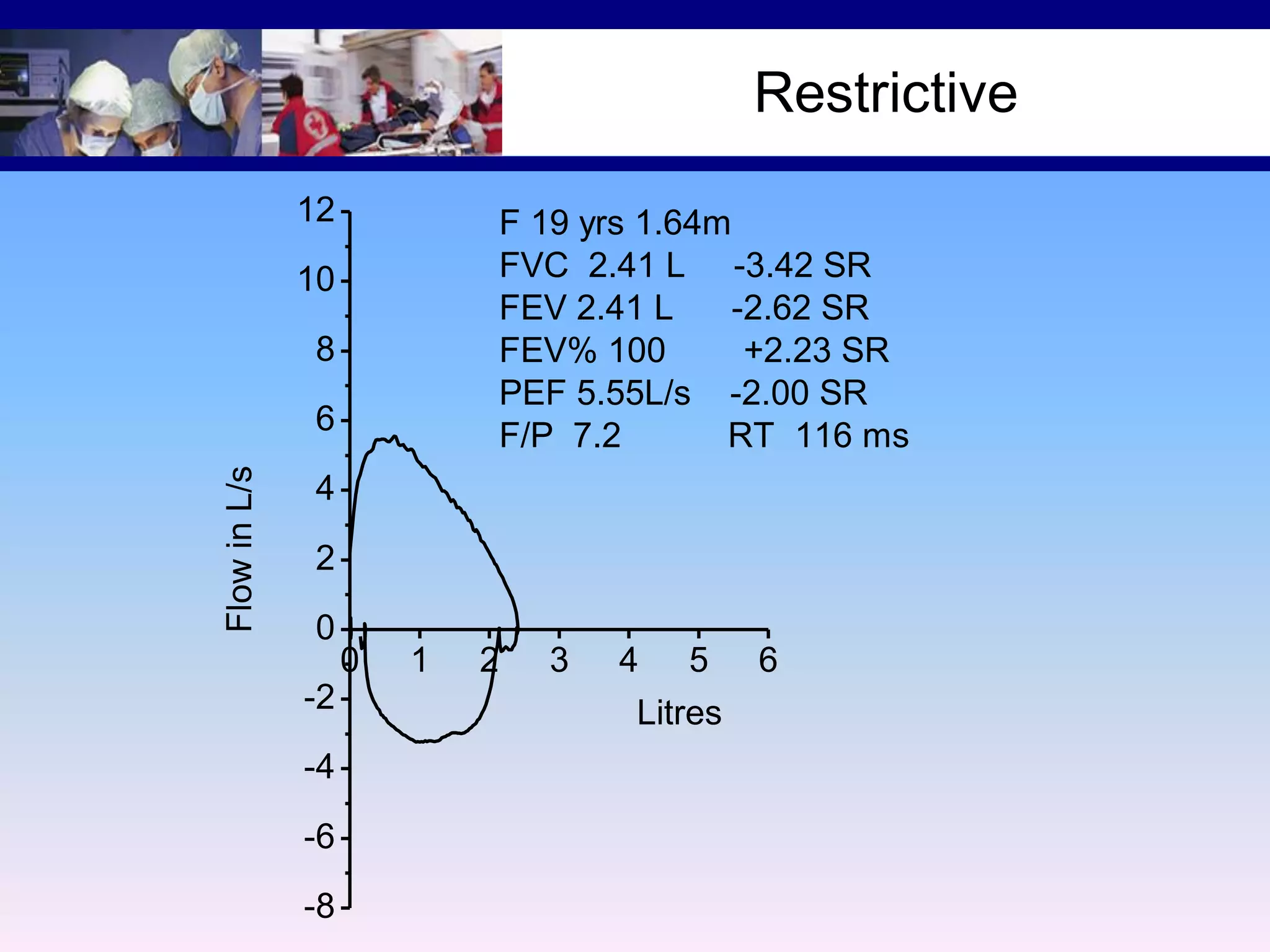
Restrictive
12

F 19 yrs 1.64m
FVC 2.41 L -3.42 SR
FEV 2.41 L
-2.62 SR
FEV% 100
+2.23 SR
PEF 5.55L/s -2.00 SR
F/P 7.2
RT 116 ms

10
8

Flow in L/s

6
4
2
0
0
-2
-4
-6
-8

1

2

3

4

5

Litres

6
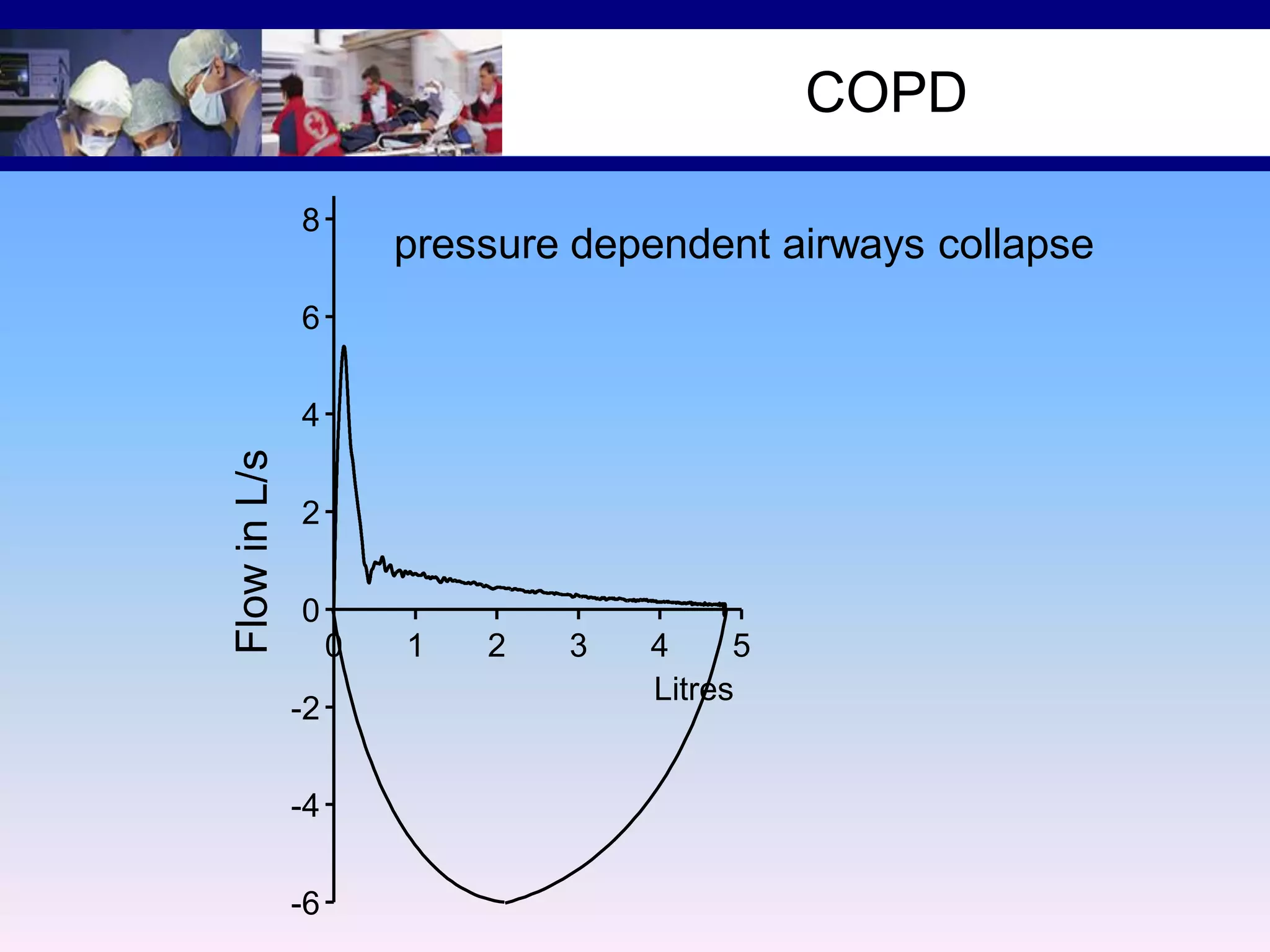
COPD

10
8

pressure dependent airways collapse

6

Flow in L/s

4
2
0
0
-2
-4
-6

1

2

3

4
5
Litres
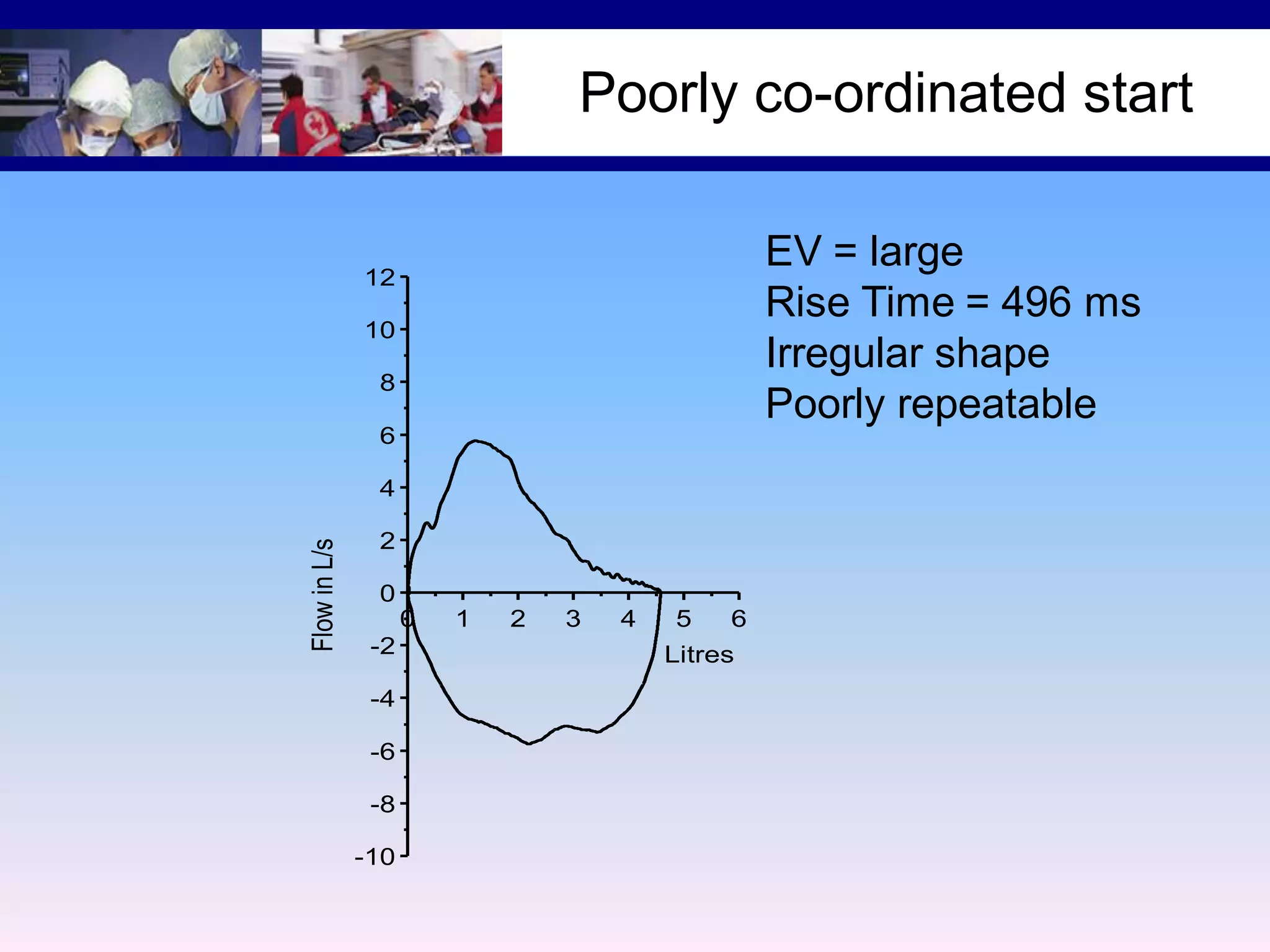
Poorly co-ordinated start
EV = large
Rise Time = 496 ms
Irregular shape
Poorly repeatable

12
10
8
6

Flow in L/s

4
2
0
0
-2
-4
-6
-8
-10

1

2

3

4

5

6

Litres
Upper Airway Obstruction
6

Expiratory

Age 40 yrs
FVC 3.52 L
FEV1 3.0

L

0.74 SR

PEF 4.57 L/s

4

0.84 SR
-2.18 SR

FEV/PEF = 10.9

Flow in L/s

2
0
0

1

2

4

5

6

Volume in Litres

-2
-4
-6

3

Inspiratory

FEV1 in mls > 8
PEF in L/min
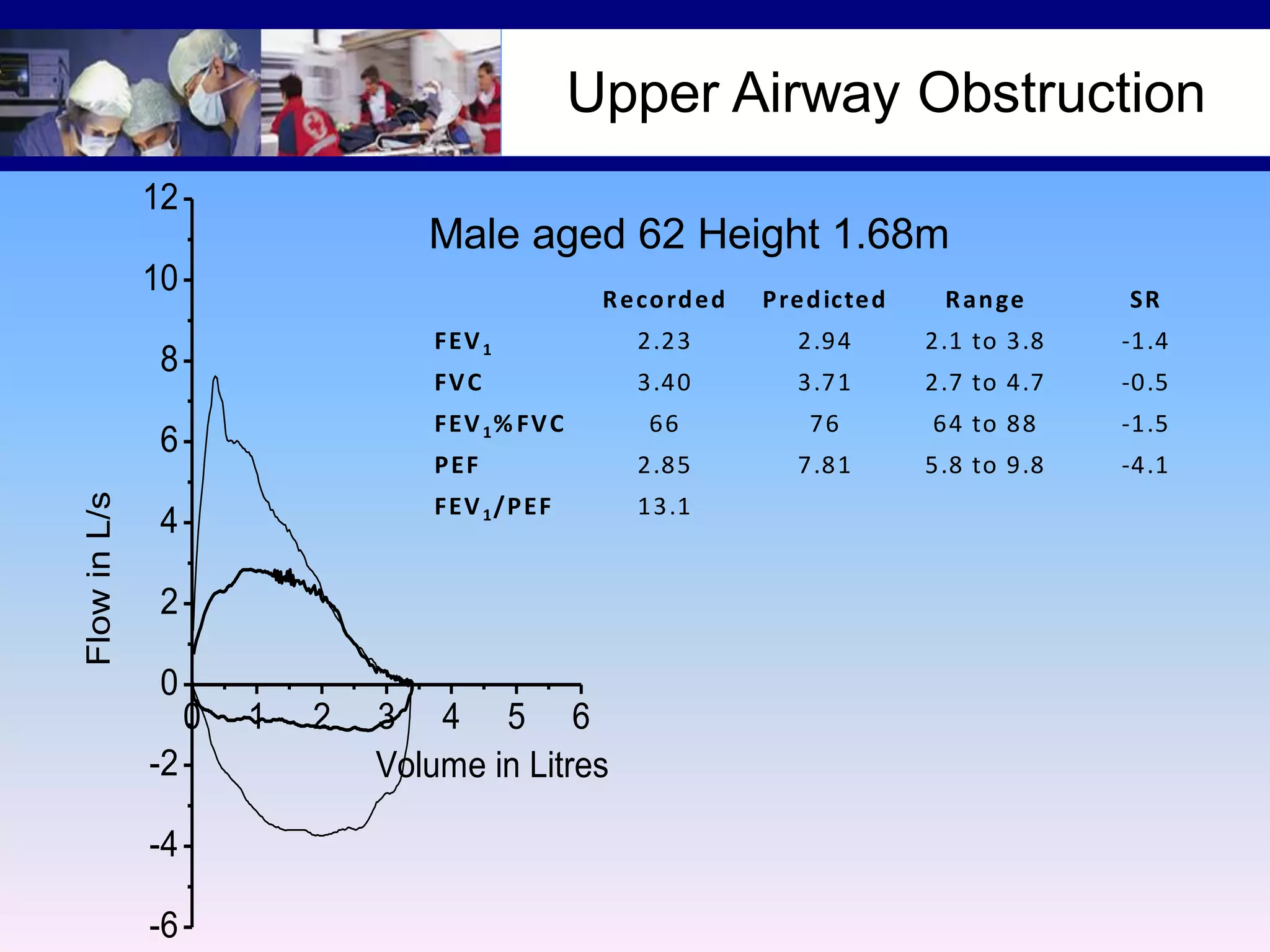
Upper Airway Obstruction
12

Male aged 62 Height 1.68m
10

R e co rd e d

SR

2.23

2.94

2.1 to 3.8

-1.4

FV C

3.40

3.71

2.7 to 4.7

-0.5

66

76

64 to 88

-1.5

P EF

2.85

7.81

5.8 to 9.8

-4.1

FEV 1 /P EF

13.1

FEV 1 % FV C

6
Flow in L/s

R an ge

FEV 1

8

P re d icte d

4
2
0
0
-2
-4
-6

1

2

3 4 5 6
Volume in Litres
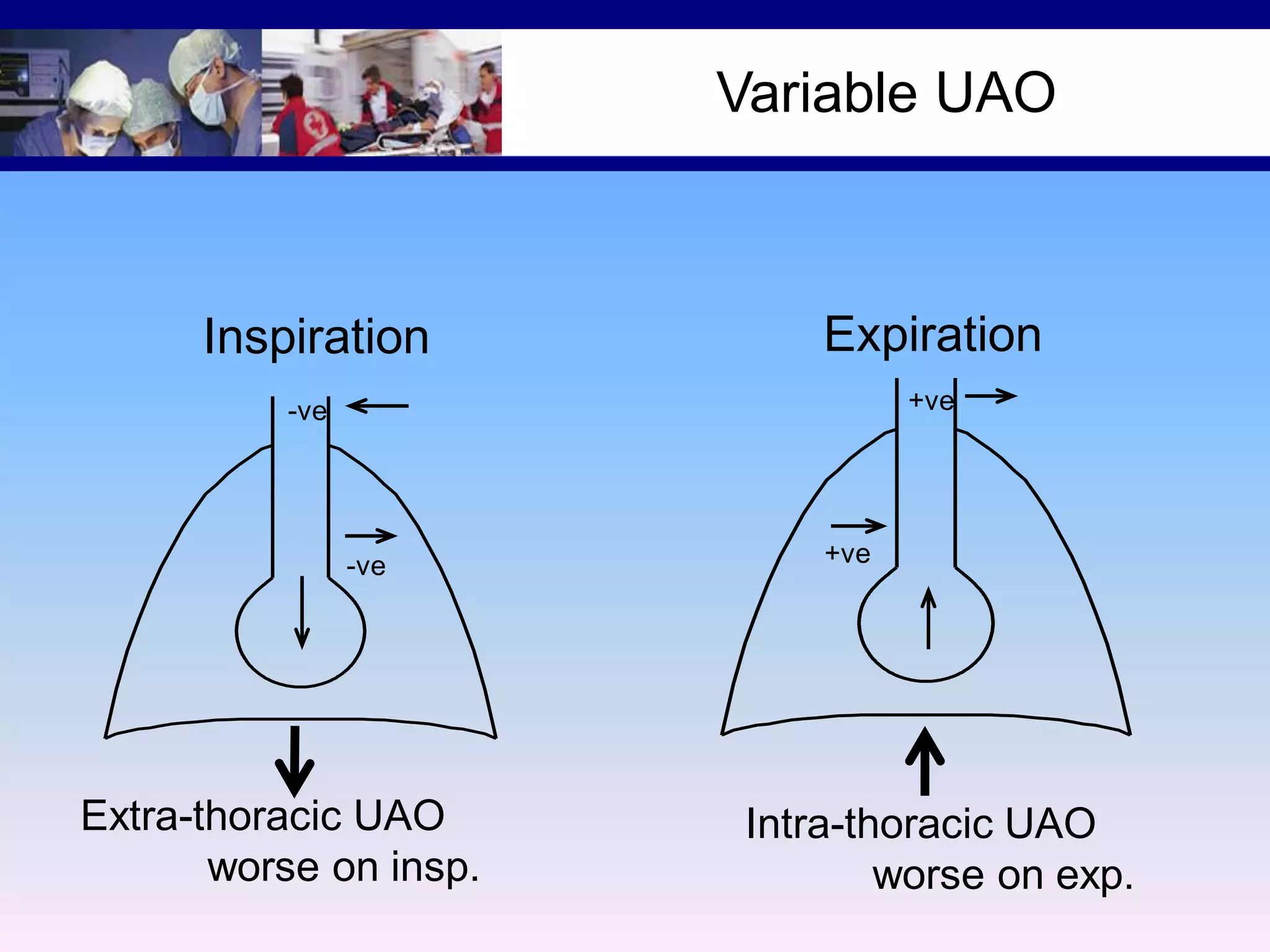
Variable UAO

Inspiration

Expiration
+ve

-ve

-ve

Extra-thoracic UAO
worse on insp.

+ve

Intra-thoracic UAO
worse on exp.
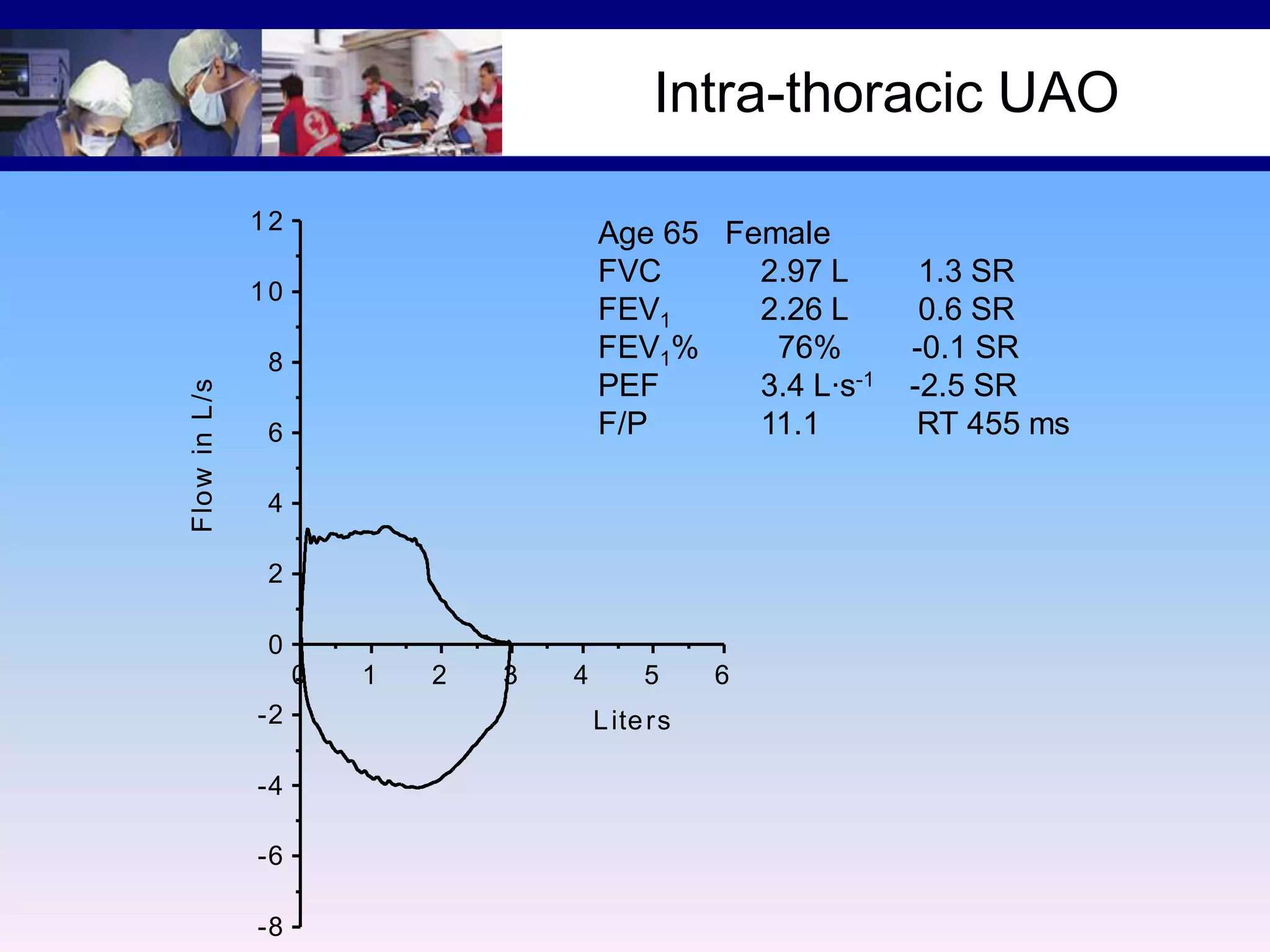
Intra-thoracic UAO
12

Age 65 Female
FVC
2.97 L
FEV1
2.26 L
FEV1%
76%
PEF
3.4 L·s-1
F/P
11.1

10

Flo w in L /s

8
6
4
2
0
0
-2
-4
-6
-8

1

2

3

4

5
L ite rs

6

1.3 SR
0.6 SR
-0.1 SR
-2.5 SR
RT 455 ms
Upper Airway Obstruction
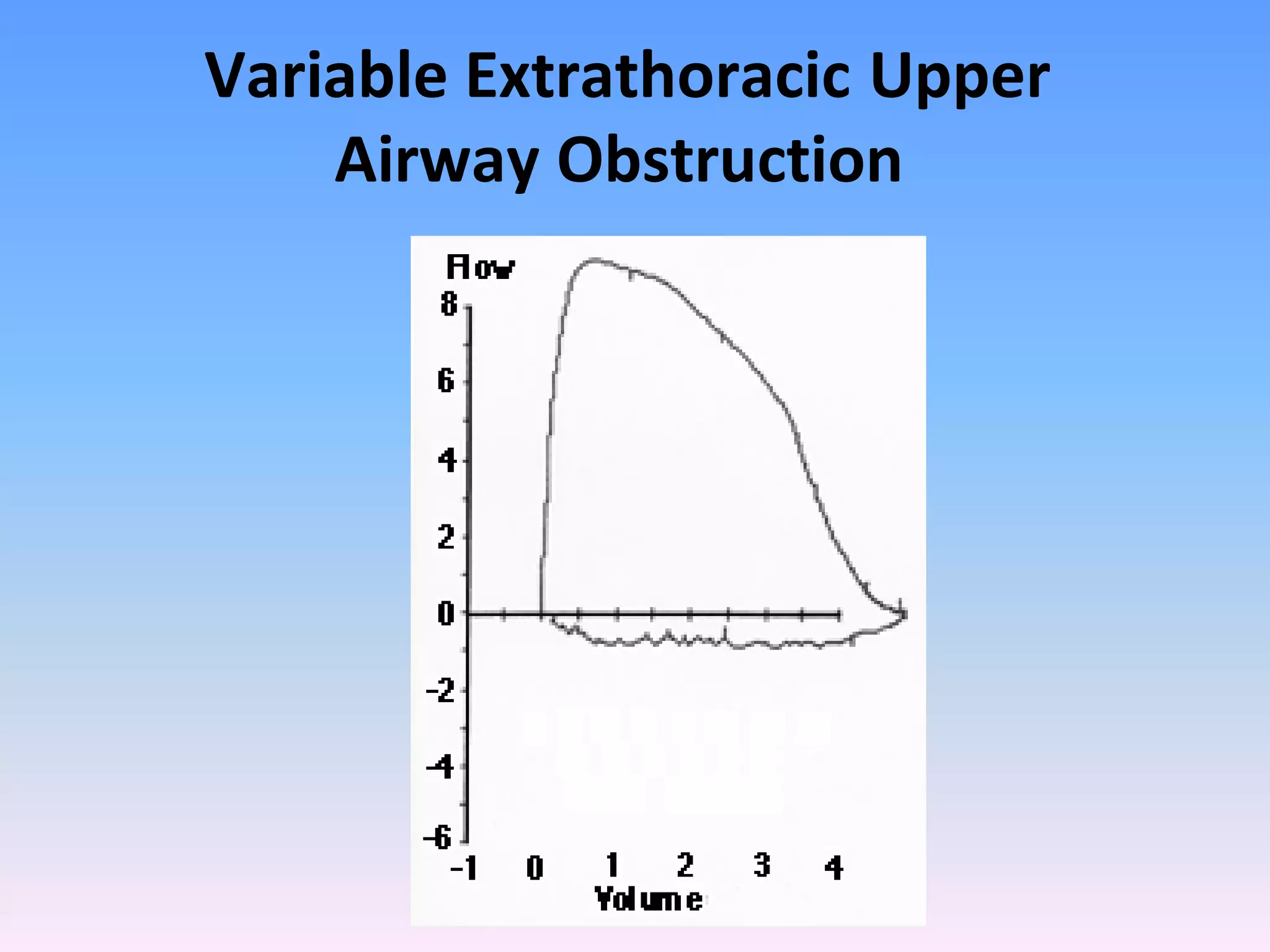
• Variable extrathoracic obstructions
1.
2.
3.
4.

vocal cord paralysis,
thyromegaly,
tracheomalacia, or
Neoplasm

• Large airways variable intrathoracic obstructions
1.
2.

tracheomalacia or
neoplasm

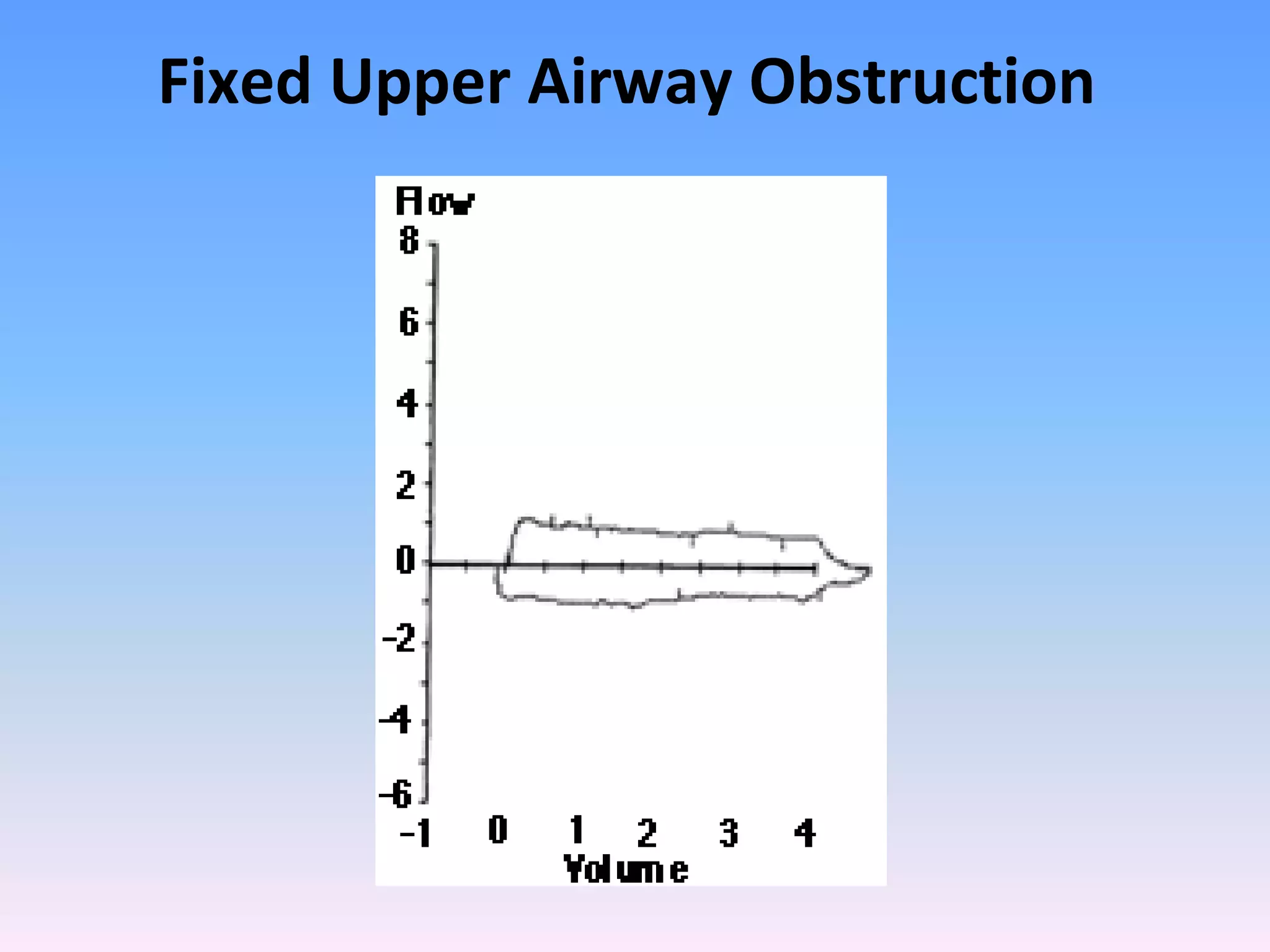
• Fixed obstruction
1.
2.

tracheal stenosis,
foreign body, or

3.

neoplasm.
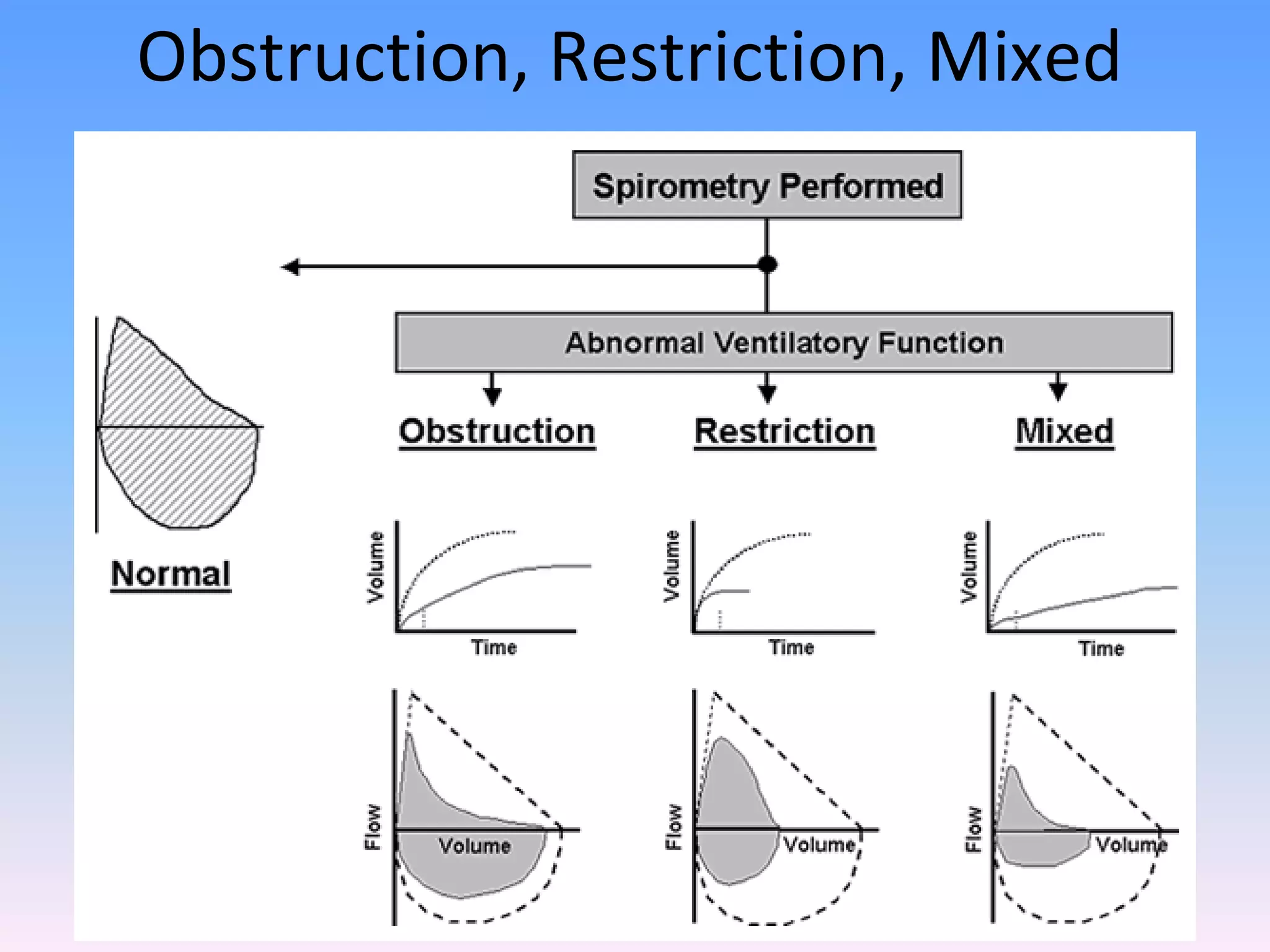
Obstruction, Restriction, Mixed
Variable Extrathoracic Upper
Airway Obstruction
Fixed Upper Airway Obstruction
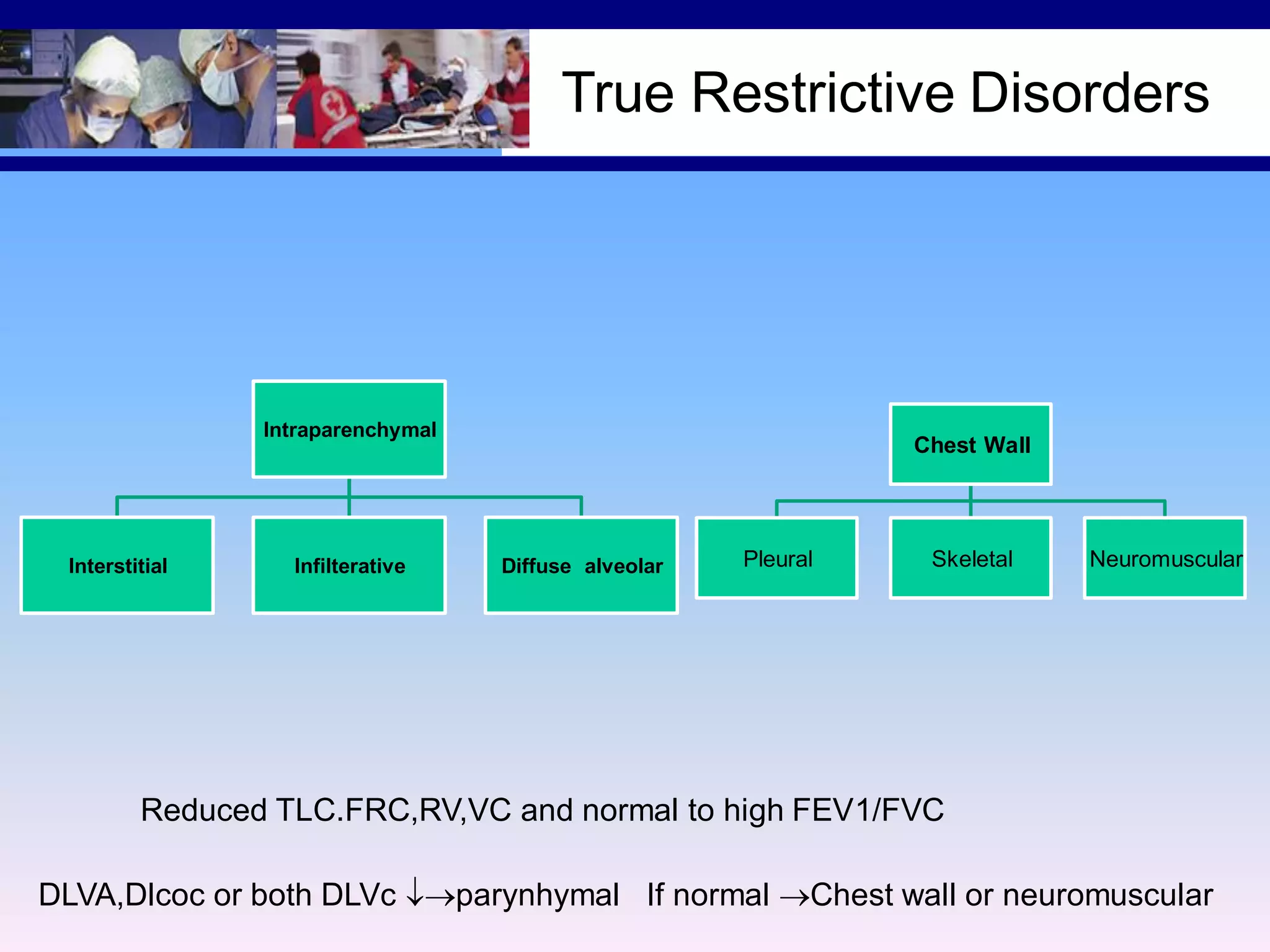
True Restrictive Disorders

Intraparenchymal

Interstitial

Infilterative

Chest Wall

Diffuse alveolar

Pleural

Skeletal

Neuromuscular

Reduced TLC.FRC,RV,VC and normal to high FEV1/FVC
DLVA,Dlcoc or both DLVc parynhymal If normal Chest wall or neuromuscular
Pseudorestrictive Disorders
Normally: IC/ERV=2-3/1
True restrictive: IC/ERV=<2/1

Pseudorestrictive: IC/ERV=6/1
Pseudorestrictive Disorders
Asthma is a disorder characterized by increased reactivity of the
airways. Patients with asthma have recurrent or persistent airflow
obstruction, which is reversible either spontaneously or with
appropriate therapy. An obstructive pattern is most often present,
recognized by reduced forced expiratory volume in 1 s (FEV1), and
FEV1 to forced vital capacity (FEV1/FVC) or FEV1/vital capacity
(VC) ratio. Patients may have normal spirometry between attacks.
In some patients, the FVC may be reduced due to air trapping,
resulting in pseudorestriction on spirometry in the presence of
increased or normal total lung capacity (TLC), increased functional
residual capacity (FRC) and increased residual volume (RV). We
have reported 12 asthmatic patients with reduced VC and no
increase in RV, i.e., a true restrictive impairment [Gill et al. Chest
2012)
Pseudorestrictive Disorders
Obesity:
*Early airway closure (low ERV & high RV)
*FRC is more reduced than TLC&VC
*Low FEF50% FEF75%, FEF25-75%,
,
Pseudorestrictive Disorders
Neuromuscular Disease:
*FRC normal
*IC&ERV decreased
*Decreased TLC
*Increased RV
*A-aO2 gradient normal
*MIP&MEP decreased
Pseudorestrictive Disorders
Asthma:
*FRC &TLC increased
*Improvement of FEV1&FVC with bronchodilators
*Positive bronchoprovacation test
*Increased diffusing capacity and DLco/VA
Pseudopseudorestrictive
Patients with obstructive diseases who do not
complete expiratory effort of FVC. This may
lead to a below normal FEV1 and FVC with
pseudonormalization of ratio.
Mixed Disorder
*Sarcoidosis
*Rhematoid
*Advanced IPF
*Bronchiectasis
*BOOP in smokers
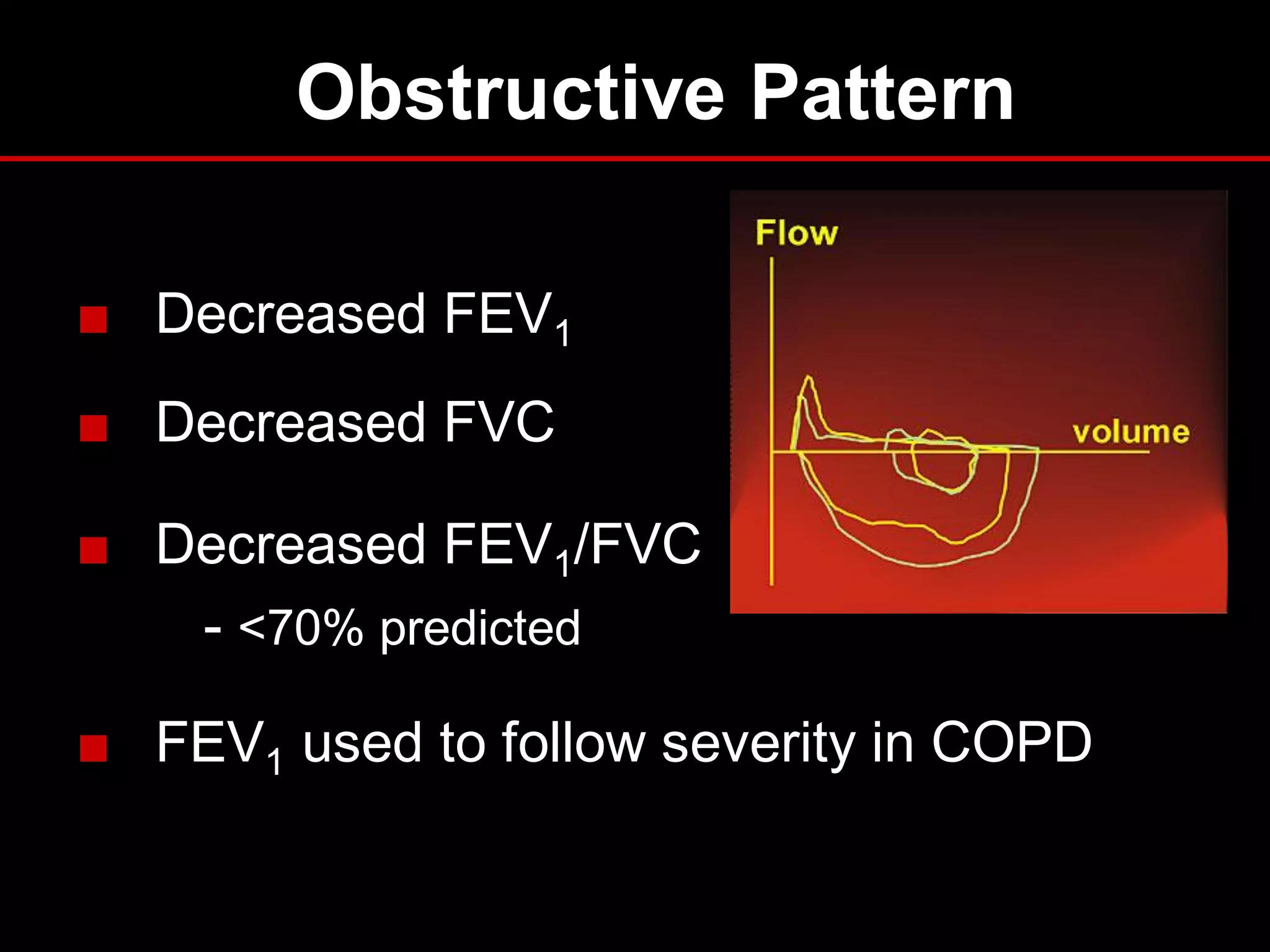
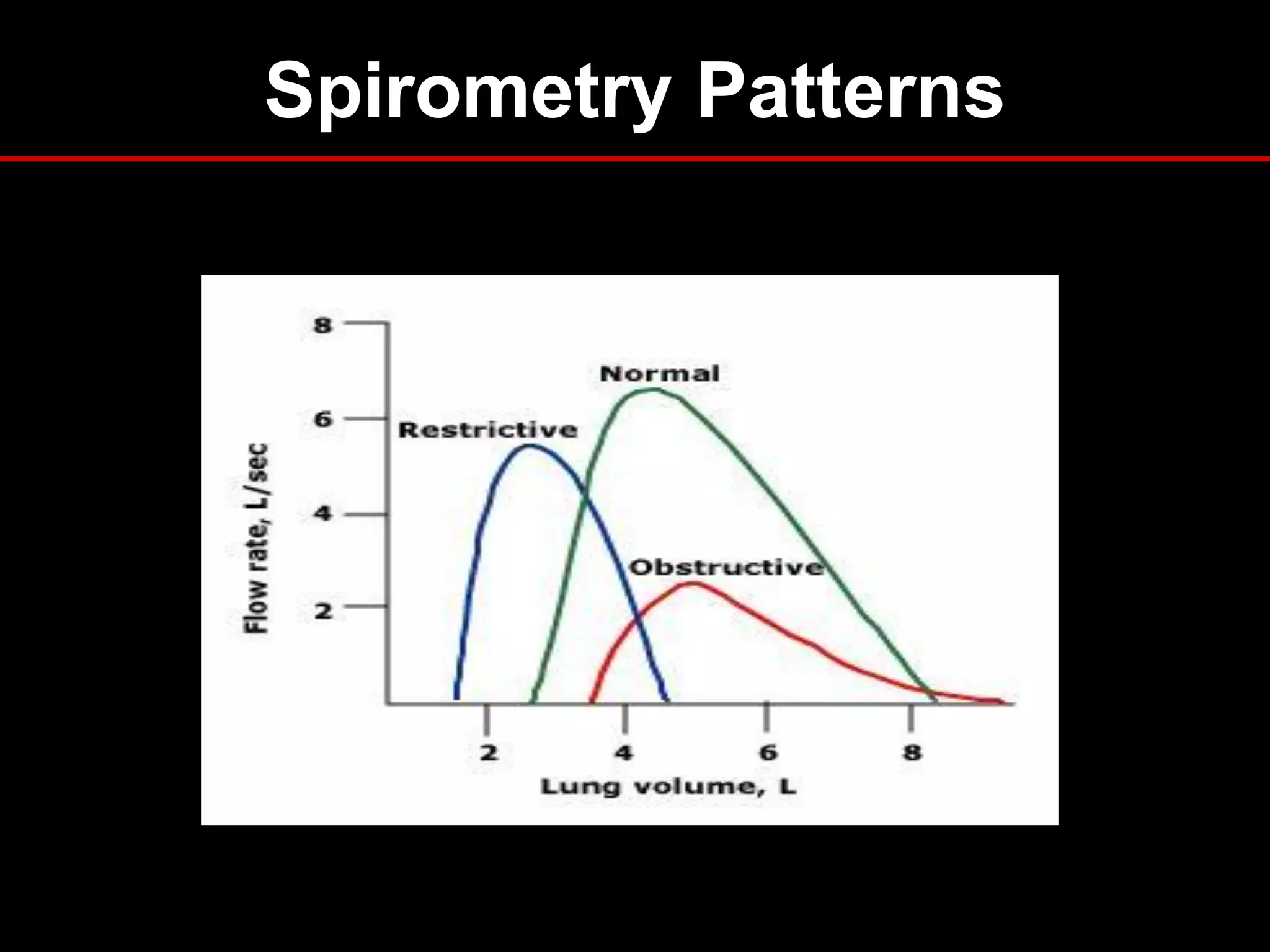
Obstructive Pattern
■ Decreased FEV1
■ Decreased FVC
■ Decreased FEV1/FVC
- <70% predicted
■ FEV1 used to follow severity in COPD
Obstructive Lung Disease —

Differential Diagnosis
 Asthma
 COPD
- chronic bronchitis
- emphysema

 Bronchiectasis
 Bronchiolitis

 Upper airway obstruction
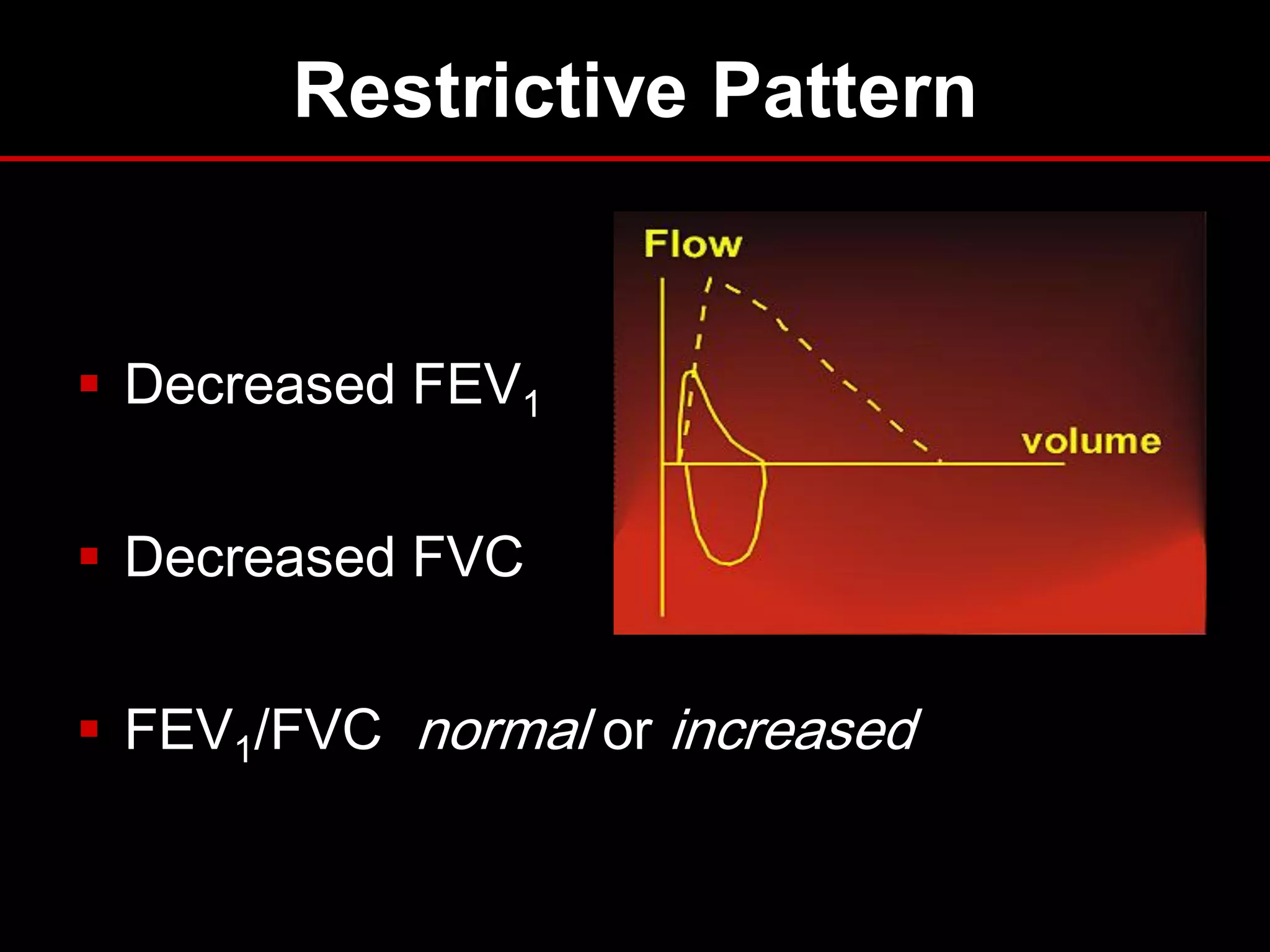
Restrictive Pattern

 Decreased FEV1
 Decreased FVC
 FEV1/FVC normal or increased
Restrictive Lung Disease —

Differential Diagnosis
 Pleural
 Parenchymal
 Chest wall
 Neuromuscular
Spirometry Patterns
Bronchodilator Response
 Degree to which FEV1 improves with inhaled
bronchodilator
 Documents reversible airflow obstruction

 Significant response if:

- FEV1 increases by 12% and >200ml
 Request if obstructive pattern on spirometry
Flow Volume Loop
 “Spirogram”
 Measures forced inspiratory and expiratory
flow rate
 Augments spirometry results
 Indications: evaluation of upper airway
obstruction (stridor, unexplained dyspnea)
Flow Volume Loop
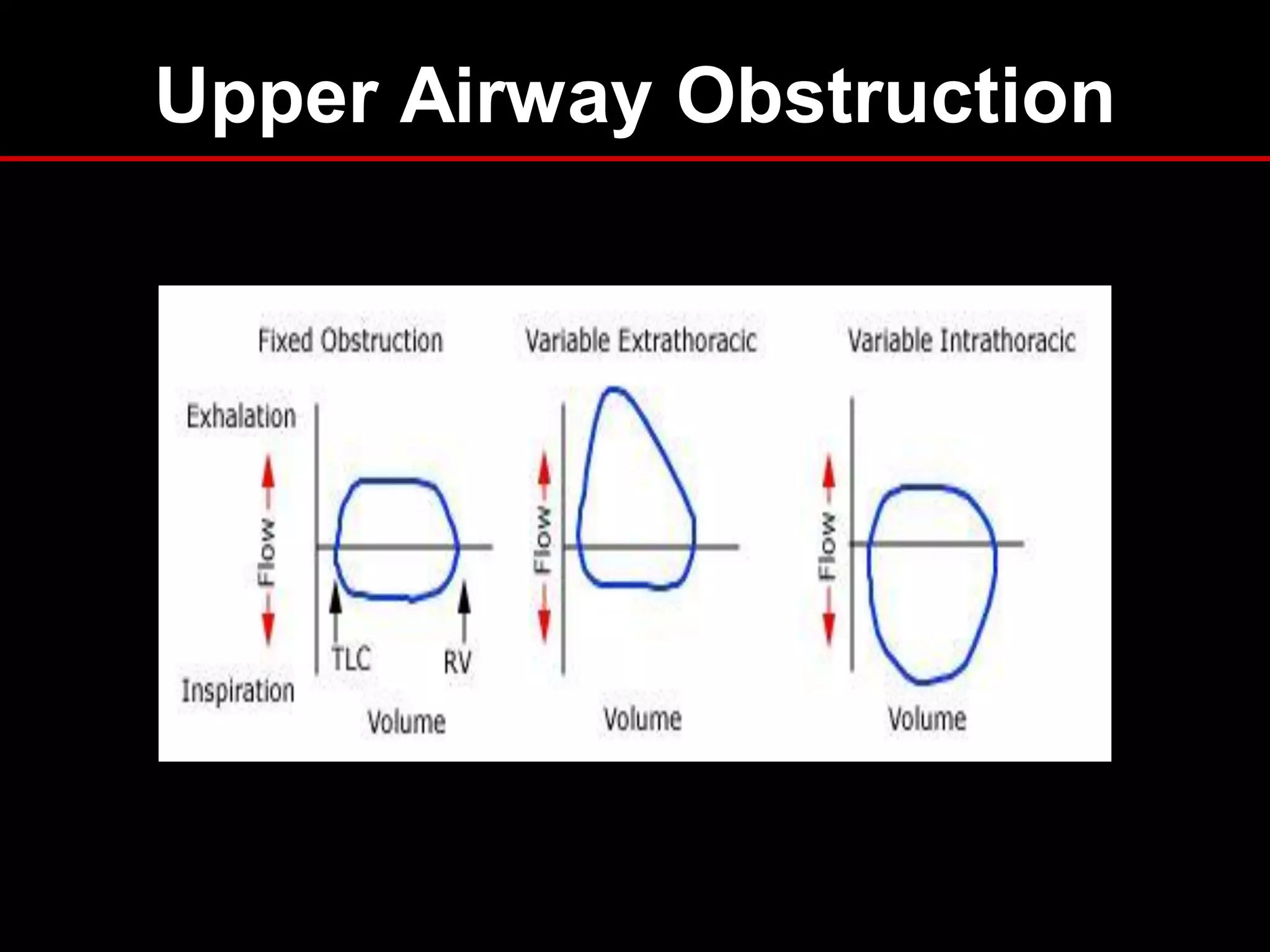
Upper Airway Obstruction
 Variable intrathoracic obstruction
 Variable extrathoracic obstruction
 Fixed obstruction
Upper Airway Obstruction
Lung Volumes
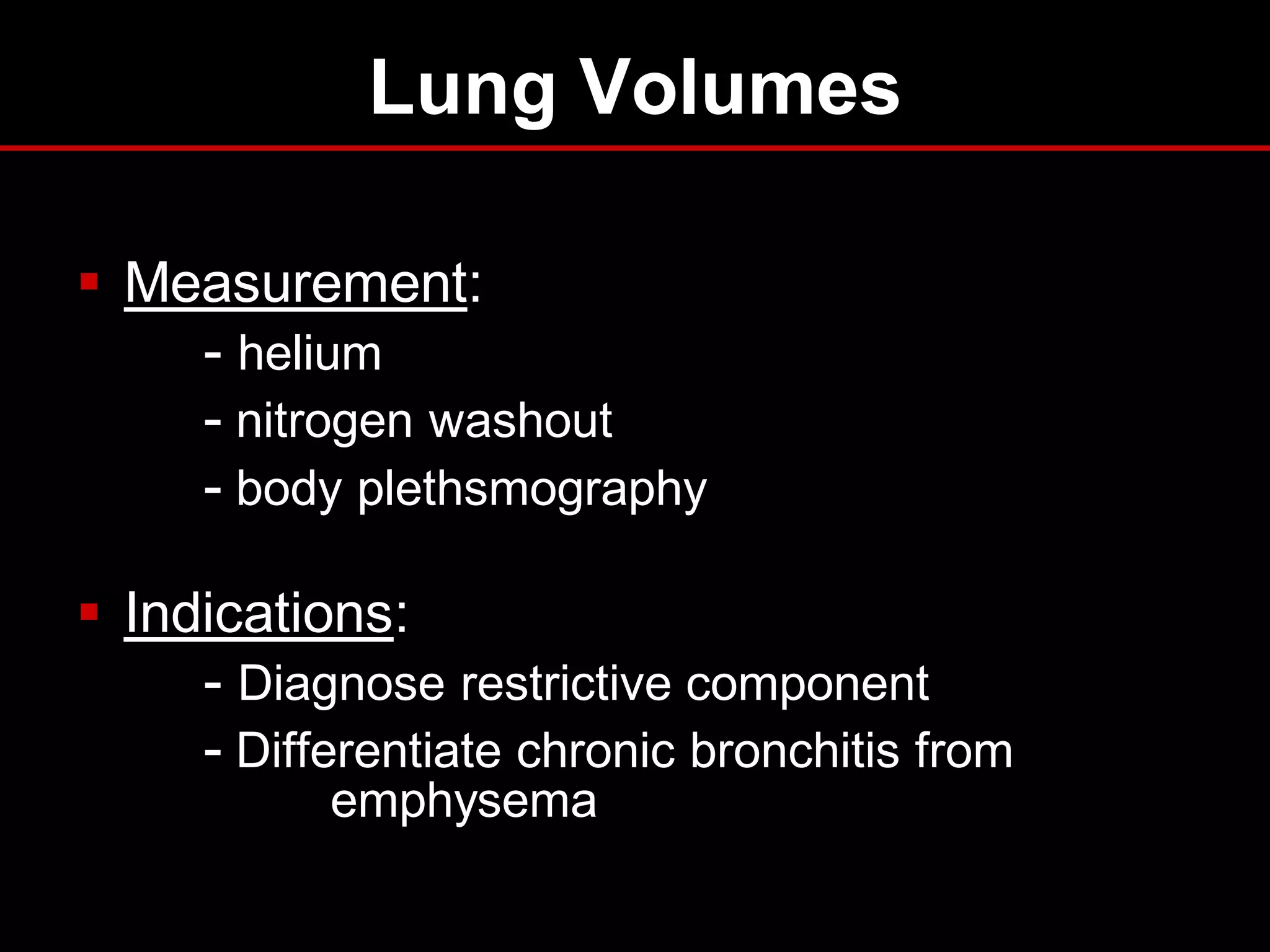
 Measurement:
- helium
- nitrogen washout
- body plethsmography
 Indications:
- Diagnose restrictive component
- Differentiate chronic bronchitis from
emphysema
Lung Volumes – Patterns
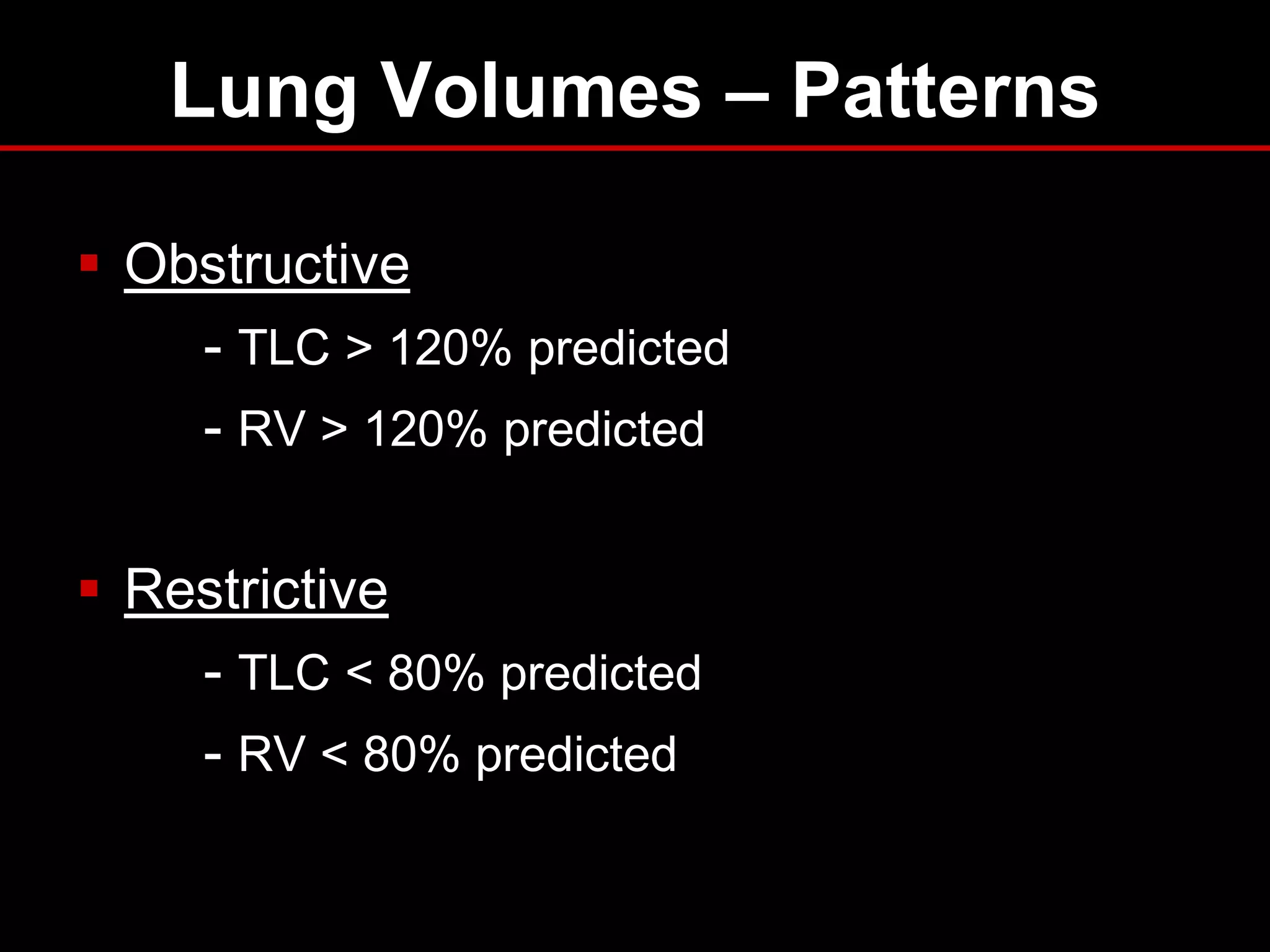
 Obstructive
- TLC > 120% predicted
- RV > 120% predicted

 Restrictive
- TLC < 80% predicted
- RV < 80% predicted
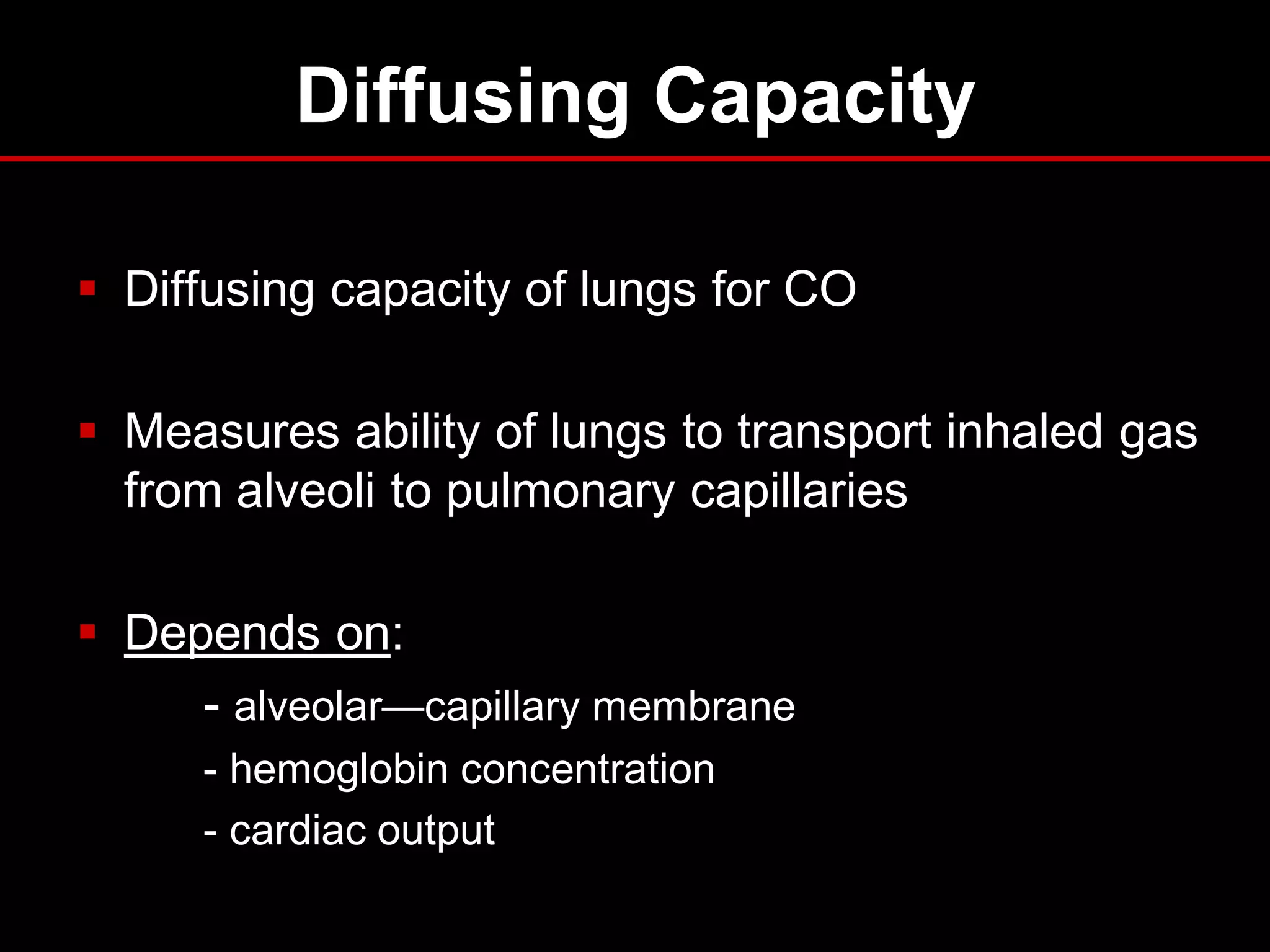
Diffusing Capacity
 Diffusing capacity of lungs for CO
 Measures ability of lungs to transport inhaled gas
from alveoli to pulmonary capillaries
 Depends on:
- alveolar—capillary membrane
- hemoglobin concentration
- cardiac output
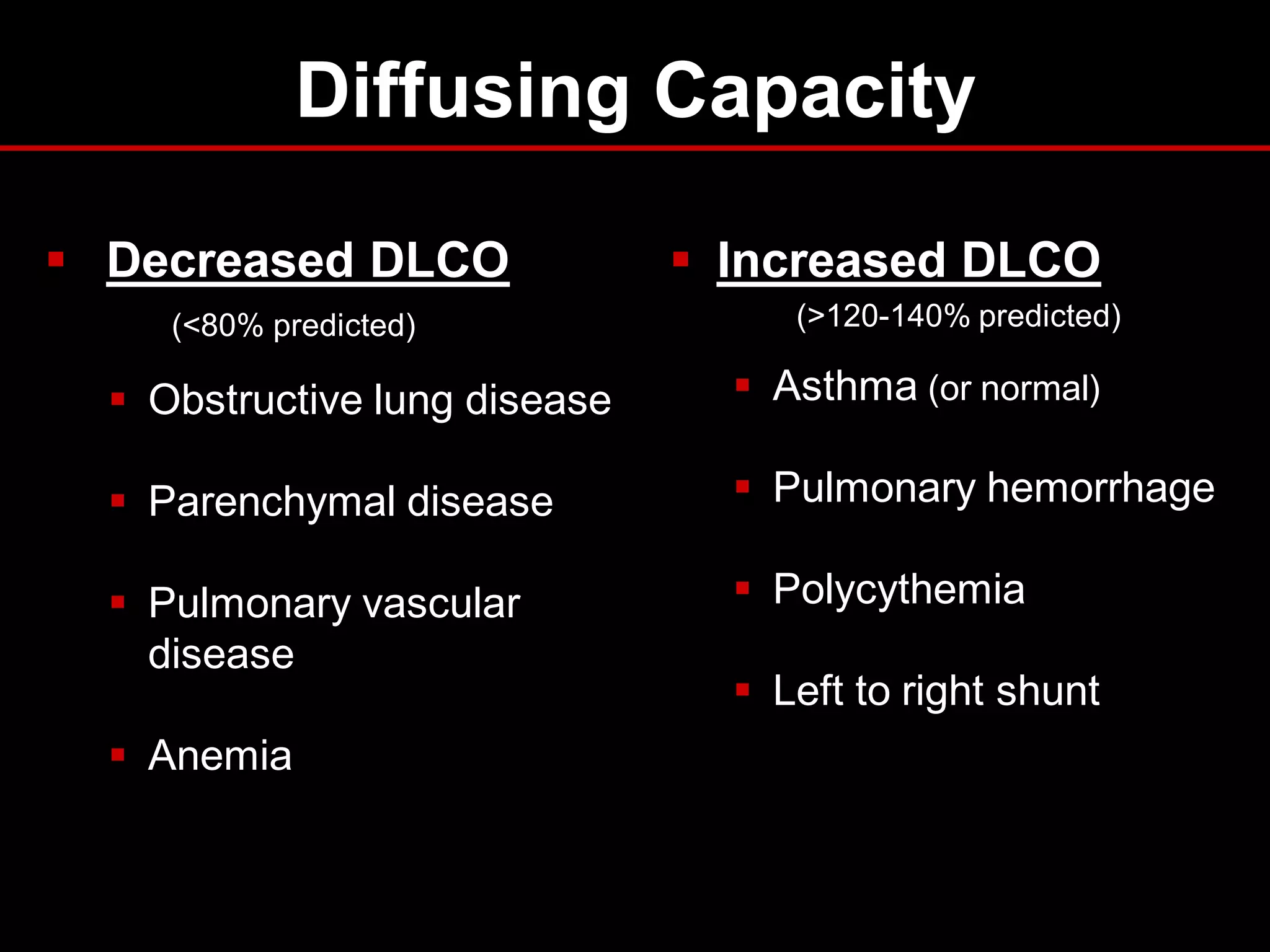
Diffusing Capacity
 Decreased DLCO
(<80% predicted)

 Increased DLCO
(>120-140% predicted)

 Obstructive lung disease

 Asthma (or normal)

 Parenchymal disease

 Pulmonary hemorrhage

 Pulmonary vascular
disease

 Polycythemia

 Anemia

 Left to right shunt
DLCO — Indications
 Differentiate asthma from emphysema
 Evaluation and severity of restrictive lung
disease
 Early stages of pulmonary hypertension
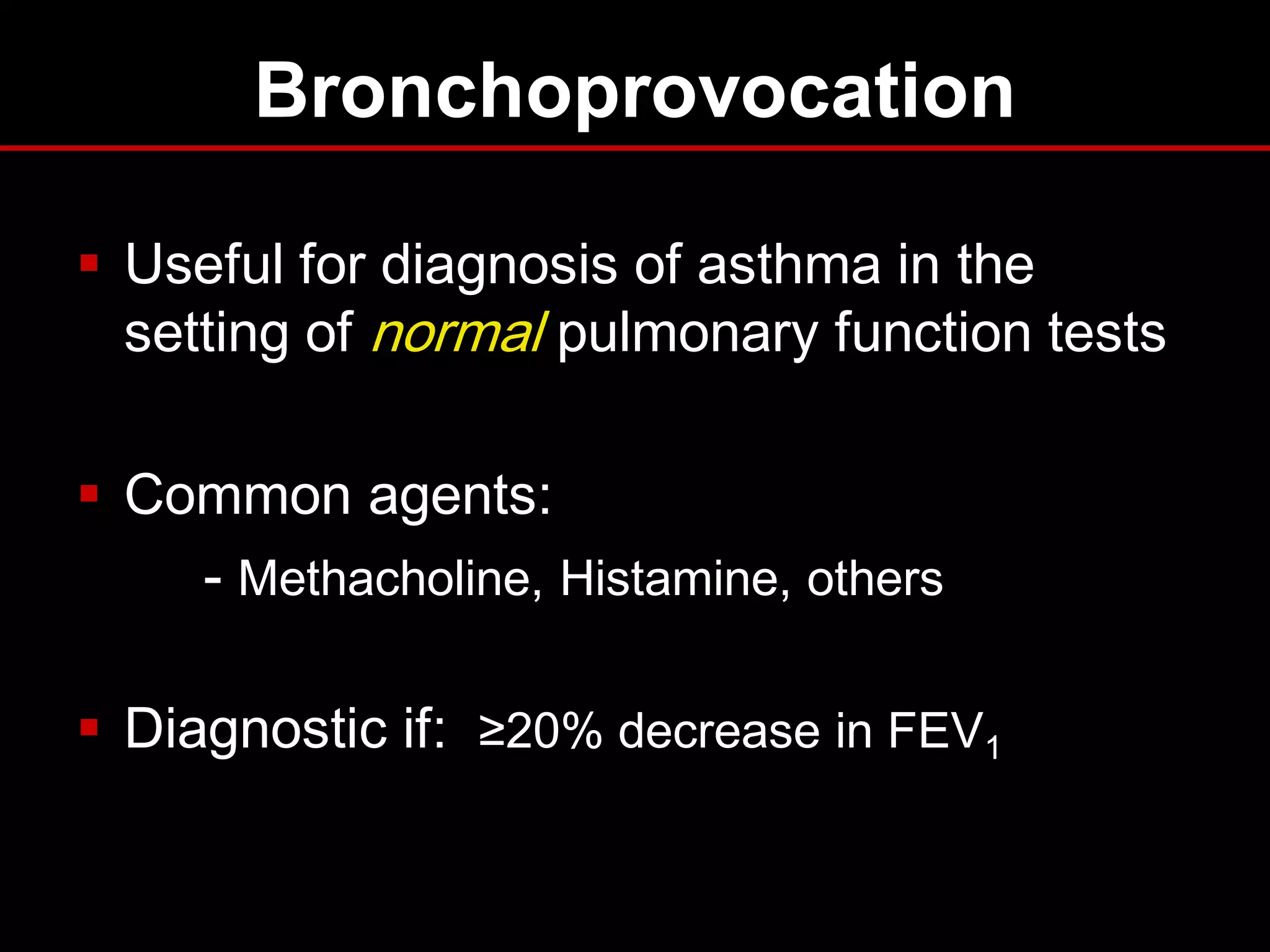
Bronchoprovocation
 Useful for diagnosis of asthma in the
setting of normal pulmonary function tests

 Common agents:
- Methacholine, Histamine, others
 Diagnostic if: ≥20% decrease in FEV1
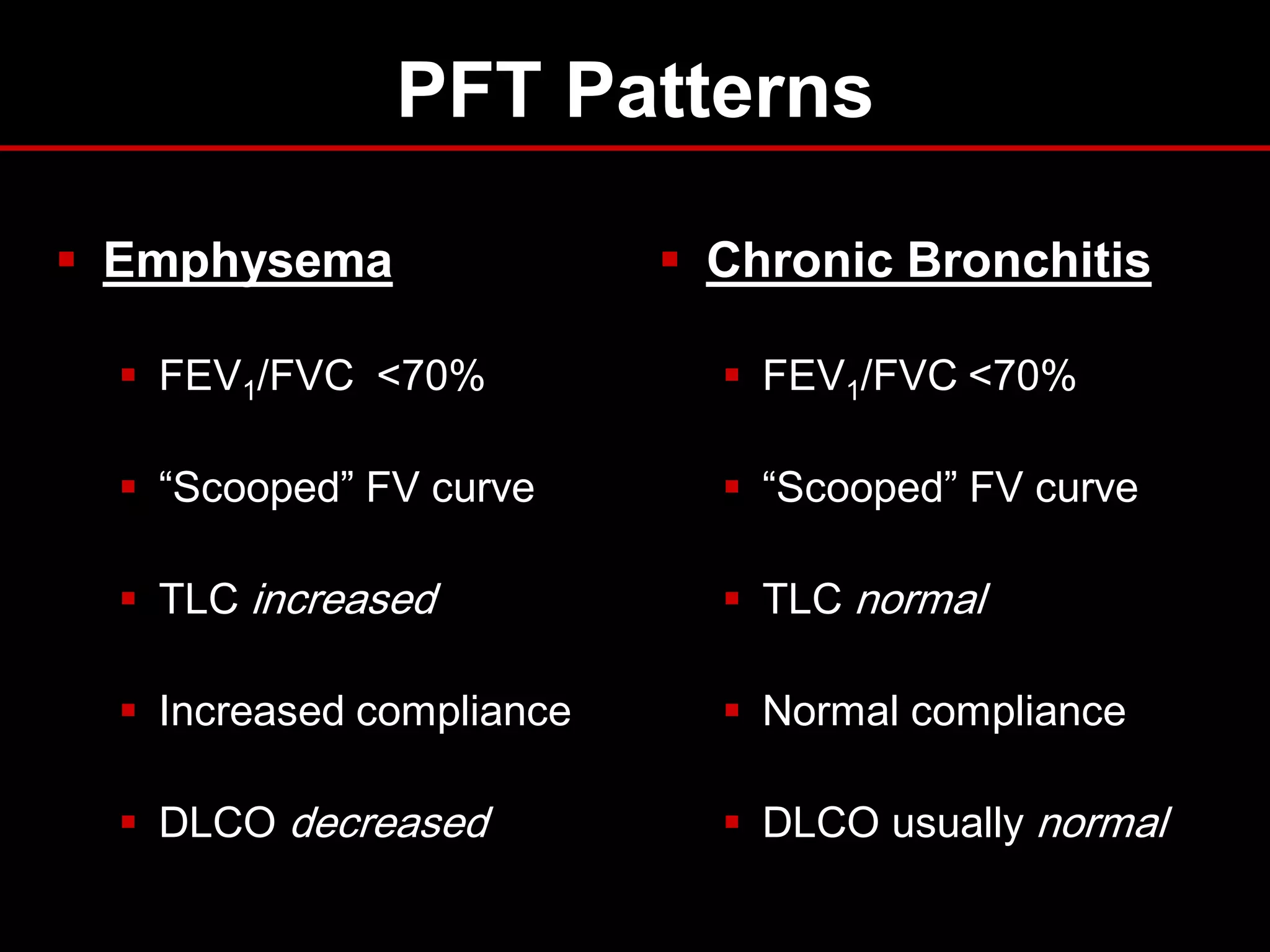
PFT Patterns
 Emphysema

 Chronic Bronchitis

 FEV1/FVC <70%

 FEV1/FVC <70%

 “Scooped” FV curve

 “Scooped” FV curve

 TLC increased

 TLC normal

 Increased compliance

 Normal compliance

 DLCO decreased

 DLCO usually normal
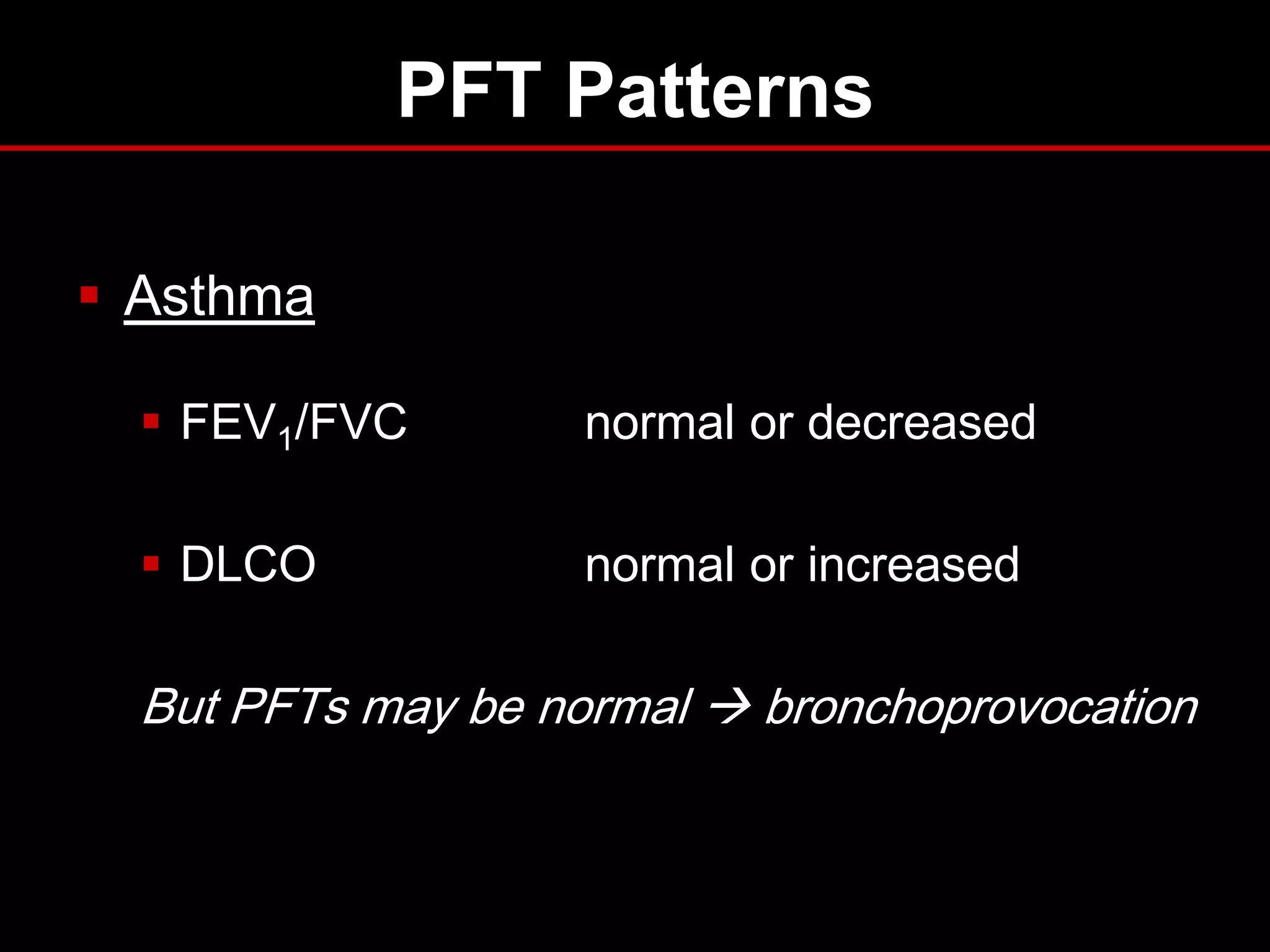
PFT Patterns
 Asthma
 FEV1/FVC

normal or decreased

 DLCO

normal or increased

But PFTs may be normal  bronchoprovocation
Simple Interpretation of Pulmonary Function tests

Simple Interpretation of Pulmonary Function tests

  • 2.
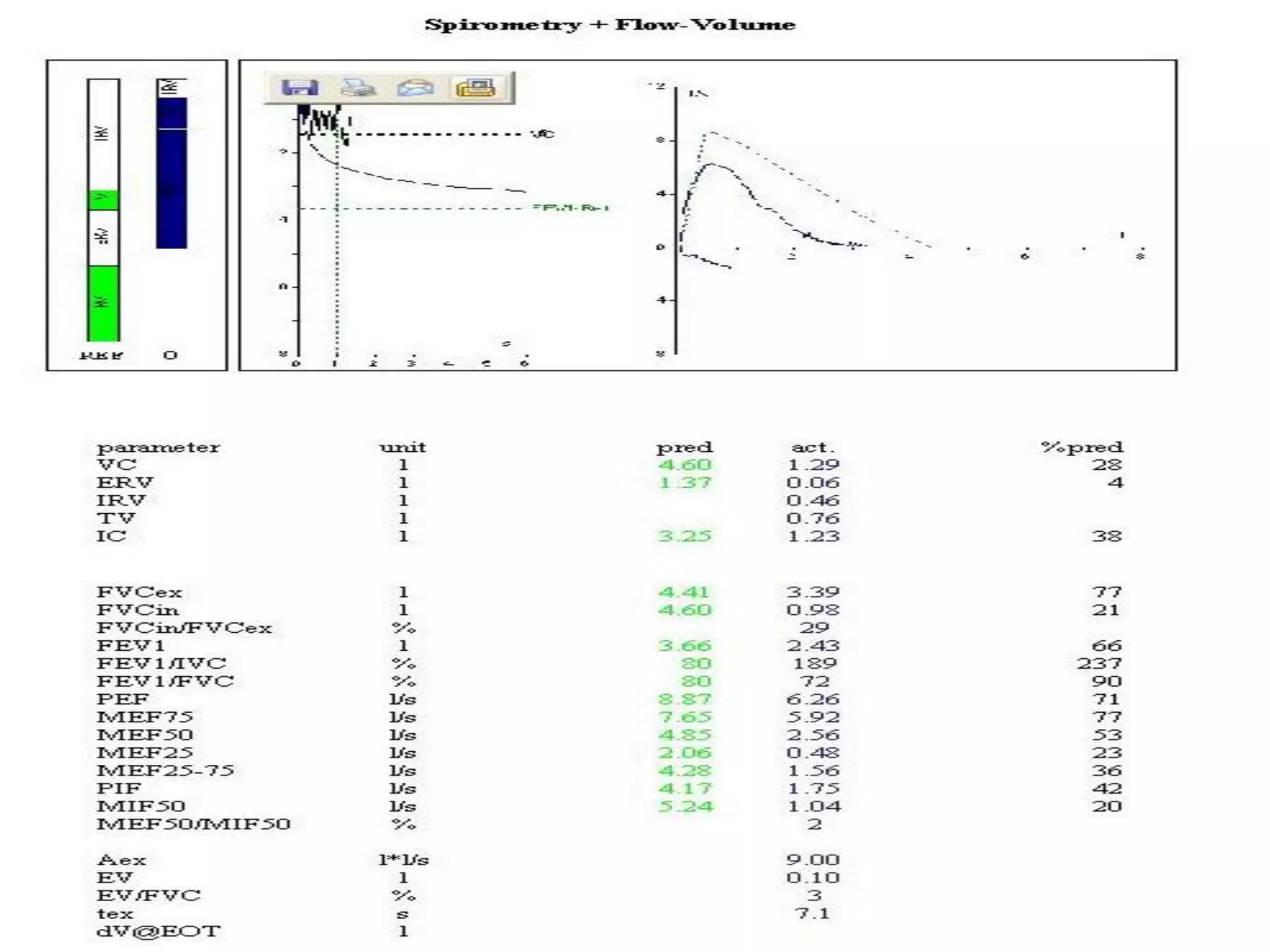
    Spirometry of Obstructive LungDiseases Gamal Rabie Agmy, MD, FCCP Professor of Chest Diseases, Assiut University
  • 3.
    Pulmonary Disorders Effectson Pulmonary Function Obstructive: Any process that interferes with air flow either into or out of the lungs. Large or small airways. Restrictive:  Any process that interferes with the bellows action of the lungs or chest wall.  Reduced lung volumes.
  • 4.
    Differential Diagnosis: COPD andAsthma COPD Onset In mid-life Symptoms slowly progressive Long smoking history Dyspnea during exercise Largely Irreversible airflow limitation Asthma Onset early in life (often childhood) Symptoms vary from day to day Symptoms at night/early morning Allergy, rhinitis, and/or eczema also present Family history of asthma Largely reversible airflow limitation
  • 5.
  • 6.
    Measures of Assessmentand Monitoring of Asthma Asthma diagnosis criteria: Repeated variability in well-performed spirometic values (increase in FEV1 or FVC). Positive bronchodilator (BD) responses (increase in FEV1 or FVC ⩾12% and 200 mL from baseline). Positive methacholine challenge (20% fall in FEV1 at a dose ⩽8 μg/mL).
  • 7.
    Objective lung function measurementsin Asthma Spirometry: ▫ Forced Expiratory Maneuvers. Exhaled Nitric Oxide. Peak Flows.
  • 8.
    GOLD 2013: Diagnosisof COPD  Key Indicators to Consider COPD Diagnosis: • SYMPTOMS 1 • Dyspnea-progressive (worsens over time and with exercise) • Chronic cough • Sputum • HISTORY OF EXPOSURE TO RISK FACTORS 2 3 • Tobacco smoke • Smoke from home cooking/heating fuels • Occupational dusts and chemical • FAMILY HISTORY OF COPD SPIROMETRY REQUIRED TO DIAGNOSE COPD Presence of a post-bronchodilator FEV1/FVC < 0.70 confirms the presence of persistent airflow limitation and thus of COPD. Adapted from GOLD 2013
  • 9.
    Simple Interpretation of PulmonaryFunction Tests Gamal Rabie Agmy, MD, FCCP Professor of Chest Diseases, Assiut University
  • 11.
  • 12.
    The Airways    Weibel ER:Morphometry of the Human Lung. Berlin and New York: SpringerVerlag, 1963 Conducting zone: no gas exchange occurs  Anatomic dead space Transitional zone: alveoli appear, but are not great in number Respiratory zone: contain the alveolar sacs
  • 13.
    The Alveoli    Murray &Nadel: Textbook of Respiratory Medicine, 3rd ed., Copyright © 2000 W. B. Saunders Company Approximately 300 million alveoli 1/3 mm diameter Total surface area if they were complete spheres 80 sq. meters (size of a tennis court)
  • 14.
    Mechanics of Breathing  Inspiration   Activeprocess Expiration Quiet breathing: passive  Can become active 
  • 15.
    Pulmonary Function Tests  Airwayfunction      Simple spirometry Forced vital capacity maneuver Maximal voluntary ventilation Maximal inspiratory/expiratory pressures Airway resistance  Lung volumes and ventilation     Functional residual capacity Total lung capacity, residual volume Minute ventilation, alveolar ventilation, dead space Distribution of ventilation
  • 16.
    Pulmonary Function Tests   Diffusingcapacity tests Blood gases and gas exchange tests      Blood gas analysis Pulse oximetry Capnography Cardiopulmonary exercise tests Metabolic measurements    Resting energy expenditure Substrate utilization Chemical analysis of exhaled breath
  • 17.
    Terminology  Forced vital capacity (FVC):    Totalvolume of air that can be exhaled forcefully from TLC The majority of FVC can be exhaled in <3 seconds in normal people, but often is much more prolonged in obstructive diseases Measured in liters (L)
  • 18.
    FVC  Interpretation of %predicted:     80-120% 70-79% 50%-69% <50% Normal Mild reduction Moderate reduction Severe reduction FVC
  • 19.
    Terminology  Forced expiratory volume in1 second: (FEV1)    Volume of air forcefully expired from full inflation (TLC) in the first second Measured in liters (L) Normal people can exhale more than 75-80% of their FVC in the first second; thus the FEV1/FVC can be utilized to characterize lung disease
  • 20.
    FEV1  Interpretation of %predicted:      >75% Normal Mild 70-75% Mod 50-69 % Severe 35-49% Very severe < 35% FEV1 FVC
  • 21.
    Terminology  Forced expiratory flow2575% (FEF25-75)      Mean forced expiratory flow during middle half of FVC Measured in L/sec May reflect effort independent expiration and the status of the small airways Highly variable Depends heavily on FVC
  • 22.
    FEF25-75  Interpretation of %predicted: >60%  40-60%  20-40%  <20%  Normal Mild obstruction Moderate obstruction Severe obstruction
  • 23.
    Acceptability Criteria Good startof test  No coughing  No variable flow  No early termination  Reproducibility 
  • 24.
    Changes in LungVolumes in Various Disease States Ruppel GL. Manual of Pulmonary Function Testing, 8th ed., Mosby 2003
  • 25.
    TLC TLC < 80%of predicted value = restriction.  TLC > 120% of predicted value = hyperinflation. 
  • 26.
  • 27.
    Spirometry Spirometry should beperformed after the administration of an adequate dose of a short acting inhaled bronchodilator (e.g. 400 ᶙg salbutamol) to minimize variability. A post-bronchodilator FEV 1/FVC <0.70 confirms the presence of airflow limitation that is not fully reversible. Where possible, values should be compared to age-related normal values to avoid overdiagnosis of COPD In the elderly.
  • 28.
    Why Do WeNeed Spirometry in COPD? Spirometry is useful for: Screen individuals at risk for pulmonary disease. Confirmation of COPD diagnosis. Assessing severity of pulmonary dysfunction. Guiding selection of treatment. Assessing the effects of therapeutic interventions.
  • 29.
    Who Should BeScreened for COPD? Consider COPD, and perform spirometry, if any of these indicators are present in an individual over age 40. ▫ Dyspnea that is progressive, usually worse with exercise, and persistent. ▫ Chronic cough (may be intermittent and unproductive). ▫ Chronic sputum. ▫ History of tobacco smoke exposure. ▫ Exposure to occupational dusts and chemicals. ▫ Risk factors. ▫ Exposure to smoke from home cooking and heating fuels.
  • 30.
    Spirometry Origin Most basicof Pulmonary Function Tests Clinical Tools Origin - Mid 1800' s ▫ John Hutchinson. ▫ Water-sealed spirometry to measure vital capacity (VC).
  • 31.
    Reasons for Performing Spirometry DiagnosticPurposes. Monitoring Lung Disease. Assessing Disability.
  • 32.
    Spirometry Spirometry with flowvolume loops assesses the mechanical properties of the respiratory system by measuring expiratory volumes and flow rates. ▫ Maximal inspiratory and expiratory effort. ▫ At least 3 tests of acceptable effort are performed to ensure reproducibility.
  • 33.
    21st Century Spirometry Measurementsof: Forced Vital Capacity (FVC). Forced Expiratory Volume in one second (FEV1). Forced Expiratory Volume in six seconds (FEV6). Forced Expiratory Flow over various Intervals (FEFx). Peak Expiratory Flow (PEF).
  • 34.
    Definitions and Terms FEV1- forced expiratory volume 1 - the volume of air that is forcefully exhaled in one second. FEV6 - forced expiratory volume 6 - the volume of air that Is forcefully exhaled in six seconds. FVC- forced vital capacity- the volume of air that can be maximally forcefully exhaled. FEV1/FVC- ratio of FEV1 to FVC, expressed as a percentage.
  • 35.
    Definitions and Terms FEV/FVC-ratio of FEV6 to FVC, expressed as a percentage. FEF25 -75 - forced expiratory flow - the average forced expiratory flow during the mid (25 - 75%) portion of the FVC. PEF- peak expiratory flow rate - the peak flow rate during expiration.
  • 36.
    Spirometry Flow volume loopsprovide a graphic illustration of a patient's spirometric efforts. Flow is plotted against volume to display a continuous loop from inspiration to expiration. The volume versus time curve is a an alternative way of plotting spirometric results. The overall shape of the flow volume loop is important in Interpreting spirometric results.
  • 37.
  • 38.
    Acceptability At least three(3) acceptable maneuvers Good start to the test. No hesitation or coughing for the 1st second. FVC lasts at least 6 seconds with a plateau of at least 1 second. No valsalva maneuver or obstruction of the mouthpiece. FIVC shows apparent maximal effort.
  • 39.
    Repeatability Repeatability criteria actas guideline to determine need for additional efforts. ▫ Largest and 2nd largest FVC must be within 150 mL. ▫ Largest and 2nd largest FEV 1 must be 150 mL. ▫ PEF values may be variable (within 15%). If three acceptable reproducible maneuvers are not recorded, up to B attempts may be recorded.
  • 40.
    Spirometry Value Spirometry istypically reported in both absolute values and as a predicted percentage of normal. Normal values vary and are dependent on: ▫ ▫ ▫ ▫ Gender, Race, Age, and Height.
  • 41.
    Reporting Standards Largest FVCobtained from all acceptable efforts should be reported. Largest FEV1 obtained from all acceptable trials should be reported. May or may not come from largest FVC effort. All other flows, should come from the effort with the largest sum of FEV 1 & FVC. PEF should be the largest value obtained from at least 3 acceptable maneuvers.
  • 42.
  • 43.
    Report Format Report shouldalso include: ▫ ▫ ▫ ▫ ▫ ▫ Age on testing day. Height (standing without shoes). Weight (without shoes). Gender. Race or ethnic origin. Technologist comment section.
  • 44.
  • 45.
    FEV 1 SeverityResults for Asthma
  • 46.
    At Risk forCOPD Spirometric classification of airflow limitation (in patients with FEV1/FVC<0.70). ▫ ▫ ▫ ▫ GOLD 1 GOLD 2 GOLD 3 GOLD 4 Adapted from GOLD 2013 (Mild; FEV1 ≥80% predicted). (Moderate; 50% ≤FEV1 <80% predicted). (Severe; 30% ≤FEV1 <50% predicted). (Very severe; FEV1 <30% predicted).
  • 47.
    Pre & PostBronchodilator Studies B-Adrenergic aerosols are most common form for testing. Standardize. ▫ Drug. ▫ Dosage. ▫ Delivery Device. Minimum of 15 minutes between pre and post tests.
  • 48.
    Pre & PostBronchodilator Studies: Withholding Medications
  • 49.
    Pre & PostBronchodilator Studies: Interpretations Determined based on improvement of FEV1. Commonly expressed as Percent Change. % Change = Post FEV 1 - Pre FEV1 x 100 Pre FEV1
  • 50.
    Reversibility Reversibility of airwaysobstruction can be assessed with the use of bronchodilators. > 12% increase in the FEV1 and 200 ml improvement in FEV1 OR > 12% increase in the FVC and 200 ml improvement in FVC.
  • 51.
  • 52.
    Asthma Challenge Testing Spirometrycan be used to detect the bronchial hyperreactivity that characterizes asthma. Increasing concentrations of histamine or methacholine. Patients with asthma will demonstrate symptoms and produce spirometric results consistent with airways obstruction at much lower threshold concentration than normals.
  • 53.
  • 54.
    Spirometry Indications — Diagnosis Evaluation of signs and symptoms - SOB, exertional dyspnea, chronic cough  Screening at-risk populations  Monitoring pulmonary drug toxicity  Abnormal study - CXR, EKG, ABG, hemoglobin  Preoperative assessment
  • 55.
    Spirometry Indications — Diagnosis Evaluation of signs and symptoms - SOB, exertional dyspnea, chronic cough  Screening at-risk populations Smokers > 45yo  Monitoring pulmonary drug toxicity & current) (former  Abnormal study - CXR, EKG, ABG, hemoglobin  Preoperative assessment
  • 56.
    Spirometry Indications — Diagnosis Evaluation of signs and symptoms - SOB, exertional dyspnea, chronic cough  Screening at-risk populations  Evaluation of occupational symptoms  Monitoring pulmonary drug toxicity  Abnormal study - CXR, EKG, ABG, hemoglobin  Preoperative assessment
  • 57.
    Spirometry Indications — Prognostic ■Assess severity ■ Follow response to therapy ■ Determine further treatment goals ■ Referral for surgery ■ Disability
  • 59.
    1-First Step, Checkquality of the test 1- Start: *Good start: Extrapolated volume (EV) < 5% of FVC or 0.15 L *Poor start: Extrapolated volume (EV) ≥5% of FVC or ≥ 0.15 L 2- Termination: *No early termination :Tex ≥ 6 s *Early termination : Tex < 6 s
  • 60.
    2- Look at…………FEV1/FVC < N(70%) Obstructive or Mixed ≥ N(70%) Restrictive or Normal 3- Look at FEV1 To detect degree Mild > 70% Mod 50-69 % Severe 35-49% Very severe < 35%
  • 61.
    4- Postbronchodilator FEV1/FVC >70% asthma < 70% COPD
  • 62.
    5- Reversibility testof FEV1 > 12%, 200 ml Reversible (asthma) < 12% ,200 ml Ireversible (COPD) 6- Look at TLC ≥ 80-120% Pure obstruction < 80% Mixed
  • 63.
    2- Look at…………FEV1/FVC < N(70%) ≥ N(70%) Obstructive or Mixed Restrictive or Normal 3- Look at FVC ≥ N(80%) Normal or SAWD 4-Look at FEF25/75 > 50% Normal < 50% SAWD < N(80%) Restrictive
  • 64.
    Patterns of Abnormality Obstructivelow FEV1 relative to FVC, low PEF, low FEV1%FVC R eco rd ed Pred icted SR % Pred 0.56 3.25 -5.3 17 1.65 4.04 -3.9 41 FEV 1 % FV C 34 78 -6.1 44 PEF 2.5 8.28 -4.8 30 FEV 1 FV C Restriction low FEV1 & FVC, high FEV1%FVC R eco rd ed FEV 1 FV C FEV 1 % FV C PEF Pred icted SR % Pred 1.49 2.52 -2.0 59 1.97 3.32 -2.2 59 76 74 0.3 103 8.42 7.19 1.0 117 high PEF early ILD low PEF late ILD
  • 65.
    Patterns of Abnormality UpperAirway Obstruction low PEF relative to FEV1 R eco rd ed Pred icted SR % Pred 2.17 2.27 -0.3 96 2.68 2.70 0.0 99 81 76 0.7 106 PEF 2.95 5.99 -3.4 49 FEV 1 /PEF 12.3 FEV 1 FV C FEV 1 % FV C Discordant PEF and FEV1 High PEF versus FEV1 = early interstitial lung disease (ILD) Low PEF versus FEV1 = upper airway obstruction Concordant PEF and FEV1 Both low in airflow obstruction, myopathy, late ILD
  • 66.
    Flow Common FVL Shapes Volume Normal Hesitation Youngor quitter Knee Poor effort Coughing
  • 67.
    12 Asthma Flow in L/s 10 concaveFV curve intrapulmonary airflow obstruction 8 6 4 2 0 0 1 2 3 4 5 Litres 6
  • 68.
    Restrictive 12 F 19 yrs1.64m FVC 2.41 L -3.42 SR FEV 2.41 L -2.62 SR FEV% 100 +2.23 SR PEF 5.55L/s -2.00 SR F/P 7.2 RT 116 ms 10 8 Flow in L/s 6 4 2 0 0 -2 -4 -6 -8 1 2 3 4 5 Litres 6
  • 69.
    COPD 10 8 pressure dependent airwayscollapse 6 Flow in L/s 4 2 0 0 -2 -4 -6 1 2 3 4 5 Litres
  • 70.
    Poorly co-ordinated start EV= large Rise Time = 496 ms Irregular shape Poorly repeatable 12 10 8 6 Flow in L/s 4 2 0 0 -2 -4 -6 -8 -10 1 2 3 4 5 6 Litres
  • 71.
    Upper Airway Obstruction 6 Expiratory Age40 yrs FVC 3.52 L FEV1 3.0 L 0.74 SR PEF 4.57 L/s 4 0.84 SR -2.18 SR FEV/PEF = 10.9 Flow in L/s 2 0 0 1 2 4 5 6 Volume in Litres -2 -4 -6 3 Inspiratory FEV1 in mls > 8 PEF in L/min
  • 72.
    Upper Airway Obstruction 12 Maleaged 62 Height 1.68m 10 R e co rd e d SR 2.23 2.94 2.1 to 3.8 -1.4 FV C 3.40 3.71 2.7 to 4.7 -0.5 66 76 64 to 88 -1.5 P EF 2.85 7.81 5.8 to 9.8 -4.1 FEV 1 /P EF 13.1 FEV 1 % FV C 6 Flow in L/s R an ge FEV 1 8 P re d icte d 4 2 0 0 -2 -4 -6 1 2 3 4 5 6 Volume in Litres
  • 73.
  • 74.
    Intra-thoracic UAO 12 Age 65Female FVC 2.97 L FEV1 2.26 L FEV1% 76% PEF 3.4 L·s-1 F/P 11.1 10 Flo w in L /s 8 6 4 2 0 0 -2 -4 -6 -8 1 2 3 4 5 L ite rs 6 1.3 SR 0.6 SR -0.1 SR -2.5 SR RT 455 ms
  • 75.
    Upper Airway Obstruction •Variable extrathoracic obstructions 1. 2. 3. 4. vocal cord paralysis, thyromegaly, tracheomalacia, or Neoplasm • Large airways variable intrathoracic obstructions 1. 2. tracheomalacia or neoplasm • Fixed obstruction 1. 2. tracheal stenosis, foreign body, or 3. neoplasm.
  • 76.
  • 77.
  • 78.
    Fixed Upper AirwayObstruction
  • 79.
    True Restrictive Disorders Intraparenchymal Interstitial Infilterative ChestWall Diffuse alveolar Pleural Skeletal Neuromuscular Reduced TLC.FRC,RV,VC and normal to high FEV1/FVC DLVA,Dlcoc or both DLVc parynhymal If normal Chest wall or neuromuscular
  • 80.
    Pseudorestrictive Disorders Normally: IC/ERV=2-3/1 Truerestrictive: IC/ERV=<2/1 Pseudorestrictive: IC/ERV=6/1
  • 81.
    Pseudorestrictive Disorders Asthma isa disorder characterized by increased reactivity of the airways. Patients with asthma have recurrent or persistent airflow obstruction, which is reversible either spontaneously or with appropriate therapy. An obstructive pattern is most often present, recognized by reduced forced expiratory volume in 1 s (FEV1), and FEV1 to forced vital capacity (FEV1/FVC) or FEV1/vital capacity (VC) ratio. Patients may have normal spirometry between attacks. In some patients, the FVC may be reduced due to air trapping, resulting in pseudorestriction on spirometry in the presence of increased or normal total lung capacity (TLC), increased functional residual capacity (FRC) and increased residual volume (RV). We have reported 12 asthmatic patients with reduced VC and no increase in RV, i.e., a true restrictive impairment [Gill et al. Chest 2012)
  • 82.
    Pseudorestrictive Disorders Obesity: *Early airwayclosure (low ERV & high RV) *FRC is more reduced than TLC&VC *Low FEF50% FEF75%, FEF25-75%, ,
  • 83.
    Pseudorestrictive Disorders Neuromuscular Disease: *FRCnormal *IC&ERV decreased *Decreased TLC *Increased RV *A-aO2 gradient normal *MIP&MEP decreased
  • 84.
    Pseudorestrictive Disorders Asthma: *FRC &TLCincreased *Improvement of FEV1&FVC with bronchodilators *Positive bronchoprovacation test *Increased diffusing capacity and DLco/VA
  • 85.
    Pseudopseudorestrictive Patients with obstructivediseases who do not complete expiratory effort of FVC. This may lead to a below normal FEV1 and FVC with pseudonormalization of ratio.
  • 86.
  • 87.
    Obstructive Pattern ■ DecreasedFEV1 ■ Decreased FVC ■ Decreased FEV1/FVC - <70% predicted ■ FEV1 used to follow severity in COPD
  • 88.
    Obstructive Lung Disease— Differential Diagnosis  Asthma  COPD - chronic bronchitis - emphysema  Bronchiectasis  Bronchiolitis  Upper airway obstruction
  • 89.
    Restrictive Pattern  DecreasedFEV1  Decreased FVC  FEV1/FVC normal or increased
  • 90.
    Restrictive Lung Disease— Differential Diagnosis  Pleural  Parenchymal  Chest wall  Neuromuscular
  • 91.
  • 92.
    Bronchodilator Response  Degreeto which FEV1 improves with inhaled bronchodilator  Documents reversible airflow obstruction  Significant response if: - FEV1 increases by 12% and >200ml  Request if obstructive pattern on spirometry
  • 93.
    Flow Volume Loop “Spirogram”  Measures forced inspiratory and expiratory flow rate  Augments spirometry results  Indications: evaluation of upper airway obstruction (stridor, unexplained dyspnea)
  • 94.
  • 95.
    Upper Airway Obstruction Variable intrathoracic obstruction  Variable extrathoracic obstruction  Fixed obstruction
  • 96.
  • 97.
    Lung Volumes  Measurement: -helium - nitrogen washout - body plethsmography  Indications: - Diagnose restrictive component - Differentiate chronic bronchitis from emphysema
  • 98.
    Lung Volumes –Patterns  Obstructive - TLC > 120% predicted - RV > 120% predicted  Restrictive - TLC < 80% predicted - RV < 80% predicted
  • 99.
    Diffusing Capacity  Diffusingcapacity of lungs for CO  Measures ability of lungs to transport inhaled gas from alveoli to pulmonary capillaries  Depends on: - alveolar—capillary membrane - hemoglobin concentration - cardiac output
  • 100.
    Diffusing Capacity  DecreasedDLCO (<80% predicted)  Increased DLCO (>120-140% predicted)  Obstructive lung disease  Asthma (or normal)  Parenchymal disease  Pulmonary hemorrhage  Pulmonary vascular disease  Polycythemia  Anemia  Left to right shunt
  • 101.
    DLCO — Indications Differentiate asthma from emphysema  Evaluation and severity of restrictive lung disease  Early stages of pulmonary hypertension
  • 102.
    Bronchoprovocation  Useful fordiagnosis of asthma in the setting of normal pulmonary function tests  Common agents: - Methacholine, Histamine, others  Diagnostic if: ≥20% decrease in FEV1
  • 103.
    PFT Patterns  Emphysema Chronic Bronchitis  FEV1/FVC <70%  FEV1/FVC <70%  “Scooped” FV curve  “Scooped” FV curve  TLC increased  TLC normal  Increased compliance  Normal compliance  DLCO decreased  DLCO usually normal
  • 104.
    PFT Patterns  Asthma FEV1/FVC normal or decreased  DLCO normal or increased But PFTs may be normal  bronchoprovocation