1
BRONCHIAL
HYPERRESPONSIVENESS
&
BRONCHIAL
PROVOCATION
TESTS - Dr. M.A.WASEEM
PG - Dept. Of Pulmonary Medicine
2
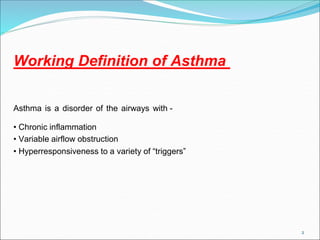
Working Definition of Asthma
Asthma is a disorder of the airways with -
• Chronic inflammation
• Variable airflow obstruction
• Hyperresponsiveness to a variety of “triggers”
3
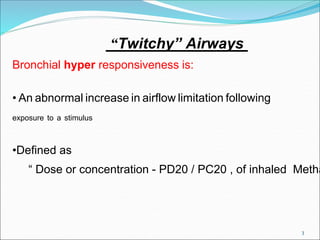
“Twitchy” Airways
Bronchial hyper responsiveness is:
• An abnormal increase in airflow limitation following
exposure to a stimulus
•Defined as
“ Dose or concentration - PD20 / PC20 , of inhaled Metha
4
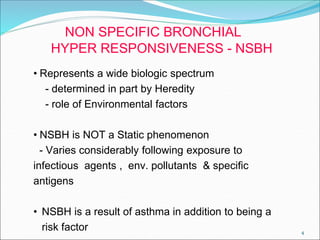
NON SPECIFIC BRONCHIAL
HYPER RESPONSIVENESS - NSBH
• Represents a wide biologic spectrum
- determined in part by Heredity
- role of Environmental factors
• NSBH is NOT a Static phenomenon
- Varies considerably following exposure to
infectious agents , env. pollutants & specific
antigens
• NSBH is a result of asthma in addition to being a
risk factor
5
PATHOGENESIS
6
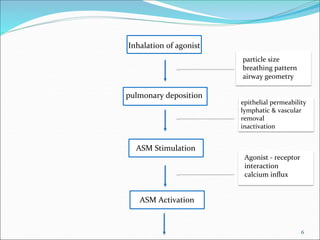
Inhalation of agonist
pulmonary deposition
ASM Stimulation
ASM Activation
particle size
breathing pattern
airway geometry
epithelial permeability
lymphatic & vascular
removal
inactivation
Agonist - receptor
interaction
calcium influx
7
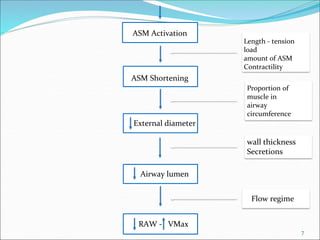
ASM Shortening
External diameter
Airway lumen
RAW - VMax
Proportion of
muscle in
airway
circumference
ASM Activation
Length - tension
load
amount of ASM
Contractility
wall thickness
Secretions
Flow regime
8
• NSBH is Sensitive , not Specific of ASTHMA
• also seen in Sarcoidosis , COPD , Extrinsic
Allergic Alveolitis , Cystic fibrosis.
• unrelated to base line FEV1 in asthma ,
significantly related in others
9
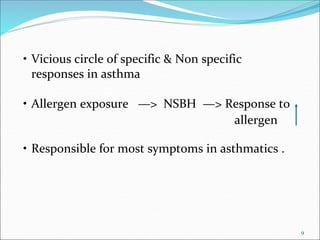
• Vicious circle of specific & Non specific
responses in asthma
• Allergen exposure —> NSBH —> Response to
• Responsible for most symptoms in asthmatics .
allergen
10
• Lack of NSBH does not exclude Asthma
diagnosis
- as in seasonal & occupational asthmatics
• Presence of NSBH alone does not make the
diagnosis , particularly with abnormal baseline
functions
• Serial measurements required in occupational
asthma to see for worsening or improvement of
symptoms with exposure
● BHR can be quantified by BPT
➢WHAT IS BPT ?
● Just opposite of looking for an improvement in lung
function with bronchodilator.
● BPT attempts to provoke airflow obstruction after
inhaling an irritant substance.
BRONCHIAL PROVOCATION TESTS
INDICATIONS OF BPT
13
1. Establishing a diagnosis of asthma with atypical features :
-Asthma symptoms with normal spirometry
-a presumptive diagnosis of asthma that does not
improve with asthma therapy
-nonspecific asthma symptoms such as persistent
cough
2. Evaluating the possibility of occupational asthma:
- a sensitive but not specific test
3. Excluding diagnosis of asthma in patients for
whom an erroneous diagnosis has significant social impact
(military recruits, divers, firefighters, and other high-risk
14
4. Monitoring asthma therapy :
- Symptoms and lung function may normalise
despite ongoing airway inflammation
- BHR correlates well with airway inflammation
- adjusting therapy based on BHR may improve
outcomes.
5. Identifying specific asthma triggers , rarely necessary ,
for research or legal purposes.
6. Objectively assessing asthma severity.
15
Contraindications
16
ABSOLUTE :
• Severe airflow limitation (FEV1 < 50% predicted
or <1.0 L)
• Acute coronary syndrome or stroke within 3
months
• Severe hypertension (systolic BP > 200 mm
Hg or diastolic BP > 100 mm Hg)
• Cerebral or aortic aneurysm
17
RELATIVE :
• Moderate airflow limitation (FEV1 < 60% predicted or
<1.5 L)
• Inability to perform acceptable and repeatable
spirometry
• Pregnancy
• Nursing mothers
• Current use of cholinesterase inhibitor medication for
myasthenia gravis
18
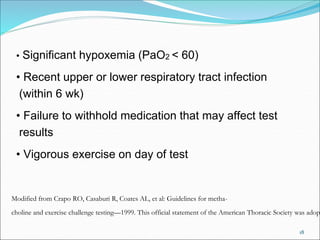
• Significant hypoxemia (PaO2 < 60)
• Recent upper or lower respiratory tract infection
(within 6 wk)
• Failure to withhold medication that may affect test
results
• Vigorous exercise on day of test
Modified from Crapo RO, Casaburi R, Coates AL, et al: Guidelines for metha-
choline and exercise challenge testing—1999. This official statement of the American Thoracic Society was adop
19
21
Categories of
Bronchial provocation Tests
22
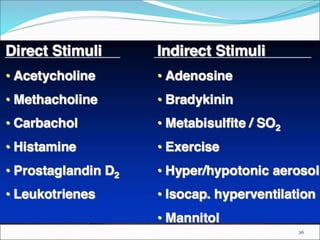
1.Specific airway irritants - Allergen , Aspirin , food
2.“direct” stimuli using nonspecific pharmacologic agents -
Methacholine
Histamine
3.“indirect” stimuli -
exercise,
eucapnic voluntary hyperventilation,
cold air hyperventilation,
hypertonic saline,
mannitol, and
adenosine monophosphate [AMP]
23
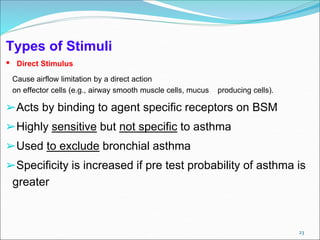
Types of Stimuli
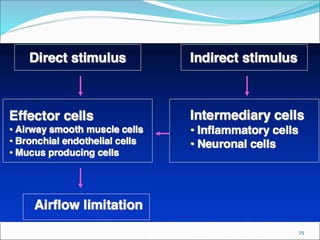
• Direct Stimulus
Cause airflow limitation by a direct action
on effector cells (e.g., airway smooth muscle cells, mucus producing cells).
➢Acts by binding to agent specific receptors on BSM
➢Highly sensitive but not specific to asthma
➢Used to exclude bronchial asthma
➢Specificity is increased if pre test probability of asthma is
greater
24
• Indirect Stimulus
Cause airflow limitation by an action on cells other
than effector cells, which then interact with the
effector cells.
• release endogenous preformed mediators through
neural or humeral pathways, which, in turn, provoke
BSM contraction
➢They reflect ongoing airway inflammation
➢ More specific to identify active asthma.
25
26
27
Specific inhalation challenge tests :
• gold standard for diagnosing occupational asthma.
• a negative test may not definitively exclude the
diagnosis (wrong agent or too low a concentration)
• require specialised equipment
• potential to trigger severe life-threatening asthmatic
reactions.
• performed only at specialised centres
Methacholine Inhalation Challenge
METHACHOLINE:
• Synthetic cholinergic agent
• most frequently used , most safe .
• directly stimulates specific receptors on bronchial smooth
muscle
• sensitivity 85%-90% - for diagnosing asthma, including
occupational asthma, cough variant asthma, and EIB
29
• specificity is relatively poor
• false-positive tests :
Allergic rhinitis, COPD, patients who smoke,
cystic fibrosis, bronchiectasis, bronchiolitis,
and recent respiratory tract infections
STANDARDIZATION OF TEST
-Delivery of a 0.6.s pulse of airflow at 20 lb into a
nebuliser, which in turn discharges particles of 0.3-4 uM
in diameter in to airways.
● The two methods most commonly used are:
1. Two minute tidal breathing method (more sensitive)
2. Five breath dosimeter method
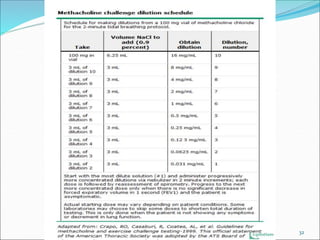
DOING PROTOCOLS
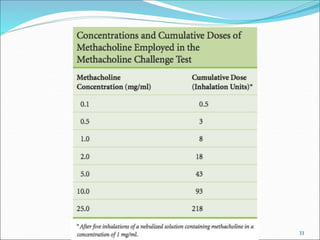
• Methacholine aerosol prepared by using bicarbonate
buffered isotonic saline as a diluent in concentration
ranging from 0.1 to 25 mg /ml
● The cumulative dose delivered is expressed in
inhalation units
● One IU =inhalation of a solution containing
1mg of methacholine per ml
32
33
PROCEDURE
➢Counsel regarding symptoms
➢The pt is then asked to wear a nose clip and breathe
normally through the mouthpiece of a De vilbiss 646
nebulizer
➢Measure the baseline FEV1
Continue…..
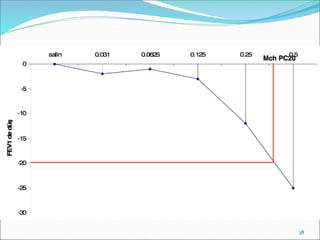
➢ Give inhalation of methacholine for 2minutes at
interval of 5 min beginning with 0.03 mg/ml and
increased up to 16mg/ml.
➢ Measure the FEV1 at 30 and 90 seconds after the
nebulisation is completed until the FEV1 falls >20
%
Continue…..
• The test is stopped when
-Fall of FEV1 >20% at any dose
-highest concentration is reached
(16mg) at any FEV1
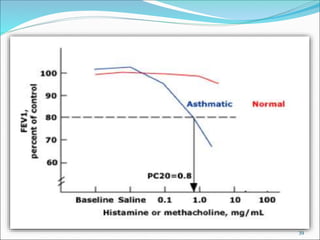
WHAT IS PC 20 ?
Provocation Concentration producing 20% fall in
FEV1
• The PC20 is universally lower than 8mg in
asthmatics.
37
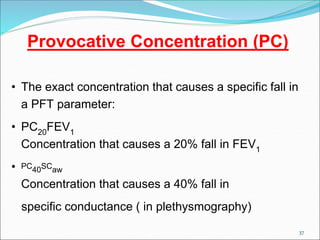
Provocative Concentration (PC)
• The exact concentration that causes a specific fall in
a PFT parameter:
• PC20
FEV1
Concentration that causes a 20% fall in FEV1
• PC40SCaw
Concentration that causes a 40% fall in
specific conductance ( in plethysmography)
38
39
PRE CHALLENGE
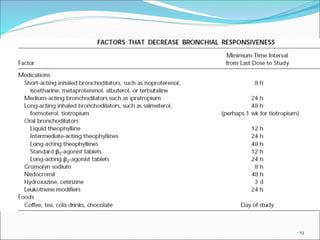
● Just before BPT Pts should be screened for factors
that may result in false-positive or negative
responses.
● FALSE-POSITIVE
● FACTORS THAT INCREASE BHR
➢Recent viral infections -eg.- RSV
-CMV
-parainfluenzae
Continue…..
➢ Exposure to environmental antigens
➢ Occupational sensitisers
➢ Irritants (smoke)
➢ Pollutants
➢ Chemicals
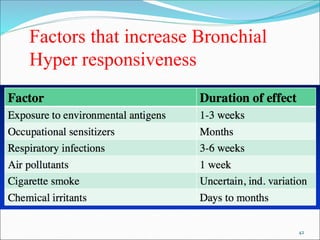
42
Factors that increase Bronchial
Hyper responsiveness
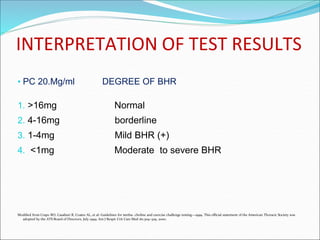
INTERPRETATION OF TEST RESULTS
• PC 20.Mg/ml DEGREE OF BHR
1. >16mg Normal
2. 4-16mg borderline
3. 1-4mg Mild BHR (+)
4. <1mg Moderate to severe BHR
Modified from Crapo RO, Casaburi R, Coates AL, et al: Guidelines for metha- choline and exercise challenge testing—1999. This official statement of the American Thoracic Society was
adopted by the ATS Board of Directors, July 1999. Am J Respir Crit Care Med 161:309–329, 2000.
44
Indirect Bronchoprovocation Tests
• less sensitive than direct challenges for diagnosis of
asthma but are more specific.
• better tests for assessing airway inflammation and
determining response to an inhaled corticosteroid than
methacholine testing.
• useful for titrating the dose of inhaled corticosteroid
45
Exercise testing
• commonly performed in the evaluation of exercise-
induced bronchospasm.
• is less sensitive - due to the inability to achieve
adequate exercise levels due to reconditioning,
musculoskeletal limitations, or sub maximal effort.
• is highly specific in differentiating asthma from
normal.
• performed in laboratory, on treadmill or bicycle
ergometer.
MECH. OF BRONCHO CONSTRICTION :
1.Mucosal drying and increased osmolarity –
Stimulating mast cell degranulation .
2.Rapid airway rewarming after exercise causing –
Vascular congestion
-Increased permeability and edema ,
leading to obstruction
• Symptoms peak 8-15 min post exercise and resolve
spontaneously in about 60 min
INDICATIONS
1. In making a diagnosis of EIB –in asthmatics with
history of SOB during or after exercise.
2. To evaluate the ability of performing life saving
works (military, police) in persons with a history
suggestive of asthma.
3. To determine the effectiveness and optimal dosing
of medications prescribed to prevent asthma.
PROCEDURE
• exercise for a total duration of 6 to 8 minutes with 4
to 6 minutes of exercise at near-maximum levels
• The minute ventilation should achieve 50% to 60% of
MVV and the heart rate should reach 90% of
predicted maximum
• FEV1 is the primary outcome variable and it should
be obtained 5, 10, 15, 20, and 30 minutes
postexercise.
49
• A reduction in FEV1 of 10% compared with baseline is
considered a positive test.
• Exercise test should be stopped when
-Patient is distressed
-Breathing is laboured
-Ventilation is reduced
-SaO2 falling during exercise.
• In children an exercise challenge is better than
methacholine at distinguishing asthma from chronic
airway disorders
eg.-Cystic fibrosis
-Bronchiectasis
-Bronchiolitis obliterans
-Pulm.ciliary dyskinesia.
51
Eucapnic Voluntary Hyperventilation
[ EVH ]
• most sensitive test for diagnosing EIB.
• patient breathes deep and fast a gas mixture of 5%
CO2 and balance room air for 6 to 8 minutes.
• A target minute ventilation is set at 30 × FEV1.
• Spirometry at 5, 10, and 20 minutes.
• A positive test is defined as a 10% reduction in FEV1.
52
Hypertonic saline and mannitol :
• cause an increase in airway osmolarity, resulting in
mediator release and bronchoconstriction.
• Hypertonic saline challenge tests involve the
nebulization of 4.5% saline.
• Mannitol capsules are inhaled using a dry powder
inhaler.
• Spirometry is performed at 0, 5, 10, and 20 minutes,
• 10% reduction in FEV1 compared with baseline is
considered a positive study.
53
• Osmotic stimuli helpful for monitoring asthma
• Bronchial challenge with hypertonic saline can be
combined with an induction of sputum to assess
airway inflammation
54
AMP
• Airway response to adenosine is a sensitive marker of mast
cell priming
• atopic asthmatics are more responsive to AMP than to
methacholine.
• more specific in distinguishing pediatric asthma from other
obstructive diseases such as bronchiectasis and
bronchiolitis obliterans.
55
• separates non-smoking adults with COPD from those with as
• administered similar to methacholine
• A 20% reduction in FEV1 is considered a positive test.
56
➢AMP response in children is a more sensitive predictor of
effect of anti- inflammatory therapy
➢PC20 to AMP better reflects airway inflammation than
methacholine
➢inverse correlation between sputum eosinophilia and PC20
to AMP and PC20 to methacholine , is stronger with AMP
➢Corticosteroid treatment is associated with greater
improvement in PC20 to AMP
All the above suggest that AMP is a better indicator of
airway inflammation
57
Precautions for Patient Safety
• Trained staff close enough to respond quickly to an emergency
• Medications to treat bronchospasm must be present in testing area
58
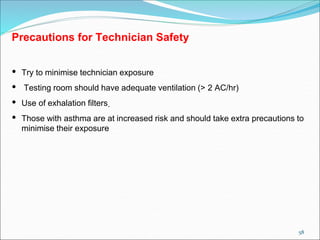
Precautions for Technician Safety
• Try to minimise technician exposure
• Testing room should have adequate ventilation (> 2 AC/hr)
• Use of exhalation filters.
• Those with asthma are at increased risk and should take extra precautions to
minimise their exposure
59
REACTIVE AIRWAYS DYSFUNCTION SYNDROME
[ RADS ]
• Acute exposure to certain Gases / vapours
• producing severe bronchial / bronchiolar injury —> hyper
responsiveness & narrowing
• most cases develop in Work place
• Pathology :
- sloughing of epithelium ,
- replacement by a fibrinohemorrhagic exudate
60
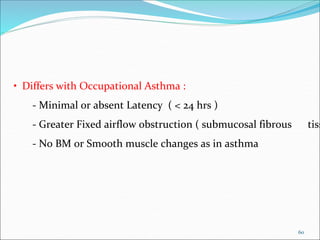
• Differs with Occupational Asthma :
- Minimal or absent Latency ( < 24 hrs )
- Greater Fixed airflow obstruction ( submucosal fibrous tiss
- No BM or Smooth muscle changes as in asthma
61
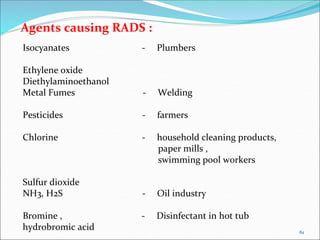
Agents causing RADS :
Isocyanates - Plumbers
Ethylene oxide
Diethylaminoethanol
Metal Fumes - Welding
Pesticides - farmers
Chlorine - household cleaning products,
paper mills ,
swimming pool workers
Sulfur dioxide
NH3, H2S - Oil industry
Bromine , - Disinfectant in hot tub
hydrobromic acid
THANK YOU

Broncho provocation testing ppt

  • 1.
  • 2.
    2 Working Definition ofAsthma Asthma is a disorder of the airways with - • Chronic inflammation • Variable airflow obstruction • Hyperresponsiveness to a variety of “triggers”
  • 3.
    3 “Twitchy” Airways Bronchial hyperresponsiveness is: • An abnormal increase in airflow limitation following exposure to a stimulus •Defined as “ Dose or concentration - PD20 / PC20 , of inhaled Metha
  • 4.
    4 NON SPECIFIC BRONCHIAL HYPERRESPONSIVENESS - NSBH • Represents a wide biologic spectrum - determined in part by Heredity - role of Environmental factors • NSBH is NOT a Static phenomenon - Varies considerably following exposure to infectious agents , env. pollutants & specific antigens • NSBH is a result of asthma in addition to being a risk factor
  • 5.
  • 6.
    6 Inhalation of agonist pulmonarydeposition ASM Stimulation ASM Activation particle size breathing pattern airway geometry epithelial permeability lymphatic & vascular removal inactivation Agonist - receptor interaction calcium influx
  • 7.
    7 ASM Shortening External diameter Airwaylumen RAW - VMax Proportion of muscle in airway circumference ASM Activation Length - tension load amount of ASM Contractility wall thickness Secretions Flow regime
  • 8.
    8 • NSBH isSensitive , not Specific of ASTHMA • also seen in Sarcoidosis , COPD , Extrinsic Allergic Alveolitis , Cystic fibrosis. • unrelated to base line FEV1 in asthma , significantly related in others
  • 9.
    9 • Vicious circleof specific & Non specific responses in asthma • Allergen exposure —> NSBH —> Response to • Responsible for most symptoms in asthmatics . allergen
  • 10.
    10 • Lack ofNSBH does not exclude Asthma diagnosis - as in seasonal & occupational asthmatics • Presence of NSBH alone does not make the diagnosis , particularly with abnormal baseline functions • Serial measurements required in occupational asthma to see for worsening or improvement of symptoms with exposure
  • 11.
    ● BHR canbe quantified by BPT ➢WHAT IS BPT ? ● Just opposite of looking for an improvement in lung function with bronchodilator. ● BPT attempts to provoke airflow obstruction after inhaling an irritant substance. BRONCHIAL PROVOCATION TESTS
  • 12.
  • 13.
    13 1. Establishing adiagnosis of asthma with atypical features : -Asthma symptoms with normal spirometry -a presumptive diagnosis of asthma that does not improve with asthma therapy -nonspecific asthma symptoms such as persistent cough 2. Evaluating the possibility of occupational asthma: - a sensitive but not specific test 3. Excluding diagnosis of asthma in patients for whom an erroneous diagnosis has significant social impact (military recruits, divers, firefighters, and other high-risk
  • 14.
    14 4. Monitoring asthmatherapy : - Symptoms and lung function may normalise despite ongoing airway inflammation - BHR correlates well with airway inflammation - adjusting therapy based on BHR may improve outcomes. 5. Identifying specific asthma triggers , rarely necessary , for research or legal purposes. 6. Objectively assessing asthma severity.
  • 15.
  • 16.
    16 ABSOLUTE : • Severeairflow limitation (FEV1 < 50% predicted or <1.0 L) • Acute coronary syndrome or stroke within 3 months • Severe hypertension (systolic BP > 200 mm Hg or diastolic BP > 100 mm Hg) • Cerebral or aortic aneurysm
  • 17.
    17 RELATIVE : • Moderateairflow limitation (FEV1 < 60% predicted or <1.5 L) • Inability to perform acceptable and repeatable spirometry • Pregnancy • Nursing mothers • Current use of cholinesterase inhibitor medication for myasthenia gravis
  • 18.
    18 • Significant hypoxemia(PaO2 < 60) • Recent upper or lower respiratory tract infection (within 6 wk) • Failure to withhold medication that may affect test results • Vigorous exercise on day of test Modified from Crapo RO, Casaburi R, Coates AL, et al: Guidelines for metha- choline and exercise challenge testing—1999. This official statement of the American Thoracic Society was adop
  • 19.
  • 20.
  • 21.
    22 1.Specific airway irritants- Allergen , Aspirin , food 2.“direct” stimuli using nonspecific pharmacologic agents - Methacholine Histamine 3.“indirect” stimuli - exercise, eucapnic voluntary hyperventilation, cold air hyperventilation, hypertonic saline, mannitol, and adenosine monophosphate [AMP]
  • 22.
    23 Types of Stimuli •Direct Stimulus Cause airflow limitation by a direct action on effector cells (e.g., airway smooth muscle cells, mucus producing cells). ➢Acts by binding to agent specific receptors on BSM ➢Highly sensitive but not specific to asthma ➢Used to exclude bronchial asthma ➢Specificity is increased if pre test probability of asthma is greater
  • 23.
    24 • Indirect Stimulus Causeairflow limitation by an action on cells other than effector cells, which then interact with the effector cells. • release endogenous preformed mediators through neural or humeral pathways, which, in turn, provoke BSM contraction ➢They reflect ongoing airway inflammation ➢ More specific to identify active asthma.
  • 24.
  • 25.
  • 26.
    27 Specific inhalation challengetests : • gold standard for diagnosing occupational asthma. • a negative test may not definitively exclude the diagnosis (wrong agent or too low a concentration) • require specialised equipment • potential to trigger severe life-threatening asthmatic reactions. • performed only at specialised centres
  • 27.
    Methacholine Inhalation Challenge METHACHOLINE: •Synthetic cholinergic agent • most frequently used , most safe . • directly stimulates specific receptors on bronchial smooth muscle • sensitivity 85%-90% - for diagnosing asthma, including occupational asthma, cough variant asthma, and EIB
  • 28.
    29 • specificity isrelatively poor • false-positive tests : Allergic rhinitis, COPD, patients who smoke, cystic fibrosis, bronchiectasis, bronchiolitis, and recent respiratory tract infections
  • 29.
    STANDARDIZATION OF TEST -Deliveryof a 0.6.s pulse of airflow at 20 lb into a nebuliser, which in turn discharges particles of 0.3-4 uM in diameter in to airways. ● The two methods most commonly used are: 1. Two minute tidal breathing method (more sensitive) 2. Five breath dosimeter method
  • 30.
    DOING PROTOCOLS • Methacholineaerosol prepared by using bicarbonate buffered isotonic saline as a diluent in concentration ranging from 0.1 to 25 mg /ml ● The cumulative dose delivered is expressed in inhalation units ● One IU =inhalation of a solution containing 1mg of methacholine per ml
  • 31.
  • 32.
  • 33.
    PROCEDURE ➢Counsel regarding symptoms ➢Thept is then asked to wear a nose clip and breathe normally through the mouthpiece of a De vilbiss 646 nebulizer ➢Measure the baseline FEV1
  • 34.
    Continue….. ➢ Give inhalationof methacholine for 2minutes at interval of 5 min beginning with 0.03 mg/ml and increased up to 16mg/ml. ➢ Measure the FEV1 at 30 and 90 seconds after the nebulisation is completed until the FEV1 falls >20 %
  • 35.
    Continue….. • The testis stopped when -Fall of FEV1 >20% at any dose -highest concentration is reached (16mg) at any FEV1 WHAT IS PC 20 ? Provocation Concentration producing 20% fall in FEV1 • The PC20 is universally lower than 8mg in asthmatics.
  • 36.
    37 Provocative Concentration (PC) •The exact concentration that causes a specific fall in a PFT parameter: • PC20 FEV1 Concentration that causes a 20% fall in FEV1 • PC40SCaw Concentration that causes a 40% fall in specific conductance ( in plethysmography)
  • 37.
  • 38.
  • 39.
    PRE CHALLENGE ● Justbefore BPT Pts should be screened for factors that may result in false-positive or negative responses. ● FALSE-POSITIVE ● FACTORS THAT INCREASE BHR ➢Recent viral infections -eg.- RSV -CMV -parainfluenzae
  • 40.
    Continue….. ➢ Exposure toenvironmental antigens ➢ Occupational sensitisers ➢ Irritants (smoke) ➢ Pollutants ➢ Chemicals
  • 41.
    42 Factors that increaseBronchial Hyper responsiveness
  • 42.
    INTERPRETATION OF TESTRESULTS • PC 20.Mg/ml DEGREE OF BHR 1. >16mg Normal 2. 4-16mg borderline 3. 1-4mg Mild BHR (+) 4. <1mg Moderate to severe BHR Modified from Crapo RO, Casaburi R, Coates AL, et al: Guidelines for metha- choline and exercise challenge testing—1999. This official statement of the American Thoracic Society was adopted by the ATS Board of Directors, July 1999. Am J Respir Crit Care Med 161:309–329, 2000.
  • 43.
    44 Indirect Bronchoprovocation Tests •less sensitive than direct challenges for diagnosis of asthma but are more specific. • better tests for assessing airway inflammation and determining response to an inhaled corticosteroid than methacholine testing. • useful for titrating the dose of inhaled corticosteroid
  • 44.
    45 Exercise testing • commonlyperformed in the evaluation of exercise- induced bronchospasm. • is less sensitive - due to the inability to achieve adequate exercise levels due to reconditioning, musculoskeletal limitations, or sub maximal effort. • is highly specific in differentiating asthma from normal. • performed in laboratory, on treadmill or bicycle ergometer.
  • 45.
    MECH. OF BRONCHOCONSTRICTION : 1.Mucosal drying and increased osmolarity – Stimulating mast cell degranulation . 2.Rapid airway rewarming after exercise causing – Vascular congestion -Increased permeability and edema , leading to obstruction • Symptoms peak 8-15 min post exercise and resolve spontaneously in about 60 min
  • 46.
    INDICATIONS 1. In makinga diagnosis of EIB –in asthmatics with history of SOB during or after exercise. 2. To evaluate the ability of performing life saving works (military, police) in persons with a history suggestive of asthma. 3. To determine the effectiveness and optimal dosing of medications prescribed to prevent asthma.
  • 47.
    PROCEDURE • exercise fora total duration of 6 to 8 minutes with 4 to 6 minutes of exercise at near-maximum levels • The minute ventilation should achieve 50% to 60% of MVV and the heart rate should reach 90% of predicted maximum • FEV1 is the primary outcome variable and it should be obtained 5, 10, 15, 20, and 30 minutes postexercise.
  • 48.
    49 • A reductionin FEV1 of 10% compared with baseline is considered a positive test. • Exercise test should be stopped when -Patient is distressed -Breathing is laboured -Ventilation is reduced -SaO2 falling during exercise.
  • 49.
    • In childrenan exercise challenge is better than methacholine at distinguishing asthma from chronic airway disorders eg.-Cystic fibrosis -Bronchiectasis -Bronchiolitis obliterans -Pulm.ciliary dyskinesia.
  • 50.
    51 Eucapnic Voluntary Hyperventilation [EVH ] • most sensitive test for diagnosing EIB. • patient breathes deep and fast a gas mixture of 5% CO2 and balance room air for 6 to 8 minutes. • A target minute ventilation is set at 30 × FEV1. • Spirometry at 5, 10, and 20 minutes. • A positive test is defined as a 10% reduction in FEV1.
  • 51.
    52 Hypertonic saline andmannitol : • cause an increase in airway osmolarity, resulting in mediator release and bronchoconstriction. • Hypertonic saline challenge tests involve the nebulization of 4.5% saline. • Mannitol capsules are inhaled using a dry powder inhaler. • Spirometry is performed at 0, 5, 10, and 20 minutes, • 10% reduction in FEV1 compared with baseline is considered a positive study.
  • 52.
    53 • Osmotic stimulihelpful for monitoring asthma • Bronchial challenge with hypertonic saline can be combined with an induction of sputum to assess airway inflammation
  • 53.
    54 AMP • Airway responseto adenosine is a sensitive marker of mast cell priming • atopic asthmatics are more responsive to AMP than to methacholine. • more specific in distinguishing pediatric asthma from other obstructive diseases such as bronchiectasis and bronchiolitis obliterans.
  • 54.
    55 • separates non-smokingadults with COPD from those with as • administered similar to methacholine • A 20% reduction in FEV1 is considered a positive test.
  • 55.
    56 ➢AMP response inchildren is a more sensitive predictor of effect of anti- inflammatory therapy ➢PC20 to AMP better reflects airway inflammation than methacholine ➢inverse correlation between sputum eosinophilia and PC20 to AMP and PC20 to methacholine , is stronger with AMP ➢Corticosteroid treatment is associated with greater improvement in PC20 to AMP All the above suggest that AMP is a better indicator of airway inflammation
  • 56.
    57 Precautions for PatientSafety • Trained staff close enough to respond quickly to an emergency • Medications to treat bronchospasm must be present in testing area
  • 57.
    58 Precautions for TechnicianSafety • Try to minimise technician exposure • Testing room should have adequate ventilation (> 2 AC/hr) • Use of exhalation filters. • Those with asthma are at increased risk and should take extra precautions to minimise their exposure
  • 58.
    59 REACTIVE AIRWAYS DYSFUNCTIONSYNDROME [ RADS ] • Acute exposure to certain Gases / vapours • producing severe bronchial / bronchiolar injury —> hyper responsiveness & narrowing • most cases develop in Work place • Pathology : - sloughing of epithelium , - replacement by a fibrinohemorrhagic exudate
  • 59.
    60 • Differs withOccupational Asthma : - Minimal or absent Latency ( < 24 hrs ) - Greater Fixed airflow obstruction ( submucosal fibrous tiss - No BM or Smooth muscle changes as in asthma
  • 60.
    61 Agents causing RADS: Isocyanates - Plumbers Ethylene oxide Diethylaminoethanol Metal Fumes - Welding Pesticides - farmers Chlorine - household cleaning products, paper mills , swimming pool workers Sulfur dioxide NH3, H2S - Oil industry Bromine , - Disinfectant in hot tub hydrobromic acid
  • 61.