Molecular Genetics Part II From Gene to Protein
History  Archibald Garrod – 1909 First to suggest that genes dictate phenotype through production of proteins Believed that genetic diseases resulted from the inability to make particular enzymes “ Inborn errors of metabolism”
One Gene – One Enzyme Beadle & Ephrussi – 1930’s Studied mutations affecting eye color in Drosophila  Concluded that each mutation blocks pigment synthesis at a specific step by preventing production of the enzyme that catalyzes that step Specific pathways were not known, so results were inconclusive
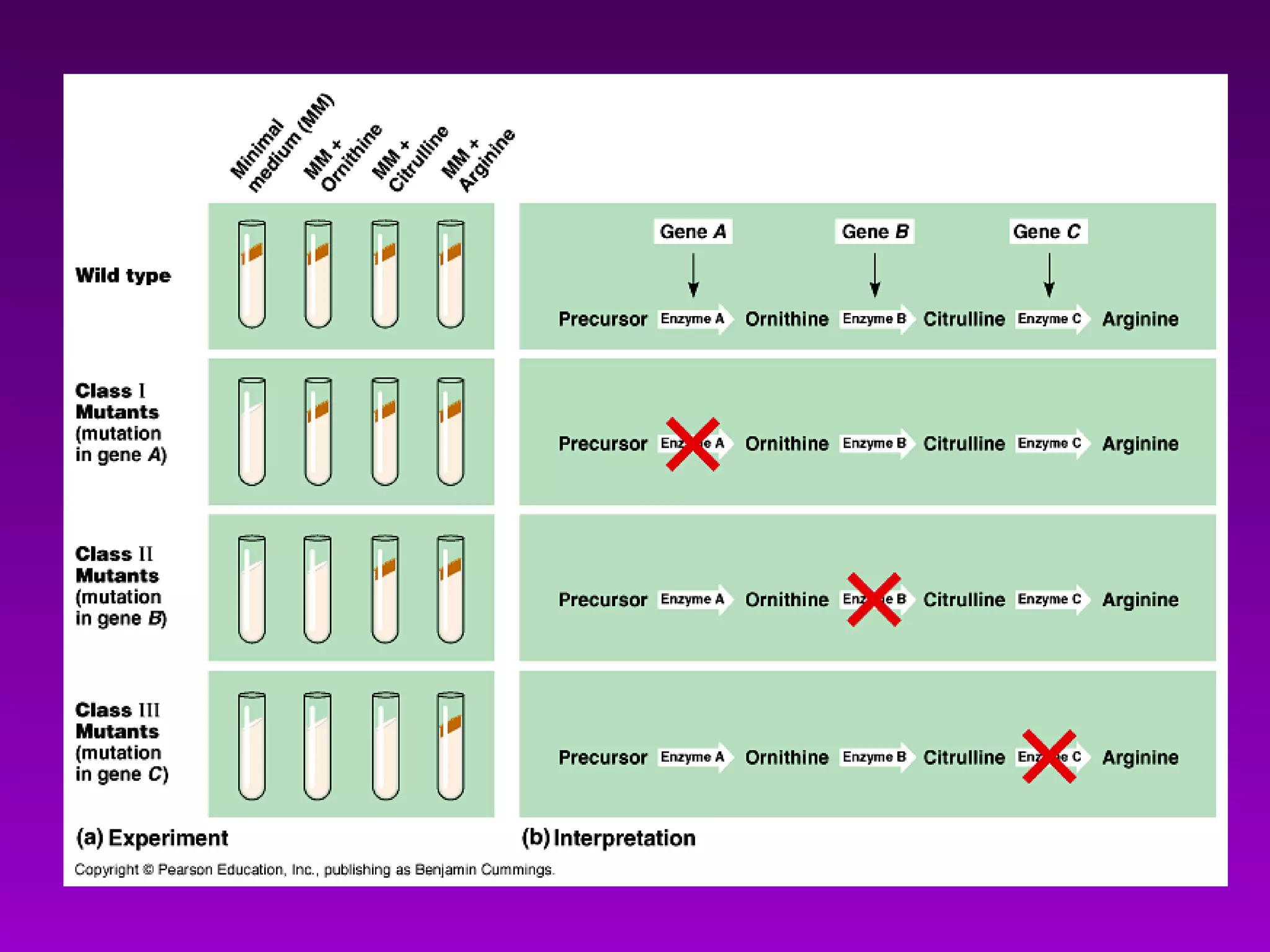
Beadle & Tatum Treated  Neurospora  (a mold) with X-rays Looked for mutations in nutritional requirements Wild type  Neurospora  grows on minimal medium (agar enriched with a few nutrients) All mutants will grow on complete medium (agar plus all 20 amino acids & other nutrients) Identified the specific amino acid required for growth by each mutant That identified the defective synthetic pathway Looked at each intermediate step in the blocked synthetic pathway Concluded that mutation in a single gene blocked production of a single enzyme
 
One Gene – One Polypeptide Not all proteins are enzymes Can extend one gene = one enzyme doctrine to one gene = one polypeptide Many proteins are comprised of two or more polypeptides
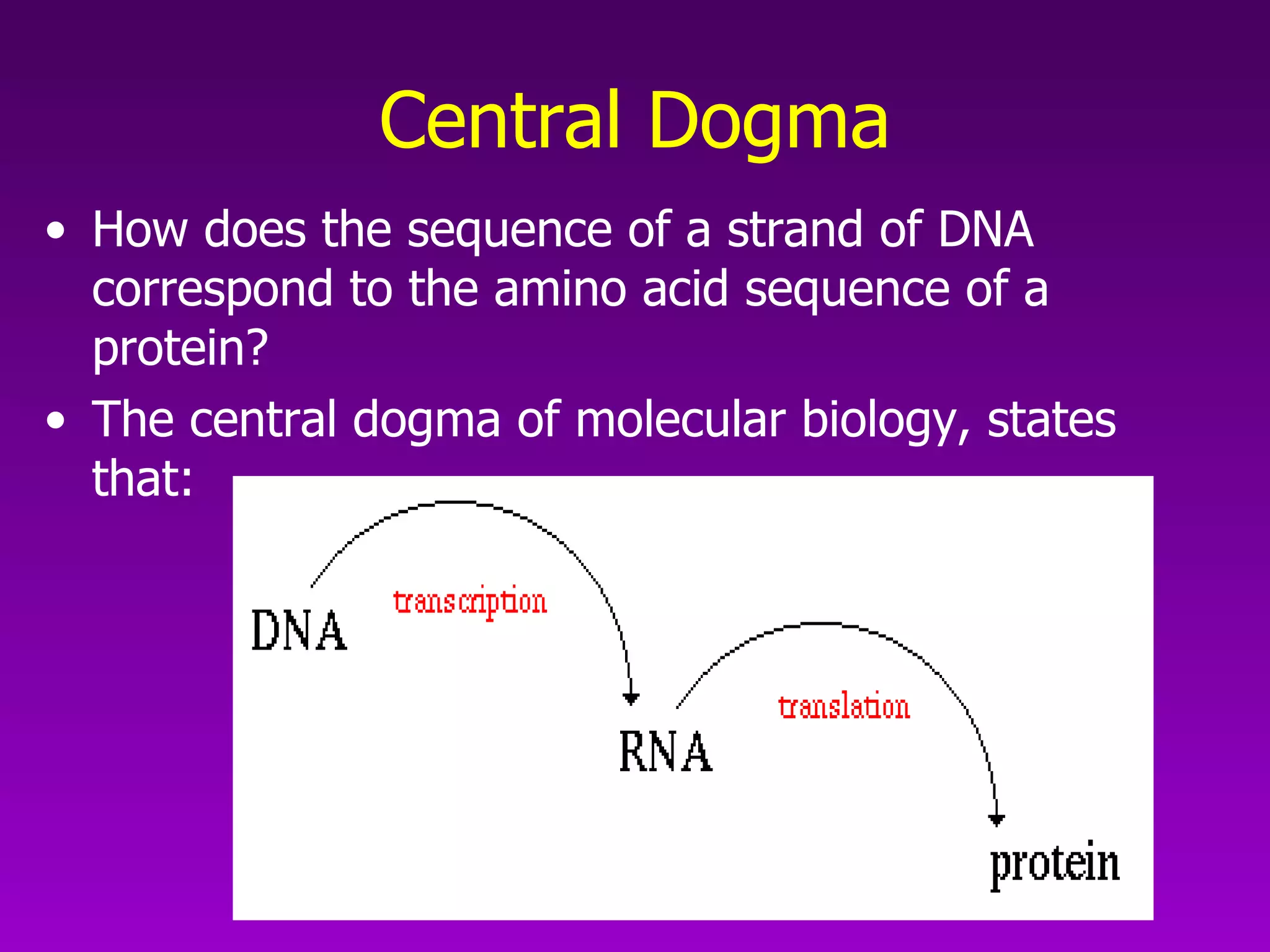
Central Dogma How does the sequence of a strand of DNA correspond to the amino acid sequence of a protein?  The central dogma of molecular biology, states that:
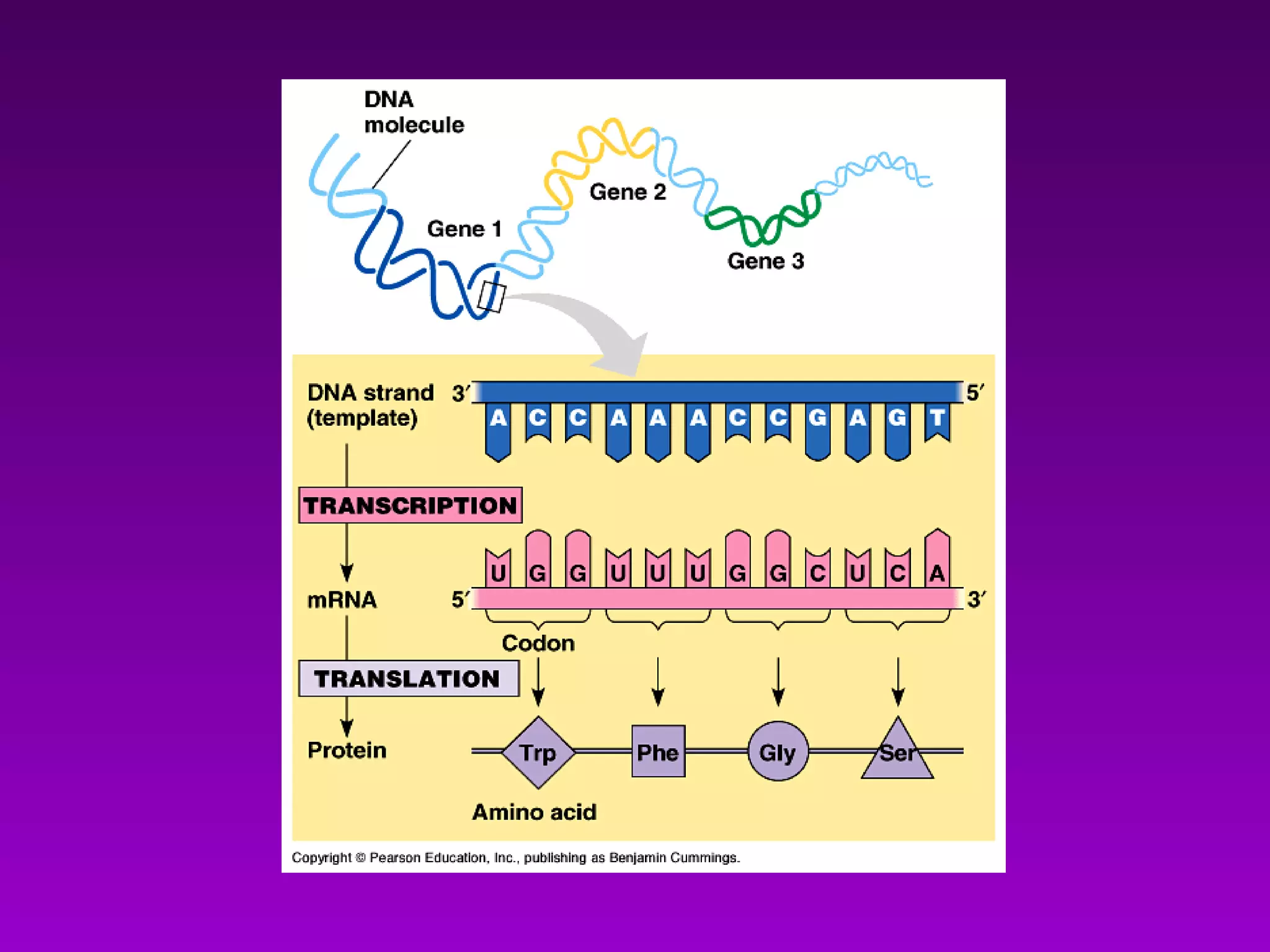
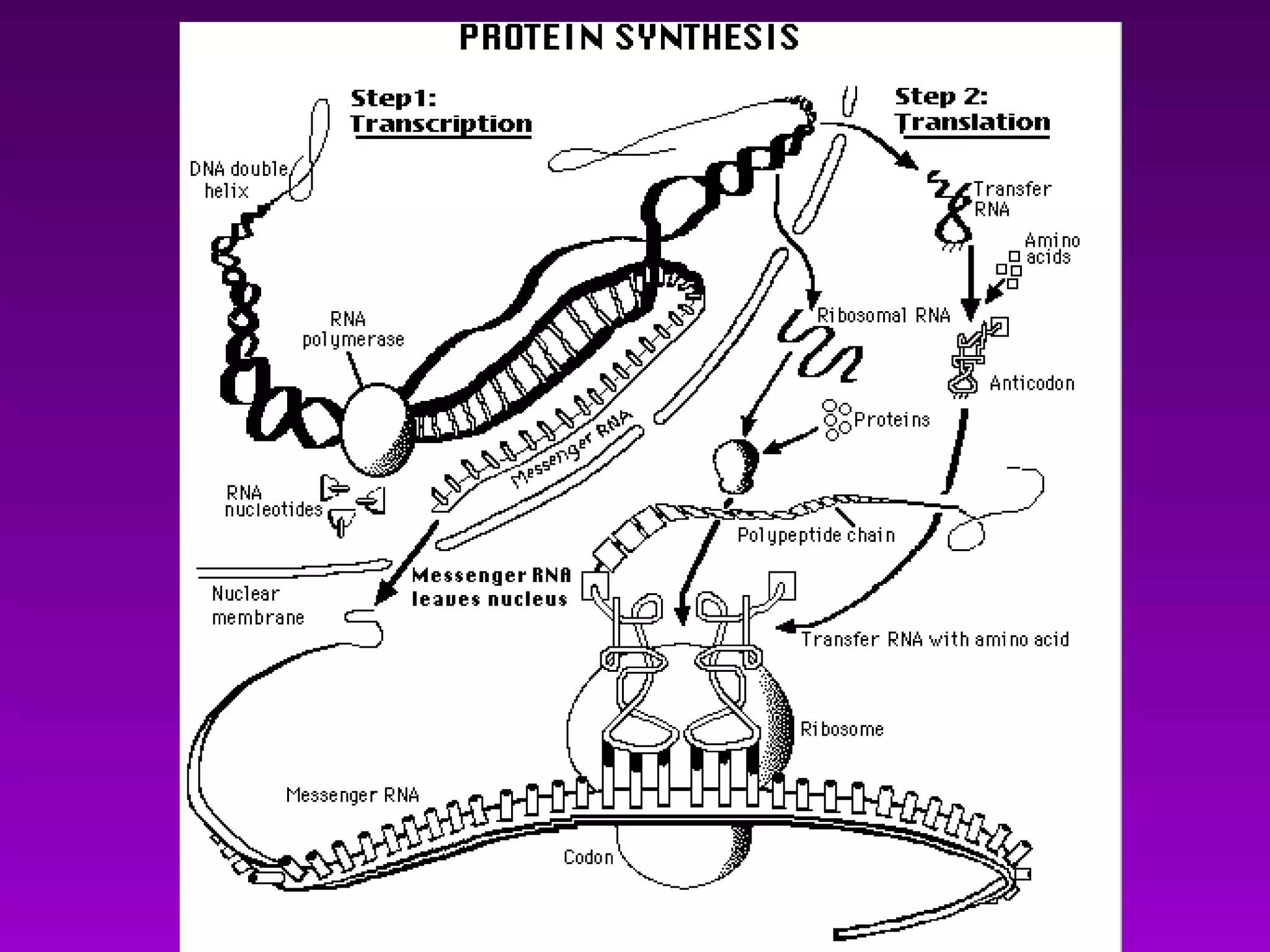
Transcription & Translation DNA is first copied ( transcribed ) to an RNA intermediate The RNA intermediate is then  translated  to protein Why have an intermediate between DNA and the proteins it encodes?
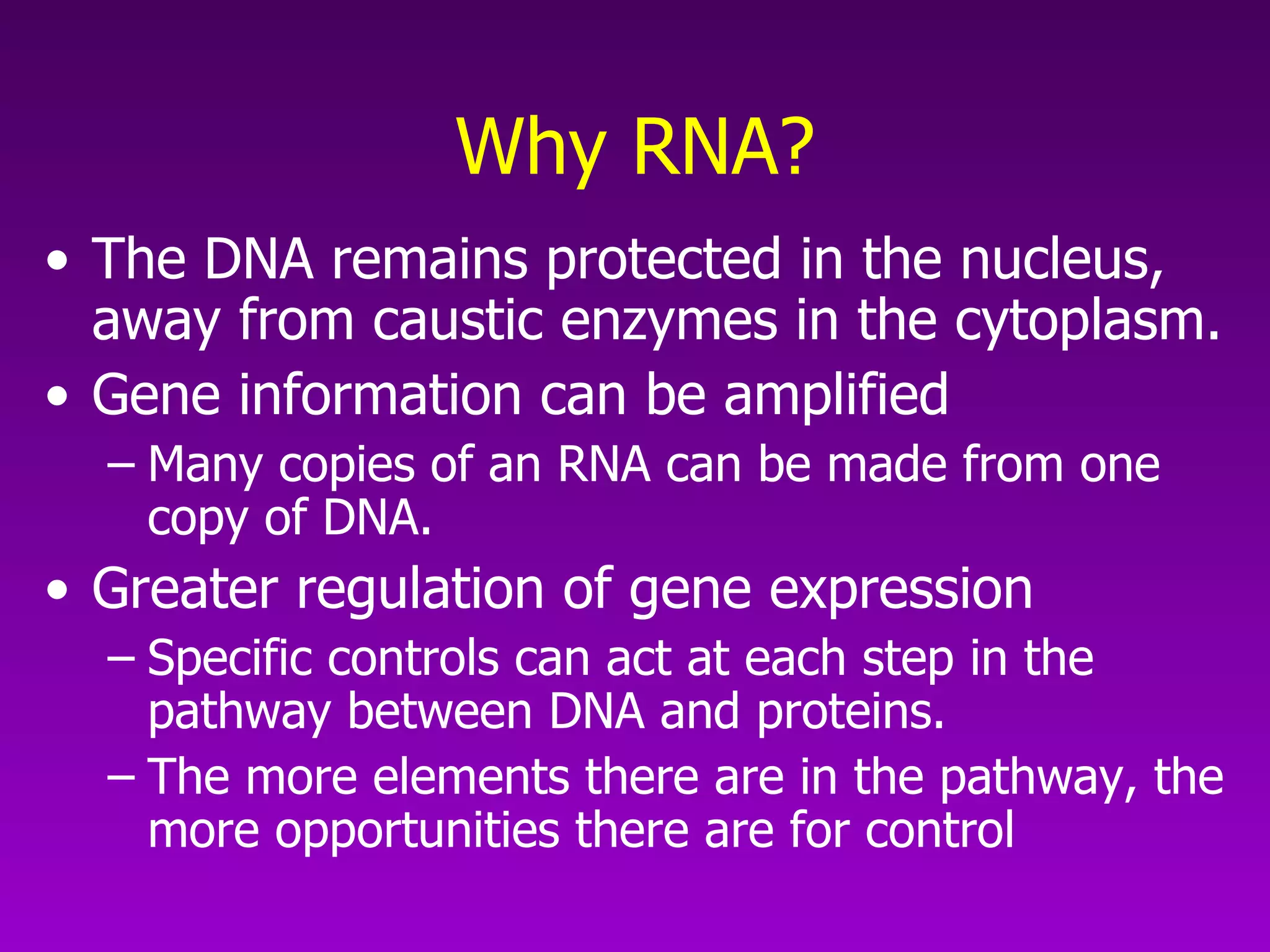
Why RNA? The DNA remains protected in the nucleus, away from caustic enzymes in the cytoplasm.  Gene information can be amplified  Many copies of an RNA can be made from one copy of DNA.  Greater regulation of gene expression  Specific controls can act at each step in the pathway between DNA and proteins.  The more elements there are in the pathway, the more opportunities there are for control
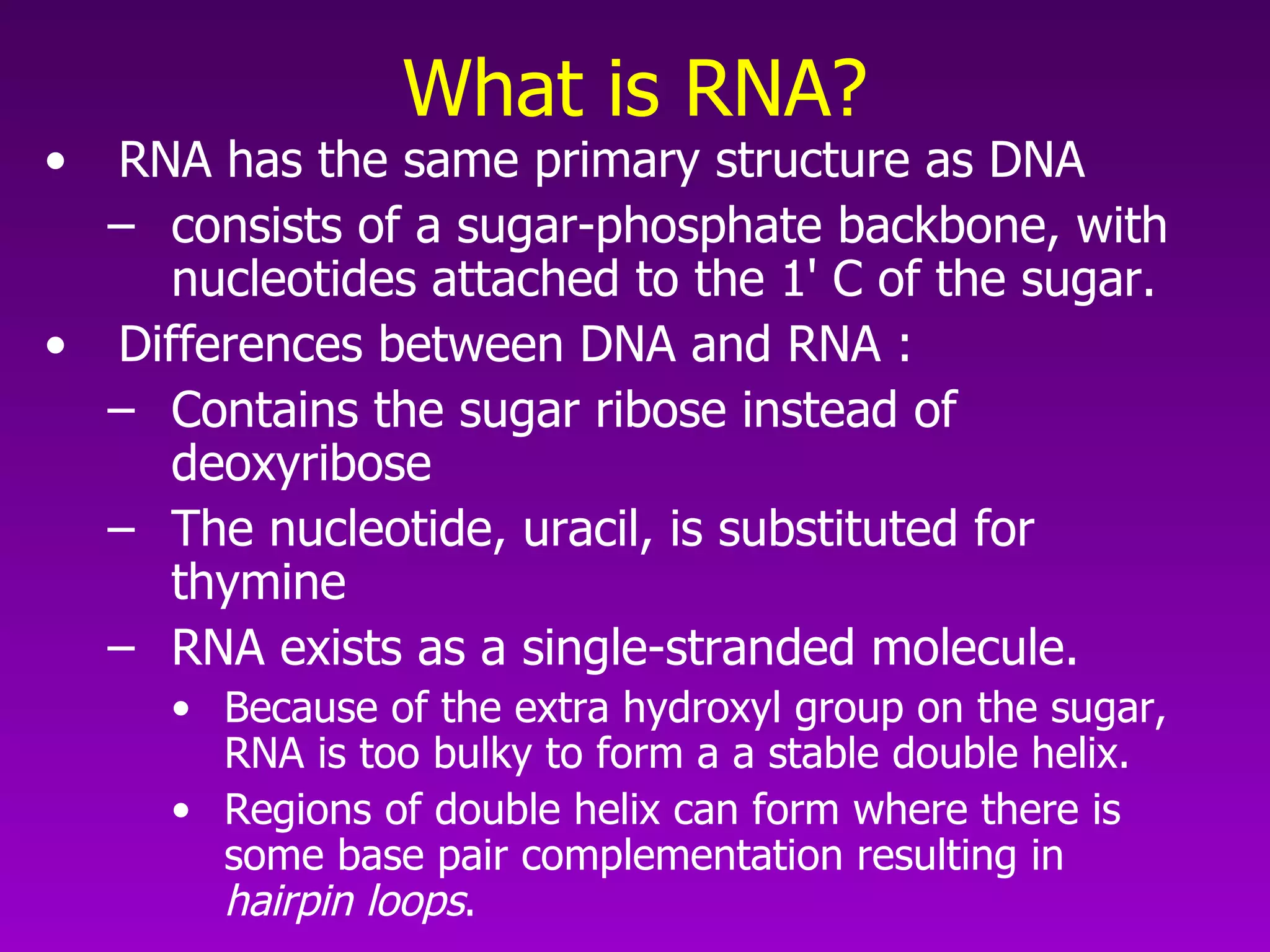
What is RNA? RNA has the same primary structure as DNA consists of a sugar-phosphate backbone, with nucleotides attached to the 1' C of the sugar. Differences between DNA and RNA :  Contains the sugar ribose instead of deoxyribose The nucleotide, uracil, is substituted for thymine  RNA exists as a single-stranded molecule. Because of the extra hydroxyl group on the sugar, RNA is too bulky to form a a stable double helix. Regions of double helix can form where there is some base pair complementation resulting in  hairpin loops .
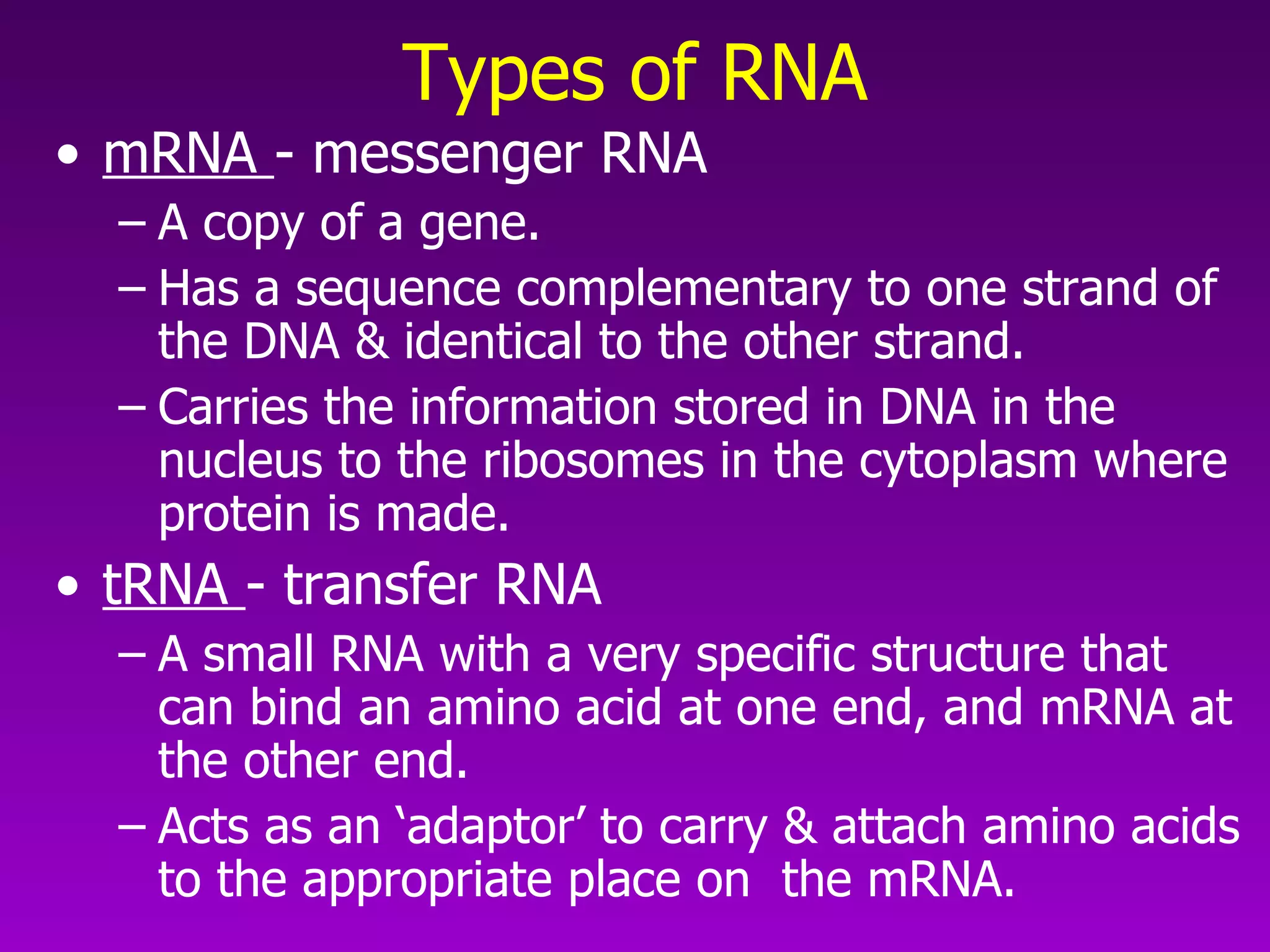
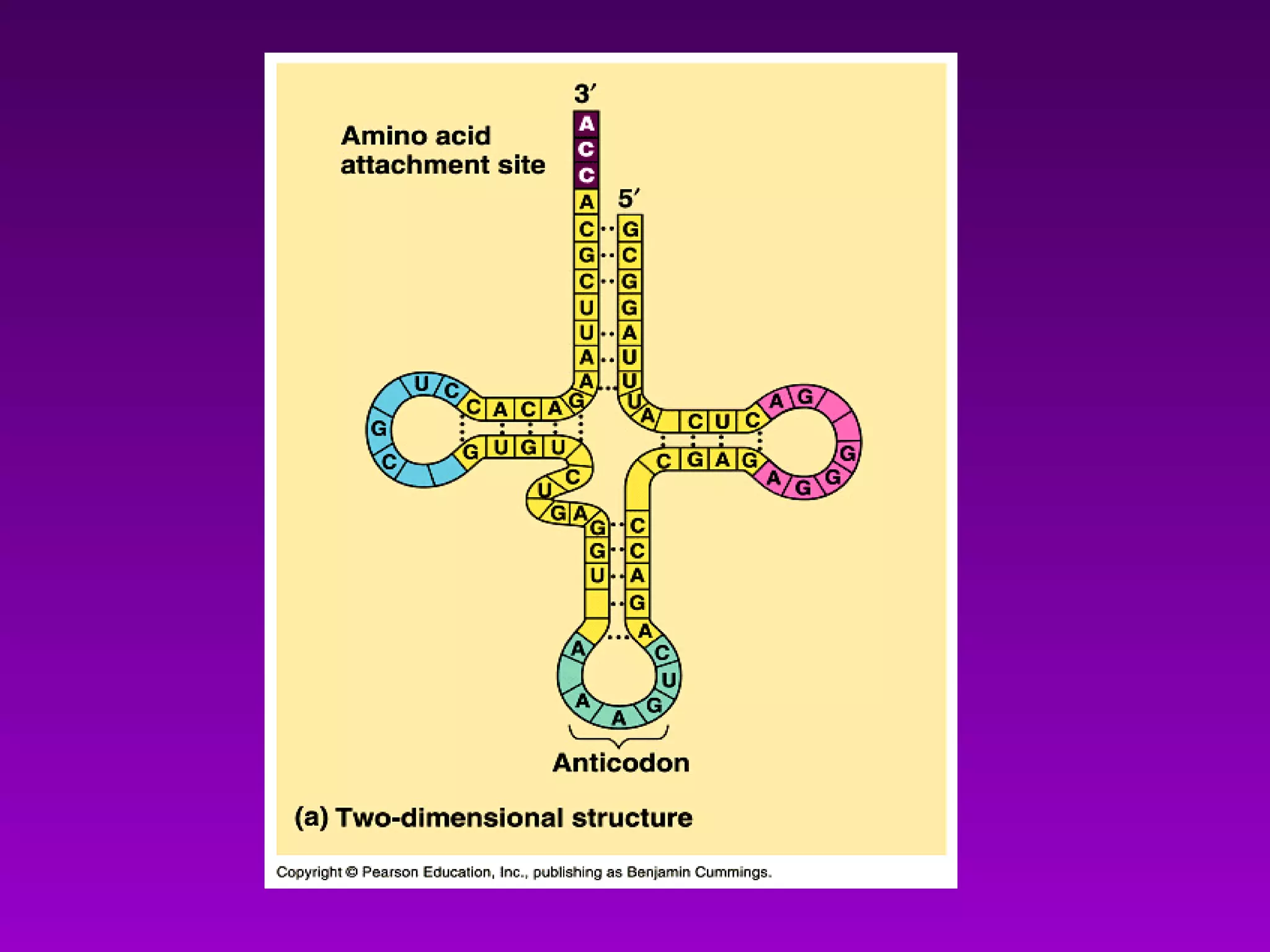
Types of RNA mRNA  - messenger RNA  A copy of a gene.  Has a sequence complementary to one strand of the DNA & identical to the other strand.  Carries the information stored in DNA in the nucleus to the ribosomes in the cytoplasm where protein is made.  tRNA  - transfer RNA  A small RNA with a very specific structure that can bind an amino acid at one end, and mRNA at the other end.  Acts as an ‘adaptor’ to carry & attach amino acids to the appropriate place on  the mRNA.
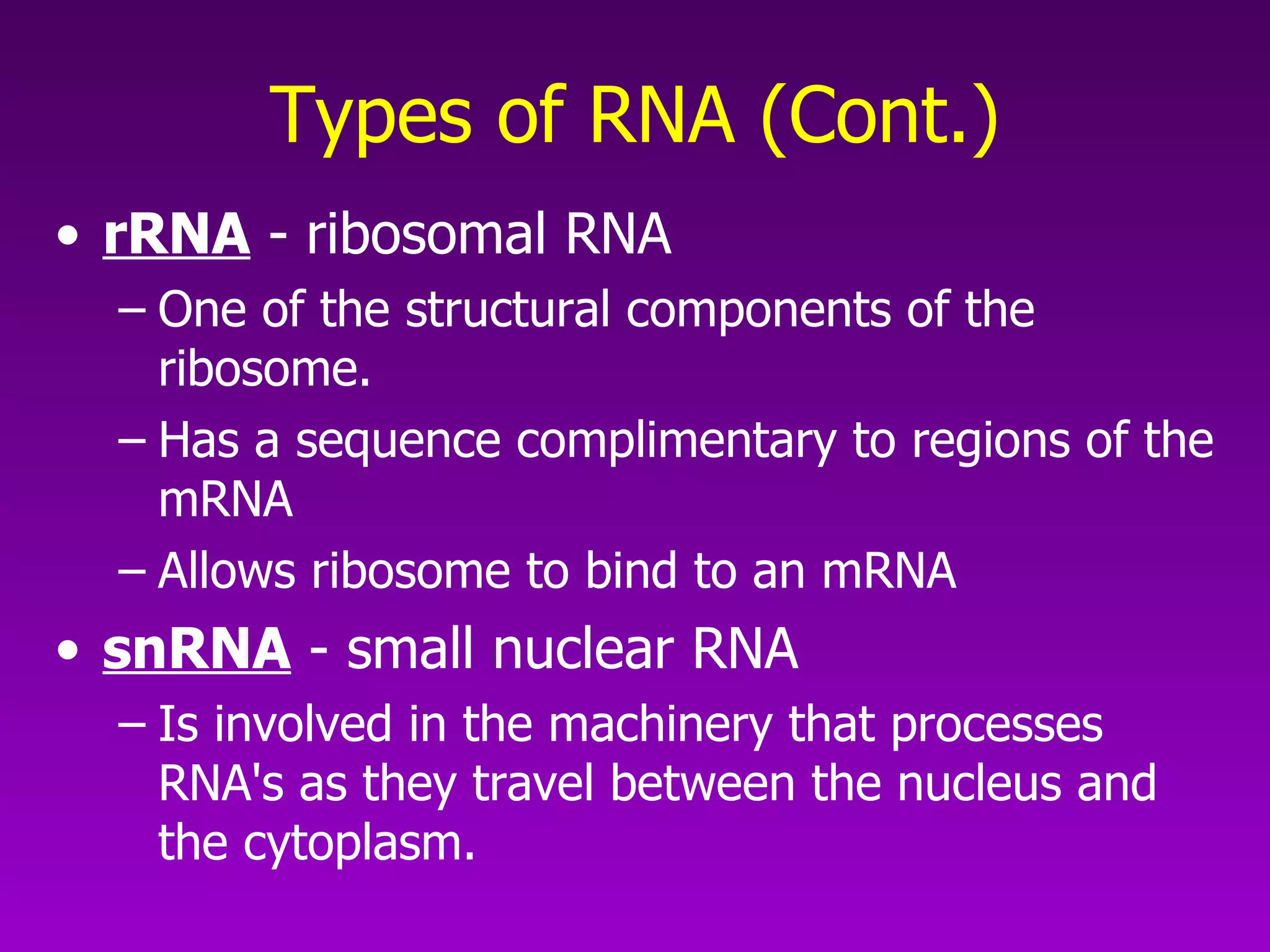
Types of RNA (Cont.) rRNA  - ribosomal RNA  One of the structural components of the ribosome.  Has a sequence complimentary to regions of the mRNA  Allows ribosome to bind to an mRNA  snRNA  - small nuclear RNA  Is involved in the machinery that processes RNA's as they travel between the nucleus and the cytoplasm.
The Genetic Code   How does mRNA specify an amino acid sequence?  It would be impossible for each amino acid to be specified by one nucleotide  there are only 4 nucleotides and 20 amino acids.  two nucleotide combinations could only specify 16 amino acids.  Each amino acid is specified by a combination of three nucleotides, called a  codon
 
 
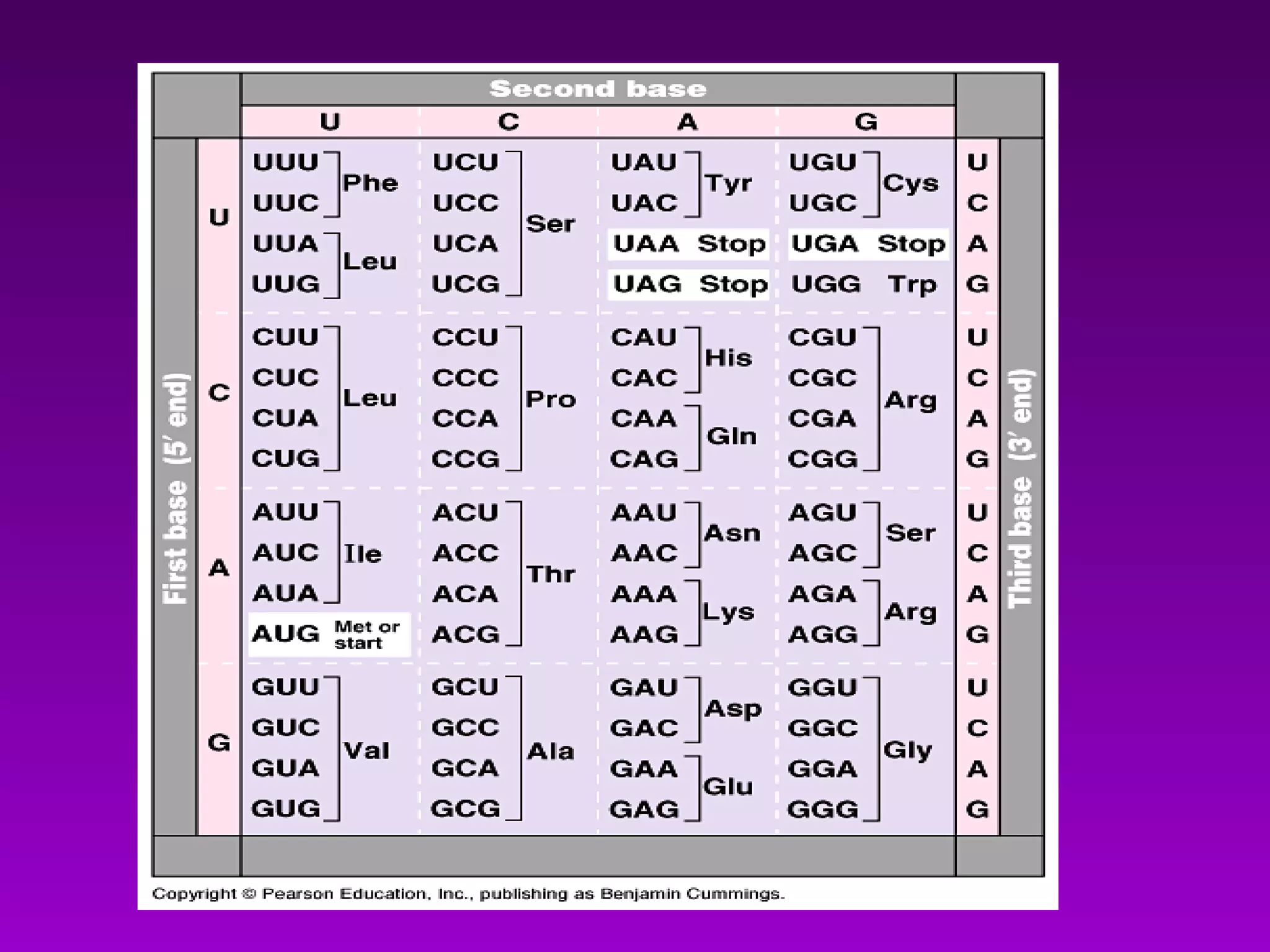
The Code is Redundant, Not Ambiguous Each amino acid may be specified by up to six codons In many cases, codons that are synonyms differ only in the third base of the triplet Different organisms have different frequencies of codon usage.  A giraffe might use CGC for arginine much more often than CGA, and the reverse might be true for a sperm whale.  Some codons specify “stop” (or “start) There is no ambiguity  the same codon ALWAYS codes for the same amino acid
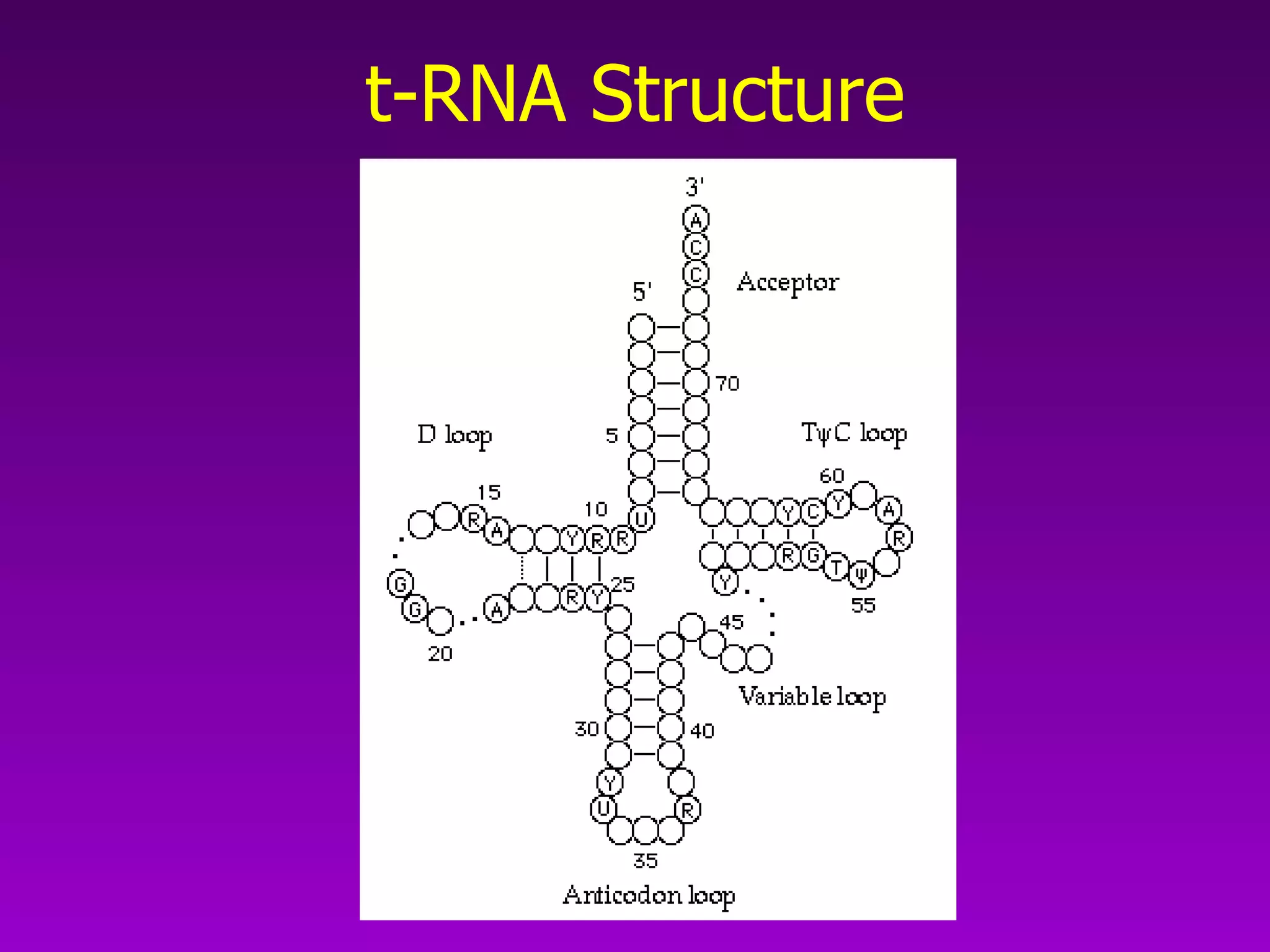
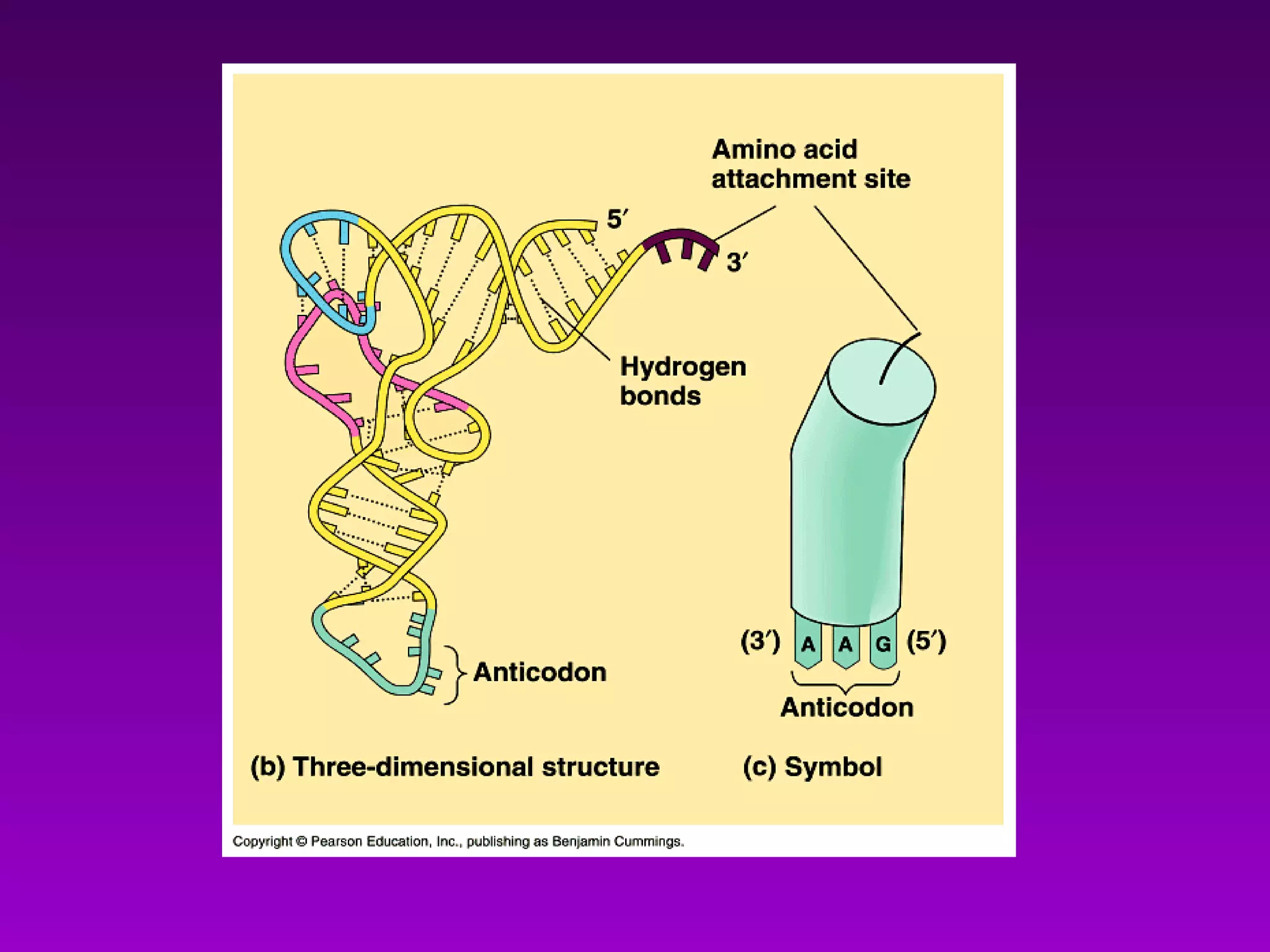
Codons & Anticodons How do tRNAs recognize to which codon to bring an amino acid?  The tRNA has an  anticodon  on its mRNA-binding end  The  anticodon  is complementary to the  codon  on the mRNA.  Each tRNA only binds the appropriate amino acid for its  anticodon
t-RNA Structure
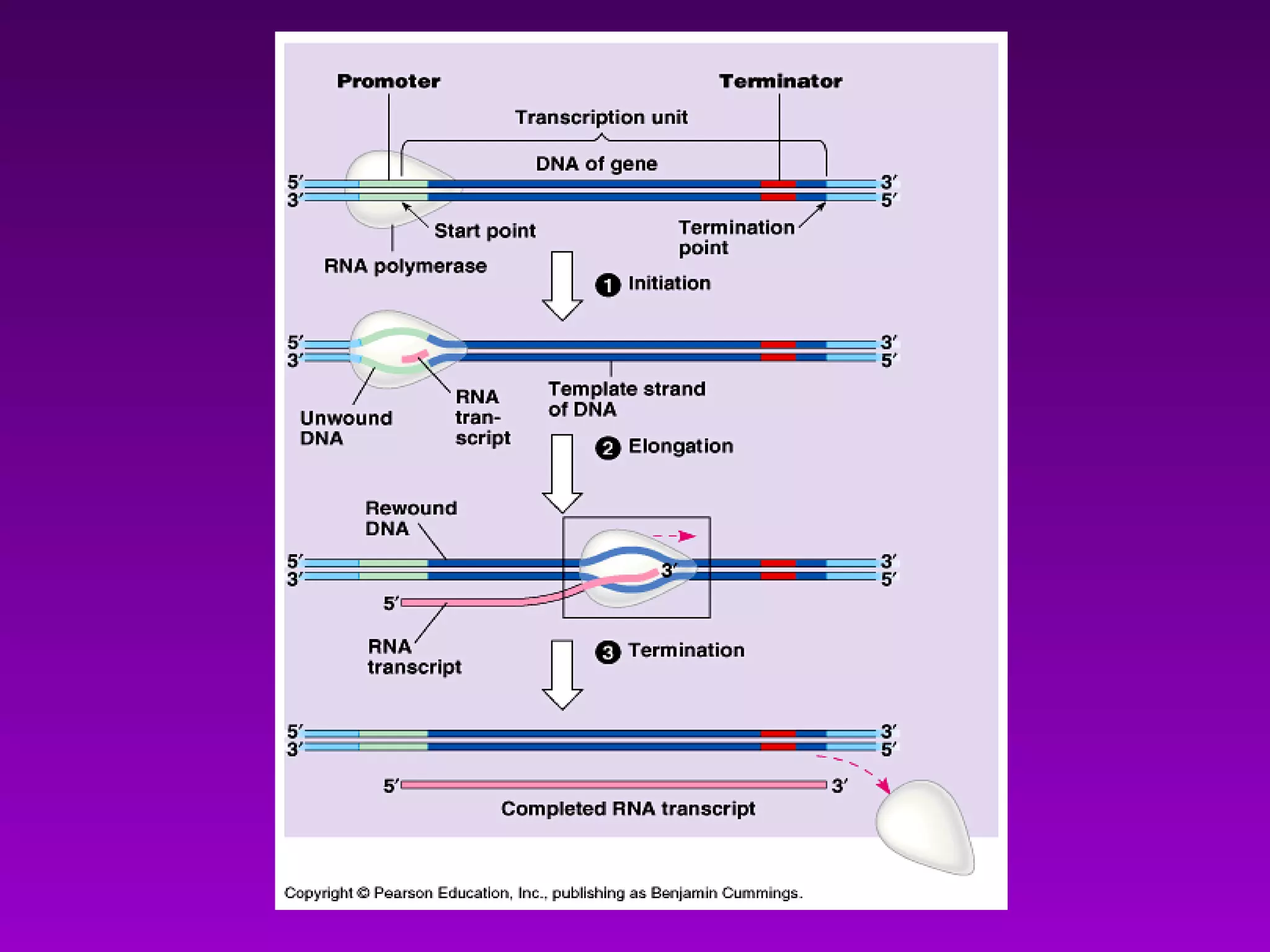
Transcription How does the sequence information from DNA get transferred to mRNA?  How is this information carried to the ribosomes in the cytoplasm?  This process is  called  transcription Highly similar to DNA replication.  Different enzymes are used in transcription.  The most important is RNA polymerase
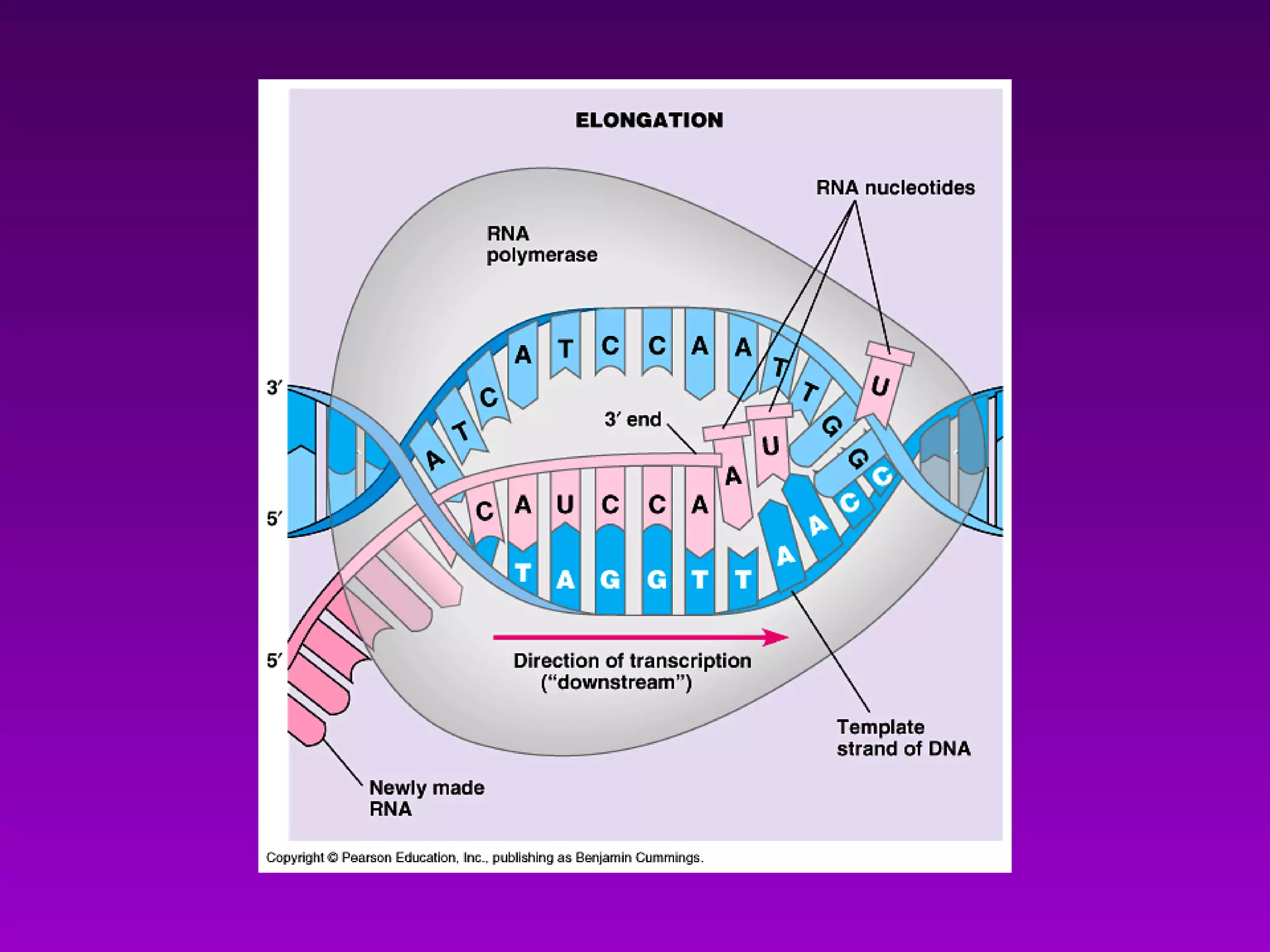
RNA Polymerase RNA polymerase is a  holoenzyme an agglomeration of many different factors Together, direct the synthesis of mRNA  Pries the DNA strands apart  Strings complimentary RNA nucleotides on the DNA template Like DNA polymerase, can only add to the 3’ end So only one mRNA is made, elongating 5’    3’
Stages of Transcription Initiation Elongation Termination
 
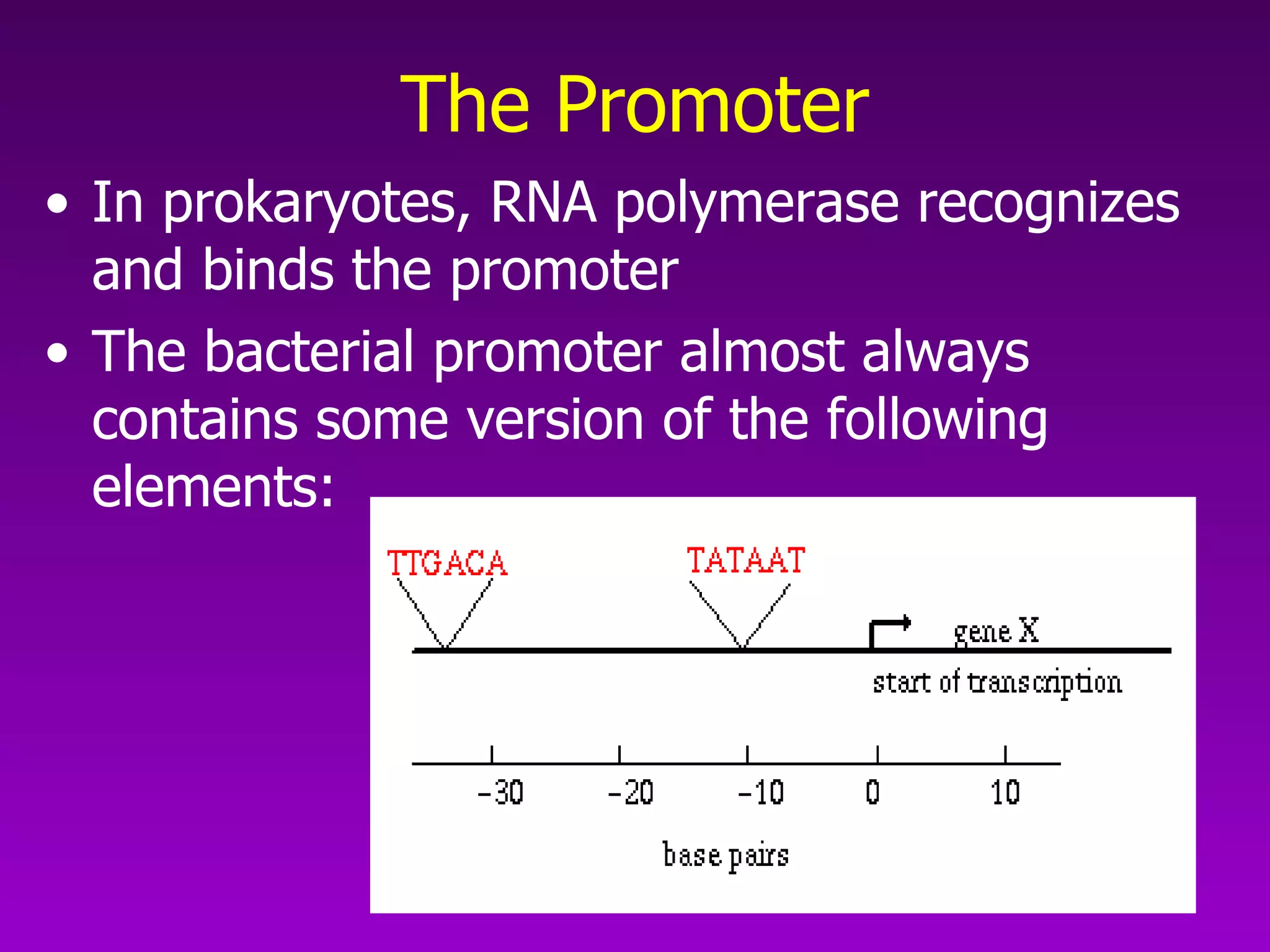
Initiation RNA polymerase must recognize the beginning of a gene to know where to start synthesizing mRNA.  One part of the enzyme has a high affinity for a particular DNA sequence that appears at the beginning of genes. The sequence where RNA polymerase attaches to the DNA and begins transcription = the  promoter a unidirectional sequence on one strand of the DNA  Tells RNA polymerase both where to start and in which direction (that is, on which strand) to continue synthesis.
The Promoter In prokaryotes, RNA polymerase recognizes and binds the promoter The bacterial promoter almost always contains some version of the following elements:
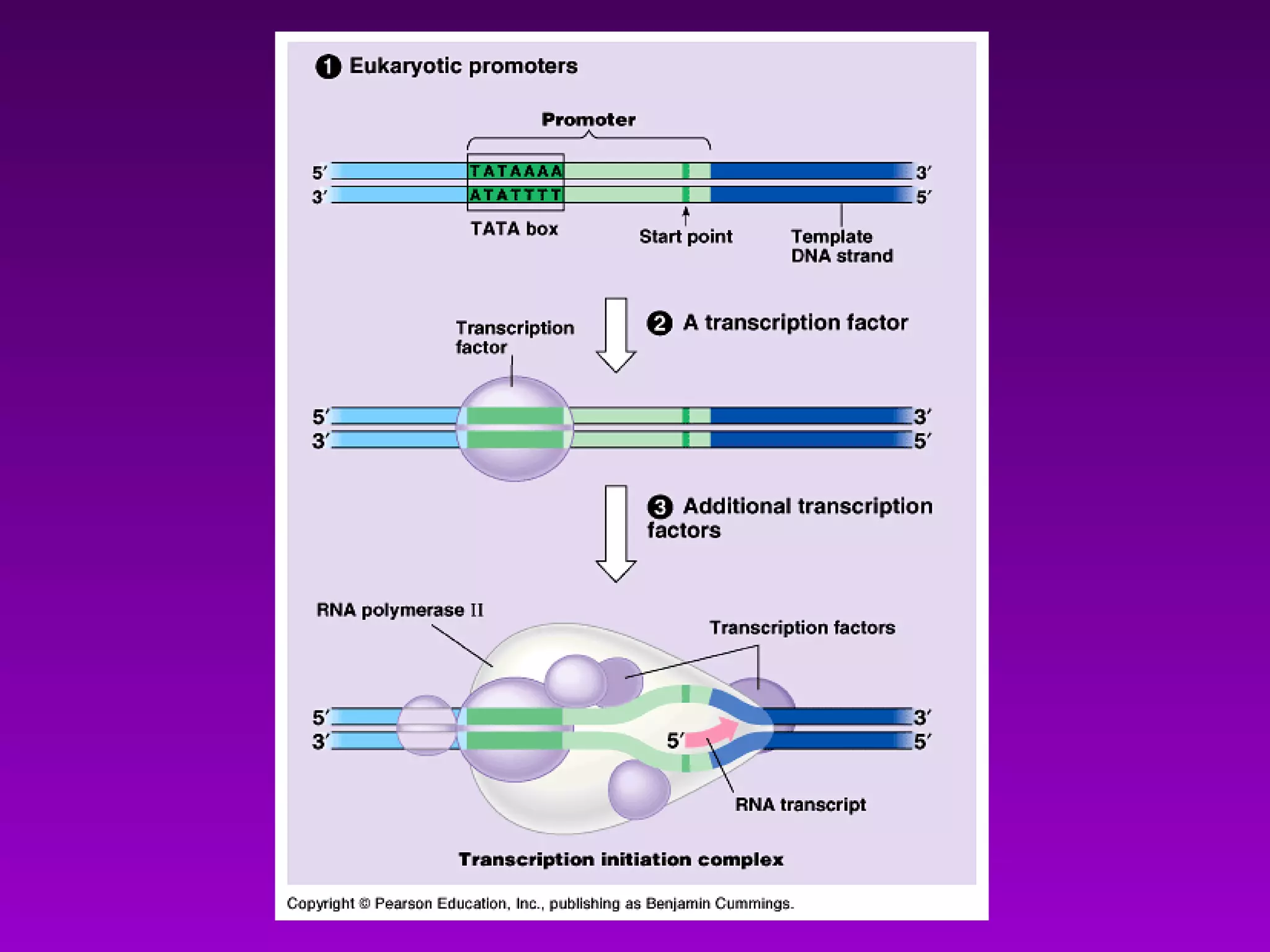
Eukaryotic Promoters In eukaryotes special proteins,  transcription factors ,  mediate binding RNA polymerase and the promoter RNA polymerase binds to the promoter only after transcription factors bind Transcription factors + RNA polymerase, bound to the promoter =  transcription initiation complex Eukaryotic promoters usually include a TATA box A nucleotide sequence containing TATA about 25 nucleotides prior to the start point
 
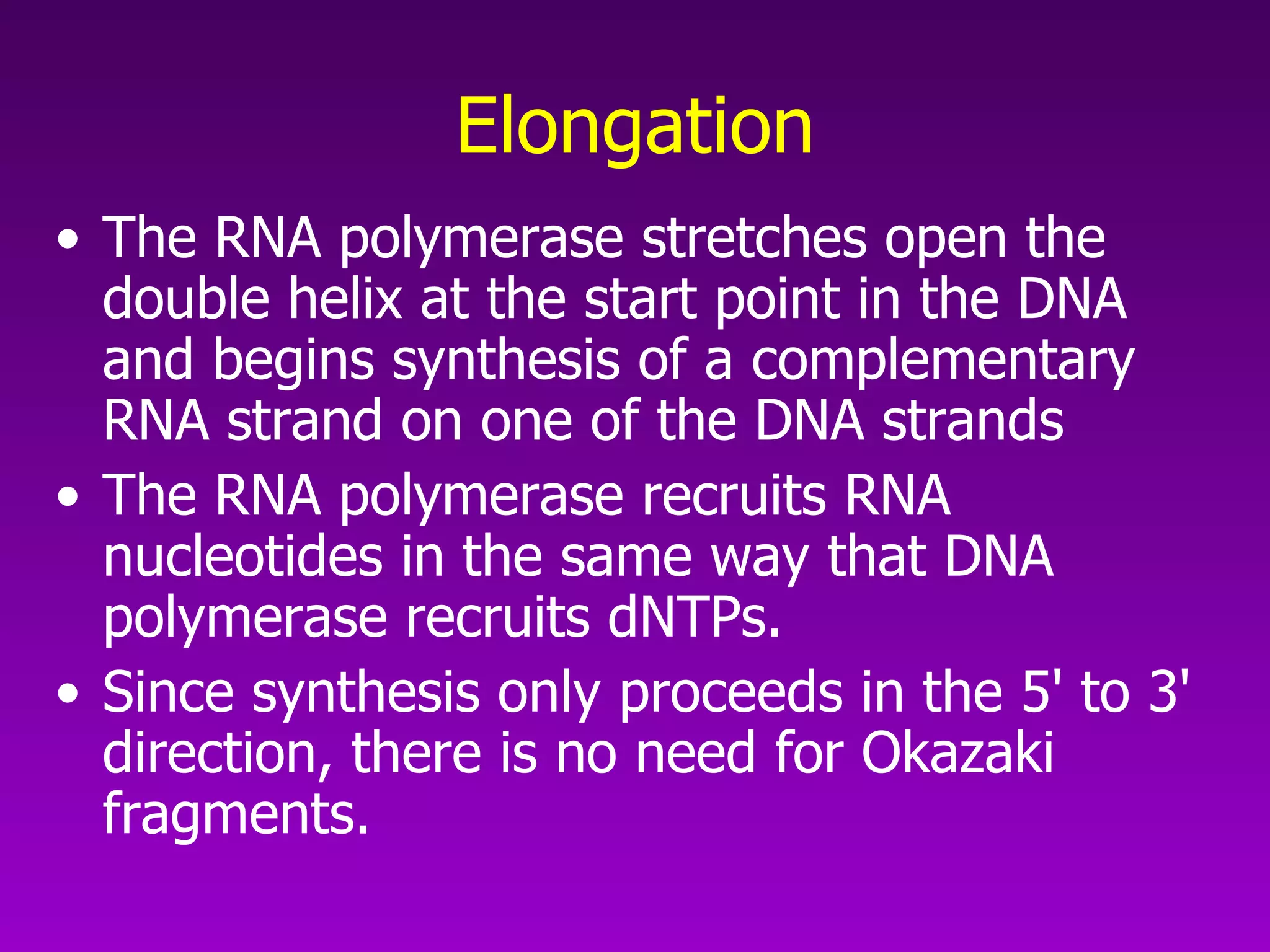
Elongation The RNA polymerase stretches open the double helix at the start point in the DNA and begins synthesis of a complementary RNA strand on one of the DNA strands The RNA polymerase recruits RNA nucleotides in the same way that DNA polymerase recruits dNTPs.  Since synthesis only proceeds in the 5' to 3' direction, there is no need for Okazaki fragments.
 
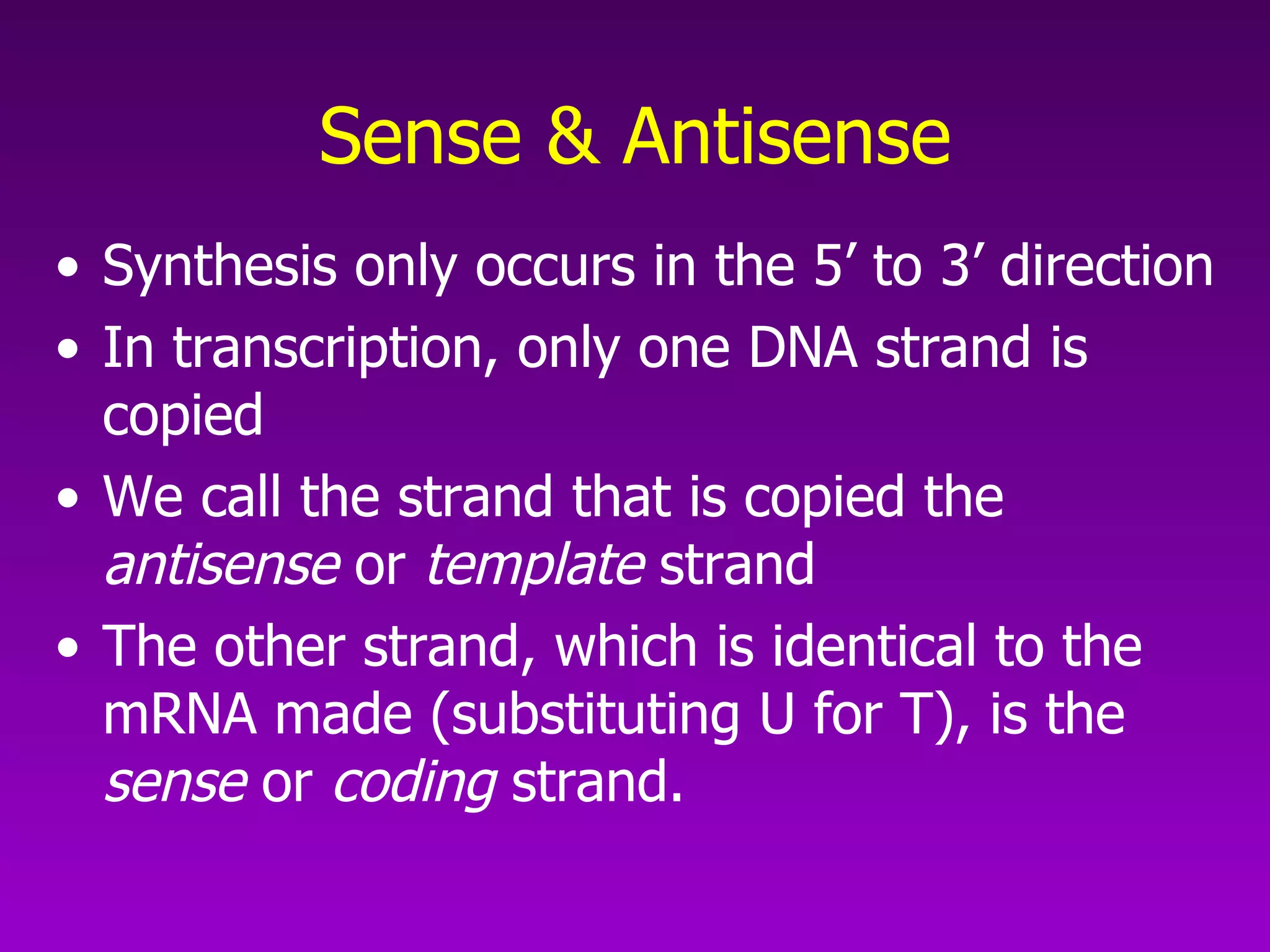
Sense & Antisense Synthesis only occurs in the 5’ to 3’ direction In transcription, only one DNA strand is copied We call the strand that is copied the  antisense  or  template  strand The other strand, which is identical to the mRNA made (substituting U for T), is the  sense  or  coding  strand.
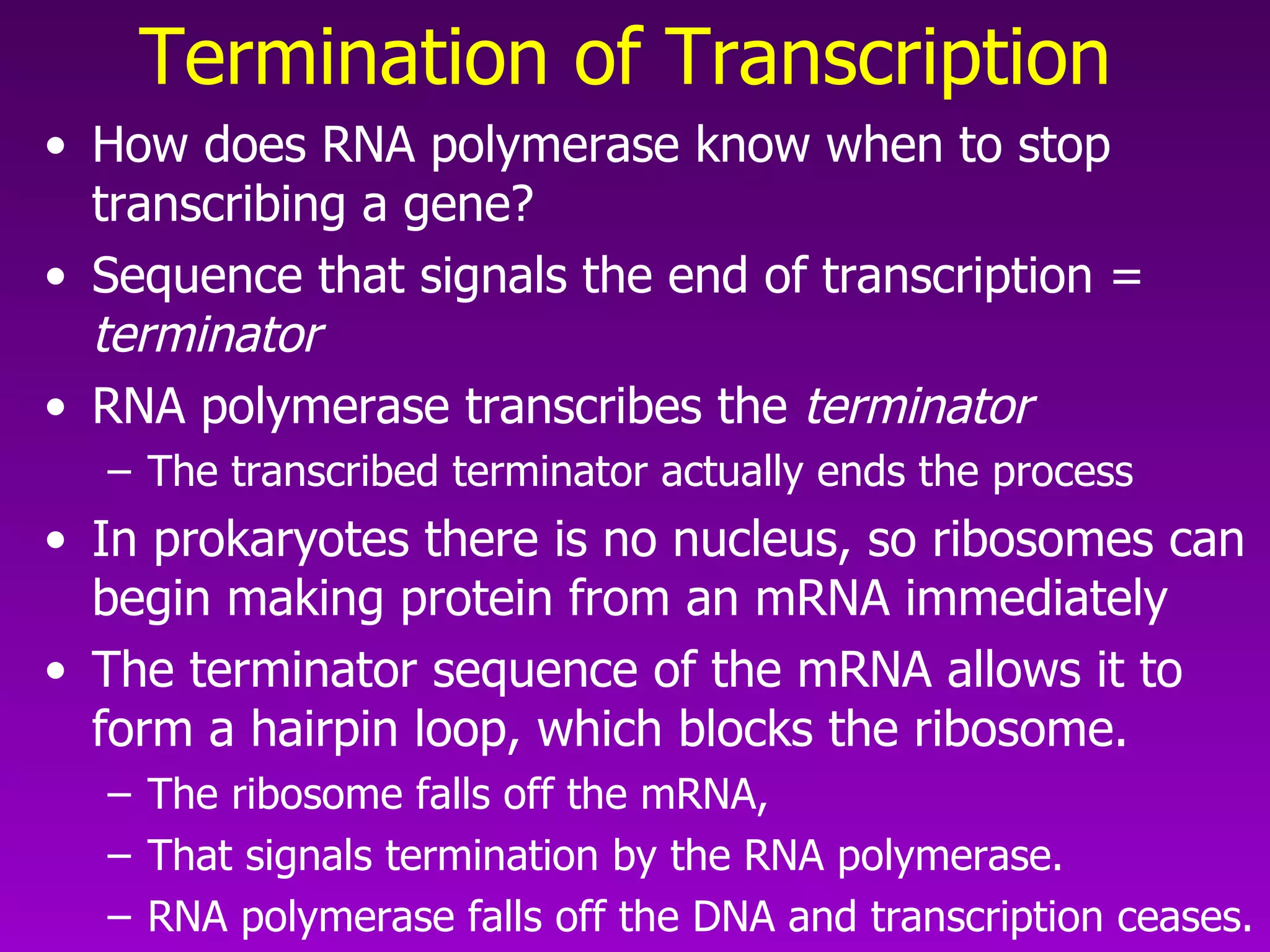
Termination of Transcription   How does RNA polymerase know when to stop transcribing a gene? Sequence that signals the end of transcription =  terminator RNA polymerase transcribes the  terminator The transcribed terminator actually ends the process  In prokaryotes there is no nucleus, so ribosomes can begin making protein from an mRNA immediately  The terminator sequence of the mRNA allows it to form a hairpin loop, which blocks the ribosome.  The ribosome falls off the mRNA, That signals termination by the RNA polymerase.  RNA polymerase falls off the DNA and transcription ceases.
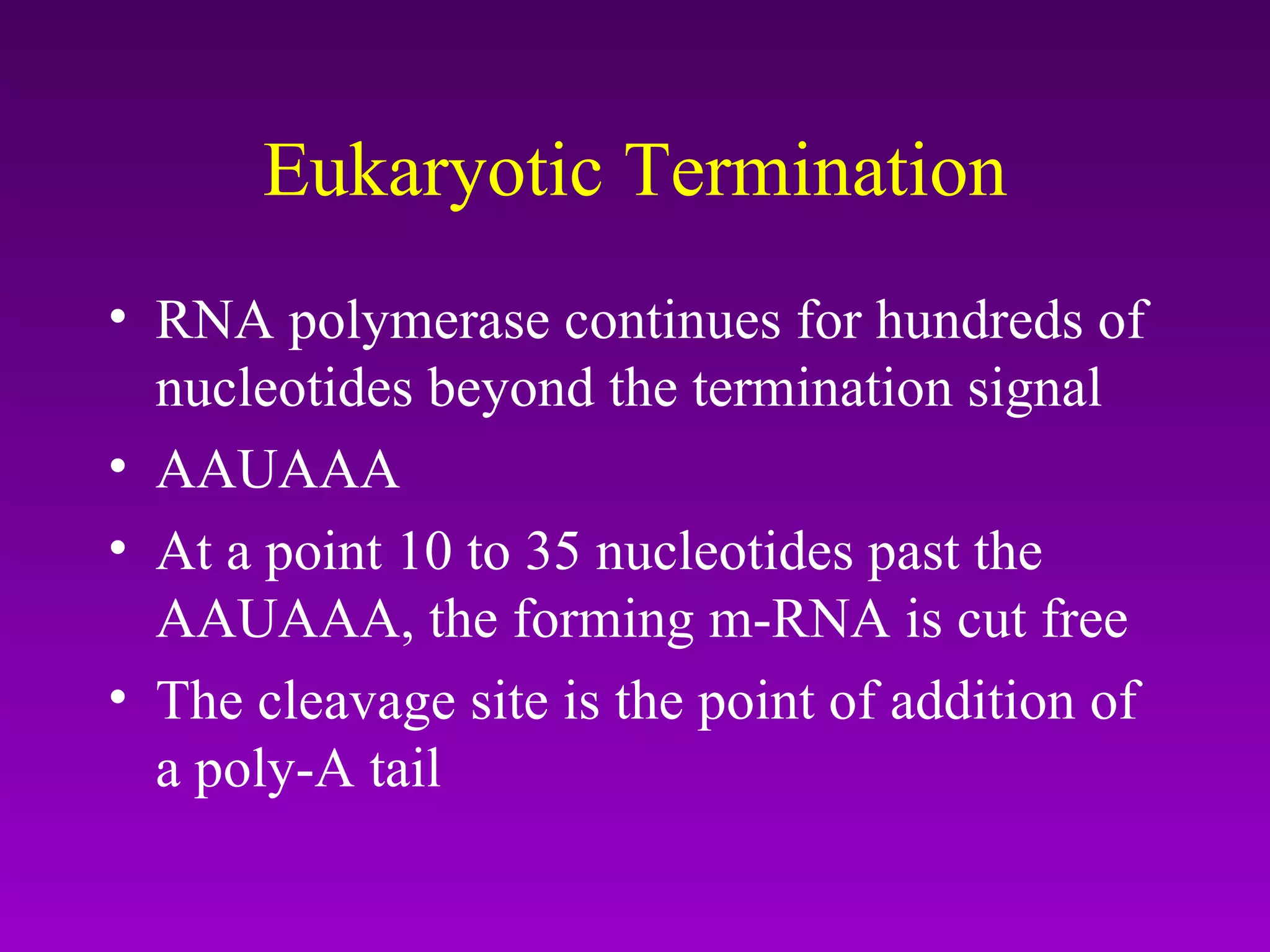
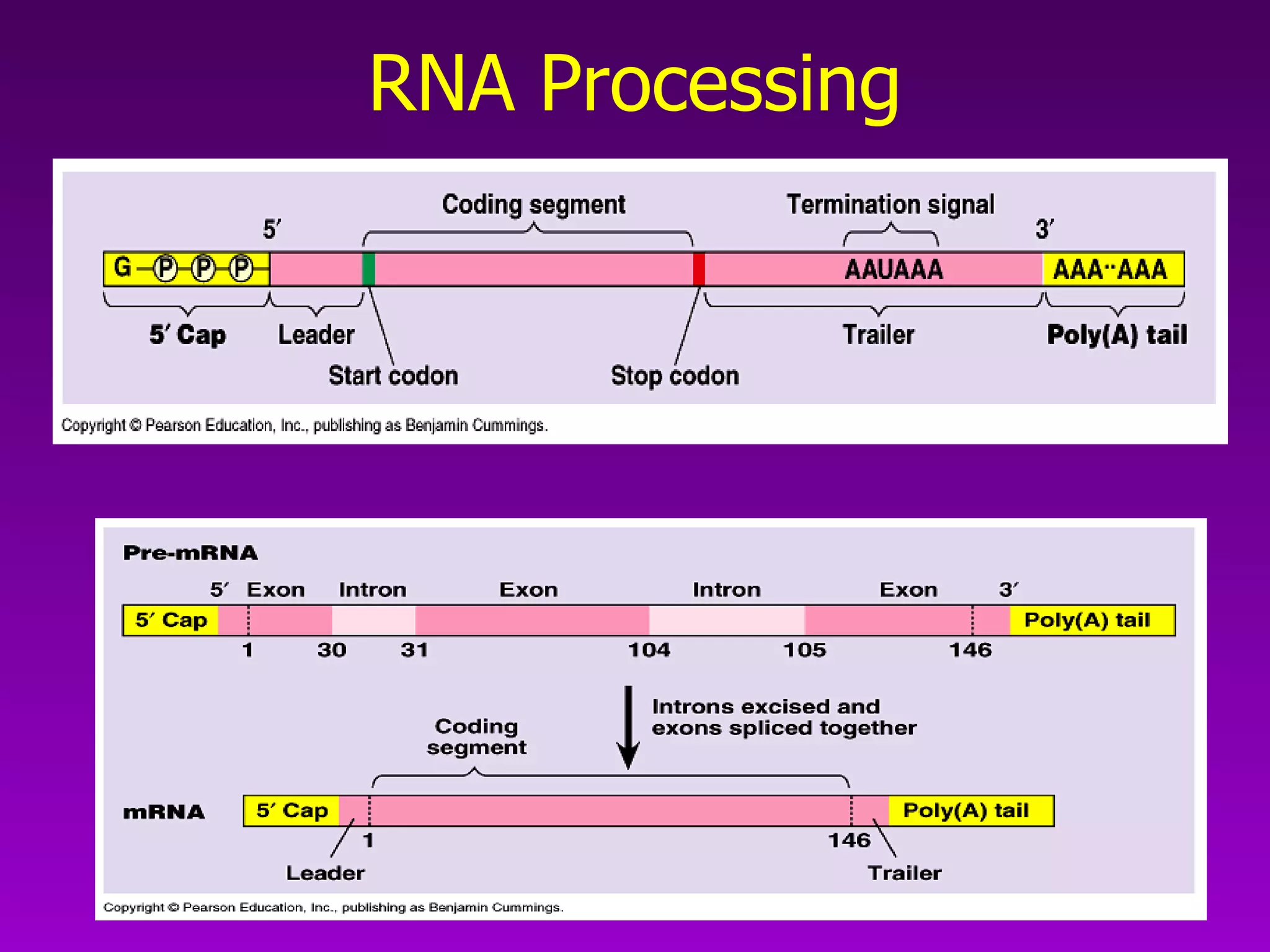
Eukaryotic Termination RNA polymerase continues for hundreds of nucleotides beyond the termination signal AAUAAA At a point 10 to 35 nucleotides past the AAUAAA, the forming m-RNA is cut free The cleavage site is the point of addition of a poly-A tail
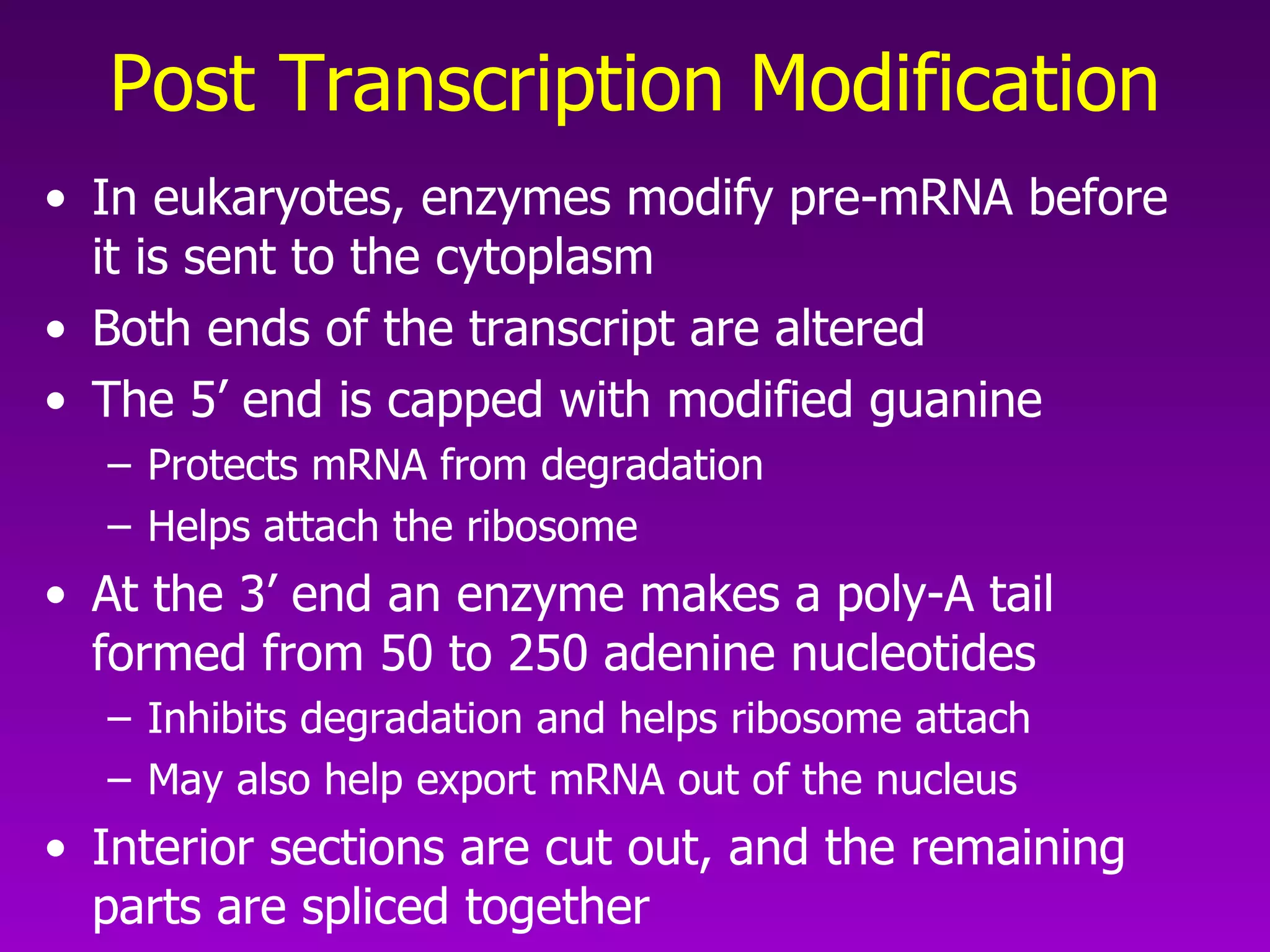
Post Transcription Modification In eukaryotes, enzymes modify pre-mRNA before it is sent to the cytoplasm Both ends of the transcript are altered The 5’ end is capped with modified guanine Protects mRNA from degradation Helps attach the ribosome At the 3’ end an enzyme makes a poly-A tail formed from 50 to 250 adenine nucleotides Inhibits degradation and helps ribosome attach May also help export mRNA out of the nucleus Interior sections are cut out, and the remaining parts are spliced together
RNA Processing
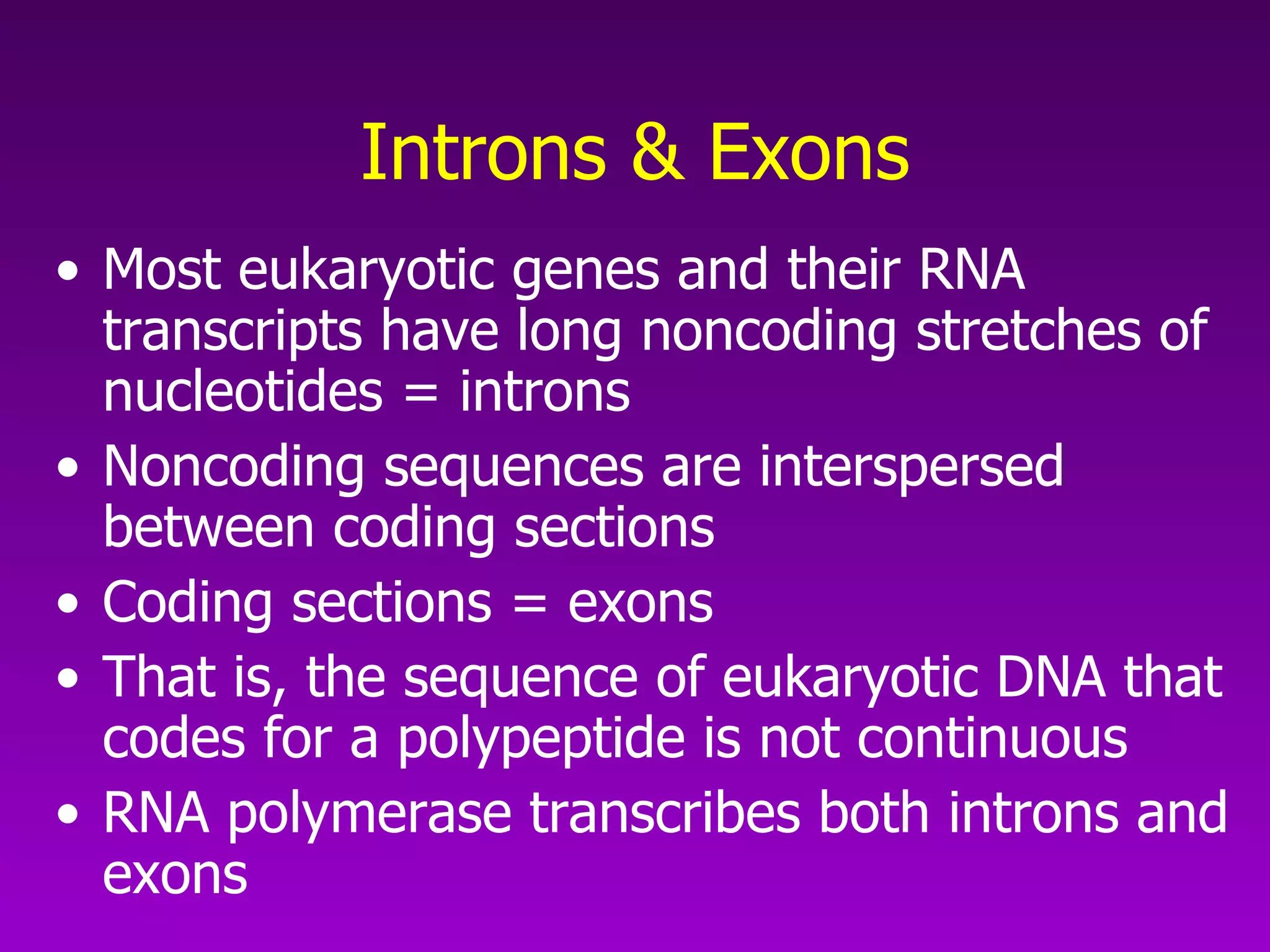
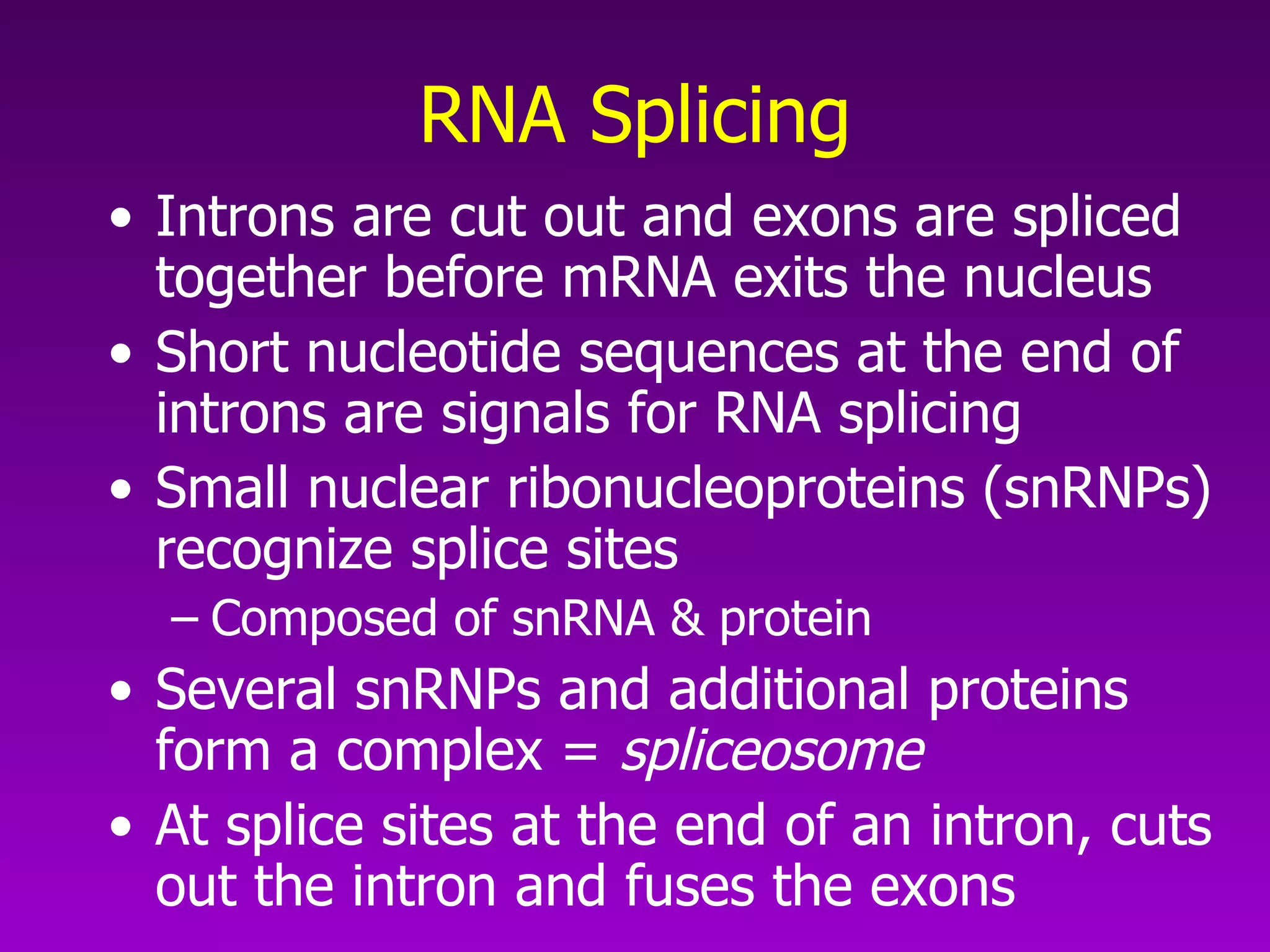
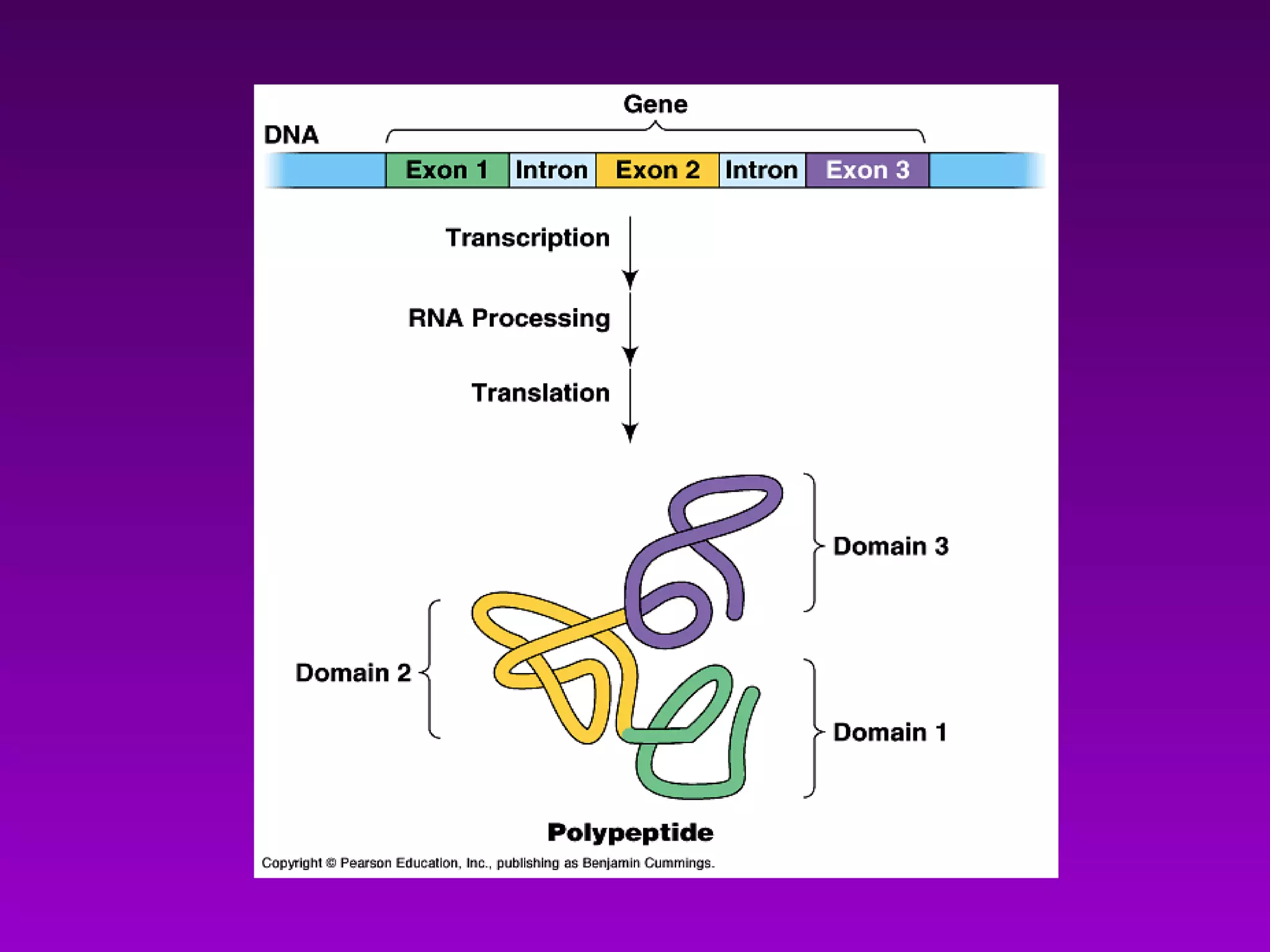
Introns & Exons Most eukaryotic genes and their RNA transcripts have long noncoding stretches of nucleotides = introns Noncoding sequences are interspersed between coding sections Coding sections = exons That is, the sequence of eukaryotic DNA that codes for a polypeptide is not continuous RNA polymerase transcribes both introns and exons
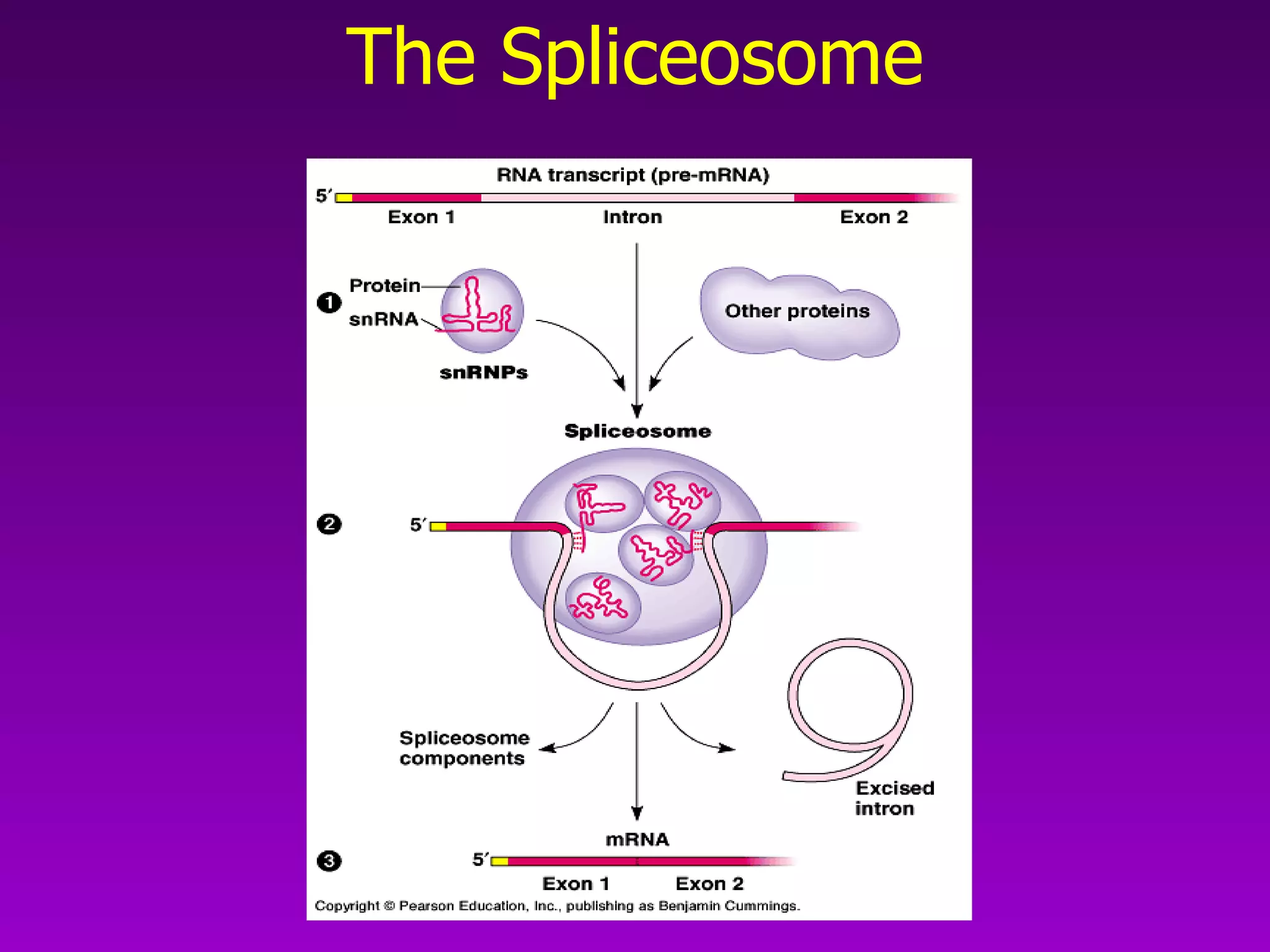
RNA Splicing Introns are cut out and exons are spliced together before mRNA exits the nucleus Short nucleotide sequences at the end of introns are signals for RNA splicing Small nuclear ribonucleoproteins (snRNPs) recognize splice sites Composed of snRNA & protein Several snRNPs and additional proteins form a complex =  spliceosome At splice sites at the end of an intron, cuts out the intron and fuses the exons
The Spliceosome
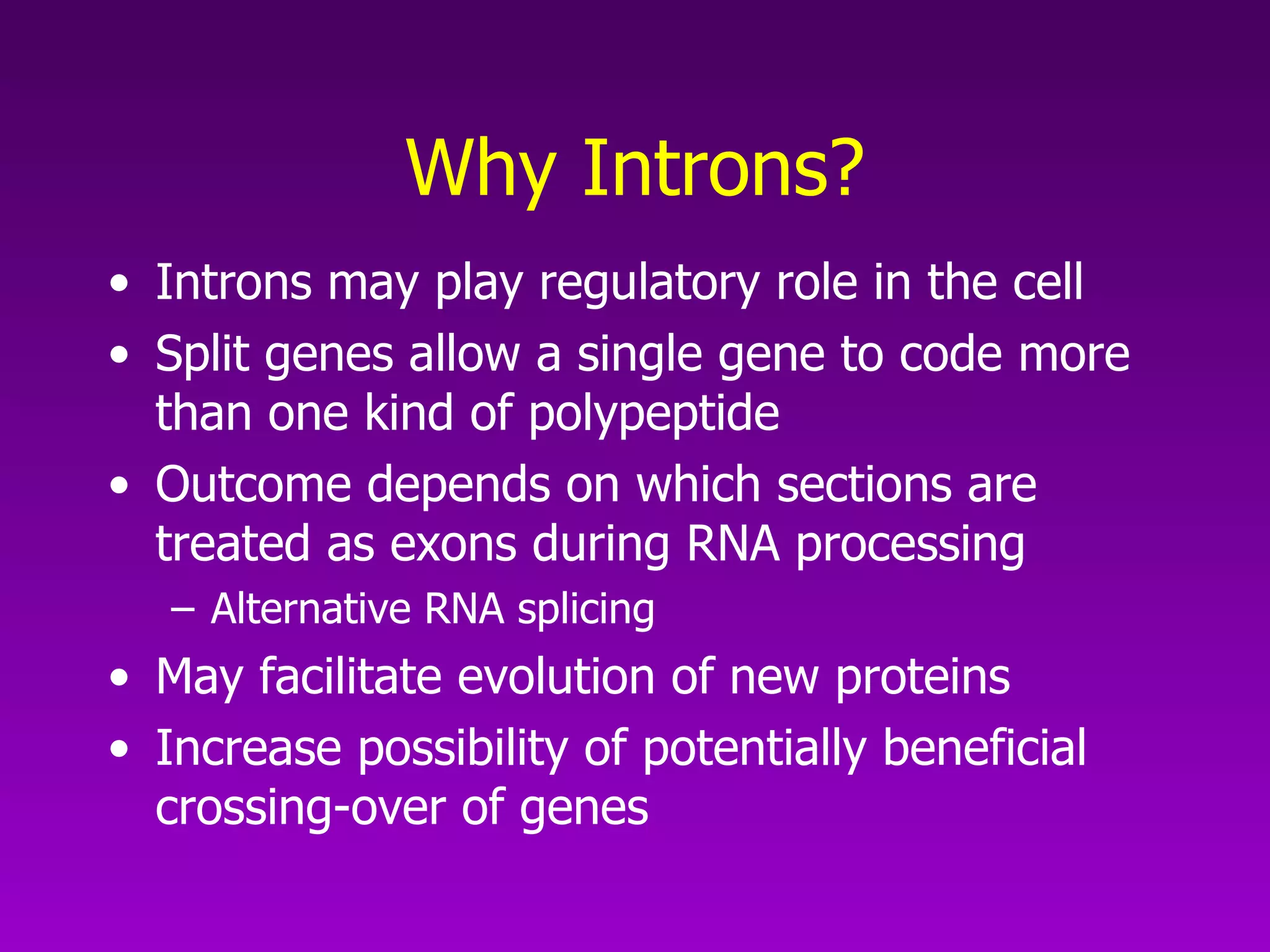
Why Introns? Introns may play regulatory role in the cell Split genes allow a single gene to code more than one kind of polypeptide Outcome depends on which sections are treated as exons during RNA processing Alternative RNA splicing May facilitate evolution of new proteins Increase possibility of potentially beneficial crossing-over of genes
 
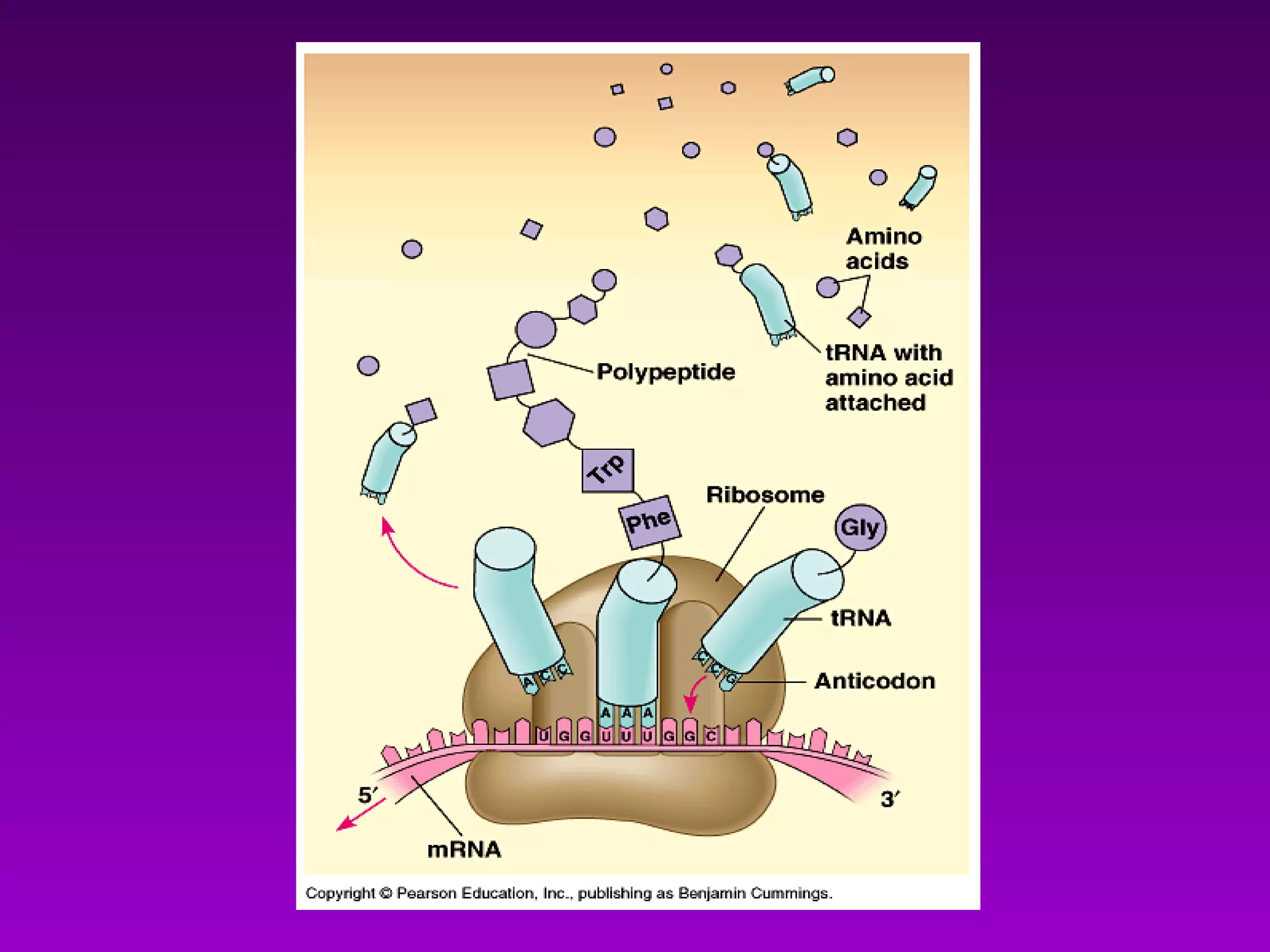
Translation How do messenger RNAs direct protein synthesis? The message encoded in the mRNA is an amino acid sequence mRNA travels to ribosome in the cytoplasm, where the message is read The specified amino acids are assembled on the mRNA template on the ribosome Enzymes help form the sequenced amino acids into a polypeptide
 
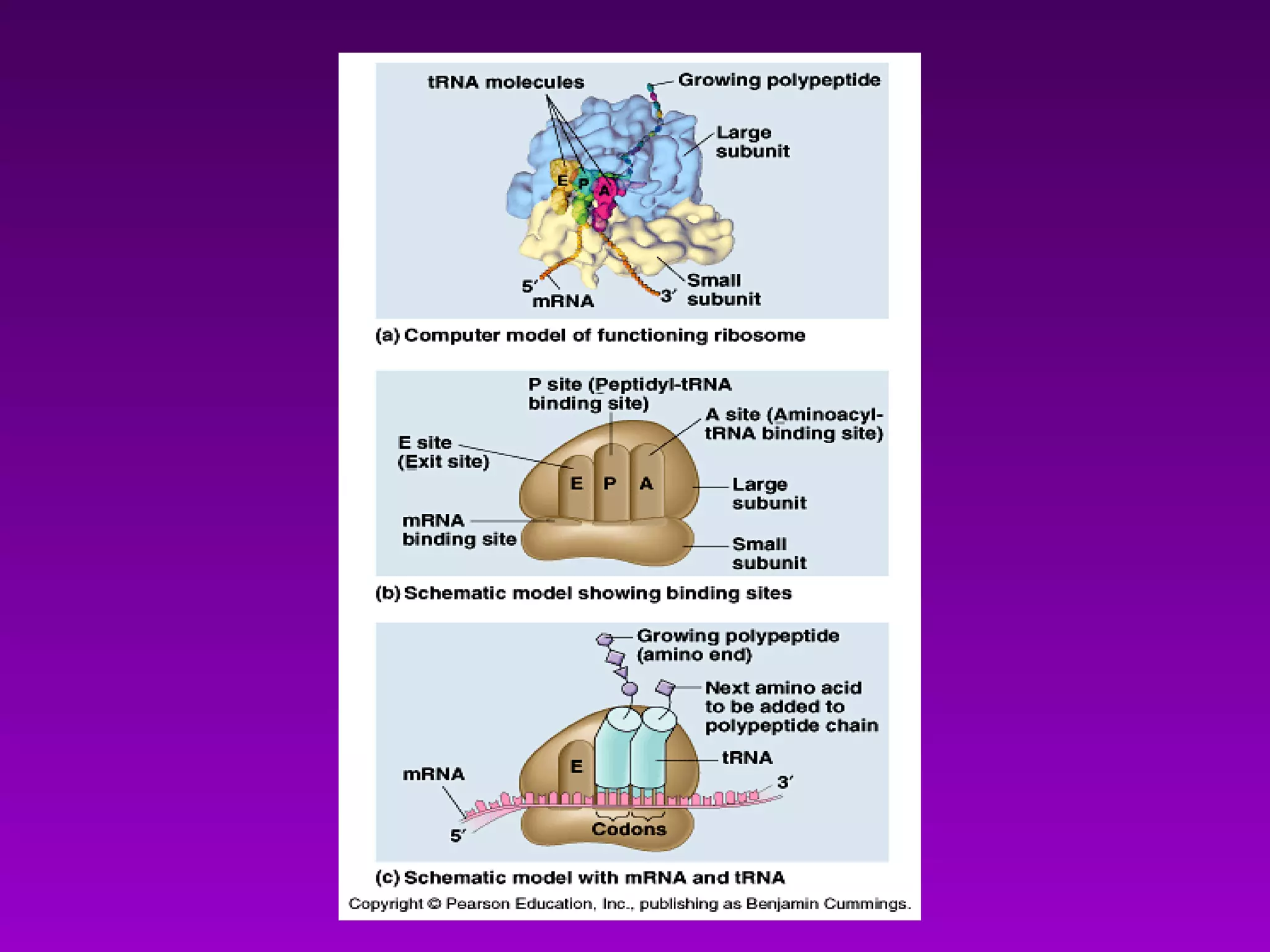
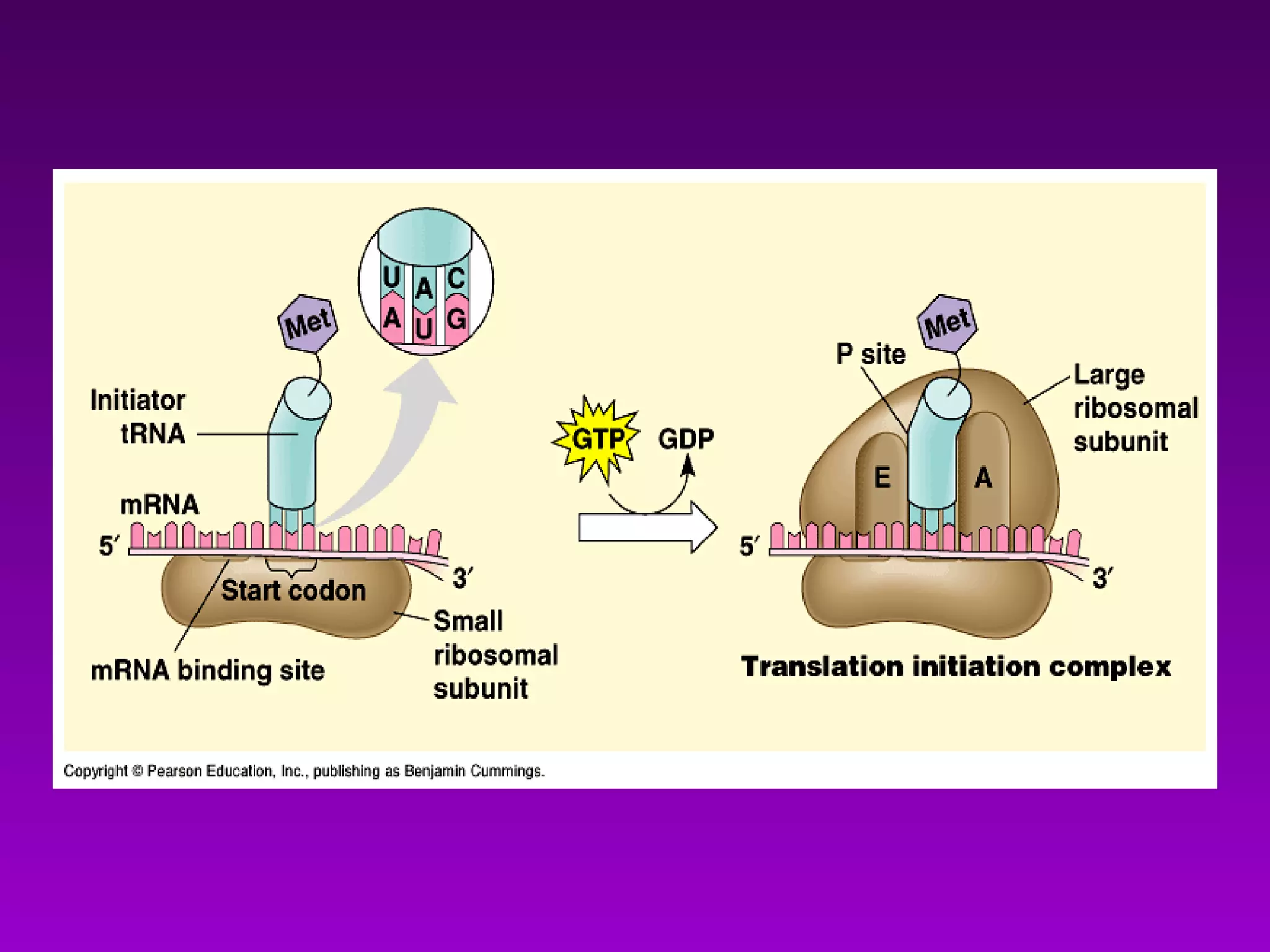
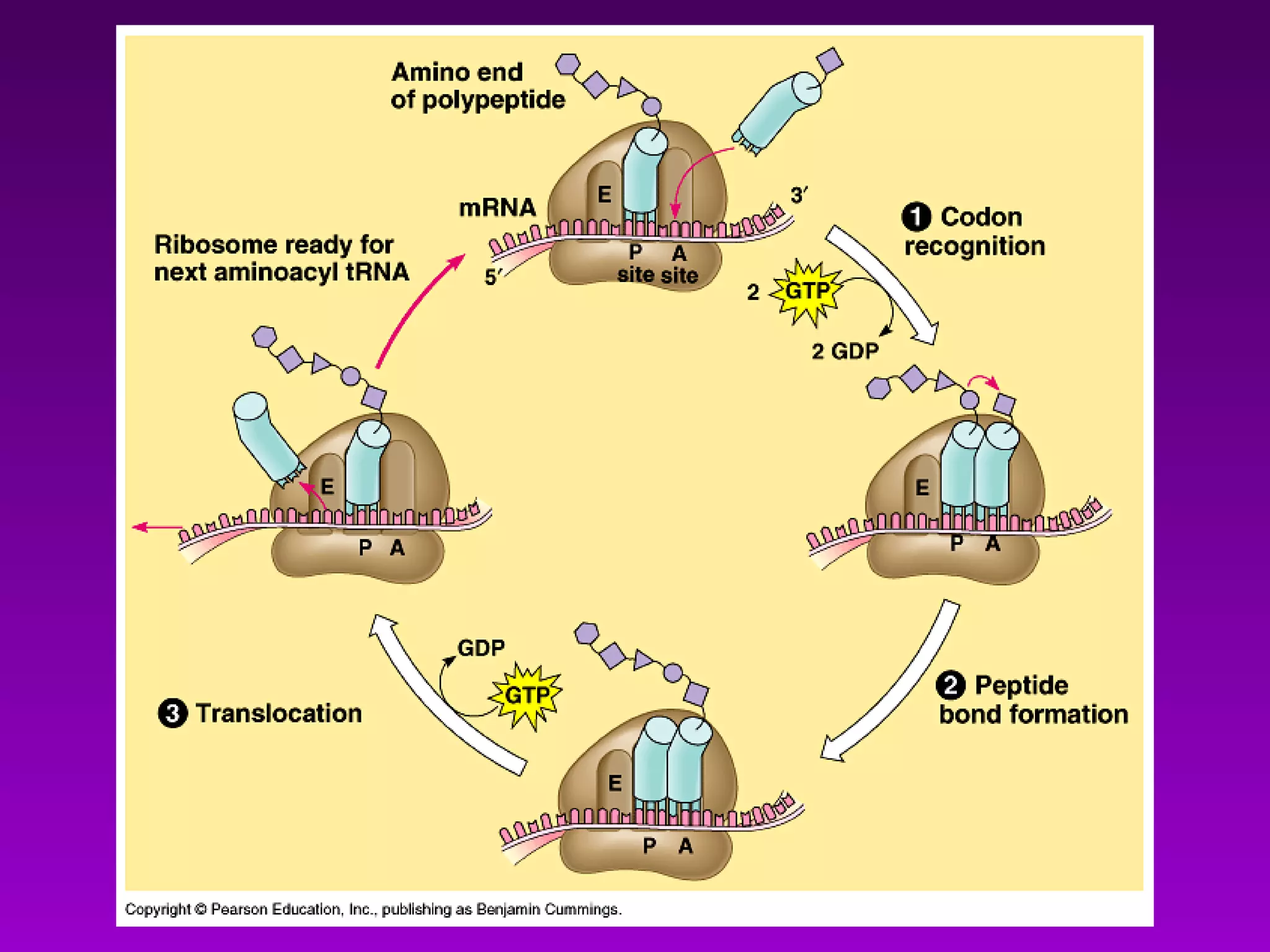
The Ribosome   The cellular factory where proteins are synthesized Consists of structural RNA and ~ 80 different proteins.  In its inactive state, it exists as two subunits a large subunit and a small subunit.  When the small subunit encounters an mRNA, it begins translation of the mRNA to protein.  There are three sites in the large subunit The A site accepts a new tRNA bearing an amino acid the P site bears the tRNA attached to the growing chain.  The E site contains the exiting tRNA
 
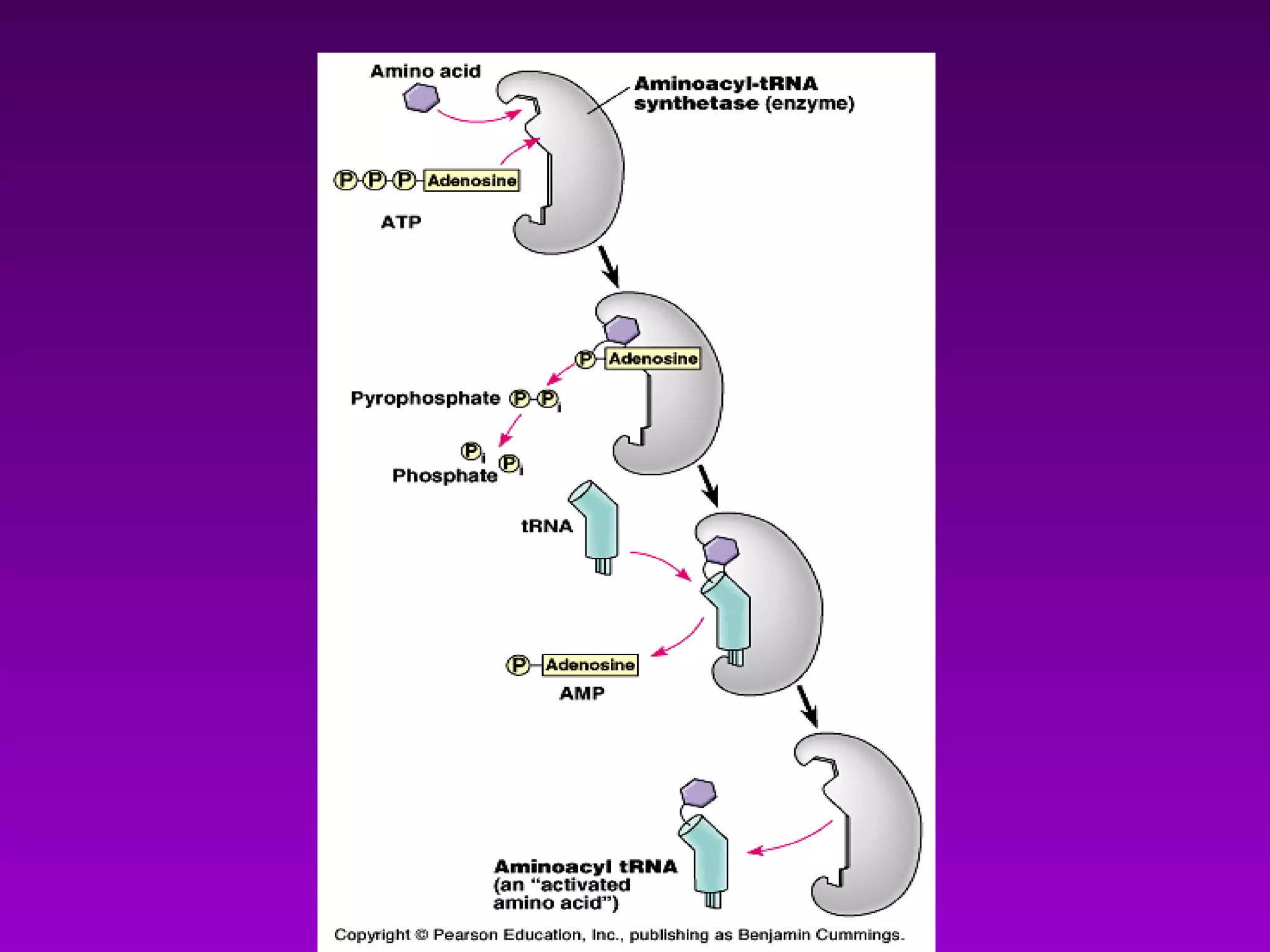
Charging the tRNA   tRNA (transfer RNA) acts as a translator between mRNA and protein  Each tRNA has a specific  anticodon  and an amino acid acceptor site.  Each tRNA also has a specific charger protein; This protein can only bind to that particular tRNA and attach the correct amino acid to the acceptor site.  These charger proteins are called aminoacyl tRNA synthetases  The energy to make this bond comes from ATP .
 
Aminoacyl-tRNA Synthases Each tRNA must match with the correct amino acid Each tRNA must attach only the amino acid specified by the mRNA codon to which the tRNA anticodon binds The amino acid is joined to the tRNA by an  aminoacyl-tRNA synthase There are 20 of these enzymes; one for each amino acid Catalyzes the covalent bond between the amino acid and tRNA The active site of each aminoacyl-tRNA synthase fits only a specific amino acid and tRNA Once the amino acid is bound, the tRNA is aminoacyl tRNA
 
Wobble If there was one tRNA for each mRNA codon, there would be 61 different tRNAs Actually, there are fewer Some tRNAs have anticodons that recognize 2 or more different codons Base pairing rules between the third base of a codon and its tRNA anticodon are not a rigid as DNA to mRNA pairing Example: U in tRNA can pair with either A or T in the third position of an mRNA codon This flexibility is called  wobble
 
Initiation of Translation The start signal for translation is the codon ATG Codes for methionine.  Not every protein starts with methionine, Often this first amino acid will be removed in post-translational processing.  A tRNA charged with methionine binds to the translation start signal.  The large subunit binds to the mRNA and the small subunit Elongation begins.
 
Elongation of the New Protein After the first charged tRNA appears in the A site, the ribosome shifts so that the tRNA is in the P site.  New charged tRNAs, corresponding the codons of the mRNA, enter the A site, and a peptide bond is formed between the two amino acids.  The first tRNA is now released  The ribosome shifts again so that a tRNA carrying two amino acids is now in the P site A new charged tRNA can bind to the A site.  This process of elongation continues until the ribosome reaches a stop codon.
 
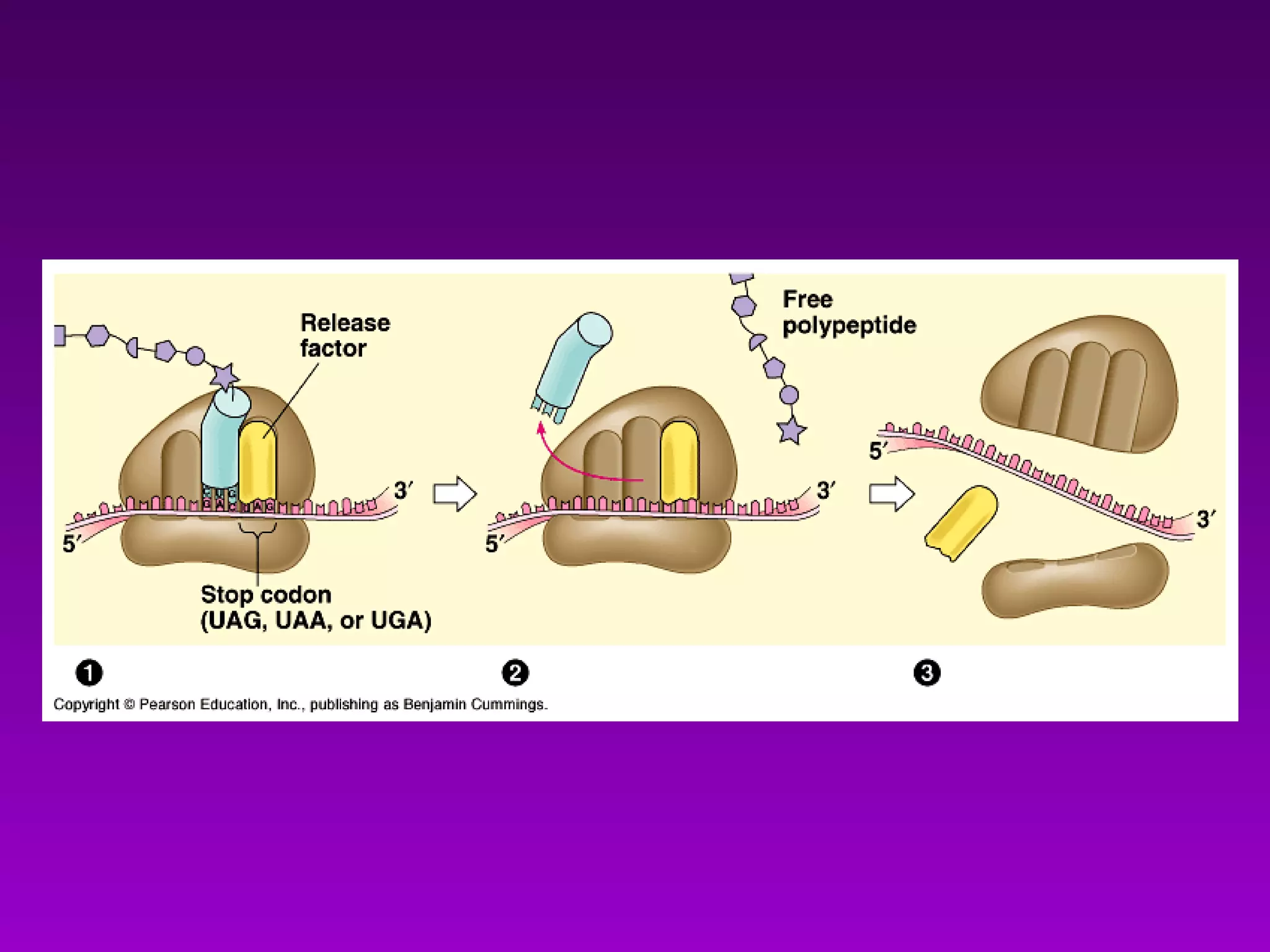
Termination of the Protein When the ribosome reaches a stop codon, no aminoacyl tRNA binds to the empty A site.  This is the ribosome’s signal to break into its large and small subunits, Releasing the new protein and the mRNA.
 
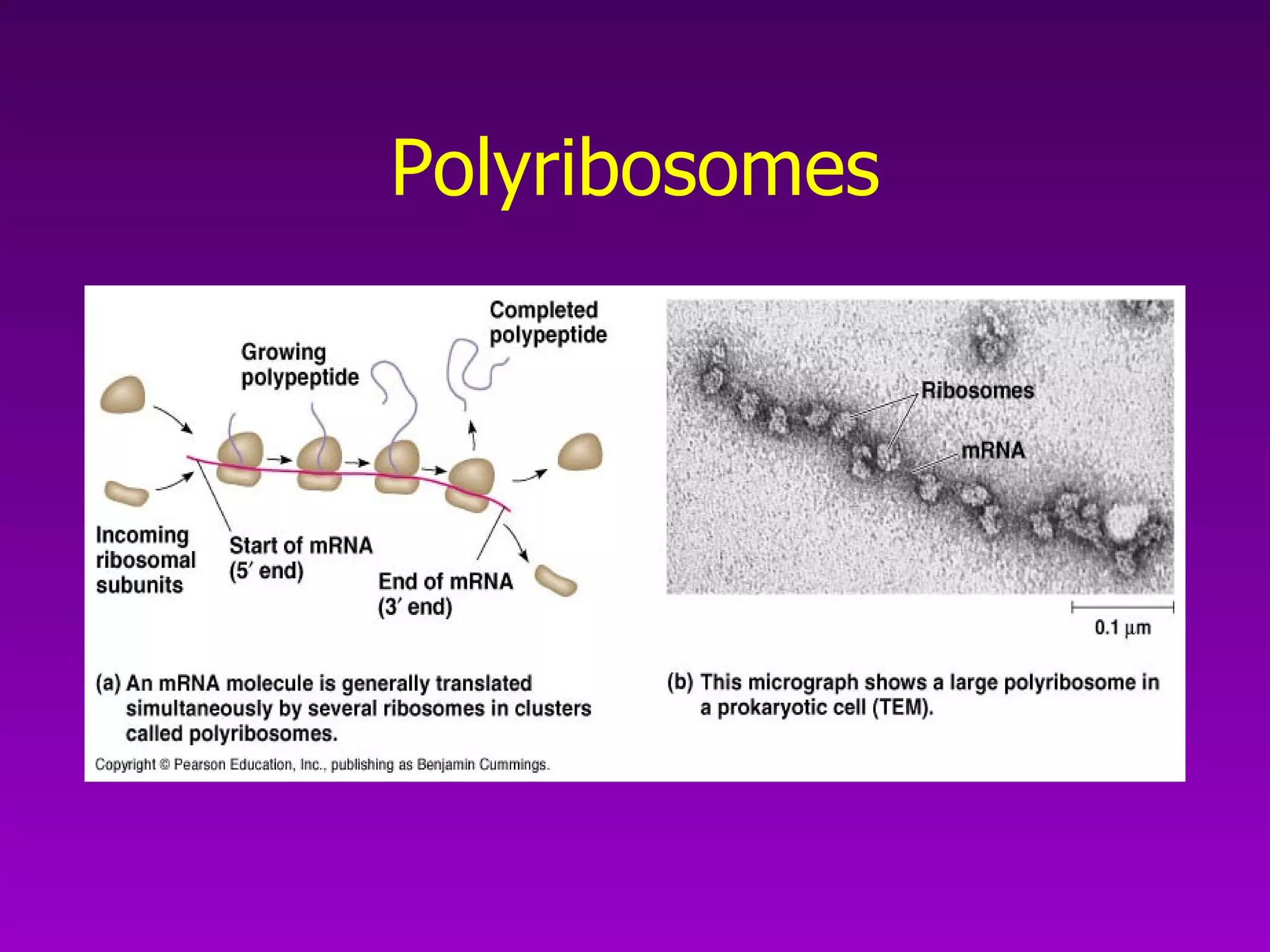
Polyribosomes A single mRNA can be used to make many copies of a polypeptide at the same time Multiple ribosomes can read the same mRNA strand, like beads on a string These strings are called  polyribosomes
Polyribosomes
Post-Translational Processing   This isn't always the end of the story for the new protein.  Often it will undergo  post-translational modifications .  Modifications include:  Cleavage by a proteolytic (protein-cutting) enzyme at a specific place.  Having some amino acids altered.  For example, a tyrosine residue might be phosphorylated.  Become  glycosylated.  Many proteins have carbohydrates covalently attached to asparagine residues.
 
Mutations What kinds of errors can occur in DNA?  What causes them?  What are their effects?  Types of mutations: Chromosomal mutations  Point mutations Frameshift mutations
 
Chromosomal Mutations   Mutations that occur at a macroscopic level.  Large sections of chromosomes can be altered or shifted, leading to changes in the way genes are expressed.  Types of chromosomal mutations: Translocations Inversions Deletions Nondisjunction
Translocations & Inversions Translocation The interchange of large segments of DNA between two chromosomes.  Can change gene expression if a gene is at the translocation breakpoint or if it is reattached so that it is incorrectly regulated Inversion Occurs when a region of DNA flips its orientation with respect to the rest of the chromosome.  Rotates, end for end This can lead to the same problems as translocations.
Deletions & Nondisjunction Deletion Sometimes large regions of a chromosome are deleted.  This can lead to a loss of important genes.  Nondisjunction Sometimes chromosomes do not divide correctly in cell division When large regions of a chromosome are altered (such as translocation), the chromosome may not segregate properly during cell division   One daughter cell will end up with extra genetic material, one will end up with less than its share This is called  nondisjunction.   When there are extra or too few copies of a gene, the cell will have problems
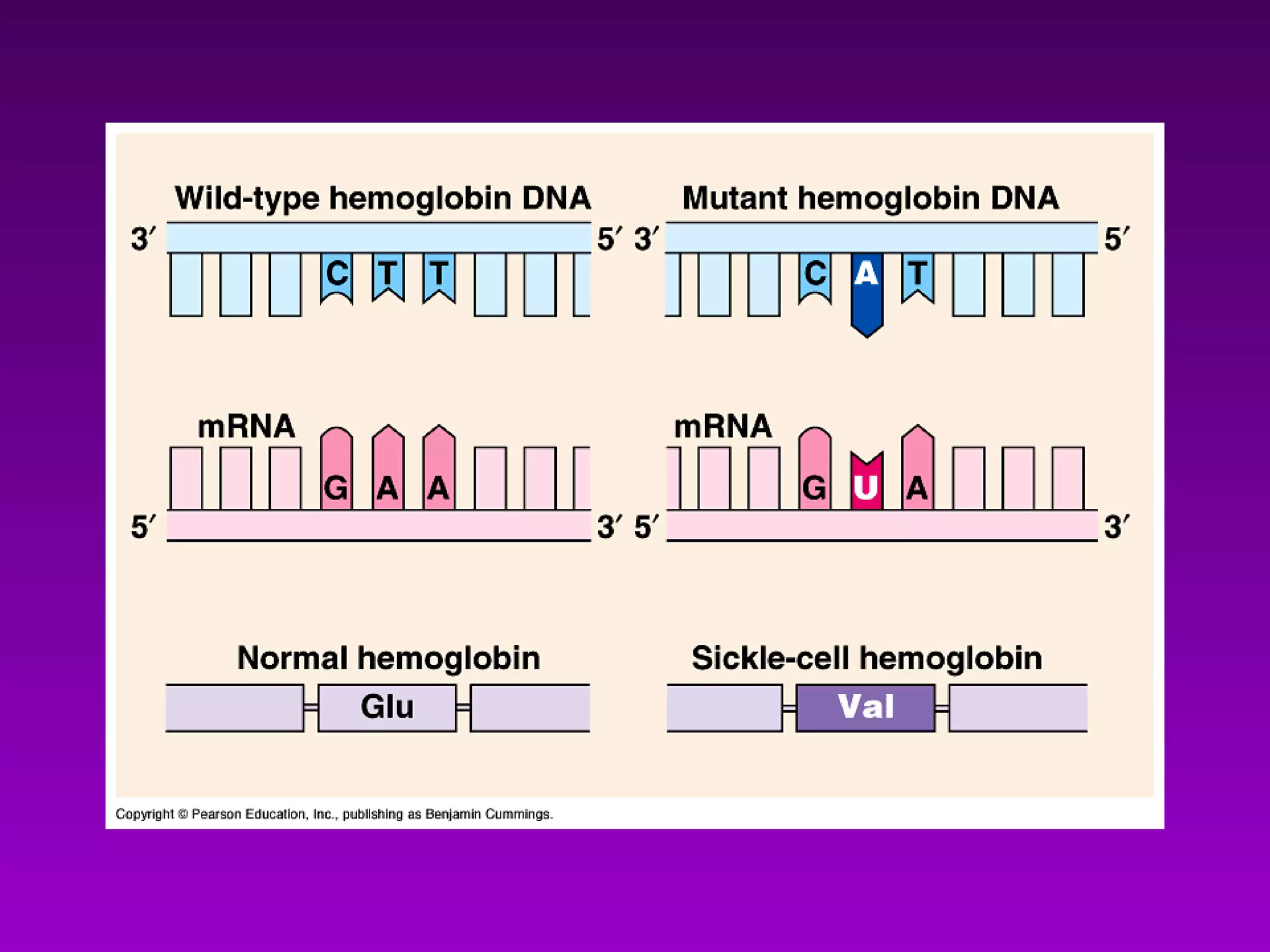
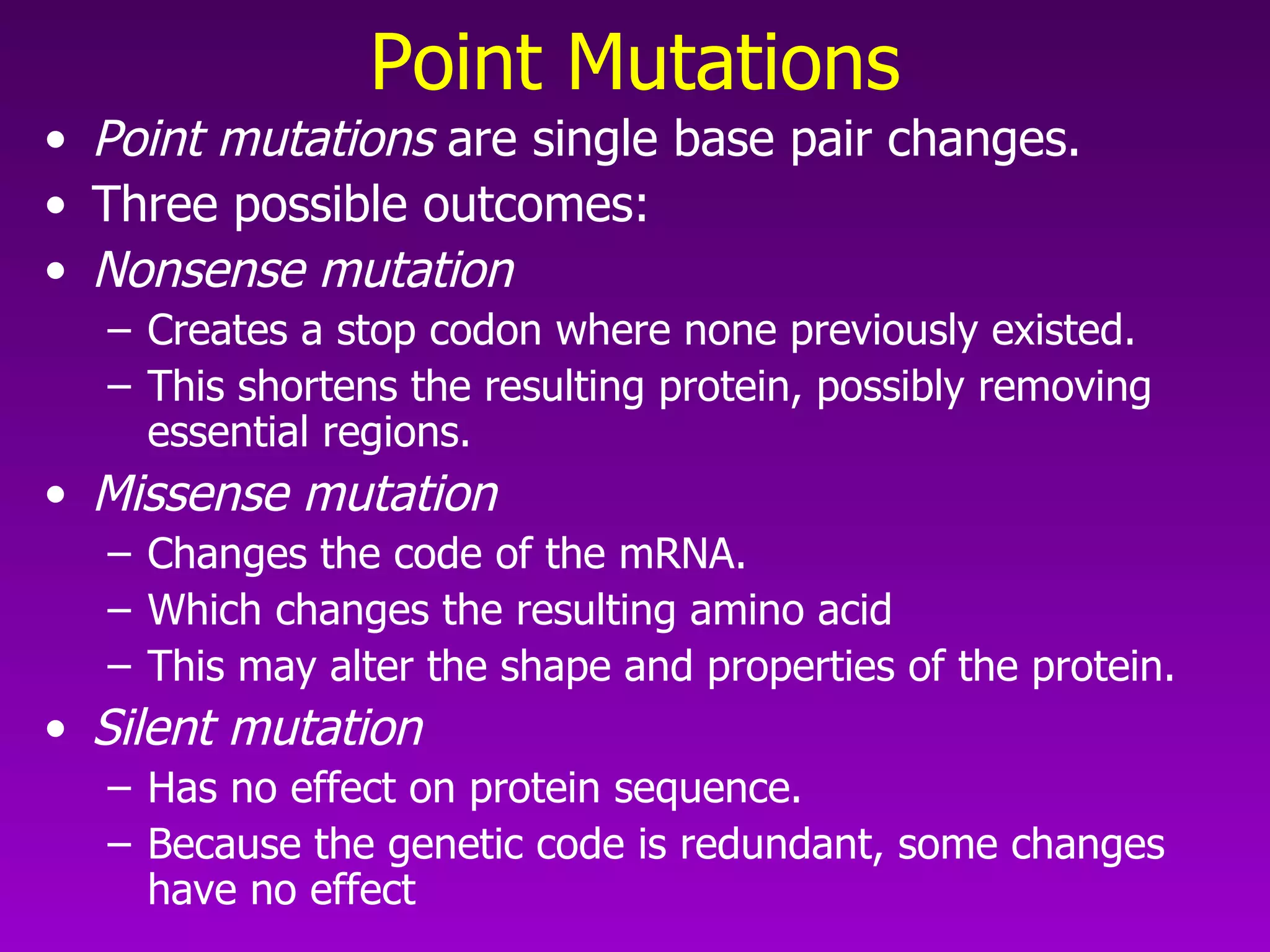
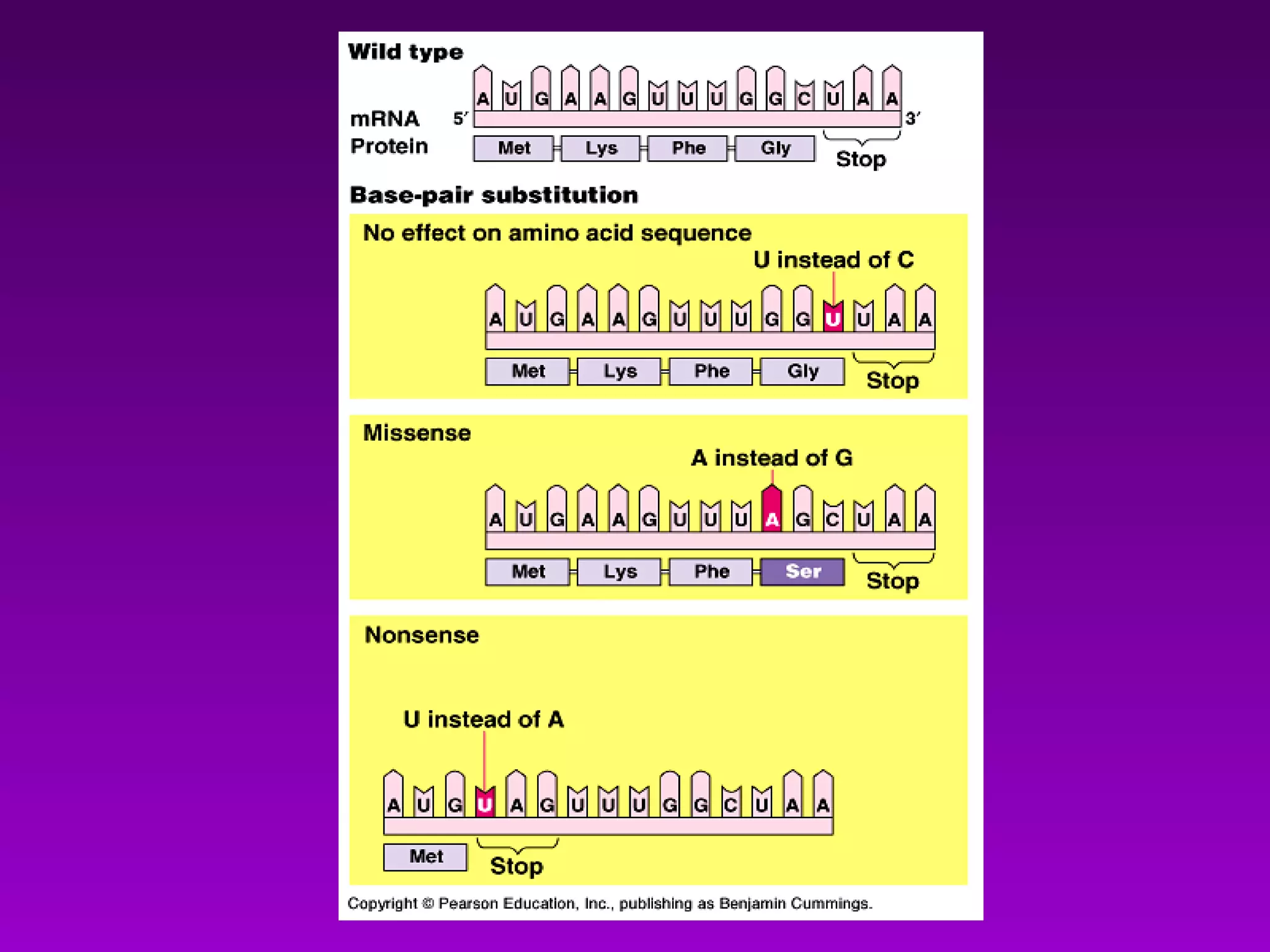
Point Mutations Point mutations  are single base pair changes.  Three possible outcomes: Nonsense mutation   Creates a stop codon where none previously existed.  This shortens the resulting protein, possibly removing essential regions.  Missense mutation   Changes the code of the mRNA.  Which changes the resulting amino acid This may alter the shape and properties of the protein.  Silent mutation  Has no effect on protein sequence.  Because the genetic code is redundant, some changes have no effect
 
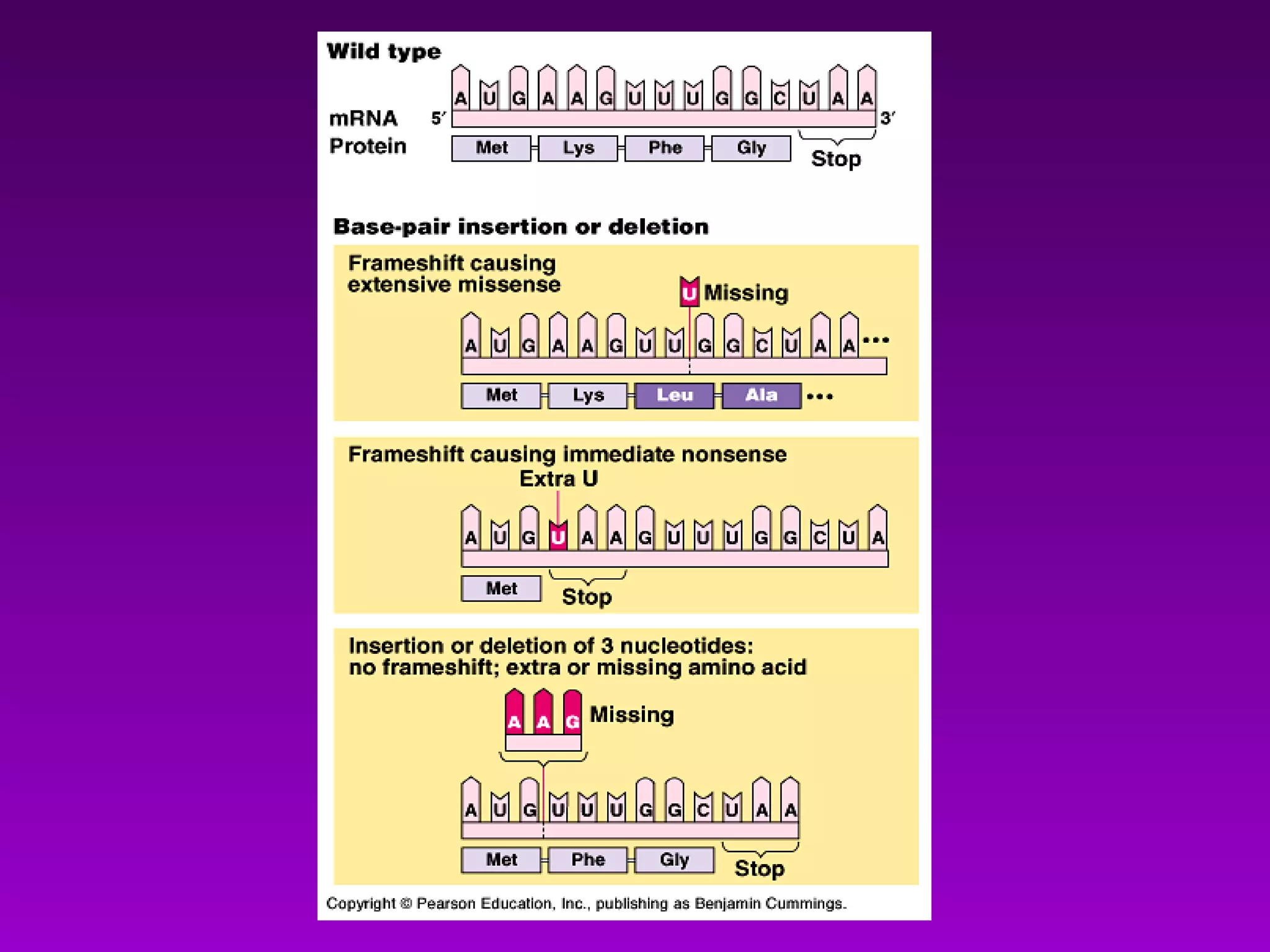
Frameshift Mutations Insertions or deletions have a disastrous effect mRNA is “read” as a series of three letter words Insertions or deletions that are not multiples of three, shift the reading frame
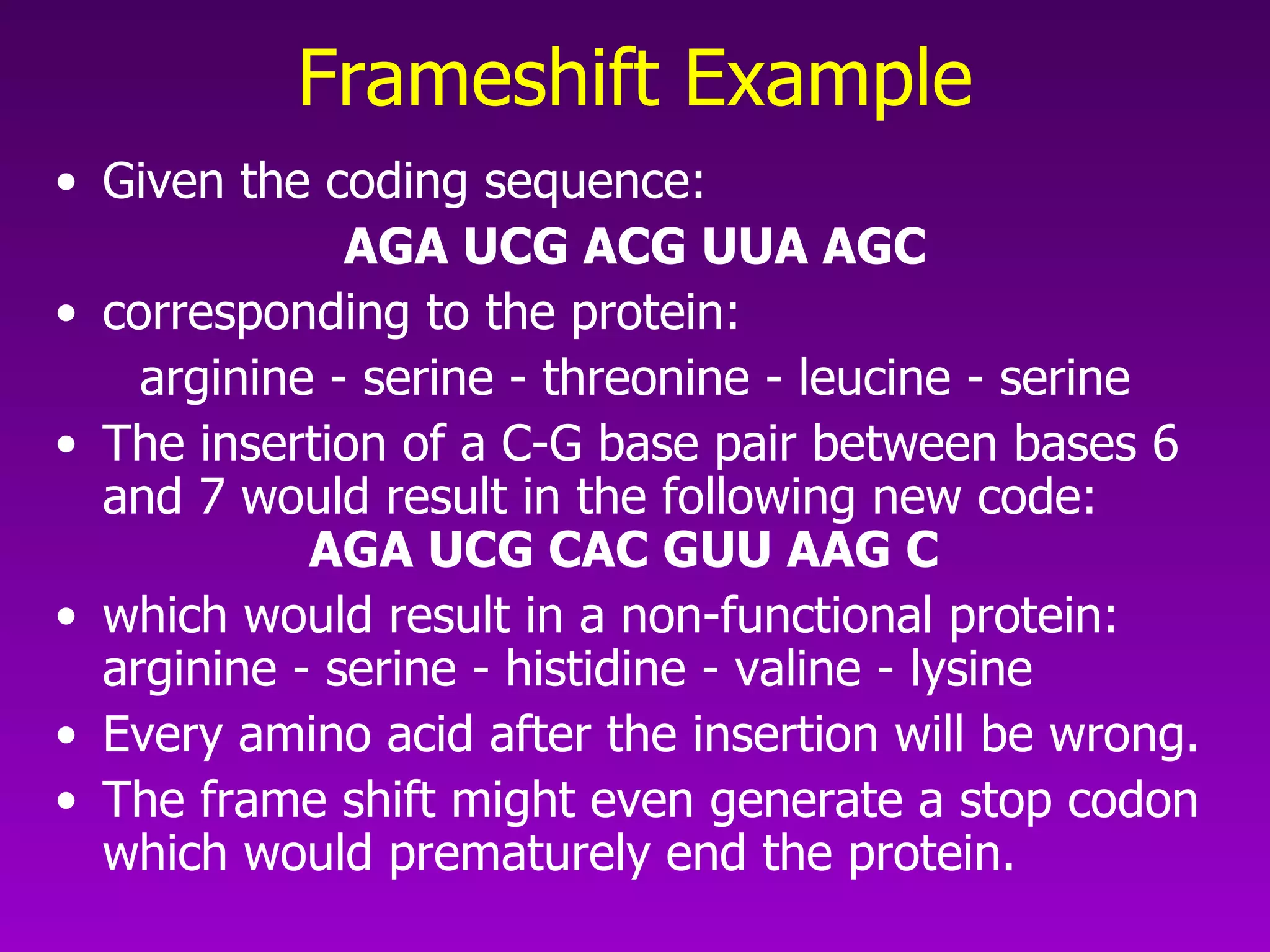
Frameshift Example Given the coding sequence:  AGA UCG ACG UUA AGC corresponding to the protein:  arginine - serine - threonine - leucine - serine The insertion of a C-G base pair between bases 6 and 7 would result in the following new code:  AGA UCG CAC GUU AAG C which would result in a non-functional protein:  arginine - serine - histidine - valine - lysine Every amino acid after the insertion will be wrong.  The frame shift might even generate a stop codon which would prematurely end the protein.
 
DNA Repair If replication of DNA proceeded as was described previously, DNA polymerase would make a mistake on average about every 1000 base pairs. This level would be unacceptable, because too many genes would be rendered non-functional. Organisms have elaborate DNA proofreading and repair mechanisms, which can recognize false base-pairing and DNA damage, and repair it.  The actual error rate is more in the region of one in a million to one in a billion.
The Beauty of Mutations Why mutations? Our environment constantly changes, the Earth and its ecosystems change.  Populations must change to survive Evolutionary change requires variation, the raw material on which natural selection works One mechanism for variation and change is at the DNA level.  Mutations can be beneficial and enable the organism to adapt to a changing environment.  However, most mutations are deleterious, and cause varied genetic diseases

Molecular Genetics Part II

  • 1.
    Molecular Genetics PartII From Gene to Protein
  • 2.
    History ArchibaldGarrod – 1909 First to suggest that genes dictate phenotype through production of proteins Believed that genetic diseases resulted from the inability to make particular enzymes “ Inborn errors of metabolism”
  • 3.
    One Gene –One Enzyme Beadle & Ephrussi – 1930’s Studied mutations affecting eye color in Drosophila Concluded that each mutation blocks pigment synthesis at a specific step by preventing production of the enzyme that catalyzes that step Specific pathways were not known, so results were inconclusive
  • 4.
    Beadle & TatumTreated Neurospora (a mold) with X-rays Looked for mutations in nutritional requirements Wild type Neurospora grows on minimal medium (agar enriched with a few nutrients) All mutants will grow on complete medium (agar plus all 20 amino acids & other nutrients) Identified the specific amino acid required for growth by each mutant That identified the defective synthetic pathway Looked at each intermediate step in the blocked synthetic pathway Concluded that mutation in a single gene blocked production of a single enzyme
  • 5.
  • 6.
    One Gene –One Polypeptide Not all proteins are enzymes Can extend one gene = one enzyme doctrine to one gene = one polypeptide Many proteins are comprised of two or more polypeptides
  • 7.
    Central Dogma Howdoes the sequence of a strand of DNA correspond to the amino acid sequence of a protein? The central dogma of molecular biology, states that:
  • 8.
    Transcription & TranslationDNA is first copied ( transcribed ) to an RNA intermediate The RNA intermediate is then translated to protein Why have an intermediate between DNA and the proteins it encodes?
  • 9.
    Why RNA? TheDNA remains protected in the nucleus, away from caustic enzymes in the cytoplasm. Gene information can be amplified Many copies of an RNA can be made from one copy of DNA. Greater regulation of gene expression Specific controls can act at each step in the pathway between DNA and proteins. The more elements there are in the pathway, the more opportunities there are for control
  • 10.
    What is RNA?RNA has the same primary structure as DNA consists of a sugar-phosphate backbone, with nucleotides attached to the 1' C of the sugar. Differences between DNA and RNA : Contains the sugar ribose instead of deoxyribose The nucleotide, uracil, is substituted for thymine RNA exists as a single-stranded molecule. Because of the extra hydroxyl group on the sugar, RNA is too bulky to form a a stable double helix. Regions of double helix can form where there is some base pair complementation resulting in hairpin loops .
  • 11.
    Types of RNAmRNA - messenger RNA A copy of a gene. Has a sequence complementary to one strand of the DNA & identical to the other strand. Carries the information stored in DNA in the nucleus to the ribosomes in the cytoplasm where protein is made. tRNA - transfer RNA A small RNA with a very specific structure that can bind an amino acid at one end, and mRNA at the other end. Acts as an ‘adaptor’ to carry & attach amino acids to the appropriate place on the mRNA.
  • 12.
    Types of RNA(Cont.) rRNA - ribosomal RNA One of the structural components of the ribosome. Has a sequence complimentary to regions of the mRNA Allows ribosome to bind to an mRNA snRNA - small nuclear RNA Is involved in the machinery that processes RNA's as they travel between the nucleus and the cytoplasm.
  • 13.
    The Genetic Code How does mRNA specify an amino acid sequence? It would be impossible for each amino acid to be specified by one nucleotide there are only 4 nucleotides and 20 amino acids. two nucleotide combinations could only specify 16 amino acids. Each amino acid is specified by a combination of three nucleotides, called a codon
  • 14.
  • 15.
  • 16.
    The Code isRedundant, Not Ambiguous Each amino acid may be specified by up to six codons In many cases, codons that are synonyms differ only in the third base of the triplet Different organisms have different frequencies of codon usage. A giraffe might use CGC for arginine much more often than CGA, and the reverse might be true for a sperm whale. Some codons specify “stop” (or “start) There is no ambiguity the same codon ALWAYS codes for the same amino acid
  • 17.
    Codons & AnticodonsHow do tRNAs recognize to which codon to bring an amino acid? The tRNA has an anticodon on its mRNA-binding end The anticodon is complementary to the codon on the mRNA. Each tRNA only binds the appropriate amino acid for its anticodon
  • 18.
  • 19.
    Transcription How doesthe sequence information from DNA get transferred to mRNA? How is this information carried to the ribosomes in the cytoplasm? This process is called transcription Highly similar to DNA replication. Different enzymes are used in transcription. The most important is RNA polymerase
  • 20.
    RNA Polymerase RNApolymerase is a holoenzyme an agglomeration of many different factors Together, direct the synthesis of mRNA Pries the DNA strands apart Strings complimentary RNA nucleotides on the DNA template Like DNA polymerase, can only add to the 3’ end So only one mRNA is made, elongating 5’  3’
  • 21.
    Stages of TranscriptionInitiation Elongation Termination
  • 22.
  • 23.
    Initiation RNA polymerasemust recognize the beginning of a gene to know where to start synthesizing mRNA. One part of the enzyme has a high affinity for a particular DNA sequence that appears at the beginning of genes. The sequence where RNA polymerase attaches to the DNA and begins transcription = the promoter a unidirectional sequence on one strand of the DNA Tells RNA polymerase both where to start and in which direction (that is, on which strand) to continue synthesis.
  • 24.
    The Promoter Inprokaryotes, RNA polymerase recognizes and binds the promoter The bacterial promoter almost always contains some version of the following elements:
  • 25.
    Eukaryotic Promoters Ineukaryotes special proteins, transcription factors , mediate binding RNA polymerase and the promoter RNA polymerase binds to the promoter only after transcription factors bind Transcription factors + RNA polymerase, bound to the promoter = transcription initiation complex Eukaryotic promoters usually include a TATA box A nucleotide sequence containing TATA about 25 nucleotides prior to the start point
  • 26.
  • 27.
    Elongation The RNApolymerase stretches open the double helix at the start point in the DNA and begins synthesis of a complementary RNA strand on one of the DNA strands The RNA polymerase recruits RNA nucleotides in the same way that DNA polymerase recruits dNTPs. Since synthesis only proceeds in the 5' to 3' direction, there is no need for Okazaki fragments.
  • 28.
  • 29.
    Sense & AntisenseSynthesis only occurs in the 5’ to 3’ direction In transcription, only one DNA strand is copied We call the strand that is copied the antisense or template strand The other strand, which is identical to the mRNA made (substituting U for T), is the sense or coding strand.
  • 30.
    Termination of Transcription How does RNA polymerase know when to stop transcribing a gene? Sequence that signals the end of transcription = terminator RNA polymerase transcribes the terminator The transcribed terminator actually ends the process In prokaryotes there is no nucleus, so ribosomes can begin making protein from an mRNA immediately The terminator sequence of the mRNA allows it to form a hairpin loop, which blocks the ribosome. The ribosome falls off the mRNA, That signals termination by the RNA polymerase. RNA polymerase falls off the DNA and transcription ceases.
  • 31.
    Eukaryotic Termination RNApolymerase continues for hundreds of nucleotides beyond the termination signal AAUAAA At a point 10 to 35 nucleotides past the AAUAAA, the forming m-RNA is cut free The cleavage site is the point of addition of a poly-A tail
  • 32.
    Post Transcription ModificationIn eukaryotes, enzymes modify pre-mRNA before it is sent to the cytoplasm Both ends of the transcript are altered The 5’ end is capped with modified guanine Protects mRNA from degradation Helps attach the ribosome At the 3’ end an enzyme makes a poly-A tail formed from 50 to 250 adenine nucleotides Inhibits degradation and helps ribosome attach May also help export mRNA out of the nucleus Interior sections are cut out, and the remaining parts are spliced together
  • 33.
  • 34.
    Introns & ExonsMost eukaryotic genes and their RNA transcripts have long noncoding stretches of nucleotides = introns Noncoding sequences are interspersed between coding sections Coding sections = exons That is, the sequence of eukaryotic DNA that codes for a polypeptide is not continuous RNA polymerase transcribes both introns and exons
  • 35.
    RNA Splicing Intronsare cut out and exons are spliced together before mRNA exits the nucleus Short nucleotide sequences at the end of introns are signals for RNA splicing Small nuclear ribonucleoproteins (snRNPs) recognize splice sites Composed of snRNA & protein Several snRNPs and additional proteins form a complex = spliceosome At splice sites at the end of an intron, cuts out the intron and fuses the exons
  • 36.
  • 37.
    Why Introns? Intronsmay play regulatory role in the cell Split genes allow a single gene to code more than one kind of polypeptide Outcome depends on which sections are treated as exons during RNA processing Alternative RNA splicing May facilitate evolution of new proteins Increase possibility of potentially beneficial crossing-over of genes
  • 38.
  • 39.
    Translation How domessenger RNAs direct protein synthesis? The message encoded in the mRNA is an amino acid sequence mRNA travels to ribosome in the cytoplasm, where the message is read The specified amino acids are assembled on the mRNA template on the ribosome Enzymes help form the sequenced amino acids into a polypeptide
  • 40.
  • 41.
    The Ribosome The cellular factory where proteins are synthesized Consists of structural RNA and ~ 80 different proteins. In its inactive state, it exists as two subunits a large subunit and a small subunit. When the small subunit encounters an mRNA, it begins translation of the mRNA to protein. There are three sites in the large subunit The A site accepts a new tRNA bearing an amino acid the P site bears the tRNA attached to the growing chain. The E site contains the exiting tRNA
  • 42.
  • 43.
    Charging the tRNA tRNA (transfer RNA) acts as a translator between mRNA and protein Each tRNA has a specific anticodon and an amino acid acceptor site. Each tRNA also has a specific charger protein; This protein can only bind to that particular tRNA and attach the correct amino acid to the acceptor site. These charger proteins are called aminoacyl tRNA synthetases The energy to make this bond comes from ATP .
  • 44.
  • 45.
    Aminoacyl-tRNA Synthases EachtRNA must match with the correct amino acid Each tRNA must attach only the amino acid specified by the mRNA codon to which the tRNA anticodon binds The amino acid is joined to the tRNA by an aminoacyl-tRNA synthase There are 20 of these enzymes; one for each amino acid Catalyzes the covalent bond between the amino acid and tRNA The active site of each aminoacyl-tRNA synthase fits only a specific amino acid and tRNA Once the amino acid is bound, the tRNA is aminoacyl tRNA
  • 46.
  • 47.
    Wobble If therewas one tRNA for each mRNA codon, there would be 61 different tRNAs Actually, there are fewer Some tRNAs have anticodons that recognize 2 or more different codons Base pairing rules between the third base of a codon and its tRNA anticodon are not a rigid as DNA to mRNA pairing Example: U in tRNA can pair with either A or T in the third position of an mRNA codon This flexibility is called wobble
  • 48.
  • 49.
    Initiation of TranslationThe start signal for translation is the codon ATG Codes for methionine. Not every protein starts with methionine, Often this first amino acid will be removed in post-translational processing. A tRNA charged with methionine binds to the translation start signal. The large subunit binds to the mRNA and the small subunit Elongation begins.
  • 50.
  • 51.
    Elongation of theNew Protein After the first charged tRNA appears in the A site, the ribosome shifts so that the tRNA is in the P site. New charged tRNAs, corresponding the codons of the mRNA, enter the A site, and a peptide bond is formed between the two amino acids. The first tRNA is now released The ribosome shifts again so that a tRNA carrying two amino acids is now in the P site A new charged tRNA can bind to the A site. This process of elongation continues until the ribosome reaches a stop codon.
  • 52.
  • 53.
    Termination of theProtein When the ribosome reaches a stop codon, no aminoacyl tRNA binds to the empty A site. This is the ribosome’s signal to break into its large and small subunits, Releasing the new protein and the mRNA.
  • 54.
  • 55.
    Polyribosomes A singlemRNA can be used to make many copies of a polypeptide at the same time Multiple ribosomes can read the same mRNA strand, like beads on a string These strings are called polyribosomes
  • 56.
  • 57.
    Post-Translational Processing This isn't always the end of the story for the new protein. Often it will undergo post-translational modifications . Modifications include: Cleavage by a proteolytic (protein-cutting) enzyme at a specific place. Having some amino acids altered. For example, a tyrosine residue might be phosphorylated. Become glycosylated. Many proteins have carbohydrates covalently attached to asparagine residues.
  • 58.
  • 59.
    Mutations What kindsof errors can occur in DNA? What causes them? What are their effects? Types of mutations: Chromosomal mutations Point mutations Frameshift mutations
  • 60.
  • 61.
    Chromosomal Mutations Mutations that occur at a macroscopic level. Large sections of chromosomes can be altered or shifted, leading to changes in the way genes are expressed. Types of chromosomal mutations: Translocations Inversions Deletions Nondisjunction
  • 62.
    Translocations & InversionsTranslocation The interchange of large segments of DNA between two chromosomes. Can change gene expression if a gene is at the translocation breakpoint or if it is reattached so that it is incorrectly regulated Inversion Occurs when a region of DNA flips its orientation with respect to the rest of the chromosome. Rotates, end for end This can lead to the same problems as translocations.
  • 63.
    Deletions & NondisjunctionDeletion Sometimes large regions of a chromosome are deleted. This can lead to a loss of important genes. Nondisjunction Sometimes chromosomes do not divide correctly in cell division When large regions of a chromosome are altered (such as translocation), the chromosome may not segregate properly during cell division One daughter cell will end up with extra genetic material, one will end up with less than its share This is called nondisjunction. When there are extra or too few copies of a gene, the cell will have problems
  • 64.
    Point Mutations Pointmutations are single base pair changes. Three possible outcomes: Nonsense mutation Creates a stop codon where none previously existed. This shortens the resulting protein, possibly removing essential regions. Missense mutation Changes the code of the mRNA. Which changes the resulting amino acid This may alter the shape and properties of the protein. Silent mutation Has no effect on protein sequence. Because the genetic code is redundant, some changes have no effect
  • 65.
  • 66.
    Frameshift Mutations Insertionsor deletions have a disastrous effect mRNA is “read” as a series of three letter words Insertions or deletions that are not multiples of three, shift the reading frame
  • 67.
    Frameshift Example Giventhe coding sequence: AGA UCG ACG UUA AGC corresponding to the protein: arginine - serine - threonine - leucine - serine The insertion of a C-G base pair between bases 6 and 7 would result in the following new code: AGA UCG CAC GUU AAG C which would result in a non-functional protein: arginine - serine - histidine - valine - lysine Every amino acid after the insertion will be wrong. The frame shift might even generate a stop codon which would prematurely end the protein.
  • 68.
  • 69.
    DNA Repair Ifreplication of DNA proceeded as was described previously, DNA polymerase would make a mistake on average about every 1000 base pairs. This level would be unacceptable, because too many genes would be rendered non-functional. Organisms have elaborate DNA proofreading and repair mechanisms, which can recognize false base-pairing and DNA damage, and repair it. The actual error rate is more in the region of one in a million to one in a billion.
  • 70.
    The Beauty ofMutations Why mutations? Our environment constantly changes, the Earth and its ecosystems change. Populations must change to survive Evolutionary change requires variation, the raw material on which natural selection works One mechanism for variation and change is at the DNA level. Mutations can be beneficial and enable the organism to adapt to a changing environment. However, most mutations are deleterious, and cause varied genetic diseases