MITOCHONDRIAL
DNA
Sijo.A
B.sc.Botany & Biotechnology
Mar ivanios College
Mitochondrial DNA
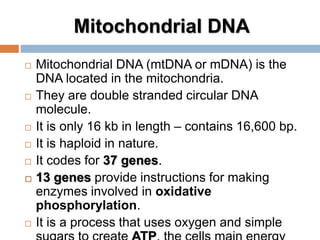
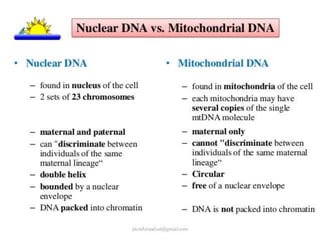
 Mitochondrial DNA (mtDNA or mDNA) is the
DNA located in the mitochondria.
 They are double stranded circular DNA
molecule.
 It is only 16 kb in length – contains 16,600 bp.
 It is haploid in nature.
 It codes for 37 genes.
 13 genes provide instructions for making
enzymes involved in oxidative
phosphorylation.
 It is a process that uses oxygen and simple
Mitochondrial DNA
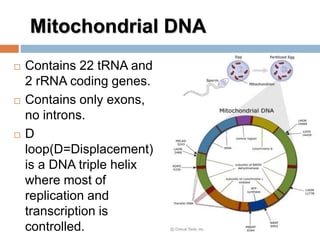
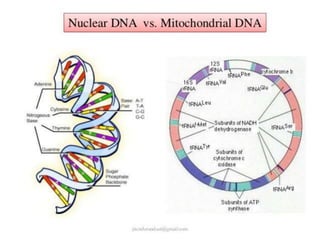
 Contains 22 tRNA and
2 rRNA coding genes.
 Contains only exons,
no introns.
 D
loop(D=Displacement)
is a DNA triple helix
where most of
replication and
transcription is
controlled.
HOMOPLASMY AND
HETEROPLASMY
 Homoplasmy:
 Homoplasmy is a term used in
genetics to describe a eukaryotic cell whose
copies of mtDNA are identical.
 Heteroplasmy
 Heteroplasmy is the presence of more than
one type of mtDNA which has a mixture of
both wild type and mutant DNA in a single cell.
 It is a rare condition and is often associated
with mitochondrial DNA diiseases.
 Maternal inheritance refers to the
transmission of genes only through the female.
 In higher animals, mitochondrial DNA
(mtDNA) shows maternal inheritance.
 During fertilisation, the sperm only contributes
its nucleus(23 chromosomes)
 Mitochondria of the sperm cell are located at
the mitochondrial sheath which is destroyed
upon fertilization.
 Only available mtDNA is that of the mother’s;
this is why mtDNA is of maternal origin.
Maternal Inheritance of
mtDNA
 The mitochondrial genome has a very high
mutation rate, 10 to 17 fold higher than that
observed in nuclear DNA. It is due to
(i) insufficient DNA repair system.
(ii) Lack of DNA proteins such as histones.
(iii) Spontaneous error arising during DNA.
 The diseases associated with mtDNA are:
1) Cyclic vomiting syndrome
2) Kearnes sayre syndrome
3) Cytochrome c oxidase deficiency
4) Leigh syndrome
5) Mitochondrial complexIII deficiency
THANK YOU…..

Mitochondrial DNA

  • 1.
  • 2.
    Mitochondrial DNA  MitochondrialDNA (mtDNA or mDNA) is the DNA located in the mitochondria.  They are double stranded circular DNA molecule.  It is only 16 kb in length – contains 16,600 bp.  It is haploid in nature.  It codes for 37 genes.  13 genes provide instructions for making enzymes involved in oxidative phosphorylation.  It is a process that uses oxygen and simple
  • 3.
    Mitochondrial DNA  Contains22 tRNA and 2 rRNA coding genes.  Contains only exons, no introns.  D loop(D=Displacement) is a DNA triple helix where most of replication and transcription is controlled.
  • 6.
    HOMOPLASMY AND HETEROPLASMY  Homoplasmy: Homoplasmy is a term used in genetics to describe a eukaryotic cell whose copies of mtDNA are identical.  Heteroplasmy  Heteroplasmy is the presence of more than one type of mtDNA which has a mixture of both wild type and mutant DNA in a single cell.  It is a rare condition and is often associated with mitochondrial DNA diiseases.
  • 7.
     Maternal inheritancerefers to the transmission of genes only through the female.  In higher animals, mitochondrial DNA (mtDNA) shows maternal inheritance.  During fertilisation, the sperm only contributes its nucleus(23 chromosomes)  Mitochondria of the sperm cell are located at the mitochondrial sheath which is destroyed upon fertilization.  Only available mtDNA is that of the mother’s; this is why mtDNA is of maternal origin. Maternal Inheritance of mtDNA
  • 9.
     The mitochondrialgenome has a very high mutation rate, 10 to 17 fold higher than that observed in nuclear DNA. It is due to (i) insufficient DNA repair system. (ii) Lack of DNA proteins such as histones. (iii) Spontaneous error arising during DNA.
  • 10.
     The diseasesassociated with mtDNA are: 1) Cyclic vomiting syndrome 2) Kearnes sayre syndrome 3) Cytochrome c oxidase deficiency 4) Leigh syndrome 5) Mitochondrial complexIII deficiency
  • 11.