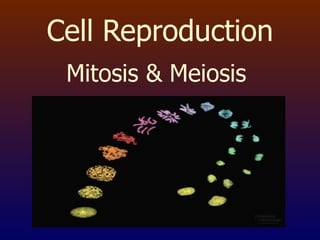
Cell Reproduction Mitosis & Meiosis
Why Cells Divide Surface Area/ Volume Ratio As the cell grows, the volume increases at a greater rate than the surface area Can't take in enough nutrients, or remove wastes Therefore the cell must grow or divide Growth and Repair Replace worn or damaged cells Frequency of replacement varies: bacteria ~ every 20 minutes human cells ~ every 18-22 hours Many cells in the body don't divide
Cell Division
Cellular Reproduction When the parent cell divides, it forms new  daughter  cells Organisms reproduce in two ways: Asexual Reproduction Sexual Reproduction
Sexual vs. Asexual Reproduction Asexual Reproduction production of offspring from one parent  therefore genetic material is identical to parent Sexual Reproduction  formation of a new individual from the union of 2 cells  2 parents, therefore offspring have some hereditary material from each
Types of Asexual Reproduction Binary Fission  simplest form; the  cell splits in 2 Spore Formation Begins with replication Spores can remain inactive until conditions are favorable molds, fungi Yeast reproduce by budding Vegetative Propagation Some plants, e.g. strawberries Regeneration  planaria, star fish, etc.
  Cell Division in    Prokaryotes   Binary Fission: The simplest form of cell division The cell splits in 2
The Process of Binary Fission First the single circular chromosome duplicates =  Replication Both chromosomes attach to sites on the cell membrane As the cell grows, a new membrane forms between attachment sites Membrane pinches off and the new cells separate
Sexual Reproduction The joining of 2 specialized sex cells called  gametes male = sperm female = ovum Process of combining gametes =  fertilization   Fertilization produces a  zygote has characteristics of both parents
  Human Sexual    Reproduction Male testis produces sperm Female ovary produces ova Each has 23 chromosomes Unite to form a zygote with 46 chromosomes 23 pair Develops into a fetus
Cell Division All types of reproduction require cell division 2 processes can be used to divide the cell’s nuclear material: Mitosis Occurs in  somatic  cells (body cells) in eukaryotes As a result of  mitosis   each daughter cell receives an exact copy of the chromosomes present in the parent cell Meiosis Occurs in gametes (sex cells) As a result each daughter cell receives 1 of each pair of chromosomes present in the parent cell
Mitosis Cell division in eukaryotic cells involves  nuclear  division called  mitosis Occurs in  somatic  cells  body cells; not sex cells As a result of  mitosis,   each daughter cell receives an exact copy of the  chromosomes  present in the parent cell Chromosomes  contain genetic material DNA
Chromosomes During cell division in eukaryotic cells, the DNA is coiled into  chromosomes Every body cell of the same type of organism has the same number of chromosomes humans = 46 goldfish = 94 mosquito = 6
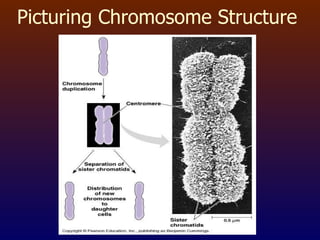
Chromosome Structure Each chromosome is formed from two joined strands called  chromatids Each  chromatid  is alike has a long arm & a short arm joined at the  centromere Chromosomes contain DNA and associated proreins
Chromosomal Proteins Each chromosome is a single DNA molecule and associated proteins Histones – One type of chromosomal protein The DNA wraps tightly around the histones Histones help maintain the shape of the chromosome Nonhistone proteins -  control the activity of specific regions of DNA
Picturing Chromosome Structure
Visualizing Chromosomes
Chromosome Make-up Chromosomes of somatic cells are in pairs One of each pair comes from mother, one from father The 2 chromosomes in a pair are  homologous  Alike in appearance and type of genetic information carried Humans have 23 pairs of chromosomes 22 pairs of  autosomes   Autosomes are all but the sex 2 sex chromosomes ( X & Y)
Sex Chromosomes Determine the sex of the organism Also carry other genetic information  In humans, either X or Y Females are XX, males are XY Thus the male determines the sex of the offspring
Haploid vs. Diploid Cells with two copies of each chromosome =  diploid Autosomal  cells are  diploid Gametes (sex cells) have only one of each type of chromosome Cells with one copy of each chromosome =  haploid
Karyotypes A picture of paired human chromosomes Used to to detect certain genetic diseases
 
Mitosis The process of dividing the nuclear material in a somatic cell in eukaryotes Necessary for cell division
Preparation for Mitosis Interphase   The time between the formation of a cell through mitosis and the next mitosis Most of the cell cycle is  interphase During this phase cell prepares by: replicating genetic material producing organelles assembling structures needed for mitosis
Chromosomes & Interphase During  interphase  chromosomes cannot be distinguished under the light microscope  They appear as  chromatin At the start of mitosis, the  chromatin   thickens, and chromosomes become visible
The Cell Cycle The sequence of cell growth and division The cell cycle can last several hours to several days Can be affected by environmental factors, like temperature Has 4 stages: mitosis & division of cytoplasm ( cytokinesis ) The other 3 are part of  interphase : G1 S G2
Picturing the Cell Cycle
G1 - Growth After mitosis, a period of intense cellular activity and growth The cell doubles in size Enzyme production is high Cells that stop growing remain in G1
S- Synthesis   Cells that divide enter S, or synthesis, phase   The chromosomes replicate
G2 – Further Growth A second period of growth Structures used in mitosis are assembled
The Phases of Mitosis  Mitosis is actually a continuous process But we divide it into 4 phases: Prophase Metaphase Anaphase Telophase
Prophase 60% of the period of mitosis is  prophase Divided into 3 parts:  early, middle, & late Chromosomes begin to coil into short rods Nucleoli break down & begin to disappear 2 pairs of dark spots called  centrosomes  appear outside the nuclear membrane In animal cells, the  centrosomes  contain  centrioles , formed from  microtubules Plant cells have no  centrioles The  centrosomes  move to opposite sides of the cell
Mid Prophase At the beginning of mid-prophase spindle fibers form between the centrioles Additional fibers radiating out from each centriole form the  aster The nuclear membrane has broken down and disappeared
The Mitotic Spindle Spindle fibers  made of  microtubules  radiate from the  centrosomes This array of spindle fibers = the  mitotic spindle 2 types of spindle fibers: Kinetechore  fibers Attach to a disk-shaped protein called a kinetecore Found in the centromere of each chromosome Extend from the kinetechore of each chromatid to one of the centrosomes Polar  fibers Extend across the dividing cell from one centrosome to the other
 
Late Prophase The centrosome pairs are at opposite ends of the cell The centosomes are fully formed Chromosomes are attached to the centrosomes by spindle fibers Other spindle fibers stretch across the cell from one centriole to the other
 
Metaphase The chromosomes are pushed and pulled by spindle fibers along cell's the midplane called the  equator
Anaphase Begins with the separation of  chromatids  in each  chromosome Spindle fibers  appear to shorten, pulling the  chromatids  apart at the centomere Each  chromatid  is now a  chromosome 2 sets of separated chromosomes then move through the cytoplasm to opposite poles of the cell
 
Telophase The last stage of mitosis After the individual chromosomes have reached opposite poles of the cell, spindles disappear A nuclear membrane forms around each set of chromosomes Chromosomes return to a thread-like mass Centrioles duplicate  2 centrioles formed in each daughter cell Nucleoli re-form within each newly formed nucleus
 
Cytokinesis The division of the cytoplasm Follows mitosis   Cytokinesis begins during telophase In animal cells, the cell membrane pinches together The area that pinches in and separates is called the  cleavage furrow In plants, a  cell plate  is formed, dividing the two halves
Picturing Cytokinesis
 
 
Chromosome Number Cells formed thru mitosis have the same number of chromosomes as the parent cells If combined in sexual reproduction, the offspring would have 2x chromosomes! Therefore gametes have only half the number of chromosomes of somatic cells Gametes = sex cells
Meiosis Gametes need another process for nuclear division  Meiosis reduces the number of chromosomes to 1/2 the number in somatic cells
Meiosis I & II Forming  haploid  daughter cells from  diploid  parent cells requires two successive cell divisions: First = Meiosis I –  homologous chromosomes separate Second = Meiosis II  chromatids of each chromosome separate
Meiosis I Preceded by replication of DNA that forms the chromosome Synapsis  = pairing of homologous chromosomes Each pair of homologous chromosomes twists around each other, forming a structure called a  tetrad Meiosis can be divided into same 4 phases as mitosis:  Prophase, Metaphase, Anaphase, Telophase
Prophase I   Chromatin begins to coil into short rods   Homologous chromosomes are formed   Spindle fibers appear   Nucleoli break down By the end, the nuclear membrane has dissolved, and tetrads are visible
Crossing Over During  synapsis , (prophase I) the chromatids of homologous pairs twist around each other A portion of one chromatid may break off and reattach, “trading” with the same piece from its homologous partner The exchange of genes by reciprocal segments of homologous chromosomes during meiosis = “ crossing-over ”
Crossing over causes exchange of genetic material between maternal & paternal chromosomes  Results in genetic recombination Genetic recombination is less likely in genes that are closer together.
Chromosome Mapping The likelihood that recombination will occur due to crossing-over depends on the genes’ distance from each other on the chromosome Scientists can determine how frequently genes for particular traits occur together in offspring This can be used to create a map of the chromosome 1% recombination (crossing-over) = 1 map unit
Metaphase I Tetrads line up along the equator of the cell Each tetrad becomes attached to spindle fibers
Anaphase I Homologous chromosomes that form each tetrad are pulled apart in pairs One pair goes to one end of the cell, the other to opposite end
Telophase I Chromosomes reach ends of the cell Cell divides into 2 daughter cells
 
Independent Assortment During Anaphase I, one member of each homologous chromosome pair moves to one end of the cell, the other moves to the opposite end The separation of homologous chromosomes is random More, or fewer maternal (or paternal) chromosomes may end up on one side or the other Each separation is independent of the others This is the principal of  independent assortment  of chromosomes Results in genetic variation
 
Meiosis I Summary Meiosis I is a  Reductive Division It reduces the number of chromosomes from diploid "2n" to haploid "n"
Meiosis II Similar to mitosis but not preceded by replication of DNA 4 Stages: Prophase II Metaphase II Anaphase II Telophase II
Prophase II & Metaphase II Prophase II A new spindle forms around paired chromatids Metaphase II Chromosomes line up along the equator They are attached at the centromere to spindle fibers
Anaphase II Centromeres duplicate & the chromatids separate Resulting single chromatids move to opposite poles Chromatids are now called chromosomes
Telophase II   A nuclear membrane forms around each set of chromosomes   The spindle breaks down and cytokinesis occurs   Result:  4 haploid daughter cells
 
Males vs. Females In males, all 4 daughter cells differentiate to become sperm   In females, the cytoplasm divides unevenly in Meiosis I  The smaller cell =  first polar body   doesn't survive   In Meiosis II, the division is again unequal smaller half is  second polar body So only 1 of 4 daughter cells survives rich in cytoplasm, has many nutrients to nourish the young organism
Comparing Mitosis & Meiosis MEIOSIS 2 4 diploid haploid different MITOSIS 1 2 diploid diploid identical # of nuclear divisions: # of daughter cells: Parent cell type: Daughter cell type: Genetic likeness to  parent:
 
Control of Cell Division Timing and rate of cell division varies in different cell types Control of rate of division is critical Some cells require regulatory substances to begin division =  growth factors
Effect of Growth Factors
Effect of Density Density of cells also effects the rate of division Crowding inhibits cell division
The Restriction Point A crucial checkpoint occurs late in the G1 phase of the cell cycle  Point of decision to divide =  restriction point Cell cannot turn back after this point If it is “yes,” cell goes to S phase and copies DNA If “no,” it goes to non-dividing state (G 0 ) Most cells are in G 0
MPF After S, the cell will enter G2 The “OK” signal that causes the cell to proceed from G2 to mitosis =  mitosis promoting factor   (MPF) A complex of proteins   MPF is an enzyme Protein kinase
Abnormal Cell Division Cancer cells do not respond normally to the body’s control mechanisms for cell division Cancer cells divide excessively Can invade other body tissues When a cell divides abnormally =  transformed Abnormal cells are usually destroyed by the immune system
Cancer If abnormal cells are not destroyed and reproduce, they may form a mass of abnormal cells =  tumor Benign tumor  = abnormal cells remain at the original site Malignant tumor  = cells spread to other parts of the body Metastasis  = spread of cancer cells in the body
Breast Cancer Cell

Cell Reproduction

  • 1.
  • 2.
    Why Cells DivideSurface Area/ Volume Ratio As the cell grows, the volume increases at a greater rate than the surface area Can't take in enough nutrients, or remove wastes Therefore the cell must grow or divide Growth and Repair Replace worn or damaged cells Frequency of replacement varies: bacteria ~ every 20 minutes human cells ~ every 18-22 hours Many cells in the body don't divide
  • 3.
  • 4.
    Cellular Reproduction Whenthe parent cell divides, it forms new daughter cells Organisms reproduce in two ways: Asexual Reproduction Sexual Reproduction
  • 5.
    Sexual vs. AsexualReproduction Asexual Reproduction production of offspring from one parent therefore genetic material is identical to parent Sexual Reproduction formation of a new individual from the union of 2 cells 2 parents, therefore offspring have some hereditary material from each
  • 6.
    Types of AsexualReproduction Binary Fission simplest form; the cell splits in 2 Spore Formation Begins with replication Spores can remain inactive until conditions are favorable molds, fungi Yeast reproduce by budding Vegetative Propagation Some plants, e.g. strawberries Regeneration planaria, star fish, etc.
  • 7.
    CellDivision in Prokaryotes Binary Fission: The simplest form of cell division The cell splits in 2
  • 8.
    The Process ofBinary Fission First the single circular chromosome duplicates = Replication Both chromosomes attach to sites on the cell membrane As the cell grows, a new membrane forms between attachment sites Membrane pinches off and the new cells separate
  • 9.
    Sexual Reproduction Thejoining of 2 specialized sex cells called gametes male = sperm female = ovum Process of combining gametes = fertilization Fertilization produces a zygote has characteristics of both parents
  • 10.
    HumanSexual Reproduction Male testis produces sperm Female ovary produces ova Each has 23 chromosomes Unite to form a zygote with 46 chromosomes 23 pair Develops into a fetus
  • 11.
    Cell Division Alltypes of reproduction require cell division 2 processes can be used to divide the cell’s nuclear material: Mitosis Occurs in somatic cells (body cells) in eukaryotes As a result of mitosis each daughter cell receives an exact copy of the chromosomes present in the parent cell Meiosis Occurs in gametes (sex cells) As a result each daughter cell receives 1 of each pair of chromosomes present in the parent cell
  • 12.
    Mitosis Cell divisionin eukaryotic cells involves nuclear division called mitosis Occurs in somatic cells body cells; not sex cells As a result of mitosis, each daughter cell receives an exact copy of the chromosomes present in the parent cell Chromosomes contain genetic material DNA
  • 13.
    Chromosomes During celldivision in eukaryotic cells, the DNA is coiled into chromosomes Every body cell of the same type of organism has the same number of chromosomes humans = 46 goldfish = 94 mosquito = 6
  • 14.
    Chromosome Structure Eachchromosome is formed from two joined strands called chromatids Each chromatid is alike has a long arm & a short arm joined at the centromere Chromosomes contain DNA and associated proreins
  • 15.
    Chromosomal Proteins Eachchromosome is a single DNA molecule and associated proteins Histones – One type of chromosomal protein The DNA wraps tightly around the histones Histones help maintain the shape of the chromosome Nonhistone proteins - control the activity of specific regions of DNA
  • 16.
  • 17.
  • 18.
    Chromosome Make-up Chromosomesof somatic cells are in pairs One of each pair comes from mother, one from father The 2 chromosomes in a pair are homologous Alike in appearance and type of genetic information carried Humans have 23 pairs of chromosomes 22 pairs of autosomes Autosomes are all but the sex 2 sex chromosomes ( X & Y)
  • 19.
    Sex Chromosomes Determinethe sex of the organism Also carry other genetic information In humans, either X or Y Females are XX, males are XY Thus the male determines the sex of the offspring
  • 20.
    Haploid vs. DiploidCells with two copies of each chromosome = diploid Autosomal cells are diploid Gametes (sex cells) have only one of each type of chromosome Cells with one copy of each chromosome = haploid
  • 21.
    Karyotypes A pictureof paired human chromosomes Used to to detect certain genetic diseases
  • 22.
  • 23.
    Mitosis The processof dividing the nuclear material in a somatic cell in eukaryotes Necessary for cell division
  • 24.
    Preparation for MitosisInterphase The time between the formation of a cell through mitosis and the next mitosis Most of the cell cycle is interphase During this phase cell prepares by: replicating genetic material producing organelles assembling structures needed for mitosis
  • 25.
    Chromosomes & InterphaseDuring interphase chromosomes cannot be distinguished under the light microscope They appear as chromatin At the start of mitosis, the chromatin thickens, and chromosomes become visible
  • 26.
    The Cell CycleThe sequence of cell growth and division The cell cycle can last several hours to several days Can be affected by environmental factors, like temperature Has 4 stages: mitosis & division of cytoplasm ( cytokinesis ) The other 3 are part of interphase : G1 S G2
  • 27.
  • 28.
    G1 - GrowthAfter mitosis, a period of intense cellular activity and growth The cell doubles in size Enzyme production is high Cells that stop growing remain in G1
  • 29.
    S- Synthesis  Cells that divide enter S, or synthesis, phase   The chromosomes replicate
  • 30.
    G2 – FurtherGrowth A second period of growth Structures used in mitosis are assembled
  • 31.
    The Phases ofMitosis Mitosis is actually a continuous process But we divide it into 4 phases: Prophase Metaphase Anaphase Telophase
  • 32.
    Prophase 60% ofthe period of mitosis is prophase Divided into 3 parts: early, middle, & late Chromosomes begin to coil into short rods Nucleoli break down & begin to disappear 2 pairs of dark spots called centrosomes appear outside the nuclear membrane In animal cells, the centrosomes contain centrioles , formed from microtubules Plant cells have no centrioles The centrosomes move to opposite sides of the cell
  • 33.
    Mid Prophase Atthe beginning of mid-prophase spindle fibers form between the centrioles Additional fibers radiating out from each centriole form the aster The nuclear membrane has broken down and disappeared
  • 34.
    The Mitotic SpindleSpindle fibers made of microtubules radiate from the centrosomes This array of spindle fibers = the mitotic spindle 2 types of spindle fibers: Kinetechore fibers Attach to a disk-shaped protein called a kinetecore Found in the centromere of each chromosome Extend from the kinetechore of each chromatid to one of the centrosomes Polar fibers Extend across the dividing cell from one centrosome to the other
  • 35.
  • 36.
    Late Prophase Thecentrosome pairs are at opposite ends of the cell The centosomes are fully formed Chromosomes are attached to the centrosomes by spindle fibers Other spindle fibers stretch across the cell from one centriole to the other
  • 37.
  • 38.
    Metaphase The chromosomesare pushed and pulled by spindle fibers along cell's the midplane called the equator
  • 39.
    Anaphase Begins withthe separation of chromatids in each chromosome Spindle fibers appear to shorten, pulling the chromatids apart at the centomere Each chromatid is now a chromosome 2 sets of separated chromosomes then move through the cytoplasm to opposite poles of the cell
  • 40.
  • 41.
    Telophase The laststage of mitosis After the individual chromosomes have reached opposite poles of the cell, spindles disappear A nuclear membrane forms around each set of chromosomes Chromosomes return to a thread-like mass Centrioles duplicate 2 centrioles formed in each daughter cell Nucleoli re-form within each newly formed nucleus
  • 42.
  • 43.
    Cytokinesis The divisionof the cytoplasm Follows mitosis   Cytokinesis begins during telophase In animal cells, the cell membrane pinches together The area that pinches in and separates is called the cleavage furrow In plants, a cell plate is formed, dividing the two halves
  • 44.
  • 45.
  • 46.
  • 47.
    Chromosome Number Cellsformed thru mitosis have the same number of chromosomes as the parent cells If combined in sexual reproduction, the offspring would have 2x chromosomes! Therefore gametes have only half the number of chromosomes of somatic cells Gametes = sex cells
  • 48.
    Meiosis Gametes needanother process for nuclear division Meiosis reduces the number of chromosomes to 1/2 the number in somatic cells
  • 49.
    Meiosis I &II Forming haploid daughter cells from diploid parent cells requires two successive cell divisions: First = Meiosis I – homologous chromosomes separate Second = Meiosis II chromatids of each chromosome separate
  • 50.
    Meiosis I Precededby replication of DNA that forms the chromosome Synapsis = pairing of homologous chromosomes Each pair of homologous chromosomes twists around each other, forming a structure called a tetrad Meiosis can be divided into same 4 phases as mitosis: Prophase, Metaphase, Anaphase, Telophase
  • 51.
    Prophase I  Chromatin begins to coil into short rods   Homologous chromosomes are formed   Spindle fibers appear   Nucleoli break down By the end, the nuclear membrane has dissolved, and tetrads are visible
  • 52.
    Crossing Over During synapsis , (prophase I) the chromatids of homologous pairs twist around each other A portion of one chromatid may break off and reattach, “trading” with the same piece from its homologous partner The exchange of genes by reciprocal segments of homologous chromosomes during meiosis = “ crossing-over ”
  • 53.
    Crossing over causesexchange of genetic material between maternal & paternal chromosomes Results in genetic recombination Genetic recombination is less likely in genes that are closer together.
  • 54.
    Chromosome Mapping Thelikelihood that recombination will occur due to crossing-over depends on the genes’ distance from each other on the chromosome Scientists can determine how frequently genes for particular traits occur together in offspring This can be used to create a map of the chromosome 1% recombination (crossing-over) = 1 map unit
  • 55.
    Metaphase I Tetradsline up along the equator of the cell Each tetrad becomes attached to spindle fibers
  • 56.
    Anaphase I Homologouschromosomes that form each tetrad are pulled apart in pairs One pair goes to one end of the cell, the other to opposite end
  • 57.
    Telophase I Chromosomesreach ends of the cell Cell divides into 2 daughter cells
  • 58.
  • 59.
    Independent Assortment DuringAnaphase I, one member of each homologous chromosome pair moves to one end of the cell, the other moves to the opposite end The separation of homologous chromosomes is random More, or fewer maternal (or paternal) chromosomes may end up on one side or the other Each separation is independent of the others This is the principal of independent assortment of chromosomes Results in genetic variation
  • 60.
  • 61.
    Meiosis I SummaryMeiosis I is a Reductive Division It reduces the number of chromosomes from diploid "2n" to haploid "n"
  • 62.
    Meiosis II Similarto mitosis but not preceded by replication of DNA 4 Stages: Prophase II Metaphase II Anaphase II Telophase II
  • 63.
    Prophase II &Metaphase II Prophase II A new spindle forms around paired chromatids Metaphase II Chromosomes line up along the equator They are attached at the centromere to spindle fibers
  • 64.
    Anaphase II Centromeresduplicate & the chromatids separate Resulting single chromatids move to opposite poles Chromatids are now called chromosomes
  • 65.
    Telophase II  A nuclear membrane forms around each set of chromosomes   The spindle breaks down and cytokinesis occurs   Result: 4 haploid daughter cells
  • 66.
  • 67.
    Males vs. FemalesIn males, all 4 daughter cells differentiate to become sperm   In females, the cytoplasm divides unevenly in Meiosis I The smaller cell = first polar body doesn't survive   In Meiosis II, the division is again unequal smaller half is second polar body So only 1 of 4 daughter cells survives rich in cytoplasm, has many nutrients to nourish the young organism
  • 68.
    Comparing Mitosis &Meiosis MEIOSIS 2 4 diploid haploid different MITOSIS 1 2 diploid diploid identical # of nuclear divisions: # of daughter cells: Parent cell type: Daughter cell type: Genetic likeness to parent:
  • 69.
  • 70.
    Control of CellDivision Timing and rate of cell division varies in different cell types Control of rate of division is critical Some cells require regulatory substances to begin division = growth factors
  • 71.
  • 72.
    Effect of DensityDensity of cells also effects the rate of division Crowding inhibits cell division
  • 73.
    The Restriction PointA crucial checkpoint occurs late in the G1 phase of the cell cycle Point of decision to divide = restriction point Cell cannot turn back after this point If it is “yes,” cell goes to S phase and copies DNA If “no,” it goes to non-dividing state (G 0 ) Most cells are in G 0
  • 74.
    MPF After S,the cell will enter G2 The “OK” signal that causes the cell to proceed from G2 to mitosis = mitosis promoting factor (MPF) A complex of proteins MPF is an enzyme Protein kinase
  • 75.
    Abnormal Cell DivisionCancer cells do not respond normally to the body’s control mechanisms for cell division Cancer cells divide excessively Can invade other body tissues When a cell divides abnormally = transformed Abnormal cells are usually destroyed by the immune system
  • 76.
    Cancer If abnormalcells are not destroyed and reproduce, they may form a mass of abnormal cells = tumor Benign tumor = abnormal cells remain at the original site Malignant tumor = cells spread to other parts of the body Metastasis = spread of cancer cells in the body
  • 77.