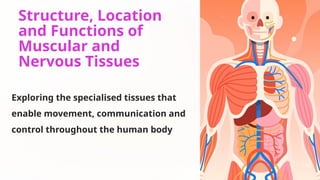
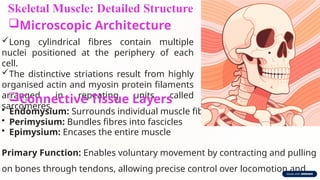
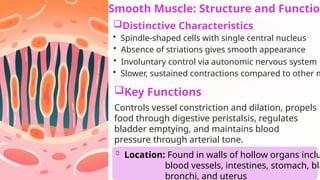
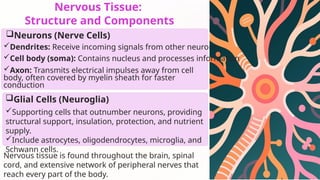
Structure, Location and Functions of Muscular and Nervous Tissues, Exploring the specialised tissues that enable movement, communication and control throughout the human body. Muscular Tissue is a Specialised for contraction and movement, enabling both voluntary actions and involuntary functions throughout the body. Nervous Tissue is a Specialised for rapid communication and precise control, transmitting electrical signals to coordinate bodily functions. These two tissue types work in remarkable coordination, with the nervous system controlling muscular contractions while muscles provide the force for movement and organ function. Function of skeletal muscle Enables voluntary movement by contracting and pulling on bones through tendons, allowing precise control over locomotion and body positioning. Found only in the myocardium (heart wall), continuously contracting throughout life without fatigue. Dendrites: Receive incoming signals from other neurons. Cell body (soma): Contains nucleus and processes information. Axon: Transmits electrical impulses away from cell body, often covered by myelin sheath for faster conduction. Nervous tissue is found throughout the brain, spinal cord, and extensive network of peripheral nerves that reach every part of the body. Central Nervous System: Brain and spinal cord process and integrate information,
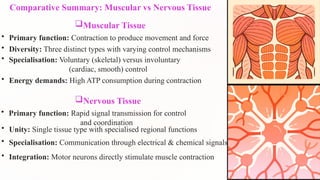
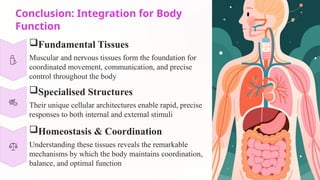
Peripheral Nervous System: Nerves extending throughout the body relay signals to and from the CNS. Muscular Tissue Primary function: Contraction to produce movement and force. Nervous Tissue Primary function: Rapid signal transmission for control and coordination. Understanding these tissues reveals the remarkable mechanisms by which the body maintains coordination, balance, and optimal function. Muscular and nervous tissues form the foundation for coordinated movement, communication, and precise control throughout the body. Orchestrates muscle contraction, sensory perception, memory formation, reasoning, emotions, and maintains homeostasis through constant monitoring. Controls vessel constriction and dilation, propels food through digestive peristalsis, regulates bladder emptying, and maintains blood pressure through arterial tone.