PROTEINS
SYNTHESIS
TRANSCRIPTION AND TRANSLATION
PROTEIN SYNTHESIS: AN
OVERVIEW
• Genetic information is contained within the nucleus of
a cell
• DNA in the nucleus directs protein synthesis but
protein synthesis occurs in ribosomes located in the
cytoplasm
• How does a ribosome synthesize the protein required
if it does not have access to DNA?
THE CENTRAL DOGMA OF
PROTEIN SYNTHESIS
PROTEIN SYNTHESIS: AN
OVERVIEW
• The answer lies in an intermediate
substance known as mRNA.
• Information is copied from DNA into
mRNA, this is transcription
• mRNA leaves the nucleus and enters the
cytoplasm of the cell
• Ribosomes use the mRNA as a blueprint
to synthesize proteins composed of aa,
this is translation.
DNA
3 main components:
• Deoxyribose sugar
• Phosphate group
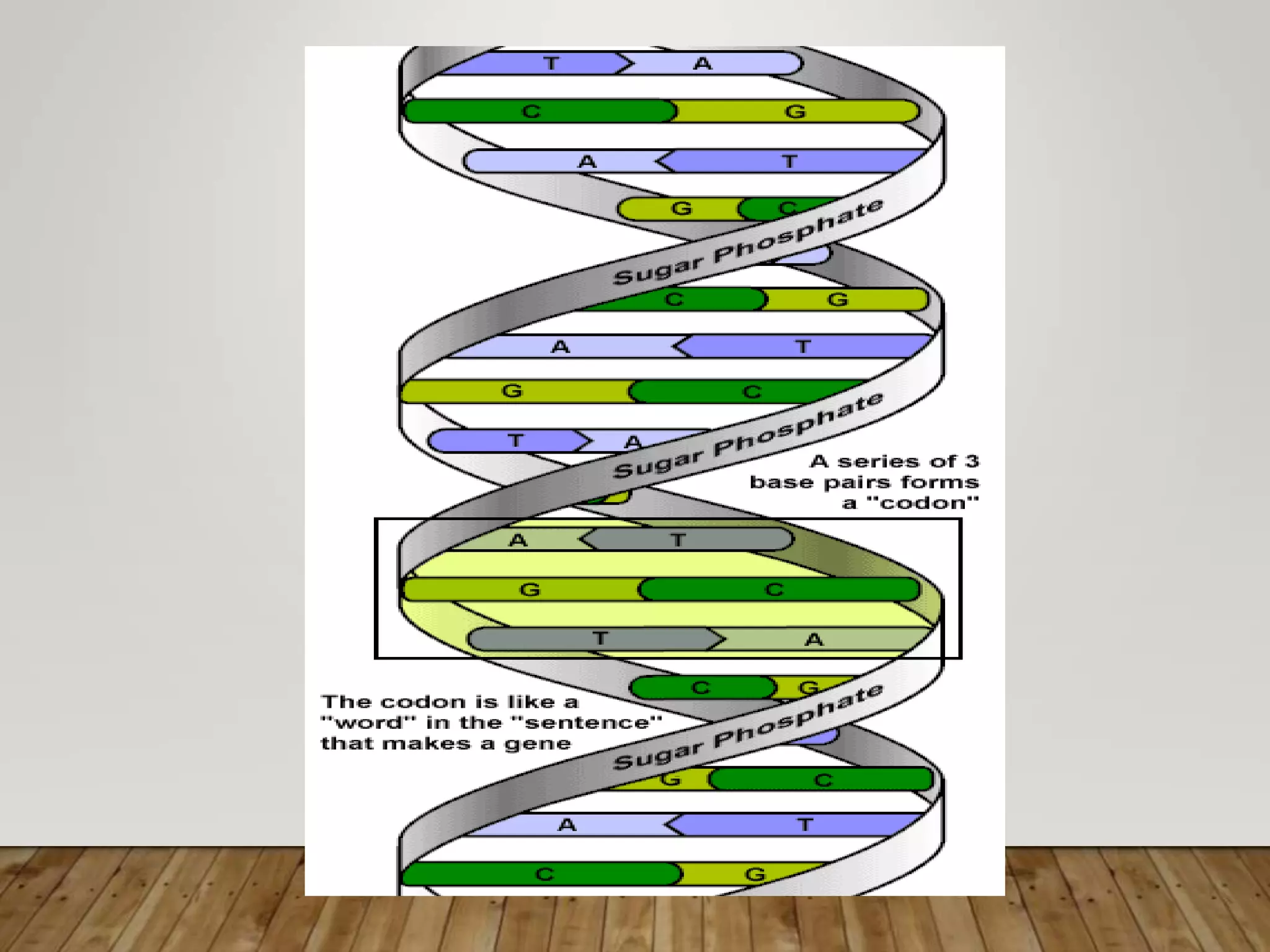
• Nitrogenous bases-adenine, guanine, cytosine and
thymine
• A forms 2 hydrogen bonds to T, G forms 3 hydrogen
bonds to C
DNA VS RNA
• Deoxyribose sugar
• Double stranded
• A pairs with T
• G pairs with C
• Resides in nucleus
• Ribose sugar
• Single stranded
• A pairs with U
• G pairs with C
• Resides in nucleus and
cytoplasm
RNA
• There are three types of RNA:
• mRNA is the “blueprint” for construction of a protein
• rRNA is the “construction site” where the proteins are
made
• tRNA is the “truck” delivering the proper aa to the site
of protein synthesis
GENES AND PROTEINS
• Genes are a sequence of nucleotides in DNA that code
for a particular protein
• Proteins drive cellular processes, determine physical
characteristics, and manifest genetic disorders by their
absence or presence
GENETIC CODE
• Proteins are composed of 20 different amino acids
• A sequence of 3 nucleotides is used to code each
amino acid
• Each triplet of nucleotides is called a codon
• Start codon AUG codes for amino acid methionine
• 3 stop codons
• There are 64 codons in the genetic code 43=64
• Several different codons can code for the same aa,
but no codon ever has more than one amino acid
counterpart.
• Codons are always written in the form of the RNA
transcript from the original DNA molecule.
CHARACTERISTICS OF THE CODE
• Continuity The genetic code reads as a long
series of three-letter codons that have no spaces
or punctuation and never overlap.
• Redundancy – Several different codons can code
for the same amino acid, but no codon ever has
more than one amino acid counterpart.
• Universality – the genetic code is the same in
almost all living organisms, from bacteria to
mammals
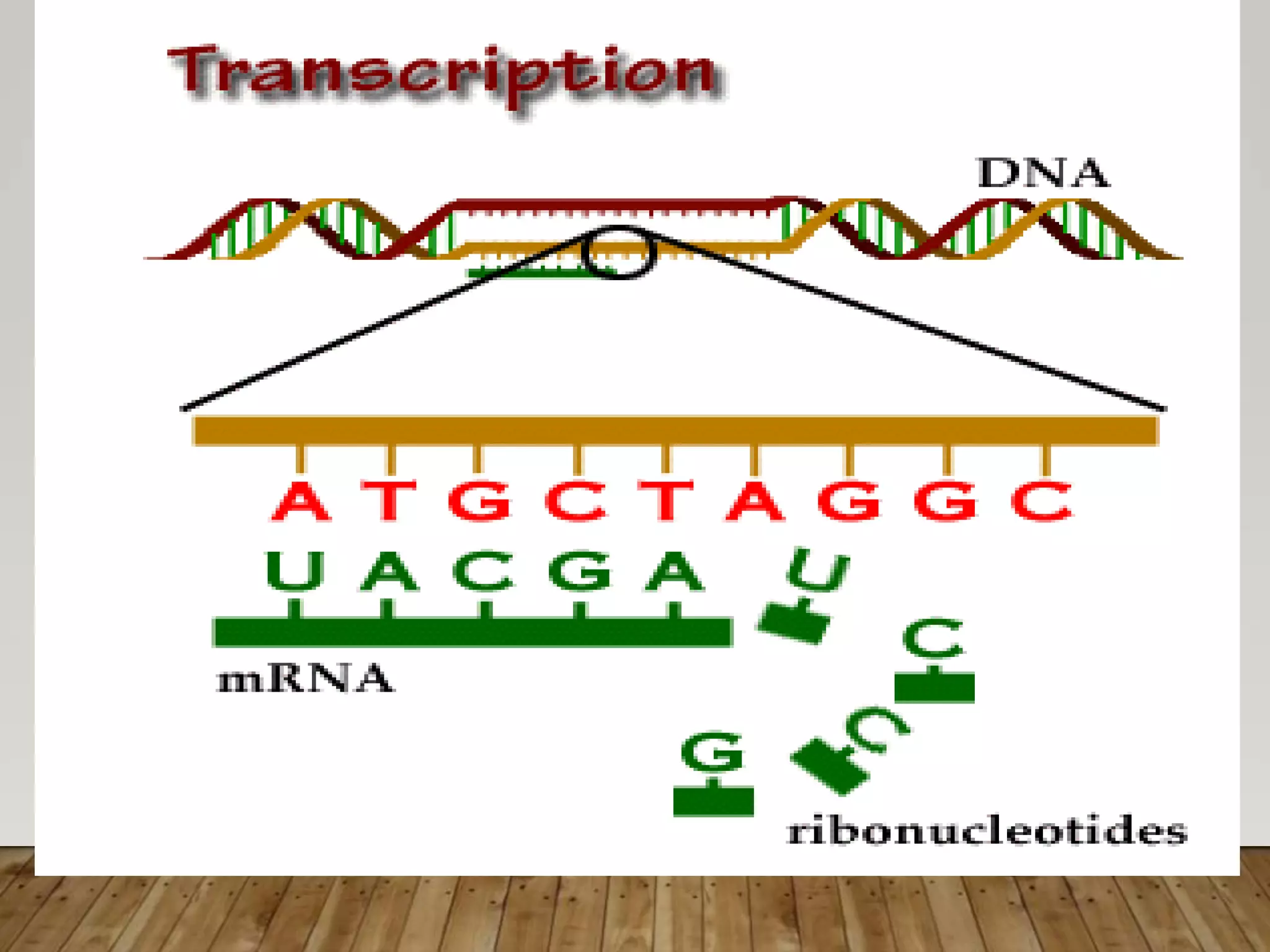
TRANSCRIPTION: INITIATION
• RNA polymerase binds to a segment of DNA and opens up the double
helix
• RNA polymerase recognizes the promoter region which is a sequence of
DNA rich in A and T bases (TATA box) found only on one strand of the
DNA.
TRANSCRIPTION: INITIATION
• An RNA polymerase cannot recognize the TATA box
and other landmarks of the promoter region on its
own. Another protein, a transcription factor that
recognizes the TATA box, binds to the DNA before the
RNA polymerase can do so.
TRANSCRIPTION: INITIATION
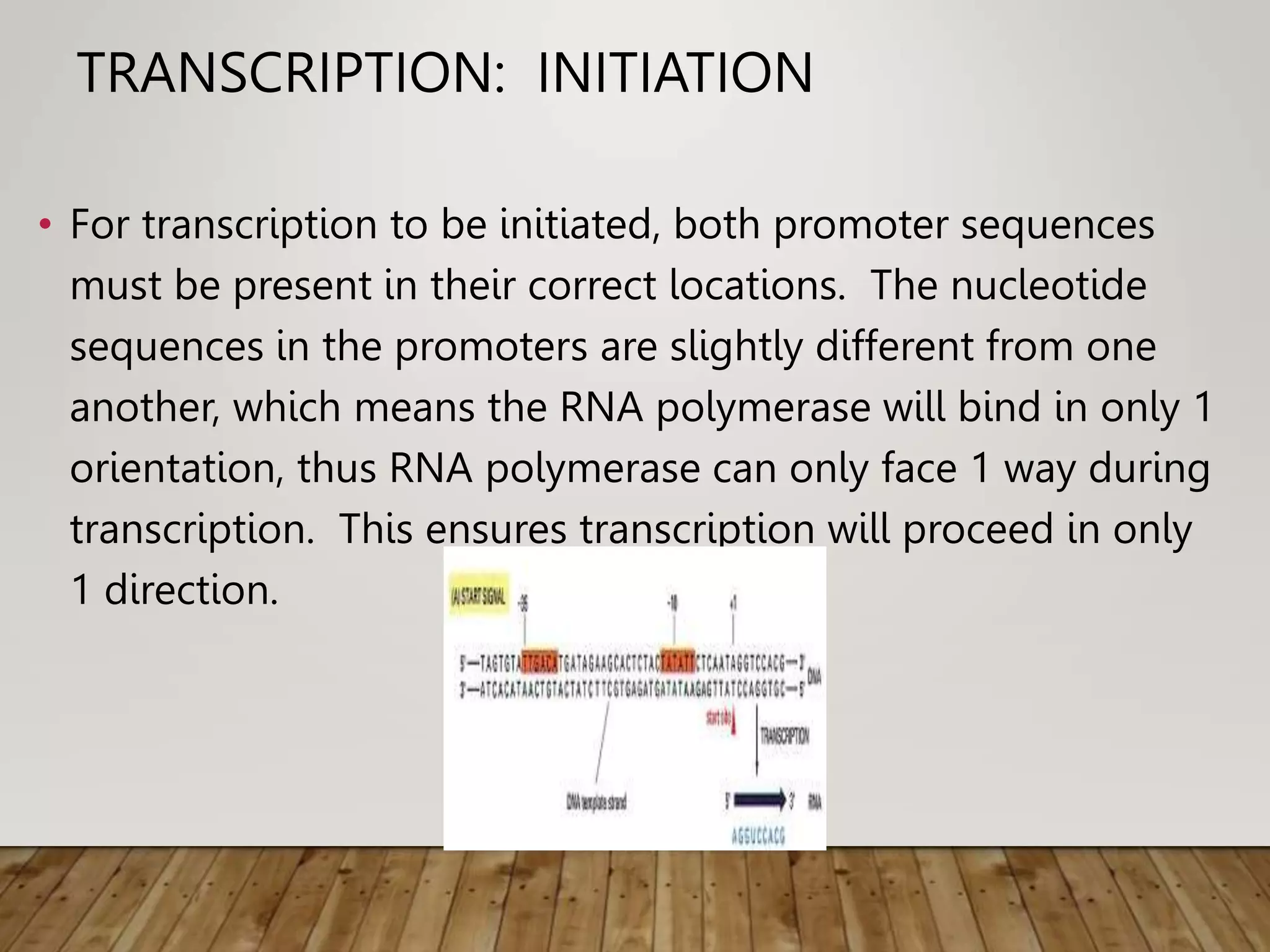
• For transcription to be initiated, both promoter sequences
must be present in their correct locations. The nucleotide
sequences in the promoters are slightly different from one
another, which means the RNA polymerase will bind in only 1
orientation, thus RNA polymerase can only face 1 way during
transcription. This ensures transcription will proceed in only
1 direction.
TRANSCRIPTION: ELONGATION
TRANSCRIPTION : ELONGATION
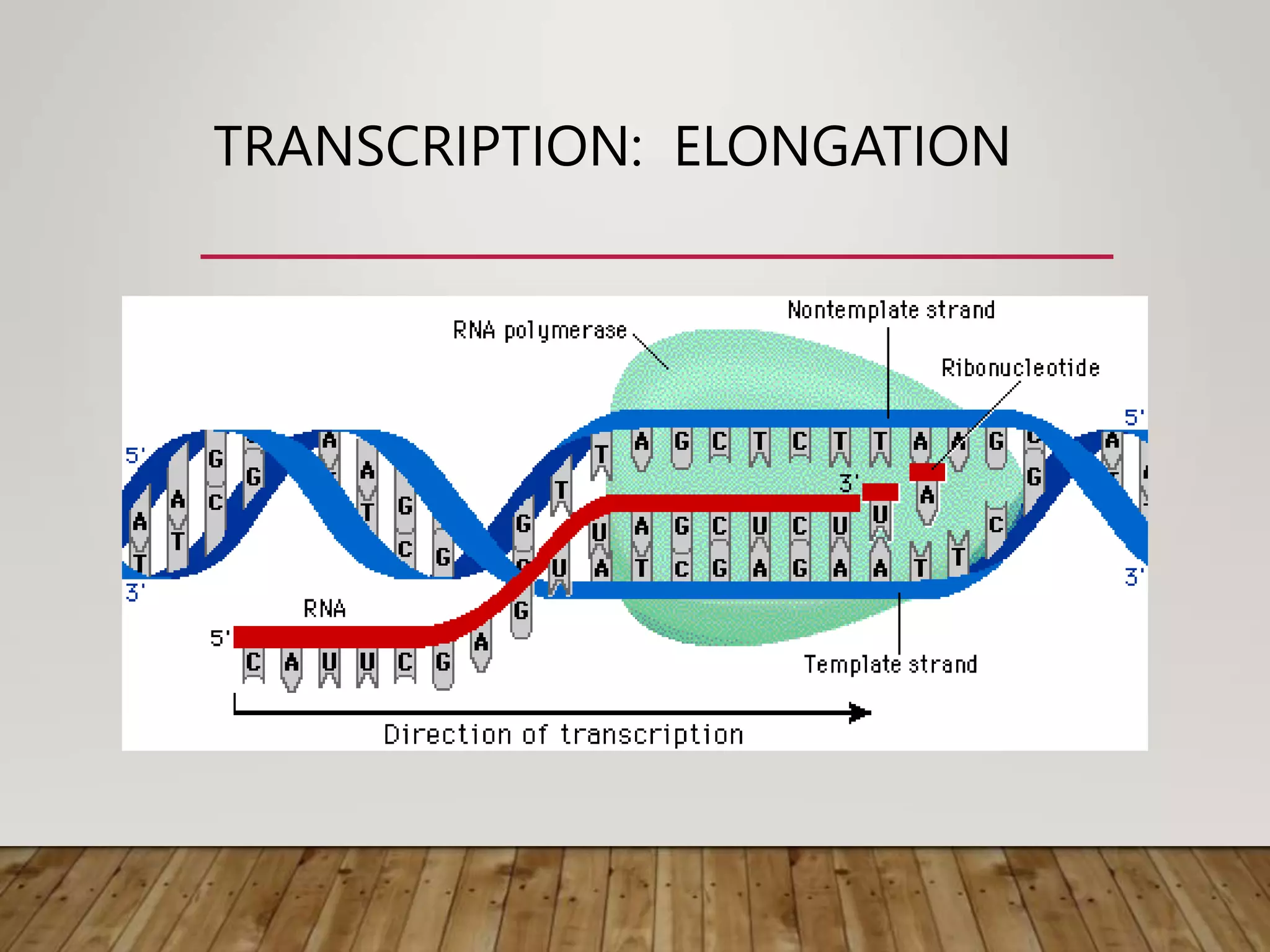
• The RNA polymerase uses only one of the strands
of DNA as a template for mRNA synthesis. This is
called the template strand or sense strand. The
coding strand or anti-sense strand contains the
complementary nucleotide sequence to the sense
strand.
• RNA polymerases can add nucleotides only to the
3’ end of a DNA sequence. Thus, an RNA molecule
elongates in the 5’ to 3’ direction.
• Consider the following DNA sequence
3’ TACTTACTCGTCTTG 5’
THE CODING STRAND
• RNA polymerase uses the
template strand to transcribe.
Thus the RNA is complimentary to
the template. The coding strand is
exactly identical to the mRNA, but
mRNA has uracil in place of
thymine.
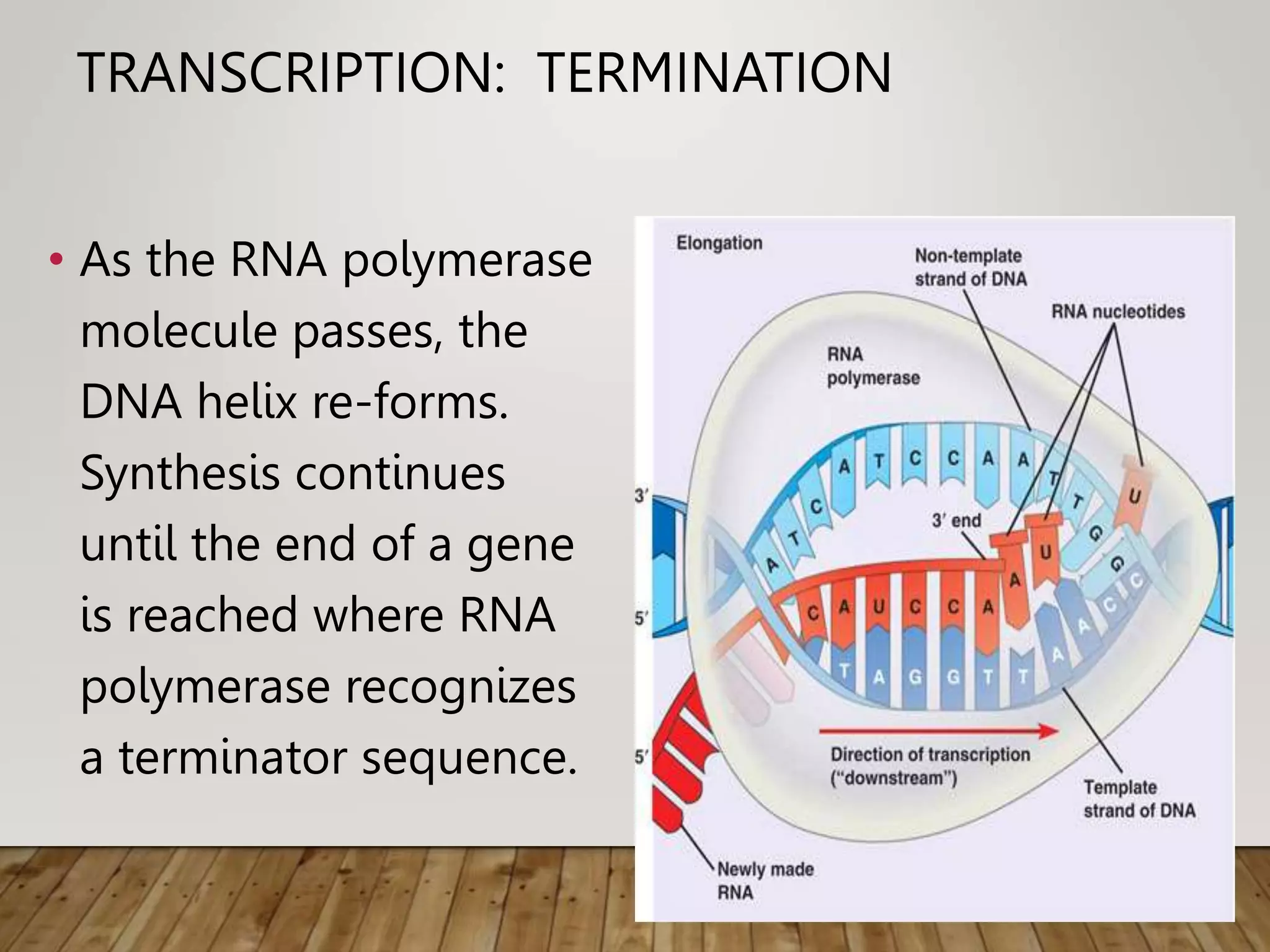
TRANSCRIPTION: TERMINATION
• As the RNA polymerase
molecule passes, the
DNA helix re-forms.
Synthesis continues
until the end of a gene
is reached where RNA
polymerase recognizes
a terminator sequence.
TRANSCRIPTION
• Once the RNA polymerase leaves the promoter region, a new RNA
polymerase can bind there to begin a new mRNA transcript.
• Since prokaryotes lack a membrane bound nucleus translation can
begin even before the mRNA dissociates. However the pre-mRNA
from eukaryotic cells needs some modification before it leave the
nucleus.
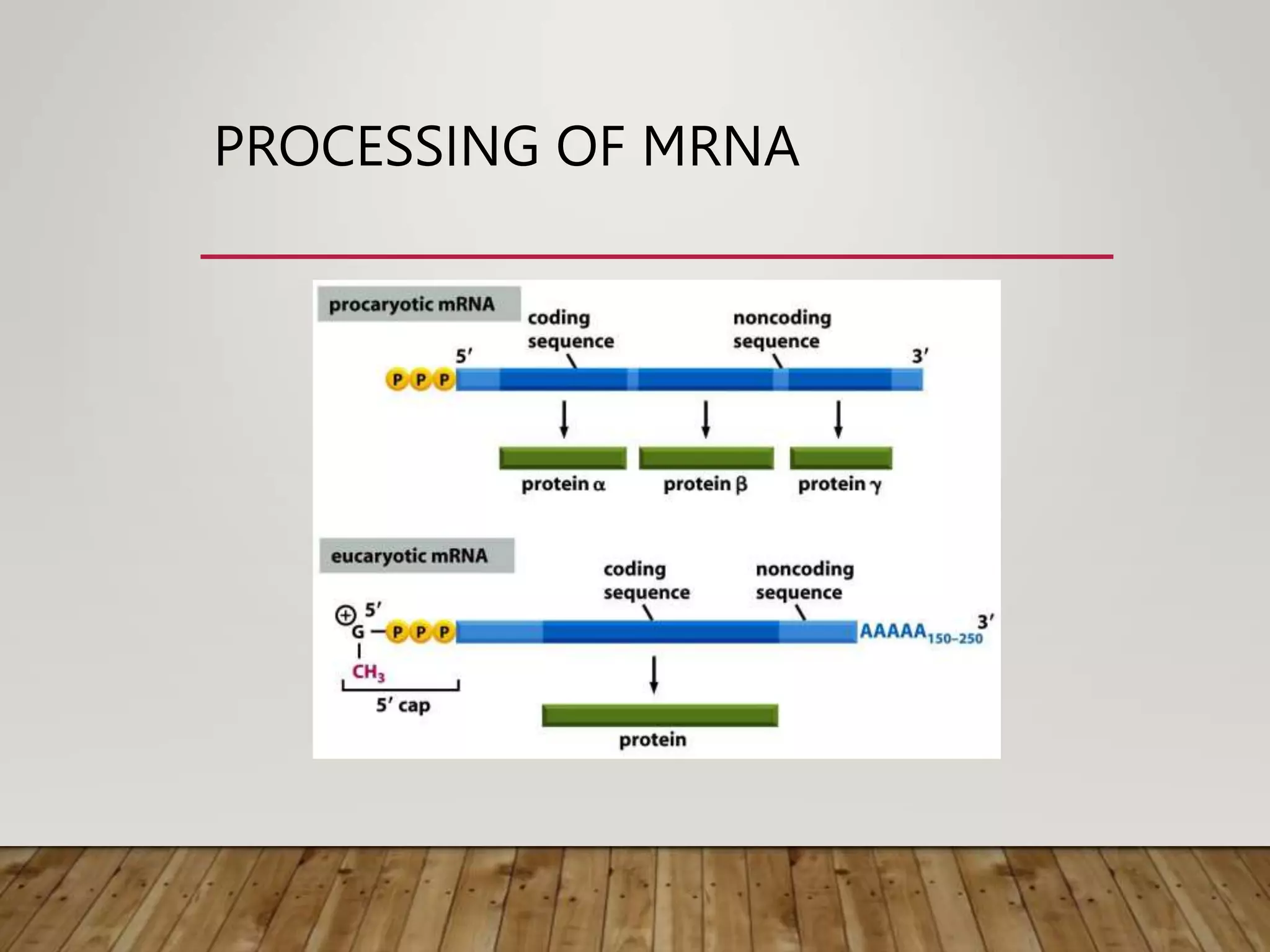
PROCESSING OF MRNA
TRANSCRIPT
• In eukaryotes, the mRNA that is released at the end of transcription is
called pre-mRNA. Pre-mRNA undergoes several changes before it is
exported out of the nucleus to protect it from the cytoplasmic
environment.
• The 5’ end of the pre-mRNA is capped with a modified form of the G
nucleotide. At the 3’ end, an enzyme in the nucleus adds the poly A tail,
a long series of A nucleotides.
PROCESSING OF MRNA
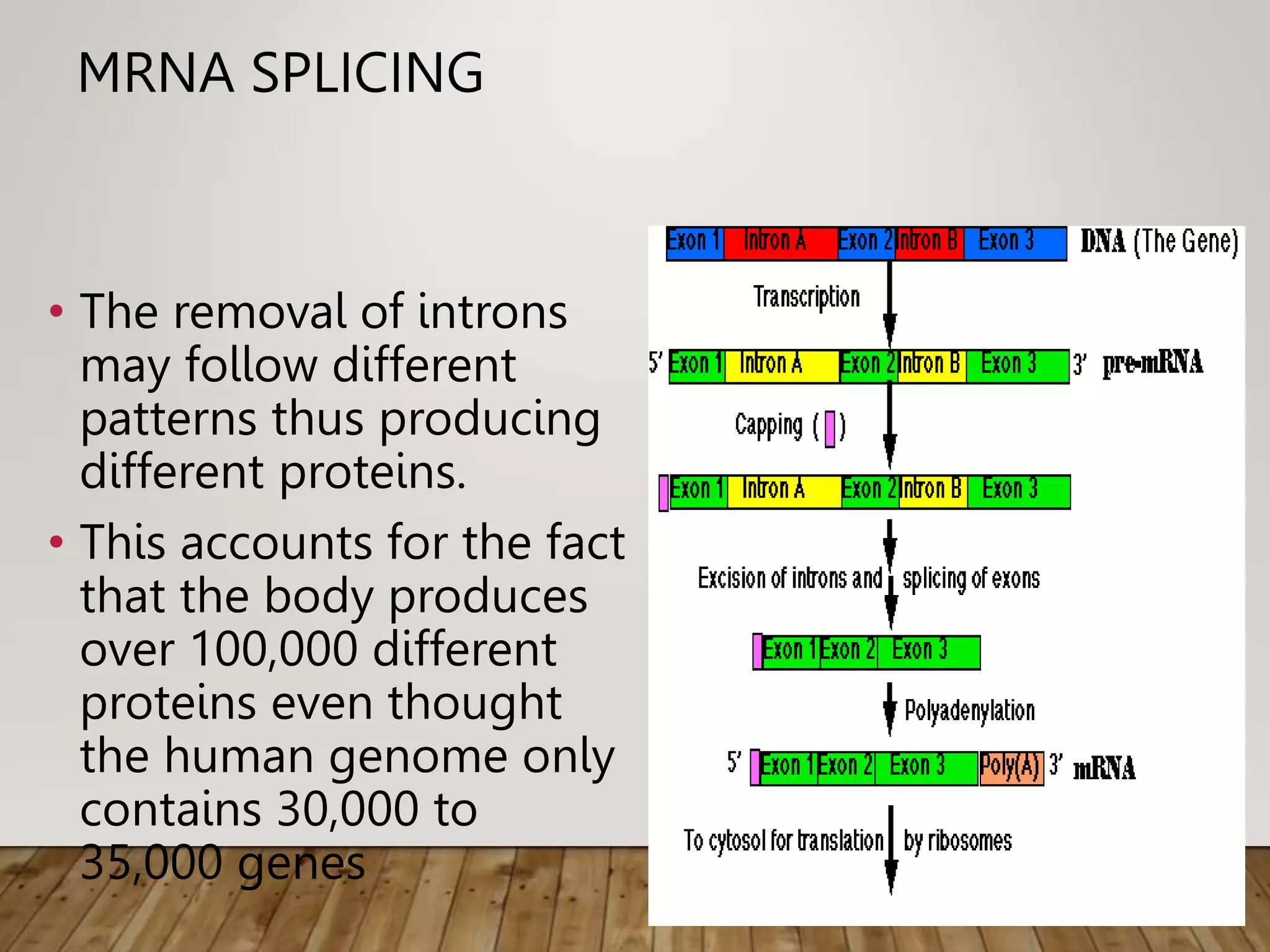
MRNA SPLICING
• The entire gene (introns and
exons) are transcribed by the
RNA polymerase.
• The initial pre-mRNA
contains introns that are
removed from the pre-mRNA
by spliceosomes while the
exons are spliced together.
• INtrons are cut OUT.
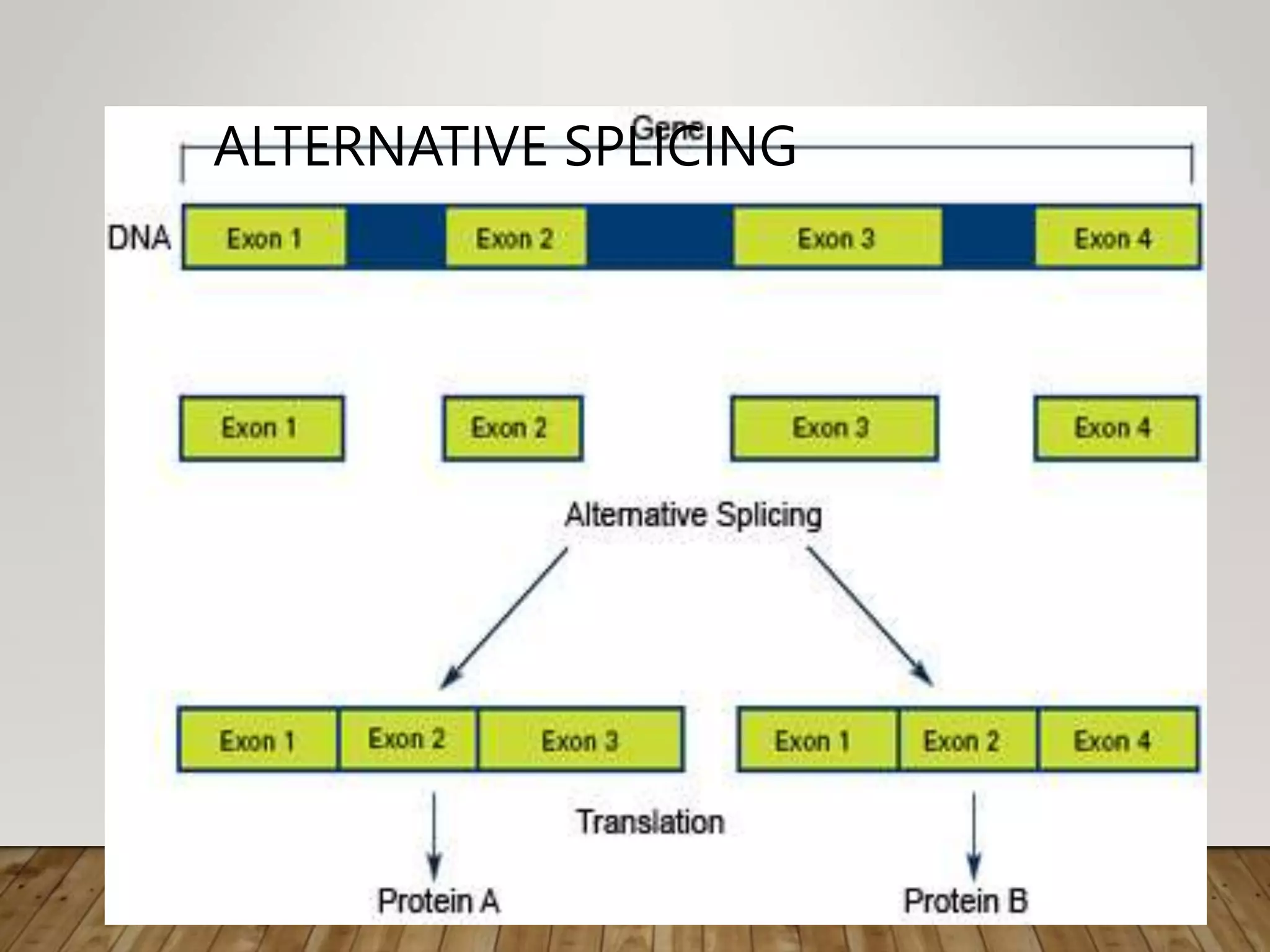
MRNA SPLICING
• The removal of introns
may follow different
patterns thus producing
different proteins.
• This accounts for the fact
that the body produces
over 100,000 different
proteins even thought
the human genome only
contains 30,000 to
35,000 genes
ALTERNATIVE SPLICING
TRANSLATION
• After transcription mRNA exits the
nucleus via nuclear pores and ribosomes
bind to mRNA
• Ribosomes synthesize different proteins
by reading the coding sequence on
mRNA
• The mRNA is read in triplets of
nucleotides each of which encodes an aa
• Consider the following mRNA sequence:
5’ AUGAAUGAGCUGAAC 3’
TRANSFER RNA
• The ribosome alone cannot synthesize the polypeptide
chain
• The correct amino acids must be delivered to the
polypeptide building site by tRNA
TRANSFER RNA
• tRNA look like three-
lobed “cloverleaf” due
to base pairing
between
complementary
nucleotides on
different regions of
each tRNA molecule
causing it to fold
TRANSFER RNA
• At the end of one lobe of
tRNA, a sequence of three
bases called the anticodon
recognizes and is
complementary to the codon
of the mRNA.
• The anticodon sequence is
written in the 3’ to 5’ direction.
• At the 3’ end of the strand is
an attachment site for the
corresponding aa specified by
the mRNA codon.
WOBBLE IN THE GENETIC CODE
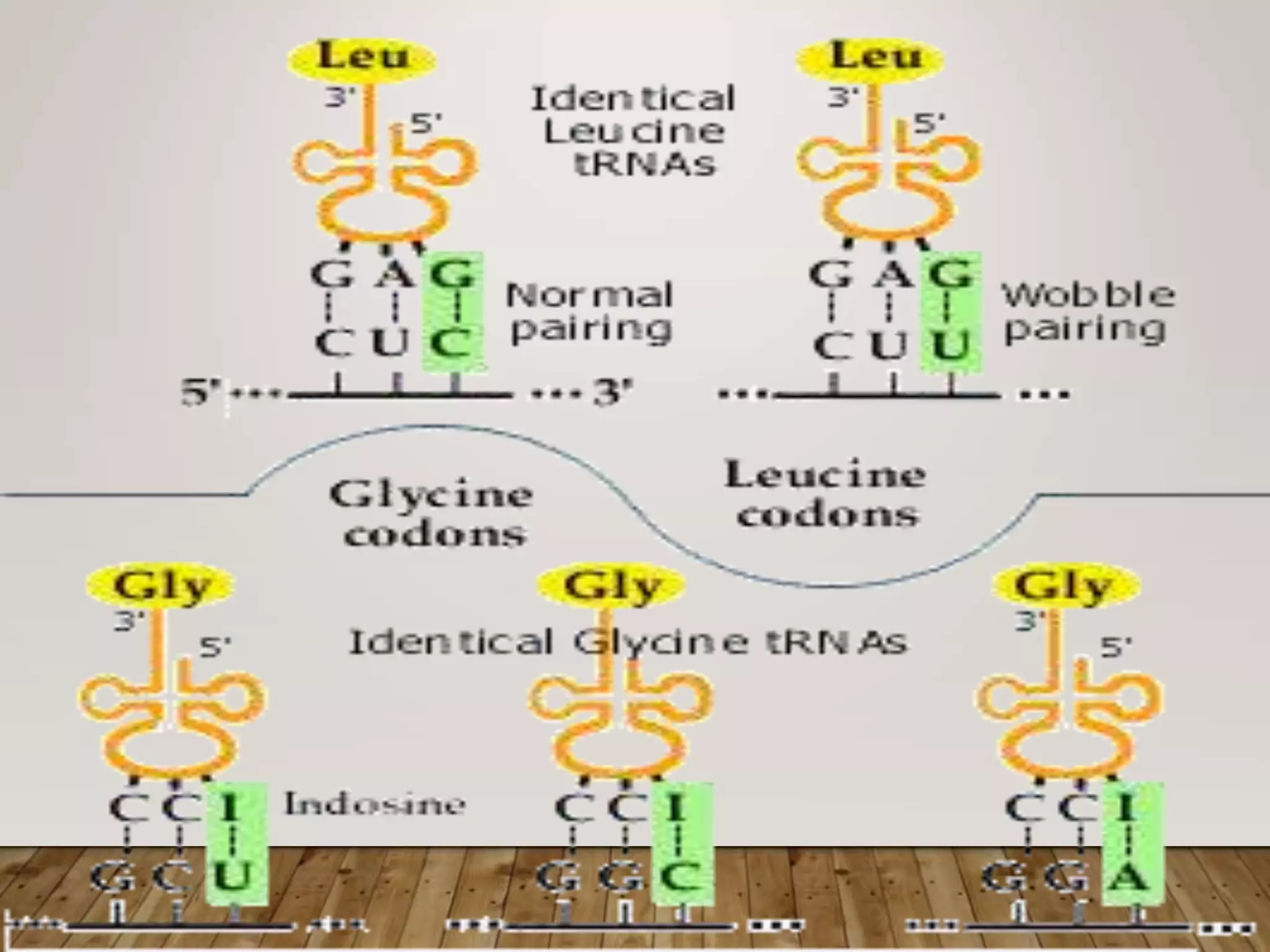
• Although there are 64 possible codon combinations, the cytoplasm
only holds about 35-45 different tRNAs. This leaves some anti-
codons pairing with more than one codon creating a more lenient
compliment in the third position.
• This is consistent with the redundancy of amino acid codons in the
“wobble position hypothesis”
AMINOACYL-TRNA SYNTHETASE
• Aa-tRNA (tRNA molecule
bound to its particular
amino acid) has 2 binding
sites; one is for a specific
amino acid, the other is
specific to a particular
anticodon
• When both are in the
enzyme’s active site the
enzyme catalyzes a
reaction that binds the
two.
RIBOSOMES
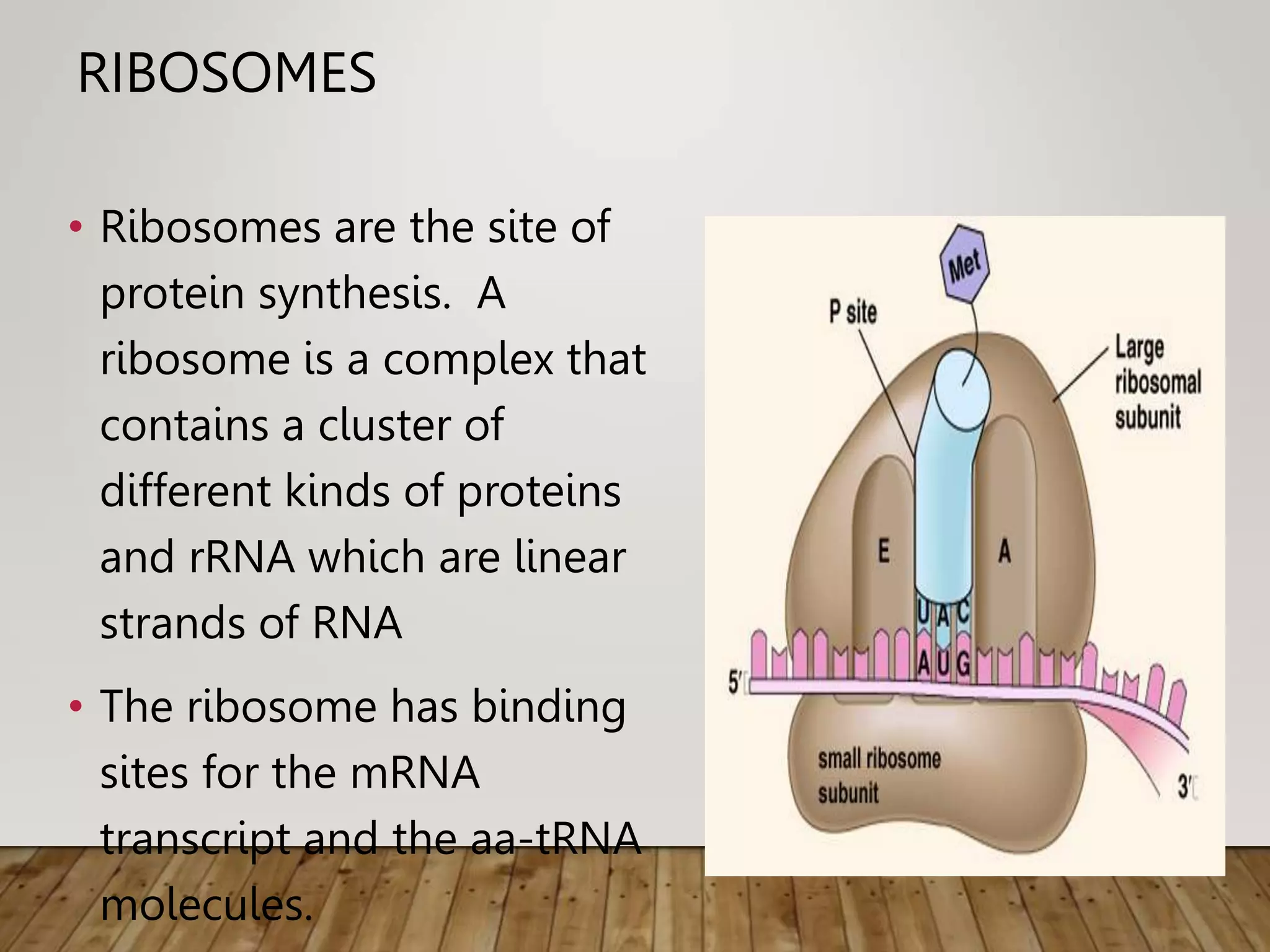
• Ribosomes are the site of
protein synthesis. A
ribosome is a complex that
contains a cluster of
different kinds of proteins
and rRNA which are linear
strands of RNA
• The ribosome has binding
sites for the mRNA
transcript and the aa-tRNA
molecules.
RIBOSOMES
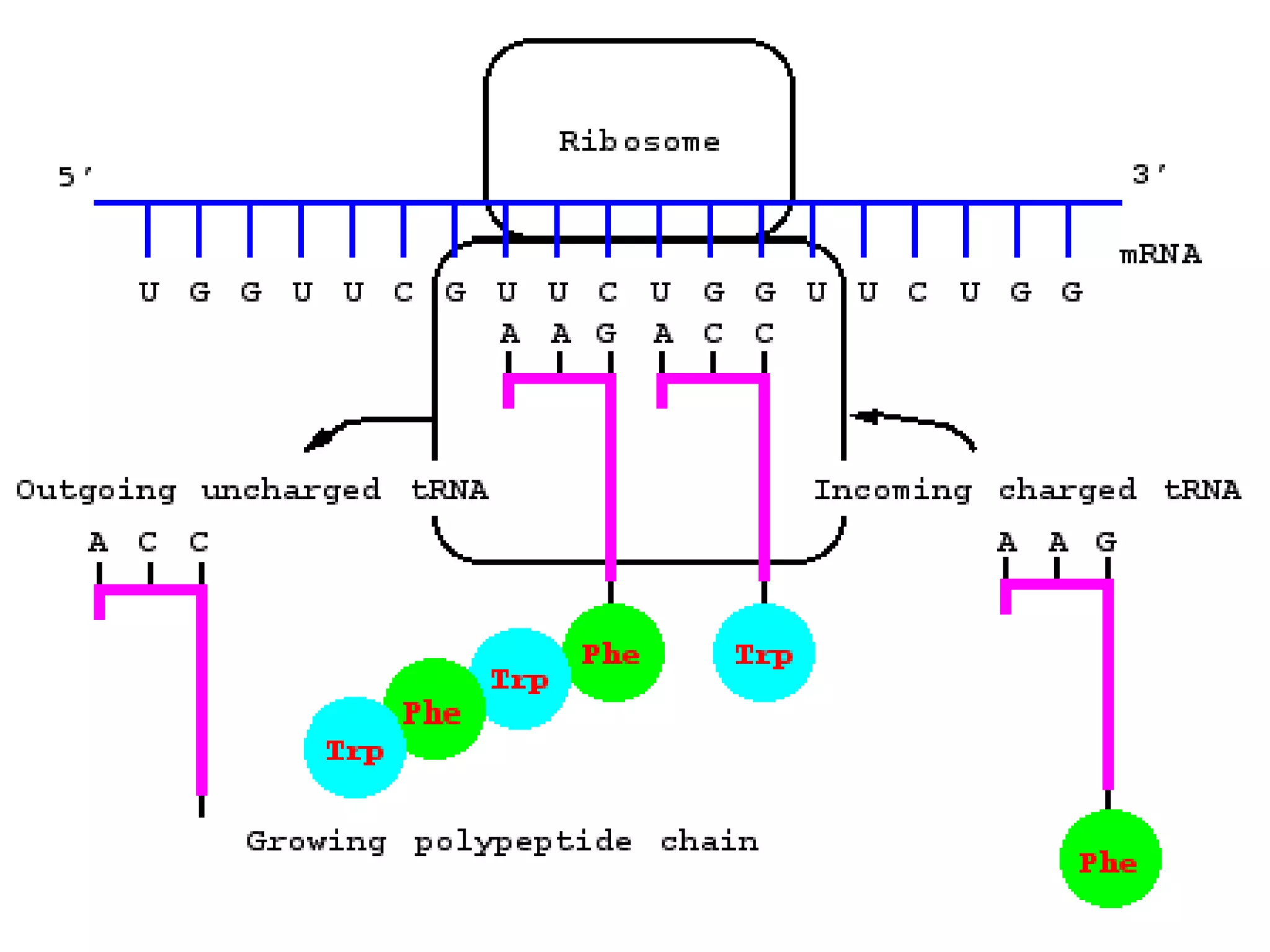
• Each active ribosome has 3 different binding sites for
tRNA molecules: the P (peptide) site, which holds one
aa-tRNA and the growing chain of amino acids; the A
(acceptor) site, which holds the tRNA bringing the
next amino acid to be added to the chain; and the E
(exit) site, which releases the tRNA molecules back
into the cytoplasm.
• The anticodon of an aa-tRNA
molecule binds to the mRNA
codon exposed in the A site.
• Enzymes catalyze the formation of
a bond between the last aa on the
lengthening polypeptide and the
new aa. The polypeptide chain is
transferred from the tRNA in the P
site to the tRNA in the A site.
• The ribosome moves down the
mRNA strand, shifting the binding
site a distance of 3 nucleotides (1
codon), this is called
translocation. A new A site is
exposed as the tRNA that was in
the P site is moved to the E site
and released.
TERMINATION OF PROTEIN
SYNTHESIS
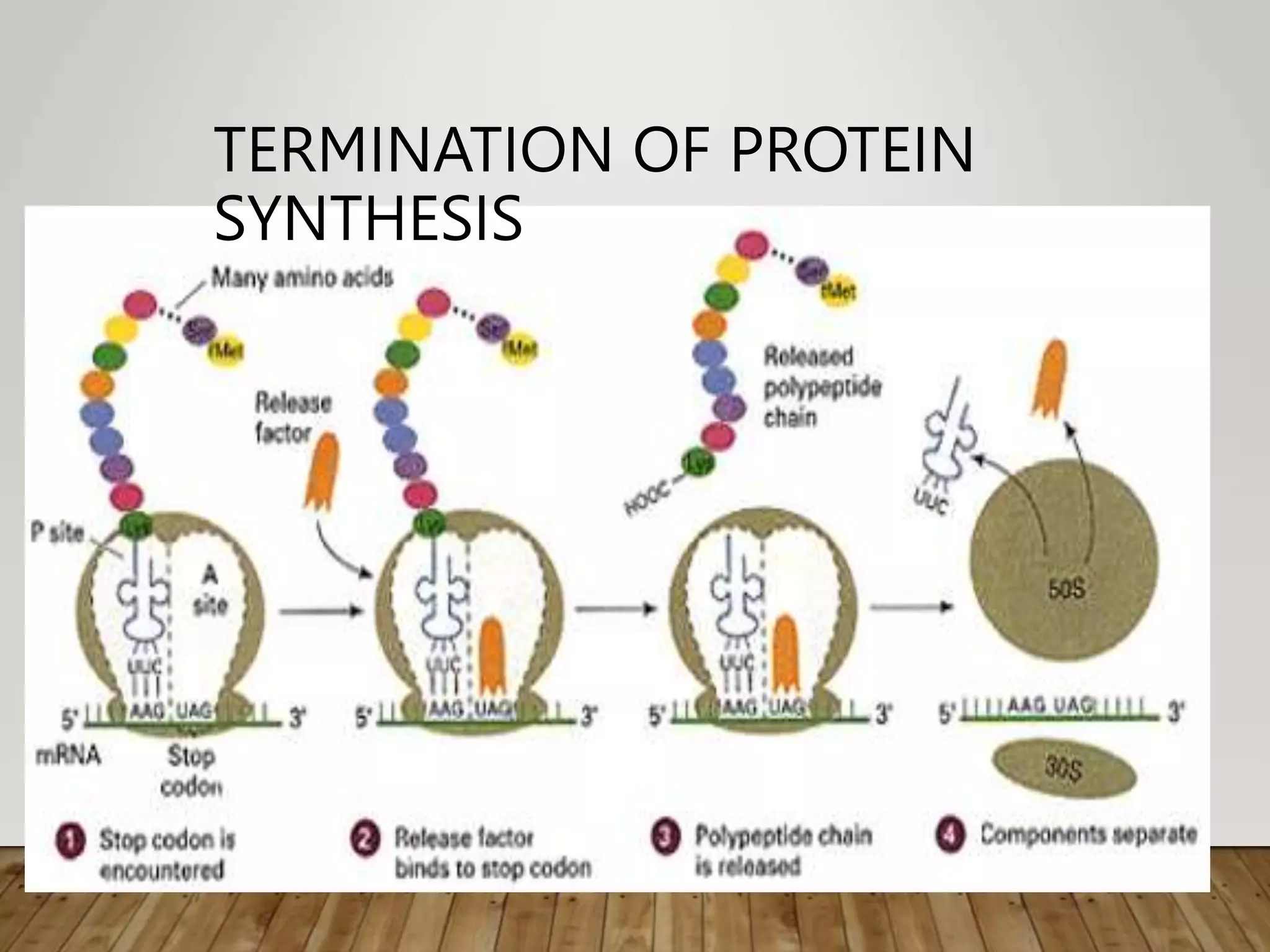
• Translocation of the ribosome exposes a stop codon in the A site.
Stop codons do not code for an aa, there are no corresponding
tRNAs.
• A protein called a release factor binds to the exposed A site causing
the polypeptide to separate from the remaining tRNA molecule
• Ribosome falls of the mRNA and translation stops
TERMINATION OF PROTEIN
SYNTHESIS
HYPERLINKS
• Beadle and Tatum
• Transcription in Prokaryotes vs Eukaryotes
• Spliceosomes
• translation narrated
• Translation McGraw Hill
• Transcription McGraw Hill
• Transcription 2
HOMEWORK
1. Why do all cells need to perform protein synthesis?
2. Why is it important that DNA never leave the nucleus?
3. Differentiate between the terms transcription and
translation. What is the end result of each of these
processes and where in the cell do they take place?
4. What amino acids are coded for by each of the following
codons?
i) UUC ii) ACU iii)GCG iv) UAA
5. Each codon codes for how many amino acids?
6. What codons could code for the amino acid proline (pro) ?
For the amino acid arginine (arg)?
7. What are the advantages of having 4 different codons for the
amino acid proline?
8. A portion of an mRNA molecule has the sequence
CCUAGGCUA. What is the sequence of the complementary
strand of DNA?
9. The following mRNA strand is being used to assemble a
polypeptide strand by a ribosome:
• 5’ -AUGCUUGCUCAUCGGGGUUUUAAA-3’
a) Write out the amino acids that will be assembled, in their
correct order.
b) Provide an alternative mRNA sequence with four or more
changes that would translate to the same amino acid sequence.

Proteins synthesis.ppt

  • 1.
  • 2.
    PROTEIN SYNTHESIS: AN OVERVIEW •Genetic information is contained within the nucleus of a cell • DNA in the nucleus directs protein synthesis but protein synthesis occurs in ribosomes located in the cytoplasm • How does a ribosome synthesize the protein required if it does not have access to DNA?
  • 3.
    THE CENTRAL DOGMAOF PROTEIN SYNTHESIS
  • 4.
    PROTEIN SYNTHESIS: AN OVERVIEW •The answer lies in an intermediate substance known as mRNA. • Information is copied from DNA into mRNA, this is transcription • mRNA leaves the nucleus and enters the cytoplasm of the cell • Ribosomes use the mRNA as a blueprint to synthesize proteins composed of aa, this is translation.
  • 6.
    DNA 3 main components: •Deoxyribose sugar • Phosphate group • Nitrogenous bases-adenine, guanine, cytosine and thymine • A forms 2 hydrogen bonds to T, G forms 3 hydrogen bonds to C
  • 9.
    DNA VS RNA •Deoxyribose sugar • Double stranded • A pairs with T • G pairs with C • Resides in nucleus • Ribose sugar • Single stranded • A pairs with U • G pairs with C • Resides in nucleus and cytoplasm
  • 10.
    RNA • There arethree types of RNA: • mRNA is the “blueprint” for construction of a protein • rRNA is the “construction site” where the proteins are made • tRNA is the “truck” delivering the proper aa to the site of protein synthesis
  • 11.
    GENES AND PROTEINS •Genes are a sequence of nucleotides in DNA that code for a particular protein • Proteins drive cellular processes, determine physical characteristics, and manifest genetic disorders by their absence or presence
  • 12.
    GENETIC CODE • Proteinsare composed of 20 different amino acids • A sequence of 3 nucleotides is used to code each amino acid • Each triplet of nucleotides is called a codon • Start codon AUG codes for amino acid methionine • 3 stop codons • There are 64 codons in the genetic code 43=64 • Several different codons can code for the same aa, but no codon ever has more than one amino acid counterpart. • Codons are always written in the form of the RNA transcript from the original DNA molecule.
  • 14.
    CHARACTERISTICS OF THECODE • Continuity The genetic code reads as a long series of three-letter codons that have no spaces or punctuation and never overlap. • Redundancy – Several different codons can code for the same amino acid, but no codon ever has more than one amino acid counterpart. • Universality – the genetic code is the same in almost all living organisms, from bacteria to mammals
  • 15.
    TRANSCRIPTION: INITIATION • RNApolymerase binds to a segment of DNA and opens up the double helix • RNA polymerase recognizes the promoter region which is a sequence of DNA rich in A and T bases (TATA box) found only on one strand of the DNA.
  • 16.
    TRANSCRIPTION: INITIATION • AnRNA polymerase cannot recognize the TATA box and other landmarks of the promoter region on its own. Another protein, a transcription factor that recognizes the TATA box, binds to the DNA before the RNA polymerase can do so.
  • 17.
    TRANSCRIPTION: INITIATION • Fortranscription to be initiated, both promoter sequences must be present in their correct locations. The nucleotide sequences in the promoters are slightly different from one another, which means the RNA polymerase will bind in only 1 orientation, thus RNA polymerase can only face 1 way during transcription. This ensures transcription will proceed in only 1 direction.
  • 18.
  • 20.
    TRANSCRIPTION : ELONGATION •The RNA polymerase uses only one of the strands of DNA as a template for mRNA synthesis. This is called the template strand or sense strand. The coding strand or anti-sense strand contains the complementary nucleotide sequence to the sense strand. • RNA polymerases can add nucleotides only to the 3’ end of a DNA sequence. Thus, an RNA molecule elongates in the 5’ to 3’ direction. • Consider the following DNA sequence 3’ TACTTACTCGTCTTG 5’
  • 21.
    THE CODING STRAND •RNA polymerase uses the template strand to transcribe. Thus the RNA is complimentary to the template. The coding strand is exactly identical to the mRNA, but mRNA has uracil in place of thymine.
  • 22.
    TRANSCRIPTION: TERMINATION • Asthe RNA polymerase molecule passes, the DNA helix re-forms. Synthesis continues until the end of a gene is reached where RNA polymerase recognizes a terminator sequence.
  • 23.
    TRANSCRIPTION • Once theRNA polymerase leaves the promoter region, a new RNA polymerase can bind there to begin a new mRNA transcript. • Since prokaryotes lack a membrane bound nucleus translation can begin even before the mRNA dissociates. However the pre-mRNA from eukaryotic cells needs some modification before it leave the nucleus.
  • 24.
    PROCESSING OF MRNA TRANSCRIPT •In eukaryotes, the mRNA that is released at the end of transcription is called pre-mRNA. Pre-mRNA undergoes several changes before it is exported out of the nucleus to protect it from the cytoplasmic environment. • The 5’ end of the pre-mRNA is capped with a modified form of the G nucleotide. At the 3’ end, an enzyme in the nucleus adds the poly A tail, a long series of A nucleotides.
  • 25.
  • 26.
    MRNA SPLICING • Theentire gene (introns and exons) are transcribed by the RNA polymerase. • The initial pre-mRNA contains introns that are removed from the pre-mRNA by spliceosomes while the exons are spliced together. • INtrons are cut OUT.
  • 27.
    MRNA SPLICING • Theremoval of introns may follow different patterns thus producing different proteins. • This accounts for the fact that the body produces over 100,000 different proteins even thought the human genome only contains 30,000 to 35,000 genes
  • 28.
  • 29.
  • 30.
    TRANSLATION • After transcriptionmRNA exits the nucleus via nuclear pores and ribosomes bind to mRNA • Ribosomes synthesize different proteins by reading the coding sequence on mRNA • The mRNA is read in triplets of nucleotides each of which encodes an aa • Consider the following mRNA sequence: 5’ AUGAAUGAGCUGAAC 3’
  • 32.
    TRANSFER RNA • Theribosome alone cannot synthesize the polypeptide chain • The correct amino acids must be delivered to the polypeptide building site by tRNA
  • 33.
    TRANSFER RNA • tRNAlook like three- lobed “cloverleaf” due to base pairing between complementary nucleotides on different regions of each tRNA molecule causing it to fold
  • 34.
    TRANSFER RNA • Atthe end of one lobe of tRNA, a sequence of three bases called the anticodon recognizes and is complementary to the codon of the mRNA. • The anticodon sequence is written in the 3’ to 5’ direction. • At the 3’ end of the strand is an attachment site for the corresponding aa specified by the mRNA codon.
  • 35.
    WOBBLE IN THEGENETIC CODE • Although there are 64 possible codon combinations, the cytoplasm only holds about 35-45 different tRNAs. This leaves some anti- codons pairing with more than one codon creating a more lenient compliment in the third position. • This is consistent with the redundancy of amino acid codons in the “wobble position hypothesis”
  • 37.
    AMINOACYL-TRNA SYNTHETASE • Aa-tRNA(tRNA molecule bound to its particular amino acid) has 2 binding sites; one is for a specific amino acid, the other is specific to a particular anticodon • When both are in the enzyme’s active site the enzyme catalyzes a reaction that binds the two.
  • 38.
    RIBOSOMES • Ribosomes arethe site of protein synthesis. A ribosome is a complex that contains a cluster of different kinds of proteins and rRNA which are linear strands of RNA • The ribosome has binding sites for the mRNA transcript and the aa-tRNA molecules.
  • 39.
    RIBOSOMES • Each activeribosome has 3 different binding sites for tRNA molecules: the P (peptide) site, which holds one aa-tRNA and the growing chain of amino acids; the A (acceptor) site, which holds the tRNA bringing the next amino acid to be added to the chain; and the E (exit) site, which releases the tRNA molecules back into the cytoplasm.
  • 40.
    • The anticodonof an aa-tRNA molecule binds to the mRNA codon exposed in the A site. • Enzymes catalyze the formation of a bond between the last aa on the lengthening polypeptide and the new aa. The polypeptide chain is transferred from the tRNA in the P site to the tRNA in the A site. • The ribosome moves down the mRNA strand, shifting the binding site a distance of 3 nucleotides (1 codon), this is called translocation. A new A site is exposed as the tRNA that was in the P site is moved to the E site and released.
  • 43.
    TERMINATION OF PROTEIN SYNTHESIS •Translocation of the ribosome exposes a stop codon in the A site. Stop codons do not code for an aa, there are no corresponding tRNAs. • A protein called a release factor binds to the exposed A site causing the polypeptide to separate from the remaining tRNA molecule • Ribosome falls of the mRNA and translation stops
  • 44.
  • 45.
    HYPERLINKS • Beadle andTatum • Transcription in Prokaryotes vs Eukaryotes • Spliceosomes • translation narrated • Translation McGraw Hill • Transcription McGraw Hill • Transcription 2
  • 46.
    HOMEWORK 1. Why doall cells need to perform protein synthesis? 2. Why is it important that DNA never leave the nucleus? 3. Differentiate between the terms transcription and translation. What is the end result of each of these processes and where in the cell do they take place? 4. What amino acids are coded for by each of the following codons? i) UUC ii) ACU iii)GCG iv) UAA 5. Each codon codes for how many amino acids? 6. What codons could code for the amino acid proline (pro) ? For the amino acid arginine (arg)?
  • 47.
    7. What arethe advantages of having 4 different codons for the amino acid proline? 8. A portion of an mRNA molecule has the sequence CCUAGGCUA. What is the sequence of the complementary strand of DNA? 9. The following mRNA strand is being used to assemble a polypeptide strand by a ribosome: • 5’ -AUGCUUGCUCAUCGGGGUUUUAAA-3’ a) Write out the amino acids that will be assembled, in their correct order. b) Provide an alternative mRNA sequence with four or more changes that would translate to the same amino acid sequence.